Deck stairs are where I see the most near-misses at my own house — a guest carrying a plate in each hand, a kid racing up in the dark, me hauling a cooler down at midnight. After one too many stubbed toes, I went looking for the best deck step lights and learned the same lesson I learn with every outdoor lighting project: there is no single winner, only the right type for your stairs and your wiring situation. So this list is organized by type, not by brand. I will tell you honestly what each kind does well, where it falls short, and who should buy it. Think in layers, the way I always do: a gentle guiding glow on every tread first, then brighter help exactly where feet land. Whether you are building a new deck, retrofitting an old one, or just trying to stop the midnight stumble, one of these nine types fits. Let me walk you through them.
1. Recessed Riser Lights: The Best Deck Step Lights for a Built-In Look
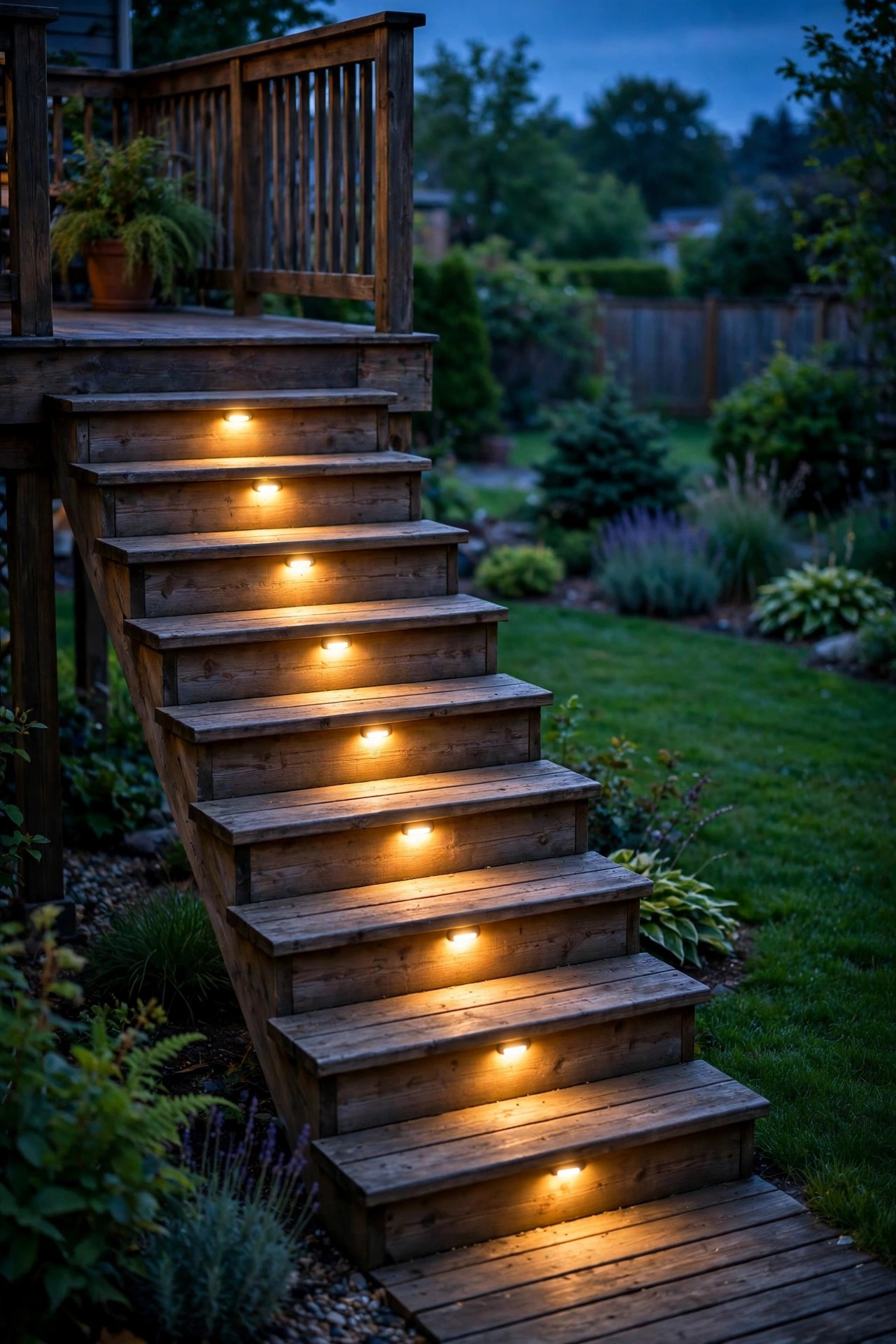
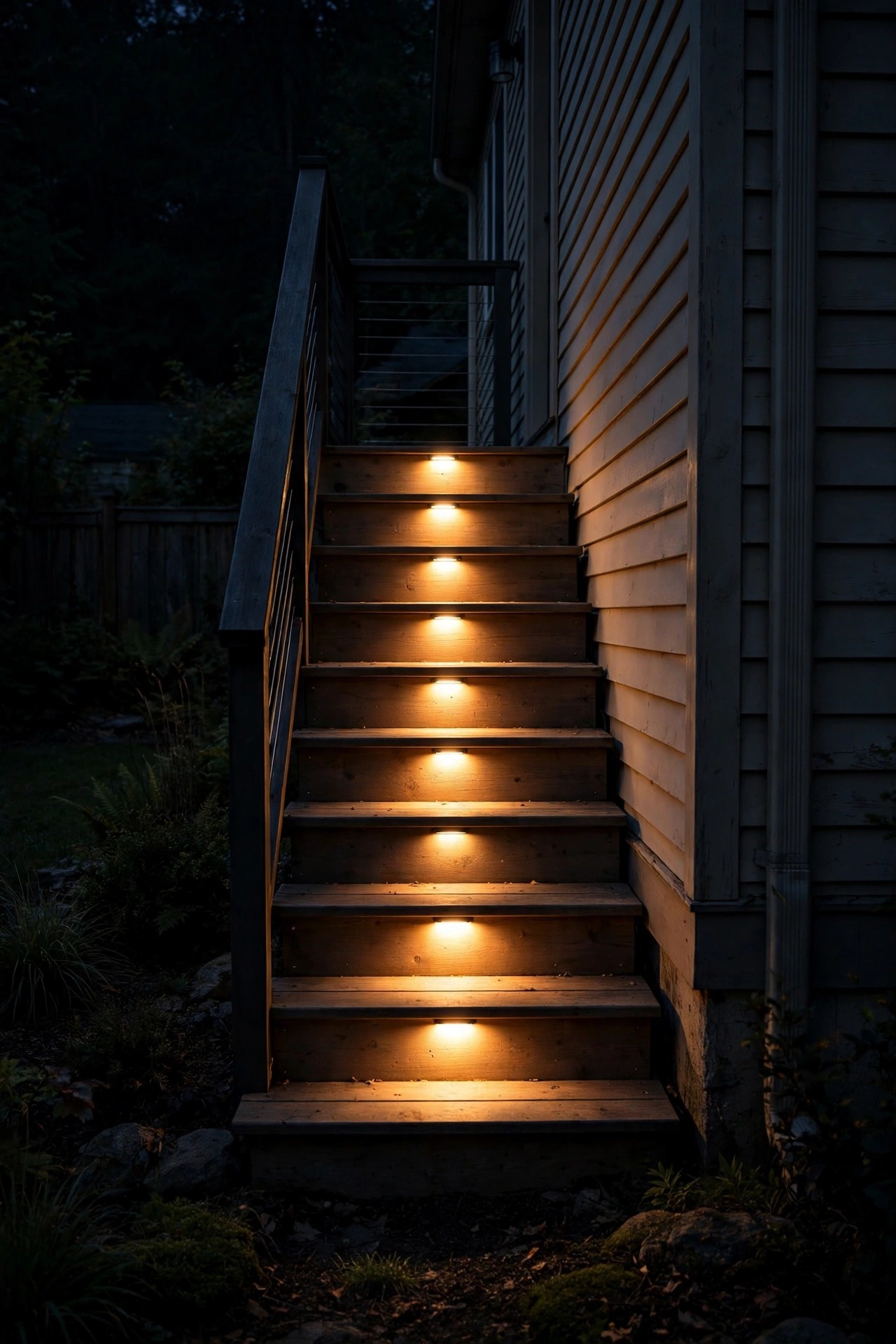
If your deck is still on paper or mid-build, recessed riser lights are the ones I would plan around. Each fixture sits inside a hole drilled into the vertical riser board — usually a 1-inch hole saw cut — so the face sits perfectly flush and throws a soft wash down across the tread below. Nothing sticks out to catch a heel, a broom, or a snow shovel, and the finished look is clean enough for the fanciest composite deck. I put one centered on each step for stairs up to about 4 feet wide, and two per step on wider flights. Most run on low-voltage cable you can staple along the stringer before the riser boards even go on. The honest limits: this is the hardest type to retrofit, because you are drilling into finished risers and fishing wire behind them, and if a sealed unit fails years later you need a replacement that matches the original hole size. Buy one or two spares while your model is still sold. My recessed step light ideas post shows more placements if you want to see the range before committing.
Suggested budget range: $15 – $35.
2. Surface-Mount Step Lights for Easy Retrofits
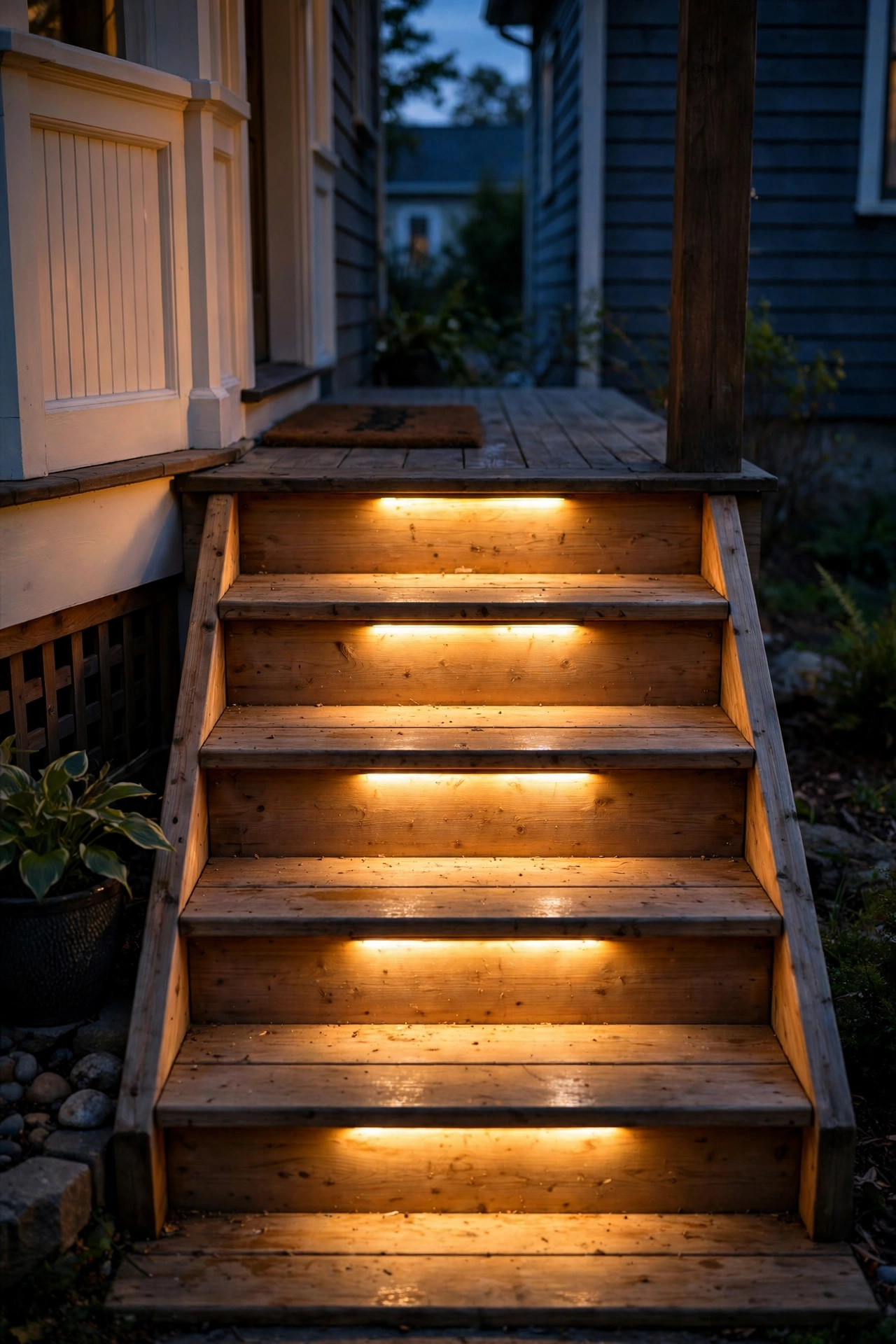
Surface-mount lights are the friendly opposite of recessed: the whole fixture screws onto the face of the riser, or tucks under the tread nosing, with two screws and no hole saw. That makes them my default recommendation for an existing deck you are not planning to rebuild. Most installs take an afternoon, and low-voltage versions wire up with simple capped connections you can run along the stringer. The downward-facing designs that hide the LED behind a small hood are the ones to look for — they wash the tread instead of shining in your eyes as you climb. The trade-offs are real but manageable. A surface fixture protrudes a quarter inch or so, which matters on narrow stairs where heels pass close, and the visible housing has to suit your deck style; cheap shiny finishes look out of place on weathered wood. Mount them under the nosing where your deck design allows it and both complaints mostly disappear. If your stairs are already built and your patience for drilling is low, honestly, start here.
Suggested budget range: $10 – $25.

3. Solar Step Lights for Sunny Stairs
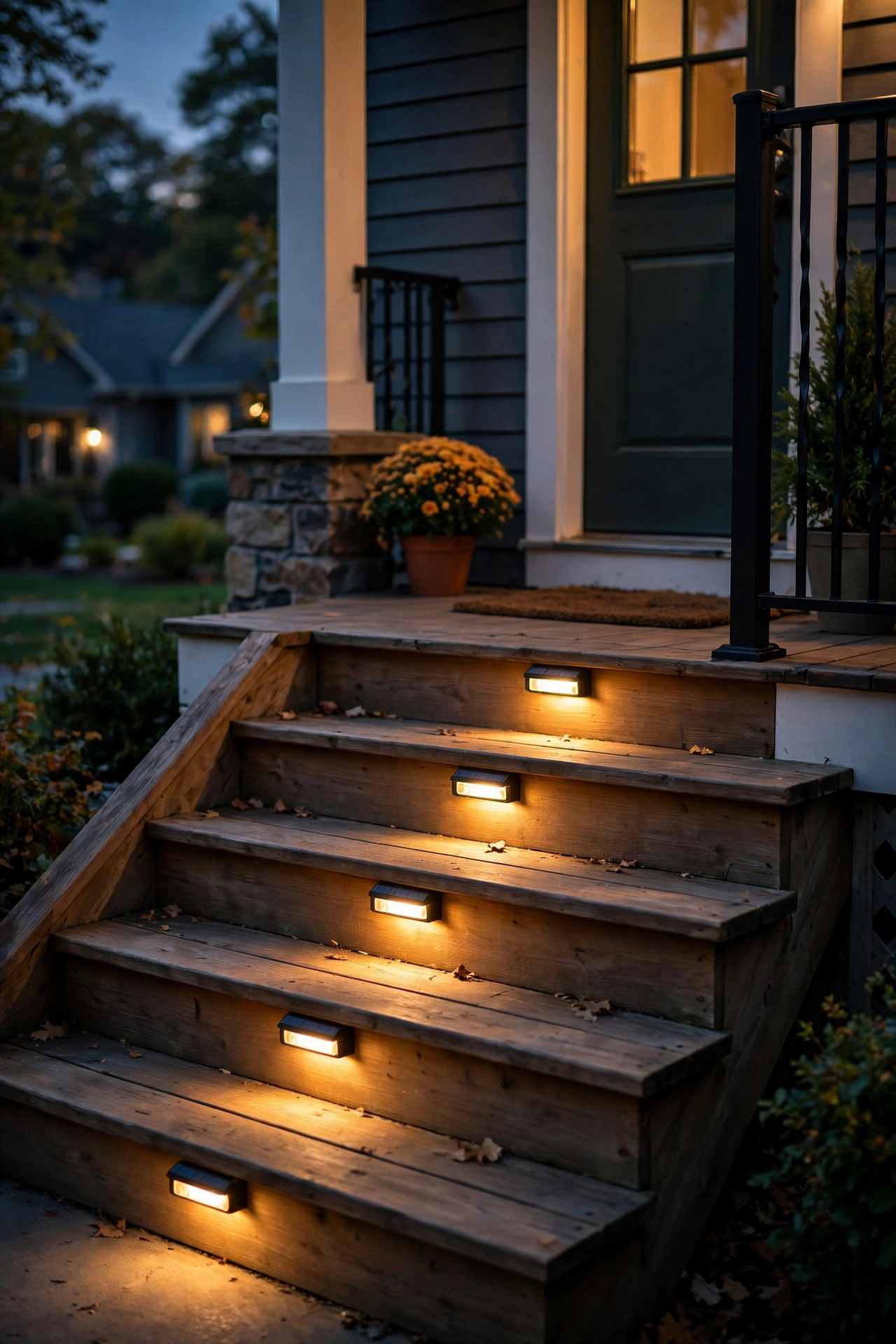
Solar step lights ask nothing of your wiring: a small panel charges all day, a photocell switches the LED on at dusk, and most screw or stick onto the riser in minutes. For a short, sunny flight — south or west facing, no tree canopy overhead — they are genuinely good, and the per-light price makes a whole staircase painless. I use them on my garden steps and they have earned their keep. Now the honest limits, because solar marketing will not tell you: brightness is modest compared with wired lights, winter runtime shrinks to a few hours on short cloudy days, and the built-in batteries typically fade after a year or two, at which point many sealed models become throwaways. Shade is the deal-breaker — a staircase under a big maple will never charge them properly, whatever the box promises. Look for models with replaceable batteries and the largest panel that still looks tidy. If your stairs get at least five or six hours of direct sun, solar is the easiest win on this list; if they do not, skip to the wired picks below.
Suggested budget range: $20 – $45.
4. Low-Voltage Wired Step Lights for Set-and-Forget Reliability
When people ask what I would install on my own main staircase, this is it. A low-voltage system runs every step light off one 12-volt transformer plugged into an outdoor outlet, so every tread gets the same steady brightness from dusk to whenever the timer says stop — no fading batteries, no cloudy-day disappointments. The cable runs under the deck or along the stringer, connections are simple pierce or cap fittings, and 12 volts is forgiving, beginner-safe power. A photocell or timer on the transformer handles the schedule for the whole flight at once. This is the type I recommend for shaded stairs where solar starves, for long flights of eight steps or more, and for anyone who wants to install once and think about it never again. The limits are front-loaded: you will spend a weekend planning cable runs and drilling, and the transformer adds upfront cost the solar aisle does not have. After that weekend, though, running costs are pennies a month. For a primary staircase used every single night, wired low-voltage is the grown-up answer.
Suggested budget range: $60 – $150.

5. Motion-Activated Step Lights That Wake Up When You Do
Motion-activated step lights stay dark or dim until the sensor sees you coming, then brighten the stairs for thirty seconds to a few minutes. I love them on the stairs you use occasionally — the side door to the trash bins, the basement bulkhead, the guest-room deck — where lighting empty steps all night feels wasteful. Because they only run on demand, battery and solar versions last far longer between charges, and wired versions can tie into a transformer you already own. Placement is the whole game here. The sensor needs a clear view of your approach, ideally triggering from the bottom and the top of the flight, and a sensor aimed across a busy patio will fire every time someone walks past with a drink. Expect a little trial and error with angles, and expect the occasional false alarm from a neighborhood cat. Choose models with adjustable sensitivity and timeout if you can. For households that come home after dark to a side entrance, honestly, the lights-come-to-you feeling never gets old.
Suggested budget range: $12 – $30.
6. LED Strip and Rope Lights Under the Tread Nosing
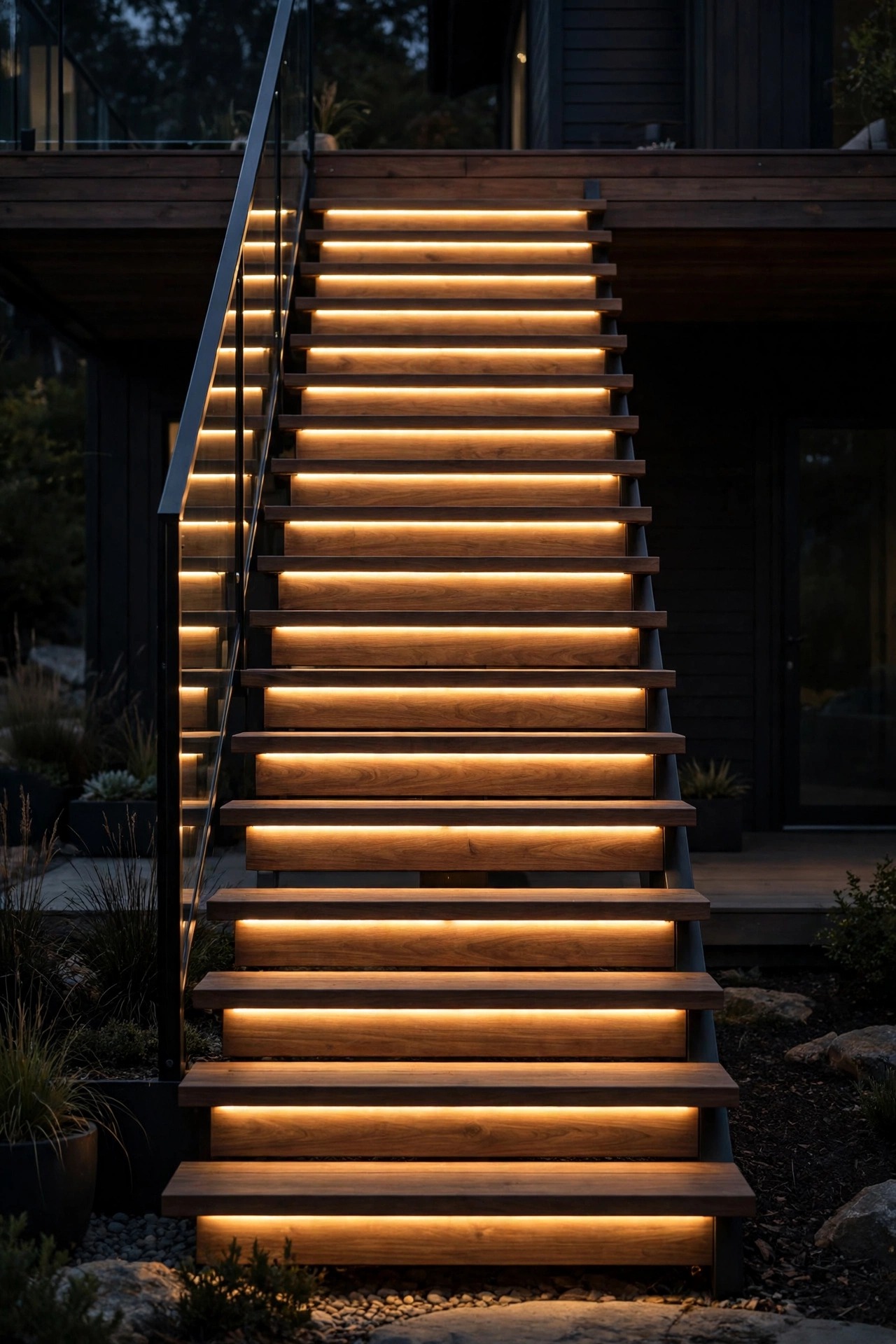
For a modern, floating look, nothing beats a continuous line of light tucked under the overhang of each tread. LED strip or rope light washes the step below in an even glow with no hotspots and no visible fixtures at all — just the light itself. It is the option guests ask about most at my house. Use outdoor-rated strip, IP65 or better, and mount it in an aluminum channel with a diffuser if you can; the channel protects the strip, hides the individual diodes, and holds far better than adhesive, which reliably gives up outdoors after one hot summer. Cut the strip to length at its marked points, run one power feed per flight, and keep the driver or power supply somewhere dry and reachable under the deck. Limits: this is a design project, not a ten-minute fix, and on open-riser stairs there is no nosing shadow to hide the strip from below, so the glow reads differently. Best suited to contemporary decks and covered stairs where the strip stays out of direct weather.
Suggested budget range: $25 – $60.
7. Post-Cap Lights for Landings and First Steps
Post-cap lights perch on top of your railing posts — solar caps pop on in seconds, low-voltage caps wire into the same transformer as the rest of the deck — and they spill a soft pool of light over whatever is below them. Placed on the newel posts at the top and bottom of a flight, they mark the entrance to the stairs, light the landing where people pause and turn, and wash the first tread or two. They are also just plain pretty, giving the whole deck a finished, lantern-lit outline. Here is the honest part, though: spillover is ambiance, not a full safety solution. A cap four feet above the third tread does not light the seventh, and I would never rely on caps alone for a full flight. Think of them as the top layer in a layered plan — caps for the landing and the welcome, riser or surface lights for the treads themselves. My roundup of deck post cap lights covers the styles in more depth if this layer appeals to you.
Suggested budget range: $15 – $40.

8. Louvered Step Lights That Keep Glare Out of Your Eyes
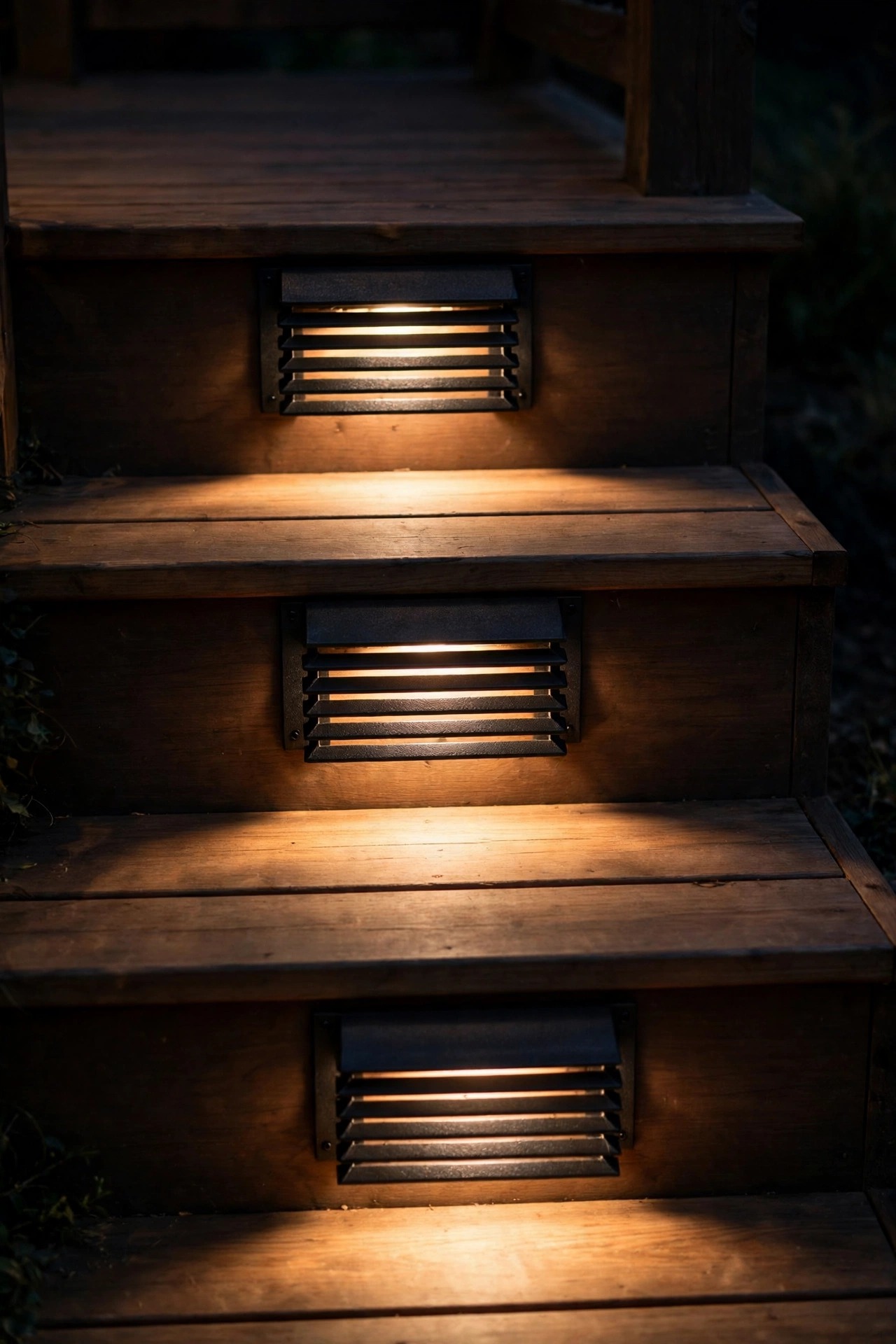
Here is something nobody warns you about: on a staircase, you spend half your time looking down at the lights, so a bare bright LED that feels fine on a wall becomes a squinting nuisance at your feet. Louvered step lights solve it with slatted or eyelid-style shields that aim every lumen downward onto the tread and block the direct view of the diode. The result is all guidance, no glare — and that matters extra for older eyes, which recover slowly from a bright flash at night. This is also the right place to talk color temperature, because shielded fixtures show it honestly. Warm 2700K light feels cozy and matches most deck lighting, but it slightly flattens the contrast between tread edge and shadow. A neutral 3000K to 4000K reads truer, and on safety-first stairs I lean neutral for exactly that reason. Avoid cold 5000K and up; it looks like a parking garage and glares worst of all. If anyone in the house wears bifocals or navigates by feel as much as sight, louvered and neutral is the combination I recommend.
Suggested budget range: $18 – $38.
9. Battery-Powered Lights: The Best Deck Step Lights for a Wire-Free Retrofit
Sometimes the right answer is the one that takes four minutes. Battery-powered step lights stick on with outdoor adhesive pads or two small screws, run for months on a set of AAs, and many add a motion sensor so they only fire when the stairs are actually used. They are the pick I hand to renters, to anyone with one dark problem step by the back door, and to homeowners who want to test a placement for a season before committing to drilled, wired fixtures. Living with the glow first is genuinely useful research. The limits are the obvious ones: output is the gentlest on this list, batteries are an ongoing cost and chore, and deep cold shortens battery life just when the nights get longest. Adhesive also lets go on rough or dirty wood, so use the screw holes if your model has them. None of that makes them a bad buy — it makes them a starter buy. Solve the midnight stumble tonight, upgrade the favorites to wired when you are ready.
Suggested budget range: $15 – $35.

Frequently Asked Questions
How many step lights do I need for one flight of stairs?
Plan on one light per tread for a seamless look, or one every other tread if the fixtures are reasonably bright and your stairs are short. On stairs wider than about 5 feet, two lights per tread — one toward each side — keeps the middle from going shadowy. Whatever spacing you choose, keep it perfectly even; an irregular rhythm looks like a mistake and reads worse to your feet than slightly dimmer even light.
Are solar step lights bright enough to keep stairs safe?
On stairs that get five or six hours of direct sun, yes — modern solar step lights give plenty of guiding light for residential stairs. The caveats are shade, winter, and age: a tree-covered or north-facing flight will undercharge them, December runtime can shrink to a few hours, and batteries fade after a year or two. For a main staircase you depend on nightly, wired low-voltage is the safer long-term answer.
What color temperature shows stair treads most clearly?
Around 3000K is the sweet spot for most people — warm enough to feel at home on a deck, neutral enough that tread edges and shadows stay distinct. Pure warm 2700K is prettier but slightly flattens contrast, while 4000K and above reads harsh and increases glare. If eyesight in the household is changing with age, I lean toward 3000K to 4000K shielded fixtures aimed straight down.
Can I add step lights to an existing deck without an electrician?
Usually, yes. Solar and battery models need no wiring at all, and low-voltage systems run on a plug-in transformer, so there is no panel work — just keep the transformer on a GFCI-protected outdoor outlet and use cable and fixtures rated for outdoor use. Recessed lights on an existing deck are the one fiddly case, since you will be drilling risers and fishing cable behind them.
Conclusion
Every staircase on this list got safer the same way: the right type matched to the sun, the wiring, and the way the stairs are actually used. Recessed and low-voltage lights are the build-it-once answers, solar and battery models solve sunny or single-step problems in minutes, and motion, strip, post-cap, and louvered designs each fix one specific annoyance beautifully. If I had to sum it up, the best deck step lights are simply the ones still glowing evenly on tread after tread long after the novelty wears off. Pick your type, keep the spacing even, and then come browse my favorite deck stair light ideas for more ways to layer the rest of the deck around your newly safe stairs.