If your porch is open to the sky, you have probably stood out there at dusk thinking, "Well, there goes my dream of a cozy porch." No ceiling means no ceiling fixture, no pendant, no fan light — and for a long time I assumed that meant porch lighting without a ceiling was basically a porch light by the door and nothing more. Honestly? I was so wrong. An open porch just asks you to light it the way you would light a garden: in layers. A wall layer by the door, a soft middle layer of lanterns and string lights, and a low layer along steps and walkways. That layered approach is exactly what I walk through in my guide to front porch lighting ideas, and it works even better when there is no ceiling boxing the light in, because the glow spills softly into the yard instead. Below are the 17 ideas I reach for again and again on open porches — most are renter-friendly, none need an electrician's ceiling box, and together they will make your porch the prettiest stop on the street after dark.
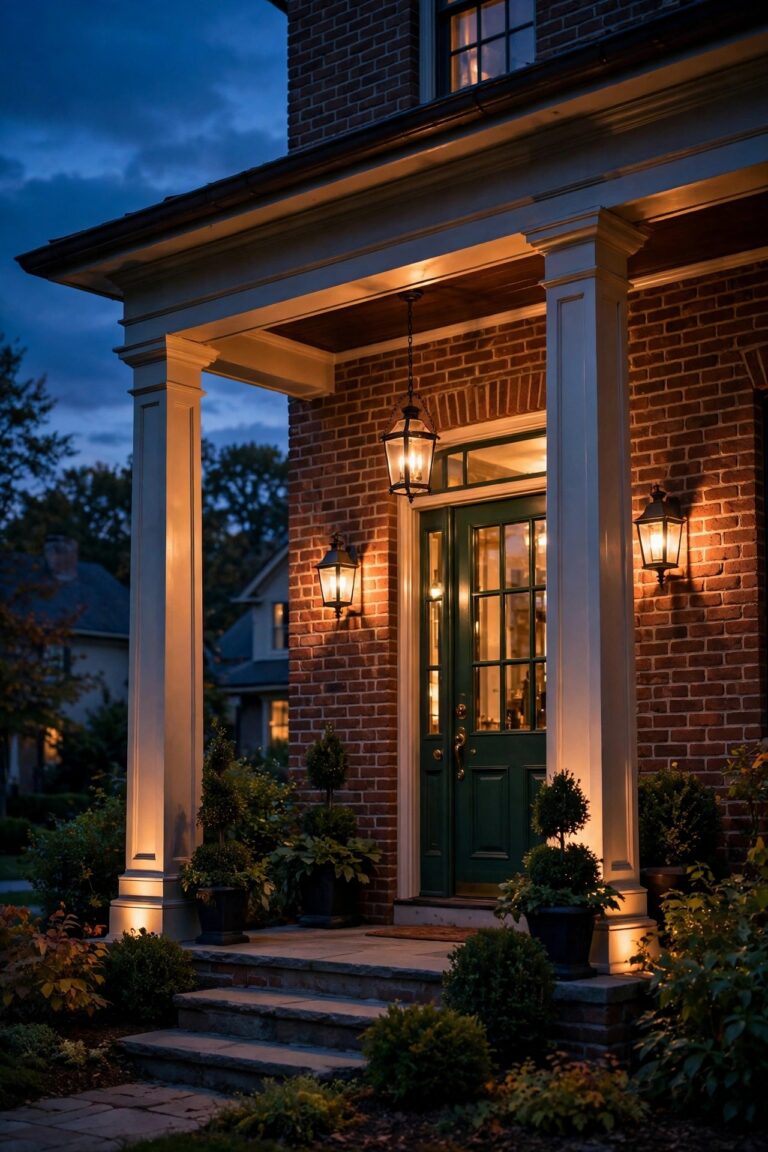
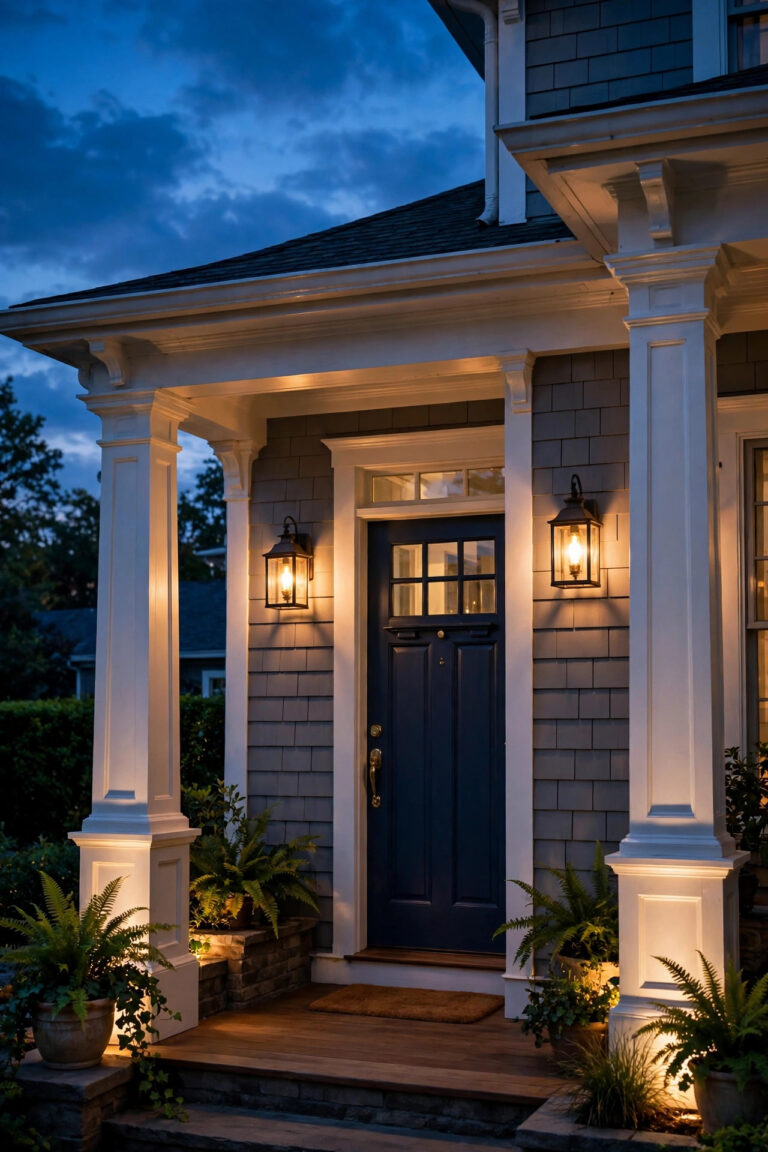
1. Flanking Wall Sconces Beside the Front Door
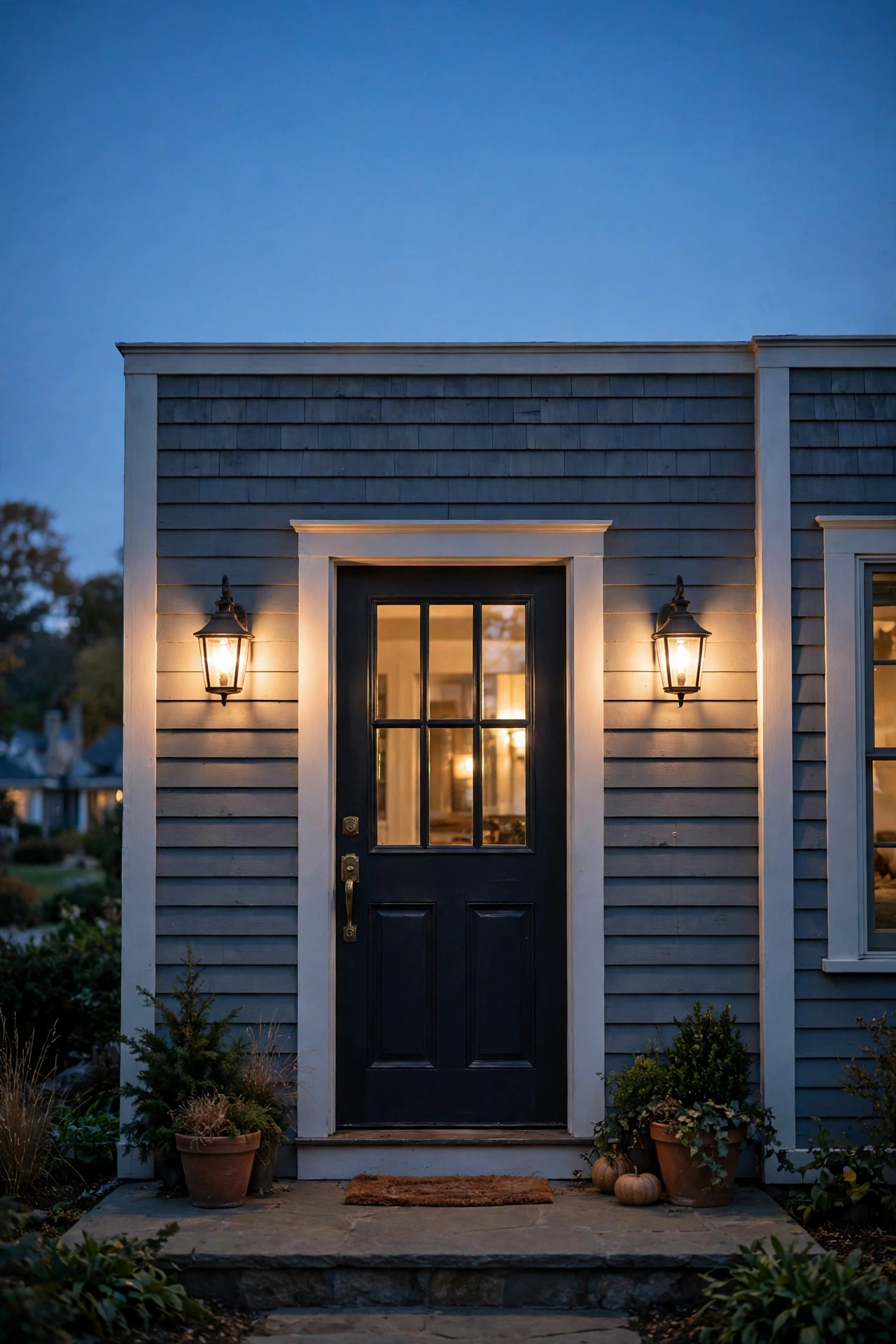
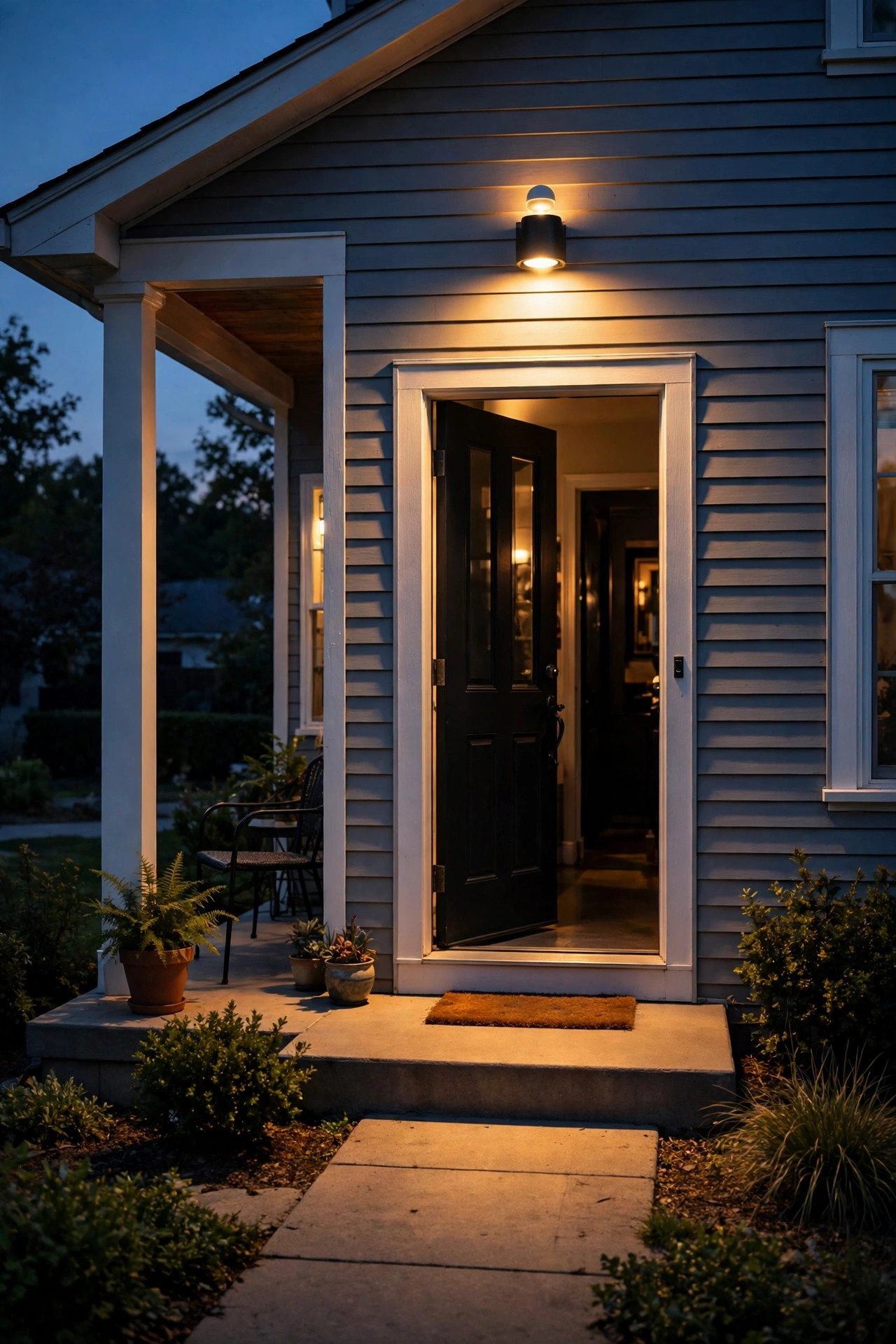
When there is no ceiling to hang anything from, the wall becomes your best friend, and a pair of sconces flanking the front door is where I always start. They frame the door like jewelry, wash the entry in even light, and give you real, usable brightness for keys, packages and guests. Mount them at eye level — about 66 inches from the porch floor to the center of the fixture — and roughly 6 to 8 inches out from the door trim. In my experience, fixtures sized about one-quarter to one-third the height of your door look perfectly proportioned. Choose fully enclosed, wet-location-rated sconces since an open porch takes direct rain, and fit them with 2700K LED bulbs in the 450–800 lumen range for warmth without glare. If your porch has no junction box by the door, plug-in sconces with a cord you can run neatly along the trim are a genuinely good workaround. My full breakdown of placement and pairing lives in this front door sconce pair guide, and it is worth a read before you drill a single hole.
Suggested budget range: $40 – $160.
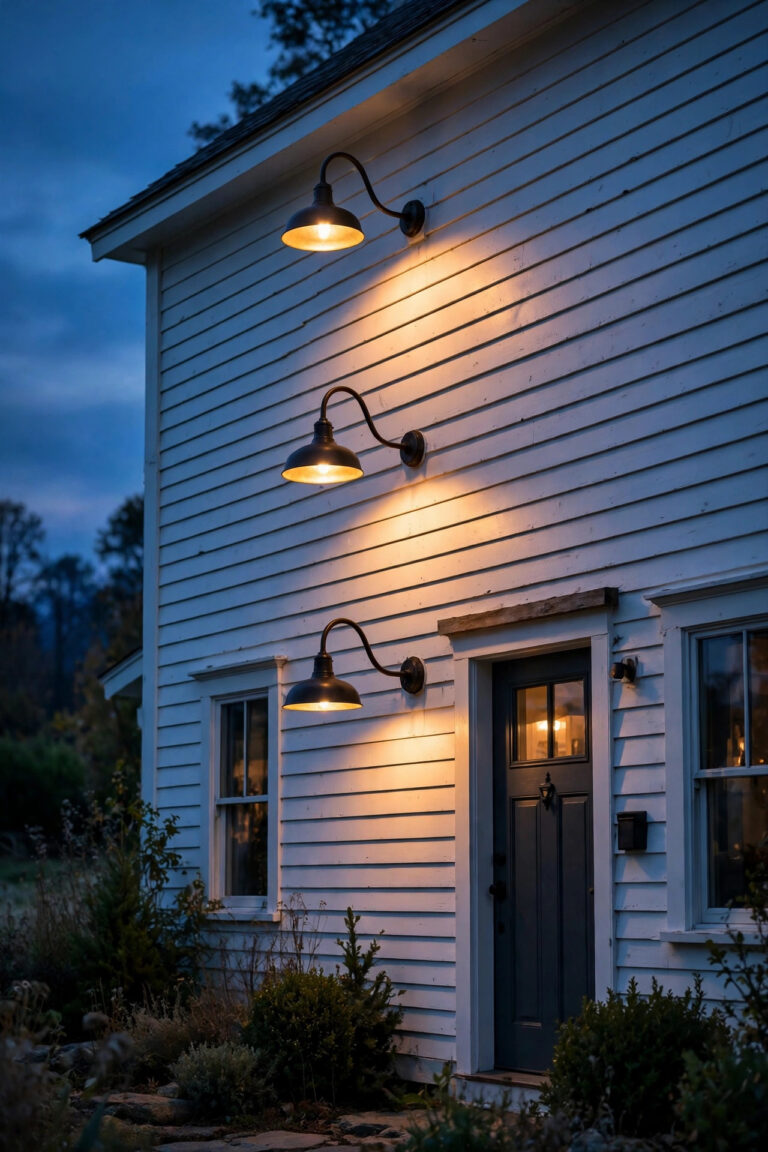
2. A Gooseneck Barn Light Over the Door
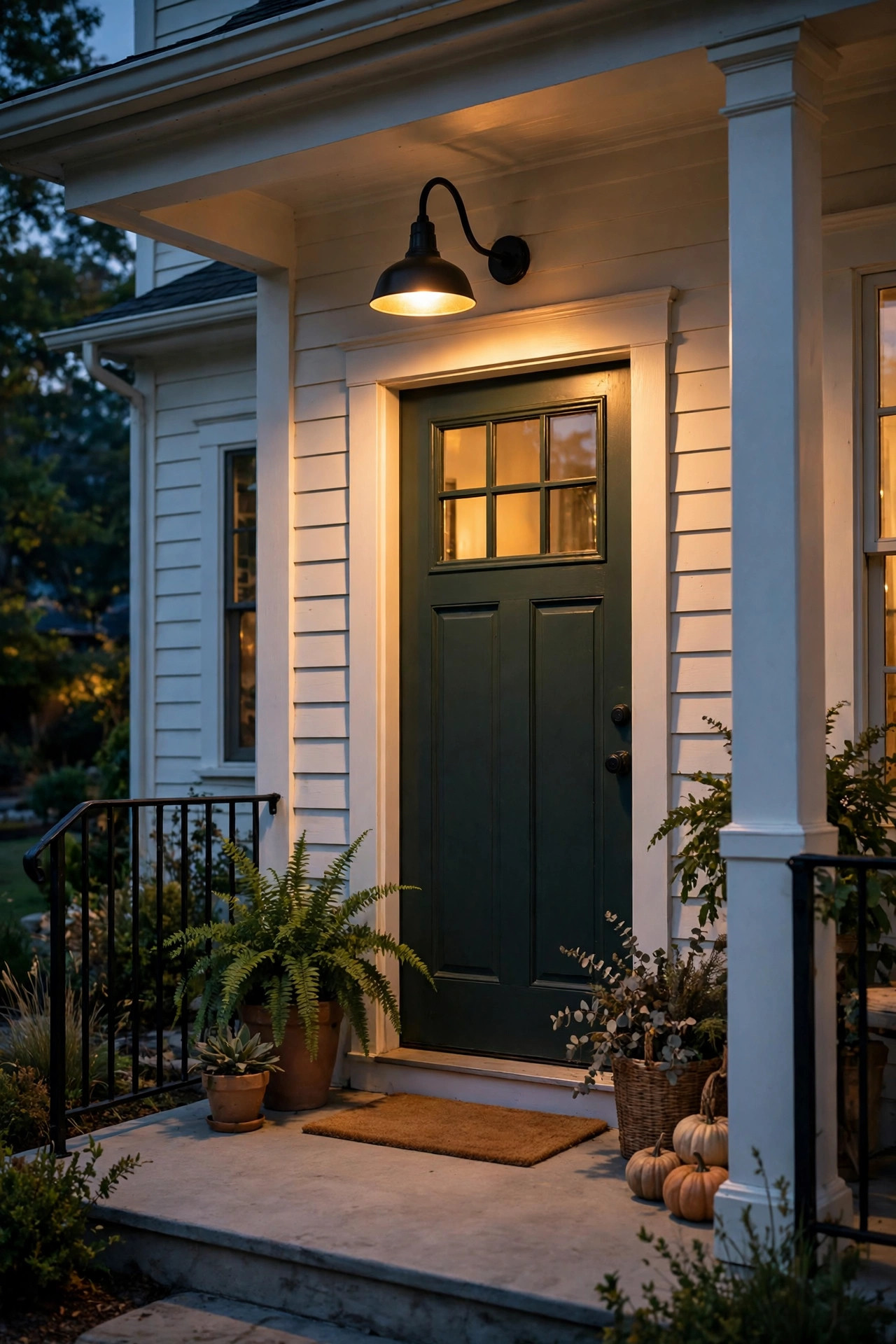
If a pair of sconces feels too formal, a single gooseneck barn light mounted above the door gives an open porch instant character. That curved arm reaches out and throws light downward exactly where you need it — on the lock, the step and the welcome mat — without needing one inch of ceiling. Mount the backplate about 12 to 18 inches above the door frame, and pick a shade 12 to 14 inches wide for a standard entry. Because an open porch exposes the fixture to everything, look for powder-coated aluminum with a wet-location rating, and seal the top of the backplate with a bead of exterior silicone so wind-driven rain cannot creep behind it. I love the look most on farmhouse, cottage and craftsman homes, but a matte black gooseneck reads surprisingly modern on brick too. Use a warm 2700K bulb, and if the bulb is visible from below, choose a filament-style LED so the glow looks soft instead of stark. It is a one-afternoon project that makes the whole entry feel intentional.
Suggested budget range: $45 – $130.
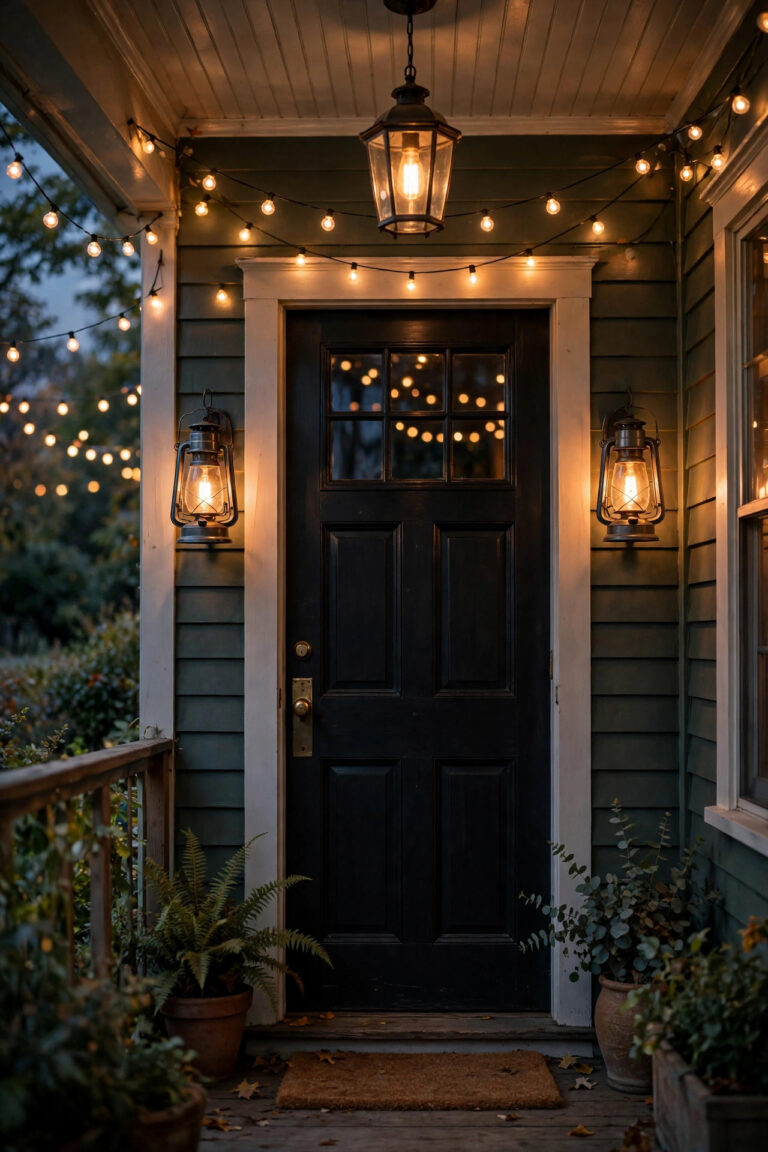
3. String Lights Strung From the House to Porch Poles
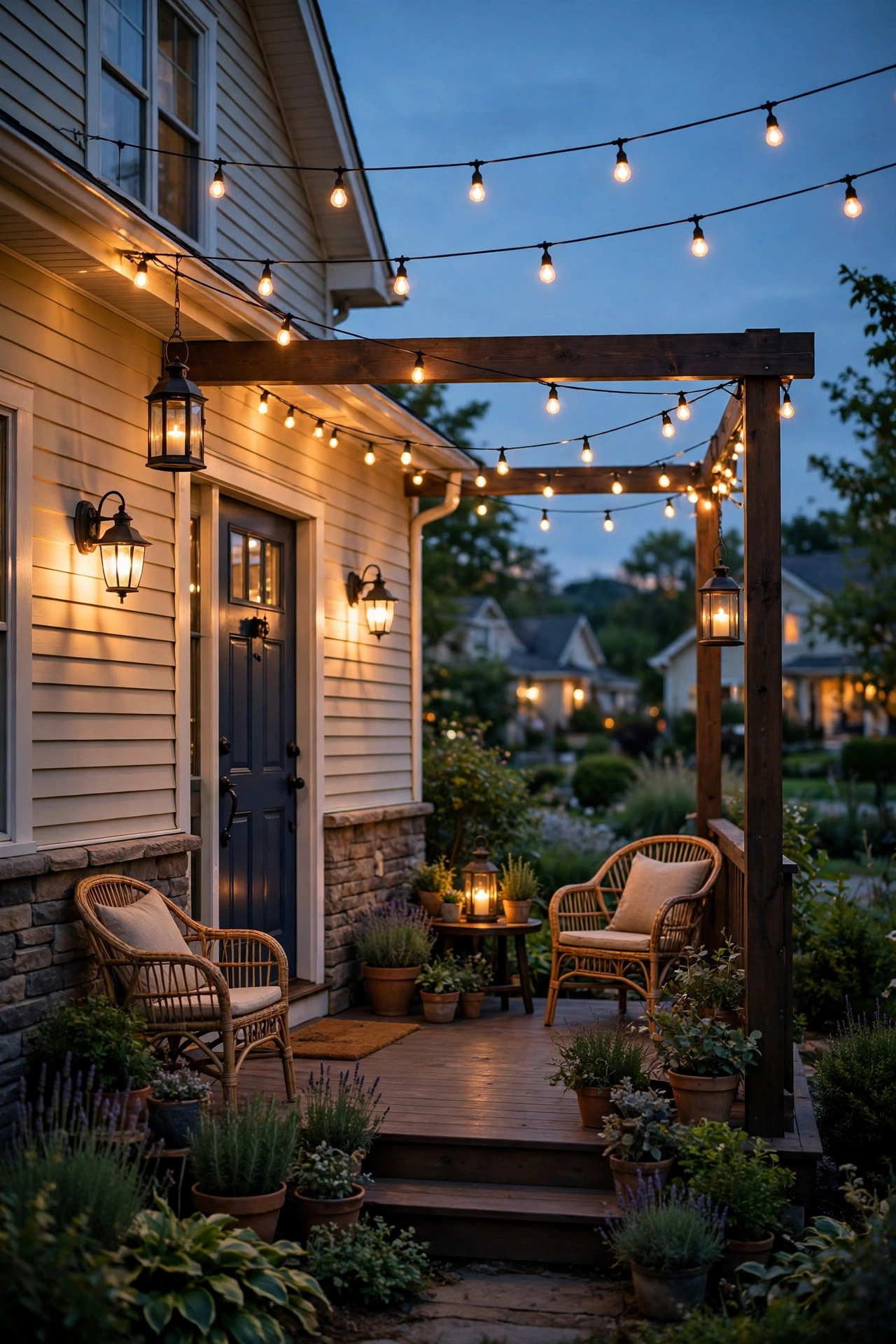
Everyone assumes string lights need a ceiling or a pergola, but on an open porch my favorite trick is to give them their own support: two sturdy poles. Set 8- to 10-foot poles in heavy planters filled with gravel or quick-set concrete at the outer corners of the porch, screw a cup hook into the fascia or siding at the same height, and run commercial-grade string lights between them in a gentle swag. Leave about a foot of drape for every 10 feet of run so the line looks relaxed, not strained. Space bulbs 18 to 24 inches apart, and always use outdoor-rated, shatterproof LED string lights with a proper plug — never indoor strands. A plug-in set on a timer gives you that golden canopy every evening at dusk without thinking about it. The outdoor string lights guide on this site covers strand lengths and connectors in detail. Honestly, the first night those lights click on over an open porch, it feels like the ceiling you always wanted — just made of stars instead.
Suggested budget range: $35 – $120.
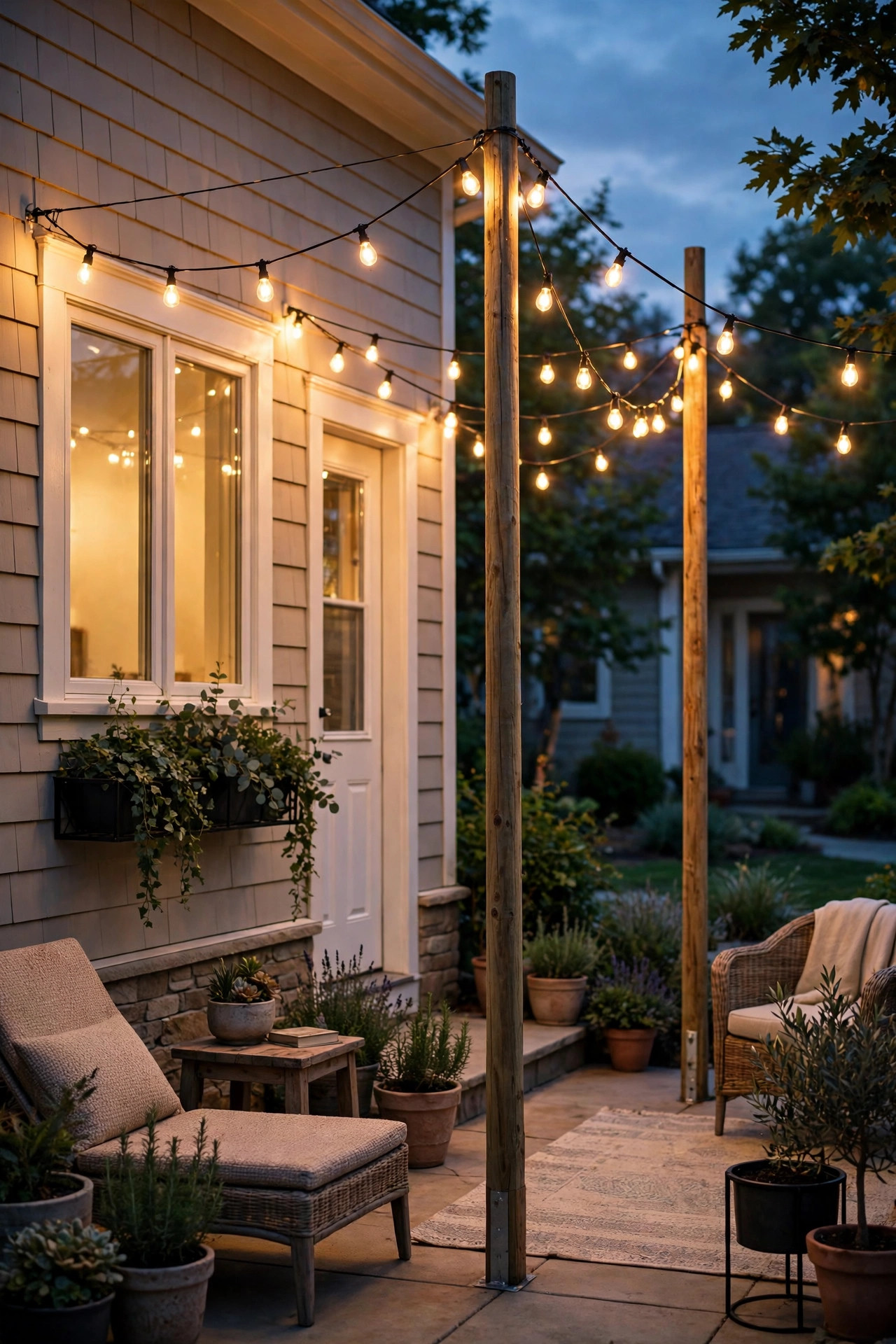
4. Solar String Lights for a Truly Wire-Free Canopy
No outdoor outlet near the porch? Solar string lights are the answer I give friends more than any other. The little solar panel stakes into a sunny planter or clips to a railing, charges all day, and the strand glows for 6 to 8 hours after dark. Run them along the porch edge, swag them between poles like the plug-in version above, or zigzag them across the open top of the porch from corner to corner. The secret to happiness here is placement: the panel needs 6 or more hours of direct sun, so aim it south and keep it out from under eaves shadows — which, on a porch with no overhang, is refreshingly easy. Look for strands with replaceable batteries and a warm-white 2700K tone; the bluish "cool white" solar sets are the ones that end up in the donation bin. Bulbs in the shatterproof plastic style survive hail and dropped strands far better than glass. Expect a softer glow than plug-in sets — think ambiance, not task lighting — and layer them with wall light for the best of both.
Suggested budget range: $20 – $60.
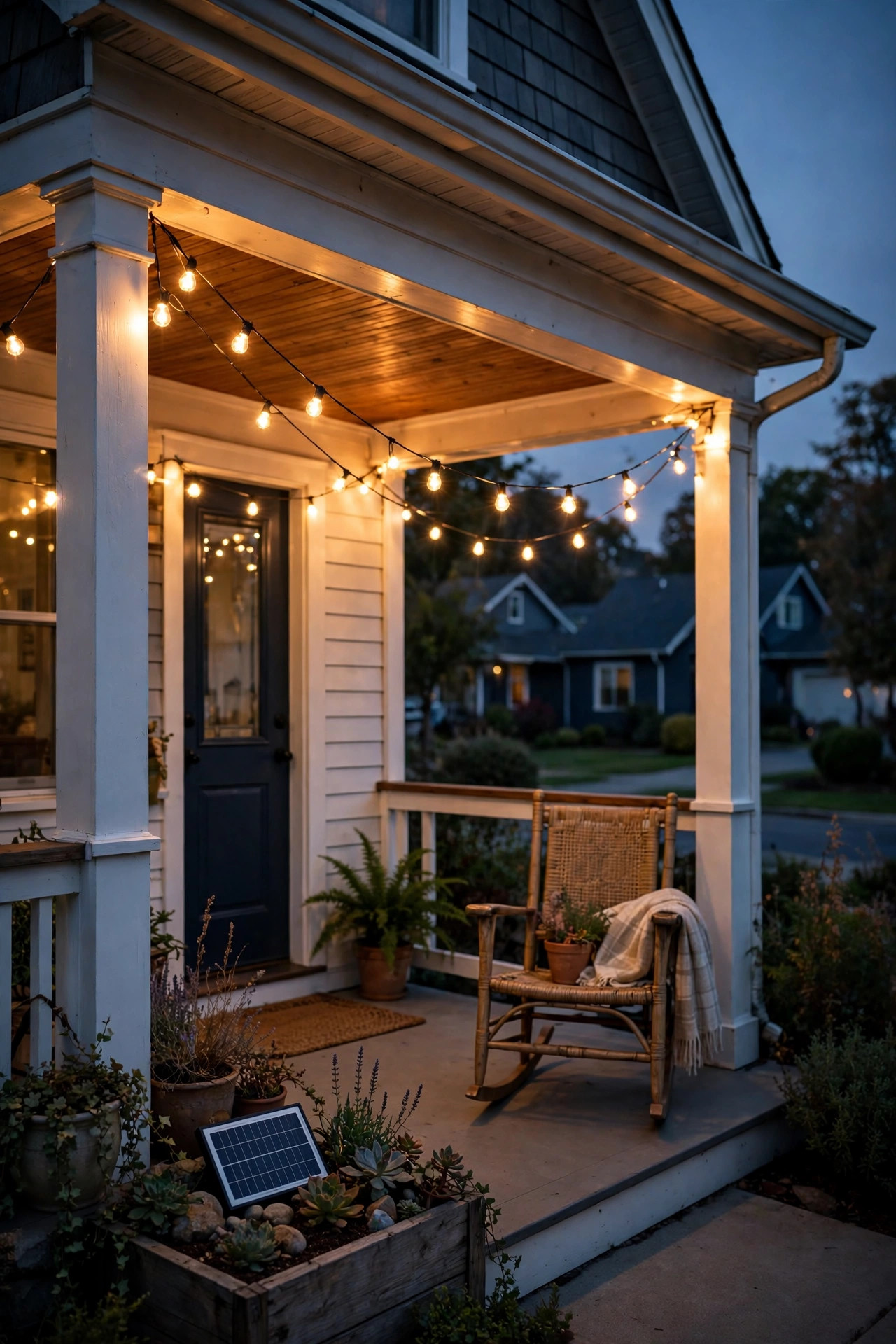
5. Ground Uplights Washing the Porch From Below
Here is a designer trick that works beautifully when there is nothing overhead: light the porch from the ground up. Two or three low-voltage spotlights or well lights tucked into the beds flanking the porch, aimed up at the columns, posts or siding, create that soft architectural wash you see on magazine porches. Angle the fixtures about 30 degrees, set them 12 to 18 inches out from the wall, and use a wide 60-degree beam so the light melts upward instead of striping. Because the fixtures sit at ground level in open beds, choose sealed, wet-rated housings and bury cable 6 inches deep. A 3000K or warmer LED keeps brick and wood looking rich rather than washed out. The effect is pure drama for very little money, and as a bonus, uplighting the porch posts makes an open porch feel taller and grander — it draws the eye up to where the ceiling would be and convinces everyone the space is finished. Pair it with a dim porch sconce so the entry itself still reads clearly for guests.
Suggested budget range: $50 – $180.
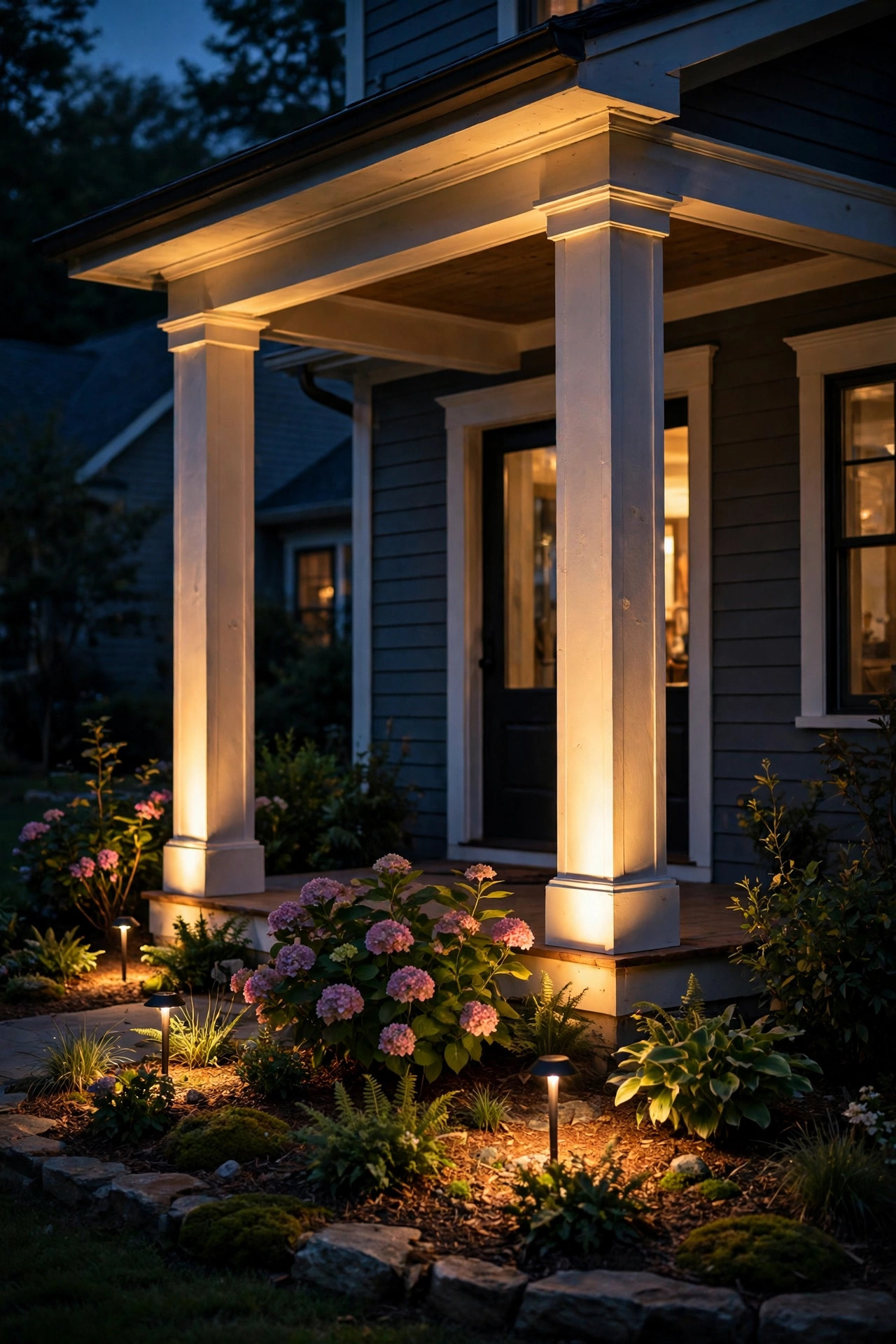
6. A Trio of Battery Lanterns on the Steps
Sometimes the prettiest porch lighting without a ceiling is the kind you can carry. A trio of battery-operated lanterns — one tall, one medium, one small — clustered on the porch steps is my go-to move for instant warmth. Modern LED lanterns run 100+ hours on a set of batteries, many have timers that repeat the same 6-hours-on, 18-hours-off cycle every day, and the flicker modes are honestly convincing. Group them in odd numbers, tuck a little faux greenery or a few pinecones around the bases seasonally, and set them where they light the tread edge so guests see each step. Because there is no flame, they are safe around doormats, pets and curious toddlers, and because there is no cord, a storm warning just means carrying them inside. Choose lanterns with an IP44 rating or better if they will sit on exposed steps, and store spare batteries in the hall closet. On nights we entertain, I move the trio to flank the door instead — it takes ten seconds and always earns a compliment.
Suggested budget range: $25 – $75.
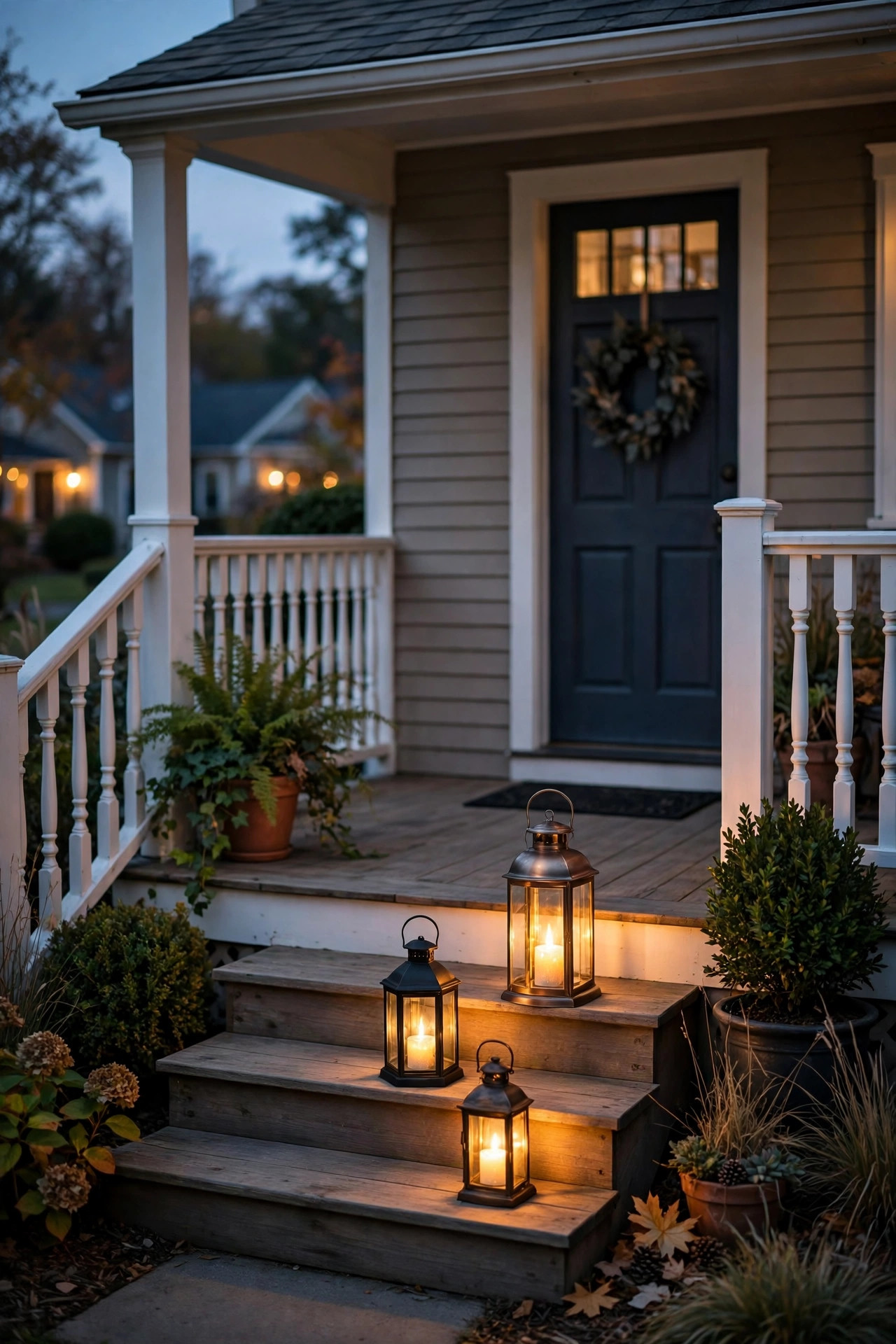
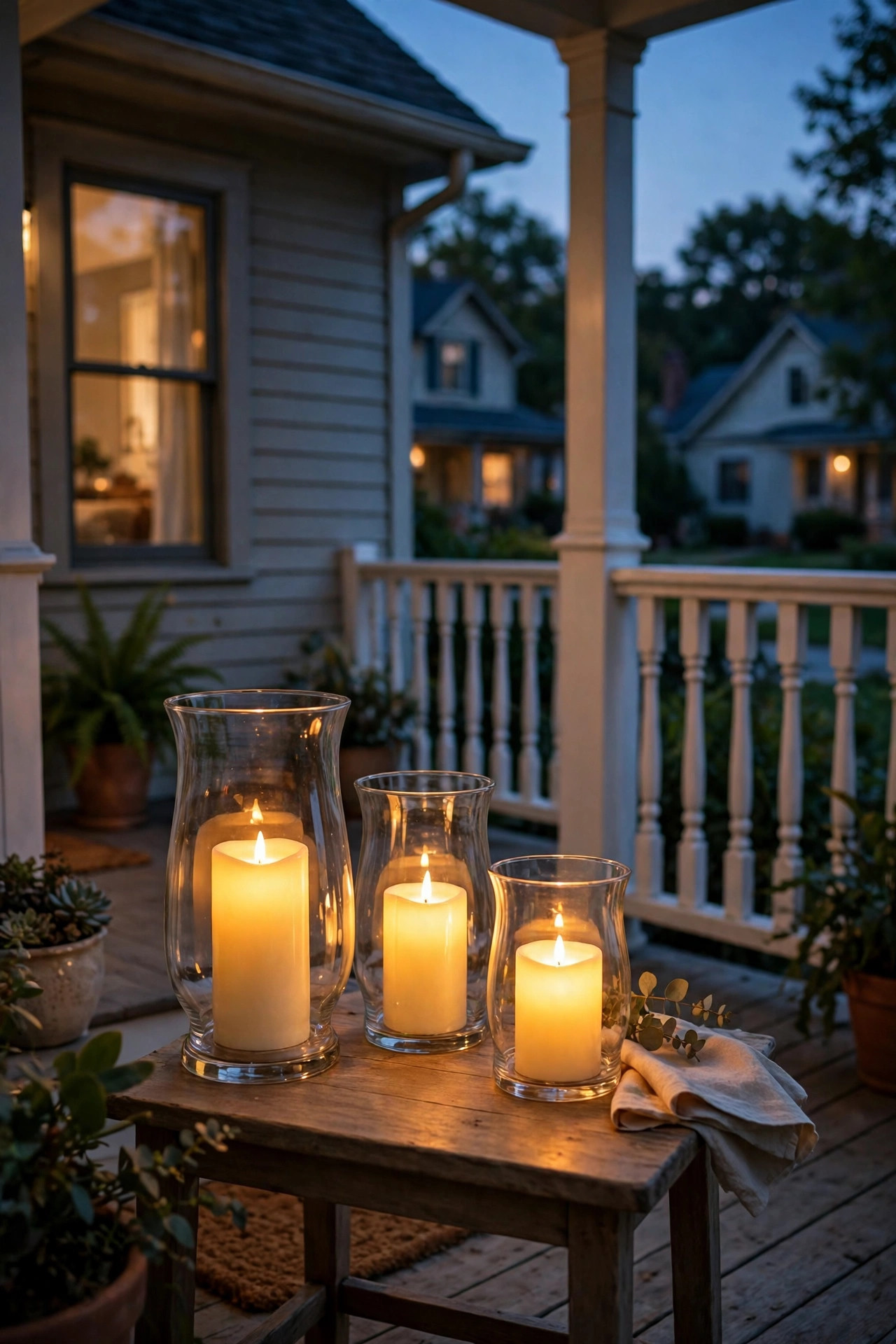
7. Flameless Candles in Hurricane Holders on a Porch Table
If your open porch holds a little side table or a bench, a cluster of flameless candles in glass hurricane holders is pure romance for almost no effort. Real candles and open porches do not mix — one gust and the flame is out, or worse, the wax is everywhere — but the new LED pillars with melted edges and a gentle flicker fool everyone at conversational distance. I group three heights inside one large hurricane, or line up three hurricanes along the table edge, and set the built-in timer so they wake up right at dusk. The glass matters: it protects the "flame" visually, throws pretty reflections, and keeps rain from pooling in the candle top on a porch with no roof to hide under. Choose outdoor-rated flameless candles with sealed battery compartments if they will live outside full time; indoor versions corrode by the second season. On a still evening this soft, low light is exactly the layer that makes a porch feel like a room — it just happens to be a room whose ceiling is the evening sky.
Suggested budget range: $15 – $50.
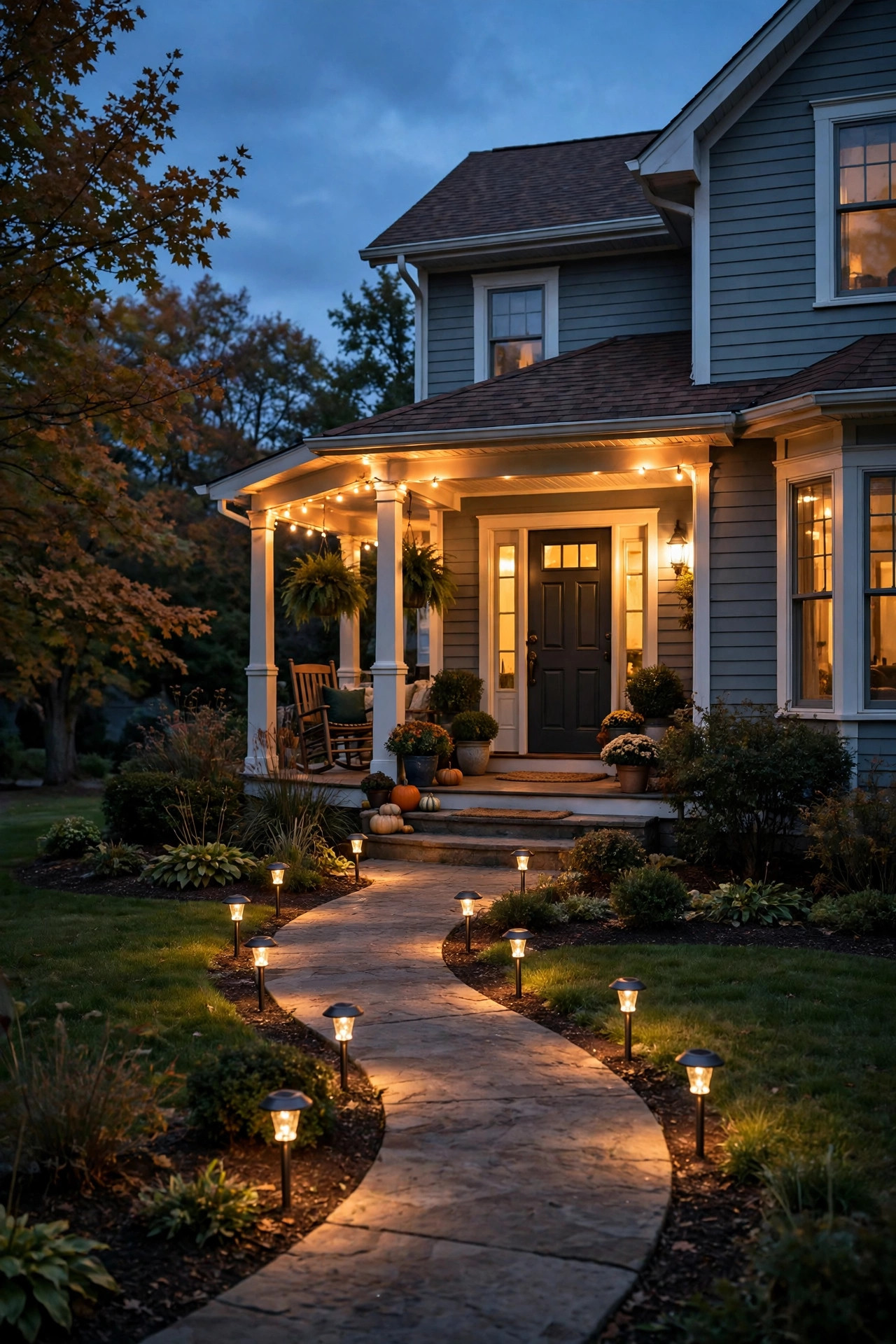
8. Solar Path Lights Leading Guests to the Porch
An open porch starts at the sidewalk, not the front step, so I always light the approach. A row of solar path lights along the walkway tells guests exactly where to go and makes the whole entry sequence feel planned. Space them 5 to 6 feet apart, staggered rather than in a stiff runway line, and keep them 6 to 12 inches back from the path edge so mower wheels and snow shovels miss them. Warm-white stakes around 2700–3000K with 10 to 30 lumens each are plenty — this is guidance light, not runway light. Push the stakes into soil, not mulch, so they stand straight, and give the panels a full sunny day before judging brightness. In my experience the metal-stake styles outlast the all-plastic ones by years. Finish the sequence with one slightly brighter light where the walk meets the steps, and suddenly that ceiling-less porch has a proper entrance. It is also the single cheapest security upgrade on this list: a lit path quietly tells the whole street the house is cared for and awake.
Suggested budget range: $20 – $70.
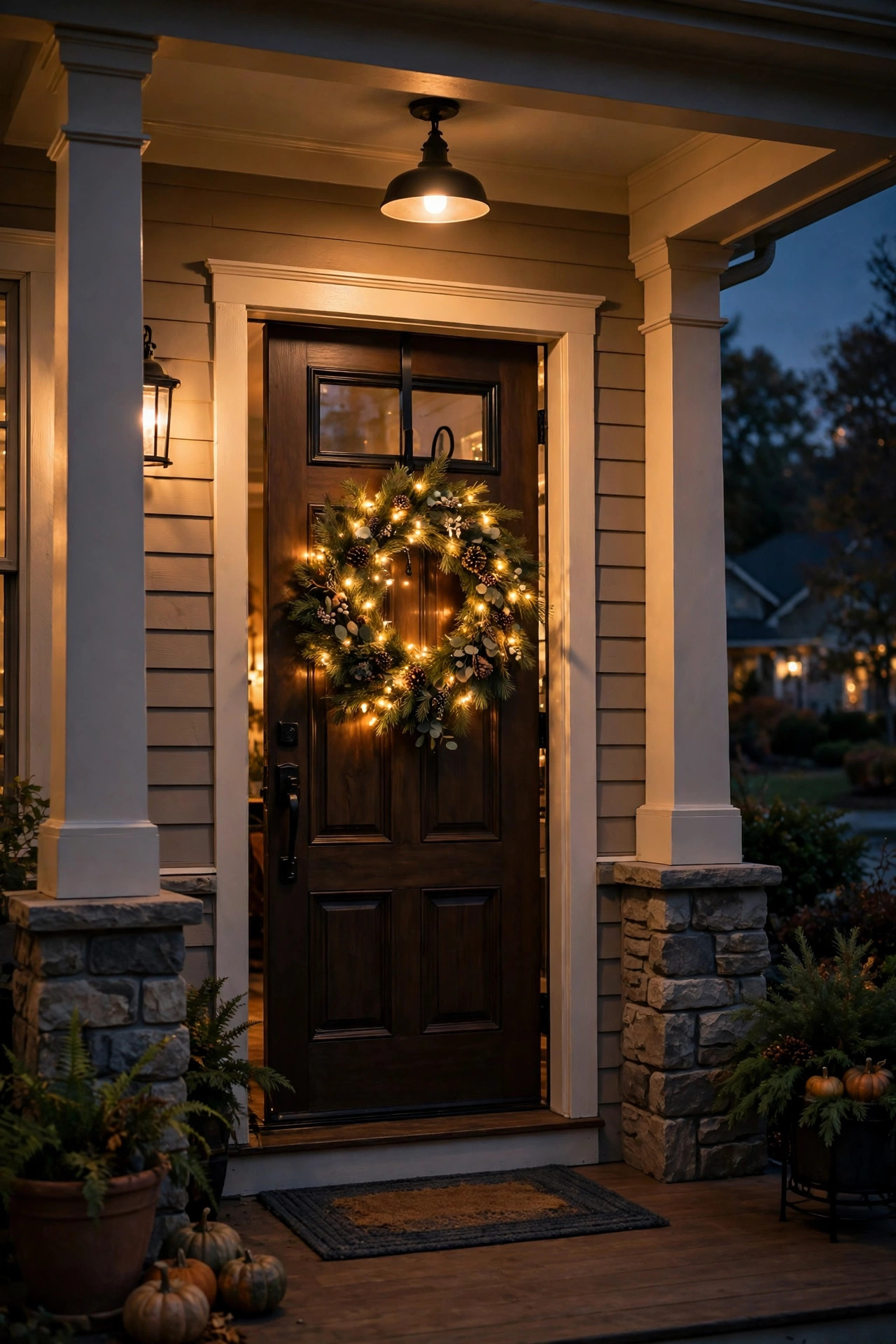
9. A Lighted Wreath on the Front Door
The front door is the one vertical surface every open porch has, and a lighted wreath turns it into a glowing focal point. Battery-operated wreaths with warm micro fairy lights woven through the greenery run on AA batteries with a built-in timer, so you hang it once and it greets you every evening for weeks. Hang it centered at eye level — about 57 inches to the wreath's center — on an over-door hook, and tuck the battery pack behind the bottom foliage where rain cannot sit on it. I swap the greenery by season: eucalyptus and cotton stems in spring, magnolia leaves in fall, classic pine and berries in winter. The trick to making it look expensive is density — choose a wreath 22 to 24 inches across for a standard door, and add a few extra copper-wire fairy lights of your own if the built-ins look sparse. It needs no wiring, no outlet and no ceiling, and from the street it reads like a little lantern hung on the door. Guests genuinely comment on it more than fixtures that cost ten times as much.
Suggested budget range: $30 – $85.
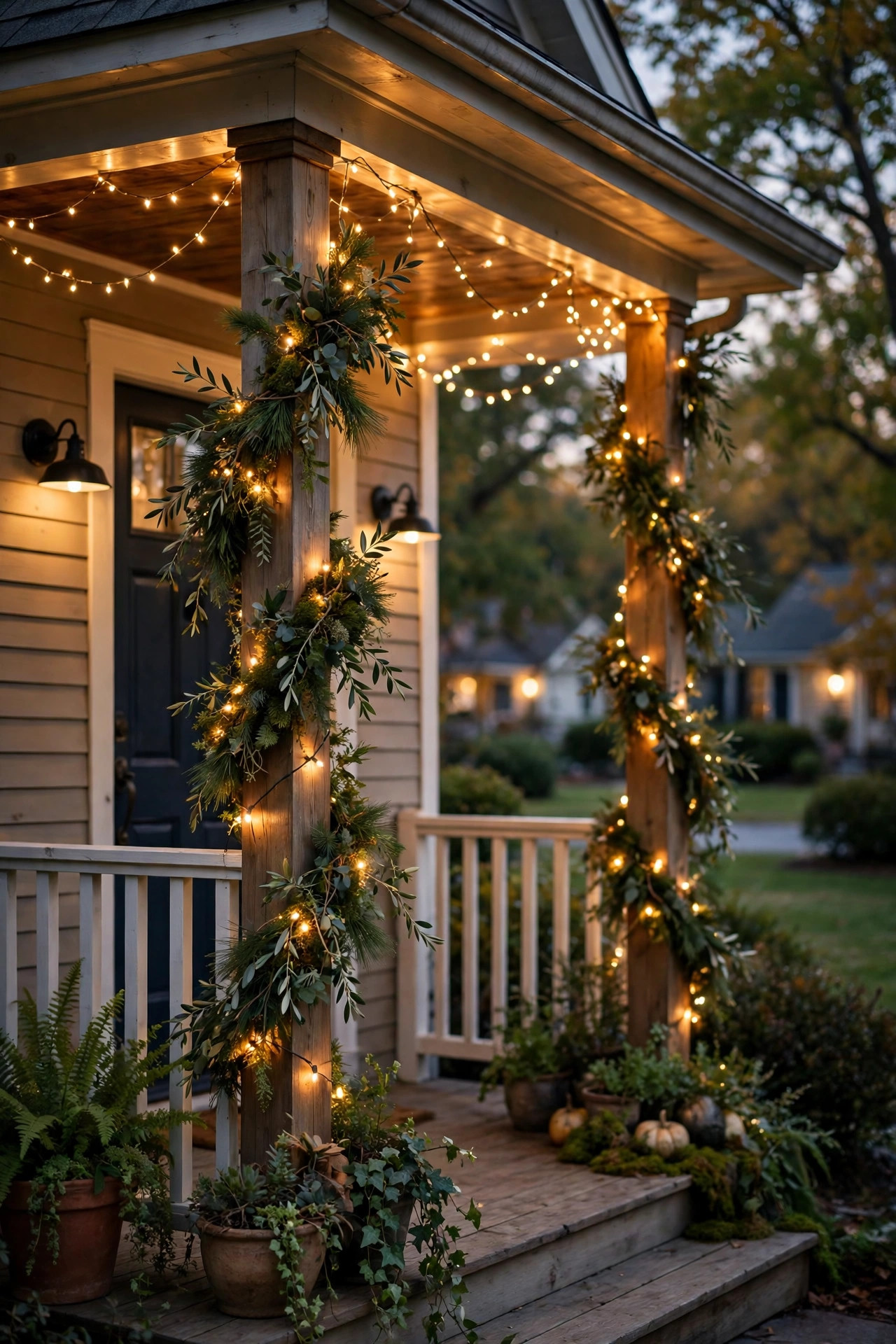
10. Fairy-Light Garland Wrapped Around Porch Posts
Open porches usually have posts or columns at the corners, and wrapping them with a lighted garland is the fastest transformation on this entire list. Take a faux greenery garland, weave in a strand of copper-wire fairy lights, and spiral the whole thing around each post from base to top, securing with floral wire or small clear zip ties every 12 inches. The battery pack hides behind the post at the base. If your porch has a railing instead of full posts, drape the garland along the top rail with gentle swags — about 6 inches of drape between each tie point looks lush, not saggy. Keep everything LED and battery- or solar-powered so nothing hot touches dry greenery, and stick to warm white lights so the garland reads as glow, not holiday. That said, come December I add red berries and nobody has to tell me twice. In my experience this is the idea that photographs best — if you are listing the house or just love a good porch photo for the family chat, start here.
Suggested budget range: $25 – $65.
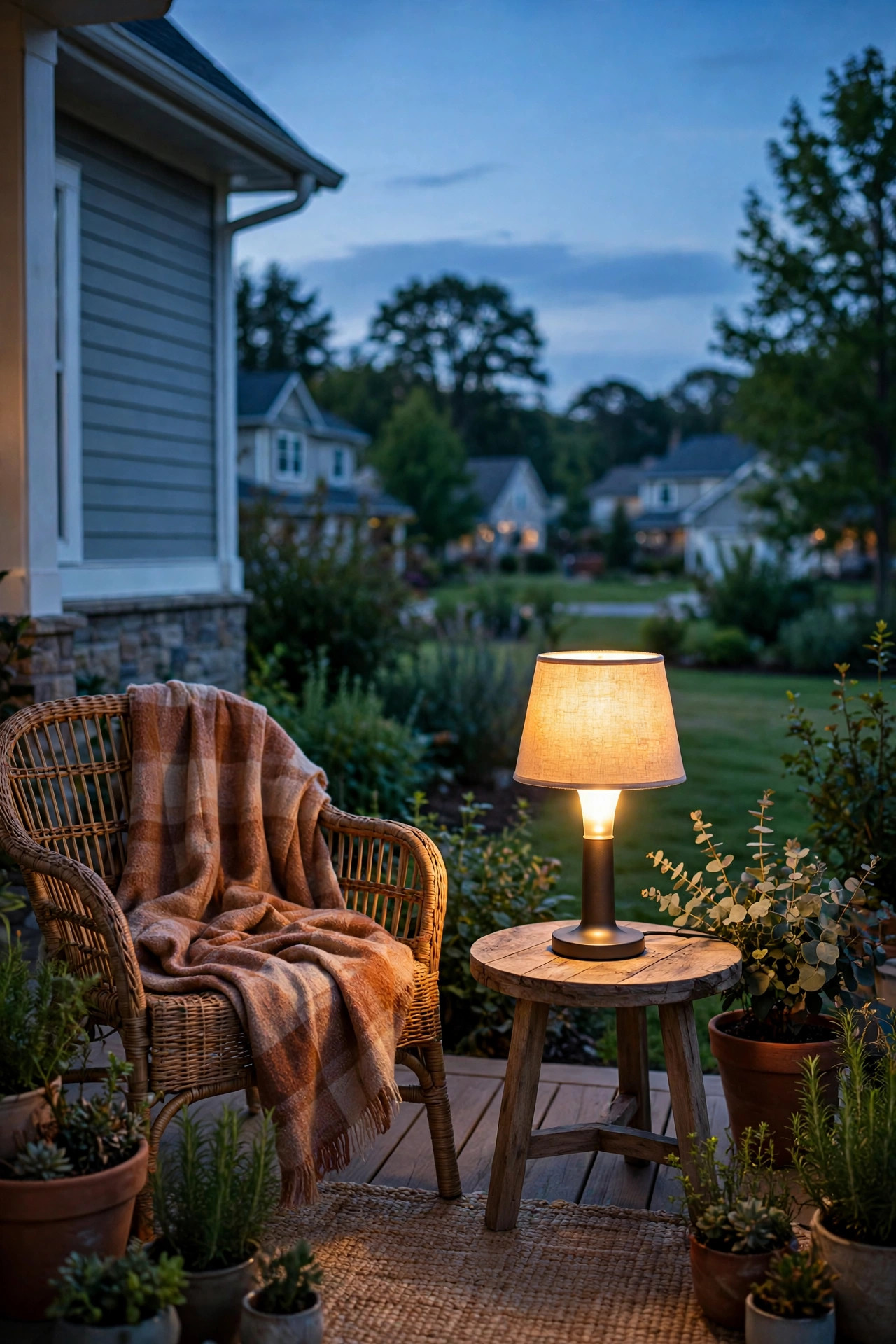
11. A Weatherproof Outdoor Table Lamp
Yes, table lamps exist for outdoors now, and on a porch with seating they are a small revelation. Rechargeable outdoor table lamps — the kind with a weighted base, a sealed shade and a USB charging port — give you that indoor, lamplit feeling beside a porch chair or swing, with no cord and no ceiling outlet involved. Expect 10 to 20 hours per charge, two or three brightness settings, and warm 2700K light. Set one on the side table between two chairs and the whole seating area instantly feels furnished rather than leftover. Choose a model rated IP44 or higher, bring it in during hard freezes if the battery is lithium, and wipe the shade monthly — open porches collect pollen and dust fast. A pair flanking a porch sofa looks downright tailored. This is also the most renter-friendly idea here: it arrives by mail, charges from any USB port, and moves out with you. Honestly, once you have read a book by lamplight on your own porch, there is no going back to the bare porch bulb.
Suggested budget range: $35 – $110.
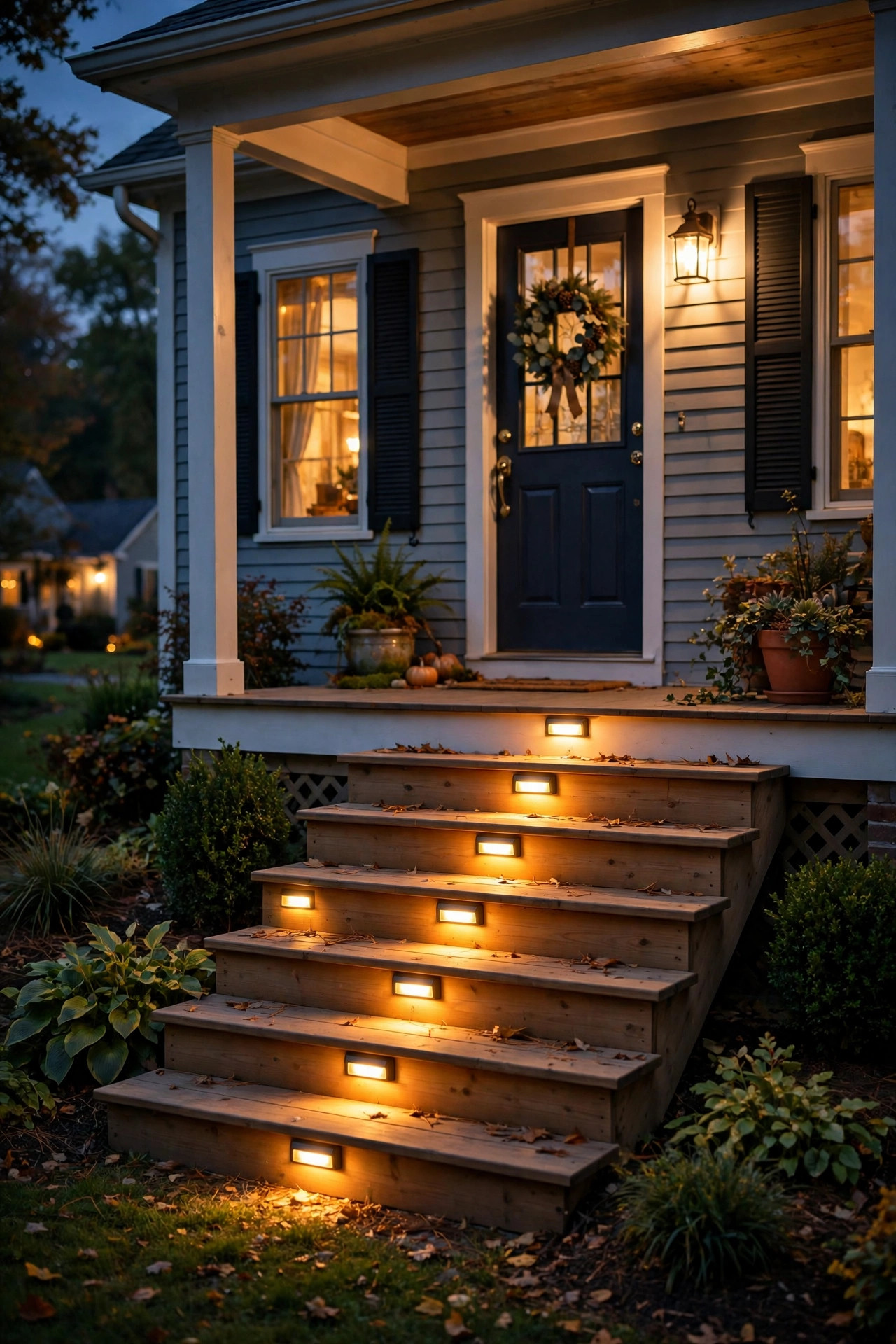
12. Solar Step Lights for Safe, Pretty Treads
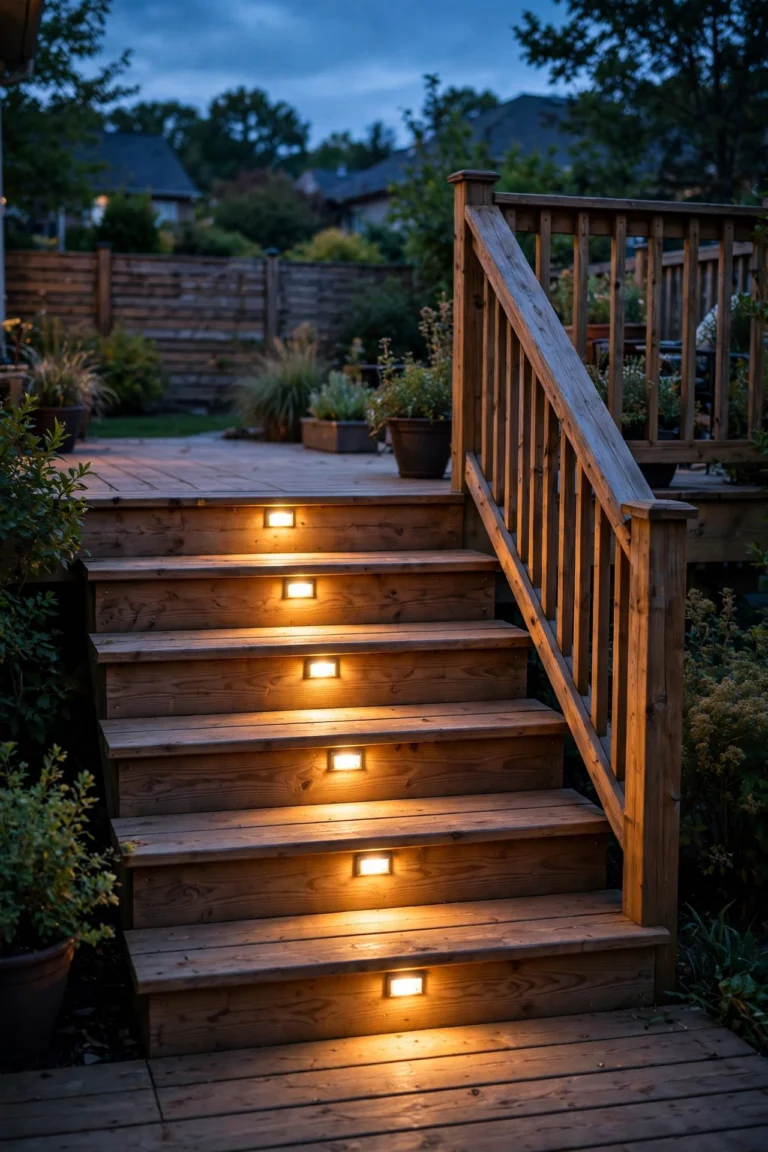
Porch steps on an open entry get genuinely tricky after dark — shadows pool on the treads, and one misjudged step is all it takes. Little solar step lights fix it for a few dollars each. The best styles screw or stick onto the vertical riser or the side stringer of each step, charge from a thumbnail-sized panel on top, and switch on automatically at dusk. Plan on one light per step, mounted consistently on the same side, about 2 inches down from the tread edge on the riser. Warm-white versions around 3000K are easier on the eyes than the stark blue-white ones, and a downward-shining design lights the tread without glaring into faces. Because these live fully exposed, rinse the panels every few weeks — a film of dust can cut charging by half — and replace the small rechargeable batteries every year or two. Wired low-voltage step lights are the longer-lasting upgrade, but honestly, for most porches the solar versions punch far above their price and take fifteen minutes to install with a drill and a level.
Suggested budget range: $15 – $55.
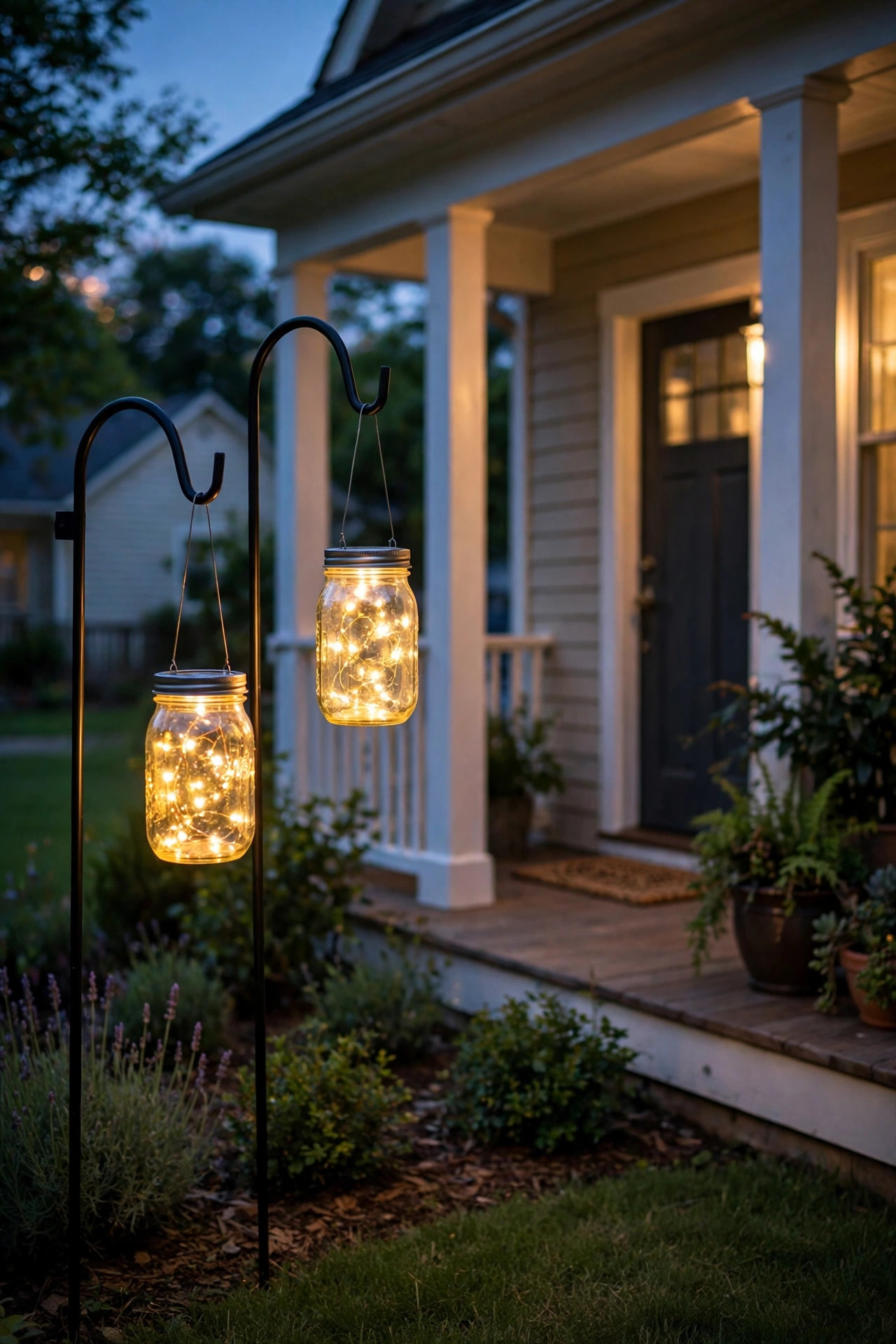
13. Solar Mason Jar Lights Hanging From Shepherd's Hooks
When you cannot hang a single thing from above, shepherd's hooks give you hanging points wherever you want them. Push two or three 48- to 60-inch hooks into the beds flanking the porch — or set them in heavy pots on the porch itself — and hang solar mason jar lights from the curls. Each jar holds its own tiny solar panel in the lid and a curl of fairy lights inside, so the whole jar glows like captured fireflies. Hang them at slightly staggered heights, 4 to 6 inches apart in level, for that casual, collected look. This is a wonderfully forgiving project: no wiring, no measuring twice, and if a jar underwhelms you, move the hook. Choose jars with stainless lids so they do not rust through a rainy season, and expect 6 to 8 hours of glow on a full charge. In my experience, three jars grouped near the steps plus two by the door creates a rhythm the eye loves. It is porch lighting as jewelry — small, sparkly, and completely unbothered by the missing ceiling.
Suggested budget range: $18 – $45.
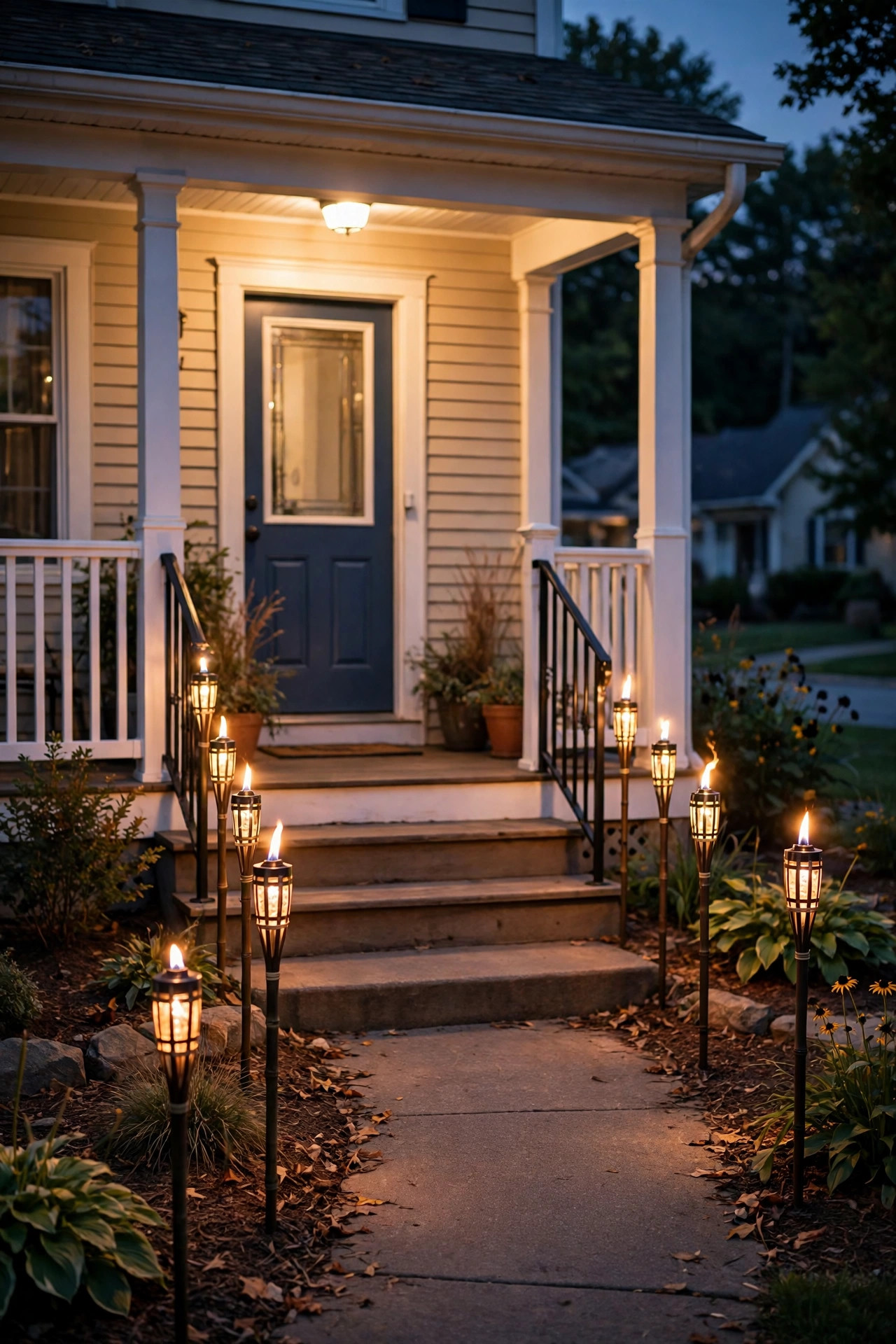
14. Flickering Solar Torch Lights Flanking the Entry
For a little drama, solar torch lights with a dancing-flame effect are hard to beat. The LED flame flickers and ripples so realistically that neighbors will ask if they are real tiki torches — but there is no fuel, no open flame, and no fire risk near the porch. Stake a pair at the base of the steps or flanking the porch corners, about 30 to 33 inches tall once installed, and let them mark the threshold like two friendly sentries. The panels charge best with full sun, so resist tucking them under shrubs. On overcast weeks they will run a little shorter, which is the honest trade-off of all solar, but on clear summer nights they go 8 to 10 hours easily. I keep the look classic with the flame style, but they also come in a steady-glow version if flicker is not your thing. Paired with calm wall light at the door, the torches add movement — and a porch with no overhang has plenty of open sightlines for that little dance of light to show off.
Suggested budget range: $25 – $60.
15. A Backlit Address Plaque by the Door
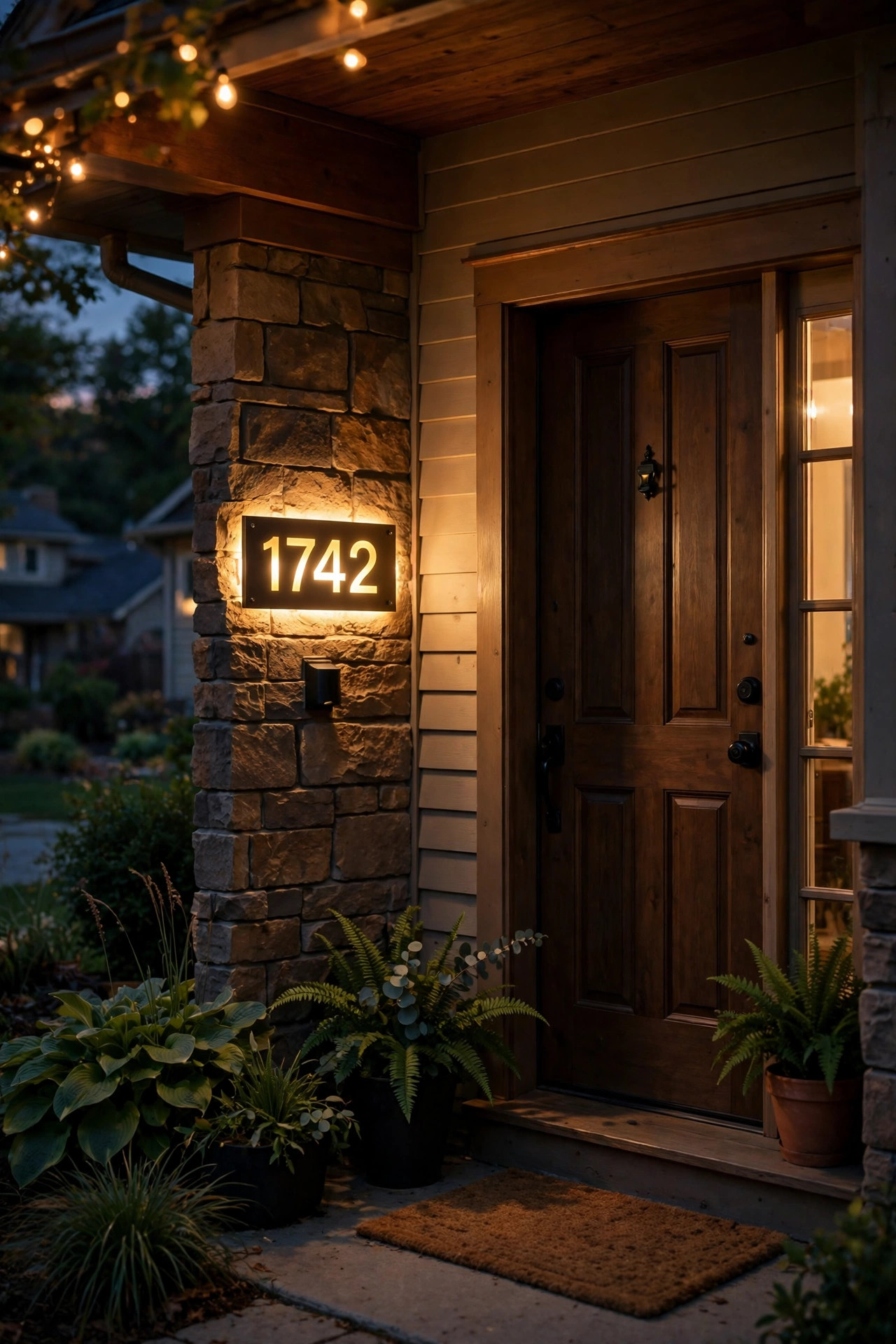
Here is the hardest-working idea on the list: a lighted house number plaque. Delivery drivers, guests and — most importantly — emergency vehicles all need to find your number after dark, and on an open porch a solar or battery backlit plaque does the job while looking genuinely handsome. Solar versions charge on the plaque's face and glow for 8+ hours; battery versions run for months and shrug off shady porches. Mount it on the wall beside the door or on a porch post at about eye level, 54 to 60 inches up, where headlights and porch light both catch it. Numbers should be at least 4 inches tall and high-contrast — white or warm-lit numbers on a dark plaque read best from the street. Keep the panel wiped clean and, for solar models, make sure nothing shades it by midday. It is porch lighting without a ceiling doing double duty: practical safety by night, tidy curb appeal by day. If you do only two ideas from this list, make it sconces and this plaque.
Suggested budget range: $20 – $55.
16. Solar Post Cap and Railing Lights
If your open porch has a railing or even short posts at the steps, post cap lights turn that structure into lighting for free. Solar caps sit right on top of 4×4 or 6×6 posts — measure your post carefully and order the matching base — charge all day, and cast a soft pool of light downward along the railing line. The effect outlines the whole porch edge, which is quietly gorgeous from the street and genuinely useful for anyone navigating the steps. Expect a gentle 5 to 15 lumens per cap: this is definition light, not reading light, so plan a cap on every post rather than every other one. No railing? Clip-on and strap-on solar railing lights mount to deck boards, stair rails and even fence tops near the porch. Look for warm-white output, replaceable batteries, and a snug fit so wind does not rattle them loose. In my experience, a lit railing line is what separates a porch that looks "finished" from one that still looks like a project — and it takes an afternoon at most.
Suggested budget range: $20 – $70.

17. A Motion-Sensor Wall Light for Safety and Welcome
The last layer of great porch lighting without a ceiling is the one that thinks for you: a motion-sensor wall light by the door. It rests dim or dark, then brightens the moment you come up the walk with groceries, a dog, or a sleeping toddler in your arms. Hardwired models tie into the same junction box a regular porch light uses; battery and solar versions stick or screw on anywhere, which makes them perfect for porches where wiring is a headache. Aim for 700 to 1,100 lumens in warm-to-neutral white, a detection range of 20 to 30 feet, and a 120- to 180-degree field so it catches the walkway, not just the doorstep. Set the timer to 1 to 3 minutes so it feels welcoming rather than interrogating, and angle the head slightly down to keep light out of the street. Test the sensor's aim after dark — most false triggers are just the head catching the road. Paired with your pretty layers, this is the light that makes the whole house feel looked after.
Suggested budget range: $25 – $80.
Frequently Asked Questions
Can you light a porch with no ceiling and no outlet?
Absolutely — most of this list needs no outlet at all. Solar string lights, path lights, step lights and torch lights charge themselves, while battery lanterns, flameless candles and lighted wreaths run for weeks on a set of batteries with built-in timers. Start with two or three battery or solar layers and add hardwired sconces later if you want more brightness.
What color temperature looks best on an open porch?
Warm white, 2700K to 3000K, is the sweet spot. It flatters wood, brick and skin tones and gives that golden, welcoming glow in the evening. The bluish 5000K "daylight" bulbs many solar lights ship with are the number one reason a porch ends up looking cold — swap them for warm-white versions whenever you can.
How do I keep rain from ruining porch lights with no roof overhead?
Choose fixtures rated for wet locations (not just damp), with an IP rating of IP44 or higher, and sealed battery compartments for anything battery-powered. Mount hardwired fixtures on a bead of exterior silicone at the top of the backplate, and bring rechargeable lamps and flameless candles in during hard freezes to protect their batteries.
How bright should porch lighting be overall?
Think in layers rather than one big number: roughly 450–800 lumens at the door for faces and locks, gentle 10–30 lumen accents along paths and steps, and soft ambient light in between. If every layer is dimmable or on a timer, the porch will feel bright enough at a fraction of the wattage — most of these ideas run on LEDs that cost pennies a month.
Conclusion
A porch with no ceiling is not a porch with no options — it is a porch lit the way gardens are lit, in warm layers that spill softly into the evening. Porch lighting without a ceiling starts at the wall with sconces or a gooseneck, floats through string lights, lanterns and garlands, and lands low along steps, rails and walkways, with a motion light and a glowing address plaque quietly doing the practical work. Pick three ideas from different layers and your porch will already feel transformed this weekend. When you are ready for more, browse the rest of the lighting ideas here on the site — your open-air porch has a lot more glow in its future.