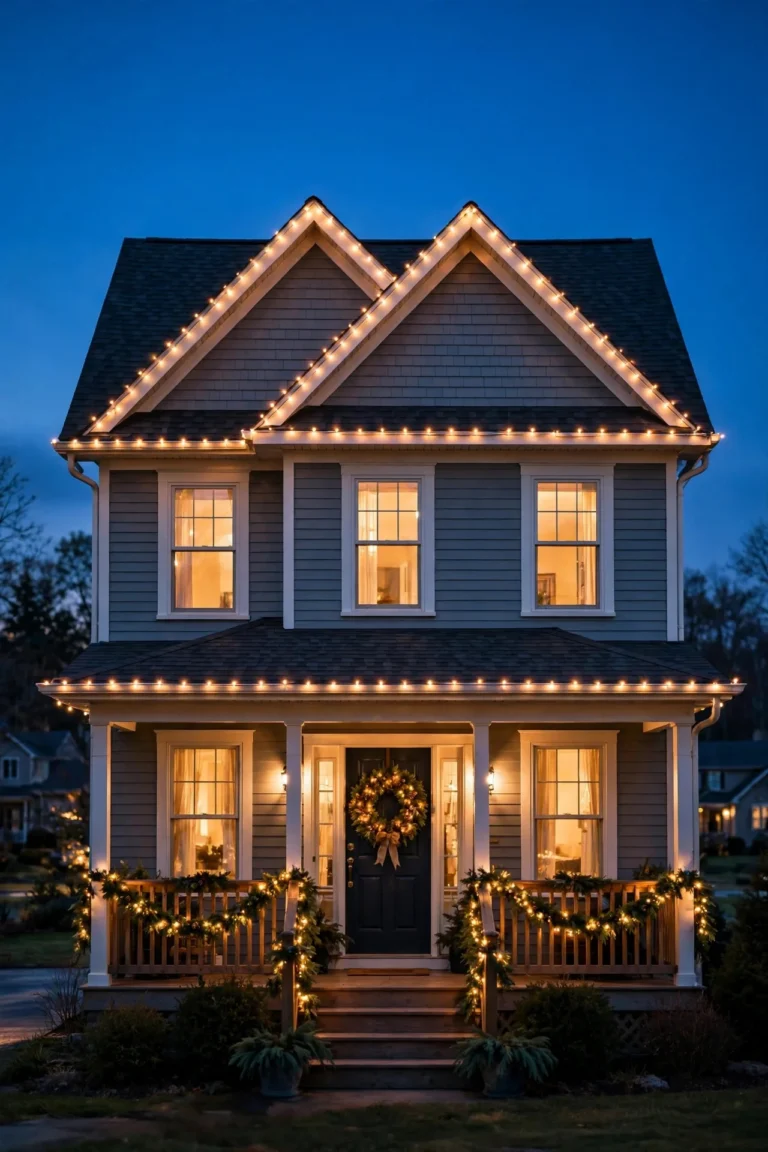
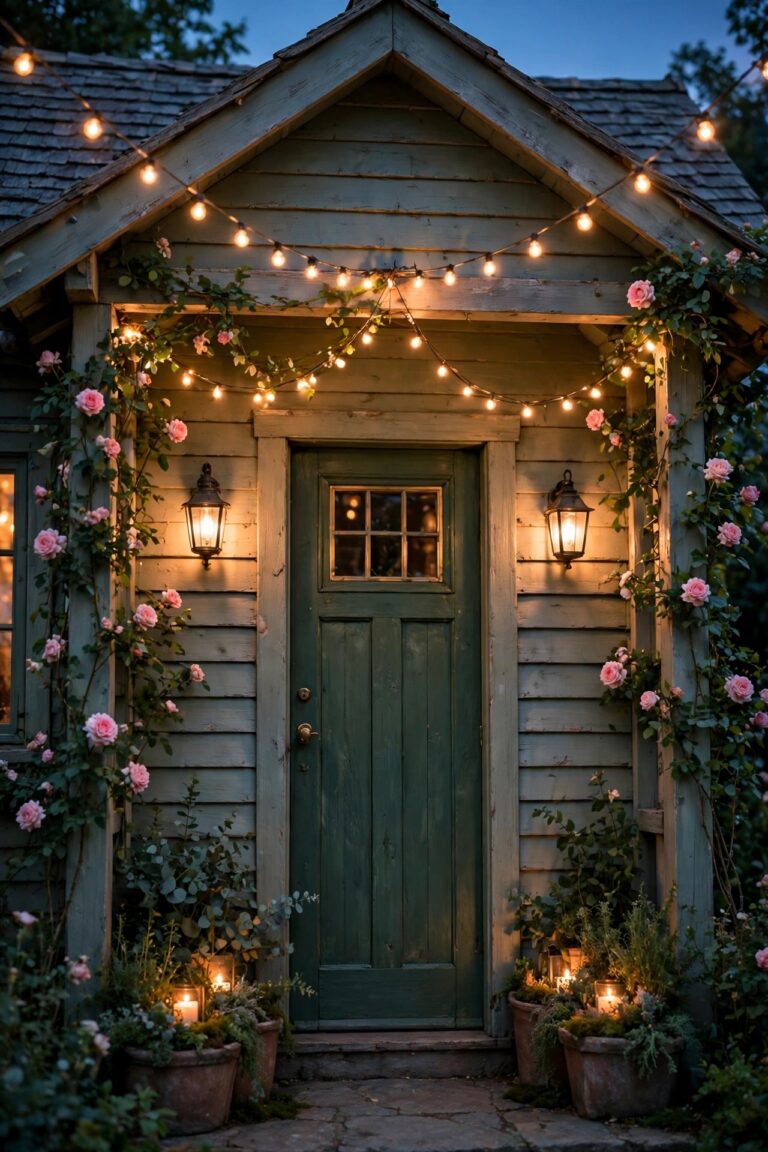
Every cottage I have ever loved looks ordinary at noon and absolutely enchanted by eight in the evening, and the difference is never the paint color — it is the light. The fairytale glow people stop to photograph comes from cottage outdoor lighting ideas that favor softness over brightness: tiny points of warm light scattered like fireflies, lanterns pooled along a path, and one or two brighter welcomes at the door. My rule, learned over years of tinkering in my own small yard, is to layer it the way a storybook illustrator would — low sparkle in the flower beds, a gentle mid-level glow for paths and porches, and a whisper of light overhead in the trees. Nothing floods, nothing glares, and every bulb stays warm, in that 2200K to 2700K candlelight range. Below are the 25 ideas I reach for again and again, from a ten-dollar string of copper-wire fairy lights to the layered plan that ties the whole yard together. Most take an afternoon, nearly all are renter-friendly, and every single one keeps the magic gentle on your electric bill and your neighbors.
1. Start With a Three-Layer Plan for Your Cottage Outdoor Lighting Ideas
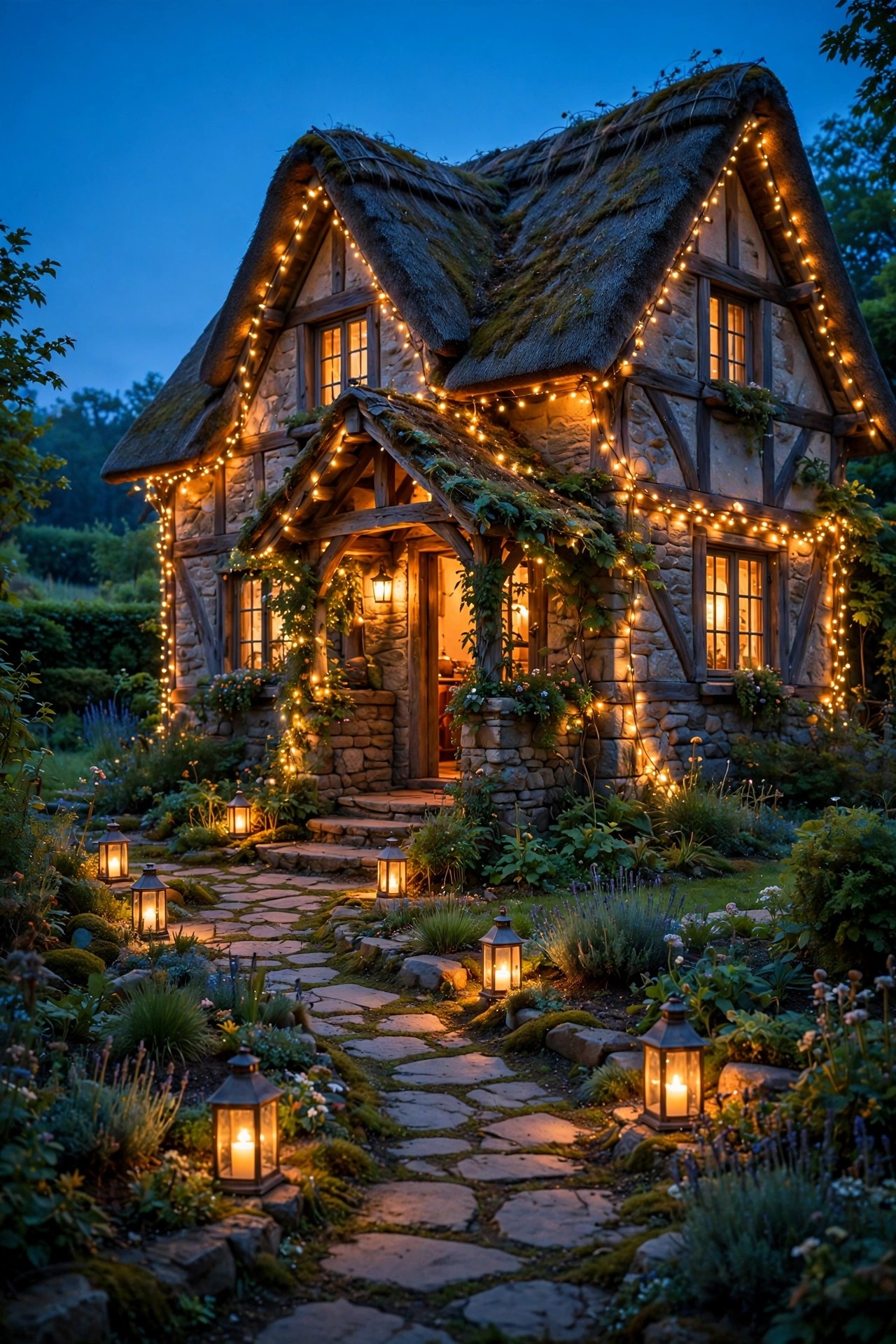
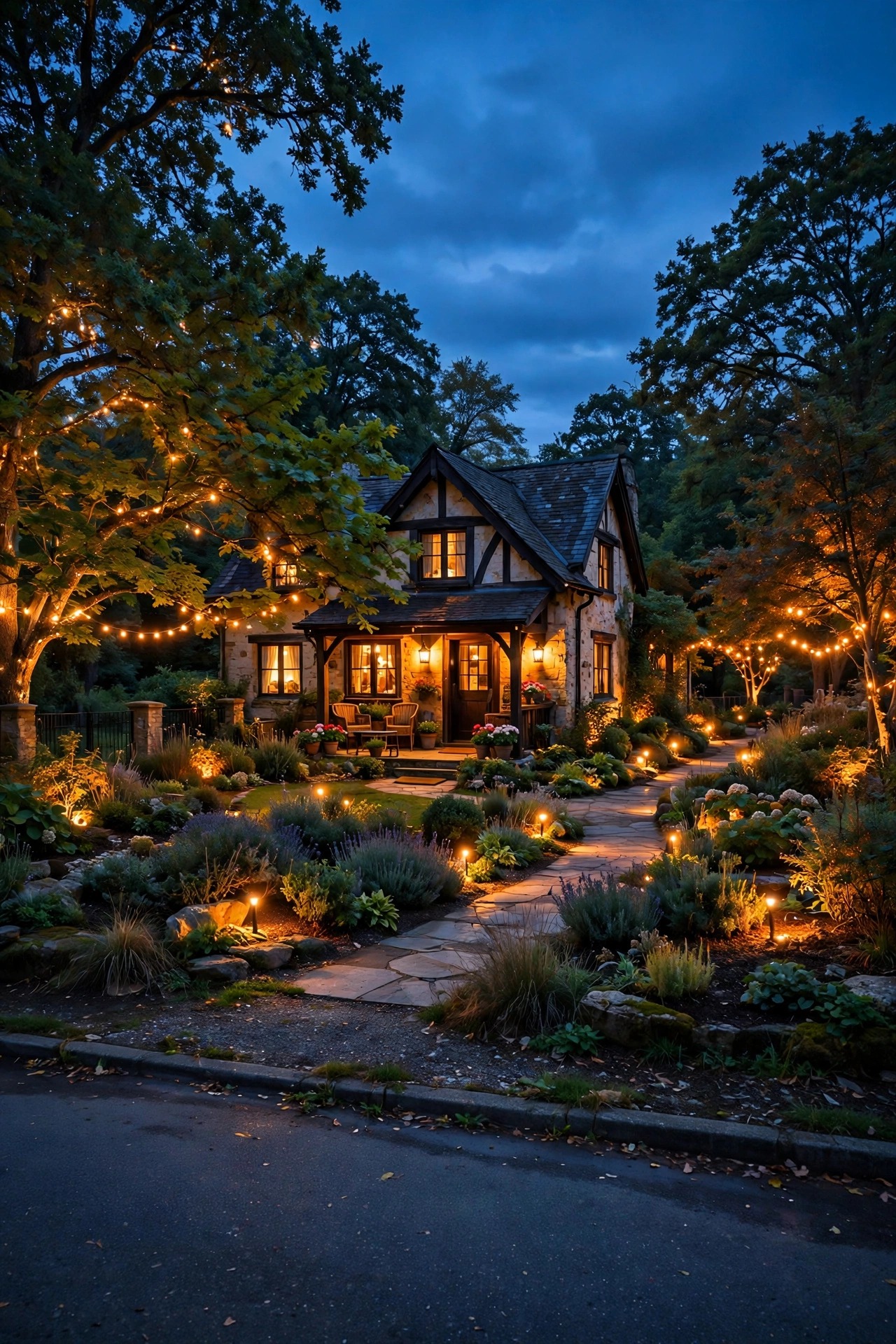
Before you buy a single bulb, sketch the yard in three layers, because every fairytale scheme that works follows this quiet structure. The low layer is sparkle: fairy lights in the beds, jar lights, and path lanterns under 18 inches tall that pool light on the ground where your feet need it. The middle layer is welcome: door lanterns, porch pendants, and step lights mounted between 3 and 6 feet, bright enough to read a house number and a smiling face. The high layer is pure atmosphere — string lights in the trees, a moonlighting fixture in one branch, a lantern swinging from an arch. Assign every purchase to one layer before it goes in the cart, and your cottage outdoor lighting ideas stop being a jumble and start being a composition. I go deeper on the planting side of this in my guide to rose and cottage garden lighting ideas, because the beds you light matter as much as the lights themselves. Stand at the street when you finish and squint: if all three layers hum at once, you have the glow.
Suggested budget range: $150 – $450.
2. Wrap a Small Tree in Copper-Wire Fairy Lights
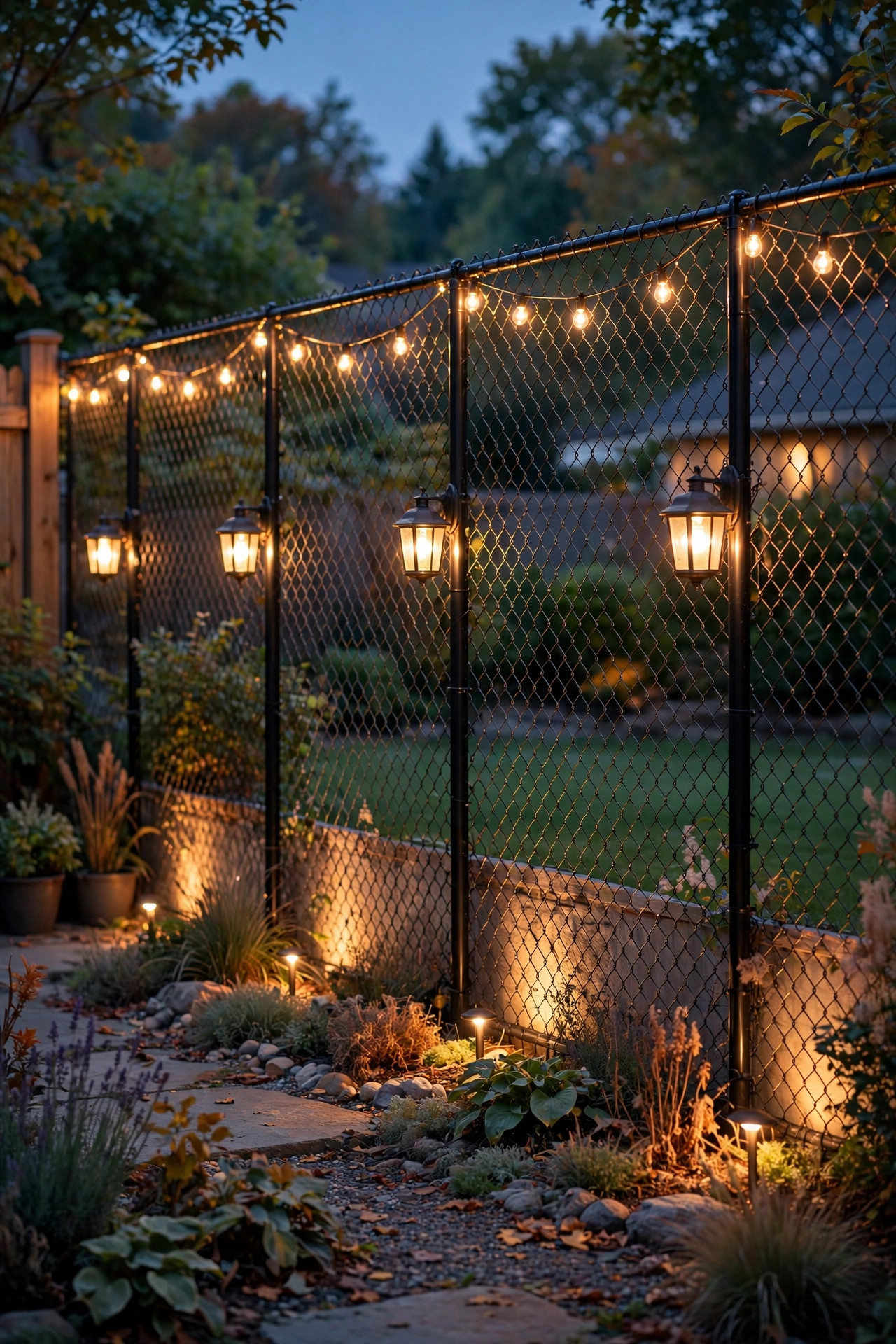
If a cottage yard has one small tree — a dogwood, a crabapple, a young maple — wrapping it is the highest-impact ten minutes in this whole list. Copper-wire fairy lights are the right tool: the wire nearly disappears against bark, the micro LEDs read as pure points of light, and a 33-foot strand with 100 lights handles most small trees. Start at the base of the trunk, wind upward with 3 to 4 inches between passes, then run out along two or three main branches, securing with loose garden ties rather than tight twists that girdle growth. Solar versions with the panel staked in a sunny spot save you the outlet math entirely, and in my experience the battery strands genuinely run six to eight hours after a decent day of sun. Keep the color warm white, never multicolor, and resist wrapping every tree — one lit tree is a focal point, five is a carnival. My roundup of outdoor fairy light ideas has more placement patterns if you want to compare the spiral wrap with a canopy drape before you commit.
Suggested budget range: $10 – $35.

3. Line the Garden Path With Low Lantern Stakes
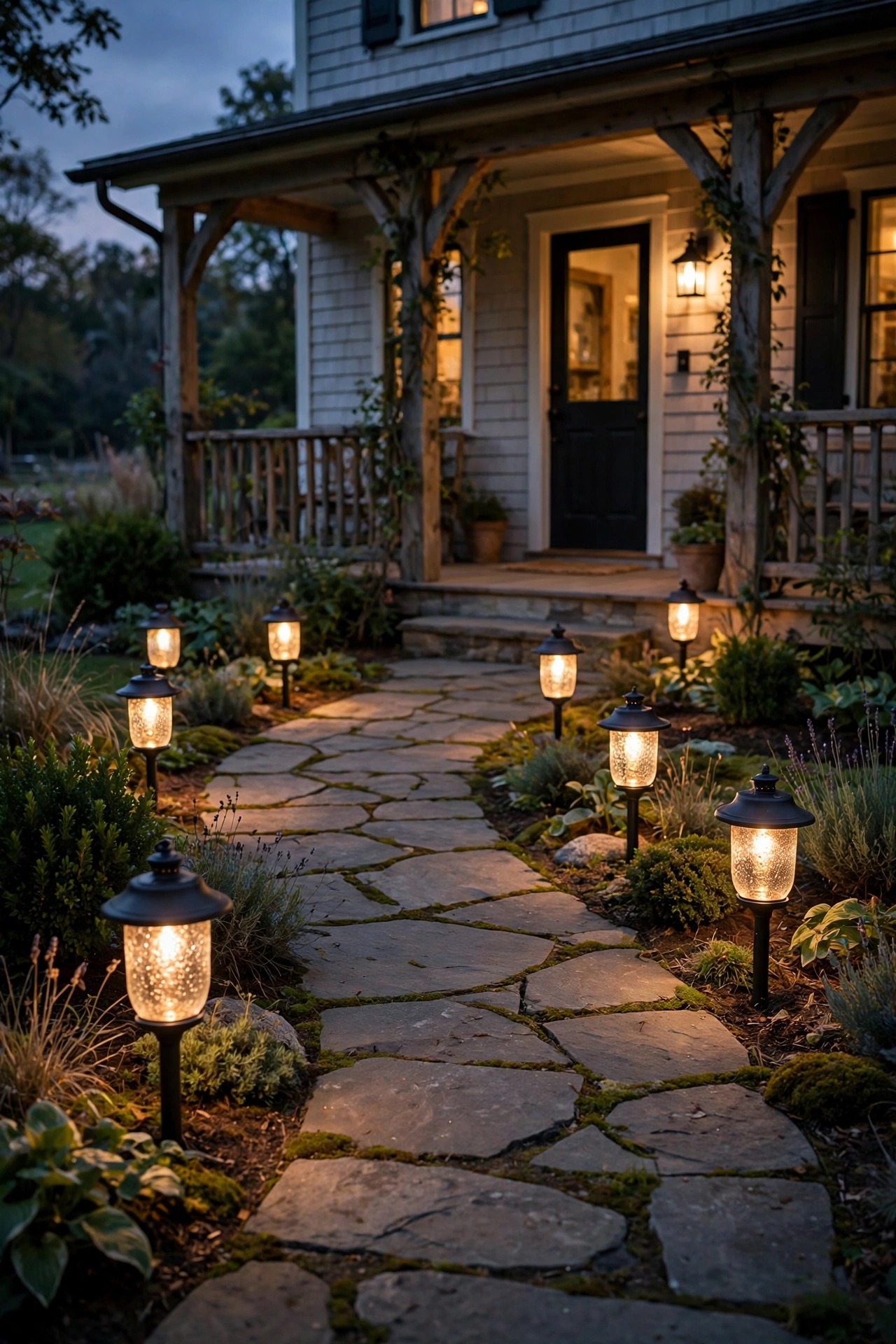
A cottage path should feel like it is showing you the way home, and low lantern-style stakes do that better than any other fixture I have tried. Choose stakes 12 to 18 inches tall with a little lantern head, warm 2700K output, and a real glass or seeded-look lens rather than bare bulbs. Space them 4 to 6 feet apart on alternating sides of the path — straight soldier rows look municipal, but a gentle stagger feels like the lanterns grew there. On curved paths, place a light at every outside bend, since that is where feet actually wander in the dark. Solar stakes are the easy default for a front walk with good sun; for a shaded north-side path, low-voltage wired stakes on one transformer stay honest all winter. Push each stake into loosened soil rather than hammering it, and check from the street after dark: you want pools of light on the stones, not a dotted line of glare in your eyes. It is the single most photographed trick in my own yard.
Suggested budget range: $40 – $120.
4. Screw Solar Mason Jar Lids Onto Pantry Jars
This is the project that converts skeptics. Solar mason jar lids — the kind with a little panel and a loop of fairy lights inside — screw onto standard jars you probably already own, and suddenly every shelf jar becomes a lantern. Coil the light strand loosely inside so it fills the glass instead of puddling at the bottom, set the jars where they catch at least five hours of sun, and by dusk each one glows like bottled fireflies. I line three along the porch rail, hang two from hooks on the fence, and keep one on the outdoor dining table where it survives every breeze that kills a real candle. Group odd numbers — threes and fives — for that collected-over-time cottage feel. Because there is no wiring and no flame, these are the safest lights in the whole post around kids, pets, and dry mulch. Wash the jars monthly; dusty glass dims the effect more than people expect. Total hands-on time for a set of six is under twenty minutes.
Suggested budget range: $15 – $40.

5. Drape Café String Lights Over a Garden Arch
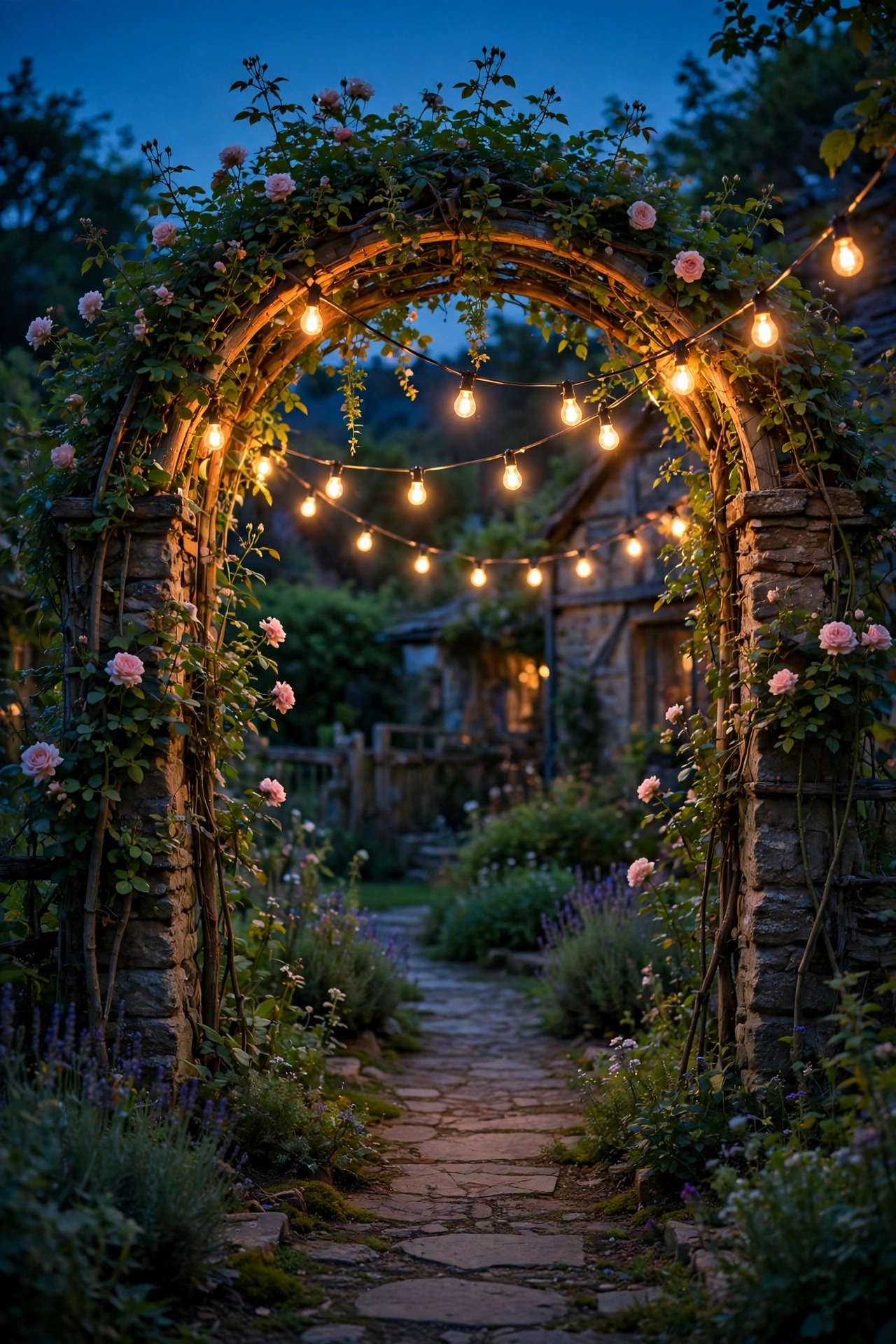
Every cottage garden deserves one threshold moment, and a rose arch or simple arbor draped in café string lights is mine. Run one strand of shatterproof LED café bulbs along each side of the arch and swag a third across the top, letting the bulbs hang 6 to 8 inches below the beam on their drops. Use outdoor-rated strands with a proper plug and connect no more than the manufacturer allows end-to-end — usually three to five strands — and always plug into a GFCI outlet. Guide wires or simple cup hooks every 18 inches keep the swags even when the climbing roses start pulling their weight in June. The bulbs should be warm 2200K to 2700K filament style; daylight-white café strings are the fastest way to make an arch look like a used-car lot. Set the whole arch on a plug-in timer for dusk to 11 p.m. and the entry to your garden lights itself every single evening without you remembering a thing. Walking through it with a cup of tea is, honestly, the entire point.
Suggested budget range: $45 – $130.
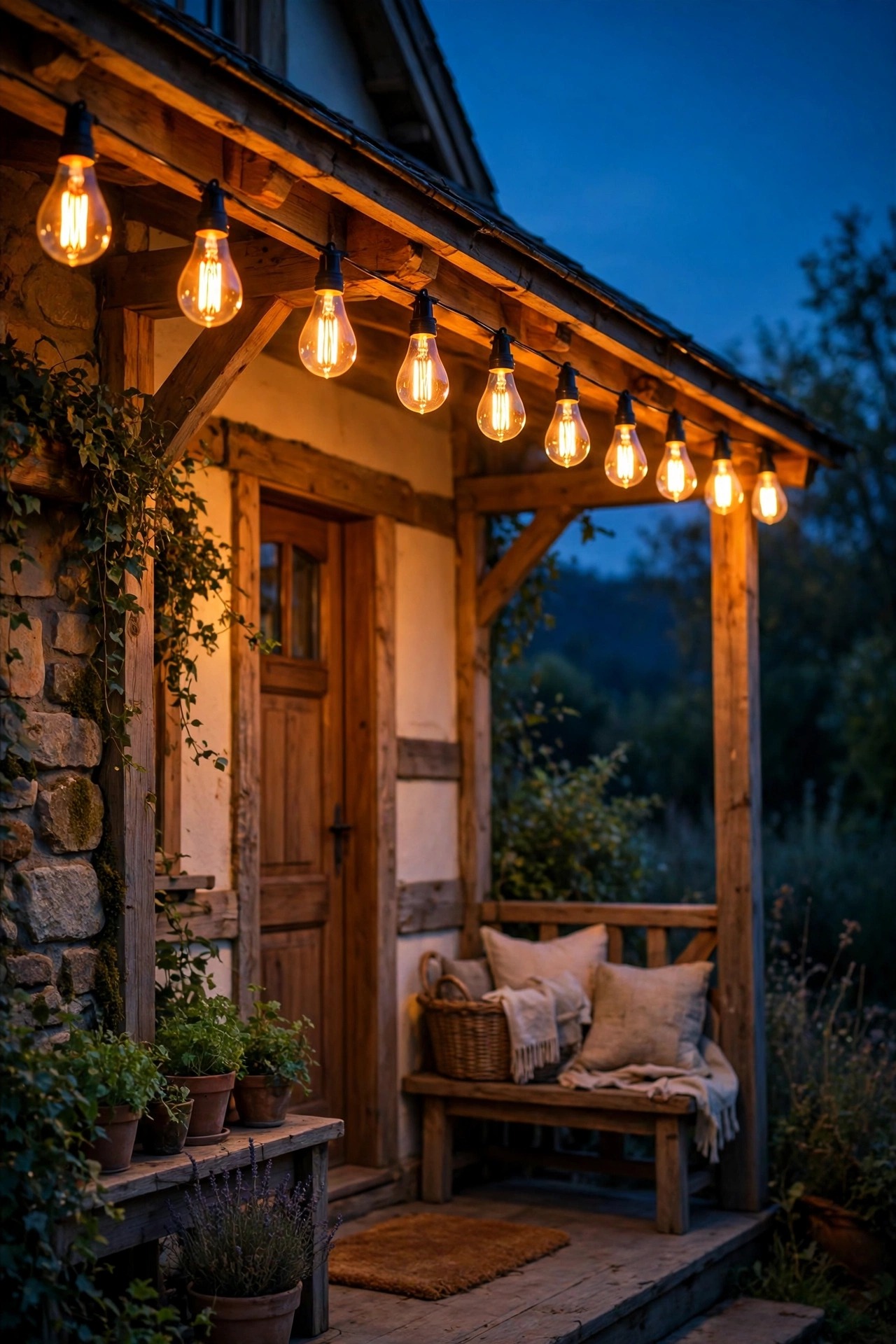
6. Flank the Front Door With a Vintage-Style Wall Lantern
The front door is where a cottage makes its promise, so give it one beautiful fixture instead of a builder-grade porch light. A vintage-style wall lantern — black or aged-bronze frame, seeded glass, a visible filament bulb — suits cottage architecture in a way modern sconces simply do not. Size it generously: the lantern should stand roughly a quarter to a third of your door height, so 18 to 24 inches for a standard door, mounted with the bulb near 66 inches from the porch floor. One lantern beside the door is classic cottage; a matched pair feels grander and lights faces evenly for guests and package cameras alike. Choose a fixture rated for wet locations even under a porch roof, because wind drives rain sideways more often than you would think. Put it on a dimmer or choose a 40-watt-equivalent bulb — door lights are welcome lights, not interrogation lights. Swap the bulb to a flame-tip or Edison filament style in winter and the whole entry reads as candlelit.
Suggested budget range: $60 – $180.

7. Tuck Micro Lights Into the Window Boxes
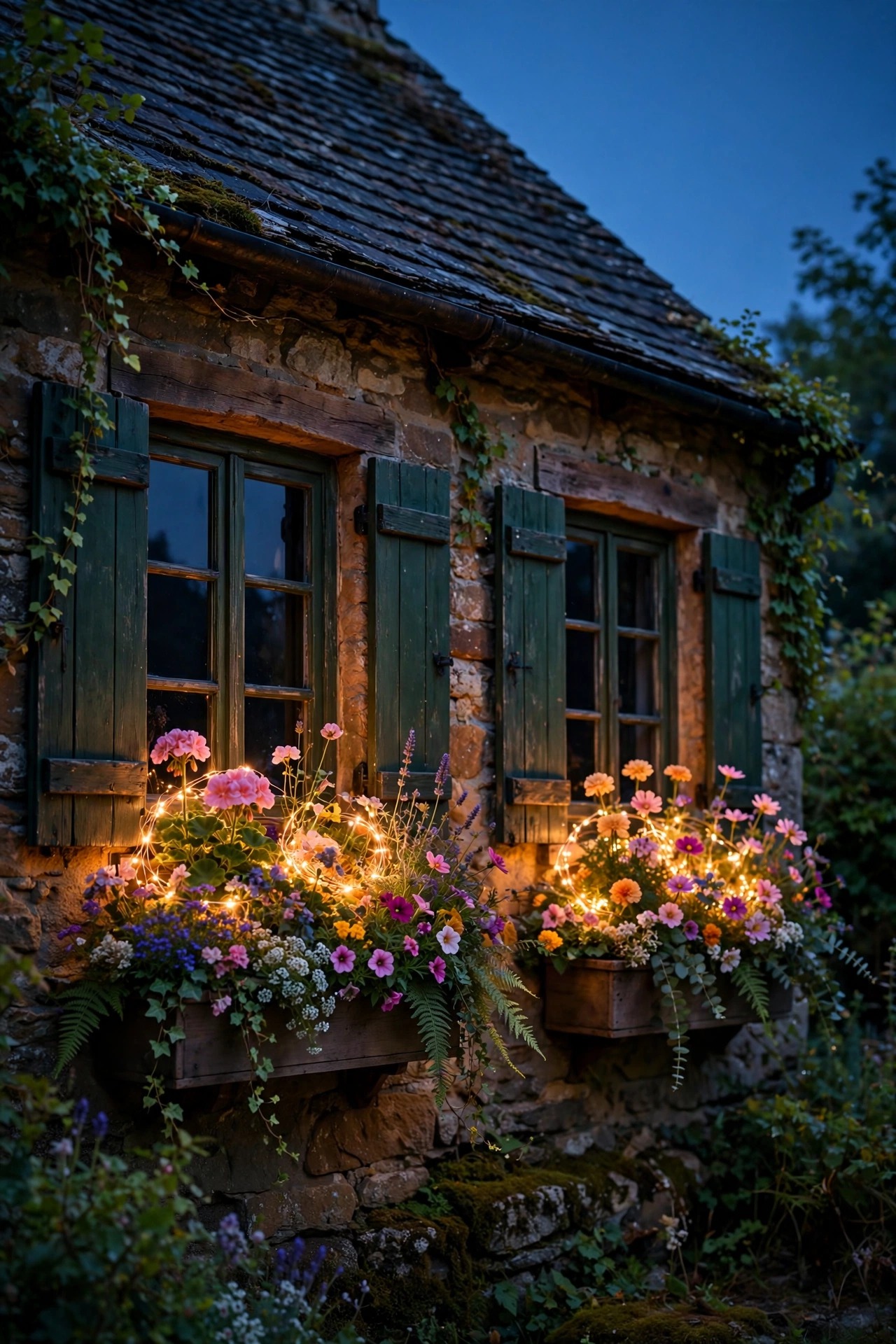
Window boxes are pure cottage, and a strand of battery micro lights woven through the geraniums turns them into floating lanterns after dark. Use the thinnest copper-wire strand you can find — 10 to 20 lights per box is plenty — and thread it loosely through the foliage so only the glow shows, never the wire. Battery packs with a built-in six-hour timer are the secret here: set them once and the boxes light themselves at dusk and shut off before bed, and one set of batteries lasts me most of a season. Tuck the pack under the box or behind a trailing plant where it stays dry and invisible. This is a low-light idea on purpose; the flowers should look lit from within, like a painting, not outlined like a parade float. It works just as beautifully in winter with evergreen boughs and pinecones swapped in for the summer annuals. From the street, three glowing window boxes make a small cottage look absolutely storybook.
Suggested budget range: $10 – $30.
8. Pour Light From a Vintage Watering Can
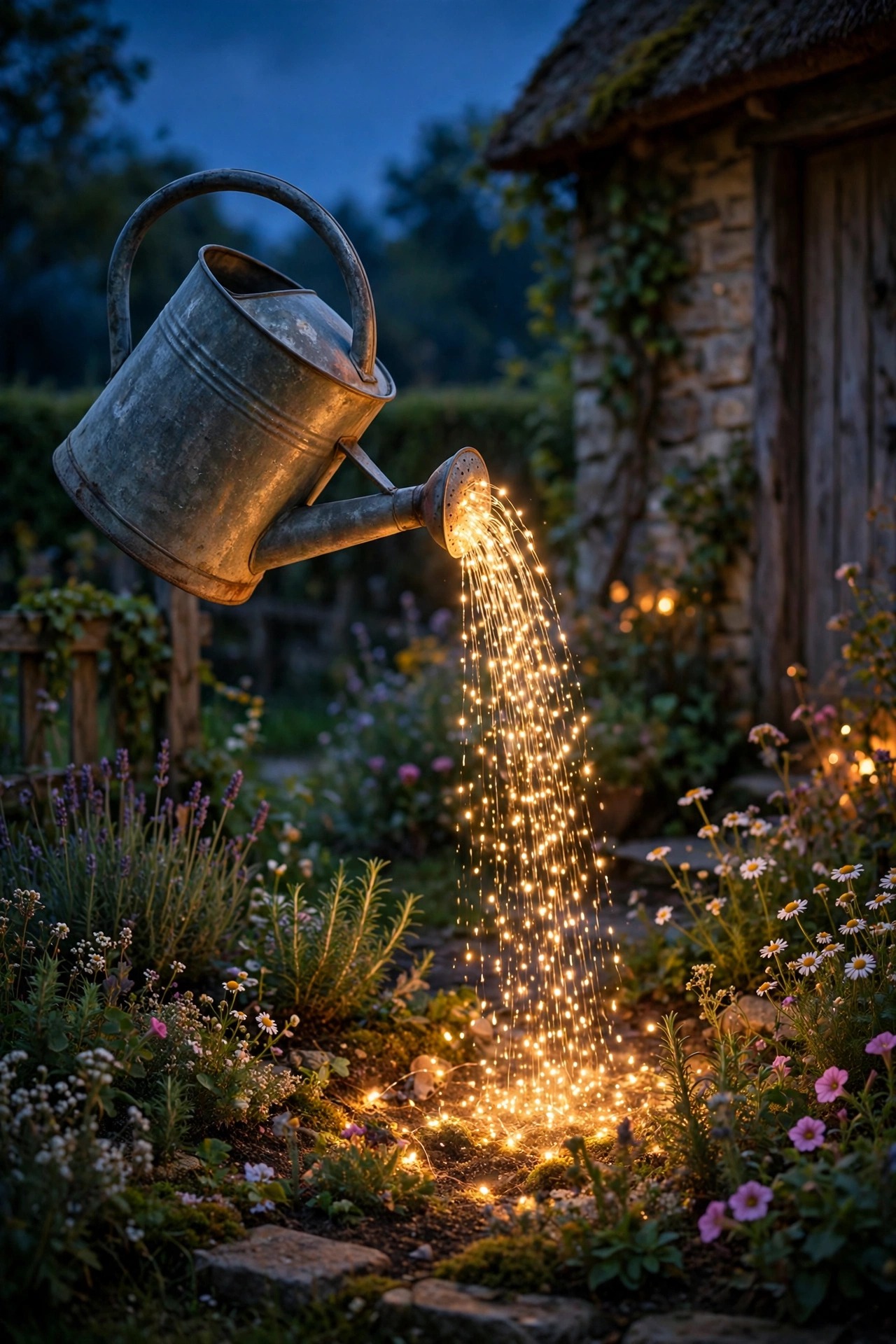
This little illusion stops every guest who walks my path. Mount a vintage-style metal watering can above a flower bed — tilted on a shepherd's hook or a small bracket — and thread a strand of solar micro lights through the spout so the lights spill out and cascade down into the flowers like a stream of glowing water. The trick is density: use a 100-light strand and let most of it pour, pooling the excess loosely in the bed below so it reads as splashes. Solar is ideal because the can usually sits far from an outlet, and the panel can hide in the bed behind it. Galvanized and copper cans both suit the cottage look; just drill nothing and modify nothing you would miss, since thrift-store cans work perfectly and cost almost nothing. Keep the cascade warm white and fairly tight — a wide scatter reads as a spilled strand, a narrow pour reads as magic. It takes twenty minutes to install and earns compliments all summer.
Suggested budget range: $20 – $50.
9. Fake Moonlight From One High Tree Branch
Moonlighting is the most natural-looking light in any yard, and it takes exactly one fixture: a shielded downlight mounted 15 to 20 feet up in your largest tree, aimed through the branches so the light breaks into dappled pools on the lawn and path below. The branches do the artistry — every leaf becomes a stencil — and because the source is hidden overhead, the effect reads as a full moon that shows up every night. Use a cool-neutral bulb here, around 3000K to 3500K, the one place in a cottage scheme where slightly cooler light actually helps the illusion; everything at ground level stays warm. Hire an electrician or arborist for the mounting if heights are not your thing, and use a fixture with a long glare shield on a proper tree-mount strap that can be loosened as the trunk grows. This is low-voltage territory, so the cable run is forgiving. Under a moonlit tree, even plain lawn furniture looks enchanted.
Suggested budget range: $120 – $350.

10. Nestle Fairy Light Strands Through the Flower Beds
Flower beds are where fairytale light lives closest to the ground. Take a copper-wire strand and weave it loosely through the plantings at foliage height — in and out of hostas, around the base of roses, along the front edge of the border — so the bed glows in scattered clusters instead of a hard outline. I use one 33-foot solar strand per 8 to 10 feet of bed and let it meander rather than measuring anything; cottage charm is deliberately imperfect. The little solar panel stakes at the back of the bed where leaves hide it by day. What you are after is depth: a few lights deep in the bed, a few at the edge, so the whole planting has dimension after dark instead of a flat silhouette. Keep strands off the soil surface where mulch and moisture shorten their life, and lift them onto small plant stakes in soggy spots. Mixed with the path lanterns from earlier, a lit bed makes the whole front yard feel like a garden room.
Suggested budget range: $12 – $35.

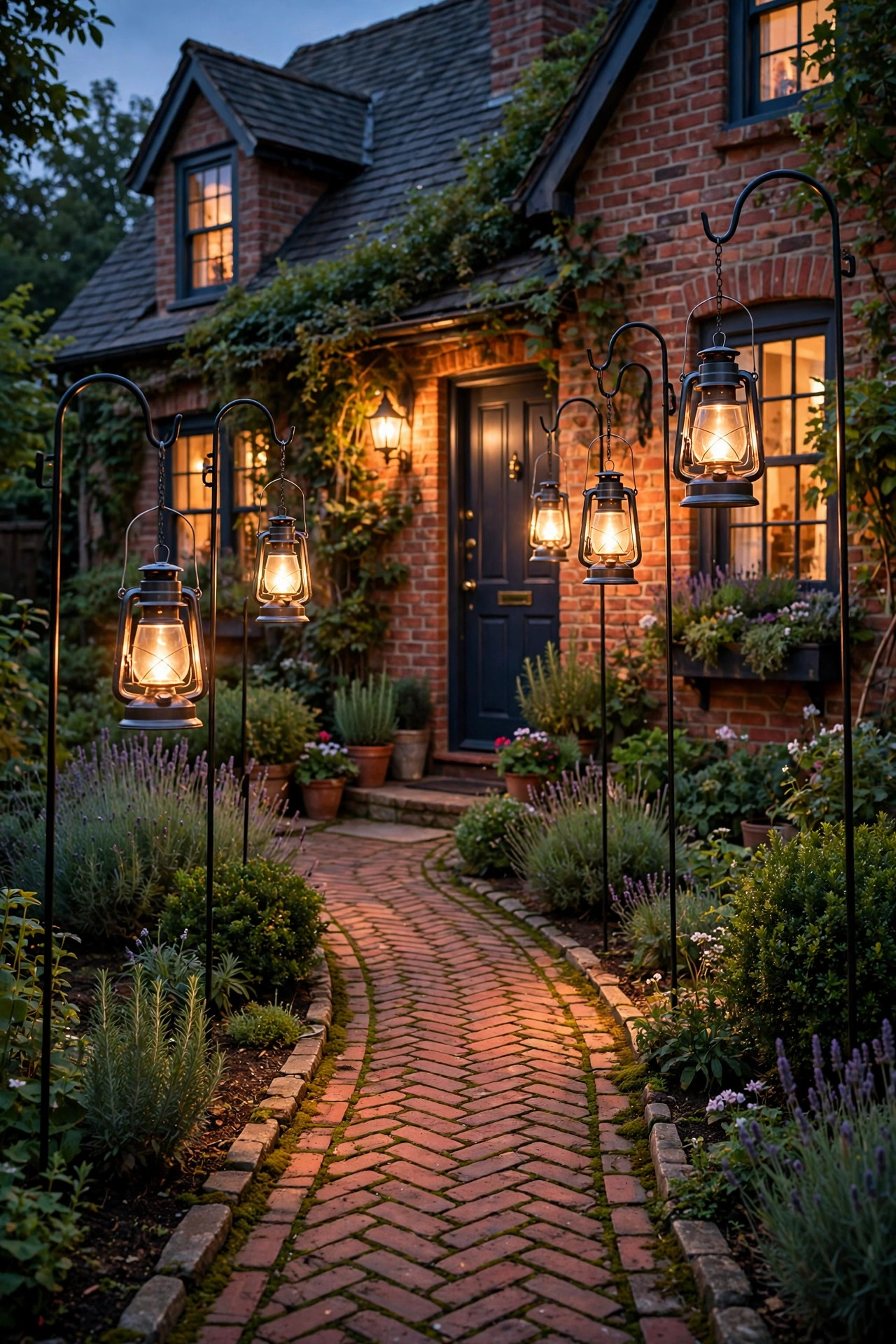
11. Hang Lanterns From Shepherd's Hooks Along the Walk
Shepherd's hooks are the cottage gardener's chandelier arms: inexpensive, movable, and charming anywhere. Push 48-inch hooks into the ground along a walk, at a bend in the path, or flanking the porch steps, and hang a lantern from each — solar lanterns with a warm flicker mode are my favorites because they light themselves and sway just slightly in the evening breeze. Vary the heights a touch, 42 inches on one side and 48 on the other, so the row feels gathered rather than installed. Make sure hooks stand in loosened soil and lean slightly back against the lantern's weight; a wobbly hook ruins the spell. For more shapes and finishes that suit this look, my collection of hanging lantern ideas for outdoors is where I send friends who cannot decide between punched tin, glass, and woven styles. Flameless candle lanterns work here too and laugh at wind, but charge their batteries where you will actually see the reminder — mine live on the kitchen counter.
Suggested budget range: $35 – $110.
12. Cluster Paper Lanterns Under the Porch Roof
For a porch ceiling, nothing softens light like paper. Outdoor-rated nylon lanterns — they read as paper but shrug off weather — in cream, blush, and pale sage, hung at staggered heights from the porch beams, turn a plain ceiling into a floating garden party. Run one string-light strand through the row with a small bulb inside each lantern, keeping total wattage modest; the shades diffuse everything into a single gentle glow. Cluster in odd numbers over the seating area rather than spacing them in a line down the whole porch, and keep the lowest lantern at least 7 feet off the floor so tall guests stay comfortable. Battery lanterns with remote controls are the low-effort version and honestly look just as good for a season. This is party lighting that earns a permanent place, because on an ordinary Tuesday the porch still feels like somewhere you meant to be. Take nylon lanterns down for winter storms and they will last for years.
Suggested budget range: $25 – $80.

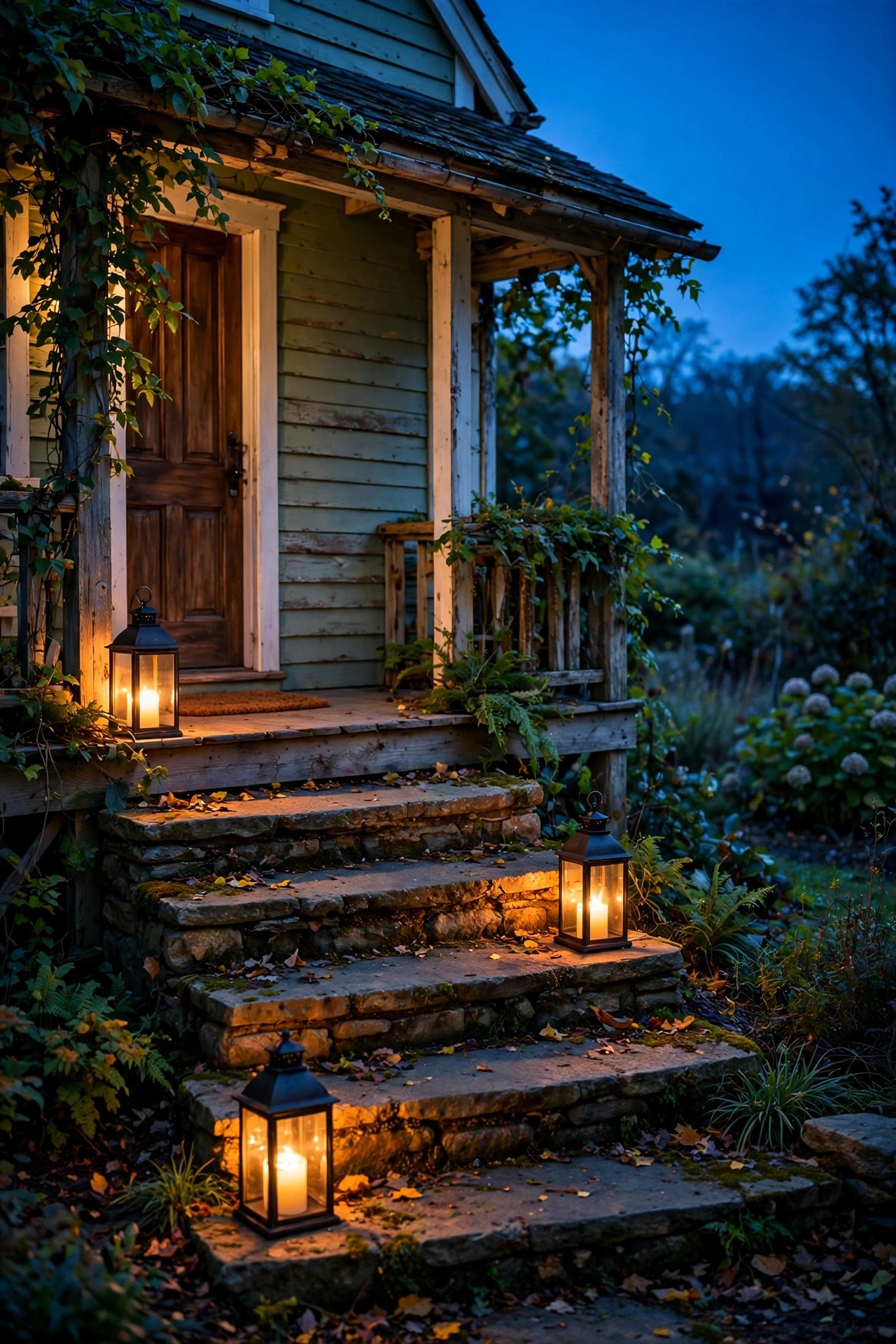
13. Set Flameless Candle Lanterns on the Steps
Steps are a safety problem wearing a decorating opportunity. A flameless candle lantern on alternating treads marks every rise without a wire in sight, and the flicker makes a plain stoop feel like the entrance to somewhere in a storybook. Choose lanterns with timers — five hours on, nineteen off — and set them all at the same moment so the whole staircase wakes and sleeps together. Real candles in glass hurricanes are lovely for a party, but for nightly duty the LED versions win on safety alone: no flame near dry leaves, no wax on the stones, no relighting after a gust. Scale matters; steps look best with lanterns 8 to 12 inches tall, big enough to read from the street but small enough to leave walking room on each tread. In autumn I tuck a few mini pumpkins and pinecones around the bases, and in December the same lanterns carry cedar sprigs. Practical and pretty in one move — my favorite kind of idea.
Suggested budget range: $30 – $90.
14. Uplight One Garden Statue or Sundial
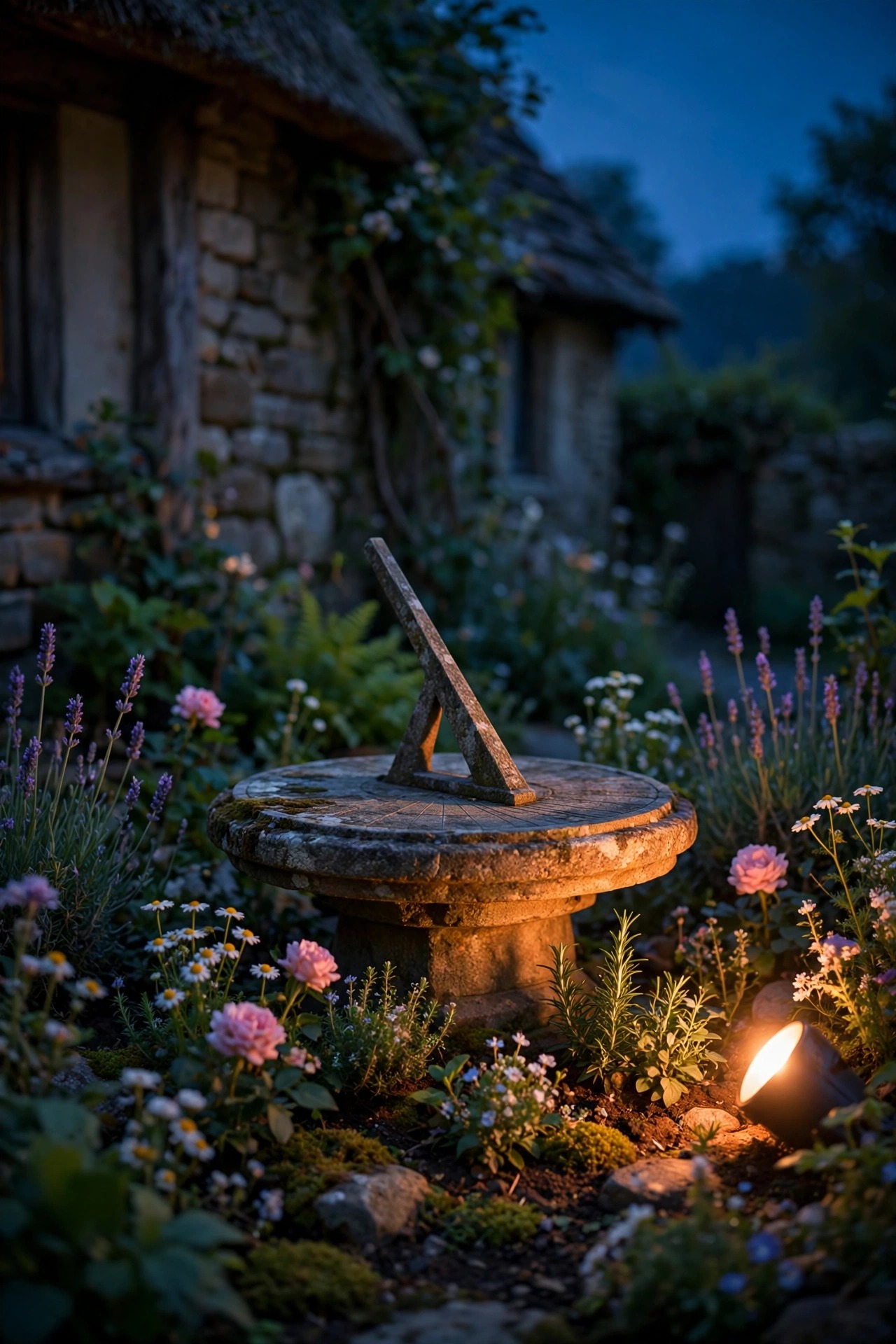
Every cottage garden hides one treasure — a sundial, a stone rabbit, a birdbath with good bones — and a single low spotlight turns it into the evening's main character. Use one warm 2700K spot on a short stake, set 12 to 18 inches in front of the piece and angled up at about 30 degrees, so the light grazes the texture instead of blasting it flat. Cross-lighting from slightly off-center models stone and metal far better than a straight-on beam. Keep the fixture itself hidden behind a tuft of ornamental grass or a low boxwood so guests see the glow, never the hardware. Low-voltage spots on the same transformer as your path lights make this a twenty-minute add-on, and solar spotlights have honestly gotten good enough for a small piece in a sunny bed. Choose just one focal point per view; a yard where everything is featured is a yard where nothing is. Rotate the honor seasonally if you have several pieces you love.
Suggested budget range: $25 – $75.
15. Plant Firefly Jar Stakes Among the Hostas
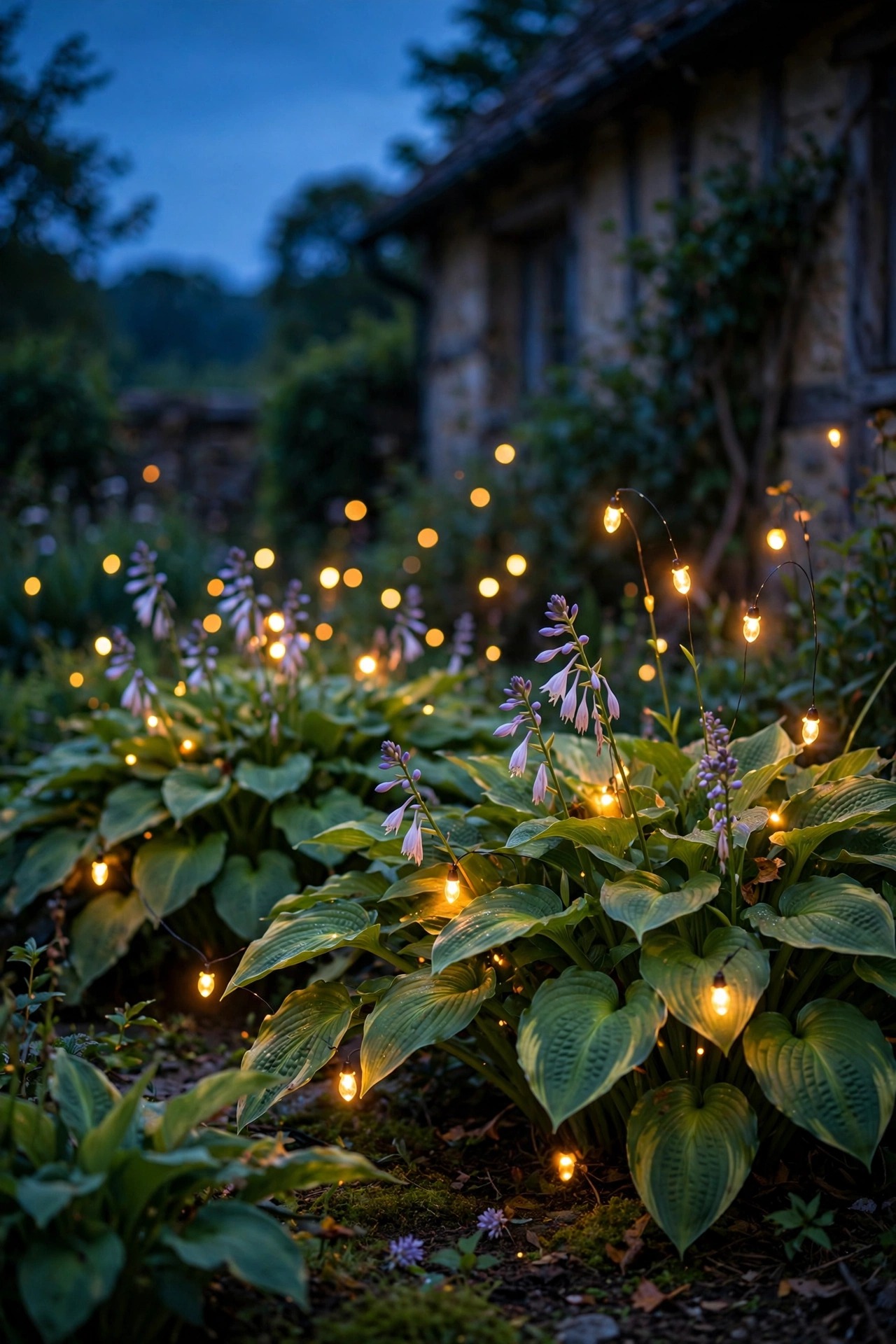
Firefly lights are the most literal fairytale fixture ever sold: a small solar jar or a swaying stem of tiny warm LEDs that drifts gently in the breeze exactly the way real fireflies hover. The stem versions, sold in bunches of six to ten lights on flexible wires, are my preference — stake the bunch at the back of a hosta clump or ornamental grass, bend each stem to a slightly different height and angle, and at dusk the whole plant appears to host its own swarm. Solar panels charge all day from the same stake, so installation is genuinely just pushing them into the soil. Keep expectations right: these are pure sparkle with almost no useful light, which is exactly their job. Two or three bunches scattered through a long bed beat a dozen in a row, because real fireflies never formed a line in their lives. In beds near the street, they start more sidewalk conversations than any other light I own.
Suggested budget range: $15 – $45.
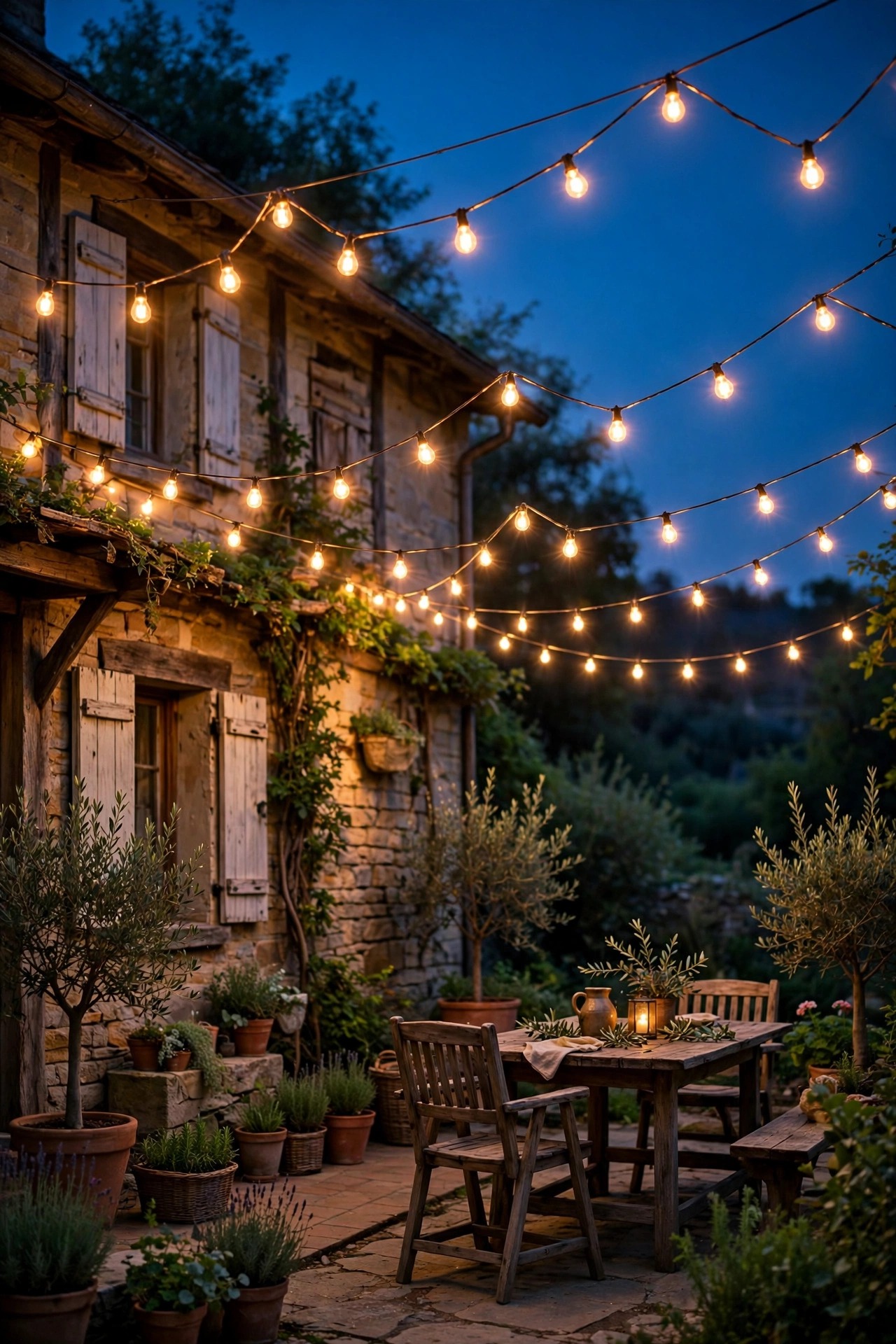
16. Zigzag a String Light Canopy Over the Patio
A cottage patio under a zigzag canopy of café lights is the closest thing to dining inside a snow globe, minus the snow. Anchor strands between the house eave and two poles or trees at 9 to 10 feet high, and zigzag three to five runs across a typical 12-by-14-foot patio so the light feels even everywhere you sit. Install proper guide wire if the spans top 15 feet — string light strands alone will sag and strain their sockets by July. Keep bulbs on 18 to 24 inch spacing for a soft canopy rather than a dense ceiling, and again, warm filament-style LEDs only. One dimmer on the circuit is worth every penny: full brightness for serving dinner, half for dessert, a quarter for the last glass of wine under the stars. Mind the drip line of any tree anchors after rain, and give the whole canopy a gentle shake-down inspection each spring. It is the hardest-working fifteen feet of wire in my yard.
Suggested budget range: $60 – $180.
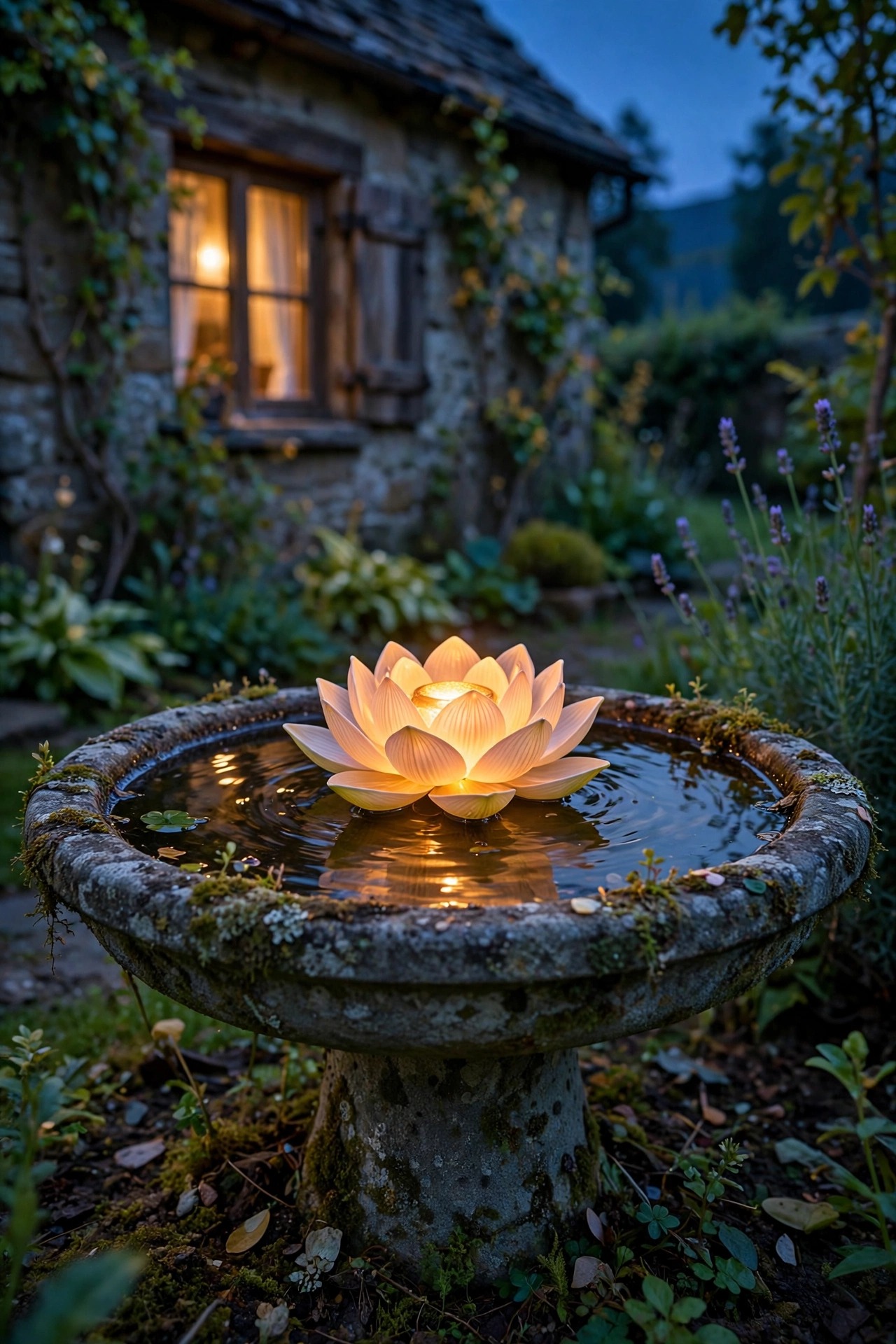
17. Float Light in the Birdbath
Water doubles every light it touches, and a cottage birdbath is the easiest water feature of all. A small floating solar light — they look like little lotus flowers or simple glowing orbs — dropped into the birdbath turns it into a shimmering lantern the moment the sun sets, with ripples doing all the animation for free. Submersible solar puck lights work too and glow up through the water for a deeper effect. Keep the water fresh for the birds just as you normally would; the lights are sealed, waterproof, and lift out in one second for cleaning. If your birdbath sits in full shade, choose a model with a separate little solar panel on a short cord that you can stake into a sunny patch nearby. Place the bath within sight of the porch or a window, because this is a light you enjoy from inside the house as much as outside. On a still evening, the reflection alone is worth the twelve dollars.
Suggested budget range: $12 – $35.
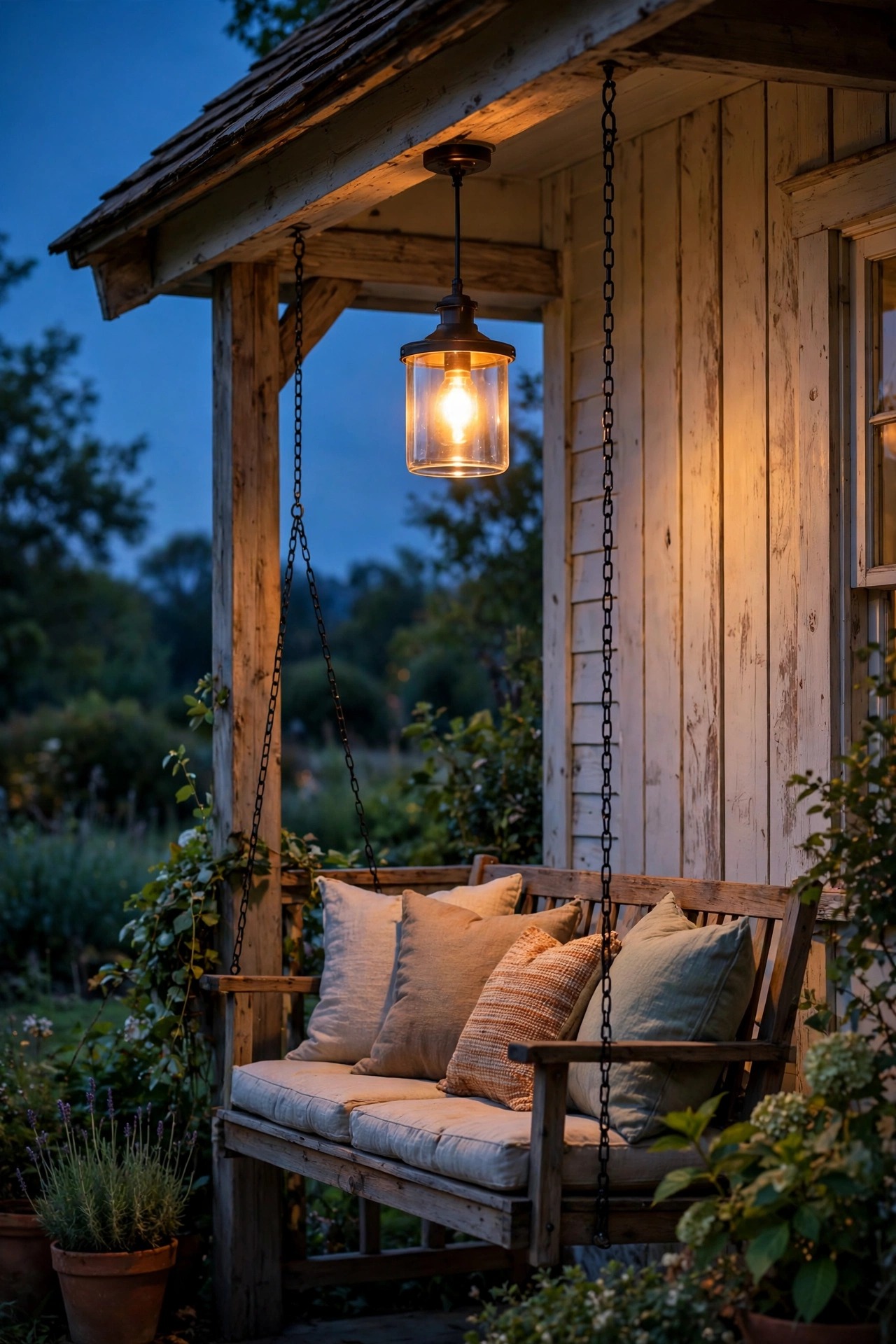
18. Hang a Pendant Over the Porch Swing
A porch swing deserves its own pool of light the way a reading chair deserves a lamp. Hang one pendant — a woven-look shade, a seeded-glass lantern, or a simple metal barn shade in miniature — centered over the swing at about 6.5 to 7 feet from the porch floor, low enough to feel intimate but high enough to clear heads when the swing is moving. Hardwired is cleanest if the junction box exists; if not, a plug-in pendant on a swag hook with the cord run neatly along the beam looks intentional and stays renter-friendly. Keep the bulb small and warm — 40-watt equivalent at 2700K — because the light sits close to faces, and put it on a dimmer if you can. This is reading light, cocoa light, long-conversation light. Pair it with the step lanterns and the door lantern and the porch becomes a fully layered room of its own, which is precisely how a cottage porch should behave.
Suggested budget range: $50 – $160.
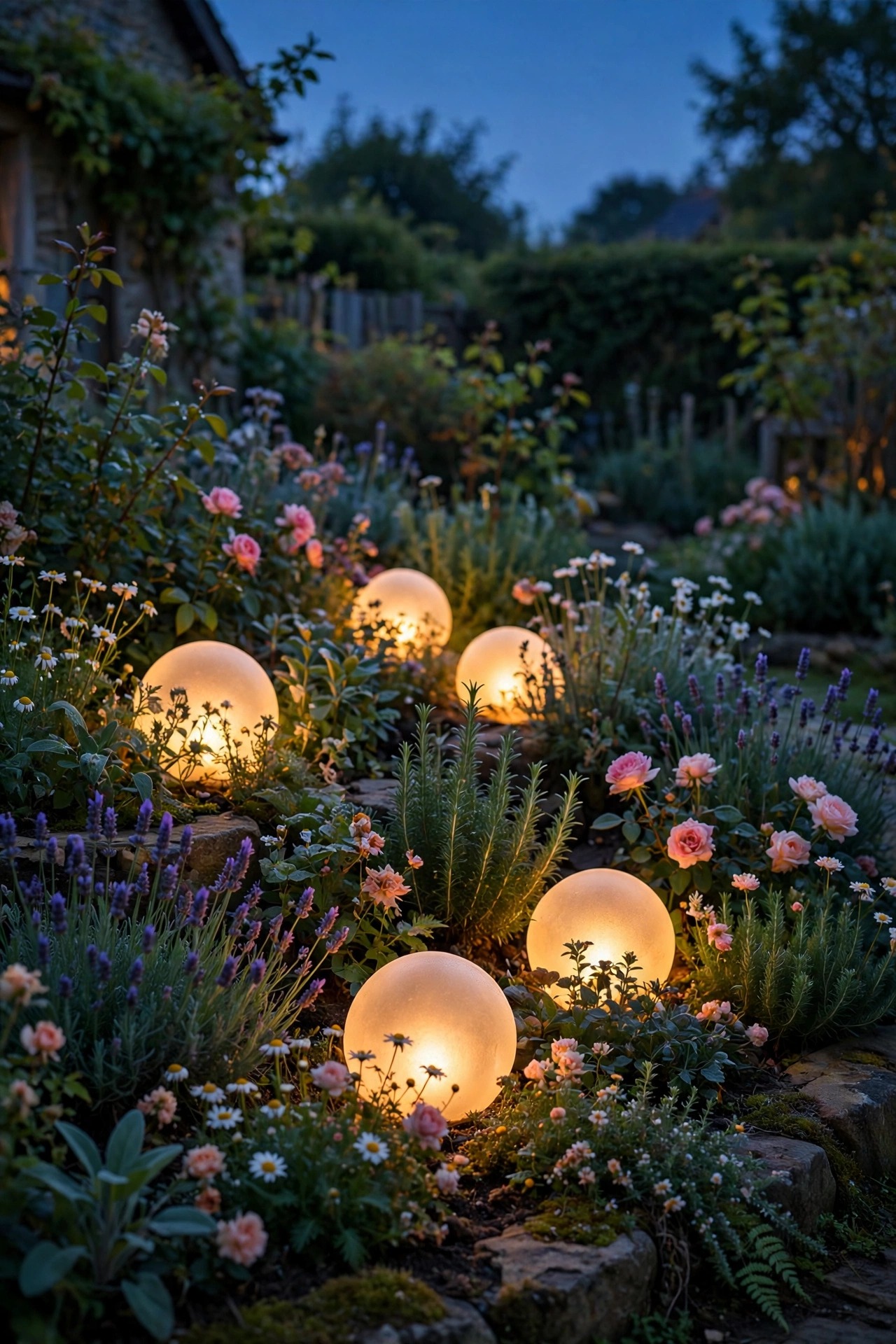
19. Scatter Glowing Garden Globes in the Beds
Glowing orbs tucked into planting beds look like moons that landed softly in the flowers, and they might be the easiest fairytale effect on this list. Frosted glass or matte resin globes from 6 to 12 inches across, solar or battery powered, nestled at the base of shrubs and among groundcover, give a bed instant focal points. Use the rule of odd clusters: one large globe alone near a path bend, three of mixed sizes gathered under a small tree. Bury the little solar stake or panel edge in mulch so only the sphere shows. Solar globes have a lovely habit of looking like pale stones by day, so the garden keeps its dignity in daylight. Warm white only — color-changing orbs belong to a different, louder garden. Because they sit low and wide, globes also quietly mark bed edges along a dark walk, which your ankles will appreciate in October. Rinse them when you water; dust creeps up fast at ground level.
Suggested budget range: $20 – $70.
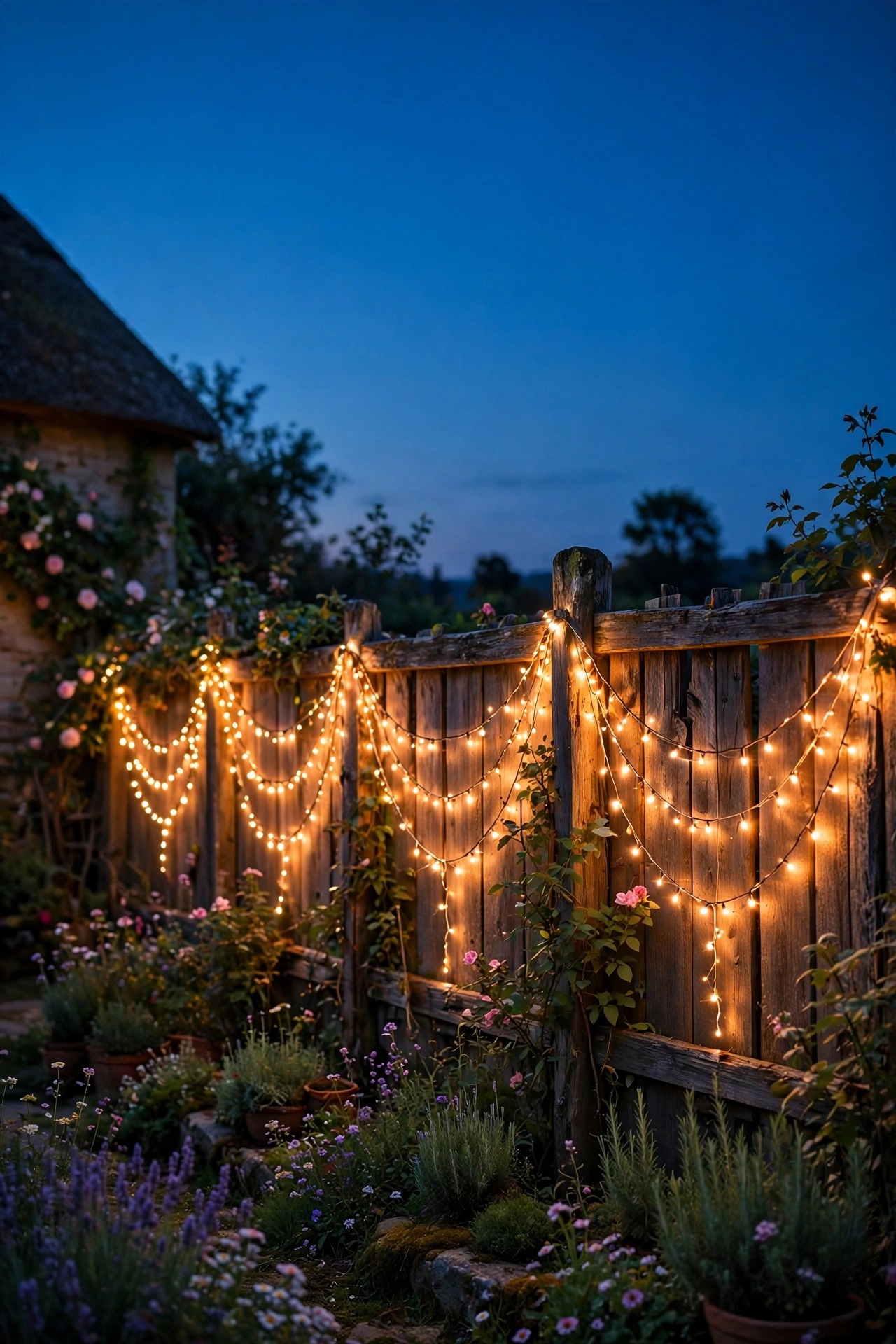
20. Weave a Fairy Light Curtain Along the Fence
A plain fence is the biggest blank canvas in a small yard, and a curtain of fairy lights turns it into the backdrop of the whole garden. Net-style lights made for bushes work beautifully draped along a fence run, or thread two long strands in loose swags between hooks every 4 feet for a softer, handmade rhythm. Keep the swags high — bottom edge around 4 to 5 feet — so the light frames the garden instead of trailing in the plantings. This is atmosphere lighting, best behind seating or a dining corner where it glows over shoulders in every photo anyone takes. Solar strands need their panels on the sunny side of the fence, which is worth planning before you hang anything. I keep my curtain on the same timer as the patio canopy so the whole back garden wakes up as one scene. From the porch, a lit fence makes a small yard feel twice as deep, because your eye travels to light instead of stopping at shadow.
Suggested budget range: $18 – $55.
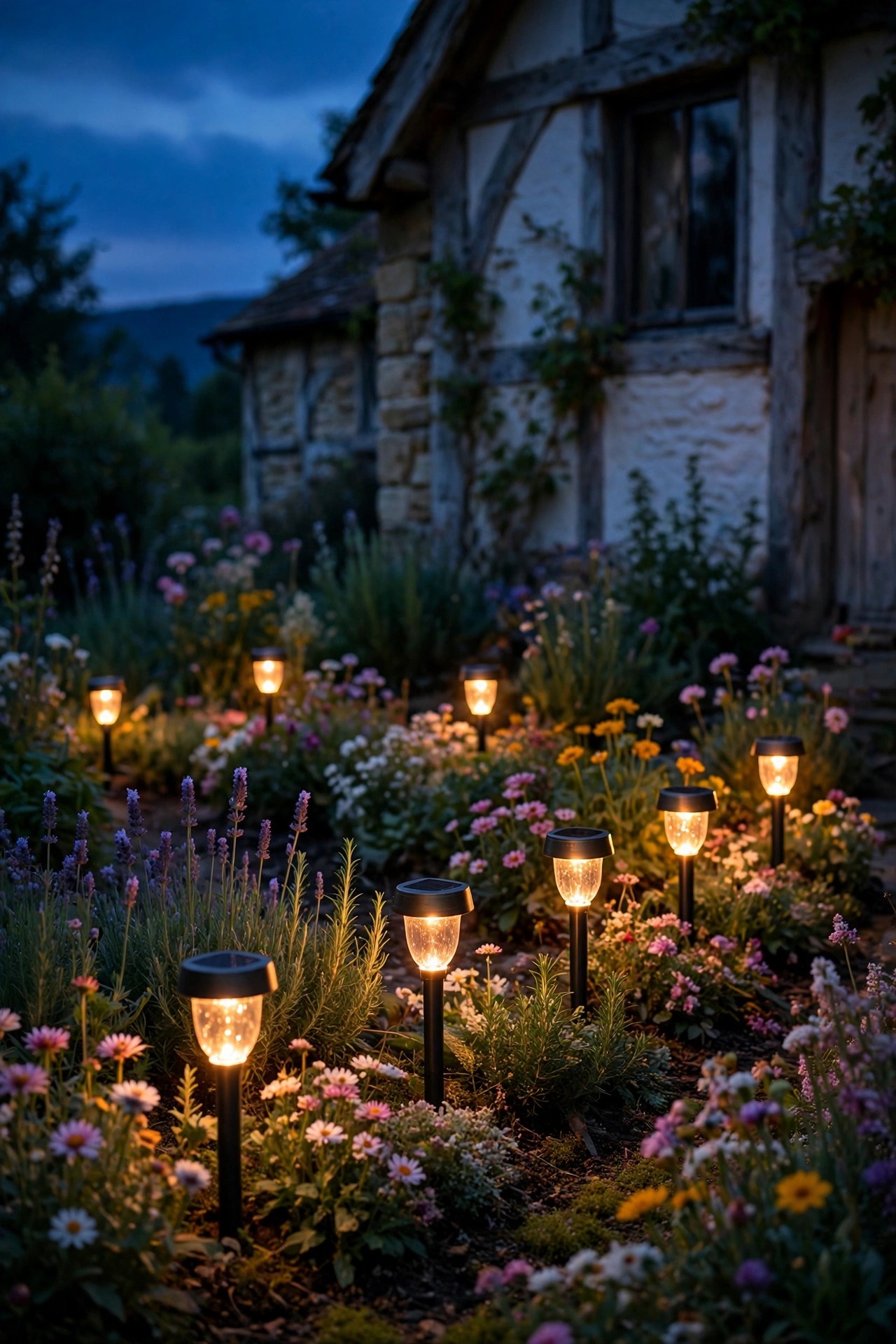
21. Edge the Cottage Beds With Short Solar Stakes
Not every bed needs drama; some just need a hem. Short solar stakes, 10 to 14 inches tall with simple warm bulbs, spaced 3 to 4 feet apart along the front edge of a border, give plantings a finished outline and quietly show guests where lawn ends and garden begins. The cottage secret is restraint in the fixture itself: plain black or copper-finish stakes with a humble little cap disappear by day, where novelty shapes — butterflies, plastic flowers, gnomes holding lamps — fight the plants for attention. Mix heights slightly by pushing some stakes an inch deeper on a slope so the tops stay level. Solar stakes are honest workers in sunny borders and disappointing in deep shade, so save them for beds with five-plus hours of sun and use wired or fairy lights in the shadowy ones. After the first season, pull the stakes for a week of winter rest if your winters are harsh; the batteries will thank you with a longer life.
Suggested budget range: $20 – $60.
22. Keep Every Bulb at One Warm Temperature
Here is the discipline that separates a fairytale yard from a yard sale: pick one color temperature and hold the whole property to it. For cottage schemes that means 2200K to 2700K everywhere — candlelight to soft lamplight — because a single 5000K daylight bulb in the mix shatters the spell instantly and makes every warm light near it look broken. When you buy replacements, match the Kelvin number on the box, not the words on the front, since one maker's "warm white" is another's "soft white" at a completely different temperature. The one planned exception is the moonlighting fixture up in the tree, a touch cooler on purpose so it reads as moon rather than lamp. Do a bulb audit some evening with fresh eyes: walk the street side and the garden side, and any fixture that looks blue, green, or office-white gets swapped that weekend. It costs almost nothing — most of us already own the right bulbs, just in the wrong fixtures — and it unifies everything else on this list.
Suggested budget range: $10 – $40.
23. Put the Whole Yard on Timers and Photocells
A fairytale that depends on you remembering a switch is a fairytale that happens twice a month. Photocell plugs and simple dusk-to-dawn timers take the whole scheme off your mental list: lights breathe on at sunset, off at bedtime or dawn, every day of the year. My setup is unglamorous and perfect — the wired strands and transformer live on one outdoor timer set to dusk plus six hours, and the solar pieces handle themselves. Smart plugs add scheduling from your phone and are wonderful for the patio canopy, letting you brighten for guests without a trip outside. Group by scene rather than by fixture type: porch circuit, garden circuit, party circuit. Total running cost stays tiny because nearly everything here is LED; my whole yard's evening glow costs less per month than one porch bulb did in the incandescent days. Set timers to shift with the seasons — a photocell does this automatically, which is why it beats a fixed clock schedule for most of us.
Suggested budget range: $15 – $60.

24. Crowd Hurricane Lanterns Down the Dining Table
When dinner moves outside, the table itself should carry the light. A loose crowd of hurricane lanterns and glass jars with flameless candles, run down the center of the table at mixed heights, gives faces the kind of glow no overhead bulb ever flatters anyone with. Keep flames — even LED ones — below eye level when seated, so guests see each other and the light at once. Glass hurricanes earn their keep outdoors by shielding real candles from breezes if you do use them for a special night, and LED pillars the rest of the year mean the centerpiece is always ready. Scatter a few votives in little jam jars between the lanterns and weave one micro strand through greenery for depth. Because the light lives on the table, the patio canopy can dim to its lowest setting and the whole scene feels like a cottage inn courtyard. Everything stores in one basket in the pantry, ninety seconds from stored to glowing.
Suggested budget range: $25 – $85.

25. Finish With a Dusk Walk-Through of Your Cottage Outdoor Lighting Ideas
The last step is a ritual, not a purchase. Once everything is in, wait for full dusk, pour something warm, and walk your cottage outdoor lighting ideas the way a guest would: in the front gate, up the path, onto the porch, around to the garden, and finally from the street. You are hunting for three things — dark gaps where a foot could miss, glare where a bulb stares straight into an eye, and fixtures that show themselves when only their light should be visible. A surprising number of fixes at this stage are free: angle a spot down five degrees, slide a lantern behind a fern, move one stake six inches. Take a photo from the street; the camera finds mismatched bulb colors and hot spots your eyes forgive. Then sit on the porch swing for ten minutes and just enjoy the scene you built. A cottage yard should glow the way a story looks by firelight — soft, warm, and a little bit magic — and now yours does.
Suggested budget range: $0 – $50.
Frequently Asked Questions
What color temperature looks most like a fairytale glow?
Warm light in the 2200K to 2700K range, every time. Use 2200K filament-style bulbs where you want a candlelit feel, like door lanterns and café strings, and 2700K where you need a touch more clarity, like path and step lights. The moment a bulb climbs past 3000K it starts reading as moonlight or office light, and past 4000K it will fight everything warm around it. Match the number on the box across the whole yard and the spell holds.
Can I build a cottage lighting look with solar lights only?
Mostly, yes — and small sunny yards do it beautifully. Solar handles fairy strands, jar lights, path stakes, firefly stems, and globes without a single wire. Where solar struggles is deep shade, north-facing beds, and mid-winter weeks of short gray days, when even good panels undercharge. My honest formula is solar for sparkle and accents, and one low-voltage wired run for the two or three lights that must never fail, like the steps and the front path.
How do I keep fairy lights from looking tangled and messy?
Work in single strands with a plan for each one — a tree wrap, a bed weave, a fence swag — and let each strand have a job. Wind wire lights onto a piece of cardboard when storing them so they never become a drawer of knots, and secure them loosely with garden ties every few feet so wind cannot rearrange your work. If a strand reads as clutter in daylight, it is too low or too loose; tighten the pattern or move it into foliage.
How much does it cost to light a small cottage yard?
A convincing starter scene — one wrapped tree, a dozen path lights, jar lights, and bed strands — lands between $150 and $300, nearly all of it solar or LED with almost no running cost. The full layered version with a patio canopy, pond or birdbath light, timers, and a moonlighting fixture runs $500 to $900 spread over a season or two of projects. Start with the path and the tree; those two alone change the whole mood.
Conclusion: Small Lights, Big Storybook
If you take one principle from all 25 of these cottage outdoor lighting ideas, let it be this: many small warm lights, layered low, middle, and high, will always beat a few bright ones. A wrapped tree, a lantern-lined path, jars glowing on the porch rail — none of it is expensive, and all of it together turns an ordinary little yard into the house people slow down for on evening walks. Start with the two or three ideas that made you nod, live with them for a week of dusks, and add the next layer when you are ready. Then come browse the rest of the lighting ideas here on the site and tell me which corner of your garden glows next — I am always collecting new favorites.