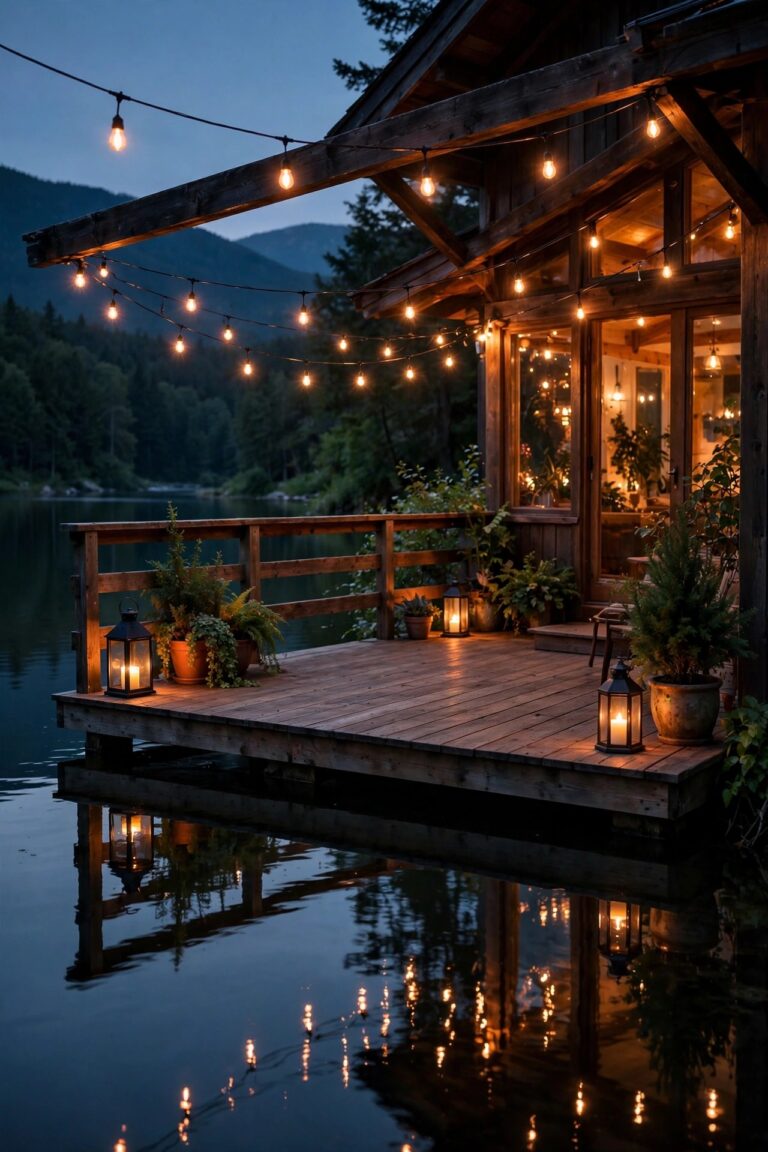
There is a particular kind of porch that makes you slow down as you walk past — the one with the climbing roses, the slightly crooked picket gate, and light so soft it looks borrowed from a storybook. That glow is never an accident. When friends ask how to get it, I always start with the same advice: the best cottage porch lighting ideas mix old-soul fixtures with gentle layering, so the entry feels candlelit instead of floodlit. Think lantern sconces with seeded glass, café lights swagged low across the beams, and tiny fairy lights hiding in the planters. In my experience, a cottage porch wants warmth more than brightness — one beautiful lantern beats a blazing floodlight every single time. Below I have gathered the 17 ideas I reach for again and again, from the layered plan I sketch first to the dusk walk-through I do last, each with honest budget ranges, mounting heights, and the little placement tricks I learned the hard way. Pour something warm, step out front at twilight, and let us plan the welcome your cottage was made for.

1. Layer Your Cottage Porch Lighting Ideas Low, Middle, and High
Every storybook entry I have ever admired follows the same quiet plan: light in three layers. Low light lives along the steps and path — little lanterns and stakes 12 to 18 inches tall that pool glow where feet land. Middle light is the welcome layer, your door sconces and hanging lantern at about 66 inches, right at eye level, where seeded glass and warm filaments can actually be admired. High light is the whisper layer: a soft wash under the eaves or one pendant swinging from the porch beam. When all three burn together on warm bulbs, a porch does not look lit, it looks candlelit, and that is the whole cottage secret. Before you buy anything, sketch the three layers on paper and assign every fixture to one. If something fills no layer, it is clutter, however pretty. I learned this planning approach from studying classic front porch lighting ideas and then softening every choice — smaller scale, warmer bulbs, more shadow left in between. Honestly, half the charm is what you deliberately leave dusky.
Suggested budget range: $150 – $350.
2. Flank the Front Door With a Matched Pair of Lantern Sconces
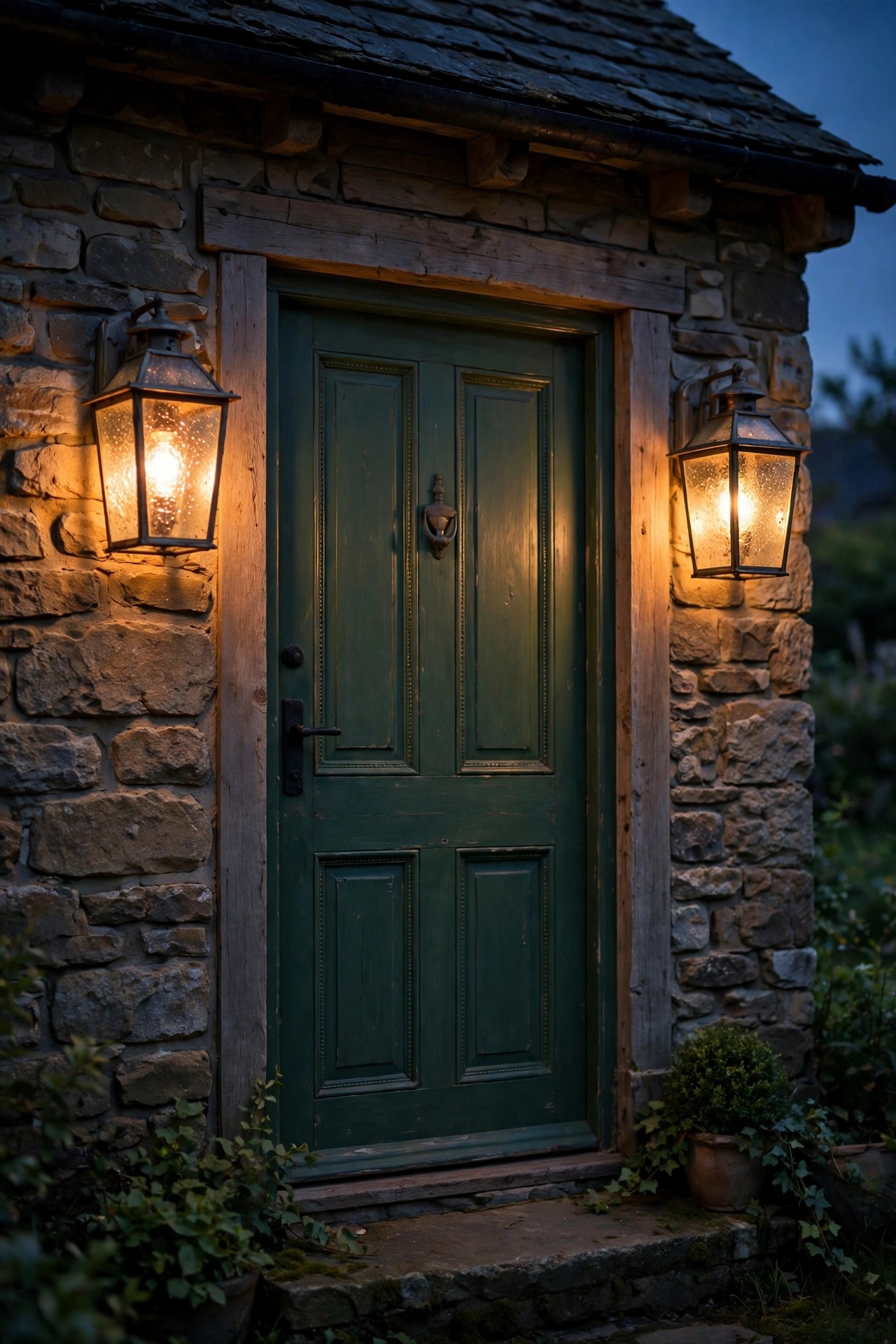
If I could keep only one fixture on a cottage porch, it would be the pair of lantern sconces flanking the door. They are the handshake of the house. Size matters more than style here: each lantern should stand about one-quarter to one-third the height of your door, so for a standard 80-inch door, look for fixtures 12 to 16 inches tall. Mount them with the bulb center around 66 inches from the porch floor, roughly 6 to 8 inches out from the door trim. Seeded or watery glass is the cottage choice — it blurs the bulb into a candle-like shimmer and hides dust beautifully. Inside, use warm 2700K LED filament bulbs, 40- to 60-watt equivalent, and put the pair on a dimmer if you can; full brightness is for unloading groceries, low is for evenings. I walk through my full sizing and placement method in my front door sconce pair guide, and honestly it saves so many crooked, too-small installs. Choose wet-location rated fixtures, and caulk the top of the backplate so rain stays out of the box.
Suggested budget range: $120 – $300.
3. Hang a Seeded-Glass Pendant Over the Porch
A single pendant over the porch turns a doorway into a room. For a cottage, I love a seeded-glass or milk-glass pendant with a soft bell or lantern silhouette — nothing sharp, nothing industrial. Hang it so the bottom of the fixture sits about 7 feet above the porch floor, or 12 to 20 inches above the door frame if your ceiling is low; on an 8-foot porch ceiling, a short chain or stem mount usually lands it perfectly. Center it on the door when the porch is narrow, or over the seating cluster when the porch is wide. A 60-watt equivalent warm LED on a dimmer gives you range: bright for shelling peas with a friend, low and golden for doing absolutely nothing. If the porch is open to the weather, choose a damp- or wet-location rated pendant and a chain with a finish that can patina gracefully, like aged bronze or galvanized steel. In my experience, one generous pendant reads far more storybook than a row of small recessed lights, which belong in kitchens, not cottages. Keep a step stool handy; you will want to dust that glass every spring.
Suggested budget range: $80 – $220.

4. String Café Lights in Soft Swags Across the Beams
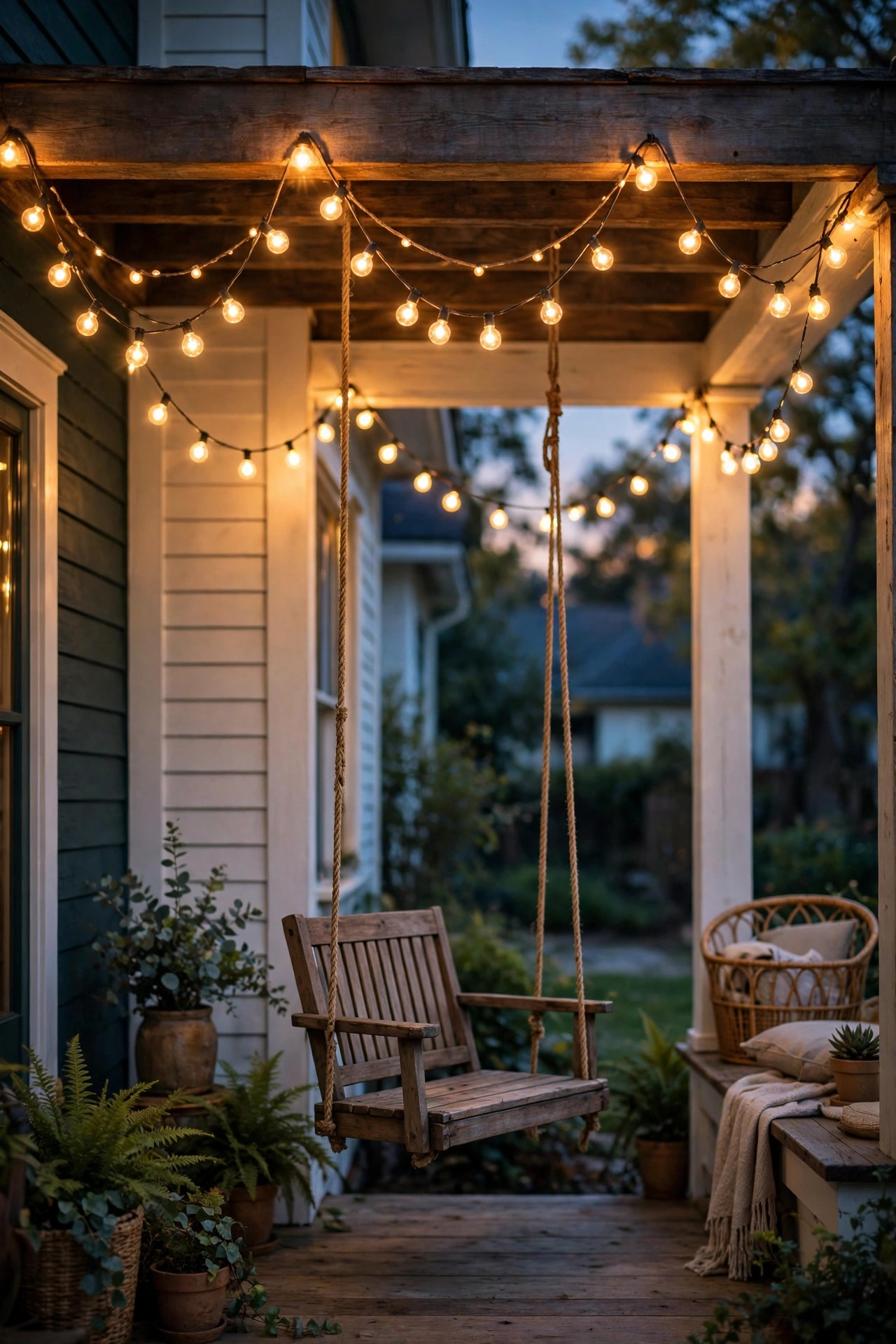
Café lights are the quickest way to make a cottage porch feel like a celebration that never quite ends. The trick is in the drape: cottage swags should sag gently, about 6 to 10 inches of belly between attachment points, not pull tight like a clothesline. Run commercial-grade LED string lights along the front beam, then swag them back to the house wall in two or three soft arcs. Space your screw hooks every 8 to 10 feet and use a thin guide wire on longer spans so the cords never strain. Keep bulbs 2700K and modest — the small G40 globe at 1 to 2 watts per bulb gives that café shimmer without turning the porch into daylight. Always plug into a GFCI outlet, keep connections off the floor where puddles form, and choose cords rated for outdoor use even under a roof, because porch mist finds everything. I hang mine with the swags low enough to feel like a canopy, around 7 feet at the lowest dip, so tall guests pass under comfortably. Add a plug-in dimmer and the whole porch exhales at dusk.
Suggested budget range: $40 – $120.
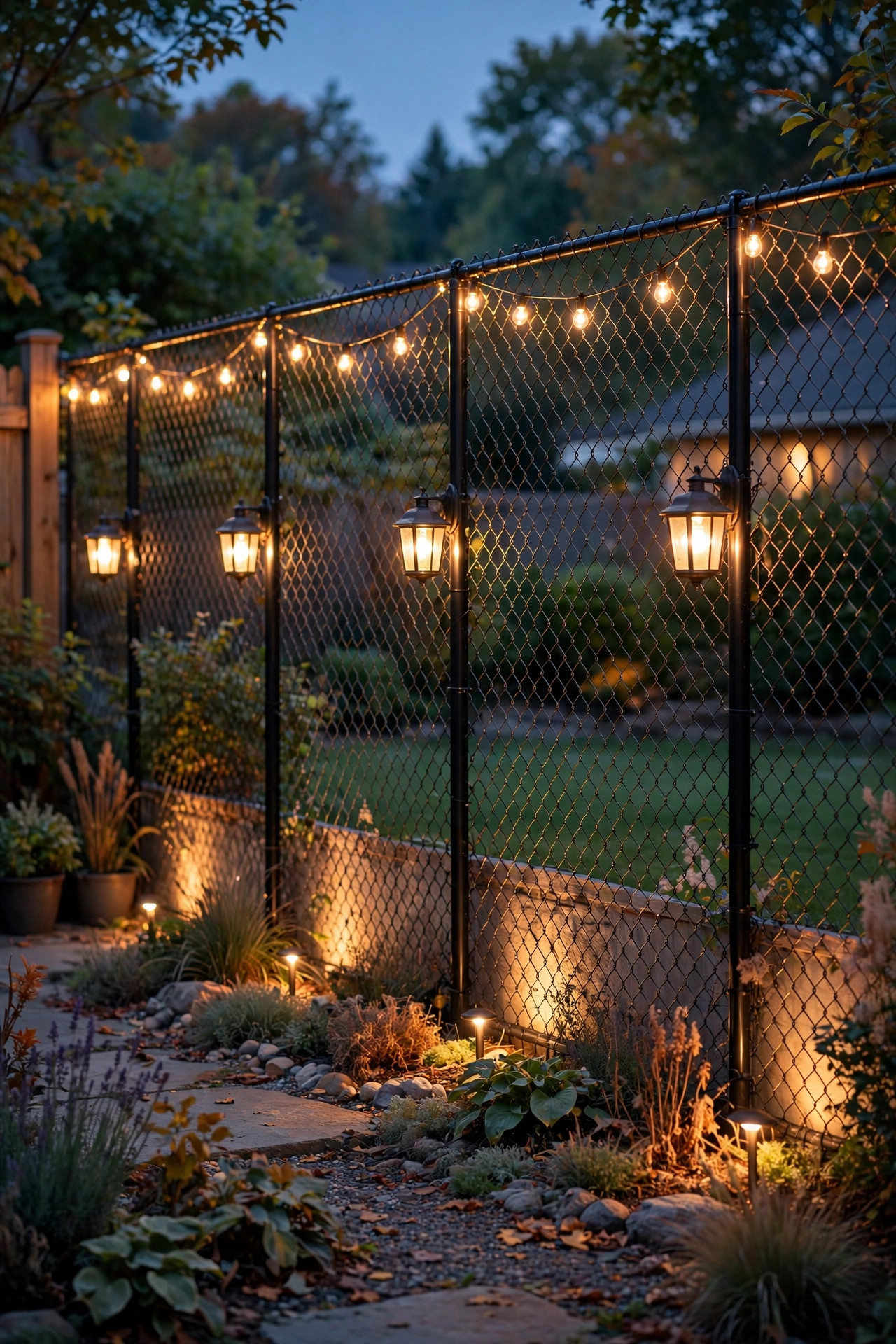
5. Line the Steps and Path With Solar Lantern Stakes
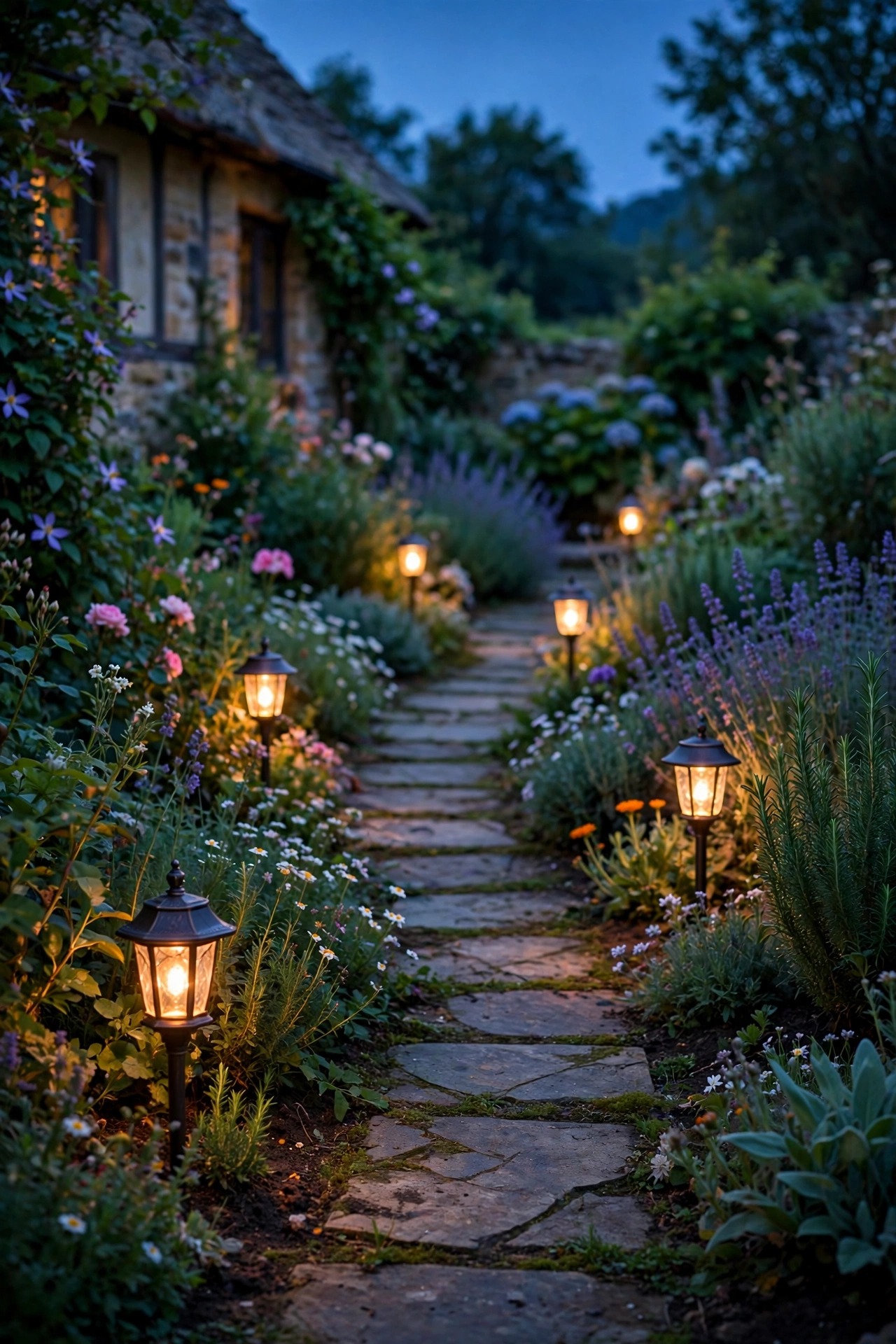
The walk from gate to porch deserves its own little procession of light. Solar lantern stakes — the kind shaped like tiny carriage lanterns — are my favorite cottage choice, because they need no wiring and their slightly imperfect glow feels handmade. Space them 6 to 8 feet apart and stagger them on alternating sides of the path instead of lining them up like a runway; staggered pools of light feel like a garden, matched pairs feel like an airport. Push the stakes where they will drink in at least 6 hours of direct sun, and wipe the little panels monthly, because pollen film quietly steals half their charge. On the steps themselves, set one stake at the base and let the sconces take over above — mixing heights keeps the layers from idea one intact. If your path curves through plantings, let a few stakes disappear into the foliage so the light seems to bloom from the garden itself, a trick I borrow from my favorite rose and cottage garden lighting ideas. Replaceable batteries stretch their life for years.
Suggested budget range: $50 – $140.
6. Cluster Mason Jar Lanterns Along the Steps
Few things say cottage like a mason jar catching the light. I fill clear jars with battery fairy lights or flameless tea lights and cluster them in threes — one tall, two short — on alternating porch steps and beside the door. Odd numbers always look more natural, and clusters beat a lonely single jar every time. Drill nothing: a loop of twine or a simple wire handle turns each jar into a hanging lantern for railing hooks on evenings when company comes. Safety first, honestly: keep real candles out of jars on wooden steps. Flameless tea lights with a warm flicker setting give the same amber wobble with zero fire risk, and the batteries last for weeks of evenings. Set them on timers if your jars allow it, so the steps greet you at dusk without a thought. Keep the actual walking lane of the steps clear — jars belong on the outer third of each tread and in the corners where feet never land. In winter, swap the fairy lights for a pinch of faux snow and a cranberry sprig inside the jar, and the same cluster turns quietly festive.
Suggested budget range: $25 – $70.

7. Wrap the Railings in Copper-Wire Fairy Lights
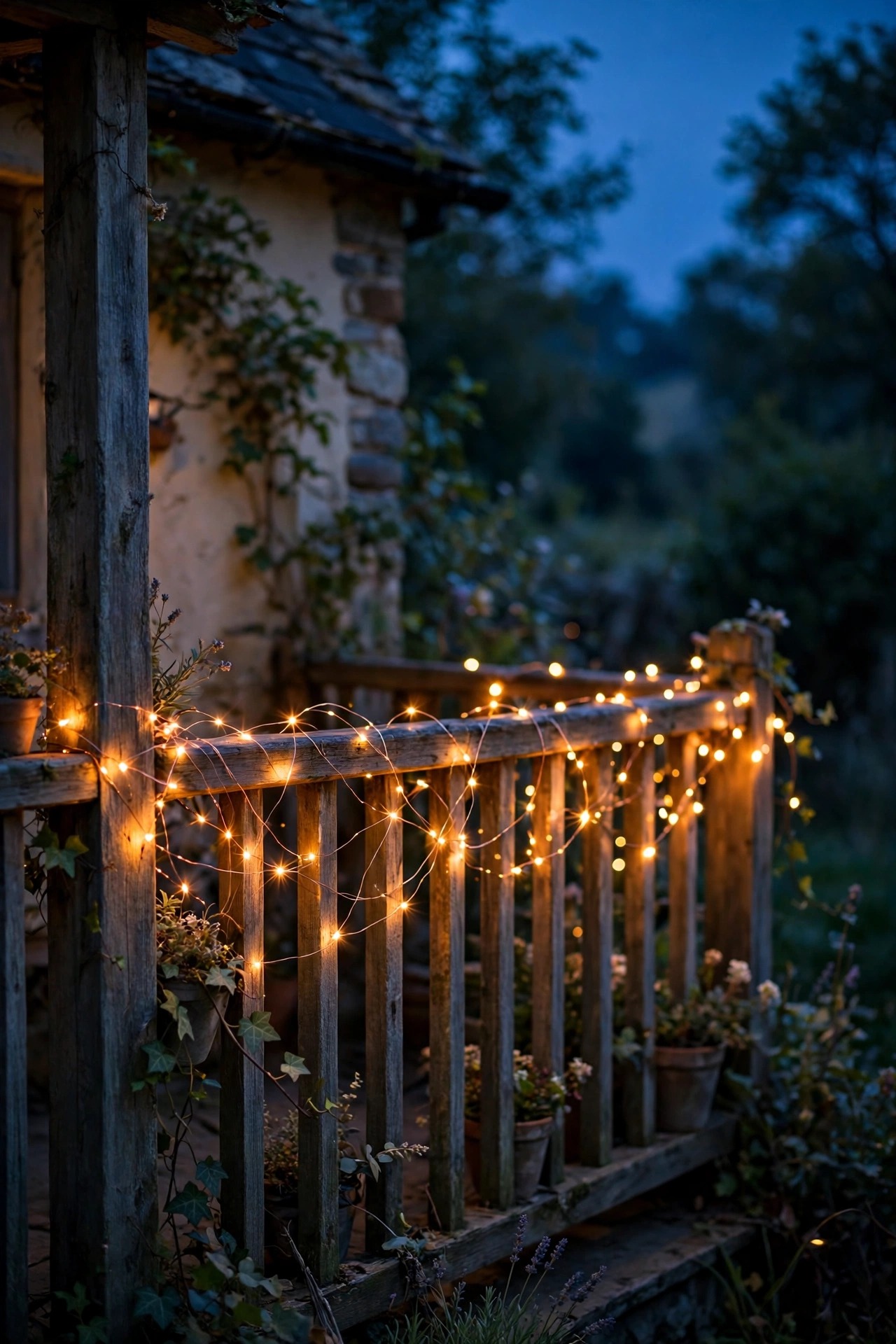
Copper-wire fairy lights are the lace trim of a cottage porch. The wire is so fine it disappears in daylight, and at dusk the railing simply sparkles, as if the porch grew its own fireflies. I wrap one 33-foot strand loosely around every 12 feet of railing, spacing the wraps 4 to 6 inches apart so the sparkle reads even, never bunched. Battery packs with built-in timers are the stress-free version — set them once to the six-hour setting and the porch lights itself every evening. Tuck the little battery box under the top rail or inside a planter where rain cannot pool on it, and choose a strand rated IP65 or better for open porches. Solar versions work beautifully on sunny south-facing rails but sulk under deep shade, so be honest about your light. Warm white only, please; the cool blue-white strands belong to winter displays and will fight every other warm fixture you own. Where the railing meets the steps, let a short tail of lights spill onto the newel post — that little flourish makes guests smile before they even knock.
Suggested budget range: $15 – $45.
8. Set a Hurricane Lantern on the Porch Table
Every cottage porch needs one lantern that can travel — to the table for supper, to the steps for stargazing, to the railing when the power flickers. A glass hurricane lantern about 12 to 14 inches tall is my workhorse. Inside goes a flameless pillar candle, 3 to 4 inches across, with a timer set to greet the evening at the same hour daily. The glass chimney does two jobs: it shields the glow from breezes so the light stays steady, and it magnifies that glow into something that looks genuinely candlelit. Group it with two smaller hurricanes at different heights on a tray, and add a sprig of whatever the garden is offering — lavender in June, bittersweet in October. Metal frames in aged black, galvanized steel, or weathered copper all suit a cottage; shiny chrome does not. Keep flameless candles as the house rule near wicker, cushions, and dried arrangements, and save real flame for the fire bowl out in the yard. On stormy nights I set the lantern in the window instead, where it reads like a lighthouse for the whole street.
Suggested budget range: $30 – $80.

9. Build a Porch Swing Corner Lit Like a Reading Nook
If your cottage porch has a swing or a pair of rocking chairs, give that corner its own pool of light and it will become the most fought-over seat in the house. I hang one small lantern or a short strand of café lights low over the swing — low enough to read by, around 6 feet up, but high enough that a swinging head never meets it; a 2-foot clearance from the highest swing arc is my rule. Warmth matters more than brightness here: a single 40-watt equivalent bulb is plenty, because the corner should feel hushed, not staged. Add a flameless candle on the little side table for a second, lower flicker, and keep a folded quilt within reach. Face the glow inward toward the seat rather than out at the yard, so faces stay soft and the street sees only a warm shimmer through the spindles. This is also the safest corner on the porch to experiment with a dimmer — dusk reading light at full, barely-there ember light once the conversation turns to stories. Honestly, this corner is where our summer evenings go to slow down.
Suggested budget range: $60 – $180.

10. Tuck Flameless Candles Into Window Boxes and Planters
Here is my favorite five-minute trick: nestle flameless candles down among the geraniums in the window boxes and porch planters, and the whole front of the cottage glows like a storybook illustration. Use candles 4 to 6 inches tall so the flames peek just above the foliage, and stagger heights — one tall, one short — inside each box. The timer setting is non-negotiable for me; six hours on at dusk means the flowers light themselves while I am still making supper. Choose candles with a warm amber flicker, never the stark white kind, and real wax shells for looks if they will be seen up close — but flameless always, because real flames near dry leaves and mulch are a risk no glow is worth. Keep candles a few inches from the siding and off direct soil where sprinklers splash; a small tile or jar lid under each one makes a tidy, dry base. In autumn I swap in shorter candles and tuck them beside miniature pumpkins, and by December the same boxes carry them among pinecones and winterberry. It is one small idea that quietly makes the entire porch feel tended.
Suggested budget range: $20 – $60.

11. Add a Gooseneck Barn Light for Farmhouse-Cottage Charm
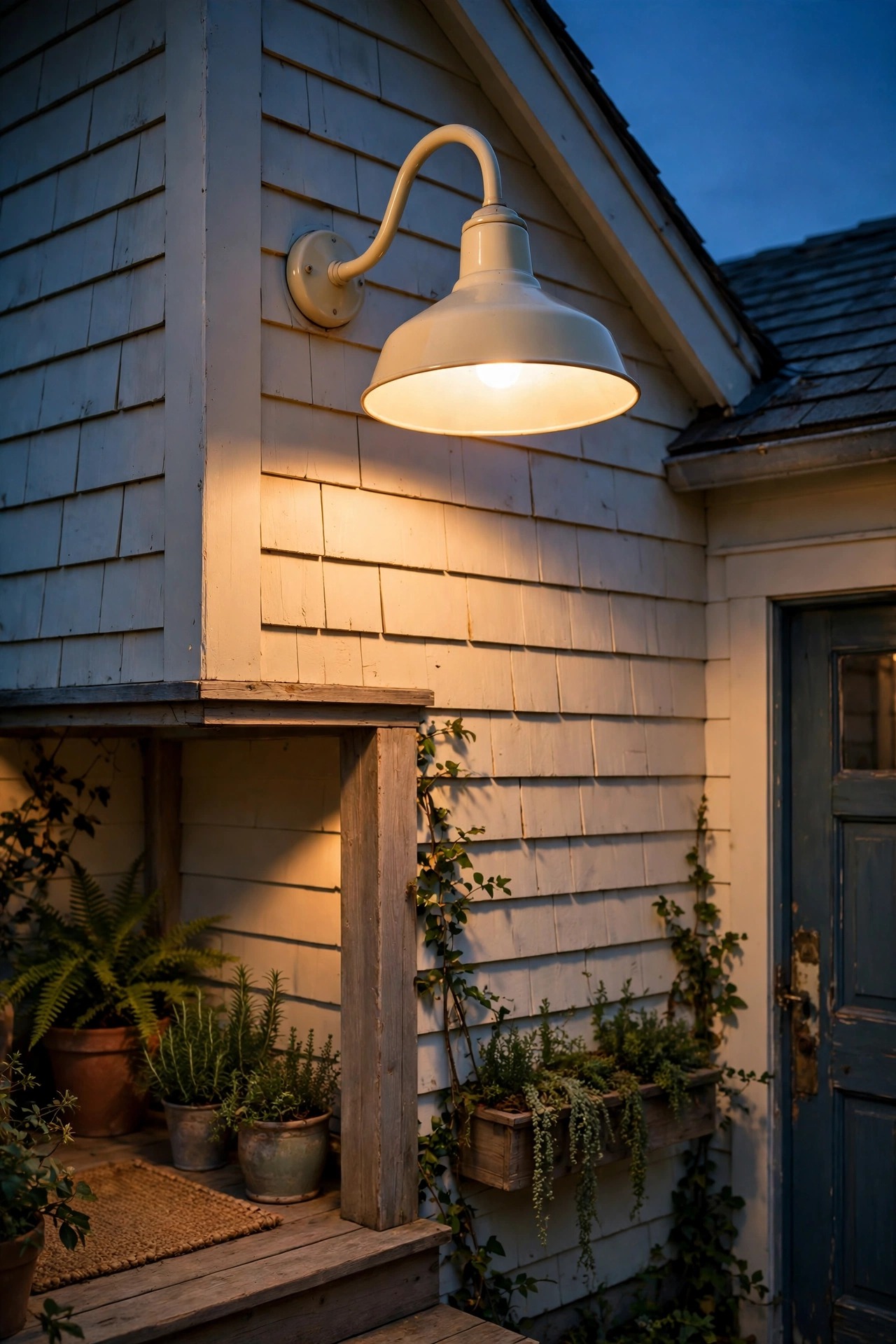
Cottage and farmhouse styles are cousins, and a small gooseneck barn light is where they happily meet. Mounted over the door or at the porch corner, its curved arm and wide shade throw a generous pool of light downward, which makes it the hardest-working fixture on this list — the one that lights keyholes, packages, and muddy boots. Choose a shade 10 to 12 inches across in cream, sage, or weathered galvanized; the underside should be white or pale so the light bounces softly instead of glaring. A warm 2700K bulb, 60- to 75-watt equivalent, is the sweet spot under that shade. Downward light is also the neighborly kind: it pools where you need it and keeps the night sky dark, which your stargazing guests will thank you for. Many goosenecks accept a photocell adapter, so the hardest-working light can also be the most automatic. I keep ours on the side of the porch where the path turns, and honestly it has ended more stubbed toes than every other fixture combined. Wet-location rating, always, because that shade will meet real weather.
Suggested budget range: $70 – $160.
12. Light the House Numbers and Mailbox So Guests Find You Gently
A storybook entry should be findable. Delivery drivers and first-time guests hunt for house numbers after dark, and a tiny, dedicated light makes that hunt kind instead of frustrating. Mount a small lantern or a discreet downlight above the numbers — numbers at least 4 inches tall read clearly from the street — and keep the bulb warm and modest, 2700K at 25-watt equivalent, so the address glows rather than blazes. If wiring is out of the question, a solar number plaque charges by day and glows all evening, no electrician required. Give the mailbox the same courtesy: a small solar lantern on the post or a flameless candle lantern hung from a hook on delivery nights makes the box visible without lighting up the whole street. Keep fixtures shielded and aimed down so light stays on the numbers, not in drivers' eyes. This is the least decorative idea on the list and the one visitors quietly appreciate most — a porch that helps you arrive feels welcoming before you ever reach the steps. Check your local rules, too; some towns require lit numbers for emergency vehicles.
Suggested budget range: $25 – $90.

13. Commit to One Warm Temperature: 2700K Everywhere
Nothing breaks the storybook spell faster than mismatched bulbs — one amber sconce, one blue-white pendant, one greenish solar stake, all arguing on the same small porch. Cottages glow in one voice, and that voice is 2700K, the color of candlelight and late-afternoon sun. Walk your porch with fresh eyes and list every bulb: sconces, pendant, string lights, stakes, candles. Then swap the rebels. LED packaging prints the temperature right on the box, and filament-style bulbs at 2700K give you the visible warm coil that suits seeded glass so well. Brightness should layer too: roughly 200 to 400 lumens at the door, gentler 50 to 100 lumen pools along the path, and the faintest sparkle from fairy lights. Solar fixtures rarely print their temperature, so buy one stake first and judge its color at dusk before ordering the set — most warm-white solar lands close enough to 2700K to blend. Keep your spare bulbs in one labeled porch basket, all 2700K, and replacements will never reintroduce a stranger. One temperature, honestly, is the cheapest professional secret on this entire list.
Suggested budget range: $20 – $75.

14. Put the Whole Porch on Timers and Photocells
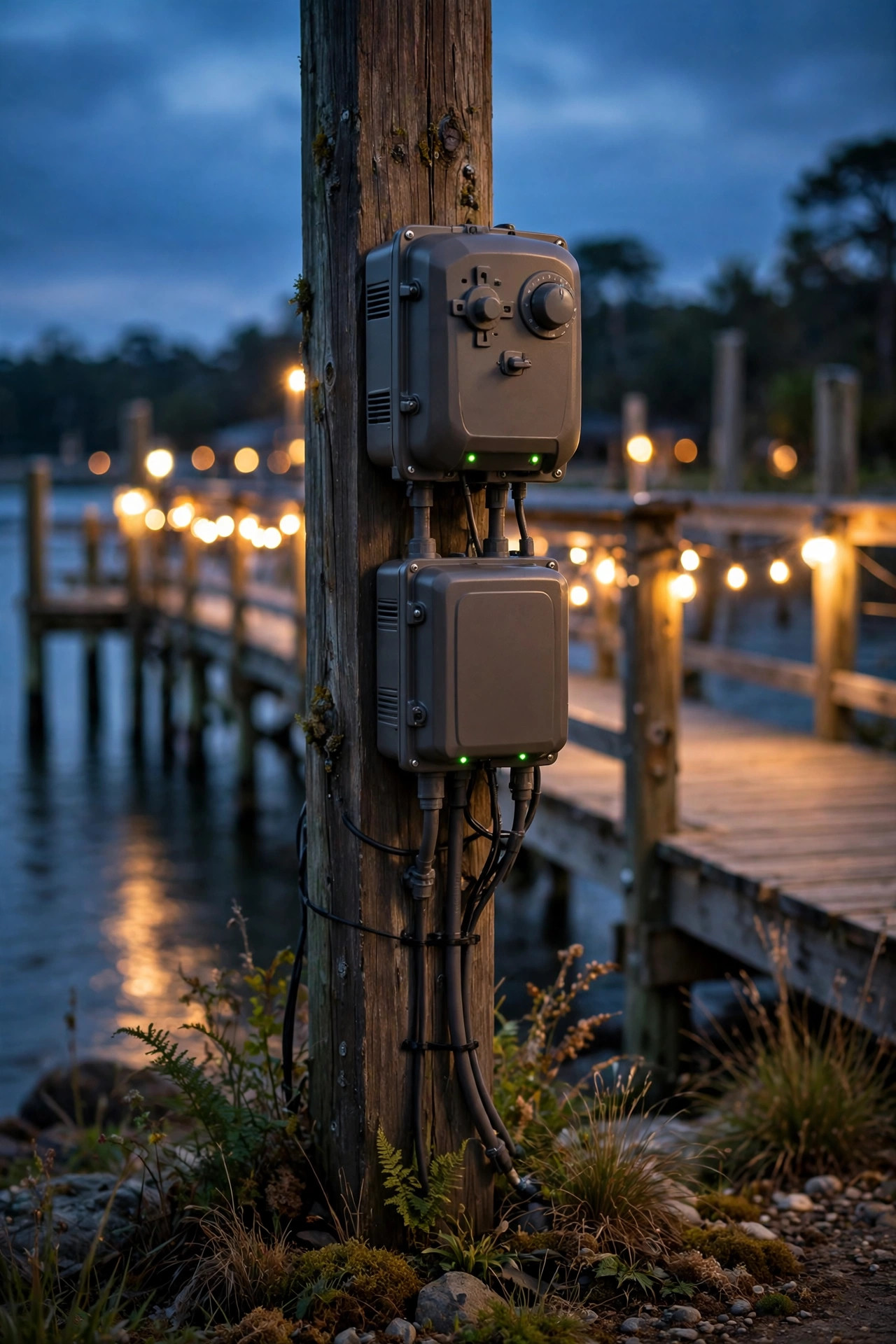
A storybook porch should light itself. Nobody's cottage glows by accident at exactly dusk every night — it glows because a photocell or a timer remembered, even when the homeowner forgot. The simplest start is a photocell screw-in adapter between bulb and socket in your sconces and pendant: lights on at dusk, off at dawn, no programming at all. For string lights and plug-in pieces, an outdoor-rated timer or smart plug on a sunset schedule does the same trick, and the astronomical setting adjusts itself as the seasons slide. Match the pieces: set battery candles and fairy-light packs to their built-in six-hour timers at the same moment one evening, and the whole porch will wake and sleep together like a well-run inn. Timers are also a safety habit — a lit porch on the nights you travel reads as somebody home. Keep one manual override switch you actually know how to use, for the evening you want the porch dark for fireflies or a meteor shower. In my experience, automation is what turns a pretty weekend project into an every-single-night welcome.
Suggested budget range: $30 – $100.
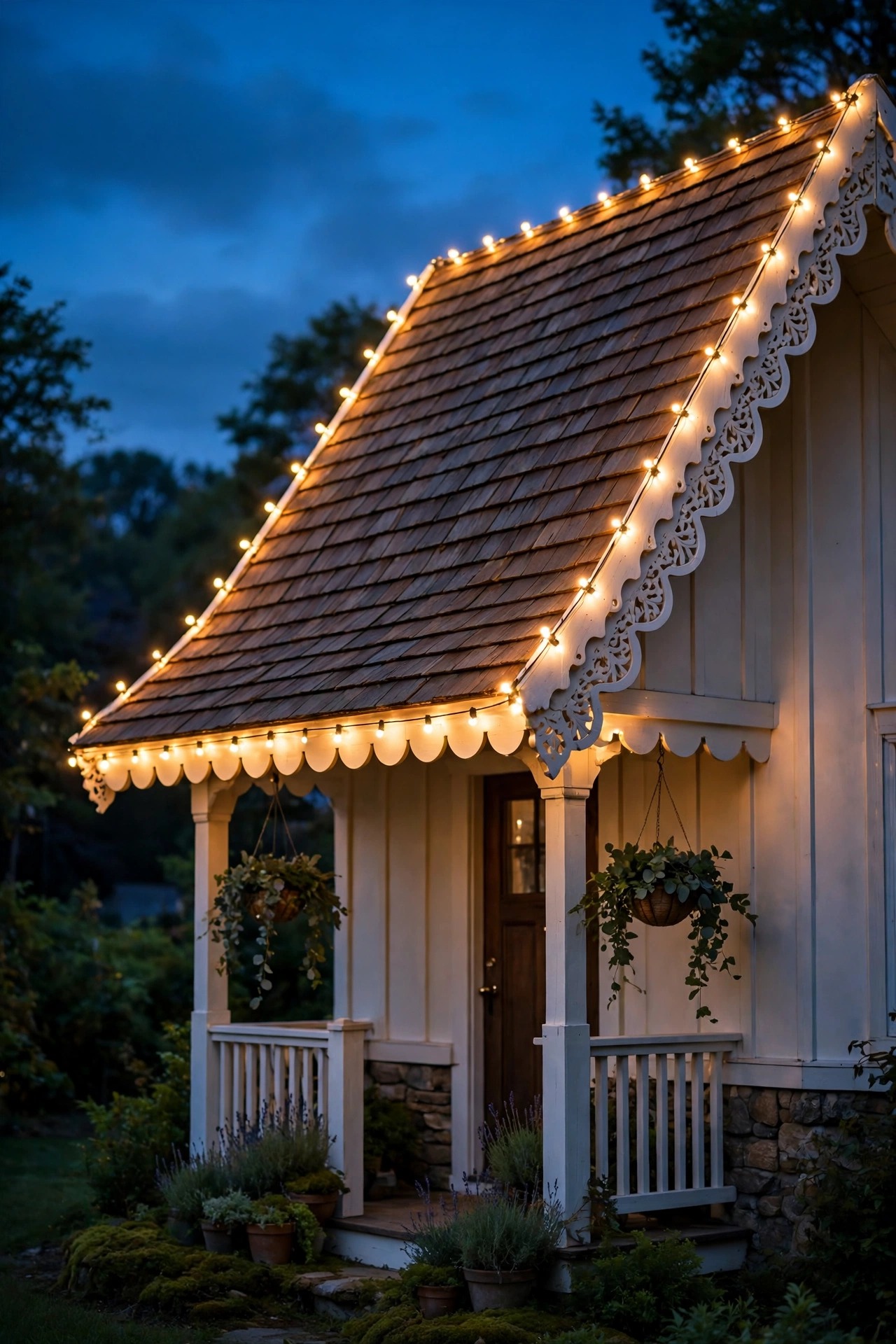
15. Trace the Porch Roof Edge With a Single Strand of Lights
If the swagged café lights of idea four feel like too much party, trace the porch roof edge instead — one quiet strand following the line of the eaves, like icing on a gingerbread cottage. Screw small cup hooks every 18 to 24 inches along the fascia and rest a commercial-grade strand in them; no sag, no swag, just a clean golden outline that shows off the roofline you fell in love with. Small G40 or C9-style LED bulbs at 2700K keep the line delicate rather than carnival-bright, and warm white is the only acceptable color here — the storybook spell breaks with rainbow strands outside December. Work from a sturdy ladder with a helper footing it, and clip, never staple: staples nick cords and void every safety rating the strand carries. Run the strand to a GFCI outlet on a timer and the outline will greet you at dusk all season. From the street, this single line does something lovely — it separates your cottage from the dark like a picture in a frame, and it pairs beautifully with the low path stakes doing their quiet work below.
Suggested budget range: $35 – $90.
16. Dress the Porch Seasonally Without Rewiring a Thing
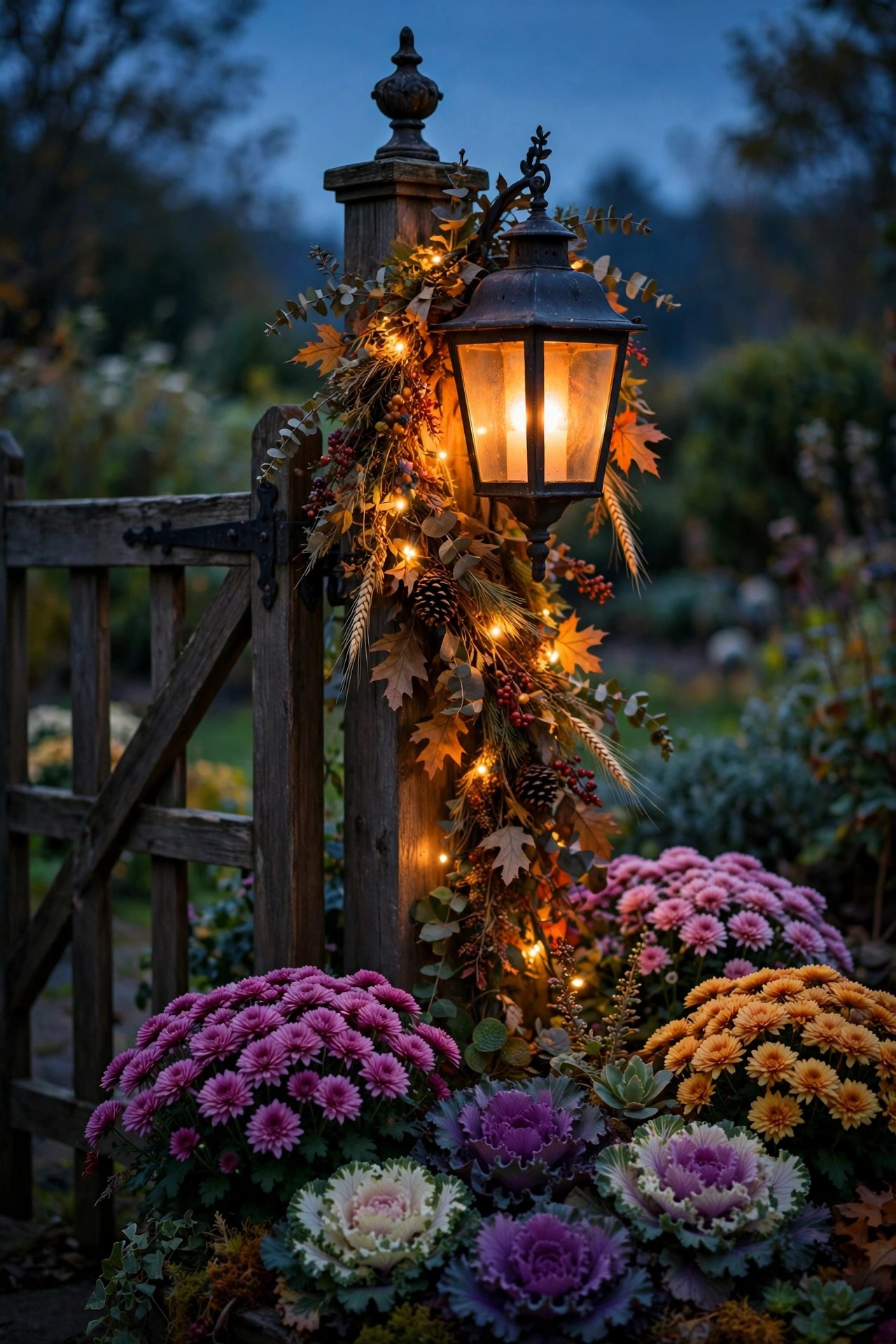
The loveliest cottage porches change their jewelry with the seasons while the fixtures stay exactly where they are. In spring, I thread battery fairy lights through a faux or fresh garland over the door — LED only, always, because real bulbs run hot against leaves and ribbon. Summer asks for almost nothing: a hanging basket near the sconce so its glow catches the blooms, and the jar lanterns already on the steps. Autumn is the show-off season — weave warm micro lights through a grapevine wreath, tuck the planter candles beside pumpkins, and let the gooseneck light the whole harvest pile. Winter wants restraint: one strand of the roof-edge lights, the wreath again with winterberry, and flameless candles glowing in the window boxes among pinecones. Every one of these swaps is battery or plug-in, so the total seasonal effort is an afternoon with a step stool, not an electrician visit. Store each season's pieces in one labeled bin with fresh batteries removed, and next year's changeover takes an hour. The fixtures are the bones of the porch; the seasons are just its wardrobe, and a cottage wears them beautifully.
Suggested budget range: $40 – $110.
17. Finish With a Dusk Walk-Through and Edit Your Cottage Porch Lighting Ideas
Here is the ritual I never skip: when you think the porch is done, wait for dusk, walk to the street, and look at your cottage porch lighting ideas the way a guest arriving does. Squint. Somewhere there will be one bulb glaring bare into your eyes — shade it, dim it, or aim it down. A stake will be leaning like it had a long day; straighten it. The fairy lights will have one bunched knot; tease it apart. Stand at the gate, then on the steps, then at the door, because each viewpoint shows a different porch. Check the practical things too: can you see every step edge, does the keyhole light work, would a delivery driver find the numbers? Then sit in the swing corner for five quiet minutes and simply notice how it feels. If it feels like a stage set, dim something. If it feels like a page in a favorite book, you are done. I repeat this walk every season change, because porches drift — bulbs get swapped, shrubs grow over stakes, timers wander. Fifteen honest minutes of editing is what keeps the storybook alive.
Suggested budget range: $0 – $50.
Frequently Asked Questions
What color temperature is best for a cottage porch?
Warm 2700K, every time. It sits closest to candlelight and gaslight, flatters wood, brick, and painted siding, and makes faces look kind instead of clinical. Avoid anything labeled daylight or 4000K and above on a cottage porch — that blue-white light belongs in a workshop. If a fixture comes with a bulb included, check the box before you fall in love; swapping one wrong bulb later is easy, but relamping a whole porch is a chore.
Can I light my whole cottage porch with solar lights alone?
On a sunny porch, nearly — solar stakes, number plaques, and lantern clusters have become genuinely good. But covered porches starve solar panels, and sconces beside the door deserve the reliability of wired power or at least a rechargeable option. My honest mix: wired for the door pair and pendant, solar for the path and garden edges, battery timers for candles and fairy lights. Each technology does what it is best at, and no single cloudy week can dim the whole welcome.
How do I keep porch lights from attracting swarms of bugs?
Warm light is your first defense — insects are drawn far more to cool blue and ultraviolet tones than to amber 2700K glow, so the cottage palette already helps. Fit yellow-toned bug bulbs in the door sconces during the worst summer weeks if you like, keep bright fixtures a few feet away from where the door swings, and let a motion-activated light near the steps do the security work instead of a bright all-night bulb beside the door where everyone gathers.
How much does a cottage porch lighting refresh cost in total?
A gentle refresh — matched bulbs at one temperature, fairy lights, jar lanterns, and flameless candles — lands between $100 and $250 and takes a single weekend. Adding the sconce pair, a pendant, and timers brings most porches to $400 to $800. A full layered scheme with a gooseneck, path stakes, and seasonal pieces can reach $900 to $1,200 spread over a season. Start with the door pair and the temperature swap; those two moves alone change everything.
Conclusion
A cottage porch does not need more light; it needs kinder light. Layer it low, middle, and high, keep every bulb at one warm 2700K, let timers do the remembering, and edit at dusk until the entry feels like a page from a favorite book. That is the whole heart of these cottage porch lighting ideas, and it works on a grand wraparound or a stoop barely big enough for two chairs. Start with the sconce pair and one strand of something twinkly, then browse the rest of my lighting ideas here on the site and keep layering at your own pace. I will be out on my porch at dusk, and I hope you will be too.