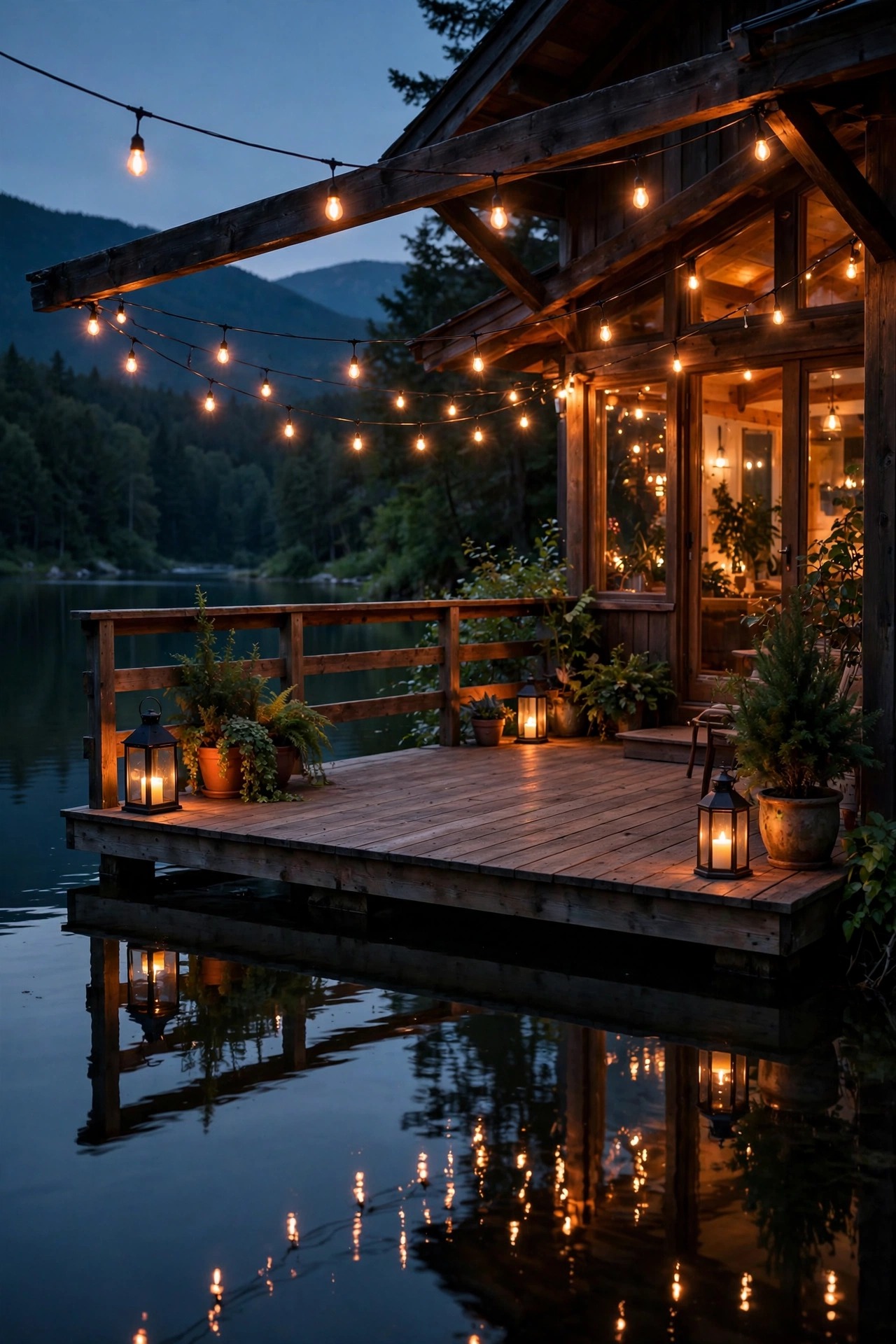
There is a moment every lake evening I never get tired of: the sun drops behind the trees, the water goes glassy and gold, and the first warm lights flicker on along the deck. That glow is what turns a plain deck into the place everyone drifts toward after dinner. After fifteen summers of tweaking our setup, I have learned that great lake house outdoor lighting ideas are never about one big fixture. They are about layering: a soft ambient base, a little task light where you cook and play cards, and small accents that catch the eye and reflect off the water. In this post I am sharing the 17 ideas I actually use and recommend, with real spacing, bulb, and weatherproofing details, honest budget ranges, and the bug-smart tricks that matter when you live this close to the water. Pick three or four to start, and your deck will feel finished by the weekend.
1. Start With Layers: My Core Lake House Outdoor Lighting Ideas
Every good lake setup I have ever seen follows the same three-layer recipe, and honestly, it is the single most useful thing I can teach you. Layer one is ambient light: the soft overall glow from string lights, post caps, or lanterns that lets people move around comfortably. Layer two is task light, the brighter, focused pools over the grill, the outdoor dining table, and the steps. Layer three is accent: uplights on a shoreline tree, a lantern tucked in a planter, lights that exist purely because they are pretty. When one layer does all the work, you get the classic mistake of a single blinding floodlight and a deck that feels like a parking lot. Aim for warm white bulbs at 2700K across every layer so the whole space feels like one conversation. I sketch my layers on paper before buying anything, marking where people sit, walk, and cook. That ten-minute sketch has saved me more money than any sale.
Suggested budget range: $75 – $250.
2. String Lights Zigzagged Over the Deck
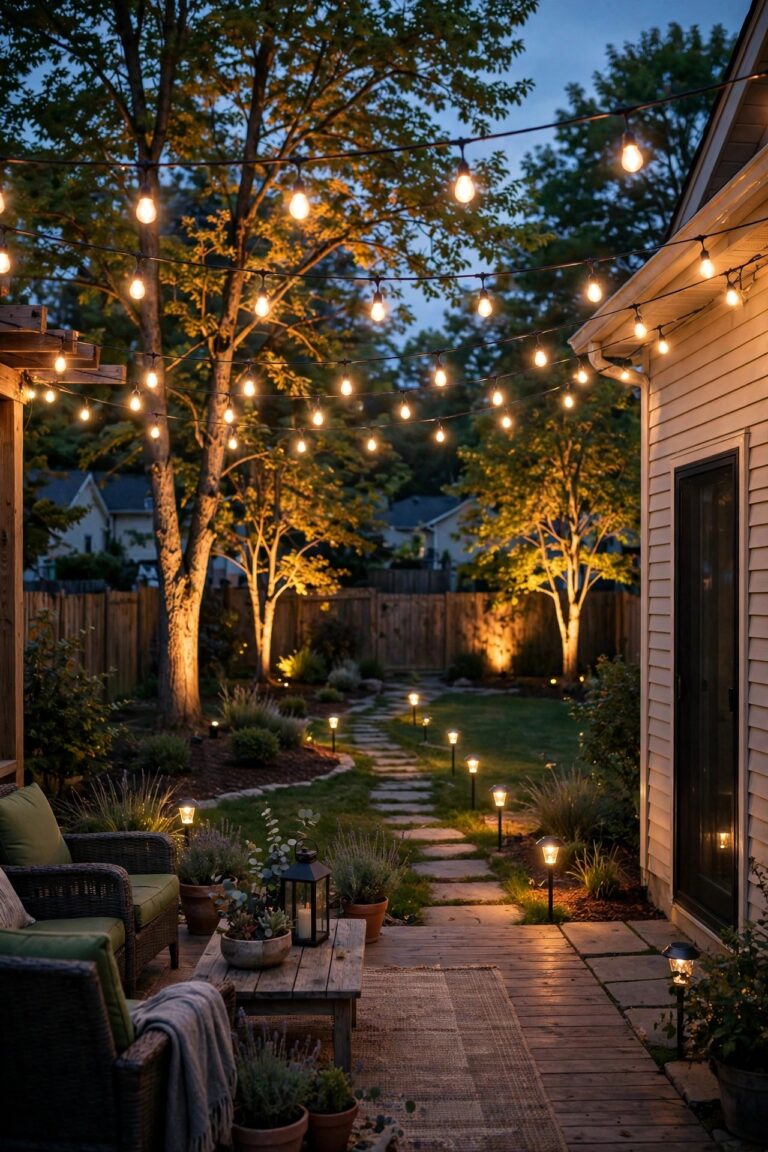
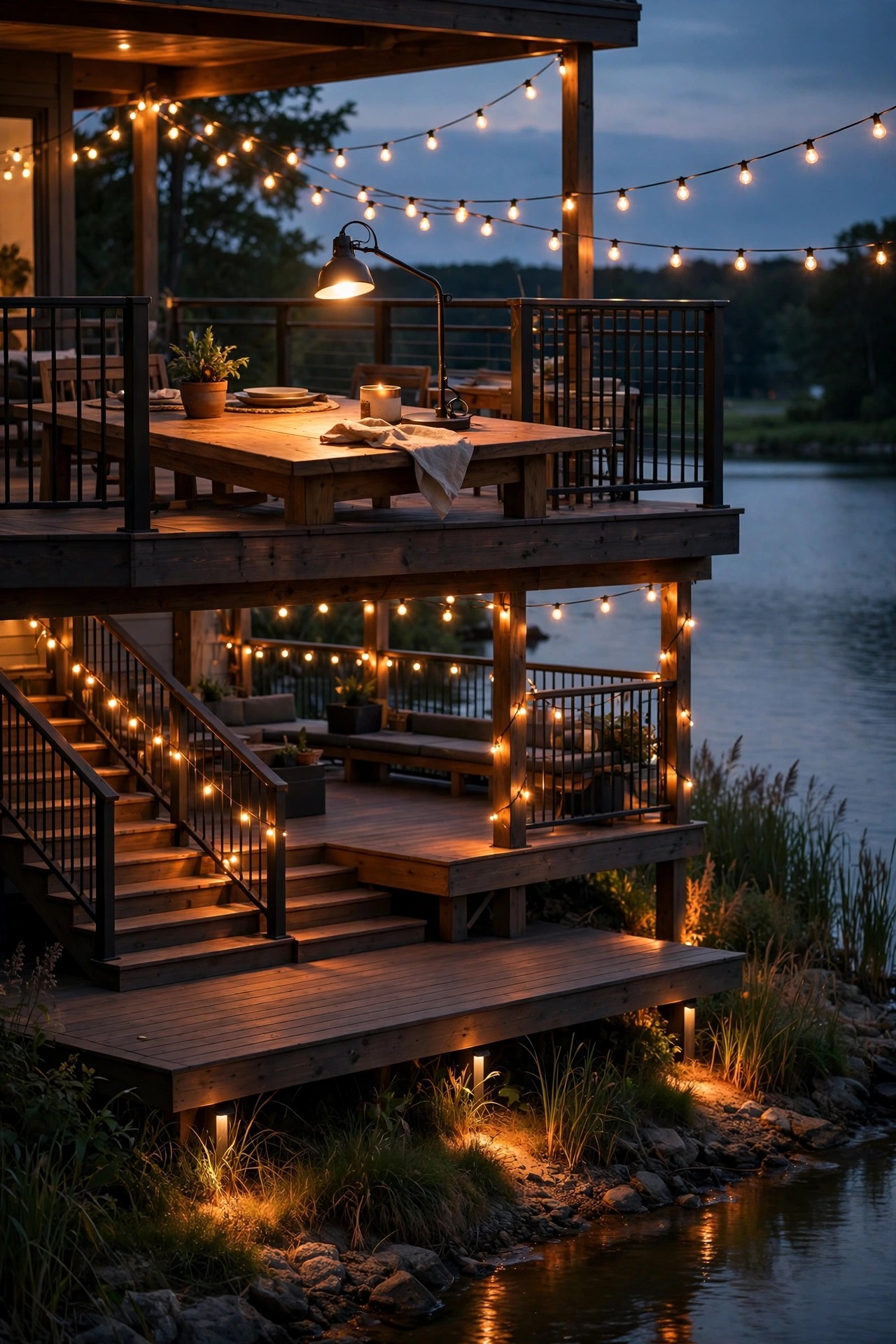
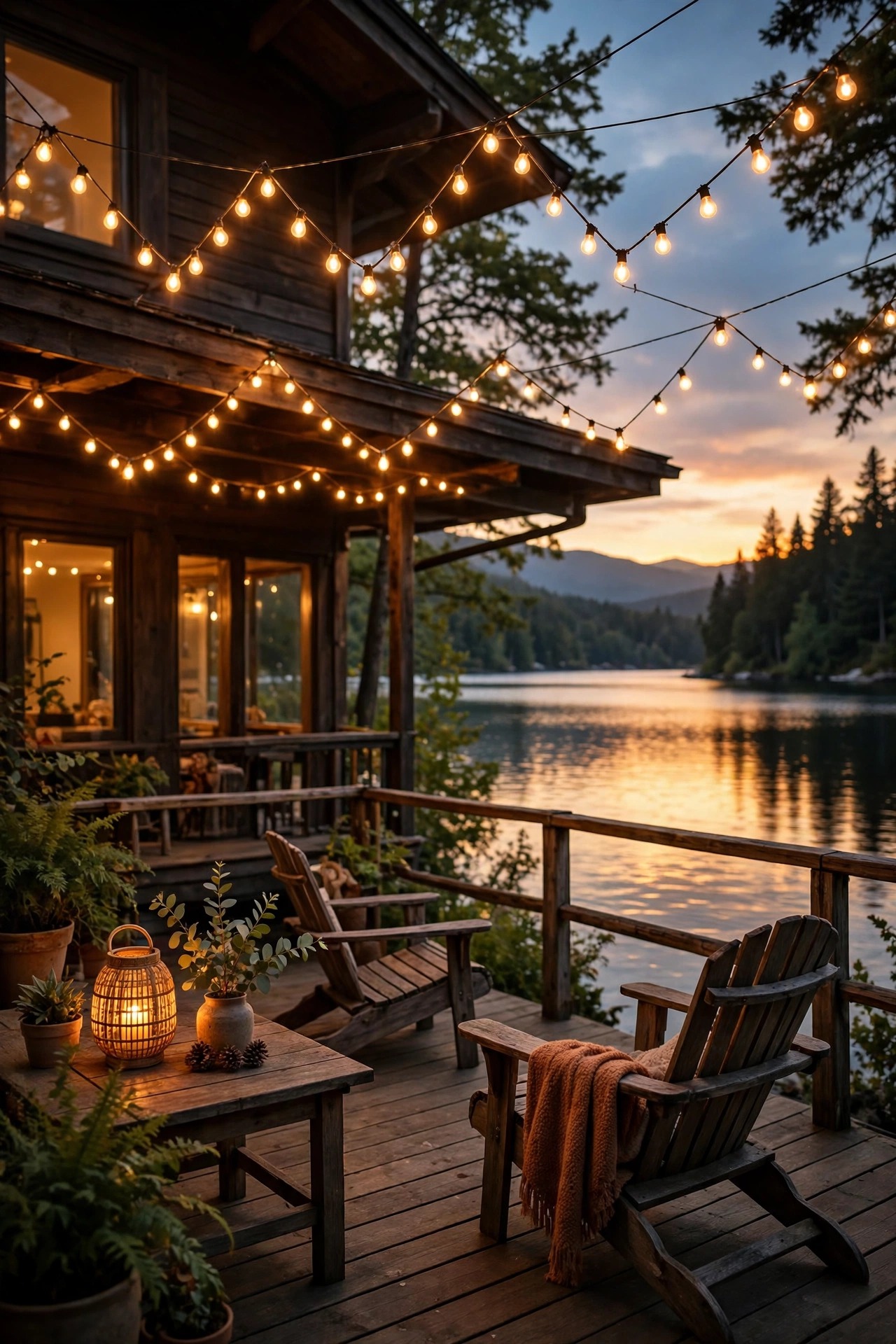
If I could keep only one idea on this list, it would be commercial-grade string lights zigzagged over the deck. They are the ambient layer that makes everything else look better. Choose outdoor-rated strands with shatterproof LED filament bulbs and heavy rubber sockets, spaced so each swag dips gently, about 18 to 24 inches of sag over an 8 to 10 foot span. At a lake house, wind is the enemy, so run a stainless guide wire between anchor points and clip the strand to it instead of letting the cord carry the load. Mount to the house and to two sturdy poles set in deck planters or bolted to railing posts. Keep plugs on a GFCI outlet and raise connections off the deck boards so puddles never reach them. I replace individual bulbs the moment one goes dark, because a gap in the pattern reads as shabby from the water. On calm nights, their reflection doubles the whole effect for free.
Suggested budget range: $60 – $180.
3. Solar Post Cap Lights on the Railing
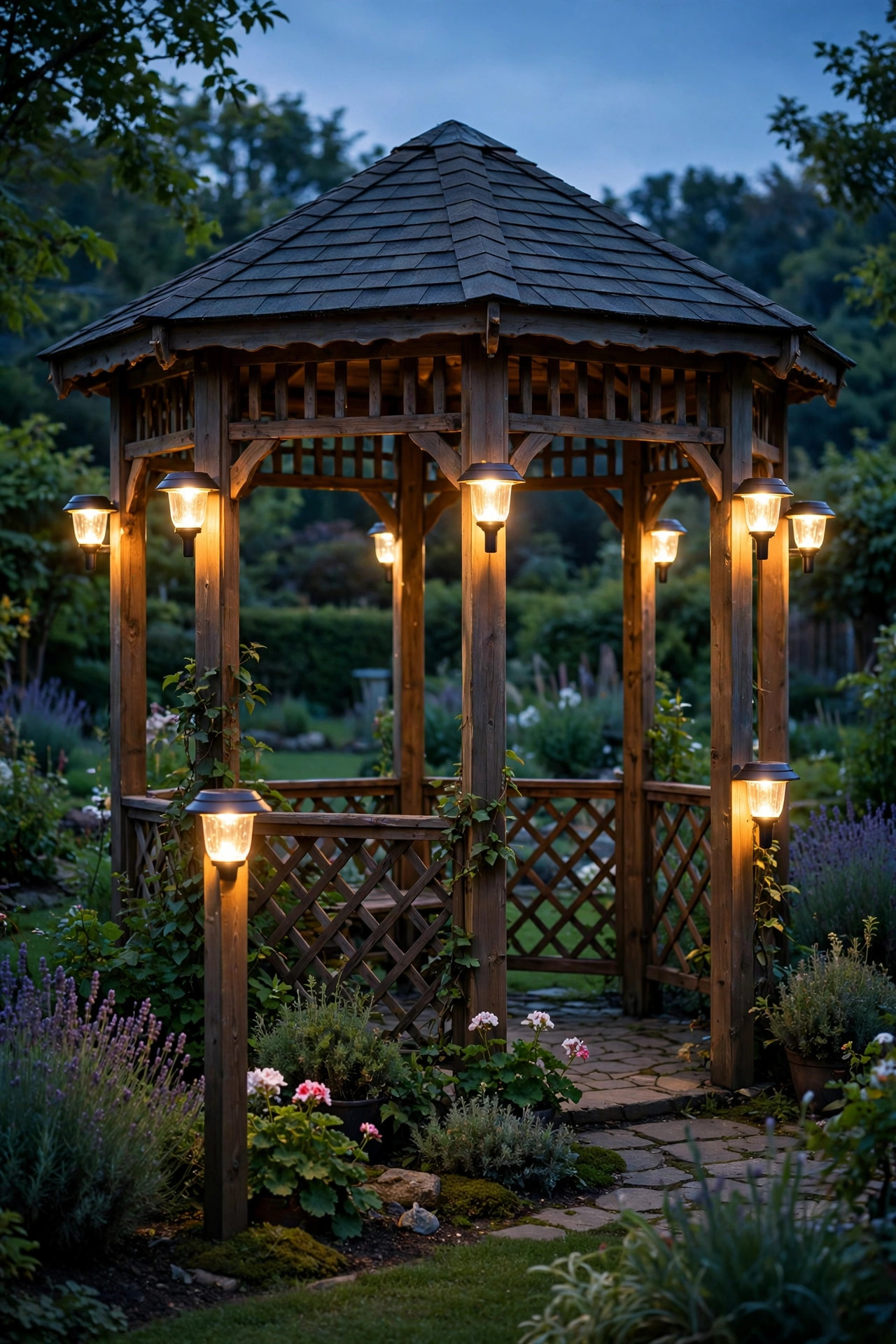
Railing post caps are the hardest-working accent at our lake house because they outline the deck edge, which is exactly what guests need when they wander out with a drink after dark. Solar caps sized for standard 4×4 or 6×6 posts charge all day on the railing and switch on automatically at dusk, no wiring, no switches to remember. Look for caps rated at least IP65 with warm 2700K output and replaceable batteries, because the battery is always the first thing to tire after two or three seasons. I stagger brighter caps at the corners and stair opening, and let dimmer ones fill in between. Caps alone will not light a dinner, but paired with the broader deck lighting ideas in my planning notes, they give the whole perimeter a finished, intentional line. Wipe the little solar panels with a damp cloth every few weeks; lake pollen and dust quietly steal a third of your brightness if you skip it.
Suggested budget range: $50 – $140.
4. Recessed Step Lights for Safer Stairs
Lake decks almost always step down toward the yard and the water, and those stairs are where every twisted ankle story begins. Recessed step lights tucked into the riser of each stair wash the tread below in a soft pool of light without glaring into anyone's eyes. Low-voltage 12-volt fixtures are my pick here: they are safe to install yourself, sip electricity, and hold up beautifully in damp lakeside air. Place one light on every second or third step for narrow stairs, or at both ends of wide treads over 5 feet. In my experience, spacing lights 4 to 6 feet apart along a run of steps gives even coverage with no dark gaps. Hardwire them to the same transformer as your other low-voltage lights so one timer runs everything. If your stairs are already built, surface-mount step lights under the tread nose are a fine retrofit. The deeper deck stair light ideas I keep bookmarked cover both styles with wiring diagrams in plain English.
Suggested budget range: $45 – $130.

5. Flameless Lanterns Clustered on the Dining Table
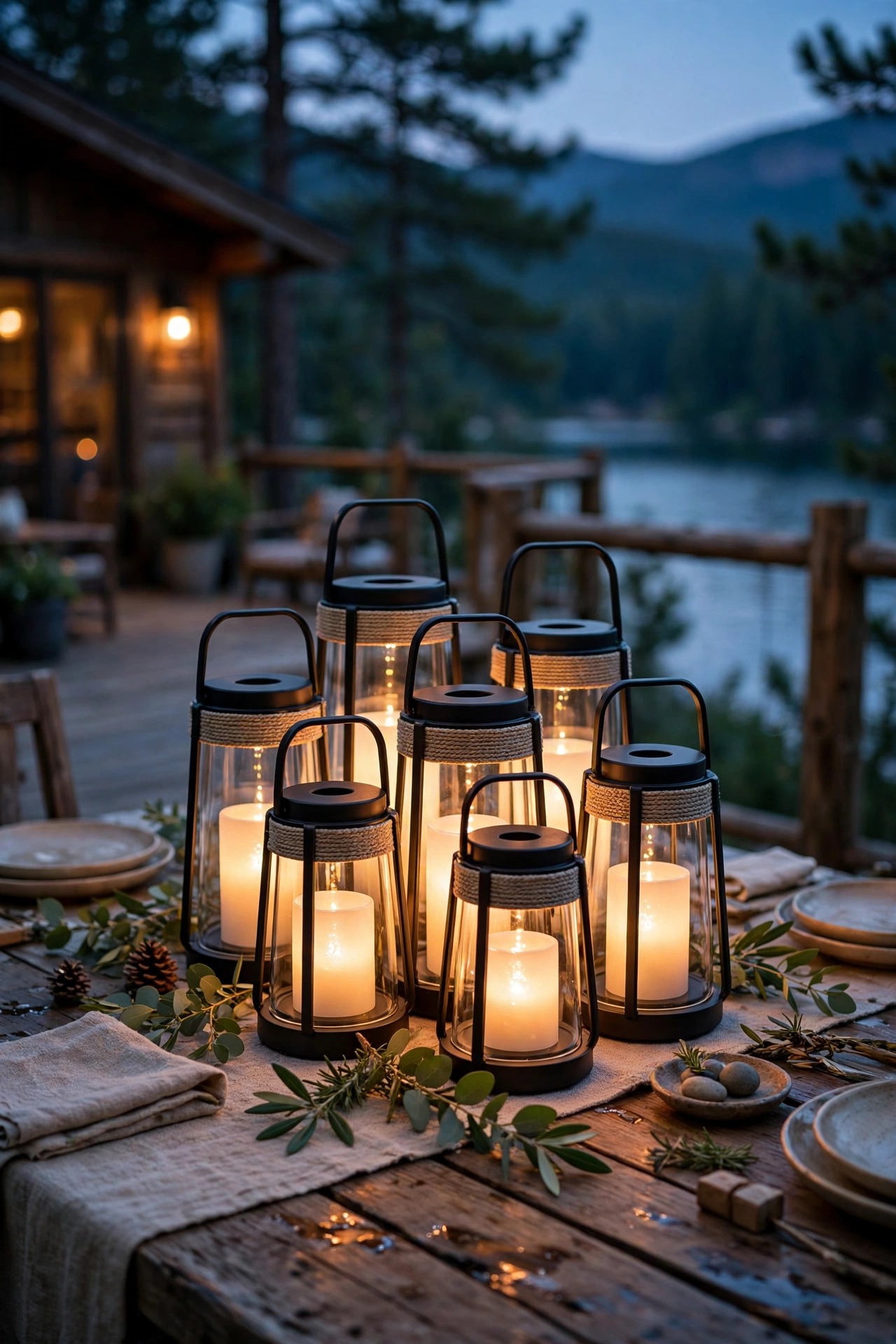
Real candles and lake breezes do not mix, so my dining table runs on flameless LED lanterns, and honestly, nobody misses the real thing. Group three lanterns of different heights in the center of the table, or run a low line of small ones down a runner. The flicker setting on modern LED candles is convincing enough that guests reach out to shield them from the wind out of habit. Choose lanterns with metal or resin frames rated for outdoor use, timers built in, and batteries you can swap without tools. I set the timers for five hours at dusk so the table lights itself right as we sit down. Keep the glow low and warm, around candle height, so faces look soft and the lake stays visible beyond the railing instead of disappearing behind glare. Between meals, the same lanterns migrate to the coffee table, the dock bench, and the porch steps. That flexibility is why I buy lanterns before almost anything else.
Suggested budget range: $30 – $90.
6. Amber Bulbs Set Back to Outsmart the Bugs
Living on the water means living with insects, and lighting choices either invite them to dinner or quietly send them elsewhere. Most flying bugs are drawn to bright white and blue-rich light, so I swap the bulbs nearest the seating to amber or warm 2000K to 2200K bug bulbs, which are far less interesting to them. The second trick matters just as much: place your brightest white task lights away from where people sit, over the grill landing or the far railing, so the bugs gather there instead of over the table. Motion and heat still attract a crowd, so no bulb is magic, but the difference on a July night is honestly dramatic. Keep one brighter light on near the shore path where nobody lingers, and let the seating zone stay golden and dim. Pair the amber glow with a quiet ceiling or standing fan over the table if your porch allows it, since moving air is the one thing mosquitoes truly cannot fight.
Suggested budget range: $25 – $80.
7. Recessed Deck Floor Lights Around the Perimeter
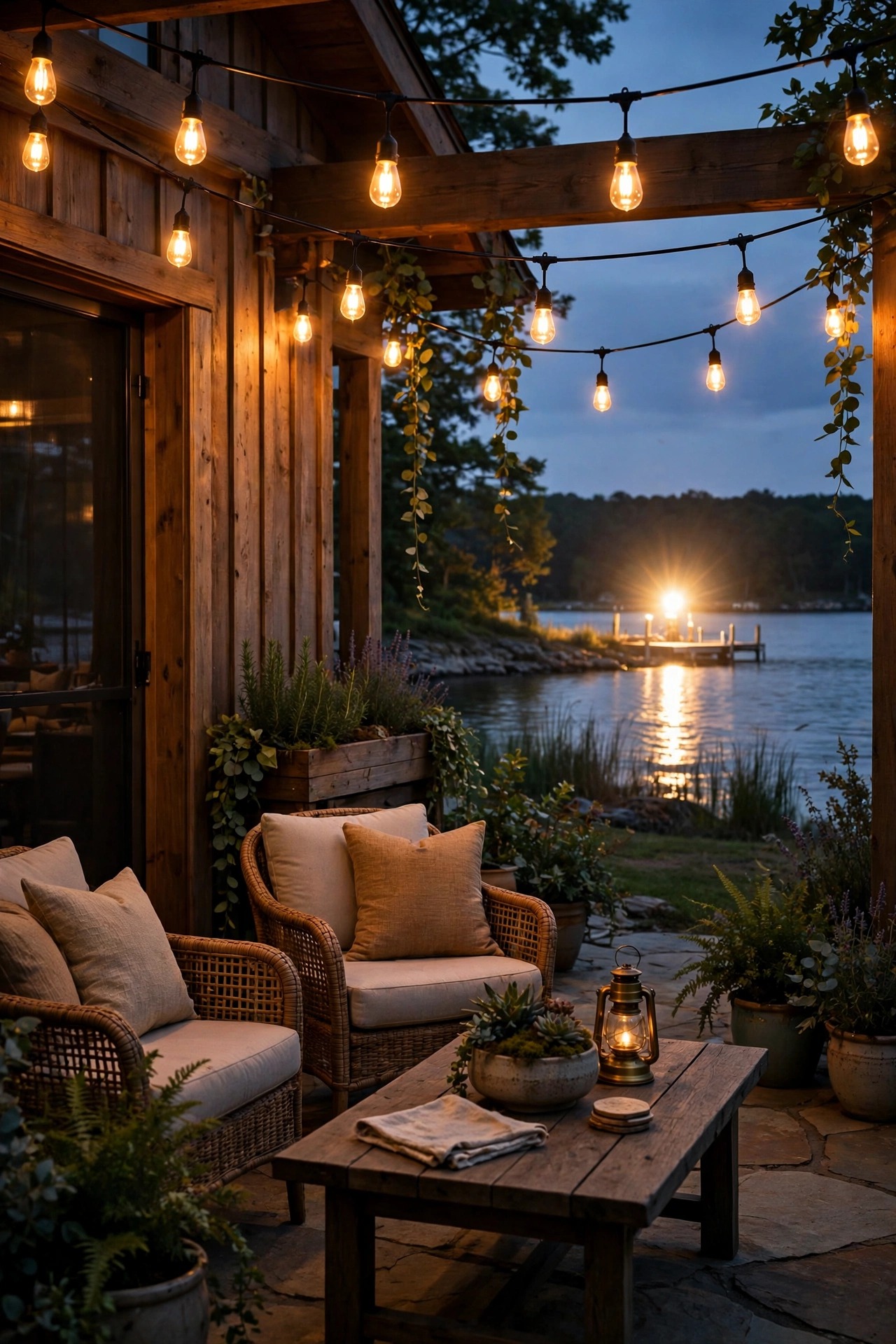
For a clean, built-in look, recessed deck floor lights are the upgrade I recommend once the basics are in place. These small round or square fixtures sit flush in the deck boards around the perimeter, marking the edge so nobody misjudges where the deck ends on a dark walk back from the dock. Space them 4 to 6 feet apart and wire them in a low-voltage loop to a single transformer with a dusk-to-dawn photocell. Choose fixtures with frosted lenses and warm 2700K output; bare bright dots in the floorboards can glare when you look down at them. Stainless steel or heavy composite housings survive lakeside moisture best, and I always order two spares because matching a discontinued style later is a headache. Installation is a weekend job with a hole saw and a little patience. They are subtle by day, pure function by night, and they make the whole deck feel like it was designed rather than decorated.
Suggested budget range: $90 – $260.

8. Uplighting the Big Tree by the Shore
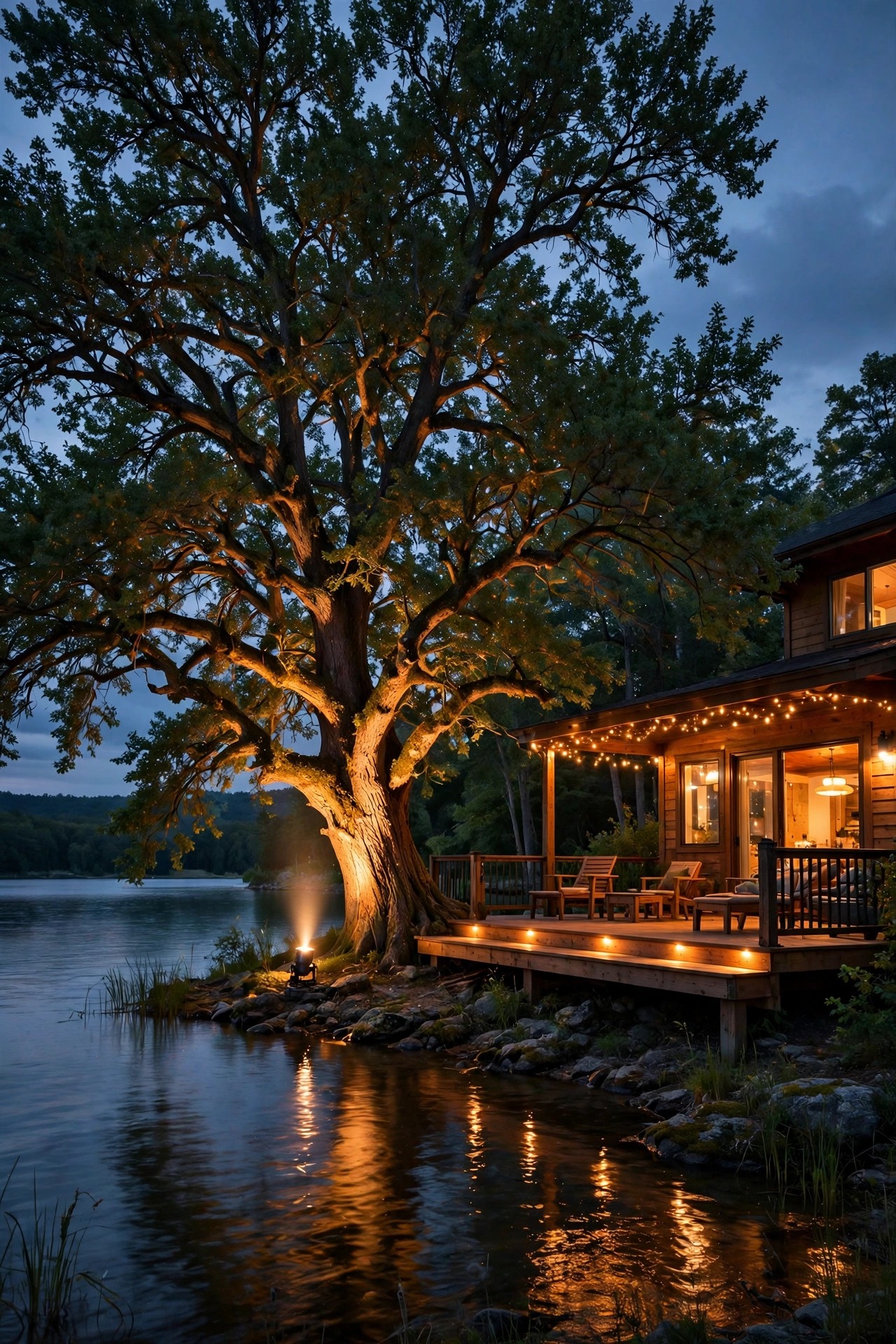
Every lake property has one hero tree, and a single well-placed uplight turns it into sculpture after dark. Use a narrow-beam 12-volt spotlight, 15 to 30 degrees, staked 12 to 18 inches from the trunk and aimed up into the canopy so the light rakes across the bark and fades into the leaves. Warm 2700K keeps it natural; anything cooler looks like a security light wandered into the yard. Keep the fixture below the sightline from the deck so you see the glow, never the source, and bury the cable a few inches down so mowers and feet miss it. From the water, a lit canopy tree is how neighbors find your house, which is a lovely problem to have. One caution from experience: aim thoughtfully and keep the beam in your own canopy. A respectful glow is charming; light spilling across the lake into someone else's windows is not, and dark-sky courtesy matters in lake communities.
Suggested budget range: $60 – $200.
9. A Low Ring of Light Around the Fire Pit
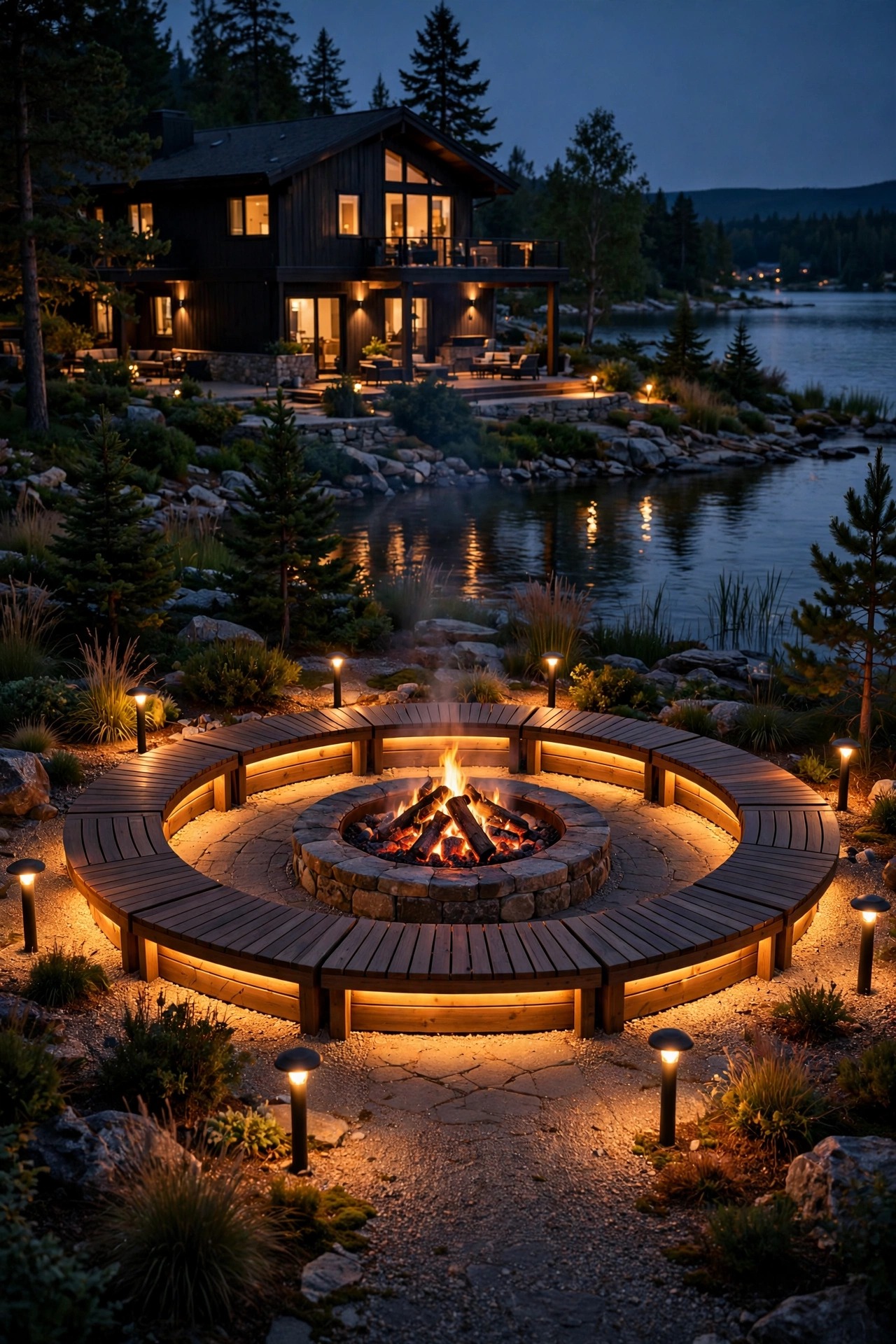
The fire pit area needs just enough light to find your chair, your drink, and the step down, and not one lumen more. Firelight is the star out there, so I ring the seating area with low, shielded lights: short bollards under 18 inches, lights tucked under bench seats, or a few solar stakes pushed to the back edge of the gravel. Keep every fixture aimed down and away from faces so the fire stays the brightest thing in the circle. Low-voltage strip lighting under a built-in bench is my favorite version; it washes the ground in a gentle crescent and costs almost nothing to run. Leave a clearly lit path from the fire pit back to the deck stairs, because that walk happens barefoot more often than anyone admits. Skip string lights directly over the fire itself, since heat and rising embers are hard on cords and bulbs. Let the flames do the overhead work and your ring of light do the footing.
Suggested budget range: $40 – $150.
10. Solar Path Lights Down to the Water
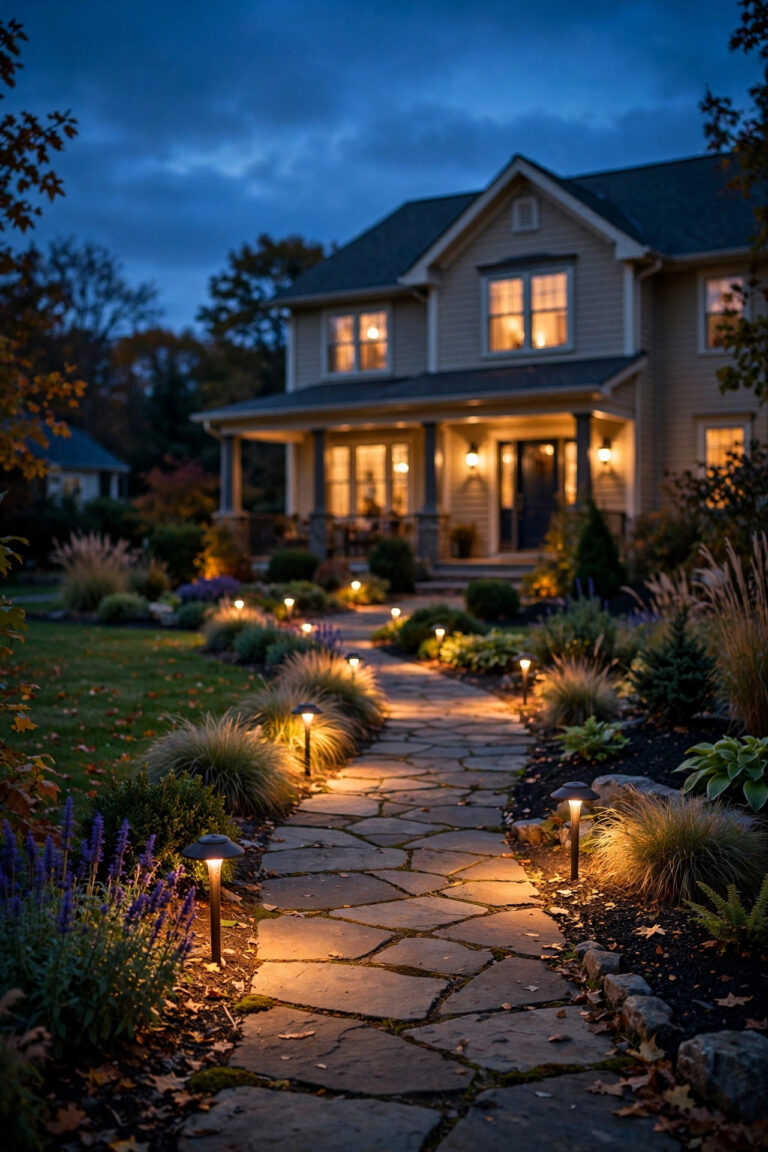
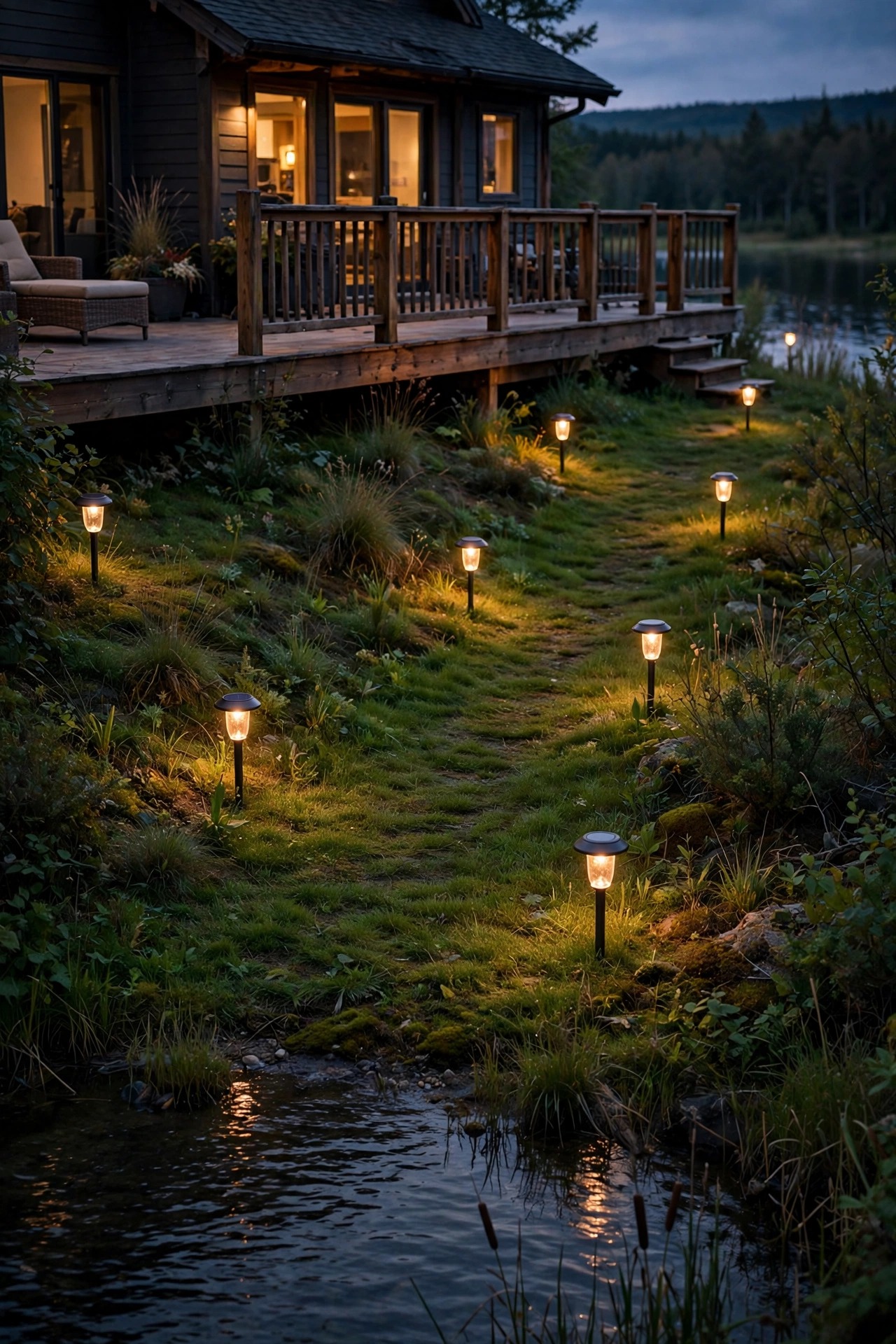
The walk from deck to dock deserves its own little runway of light, both for safety and because it looks like pure magic from the water. Solar path lights are perfect here since trenching wire across a lawn to the shore is nobody's idea of fun. Space stakes every 6 to 8 feet, staggering them on alternating sides of the path rather than lining them up like an airport. That stagger reads as intentional and garden-like instead of utilitarian. Choose stakes at least 12 inches tall with warm light and real glass or heavy plastic lenses; the cheapest sets yellow and crack within one season. On sloped ground, push stakes in on the uphill side so the light washes down across the path. I bring the shoreline set indoors for the deepest winter months, which doubles their lifespan for ten minutes of effort. Watching the path lights blink on one by one at dusk has become our unofficial start to the evening.
Suggested budget range: $35 – $110.
11. LED Strip Lights Hidden Under the Railing
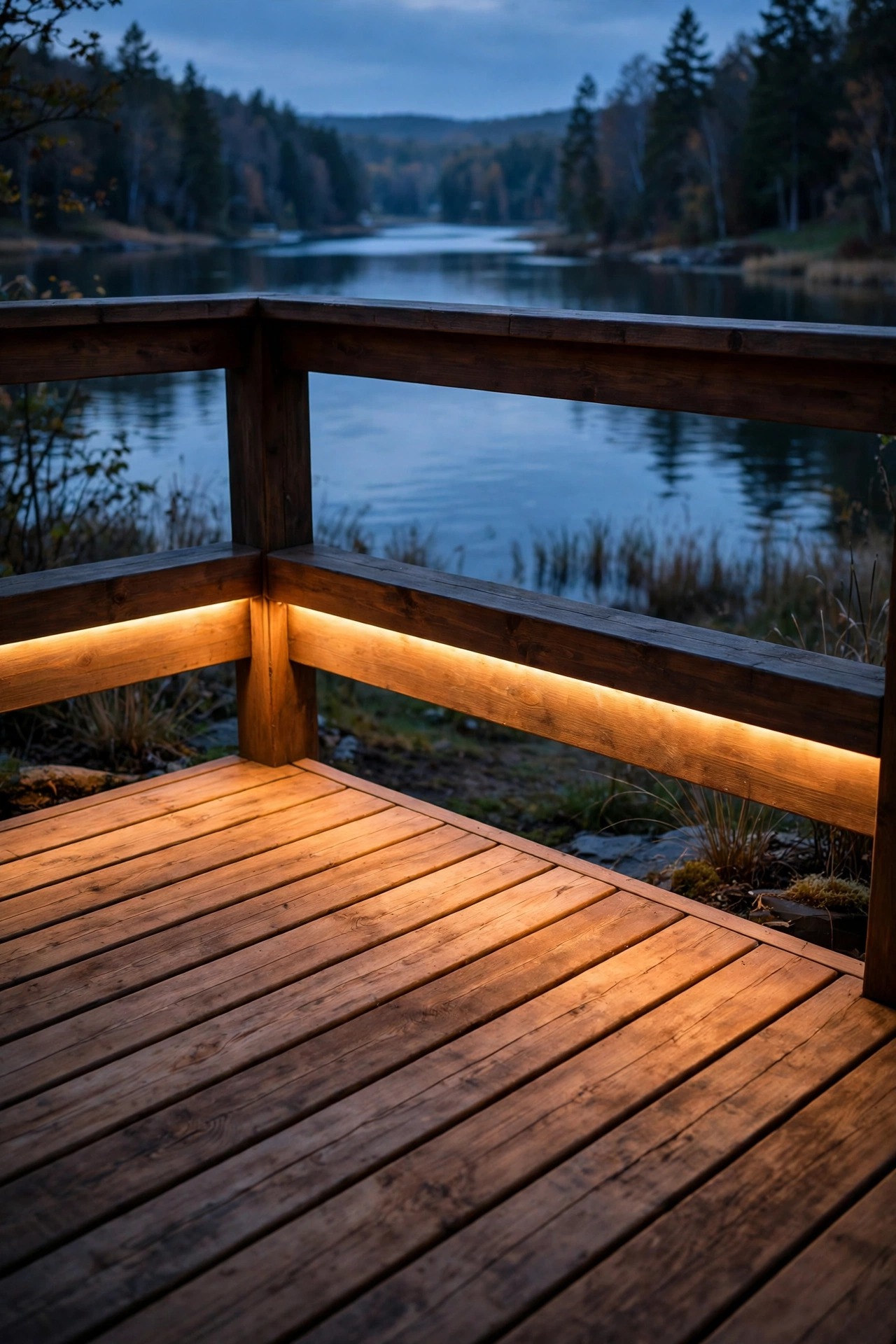
Under-railing LED strips are the detail guests ask about most, because the light seems to come from nowhere. A weatherproof strip in an aluminum channel mounts under the top rail and washes the deck boards and balusters in a continuous ribbon of warm light. It is ambient, accent, and wayfinding all at once, and it never competes with the view of the water the way a bare bulb does. Buy IP65 or better strips rated for outdoor use, 2700K, with a proper low-voltage driver kept in a weatherproof box near a GFCI outlet. The channel matters: it protects the strip, hides the individual diodes, and diffuses the light into an even line. Corners take a little patience with connectors, and I test the full run on the ground before a single screw goes in. Dim them to about half for evenings; full brightness is for cleanup after everyone has gone in. This is the most modern look on my list, and it flatters even a plain, older deck.
Suggested budget range: $55 – $160.
12. Citronella Torch Stakes Around the Patio Edge
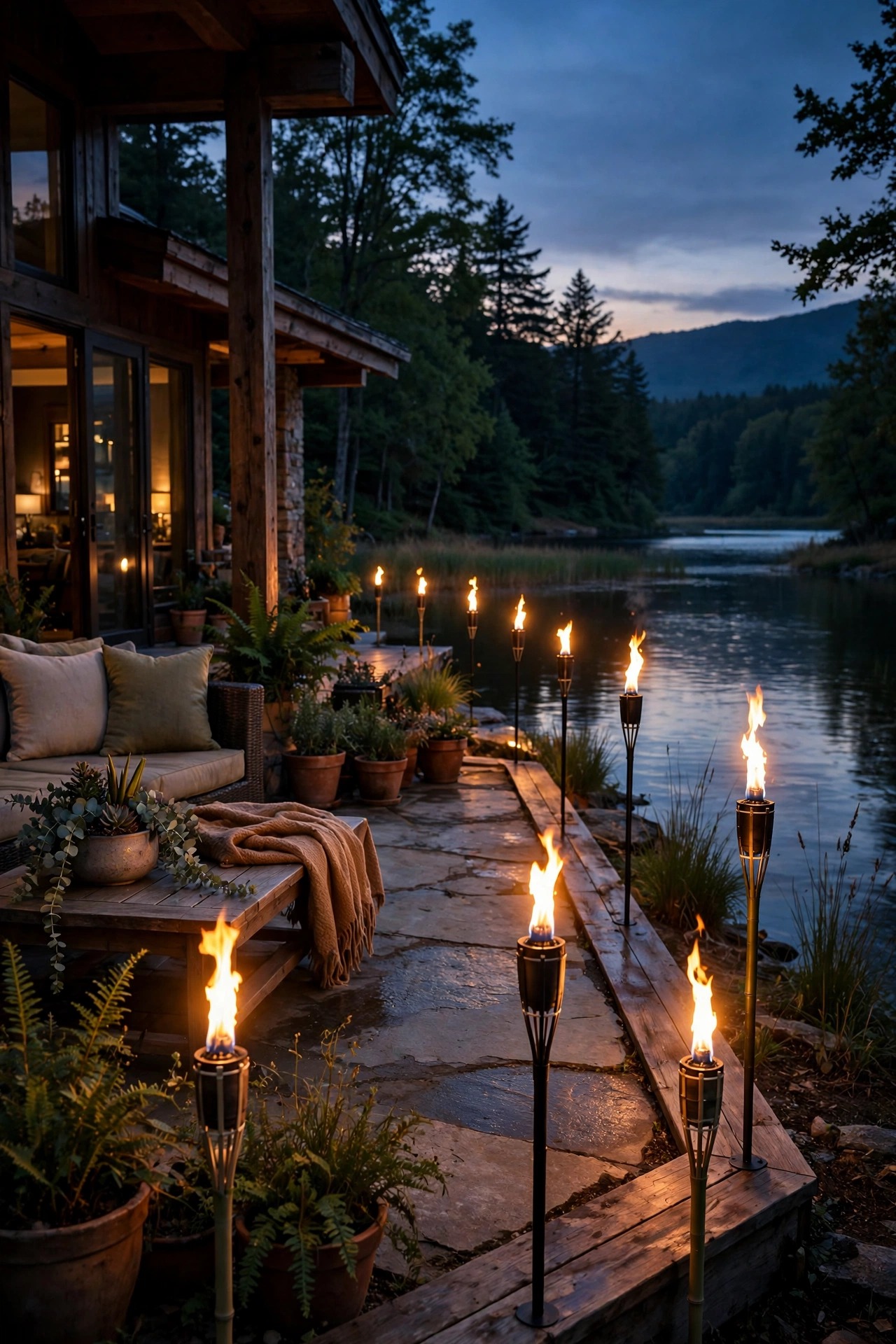
Some nights call for a little theater, and tall citronella torch stakes around the patio edge deliver it while doing honest bug duty. The real flame reads beautifully against the water and makes even a Tuesday feel like a small occasion. Plant stakes in the ground or in heavy weighted bases just outside the seating area, spaced 6 to 8 feet apart, and keep them well clear of cushions, umbrellas, and low branches. Fill reservoirs carefully outdoors, let the wicks soak before the first light, and never move a torch while it is burning. I keep a long lighter and a small funnel in the deck box so refills take two minutes. LED torch-style stakes with a flickering flame effect are the safer swap for windy shores and households with small kids, and the best ones fool me from ten feet away. Either way, extinguish and store fuel safely once the evening winds down; the lake will still be there tomorrow night.
Suggested budget range: $30 – $85.
13. Fairy Lights Twisted Through Mason Jars
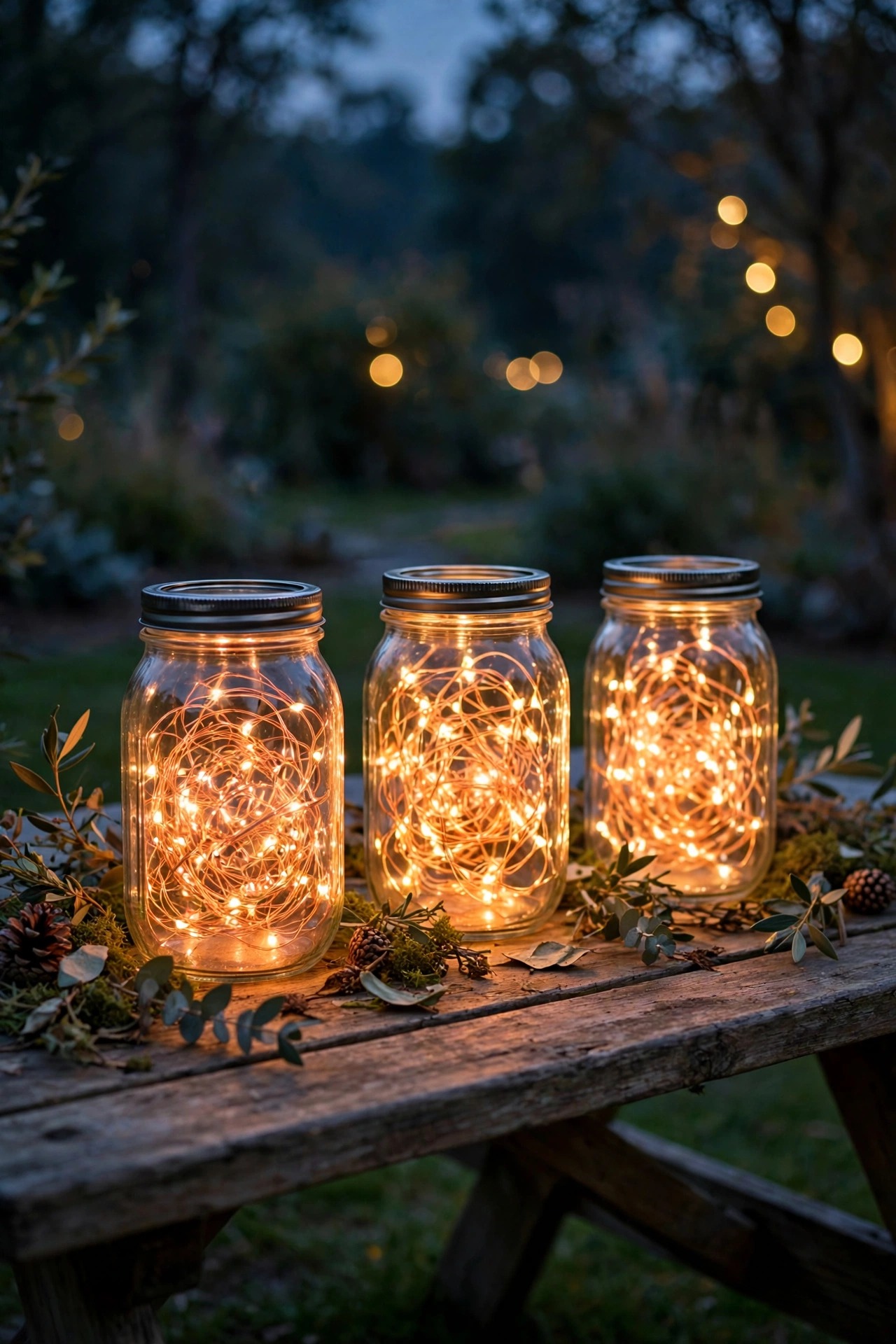
For the softest accent on this list, I fill clear glass jars with copper-wire fairy lights and scatter them everywhere: down the center of the patio table, along the deck steps, on the outdoor bar cart, inside the screen porch. A single strand of warm micro-lights in a jar glows like bottled fireflies, which is exactly the mood a lake house asks for. Battery packs with timers are the practical choice, so each jar switches itself on at dusk for six hours and off again without a thought. Keep jars under cover or choose solar-lidded versions if they will sit out in the rain, since water in the threads corrodes battery contacts fast. I group odd numbers, threes and fives, and mix jar sizes for a collected look. These cost so little that they are my standard housewarming gift to new lake neighbors, which has started more deck conversations than I can count. Small light, enormous charm.
Suggested budget range: $20 – $60.
14. A Motion-Sensor Light for the Back Door and Boathouse Path
Not every light at a lake house is about mood; some are about not tripping over a cooler at midnight. A motion-sensor fixture over the back door and another covering the boathouse or garage path gives you bright, honest light exactly when you are carrying something, then politely turns itself off. Aim sensors along the walking route rather than straight at the lake, or every passing boat wake of motion, raccoon, and windblown branch will trigger a show. Most fixtures let you adjust sensitivity and run time; I set ours to two minutes, which covers the door-to-dock walk without lingering. Choose warm-to-neutral bulbs so the security light does not clash with your 2700K scheme, and keep the fixture shielded so it lights the ground, not the neighbors across the cove. During parties I switch ours to manual-on so guests are not startled. It is the least romantic idea here and quite possibly the one you will thank daily.
Suggested budget range: $40 – $120.

15. A Pendant or Fan Light Over the Grill and Game Zone
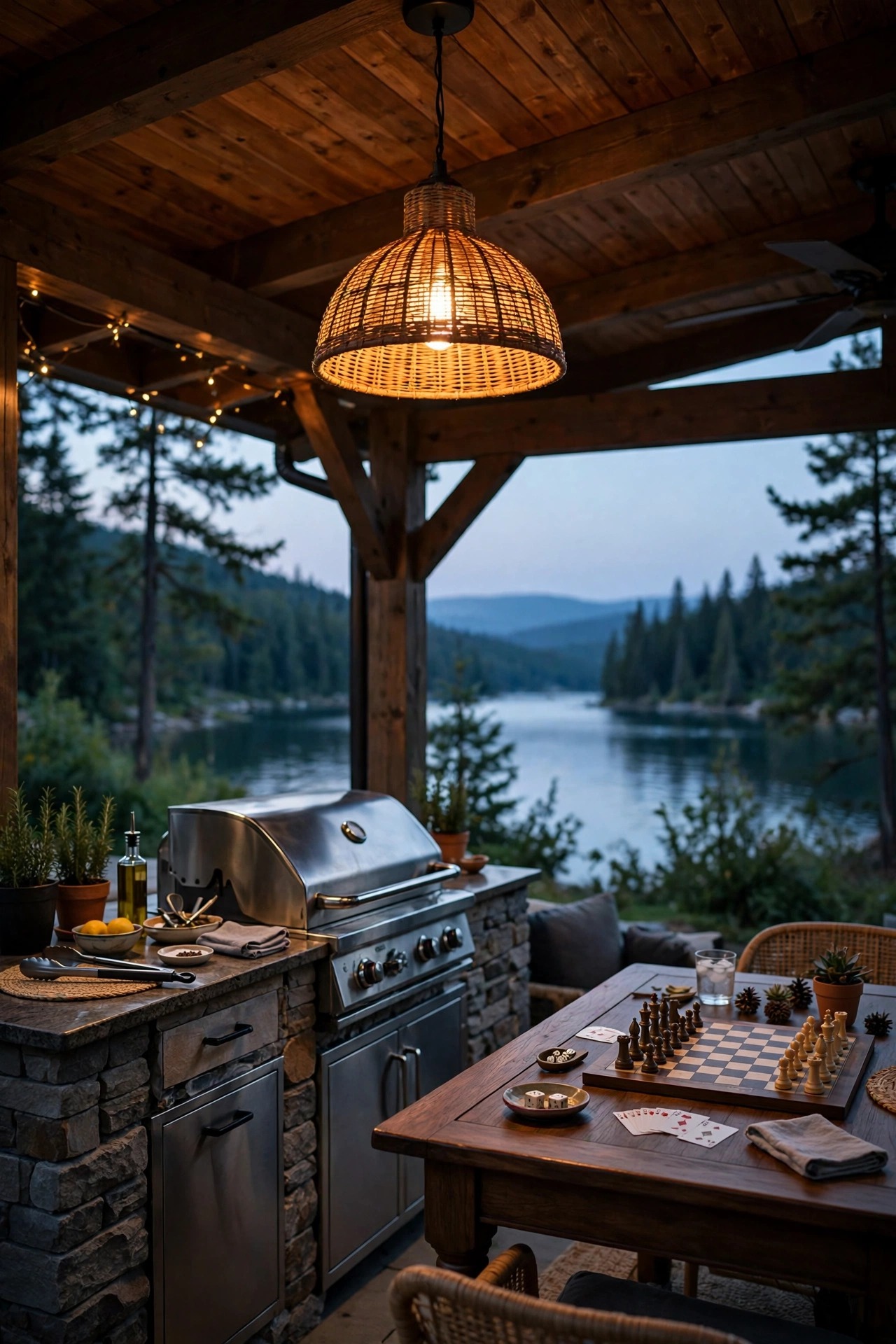
The grill master deserves better than cooking by phone flashlight, and a dedicated pendant or ceiling light over the cooking and game zone is the task layer done right. On a covered patio or pergola, hang a weather-rated pendant centered over the grill station or the card table, about 30 to 36 inches above the surface, so the light pools where hands actually work. On open decks, a damp-rated ceiling fan with a light kit on the porch ceiling does double duty, moving air against mosquitoes while it lights dinner. Keep bulbs bright here, 800 lumens or more per fixture, but stay at 2700K to 3000K so raw burgers and smiling faces both look right. Put this zone on its own switch or smart plug so the cook can have full work light while the rest of the deck stays candle-dim. Grease and lake humidity are hard on fixtures, so choose sealed outdoor housings you can wipe down in spring. Good task light is invisible until the night somebody tries to grill without it.
Suggested budget range: $70 – $220.
16. Lights That Play With the Water Itself
The lake is your biggest light fixture, and the smartest setups borrow its reflections. A few low lights aimed gently across the shoreline plantings, or a warm glow placed where it will double in the water, gives you twice the effect for the same watts. When we redid our shoreline beds, I borrowed tricks from the pond lighting ideas I use in the garden: shielded fixtures, beams kept low and contained, and light washing across texture rather than blasting outward. Submersible lights have their place in a water feature, but for the open lake I prefer lights on land, aimed at grasses, stone, and the dock posts on your own shoreline, never straight out across open water where they blind night boaters. Ripples animate every reflection, so even a single well-placed lantern near the shore looks alive all evening. On still nights the whole deck reflects like a postcard. Work with the water and it does half your decorating for you.
Suggested budget range: $45 – $140.

17. Timers and Smart Plugs That Run Your Lake House Outdoor Lighting Ideas for You
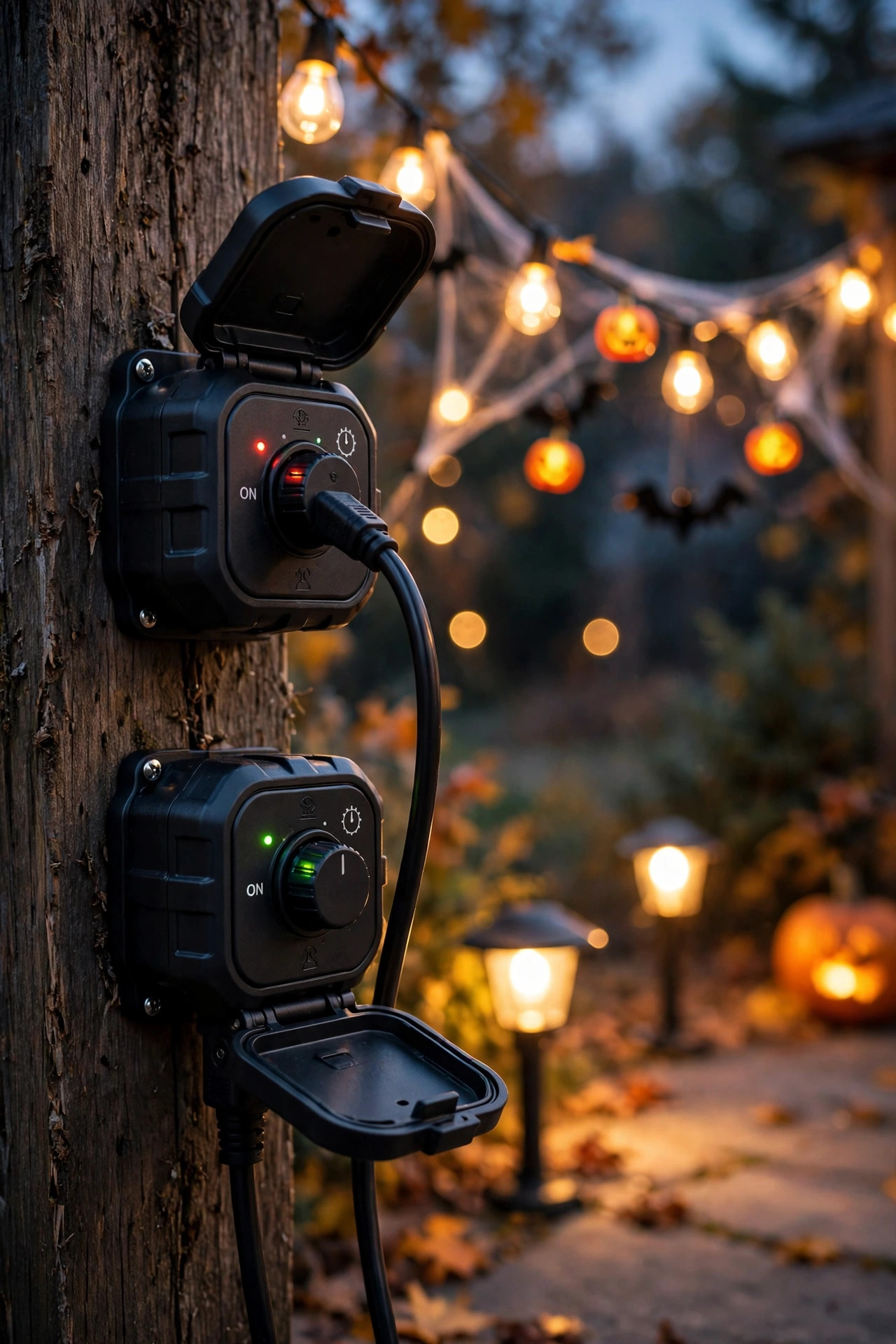
The best system is the one you never think about, and automation is how these lake house outdoor lighting ideas take care of themselves. Put string lights and low-voltage transformers on astronomical timers that track sunset, and your deck lights itself minutes before the first guest asks for a sweater. Smart plugs rated for outdoor use let you dim the patio from a phone or voice command without leaving your chair, which feels like a luxury the first night and a basic necessity by the third. Group your zones the way you layered them: ambient on one schedule, accents on another, task lights manual. Set everything to wind down by 11 p.m. or midnight out of respect for the lake and the folks across it, and to keep your own bedrooms dark. Before a trip, the same timers make the house look happily occupied. I reprogram ours twice a year as the evenings stretch and shrink. Fifteen minutes of setup buys you a whole summer of walking out to a deck that is already glowing.
Suggested budget range: $25 – $100.
Frequently Asked Questions
What color temperature is best for a lake house deck?
Warm white, 2700K, is my answer for nearly everything on the deck and patio. It flatters skin, wood, and food, and it matches the golden tone of sunset on the water instead of fighting it. Go warmer still, 2000K to 2200K amber, near seating where bugs are a problem. Save cooler light for nothing at all out here; even task areas look better at 3000K maximum.
Are solar lights bright enough for a lake house deck?
For accents and wayfinding, absolutely: modern solar post caps and path lights are plenty bright to outline a deck and mark a shore path. For real task light over a grill or a big dining table, solar falls short, so plan on low-voltage wired or a hardwired fixture there. A mix is the honest answer, solar where wiring is painful and wired where brightness matters.
How do I keep bugs away from my patio lights at the lake?
Three things together make the real difference. Use amber or warm bug bulbs near seating, since most flying insects are far less drawn to them. Place your brightest white lights away from the table so bugs gather there instead. And add moving air with a porch fan if you can. No single trick empties the sky, but together they turn swatting season into a minor nuisance.
Can I leave my lake house outdoor lights up all winter?
Wired low-voltage fixtures and hardwired lights can stay year-round if they are outdoor-rated and connections are sealed. Solar lights last longer if you bring them in for the coldest months, clean the panels, and store batteries indoors. String lights rated for permanent outdoor use can stay, though I take ours down every second winter for a close inspection of cords and sockets.
Conclusion
If you take one thing from this list, let it be the layering: ambient glow to gather under, task light where hands work, and small accents that let the water join in. Start with string lights and a few lanterns, add step and path lights for safety, then automate the whole thing and stop thinking about it. These lake house outdoor lighting ideas have carried our deck through fifteen summers of fish fries, card games, and quiet last drinks by the railing, and they will do the same for yours. Browse the rest of the site for more deck, patio, and garden lighting inspiration, and I will see you out there at dusk.