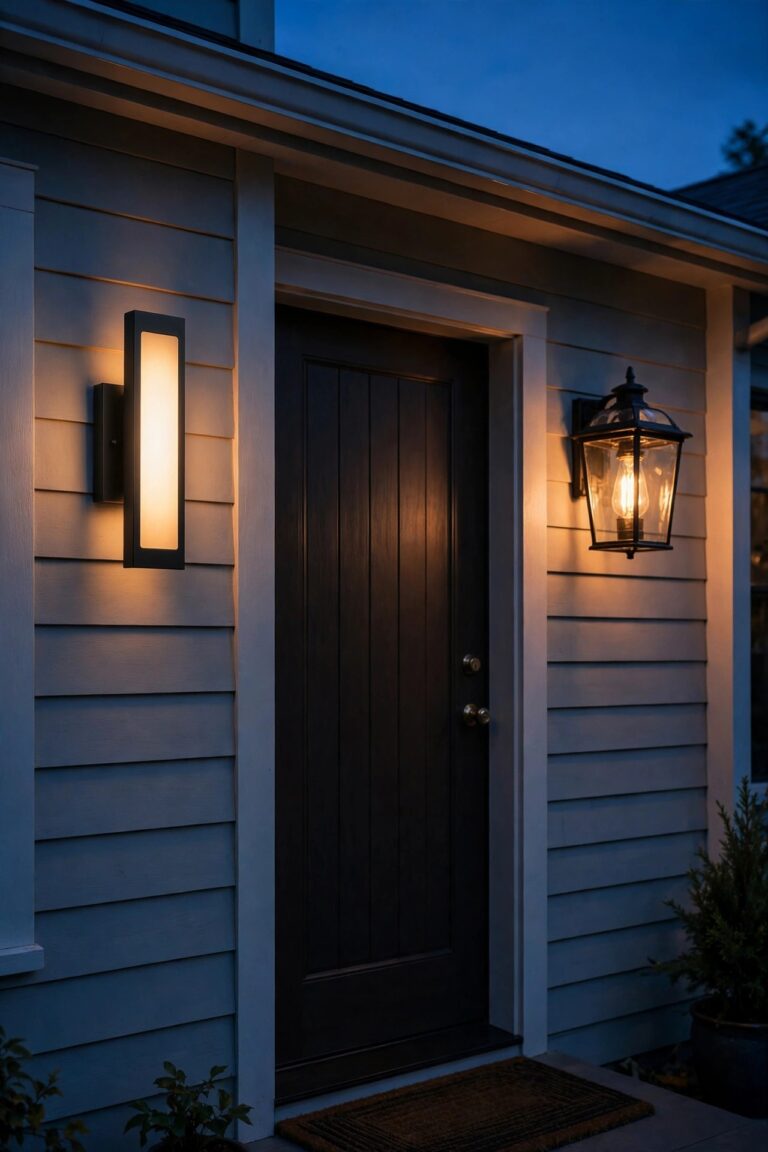
There is a reason the most photographed porches in America belong to colonial homes: they were practically designed for lamplight. Symmetry, straight walkways, paneled doors — the architecture does half the decorating for you, and the right colonial porch lighting ideas simply finish the sentence. I have styled my own brick colonial through every season, and honestly? The porches that stop neighbors mid-walk are never the brightest ones. They are the balanced ones, where every fixture has a twin and every bulb glows the same warm white. My approach is the same layering I use everywhere: a guidance layer that leads guests safely from the street, a welcome layer at the door itself, and a soft accent layer that gives the facade depth after dark. In this post I am sharing the 19 ideas I come back to again and again, from flanking lantern sconces to window candles, each with realistic 2026 pricing. If you want the whole-house picture first, my guide to colonial exterior lighting covers the facade, roofline, and yard beyond the porch.

1. Colonial Porch Lighting Ideas Start With Symmetry: My Three-Layer Plan
Before I buy a single fixture, I stand at the street and take a photo of the porch in daylight. A colonial facade is built on a center axis — door in the middle, windows matched on both sides — and your lighting plan should honor that axis or the whole front will feel quietly off. My plan layers three jobs. The guidance layer is the post light and walkway lanterns that draw guests in. The welcome layer is the door itself: flanking sconces, a ceiling fixture, a glow behind the sidelights. The accent layer is the soft stuff — window candles, an uplight on the brick, a lantern on the steps — that adds depth without glare. Sketch the three layers right onto your photo, mark every fixture as a pair or a centered single, and only then start shopping. This one habit prevents the most common colonial mistake I see: a beautiful porch where one side glows and the other sits in shadow because a fixture got added later as an afterthought.
Suggested budget range: $60 – $300.

2. Flanking Lantern Sconces: The Pair Every Colonial Door Deserves
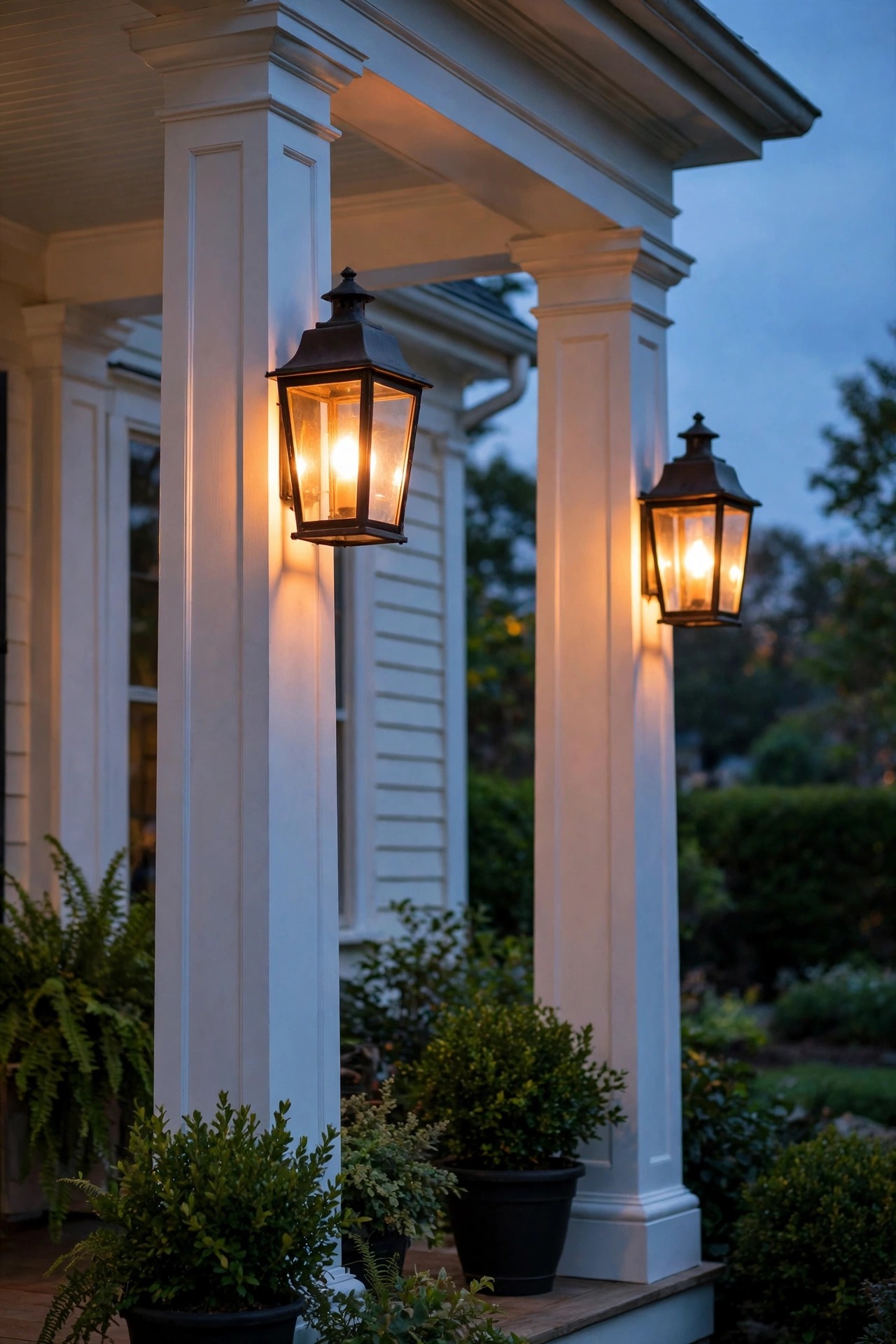
Nothing says colonial welcome like a matched pair of lanterns framing the front door. I look for black or aged-brass metal frames with clear or lightly seeded glass and a visible filament-style LED bulb inside — that candle-like glow is the whole point. Size matters more than style here: each lantern should measure roughly one-quarter to one-third the height of your door including trim, and most doors look best with lanterns 12 to 18 inches tall. Mount them with the bulb center about 66 inches above the porch floor, and put the pair on one dimmer or one photocell so they always switch together. If your door has sidelights, narrower lanterns keep the composition balanced instead of crowded. Choose fixtures rated for wet locations, not just damp, because porch edges catch real rain. My front door sconce pair guide walks through the exact measuring and spacing math if you want to double-check your numbers before ordering.
Suggested budget range: $80 – $350.
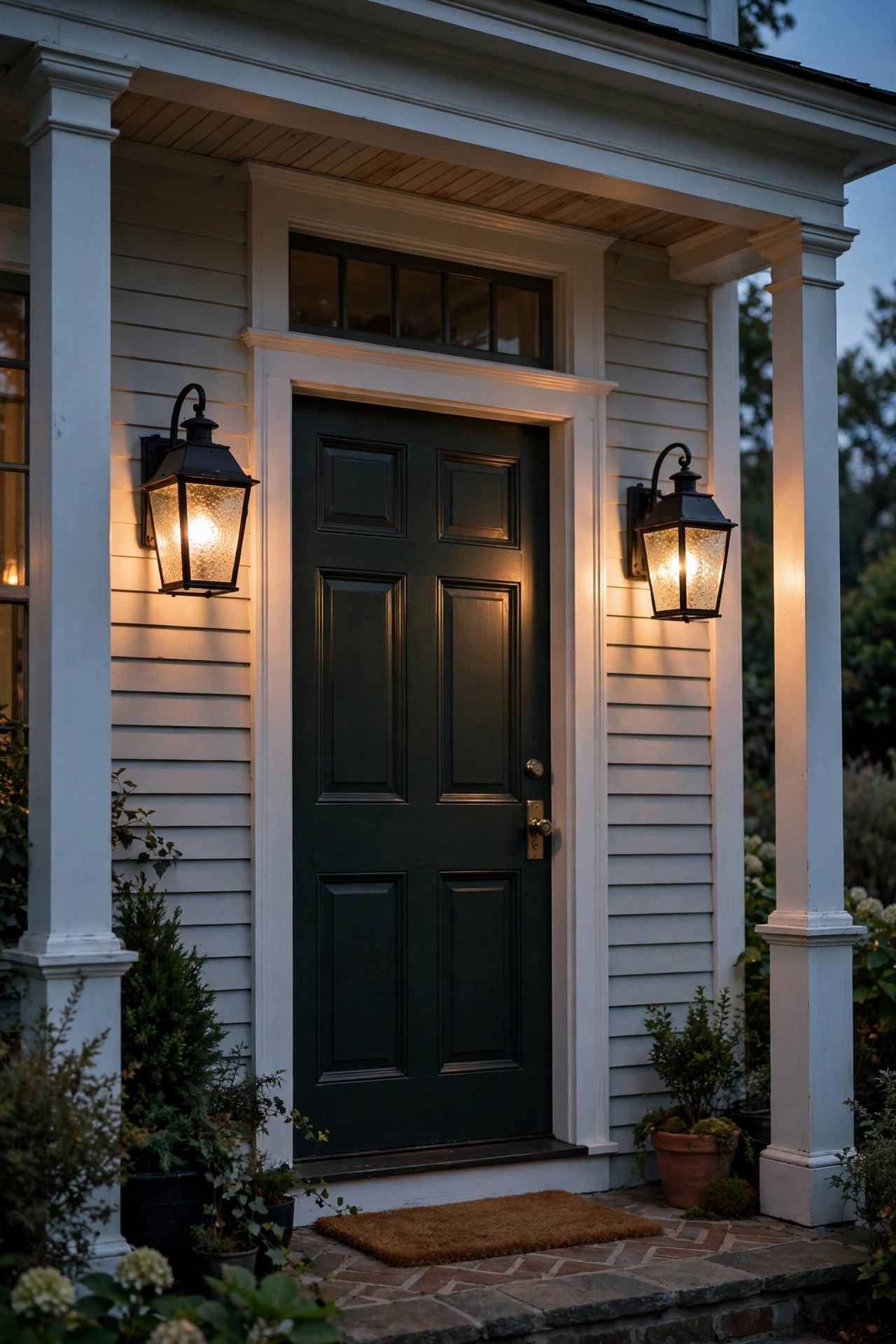
3. The Lantern Post Light: A Beacon Where the Walk Meets the Street
A lantern post light at the edge of the walk is the oldest colonial lighting trick there is — it is the lamplighter era, updated with an LED. I place mine where the walkway meets the driveway or the sidewalk, about 18 to 24 inches back from the walk edge, so guests get a beacon without glare in their eyes. An 8 to 9 foot post with the lantern head on top reads perfectly in scale with a two-story colonial; shorter 6 foot posts suit ranch-style colonials and raised ranches. Look for a louvered or pierced lantern top if you want that classic starburst spill of light on the ground, and choose a photocell version so it lights itself every single night. Hardwired posts are the most reliable, but a good solar post lantern works if the spot gets six hours of direct sun. And run the conduit or cable before you set the post in concrete — I learned that particular order the hard way one October.
Suggested budget range: $120 – $450.
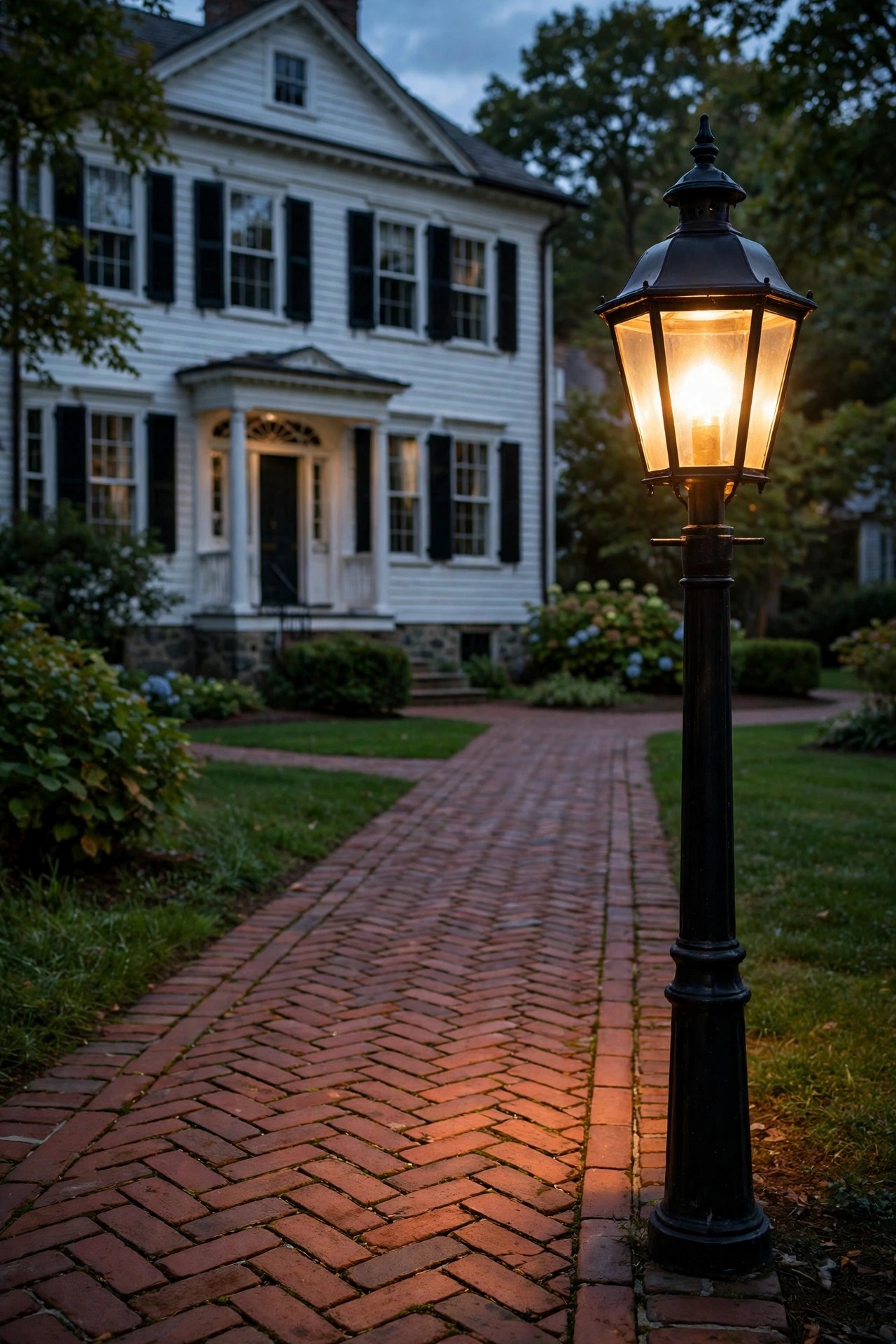
4. The Flush-Mount Ceiling Light for Low Porch Roofs
Plenty of colonial porches have low ceilings or a shallow overhang, and that is exactly where a flush-mount ceiling fixture earns its keep. I choose lantern-style flush mounts with the same finish and glass as my door sconces, so the porch reads as one designed set instead of three separate purchases. One fixture centered over the door works for porches up to about 8 feet wide; on wider porches, a matched pair spaced evenly looks intentional and lights the seating corners too. A 2700K LED around 800 to 1,200 lumens is plenty — you want faces to look warm, not interrogated. And if your porch ceiling is painted haint blue, congratulations: warm light against that soft blue is one of the prettiest combinations in American home design. Browse my favorite porch ceiling light ideas for shapes that suit low ceilings, and always confirm the fixture is damp-location rated at minimum before it goes up.
Suggested budget range: $40 – $180.
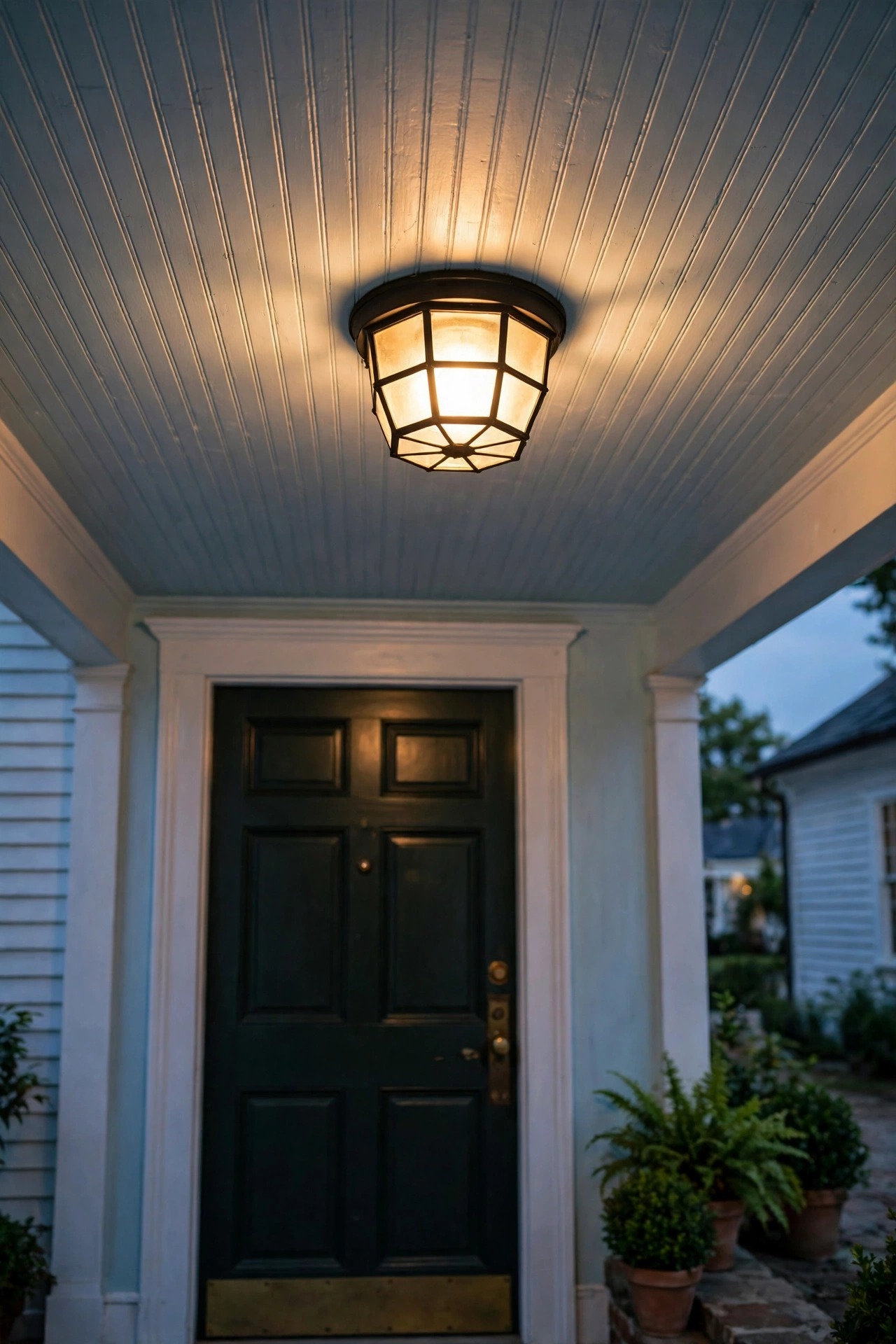
5. Window Candles in Every Front Window
Ask anyone who drives through a historic district in December what they remember, and it is the window candles. I keep mine up all year, honestly — a single warm candle in every front window is the most colonial gesture there is, and it costs almost nothing to run. The modern version is a plug-in or battery candle with a realistic flicker and a dusk sensor, drawing roughly the power of a nightlight. Consistency is everything: same candle height, same warm color, centered in every window on the facade, including the small one over the door if you have it. Set them on the sill inside, pulled back about an inch from the glass so the reflection does not double the flame. Battery versions on timers save the outlet hunt — mine click on at dusk and run for six hours. From the street, lit windows make the whole house feel occupied and loved, which is exactly the welcome a colonial is supposed to project.
Suggested budget range: $25 – $90.
6. A Hanging Lantern Pendant Over the Door
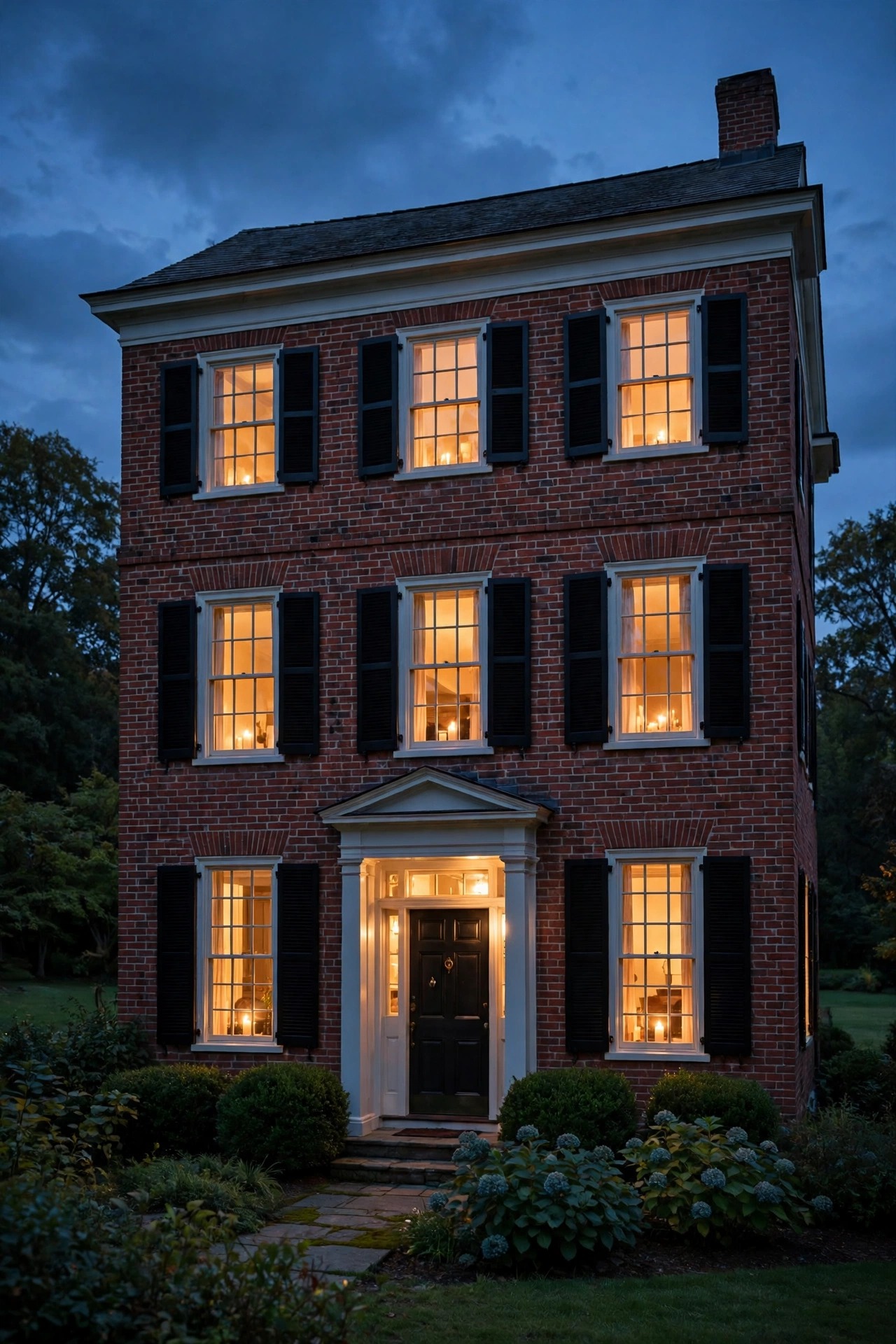
If your porch roof is tall enough, a hanging lantern pendant centered on the door can take the place of the flush mount, and it gives you that carriage-house silhouette colonials wear so well. Keep the bottom of the lantern at least 7 feet above the porch floor so tall guests never have to duck, and size it bold — a 16 to 22 inch lantern holds its own against a two-story facade where a small one just disappears. I hang mine on a black chain with three to six inches of decorative slack swagged to a hook; a perfectly taut chain looks like it is holding the roof up. Center the lantern on the door itself, not on the porch, if the two do not align. LED filament bulbs keep the candle feel without the heat, and a dimmer lets you drop the glow low for evening porch sitting. Choose a wet-location rating and a glass style that matches your sconces — seeded glass with seeded glass, clear with clear — so the set reads as family, not strangers.
Suggested budget range: $70 – $300.
7. Walkway Lanterns in Matched Rows
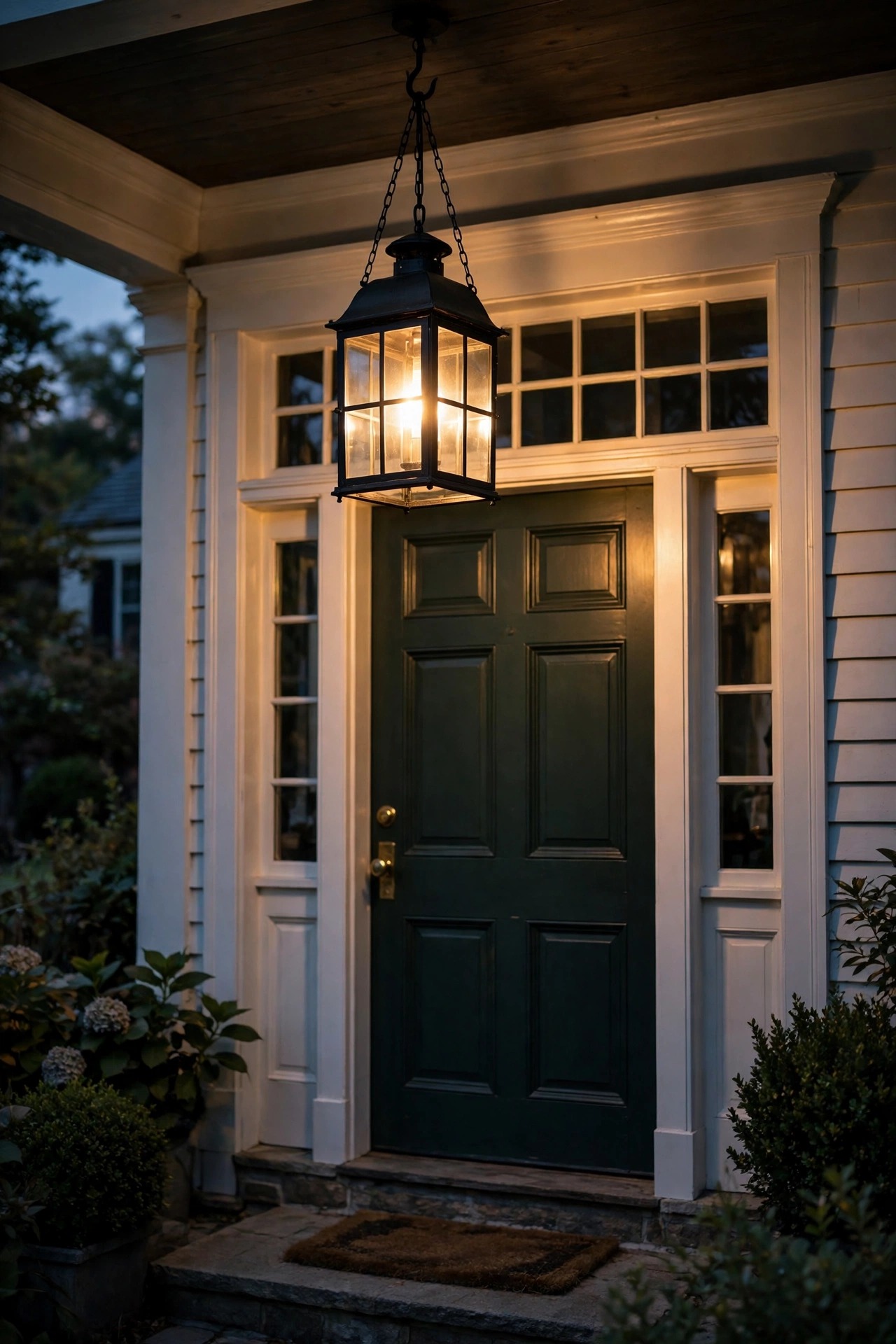
A straight colonial walkway is practically begging for a matched row of lantern-style path lights, spaced one every 6 to 8 feet. For the classic look I prefer pairs directly across from each other — symmetry again — on walks 4 feet wide or wider, and a single staggered row on narrower garden paths. Low-voltage wired lanterns are my first choice for reliability: a 12-volt system with 2700K LED heads at 100 to 200 lumens each lights the pavers without lighting up the whole yard. Keep the lantern heads 14 to 18 inches tall so they read as little lampposts, not runway markers. Space them so the pools of light just touch; guests should see one continuous ribbon of glow from the street to the steps. Solar lanterns are the budget route and they have genuinely improved, but in my experience the wired set still looks twice as rich by year two — and it never fades out at midnight.
Suggested budget range: $60 – $400.
8. A Soft Wash Up the Brick or Stone
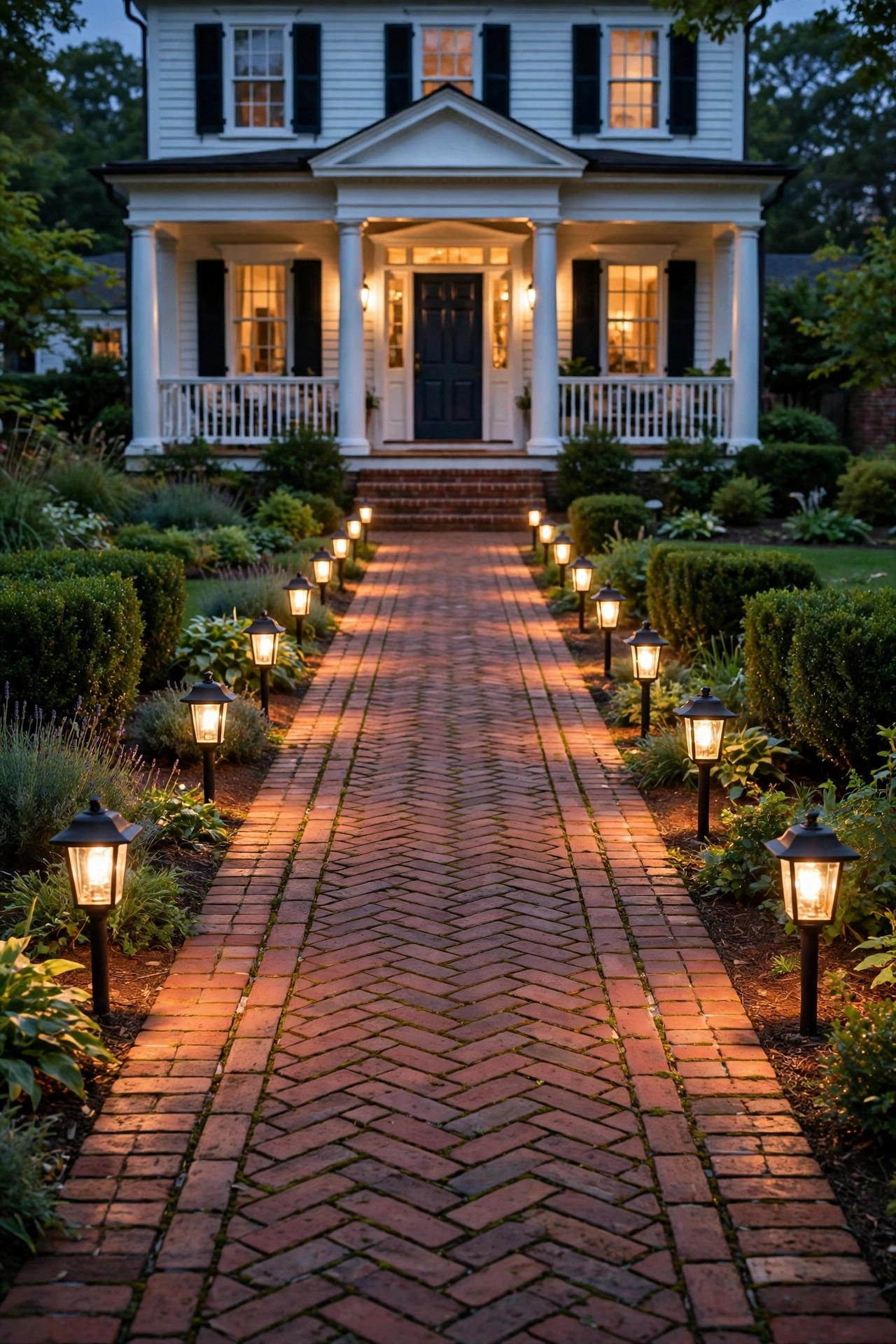
Colonial brick deserves better than a bare bulb. A pair of low uplights or a soft wall wash aimed up the facade gives the front of the house that quiet, expensive glow you see on historic inns. I place small well lights or bullet uplights 12 to 18 inches out from the foundation, aimed at the brick between the windows rather than at the windows themselves, so the light grazes texture instead of blasting glass. Warm 2700K at a modest 300 to 500 lumens per fixture is plenty; brick drinks light, and less really does look like more here. On stone or painted facades, pull the fixtures a touch farther out for a softer spread. Keep the beams off the second-story windows — nobody wants a lit bedroom ceiling — and shield anything a neighbor can see from the street. This is the accent layer doing its best work: depth, texture, and that deep-evening richness that makes people slow down as they pass your house.
Suggested budget range: $50 – $250.
9. Step Lights That Keep Guests Safe
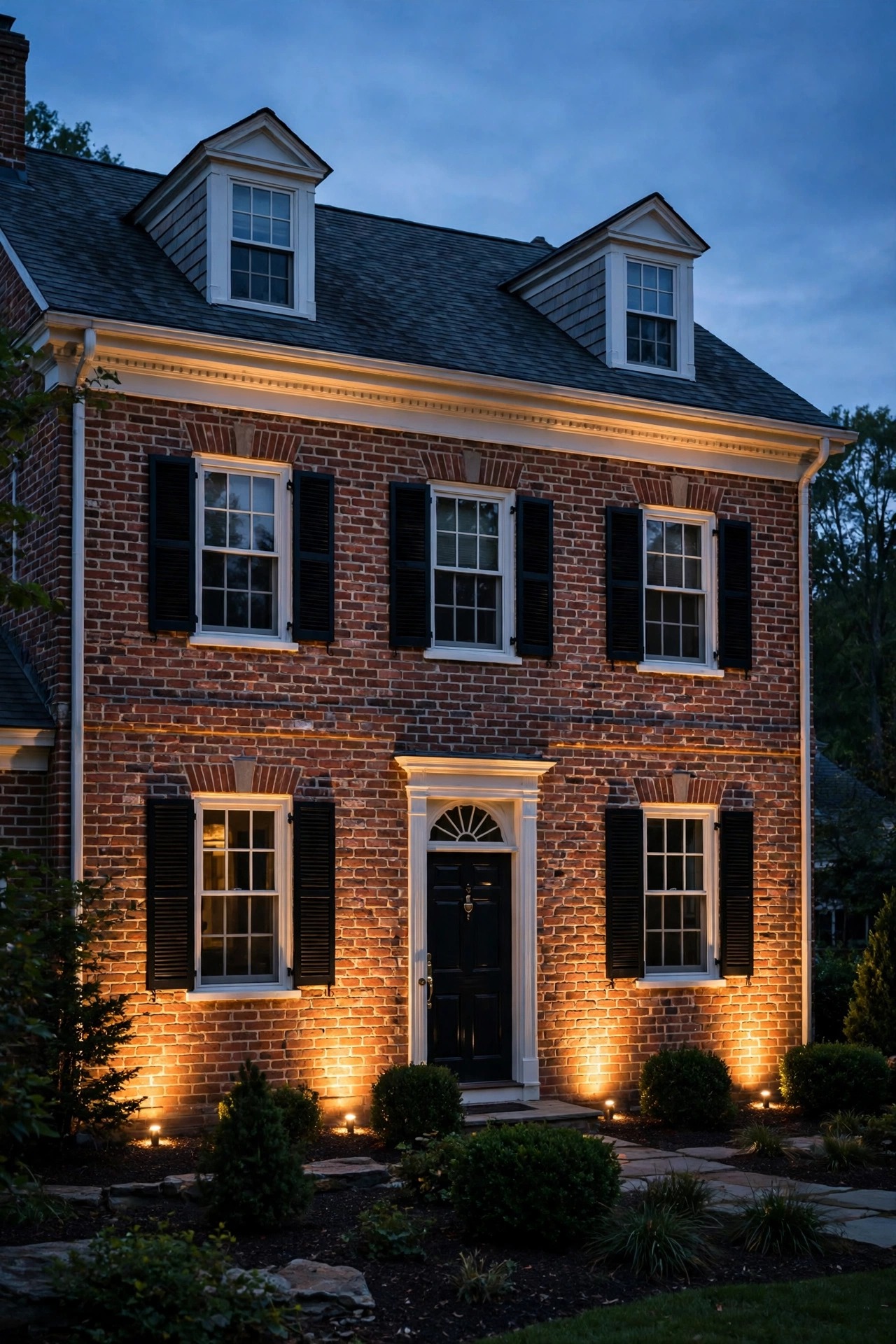
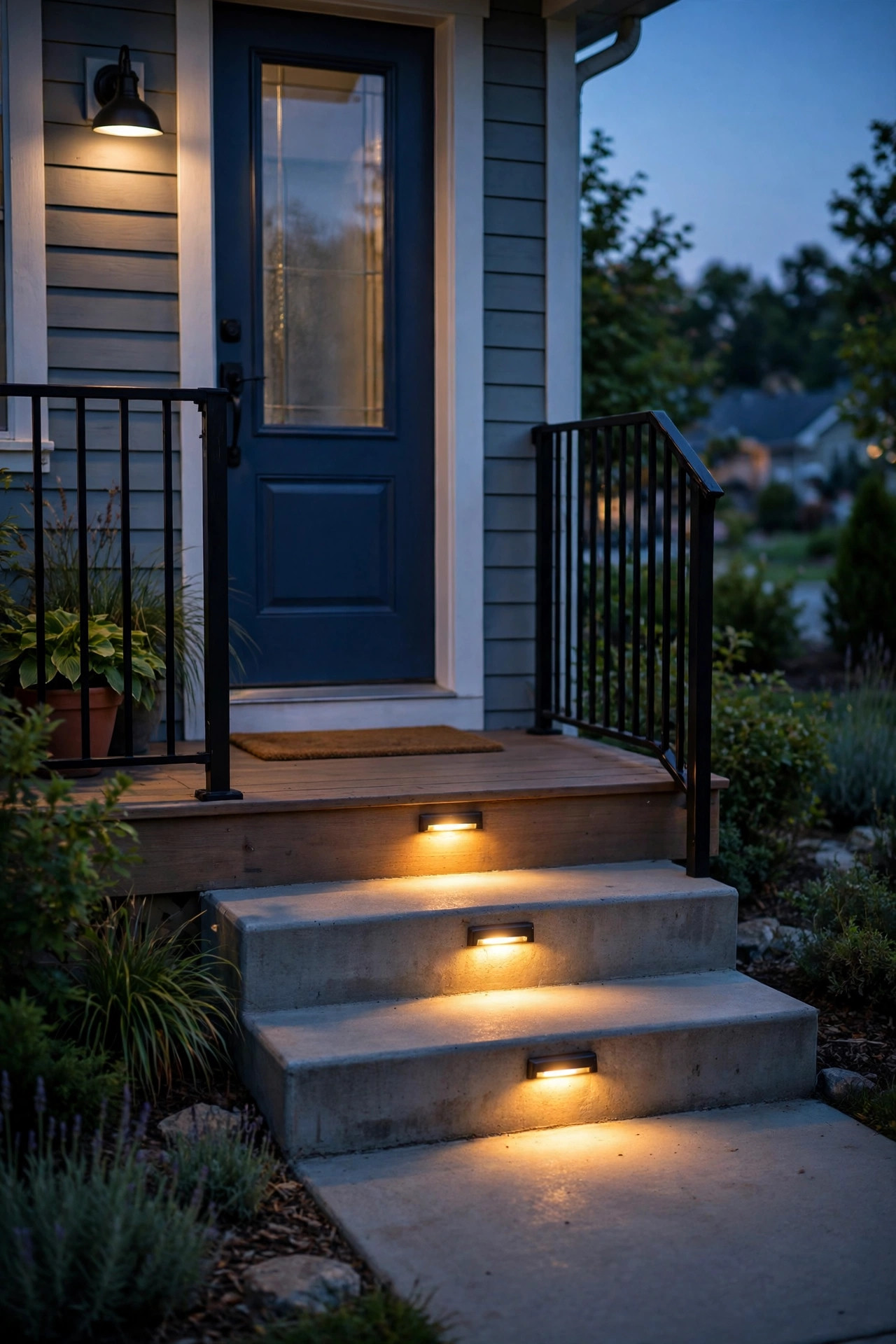
Porch steps are where guests actually get hurt, so this is the least glamorous and most important idea on the list. I light every step on a colonial entry, either with small recessed lights set into the risers or with low lanterns flanking the bottom and top steps. Riser lights should be shielded and dim — 50 to 100 lumens is plenty — aimed down at the tread so the light marks the edge without shining in anyone's eyes. If your steps are brick, a mortar-joint installation keeps the historic look intact; for wood steps, surface-mount lights tucked under the tread nosing are nearly invisible by day. Put them on the same photocell or timer as the post light so the whole arrival sequence wakes up together at dusk. In icy climates I bump the step lighting a little brighter through winter, because a shadow hiding black ice is an invitation nobody wants. Safe can absolutely still be beautiful — it just has to be planned, not leftover.
Suggested budget range: $45 – $220.
10. One Warm Temperature: The 2700K Rule Behind All My Colonial Porch Lighting Ideas
The fastest way to ruin a classic porch is five fixtures in four different color temperatures. One sconce glows amber, the post light burns blue-white, and suddenly the colonial looks like a gas station. My rule is simple: every bulb on the front of the house is 2700K, full stop, and I check the number on the box before anything goes in the cart. That warm white mimics candlelight and gaslight, which is the entire historical point, and it flatters brick, painted wood, and faces all at once. When you replace a bulb, replace it with the same brand and temperature if you can — two bulbs both labeled 2700K can still differ slightly, and matched pairs should truly match. Buy spares when you find a bulb you love, because manufacturers quietly change LED formulas all the time. If a fixture has an integrated LED, note its temperature in your phone the day you install it. One temperature, everywhere, is the cheapest professional secret on this entire list.
Suggested budget range: $15 – $60.
11. Aged Brass and Copper Accents
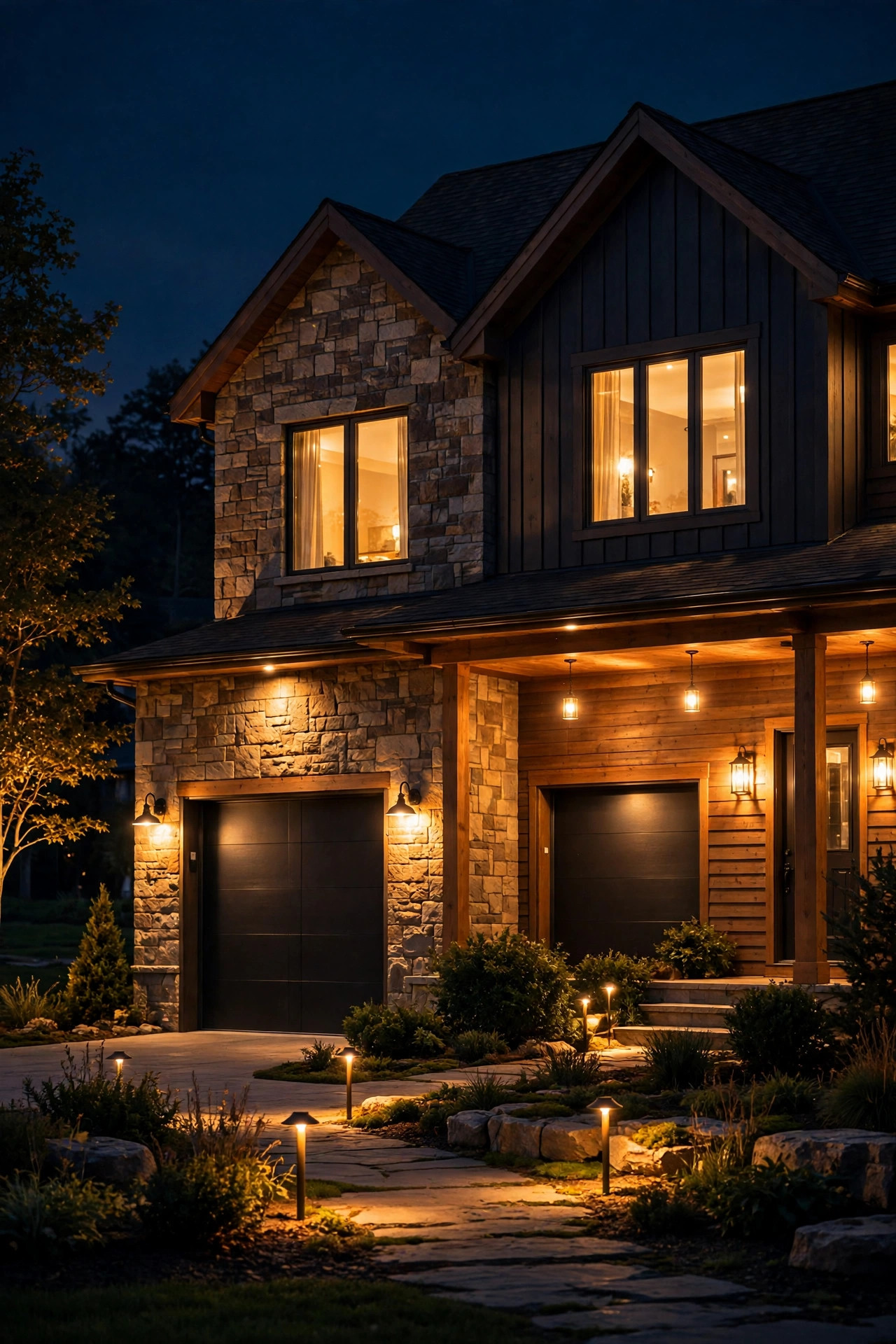
Black is the classic colonial lantern finish, but a little aged brass or copper warms up a dark facade like nothing else. I use it sparingly — maybe just the door lanterns in antique brass while the post and path lights stay black — so the porch reads collected over time rather than matched from a single box. Real copper and brass develop a soft patina outdoors; if you love the bright look instead, choose a lacquered or powder-coated finish that imitates it and never changes. Against a black or deep green door, brass is stunning. Against red brick, copper tones blend right into the masonry and glow at dusk. One caution from experience: polished brass shows every water spot, so on an uncovered porch I lean toward aged or brushed finishes that forgive the weather. Keep all the metals in one family across the front — warm metals together — and never let a chrome fixture crash the colonial party.
Suggested budget range: $90 – $400.

12. Lanterns Mounted on the Porch Columns
Wide colonial porches with real columns give you a mounting surface most homes do not have, and lanterns on the columns frame the whole facade like a portrait. I mount matched lanterns on the two outermost columns, facing the street, at the same 66-inch bulb height as the door sconces, so the whole front shares one clean horizon line of light. If your columns are round, look for curved mounting bases made for the radius — a flat backplate on a round column gaps at the edges and collects wasps, ask me how I know. Wire the column lanterns on the same circuit as the sconces so one switch or photocell runs the entire welcome layer. On a full-width porch, column lanterns plus a centered ceiling light often means you can skip a pendant and keep the sightline to the door wide open. Match the lantern style to the door pair, just one size smaller, so the composition steps down gracefully from the center outward.
Suggested budget range: $100 – $380.
13. Let the Transom and Sidelights Glow
The glow from inside the house is a layer too, and colonial doors with sidelights and a fanlight transom are built to spill it beautifully. I keep a warm lamp or a small lit console just inside the entry so the glass panels around the door glow amber at dusk — from the street it reads as candlelight in the hall, and it costs whatever one bulb costs. If your sidelights have curtains or blinds, backlight them softly rather than closing everything down tight; sheer panels diffuse the light into a gentle panel of glow on each side of the door. Match the indoor bulb to your 2700K porch rule so the inside and outside light agree. Privacy film on sidelights keeps the glow while hiding silhouettes. This is also the cheapest security lighting there is: a house whose entry glass glows every evening simply looks lived in. On its own it is subtle, but layered under the sconces it turns the doorway into the warm heart of the facade.
Suggested budget range: $20 – $120.

14. Carriage Lanterns for the Garage Doors
A colonial front usually includes the garage, and bare garage doors are where a lot of pretty fronts fall apart after dark. Carriage-style lanterns — one on each side of a single door, or three across a two-car bay — pull the garage into the same story as the porch. I match them to the door lanterns in finish and glass, sized a touch larger since they sit farther from the eye. Mount them on the same 66-inch height line as the porch fixtures where the architecture allows; that shared horizon is what makes a whole facade feel designed. Motion-sensor versions sound practical, but on the front I prefer steady photocell light — a facade that keeps snapping on and off at passing cars feels nervous, not welcoming. Save the sensors for the side yard and driveway edges, where they belong. When the garage lanterns join the porch set on one timer, the entire front of the house wakes up as a single composition every evening.
Suggested budget range: $110 – $420.

15. Photocells and Timers So It Is Always On
Colonial lighting only charms when it is actually on, and it only looks expensive when it turns on at the right time — which is why I automate every fixture on the front. Photocell bulbs and fixtures are the simplest route: they sense dusk themselves and never need resetting after a power outage or a season change. For hardwired sets without photocells, an astronomic timer that tracks your local sunset is the upgrade I recommend most; it adjusts itself all year, so the lights greet October dusk at six and June dusk at nine without you touching a thing. I set the whole front to switch off around 11 p.m. or midnight — the welcome matters in the evening, and dark-sky neighbors appreciate the curfew. Whatever you choose, automate the entire composition together. A porch where the sconces come on at dusk but the post light waits for you to remember it looks unfinished, and unfinished is the one thing a colonial should never look.
Suggested budget range: $25 – $150.

16. Seasonal Wreath and Garland Glow
A colonial porch was made for seasonal dress, and light is how the dress sparkles. In winter I wrap the door garland and wreath with warm white micro string lights — the tiny copper-wire kind that disappears by day — and keep every bulb at 2700K so the greens glow like candlelight instead of a carnival. LED only near real greenery, always, with the battery packs tucked neatly behind the wreath. Come spring, the same trick works with a flowering garland around the door; in fall, amber-toned string lights woven through a magnolia swag warm up the whole entry. Keep the added light dimmer than the sconces — the seasonal layer is jewelry, not the outfit — and never let a lit wreath be the only light on the porch. One more colonial classic: a pair of small lit arrangements on the steps, or lantern-flanked pumpkins in October, carries the theme down to the walk. Change the dress with the seasons; keep the lighting bones exactly the same.
Suggested budget range: $30 – $140.

17. Uplight the Shutters and Gable
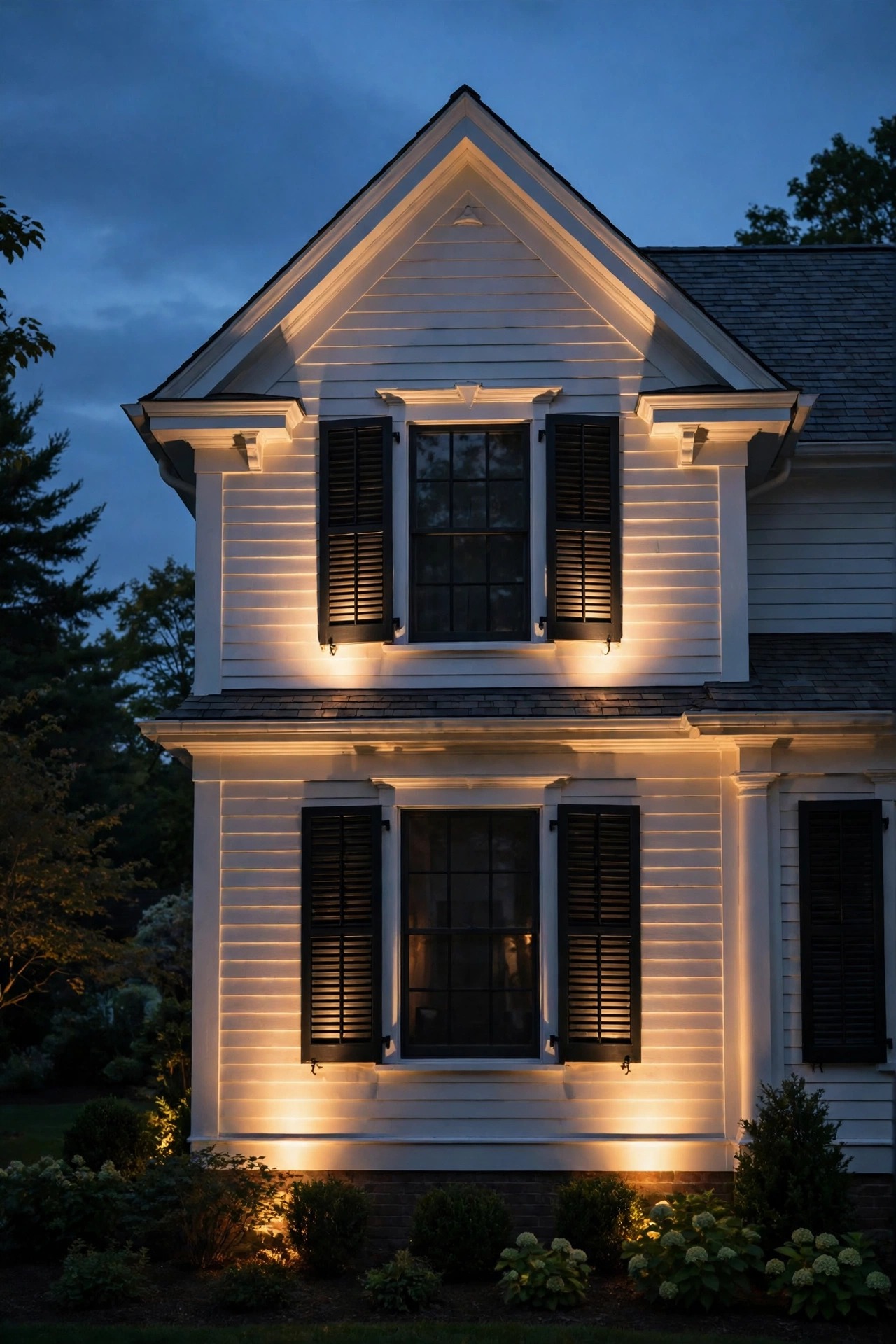
Look up. On a two-story colonial, the second floor often sits completely dark, and a facade lit only at porch level looks like it is wearing a glowing belt. Two soft uplights fix that: one grazing a shuttered window bay, one washing the gable or the stretch of brick between the floors, both angled to skim the surface rather than punch holes in it. I keep these dim — 200 to 300 lumens — and strictly warm, because their job is silhouette and texture, not illumination. Solar uplights can handle this gentle duty if the beds get real sun, but wired fixtures on the main timer keep the whole composition in sync. Angle the beams to avoid spilling into upstairs bedrooms; a slight tilt toward the facade from about 18 inches out usually keeps the glow on the wall where it belongs. It is the finishing layer that makes the house look complete from the street — porch, facade, and roofline all in one picture.
Suggested budget range: $60 – $300.
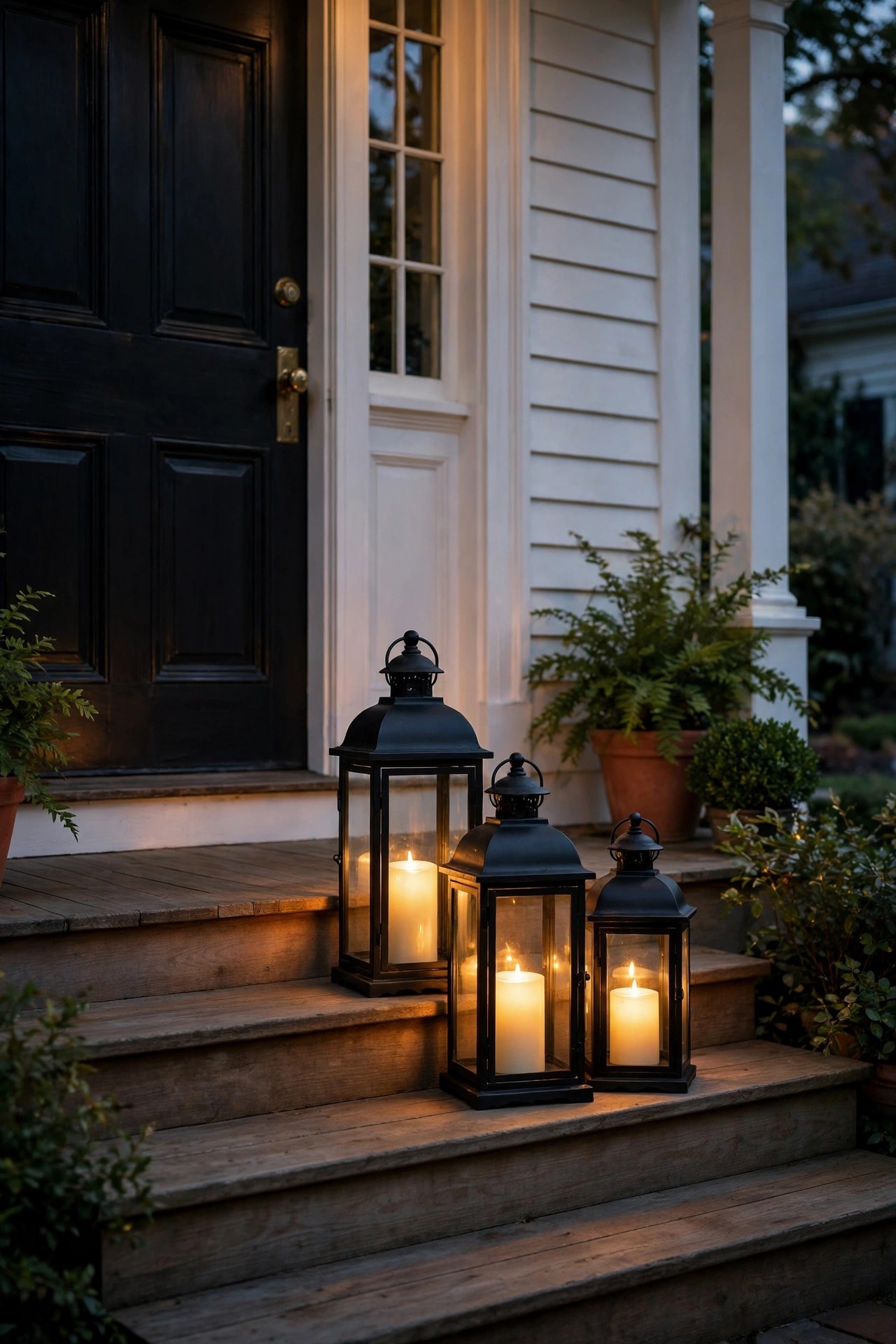
18. A Lantern Cluster Beside the Door
Not every porch has the wiring — or the budget — for another hardwired fixture, and that is where a lantern cluster by the door does quiet magic. I group three black metal lanterns in graduated heights on the porch floor or the top step beside the door, each holding a flameless candle on a timer. Odd numbers and mixed heights are the whole trick; a matched pair of identical lanterns on the floor reads like a store display, while a trio at 12, 18, and 24 inches feels gathered and real. Flameless candles with a warm flicker and a five-hour timer come on at dusk without a thought from me, and there is zero fire risk near the welcome mat or dry leaves. In summer I swap in hurricane-style lanterns with a little sand in the base for a coastal-colonial mix. Keep the cluster on the hinge side of the door, tucked close to the wall, and let it be the soft pool of light guests step into just before they knock.
Suggested budget range: $35 – $160.
19. The Dusk Walk-Through: Audit Your Colonial Porch Lighting Ideas Like a Guest
Every spring and fall I do the same ritual: I wait for full dusk, walk out to the street, and come back up the walk exactly like a guest arriving for dinner. You would be amazed at what you catch. One sconce bulb a shade cooler than its twin. A path lantern leaning two degrees after the freeze. The post light glaring because a shrub grew up and started reflecting it. I take photos from the street, the walk, and the steps, and I fix the list within the week — swap the mismatched bulb from my spare stash, straighten the lantern, trim the shrub, re-aim the uplight off the bedroom window. Stand in the doorway too and look out; the porch should glow for the people sitting on it, not just the people passing it. Twenty honest minutes twice a year keeps the whole composition tight. That walk-through is the real secret behind every timeless colonial porch: not the fixtures, but the habit of seeing your home the way your guests do.
Suggested budget range: $20 – $100.
Frequently Asked Questions
What color temperature is best for colonial porch lights?
Warm white at 2700K, every time. It is the closest modern match to the candlelight and gaslight these homes were designed around, and it flatters red brick, painted siding, and skin tones all at once. Avoid 4000K and 5000K daylight bulbs on a colonial front — they read cold and modern against classic architecture. Whatever temperature you choose, use the same one in every fixture so the porch reads as one composition.
How many lights does a colonial porch actually need?
Fewer than you think, as long as they are layered. A beautiful minimum is three points of light: a sconce pair at the door plus one ceiling fixture or pendant. A full composition with a post light, walkway lanterns, and window candles runs seven to eleven points, but because everything works in pairs or centered singles, it never feels busy. Add one layer at a time and stop when the facade looks balanced from the street.
Can I use solar lights, or should colonial porch lighting be wired?
A hybrid is what works best in my experience. Solar performs well for walkway lanterns, step accents, and the uplights, as long as the panels get five to six hours of direct sun. The fixtures you depend on every night — the door sconces, the ceiling light, the post light — are better hardwired or low-voltage, because they stay bright and consistent through winter and cloudy weeks. Match the color temperature across both and nobody can tell which is which.
How much does colonial porch lighting cost in 2026?
A simple refresh — a new sconce pair, fresh 2700K bulbs, and a photocell timer — runs about $150 to $400 and transforms most porches in a weekend. The full layered look with a post light, wired walkway lanterns, and garage carriage lights typically lands between $500 and $2,000 doing it yourself; hiring an electrician for new hardwired runs adds roughly $200 to $500 per location. Running costs are tiny: a whole LED porch composition usually draws less power than one old porch bulb.
Conclusion
The best colonial porch lighting ideas are not really about fixtures at all. It is about balance — pairs that match, one warm temperature everywhere, and layers that lead a guest from the street to the door like a story. Start with the sconces and the walk, automate them so they never miss a dusk, and add one accent at a time until the facade feels finished from the street. Then do the walk-through, fix what you see, and pour something warm to drink on the porch you just made. Browse the rest of my outdoor lighting ideas here on the site for the garden, path, and backyard layers too — your colonial deserves the full picture, front to back.