There is a moment, right around sunset at a beach house, when the whole patio seems to exhale. The heat drops, the breeze picks up, and the light turns everything gold. I have chased that feeling on my own patio for years, and honestly? It comes down to the lighting. The right coastal patio lighting ideas do not just help you see after dark — they recreate that shoreline glow: warm, layered, a little bit salty, and completely relaxed. My rule is the same one I use everywhere outdoors: layer it. A soft overhead canopy, gentle light at seating height, and low guidance light near the floor will beat one bright floodlight every single time. In this post I am sharing 21 ideas that work on real patios — string lights, rope-wrapped lanterns, solar tiki torches, marine-grade fixtures that shrug off salt air, and a few five-minute tricks. Every idea includes a realistic budget range, and most need nothing more than an outdoor outlet or a sunny afternoon. By the end, your patio will feel less like a slab of concrete and more like the last house on the dune.
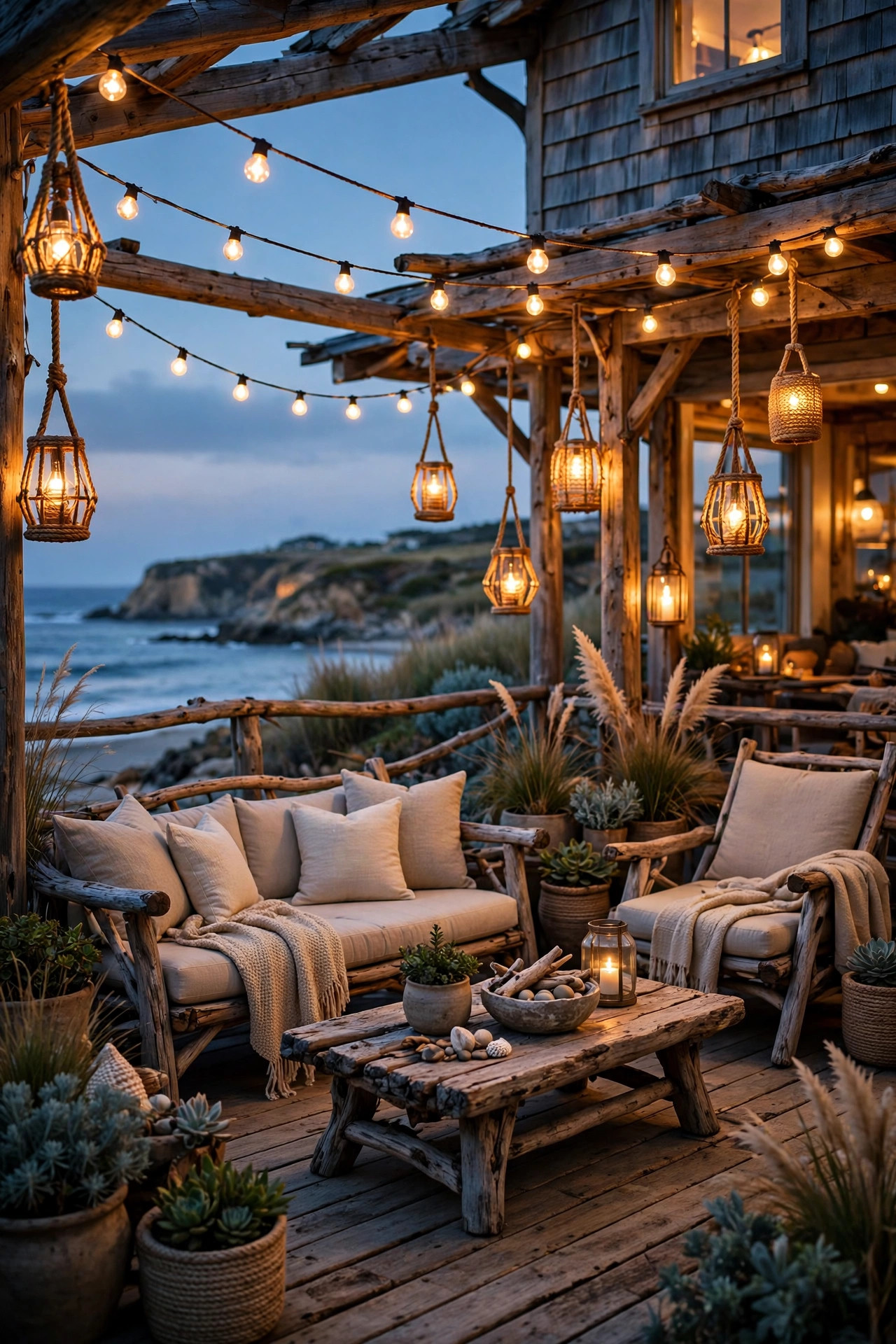
1. Layer Your Coastal Patio Lighting Ideas Like a Beach House
Every beach house patio that stops me mid-scroll has one thing in common: layers. Start with an ambient layer — string lights or a pendant that washes the whole space in soft light. Add a middle layer at seating height, like lanterns on side tables and sconces by the door, so faces glow instead of getting blasted from above. Finish with a low layer: path lights, step lights, or rope light along the patio edge that quietly shows everyone where the floor ends. In my experience, three dim layers at 2700K look ten times more expensive than one bright fixture at full power. Keep every bulb in the warm 2700–3000K range so the layers blend into one golden scene instead of competing. If you want the bigger picture before you buy anything, my guide to coastal outdoor lighting walks through the whole shoreline style. Plan the layers on paper first, even as a rough sketch, and you will avoid the classic mistake of buying six fixtures that all do the same job.
Suggested budget range: $60 – $250.
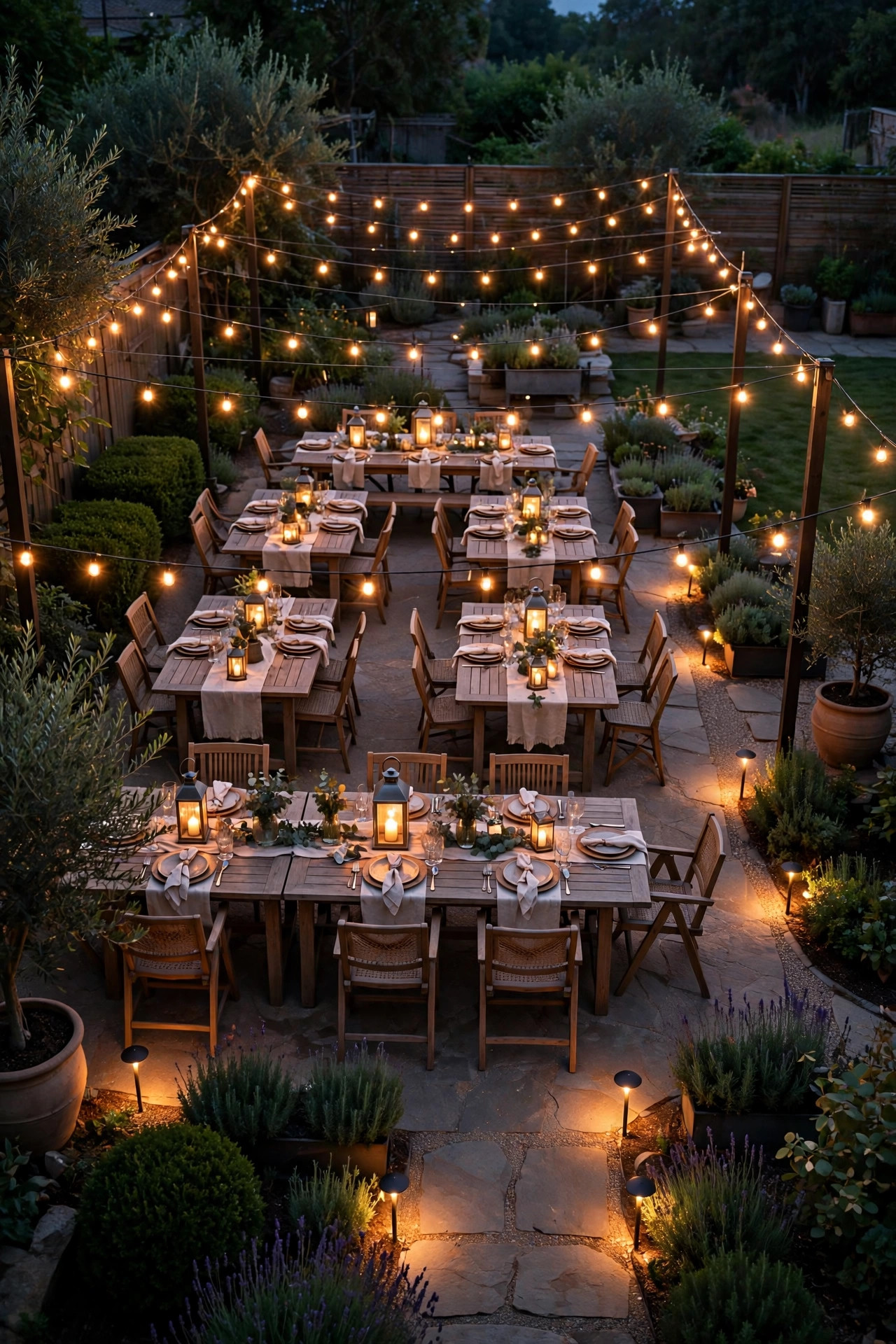
2. String Cafe Lights Overhead for Instant Vacation Mode
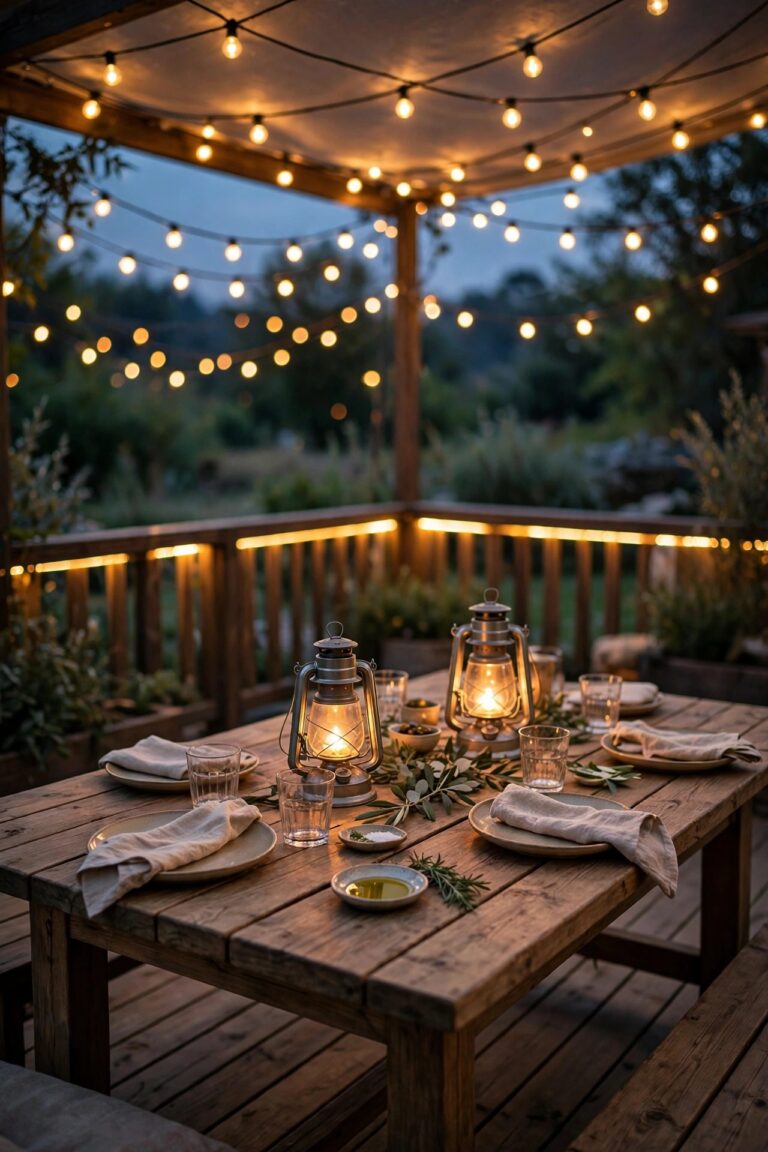
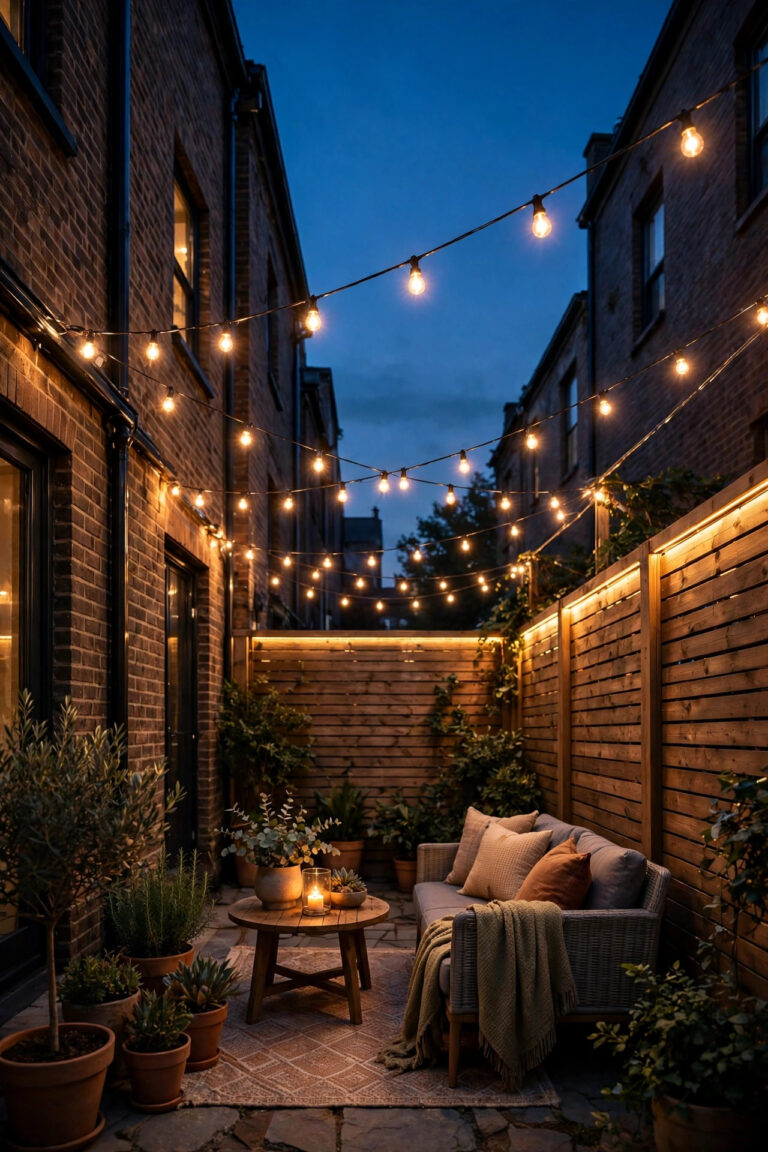
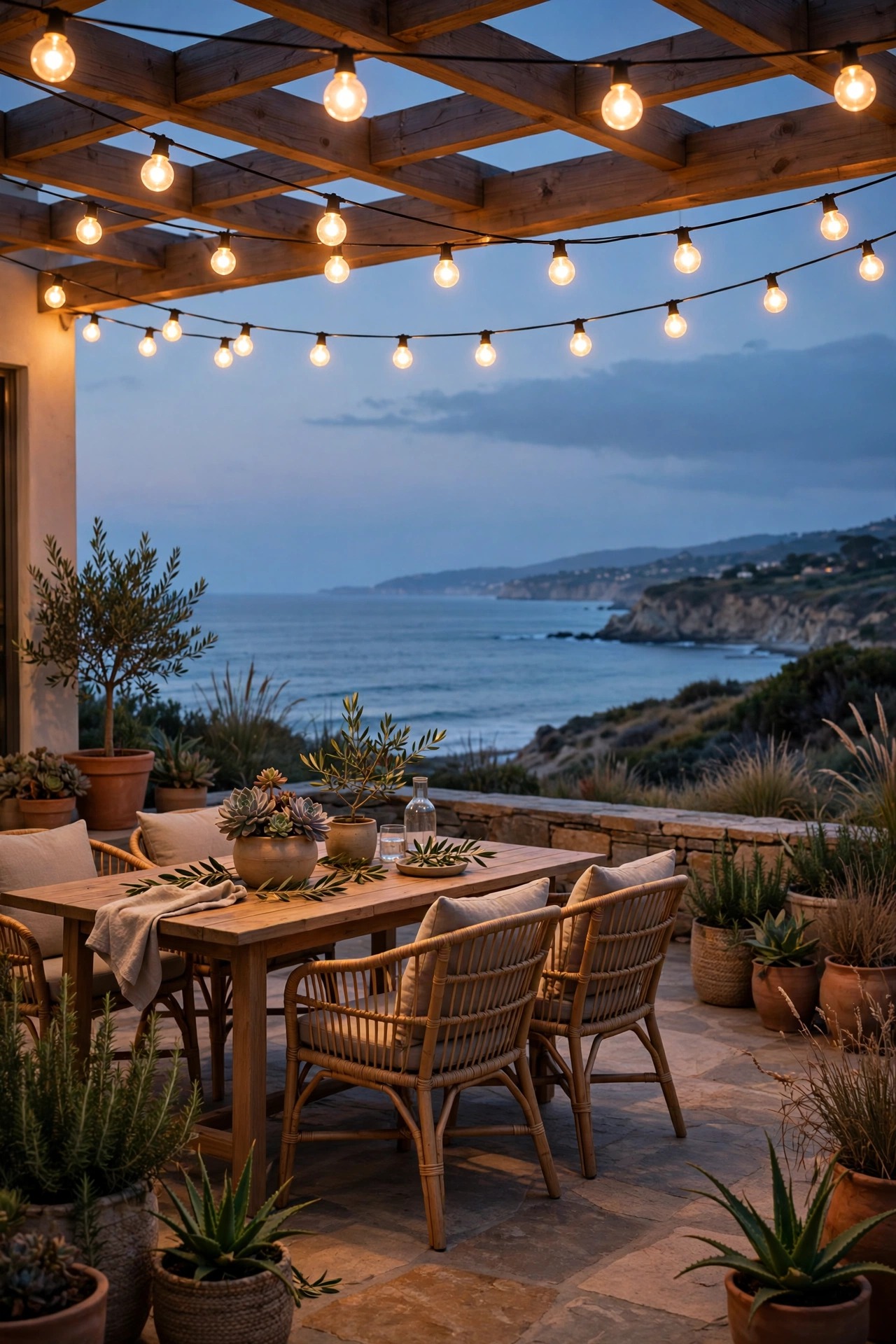
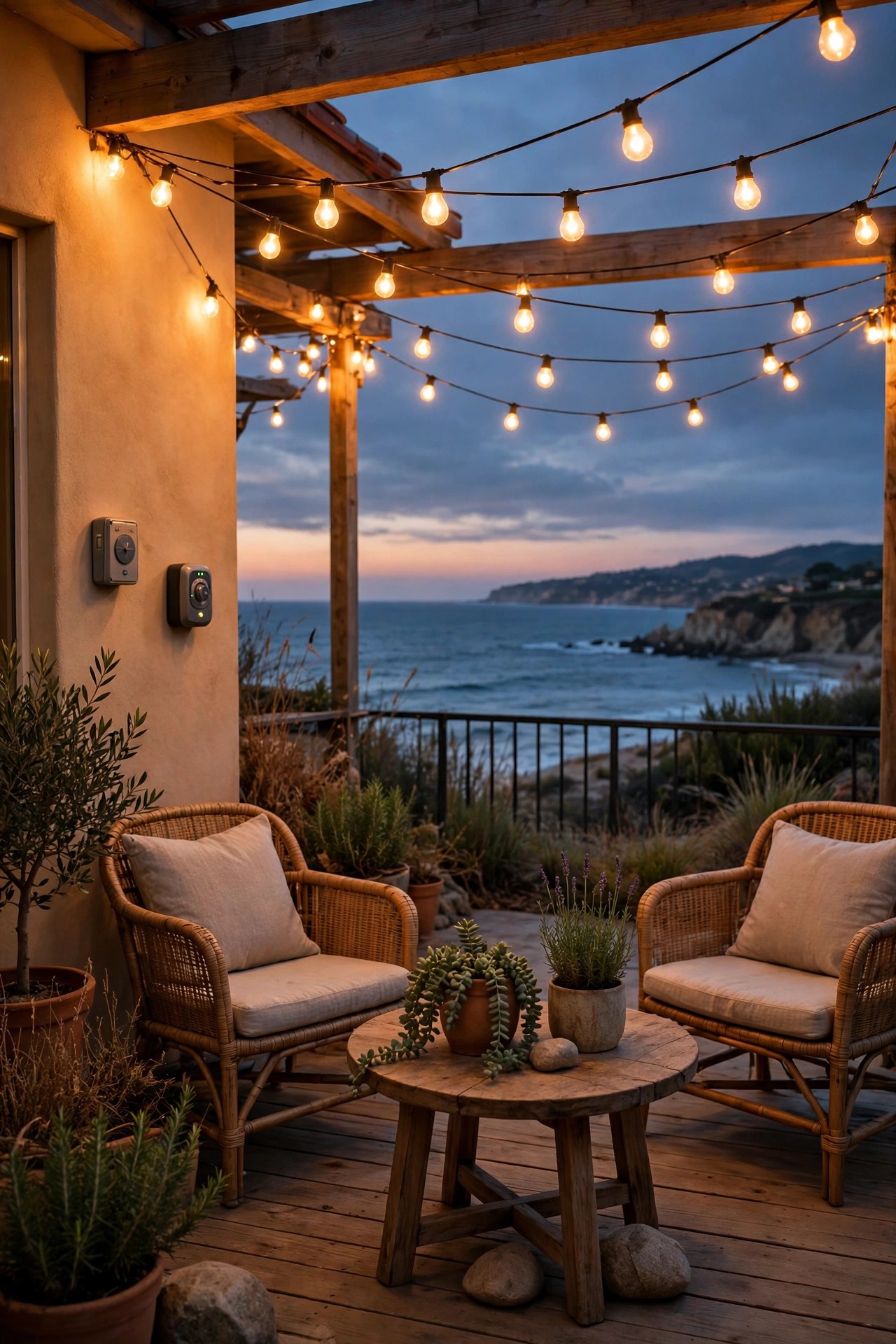
If I could only pick one upgrade, it would be a canopy of cafe string lights. Two or three strands zigzagged over the seating area give you that barefoot beach-bar glow for almost no money. Choose commercial-grade strands with shatterproof LED filament bulbs — the plastic bulbs survive coastal wind and the occasional dropped strand far better than glass. Space your anchor points about 8 to 10 feet apart, and let each run sag 6 to 12 inches in the middle for that relaxed draped look; a taut, straight line reads more parking lot than beach house. Use stainless steel eye hooks and a guide wire if your spans run longer than about 15 feet, because sea breezes will work a bare cord loose over a season. Plug the strand into a GFCI outlet and put it on a simple outdoor timer so the patio lights itself at dusk. One 48-foot strand usually covers a 12-by-12-foot seating zone nicely. Dim them if you can — at 70 percent power they look like candlelight and the bulbs last for years.
Suggested budget range: $35 – $120.

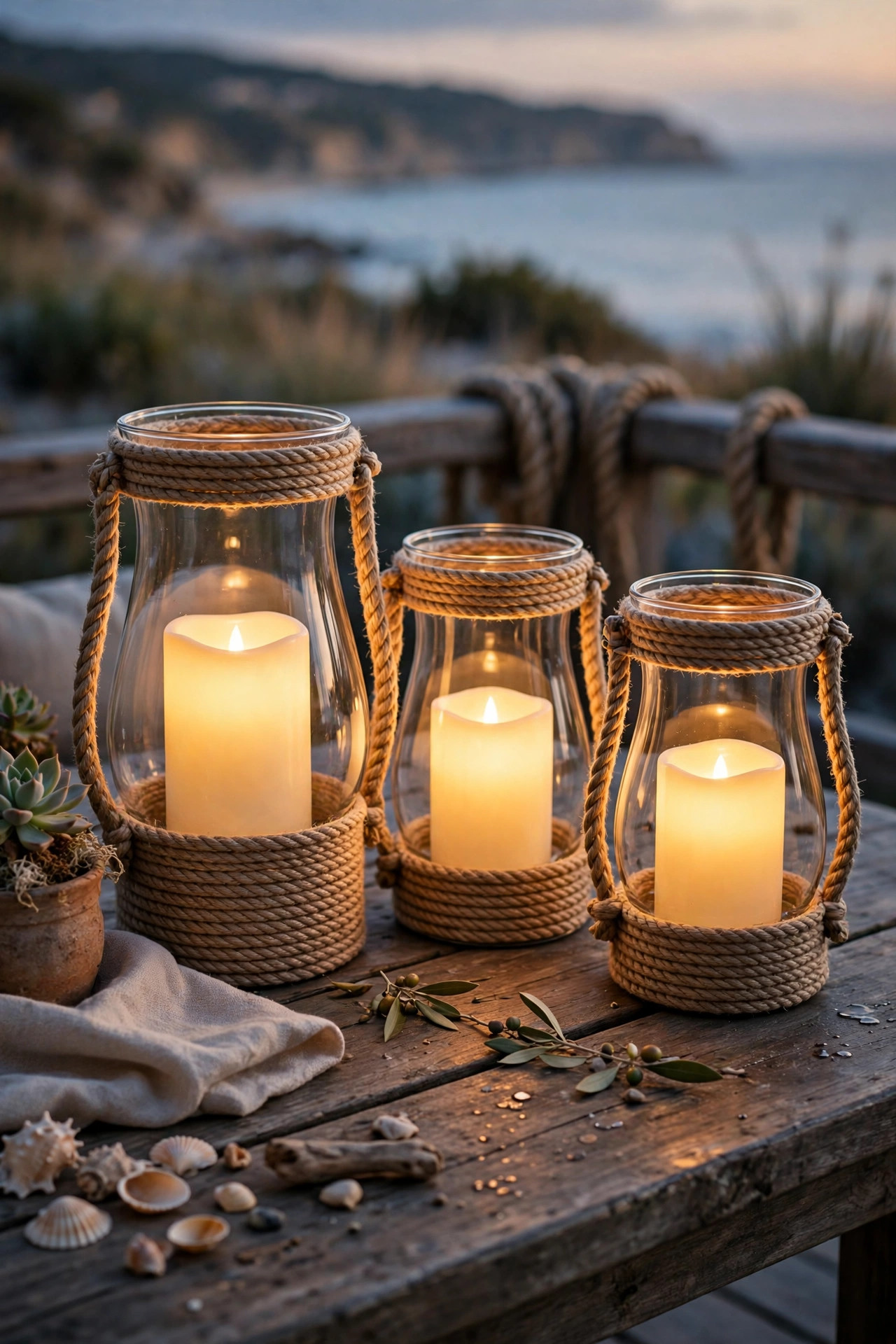
3. Rope-Wrapped Hurricane Lanterns on Every Side Table
Nothing says beach house like a hurricane lantern wrapped in natural rope. I keep a pair on the coffee table, one by the door, and a couple on the steps, and the whole patio instantly feels styled rather than just lit. Use flameless LED candles inside — real wax melts in summer heat, and an open flame near cushions and sea grass rugs is a risk I never take. Look for candles with a timer function so they flicker on at dusk and shut off five hours later without you thinking about it. The rope does double duty: it diffuses the glow into a soft halo and hides the battery pack at the base. For a cohesive look, repeat the same lantern in two sizes, roughly 8 and 12 inches tall, rather than mixing five different styles. Set them in odd-numbered groups of three for tabletops. A quick tip from my own patio: fill the bottom inch of each hurricane with coarse sand or tiny shells. It anchors the candle, looks adorable, and stops the lantern skidding in a gust.
Suggested budget range: $25 – $80.
4. Solar Tiki Torches for a Barefoot Island Edge
Along a garden edge or the path from the patio to the gate, solar tiki torches give you flickering flame ambience with zero wiring and zero fire risk. The better models have a genuinely convincing flame effect — dozens of small LEDs that dance instead of blink — and they charge all day from a little panel in the cap. Push them into soil or sand about 3 to 4 feet apart so the pools of light just touch. In my experience they run 8 to 10 hours on a full summer charge, and the stake bases hold up fine if you pull them before a big storm. Mix two heights if your torches offer extension stakes; a staggered line looks far more natural than a row of soldiers. These are strictly accent lighting, not task lighting, so pair them with a real light near steps or grills. If you want more variations on the theme, there are plenty of solar tiki torch light ideas worth browsing before you commit to a set.
Suggested budget range: $30 – $90.

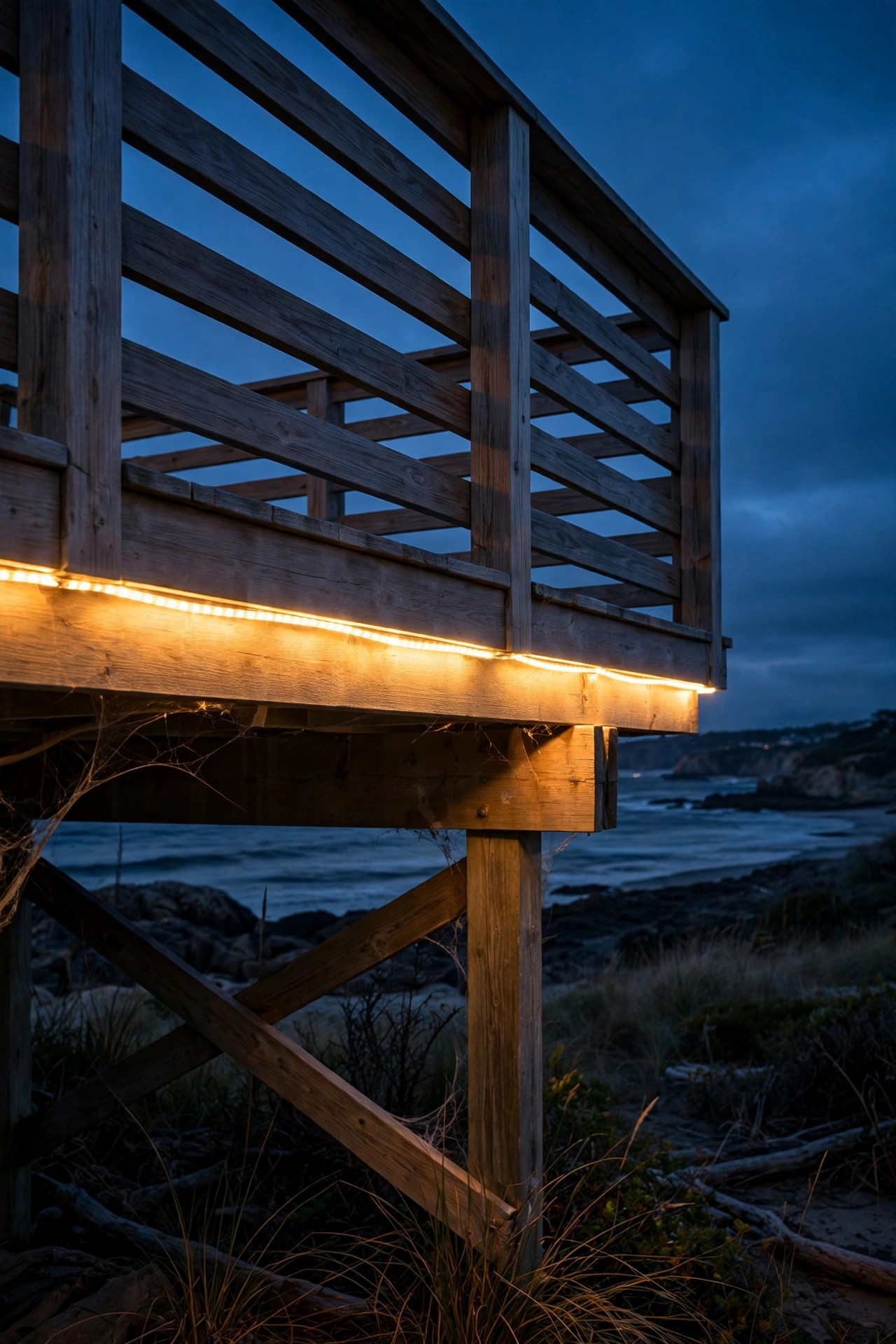
5. Nautical Rope Lights Along the Railing
Rope light is the hardest-working accent on a coastal patio. Run a warm white LED rope along the underside of your deck railing, around a pergola post, or tracing the edge of an outdoor bar, and you get a clean nautical line of light that echoes the rope on a boat railing. LED rope stays cool to the touch, bends around corners, and the sealed PVC jacket laughs at salt spray and rain. Mount it with clips every 12 to 18 inches so it does not sag between fixings, and hide the plug end inside a weatherproof outlet box. Because the light is indirect when tucked under a rail, it defines the patio edge beautifully without any glare in your eyes — guests can find the step down without a spotlight moment. Buy the cuttable kind and measure carefully; most rope lights trim at marked intervals of about 18 inches. Stick with 2700K warm white to match your other layers. For more ways to weave it into a scheme, the outdoor rope light ideas on the site cover everything from stairs to palm trees.
Suggested budget range: $20 – $70.
6. Driftwood-Style Solar Path Lights to the Gate
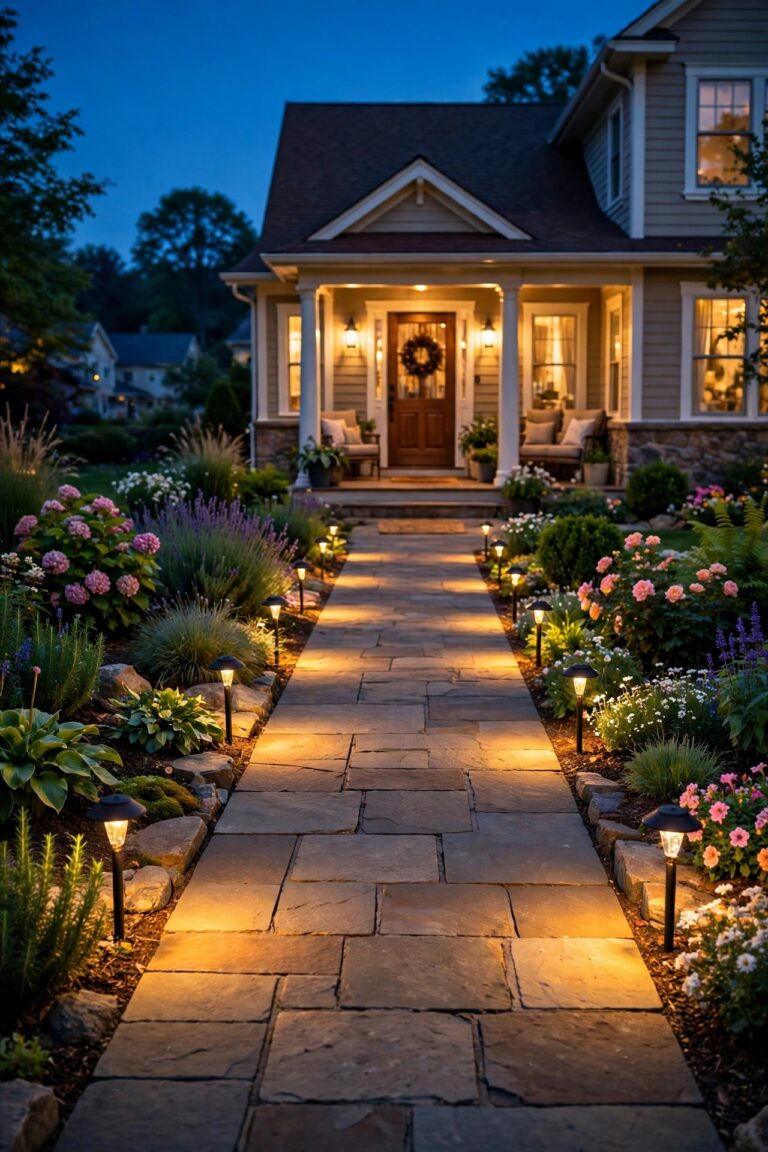
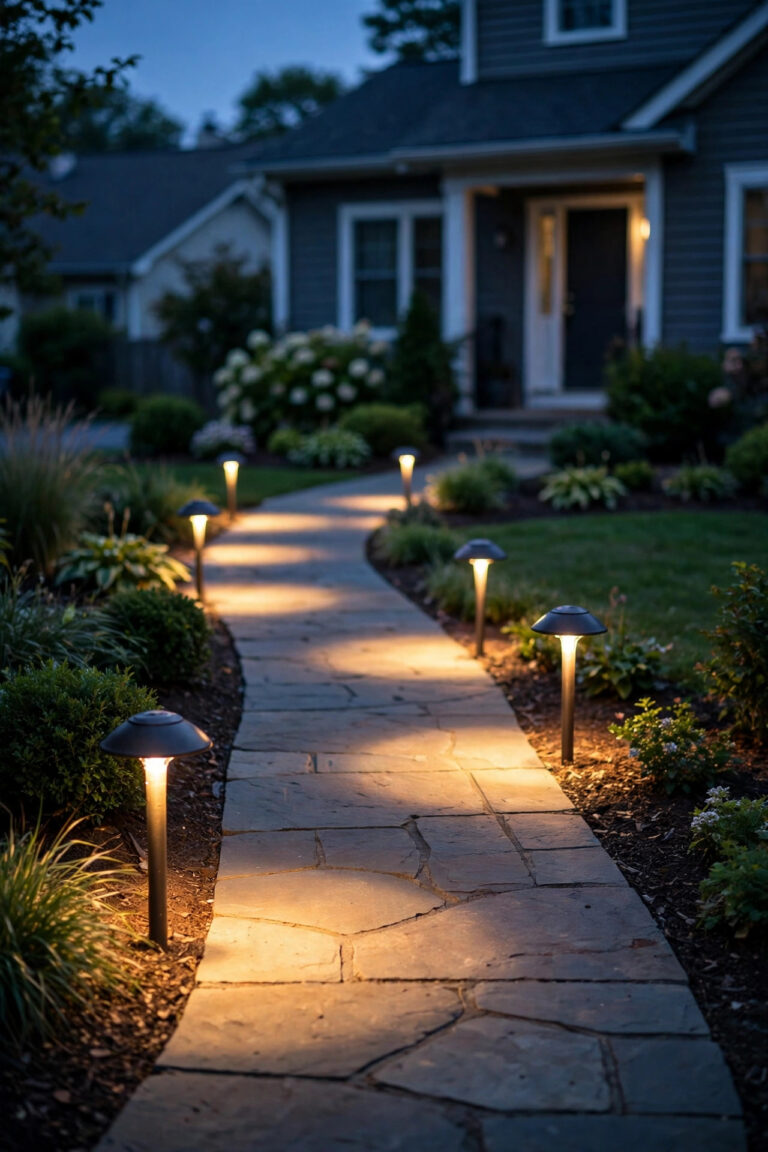
The walk from patio to gate or garage is where most patios go dark and a little sketchy. A line of solar path lights in weathered, driftwood-inspired finishes fixes the safety issue while keeping the beach story going. Choose fixtures with a gray-washed or sand-toned finish rather than shiny black — they disappear into coastal landscaping during the day. Space them 5 to 6 feet apart on alternating sides of the path for a natural rhythm, and angle each one so the light pools on the walkway, not into your eyes. Solar output varies wildly, so look for lights rated at 30 lumens or more with replaceable batteries; the dollar-store versions fade by midsummer. Push stakes into softened soil, and in sandy ground, add a handful of gravel around the base for grip. I always recommend buying two extra lights as spares, because matching a discontinued style two years later is nearly impossible. A well-lit path also makes the whole patio read bigger from the house, since your eye travels to the farthest glow.
Suggested budget range: $25 – $75.
7. A Rattan Pendant Over the Dining Table
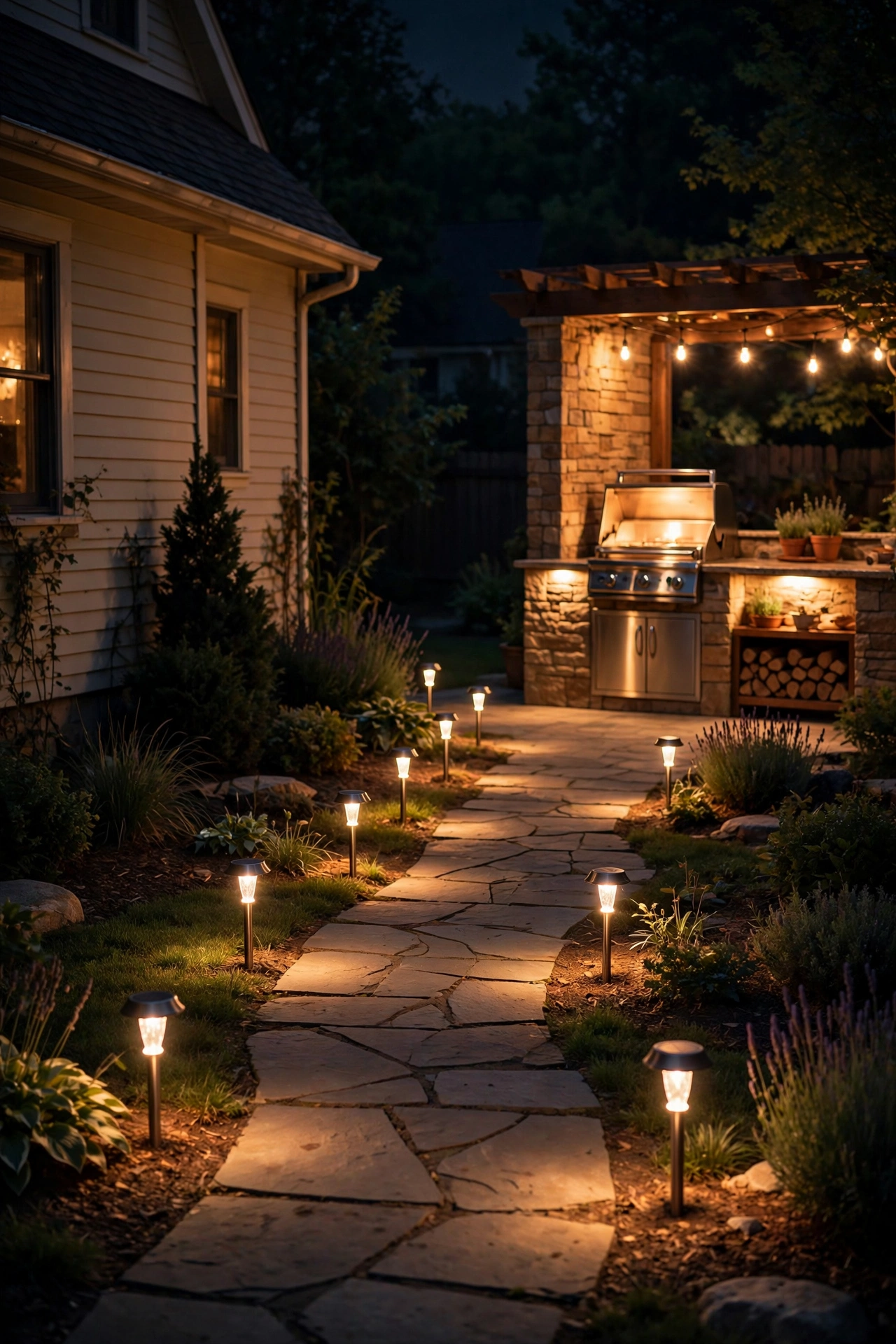
A single oversized rattan or seagrass pendant over the outdoor dining table is the fastest way to make a patio feel like a beach house porch. The woven shade throws gorgeous patterned shadows, and it puts warm light exactly where the food and faces are. Hang it so the bottom of the shade sits about 30 to 34 inches above the tabletop — low enough to feel intimate, high enough to pass a serving platter. If your patio is covered, a plug-in pendant with an inline dimmer is the easy route; for open patios, look for solar or battery pendants rated for outdoor use, or run a weatherproof cord cover along the pergola beam. Use an LED filament bulb inside for that vintage glow; the weave hides the bulb itself, so all you see is light through texture. Keep the shade under cover during storms if it is natural fiber, or choose the newer resin-wicker versions that mimic rattan but can stay out all season. One pendant centered on the table anchors the whole dining zone.
Suggested budget range: $45 – $160.
8. Mason Jar Fairy Lights for Handmade Charm
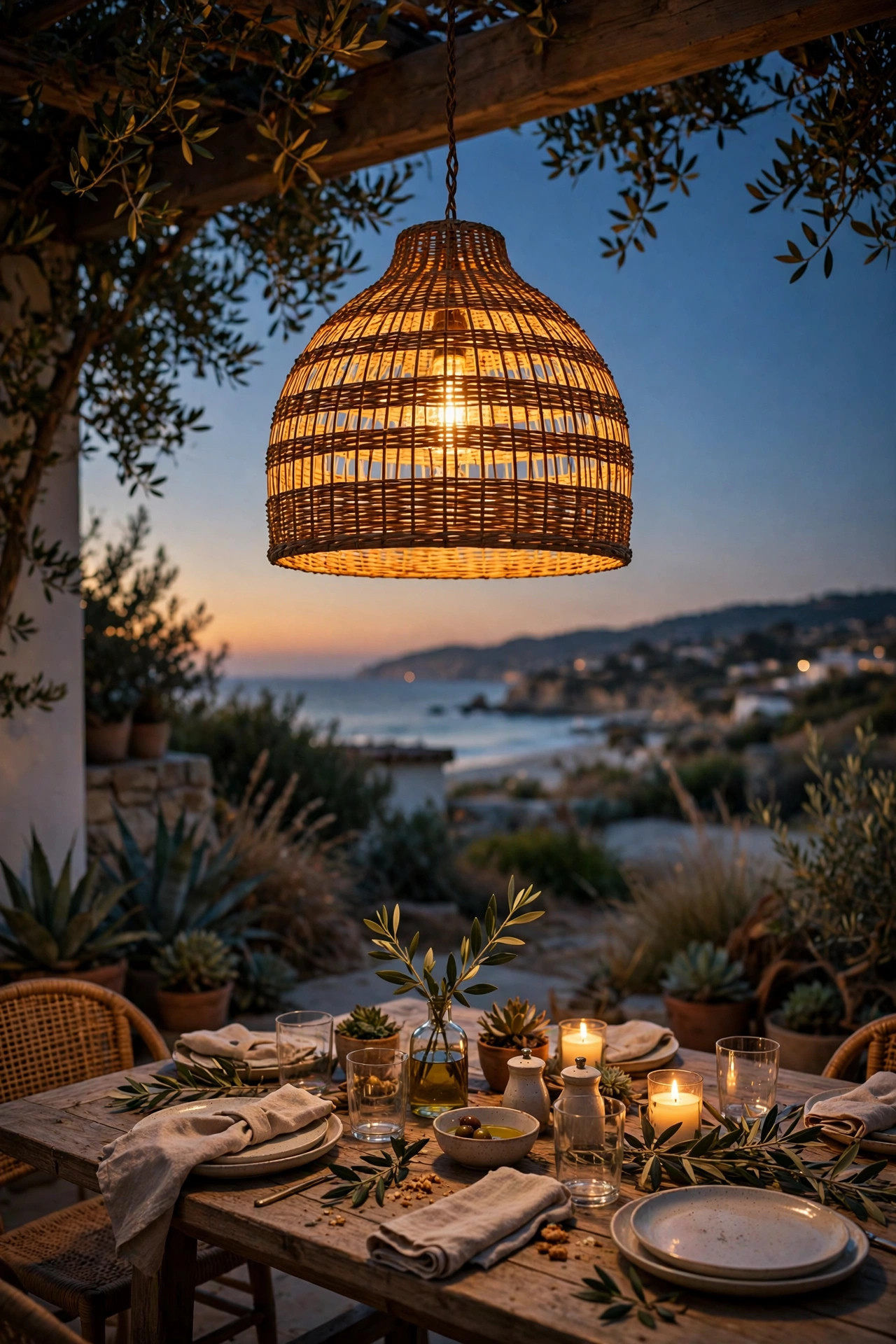
Copper-wire fairy lights tucked into mason jars are my favorite ten-minute project. A 10-foot strand of warm micro LEDs coils loosely into a quart jar, the battery pack hides in the lid, and suddenly you have a lantern that looks like bottled fireflies. Line three or four jars down the center of the table, hang a few from shepherd hooks around the seating area, or cluster them on a tray with shells and a sprig of greenery. Solar-lid versions exist too — the panel sits in the jar band and charges by day, which is perfect for a fence rail or the top of a piling. Because the wires are waterproof and the LEDs barely sip power, a set of batteries lasts weeks of evening use. Keep the light warm white; the multicolor sets read more party store than beach cottage. In my experience, jars also make the best wind-proof candle holders on breezy nights, since the glass shields the glow completely. Retire any jar with a chipped rim to planter duty and keep the lighting set smooth and safe.
Suggested budget range: $15 – $45.
9. Uplight a Palm or a Big Tropical Plant
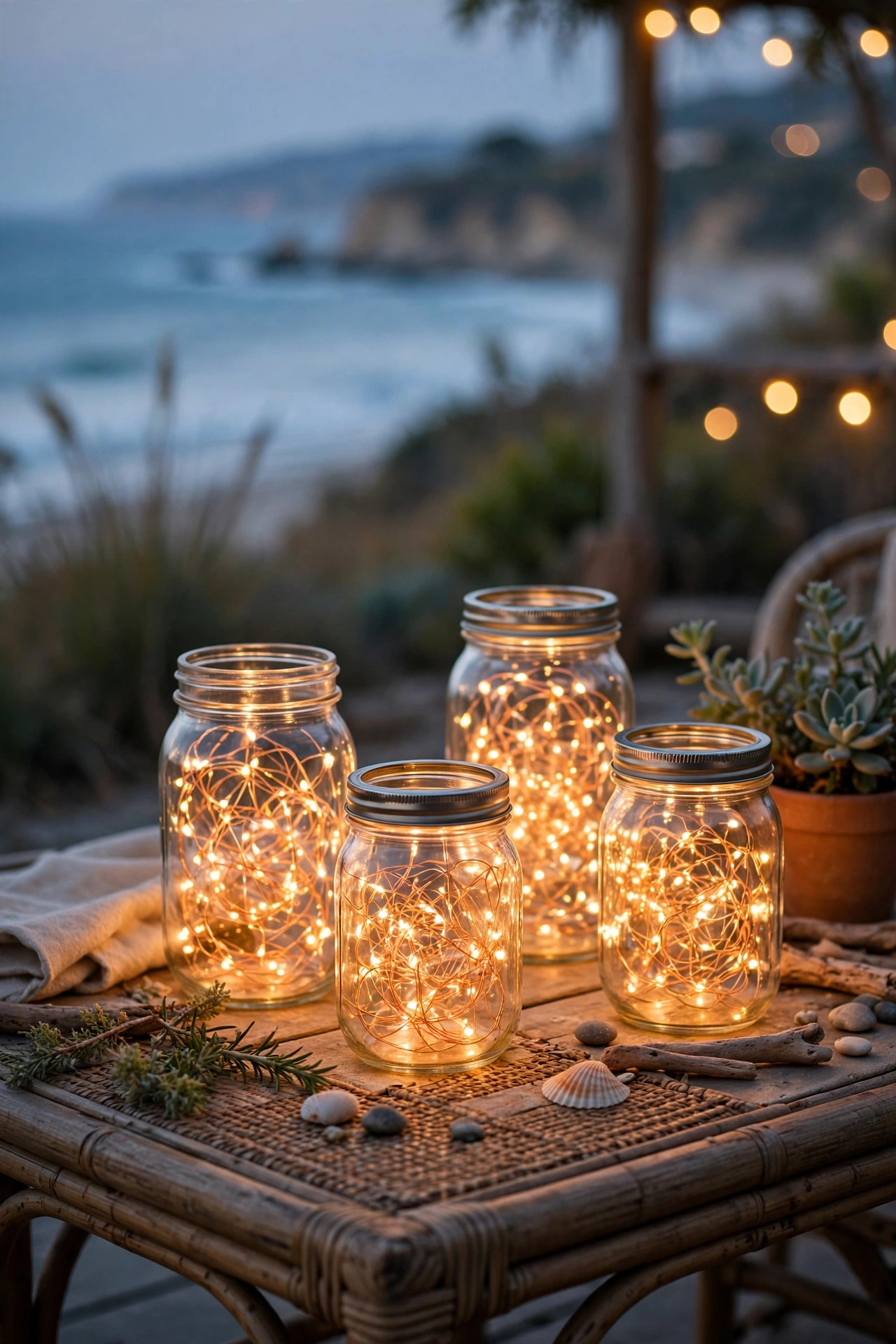
One dramatic uplight turns an ordinary patio into a resort courtyard. Aim a low-voltage spotlight up into the fronds of a palm, a bird of paradise, or a large potted tropical, and the canopy becomes a glowing sculpture overhead. Place the fixture 12 to 18 inches from the trunk, angled at about 30 degrees, and use a narrow-to-medium beam so the light climbs the plant instead of spilling into the sky. A stake-mounted LED spot drawing just 3 to 5 watts is plenty; more power washes out the texture you are trying to show off. If the plant is in a pot on the patio itself, a small solar spot at the base does the same job with no transformer at all. This is also the cheapest way to add height to your lighting scheme — everything else on most patios happens below four feet. Keep uplights on their own timer zone if you can, because two hours of drama after dinner is plenty, and your neighbors (and the local birds) will appreciate the lights-out by ten.
Suggested budget range: $20 – $85.

10. LED Strip Light Under Benches and Bar Ledges
Hidden LED strip is the designer trick behind every high-end beach house photo. Run a waterproof strip under the front edge of a built-in bench, beneath a bar ledge, or along the underside of a serving counter, and the furniture itself seems to float on a line of warm light. Choose IP65-rated strip for covered patios and IP67 if the run is fully exposed to rain and salt spray. Warm white at 2700K keeps it in the candlelight family, and a simple inline dimmer lets you drop it to a whisper after dinner. The strip mounts with its own adhesive plus a few clear clips for insurance — adhesive alone gives up in coastal humidity within a season, honestly. This light is completely indirect, so it never glares, and it gives just enough floor glow for guests to navigate with a drink in hand. A 16-foot roll usually covers a bench and a bar in one continuous run from a single plug. It is the layer I get asked about most, and it is nearly the cheapest one to install.
Suggested budget range: $18 – $60.
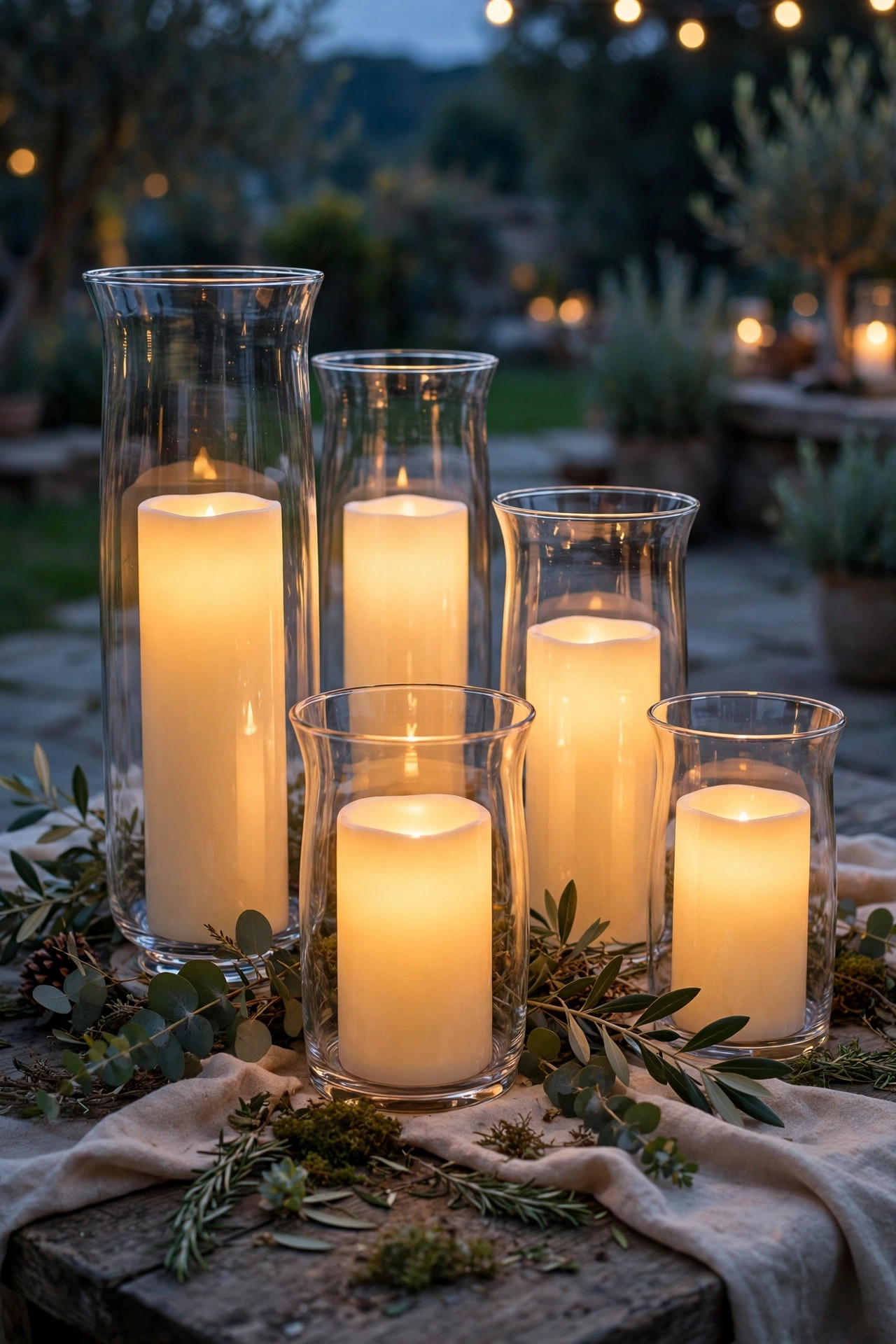
11. Flameless Candle Clusters in Glass Hurricanes
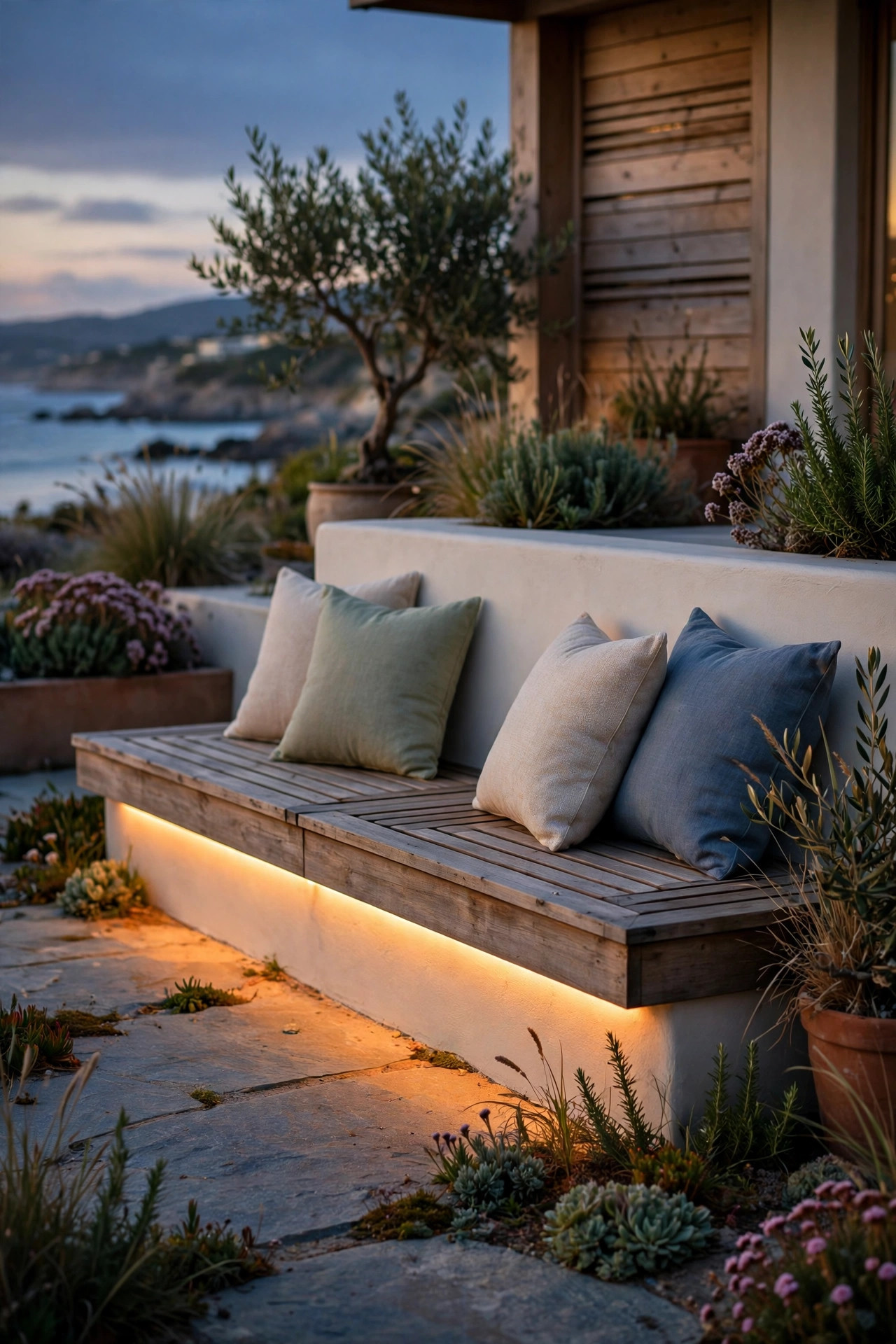
When the breeze picks up off the water, real candles surrender — flameless ones do not. Cluster three glass hurricanes of different heights on a weathered tray, fill each with an inch of sand, and drop in flameless pillar candles with a realistic flicker. The sand is not just pretty; it keeps the candles upright and gives the whole arrangement that collected-from-the-beach feel. Group them on the coffee table, beside the outdoor sofa, or flanking the door. Because there is no flame, you can nestle the cluster right up against cushions, driftwood, and dried grasses without a second thought — though I still keep anything electrical dry and check the battery compartments each spring for corrosion, which salt air loves to sneak in. Remote-control sets let you light the whole patio from your chair, and timer modes mean the candles greet you at dusk even when you forget. Mix pillar heights of 4, 6, and 8 inches for the most natural look, and stay with ivory or sand-toned wax to match the coastal palette.
Suggested budget range: $20 – $65.
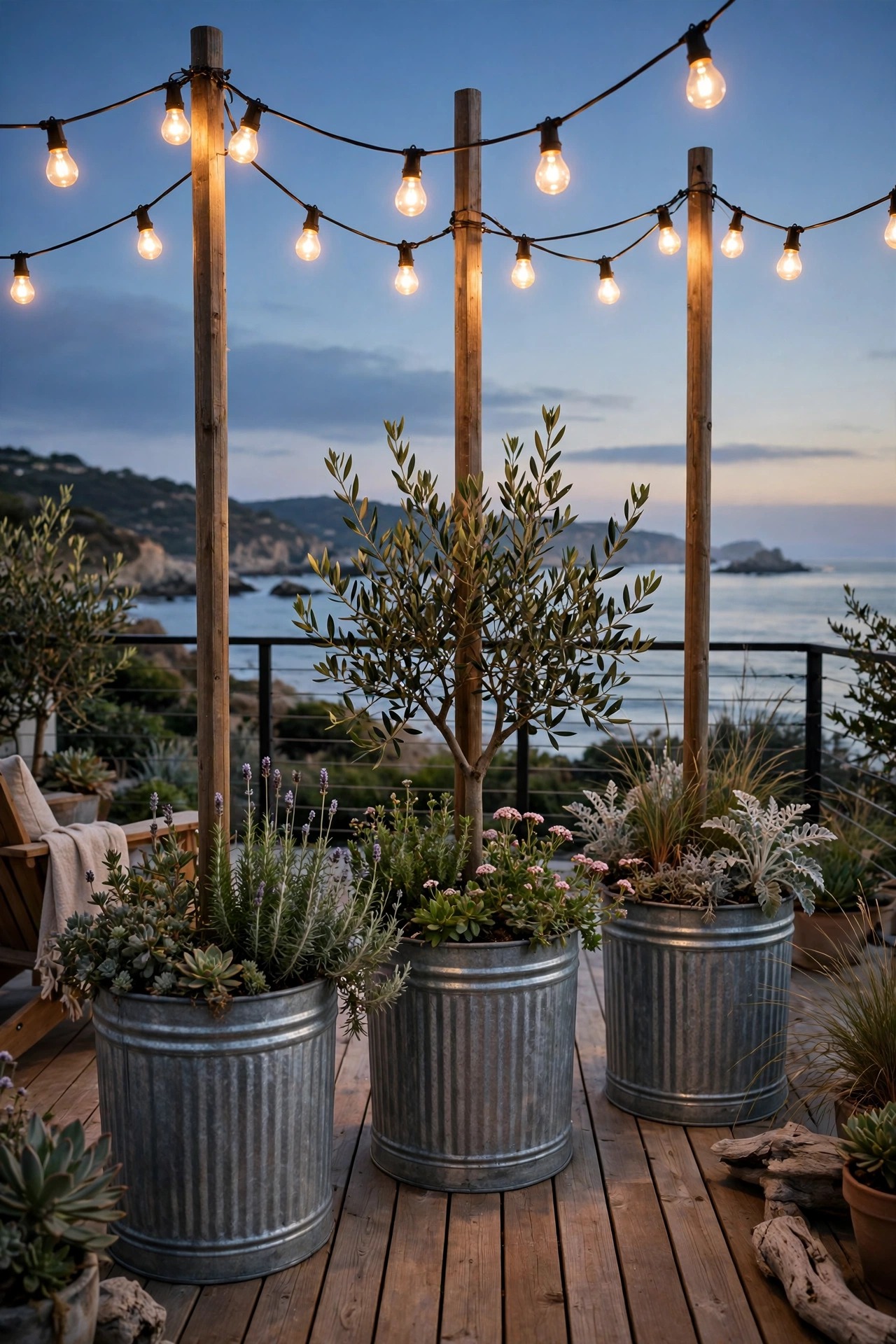
12. String Light Poles in Galvanized Planters
No pergola? No problem. Plant a sturdy pole in a galvanized bucket or a big planter, fill it with gravel and a plant at the base, and you have a movable anchor point for string lights anywhere on the patio. I use 8 to 9-foot poles in planters at least 18 inches wide — anything smaller tips in a gust, and coastal patios get gusts. Concrete in the bottom third of the pot adds serious ballast while leaving room for soil and a trailing plant up top. Two poles plus a wall hook give you a full canopy over most seating areas, and the whole setup moves when you rearrange furniture or need to store it for a storm. Galvanized metal and weathered wood both suit the beach look and shrug off salt air far better than painted finishes. Run the string light cord down the pole and clip it neatly so the mechanics disappear. This renter-friendly trick has saved more than one patio of mine, and guests always assume the poles were part of the original landscaping.
Suggested budget range: $40 – $110.
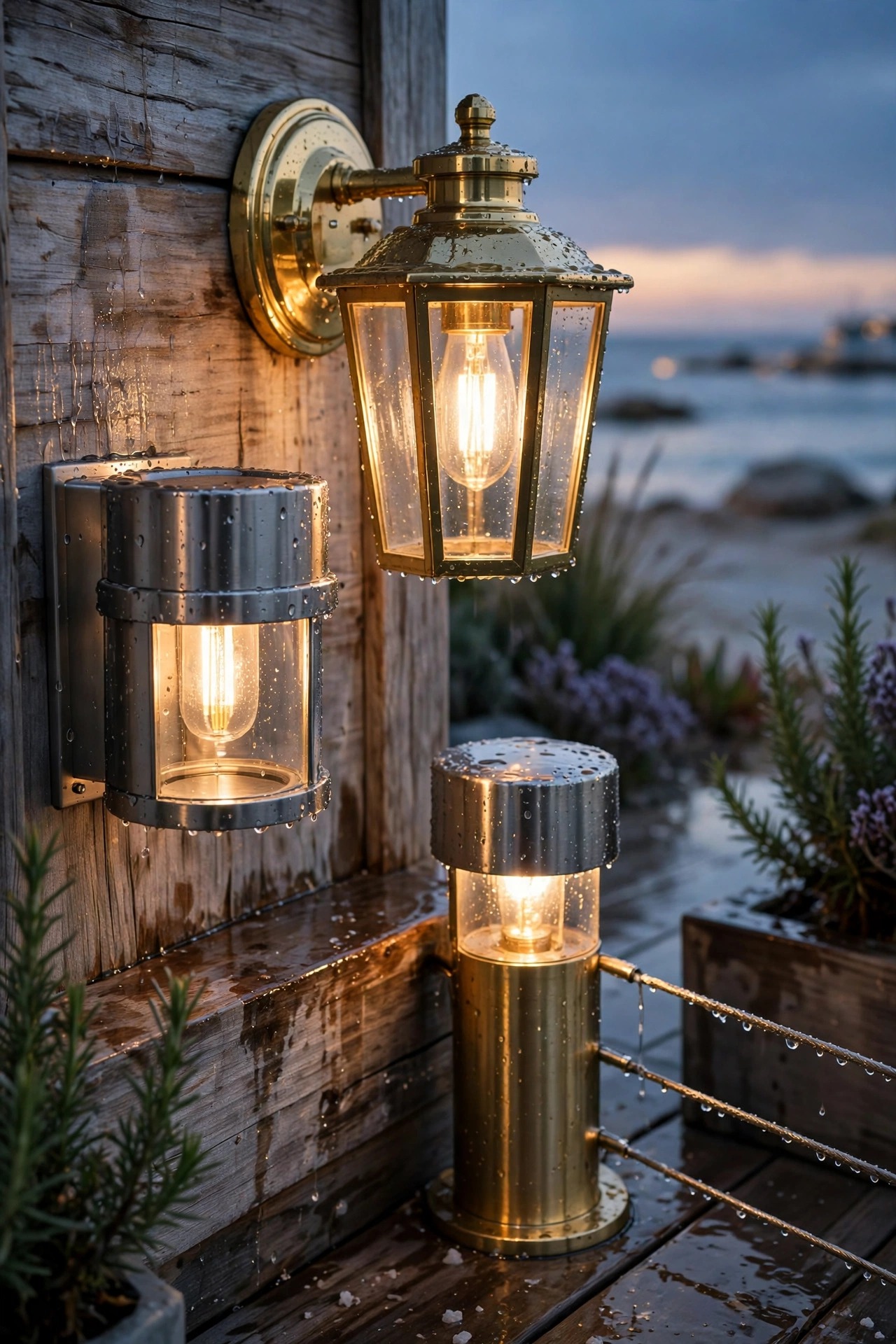
13. A Marine-Grade Motion Lantern by the Door
The light by the back door does the unglamorous work — finding keys, spotting the dog, greeting late guests — so make it a good one. A lantern-style fixture in a marine-grade finish, meaning 316 stainless steel or powder-coated cast aluminum, will survive salt air that eats a bargain fixture in two seasons. Add a motion sensor or a dusk-to-dawn photocell so it greets you automatically, and choose a model with an adjustable timer so it clicks off a minute or two after you pass. Mount it about 6 to 7 feet high beside the door, and pick a design with a seeded or frosted glass panel to soften the output. Harsh bare-bulb glare at the door kills the mood you built everywhere else, so keep the bulb shielded and warm. In my experience, this single fixture also makes the whole patio feel safer and more finished, because the doorway is where your eye lands first. Spend the extra money here; it is the one light that works 365 nights a year.
Suggested budget range: $55 – $180.

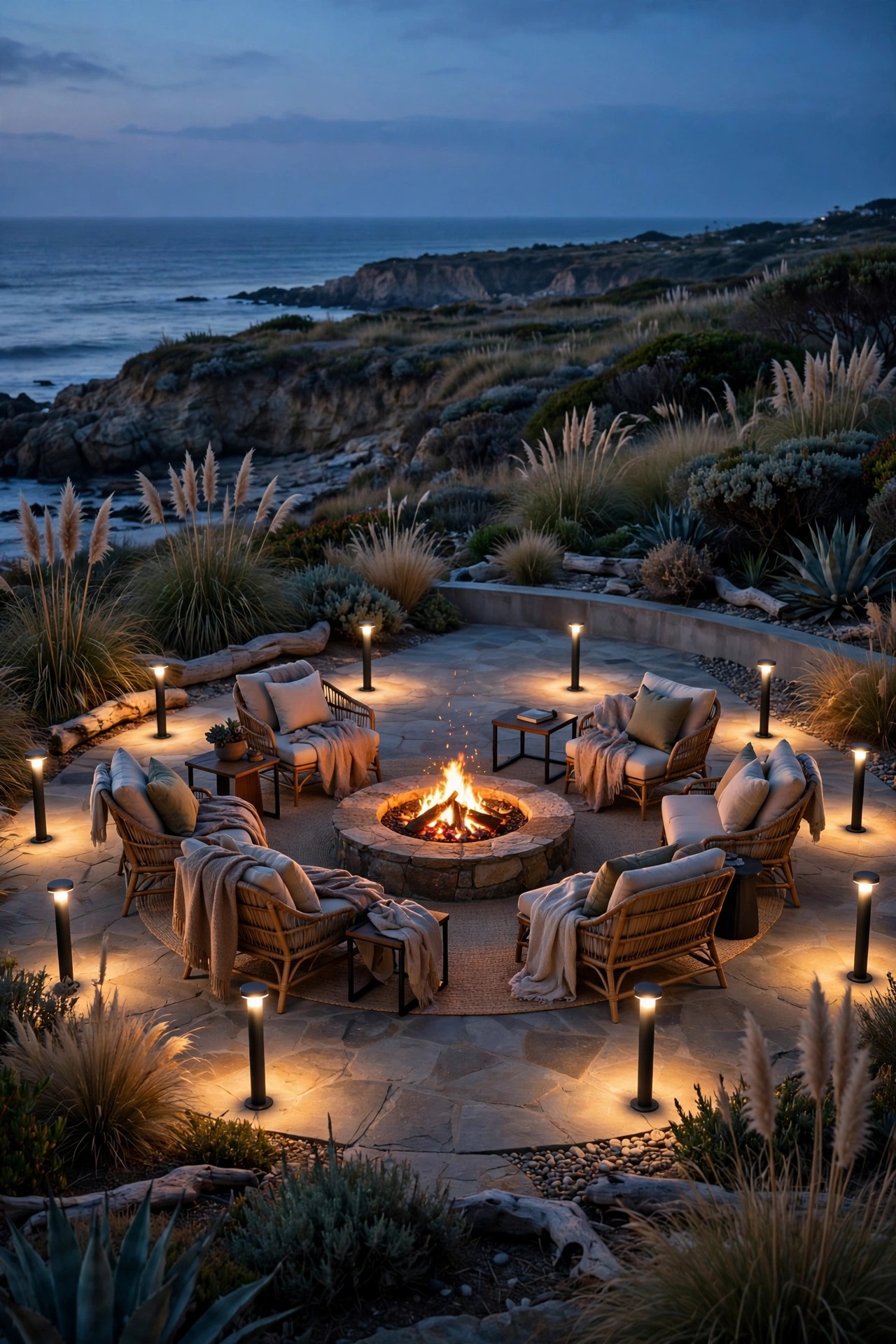
14. Low Bollard Lights Around the Fire Feature
A fire pit or outdoor fireplace already gives you flame; what it usually lacks is light at ankle height for the walk in and out. A ring of short, sturdy bollard lights — 12 to 18 inches tall — set a few feet back from the seating edge defines the zone and keeps toes off the hearth in the dark. Choose bollards with louvered or downward-facing optics so the light lands on the ground, not in seated eyes. Low-voltage wired bollards give the most reliable glow, but the better solar bollards have finally gotten bright enough for this job, and they let you skip trenching wire near a fire feature entirely. Space them 4 to 5 feet apart, and let them echo your path lights in finish so the patio reads as one scheme. The combination of flickering fire above and calm, steady light below is honestly the coziest setup on this whole list. Keep one clear, well-lit route from the fire to the door — that is the path everyone actually uses with a tray in their hands.
Suggested budget range: $50 – $150.
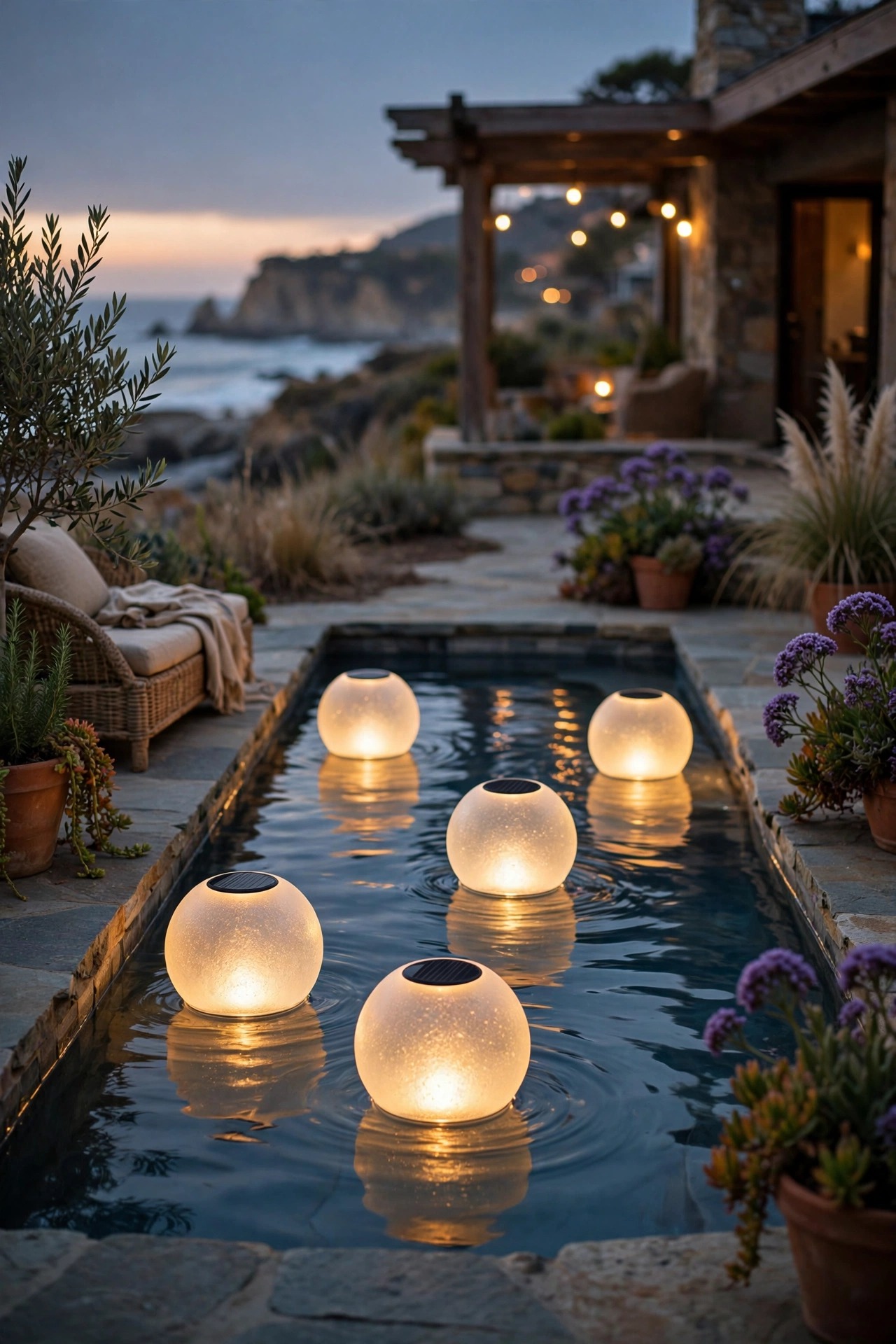
15. Floating Solar Orbs on the Pool or Water Feature
If your patio has a pool, a dipping tub, or even a wide water bowl, floating solar orbs are pure beach-resort magic. These waterproof spheres charge on the coping by day, then drift on the water glowing softly all evening. A trio in mixed sizes — say 8, 10, and 14 inches — looks far better than a matching fleet, and the reflections double every bit of light they make. Most models cycle through a steady warm white and a slow color fade; I keep mine locked on warm white for the calm coastal mood, saving the rainbow mode for parties. They are also a quiet safety feature, making the water edge obvious to guests wandering with a drink after dark. Rinse them when you skim the pool, because a film of sunscreen and salt dulls both the panel and the glow. Bring them in during a serious storm — they are light, and a strong onshore wind will relocate them to the neighbors without asking. Small touch, huge atmosphere.
Suggested budget range: $25 – $80.
16. Seagrass and Capiz Accents That Glow From Within
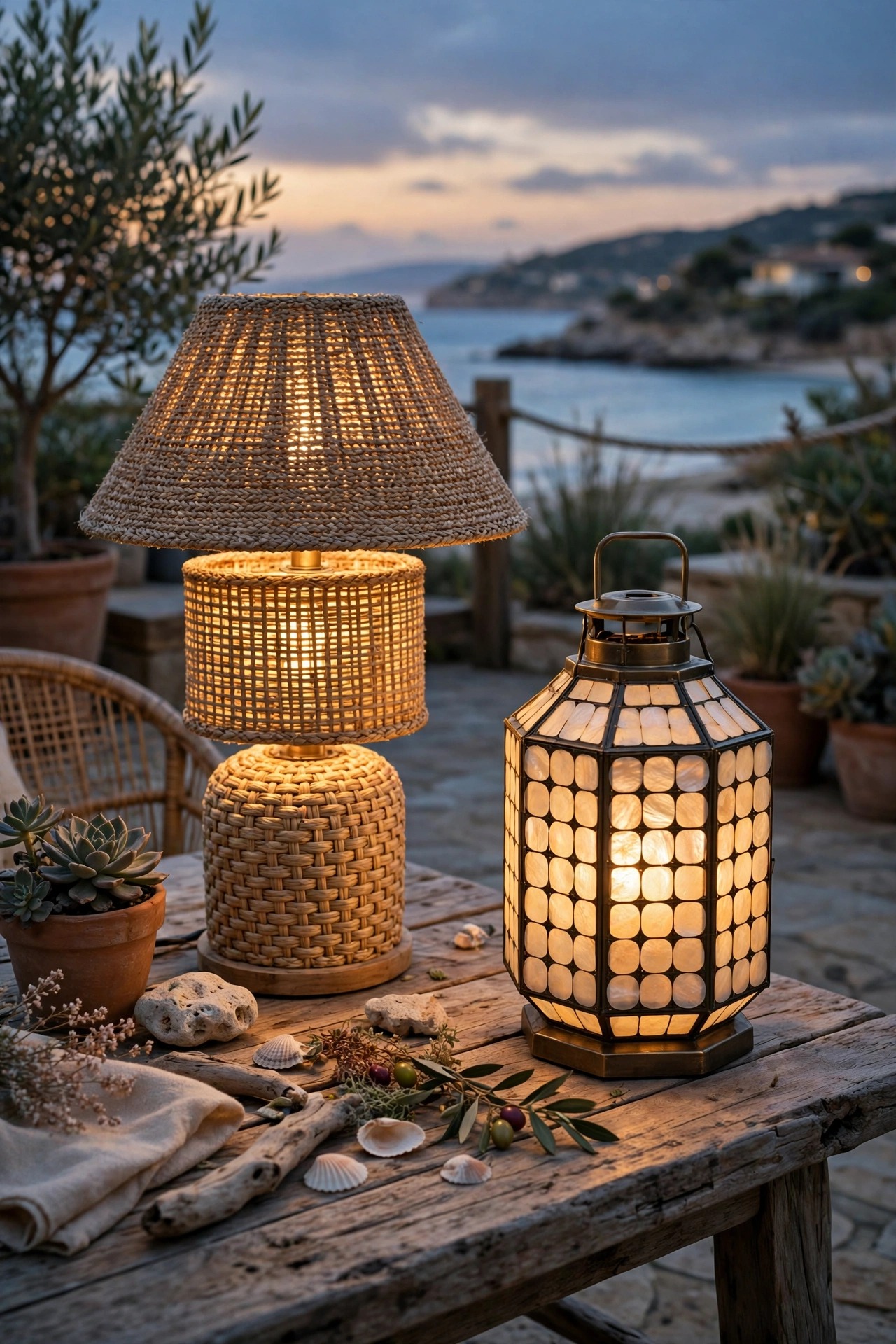
Some fixtures are decor first and lights second, and on a coastal patio that is exactly right. A seagrass table lamp with a battery LED inside, a capiz shell night lantern, or a woven basket pendant casts a textured, shell-like glow you cannot get from glass or metal. The natural materials filter the light into something soft and dappled, like sun through dune grass. Battery and solar versions have gotten genuinely good, so you can place them anywhere — a side table, a shelf on the outdoor kitchen, hanging from a pergola corner — without hunting for an outlet. Keep natural fibers under a covered patio or bring them in for wet weather; the resin look-alikes can stay out but never quite fool anyone up close. I rotate two or three of these accents seasonally, and they are always the pieces guests pick up and ask about. Think of them as jewelry for the patio: small, warm, and chosen to catch the eye at exactly one or two spots rather than everywhere at once.
Suggested budget range: $30 – $95.
17. Step Lights So Nobody Misses the Deck Edge
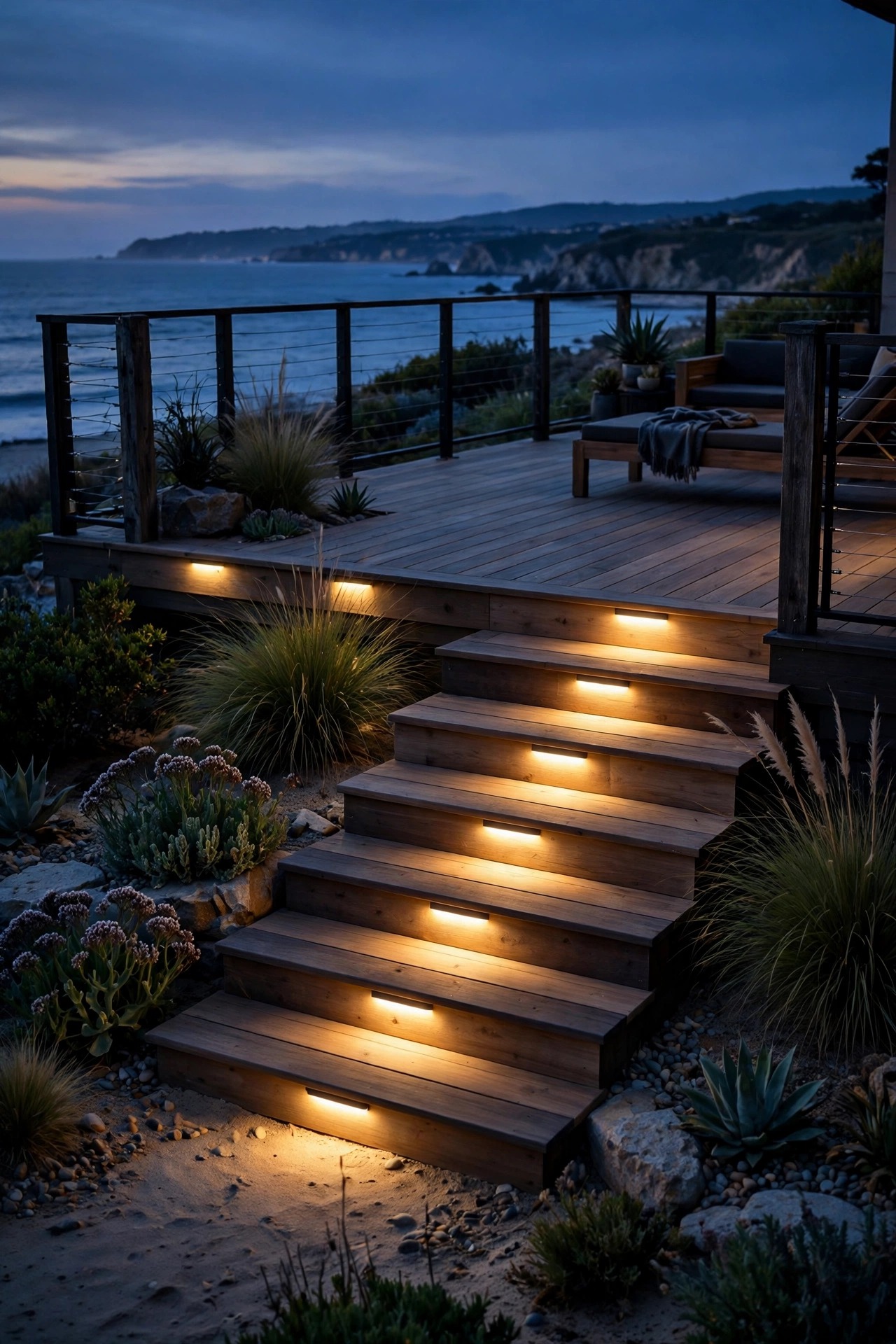
Patio steps and level changes are where good evenings go sideways, so light them properly. Small recessed step lights set into the riser, or surface-mount lights tucked under each tread nose, throw a gentle wash across the step below with no glare. You only need one fixture per step, and low-voltage LED versions sip about a watt each while lasting for years. If your steps are a retrofit and wiring sounds miserable, solar step lights have improved enormously — pick models with the panel on top of the fixture and a honest 6-plus-hour runtime rating. On a coastal patio I lean toward bronze or weathered finishes, since polished metal shows every salt spot. The goal is guidance, not a runway: keep them dim, warm, and consistent so the whole route from door to fire pit to gate feels like one calm path. This is the least glamorous idea on the list and the one I would install first in a house with kids, grandparents, or a hot tub involved.
Suggested budget range: $25 – $100.
18. Keep Every Bulb at 2700K for One Golden Mood
Here is the unglamorous secret behind every beautiful patio photo: the bulbs all match. When one fixture glows candle-warm and the next blazes blue-white, your brain reads it as a hardware store, not a beach house. Standardize on 2700K warm white across strings, lanterns, strips, and path lights, and the whole patio settles into one golden, skin-flattering mood. Check the Kelvin rating on every box before you buy — solar products especially love to sneak in 4000K or daylight 6000K bulbs that will clash with everything. If a fixture you love only comes in cool white, see whether the bulb or the LED panel can be swapped; often it can. Warm light also flatters the coastal palette — driftwood tones, sandy neutrals, sea-glass blues all look richer under it. Dimmers and low settings matter too: a 2700K bulb at half power reads as candlelight, while full blast reads as a porch light. Consistency is free once you know to look for it, and it ties together fixtures bought years apart from different stores.
Suggested budget range: $10 – $40.
19. Put the Whole Patio on Timers and Forget It
The best beach house patios light themselves. A couple of outdoor smart plugs or simple mechanical timers on your string lights, pendants, and strip lights mean the glow is waiting when you step outside, and everything clicks off at a neighbor-friendly hour. I set my main layers to come on at dusk and off at 11 p.m., with the motion lantern by the door standing guard after that. Photocell adapters that screw into a socket are the cheapest automation of all — a few dollars each, and your door light and path lights handle themselves forever. Group your timers by layer so the canopy, the lanterns, and the low lights can run different schedules; the low guidance lights earn a longer shift than the party layers. Timers also stretch bulb and battery life, and they save the nightly wander around the patio flipping switches with a towel over one arm. Set it up once in spring, check the schedule after each power outage, and enjoy a patio that behaves like a well-run little resort.
Suggested budget range: $12 – $50.
20. Choose Salt-Air-Proof Finishes From Day One
Coastal air is quietly brutal — it pits cheap metal, clouds plastic, and turns bargain fixtures shabby in a single season. Buy finishes that are born for it: 316 marine-grade stainless steel, powder-coated aluminum, solid brass that patinas gracefully, and UV-stable resin that mimics rattan or driftwood. Avoid painted steel and mystery alloys anywhere the salt breeze reaches. A five-minute monthly rinse with the hose knocks the salt film off fixtures and solar panels, and a dab of car wax on metal frames twice a year keeps corrosion from getting a foothold. When you shop, look for wet-location ratings and sealed LED modules; a fixture that cannot handle a sideways rainstorm has no business on a beach patio. Honestly, this is where I spend more per fixture than most people, and it pays — my oldest coastal lights are on year six and still look new, while the cheap set I tried first lasted eleven months. Buy once, rinse occasionally, and your patio avoids the tired, corroded look that gives coastal decor a bad name.
Suggested budget range: $40 – $200.
21. Pull Your Coastal Patio Lighting Ideas Together With a Dusk Walk-Through
The last idea is a ritual, not a purchase. One evening after everything is installed, make a drink, wait for true dusk, and walk your patio the way a guest would — in the gate, across the seating, down the steps, out to the fire. You will spot every flaw in five minutes: the strand that glares at eye level, the step that still hides in shadow, the lantern competing with the uplight. Adjust angles, swap one bulb, slide a bollard six inches, and the whole scheme clicks into place. This is when all your coastal patio lighting ideas stop being separate fixtures and become one warm scene that feels like a beach house at golden hour. Take a photo from the doorway — that is the shot that tells you whether the layers balance. I repeat the walk-through every spring when I bring the cushions out, and it takes less time than brewing the coffee I carry with me. Your patio is done when the walk feels like a deep breath.
Suggested budget range: $0 – $25.

Frequently Asked Questions
What color temperature is best for a coastal patio?
Warm white, around 2700K, wins every time. It mimics candlelight and sunset, flatters skin and food, and makes driftwood tones, sandy neutrals, and sea-glass blues look rich. Cool white and daylight bulbs (4000K and up) clash with the beach mood and make even pretty patios feel clinical, so check the Kelvin rating on strings, strips, and solar lights before buying.
How do I stop patio lights from rusting in salt air?
Choose fixtures made for it: 316 marine-grade stainless steel, powder-coated aluminum, solid brass, or UV-stable resin, all with wet-location ratings. Then rinse fixtures and solar panels with a hose once a month to remove salt film, and wax metal frames twice a year. Cheap painted steel is the usual casualty — in salt air it can pit within a single season.
Are solar lights bright enough for a beach-style patio?
For accents, paths, and ambience, absolutely — modern solar lanterns, tiki torches, and path lights run 8 to 10 hours on a summer charge. For reading, cooking, or the main dining light, go wired or plug-in, because solar output still cannot match a dimmable pendant or string canopy. The sweet spot is a hybrid: wired heroes, solar supporting cast.
Can I leave string lights up all year on a coastal patio?
Commercial-grade strands with shatterproof bulbs and sealed sockets can stay up year-round in most coastal climates, and mine do. Use stainless hardware, add a guide wire on long spans, and unplug and coil the strands before a serious storm. Check cords each spring for cracked insulation, since sun and salt are harder on the wiring than on the bulbs.
Conclusion
The beach house feeling was never about the house — it is about warm, layered light, natural textures, and fixtures tough enough to laugh at the salt breeze. Pick three or four coastal patio lighting ideas from this list, keep every bulb at 2700K, and let timers do the nightly work. Then pour something cold, kick off your shoes, and browse the rest of the lighting ideas here whenever you are ready for layer two.