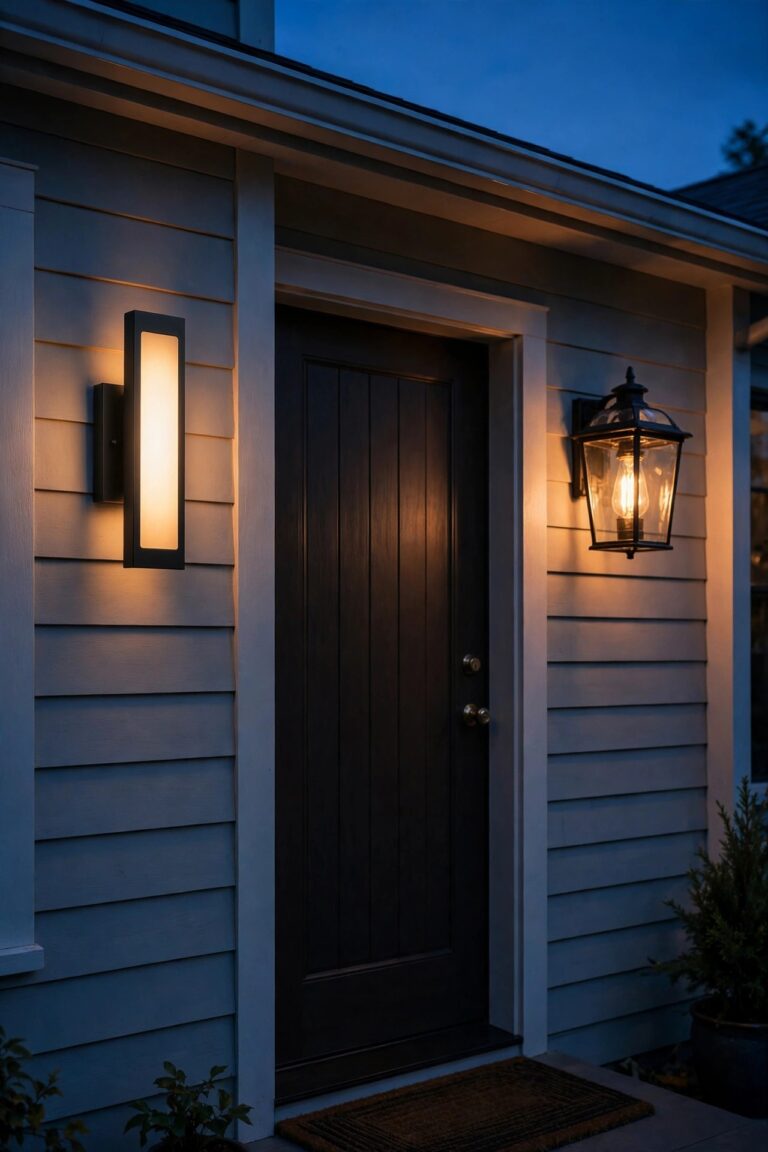
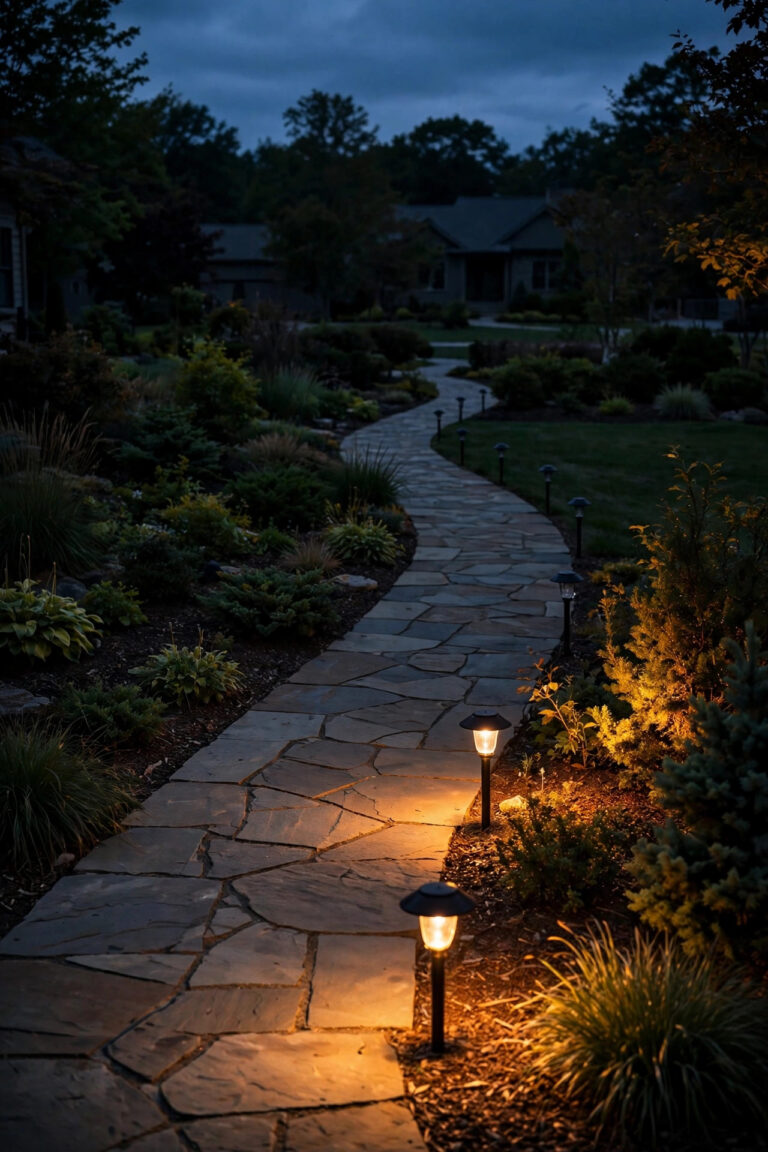
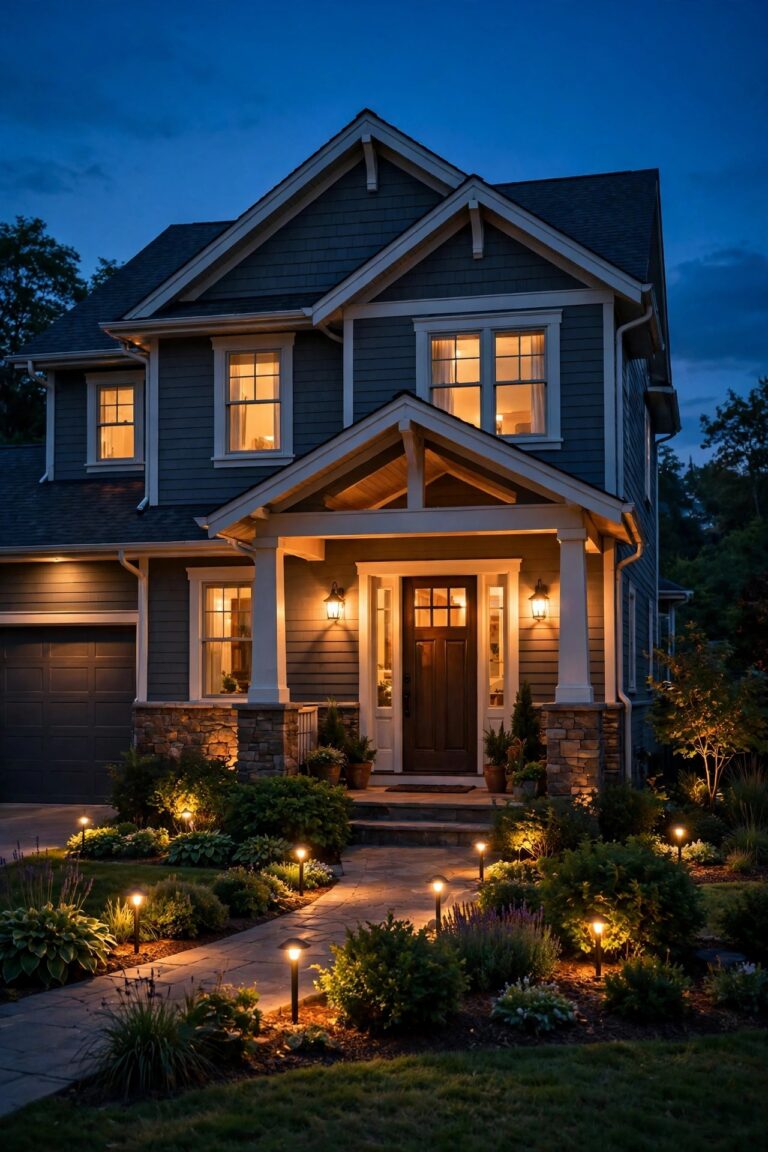
A courtyard entry is a funny little in-between space — not quite the street, not quite the house — and in my experience it is the most under-lit spot on most townhomes and villas. One bare porch bulb has to do the job of three lights, and the whole entry ends up feeling flat and a little unwelcoming. The good news? These small spaces respond beautifully to layering. When I pull together courtyard entry lighting ideas for a compact entry, I think in three layers: a warm welcome at the door, safe light along the path, and a soft glow on the walls, plantings, or water feature that gives the space its mood. Because the footprint is small, you get a finished, designed look for far less money than a big front yard. Below are 21 ideas I come back to again and again, from five-minute solar fixes to hardwired upgrades, each with honest budget ranges so you can mix and match your own plan.
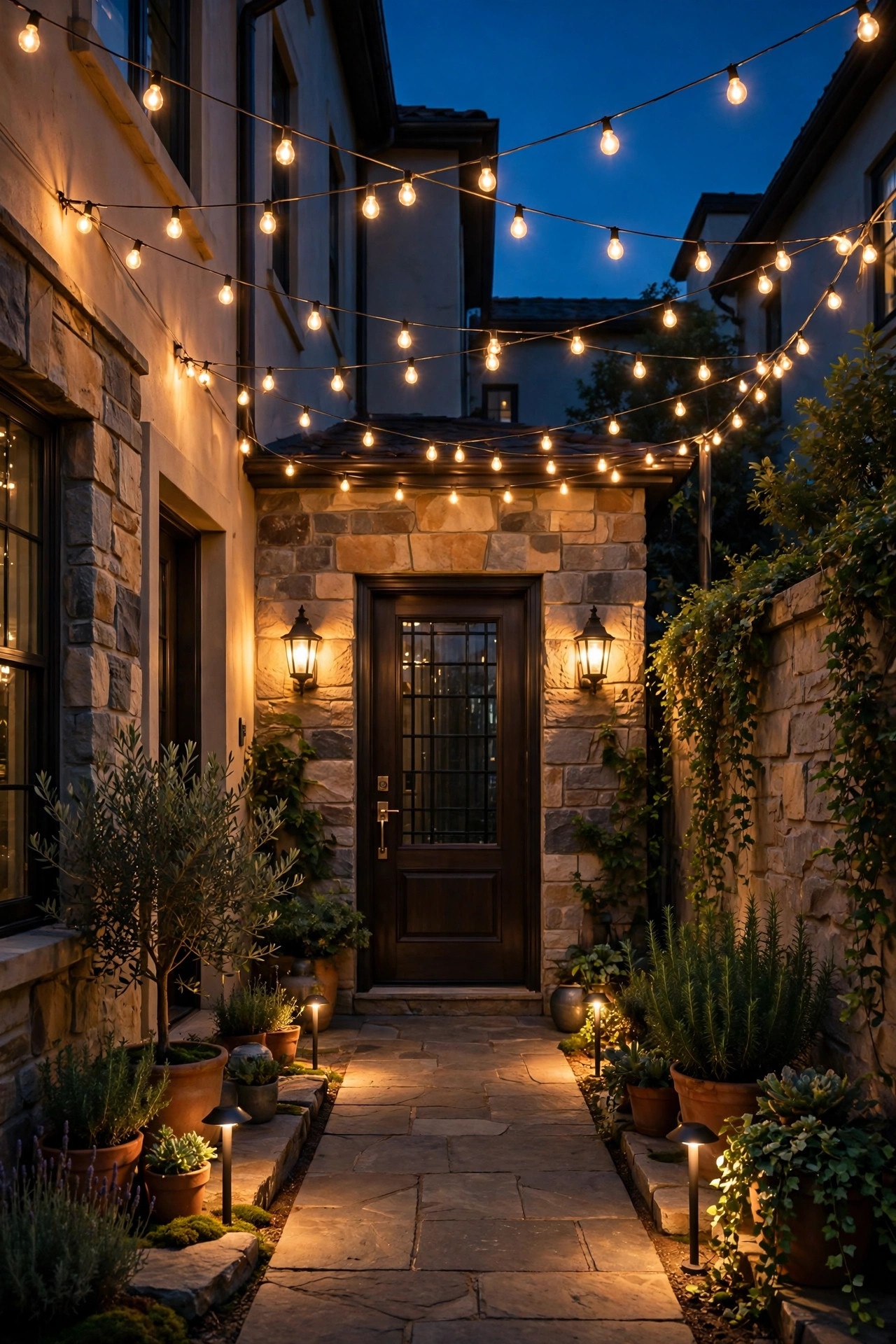
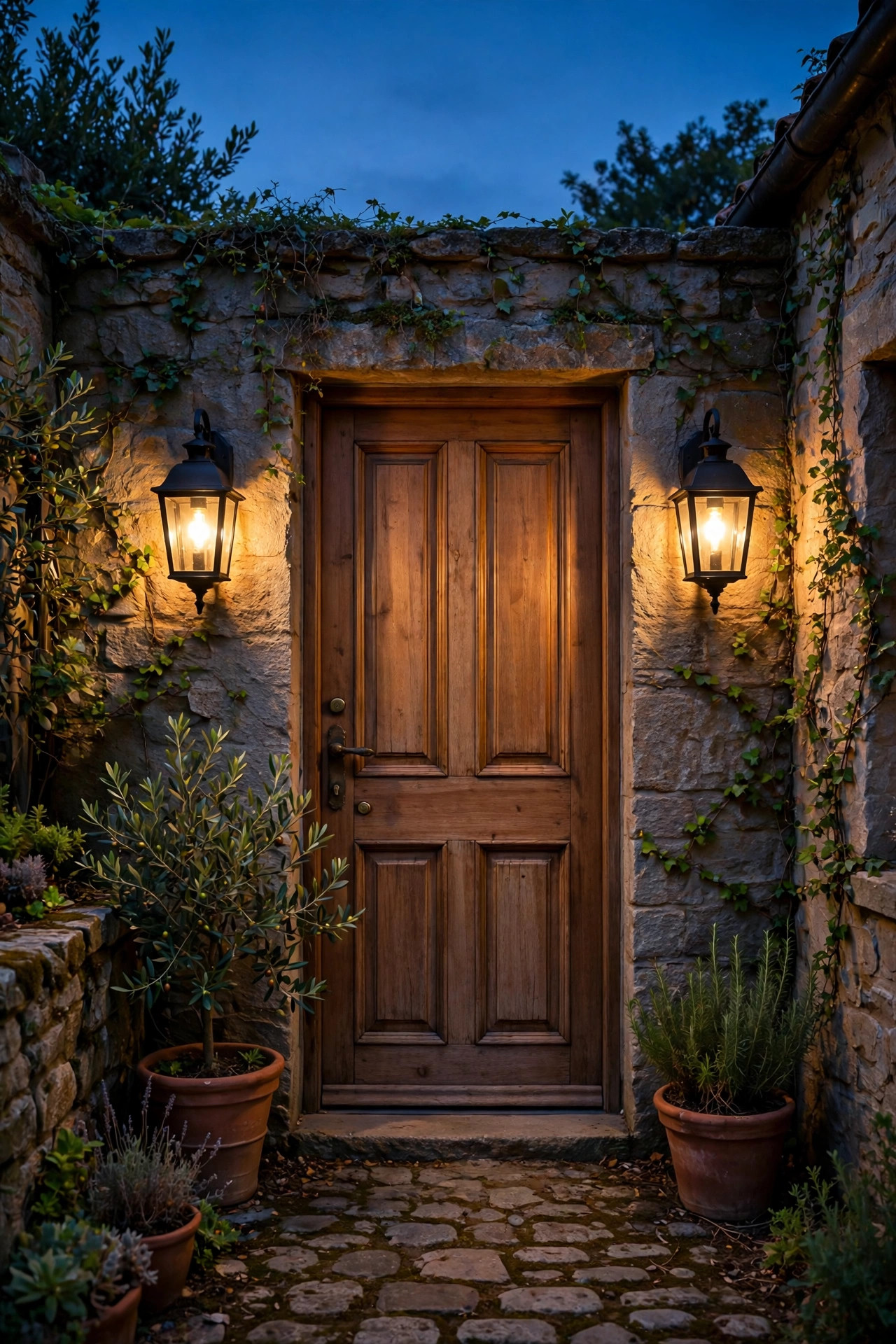
1. Flanking Sconces: Where All Good Courtyard Entry Lighting Ideas Begin
If a courtyard gets only one upgrade, I always start with a matched pair of wall sconces flanking the front door. Twin fixtures frame the door like punctuation, and the symmetry instantly makes a small townhome entry feel intentional instead of accidental. Mount them at eye level, roughly 60 to 66 inches from the ground to the center of the fixture, and about 6 to 8 inches out from the door casing on each side. For a standard 36-inch door, fixtures in the 10 to 14 inch tall range look proportionate without overwhelming the facade. I recommend warm-white bulbs around 2700K and 450 to 800 lumens each — enough to light faces kindly for guests and delivery drivers, never the harsh glare of a daylight bulb. Choose fixtures rated for wet locations, since courtyard doors often sit under only a shallow overhang. If your townhome has no junction box where you want one, an electrician can usually tap the existing porch circuit in under an hour. Honestly, this single change does more for curb appeal after dark than any other item on this list, and my front porch lighting ideas guide covers sizing in more depth.
Suggested budget range: $90 – $260.
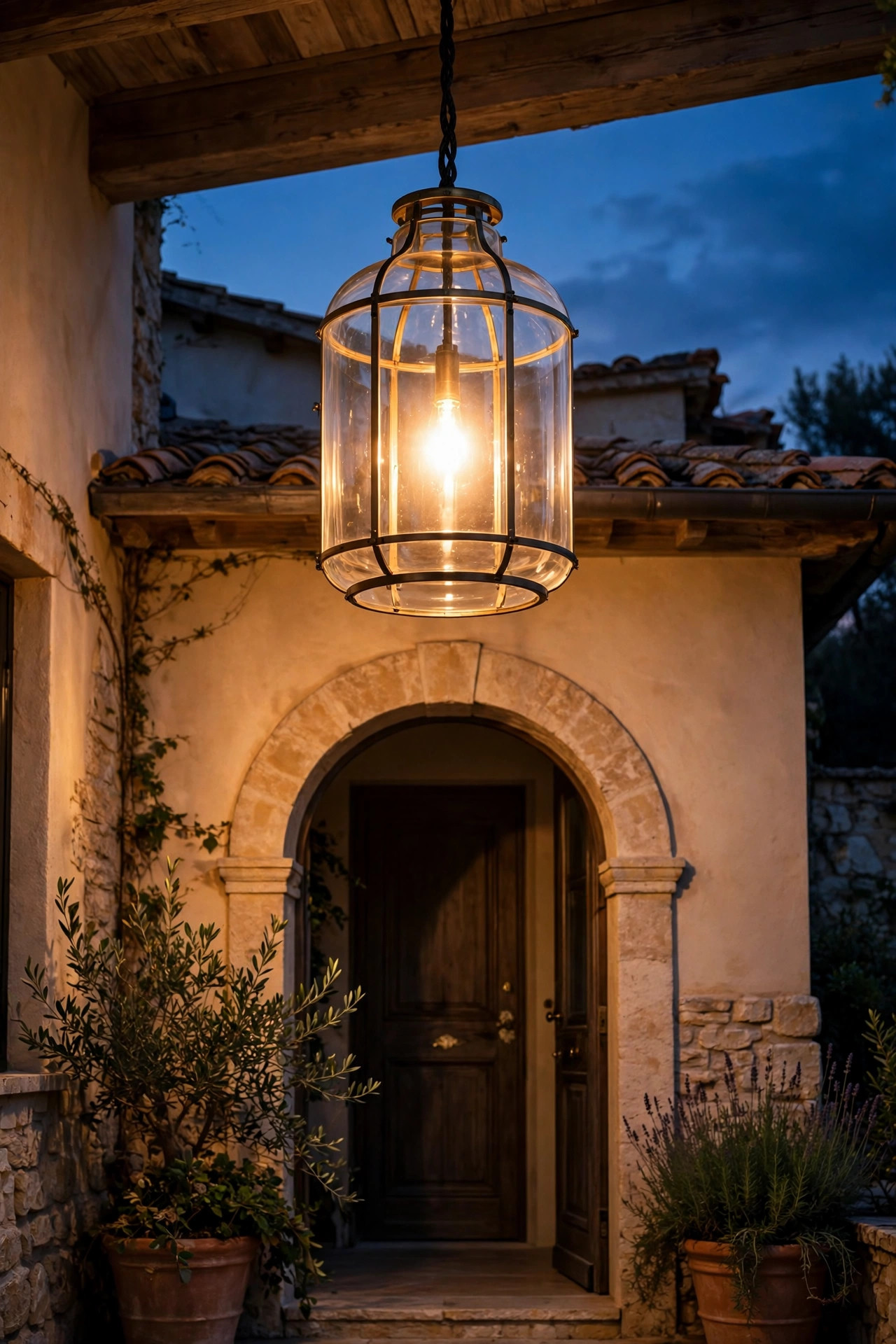
2. An Oversized Pendant Lantern Centered Over the Entry
Many villa entries have a covered loggia or a deep archway, and that ceiling is begging for a statement pendant. One oversized lantern — think 18 to 24 inches tall — centered over the door swing reads like jewelry for the whole courtyard. Hang it so the bottom of the fixture sits at least 6 feet 8 inches above the walking surface, higher if your door is tall or the arch soars. On a chain, you can fine-tune the drop until the glow pools exactly where guests pause to knock. I like clear glass with a visible LED filament bulb inside; it throws pretty patterned shadows through the panes and feels worlds warmer than a frosted dome. Keep the bulb around 800 to 1100 lumens, and put it on a dimmer if the circuit allows — full brightness for finding keys, low for evening drinks in the courtyard. In an open archway, choose a damp- or wet-rated fixture and a heavier chain, because courtyard breezes funnel through these openings more than you would expect.
Suggested budget range: $120 – $340.
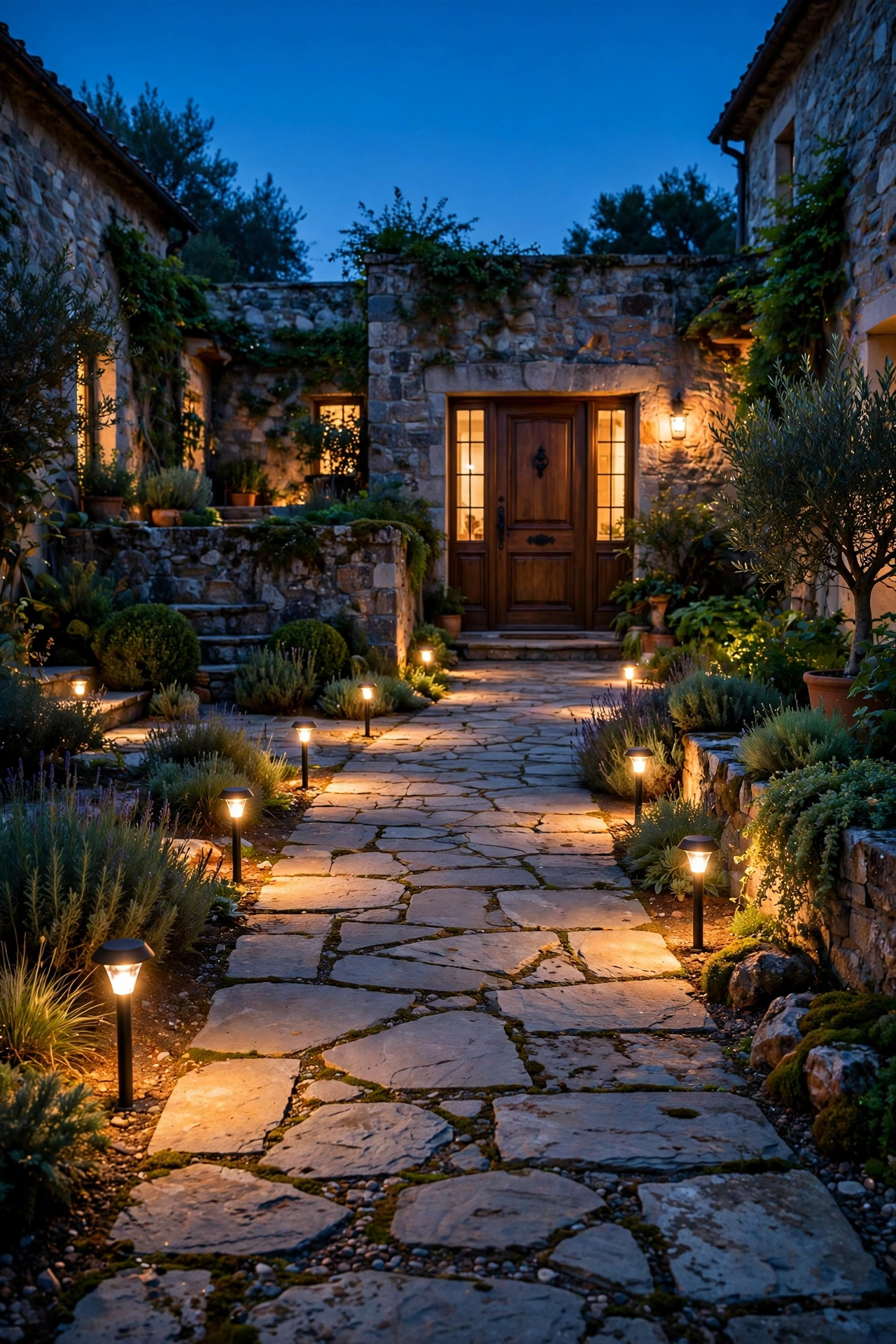
3. Low-Voltage Path Lights Along the Walkway
The walk from the courtyard gate to the front door is short, but it is exactly where guests trip on a hose, a step edge, or an uneven paver. A run of low-voltage path lights solves it elegantly. Space fixtures 5 to 6 feet apart, alternating sides of the walk so the light pools overlap gently instead of marching in a runway line. Keep them 12 to 18 inches back from the path edge, tilted slightly toward the walking surface. A small 12-volt transformer plugged into a GFCI outlet handles a courtyard run easily, and the cable can tuck under mulch or along a paver joint with no trenching drama. I prefer fixtures with a hat or shade that throws light down and out — bare bulbs glare at eye level and ruin the mood you built at the door. Around 100 to 200 lumens per fixture is plenty for a residential walk. For more layout patterns, my walkway lighting ideas roundup shows several spacings side by side.
Suggested budget range: $110 – $280.
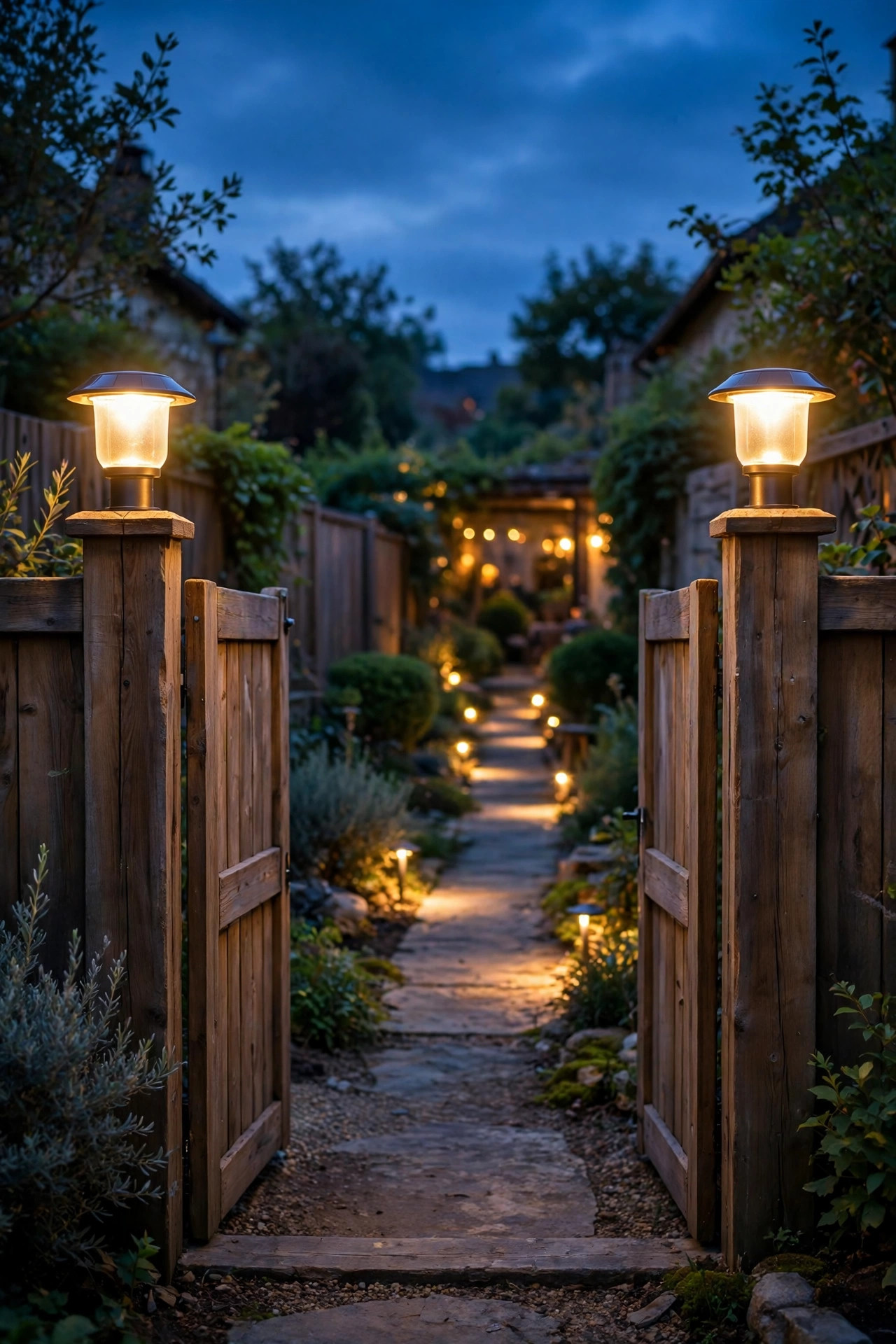
4. Gate Post Cap Lights for a Finished First Impression
The gate is the true front door of a courtyard home, so I love giving it its own light. Post cap lights sit right on top of the gate posts and cast a soft halo that says "start here" before a guest even reaches for the latch. Solar caps are the easiest route — no wiring, just make sure the panel gets a few hours of direct sun, which most courtyard gates do since they face the street. Hardwired low-voltage caps are brighter and more reliable in shaded entries, and they can share the same transformer as your path lights. Size the cap to your post: 4×4 and 6×6 are the common footprints, and a snug fit with a bead of exterior caulk keeps wind from worrying them loose. Expect a modest 30 to 80 lumens from solar versions — this is accent light, not task light — and pair it with a small downlight at the latch if your gate hardware is fiddly in the dark. The effect at night is quietly upscale, like a boutique hotel entrance in miniature.
Suggested budget range: $35 – $140.
5. Uplight a Small Courtyard Tree or Topiary
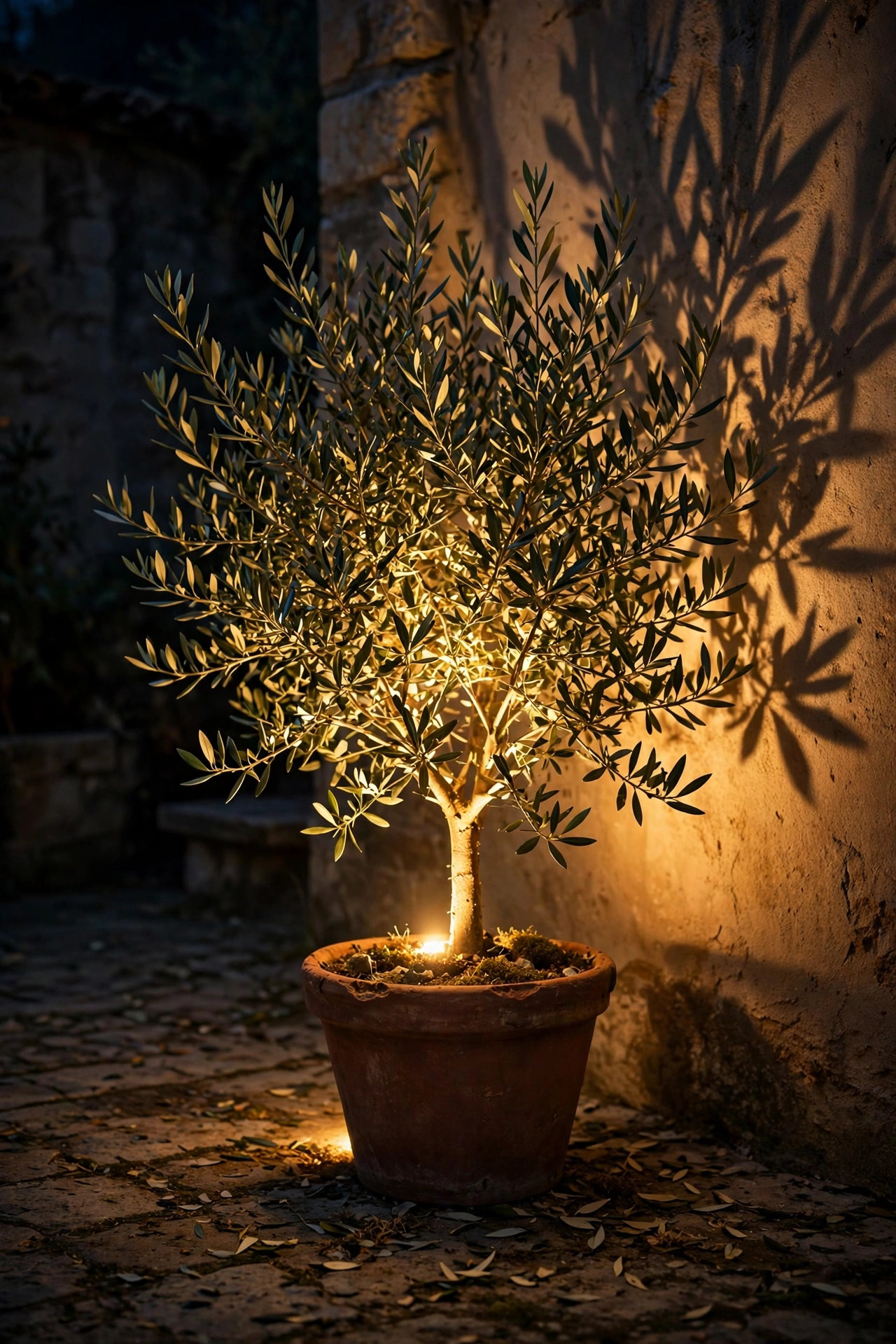
Almost every villa courtyard has one sculptural plant — an olive tree, a Japanese maple, a clipped topiary in a big terracotta pot. A single well-aimed uplight turns it into a living chandelier after dark. Place a narrow-beam spotlight 12 to 24 inches from the trunk, aimed up into the canopy at roughly a 30-degree angle, and the leaves will glow from within while shadows dance on the wall behind. A 10 to 25 degree beam keeps the light in the foliage instead of spilling into the neighbors windows. Low-voltage LED well lights that sit flush in the soil are my favorite here because you never see the hardware, only the effect. Budget 300 to 600 lumens for a small tree; more washes the detail out. If the plant lives in a pot, a battery or solar spike light tucked into the soil works surprisingly well and moves when you rearrange. This is the cheapest "wow" in the whole courtyard, honestly — one light, one plant, instant atmosphere.
Suggested budget range: $30 – $120.
6. Wall-Wash Uplights on Stucco, Brick, or Stone
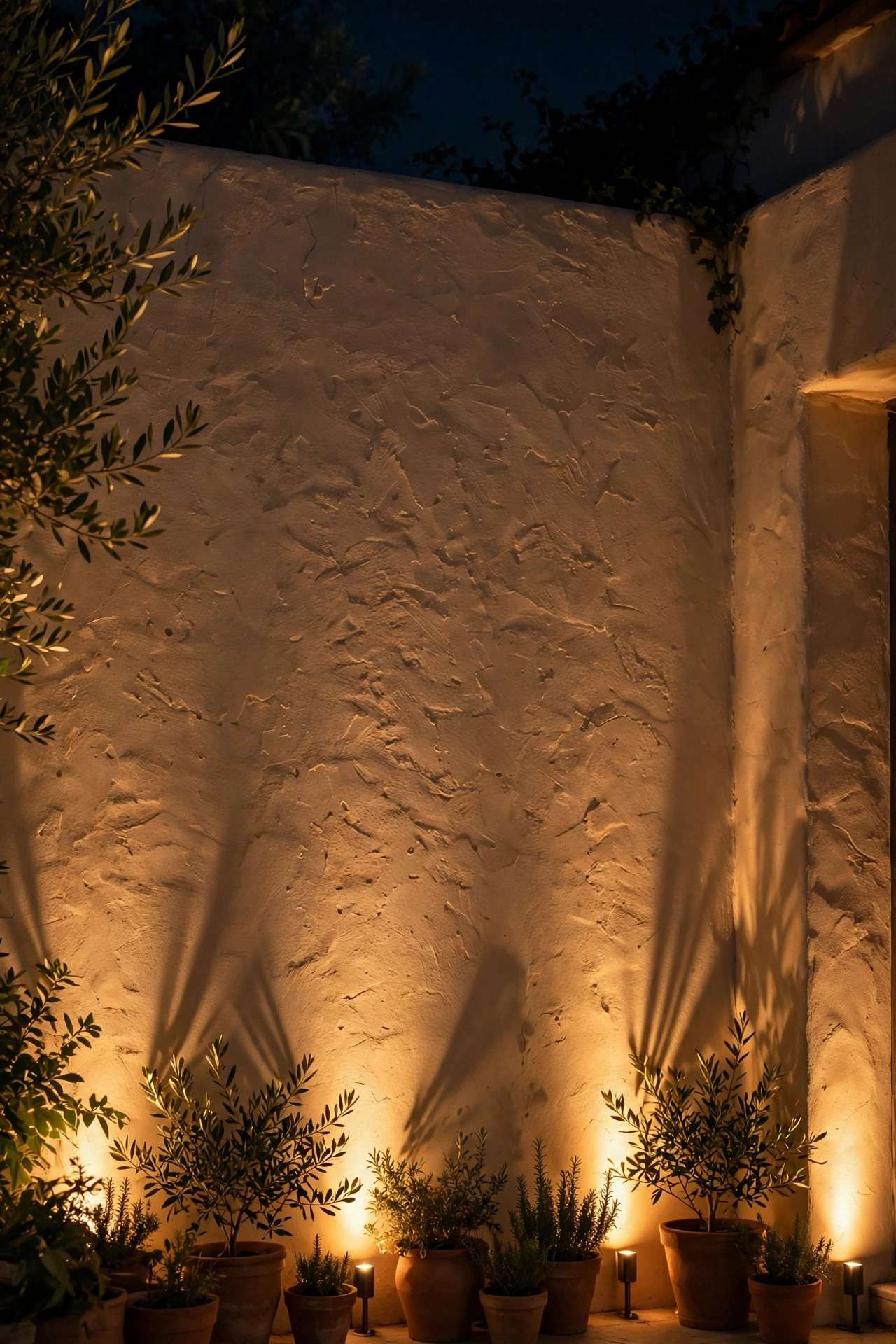
Courtyard walls are tall, close, and usually beautifully textured — stucco, brick, stacked stone — and a wash of light brings every bit of that texture alive. Set small uplights 12 to 18 inches out from the wall base and tilt them back about 30 degrees so the beam grazes the surface rather than blasting it flat. Grazing light exaggerates texture; head-on light erases it. Space the fixtures 4 to 6 feet apart along a long wall for an even rhythm of light and shadow. Warm 2700K to 3000K is flattering on warm-toned masonry, while cooler light can make stucco look chalky and gray. I use wide 45 to 60 degree floods for the wash and keep each fixture around 200 to 400 lumens. This trick is borrowed from landscape designers, and it makes a narrow townhome courtyard feel twice as wide because your eye reads the lit walls as distance. Tie the run into the same timer as the path lights and the whole entry wakes up together at dusk.
Suggested budget range: $80 – $220.
7. String Light Swags Across the Courtyard Ceiling
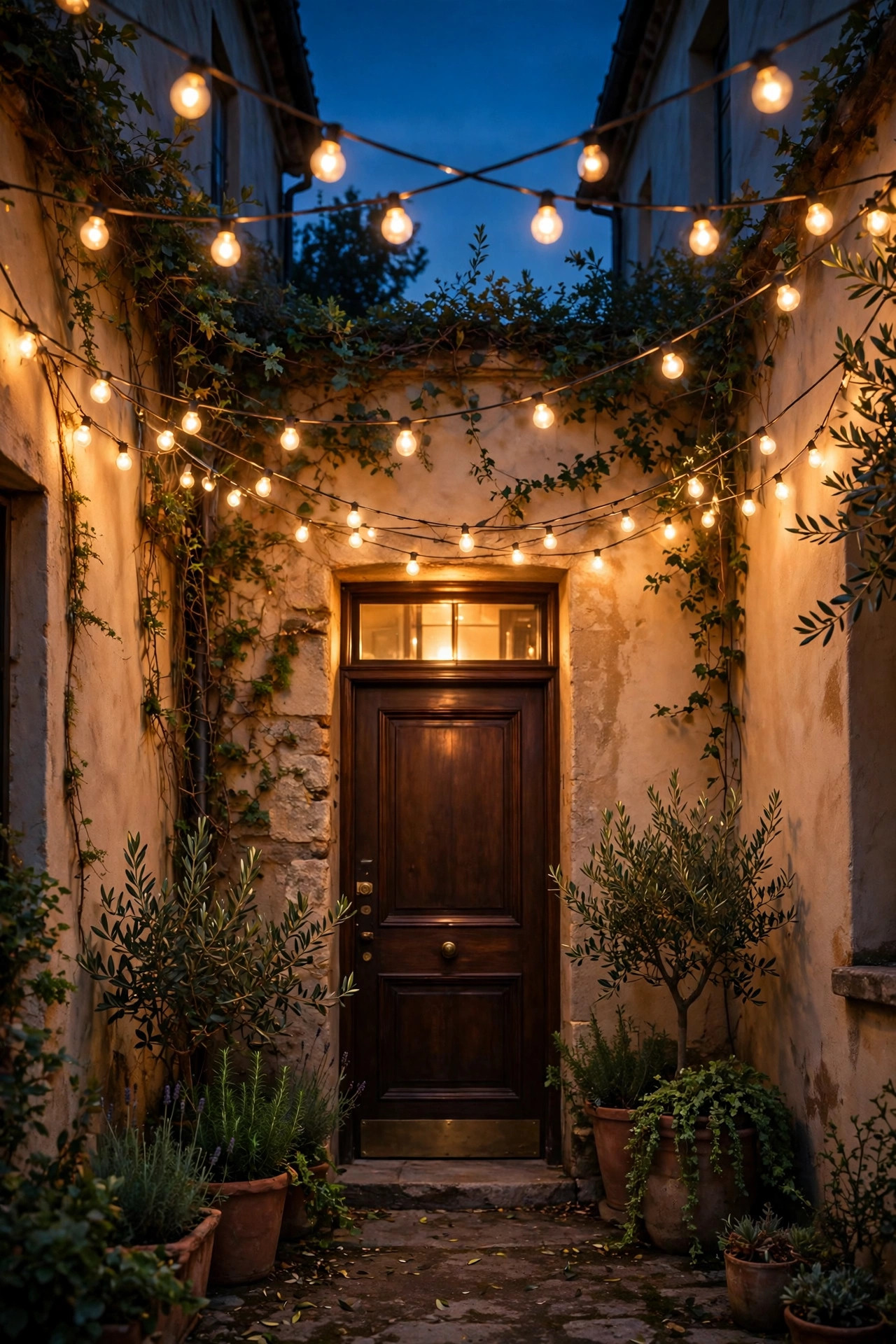
A courtyard is one of the few outdoor spaces where string lights feel architectural instead of party-ish, because the walls give you real anchor points. Two or three gentle swags from wall to wall create a ceiling of light that makes the entry feel like a little European plaza. Use commercial-grade, shatterproof LED string lights rated for outdoor use, and support any span over about 12 feet with a stainless guide wire so the weight hangs on the wire, not the sockets. Anchor into studs, masonry with proper anchors, or a mounted eye plate — never into siding alone. Keep the lowest point of the swag at least 7 feet above the walkway, and use G40 or Edison-style LED filament bulbs at 2700K for that golden cafe glow. One 24-foot strand often covers a townhome courtyard in two swags. Put them on their own plug-in timer or smart plug so they can run a slightly later schedule than the security-minded door lights. Guests will linger under them. They always do.
Suggested budget range: $45 – $150.
8. Step Lights for Entry Stairs and Raised Thresholds
If your courtyard entry includes even two or three steps, step lights are the safety upgrade I recommend most after door sconces. The human eye reads a lit tread edge instantly, and falls on entry steps are embarrassingly common after dark. Recessed step lights mount into the riser or the wall beside the stair and wash each tread with a low, wide band of light. Surface-mount versions with a louvered face are an easier retrofit — no cutting into masonry — and solar step lights handle a single sunny step with zero wiring. Aim for one fixture per step on stairs up to about 3 feet wide, and one per 2 feet of width on wider villa stairs. Keep brightness modest, 30 to 80 lumens, since the fixtures sit close to the tread and glare is the enemy. Wire them to the path light circuit so everything comes on together. Combined with the path run, the whole route from gate to door becomes one continuous, confident ribbon of light.
Suggested budget range: $40 – $180.

9. A Lantern Cluster Beside the Door
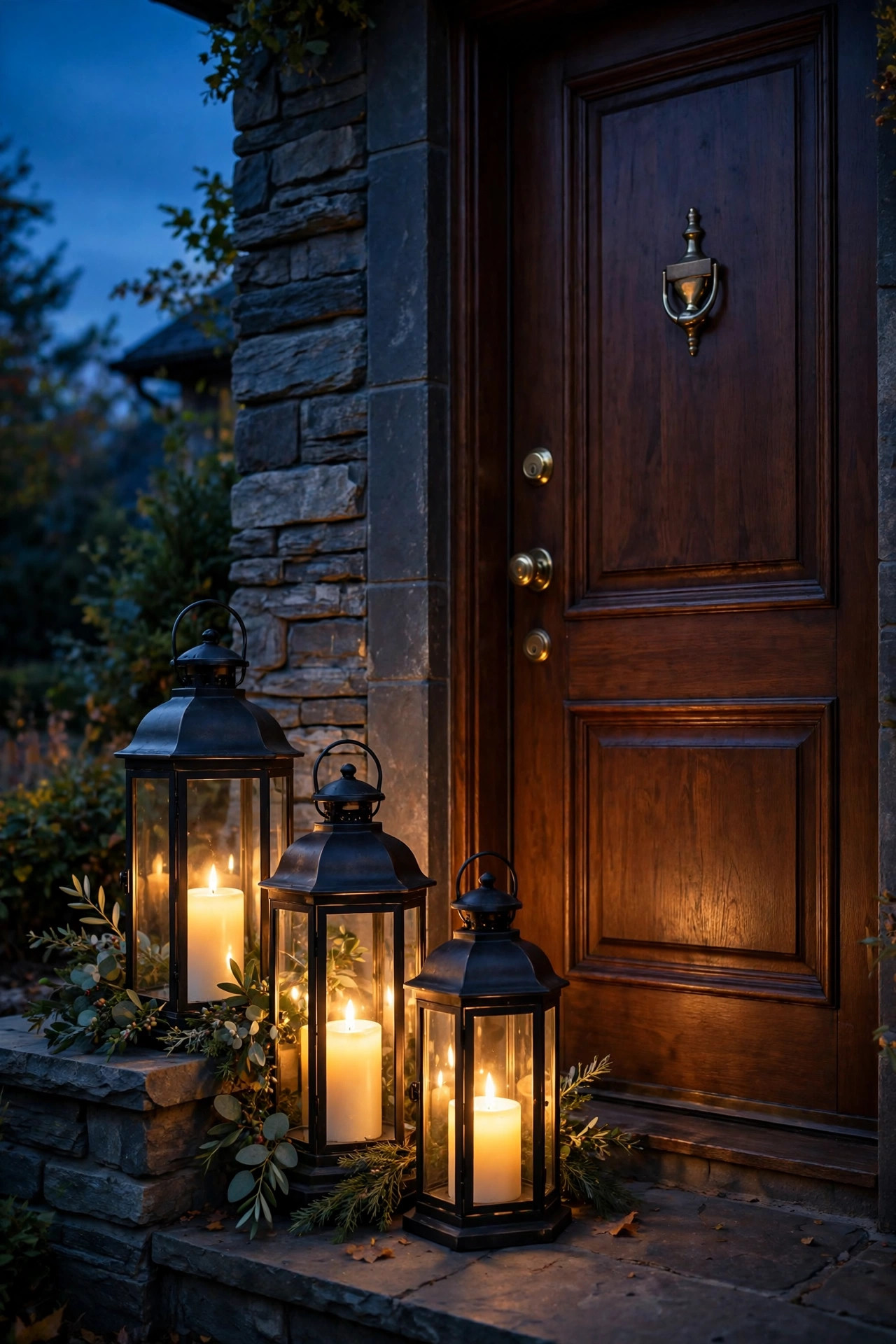
Some townhome entries have no wiring at the door at all, and renters cannot add any. That is where a cluster of lanterns earns its keep. Group three lanterns in graduated heights — say 12, 18, and 24 inches — on one side of the door, and fill them with flameless LED candles on built-in timers. The five-hour timer setting means they flicker on at dusk and off at bedtime with zero effort from you. Odd numbers and varied heights look styled rather than stored, and the cluster fills the dark corner that a single fixture leaves behind. Choose lanterns with real glass and metal frames rated for outdoor use, and bring the candles in during the worst winter storms if your climate is harsh. I keep one set in natural black metal for everyday and swap in a woven pair for summer. It is the fastest seasonal refresh on this entire list, and the warm flicker against a front door is honestly hard to beat for pure welcome.
Suggested budget range: $40 – $130.
10. Recessed Soffit Downlights for a Clean, Modern Look
For a crisp, architectural entry, nothing beats recessed downlights tucked into the soffit or porch ceiling. They disappear completely by day and pour an even cone of light over the door and landing at night — no visible fixture, no glare, just glow. Slim LED recessed modules rated for damp locations are the standard choice; a 4-inch module at around 600 to 800 lumens covers a typical townhome landing from an 8 to 9 foot ceiling. Space two modules about 3 to 4 feet apart across a double door or wide entry. If your courtyard entry has an open beam ceiling instead, surface-mount cylinders give the same effect with a little more presence. Because this is ceiling work near the roof line, many homeowners hand it to an electrician, and I think that is money well spent for clean, code-compliant results. Add a dimmer and the landing shifts from bright-and-safe to soft-and-evening in one slide. Modern villas especially suit this quiet, gallery-style approach.
Suggested budget range: $150 – $420.
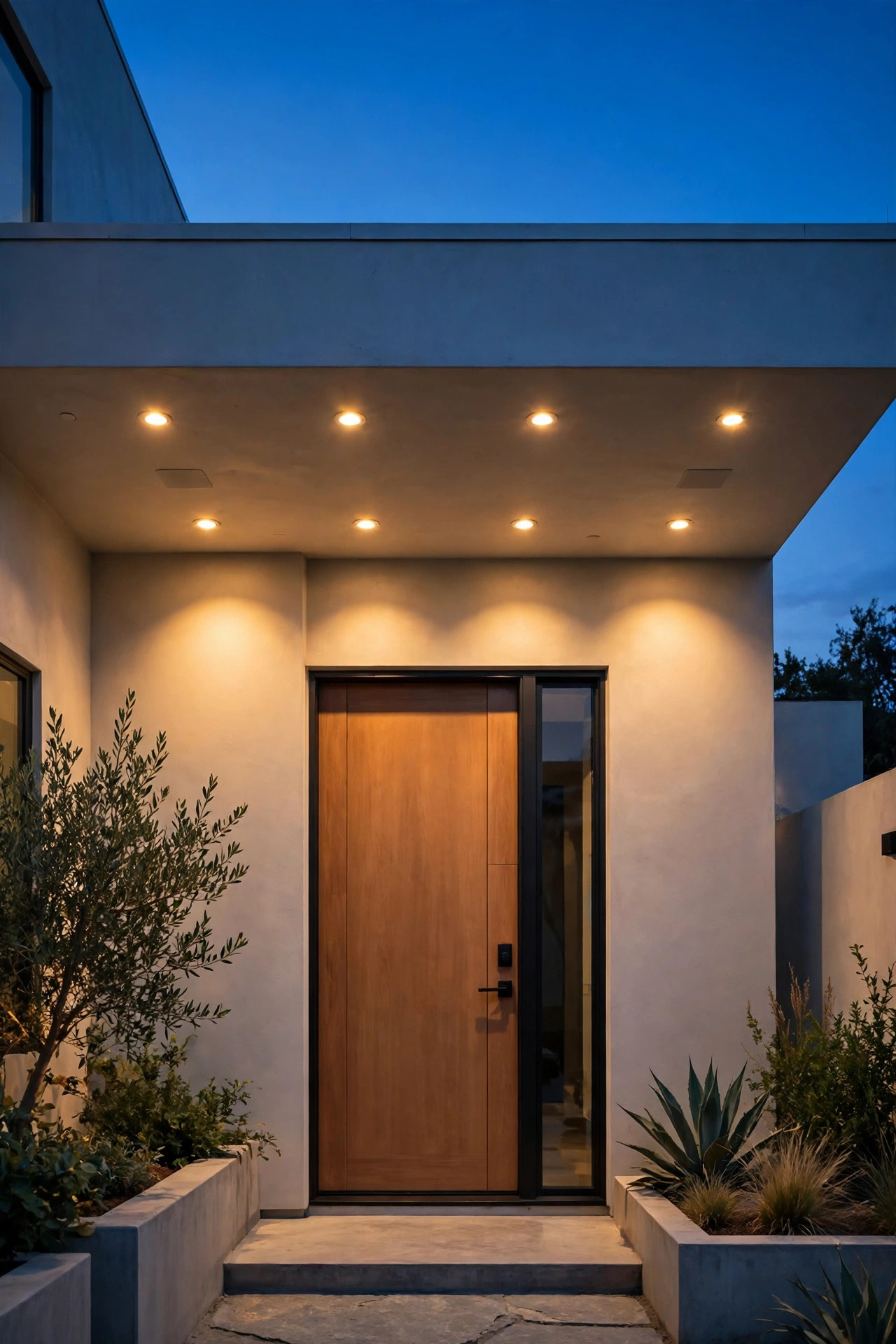
11. A Submersible Accent Light in the Fountain
If your villa courtyard has a fountain or even a modest bubbling urn, lighting the water is pure magic for very little money. A small submersible LED accent light at the base of the basin makes the water shimmer and throws moving reflections onto the surrounding walls — the courtyard literally sparkles. Choose a fixture rated IP68 for continuous submersion, and run it on low voltage only; water and line voltage never mix in my book. One warm-white fixture around 100 to 200 lumens is plenty for a residential fountain, and aiming it up through the falling water gives the prettiest effect. Solar submersibles exist but dim quickly on cloudy stretches, so I lean toward a plug-in low-voltage unit on the same timer as the path lights. Clean the lens monthly in hard-water areas, because mineral film dulls the glow fast. Even in winter, when many of us drain the fountain, the sculptural basin lit from below still earns its place in the scene.
Suggested budget range: $35 – $110.
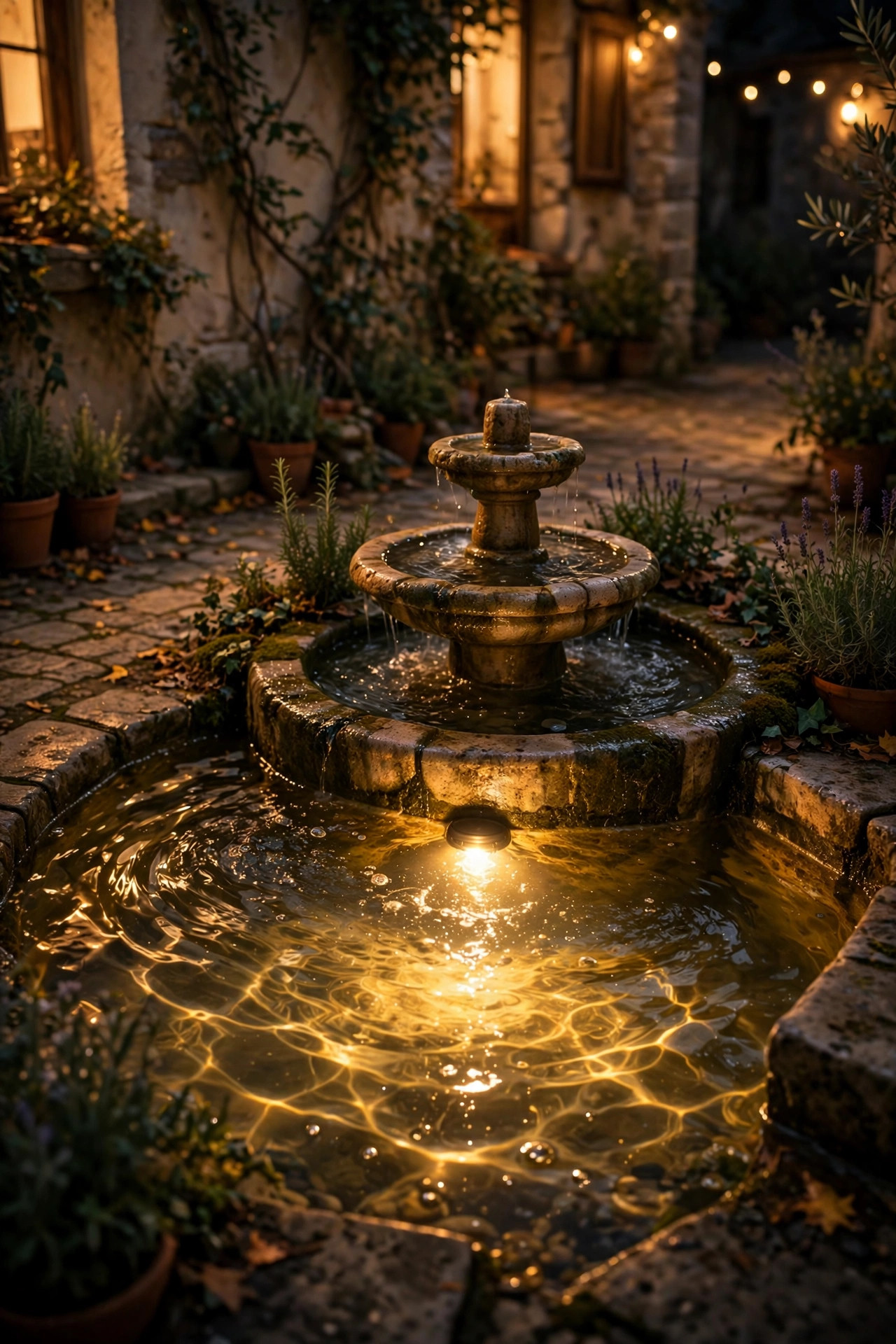
12. A Small Spotlight on the House Numbers
It sounds minor until a food delivery driver is circling your street at night: lit house numbers are a genuine kindness and a quiet safety feature. A small, focused spotlight or a pair of solar spotlights aimed at the address plaque makes numbers readable from the sidewalk without flooding the entry in light. Mount the fixture low in the planting bed or on the gate post, 3 to 5 feet from the numbers, and aim carefully so the beam lands on the plaque and not in the eyes of anyone approaching. Around 100 to 150 lumens with a narrow 25 to 35 degree beam does the job neatly. I like numbers with a matte finish mounted on a slightly raised plaque — raking light from one side makes them pop with shadow and depth. If your plaque sits in deep shade, solar will struggle; tap the low-voltage path circuit instead for dependable dusk-to-dawn service. Small light, big difference, every single night.
Suggested budget range: $25 – $90.

13. Sleek Bollard Lights for a Modern Townhome Entry
Bollards bring a tailored, almost hotel-like order to a contemporary courtyard. These short post lights, usually 18 to 30 inches tall, throw a wide, low circle of light that is perfect along a straight modern walk or flanking a wide entry stair. Space them 6 to 8 feet apart — closer than path lights, because each bollard covers a broad footprint — and stagger or line them to match your architecture. Hardwired bollards are the sturdy long-term choice; solar versions keep improving and suit a straight, sunny run. Look for a shielded source or frosted lens so the light goes down and out rather than into the eyes of someone walking toward the door. Finishes matter here: matte black and graphite disappear into modern landscaping, while bronze warms up a Mediterranean villa. A pair of bollards flanking the gate, matched with cap lights, gives a townhome entry a designed-from-the-street look that photographs beautifully and works even better in person.
Suggested budget range: $70 – $300.

14. Fairy Lights Woven Through a Trellis or Vine
Courtyards love vertical greenery — a jasmine trellis, a climbing rose, a vine softening a stucco wall — and copper-wire fairy lights were practically invented to live inside it. The wire disappears among the stems, leaving only pinpoints of warm light floating in the foliage, and the effect beside an entry door is pure storybook. Weave the strand loosely as the plant grows rather than wrapping tight circles, which can girdle stems; a relaxed spiral or zigzag reads better anyway. Battery and solar strands suit most courtyards, while a plug-in strand on a timer is the most reliable for a shaded north-facing wall. Keep the color temperature warm, around 2700K, and remember these are accent lights only — pair them with a real fixture at the door for finding keys. One 33-foot strand covers a generous trellis panel. On summer evenings, when the jasmine is blooming and the lights are twinkling through it, this corner becomes the most photographed spot in the whole entry.
Suggested budget range: $15 – $45.

15. Solar Stake Lights in the Planting Beds
Not every courtyard bed needs hardwired drama. A handful of solar stake lights tucked among the plantings adds gentle punctuation that guides the eye from gate to door. The trick is restraint and consistency: choose one style and finish, and space the stakes 3 to 4 feet apart following the bed line, rather than scattering random solar novelties. Push them in so the light head sits just above the foliage, not buried in it. Modern solar stakes with a separate, larger panel on a lead wire perform far better in partly shaded courtyards, because you can park the panel in a sunny patch while the lights sit in the shade. Expect a soft 10 to 40 lumens each — glow, not illumination — and clean the little panels with a damp cloth every few weeks, since dusty panels charge poorly. For renters and first-timers, this is the friendliest possible starting layer, and it pairs beautifully with the path lights recommended in my broader courtyard lighting ideas collection.
Suggested budget range: $25 – $80.
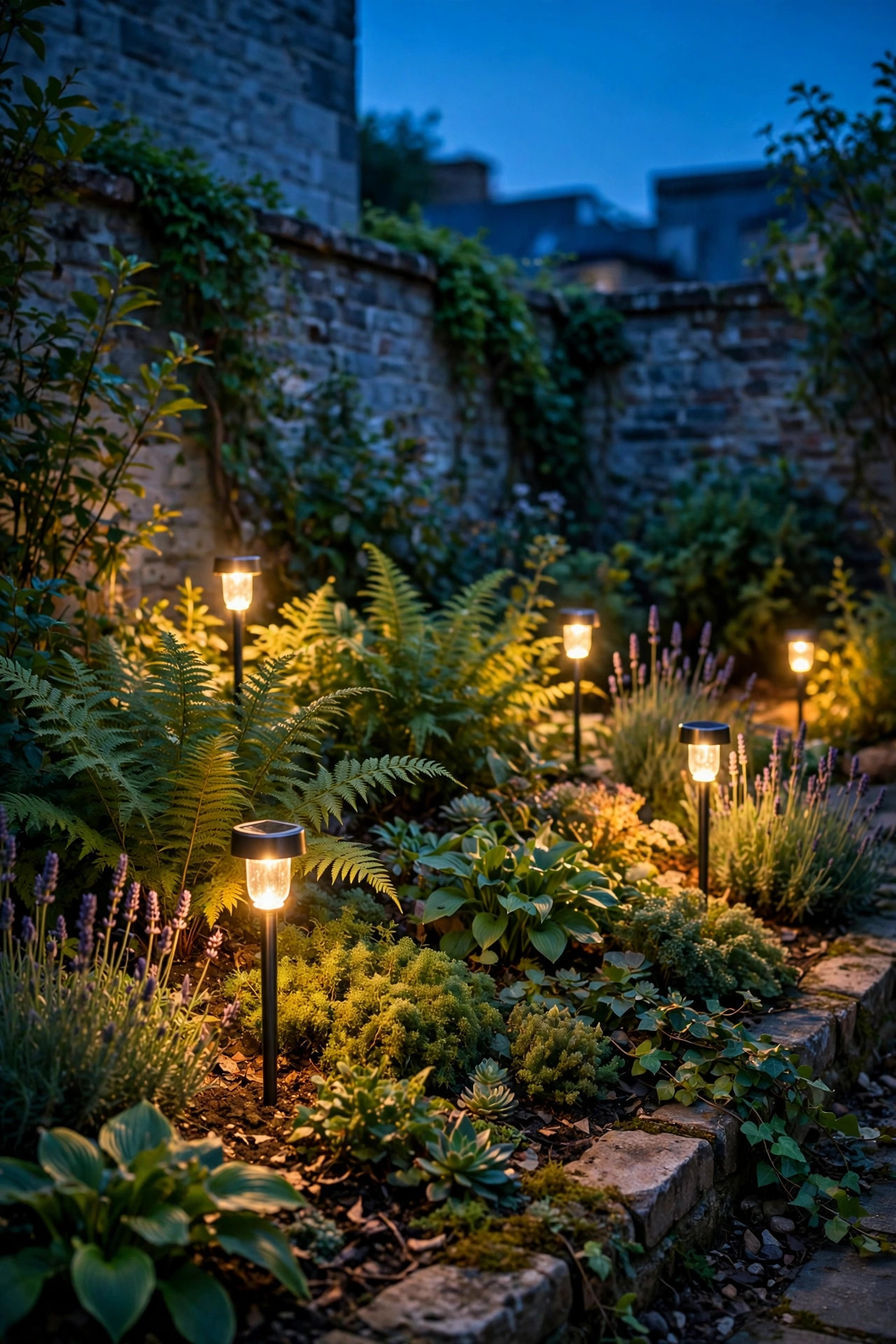
16. Moonlighting: A Downlight Hidden in a High Branch
Landscape designers call it moonlighting, and it might be the most flattering light of all. A small downlight mounted 12 to 20 feet up in a courtyard tree — or on a high wall bracket where no tree exists — shines down through the branches, dappling the ground with soft, shifting pools of light that mimic moonlight through leaves. Use a cool-neutral bulb around 3500K to 4000K here, the one exception to my warm-white rule, because real moonlight reads slightly cool and the contrast with your warm door lights is gorgeous. Keep it dim, 200 to 400 lumens with a wide flood, and aim through the branch structure so shadows do the decorating. In a townhome courtyard without a mature tree, a wall-mounted downlight under the eave at 10 to 12 feet, screened by a climbing plant, fakes the effect convincingly. Tree mounting is a job for an arborist or a confident ladder hand, and the cable should run down the back of the trunk, stapled loosely to allow growth.
Suggested budget range: $90 – $260.
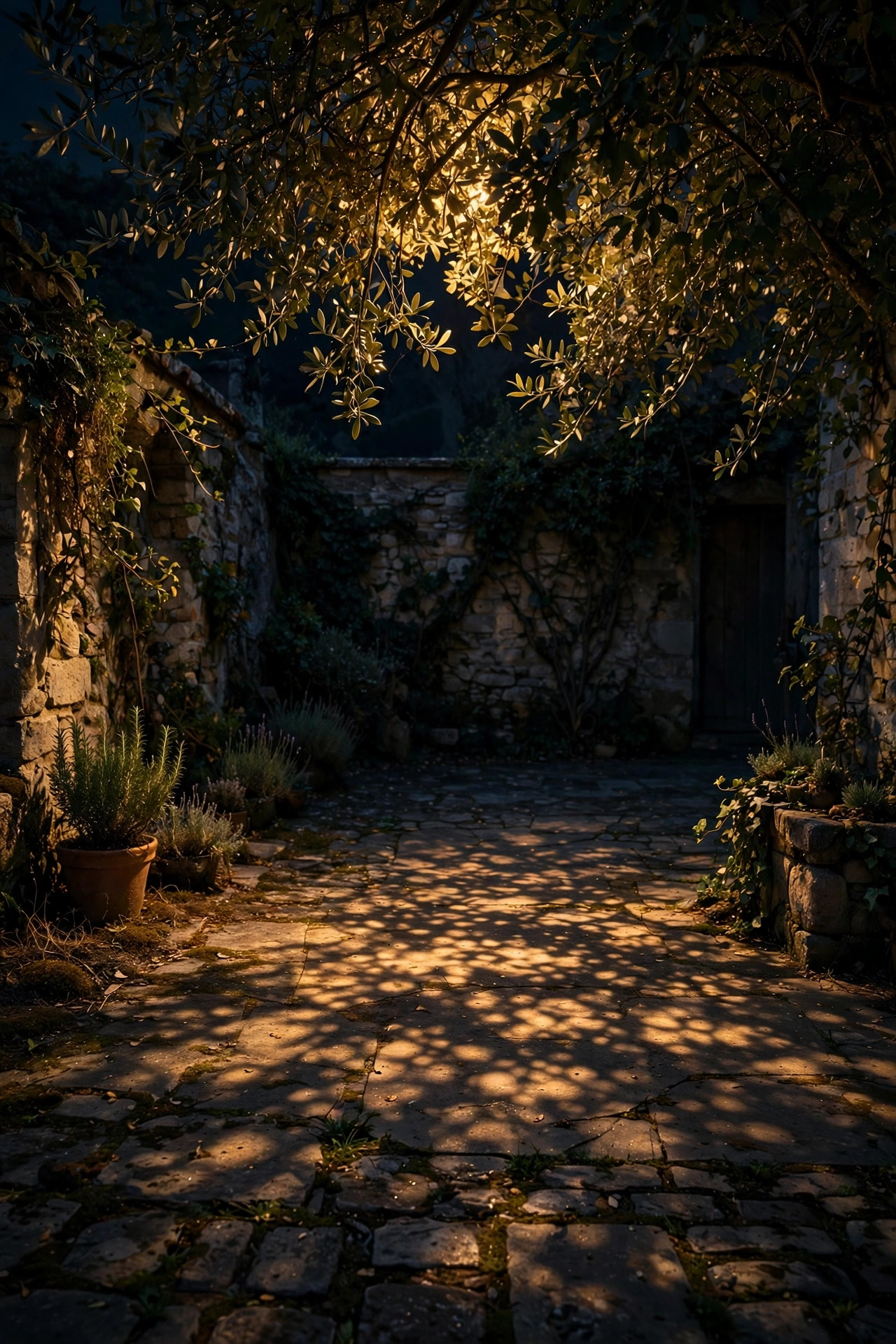
17. LED Strip Light Under a Wall Cap or Bench
Courtyards are full of horizontal edges — the cap on a low stucco wall, a built-in bench, the lip of a raised planter — and a hidden LED strip under any of them produces a floating line of light that looks seriously high-end. Use outdoor-rated, waterproof strip (IP65 or better) with an aluminum channel and diffuser; the channel protects the strip, spreads the light evenly, and hides the individual diodes so you see glow, not dots. Run it on low voltage from the same transformer as your path lights, and tuck the power lead through the wall or behind the bench where it stays invisible. Warm 2700K strip at moderate brightness is the sweet spot for masonry courtyards. The light washes down the wall face, grazes the paving below, and gives guests a subtle guide line toward the door without a single visible fixture. This is the detail visitors describe as "designer" without knowing why, and on a per-foot basis it is surprisingly affordable.
Suggested budget range: $50 – $160.

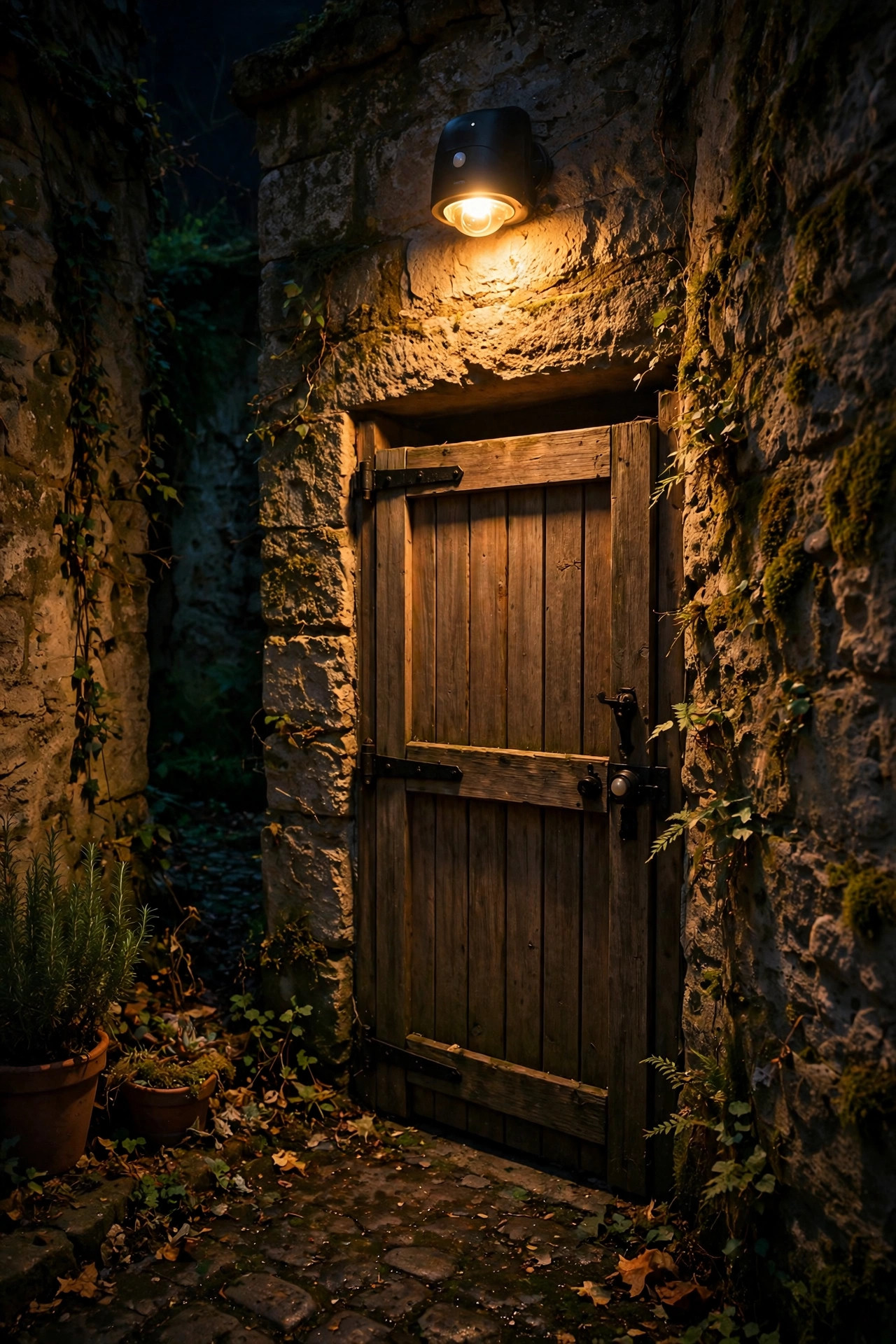
18. A Motion-Sensor Light at the Side Gate
Most courtyard homes have a secondary gate or side passage for bins, bikes, and garden tools, and it is usually pitch black. A motion-sensor light is the right tool there — bright on demand, dark at rest, and it will not annoy the neighbors by burning all night. Battery and solar motion lights have become genuinely good: look for 800 to 1200 lumens, an adjustable detection range, and a photocell so it only triggers after dark. Mount it 7 to 9 feet up, angled down the passage, and set the timer short — 30 to 60 seconds is plenty for a pass-through. If your HOA or villa association restricts visible fixtures on street-facing walls, a sensor light tucked inside the gate line usually passes without comment. I also like the quiet security dividend: a light that snaps on when someone approaches the side gate is a polite but clear deterrent, and it saves you fumbling with a flashlight app while carrying a trash bag.
Suggested budget range: $30 – $100.
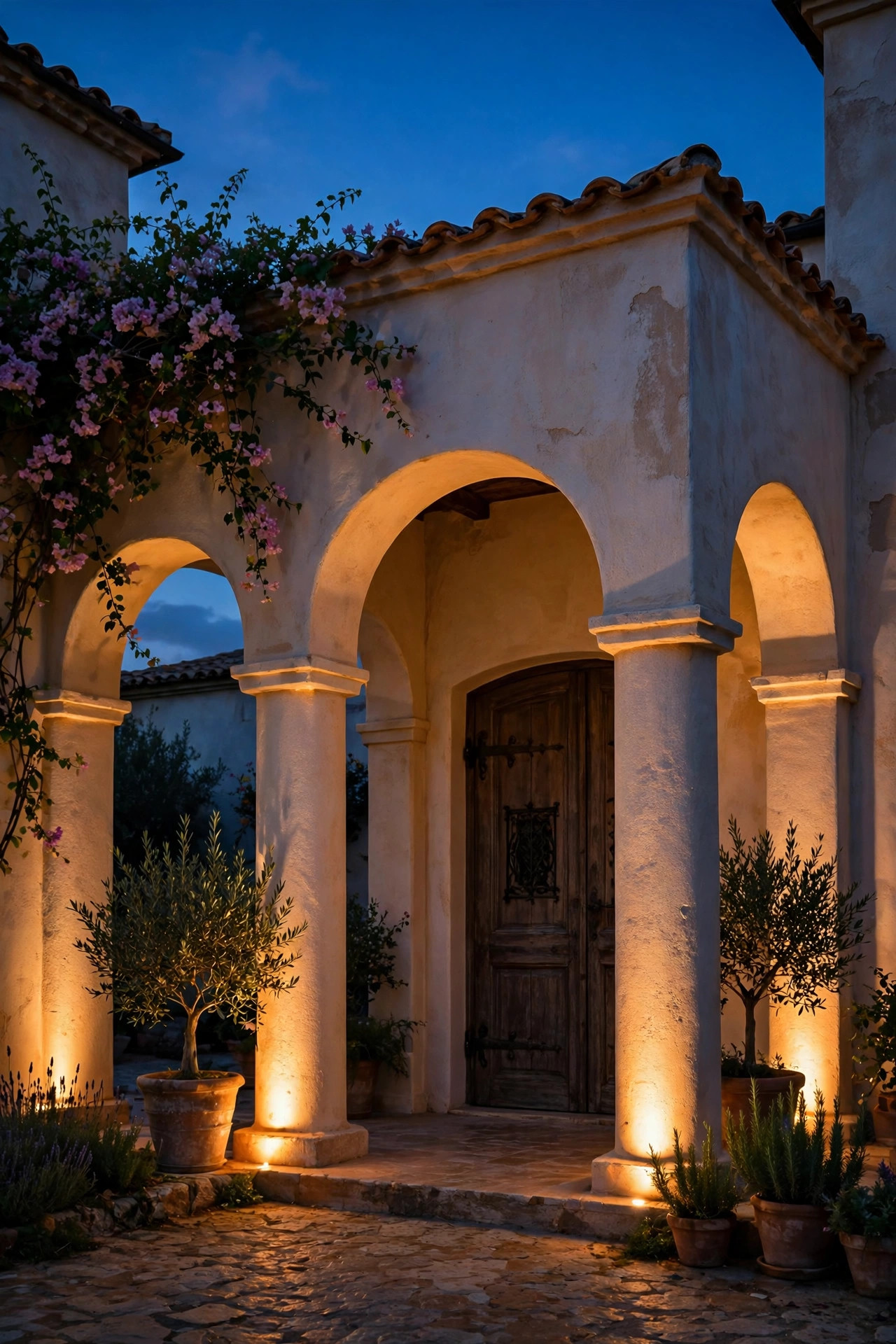
19. Uplights on Columns and Arches
Villa architecture gives you gifts a flat facade never will: columns, arches, a portico rhythm. A small uplight at the base of each column turns that architecture into the lighting design itself. Set the fixture 6 to 12 inches from the column base with a narrow-to-medium beam, and let the light climb the shaft and spill softly into the arch above. The columns read as glowing pillars, and the whole entry takes on a quiet, classical grandeur after dark. Two columns usually want two matched fixtures on the same circuit; an odd single column can borrow a path light circuit with no trouble. Around 300 to 500 lumens per column in warm 2700K to 3000K is the classic look — cooler light turns travertine and stucco a little institutional. Keep the beam inside the architecture and off the street, both for dark-sky courtesy and because contained light simply looks more expensive. It is a five-star hotel trick that scales down to a townhome portico beautifully.
Suggested budget range: $70 – $200.
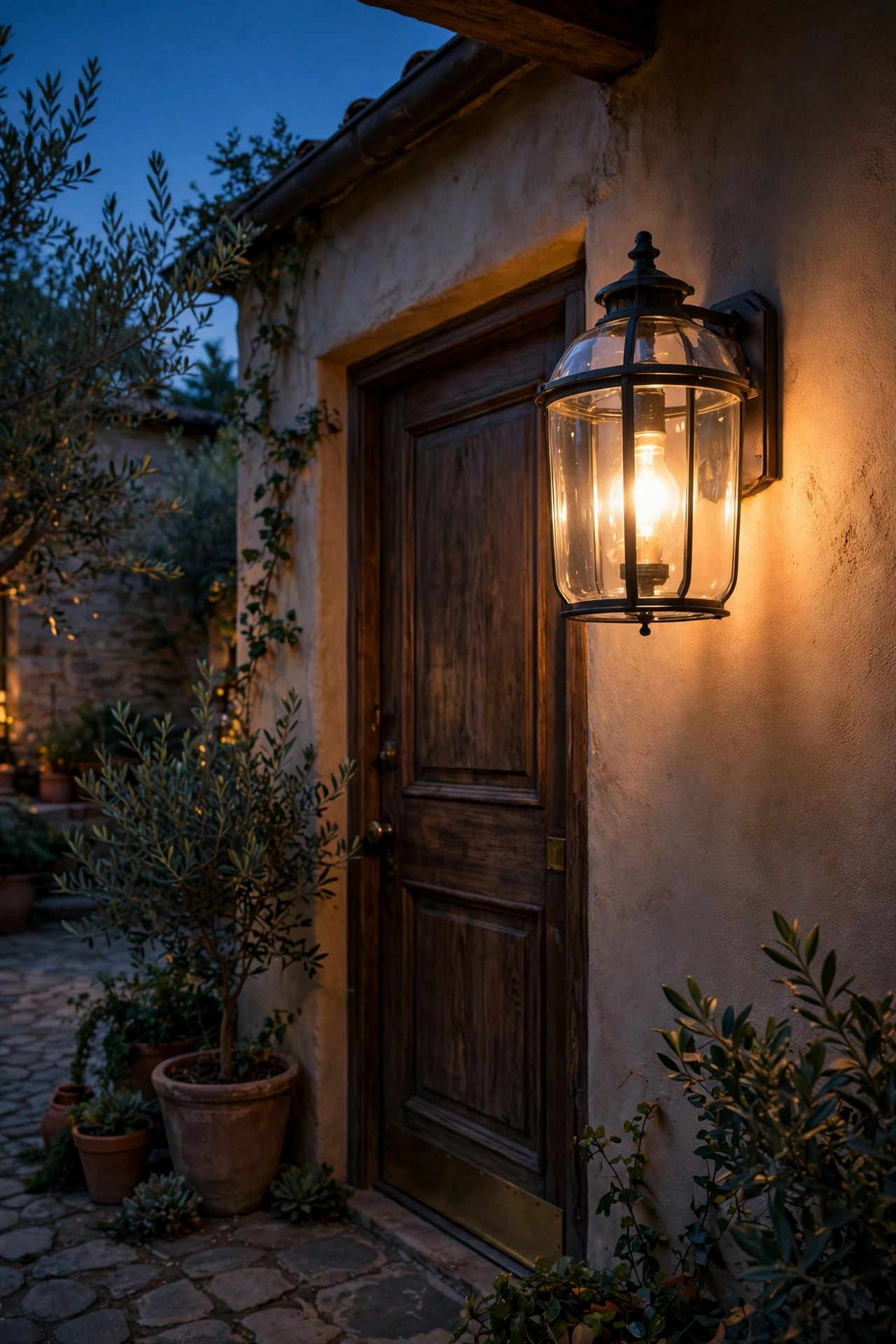
20. Dusk-to-Dawn Bulbs in the Fixtures You Already Own
Here is the five-minute upgrade I suggest to every overwhelmed homeowner: swap the bulbs in your existing entry fixtures for dusk-to-dawn LED bulbs with built-in photocells. They switch themselves on at sunset and off at sunrise, no timers to program, no smart home setup, no electrician. A pair costs less than a pizza and instantly makes a courtyard look lived-in and cared for, which is half of curb appeal. Choose bulbs rated for enclosed fixtures if your sconces are sealed, and stick with 2700K soft white at 450 to 800 lumens for door duty. The photocell sits in the bulb base, so make sure the fixture glass is clear enough for the sensor to read daylight — deeply amber or opaque shades can confuse it into running all day. In my own courtyard I ran these for two full years before wiring anything else, and honestly the entry looked finished. When you later add layers, these simply become the always-on foundation everything else schedules around.
Suggested budget range: $12 – $30.
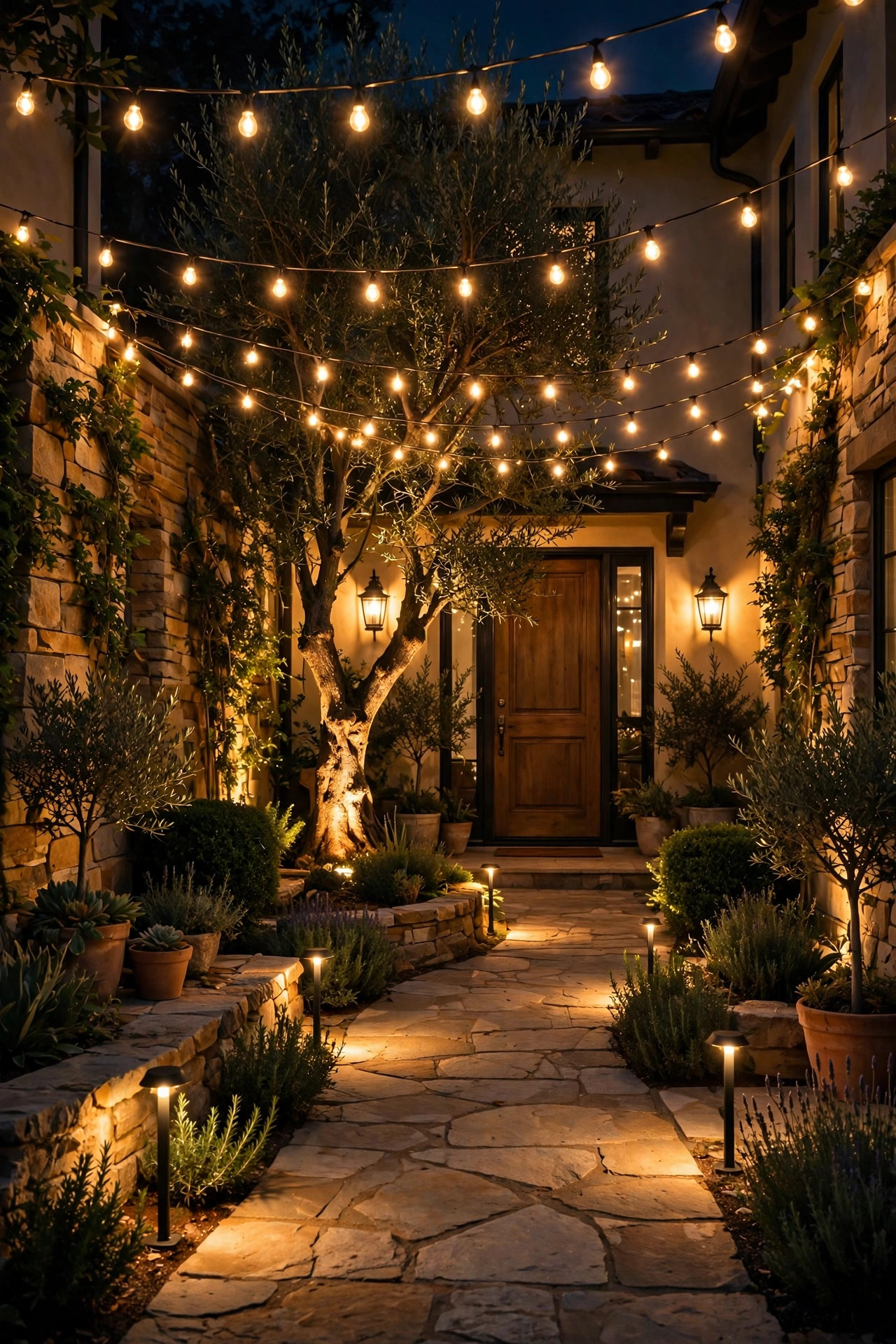
21. Pull It All Together: Layered Courtyard Entry Lighting Ideas on One Timer
The real secret is not any single fixture — it is how the layers behave as one system. When I finish pulling together courtyard entry lighting ideas for a townhome or villa, I put the hardwired and low-voltage layers on one astronomical timer or smart controller: on at sunset, dimmed or off at midnight, with the door layer staying lit until dawn for security. Set the scene in zones if your controller allows — path and steps at full brightness for arrivals, wall wash and uplights a touch lower, string lights on their own plug for party nights. Walk the route yourself from the street at night and squint: any spot that glares, any tread that disappears, any corner that goes black gets adjusted before you call it done. A courtyard entry is small, which means twenty minutes of tweaking buys you a genuinely finished result. Start with the door, add the path, finish with the mood layer, and your little in-between space becomes the warmest welcome on the street.
Suggested budget range: $40 – $180.
Frequently Asked Questions
How many lights does a small courtyard entry actually need?
For most townhome courtyards, six to ten light sources across three layers is the sweet spot: two at the door, three to five along the path and steps, and two or three accent lights on walls, plants, or a water feature. Because the space is enclosed, light bounces off the walls and multiplies, so a small entry needs far less wattage than an open front yard. Start with the door and path layers, live with them for a week, then add accents where the shadows ask for them.
What color temperature looks best in a courtyard entry?
Warm white, 2700K to 3000K, flatters stucco, brick, wood doors, and skin tones, and it matches the glow most people picture for a welcoming entry. The one exception is moonlighting from a tree or high bracket, where 3500K to 4000K mimics real moonlight. Whatever you choose, keep every bulb in the same layer at the same temperature — mixed temperatures are the fastest way to make a carefully lit courtyard look accidental.
Can I light a courtyard entry if I rent or have an HOA?
Usually, yes. Solar path lights, stake lights, lantern clusters with flameless candles, fairy lights, and dusk-to-dawn bulbs in existing fixtures are all no-wiring, no-permit upgrades that leave no trace when you move. Many HOAs and villa associations allow low-voltage landscape lighting without approval since it is not a structural change, but check your rules before hardwiring sconces or recessed lights, and keep fixtures shielded and warm-toned to stay neighbor-friendly.
How much does it cost to light a courtyard entry?
A renter-friendly starter setup with solar lights, lanterns, and smart bulbs typically runs 100 to 250 dollars total. A mid-range low-voltage system with a transformer, path lights, uplights, and a timer usually lands between 400 and 900 dollars in materials. Hiring an electrician for new sconces or recessed soffit lights adds roughly 150 to 400 dollars per fixture location, depending on how far the wiring has to run.
Conclusion
A courtyard entry may be small, but that is exactly its advantage: a few well-chosen layers turn it into the most charming moment of the whole homecoming. Start with welcoming light at the door, make the path and steps unmistakably safe, then let walls, water, and greenery carry the mood. These courtyard entry lighting ideas scale from a twelve-dollar bulb swap to a full weekend project, so pick the layer your entry needs most and begin there. Then browse the rest of the lighting ideas here on the site, pour something cold, and enjoy your little plaza at dusk — you built that.