Every spring, a reader emails me some version of the same question: "Sarah, what is this actually going to cost me?" And honestly, driveway lighting cost is one of the trickiest numbers to pin down, because two neighbors with the same length of driveway can get quotes that differ by thousands of dollars — and both quotes can be fair. The difference is almost never the lights themselves. It's how they're powered, how much trenching and wiring hides under the surface, and whether you're paying for labor or trading your own weekend instead. I've lit three of my own driveways over the years (one solar experiment I'd rather forget, one low-voltage system I still love, and one pro install), and I've helped friends price out plenty more. In this guide I'll walk you through what really drives the price, what each approach costs in 2026, where the hidden charges lurk, and how to spend smart. By the end, you'll be able to look at any quote — or any shopping cart — and know whether the number makes sense for your driveway.

The Short Answer
If you only read one section, make it this one. Your driveway lighting cost comes down to three decisions: power source, driveway length, and who does the digging. Solar stake lights are the budget route and need no wiring at all. Low-voltage wired systems are the sweet spot for most homes — bright, reliable, and very DIY-friendly. Line-voltage (120V) hardwired lighting is the premium option and usually means hiring an electrician. A short suburban driveway costs a fraction of a long rural one, and doing the work yourself can cut the labor half of the bill entirely. Full 2026 price ranges for every scenario are in the cost section below.
What Actually Drives Driveway Lighting Cost
When I priced my current system, the fixtures were barely a third of the total — and that's normal. Here's what really moves the number. First, power delivery: solar lights carry their power plant on their backs, so there's no cable, no transformer, and nothing to trench. Wired systems flip that — the fixtures themselves can be inexpensive, but you're paying for copper cable, a transformer, connectors, and the labor to bury it all. Second, length and layout: every extra stretch of driveway needs more lights, more cable, and more digging, and a curve or circular layout needs more fixtures than a straight shot. Third, your ground: soft loam trenches fast, while rocky soil, tree roots, or a run that has to cross under the driveway itself adds real money. Fourth, labor: in most professional quotes, labor is half or more of the invoice. And finally, controls — a simple timer is inexpensive, while smart zoning and dimming add up. Notice what's not on this list: the fixtures' sticker price. Chasing the cheapest lights while ignoring cable, labor, and ground conditions is exactly how budgets blow up. I tell readers to sketch the driveway, mark the cable runs, and price each of those five factors separately before looking at a single fixture — it takes twenty minutes, and it changes every conversation you have with a contractor afterward. Get those five right, and the total almost takes care of itself.

The Three Ways to Light a Driveway, Compared Honestly
There are really only three ways to power driveway lighting, and choosing between them is the single biggest cost decision you'll make. Solar lights are self-contained: a small panel charges a battery by day, and the light runs itself at night. No wiring, no electric bill, nothing to trench — but brightness and winter run time are limited, and the cheapest ones fade fast. Low-voltage (12V) wired systems run off a transformer plugged into an outdoor outlet. The cable is safe to handle and shallow to bury, the fixtures are genuinely bright, and the whole thing is very DIY-able. This is what I recommend to most homeowners, and it's what lights my own driveway. Line-voltage (120V) is household current, the same as your porch light. It's the brightest and most permanent option — think lamp posts and in-ground well lights on a big property — but it needs deep burial, conduit in many areas, permits, and almost always a licensed electrician. Here's the honest comparison:
| Type | Install effort | Brightness | Best for |
|---|---|---|---|
| Solar | Lowest — push in and go | Soft glow, marker light | Short drives, renters, accents |
| Low-voltage 12V | Moderate — a weekend DIY | Bright, even pools of light | Most homes, 40–150 ft drives |
| Line-voltage 120V | Highest — electrician territory | Brightest, most permanent | Long drives, lamp posts, new construction |
None of the three is "best" in the abstract. The right choice is the one that matches your driveway's length, your soil, and how much of the work you honestly want to do yourself.
Solar Driveway Lights: The Budget Route
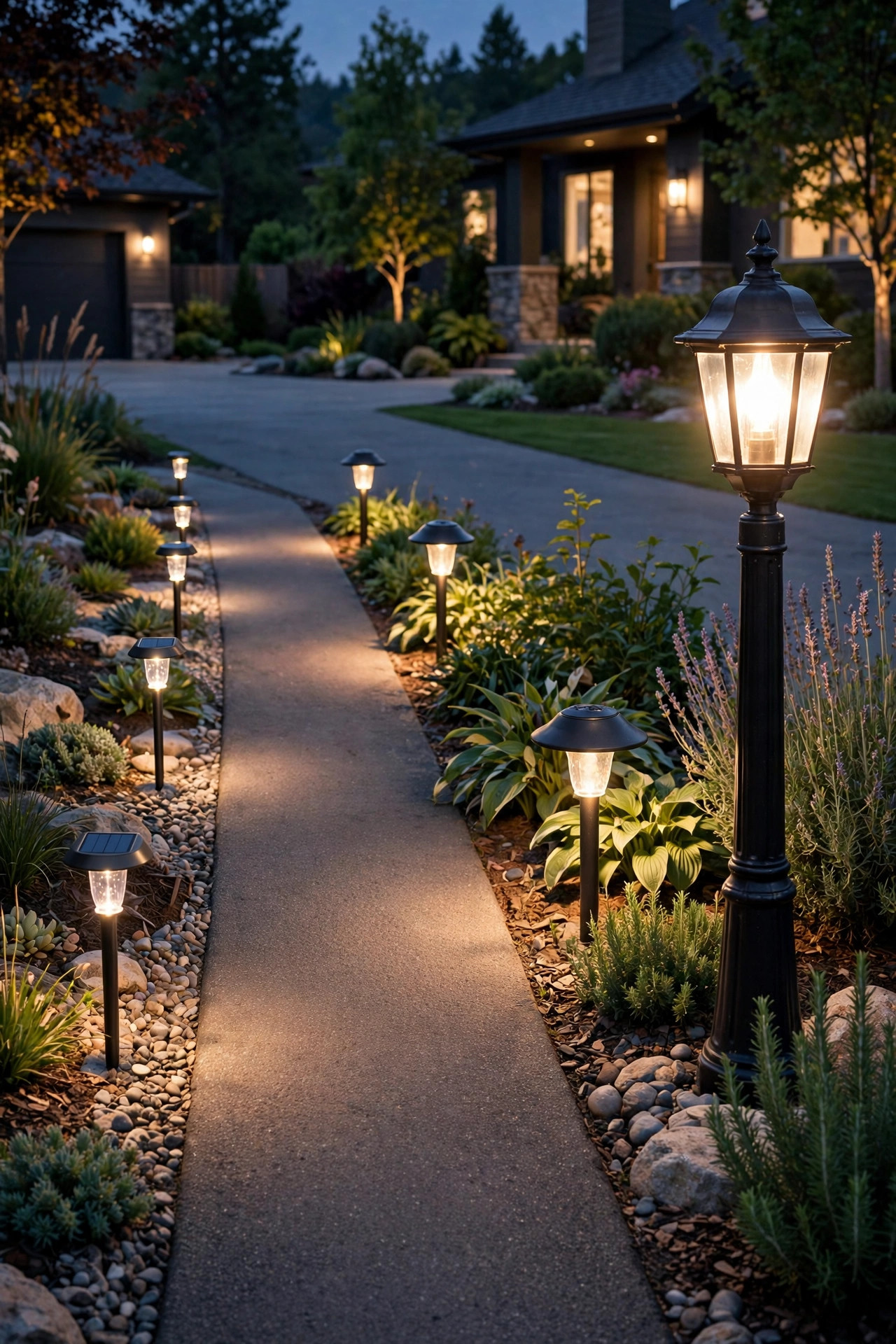
Solar is where almost everyone starts, and I get why: you unbox the lights, push them into the ground, and by dinner the driveway glows. There's no cable to bury, no transformer to mount, and no electrician to book. If you're renting, testing a layout before committing, or just lighting a short driveway edge, solar is a perfectly sensible choice. But go in with clear eyes. Solar fixtures live or die by their panel and battery. Bargain multipacks tend to be dim, bluish, and noticeably weaker by their second winter, especially if your driveway sits under trees or faces north. Better-made solar lights with replaceable batteries and warm-white LEDs are a different animal — genuinely pleasant light, and you can refresh them with fresh batteries instead of replacing the whole fixture. Placement matters more than price: a solar light in dappled shade will disappoint no matter what it cost. My honest take? Solar is the budget route and a great trial run. Just buy the best panels you can, keep them in real sun, and don't expect a bargain-bin stake light to perform like a wired fixture — because it won't, and that's fine for what it is. In my experience, two mid-priced solar lights standing in full sun will outperform five cheap ones wilting in the shade every single time.
Low-Voltage Wired: The Sweet Spot for Most Homes
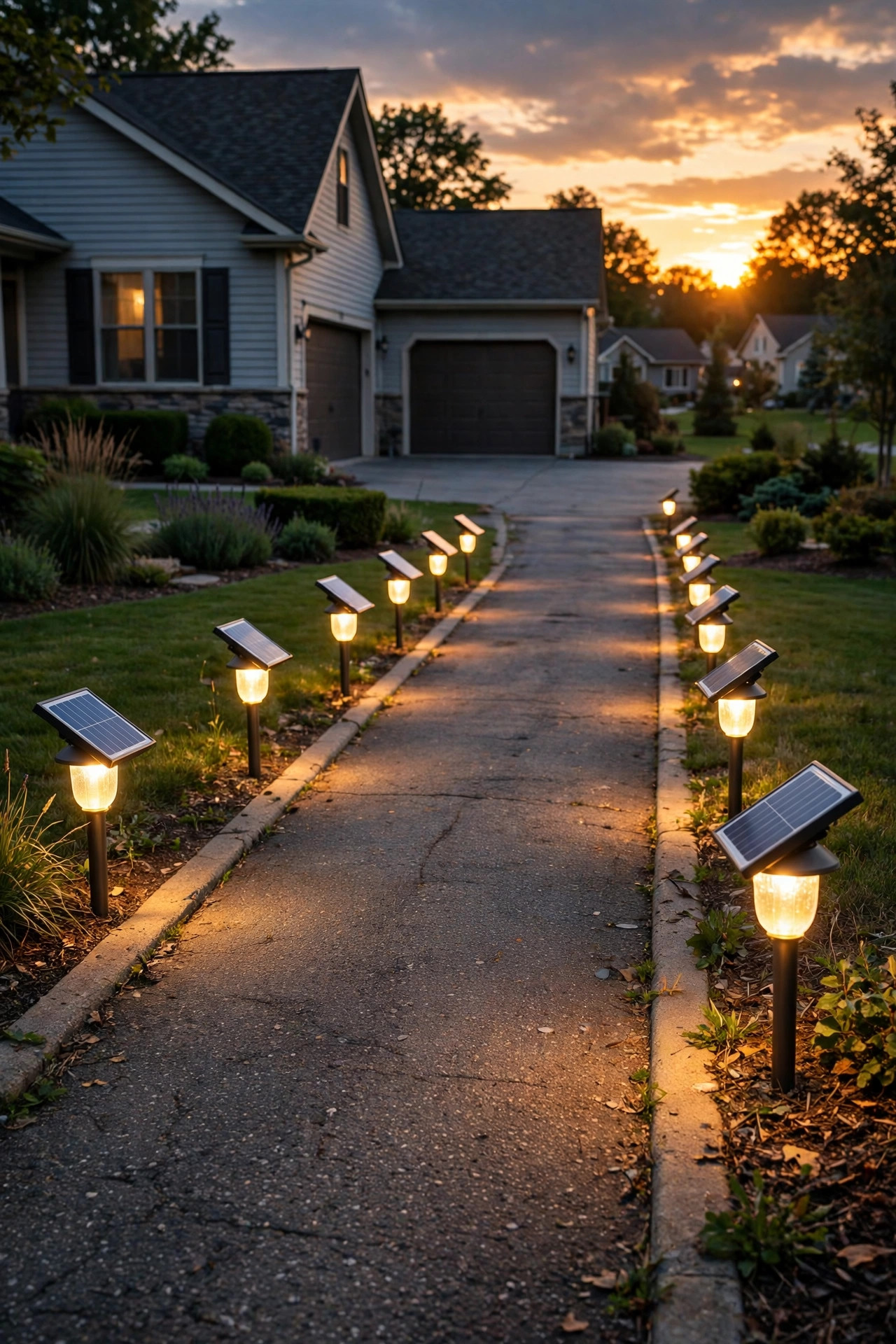
If you ask me what I'd install on a typical suburban driveway tomorrow, it's low-voltage, every time. A transformer steps household current down to a gentle 12 volts, which makes the cable safe to handle, safe to bury shallow, and forgiving of beginner mistakes. The fixtures themselves are real lighting — solid metal bodies, replaceable LED bulbs or integrated LEDs, and enough brightness to lay down even pools of light you can actually park by. The work is honest weekend work: mount the transformer near an outdoor outlet, lay cable along the driveway edge, connect fixtures, test at dark, then slit-trench the cable a few inches under the soil or mulch. No permits in most places, no electrician, and if you nick a cable with an edger someday, the repair is a ten-minute splice, not a service call. It's also the easiest system to grow: add two more fixtures next spring, move one that isn't working visually, extend to the front walk later. That flexibility is a big part of why the total driveway lighting cost stays sane with low-voltage — you can build it in stages instead of paying for the finished vision all at once. Honestly, the hardest part of the whole job is deciding exactly where each light goes — and that happens to be the fun part.

Line-Voltage (120V): The Premium Route
Line-voltage lighting is the heavyweight option: full household current running to lamp posts, in-ground well lights, or hardwired bollards. It's the right call in specific situations — a very long driveway where low-voltage runs would suffer voltage drop, a lamp post you want burning bright all night, new construction where the trench is open anyway, or a large property where you want fixtures that feel like permanent architecture rather than garden accessories. The trade-offs are serious, though. Because 120V cable must be buried deep (and often run in conduit), the digging alone is a project. Most jurisdictions want a permit, and unless you're a confident, code-fluent DIYer, this is licensed-electrician work from start to finish. That's not me being dramatic — it's the one category in this guide where I genuinely tell readers to hire it out. The payoff is real: nothing matches the brightness, permanence, and "this house is finished" feeling of a proper pair of lamp posts flanking a long drive. Just walk in knowing it's the premium route in every sense, and get at least two electrician quotes, because pricing on this work varies more than any other in the guide. If you're building new, or already trenching for a gate or irrigation line, that's the moment to do it — the ground is open anyway, and the marginal cost of the lighting run is at its lowest.
Driveway Lighting Cost by Driveway Length
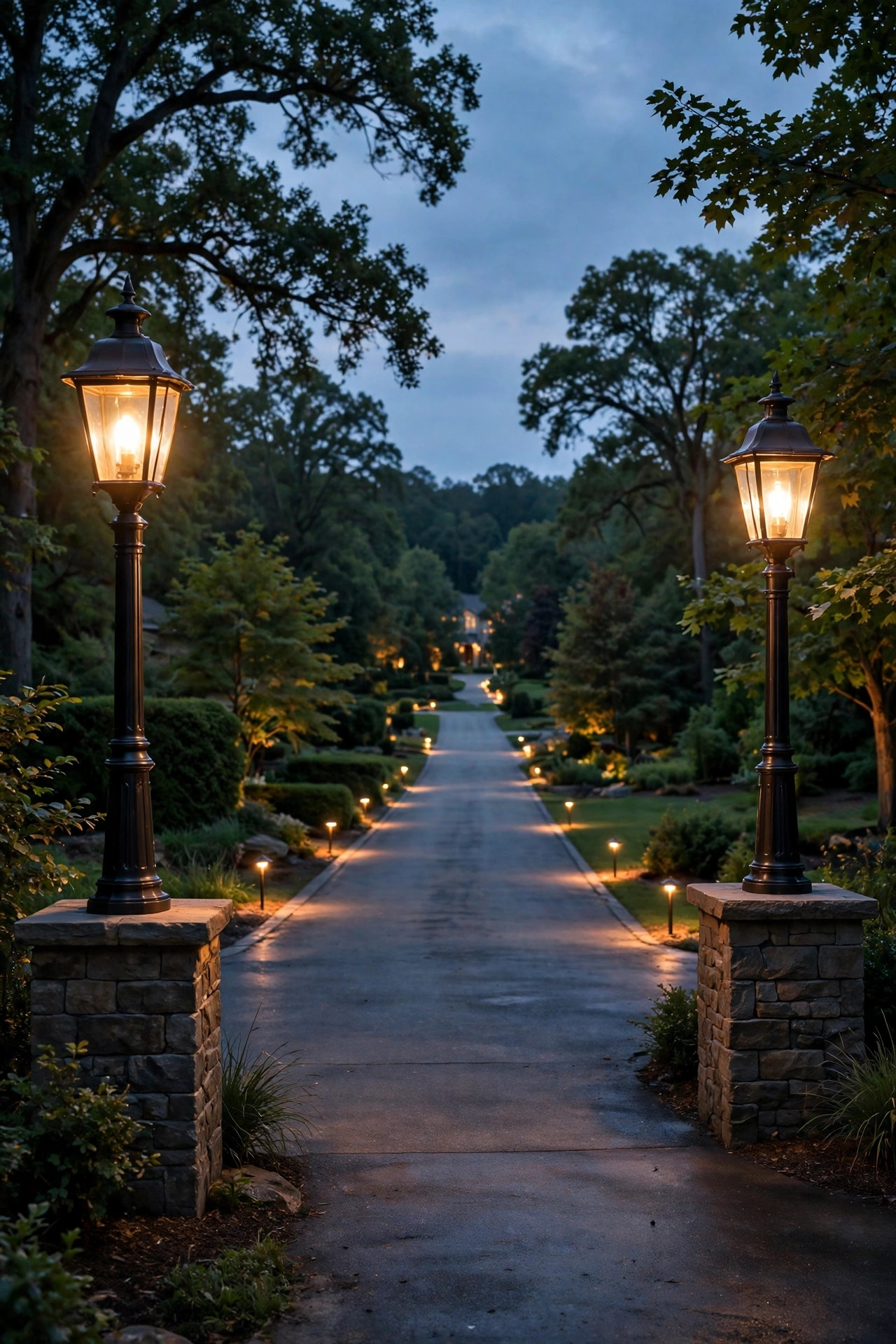
Length is the multiplier on everything. A short driveway under 40 feet might need only four to six fixtures — honestly, a single row on the garage side can do it. A standard 40-to-100-foot driveway usually wants lights every 10 to 15 feet on alternating sides, which lands around eight to fourteen fixtures, plus the cable run to feed them. Past 100 feet, the math changes character: cable runs get long enough that you need heavier-gauge wire to fight voltage drop, some layouts split into two transformer zones, and the trenching alone can eat a full day. Curved and circular driveways cost more per foot than straight ones, because curves need tighter spacing to read as a smooth ribbon of light instead of a dotted line. If your drive is genuinely long, my guide to long driveway lighting ideas covers the zoning approach in detail. The takeaway for budgeting: measure your driveway before you fall in love with any fixture, because the length you measure is quietly setting the floor for the whole project — fixtures, cable, and labor all scale from that one number. I learned this the expensive way at my second house, where I budgeted cheerfully for a "medium" driveway and discovered, tape measure in hand, that it was nearly twice the length I'd been picturing.

DIY vs. Hiring a Pro: Where the Labor Money Goes
Here's the worst-kept secret in lighting quotes: on a professional install, you're often paying as much for the digging as for everything else combined. A pro crew brings trenching tools, experience with voltage drop, and speed — a job that takes them a day might take you two weekends — and their work usually comes with a warranty on both parts and labor. What you're really buying is time, certainty, and someone else's knees in the gravel. DIY flips the equation. Your money goes almost entirely into materials, which means the same budget buys noticeably better fixtures: heavier cable, a transformer with room to grow, fixtures with replaceable bulbs. The low-voltage work itself is genuinely beginner-friendly — the scariest tool involved is a flat spade. My honest middle path, and what I did on my own house: hire an electrician only if a new outdoor outlet needs installing, then DIY everything downstream of it. And if you do hire the whole job out, ask for an itemized quote. Seeing fixtures, cable, and labor as separate lines is the fastest way to spot a padded number — and to negotiate the parts of the job you might happily do yourself. Neither route is the "smart" one in the abstract — it honestly depends on your weekends, your knees, and how much you value having a warranty to point at.

What It Costs in 2026
Here's the part you actually came for. All figures are 2026 prices for a typical suburban driveway, and I'll separate parts from labor so you can mix and match. Solar: a basic 8–12 pack of solar stake lights runs $40–$150. Better solar fixtures with replaceable batteries cost $15–$40 each, so a quality solar setup for a standard driveway lands around $150–$400, with zero labor and zero wiring. Low-voltage, DIY: expect $25–$80 per quality fixture, $60–$200 for a transformer, and $40–$120 for cable and connectors — a complete DIY system for a standard driveway usually totals $400–$1,500. Low-voltage, professionally installed: pros typically charge $150–$350 per fixture installed, and most standard driveways finish between $1,800 and $4,500 all-in. Line-voltage: budget $2,500–$7,500+ professionally installed; a single lamp post alone often runs $800–$2,000 installed, and electricians bill $75–$150 per hour. By length, the pattern looks like this:
| Driveway | DIY range | Pro range |
|---|---|---|
| Short (under 40 ft) | $150–$600 | $900–$2,000 |
| Standard (40–100 ft) | $400–$1,500 | $1,800–$4,500 |
| Long (100–300 ft) | $1,200–$3,500 | $4,000–$10,000+ |
Running costs are the pleasant surprise: a 10-light LED low-voltage system uses roughly $15–$40 of electricity per year on a dusk-to-dawn schedule, and solar costs nothing to run beyond battery replacements every couple of years. If a quote lands far outside these bands, ask what you're getting for the difference — sometimes it's genuinely better fixtures, and sometimes it's just margin.
The Hidden Costs Most Quotes Leave Out
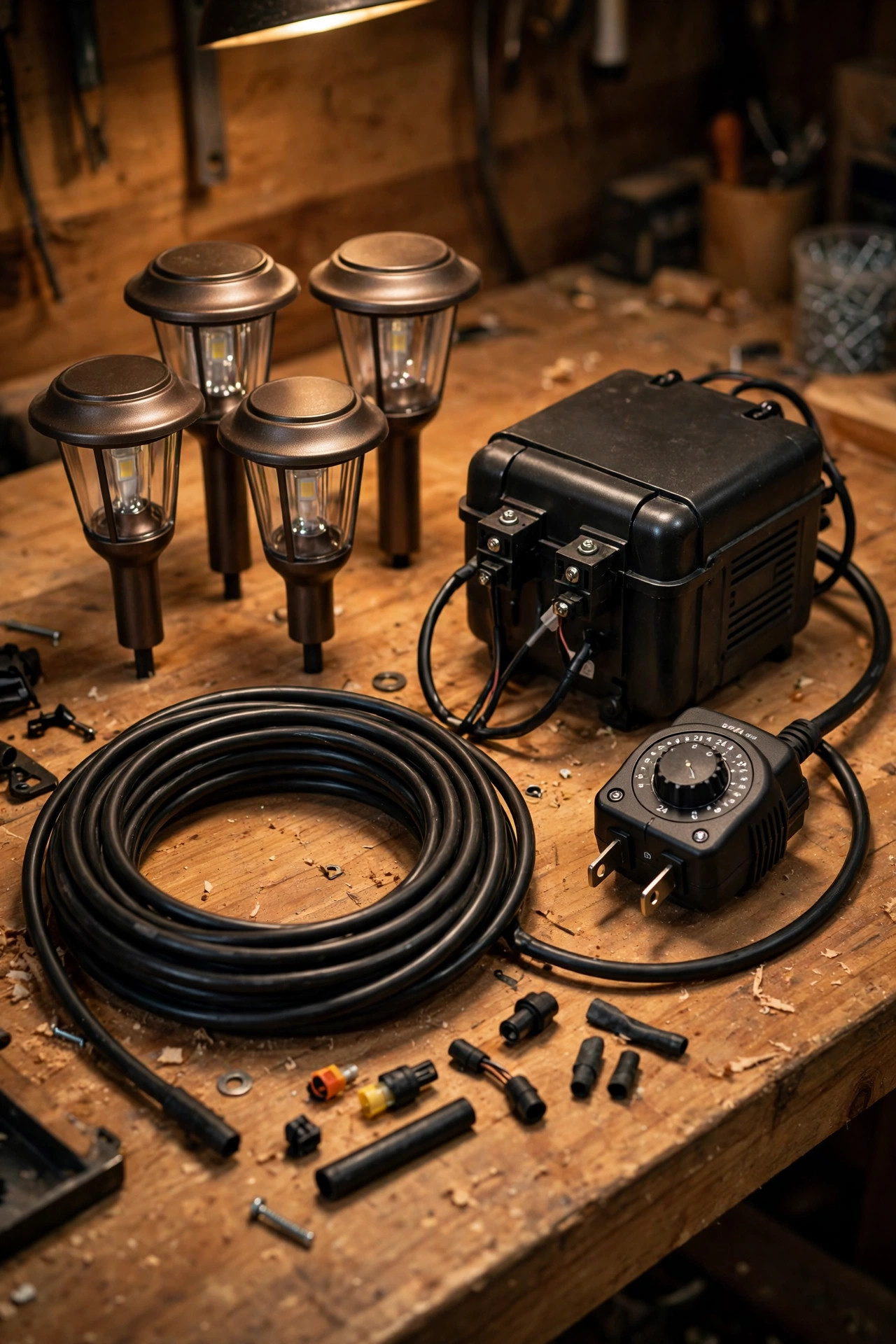
Every project has a second, quieter price tag, and this is where "surprises" come from. Cable is the classic one: long runs need heavier 12-gauge wire instead of the standard spool, and copper isn't cheap — a long driveway can quietly double the cable line. Connectors matter too; the pack-in pierce connectors are the first failure point in most systems, and proper gel-filled waterproof connectors are a small but real upgrade worth paying for once. Then there's crossing the driveway itself: if lights are going on the far side, the cable has to get under the concrete, and boring or saw-cutting is a line item nobody mentions at the estimate stage. Add the supporting cast: a GFCI outdoor outlet if you don't have one where the transformer needs to live, a timer or smart plug, replacement bulbs down the road, and permit fees on line-voltage work. None of these are scams — they're just the difference between the number in the glossy quote and the number on the final invoice. My rule: whatever your base estimate is, hold back a contingency for the unglamorous parts. The projects that stay on budget are the ones that priced the boring stuff honestly from day one.

5 Mistakes That Waste Money on Driveway Lighting
1. Buying fixtures before measuring. Six lights for a 120-foot driveway means dark gaps and a second, mismatched order later. Measure, count, then buy. 2. Skimping on cable. Undersized wire causes voltage drop — the far lights glow dim and orange — and the only real fix is re-running heavier cable. Buy the right gauge once. 3. Choosing the bargain solar multipack for a shaded drive. They'll be dim by November and in a landfill by the following fall; decent solar or wired lights cost less per year of actual service. 4. Paying pro prices for a layout you've never tested. Before anything gets buried or finalized, set the fixtures out at dusk and live with the pattern for two nights. Moving a light on paper is free; moving it after the invoice is not. 5. Forgetting the transformer headroom. A transformer maxed out on day one means a second transformer the moment you want two more lights. Sizing up once is far cheaper than buying twice. Every one of these mistakes has the same shape: a small saving at purchase that becomes a bigger spend within a year. Spend on the bones — cable, transformer, connectors — and economize on the decorative parts if you need to.
Where to Splurge and Where to Save
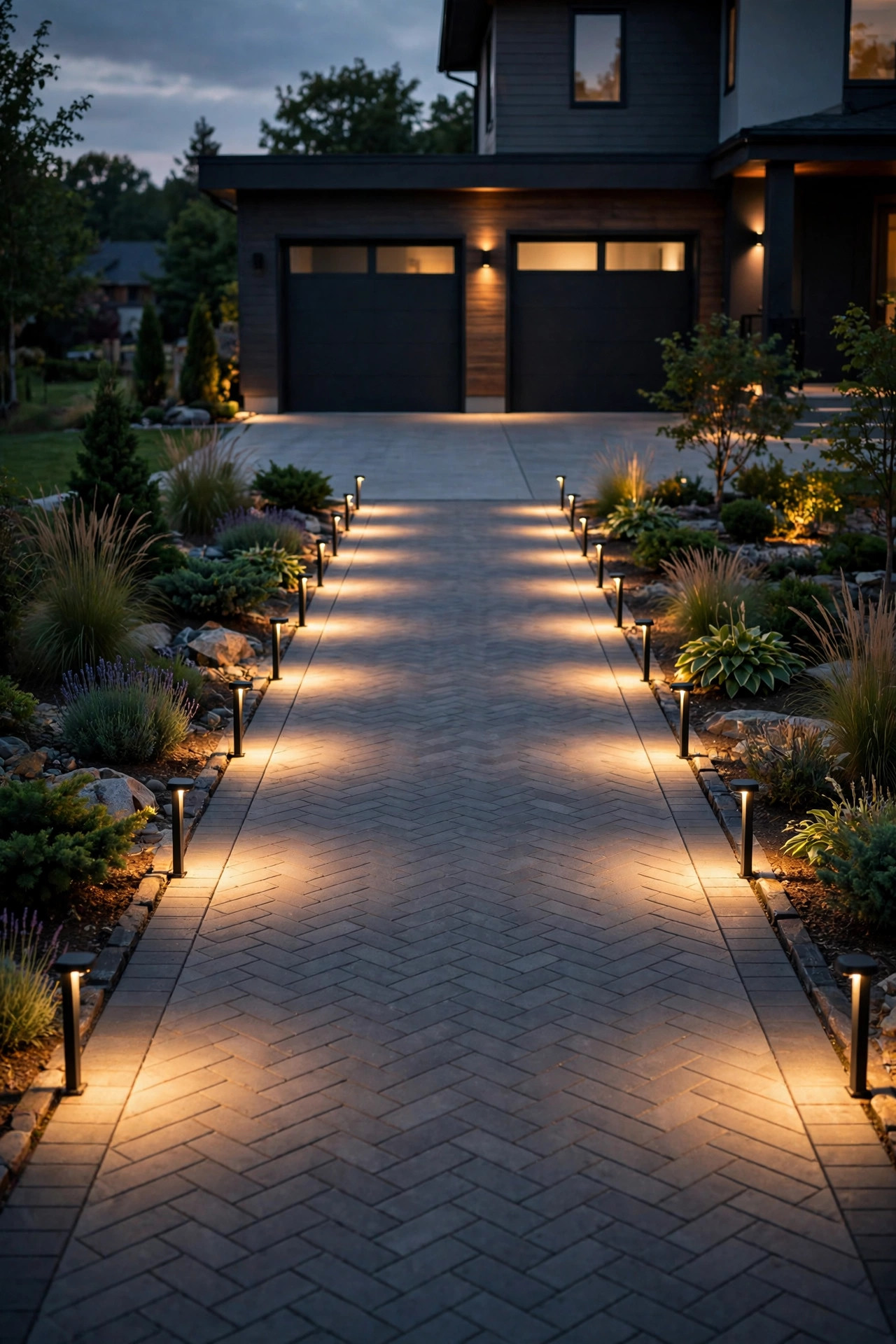
After three driveways of my own, my splurge list is boring and short: cable, transformer, and connectors. Heavy-gauge cable prevents the dim far-end lights that make a whole system look cheap. A transformer with spare capacity and a built-in timer saves you a second purchase later. Quality gel-filled connectors are the difference between a system that works for a decade and one you're repairing every spring. Splurge there, without guilt. Then save aggressively everywhere else. Mid-priced fixtures with standard replaceable bulbs give you 90% of the look of premium ones — nobody kneeling in your driveway at midnight can tell the difference, and your guests certainly can't. Buy fixtures in matching sets when they're on seasonal sale, stage the project (driveway this year, walkway next), and do the trenching yourself even if you hire out the outlet work. If your budget is truly tight, my roundup of budget driveway lighting ideas shows how far a small spend can stretch when it's aimed well. The principle I come back to: money spent underground compounds; money spent on decorative metal mostly just sits there looking pretty — which has its place, but it's second in line. Pretty is easy to add later; infrastructure is not. That's the order I'd spend in, every single time.
Maintenance and Replacement Costs Over the Years
The purchase price is the loud cost; ownership is the quiet one, and it's refreshingly small if you buy decent gear. LED fixtures are the big win — a quality LED bulb or integrated fixture is rated for 25,000 to 50,000 hours, which at dusk-to-dawn use works out to a decade or more before brightness noticeably fades. Solar lights ask a little more of you: their rechargeable batteries are a wear item, typically ready for replacement every one to three years depending on climate, and panels need a quick wipe whenever they look dusty, plus clearing after snow. Wired systems mostly ask for an annual walk-around — I do mine every spring, checking for edger-nicked cable, tilted fixtures, lenses filmed with pollen, and the occasional connector that a frost heave has worked loose. Transformers are the marathon runners of the system, commonly lasting fifteen to twenty years. The real long-term money trap is the opposite of maintenance: buying the cheapest fixtures repeatedly. Three rounds of bargain lights that each die in two seasons cost more — in money and in weekends — than one round of mid-priced fixtures that simply keep working. Build that ten-minute spring walk into your routine, and the system quietly pays you back for years.
Frequently Asked Questions
Is solar or wired cheaper for a driveway over five years?
Solar is cheaper to buy and install — there's nothing to wire — but wired low-voltage usually wins the five-year math. Solar batteries wear out and bargain fixtures get replaced whole, while a wired system's costs after install are close to zero. If the driveway is short and sunny, solar can still come out ahead; for anything long or shaded, wired is the cheaper five-year story, and the detailed ranges in the cost section above show why.
Can I install low-voltage driveway lighting myself?
Yes — it's one of the most beginner-friendly outdoor projects there is. The 12-volt cable is safe to handle, buries just a few inches deep, and connects with simple fittings; most people finish a standard driveway in a weekend. You only need an electrician if a new outdoor outlet has to be added. Set the lights out and test them at dusk before burying anything, and the job is hard to get wrong.
How many lights do I need for a 100-foot driveway?
Plan on lights every 10 to 15 feet, alternating sides — so roughly eight to twelve fixtures for 100 feet. Tight curves and the area near the street usually want slightly closer spacing, while the straight middle stretch can breathe a little wider. It's a rhythm, not a runway: pools of light that gently overlap look far more expensive than a rigid row ever does.
Will driveway lights raise my electric bill much?
Barely. Modern LED fixtures sip power — a whole low-voltage driveway system typically draws about as much as one old incandescent bulb, and a timer or dusk-to-dawn sensor keeps it from running in daylight. Solar, of course, adds nothing at all. In practice, driveway lighting is one of the cheapest upgrades you can run, and most homeowners never notice it on the bill.
Conclusion
If there's one thing I want you to take from all these numbers, it's this: driveway lighting cost is decided by your power source, your driveway's length, and your labor — in that order — long before it's decided by which pretty fixture you pick. Choose solar for short and simple, low-voltage for the best all-around value, and line-voltage when the property truly calls for it. Price the boring parts honestly, leave a little contingency, and test your layout at dusk before a single dollar gets buried. Do that, and your driveway will glow the way you pictured it — for the number you planned. If you're still in the dreaming stage, browse my favorite driveway lighting ideas and let the pretty pictures argue with the spreadsheet for a while.