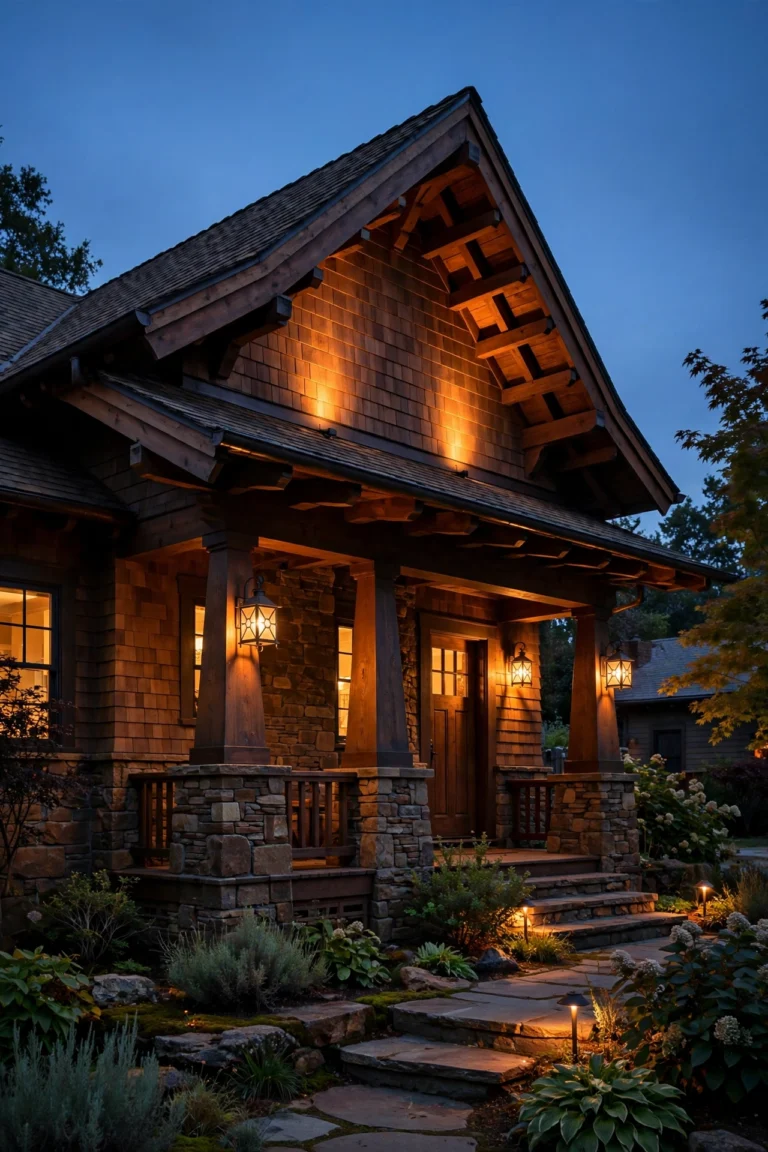
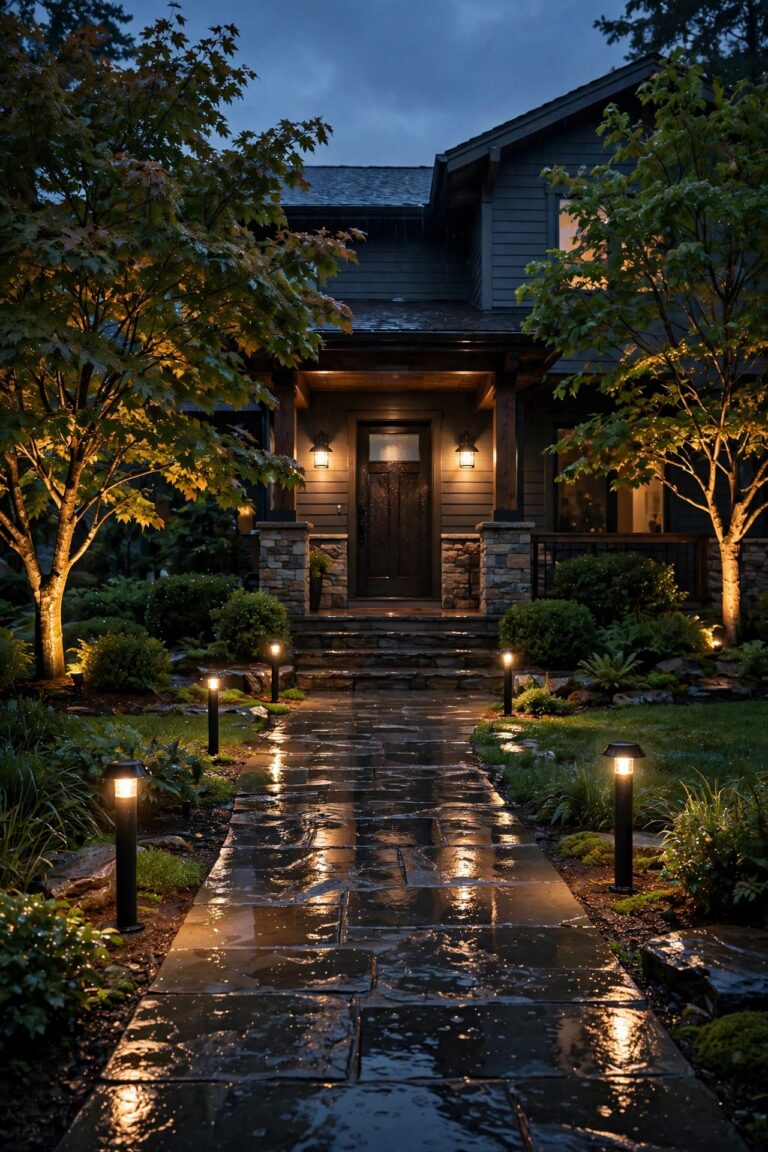
The first time I replaced a whole path light because one tiny sealed LED board gave up, I stood in the driveway holding a perfectly good fixture that was headed for the trash — and that's exactly why the integrated LED vs replaceable bulb fixtures decision matters more than most people realize. On paper, both light your walkway the same way. In real life, they behave very differently over ten or fifteen years: one lets you swap a small lamp in two minutes, the other asks you to replace the entire fixture when the light dies. Neither is automatically better. Integrated fixtures are sealed tighter, often brighter for their size, and wonderfully set-and-forget. Socketed fixtures are flexible, repairable, and let you change your mind about color temperature later. In this guide I'll walk you through how each type works, what they really cost over a decade, how they handle weather, and the exact situations where I'd choose one over the other — so you can buy once and feel good about it every evening.

The Short Answer
Short on time? Here's my honest take. Choose integrated LED fixtures for spots that are hard to reach, exposed to harsh weather, or where you want maximum brightness in a slim fixture — modern integrated units are sealed, efficient, and rated for decades of evenings. Choose replaceable-bulb fixtures for your main, easy-to-reach lighting — path lights, spotlights, well lights — where a two-minute lamp swap beats a full fixture replacement every time. If I were starting a yard from scratch today, I'd mix them: socketed fixtures for the workhorses I can service myself, integrated for the high, wet, and awkward places. Details and numbers below.
What "Integrated LED" Actually Means
An integrated LED fixture has its light source built permanently into the housing. Instead of a socket waiting for a lamp, there's an LED board — a small circuit board studded with diodes — wired straight to an internal driver, all sealed inside the fixture body. When you buy one, you're buying the light engine and the fixture as a single, matched unit.
That design has real engineering advantages. Because the manufacturer controls the whole package, the metal housing doubles as a heat sink sized exactly for that LED board, and heat is the number-one killer of LEDs. A well-built integrated fixture runs its diodes cooler, which is how they earn those 30,000- to 50,000-hour ratings. There are also no socket contacts to corrode and no lamp rattling loose in a storm.
The trade-off is absolute: when the light engine reaches the end of its life — or, more often, when the little driver electronics fail first — there's nothing to unscrew and replace. The entire fixture comes off the stake or the wall and a new one goes in. Manufacturers know this, which is why better integrated fixtures carry 5- to 10-year warranties, noticeably longer than the 1 to 3 years typical on lamps. Think of it like a modern smartphone versus an old flip phone with a swappable battery: sleeker and better sealed, but the battery's fate is the phone's fate.

What Replaceable-Bulb Fixtures Are
A replaceable-bulb fixture — often called a socketed fixture — separates the light source from the housing. The fixture is a durable shell of brass, copper, aluminum, or composite with a socket inside, and you choose the lamp that goes in it: a small bi-pin lamp for a compact well light, a wedge-base lamp for a path light, or a reflector-style lamp for a spotlight. Low-voltage LED versions of all of these cost roughly $5 to $15 apiece.
This is the way landscape lighting worked for decades, first with halogen lamps and now with LED retrofits, and that long history is its strength. The fixture itself can last 15 or 20 years — solid brass housings honestly outlive their owners' interest in the garden — while the lamp inside is a consumable you replace on your schedule. When a lamp dies, you twist out the old one, click in the new one, and you're done in about two minutes, usually without tools.
Socketed fixtures also put you in charge. The same spotlight can throw a narrow 15-degree beam at a flagpole this year and a wide 60-degree wash over a shrub next year, just by changing the lamp. Brightness, beam angle, and color temperature all live in the lamp, not the fixture — and that flexibility is the heart of the case for this design.
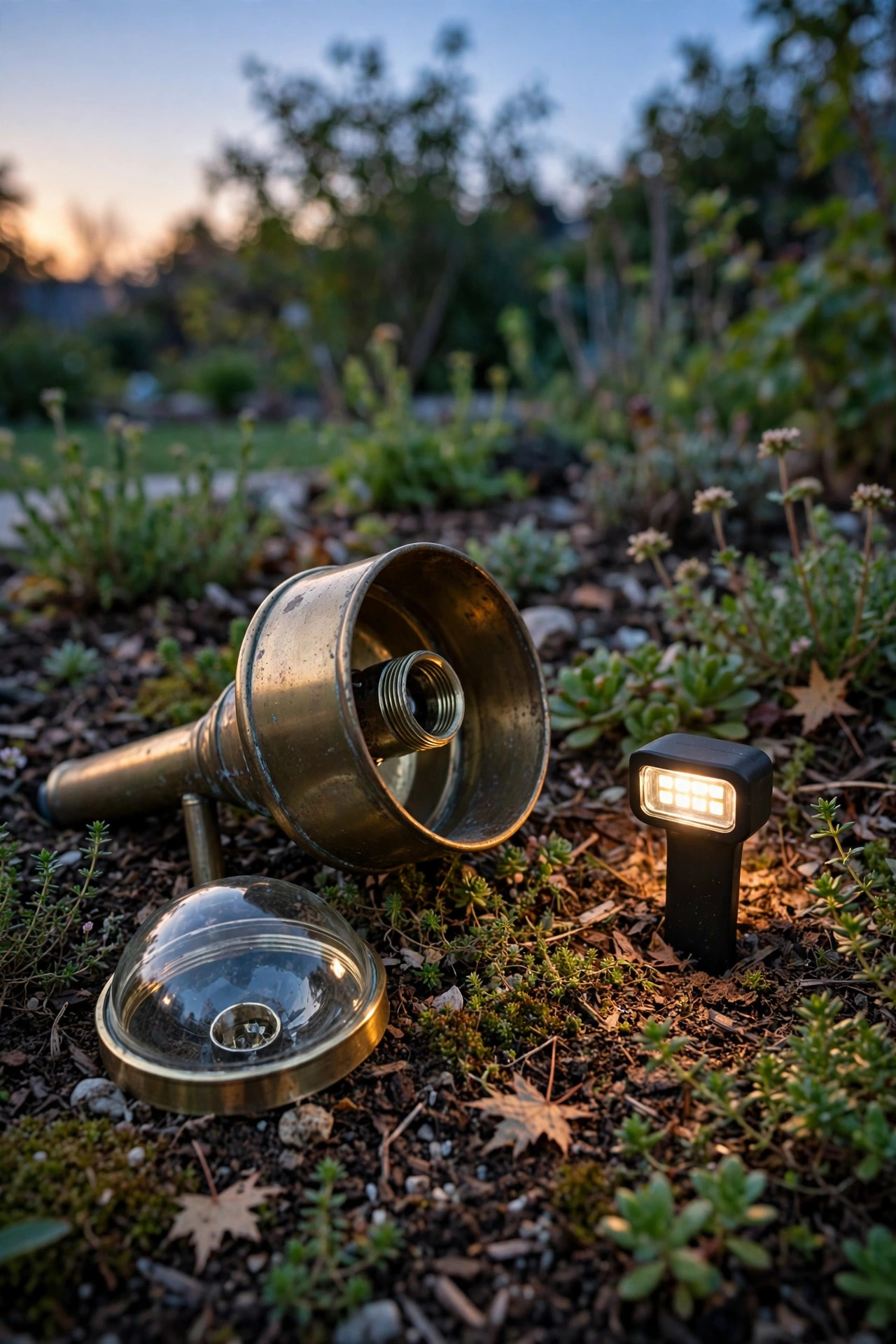
The Head-to-Head: Integrated LED vs Replaceable Bulb Fixtures Compared
Here's the honest side-by-side I wish someone had handed me before my first big purchase. Neither column wins everything — the right choice depends on where the fixture sits and how you feel about maintenance.
| Factor | Integrated LED | Replaceable Bulb |
|---|---|---|
| Upfront cost | $30–$90 per fixture | $20–$60 fixture + $5–$15 lamp |
| Rated lifespan | 30,000–50,000 hours | Lamp 25,000–40,000 hours; housing 15+ years |
| When it dies | Replace whole fixture | Swap lamp in ~2 minutes |
| Brightness per size | Excellent — optics built around the LED | Very good — depends on lamp chosen |
| Color temperature | Fixed at purchase | Change anytime with a new lamp |
| Weather sealing | Sealed unit, fewer entry points | Gasketed lens; socket can corrode over time |
| Matching later | Risky — models get discontinued | Easy — housing stays, lamps are standard |
| Best for | High, wet, hard-to-reach spots | Main workhorse lighting you service yourself |
Two rows matter more than the rest. The first is the "when it dies" row, because over a 15-year span every light source dies eventually — the only question is whether that moment costs you $8 and two minutes or $60 and a Saturday project. The second is matching: yards evolve, and a socketed system lets you add a matching fixture years later with total confidence, while integrated lines get redesigned and discontinued on a manufacturer's schedule. Where integrated pulls ahead is anywhere a ladder, a pond edge, or constant sprinkler spray makes servicing miserable — in those spots, a sealed unit you install and ignore for a decade earns its keep.

Lifespan: Rated Hours vs Real-World Years
Those hour ratings need translating into evenings. A fixture on a timer running five hours a night uses about 1,825 hours a year, so a 50,000-hour integrated fixture is theoretically a 27-year fixture — longer than most of us keep a car. Even a dusk-to-dawn setup burning 12 hours nightly takes over 11 years to reach 50,000 hours. A quality LED lamp's 25,000 to 40,000 hours works out to roughly 14 to 22 years on a timer.
Here's the honest catch, though: in integrated fixtures, the LED diodes rarely die first. The driver — the small power supply inside — is the weak link, and heat, moisture, and power surges age it faster than the diodes. Realistically, I plan on 10 to 15 good years from a quality integrated fixture, less from bargain ones. With socketed fixtures, a failed lamp is a shrug, not a funeral.
Both types sip electricity compared with old halogen, which is why the running-cost math in my breakdown of LED outdoor lighting savings looks so good either way. The lifespan question isn't really "which lasts longer" — it's "when something does fail, do I want it to be a lamp or a fixture?"
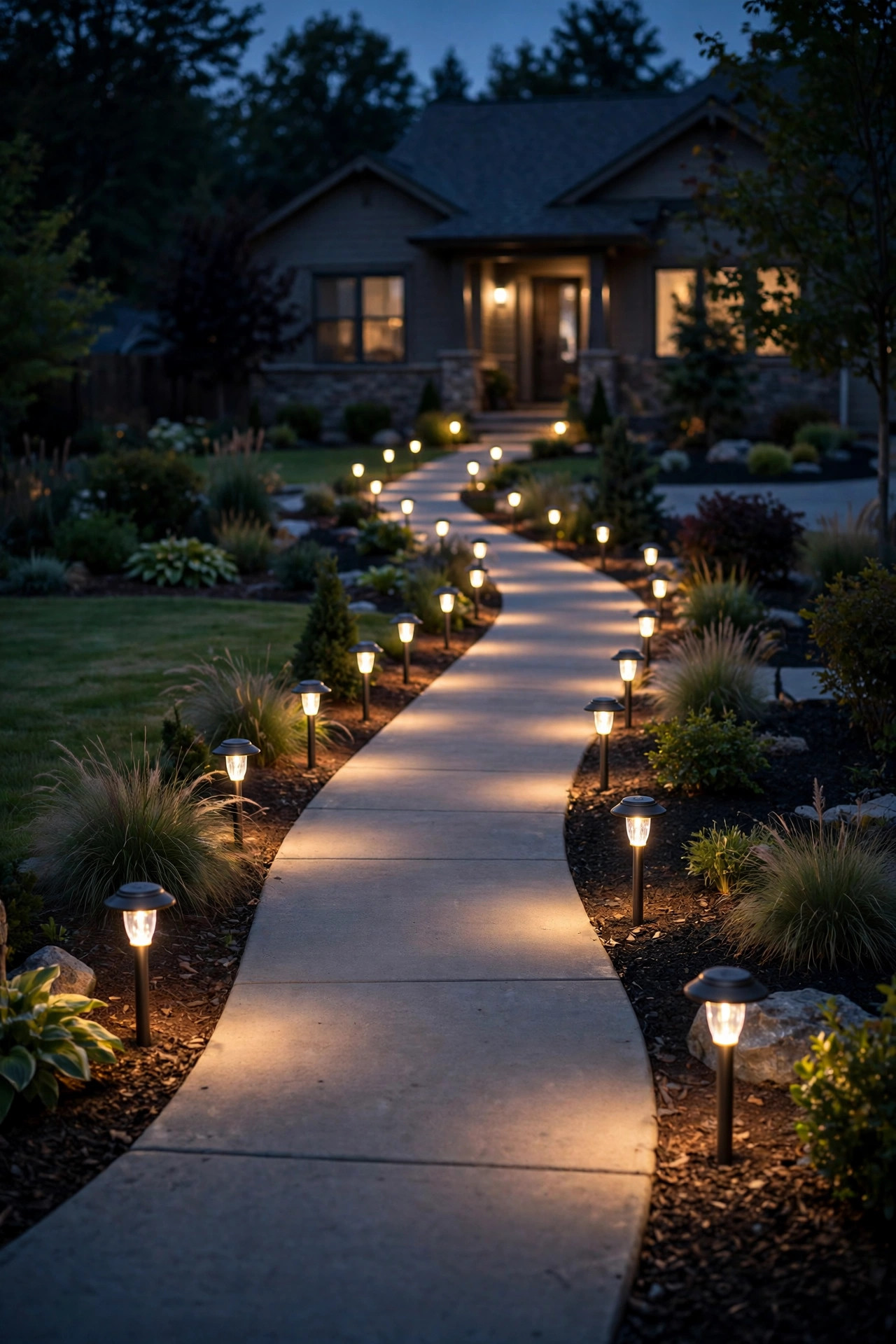
Brightness, Beam Control and Light Quality
Because an integrated fixture's optics are designed around one specific LED board, manufacturers can squeeze impressive, precisely aimed light out of surprisingly small housings — slim well lights and compact spotlights that nearly disappear into the garden by day. If you love a clean, minimal look, integrated designs often win on elegance.
Socketed fixtures trade that precision for choice. A reflector lamp's beam is built into the lamp, so a single spotlight housing can give you a tight, punchy beam for a specimen tree or a soft, wide flood for a flower bed. Quality varies more, though: a cheap lamp in a good fixture gives you cheap light, with mediocre color rendering that makes greens look muddy and stone look flat. I look for lamps with a color rendering index (CRI) of 90 or above for the fixtures nearest the house, where faces and food are involved.
One more practical note: dimming and smart control. Many integrated fixtures dim smoothly on compatible systems, but performance varies by model and you can't change it later. With socketed fixtures, you can simply choose dimmable lamps — and swap them if the first set flickers or buzzes. In my experience, light quality is a tie at the top end; the difference is who makes the decisions, the factory or you.
What Happens When One Dies: Repair and Replacement
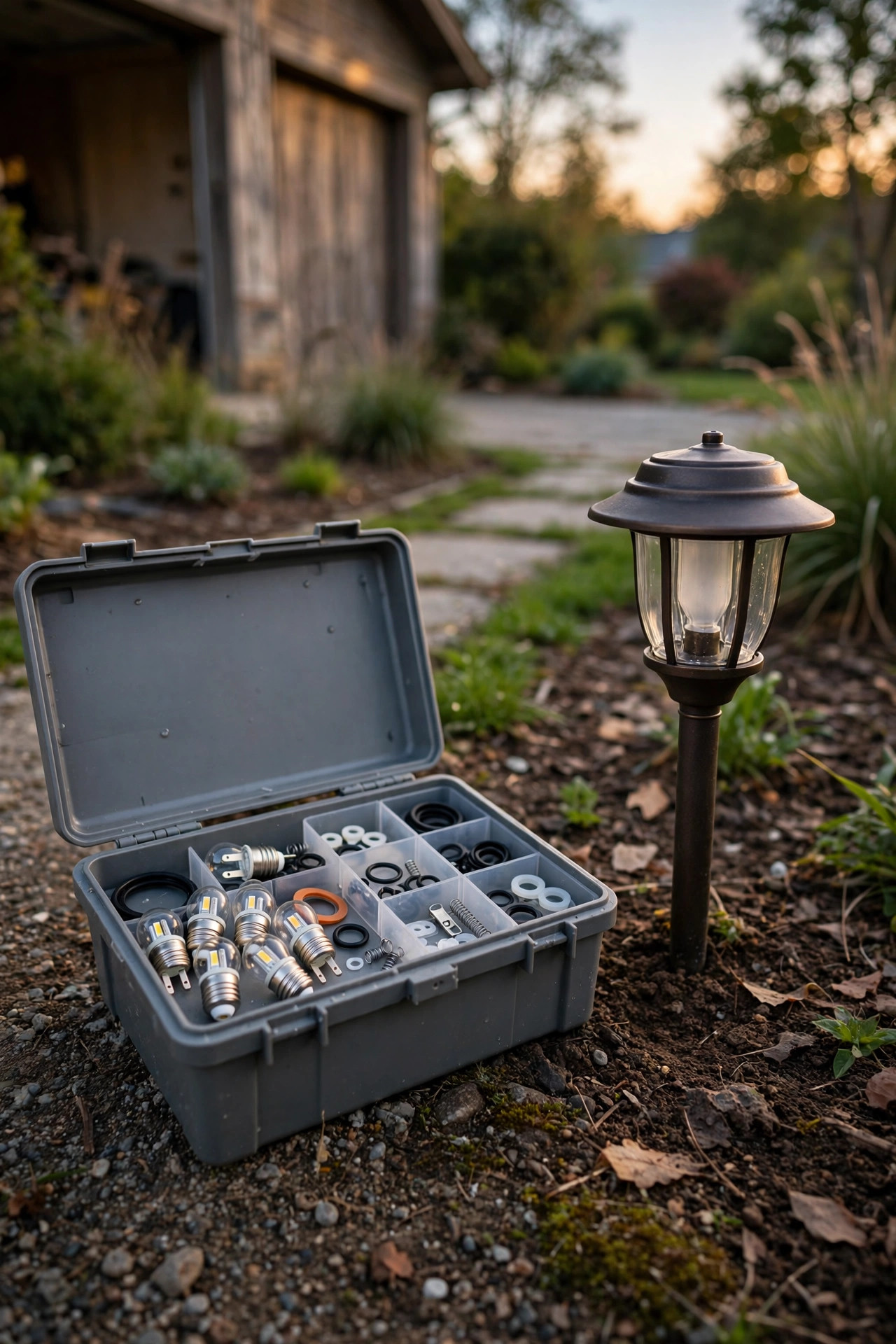
Picture a Friday evening, guests coming Saturday, and one path light dark. With a socketed fixture, this is a non-event: I keep a small shoebox of spare lamps in the garage, and the fix genuinely takes two minutes — pop the lens, twist out the old lamp, click in the new one, done for about $8.
With an integrated fixture, the same evening goes differently. There's no field repair; the whole fixture is replaced. That's $30 to $90, plus the time to unmount, rewire the low-voltage connections, re-aim, and rebury the cable. And if the fixture is three years old, there's a real chance its exact model has been redesigned, so your replacement glows at a slightly different color temperature or wears a slightly different finish than its neighbors. One mismatched fixture in a row of six is the kind of thing only you will notice — but you'll notice it every single night.
Warranties soften this. Reputable integrated fixtures carry 5- to 10-year warranties, and I've had a failed unit replaced free at year four. Just save your receipts and model numbers, because you'll need them. My rule: the easier a fixture is to reach, the stronger the case for socketed. The harder it is to reach — up in a tree, over a pond — the more a long-warranty integrated unit makes sense.
Flexibility: Changing Your Mind Later
Gardens refuse to sit still, and lighting needs to change with them. The Japanese maple that's a 4-foot sapling today will swallow a spotlight's beam in five years. Your taste changes too: the 3000K light that felt crisp a few seasons ago might feel harsh once you've lived with warmer 2700K evenings on the patio.
Socketed fixtures absorb all of that gracefully. Brighter lamp, warmer lamp, wider beam — each change is a $10 experiment you can reverse in minutes. When I converted my own front beds from a cool look to a warm one, it cost me one box of lamps and twenty minutes, and every fixture stayed exactly where it was.
An integrated system locks in the decisions you made on installation day — brightness, beam pattern, and color temperature are baked in for the life of the fixture. If you truly got it right, wonderful. But in fifteen years of tinkering with my own yard, I've changed my mind about some zone or other nearly every season. Flexibility is the socketed fixture's quiet superpower, and it's the reason the backbone of my yard — path lights, spotlights, well lights — stays socketed even though I happily use integrated pieces in specific spots.

Weather Sealing and Durability Outdoors
Water is the enemy of everything electrical outdoors, and this is where integrated fixtures genuinely shine. A sealed light engine has no socket opening, no lamp base for irrigation spray to creep into, and typically carries an IP65 or IP66 rating — sealed against dust and hard jets of water. For fixtures that sit in sprinkler range, at a pond's edge, or in mulch beds that stay damp for weeks, that sealed design removes the most common failure mode entirely.
Socketed fixtures fight water with gaskets and lenses, and good ones do it very well — a heavy brass fixture with a proper silicone gasket will shrug off decades of weather. But gaskets age, and once moisture reaches the socket, corrosion creeps across the contacts. The saving grace is that corrosion on a $10 lamp's pins is cheap to fix, and the socket itself can usually be cleaned with a wire brush and contact cleaner in spring.
My practical take: in dry, sheltered spots — under eaves, on covered porches — sealing barely matters and both types thrive. In the splash zone, choose integrated, or choose socketed fixtures built from solid brass or copper rather than painted aluminum, which flakes and pits within a few seasons in wet or coastal air.

What It Costs in 2026
Let's run the numbers on a typical set of ten path and spot lights over a decade, because the sticker price alone is misleading. Quality integrated fixtures run $30 to $90 each, call it $55 average — $550 for ten, and if two fail outside warranty in ten years, add about $110 in replacements: roughly $660 all-in. A quality socketed fixture runs $20 to $60, say $40, plus an $8 to $15 LED lamp: about $500 for the same ten, with a couple of lamp swaps over the decade adding maybe $25. Call it $525.
So socketed usually wins on pure dollars, but the gap is smaller than the shelf prices suggest, and it narrows further if your time is worth money — every lamp swap is trivial, but it isn't zero. Running costs are a wash: both use efficient LEDs drawing the same few watts per fixture, pennies a night on a timer. Transformer and cable costs are identical either way; my full breakdown of landscape lighting costs in 2026 covers those shared pieces in detail.
Where integrated can quietly save money is professional labor: if you're paying an installer for service calls, fewer, longer-lasting sealed units mean fewer visits. DIYers like me, who enjoy the tinkering, get more value from socketed.
The Verdict: Integrated LED vs Replaceable Bulb Fixtures, Yard by Yard
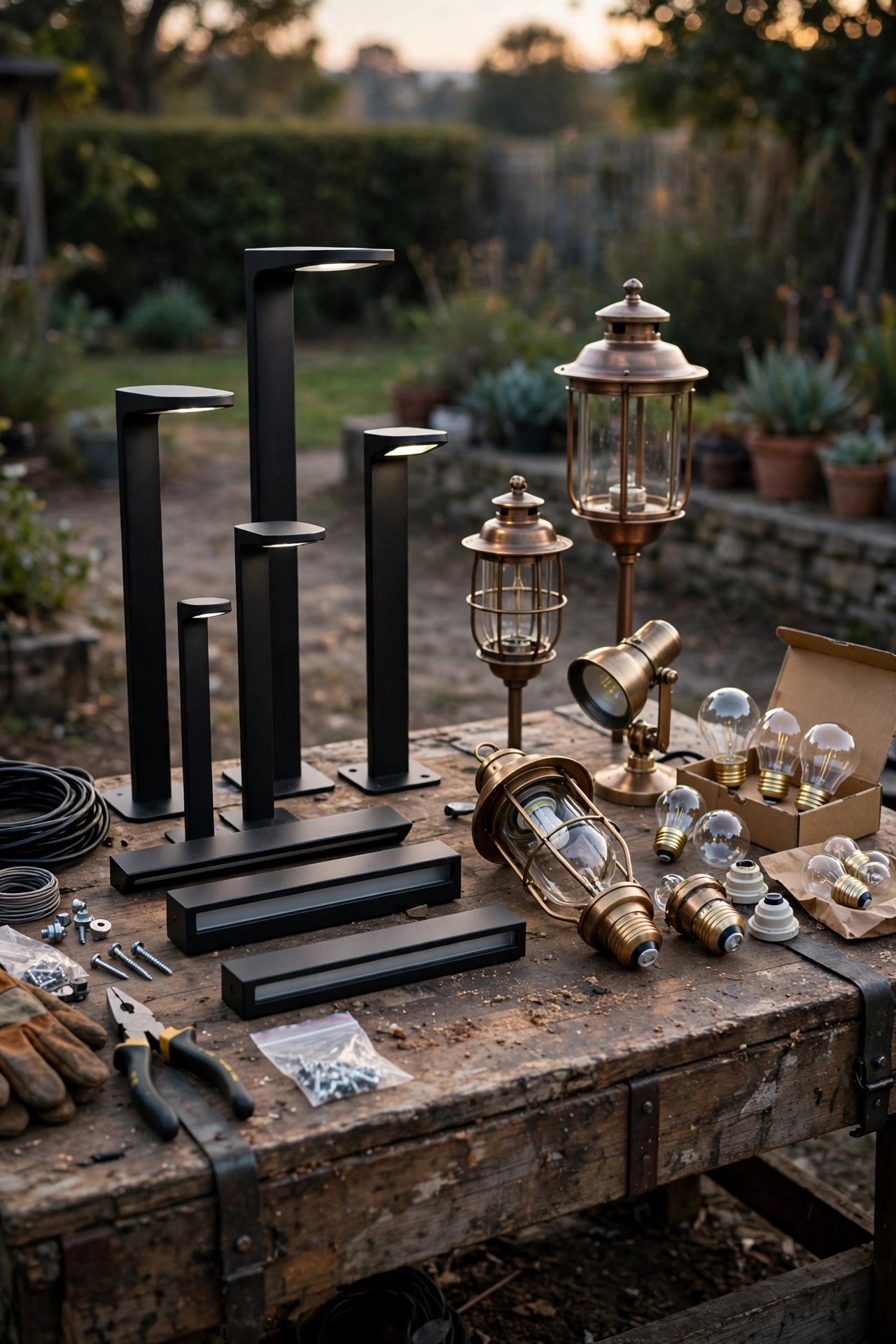
After all that, here's exactly what I'd buy, situation by situation. Building a whole new system you'll maintain yourself? Make the backbone socketed — path lights, spotlights, and well lights you can service in minutes and adapt as the garden grows. My own step-by-step guide to installing low-voltage landscape lighting assumes exactly that kind of serviceable system.
Lighting something high or awkward — tree-mounted downlights, fixtures over water, anything that needs a tall ladder? Go integrated with the longest warranty you can find, and buy one spare at installation time while the model is current. Constant sprinkler spray or a coastal yard? Integrated sealed units, or top-tier brass socketed fixtures — nothing in between survives.
On a tight budget, socketed wins: cheaper to start, cheaper to keep. Obsessed with a perfectly matched, architectural look for a decade? Socketed again, because housings stay constant while lamps are commodities. Honestly, this debate resolves to a hybrid for most real yards: socketed workhorses where your hands can reach them, integrated specialists where they can't. That's not fence-sitting — it's matching each tool to its job. Decide zone by zone, write down what you installed and when, and future-you will be genuinely grateful.

5 Mistakes to Avoid When Choosing
1. Assuming "integrated" means "lasts forever." The diodes might, but drivers fail — judge integrated fixtures by their warranty, not their hour rating. A 10-year warranty tells you more than a 50,000-hour claim.
2. Not buying a spare. If you fall for an integrated design, buy one extra fixture at installation time and store it. When a unit dies at year six and the line has been discontinued, that $55 spare saves your matched row.
3. Choosing obscure lamp bases. A socketed fixture is only flexible if its lamps are easy to find. Stick to common bi-pin, wedge, and reflector lamp sizes that any supplier stocks, and confirm before you buy a dozen fixtures.
4. Mixing color temperatures accidentally. An integrated fixture at 3000K beside socketed path lights at 2700K looks like a mistake, because it is one. Pick one temperature for the whole yard — I recommend 2700K to 3000K — and write it on the garage wall.
5. Paying for sealed fixtures where you'll never benefit. An integrated premium makes sense in the splash zone; on a dry, covered porch it's money spent solving a problem you don't have, while giving up easy lamp swaps you would have enjoyed.
Maintenance and Seasonal Care
Neither type asks much of you, but a little seasonal attention pays off. Twice a year — I do it on the spring and fall clock-change weekends — walk the yard after dark and note anything dim, flickering, or dark. Flicker on a socketed fixture usually means corroded lamp pins or a loose connection; both are five-minute fixes. A dim integrated fixture under warranty goes back to the manufacturer, so keep a simple list of what you installed and when.
Clean lenses while you're out there. A soft cloth and plain water removes the pollen film and sprinkler spots that quietly steal a third of a fixture's brightness by midsummer — this matters even more for integrated fixtures, whose output you can't boost with a brighter lamp later. Check socketed fixtures' gaskets each spring, replace any that are cracked or flattened, and snug down lens screws evenly rather than cranking one side.
Finally, keep the infrastructure tidy: re-aim spotlights after mulch day, trim back the plants that swallow path lights every June, and top up your spare-lamp shoebox when you use one. Fifteen unglamorous minutes, twice a year, is genuinely all that stands between a new system and a tired-looking one at year ten.

Frequently Asked Questions
Can you replace the LED in an integrated fixture when it burns out?
Generally, no. The LED board and driver are sealed inside the housing and aren't sold as service parts, so a dead integrated fixture is replaced as a whole unit. If it's within the warranty period — 5 to 10 years on quality models — the manufacturer replaces it free, which is why saving your receipt and model number matters so much with this type.
Do integrated LED fixtures really last 50,000 hours?
The diodes are rated that long, usually to "L70," meaning they still produce 70% of their original brightness at 50,000 hours. In practice the internal driver tends to fail first, especially in hot or wet locations, so I budget 10 to 15 real-world years for a quality integrated fixture. On a five-hour nightly timer, that's still a very long service life.
Are replaceable-bulb fixtures cheaper over 10 years?
Usually, yes — modestly. In my ten-fixture example above, socketed fixtures came to roughly $525 over a decade versus about $660 for integrated, mostly because a failed lamp costs $8 instead of a whole $55 fixture. The gap shrinks if you pay for professional service calls, and it can vanish entirely if your integrated fixtures outlive their warranty without a failure.
Which type is better for a low-voltage landscape lighting system?
For the main system — path lights, spotlights, well lights — I recommend replaceable-bulb fixtures, because low-voltage work is DIY-friendly and a two-minute lamp swap keeps it that way. Reserve integrated fixtures for the spots that are wet, high, or hard to reach. Most professional designers I know quietly do exactly this mix.
Conclusion
So, integrated LED vs replaceable bulb fixtures — which earns your money? In my yard, the answer is a deliberate mix: socketed path lights, spotlights, and well lights I can re-lamp in minutes and adapt as plants grow, plus sealed integrated fixtures anywhere a ladder, a pond edge, or a sprinkler makes servicing a chore. Buy the backbone you can repair, seal the spots you can't reach, keep a spare of anything integrated, and your lighting will still look intentional a decade from now. If you're planning your layout, browse the rest of my lighting guides here for placement ideas, spacing rules, and seasonal inspiration — and may all your failures be the two-minute kind.