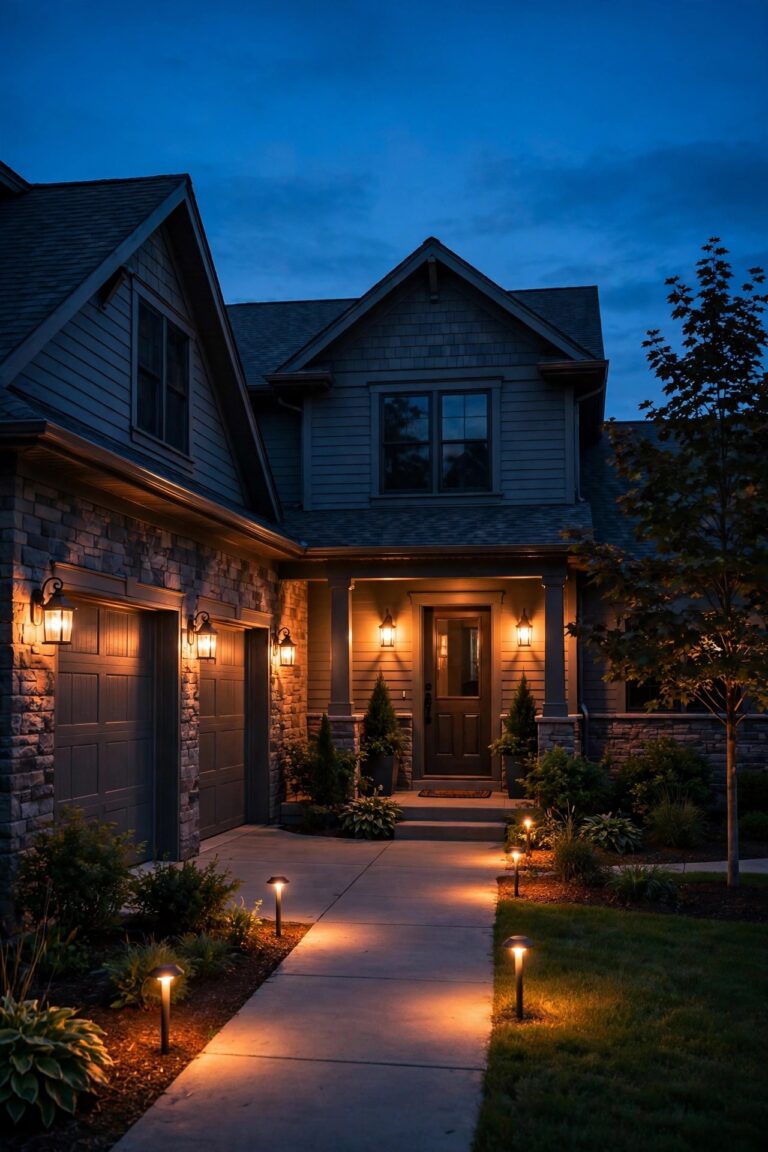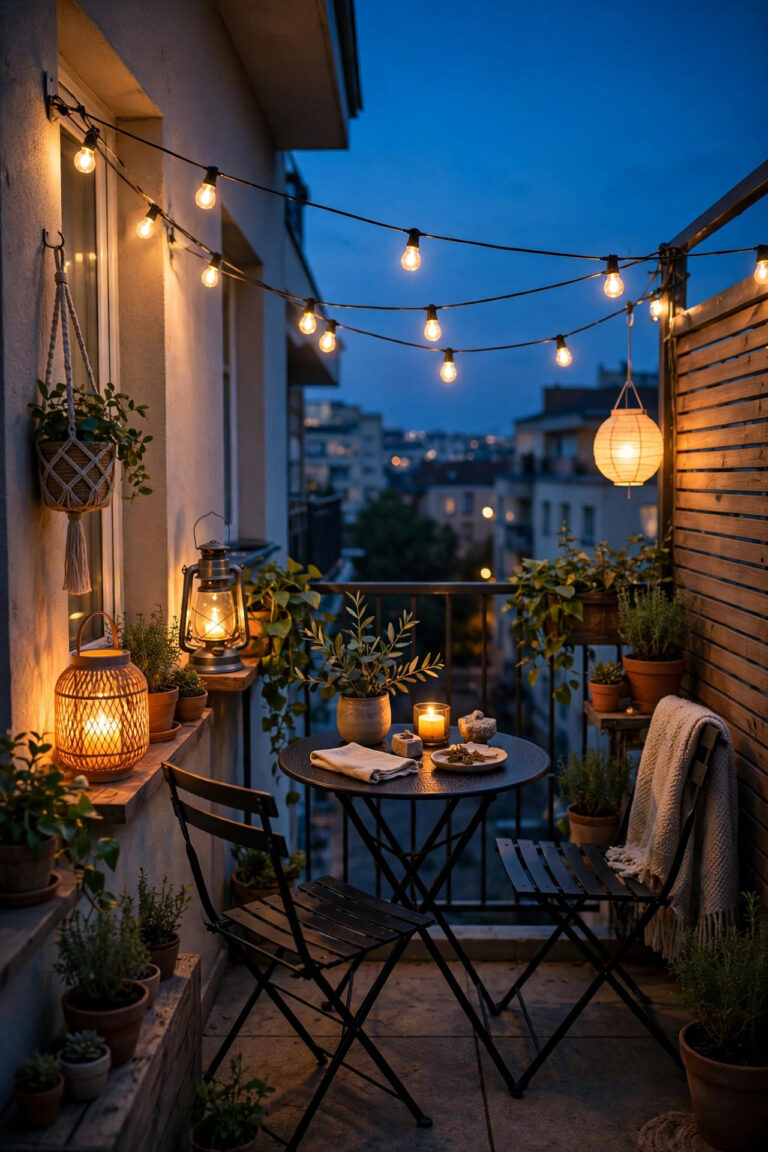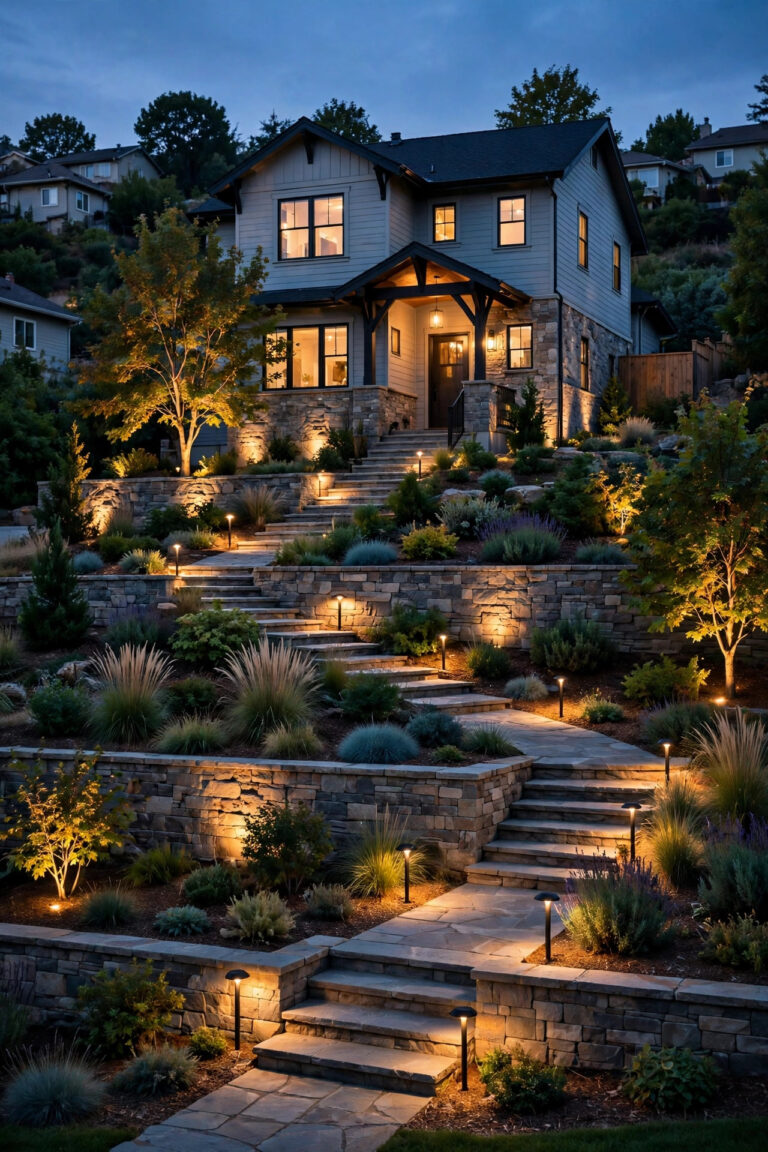
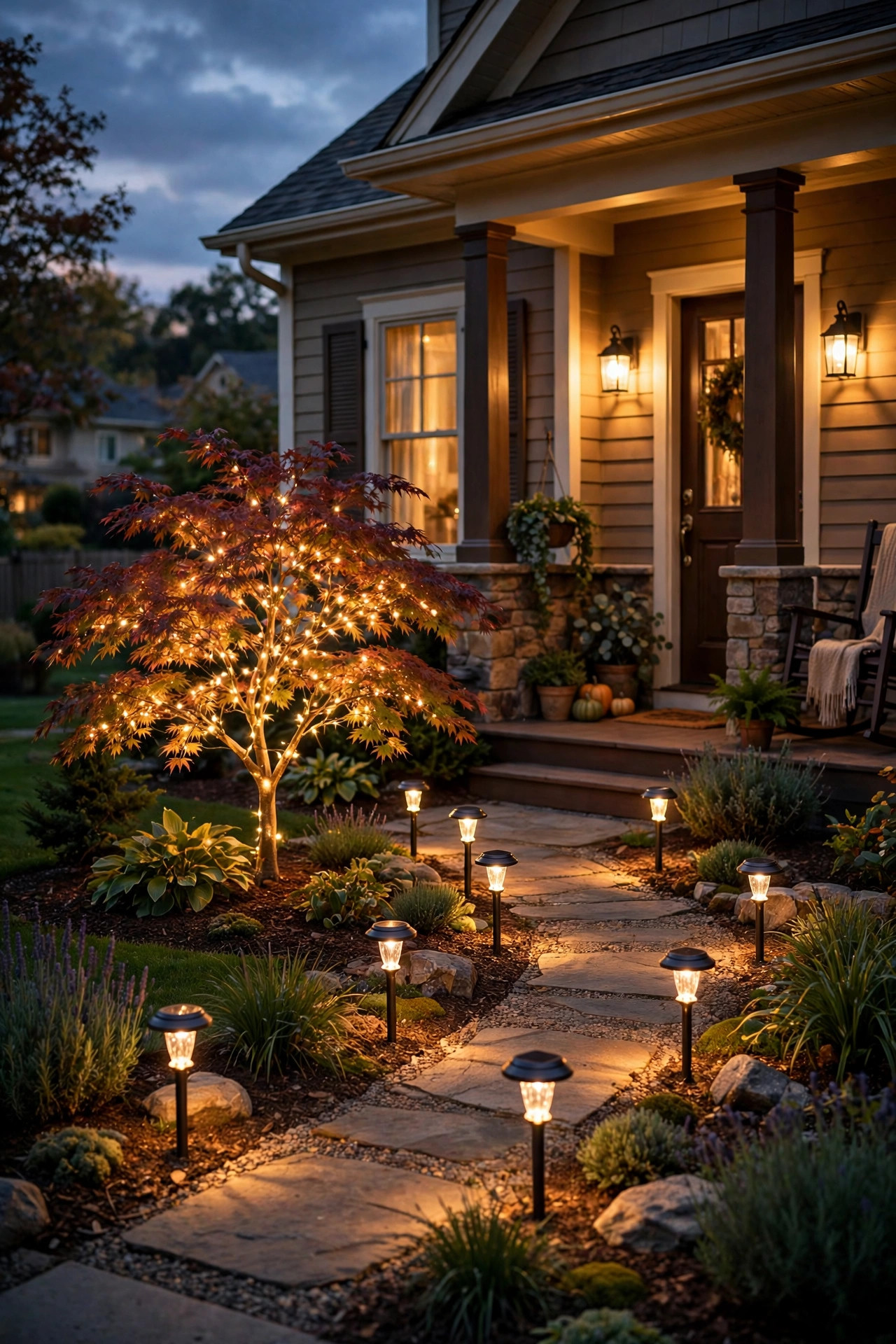
A small front yard is not a limitation — honestly? I think it's an advantage. When your whole entry is maybe 20 feet wide, every light you place actually gets noticed, and a handful of well-chosen fixtures can make the whole lot feel like a boutique hotel entrance. The trick with small front yard lighting ideas is restraint plus layering: a little path light, a little glow on the facade, one star feature, and warm light at the door. Skip any one layer and the yard looks flat; combine them and a tiny lot suddenly reads as grand. Below are the 19 moves I reach for again and again on compact lots, most of them renter-friendly, nearly all of them under $100 a layer, and every one tested on real postage-stamp yards like mine.
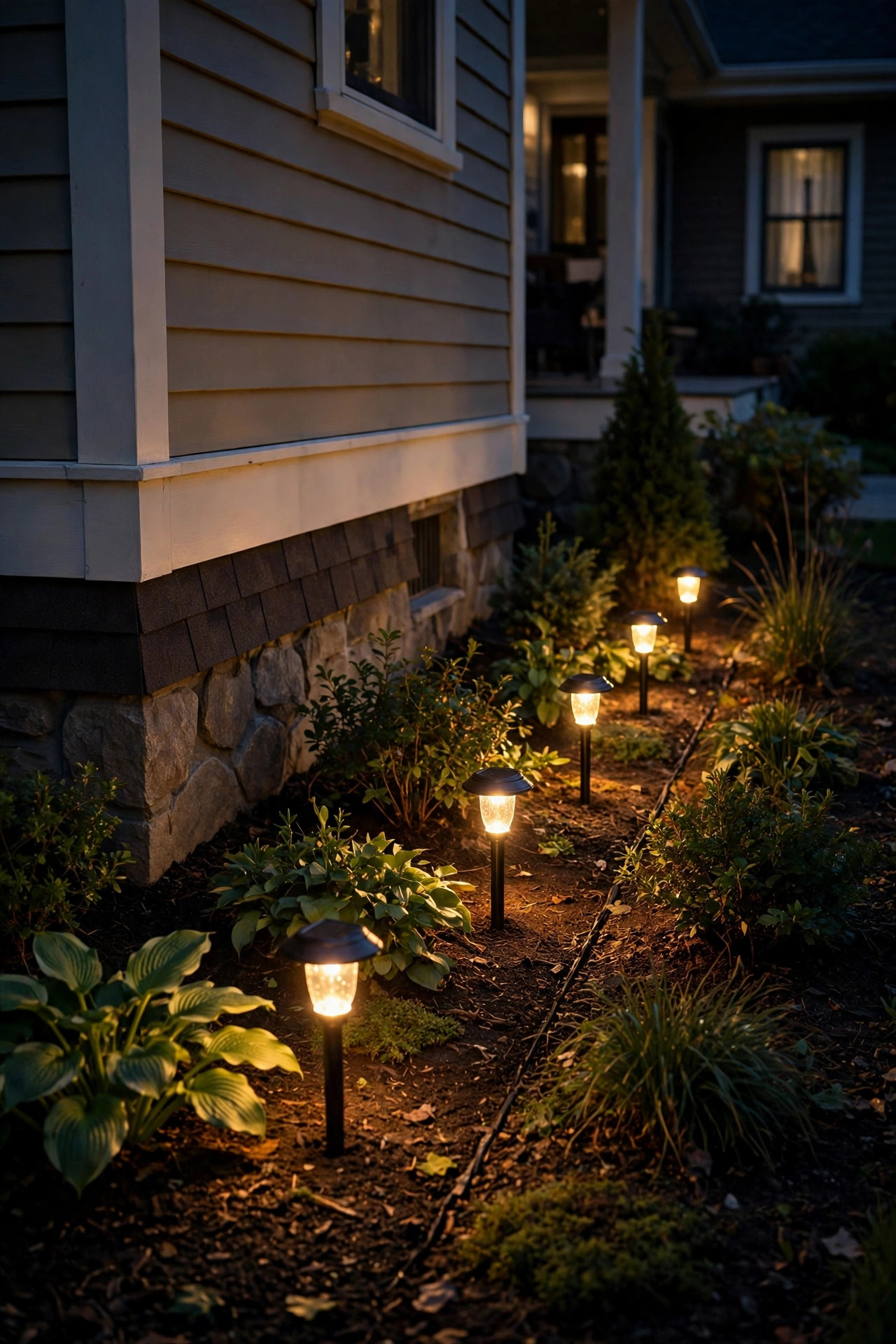
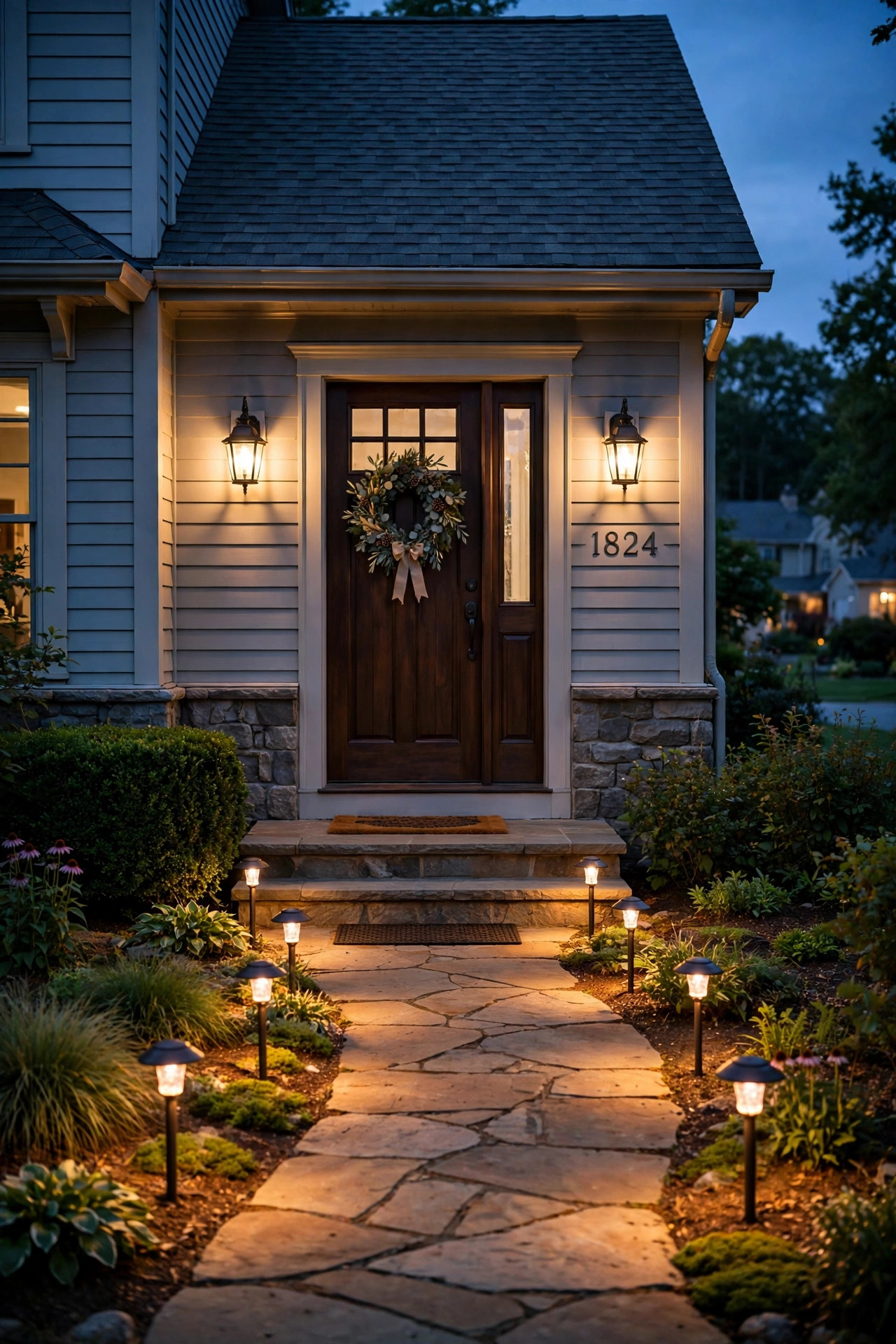
1. Line the Short Walkway With Solar Path Lights
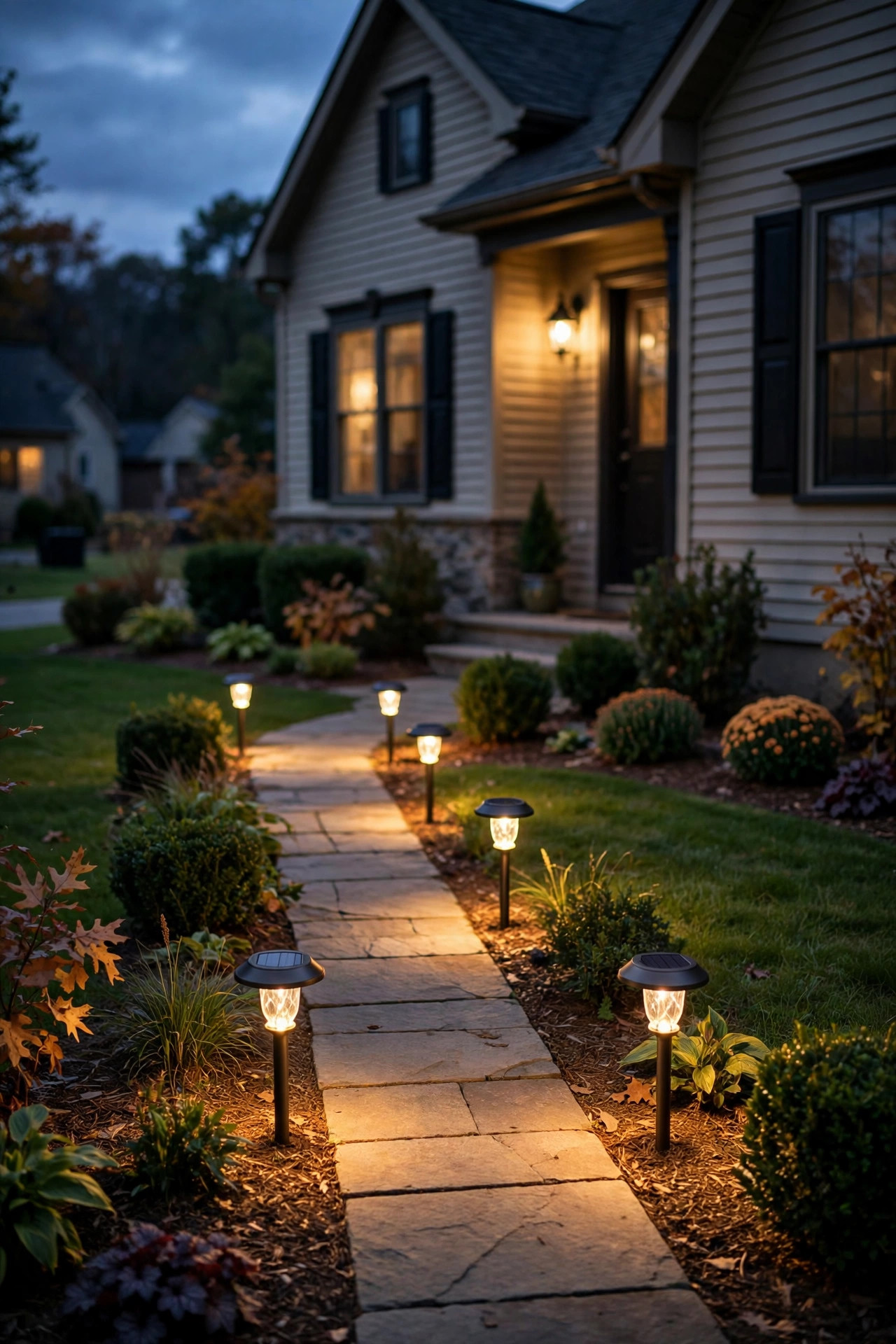
When your walkway is only 10 or 12 feet long, you do not need a fixture every two feet — that runway look shrinks a small yard. I use four to six solar path lights total, staggered on alternating sides about 3 to 4 feet apart, which reads as intentional and gives your eye a gentle zigzag to follow. Choose warm-white solar stakes in the 2700–3000K range, around 20–50 lumens each; anything brighter glares at this scale. Push the stakes 4–6 inches into the soil so they sit straight, and keep them at least 6 inches back from the walkway edge so the mower and snow shovels miss them. In my experience, solar is perfect here because a short path means short shadows, and most small front yards get enough afternoon sun on the walk to charge them. If yours is shaded, swap two of them for low-voltage fixtures instead — I cover that hybrid approach in my guide to front yard landscape lighting.
Suggested budget range: $40 – $90.
2. Give One Tree the Star Treatment
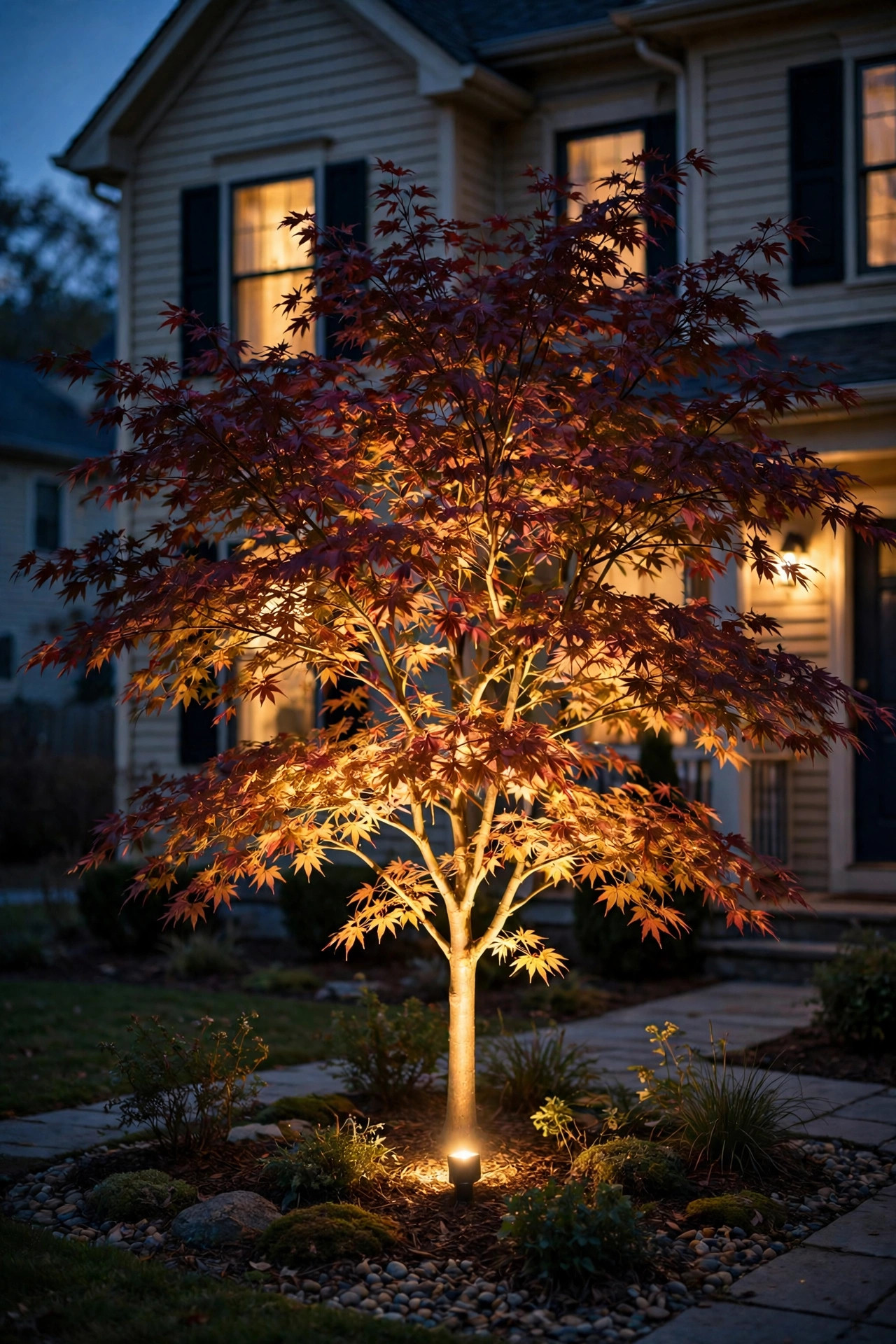
Every grand entrance has a focal point, and on a small lot you only get to pick one — so pick the tree. A single low-voltage spotlight (a 3–5 watt LED bullet or well light) staked 12 to 18 inches from the trunk and aimed up into the canopy turns a modest Japanese maple or crepe myrtle into a glowing sculpture. The light bouncing off the underside of the leaves also throws soft, dappled light across the whole yard, which is free ambiance. Keep the fixture small and black so it disappears into the mulch during the day. If your tree is young and skinny, angle the beam slightly wider and accept a softer effect; it will grow into the role. This is my favorite of all the small front yard lighting ideas because one $30 fixture does the work of ten path lights — it gives the yard height, and height is what makes small spaces feel grand rather than cramped.
Suggested budget range: $25 – $60.
3. Flank the Door With Compact Sconces
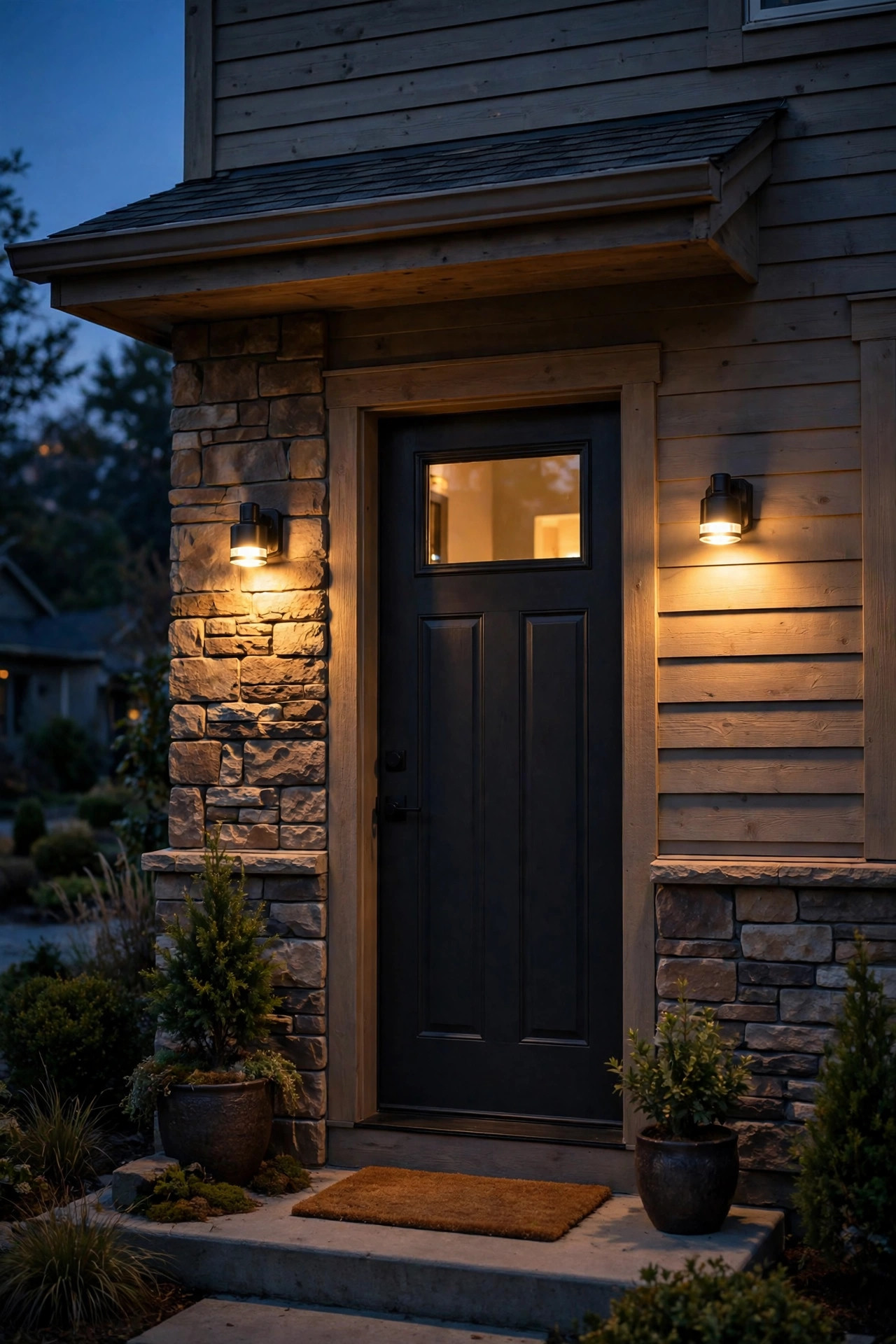
Oversized lanterns swallow a small entry whole, so scale down: sconces 8 to 11 inches tall are proportionate for most small porches and townhome entries. Mount the pair at eye level, roughly 66 inches from the porch floor to the center of the fixture, and about 6 to 8 inches out from the door trim. Warm 2700K filament-style LED bulbs (40-watt equivalent is plenty at this range) give that candlelit welcome without the glare. If your entry has room for only one fixture, center a single slightly larger sconce beside the handle side of the door rather than forcing a squeezed pair — asymmetric and intentional beats symmetrical and cramped every time. I always recommend fixtures rated for wet locations here, since small porches rarely have deep overhangs protecting them. This layer matters because the door is where guests actually arrive; light the destination first and the rest of the yard can stay simple.
Suggested budget range: $60 – $140.
4. Backlit House Numbers That Float Off the Wall
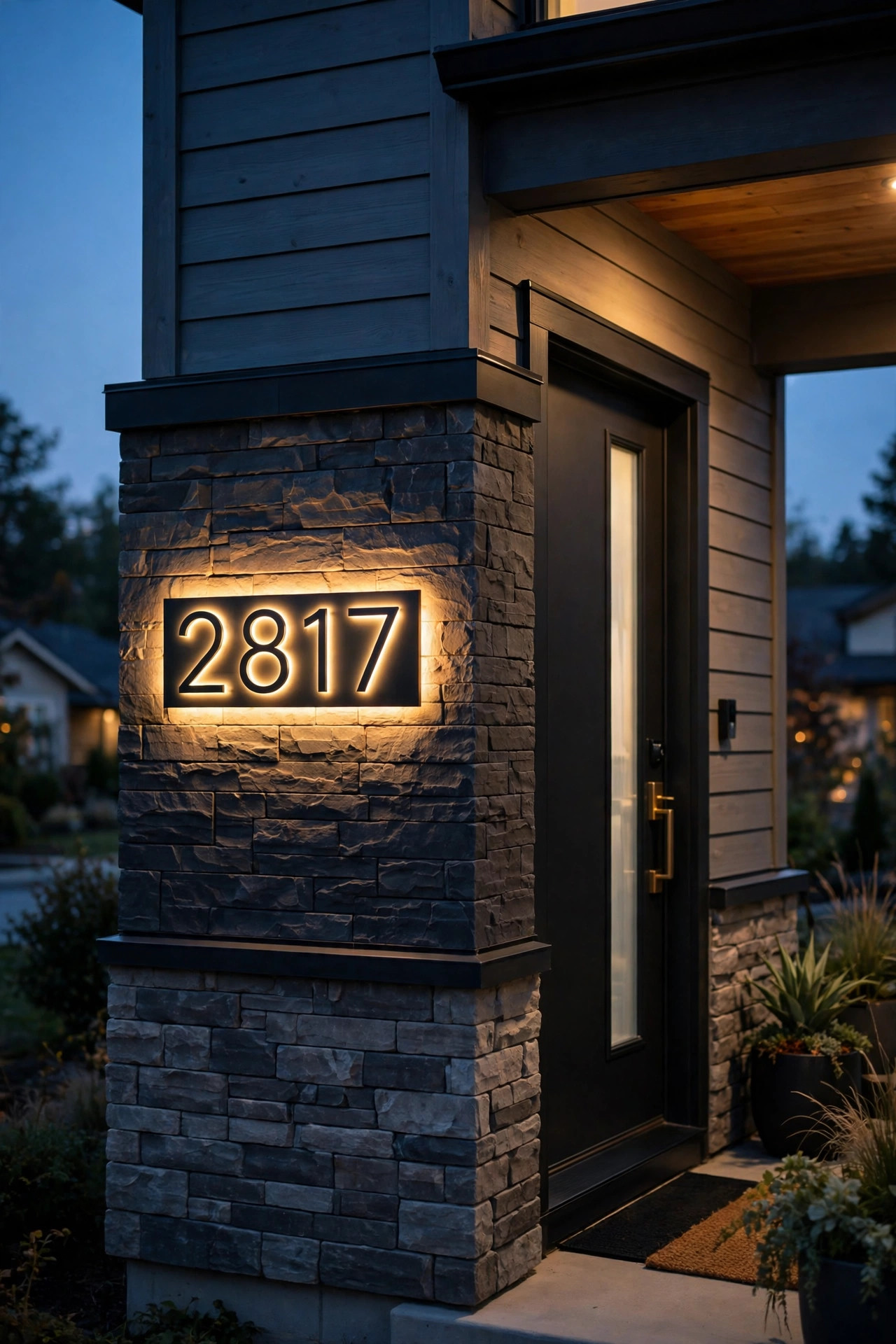
Nothing says "considered design" faster than an address you can read from the street at night — and on a small lot, this tiny detail carries outsized weight. Backlit metal numerals, 5 to 6 inches tall, mounted on standoffs about an inch off the siding, cast a soft halo that makes a plain facade look custom. Brushed brass and matte black both work; match whatever finish your sconces wear so the entry reads as one set. If wiring a new low-voltage run feels like too much, there are solar and battery versions now that charge from a little remote panel tucked in a sunny bed — in my experience the wired ones are brighter and more reliable, but the battery kind are a fine weekend compromise. Place the numbers where the porch light or streetlight doesn't wash them out, ideally on a shaded stretch of wall near the door. Delivery drivers will thank you, and honestly, so will your home's whole first impression.
Suggested budget range: $35 – $80.
5. Borrow Some Moonlight With One Soft Downlight
Uplights get all the glory, but a single gentle downlight is the secret to making a small yard feel deep instead of flat. Mount a small hooded fixture high on the facade, under an eave, or in the branches of your one tree, aimed down at a 45-degree angle so it pools light on a bed or the walkway like moonlight. The shadows it casts point downward and outward, which tricks the eye into seeing more ground — and perceived ground is perceived space. Keep it dim: a 2–3 watt LED with a frosted lens is plenty at this scale, and always shield the source so nobody sees the bare bulb from the street. One is enough. Two competing downlights on a tiny lot start to look like a parking lot, and that's the opposite of grand. I pair this with the tree uplight from idea 2 and suddenly a 15-foot yard has height, depth, and a story.
Suggested budget range: $30 – $75.
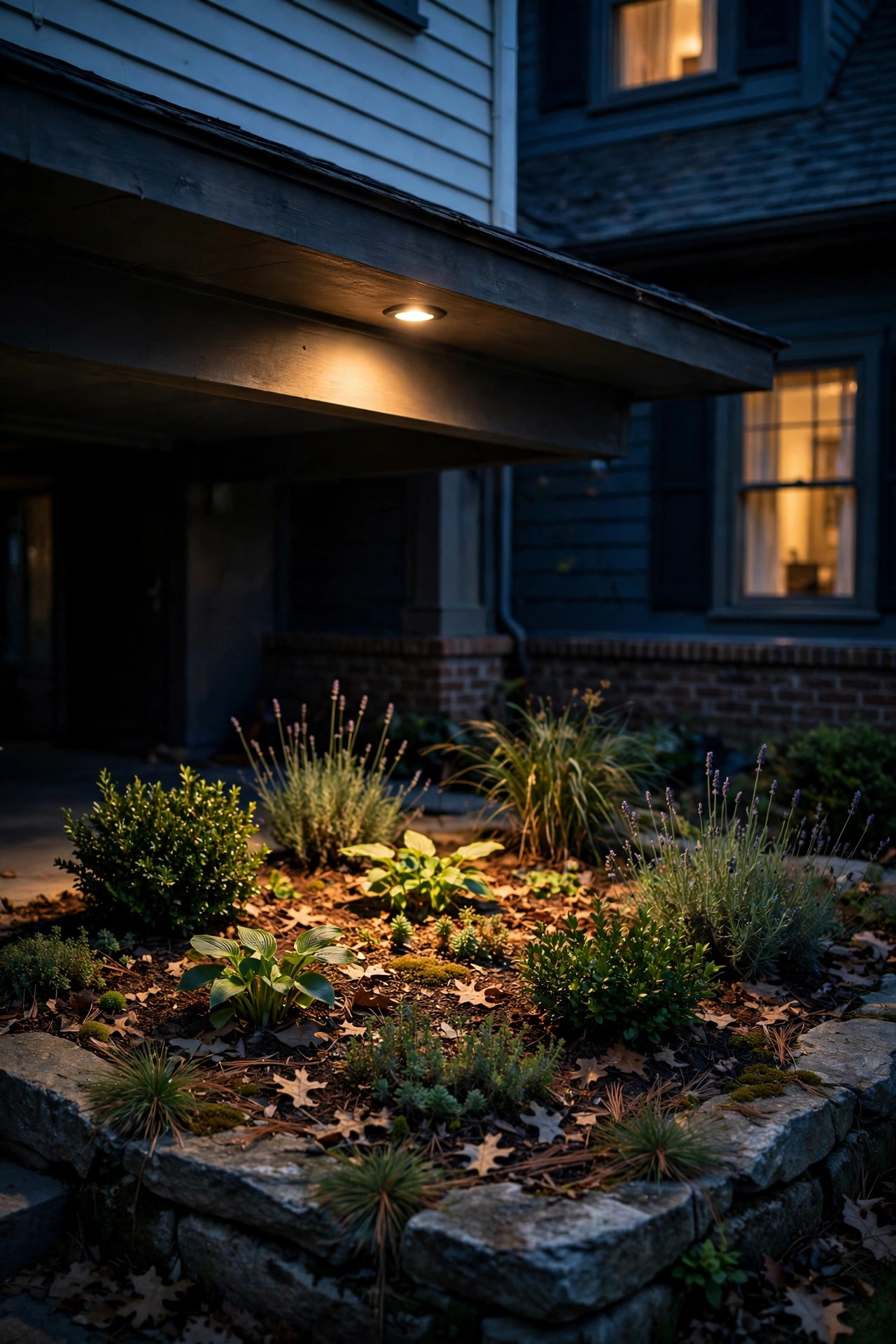
6. Swap Tall Path Lights for Low Bollards
Standard path lights stand 18 to 24 inches tall, which on a small lot reads like a crowd of little lampposts competing with your actual house. Low bollards — 8 to 12 inches — keep the glow at ankle height where it belongs, light the walking surface better, and never block a window or a flower bed view. I like simple matte-black cylinders or squares with the LED hidden under a cap, throwing light down and out in a soft disc. Space them 4 to 5 feet apart along one side of the walk; on a short path, three bollards usually do the job of six stakes. They're also sturdier — no thin stake to bend when someone backs a trash bin into it. In my experience this single swap is what separates "cute little yard" from "designed little yard," because everything at low height leaves the sightlines open and the lot feels twice its size.
Suggested budget range: $50 – $120.
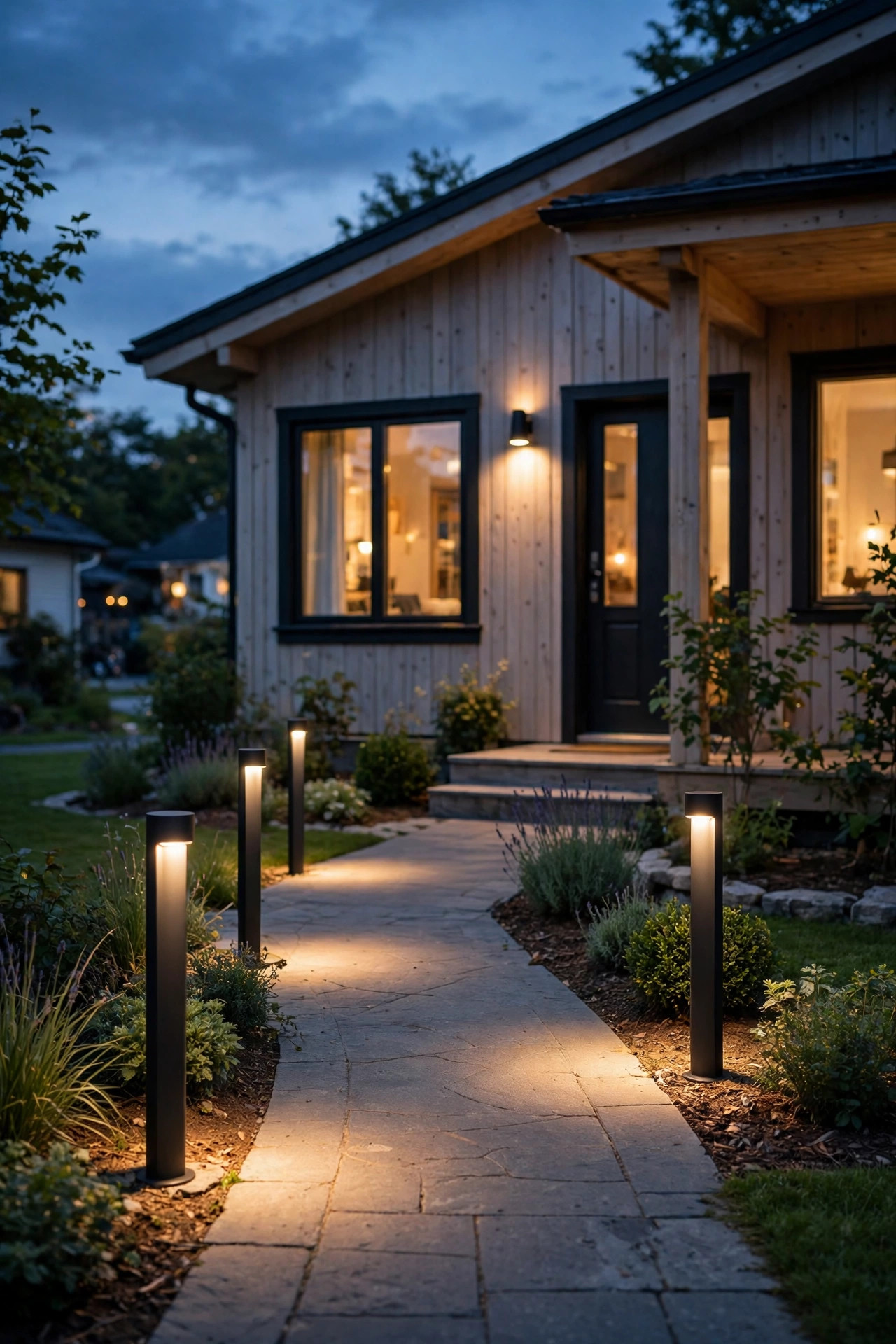
7. Tuck Step Lights Into the Porch Steps
Small homes often have two or three tall steps up to the porch, and in the dark those steps are where guests hesitate. Recessed LED step lights — mounted into the riser face or surface-mounted under each tread nosing — solve the safety problem while adding the kind of detail you'd expect at a much fancier address. One light per step, centered, at 2700K is my formula; the warm wash down each tread looks like the steps themselves are glowing. If cutting into masonry isn't in the cards, solar step lights that screw to the riser with two small bolts get you 80% of the look in 20 minutes. Keep brightness low, around 30–80 lumens per step — you're marking edges, not landing planes. This is one of those small front yard lighting ideas that visitors compliment without knowing why: the entry just feels finished, deliberate, and a little bit luxurious.
Suggested budget range: $30 – $70.
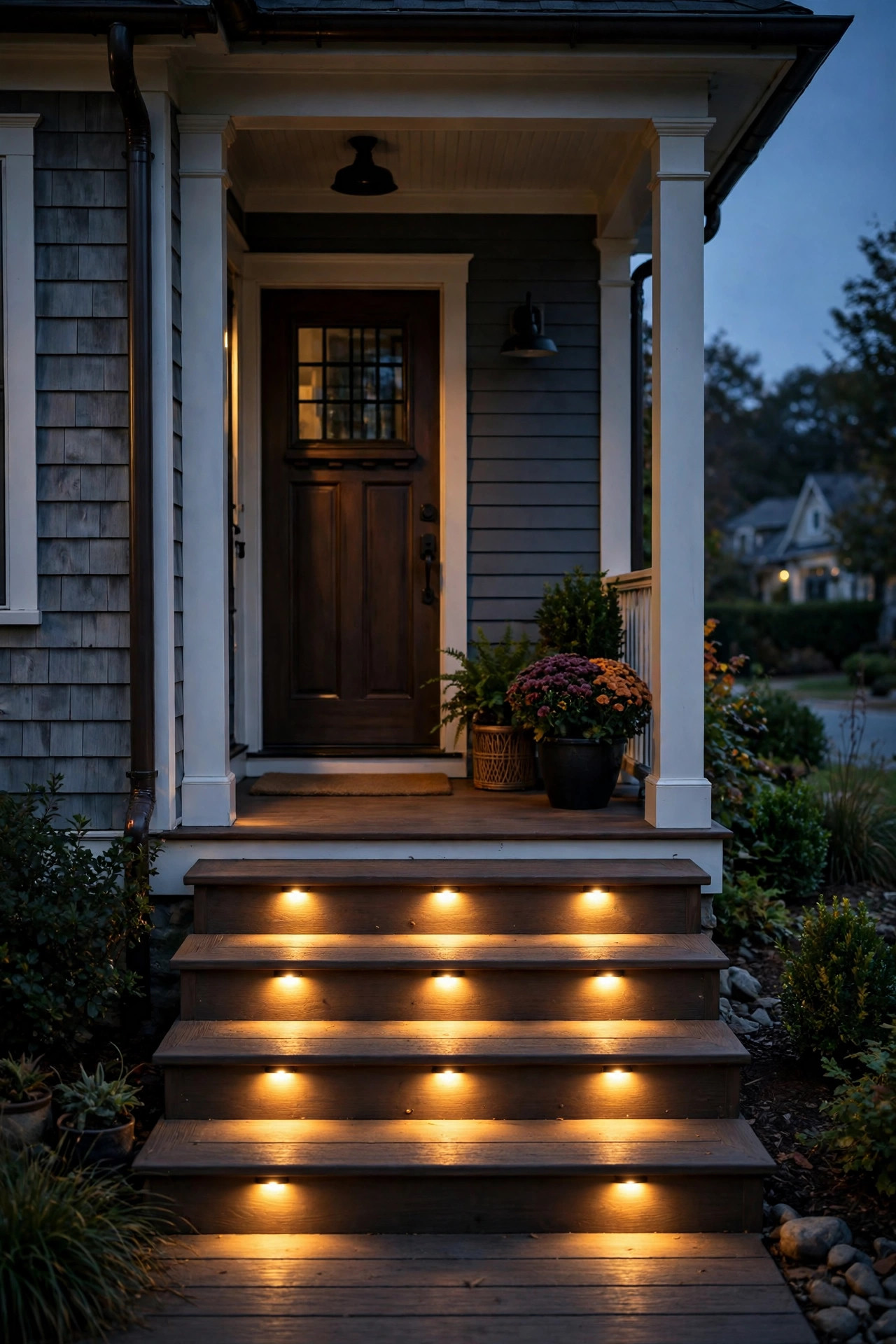
8. Drape One Strand of String Lights Along the Porch
A small porch needs exactly one strand — this is a garnish, not a main course. A 10- to 15-foot run of outdoor string lights swagged once or twice along the porch rail, beam, or a pair of small hooks gives you that bistro glow that makes people slow down on the sidewalk. Warm-white shatterproof LED bulbs only, and keep the strand on the porch footprint rather than zigzagging across the yard; on a tiny lot, a yard-wide web of strings closes the space in. Use a plug-in strand on a timer so it runs dusk to about 11 p.m. and you never think about it. Honestly, the restraint is the whole trick: one strand says "someone thoughtful lives here," while five strands say "permanent wedding venue." If your porch has no rail, two black shepherd's-hook poles at the corners make a tidy frame for the same effect.
Suggested budget range: $25 – $60.

9. Wash One Section of Facade With Grazing Light
Wall washing sounds like a big-house technique, but a small home benefits even more — one grazed wall adds texture and perceived width to the whole lot. Place a small spotlight or well light 6 to 12 inches from the base of the house, aimed steeply up so the beam rakes across brick, stone, or board-and-batten siding and exaggerates every shadow line. It makes a 25-foot-wide facade look like architecture. Pick the most interesting stretch — the section beside the door, or under a front window — and light only that. Smooth stucco and flat siding take a softer, wider wash; rough textures want the fixture closer and the angle steeper. I learned this from the layering approach in my layered landscape lighting guide: on a small lot, one washed wall replaces three random accent lights and the composition instantly tightens up.
Suggested budget range: $35 – $85.
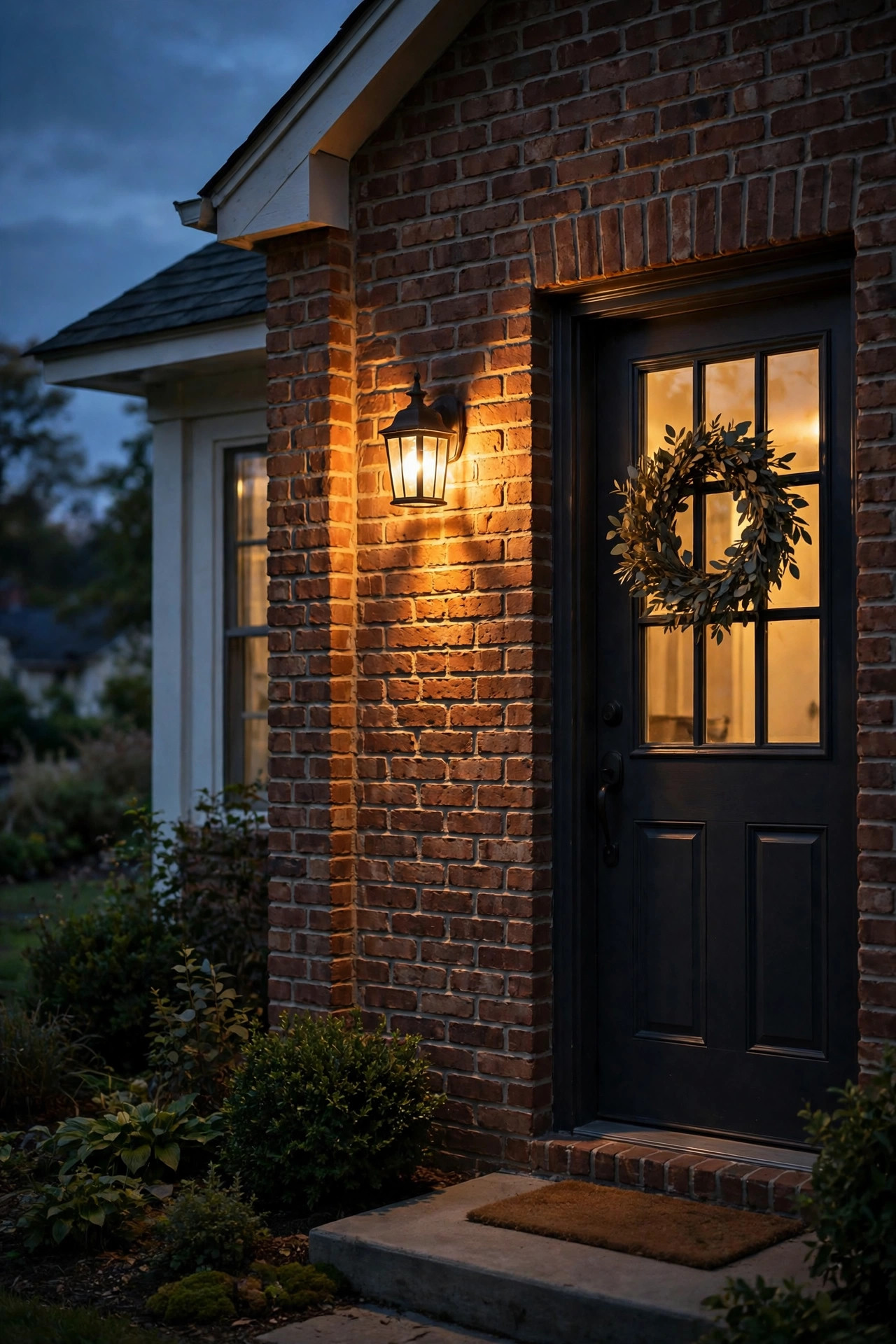
10. Dot the Planting Beds With Solar Stakes
Foundation beds on small homes are usually narrow — 18 to 30 inches — so there's no room for fixtures with big footprints. Slim solar stake lights, the kind with a head barely 2 inches wide, slip between shrubs and perennials without stealing a single planting spot. I group them in threes: a little triangle of glow in front of a boxwood, another near the hydrangea, rather than a soldier-straight row. Warm white only, and choose models where you can swap the rechargeable battery, because the panel and LED will outlive the first battery by years. Expect a gentle 10–20 lumens — these are sparkle, not work light, and that's fine because the walkway and porch layers are already doing the heavy lifting. On cloudy stretches they'll dim early; treat that as a mood, not a malfunction. They're the cheapest layer in this whole list and, layered right, they make a tiny bed look like a night garden.
Suggested budget range: $30 – $65.
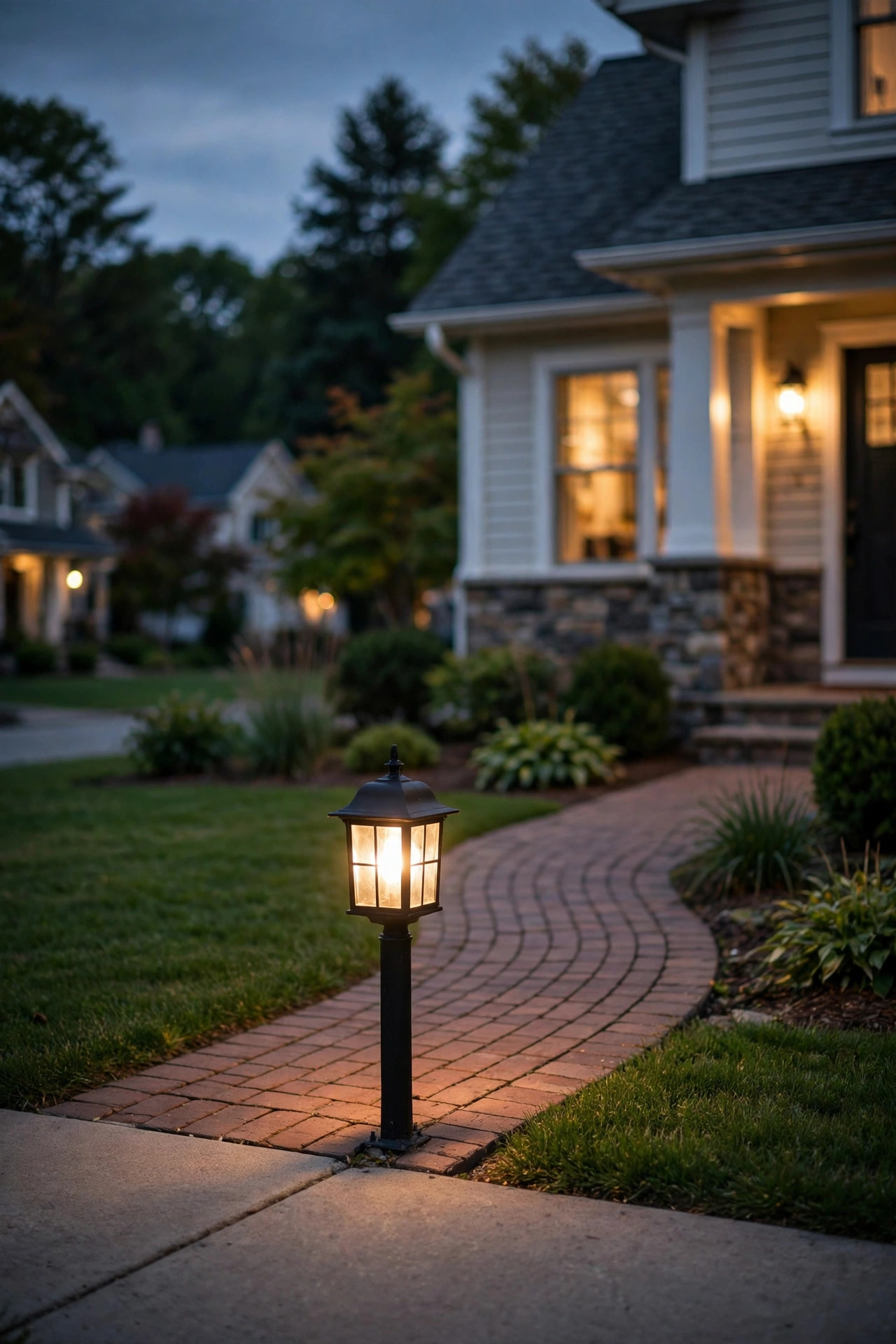
11. Mark the Start of the Walk With a Short Lantern Post
Think of this as punctuation: a single lantern-style post, just 3 to 4 feet tall, where the walkway meets the sidewalk or driveway, tells guests "the welcome starts here." On a big estate you'd do a pair; on a small lot, one is the elegant choice — two would crowd the frame. Match the lantern style to your door sconces (same silhouette family, same finish) so the yard reads as a matched set from the street. Solar versions with a warm filament-look bulb have gotten genuinely good, and they save you trenching a wire across the whole yard. Set the post in a small bed of mulch or river rock rather than bare lawn so it looks planted, not parked. In my experience this is the single idea that most changes how a small house photographs from the street — it gives the composition a starting point, and small spaces live or die on composition.
Suggested budget range: $45 – $110.
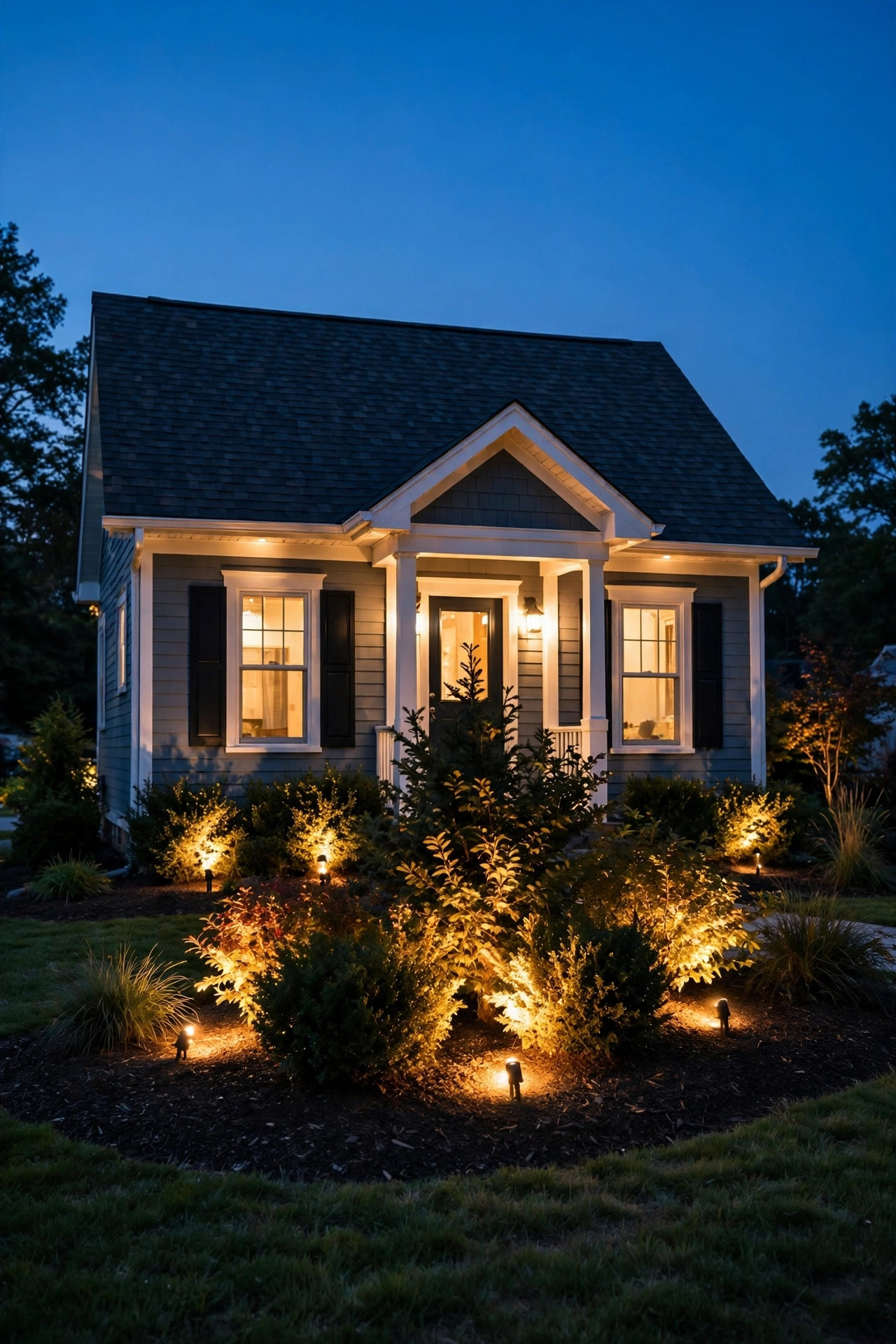
12. Uplight the Foundation Shrubs From Inside the Bed
When shrubs sit against the house, a tiny uplight hidden at the base of each one — aimed into the foliage — makes the whole planting bed glow like it's lit from within, and the house appears to float behind it. Use compact 1–3 watt fixtures, one per anchor shrub rather than one per plant; on a small lot, three lit shrubs beat eight. Evergreens take this best because they hold their shape and leaves all winter. Angle the beam into the thickest part of the canopy and stand back at the street to check for hot spots: you want an even bloom of light, not a searchlight in a bush. This layer adds the middle height between your low path lights and the tree, which is exactly the layering that makes a yard feel designed. My full set of small yard lighting tricks leans on the same principle — light the plants you have, at the heights you have, and small stops mattering.
Suggested budget range: $40 – $95.
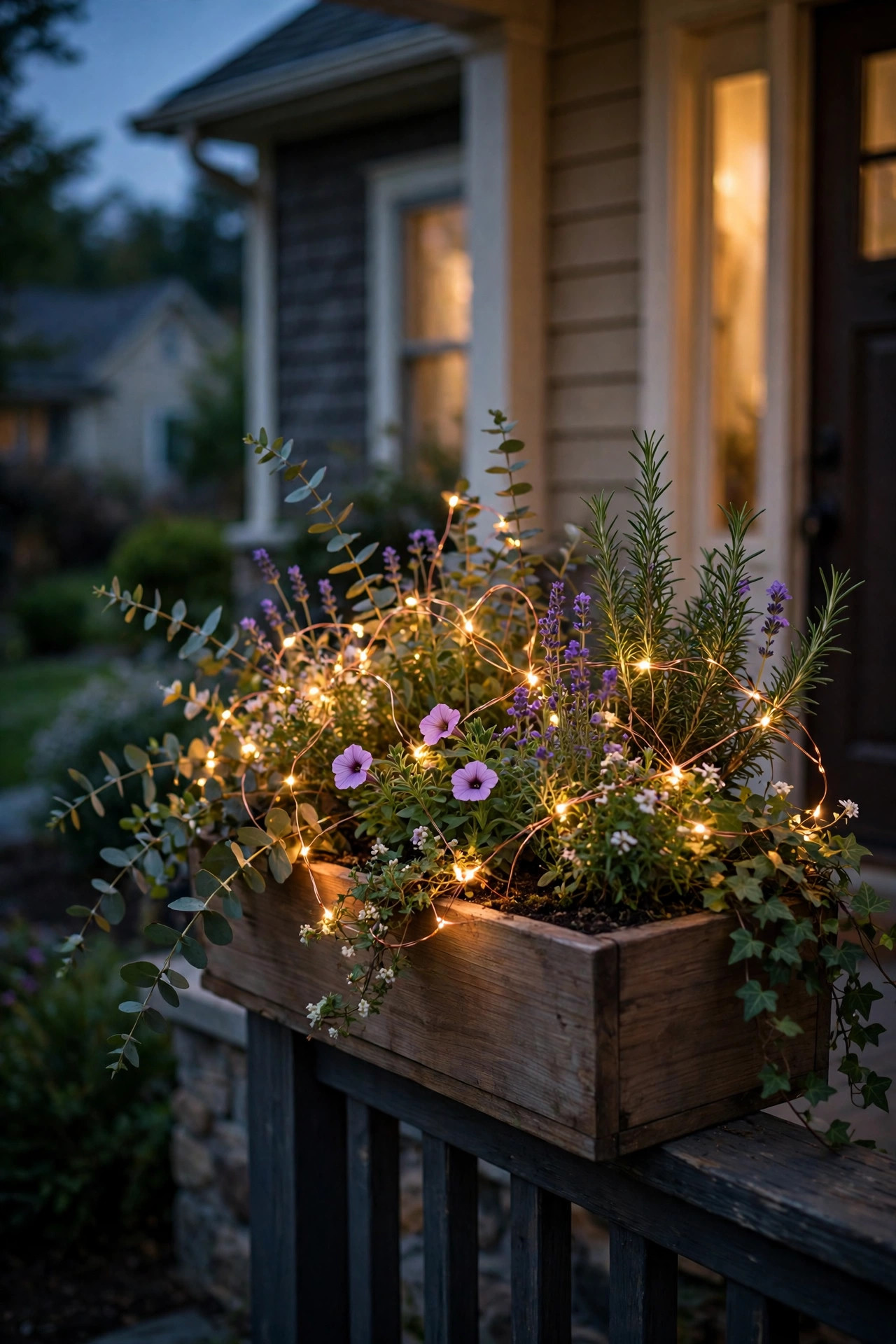
13. Weave Fairy Lights Through a Planter or Window Box
The smallest layer of all, and maybe the most charming: a strand of copper-wire fairy lights woven through a porch planter, a window box, or the railing planter by the steps. Because the wire practically disappears, all you see after dark is a constellation floating in the greenery — instant magic for about the price of a pizza. Battery-powered strands with a built-in 6-hours-on timer are my pick for planters (no outlet hunting, no cord across the walk), and solar ones work in sunny beds. Keep the lights warm white; the multicolor sets read as holiday decor year-round. One honest caution: fairy lights are decoration, not illumination — they won't light a step or a path, so never count them as a safety layer. But as the finishing sparkle over the top of a well-lit small yard, nothing else delivers this much perceived effort for this little money and zero installation skill.
Suggested budget range: $15 – $35.
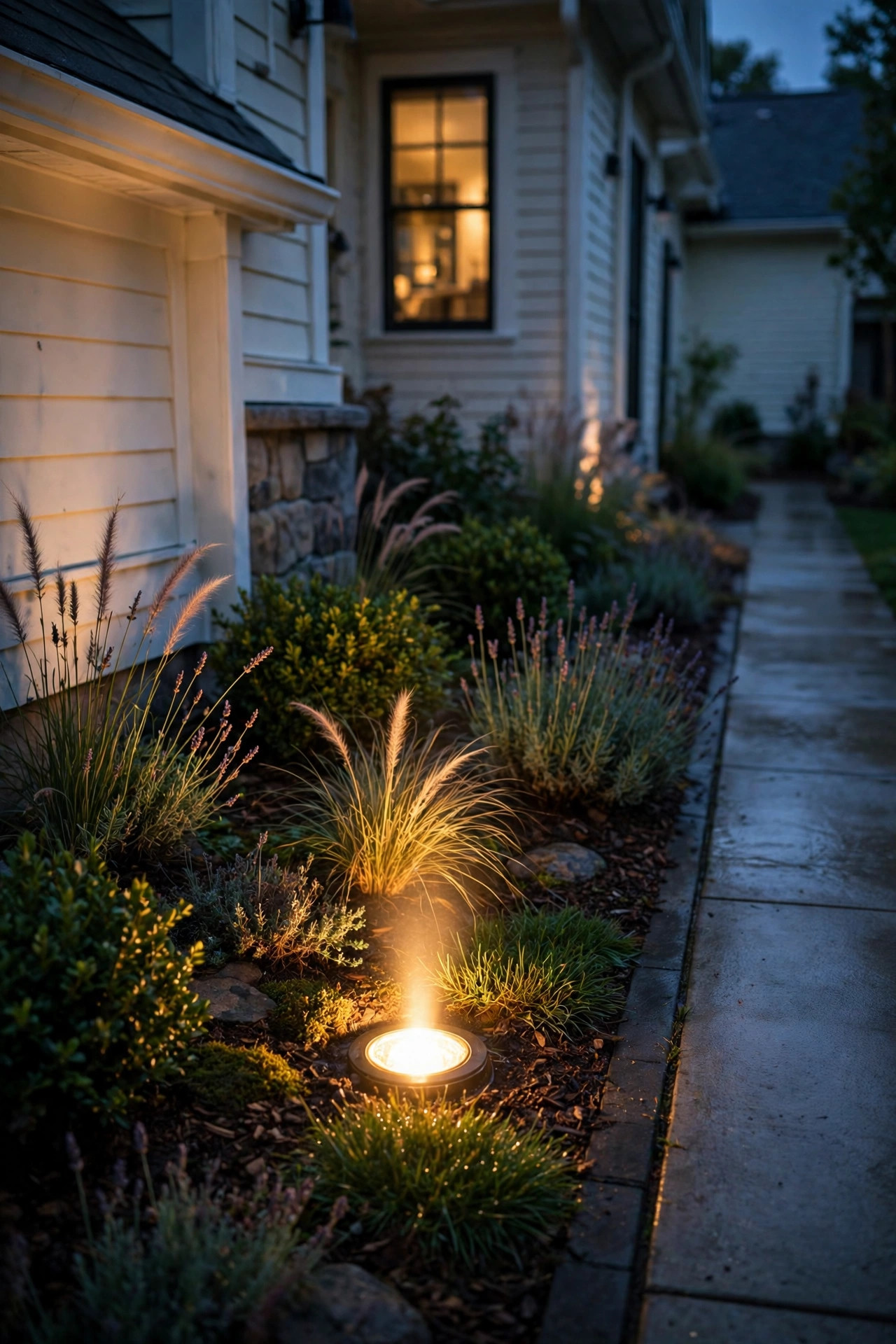
14. Sink In-Ground Well Lights Where There's No Room to Spare
When every square foot is spoken for — narrow beds, a walk that hugs the house, no lawn to stake into — in-ground well lights disappear entirely into the soil or gravel and throw their light straight up from flush with the ground. I use them in the two spots small yards struggle with: tight corners beside the porch, and the sliver of bed between walkway and foundation. One well light under a small tree, one washing the corner of the house, and the yard gains two features without losing an inch. Choose fixtures with a tempered glass lens rated for foot traffic if they'll sit near the walk, and bury a small gravel pocket underneath each one for drainage — standing water is the only real enemy these fixtures have. They cost a bit more per fixture than stakes, but on a truly tiny lot they're often the difference between "we ran out of room to light" and a complete, layered scheme.
Suggested budget range: $45 – $100.
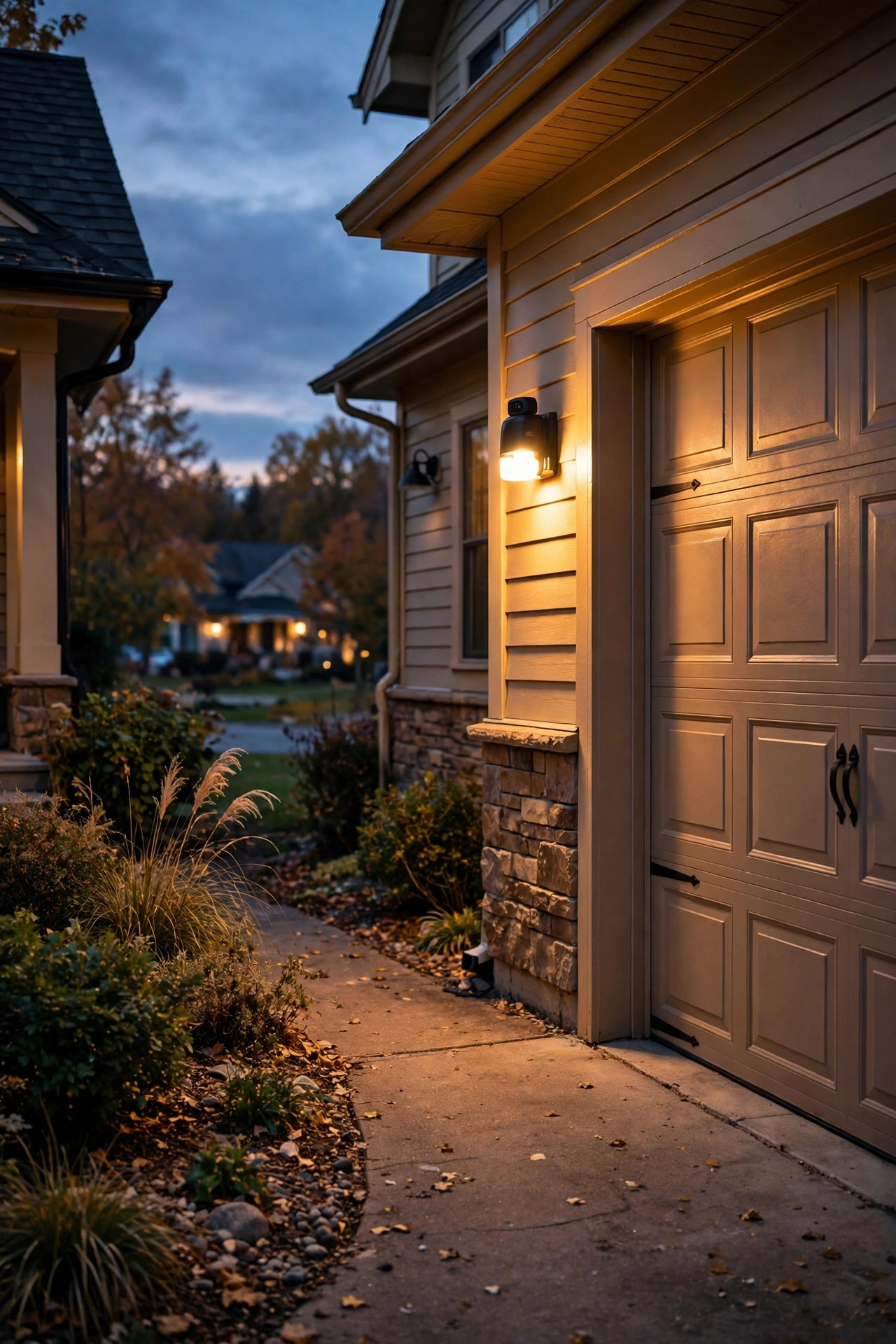
15. Add a Motion-Sensor Light Where the Driveway Meets the House
Small lots usually park the car steps from the front door, so the driveway strip doubles as your arrival path — and it deserves light that shows up when you do. A compact motion-sensor fixture over the garage or beside the door, with a warm 2700–3000K LED rather than the icy blue-white of old security floods, lights your way in without permanently floodlighting the whole lot (your neighbors will appreciate that). Look for a detection range you can dial down to 10–15 feet so passing sidewalk traffic doesn't trigger it all night, and a dusk-to-dawn low-glow mode if you can get it: a gentle 10% standby glow that brightens on approach is the best of both worlds. Keep the sensor aimed along the driveway, not across it, for the fewest false triggers. Security lighting that matches your color temperature keeps the small yard feeling like a home instead of a loading dock.
Suggested budget range: $30 – $70.
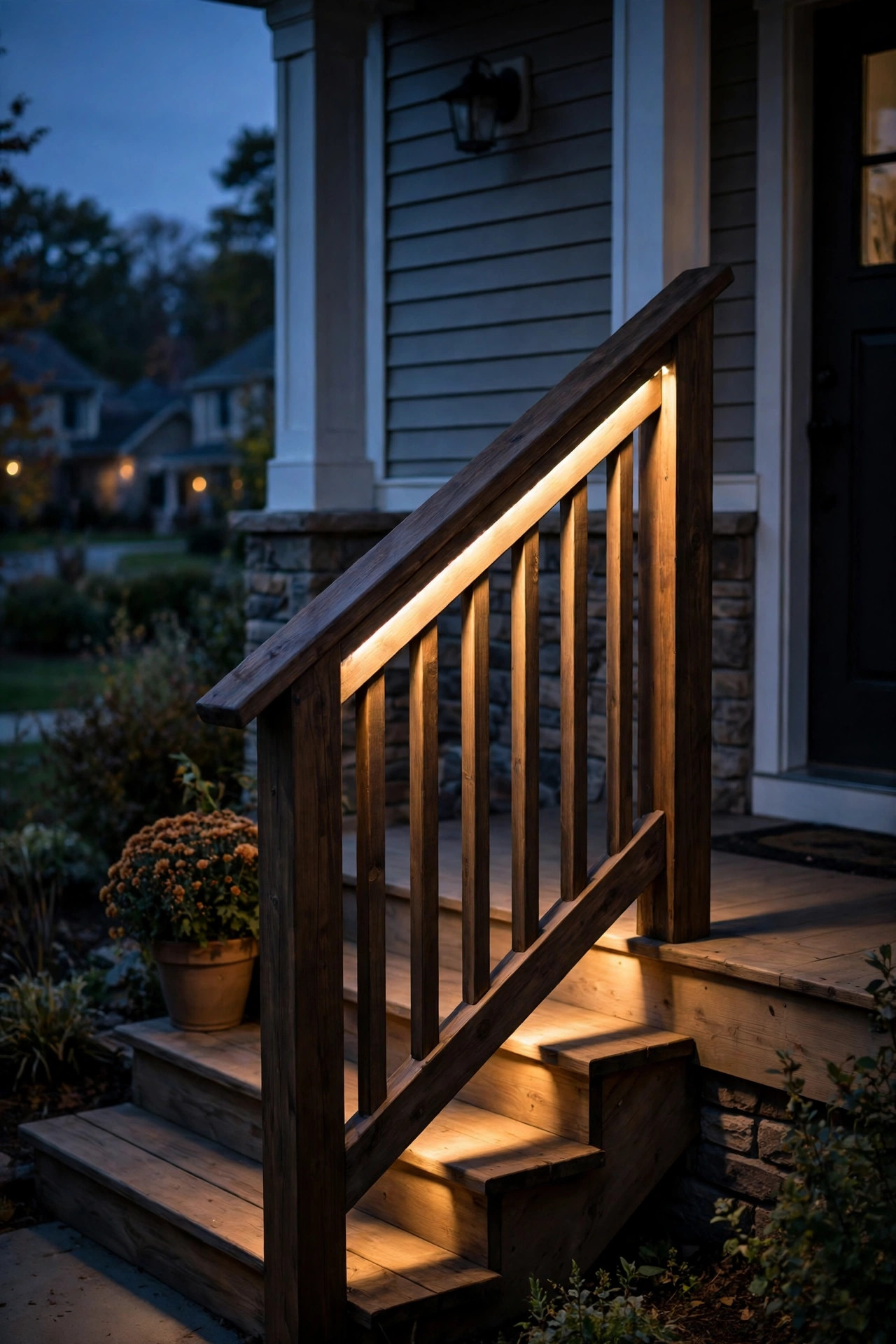
16. Run an LED Strip Under the Porch Rail or Step Edge
The most modern trick on this list, and the best space-saver: a weatherproof LED strip (IP65 or higher, 2700K) tucked under the porch handrail or beneath the lip of the top step throws a clean ribbon of light with the source completely invisible. On a small porch where every fixture shows, hiding the source is half the battle — all glow, no hardware. Cut the strip to length at the marked points, stick it with its adhesive plus a few clips for insurance, and run the low-voltage wire down a post corner where nobody will ever see it. Under a rail, it lights the porch floor and steps in one move; under a step lip, it defines the edge guests need to see. I always recommend a dimmer or a low-voltage transformer with a timer on strips, because full-brightness strips are too much for a small space — at 50% they're pure atmosphere.
Suggested budget range: $20 – $45.
17. Swap Every Bulb to One Warm Temperature
This is the cheapest idea here and, honestly, the one I'd do first. Small yards expose mismatched lighting mercilessly — when the whole scene is 20 feet wide, a cool blue porch bulb next to warm path lights reads as a mistake you can see from space. Pick one temperature for everything a visitor can see at once: 2700K warm white is my default for small front yards because it flatters brick, wood doors, and skin tones, and it makes greenery look lush rather than swampy. Go through the sconces, the porch fixture, the garage light, even the solar stakes (they're sold in warm and cool versions — check the box), and make them match. The yard instantly looks like it was designed in one pass by one person with a plan, which is the entire secret of "grand." It costs almost nothing, takes an afternoon, and in my before-and-afters it's the change neighbors ask about most.
Suggested budget range: $15 – $40.
18. Put Your Small Front Yard Lighting on Autopilot
Lighting you have to remember to switch on is lighting that stays dark half the time — and a small yard with half its layers off just looks unfinished. The fix costs less than dinner out: put plug-in fixtures on an outdoor smart plug or timer, choose solar with built-in photocells where you can, and for low-voltage runs use a transformer with a dusk-to-dawn sensor so the whole system wakes up at sunset by itself. My schedule is simple — on at dusk, off at 11 p.m. on weeknights, a little later on weekends; nobody's admiring curb appeal at 3 a.m. and the electricity savings (pennies a month with LEDs, but still) add up. Set it once in an app and your small front yard lighting performs every single evening like you hired someone. This is the unglamorous idea that makes all 18 others actually get seen.
Suggested budget range: $15 – $50.

19. Finish With a Lit Wreath and Garland at the Door
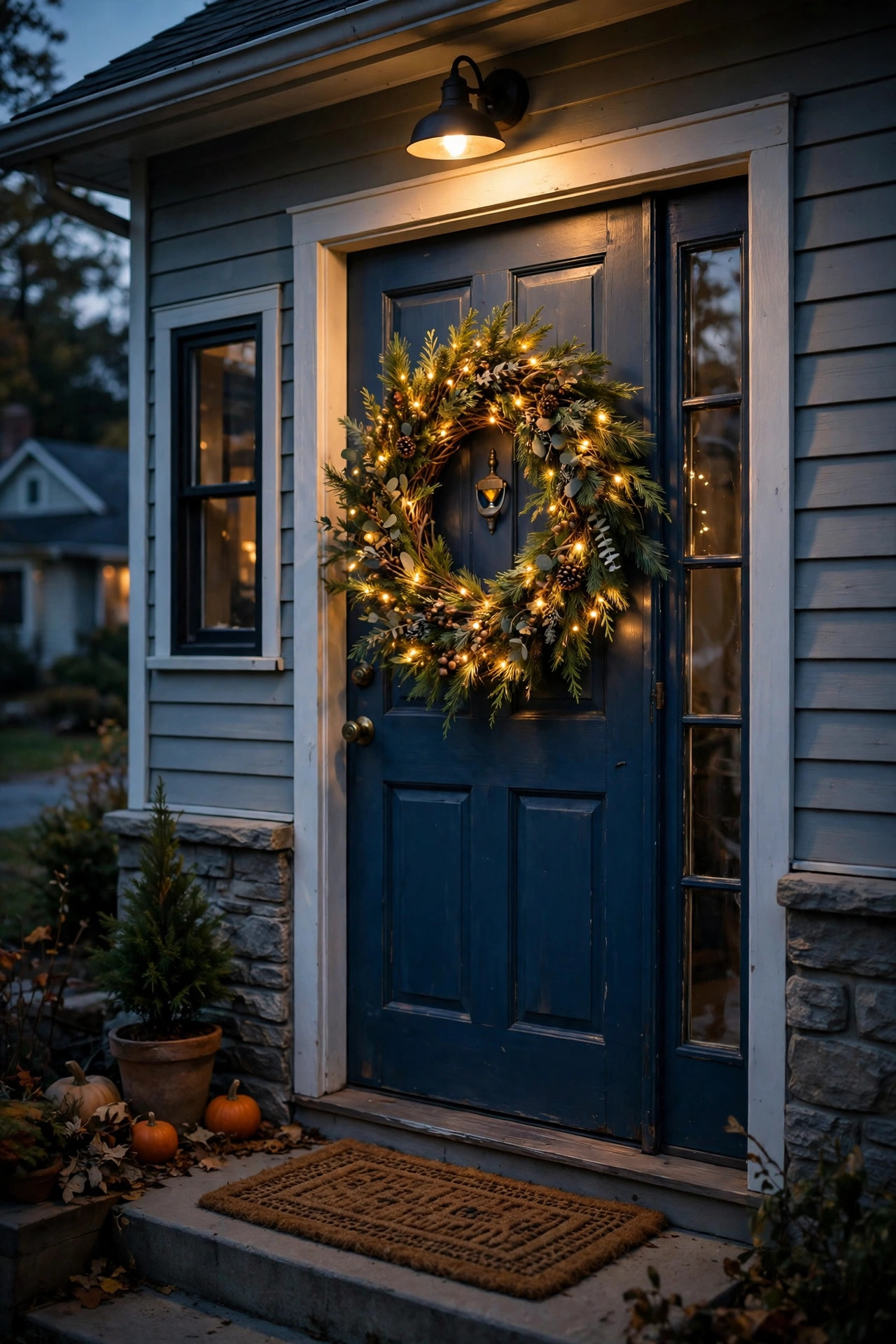
The final layer is pure welcome: a wreath on the door with a strand of battery fairy lights woven through it, or a short garland swagged across the top of the door frame with the same warm lights. It draws the eye to the destination, frames the entry like a picture, and photographs beautifully — which matters more than any of us admit. Keep it to the door zone only; on a small house, garland marching down the porch posts and along the roofline tips from "tasteful" to "theme park" fast. A magnolia or eucalyptus wreath reads year-round, and you can tuck in seasonal picks — pinecones in fall, ornaments in December — without changing the lighting. Use a battery pack with a timer so it joins the nightly show on its own. It's the smallest gesture in this entire list, and it's the one that makes guests smile before they've even knocked.
Suggested budget range: $25 – $55.
Frequently Asked Questions
How many lights does a small front yard actually need?
Fewer than you think — usually 8 to 14 fixtures total for a complete, layered look. My formula is 4–6 for the path, 1 star uplight, a pair at the door, and a few sparkle accents in the beds. On a small lot, every extra fixture past that point starts subtracting: the yard looks busy instead of grand. If you're planning your layout, start with the path and the door, live with it a week, then add layers one at a time.
Is solar or low-voltage better for a small front yard?
Honestly, a mix wins. Solar is unbeatable for path lights and bed accents in sunny yards — no wiring, no transformer, done in an afternoon. Low-voltage is better for the hero jobs (tree uplight, wall wash) because it's brighter and stays on all evening at full strength. If your yard is heavily shaded, lean low-voltage; a small 45-watt transformer runs an entire tiny-yard system with capacity to spare.
What color temperature makes a small yard feel bigger?
Warm white, 2700K, applied consistently. Warm light feels like it spreads and glows rather than beams, and consistency is what makes a small scene read as one designed space instead of a collection of fixtures. Cool 4000K+ light has its place in modern designs, but it tends to feel stark and exposing at small scale.
How much does it cost to light a small front yard?
A complete layered setup using the ideas above typically lands between $250 and $600 if you DIY, with solar-heavy versions at the low end. Running costs are almost a rounding error: a full LED system on a timer uses roughly $1–$3 of electricity per month. Start with the path, door, and one uplight for around $150, and add a layer each season.
Conclusion
If there's one thing I hope you take from these small front yard lighting ideas, it's that grand was never about square footage — it's about layers. A lit path, one glowing feature, warm light at the door, and everything on the same warm temperature: that's the whole formula, and it fits on the tiniest lot on the street. Start with two or three ideas this weekend, stand at the curb after dark, and add from there. Then browse the rest of my outdoor lighting ideas here on the site — your porch, patio, and garden deserve the same treatment.