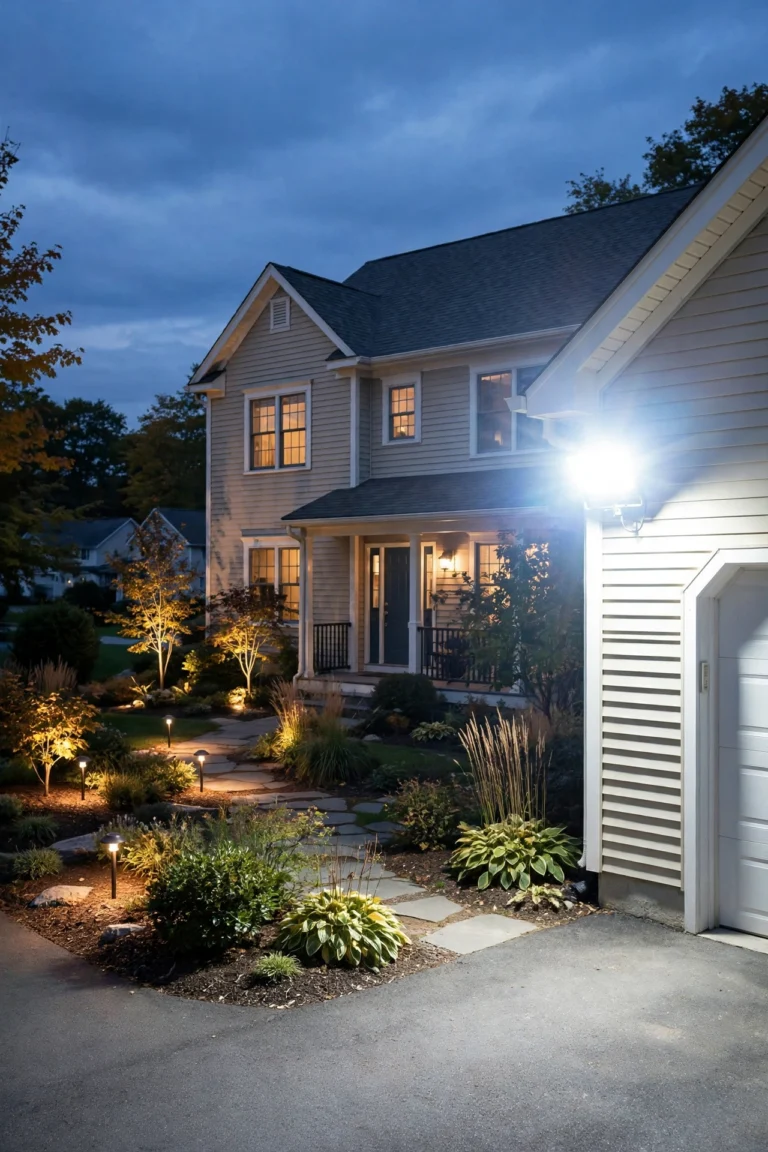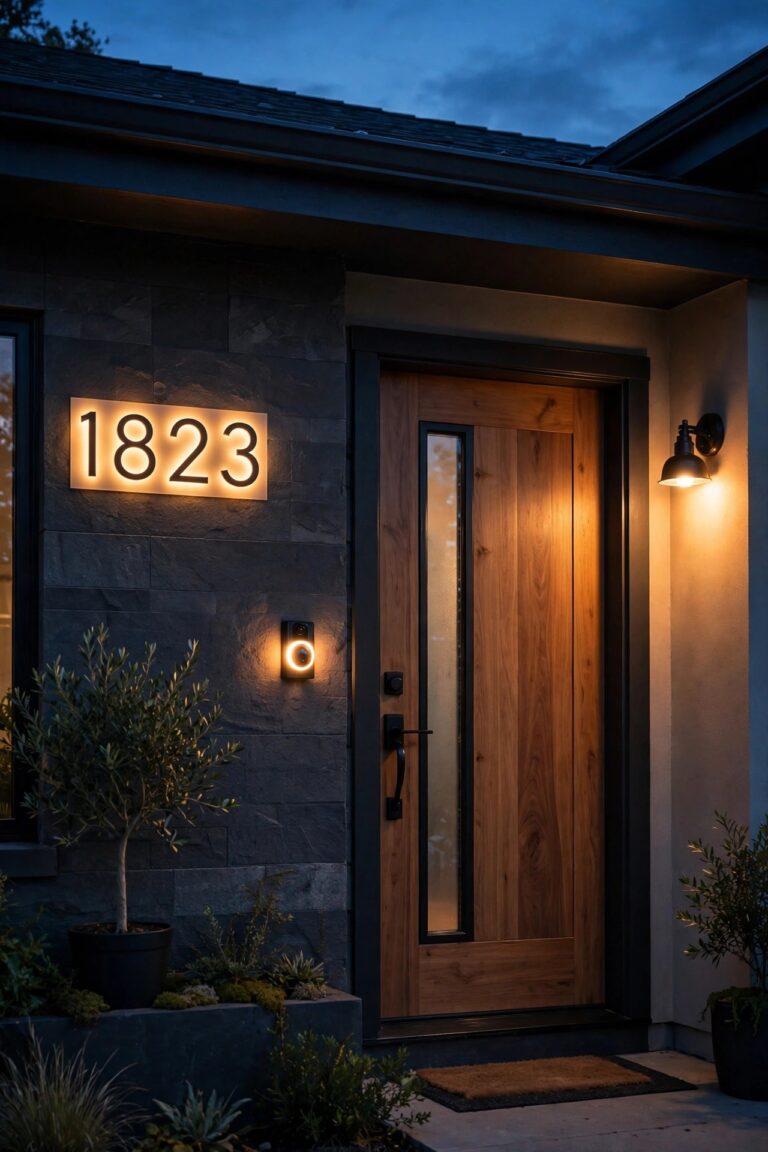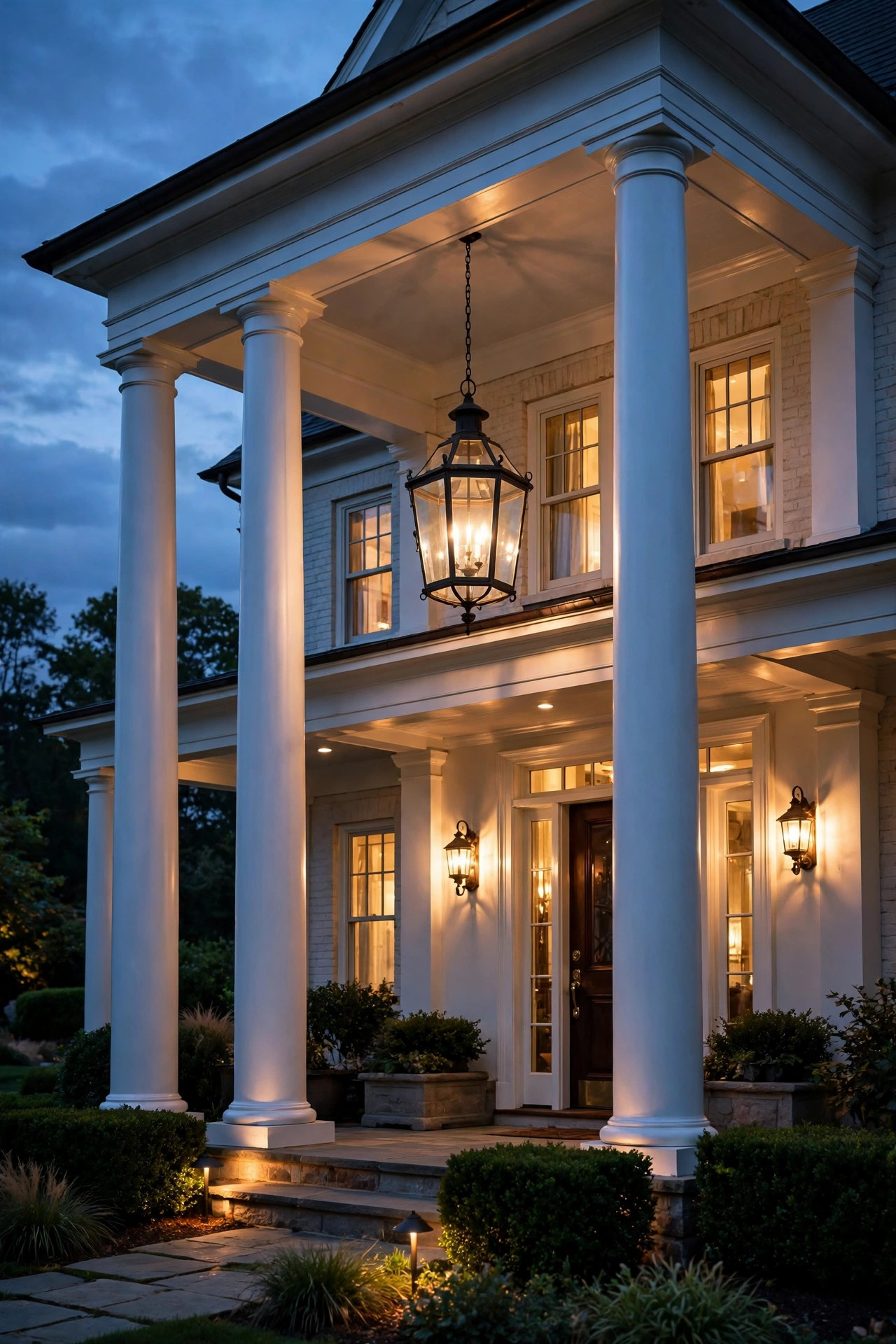
A two-story portico is a promise. Those tall columns and that soaring ceiling tell everyone who pulls into the driveway that this house has presence — but after dark, most porticos quietly break that promise. One undersized lantern rattling on a long chain, one dim bulb beside the door, and all that architecture disappears into the dark. The right portico lighting ideas fix that by working at the same scale as the architecture itself: bigger fixtures, higher mounting points, and layers that start at the walkway and climb all the way to the roofline. In my experience, a grand entry needs at least three layers — something glowing overhead, something framing the door, and something lifting the columns. Below are the 17 portico lighting ideas I recommend again and again for two-story porches, from the oversized pendant that sets the scale to the smart timers that bring the whole scene to life at dusk. Most are weekend-doable, and every single one is sized for a tall entry, not a standard 8-foot porch.
1. Hang One Oversized Pendant Lantern — the Portico Lighting Idea That Sets the Scale
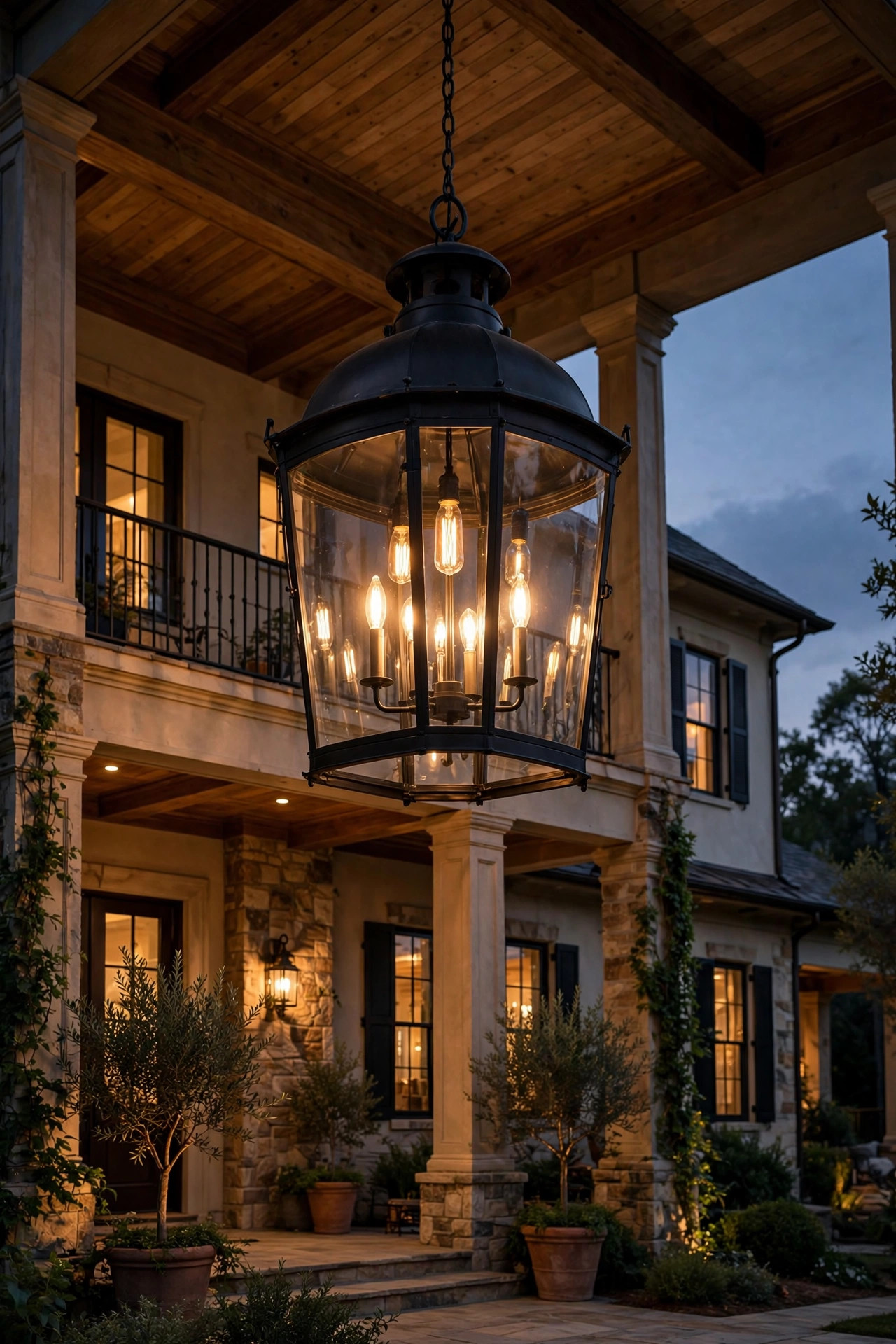
If you change only one thing, change this. The standard 12-inch porch pendant that looks fine over a cottage door simply vanishes under a 16- to 20-foot portico ceiling. For a two-story entry, I always recommend a pendant lantern that's 24 to 36 inches tall and 14 to 20 inches wide — it sounds enormous in the store, and then it looks exactly right once it's hanging in all that vertical space. Hang it on a sturdy chain or rod so the bottom of the lantern sits roughly 10 to 12 feet above the porch floor on taller ceilings: well above an 8-foot door and any transom, but low enough to read as a glowing centerpiece rather than a distant dot. Choose a wet-location-rated fixture with LED filament-style bulbs in the 800 to 1,200 lumen range, and put it on a dimmer so you can soften it for everyday evenings and bring it up when guests arrive. Honestly? This single fixture does more for a grand entry than any other item on this list, because every other layer you add will be judged against its scale.
Suggested budget range: $180 – $650.
2. Flank the Front Door With a Pair of Grand Wall Lanterns
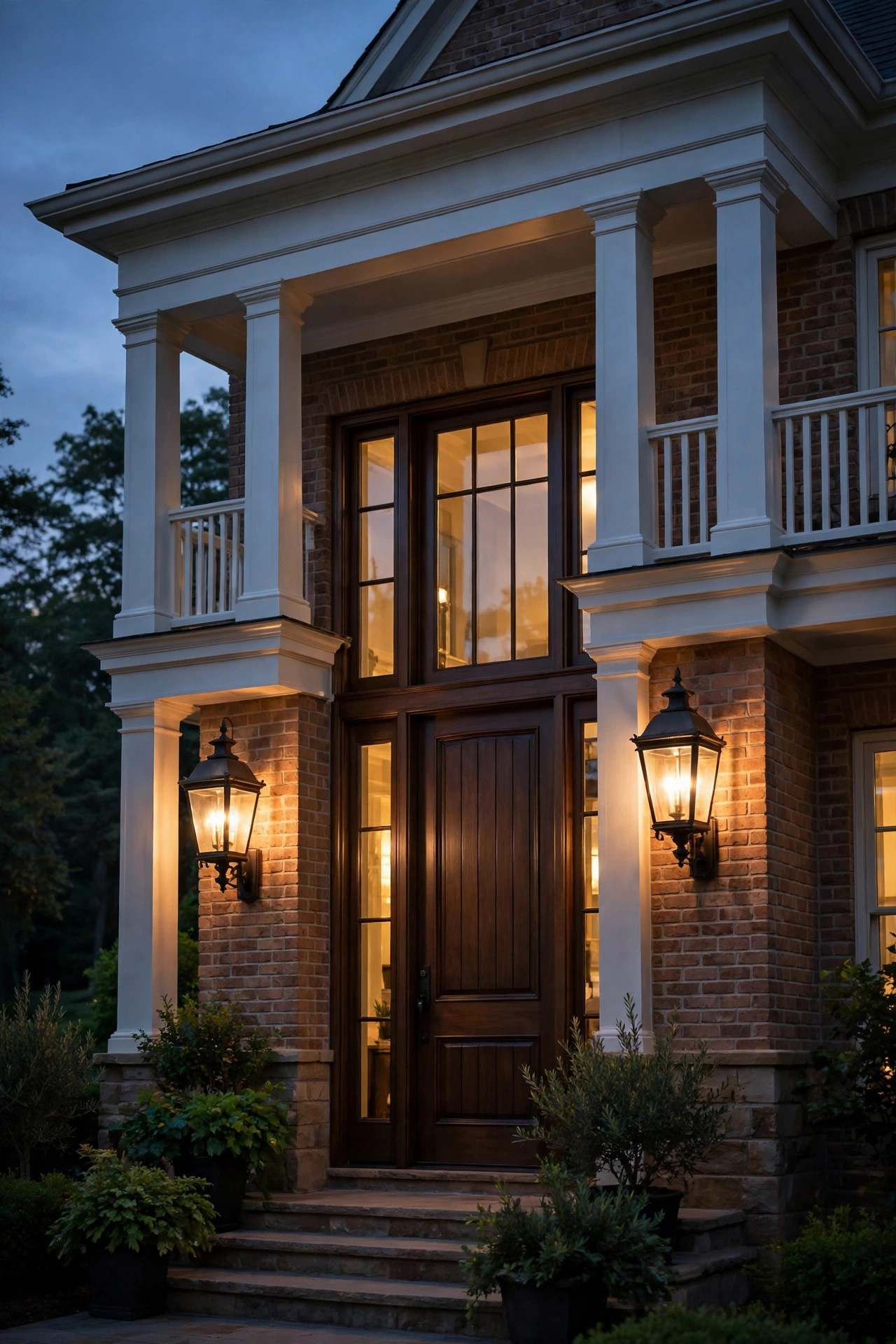
A two-story portico usually means an oversized door to match, and standard sconces get swallowed by it. My rule of thumb: each wall lantern should stand about one-quarter to one-third the height of the door itself, so for an 8-foot door with a transom, look for lanterns 20 to 28 inches tall. Mount them with the center of the fixture around 72 to 78 inches above the porch floor — a touch higher than the usual 66 inches, because the eye reads them against a much taller wall. Symmetry matters enormously at this scale; even a half-inch difference in mounting height shows from the street. Aim for 400 to 800 lumens per lantern in warm 2700K light, and match the finish and glass style to your overhead pendant so the entry reads as one designed suite. If your door has sidelights, keep the lantern width proportional so they don't crowd the glass. I walk through the sizing math in more detail in my front door sconce pair guide, but the short version is this: when you're torn between two sizes, the bigger one is almost always right on a two-story entry.
Suggested budget range: $120 – $480.
3. Uplight Every Column From Its Base
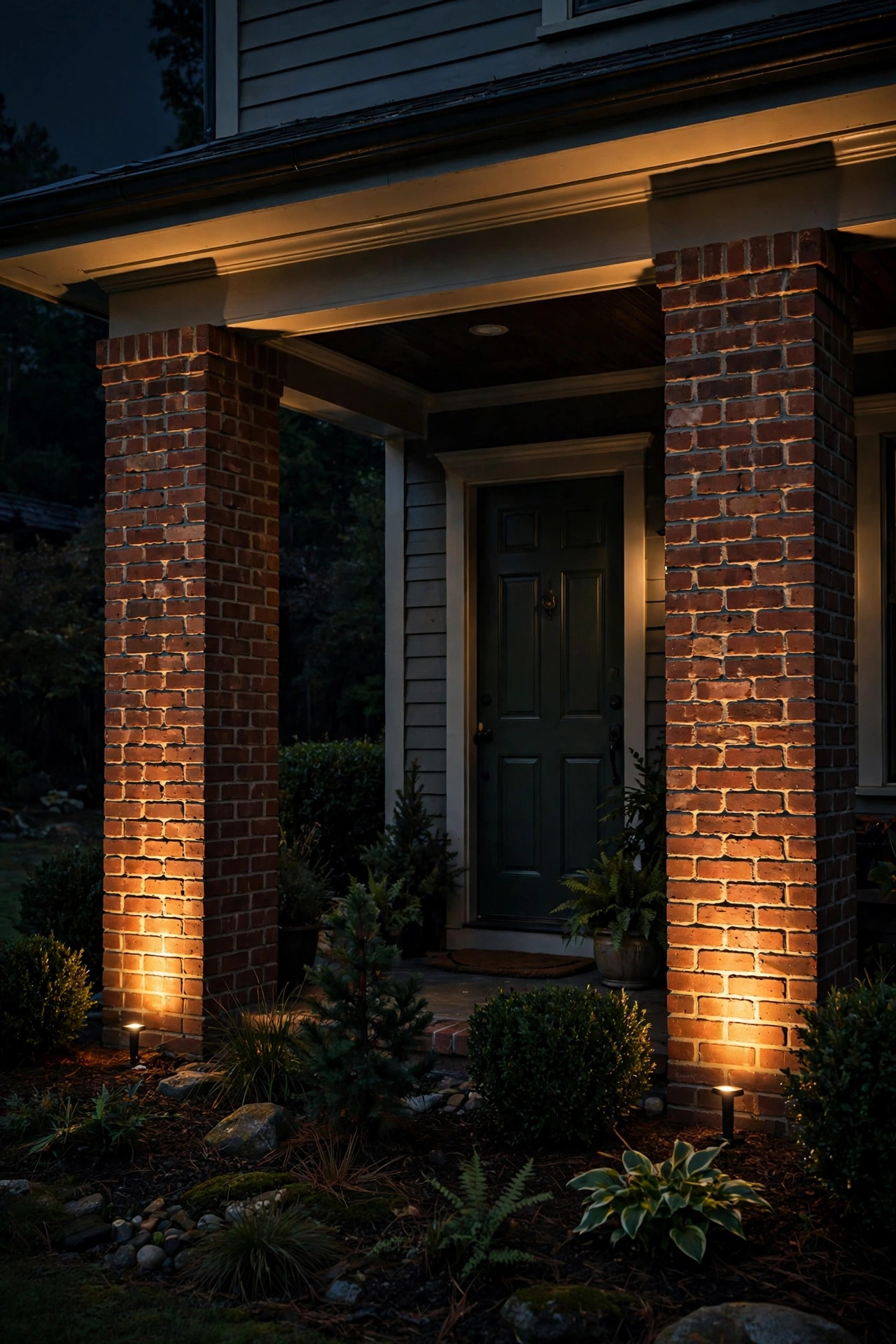
This is the layer that creates the drama people remember. A small in-ground well light or adjustable low-voltage spotlight tucked at the base of each column, aimed straight up with a narrow 15- to 30-degree beam, sends a ribbon of light the full height of the shaft and turns plain columns into glowing pillars. Position each fixture 6 to 12 inches out from the base so the beam grazes the surface and picks up every bit of texture — fluting, brick, and stone all look incredible lit this way. For most columns, 300 to 600 lumens per fixture is plenty; you're sculpting, not floodlighting. A 12V low-voltage system keeps this DIY-friendly and cheap to run, and it ties neatly into the same transformer as your path lights. In my experience, column uplighting is what separates a portico that looks "lit" from one that looks like a magazine cover, because it gives the architecture height after dark instead of letting the roofline crush everything into shadow. Do the columns in pairs so both sides of the entry match exactly, and angle one test light before you commit to trenching for all of them.
Suggested budget range: $60 – $300.
4. Graze the Columns With Downlights From the Capitals
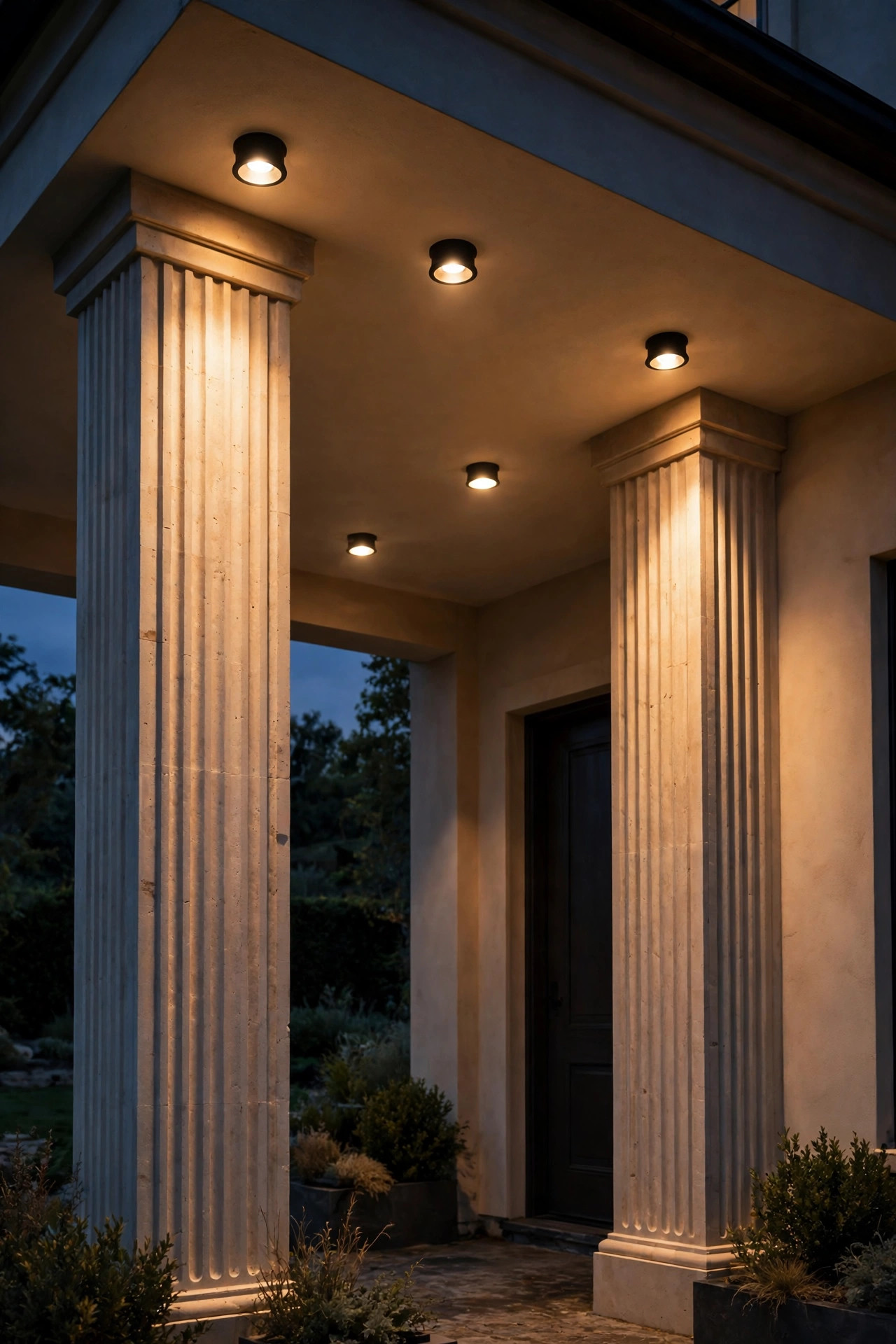
Uplighting isn't the only direction that works. Small, shielded downlights tucked just under the portico ceiling or at the column capitals wash light down the shaft instead, pooling softly at the base. The effect is moodier and more architectural — long scallops of light that feel like candlelight scaled up. It's a wonderful choice when in-ground fixtures aren't practical, say over a stone or concrete porch floor where you can't trench, or when your columns sit close to planting beds you'd rather not disturb. Keep the fixtures small and recessed or surface-mounted tight to the beam so they disappear by day, and choose 2700K LED modules around 200 to 400 lumens each so the wash stays gentle. One caution from experience: never mix directions on the same column. Pick uplight or downlight per column and stay consistent across the whole portico, or the entry starts to look accidental. Downlights also throw a little useful light onto the porch floor itself, which makes them a smart partner to dim statement pendants that are more about glow than illumination.
Suggested budget range: $90 – $350.
5. Add Recessed Downlights Across the Portico Ceiling
A tall portico ceiling collects shadows like nobody's business, and recessed downlights are the cleanest way to erase them. Slim 4- to 6-inch LED downlights with wet-location trims, spaced about 4 to 6 feet apart in a tidy grid or a single row over the door swing, give you an even wash of working light across the whole porch floor. On a high ceiling, choose narrower beam angles or slightly higher output — 600 to 900 lumens per fixture — because the light has farther to travel before it lands. Put them on their own dimmer, separate from your statement pendant, so you can run them low as a background layer or bring them up when you're hauling in groceries after dark. Gimbal trims are worth the small upgrade near the edges, since you can tip the beam slightly toward the door and steps where footing matters most. This is the least glamorous idea on the list, I'll admit, but it's the layer guests unconsciously appreciate: no dark corners, no squinting at the keypad, and a porch floor that looks as generous as it does at noon.
Suggested budget range: $150 – $600.
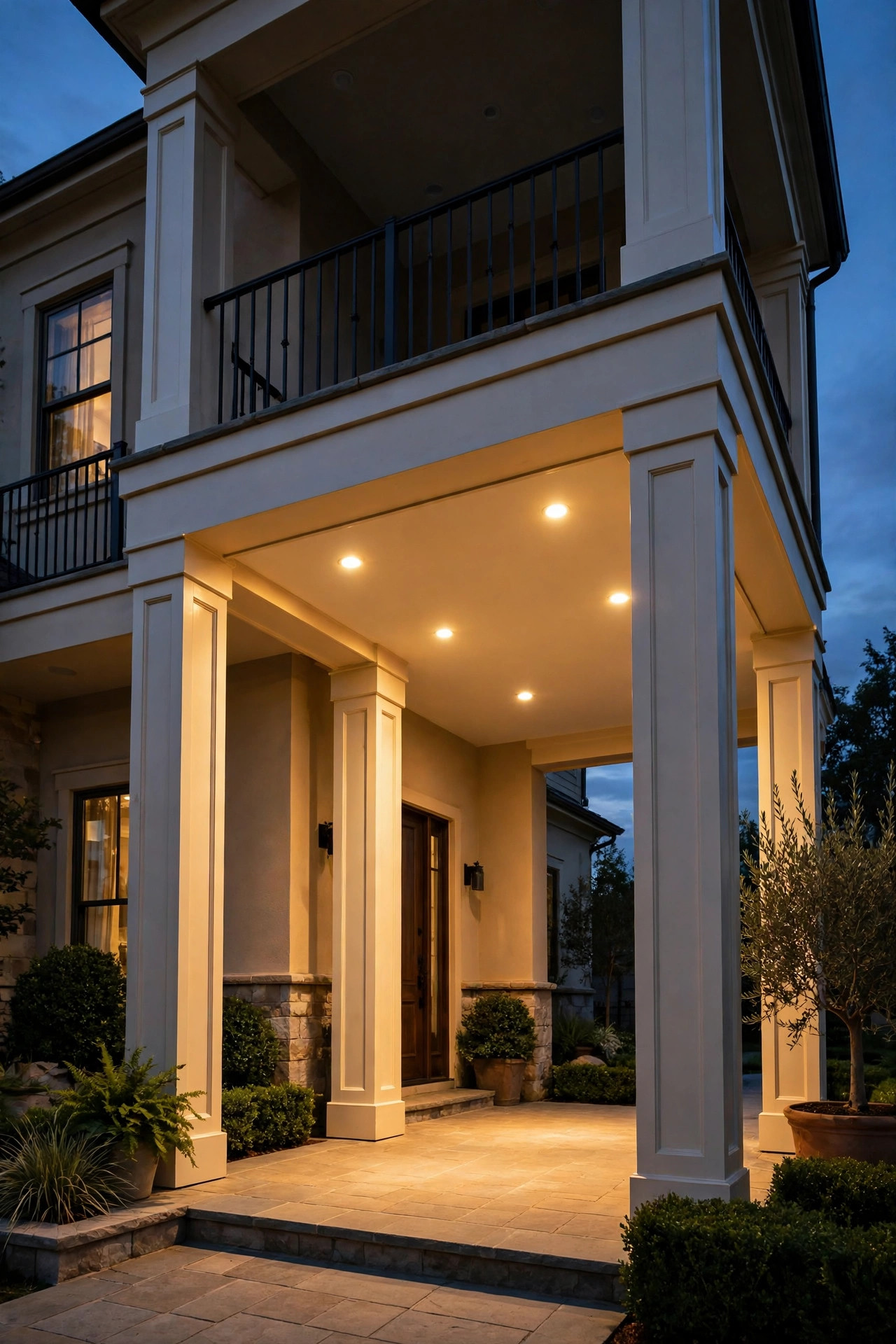
6. Make Room for a Statement Outdoor Chandelier
Some porticos are practically outdoor rooms — if yours has a ceiling of 12 feet or more and real depth, a chandelier can be the crown jewel. Look for a fixture 30 to 48 inches wide, rated for damp or wet locations, with candle-style LED bulbs that mimic the flicker of real flame without any of the fire risk. Proportions follow the same rule as a dining room: the chandelier should span roughly half to two-thirds the width of the "table" beneath it, which on a portico means the width of your door grouping or seating area. Hang it on the centerline of the entry, and confirm your junction box is rated for the weight — grand chandeliers can run 30 pounds or more, and a fan-rated support box is cheap insurance an electrician can swap in an hour. A dimmer isn't optional here; at full brightness a chandelier can flatten all your other layers, but dimmed to about 60 percent it becomes the warm heart of the whole composition. Honestly, nothing else on this list gets compliments from the sidewalk quite like it.
Suggested budget range: $350 – $1,200.
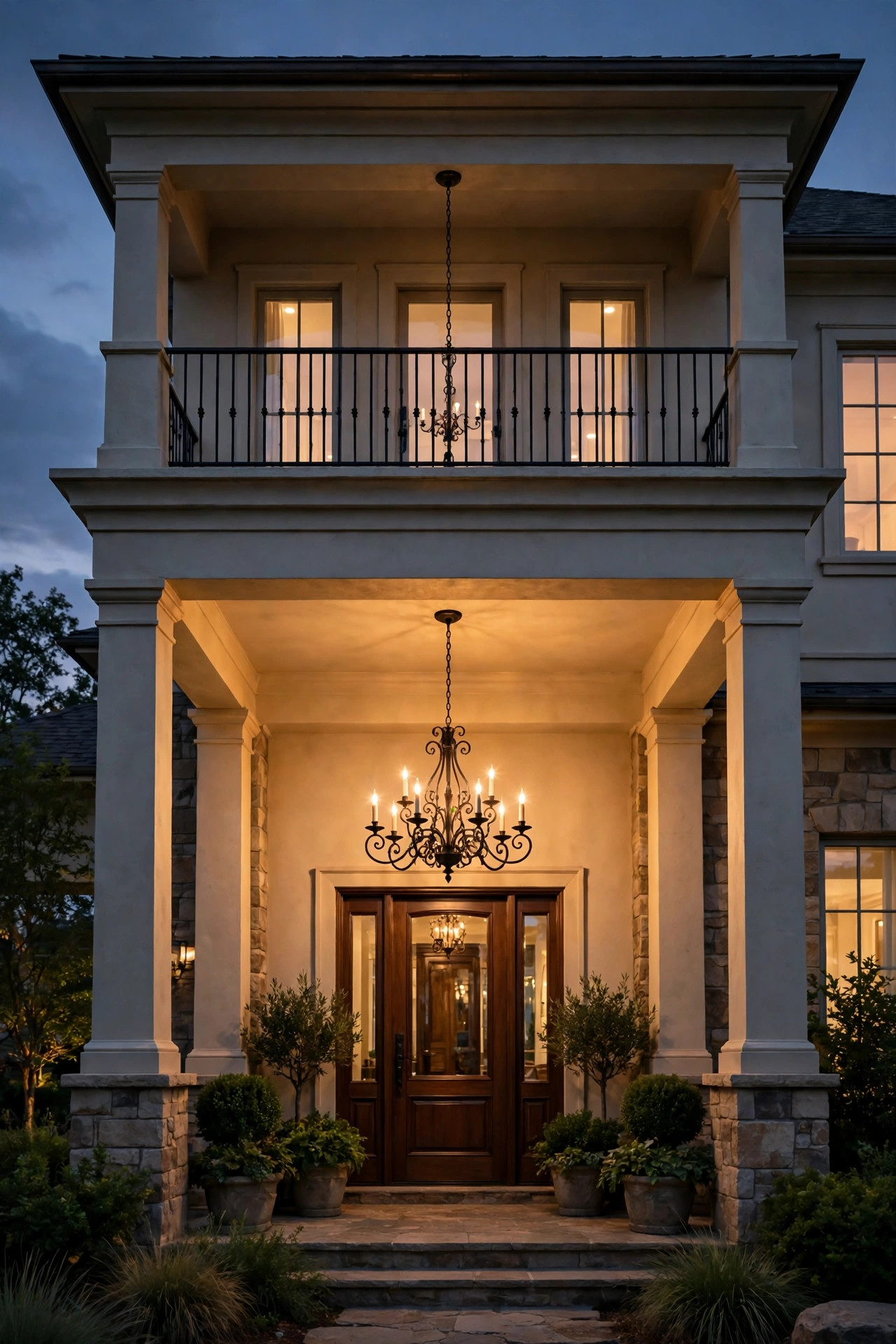
7. Hang Twin Pendants at Staggered Heights
Deep porticos — the kind that run 10 or 12 feet from door to columns — can swallow a single pendant whole, no matter how oversized it is. The fix I love here is a pair (or trio) of matching pendants hung at staggered heights along the depth of the porch, dropping in steps of 12 to 18 inches from the door outward. The eye follows the descending rhythm of light toward the street, and the whole entry gains a sense of procession, like walking up to a grand hotel. Keep all the fixtures identical in style and finish; it's the chain lengths that should vary, not the design. Each pendant can be a touch smaller than the single statement fixture from idea one — 18 to 26 inches tall works beautifully — because together they carry the scale. Wire them on one switch and one dimmer so they always behave as a set. This arrangement also solves a sneaky practical problem: on deep porches, the area halfway between door and steps is often the darkest, and the lower outer pendant lands its glow right where guests pause to climb.
Suggested budget range: $220 – $700.
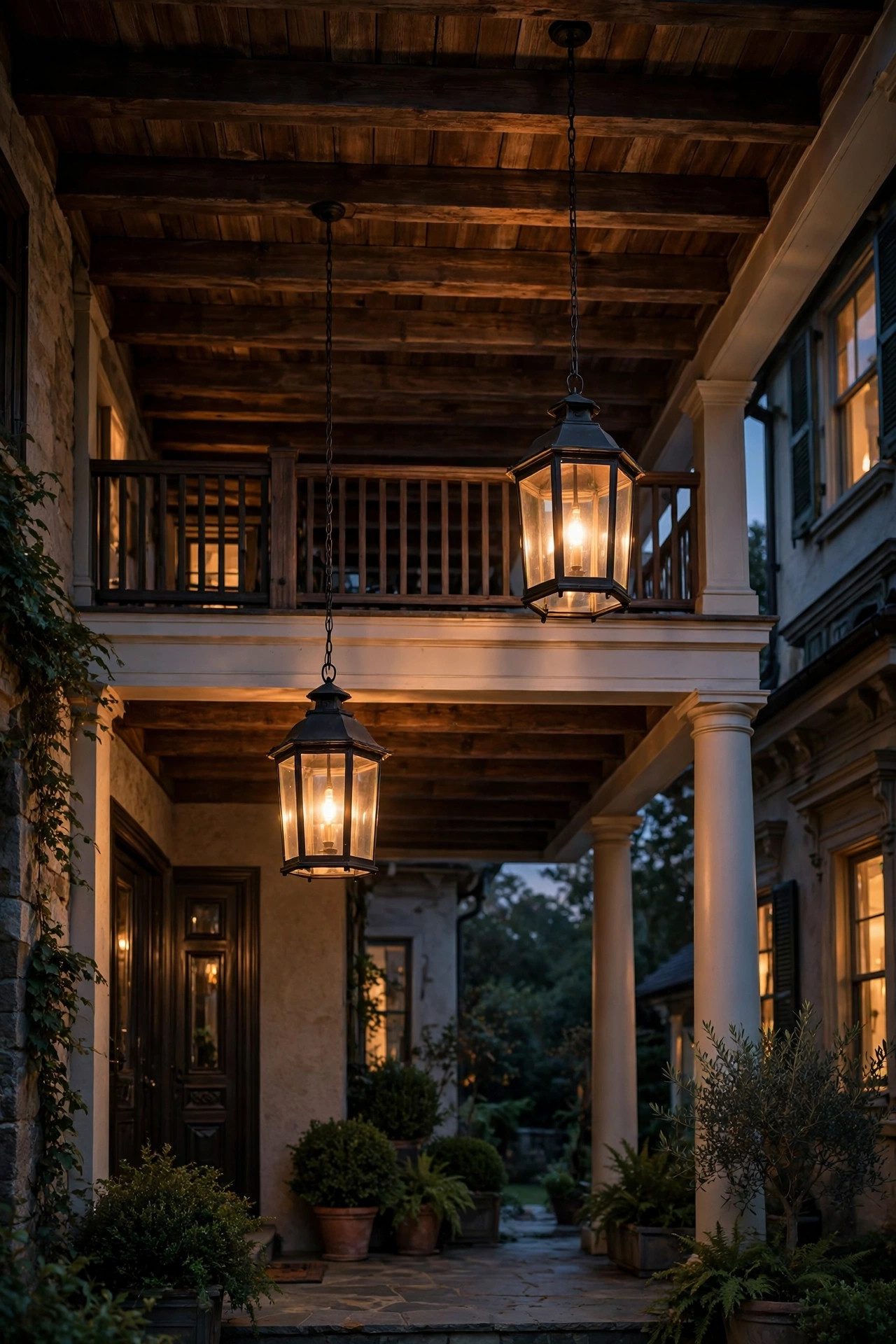
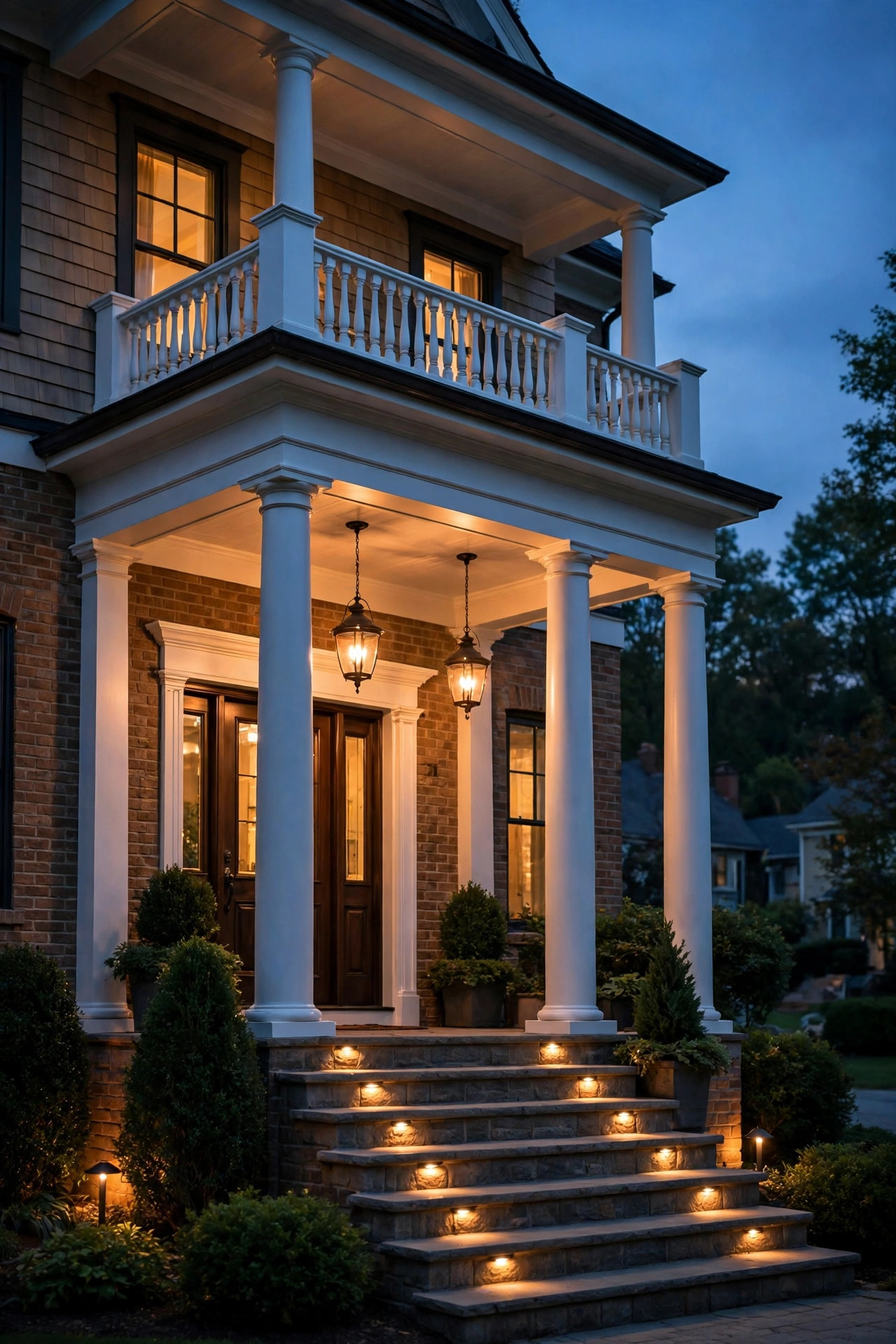
8. Light the Steps for a Safe, Grand Climb
Wide ceremonial steps are part of the two-story portico package, and they're a genuine hazard in the dark — I've watched guests hesitate at the top more than once. Recessed step lights set into the risers, or small louvered fixtures in the side walls of the staircase, put a soft pool of light exactly where feet land. For stairs wider than 6 feet, place a fixture toward each end of every second or third step; narrower runs do fine with one centered light per step or two. Keep output modest, 50 to 100 lumens per fixture, with louvers or frosted lenses so nobody's looking straight at a diode from below. Warm 2700K light, wired low-voltage where you can, keeps the climb feeling like part of the welcome instead of a parking lot. If your steps are already built and cutting into risers isn't an option, surface-mount tread lights under each nosing give nearly the same effect with far less surgery. This is safety lighting, yes — but done right, it reads as pure luxury, like the staircase of a boutique hotel.
Suggested budget range: $80 – $320.
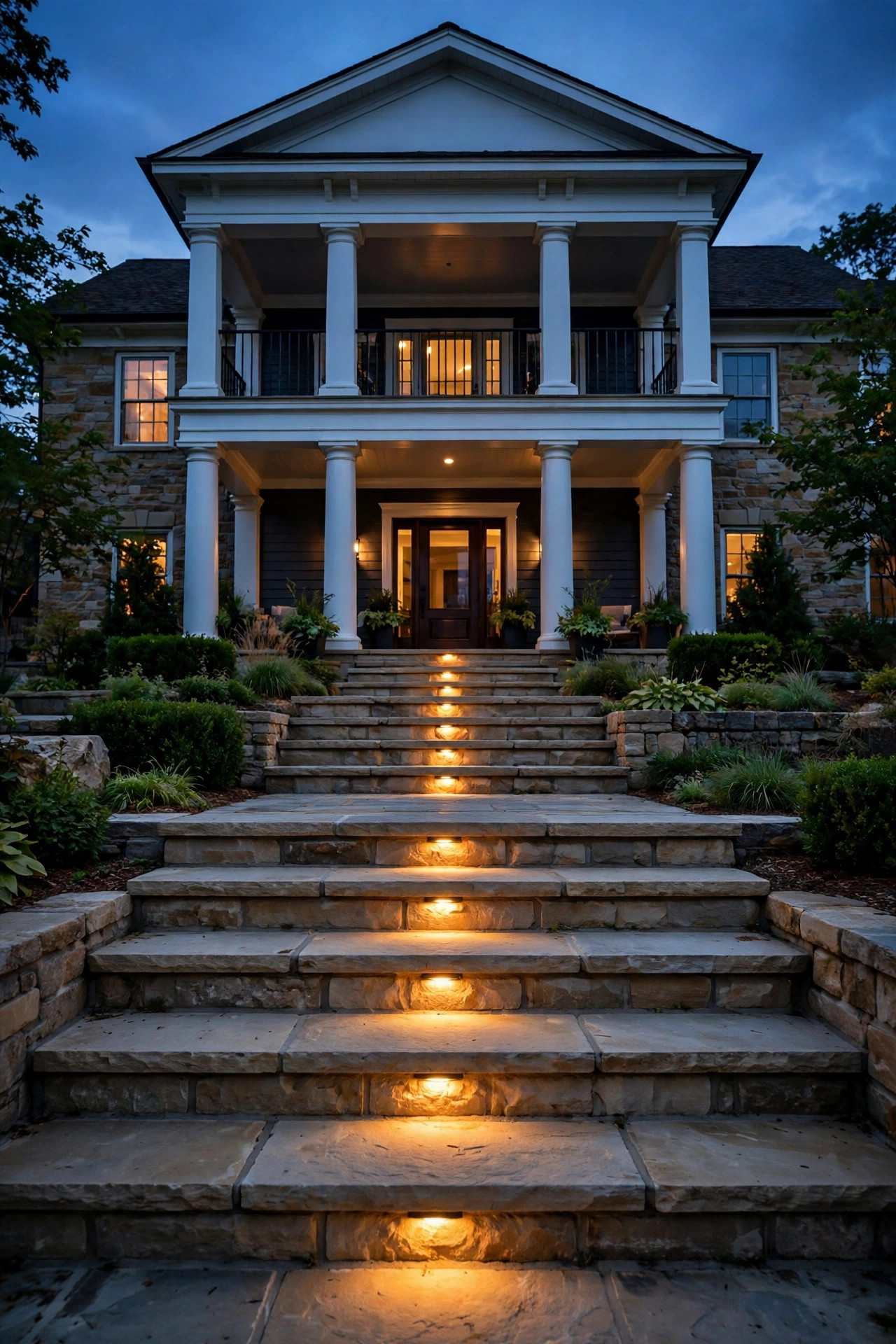
9. Line the Steps With Hurricane Lanterns
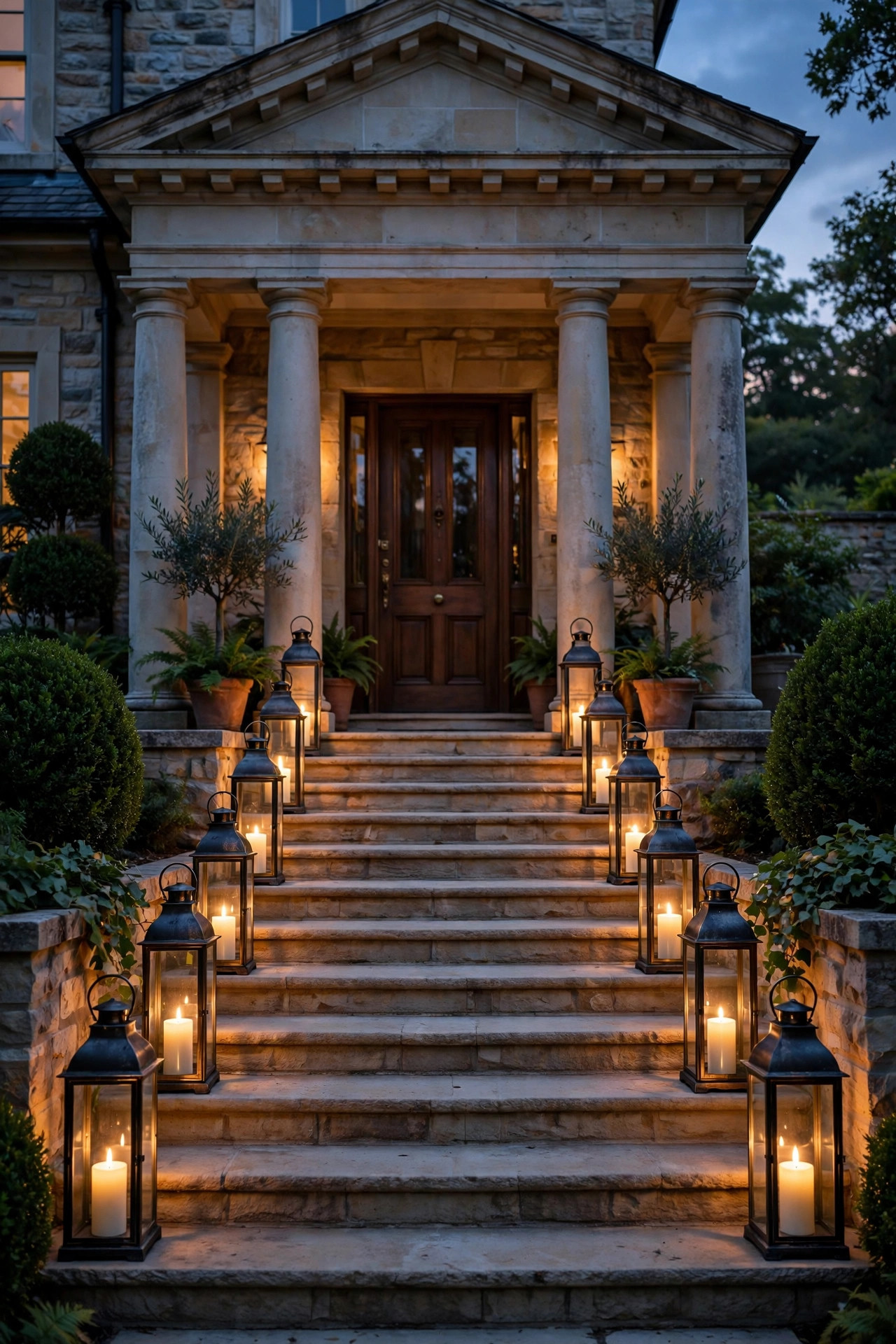
Not every layer needs a wire. Oversized hurricane lanterns with flameless LED candles, set in pairs on alternating steps or flanking the base of the staircase, add a flickering, human-scale warmth that balances all the big architectural lighting above. Choose lanterns at least 18 to 24 inches tall so they hold their own against the scale of the entry — the little tabletop sizes disappear out here. Flameless candles with built-in 5-hour timers are the move: set them once, and they glow every evening and shut themselves off before bed. Battery life runs weeks to months depending on the candle, and there is zero fire risk near garlands, wreaths, or dry autumn leaves, which is more than I can say for real flames on a breezy porch. I swap the styling with the seasons — plain candles most of the year, a little greenery tucked around the bases in December, mini pumpkins nearby in October. It's the cheapest idea in this whole list, and somehow it's the one that makes people slow down and say the entry feels like a home, not just a house.
Suggested budget range: $40 – $150.
10. Hide LED Strip Lighting in the Ceiling Beams
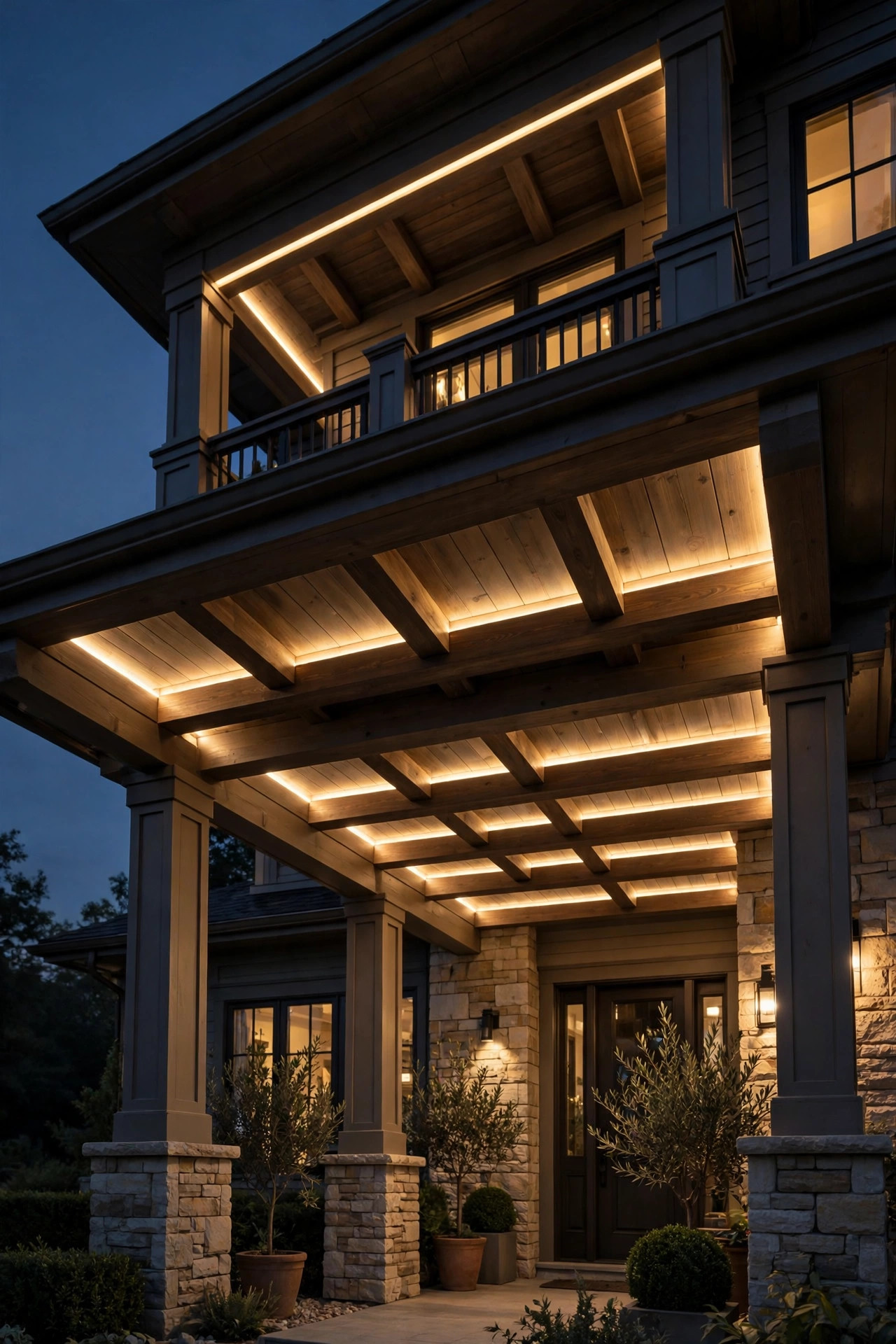
Two-story porticos often have beautiful bones overhead — exposed beams, coffers, or a beadboard ceiling — and hidden strip lighting shows them off without a single visible fixture. Run outdoor-rated (IP65) LED tape in an aluminum channel with a frosted diffuser, tucked along the top edge of beams or behind a trim strip at the ceiling line, and the whole ceiling floats on a soft indirect glow. The light bounces down gently, raising the perceived ceiling height and filling in the shadows between your pendant and recessed cans. Low voltage keeps it safe and DIY-friendly, and a separate dimmer lets it whisper in the background at 30 percent on normal nights. Two practical notes from my own installs: always use the channel, because bare tape shows as a row of harsh dots reflected in windows and glossy paint, and choose 2700K tape to match your other layers — mismatched color temperatures are the fastest way to make a grand entry look like a patchwork. Run the driver (power supply) somewhere reachable, like a closet or the garage wall just inside, so a future replacement isn't a ceiling project.
Suggested budget range: $110 – $380.
11. Wash the Upper Facade With Light
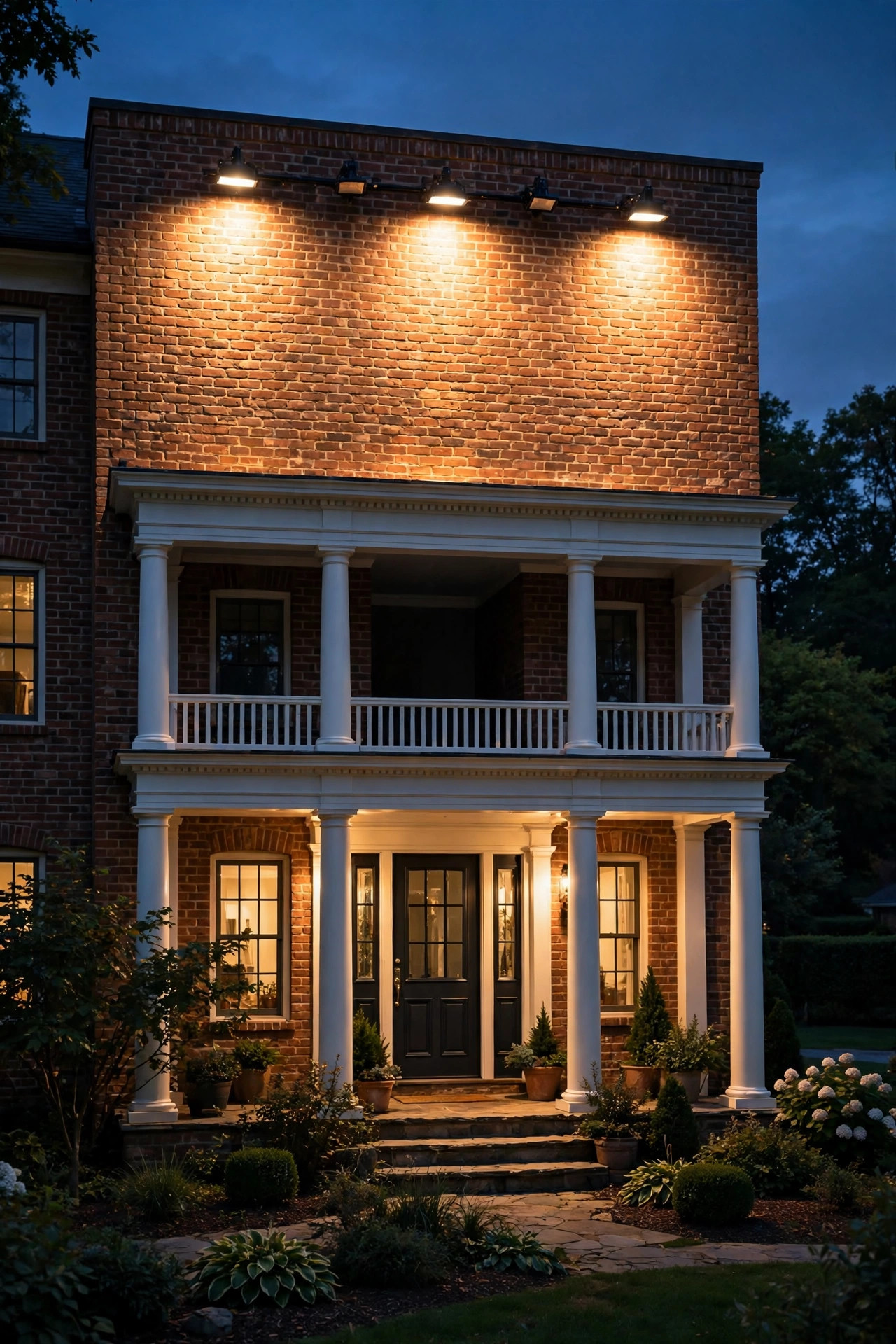
Here's something most people forget: a two-story portico stands in front of a two-story wall, and if that wall stays black, the entry looks like a bright stage set floating in nothing. A pair of wide-beam floodlights — ground-mounted spots aimed up, or discreet fixtures on the portico roof — can graze the brick, siding, or stone above the portico and give the whole facade depth. Use a wide 60- to 120-degree beam and keep the aim steep so light rakes across the surface rather than blasting straight into second-story windows; your family upstairs will thank you. This wash doesn't need to be bright. A gentle 400 to 800 lumens per fixture at 2700K is enough to separate the house from the night sky and show off the architecture the portico belongs to. Shielded, dark-sky-friendly fixtures keep the glow polite for neighbors. In my experience this is the layer that makes a house look genuinely expensive from the street, because it completes the vertical picture — walkway, columns, portico, and now the full face of the home, all reading as one composition.
Suggested budget range: $100 – $420.
12. Uplight the Frieze and Roofline — the Portico Lighting Idea Most People Skip
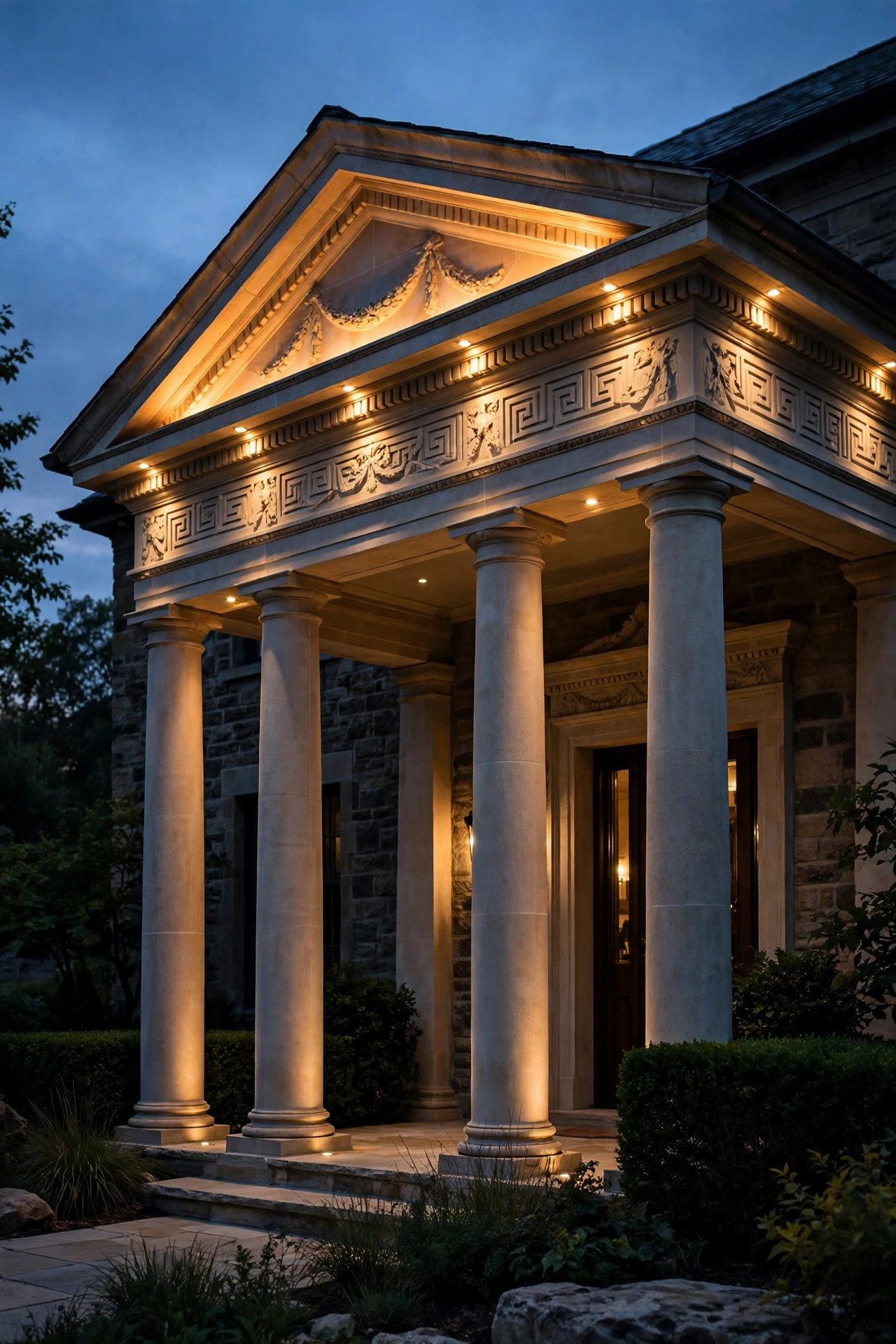
Every grand portico has a crowning element: the horizontal band, frieze, or pediment where the columns meet the roof. By day it's the exclamation point of the design; by night, on most houses, it vanishes. Two or three small, narrow-beam accent lights aimed at that band from the portico floor or tucked along the beam will pick it out of the darkness and finish the vertical story your column lights started. Think of it as the top note in a chord — the columns carry the middle, the steps anchor the bottom, and this slim ribbon of light signs the whole thing. Keep beams narrow (10 to 25 degrees) and output low, 200 to 400 lumens, because the frieze is usually painted wood or trim that reflects light efficiently and blows out fast. If your portico has a pediment with a decorative vent or medallion, a single centered spot turns it into a nighttime focal point. This is a subtle layer, and that's exactly the point: visitors won't be able to name why the entry looks finished, but they'll feel it.
Suggested budget range: $90 – $340.
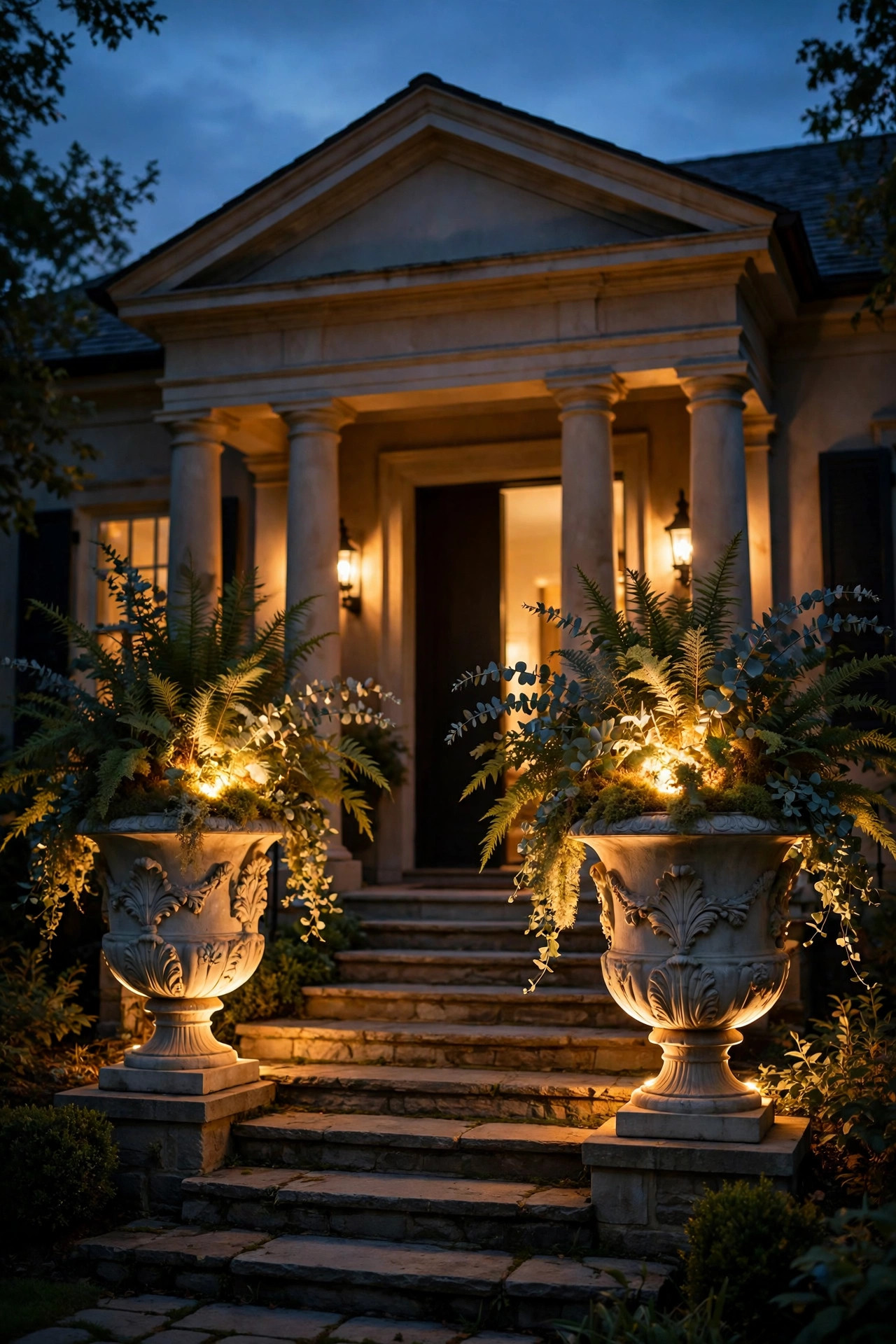
13. Spotlight the Urns and Planters Flanking the Steps
A pair of big urns or planters at the base of the steps is practically mandatory on a two-story portico, and a small spotlight makes them glow like sculpture after dark. Tuck a low-voltage accent light behind each planter, aimed up into the foliage, or nestle a fixture inside the planter itself behind the plantings — the leaves catch the light, shadows dance on the wall behind, and the whole arrangement looks alive. Topiary, ornamental grasses, and seasonal flowers all take uplighting beautifully. You only need 200 to 300 lumens per planter; more will flatten the plant into a green blob. Solar spotlights with separate panels are a decent no-wire option here if the spot gets decent afternoon sun, though I find wired fixtures more reliable through winter. This is also the perfect place to add a whisper of seasonal color — flowering annuals in spring, ornamental kale and pansies in fall — because the dedicated light makes even a modest planting look deliberate and lush against the big scale of the entry.
Suggested budget range: $35 – $160.
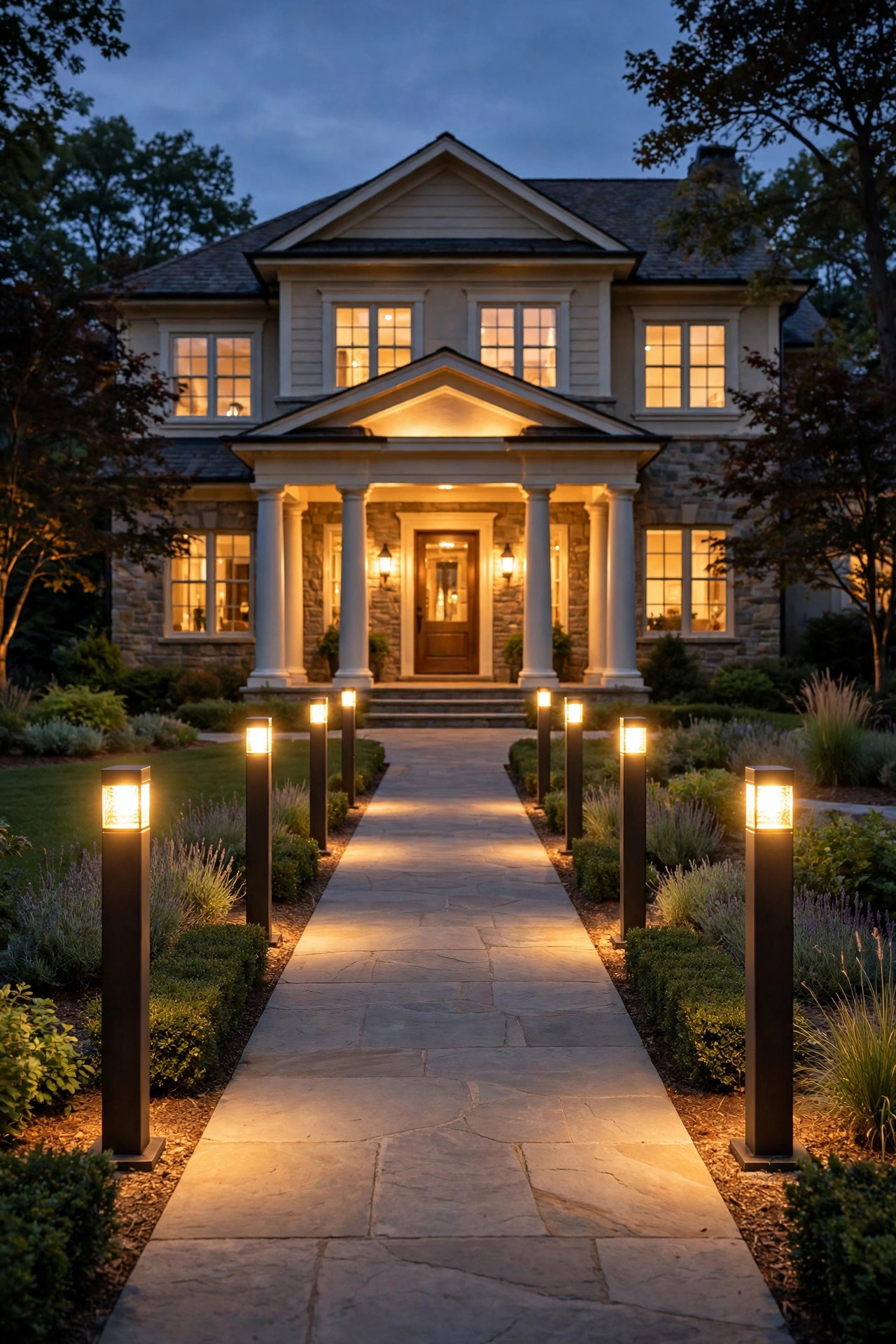
14. Lead Guests In With Path Lights
The portico experience starts at the driveway, not at the steps. A run of path lights from the street or drive to the staircase tells guests exactly where to walk and builds anticipation with every step. On a grand entry, skip the tiny mushroom-cap solar lights and choose taller fixtures — 24- to 30-inch bollard-style or lantern-style path lights that hold their own against the scale of the house. Space them 6 to 8 feet apart, and for a formal two-story entry I prefer matched pairs on both sides of the walk over the staggered zigzag that suits casual gardens; symmetry is the whole language of a portico. Low-voltage fixtures on one transformer with your column uplights keep everything on the same timer and color temperature. If you're planning a full walkway scheme, my walkway lighting ideas cover spacing and placement patterns in depth. Keep fixtures a foot back from the walk's edge so mower wheels and suitcase corners don't find them, and shield the light source downward — guests should see the lit path, never the bulb itself.
Suggested budget range: $120 – $450.
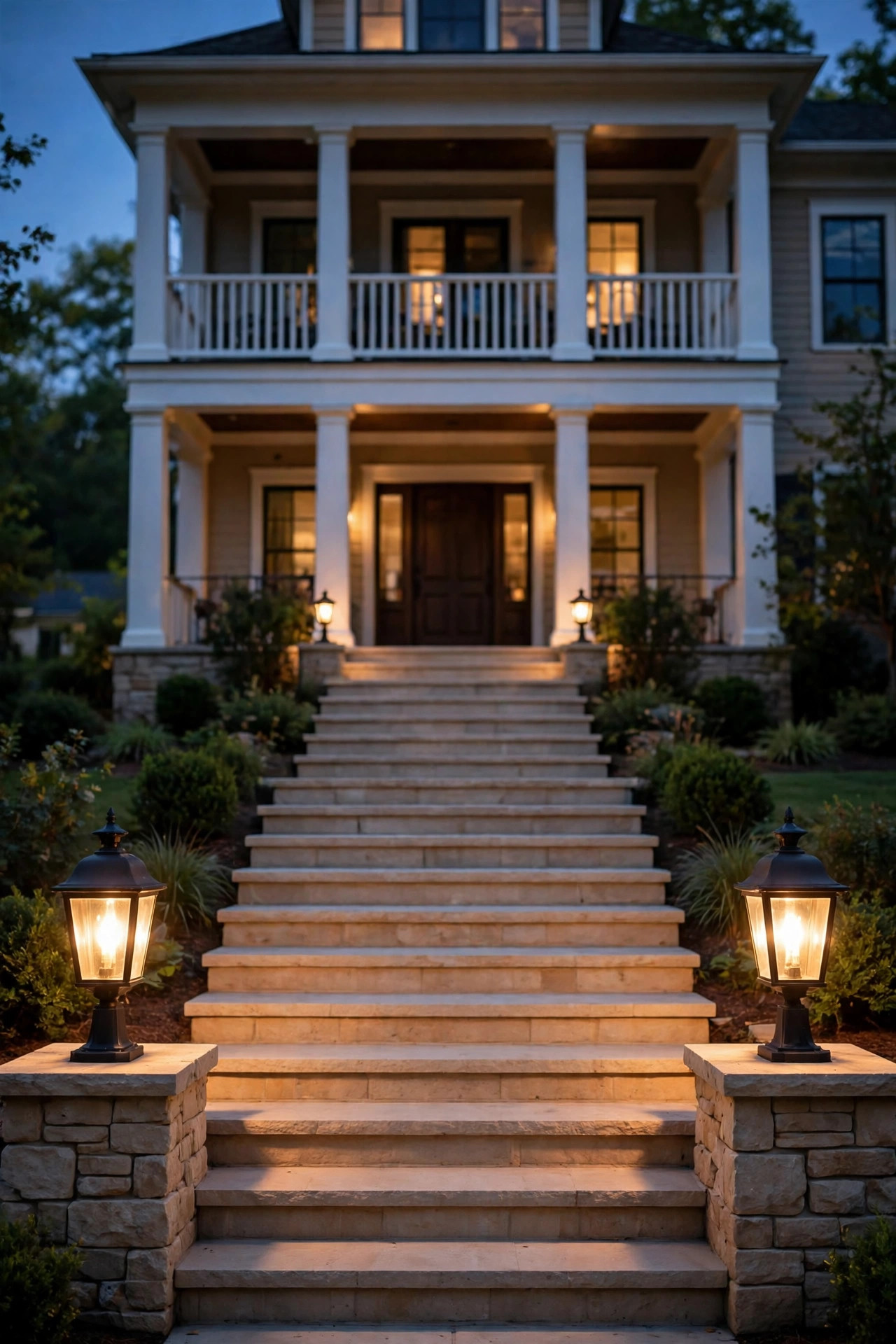
15. Anchor the Foot of the Steps With Post Lanterns
Every grand staircase deserves a proper beginning. Post-mount lanterns on short masonry piers, chunky newel posts, or standalone 3- to 4-foot posts at the base of the steps mark the exact moment a guest transitions from yard to entry — and they frame that first photograph everyone takes of the house. Choose lantern heads 18 to 24 inches tall in the same finish and glass as your door lanterns and pendant, because this fixture family is read as one set from the street. If you're building piers anyway, have the electrician stub conduit through them during construction; retrofitting wire through finished masonry is the expensive way to learn that lesson. Post lanterns also do quiet practical work: they light the first step from the front, where step lights can't reach, and they give delivery drivers and rideshares an unmistakable target. Output of 300 to 600 lumens each is plenty — these are beacons, not floodlights. In my experience, no other fixture gets borrowed by neighbors more often once they see it glowing at the bottom of a wide staircase.
Suggested budget range: $160 – $520.
16. Put Every Layer on Timers and Dimmers
Seventeen ideas are useless if the entry is dark because somebody forgot a switch. The secret to a portico that performs every single night is control: group your layers — overhead fixtures on one dimmer, door lanterns on another, landscape uplights on the low-voltage transformer's timer — and let an astronomical timer or smart switch bring the scene up at dusk and down at your chosen hour. Then build two or three scenes. "Everyday" might be door lanterns and column uplights at 70 percent. "Guests" brings the pendant, steps, and path to full. "Late night" drops everything except a whisper of column light for security and beauty. The running cost surprises people: a full LED portico composition might draw 60 to 100 watts total, which works out to pennies a night — less than the single old halogen flood it replaced. And there's a safety dividend, too, since a house that lights itself on schedule looks occupied whether you're home, at dinner, or two time zones away on vacation.
Suggested budget range: $60 – $280.
17. Add a Dedicated Spotlight for Wreaths and Seasonal Decor
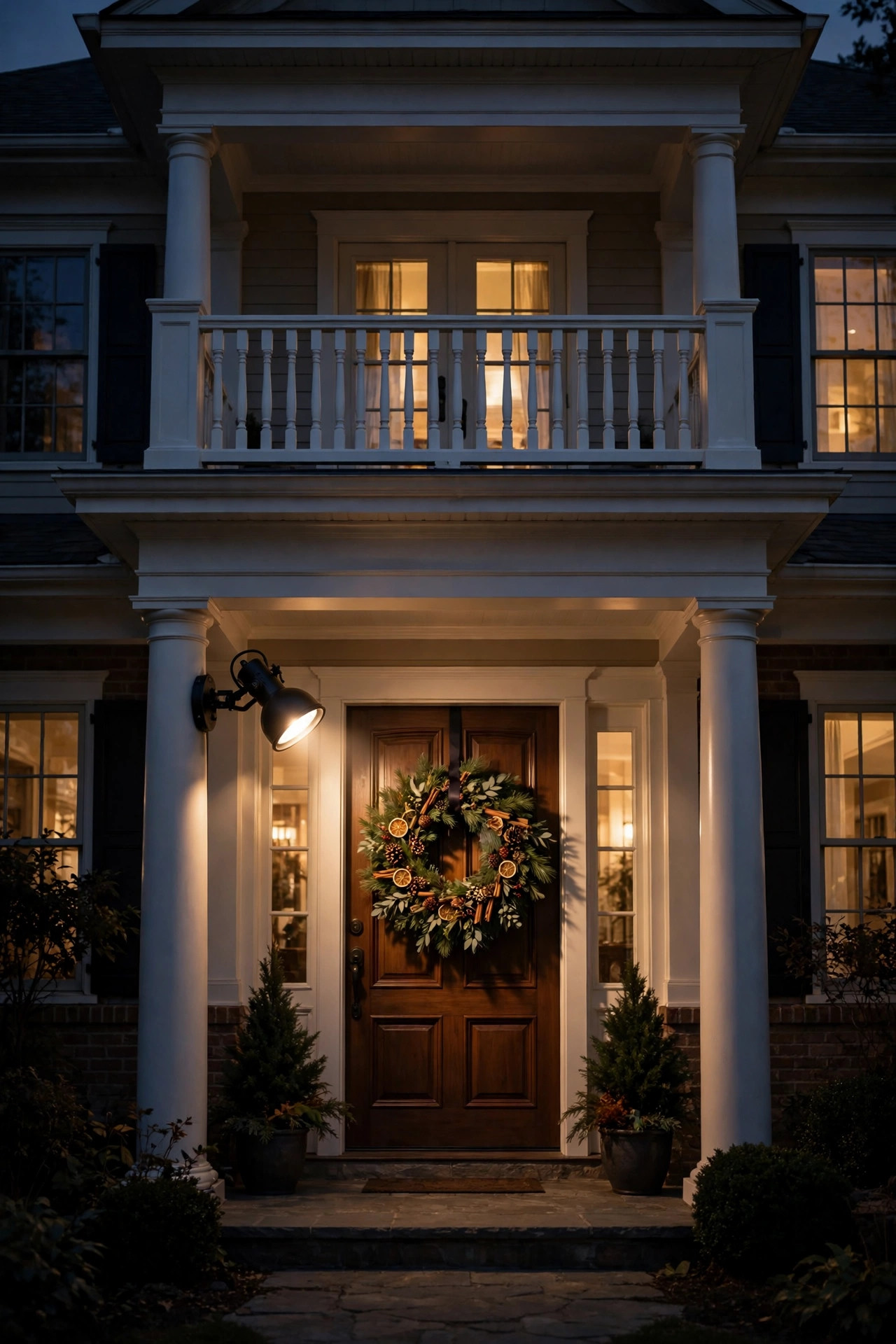
The front door of a two-story entry is a billboard, and most of the year it's working hard — a spring wreath, a summer flag, fall garlands, and the big December production. One small adjustable spotlight, mounted on the portico ceiling or hidden at the base of a column and aimed at the center of the door, makes all of it look professionally styled. A narrow 15- to 25-degree beam at 200 to 300 lumens is enough to model a wreath's texture without flattening it, and because the fixture is adjustable you can re-aim in seconds as displays change. In the off-season, swing it toward your house numbers or a beautiful door knocker instead — nothing should sit idle. One firm safety note: keep every bulb LED and cool to the touch anywhere near garlands, ribbons, and dried arrangements, and give real greenery a little breathing room from any fixture. Honestly, this tiny light is the difference between holiday decor that looks charming in daylight and disappears at 6 p.m., and a door that stops cars in December.
Suggested budget range: $30 – $120.
Frequently Asked Questions
How big should a lantern be for a two-story portico?
Bigger than you think. For wall lanterns, aim for a fixture height of roughly one-quarter to one-third of your door's height — so 20 to 28 inches for an 8-foot door with a transom. Pendant lanterns under a 14- to 20-foot ceiling should be 24 to 36 inches tall. Standard porch fixtures are designed for 8-foot ceilings and simply disappear at this scale, so when you're torn between two sizes, choose the larger one every time.
How high should I hang a pendant over a two-story entry?
The bottom of the fixture must stay at least 7 feet above any walking surface, but for real presence on a 16- to 18-foot ceiling, I hang pendants so the bottom lands around 10 to 12 feet up — roughly in the upper third of the space, centered over the entry axis. Use a chain or rod rated for the fixture's weight, and view it from the street before finalizing: it should read clearly against the door, not hide behind the portico beam.
What color temperature looks best on a grand entry?
Warm white, 2700K, across every layer. A stately portico is all about glow, and 2700K flatters brick, stone, wood doors, and skin tones alike. Cooler 4000K light makes tall entries feel institutional. The one rule that matters even more than the number itself is consistency — pendants, sconces, uplights, and path lights should all match, or the composition falls apart.
Can I light a portico without hiring an electrician?
Partly. Low-voltage 12V landscape lighting (column uplights, path lights, step lights on a plug-in transformer), solar accents, and battery flameless lanterns are all comfortable DIY. Swapping a fixture on an existing junction box is a common homeowner job with the breaker off. But new junction boxes, new switches, and chandelier support upgrades belong to a licensed electrician — and always plug outdoor transformers into a GFCI-protected outlet.
Conclusion
A two-story portico already has the architecture; it just needs light with the same confidence. Scale up your fixtures, give the columns their own layer, and build the scene in levels — overhead glow, a framed door, lit steps, and a path that leads guests in — and the entry will finally look at midnight the way it looks at noon. You don't need all 17 of these portico lighting ideas at once, either. Start with the pendant and the door lanterns, add the columns next season, and layer from there. If you'd like to go deeper on planning layers across the whole yard, browse my guide to layered landscape lighting — your portico is just the tallest, proudest layer of the picture.