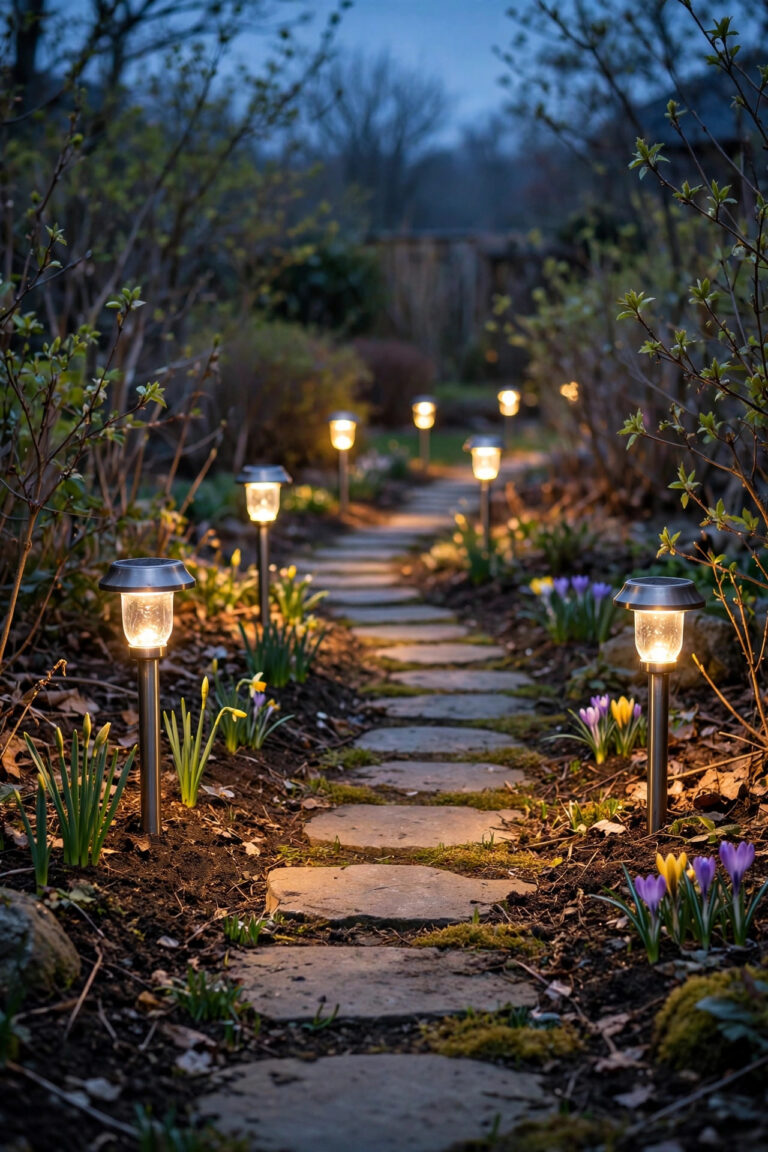
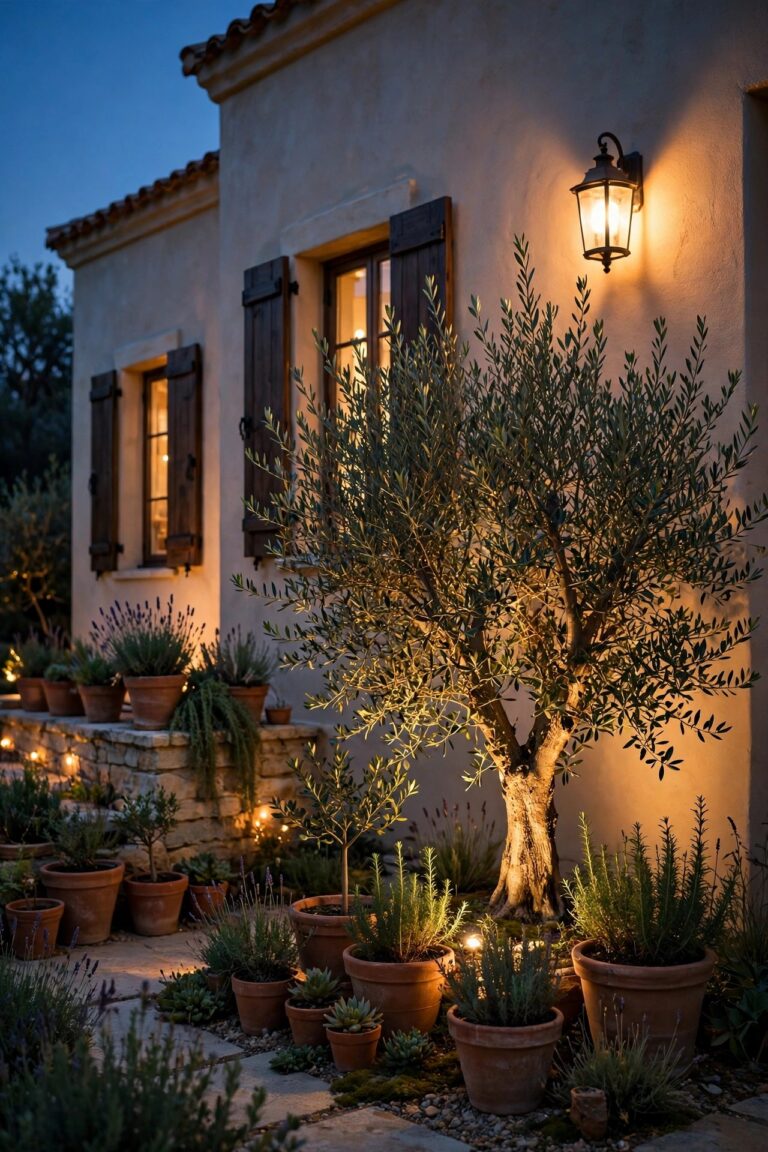
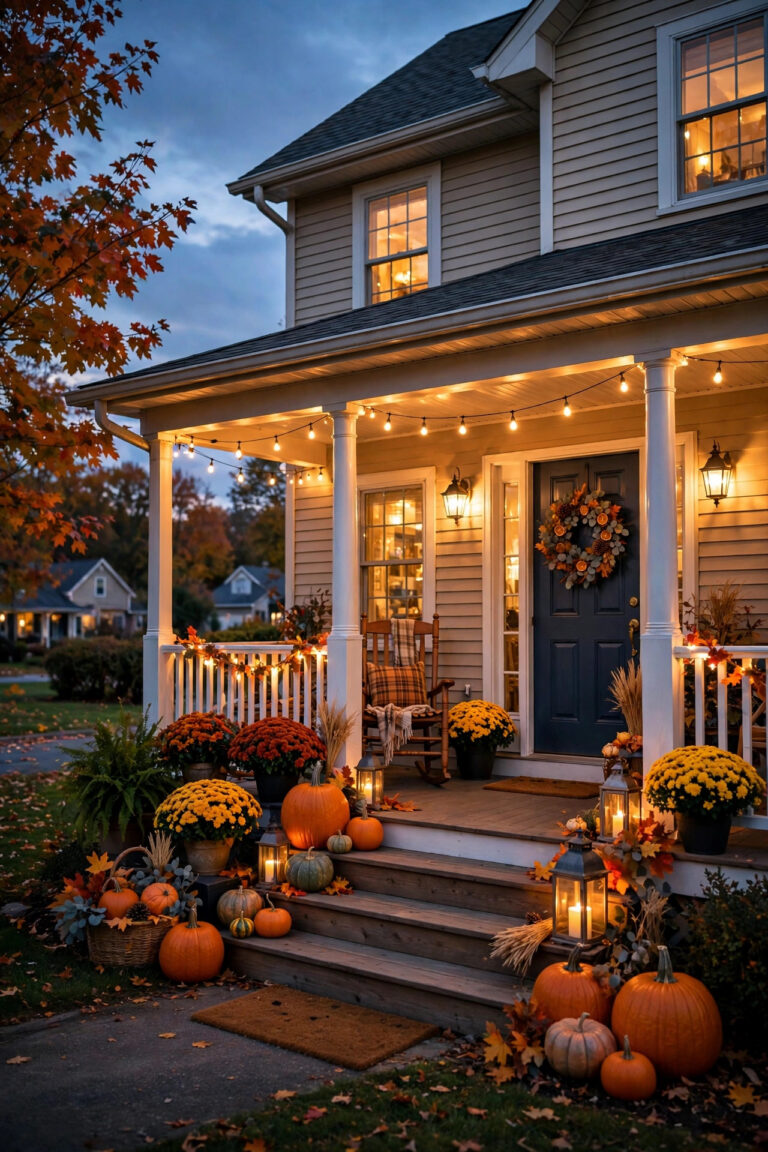
There is a moment on our porch, right around dusk, when the whole day seems to exhale — and honestly, that moment only happens because I finally figured out my porch swing lighting ideas instead of relying on the one harsh porch bulb by the door. A swing or a garden daybed is where we read, nap, talk, and watch the fireflies, so the light there needs to feel soft and close, never like an interrogation. I light these spots the same way I light every cozy corner of my yard: in layers. A gentle glow overhead, warm light at sitting height where faces and books live, and a whisper of light low down so nobody trips on the steps heading back inside. In this post I am sharing 19 ideas I rotate between our porch swing and the daybed out in the garden — string lights, lanterns, solar tricks, and a few renter-friendly favorites. Every one is simple, affordable, and kind to tired eyes.

1. Start With a Layered Plan for Your Porch Swing Lighting Ideas
Before you hang a single bulb, sit on your swing at dusk and think in three layers, because every porch swing lighting setup I have ever loved started with a plan instead of a shopping trip. The top layer is ambient: string lights, a ceiling fixture, or a hanging lantern 6 to 8 feet up, giving the whole seat a soft ceiling of glow. The middle layer lives at sitting height, roughly 2 to 3 feet off the floor: a lantern on the side table, sconces on the wall behind you, light that flatters faces and falls nicely across a book. The bottom layer is quiet guidance: low path lights or step lights so you can find your slippers and the lemonade without a phone flashlight. Sketch the three layers on paper first and you will never overbuy. I also pick one warm color temperature, around 2700K, for every bulb in the plan, so the swing, the daybed, and the garden beyond all blend into one calm, golden scene instead of competing.
Suggested budget range: $20 – $60.
2. Swag String Lights Over the Swing
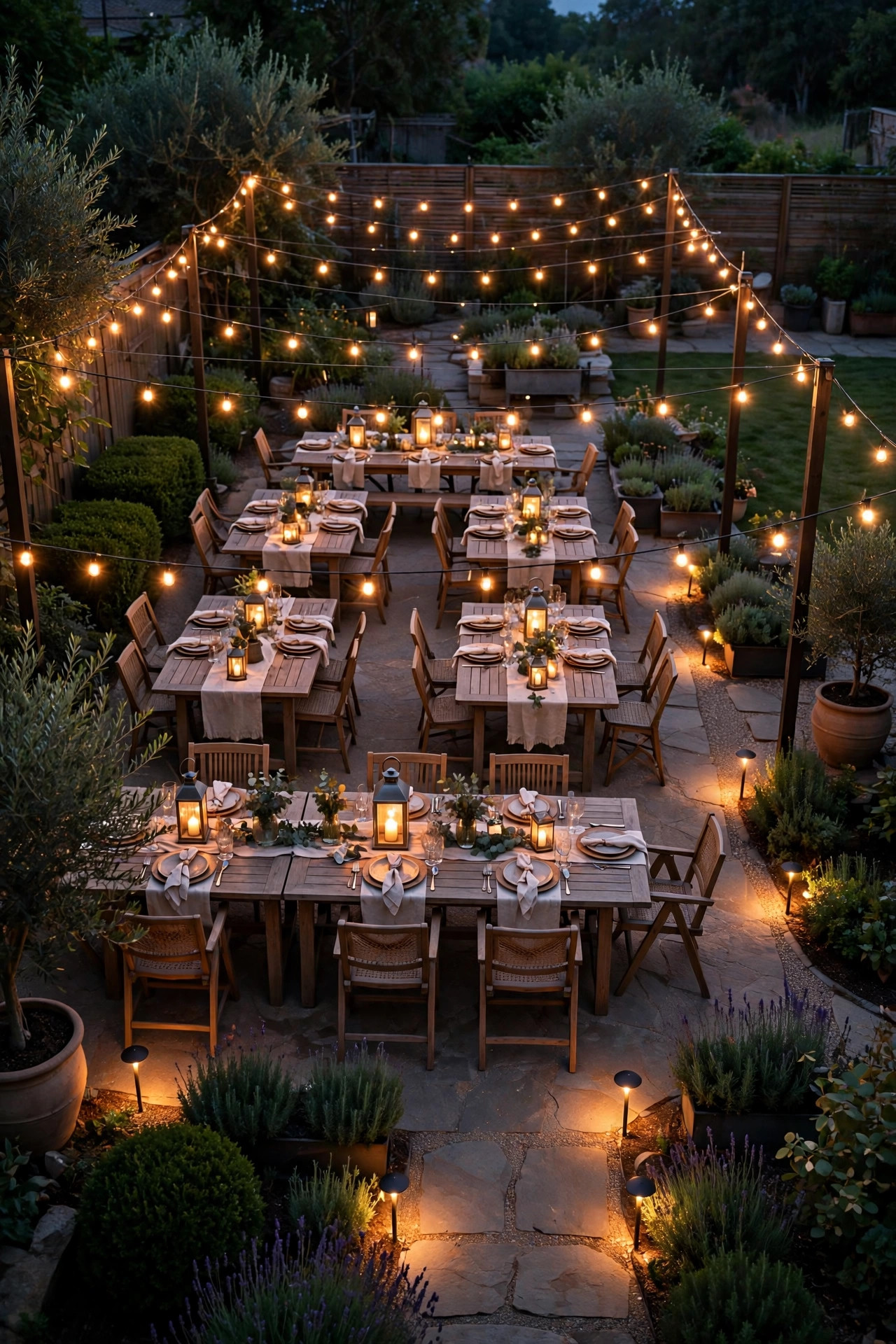
String lights are the backbone of my swing setup, and swagging them overhead is the fastest way to make a plain porch feel like a little café made just for two. I run two strands in gentle curves from the house wall to the porch posts, crossing above the swing at about 7 feet high so the light pools down softly instead of shining straight into your eyes. Space anchor points 8 to 10 feet apart and let each swag dip 6 to 12 inches in the middle for that relaxed look. Commercial-grade strands with shatterproof LED bulbs are worth the small splurge — they survive storms, curious grandkids, and being taken down by someone in a hurry. Choose warm white bulbs around 2700K and put the run on a plug-in timer so the canopy switches on at dusk all by itself. Screw-in cup hooks hold everything neatly, and if your porch has no convenient beam, a strand run along the wall behind the swing works almost as well.
Suggested budget range: $25 – $70.

3. Weave Fairy Lights Through the Swing Chains
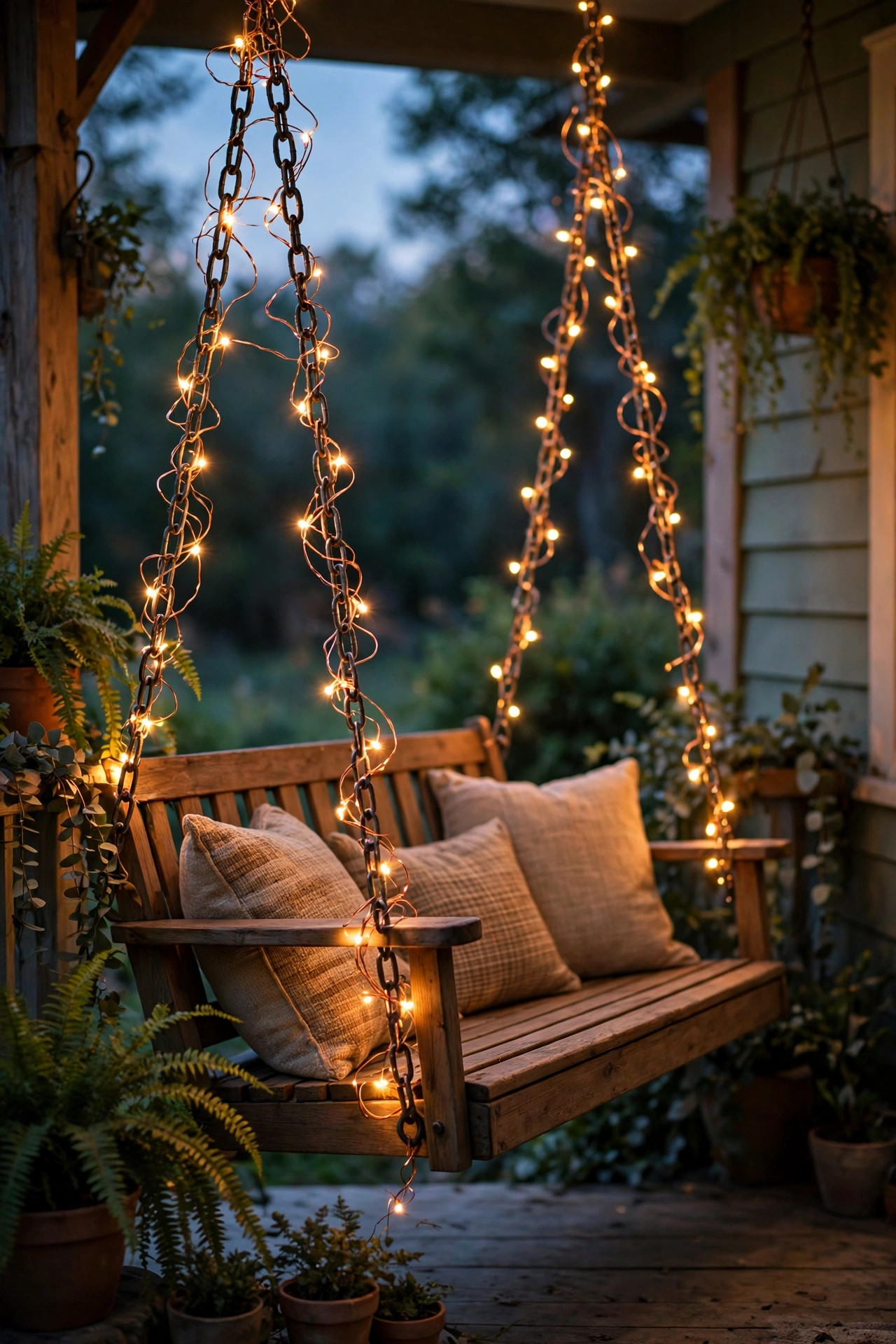
This is the cheapest transformation on the whole list, and honestly it might be my favorite. Take two strands of copper-wire fairy lights and weave them loosely along the swing chains, spiraling from the top hook down to the seat on both sides. The tiny warm pinpoints make the swing itself glow, like it is outlined in fireflies, and because the wire is nearly invisible in daylight your porch still looks tidy. Battery-powered strands are perfect here — no cord to dangle or get tangled — and most come with a built-in timer that runs six hours on, eighteen off, so they light themselves every evening. Expect a set of batteries to last several weeks of nightly use. One caution from experience: keep the weave loose, not tight, so the chains can still move freely without pinching the wire. The effect is pure magic for about the price of a pizza, and kids in particular cannot resist it.
Suggested budget range: $10 – $25.
4. Hang One Statement Lantern Over the Swing
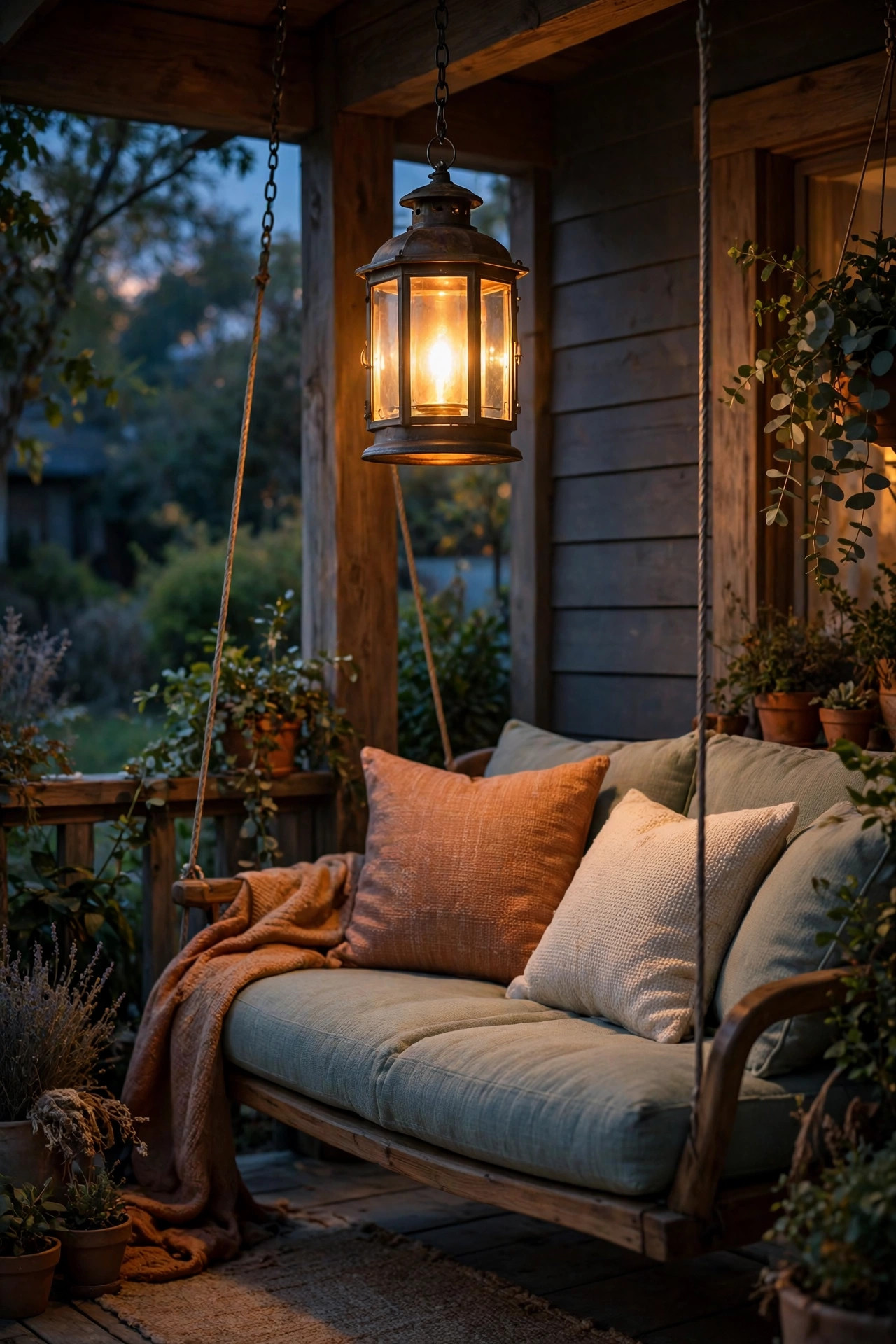
If string lights feel too casual, a single beautiful hanging lantern centered over the swing gives you the same warm pool of light with a little more polish. I hang mine from a ceiling hook so the bottom of the lantern sits about 6 and a half feet above the porch floor — high enough to clear heads when the swing is moving, low enough to feel intimate. A matte black or weathered bronze finish disappears at night and lets the glow do the talking. Use a warm LED filament-style bulb, the kind that mimics an old-time filament glow without the heat, and look for a damp-location rating since porch air carries moisture. If your ceiling is too high or you rent, hang the lantern from a wall-mounted bracket arm instead. My collection of porch swing lighting ideas rounds up more overhead options if you want to compare styles before you commit to one fixture.
Suggested budget range: $30 – $90.
5. Use a Porch Ceiling Light or Fan Light You Already Have
Sometimes the best swing light is the fixture already wired above you — it just needs the right bulb and a dimmer. The builder-grade bulb in most porch ceiling lights is a cold, bluish 4000K or higher, which is exactly why the porch feels uninviting. Swap in a warm 2700K LED and the same fixture suddenly feels like candlelight. If you have a ceiling fan over the swing, a fan light kit with frosted shades softens the light beautifully and the breeze keeps bugs off you, which is a genuine bonus on summer nights. A plug-in dimmer or a simple dimmer switch lets you drop the light low for conversation and raise it for reading. Before you buy anything new, spend an evening testing what you own — I explain bulb shapes and shade styles in my guide to porch ceiling light ideas, and more than one reader has fixed their whole porch with a twelve-dollar bulb swap.
Suggested budget range: $10 – $80.

6. Flank the Garden Daybed With Wall Sconces
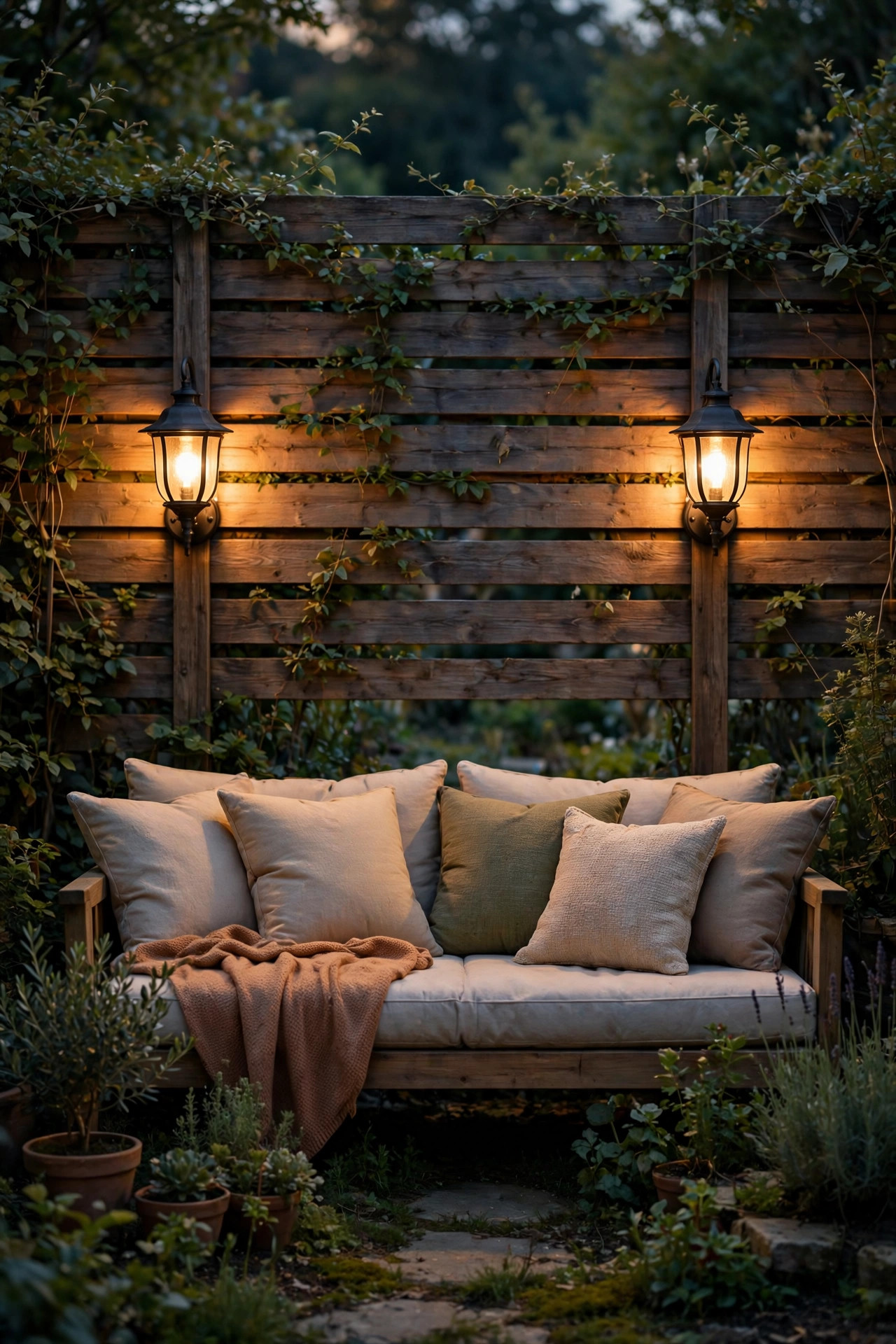
Out in the garden, my daybed sits against the fence, and a pair of wall sconces mounted on that fence turned it from a nap spot into a destination. I placed them about 5 feet up and roughly 2 feet out from each end of the daybed, so the light washes across the cushions from both sides and nobody reads with one shoulder in shadow. Battery-powered and solar sconces both work here since fences rarely have wiring, and the newer solar models with separate panels on a cord let you tuck the panel up into the sun while the fixture stays in the shade. Shielded designs that aim light downward are the kindest choice — they light your book, not the whole neighborhood. Match the finish to your fence stain or go matte black for contrast. If you are syncing the style with the rest of the yard, my garden lighting ideas post shows how sconces play with path lights and uplights in one plan.
Suggested budget range: $35 – $110.
7. Cluster Solar Lanterns on the Side Table
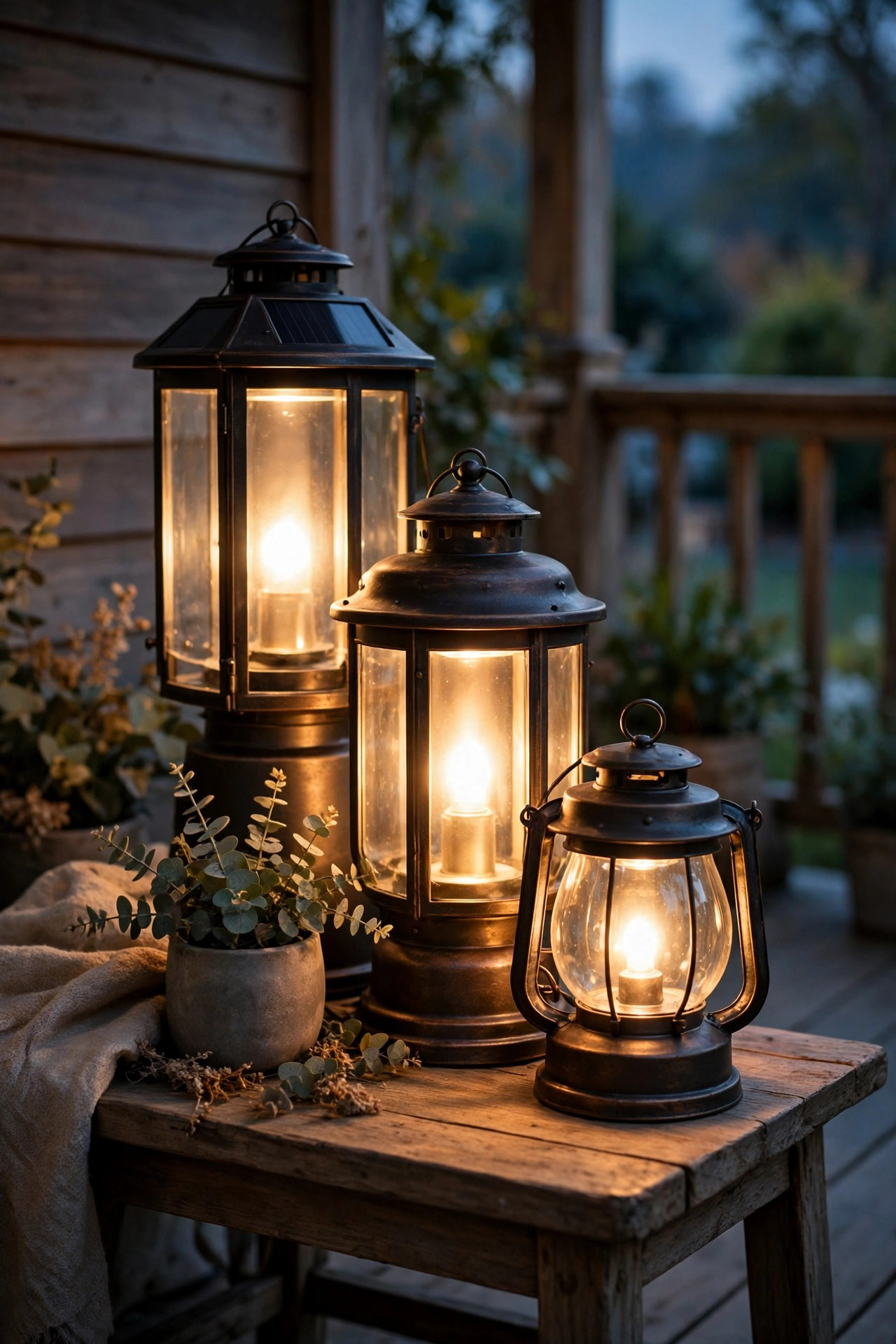
Every swing and daybed needs a trusty side table, and a little cluster of solar lanterns on it is the easiest mid-level light you will ever install — because there is nothing to install. I group three lanterns in different heights, like a small family, and let them charge on the porch rail during the day before moving them to the table at dusk. That charging trick matters: a lantern left in porch shade all day gives a weak, short glow, while one that sat in full sun runs strong past midnight. Look for lanterns with warm white LEDs and flicker modes that mimic candlelight if you like that look. The cluster gives you enough light to find your tea, your glasses, and the page you were on, without a single cord crossing the floor. Grouping in odd numbers, three or five, always looks more styled than a pair, in my experience.
Suggested budget range: $20 – $55.
8. Drape Paper Lanterns for a Soft Daybed Glow
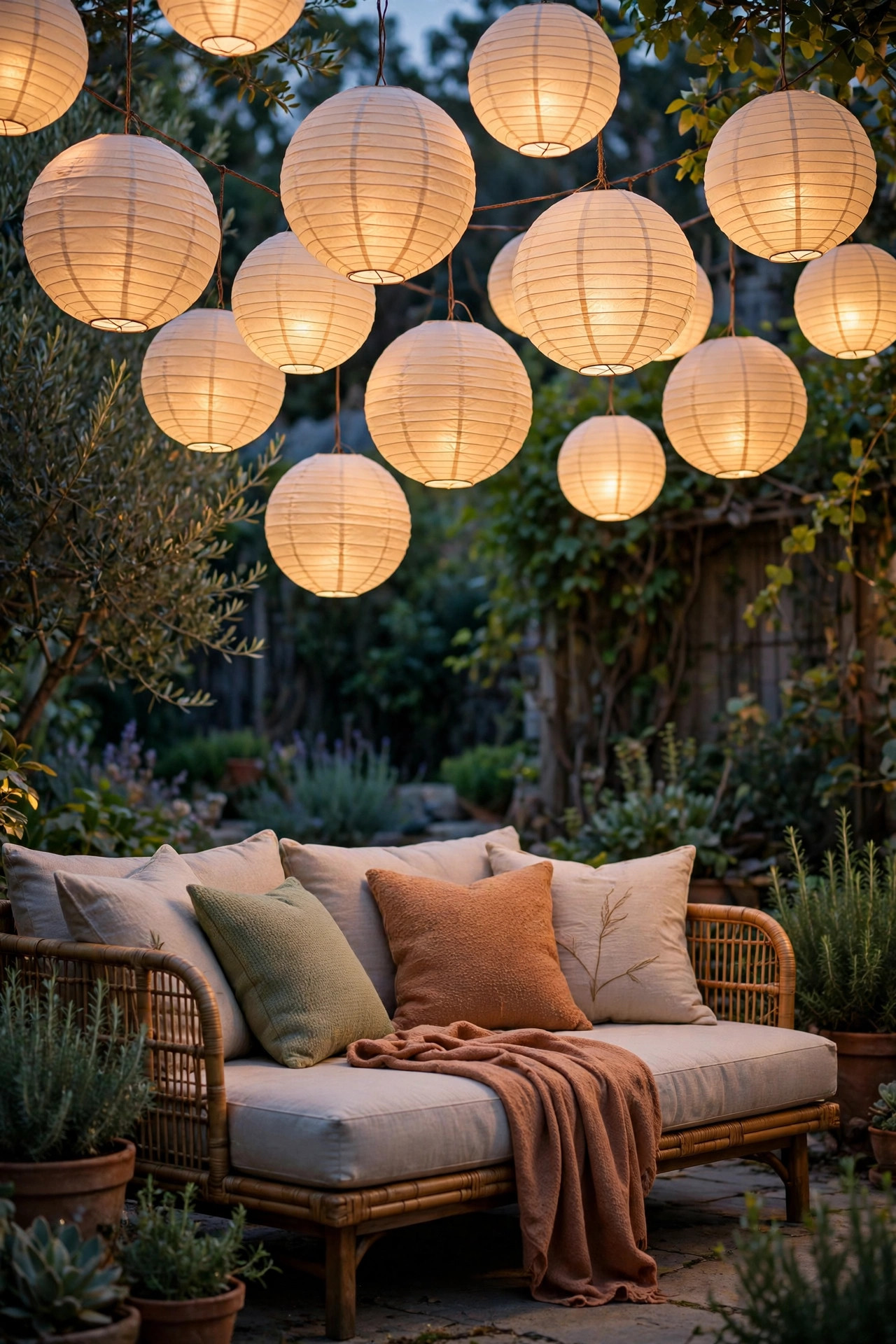
For parties and slow Sunday afternoons alike, paper lanterns strung over the garden daybed give the dreamiest diffused light on this list. I run a strand of small globe bulbs first, then hang paper lanterns in mixed sizes — 8, 10, and 12 inches — at staggered heights along it, so the whole canopy looks like low moons drifting over the cushions. The paper softens the LED glow into something truly gentle on the eyes, which is why this is my go-to setup for reading outside. Safety first, always: LED bulbs only inside paper lanterns, never incandescent, since paper and heat do not mix. Paper lanterns are fair-weather friends, so I bring mine in when rain threatens; a whole set costs so little that replacing a tired one each season is no hardship. Cream and warm white paper keeps the palette calm, while a single soft sage or blush lantern adds a wink of personality.
Suggested budget range: $15 – $45.
9. Tuck Rope Light Under the Daybed Frame
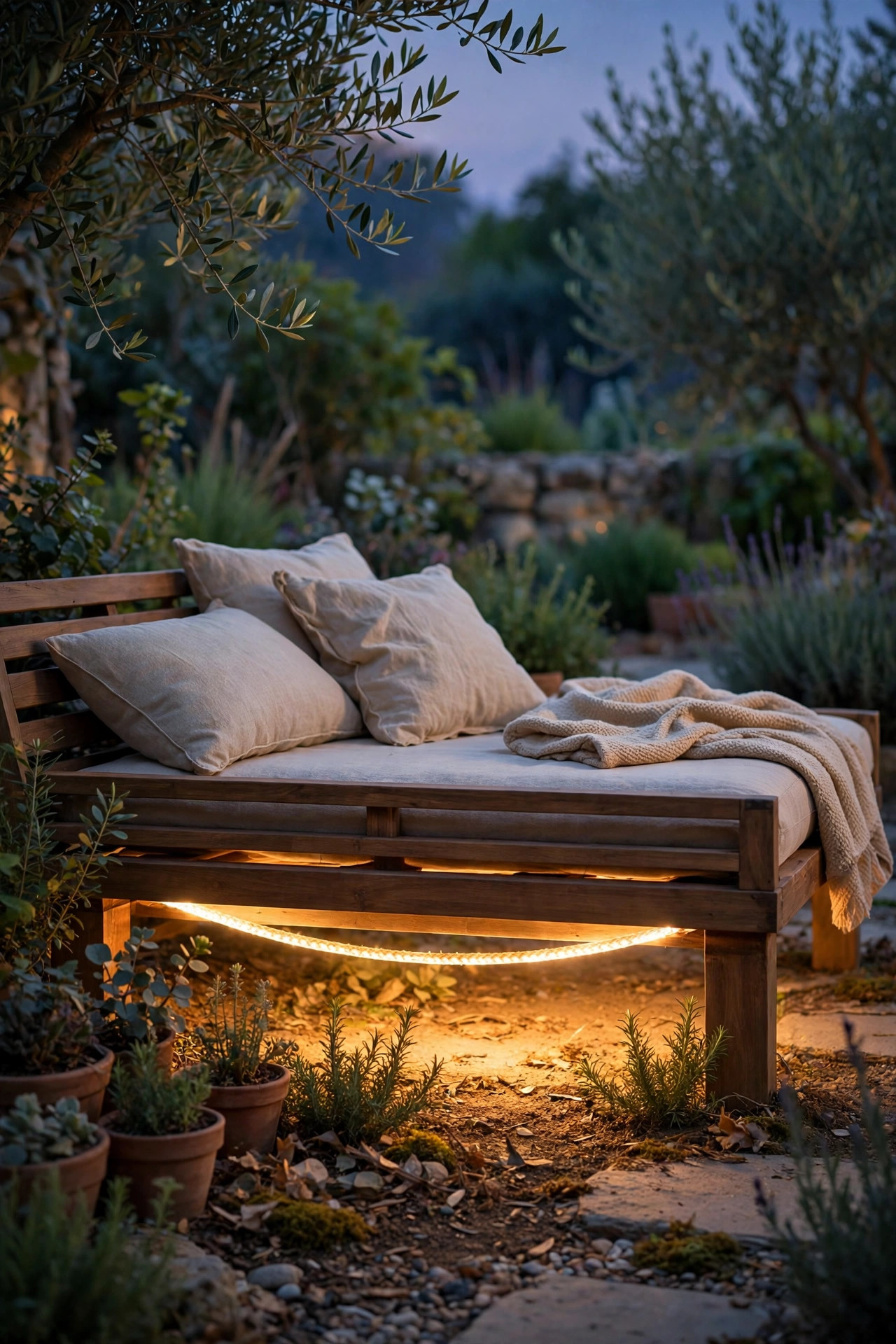
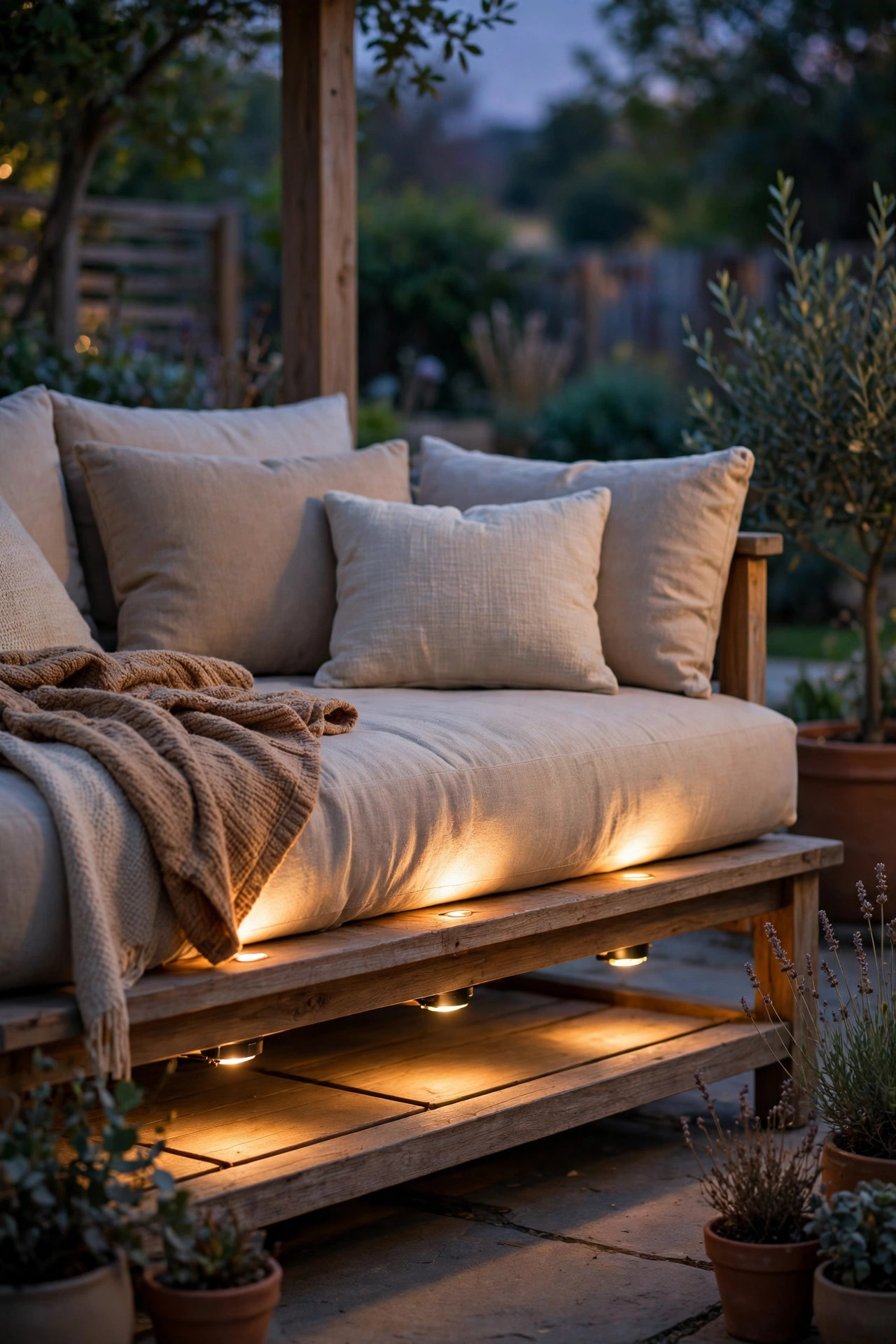
Here is a trick I borrowed from boat docks: a warm LED rope light tucked under the daybed frame makes the whole bed look like it is floating on a cushion of light. Run the rope along the underside of the frame rails with mounting clips every 12 inches, keeping the light itself hidden so you only see the glow spilling onto the ground beneath. It defines the bed footprint at night, keeps toes from stubbing on the frame legs, and looks genuinely high-end for very little money. Choose a rope rated for outdoor use, and plug it into a GFCI-protected outlet — anything near garden soil and watering cans needs that protection. Battery-powered rope and strip lights exist too if your daybed sits far from an outlet. A single 16-foot rope usually covers a twin-size daybed frame with enough left over to outline the headboard end as well.
Suggested budget range: $15 – $40.
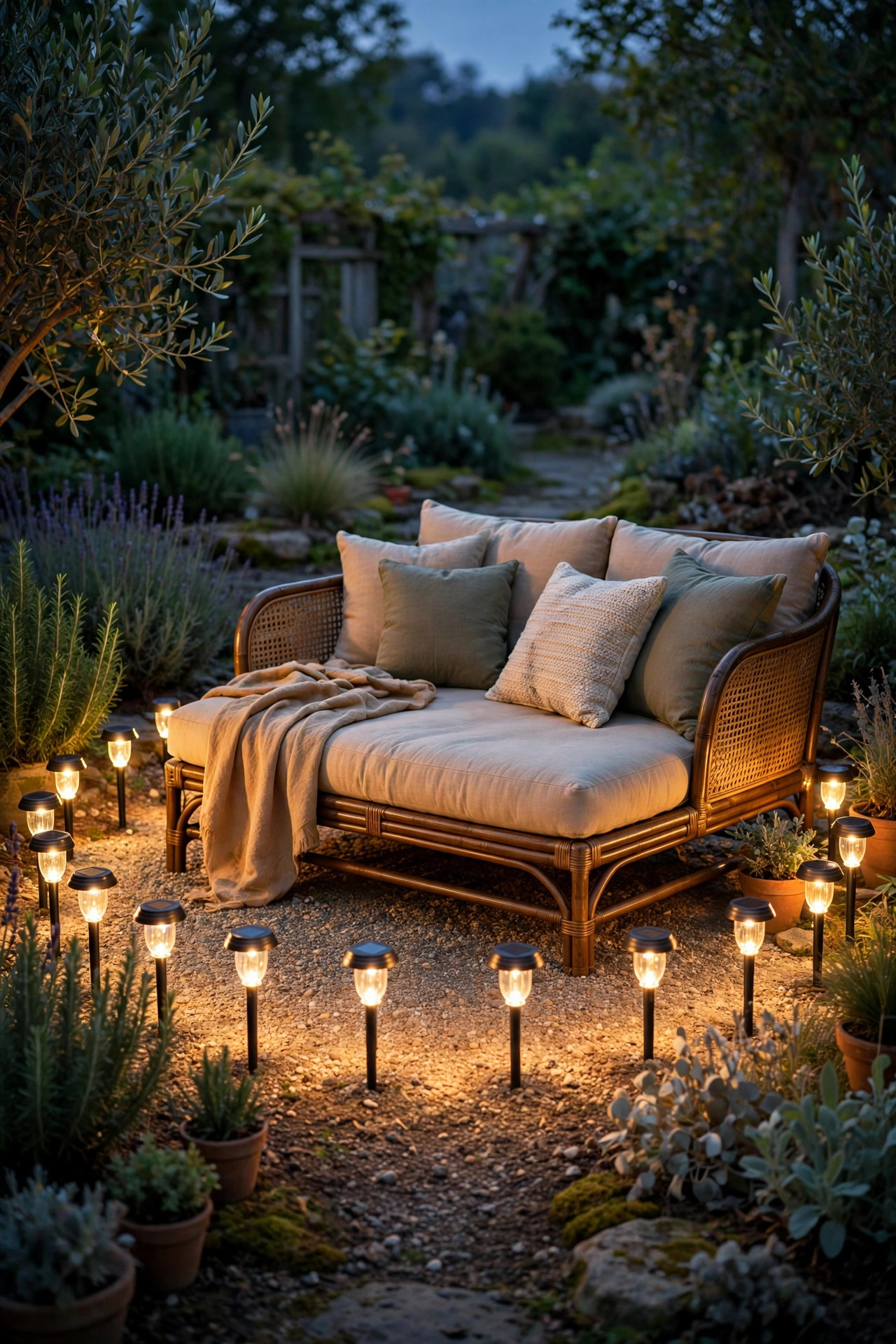
10. Ring a Garden Daybed With Solar Stake Lights
When your daybed lives out in the garden instead of on a porch, a low ring of solar stake lights draws its boundary and makes the whole bed feel like a room of its own. I place six to eight stakes about 3 feet out from the bed, spaced 2 to 3 feet apart, close enough that their pools of light nearly touch. Short stakes, 12 to 15 inches tall, keep the glow low and sleepy rather than glaring across the lawn. Push them into mulched edges rather than open grass so they look intentional and mowing stays easy. Solar stakes are the ultimate no-wiring solution, but give them honest sun during the day — a ring under a dense tree canopy will fade by ten o'clock, so choose models with remote panels if your corner is shady. On nights we host friends, this little glowing circle around the daybed is where everyone ends up drifting after dinner.
Suggested budget range: $20 – $50.
11. Hang Mason Jar Lights From Shepherd Hooks
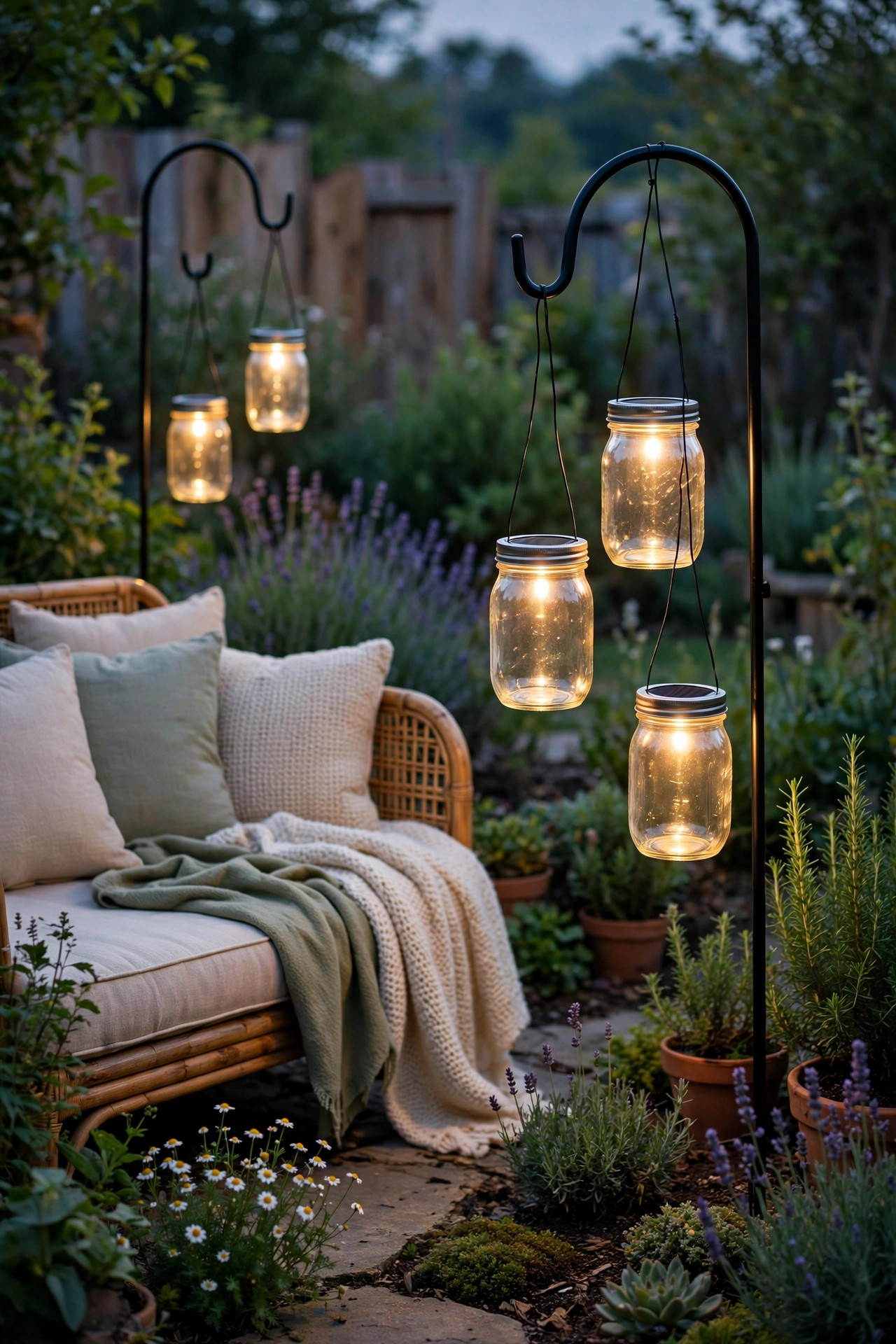
For a farmhouse wink that costs almost nothing, solar mason jar lights hanging from shepherd hooks around the daybed or flanking the porch steps are hard to beat. The jars come with solar lids threaded with tiny fairy lights, so each one charges by day and sparkles by night with zero effort from you. I push 36-inch shepherd hooks into the garden beds at the corners of the daybed and hang a jar on each, letting them sway a little in the breeze like lightning bugs in captivity. On the porch, a pair of hooks in big planters frames the swing beautifully. The light is decorative rather than useful for reading, so think of jars as the jewelry layer — pair them with a real lantern or sconce for task light. Crackled-glass jars throw the prettiest patterns, and a drop of contrast comes free when you mix clear and amber jars on alternating hooks.
Suggested budget range: $15 – $40.
12. Uplight the Tree or Trellis Behind the Daybed
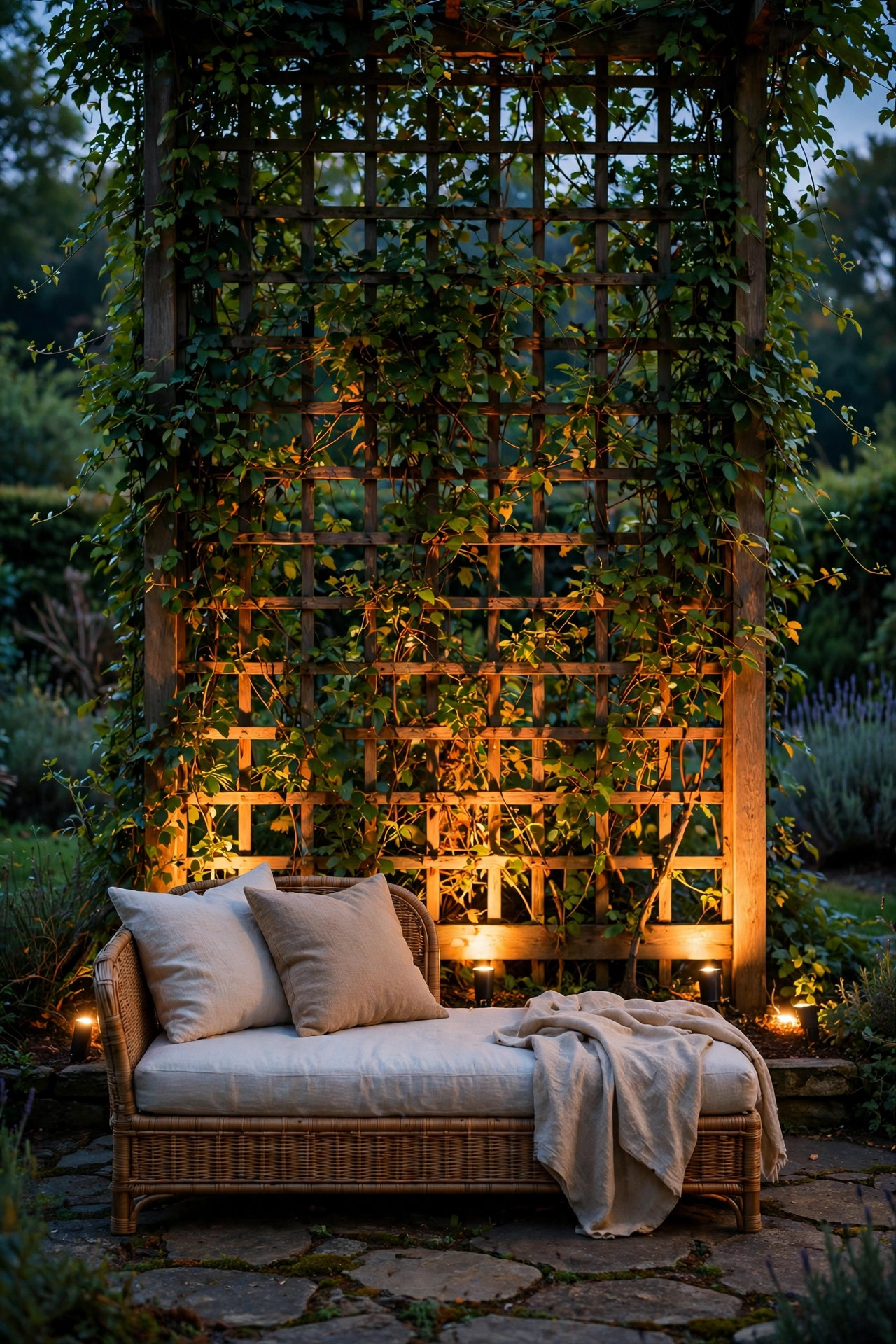
A daybed backed by a fence or trellis can feel flat at night, so I aim one low-voltage uplight at whatever stands behind it — a small tree, a climbing rose trellis, the slats of the fence itself — and the whole seat suddenly has a backdrop. Position the fixture 12 to 18 inches out from the trunk or trellis base, tilted up at about 30 degrees, and let the branches or vines throw soft shadows across the scene. This is grazing light, not a spotlight: a modest 200 to 300 lumens is plenty, and warm 2700K keeps bark and leaves looking golden instead of ghostly. Low-voltage landscape lights on a small transformer are reliable and cheap to run, and solar uplights work if the spot gets sun. The daybed itself stays dim and restful while the garden glows behind it, which is exactly the layered contrast designers charge for. Once you try it, a flat dark fence will never satisfy you again.
Suggested budget range: $25 – $75.
13. Set Flameless Candles in Hurricane Holders
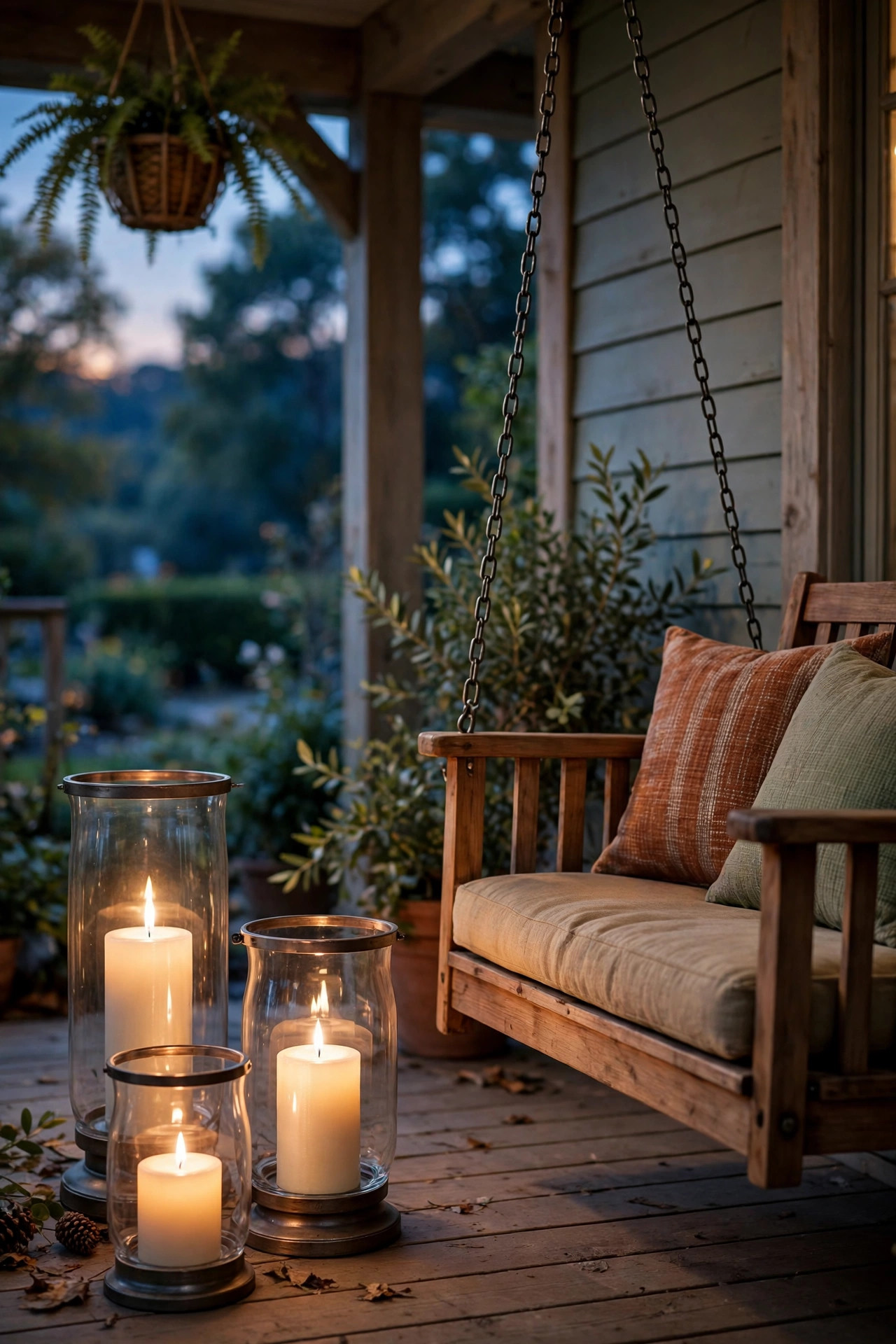
Real candles on a moving swing are a fire lecture waiting to happen, but flameless candles inside glass hurricane holders give you the same flicker with none of the worry. I use two or three on the side table and one on the porch floor in the corner, in ivory tones with a realistic flicker setting. The glass hurricane does double duty: it protects the flame effect from breezes that would flatten a real candle in seconds, and it makes the glow look deeper and more expensive than a bare pillar. Timers are the feature to insist on — set them once and your candles greet you every evening at dusk like a tiny staff that actually does its job. Modern flameless candles run for hundreds of hours on a pair of batteries. Keep them out of direct rain, since most are indoor-rated, and bring the set in for winter if your porch is open to the weather.
Suggested budget range: $15 – $45.
14. Mount Railing Downlights Along the Porch Edge
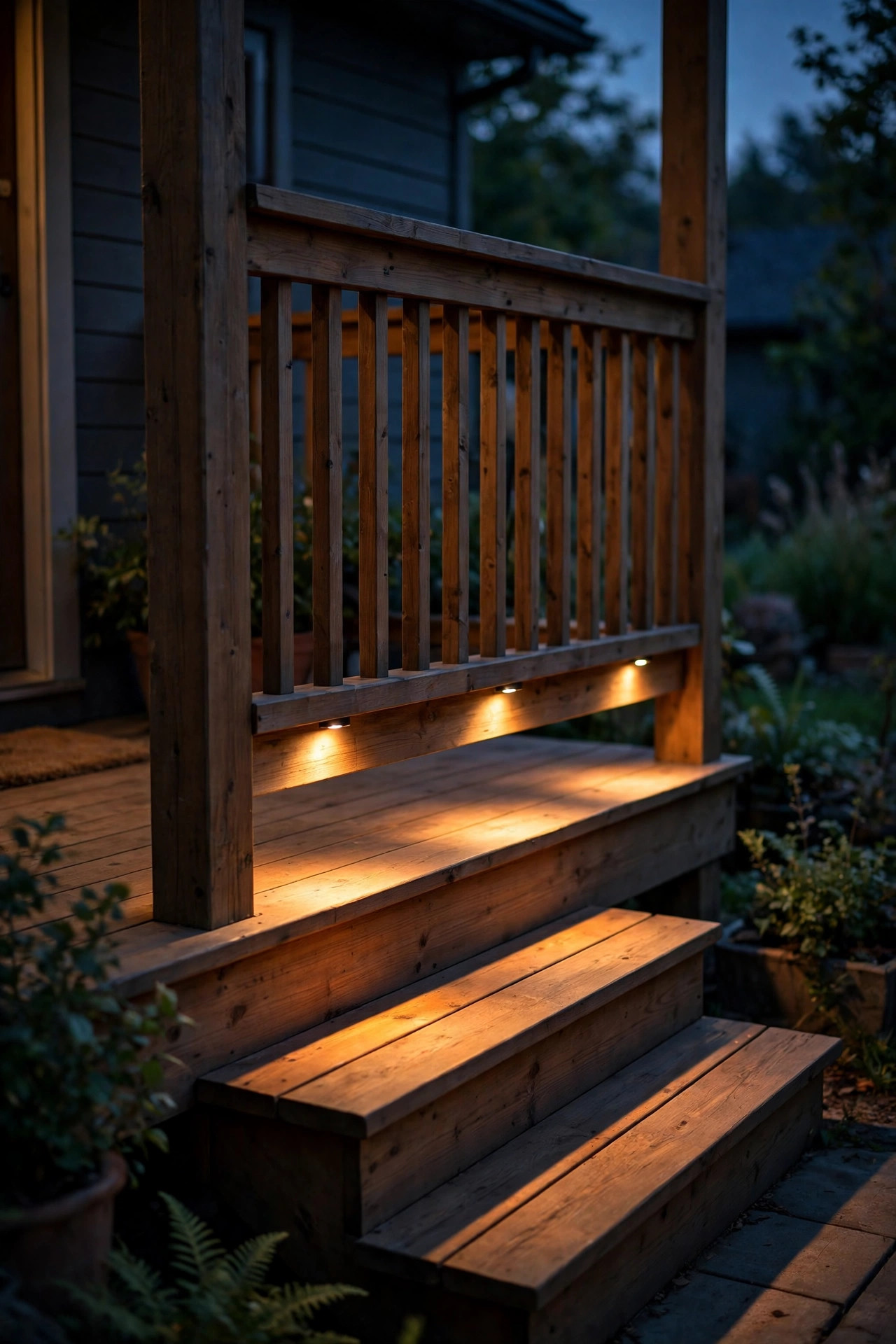
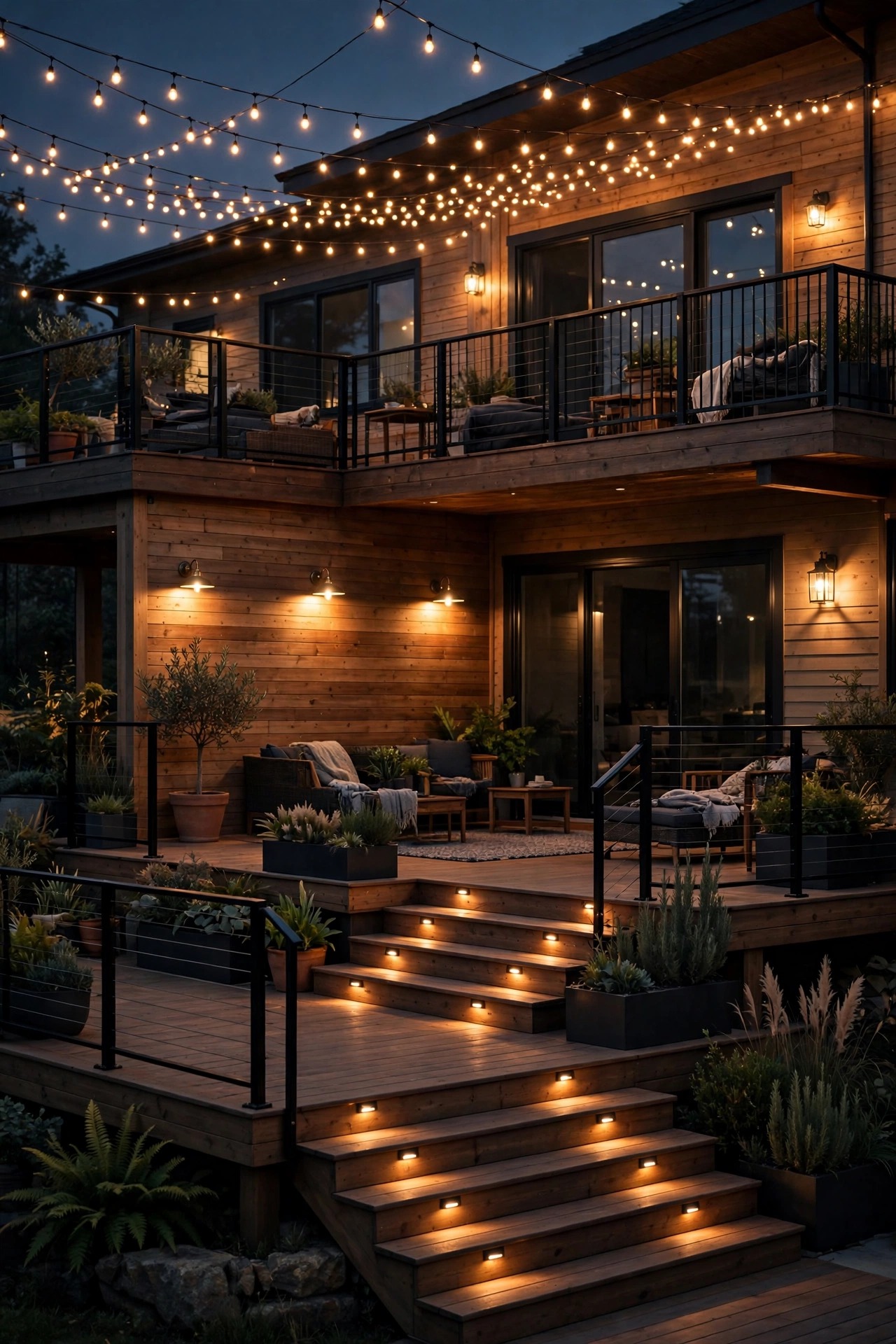
The most practical light on my porch is the one nobody notices: small downlights mounted under the top rail, washing the floorboards at the edge of the steps. They mark the boundary of the porch and the start of the stairs without shining in anyone's eyes, which matters when you are carrying a sleepy toddler or a tray of lemonade at nine o'clock. Low-voltage rail lights wire together in a daisy chain under the rail, or you can choose solar cap and rail models that clip on with no wiring at all. Space them every 4 to 6 feet, and always place one directly above the top step. This is guidance light, the bottom layer of the plan, so keep it dim and warm. Guests always comment that our porch feels easy to move around in after dark, and these modest little fixtures are the reason why.
Suggested budget range: $30 – $85.
15. Add Battery Puck Lights Under a Shelf or Canopy
If your swing bench has a canopy top, or your daybed has a headboard shelf, battery puck lights underneath are invisible magic. Stick three warm-white pucks under the frame or shelf edge, spaced evenly, and you get a clean wash of reading light with no visible fixture and no cord at all. Most pucks come with a remote, so you can dim from the swing without getting up — a luxury I did not know I needed until movie night on the porch. Rechargeable models save the battery shuffle; a charge lasts us a couple of weeks of evening reading. Adhesive pads handle smooth wood fine, but for rough or outdoor-porous surfaces I use the little screws most kits include, so a humid week does not drop a puck on my head. Pucks rated for damp locations survive porch humidity best. It is the tidiest light on this whole list, and renters will love it.
Suggested budget range: $15 – $35.
16. Keep One Warm Color Temperature Everywhere
Here is the unglamorous secret behind every cozy swing photo you have ever saved: all the bulbs match. When the string lights are warm, the lantern is amber, and the ceiling bulb is blue-white, the porch looks like three arguments happening at once. I buy everything at 2700K, which mimics late golden-hour light and flatters skin, wood, and cushion fabrics alike. Check the box before you buy — color temperature is printed right on it — and be suspicious of anything labeled daylight. If one fixture you love only comes in 3000K, that is close enough to blend; the jump to 4000K is where the clash shows. This discipline matters most on the daybed, where you are close to the light for long stretches of reading or napping. Consistent warm light is also easier on the eyes after dark, with none of that gas-station glare. One temperature, everywhere, always — that is the whole trick.
Suggested budget range: $10 – $30.

17. Add a Motion-Sensor Light for the Trip Back Inside
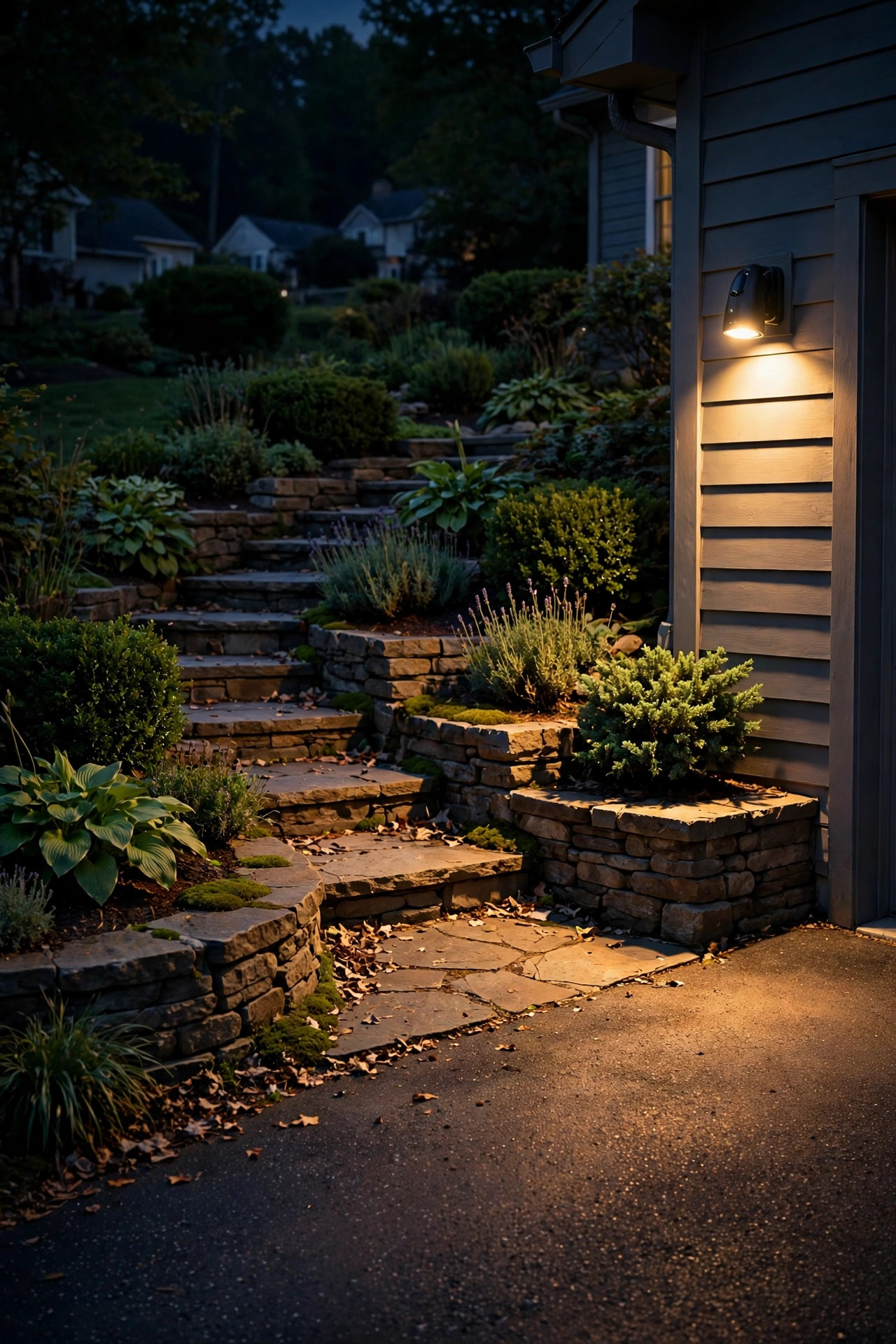
Ambience is lovely until someone has to cross a dark yard with an empty tray, so I keep one honest motion-sensor light on the path between the garden daybed and the back door. Mine is a small solar model on the fence, set to glow dim all evening and brighten when it senses movement, which saves its battery for the moments that count. Place it about 6 feet up, angled along the path rather than across it, so it lights your route without blasting the seating area every time the dog wanders past. On the porch, a sensor bulb in the door fixture does the same job for the steps. Keep the sensor light a different job description from your pretty lights: it is a safety layer, and it is allowed to be a touch brighter and cooler if that helps footing — though I still choose warm. Peace of mind, installed in five minutes.
Suggested budget range: $15 – $40.
18. Set a Small Tabletop Fire Bowl Beside the Swing
A little tabletop fire bowl on the side table gives a porch swing or daybed the primal flicker humans have loved since forever, and the scale is perfect for a seating nook. I use a small gel-fuel or bioethanol bowl about 6 inches across, set on a heatproof tray, well away from cushions, throws, and anything that flutters. Real flame rules apply without exception: never leave it burning unattended, keep it where a swinging elbow cannot reach it, and snuff it before you go in. The light is modest — think candle, not campfire — but the movement of real flame does something no LED quite copies. If your household has small kids or big dogs, skip the real flame and choose a quality flame-effect LED lantern instead; you will relax more, and relaxing is the entire point of a swing. Either way, the bowl anchors the side table like a miniature hearth.
Suggested budget range: $25 – $70.

19. Porch Swing Lighting Ideas: The Layered Finale
When friends ask which of these porch swing lighting ideas to actually buy, I tell them to copy my exact finale: a little of everything, layered on purpose. Over the swing, string lights swag on a timer for the ambient ceiling. At sitting height, a lantern cluster on the side table and fairy lights in the chains handle faces, books, and mood. Down low, railing downlights and solar stakes guard the steps and the garden path, and one motion-sensor light watches the trip back inside. Out at the daybed, sconces flank the cushions, an uplight paints the trellis behind it, and rope light floats the frame. The whole scene runs on timers and solar, costs less than a fancy dinner out, and folds together because every bulb shares the same warm 2700K glow. Start with three layers and add one idea a season — by next summer your swing corner will be the most fought-over seat in the house, I promise.
Suggested budget range: $60 – $150.
Frequently Asked Questions
What color temperature is best for porch swing and daybed lighting?
Warm white around 2700K is the sweet spot for seating areas. It mimics golden-hour light, flatters skin and fabrics, and feels restful for reading or conversation. Avoid anything labeled daylight or 4000K and above near a swing — it reads as harsh and commercial. If you mix fixtures, keep everything within 2700K to 3000K so the layers blend.
Can I light a garden daybed without any wiring?
Absolutely, and most of my daybed setup is wire-free. Solar sconces, stake lights, and lanterns handle the fence and garden ring, battery fairy lights and puck lights cover the details, and flameless candles fill in the flicker. The one rule is honest sun: solar fixtures need several hours of direct light to charge, so use remote-panel models in shady corners and rechargeable battery lights everywhere else.
Are string lights safe to leave over a porch swing all season?
Yes, with the right strand. Choose commercial-grade string lights with shatterproof LED bulbs and an outdoor rating, hang them from proper hooks rather than nails, and plug them into a GFCI-protected outlet. LEDs stay cool, so they are safe near cushions and canopy fabric — unlike old incandescent strands, which I would not leave unattended. A plug-in timer keeps the routine automatic and saves energy.
How much does it cost to light a porch swing area?
A lovely setup does not need a big budget. The fairy lights, a lantern cluster, and a few solar stakes — the core of most of my scenes — come in around $50 to $100 total. Add string lights on a timer and railing downlights and you are near $150 for a fully layered porch. Buy one layer at a time and match every bulb to 2700K as you go.
Conclusion
However you mix them, the best porch swing lighting ideas all do the same quiet job: they make a seat feel like a place worth lingering in after dark. Layer a soft glow overhead, keep warm light at sitting height, and add a little guidance down low, and both a porch swing and a garden daybed turn into the favorite room of the house — the one without walls. Start with the layer your corner is missing most, and browse the rest of my outdoor lighting ideas here whenever you are ready for the next project. I will be on the swing, saving you a seat.