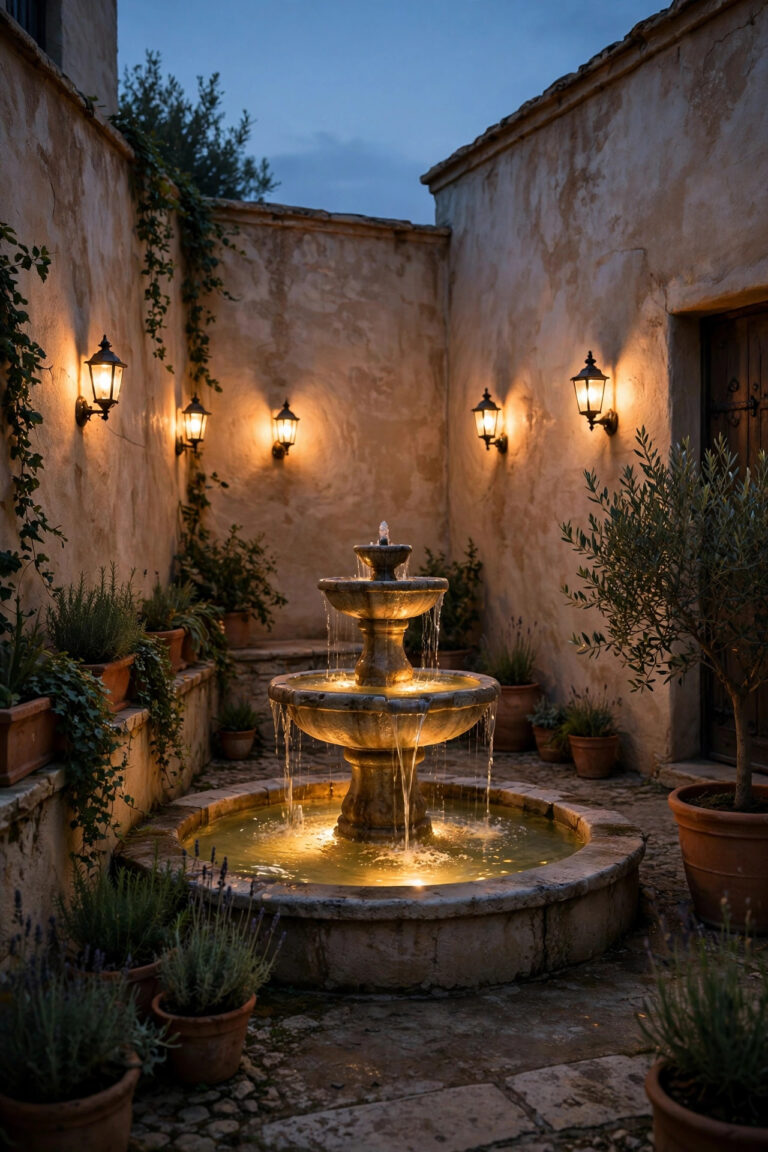
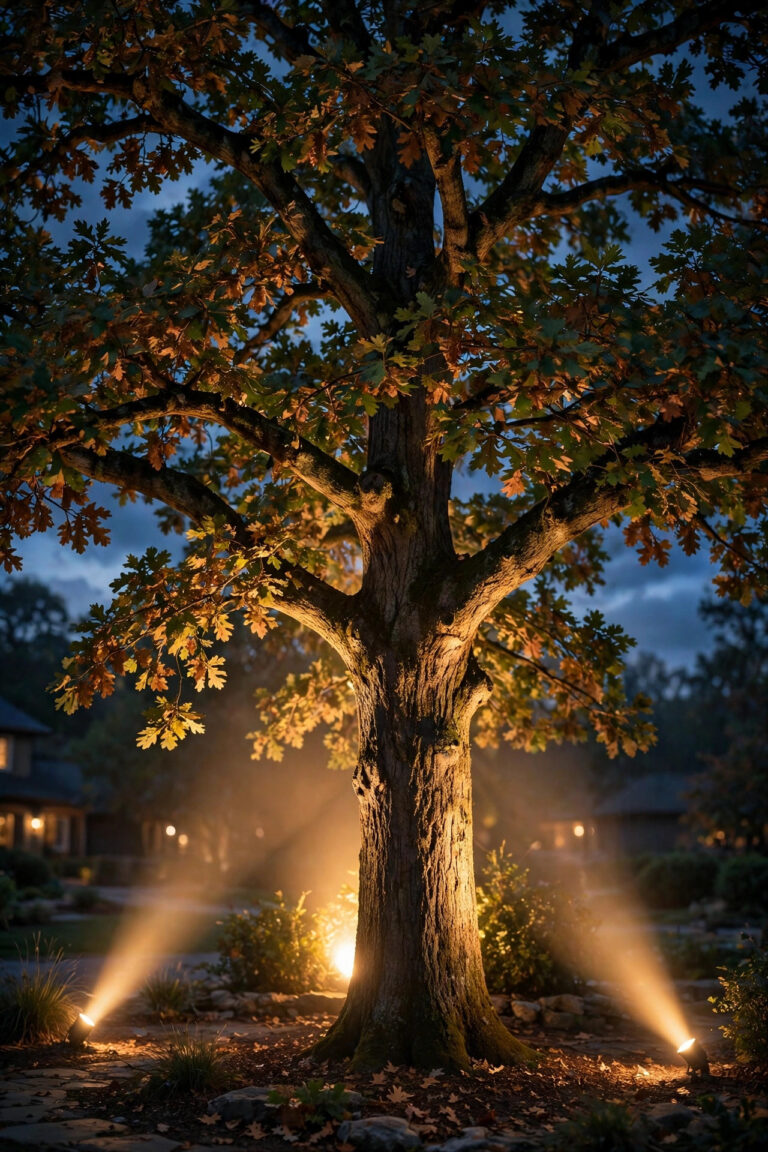
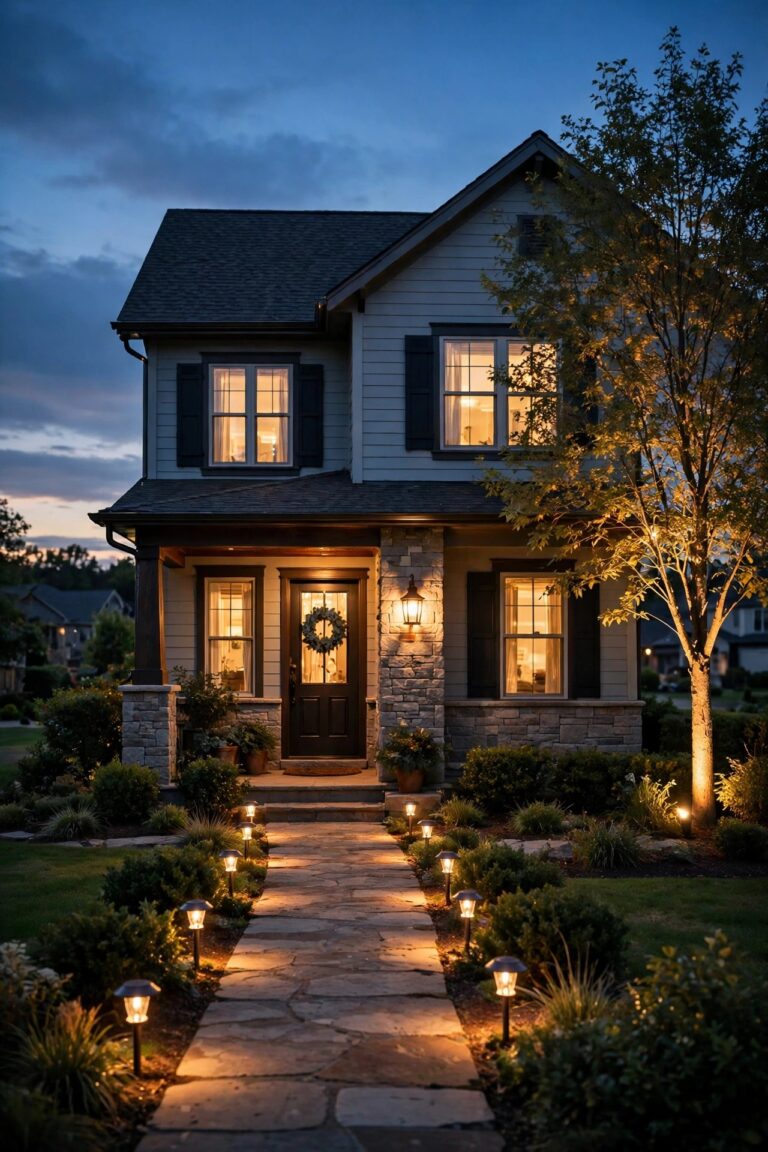
Stand at the curb after dark and look at your front walk. If it reads as a dotted line of little glowing mushrooms, you have one kind of fixture. If it reads as a row of short glowing posts, you have the other. The path lights vs bollard lights choice looks like a style decision, and honestly, part of it is. But the two fixtures throw light in completely different patterns, need different spacing, and survive very different kinds of abuse, so the wrong pick shows up fast: dark gaps between pools, glare in your eyes on the porch steps, or a fixture clipped by the mower in the first month. I have layered both into yards over the years, sometimes on the same property, and the happiest results always come from matching the fixture to the job instead of the catalog photo. This guide compares how each one lights, how many you actually need, what they cost, and which walkways each one genuinely suits, so you can choose once and enjoy it every night.

The Short Answer
Choose path lights when you want soft pools of light washing the walking surface itself, tucked into plantings along a garden path or a classic front walk. They sit low, hide the bulb, and space about six to eight feet apart. Choose bollard lights when you want a taller, more architectural fixture that throws a wider pool, marks an edge drivers and guests can read, and spaces eight to twelve feet apart. Bollards cost more per fixture but you buy fewer of them. Many yards end up happiest with bollards at the driveway and entry, and path lights along the garden runs. Match the color temperature and finish, and the mix looks planned, not patched.
What Each One Actually Is
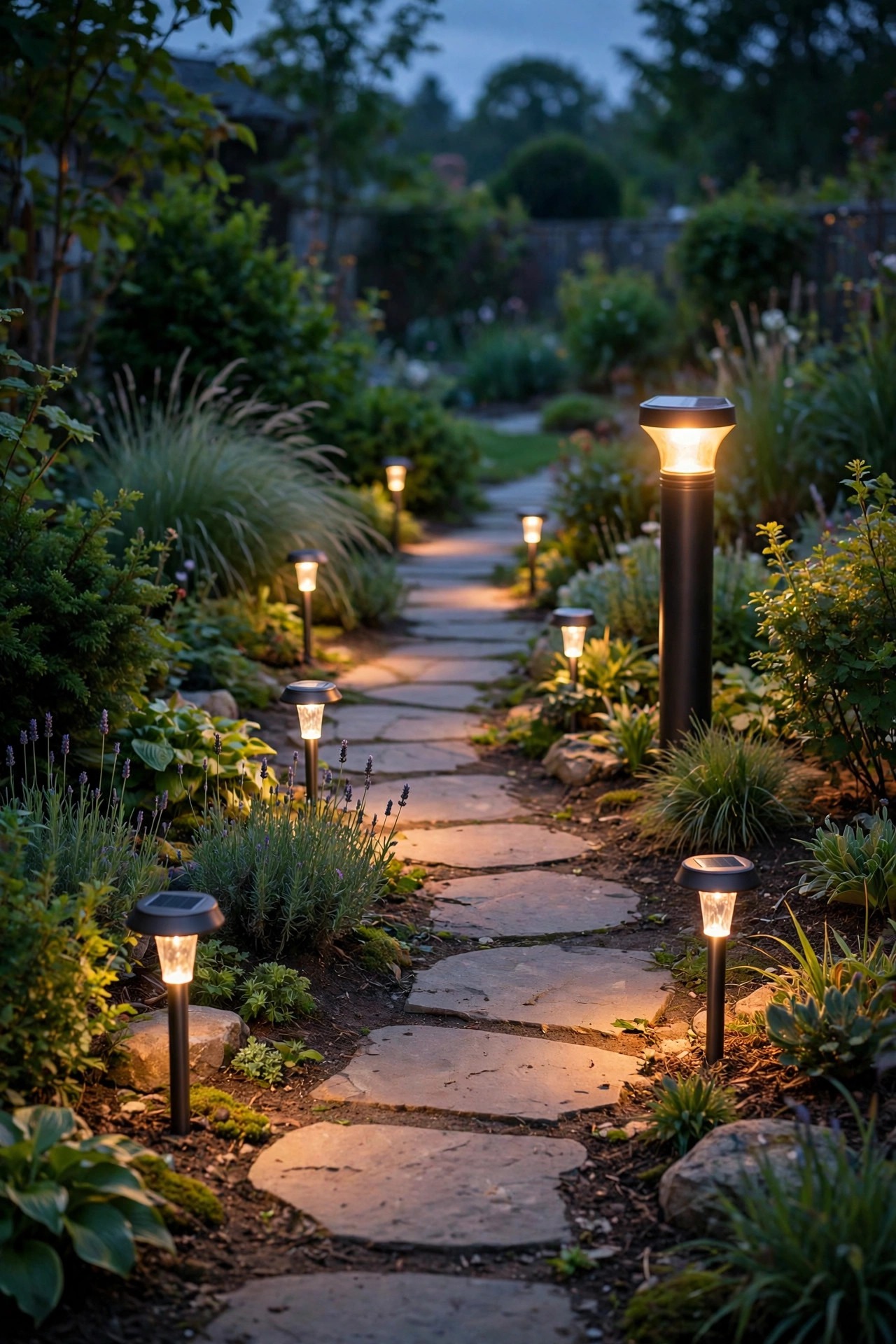
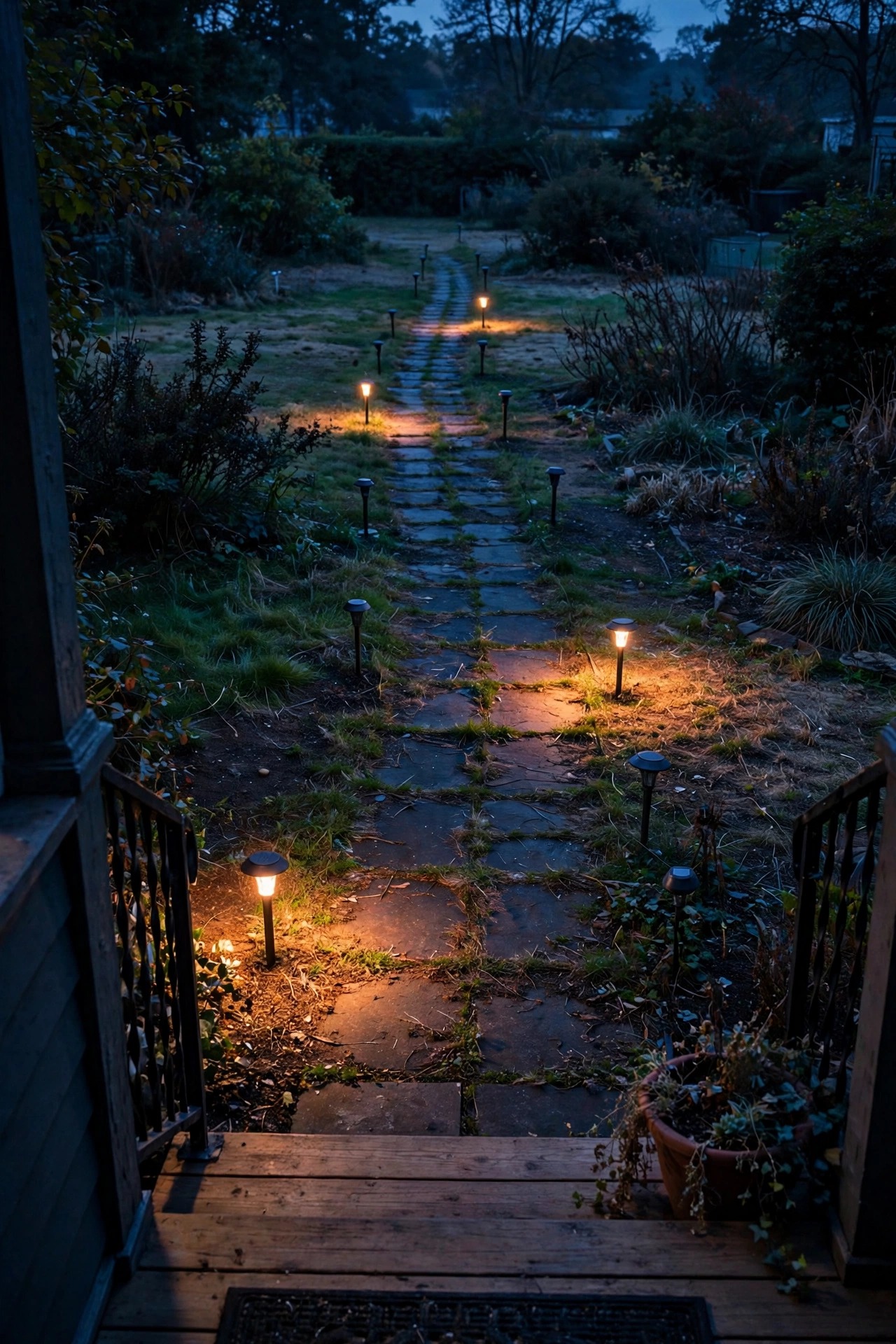
A path light is a small fixture on a short stake, usually twelve to twenty-four inches tall, with a cap, shade, or mushroom top that throws light downward in a soft circle about four to six feet across. The light lands on the path surface, which is exactly where your feet need it, and the fixture itself nearly disappears into the planting bed during the day. Most are low-voltage, and the solar versions are everywhere.
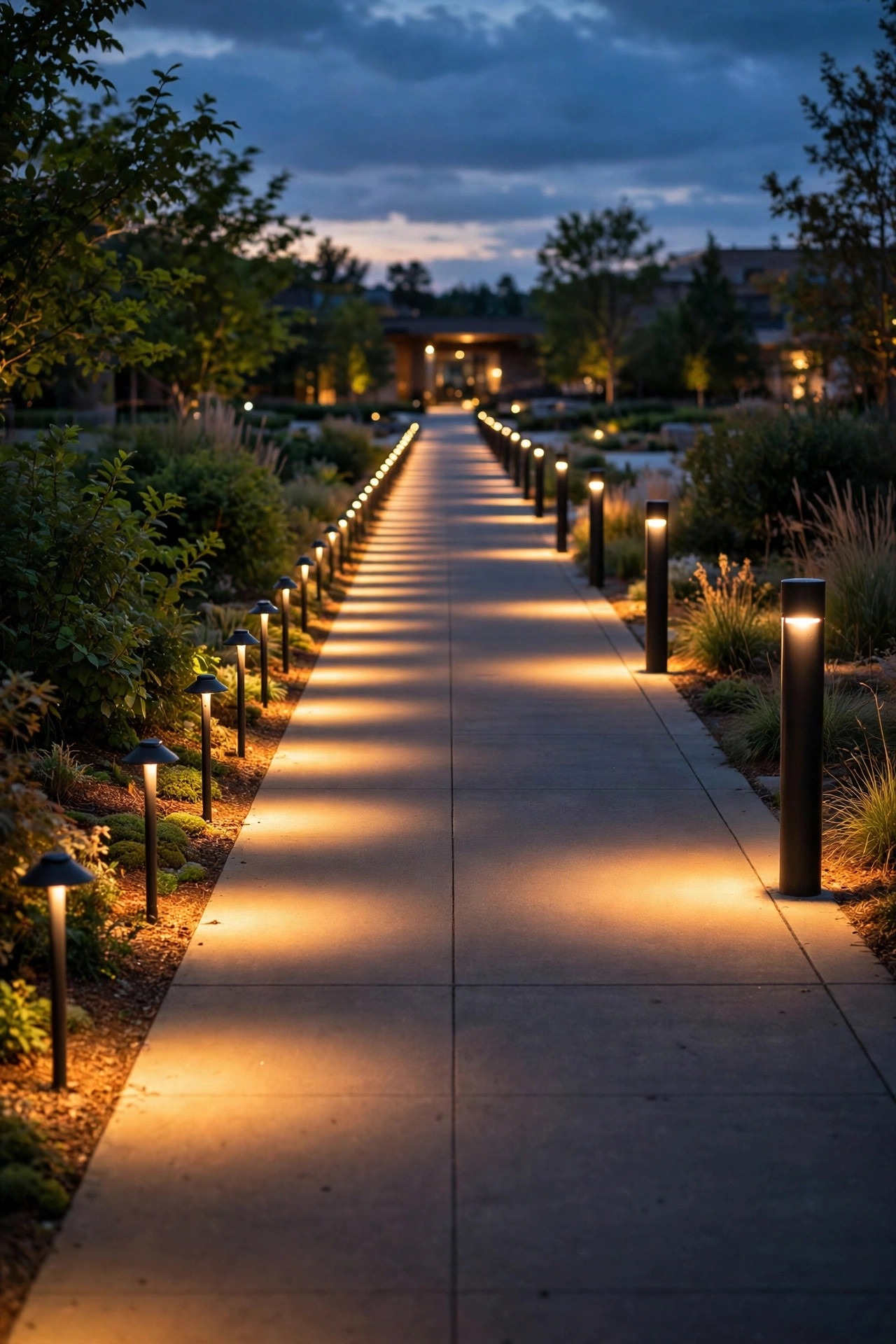
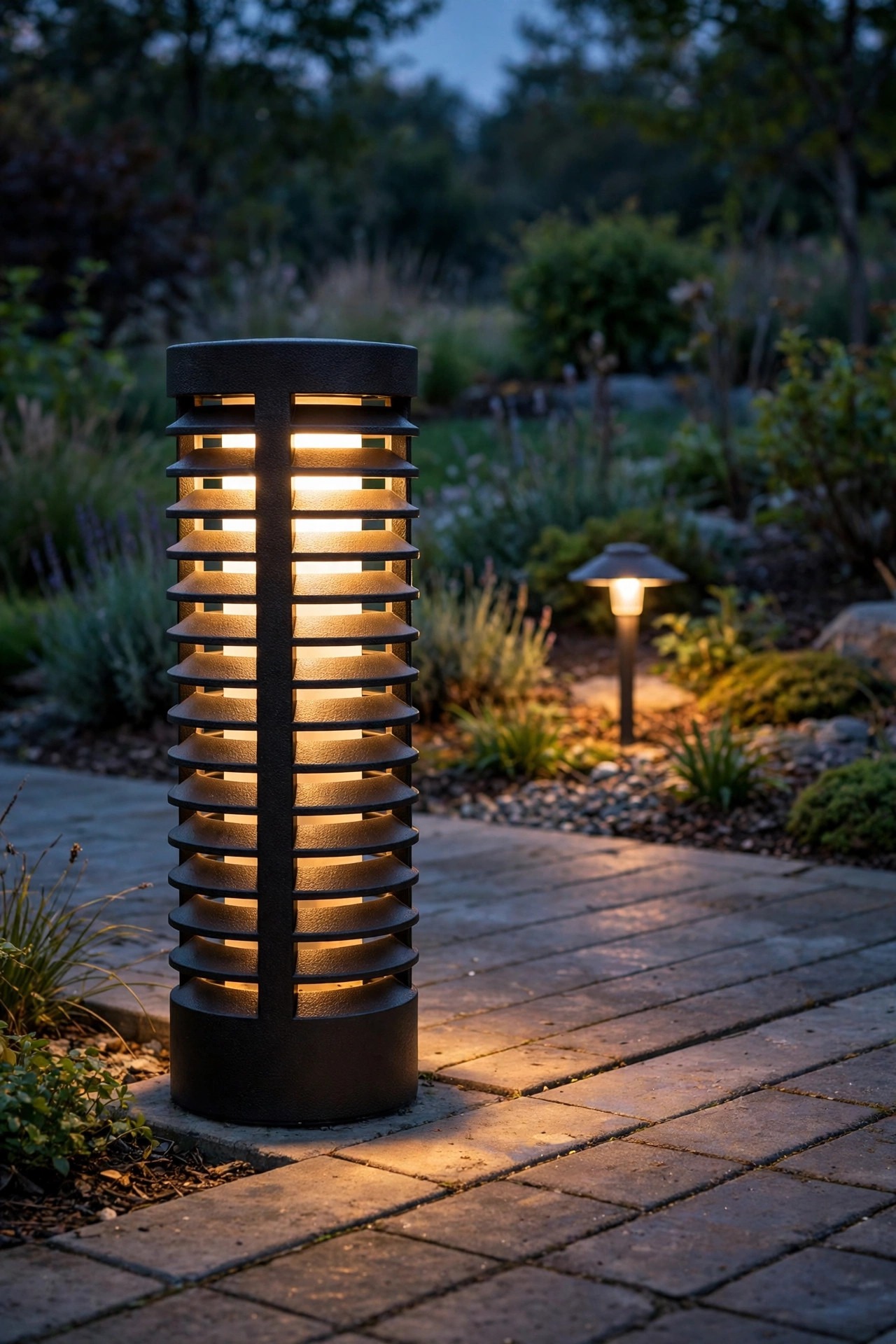
A bollard light is a short post, usually twenty-four to forty-two inches tall, with the light source near the top shining out through louvers, slots, or a frosted lens. It throws a wider pool, often eight to twelve feet across, and just as importantly it is visible. A bollard reads as an object: an edge marker, a boundary, a deliberate line you can follow with your eyes before you ever step onto the walk. That presence is the whole point, and it is why bollards feel at home along driveways, straight modern walks, and commercial-style entries. Think of it this way: a path light washes a surface, while a bollard marks a route and lights it at the same time.

Spacing Math: How Many You Actually Need
Spacing is where the two fixtures quietly change your whole budget and wiring plan. Path lights space six to eight feet apart, because each one only washes a four-to-six-foot circle and the pools need to overlap slightly so your eye reads one continuous ribbon instead of separate dots. On a forty-foot front walk lit from one side, that means six or seven fixtures. Staggering them on both sides of a curved path stretches spacing a little and looks more natural, but the count stays similar.
Bollards space eight to twelve feet apart, because the pool is wider and the fixture is brighter. That same forty-foot walk needs four or five bollards. Fewer fixtures means fewer cable connections and less voltage drop to manage on a wired run, which matters on long walks. The trap is pushing bollards to fourteen or fifteen feet to save money: the pools stop overlapping, the walk goes scalloped, and the dark gaps land exactly where a guest steps off the edge. Whichever fixture you choose, space for gentle overlap at walking height, not for how the row looks from the street at noon. Guidance, not floodlighting, is the goal.
Path Lights vs Bollard Lights: Glare and Light Control
Glare is simply this: can you see the bare light source? Path lights win this round almost by design. The cap or mushroom shade hides the bulb from nearly every angle, so the light lands on the path and your eyes stay comfortable. You can walk toward a row of them all evening and never squint.
Bollards need more care, because the source sits twenty-four to forty-two inches off the ground, right in the sightline of a seated guest, a child, or a driver pulling in. An unshielded bollard with a clear lens can be genuinely unpleasant at eye level. The fix is to choose louvered or shielded optics that push light down and out instead of sideways, or a frosted lens that softens the source, and to keep the output modest. Warm 2700K light feels gentler than cool white at the same brightness, too. Before you commit to a full row, set one bollard in place, plug it in after dark, and look at it from the porch chairs, from the sidewalk, and from the driver seat of your car. Ten minutes of testing beats a season of squinting at your own front walk.
Style: Garden-Soft vs Architectural
By day, path lights are nearly invisible. A dark stake and a small cap tuck into mulch and foliage, so the garden stays the star. That softness suits cottage gardens, traditional homes, curved beds, and anywhere you want the light to appear as if from nowhere. Finishes like black, bronze, and aged copper disappear fastest.
Bollards are furniture. Their lines are part of the design whether the light is on or off, so they suit modern and architectural homes, straight walks, wide entries, and landscapes with strong geometry. A row of clean square bollards along a straight concrete walk looks deliberate in a way path lights never quite manage. The flip side is that a bollard in the wrong setting can feel like a parking lot wandered into your yard. Match the finish to your door hardware and house numbers, keep the profile simple, and let the planting soften the base. If your home is traditional with curving beds, you will probably fight a bollard row all season. If your home is modern with straight lines, path light mushrooms can look oddly timid. Let the house vote first, then check the light pattern. One more test I love: look at your walk at midday in a photo. If the eye already travels in a straight, formal line, bollards will feel like they were always meant to be there. If the eye wanders through planting, keep the fixtures invisible and let the light do the talking.

Durability: Mowers, Snow and Daily Abuse
Walkway lights live a harder life than almost any other fixture in the yard, and the two forms fail in different ways. Path lights get clipped by mower decks, chewed by string trimmers, kicked by kids cutting the corner, and leaned on by every delivery driver who steps off the walk. The cheap failure point is the plastic stake and stem: it snaps at ground level, usually in the first season. Metal housings, thicker stems, and setting fixtures a few inches back into the bed instead of right at the edge buy real years. Solar path lights add a faded, hazed cap to the list after a couple of summers.
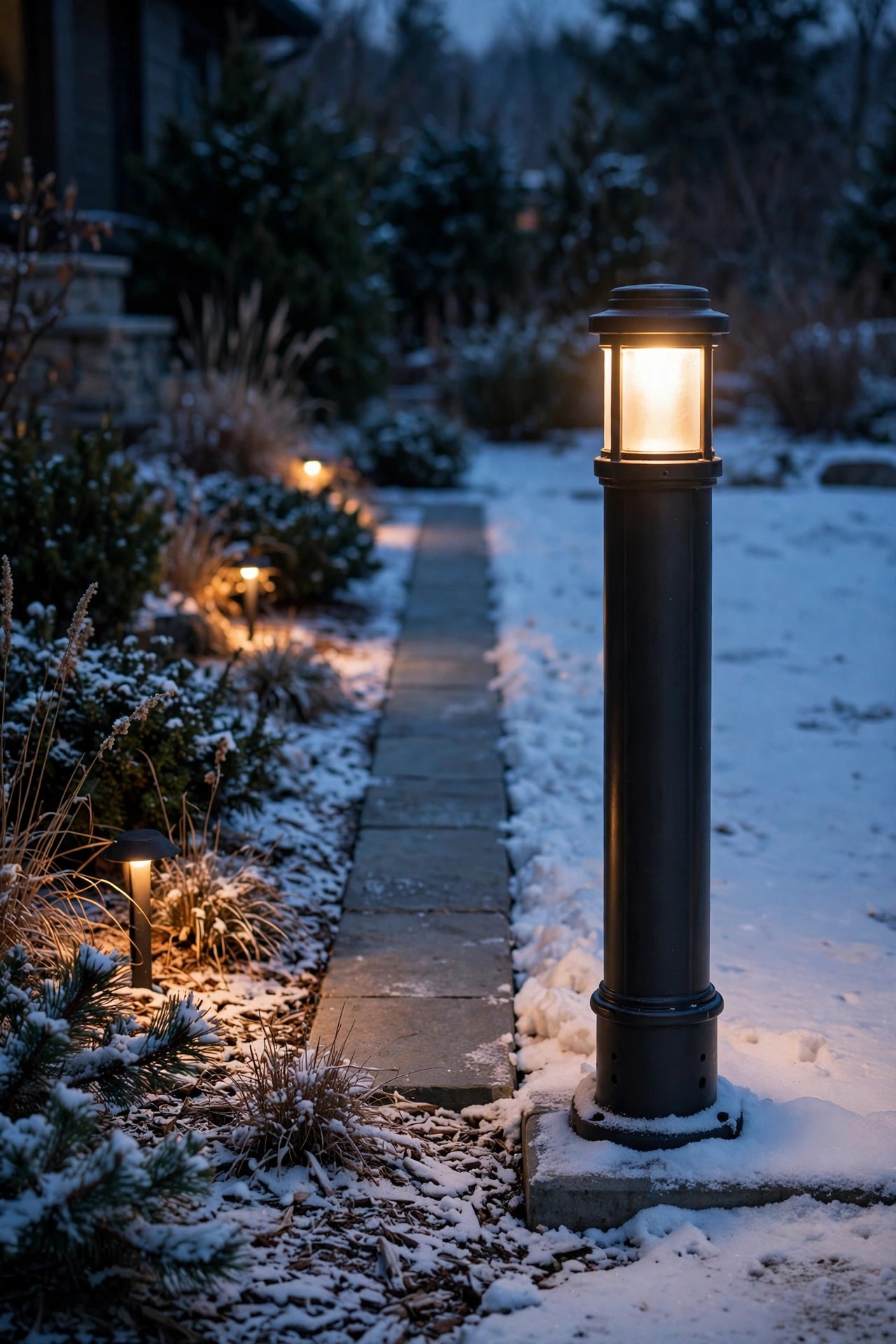
Bollards start sturdier. A metal post on a solid base shrugs off trimmers and most kicks, and it stands far enough above snow cover to keep working through winter in cold climates, where low path lights can vanish under a six-inch snowfall until spring. But a bollard is not invincible: a car bumper or a snowplow blade will still win, and the repair bill is bigger when one does lose. Place bollards where tires genuinely cannot reach, respect the base, and the fixture will likely outlast two or three sets of economy path lights.
Driveways and Bigger Jobs
Driveways change the answer. A driver backing out at night needs to read the edge of the pavement, and bollards do that job beautifully: the post is tall enough to catch the eye, the pool is wide enough to show where concrete ends and lawn begins, and a line of them gives a parking court or long drive a calm, almost commercial order. If you are planning a full driveway scheme, my driveway lighting ideas walkthrough covers the layout side of it.
Path lights struggle here. They are low, their wash is small, and placed anywhere near tire paths they get clipped, crushed, or knocked flat within a season. I only use them along a driveway when they sit deep inside a planted bed well back from the edge, purely as decoration. There is a visibility problem, too: a driver watches for vertical cues at mirror height, and a fourteen-inch fixture simply does not register the way a three-foot post does, especially in rain or when headlights are washing everything out. Bollards also survive the driveway environment better, since their bases sit above the splash zone and out of the string-trimmer line that runs along every pavement edge in summer. Shared walks, guest parking areas, and wide front entries follow the same logic as driveways: the bigger and more public the space feels, the more a bollard earns its place. Save path lights for the pedestrian-only routes where feet, not tires, set the rules.

Solar Options in Both Forms
Both fixtures come in solar versions, and the honest differences matter more than the marketing. Solar path lights are the most forgiving solar product in the yard: the job is a soft wash over a few feet, so even a modest panel and battery can do it well in a sunny bed. The better ones in my solar path lights guide use replaceable batteries and warm-white LEDs, and they fail mainly in shade, where no panel placement trick can rescue them.
Solar bollards exist and look convincing in photos, but physics is stingy: a taller fixture promising a wide, bright pool needs more stored energy than a small top panel gathers on a short winter day. In practice, solar bollards work as edge markers and gentle accents, not as the main light for a long or dark walk. Expect the pool to shrink and dim as the night goes on, especially from December through February. If a route is safety-critical, steps, a slope, a busy front walk, wire it or choose a remote-panel solar model whose panel can sit in full sun while the fixture stays in shade. Solar is a wonderful accent layer. It is a risky only layer.
Installation and Wiring
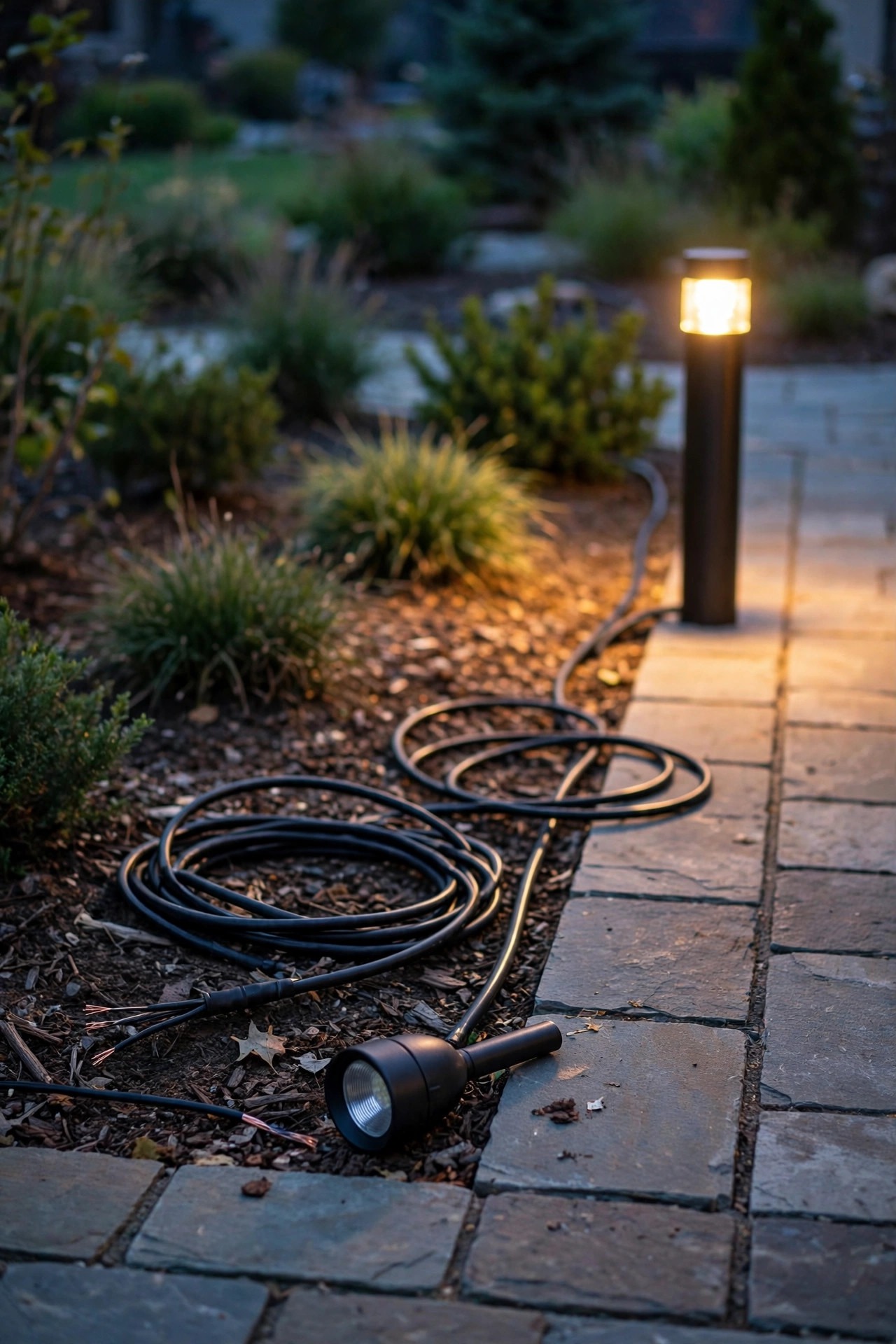
Wired versions of both fixtures usually run on the same low-voltage system: a transformer by an outdoor outlet, a buried cable run, and quick connections at each fixture. That shared backbone is good news, because the install differences are about the fixture, not the system. Path lights are the easy end of the job. Push the stake, connect the cable, nudge the angle, done. Adding two more next spring takes twenty minutes, and moving one to fix a dark spot is trivial. My notes on low voltage path lights cover transformer sizing and cable layout if you are starting from scratch.
Bollards ask for a little more carpentry. Each post needs to stand plumb on something solid, a buried mounting stake, a small concrete footing, or a deck mount, and a leaning bollard looks worse than no bollard at all. The cable work is identical, but plan positions before you trench: with fewer, pricier fixtures, a bollard placed a foot off the line shows. Voltage drop also behaves differently. Many small path lights spread load along the whole run, while a few bollards cluster it, so check the far fixture after dark before you bury anything permanently.
What It Costs in 2026
Here is the honest math for a typical forty-foot front walk, lit from one side, at 2026 prices. Solar path lights run $5 to $25 each, so a six-light row costs $30 to $150 with zero wiring. Wired path lights run $20 to $60 each; add a transformer at $80 to $200 and cable, and a seven-fixture DIY setup lands around $350 to $700. Bollards run $60 to $250 each wired, and $40 to $150 each in solar form; four or five wired bollards with the same transformer and cable come to roughly $400 to $900 installed by you, with the per-fixture price higher but the count lower.
Running costs are nearly a rounding error for both. A wired LED path light draws about 3 watts and a bollard about 6 to 10 watts; at six hours a night and roughly $0.17 per kilowatt-hour, a whole walk costs $5 to $15 a year. The real cost difference is replacement rhythm. Economy solar path lights often need full replacement every two to four years, while a decent metal bollard or wired path light should run a decade with only an occasional bulb or battery. Cheap per fixture is not always cheap per decade.

Path Lights vs Bollard Lights: The Verdict by Walkway
After all of that, here is how I actually assign them. A curved garden path through planting beds gets path lights, staggered on alternating sides, tucked into the foliage so the light seems to come from the plants themselves. A classic straight front walk on a traditional home can wear either, but path lights keep it soft and welcoming. A modern home with a straight concrete or paver walk gets bollards, evenly spaced, matched finish, no apologies. A driveway edge gets bollards set back from the tire line, always. Steps and slopes get whichever form keeps the source shielded and the treads lit, and often a dedicated step light does that job better than both.
Mixing the two is not only allowed, it is often the best answer, as long as you follow three rules. Keep one color temperature everywhere, ideally 2700K to 3000K. Keep one finish family, so the metal reads as a set. And give each form its own territory: bollards at the driveway and the entry landing, path lights along the garden run, rather than alternating them down the same line. Mixed with intent, the yard looks layered. Mixed at random, it looks like a clearance sale.

5 Mistakes That Ruin the Effect
First, spacing bollards like path lights. A bollard every six feet is an airport runway, bright, expensive, and vaguely stressful. Bollards want eight to twelve feet and room to breathe. Second, putting path lights along a driveway edge, where they will be clipped by tires and plow blades within the season. Third, choosing an unshielded bollard and mounting its bright lens at sitting eye height beside the porch or patio, so guests squint through every conversation. Fourth, spacing either fixture for how the row looks at noon instead of how the pools overlap at night, which leaves dark scallops exactly where feet land. Fifth, mixing color temperatures, a warm row on one side and cool blue-white on the other, which makes even good fixtures look like mistakes from two different projects. I would add a quiet sixth that I see every spring: burying the cable and staking everything permanently on day one, then discovering the layout is wrong and living with it for years because moving it feels like starting over. Every one of these is easy to avoid with a single test: place the fixtures on the ground after dark, before you trench or stake anything permanently, and walk the route the way a guest would. Live with the test layout for two or three nights if you can. The walk will tell you the truth your eyes could not see in the store aisle.
Frequently Asked Questions
How far apart should walkway lights be spaced?
For path lights, plan on six to eight feet between fixtures so the pools overlap gently. Bollards can stretch to eight to twelve feet because each one throws a wider pool. On curves, tighten the spacing slightly, and always judge the result after dark at walking pace rather than from the street.
Are bollard lights brighter than path lights?
Usually, yes. A typical wired bollard puts out more light over a wider area than a typical path light, which is designed to wash a small circle. Brighter is not automatically better, though. For a narrow garden path, a bollard can overwhelm the planting and flatten the mood that made you choose the path in the first place.
Can I mix path lights and bollards on the same property?
Absolutely, and I often recommend it. Give each form its own zone, bollards for the driveway and entry, path lights for garden runs, and hold the color temperature and finish consistent across both. The mix fails only when the two forms alternate randomly down the same stretch of walk.
Do solar bollard lights actually work?
They work as markers and soft accents, and the better models with larger panels do a respectable job in sunny spots. They do not match a wired bollard for a wide, steady pool all night, especially in winter or shade. Use solar bollards where a gentle glow is enough, and wire the routes that carry real traffic after dark.
Conclusion
The path lights vs bollard lights question answers itself once you look at the route instead of the fixture: low, soft washes for the paths you stroll, taller structured pools for the edges you drive and arrive by. Get the spacing to overlap, shield anything near eye level, keep one warm color temperature across the yard, and either choice will serve you for years. If you are still deciding, set out one of each after dark and walk your own front path both ways. Then browse the rest of the lighting ideas here for the layers that go around your winner, because a great walk is only the first layer of a great yard.