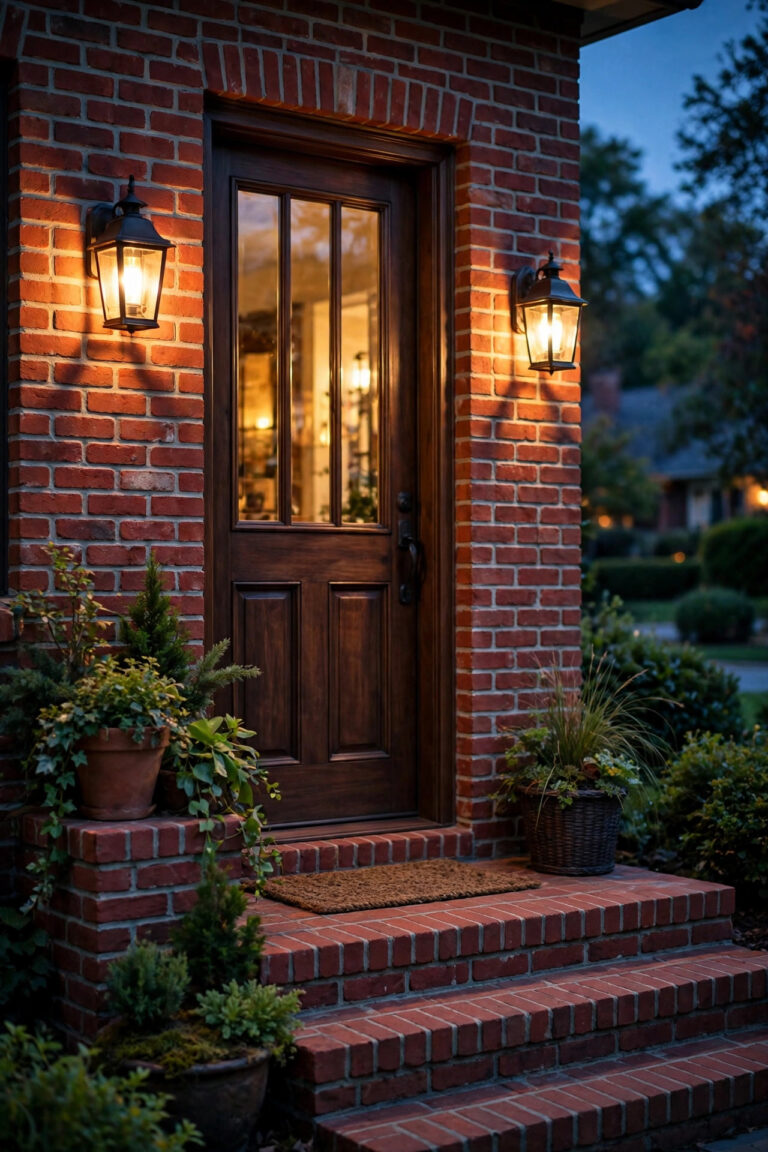
If your home has a two-story entry, a 9-foot front door, or a facade that stretches wide across the lot, you already know the frustration: standard 12-inch sconces just disappear. I learned this the hard way at my sister's house — we hung a pair of perfectly pretty lanterns beside her double doors and from the street they looked like two birthday candles on a wedding cake. Scale is everything on a big home. Oversized outdoor sconces, the kind that run 20, 24, even 30 inches tall, are what make a tall entry feel intentional instead of underdressed. In this post I'm sharing 21 ways to use them — beside double doors, on stone columns, over garages, in porticos — plus the sizing and mounting rules I always follow so they look grand, never gaudy. Think of it as layering with bigger brushstrokes: same warm glow, just proportioned to the canvas.
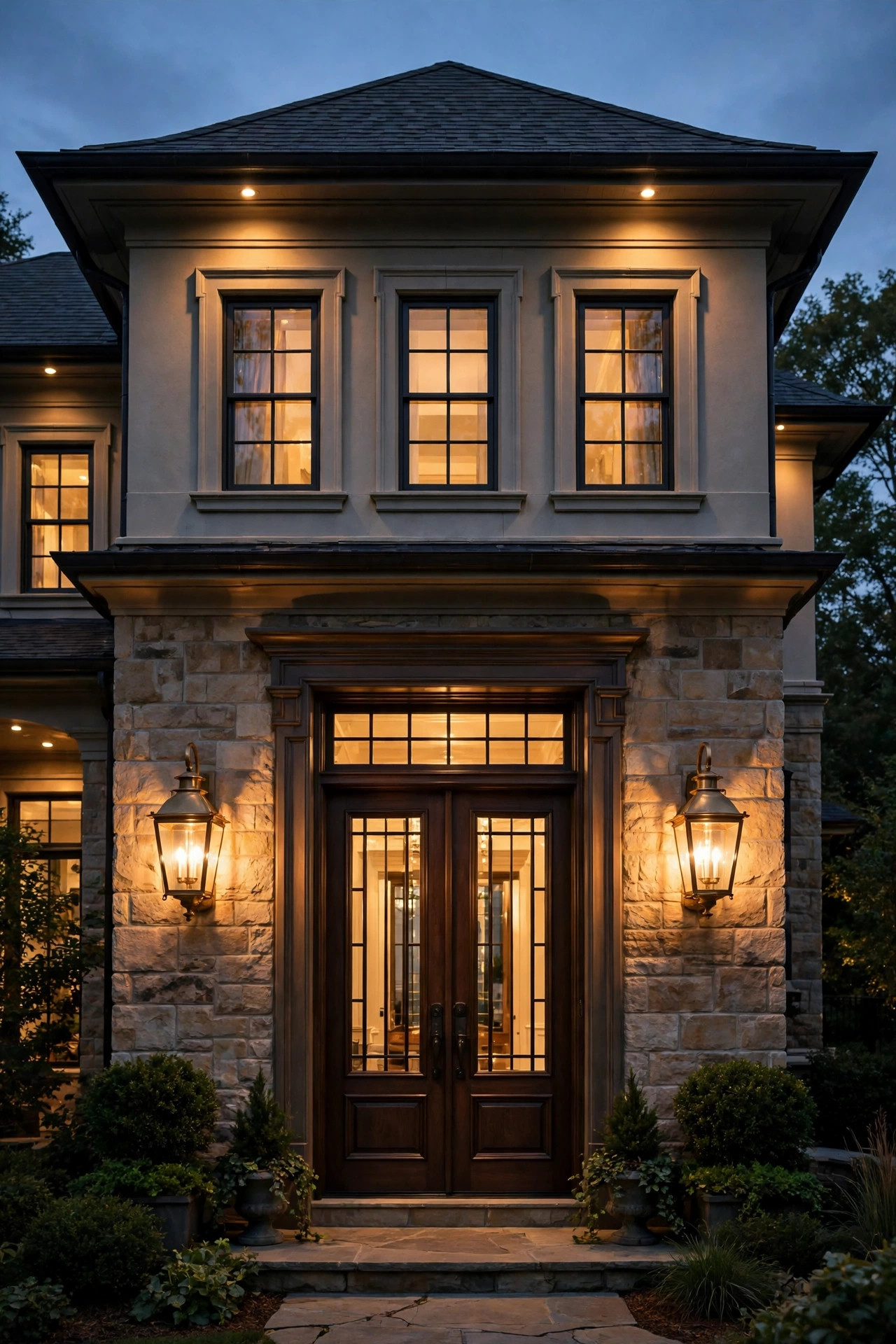
1. Truly Oversized Outdoor Sconces Beside a Double Door
A double front door is roughly 6 feet wide and often 8 feet tall, so it needs fixtures with real presence. My rule of thumb: each sconce should measure about one-quarter to one-third of the door's height, which means 24 to 30 inches tall for a standard double entry — bigger than most people dare to order, and exactly right once they're up. Look for lanterns with a substantial backplate (at least 5 by 8 inches) so the fixture reads as architecture, not an afterthought. Mount the pair so the center of each light sits about 66 to 72 inches from the ground, spaced evenly on either side of the trim. Inside, use LED filament-style bulbs in 2700K, around 800 lumens each; oversized glass shows the bulb, so a pretty filament matters. If your trim is narrow, choose sconces that project less than 8 inches so they don't crowd the door swing. This is the single highest-impact upgrade for a big entry, and it's the one guests notice before they even reach the porch.
Suggested budget range: $180 – $450.
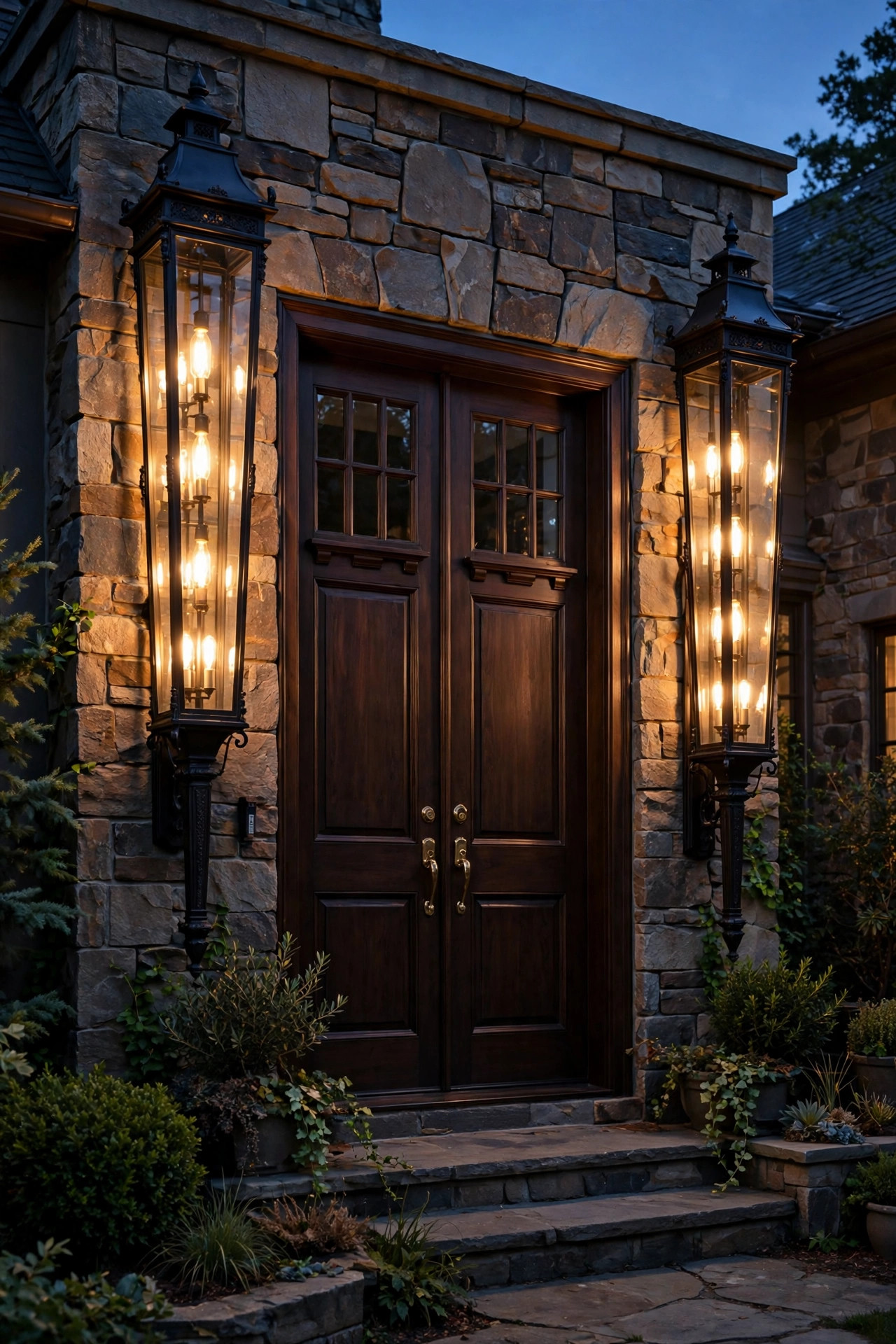
2. A Grand Pair for a Two-Story Foyer Entry
When the entry soars two stories — think a tall portico, a gabled foyer bump-out, or floor-to-ceiling windows beside the door — a single pair of sconces has to hold its own against a lot of vertical wall. I like fixtures in the 26- to 32-inch range here, with elongated bodies: stretched lantern silhouettes, tall rectangular frames, or stacked double-light designs that draw the eye upward. Mount them a touch higher than usual, around 72 to 78 inches to center, so they relate to the full height of the entry rather than huddling at door level. Because these fixtures sit high, pick enclosed or top-covered designs so rain and bugs don't collect in the glass, and plan on an extension ladder or a telescoping bulb changer for maintenance. Warm white light at 2700–3000K keeps the scale feeling welcoming instead of institutional. If the facade is symmetrical, keep the pair perfectly matched; if your entry is offset, one oversized sconce on the wide side plus a lit house number plaque on the other balances beautifully.
Suggested budget range: $220 – $550.

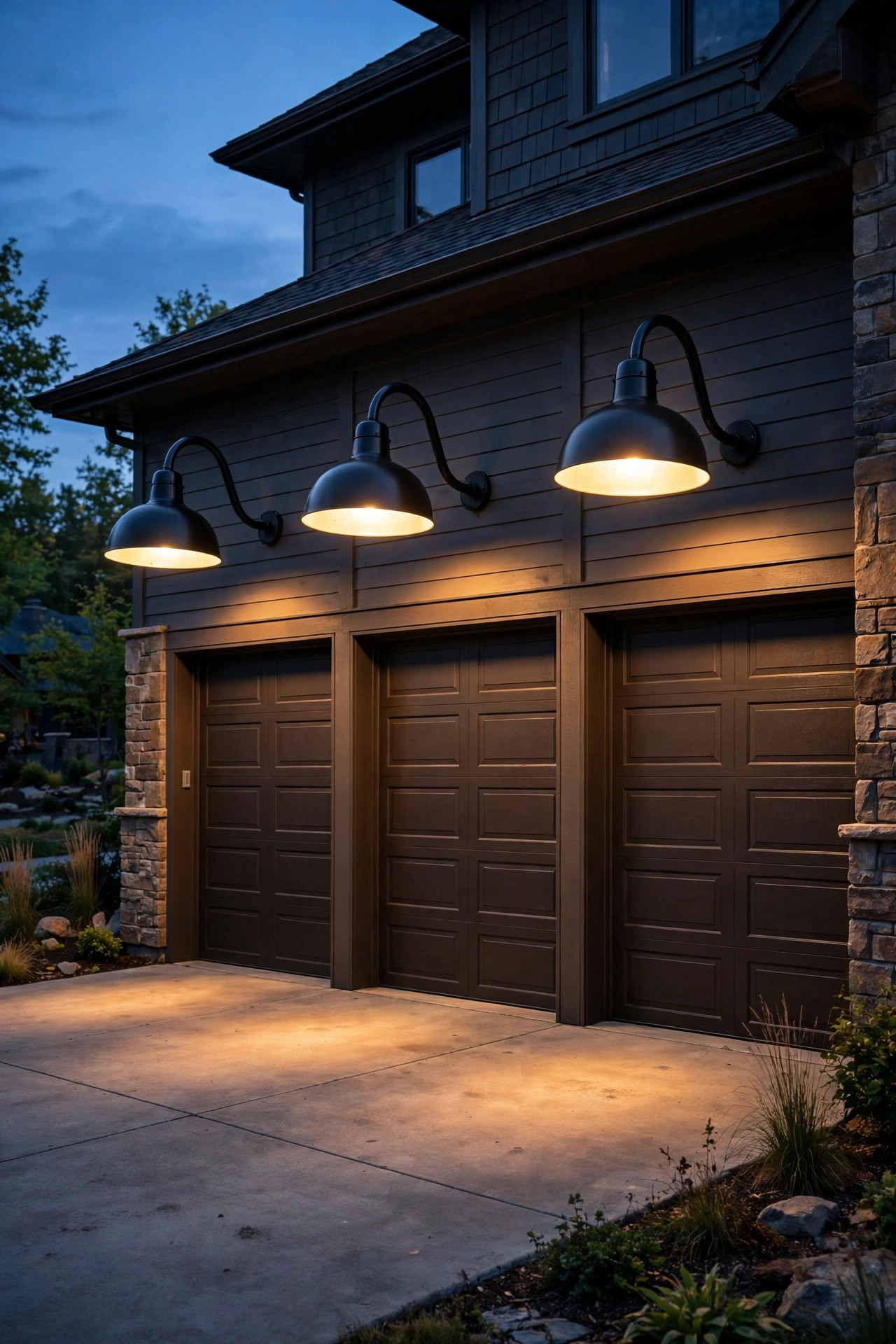
3. Oversized Gooseneck Barn Lights Over Garage Doors
Big homes usually mean big garages — two or three bays across — and a row of dinky carriage lights over those wide doors gets lost fast. Oversized gooseneck barn lights solve it: a 14- to 18-inch shade on a long curved arm throws a generous pool of light down the driveway while reading clearly from the street. Space one over the center of each bay, mounted 8 to 10 feet up depending on your door height, and keep the arm length consistent so the row marches in rhythm. These fixtures are downward-focused, which neighbors appreciate and dark-sky guidelines love. Choose a shade with a white interior for maximum light spread, and pair them with 3000K LEDs at 1,100 to 1,600 lumens for real task brightness when you're unloading groceries at night. A matte black or oil-rubbed bronze finish works on almost every exterior; galvanized steel leans farmhouse. For extra polish, put the whole row on a timer so the garage face lights up as one scene at dusk.
Suggested budget range: $120 – $320.
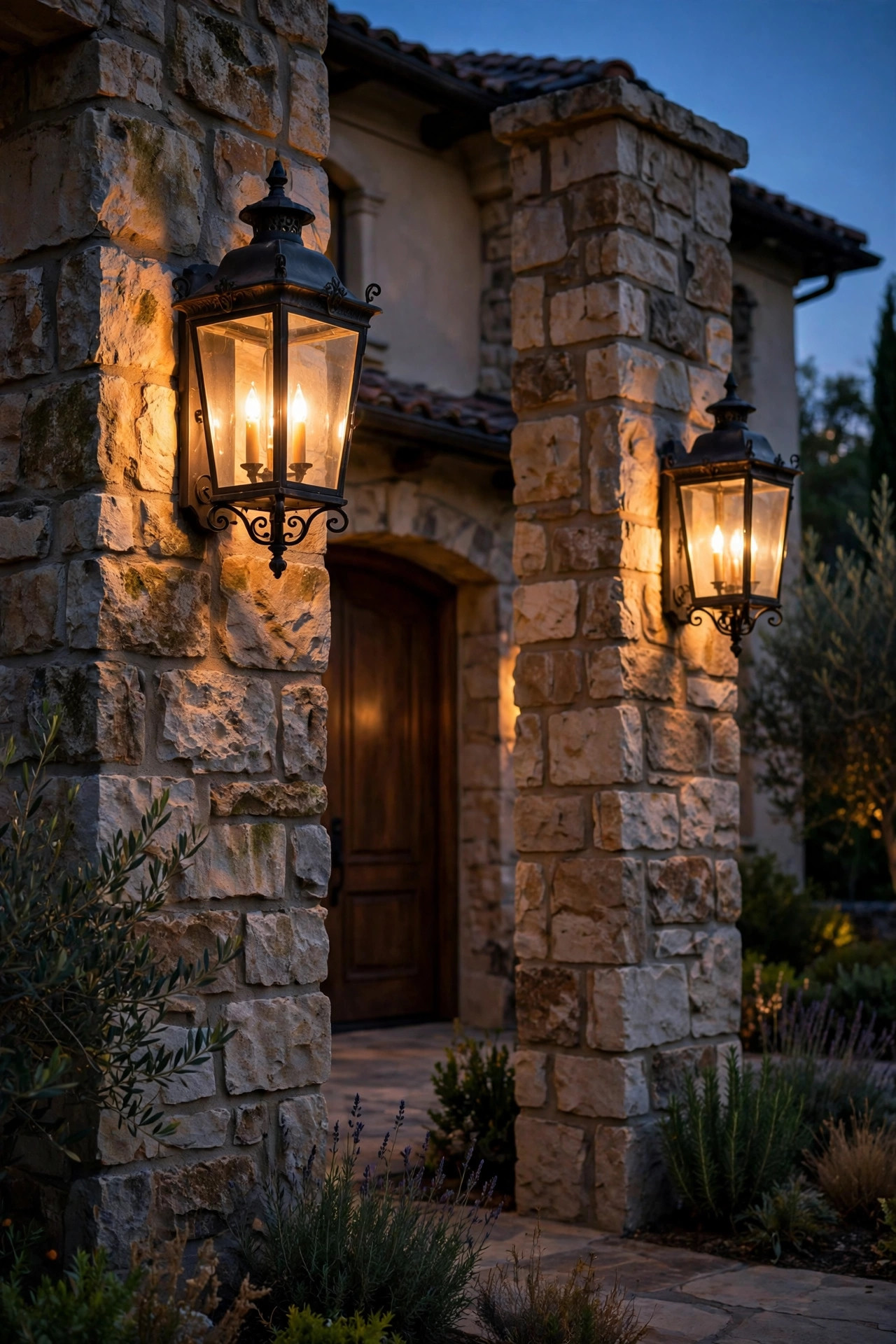
4. Statement Sconces Mounted on Stone or Brick Columns
Many large entries are framed by masonry — stone-clad columns, brick piers, or stucco pillars — and mounting oversized sconces directly on those columns makes the whole entry feel built-in and permanent. The fixture scale should relate to the column width: on a 16- to 20-inch-wide pier, a sconce 22 to 28 inches tall with a wide backplate looks anchored and intentional. Use a masonry-rated junction box and stainless hardware, and have an electrician drill the stone if you're not comfortable — cracked veneer is an expensive lesson. I love a lantern silhouette here, with seeded or water glass that softens the bulb's glare against rough stone texture. Position the fixtures so the light grazes the masonry; the shadows in the stone's texture are half the beauty. If your columns flank a driveway gate instead of a porch, run the same oversized design out there for a matched look from street to door. Keep color temperature consistent at 2700K so the entry reads as one warm composition.
Suggested budget range: $250 – $600.
5. A Rhythm of Three Across a Wide Facade
Long, sprawling homes — ranches with extended wings, wide colonials — sometimes need more than a pair. A rhythm of three (or even five) oversized sconces spaced evenly across the facade creates a cadence that ties the whole front together. The trick is spacing: divide the wall into equal bays and center a fixture in each, often 10 to 14 feet apart, all mounted at exactly the same height so the line reads clean. Because you're multiplying fixtures, each one can be slightly less ornate, but keep the height generous — 20 inches minimum — so they still hold their own. Wire them on a single circuit with a smart timer or photocell control so they always switch together. This approach works beautifully across a wide porch, along a garage wing, or flanking a centered door with one fixture on each side plus one at each end of the porch. Honestly, it's the designer move that makes a big, plain facade suddenly look custom-built, and it costs less than most people expect per fixture.
Suggested budget range: $450 – $1,100.

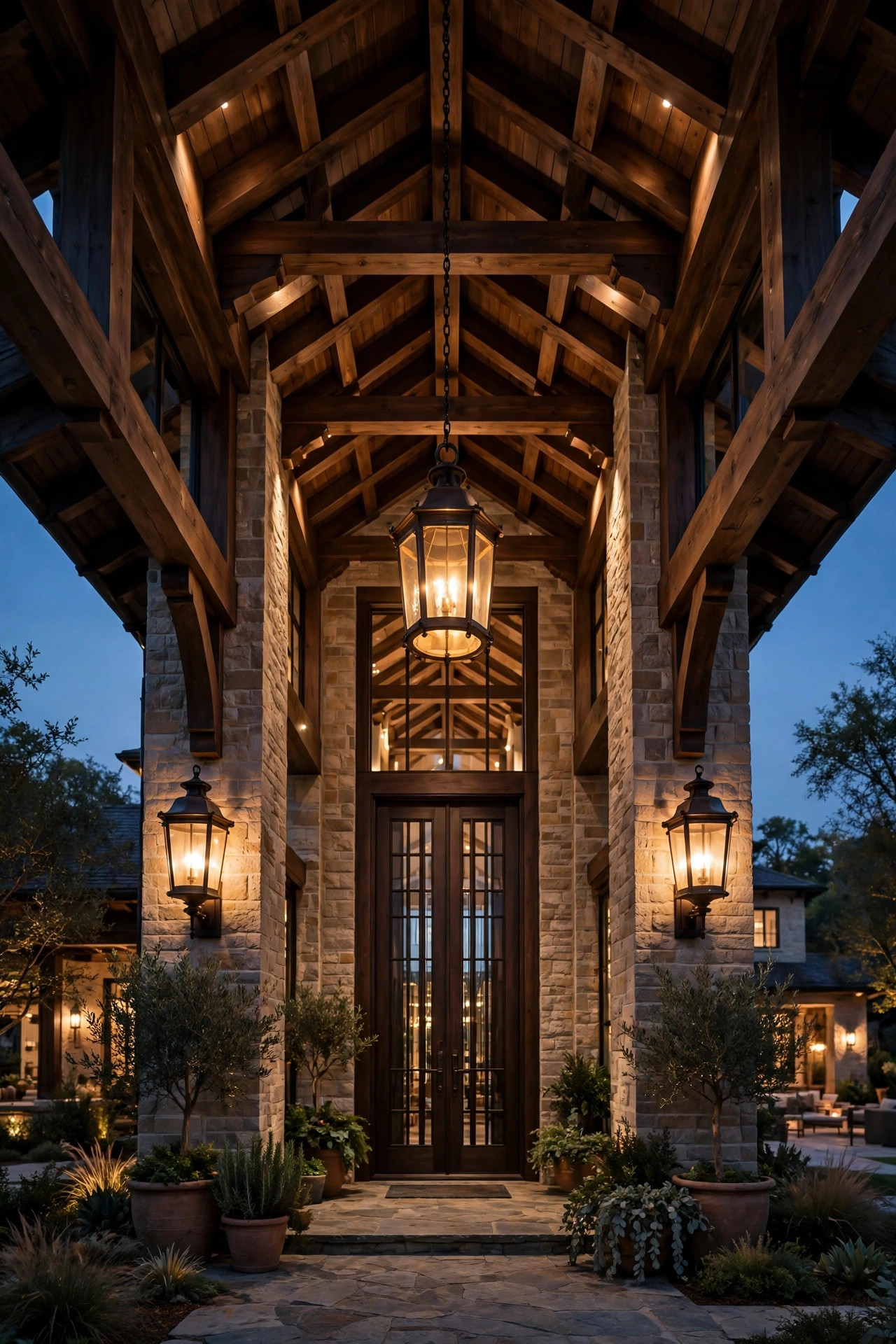
6. Oversized Sconces in a Tall Portico or Covered Entry
A portico with a 10- or 11-foot ceiling swallows small fixtures whole. Inside a covered entry like this, I go big and a little dramatic: 24- to 30-inch sconces flanking the door, sometimes paired with a matching oversized hanging lantern centered under the portico roof. Because the space is sheltered, you have more freedom with open designs and clear glass, though the fixture still needs at least a damp-location rating. Mount sconces so their tops sit roughly a foot below the portico's beam or crown line — that breathing room keeps proportions graceful. With high ceilings, light also needs help reaching the floor, so choose bulbs on the brighter side (1,000+ lumens) or sconces with a downward light component. Layer in a lit step or two and the portico becomes a genuine outdoor room at night. For more covered-entry inspiration, my roundup of outdoor entryway lighting ideas covers porches and porticos of every size.
Suggested budget range: $280 – $700.
7. Long Linear LED Sconces for a Modern Big Home
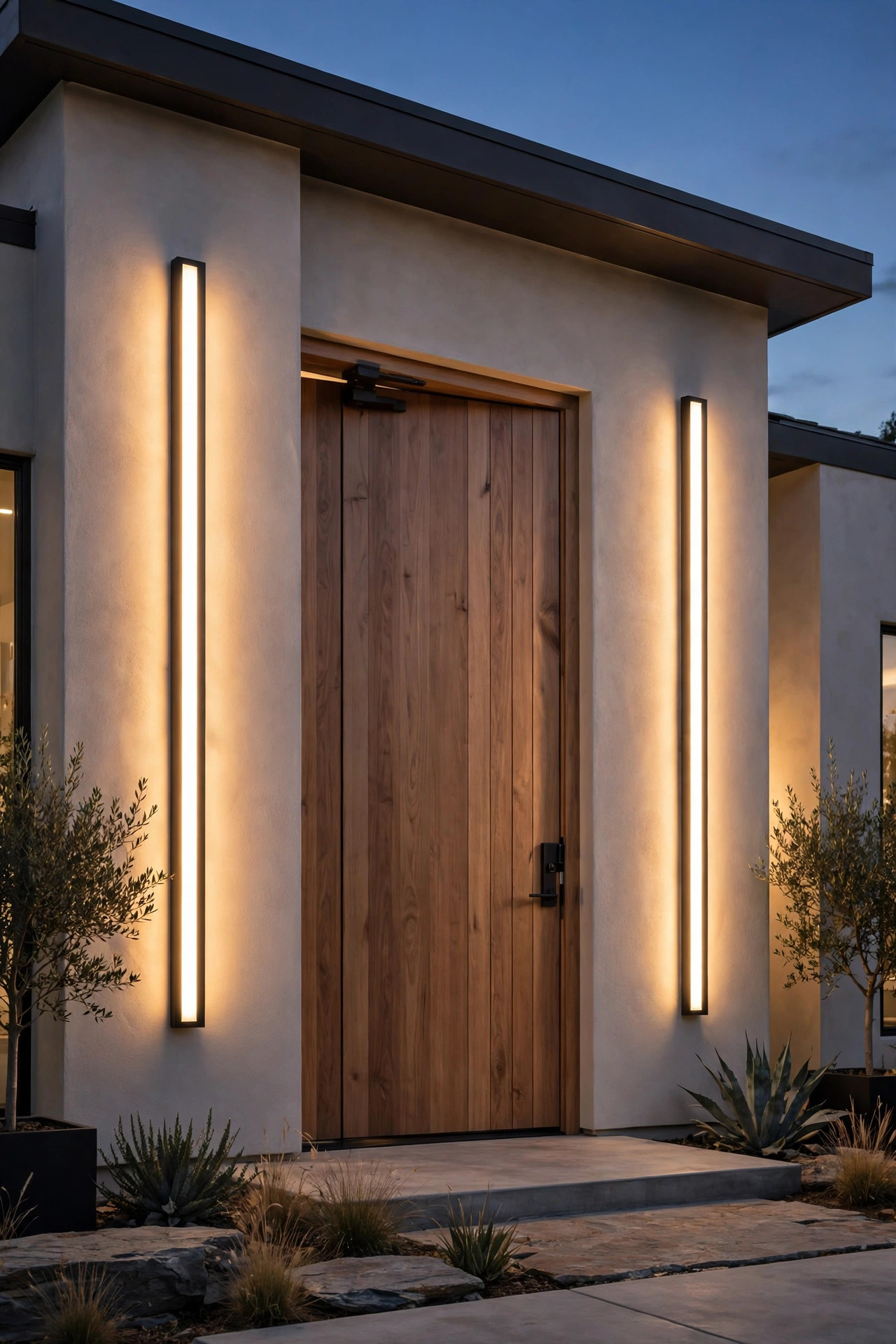
If your home leans modern — flat planes, mixed siding, big windows — an oversized linear sconce is the statement piece. These run 36 to 48 inches long, slim bars or tubes mounted vertically beside the door, and they wash the wall with a clean blade of light that makes architecture look sculptural. Vertical mounting echoes tall doors and windows; horizontal mounting works over wide, low entries. Look for integrated LED models with a high CRI (90+) so stone, wood, and stucco colors stay true at night, and a wet-location rating with a sealed housing since there's no bulb to swap. Color temperature is a style choice here: 3000K keeps it warm and residential while 4000K reads crisp and gallery-like, but never mix temperatures on one facade. Installation is usually a simple two-screw bracket, though the fixtures are heavy enough that a second pair of hands helps. On a minimalist exterior, one pair of these is genuinely all the decoration the entry needs.
Suggested budget range: $200 – $520.
8. Seeded-Glass Lanterns With Old-World Scale
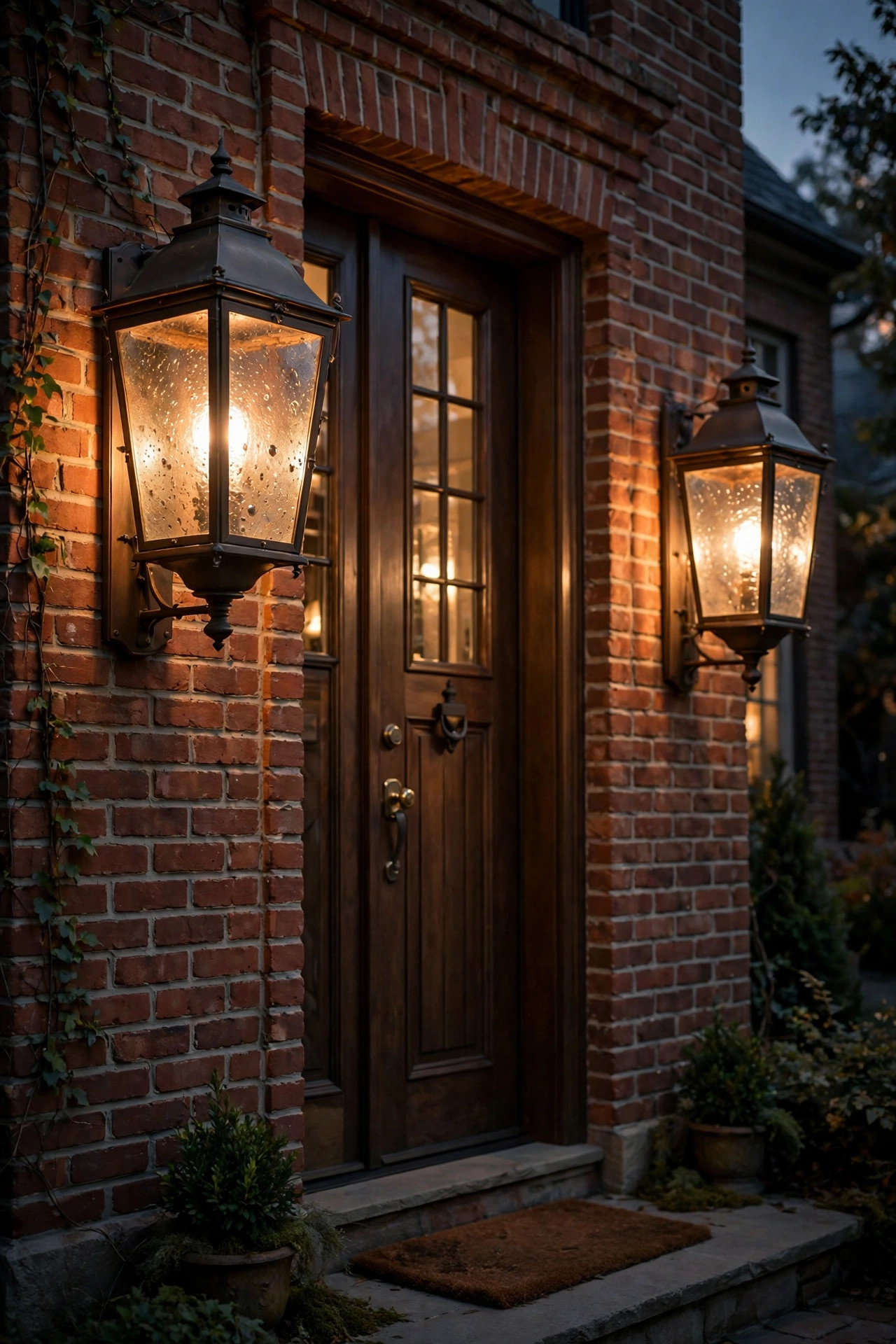
There's something about seeded glass — that bubbly, hand-blown look — in a big lantern body that feels instantly established, like the house has been gracious for a hundred years. In oversized versions, 22 to 28 inches tall, the glass area is large enough for the texture to really sparkle when lit. I pair these with traditional, colonial, and European-influenced homes, especially with brick or stone. The seeded panes diffuse the bulb just enough that you can use a bright 800- to 1,100-lumen LED filament without glare, and at night the whole lantern glows like a real flame-keeper's lamp. Frames in aged bronze, matte black, or antique brass all work; match whatever your door hardware wears. One caution: large glass panes mean more cleaning. A twice-a-year wipe with a microfiber cloth and a spritz of glass cleaner keeps them luminous, and hinged-door designs make bulb changes easy. Mounted beside a tall door with sidelights, these lanterns turn a plain entry into the neighborhood's favorite facade.
Suggested budget range: $190 – $480.
9. Up-Down Cylinder Sconces, Super-Sized
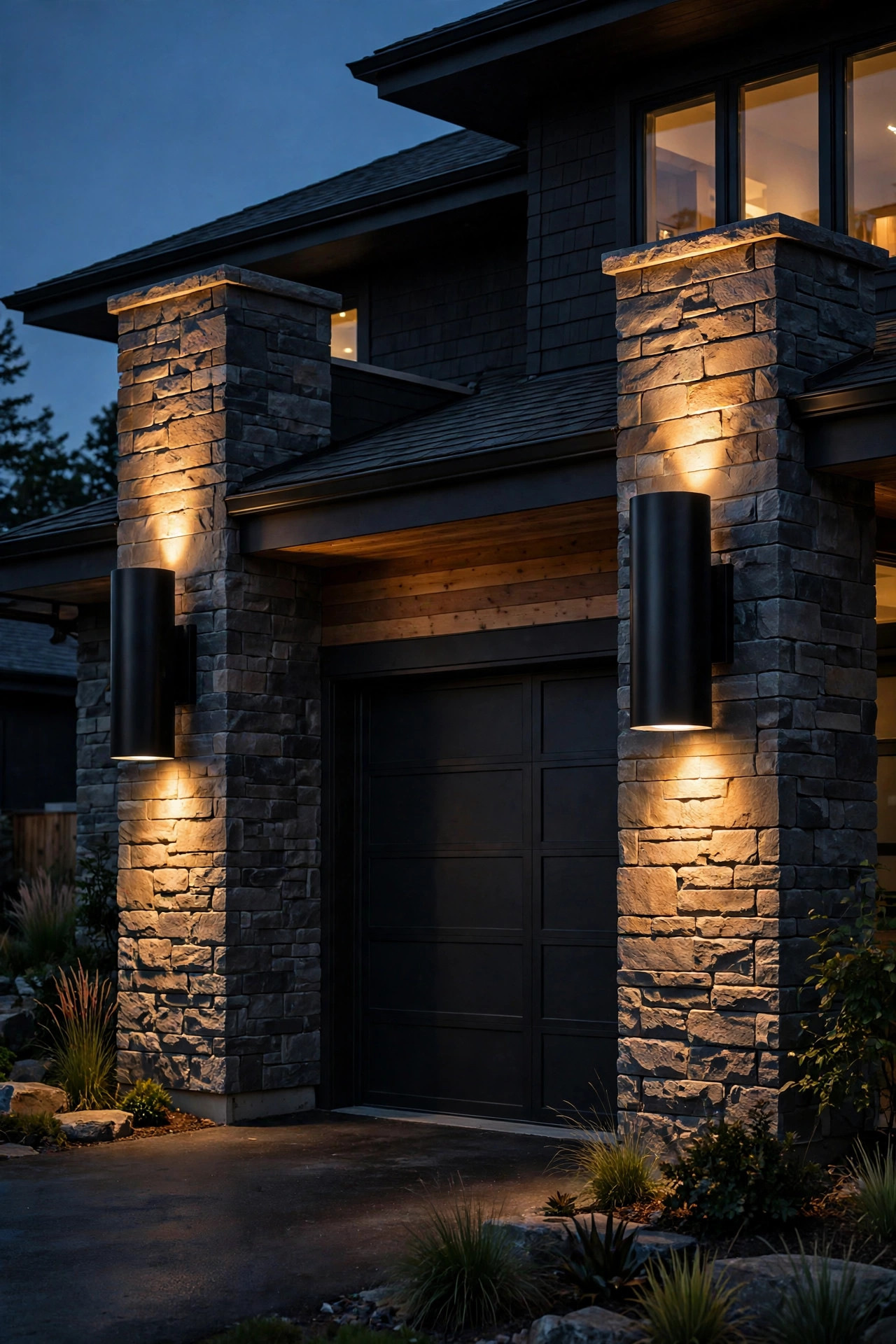
Up-down sconces throw one beam toward the sky and one toward the ground, painting tall columns of light on the wall — and in oversized form they're spectacular on big homes. Look for cylinders 18 to 24 inches tall with dual LED modules; mounted on the piers between garage doors, beside a tall entry, or along a long covered porch, they turn flat walls into architecture. The grazing light emphasizes texture, so they're magic on board-and-batten, stucco, and stone. Because both beams are narrow, you get drama without flooding the yard — very neighbor-friendly. Space them evenly and keep mounting height consistent, with the fixture center around 72 inches. A word of care: the upward beam can catch eaves or second-story windows, so test with a temporary clamp light after dark before drilling. Choose adjustable models if your walls have trim or stone ledges that might block the beam. In matte black or bronze, a row of these gives a large home a tailored, resort-like evening face.
Suggested budget range: $150 – $380.
10. Oversized Sconces Flanking Tall Windows and French Doors
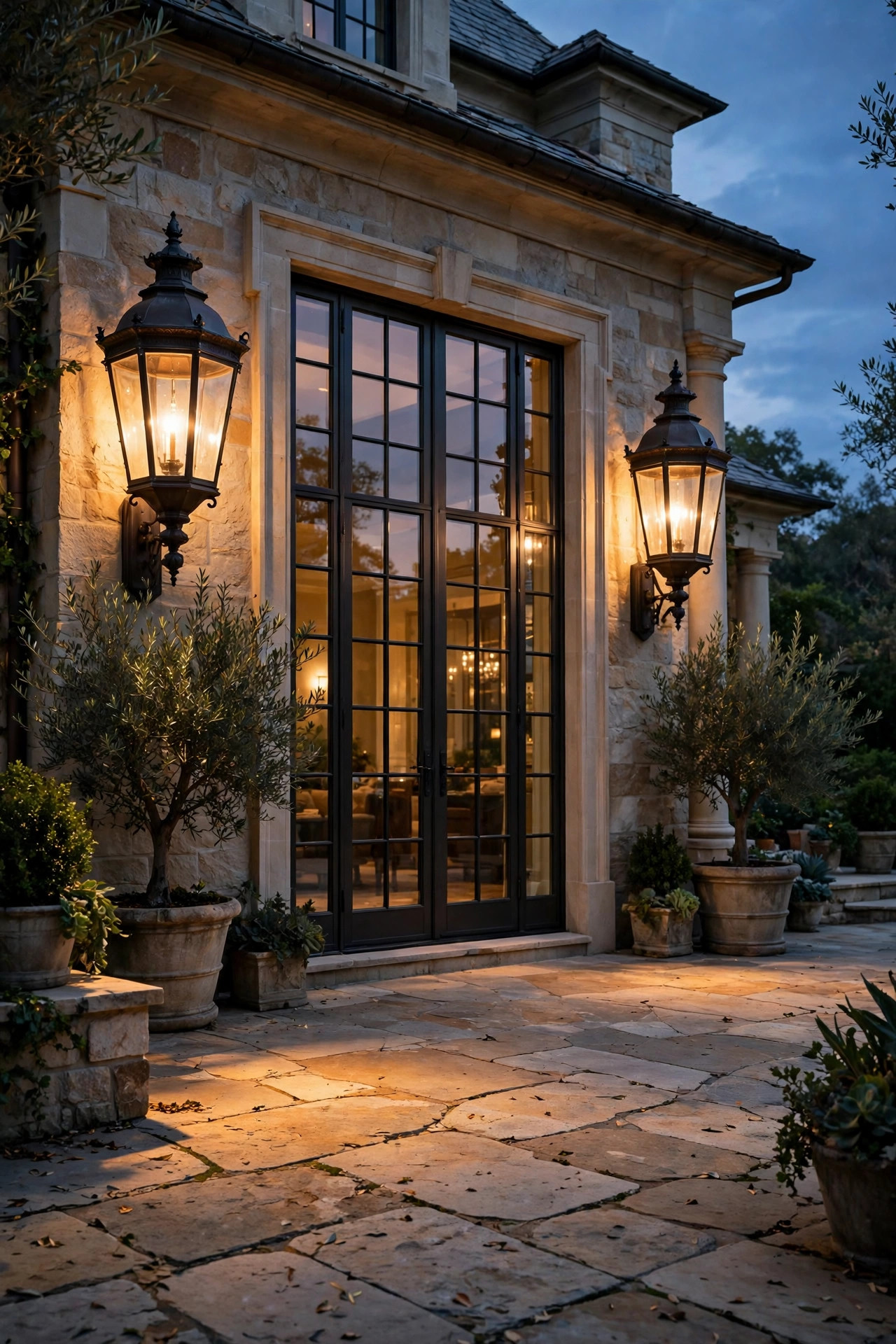
Entries aren't the only place scale matters. If your front facade has tall windows or French doors opening to a terrace, flanking them with oversized sconces extends that grand entry feeling across the whole front of the house. Use the same sizing logic — fixtures roughly one-quarter the height of the window or door — which usually lands at 20 to 26 inches. Matching the entry sconces exactly creates a cohesive suite; if the entry fixtures are very ornate, a simpler sibling design in the same finish works too. For French doors, make sure sconces clear the door swing and any shutters: measure the open door's arc before choosing projection depth. These fixtures earn their keep during evening gatherings, washing the terrace in the same warm light as the entry so indoor and outdoor spaces feel continuous. Put them on a separate dimmer or smart switch from the entry pair and you can set scenes — bright for arrivals, low and golden for lingering over dessert.
Suggested budget range: $170 – $460.
11. One Suite, Whole House: Match Entry, Garage, and Side Doors
On a big home with several visible doors — front entry, garage pedestrian door, side door, mudroom door — mixing fixture styles looks chaotic fast. My favorite strategy for large homes is to pick one oversized design family and repeat it everywhere, scaling the size to each door: 26-inch versions at the main entry, 20-inch at secondary doors, same finish, same glass, same bulb temperature. Manufacturers often sell one lantern design in three sizes for exactly this reason. The repetition reads as calm and intentional from the street, and it makes future replacements simple. When I plan a suite like this, I sketch the facade and mark every door, then count fixtures before ordering — you'd be surprised how many doors a big house has. For guidance on proportions at each door type, the front door sconce pair guide is the sizing reference I send friends. Finish matching matters more than perfect size matching, so order all pieces in the same finish batch when you can.
Suggested budget range: $500 – $1,400.

12. Aged Copper and Brass Lanterns for Traditional Scale
Some big homes — colonials, Georgians, brick traditionals — want metal with a little soul. Oversized lanterns in aged copper, living brass, or verdigris finishes bring that, and their 24- to 30-inch frames carry the warm metallic tones across a large facade beautifully. These finishes actually improve with weather: copper deepens, brass softens, and the fixtures look more rooted every year. Because the metal is the decoration, the silhouettes tend to be classic — coach lanterns, hexagonal cages, onion-style globes borrowed from old carriage houses. Pair them with 2700K filament bulbs; anything cooler fights the metal's warmth. Upkeep is minimal: a gentle wash, no polishing unless you want them bright, and avoid harsh cleaners on living finishes. One honest note — solid copper and brass fixtures are heavier than aluminum, so confirm your junction box and mounting surface can carry the weight, especially on older siding. The result is an entry that feels inherited rather than installed, which is exactly the mood traditional architecture deserves.
Suggested budget range: $260 – $650.

13. Dusk-to-Dawn Oversized Outdoor Sconces for Hard-to-Reach Spots
Here's a practical truth about big fixtures mounted high: nobody wants to climb a ladder to flip them on or change bulbs on a schedule. Oversized outdoor sconces with built-in dusk-to-dawn photocells solve the switching — they wake up at sunset, glow all evening, and shut off at dawn without timers or apps. Choose models where the sensor is positioned to actually see daylight (some tuck it behind the glass, which confuses it), and where the LED is integrated and rated for 30,000+ hours so bulb changes become rare events. This is my go-to recommendation for two-story entries, gate piers, and garage gables — anywhere access is awkward. If you prefer control, smart oversized sconces are the other ladder-free option: set schedules in an app, dim for late evening, and get a notification if one ever fails. Either way, plan the wiring once and enjoy years of a front door that simply handles itself. For a deeper dive on the tech, see the guide to installing exterior wall lights.
Suggested budget range: $160 – $420.
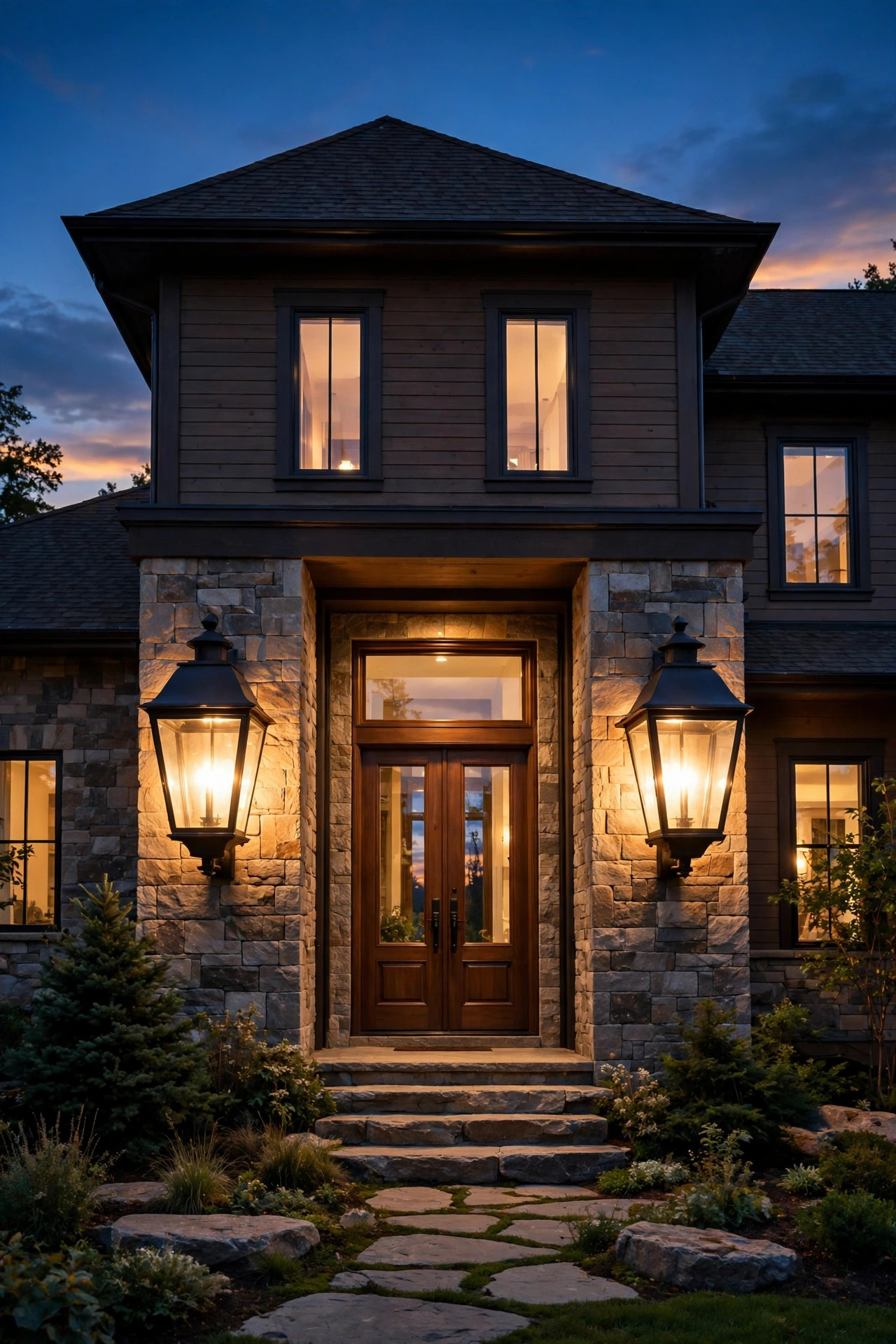
14. Oversized Sconces Beside an Arched Entry
An arched doorway or arched portico opening is pure romance, and it deserves fixtures that echo the curve. Oversized lantern sconces with arched tops, rounded cages, or onion silhouettes mirror the architecture instead of fighting it — a 24- to 28-inch lantern beside a tall arch looks like it was designed with the house. Mount them just outside the arch's spring line, where the curve begins, so the fixture and the arch share a visual rhythm. Mediterranean, Spanish revival, and Tudor homes wear this pairing especially well, particularly in dark bronze with amber-tinted or seeded glass. If your arch is wide, you can push fixture width a bit too — a broader lantern, 10 to 12 inches across, holds the space better than a narrow one. Keep bulbs at 2700K for that candlelit, courtyard feeling. And if there's an arch-shaped transom window above the door, a lower-wattage bulb keeps the sconces from competing with the glow spilling from inside. This is the combination that makes delivery drivers slow down and stare, in the best way.
Suggested budget range: $210 – $540.
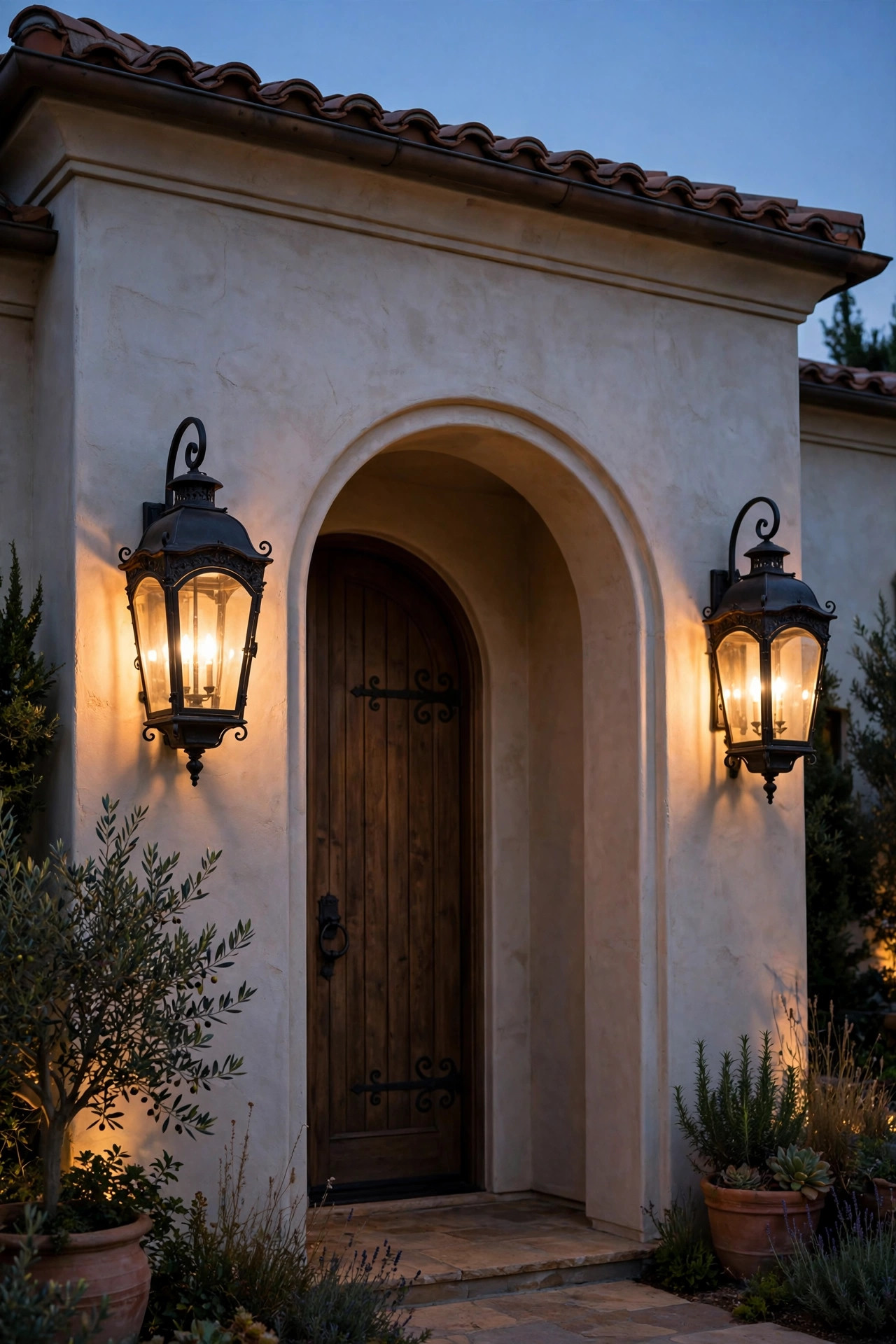
15. Porch-Column Sconces That Turn a Veranda Into a Room
Wide wraparound porches on large homes often have a row of columns and — puzzlingly — no light on any of them. Mounting an oversized sconce on each porch column (or every other column) transforms the veranda into a softly lit outdoor room and keeps the entry fixtures from doing all the work alone. Scale to the column: a 10- to 12-inch square column carries an 18- to 22-inch sconce gracefully. Face them outward for street presence, or inward for a cozier, inward-looking glow; I often alternate on very long porches. Because porch columns sit under cover, damp-rated fixtures suffice, but if your porch catches wind-driven rain, choose wet-rated to be safe. Wire them on the same circuit as the entry pair for one-switch evenings, and consider warm dimmers — a veranda at 40% brightness with a ceiling fan turning slowly is my definition of a perfect July night. This treatment also solves the "dark corners" problem on deep porches, where the entry light never reaches the porch swing.
Suggested budget range: $300 – $800.

16. Coastal-Scale Lanterns Built for Big Beach Houses
Coastal homes run large and breezy, and their lighting needs to handle salt air as gracefully as it handles scale. Oversized marine-inspired lanterns — 22 to 28 inches, with caged glass, rounded tops, and corrosion-resistant finishes — suit sprawling beach houses perfectly. Look for fixtures rated for coastal or wet locations, with powder-coated aluminum, solid brass, or polymer construction that won't pit or peel in the salt spray. The cage isn't just nautical styling; it protects large glass panes from wind-blown debris. Mount them a little lower than inland entries if your porch is exposed, around 60 to 66 inches to center, so the light pools where people gather rather than blowing across the dunes. Keep brightness moderate — coastal communities often have lighting ordinances to protect sea turtles and dark skies, so choose shielded designs and warm 2700K or amber bulbs. A pair of these beside a tall, weathered-wood door with a rope-wrapped accent somewhere nearby? Pure coastal grandma chic, at mansion scale.
Suggested budget range: $230 – $580.
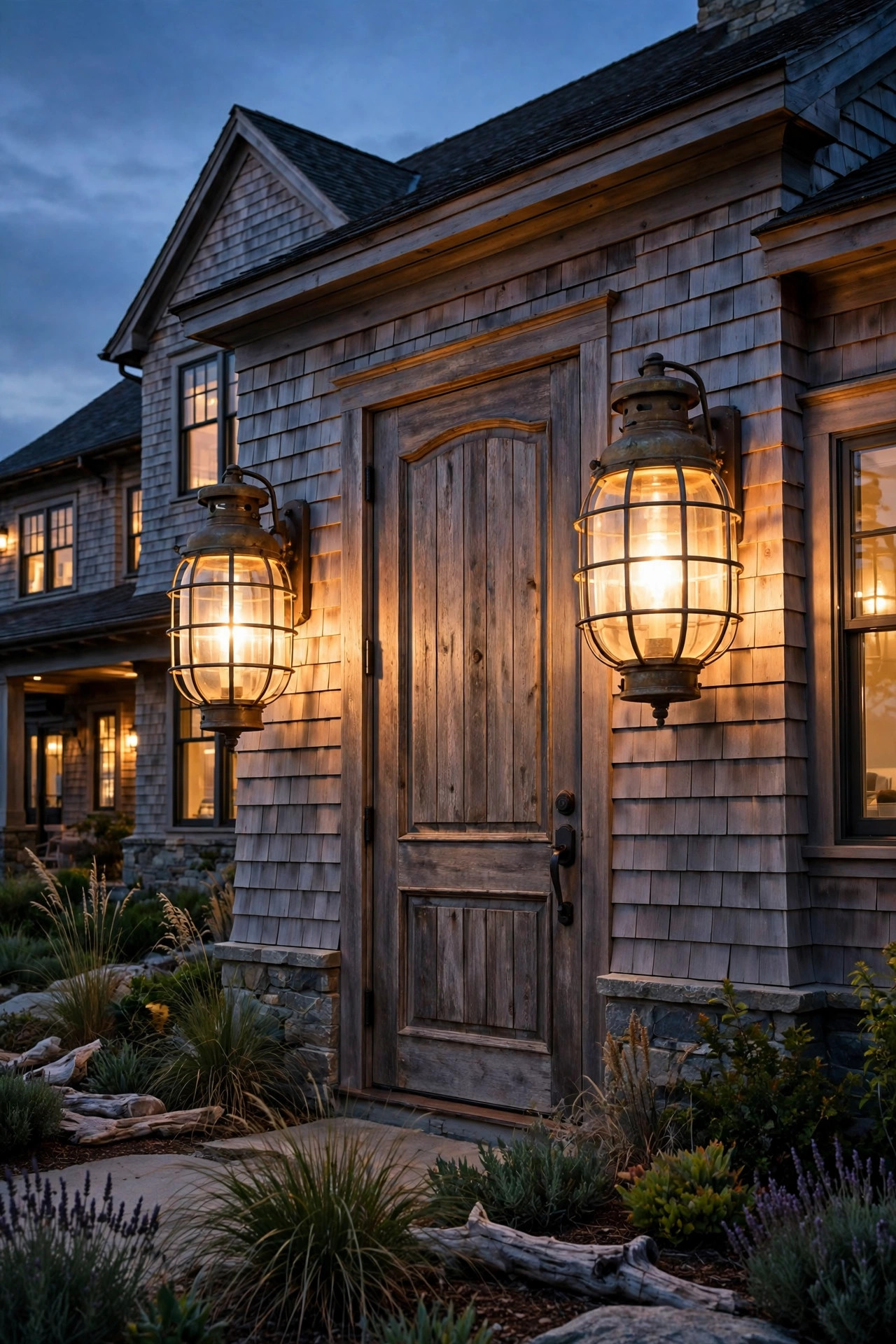
17. Farmhouse-Scale Sconces With Rustic Charm
The modern farmhouse look loves a big house, and its lighting should be just as generous. Oversized farmhouse sconces — wide barn-style shades, chunky goosenecks, or tall rustic lanterns in galvanized steel or matte black — run 18 to 26 inches and look right at home beside board-and-batten siding and chunky timber posts. A favorite arrangement of mine: two tall lantern sconces at the entry plus a wide gooseneck over the garage, all in the same finish, so the whole front speaks one rustic language. Bulbs matter here — exposed LED filament bulbs in warm 2700K sell the vintage feel, and in large clear-glass lanterns they're part of the show. Watch projection on goosenecks over walkways; keep fixtures at least 7 feet above walking surfaces or tucked beside doors so nobody meets one with a forehead. These fixtures are also forgiving budget-wise, since the style favors simple construction. On a white farmhouse with black accents, black oversized sconces are the punctuation marks the facade was missing.
Suggested budget range: $140 – $390.
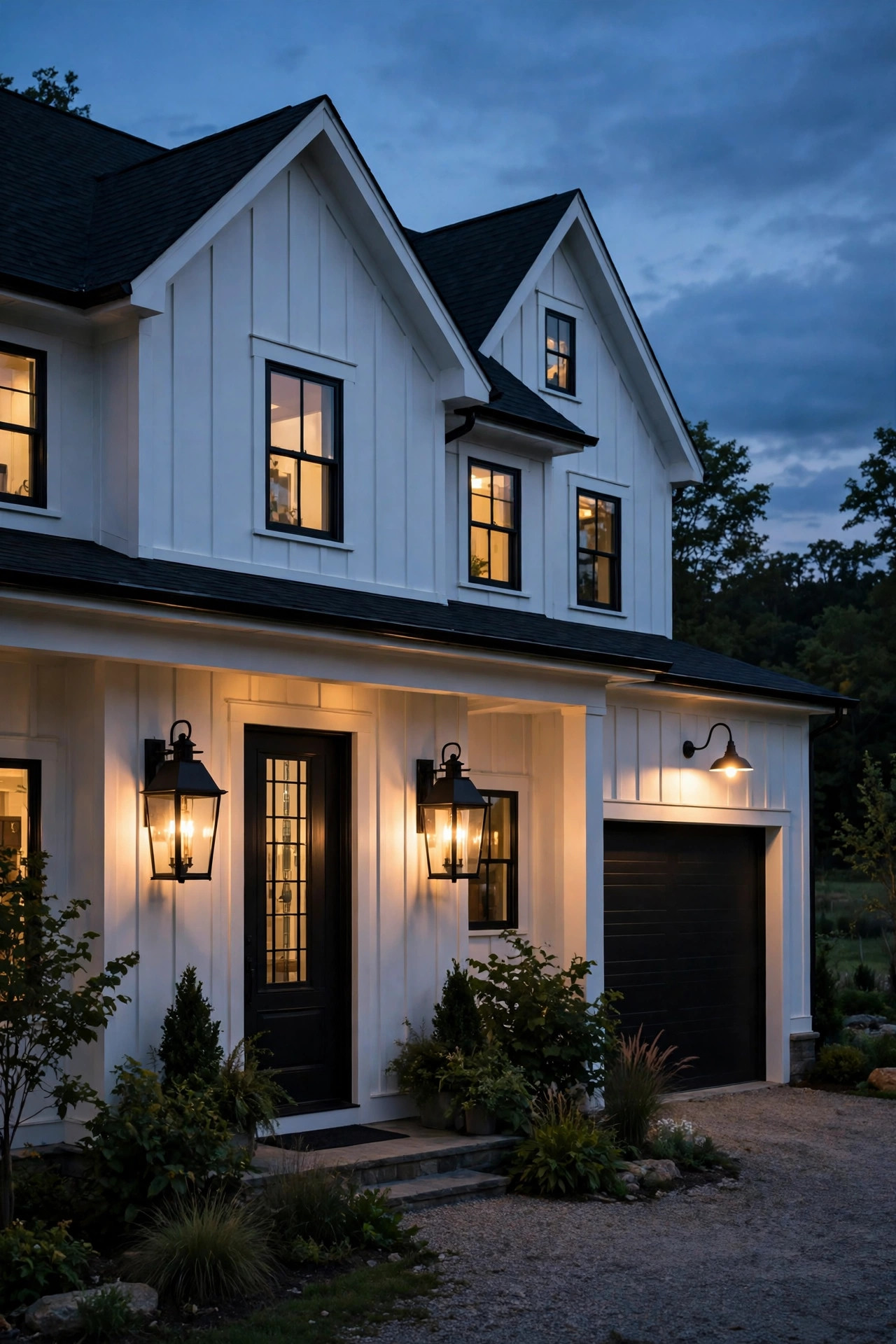
18. The Oversized Trio Over a Three-Car Garage
A three-car garage spans 30 feet or more of facade, and treating it as an afterthought leaves a third of your home's face dark. My formula: one oversized sconce between each pair of doors and one at each outer pier — or, for a cleaner look, three generous fixtures, one centered over each door. In this position, 20- to 24-inch sconces or wide gooseneck lights carry the width without crowding. Between-door piers on three-car garages are often only 12 to 18 inches wide, so check fixture width carefully — a lantern that's 9 inches wide with a matching backplate fits where a 12-inch one won't. Matching the garage trio to the entry pair (idea 11's suite strategy) makes the whole elevation look planned. Brightness can run slightly higher here for driveway safety, around 1,200 lumens per fixture, on its own timer so the garage can go dark at midnight while the entry stays lit for late arrivals.
Suggested budget range: $350 – $900.

19. Layered Pairs: Sconces Plus a Statement Pendant
For the grandest entries — tall porticos, deep covered porches, entries with ceilings over 10 feet — sconces alone, however oversized, leave the ceiling plane dark. Layering an oversized pendant or hanging lantern in the center with your oversized sconce pair creates the three-point composition designers use: two vertical accents plus one glowing centerpiece overhead. Scale the pendant generously too — 18 to 24 inches wide — hung so its bottom sits at least 7 feet above the porch floor, higher if the door has a transom it might block. Matching the set exactly is easiest, but a pendant in the same finish with a related silhouette works if you can't find a true suite. Keep all bulbs the same color temperature and similar brightness so the layers blend into one warm pool rather than competing spots. On a dimmer, this combination goes from "dinner party bright" to "firefly soft" beautifully. It's the most finished look on this list, and the one that photographs like a magazine cover.
Suggested budget range: $400 – $1,000.
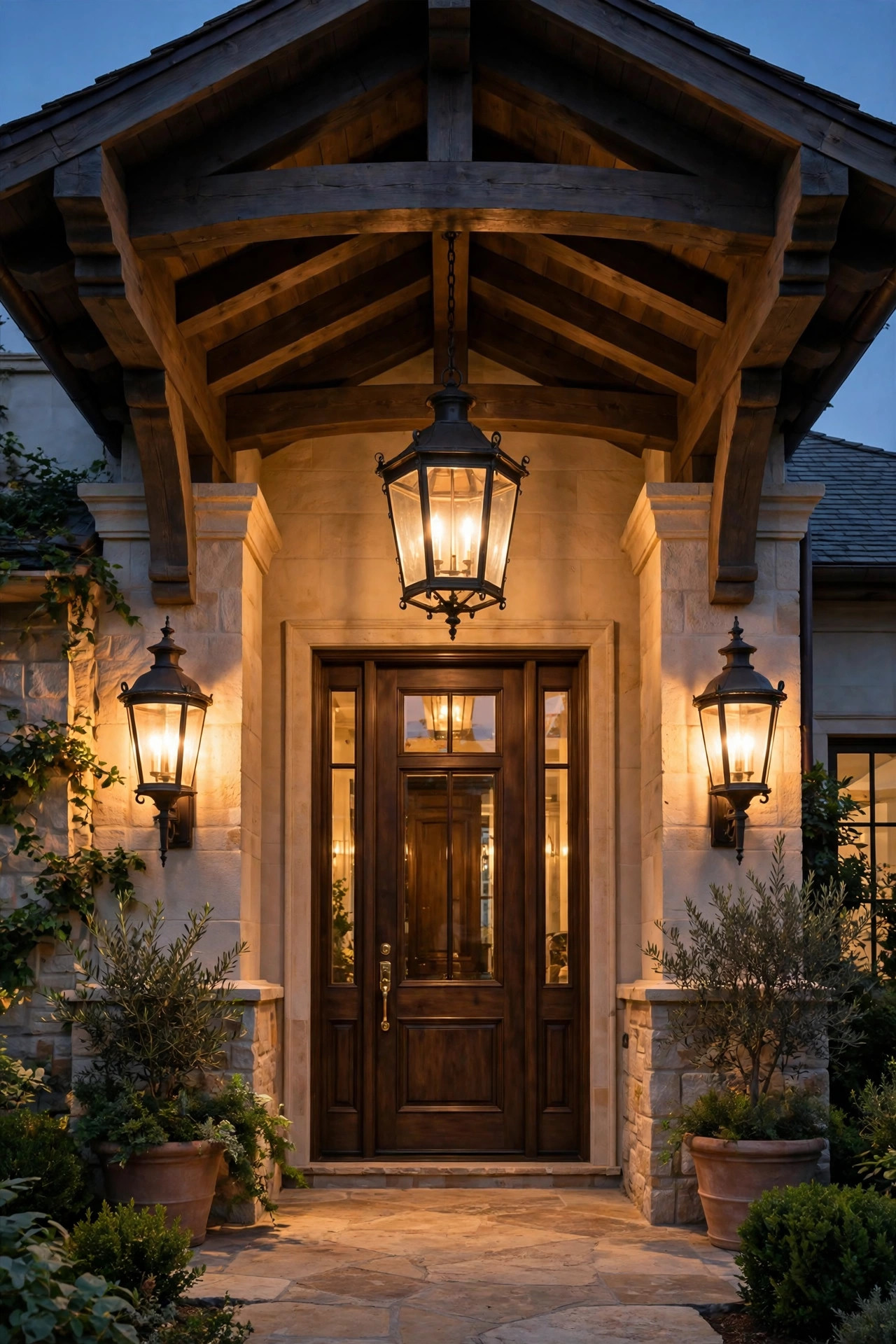
20. Oversized Sconces for a Side or Guest Entry That Still Matters
Big homes often have a side entry, garden door, or guest-suite door that guests actually use — and it frequently gets the leftover fixture from the garage. Resist. A slightly scaled-down version of your main entry sconces, say 18 to 20 inches where the front wears 26, keeps the hierarchy clear while still giving that door real presence and safe light. This is also the perfect spot for a motion-sensor model: side paths are where guests arrive after dark and where you take out recycling, so light that wakes when approached is genuinely useful. Match finish and glass to the main suite so the house feels designed from every angle — neighbors see your side elevation more than you do. If the side door has steps, pair the sconce with a low step light or two; falls happen on familiar stairs in the dark. Treating secondary doors generously is, in my experience, the detail that separates homes that feel luxurious everywhere from homes with one pretty face.
Suggested budget range: $130 – $340.
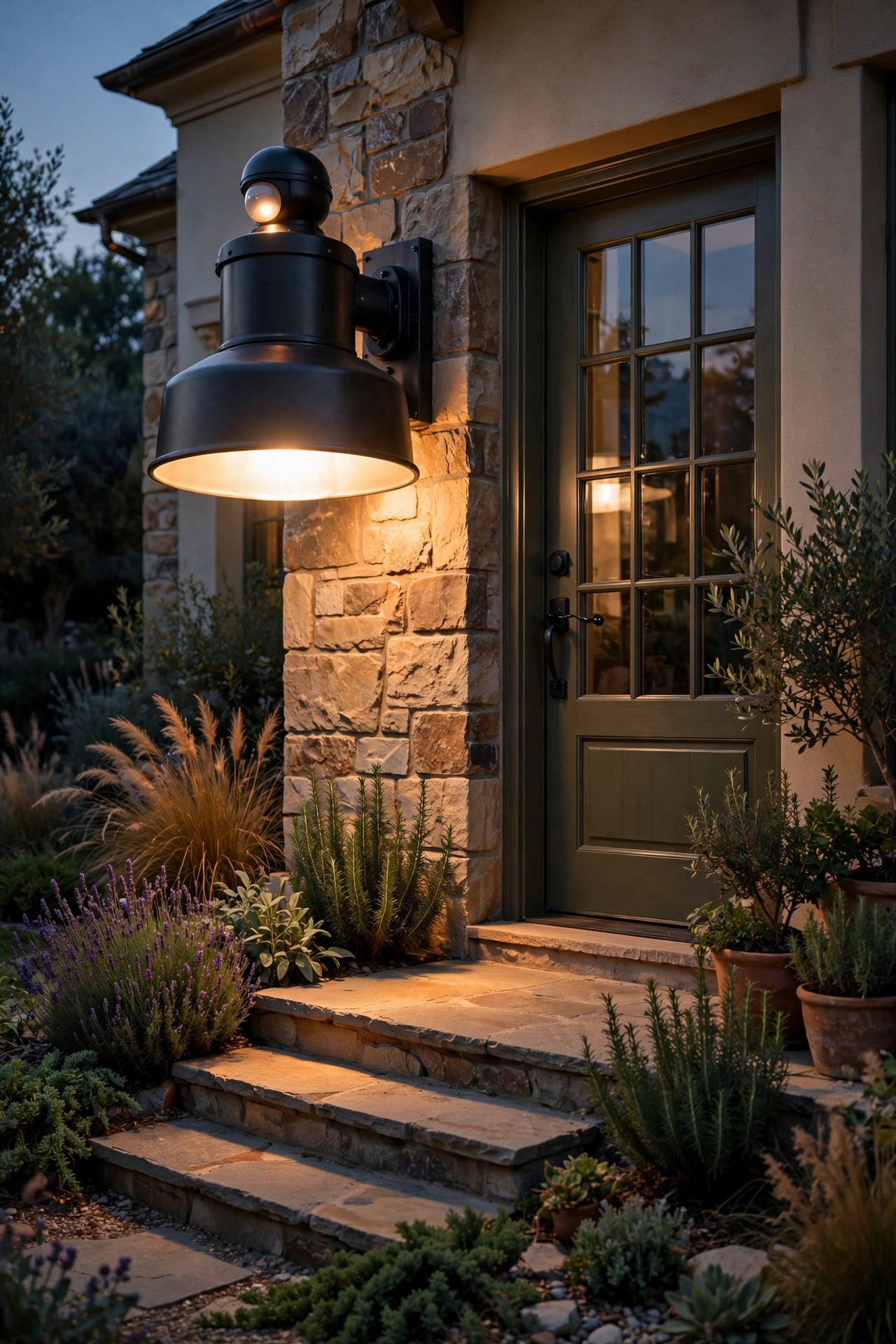
21. Go Big and Warm: The Layered Whole-Facade Plan
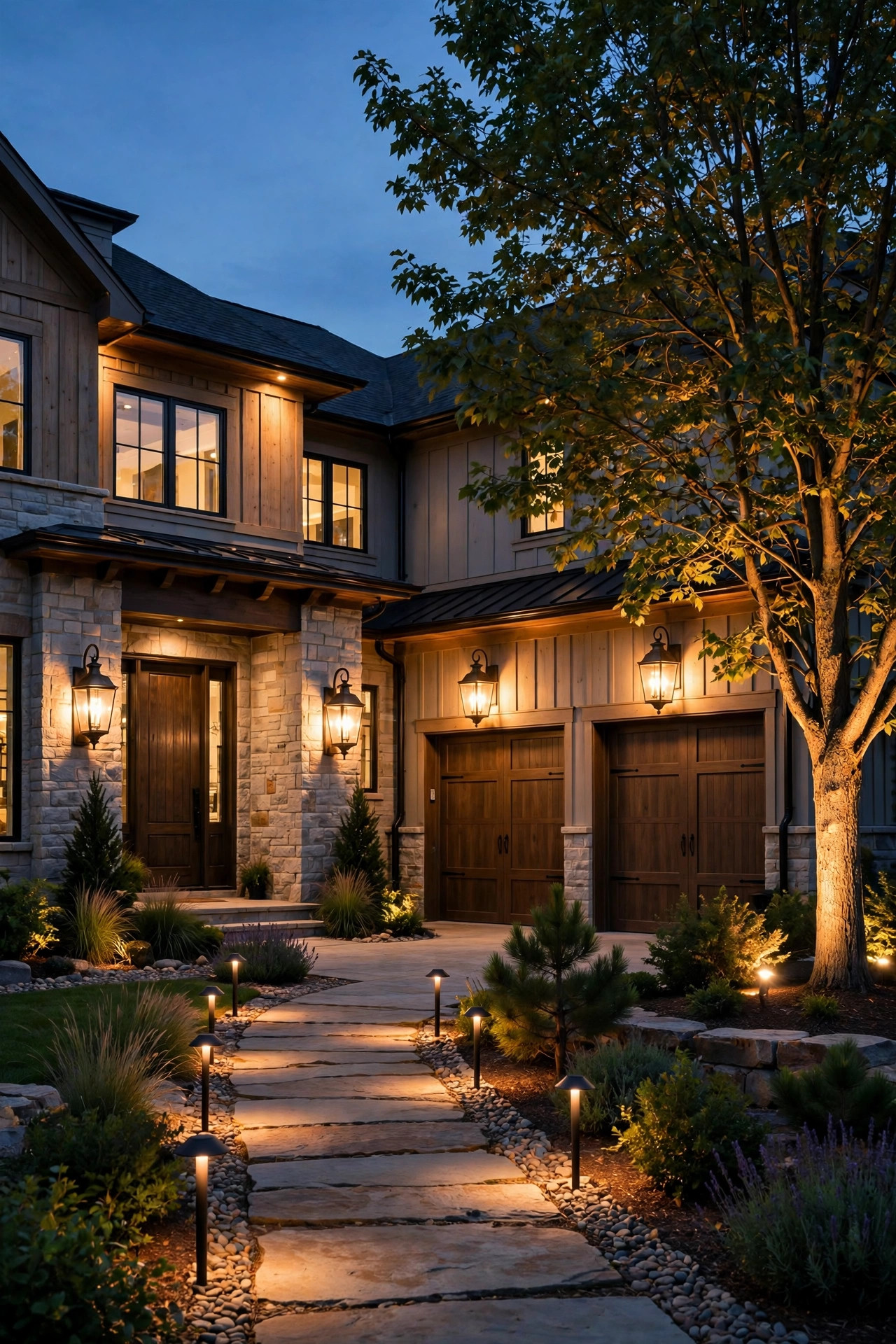
My last idea is really the philosophy behind all the others: on a big home, plan the facade as one layered composition, then let oversized sconces be its backbone. Start with the entry pair — the largest fixtures, 24 to 30 inches. Add the garage row at a slightly smaller scale. Wash any tall blank walls with up-down sconces or a rhythm of three. Then fill the gaps with low path lights and a soft uplight on your prettiest tree, keeping every bulb at 2700K so the whole scene glows as one. Put it all on timers or smart controls in two zones — "arrival" and "evening" — and the house will greet you brightly, then settle into a warm murmur for the night. When I stand across the street from a home lit this way, what I feel is welcome, scaled to the architecture. That's what oversized outdoor sconces really buy you: not bigger lights, but a big home that finally looks finished after dark. Start with the entry pair this weekend; the rest can layer in season by season.
Suggested budget range: $900 – $2,500.
Frequently Asked Questions
How big should oversized outdoor sconces be for my front door?
Use the door as your ruler. A single door (about 80 inches tall) pairs well with sconces 18 to 22 inches tall. For double doors or doors with sidelights and transoms, go 24 to 30 inches. A good check: each sconce should be roughly one-quarter to one-third the height of the door itself. When in doubt between two sizes, choose the larger — on tall entries, "too big" is almost never the mistake people make.
How high should I mount large sconces beside a tall entry?
The classic rule is to center the fixture 66 to 72 inches above the ground, roughly eye level, with the actual light source near the top third of the door. For two-story entries and tall porticos, 72 to 78 inches to center works better so the fixtures relate to the full facade. Whatever height you choose, keep a matched pair or row perfectly level with each other — the eye catches uneven fixtures instantly.
Are oversized sconces too bright for a residential street?
Not if you choose bulbs thoughtfully. The glass area is larger, but brightness depends on lumens, not fixture size. For entries, 800 to 1,200 lumens per sconce in warm 2700–3000K is plenty, and fixtures with shades, seeded glass, or up-down designs keep light on your walls instead of in neighbors' windows. A dimmer or smart bulb lets you run them softer late at night.
Can I install oversized sconces myself, or should I hire an electrician?
Swapping an existing fixture for a larger one is a comfortable DIY for most homeowners — same junction box, same wiring — though oversized fixtures are heavy, so bring a helper and confirm the box is rated for the weight. Hire an electrician for new wiring runs, masonry drilling, or mounting very heavy solid brass or copper pieces. Always cut power at the breaker and verify with a tester before touching wires.
Conclusion
A tall entry is a gift — it just needs fixtures with the confidence to match it. Whether you start with a single grand pair beside the double door, a rhythm of three across a wide facade, or a full layered plan, oversized outdoor sconces give big homes the warm, finished glow they've been missing. Measure your door, trust the one-quarter-to-one-third rule, keep the light warm, and don't be afraid of the bigger box. Browse more of my outdoor lighting ideas here on the site for porches, pathways, and gardens, and you'll have every corner of your home glowing by the end of the season.