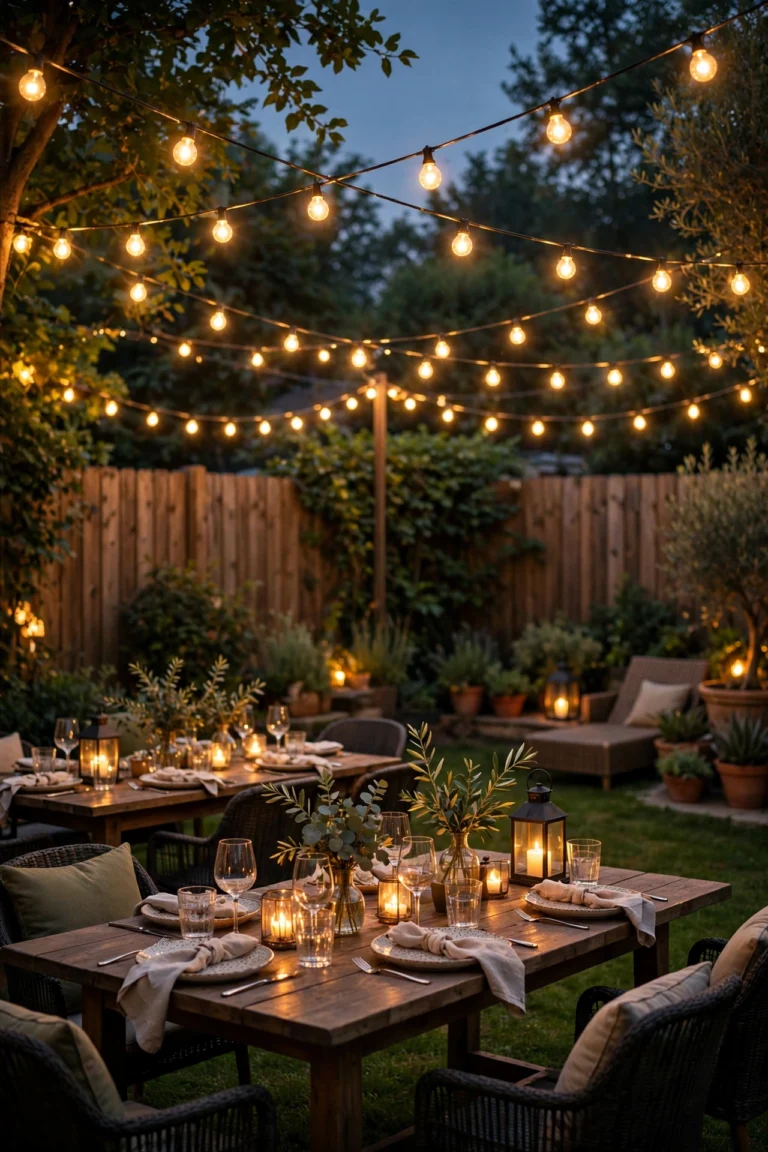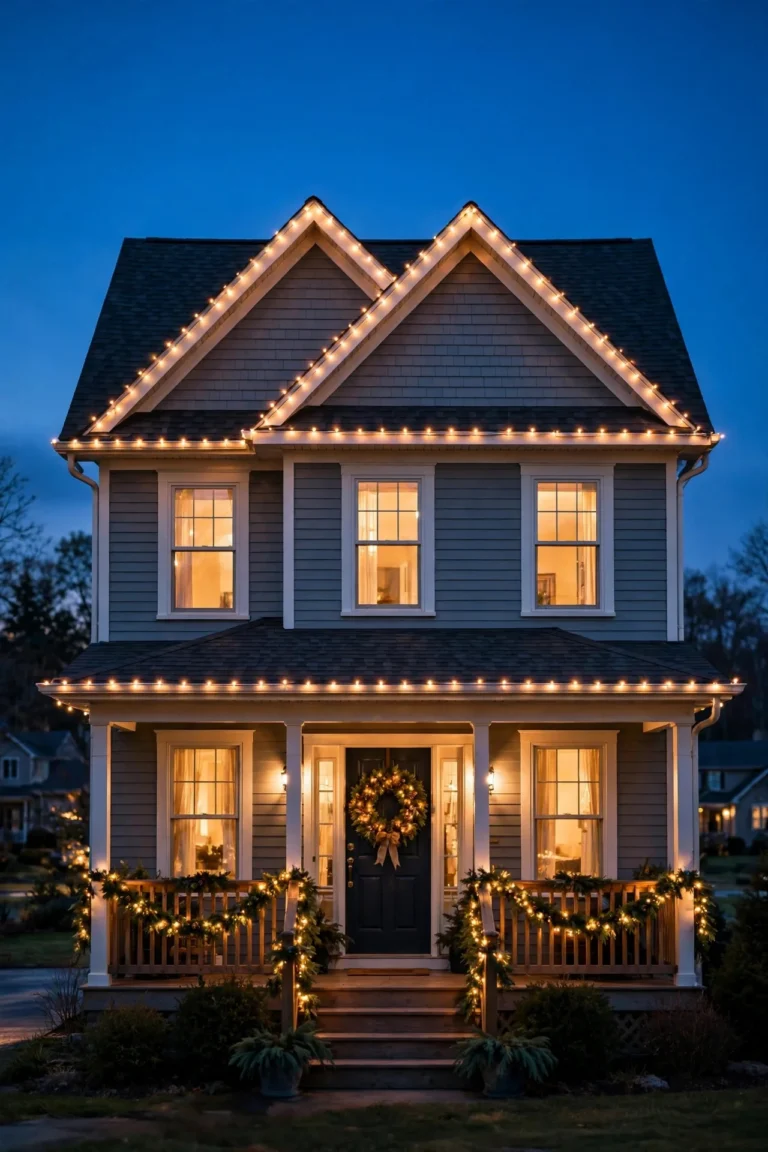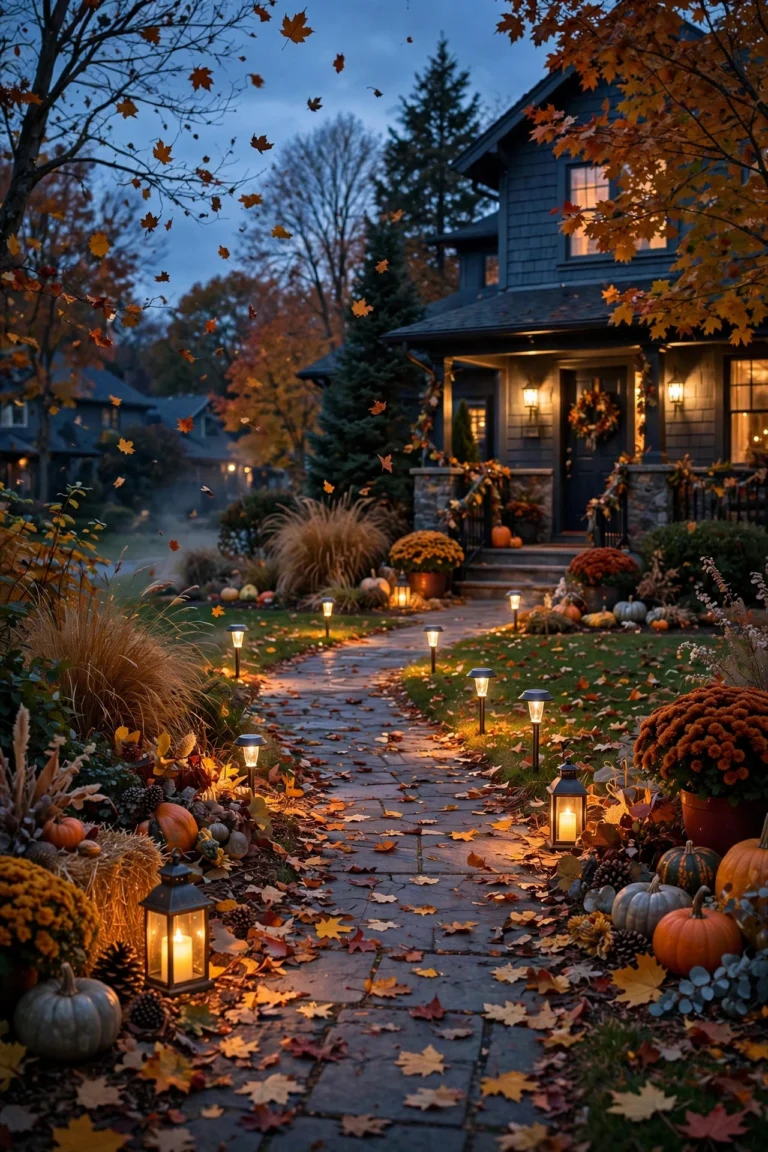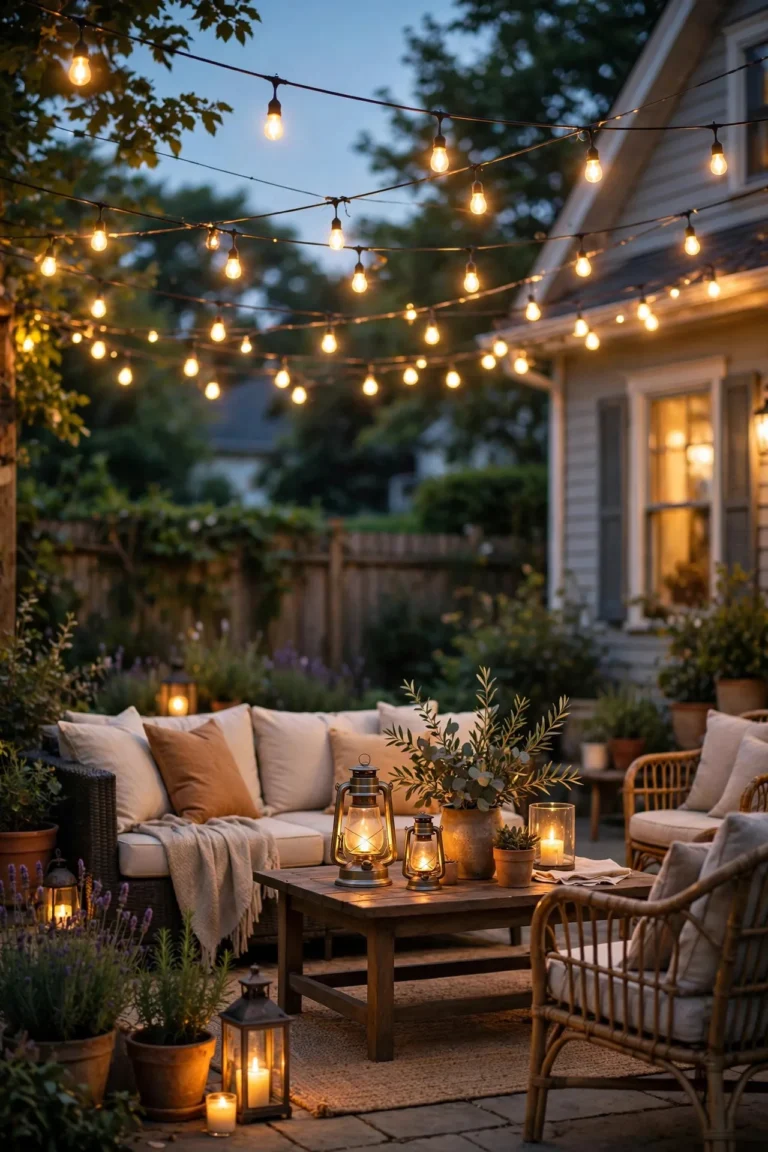
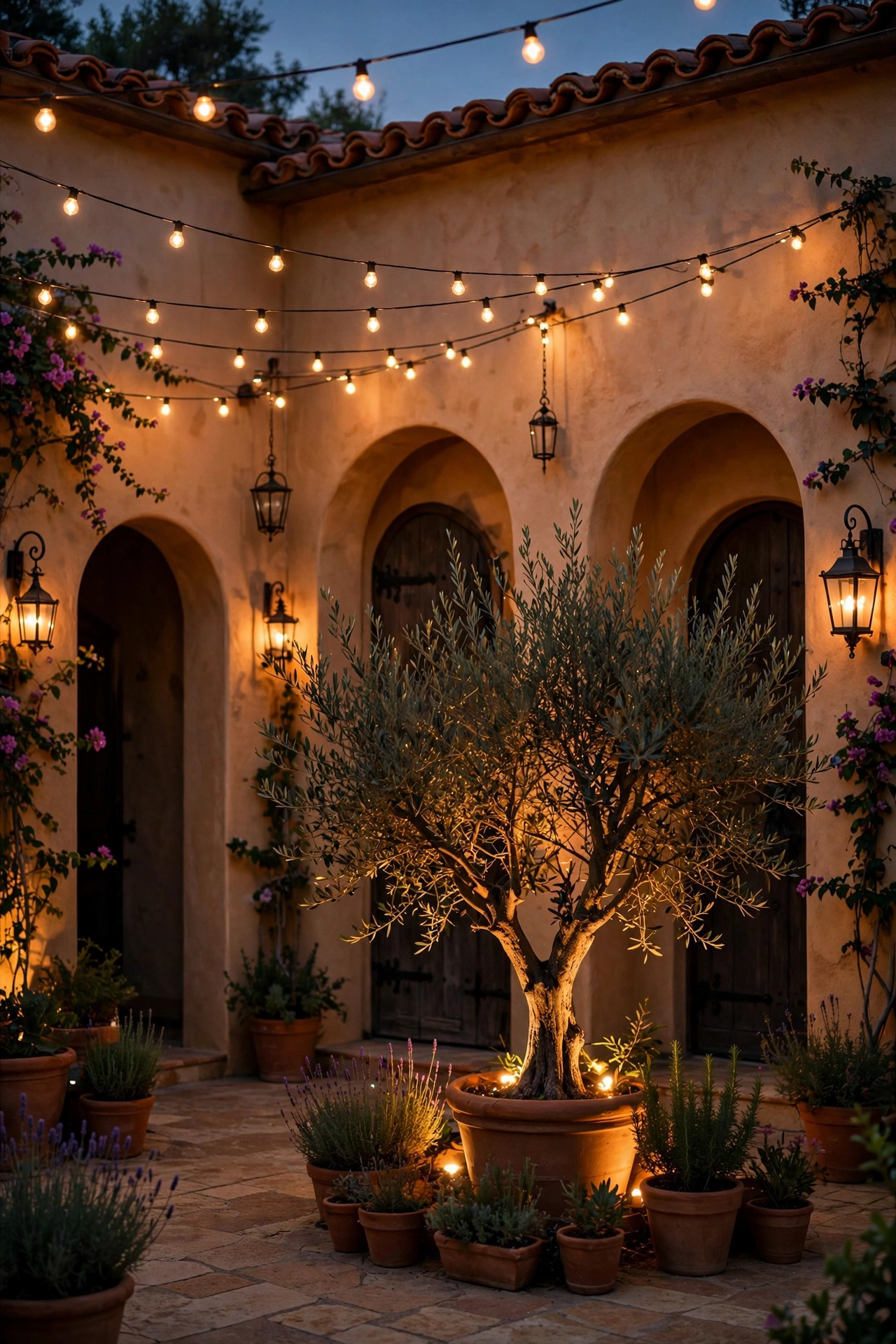
There's a particular kind of magic that happens on a Mediterranean villa patio just after sunset — the terracotta tiles still radiating the day's warmth, the scent of jasmine on the air, and everything bathed in that golden, candlelit glow. That's the feeling I want to help you recreate with mediterranean outdoor lighting, whether you own a true Mediterranean-revival home in California, Florida, or Texas, or you're simply borrowing the style for your suburban backyard.
In my experience, the secret to that villa look isn't any single fixture — it's layering. Mediterranean lighting works in three layers: warm ambient glow (lanterns and string lights), accent light that shows off texture (uplights grazing stucco walls, olive trees, and arched doorways), and task light where you actually need to see (steps, dining tables, pathways). Keep every bulb in the warm amber range of 2200–2700K and you'll get that candlelight warmth no matter which ideas you choose.
Below are 19 of my favorite ideas, from grand entry statements to tiny budget-friendly touches, all with concrete measurements, bulb specs, and real cost ranges. Honestly? Start with whichever idea matches the spot where you spend your evenings — you'll feel the difference the very first night.
1. Flank the Arched Entry with Wrought-Iron Wall Lanterns
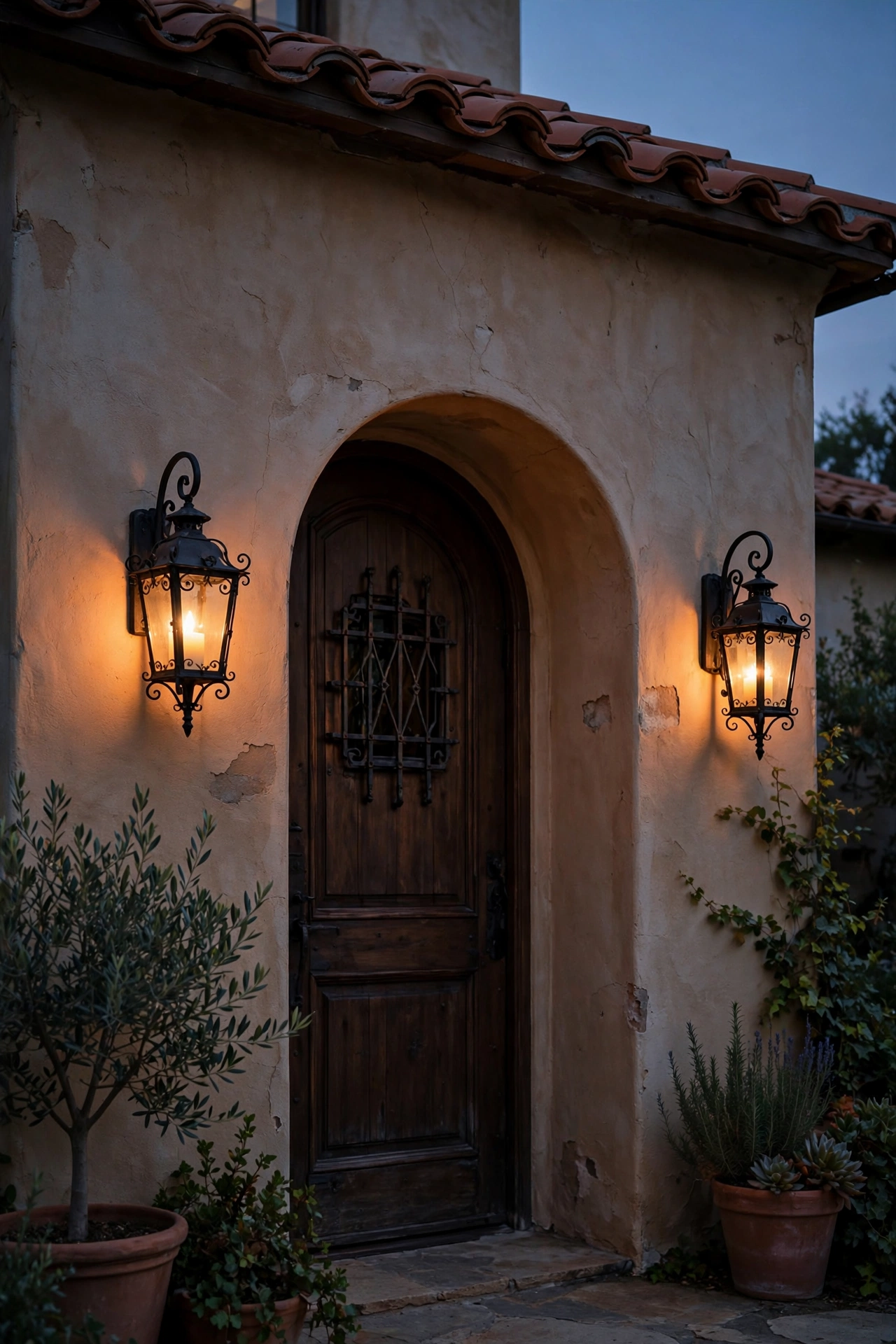
Nothing says "Mediterranean villa" quite like a pair of wrought-iron lanterns framing an arched doorway. Mount one lantern on each side of the arch, centered roughly 66 inches from the ground to the center of the fixture — that's eye level for most adults and the sweet spot for flattering, shadow-free light on faces. Choose lanterns with seeded or clear glass rather than frosted so the warm bulb filaments show through, and look for fixtures with an open bottom so light spills downward onto the step below.
For bulbs, I always recommend warm 2200–2700K LED filament bulbs at 400–600 lumens each; they're bright enough to greet guests safely without washing out the arch. If your entry is recessed inside a deep archway, add a small flush-mount or recessed light inside the arch itself so the doorway doesn't become a dark cave behind the lanterns. Put the pair on a dusk-to-dawn sensor or a smart timer so they switch on automatically at sunset — entry lighting is one place you never want to forget. In my experience, matching sconce pairs flanking a front door instantly double the curb appeal of any entry, and the arched Mediterranean doorway might be the single best canvas for it.
Suggested budget range: $80 – $250.
2. Hang Pierced-Metal Pendants Over Courtyard Dining
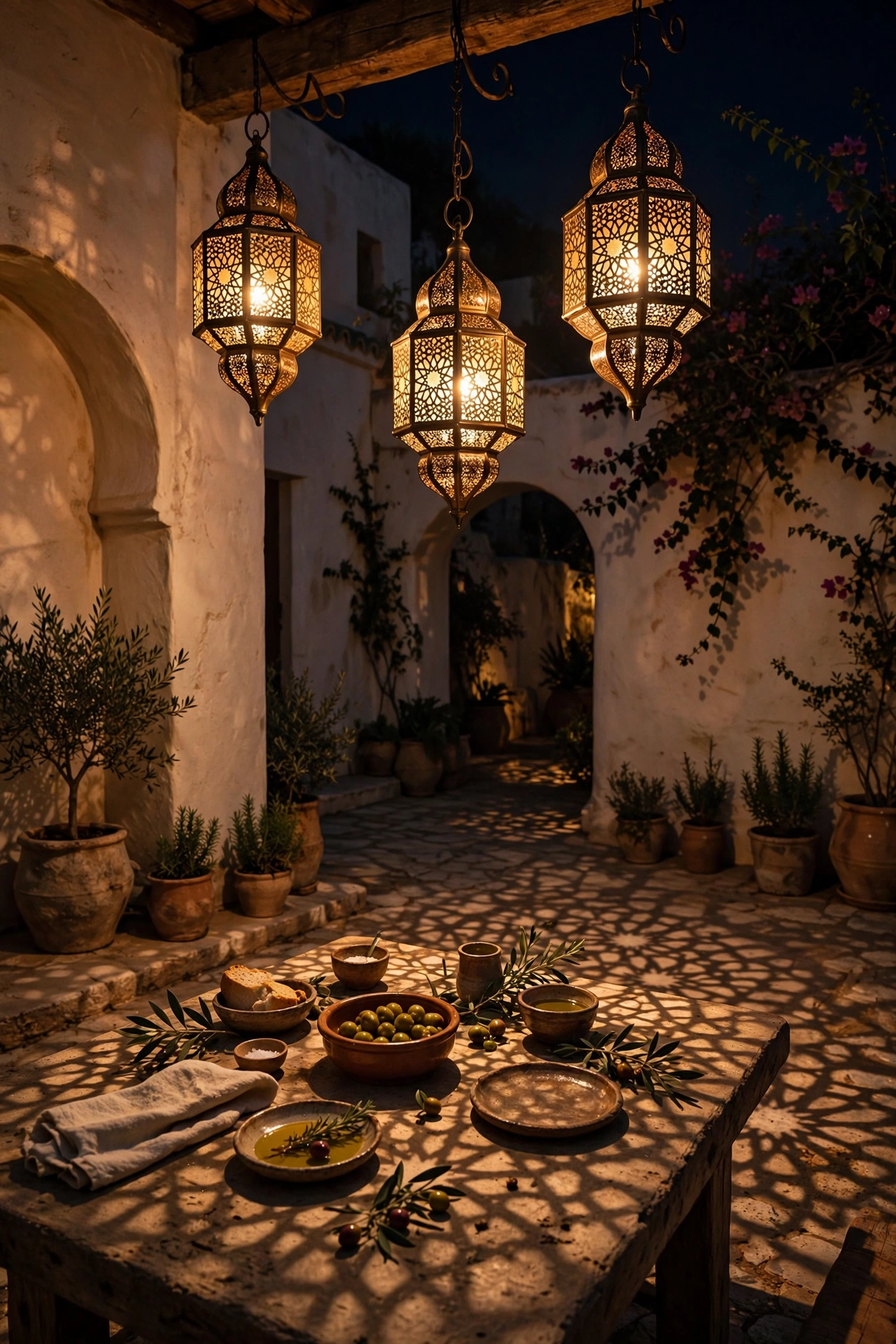
Moroccan-style pierced-metal pendants are the jewelry of mediterranean outdoor lighting — when they're lit, they throw hundreds of tiny star-shaped light patterns across the table, the walls, and your guests. Hang one large pendant (18–24 inches in diameter) centered over a round dining table, or a row of two to three smaller pendants (10–14 inches each) spaced 24–30 inches apart over a long rectangular table. The bottom of the pendant should sit 30–36 inches above the tabletop: low enough to feel intimate, high enough that nobody bonks their head standing up.
Because the pierced metal naturally dims and scatters light, use a brighter-than-usual warm bulb — a 2700K LED at 800 lumens works beautifully. Hang them from a pergola beam, a sturdy shepherd's-style arm mounted to the house, or a freestanding cantilever base if there's no overhead structure. Make sure any pendant hung outdoors is rated for damp locations at minimum, and keep the socket protected under the metal shade so wind-blown rain can't reach the electrical parts. A dimmer on this circuit is worth its weight in gold — full brightness for setting the table, low and moody once dinner is served.
Suggested budget range: $120 – $400.
3. Uplight Your Olive Trees for Sculptural Drama
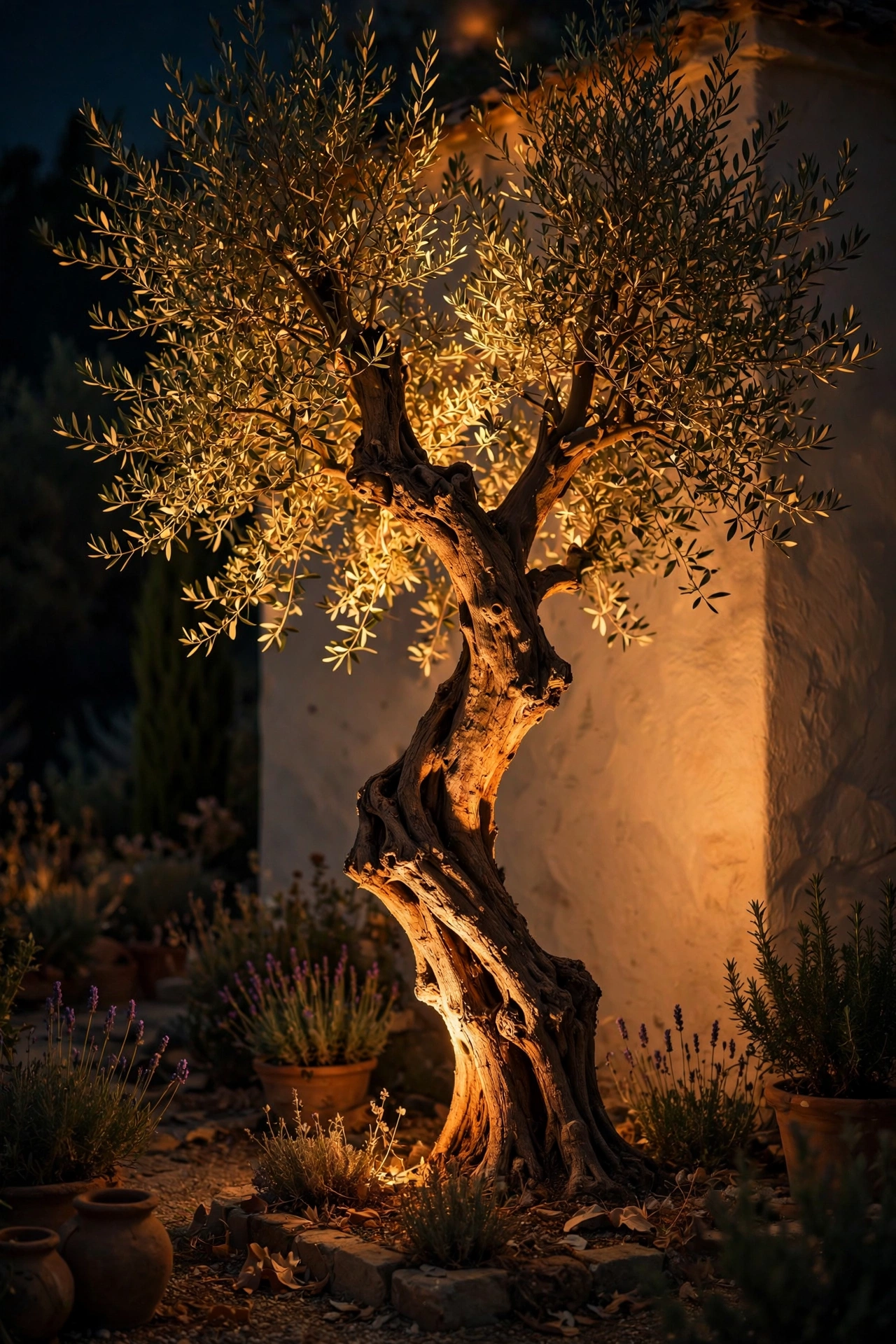
Olive trees are the soul of the Mediterranean garden, and uplighting turns their silvery-green canopies into living sculptures after dark. Place one low-voltage LED uplight (well light or stake-mounted spotlight) about 18–24 inches from the trunk, aimed up into the canopy at a slight angle so the beam grazes the branches and catches the undersides of the leaves. For a mature olive tree with a 6–8 foot canopy, two fixtures positioned on opposite sides give you full, balanced coverage without a harsh single-sided hotspot.
Use warm 2700K bulbs at 200–400 lumens per fixture — you want the tree to glow, not look interrogated. Honestly, this is the one upgrade my friends always comment on first. Bury the low-voltage cable 4–6 inches deep along the bed edge back to the transformer, and choose fixtures with a bronze or dark finish that disappears into the mulch by day. If you're uplighting several trees, our guide to uplighting trees the right way covers beam angles and spacing in more detail. Put tree uplights on the same dusk-to-dawn timer as your entry lanterns so the whole scene comes alive together at sunset.
Suggested budget range: $60 – $200 per tree.
4. Light the Courtyard Fountain from Within and Below
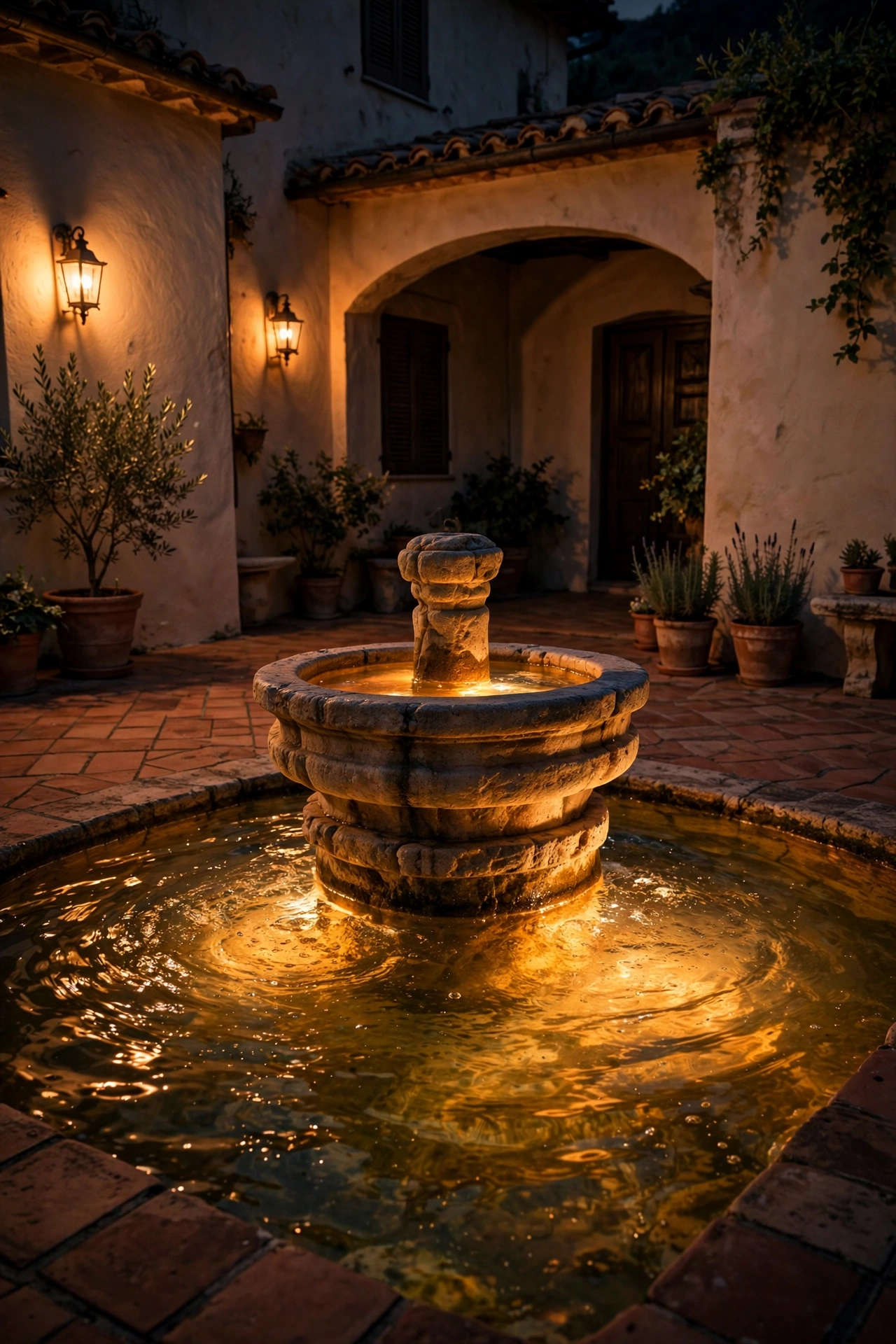
A courtyard fountain is already the heart of a Mediterranean outdoor room — lighting it makes it the heart after dark, too. The most magical approach is a combination: one small submersible LED spotlight (rated IP68 for underwater use) placed inside the fountain basin aimed up at the water flow, plus one or two low-voltage uplights positioned outside the basin aimed at the fountain's stone or tile surround. The underwater light makes the falling water sparkle; the exterior uplights show off the craftsmanship of the fountain itself.
Use warm white 2700–3000K for the underwater fixture — cool white makes water look like a swimming pool, which kills the old-world mood. Keep underwater fixtures at 12 volts for safety, and plug them into a GFCI-protected outlet. If your fountain has a deep basin, mount the submersible light on a small weighted base so it stays put and aims true; for shallow spillover bowls, a fixture clipped just under the water's edge works. Clean the fixture lens monthly — algae film dims the light faster than you'd think. And if the fountain pump runs on a timer, wire the lights to the same schedule so water and light dance together.
Suggested budget range: $50 – $180.
5. Drape String Lights Across the Pergola
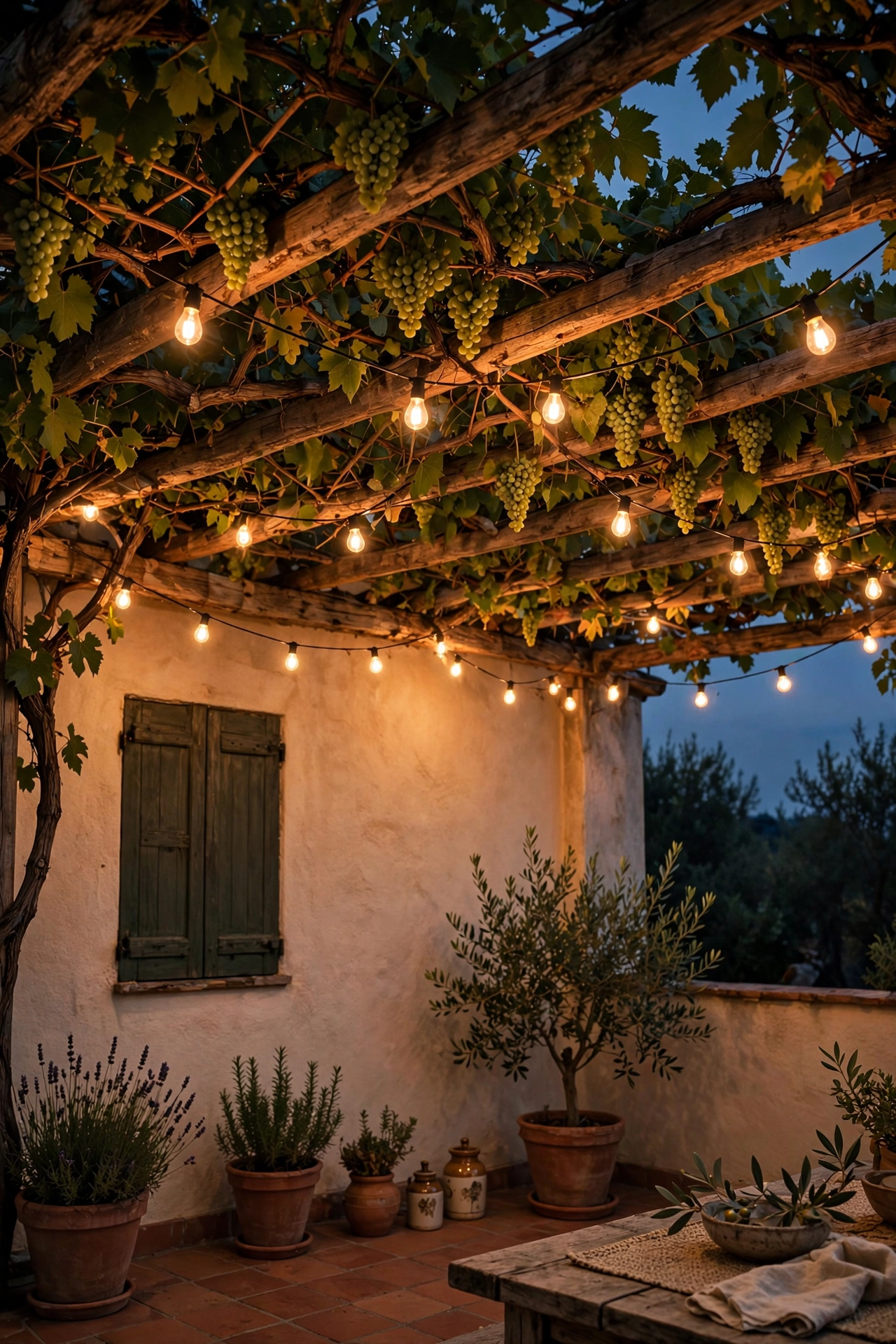
String lights woven through a pergola draped in climbing vines — bougainvillea, jasmine, wisteria — is peak Mediterranean romance. Run the strings in a zigzag or parallel pattern across the pergola beams, spacing each run 18–24 inches apart, and let them sag 6–8 inches between attachment points for that relaxed, festive drape. Attach with small screw-in cup hooks or zip ties every 4–6 feet so wind can't whip them around and tangle the vines.
Choose commercial-grade, shatterproof LED string lights with warm 2200–2700K bulbs — the heavy-duty kind with the thick rubber cord, not the delicate fairy-light wire, because pergola installations live outside year-round. For a 12×12 foot pergola, you'll need roughly 60–80 feet of lights. Plug into an outdoor-rated smart plug with a dusk-to-dawn schedule; honestly, automating these is the difference between lights you enjoy nightly and lights you forget to turn on. Leave a little slack at the corners so you can lower a section easily when it's time to prune the vines. Keep the bulbs at least 12 inches from any dry vine material, and stick to LED — they run cool enough to be safe near foliage.
Suggested budget range: $40 – $150.
6. Add Step Lights to Terracotta Stairs
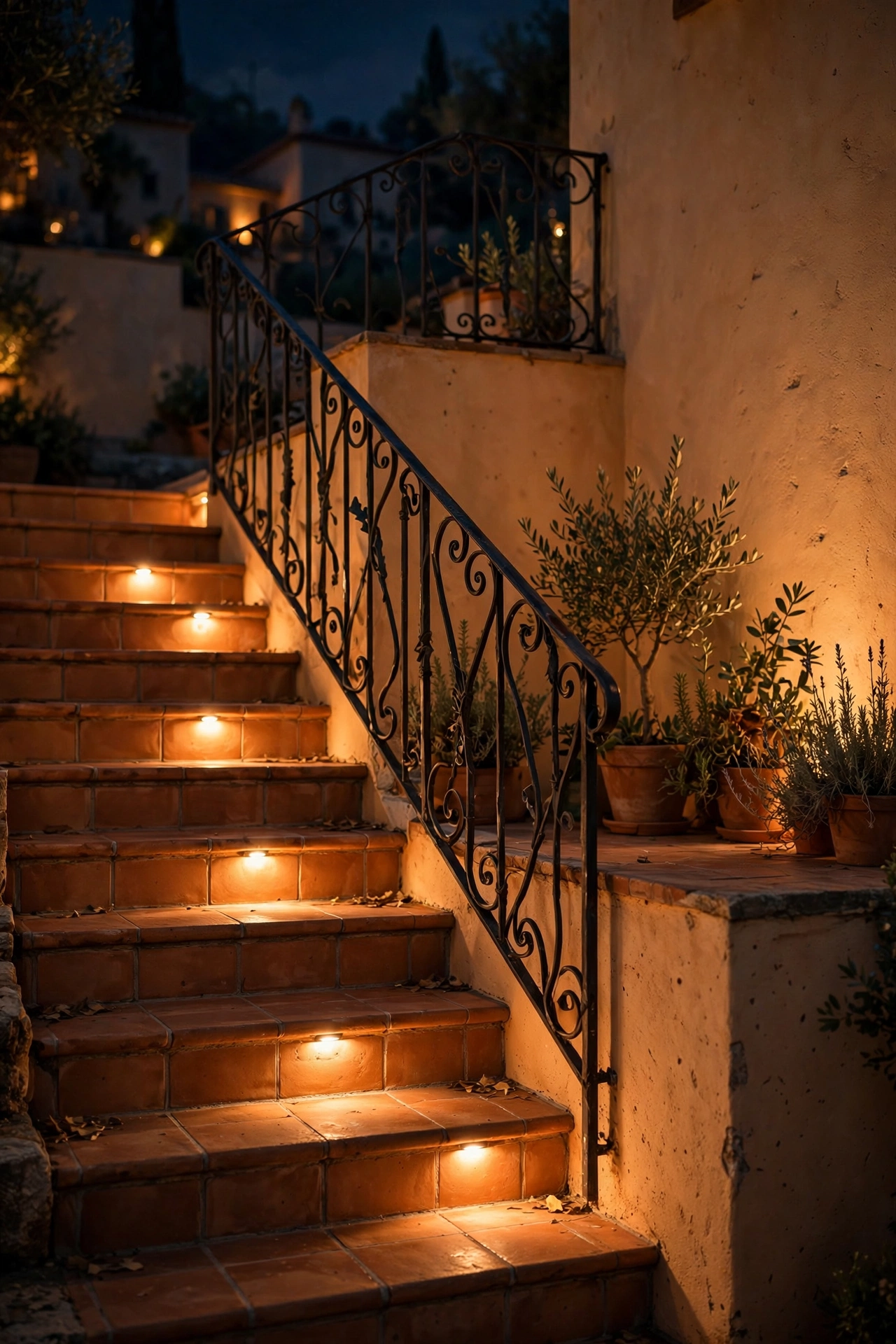
Terracotta stairs are gorgeous and, after dark, genuinely treacherous — a warm step light on every other riser fixes both problems at once. Surface-mount small LED step lights (louvered or shielded so the beam washes downward) centered on alternating risers, about 4–6 inches above the tread, or recess them into the riser face if you're comfortable with a little masonry work. Shielded fixtures are key here: you want pools of light on each tread, not glare in anyone's eyes as they climb.
Warm 2700K at 50–100 lumens per fixture is plenty — steps need visibility, not brightness. For a typical 5-step villa staircase, three fixtures on alternating risers give you safe, even coverage. Low-voltage 12V fixtures wired to the same transformer as your landscape lights keep installation simple; the cable can run behind the stair stringer or be tucked under the tread nosing. In my experience, guests always compliment the stairs themselves, never realizing the lighting is why they feel so safe and inviting. If your stairs curve, place fixtures on the outer edge of each curve where the tread is widest and the trip risk is highest.
Suggested budget range: $75 – $220.
7. Line the Loggia with Repeating Sconces
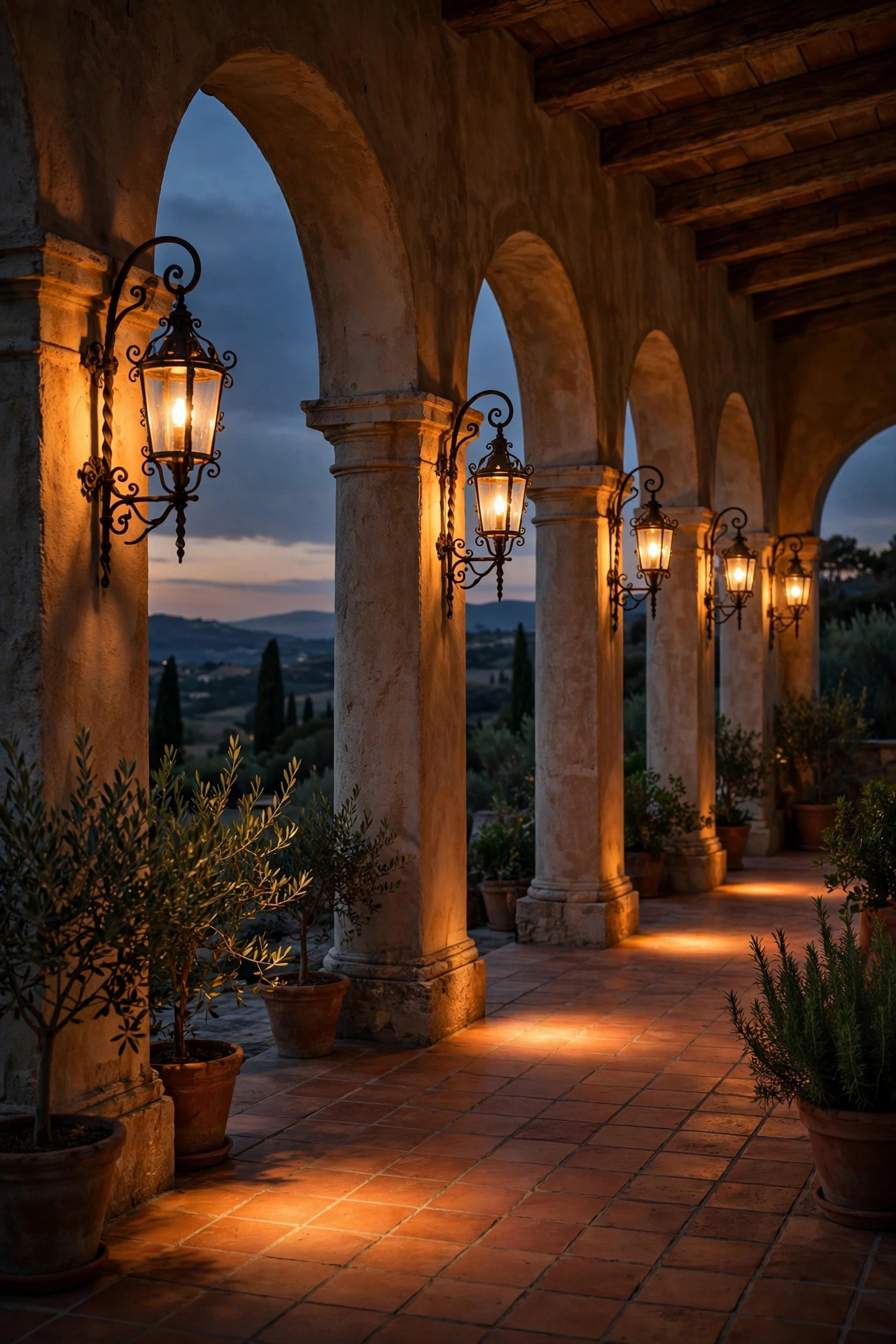
The loggia — that covered arcade or deep porch so common on Mediterranean-revival homes — begs for a rhythm of repeating sconces along its back wall. Space them 8–10 feet apart, mounted 66–72 inches high, so the light washes evenly across the stucco and creates that gorgeous repeating-arch shadow play on the ceiling. Choose simple wrought-iron or bronze sconces with an upward-and-downward light throw; the up-light grazes the ceiling beams while the down-light pools softly on the floor.
Because a loggia is covered, damp-rated fixtures are fine — but if yours is open on one side to driving rain, go wet-rated to be safe. Wire all the sconces to a single dimmer switch just inside the door; being able to dial the whole arcade from bright (arriving home with groceries) to a low simmer (late-night conversation) makes the space infinitely more usable. For seating areas within the loggia, I like 2700K bulbs at 400 lumens per sconce — enough to read by, soft enough to flatter. If the loggia is long, break it into two dimmable zones so you can light just the dining end or just the lounging end.
Suggested budget range: $150 – $500.
8. Gather Around a Fire Bowl with Perimeter Glow
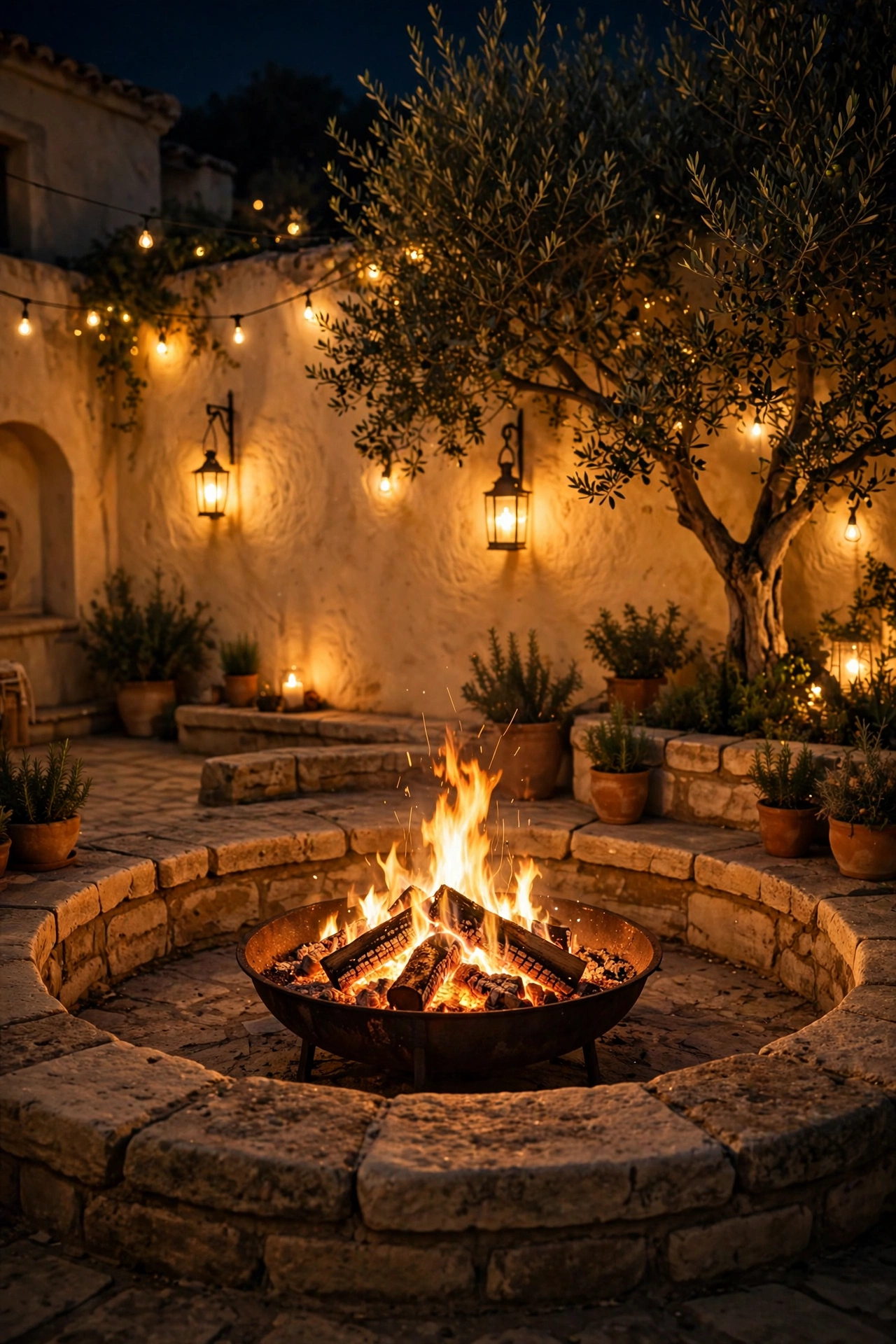
A fire bowl is the Mediterranean courtyard's answer to the campfire, and the lighting around it matters as much as the flame. Keep the immediate 3–4 feet around the bowl free of bright fixtures — let the fire be the star — then ring the seating area with low, warm perimeter light: small lanterns on side tables, a few low path lights behind the chairs, or LED candles in hurricane glass on the surrounding low wall. The contrast between the flickering firelight and the steady warm glow around it is what makes the scene feel so cinematic.
Safety first, always: keep all electrical fixtures at least 3 feet from the fire bowl's edge, use only LED candles (never real flames) inside hurricane glass near cushions or throws, and choose a fire bowl with a spark screen if you have overhanging vines or a pergola above. A gas fire bowl with an electronic ignition and timer shutoff is worth the upgrade — it kills the flame automatically if you forget. For the perimeter lights, warm 2200K at low lumens keeps everything in the firelight family. In my experience, this setup turns a fire bowl from a 20-minute novelty into the spot where everyone ends up every single evening.
Suggested budget range: $100 – $450.
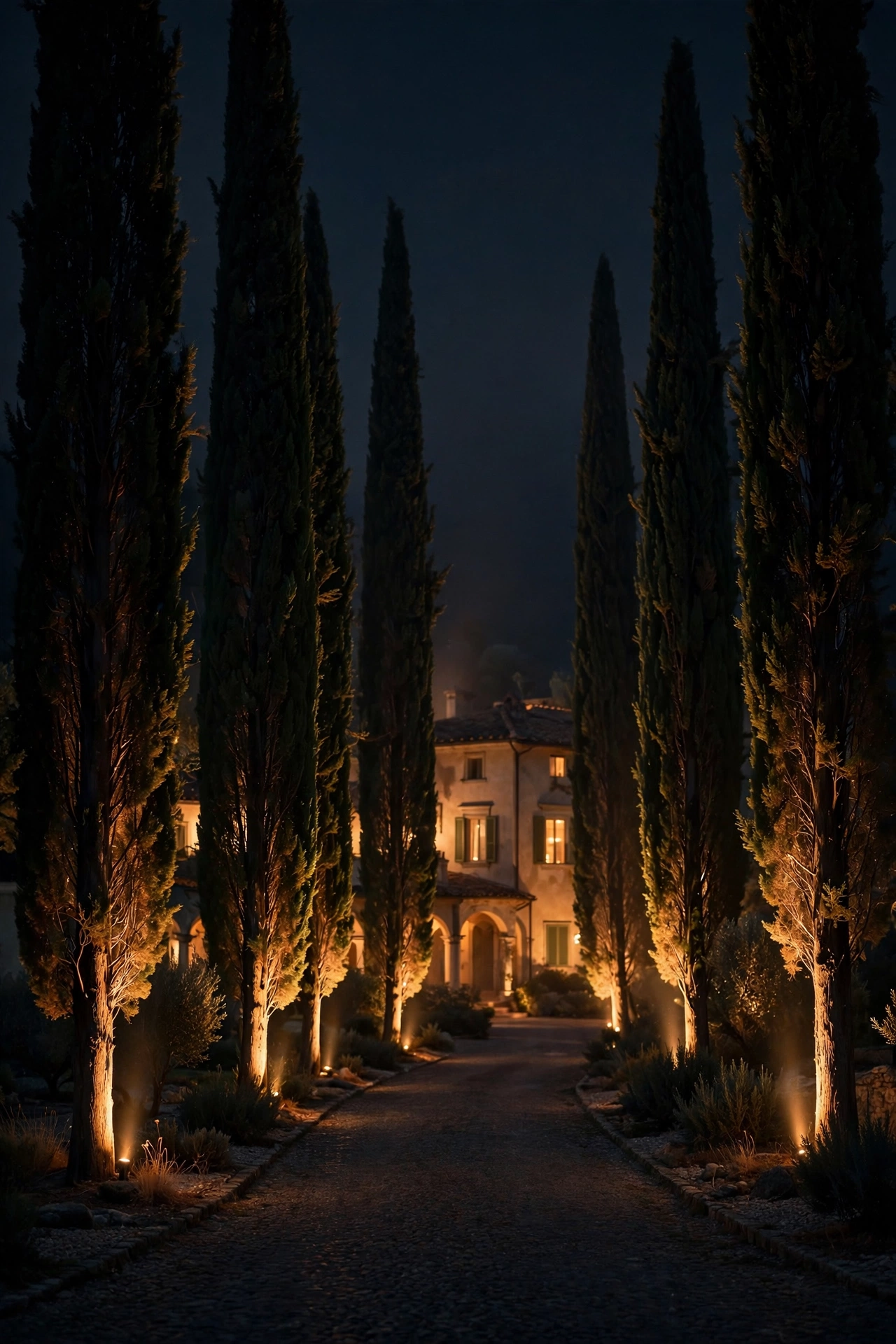
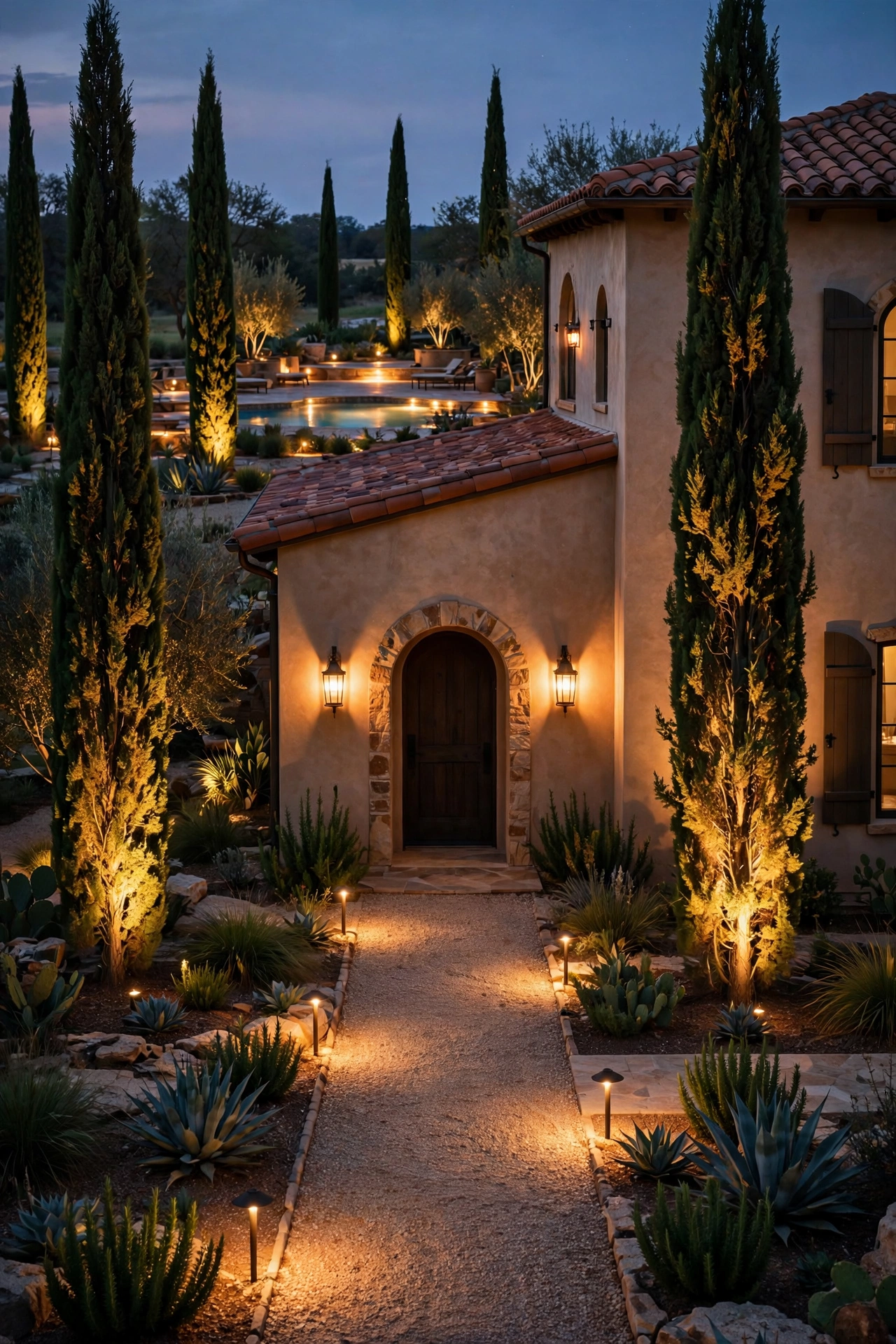
9. Send Cypress Trees Skyward with Narrow-Beam Uplights
Italian cypress trees are nature's exclamation points, and a narrow-beam uplight at the base of each one turns them into glowing green flames against the night sky. Use a tight 15–25 degree beam spotlight placed 12–18 inches from the trunk, aimed straight up the column of foliage. Because cypress are so vertical, one fixture per tree is usually enough — the beam naturally follows the tree's shape upward.
Warm 2700K at 300–500 lumens gives you presence without turning the tree into a lighthouse; cypress look best slightly underlit rather than blasted. Space uplighted cypress 6–8 feet apart along a driveway or property line for that classic allée effect, and put them on the same transformer zone as your olive trees so everything rises together at dusk. One caution: keep the fixture aimed true-vertical and the lens clean — a tilted beam spilling into a neighbor's window is the fastest way to ruin a good lighting plan. Bronze or black fixtures tucked into gravel or mulch disappear completely by day.
Suggested budget range: $50 – $160 per tree.
10. Graze Light Across Arched Doorways and Niches
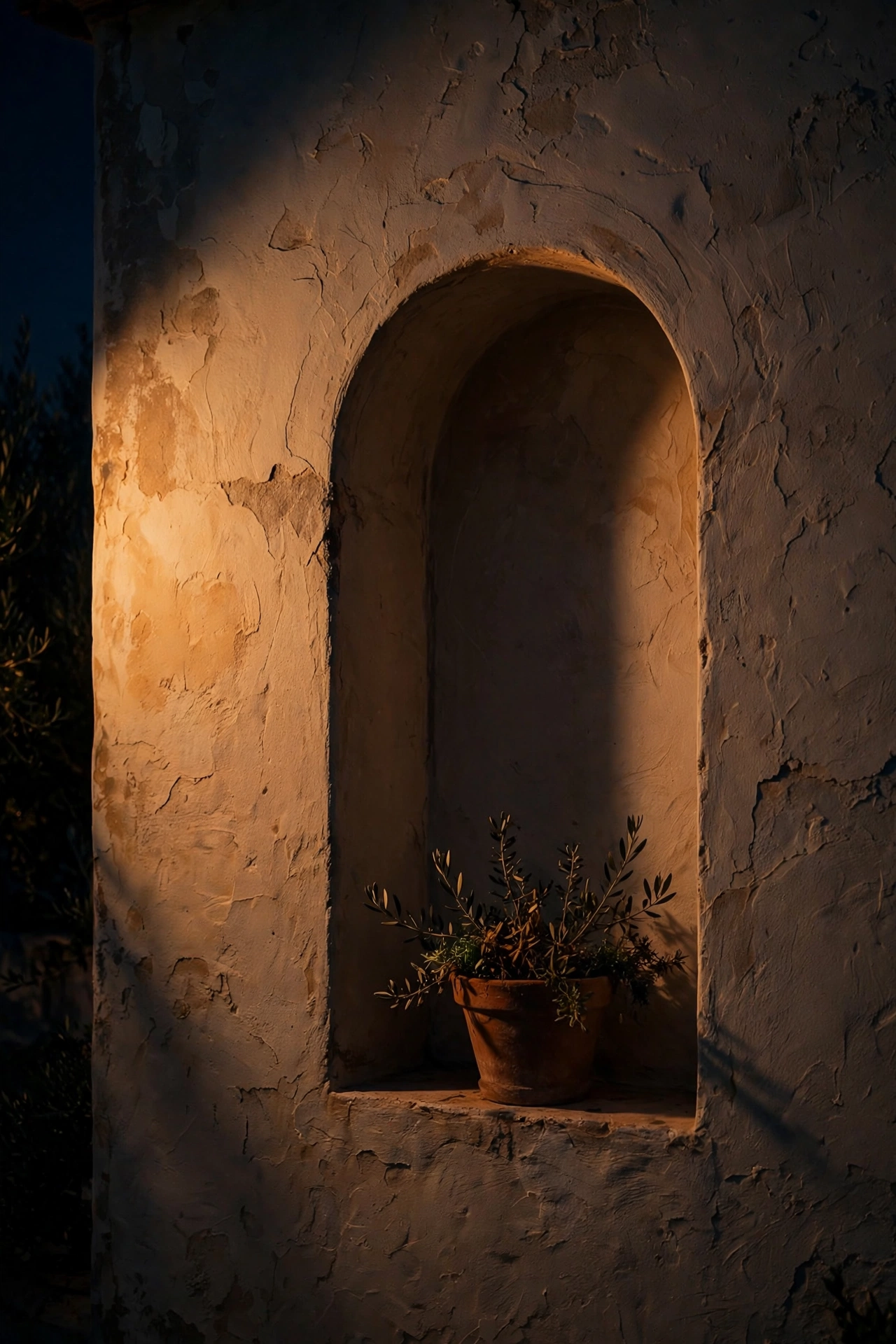
Mediterranean architecture is all about texture — hand-troweled stucco, arched niches, carved stone surrounds — and grazing light is how you show it off. Mount a small adjustable wall-wash or recessed downlight 12–18 inches out from the wall (in the soffit above an arch, or on a stake below a niche), aimed so the beam skims across the surface at a shallow angle. The raking light throws every trowel mark and curve into soft relief, and an arched niche with a small statue or potted citrus inside becomes a little glowing shrine.
This is a technique more than a fixture: any adjustable 2700K spot at 200–350 lumens works. For niches, a tiny 2-inch recessed downlight centered in the niche ceiling, set back 4–6 inches from the front edge, gives you a perfect museum-style wash. Keep the beam tight enough that it doesn't spill onto neighboring windows — 36-degree floods are usually the widest you want for grazing. I always recommend testing placement at night with a temporary stake light before committing to a hardwired position; what looks right in daylight almost never looks right in the dark. On a dimmer, grazing light doubles as subtle security lighting that flatters instead of interrogates.
Suggested budget range: $40 – $140 per feature.
11. Cluster Tabletop Lanterns on Patio Tables
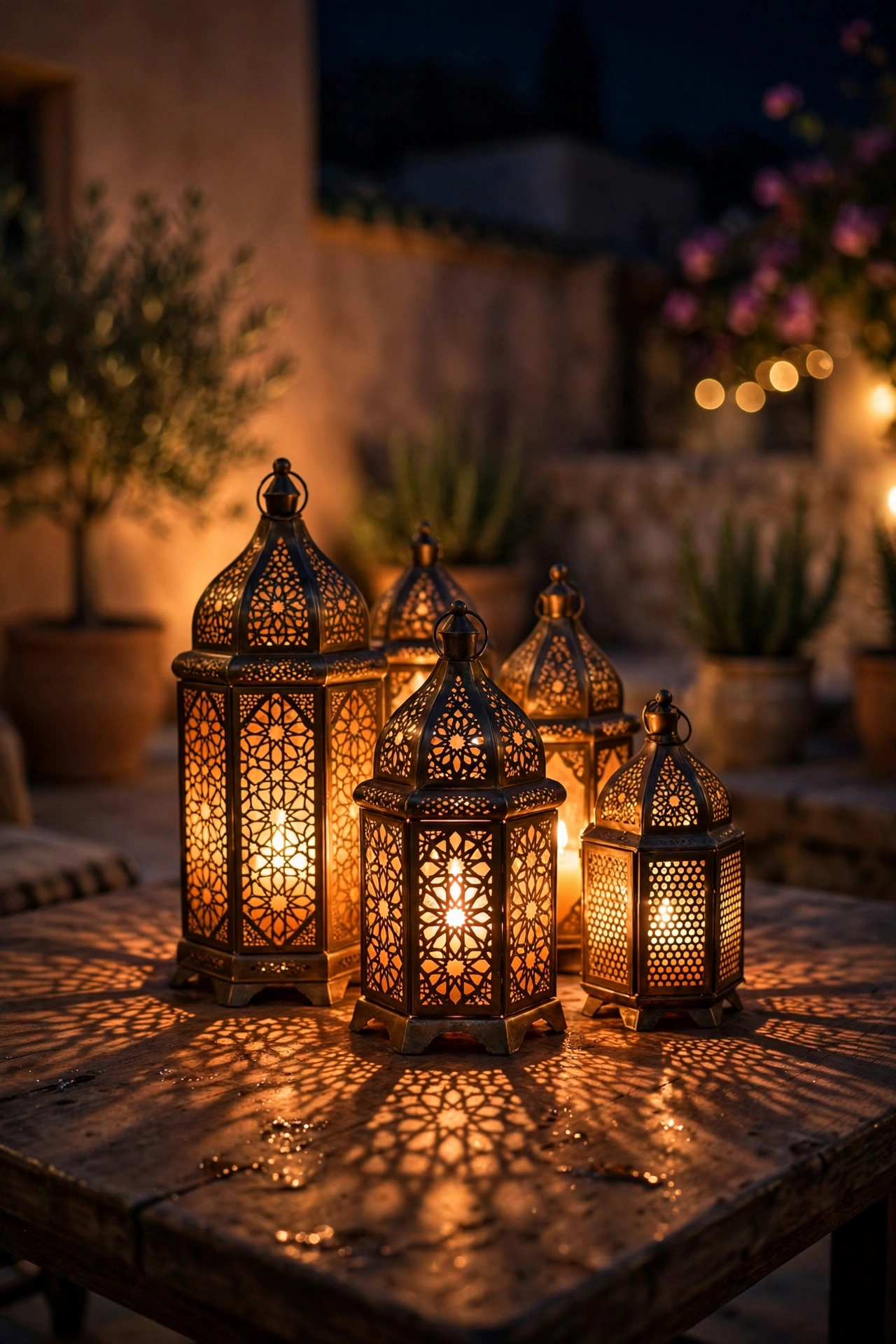
Some evenings call for the simplest magic of all: a cluster of small lanterns on the patio table, no wiring required. Group three to five lanterns of varying heights (8–16 inches tall) in the center of the table, mixing pierced-metal Moroccan styles with simple glass hurricanes. Battery-powered LED candles or rechargeable tea lights inside each one give you real flicker with zero fire risk — and honestly, modern flicker-effect LEDs fool almost everyone.
This is the lowest-commitment idea on the list and one of my favorites for that reason. Use warm 2200K flicker bulbs, and look for lanterns with a handle or top loop so you can hang one from a nearby branch or pergola hook when you want the table clear for serving. For windy evenings, choose heavier metal or glass lanterns over lightweight paper styles, and set the cluster on a tray so you can whisk the whole arrangement inside in ten seconds if weather turns. Rechargeable candles with a remote or timer mean the cluster lights itself at dusk — I set mine once in spring and don't touch them until fall.
Suggested budget range: $30 – $120.
12. Edge Gravel Pathways with Low Warm Path Lights
Mediterranean gardens love their decomposed-granite and gravel paths, and low path lights keep them walkable while preserving the old-world feel. Space fixtures 6–8 feet apart, staggering them side to side rather than lining them up like runway lights — the staggered rhythm feels natural and uses fewer fixtures. Set each light 12–18 inches back from the path edge so the beam (aimed downward and outward) washes across the gravel without shining into walkers' eyes.
Choose fixtures with a hooded or shielded top and warm 2700K bulbs at 100–200 lumens; the classic "pagoda" or "mushroom" silhouettes in bronze or oil-rubbed finishes suit the style perfectly. Low-voltage 12V systems are the easy DIY route — the cable just presses into the soil along the bed line — while solar path lights work if your paths get 6+ hours of direct sun. In my experience, solar is fine for ambiance but low-voltage wins for reliability; nothing kills the mood like half your path going dark by 10 p.m. because of a cloudy day. Wire path lights to the same dusk-to-dawn zone as your entry so guests are guided from the street to the door.
Suggested budget range: $80 – $300 for a typical walkway.
13. Tuck Recessed Downlights into Pergola Beams
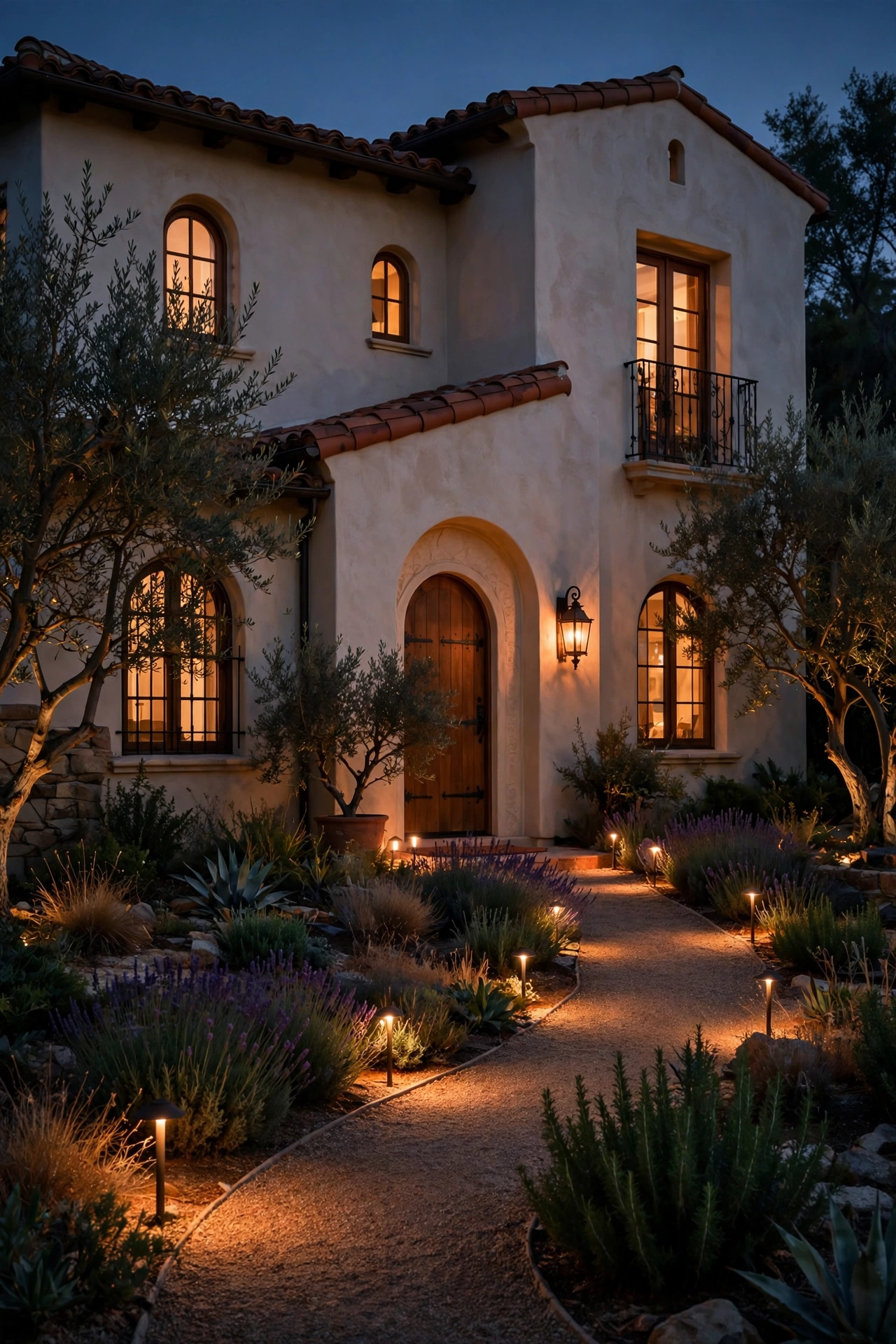
If string lights feel too festive for your pergola dining area, recessed downlights tucked into the beams give you the same warm pool of light with a cleaner, more architectural look. Install small 3-inch low-voltage recessed fixtures centered in every other beam bay, aimed straight down at the table — for a 12-foot pergola, three to four fixtures spaced about 3–4 feet apart covers a standard dining table beautifully. The fixtures hide completely in the beam, so by day the pergola looks untouched.
Use warm 2700K bulbs at 300–400 lumens each with a 60-degree beam for soft, overlapping pools of light rather than harsh spots. Run the low-voltage cable along the top of the beams (invisible from below) back to the transformer, and put this zone on its own dimmer — full brightness for dinner prep, half for the meal itself. If your pergola has climbing vines, trim growth back from the fixtures each spring so leaves don't block the beam or trap heat. In my experience, pairing beam downlights with a single pierced-metal pendant (idea #2) over the table's center gives you the best of both: architectural light plus that magical patterned glow.
Suggested budget range: $120 – $350.
14. Wash the Stucco Walls with Soft Floodlighting
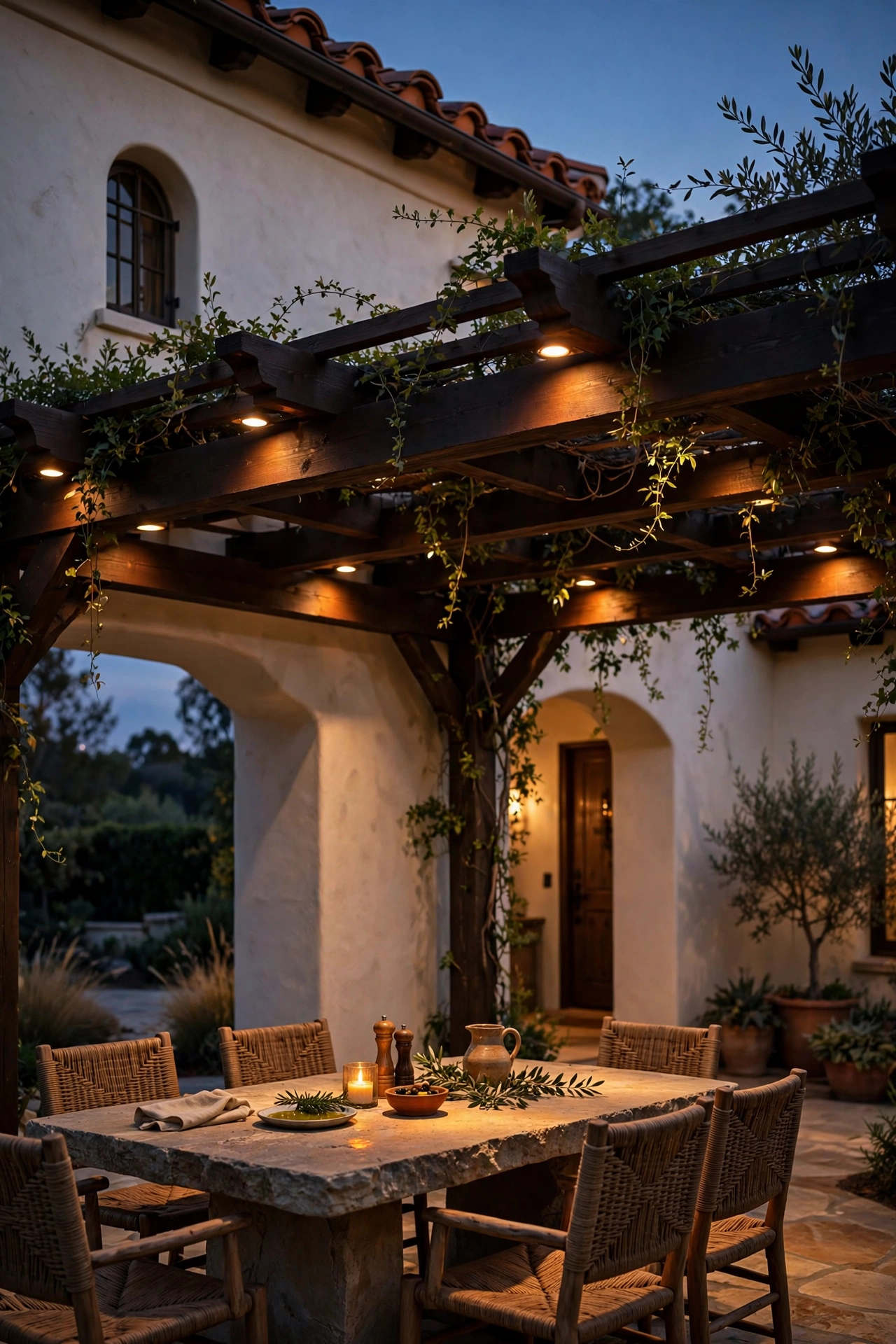
Big blank stucco walls can look flat and imposing at night — a soft wall wash turns them into a warm, glowing backdrop for the whole courtyard. Place one or two wide-beam (60-degree) low-voltage floodlights 8–12 feet out from the wall, aimed upward at a 30–45 degree angle, so the light spreads evenly from the base of the wall toward the eaves. The goal is a gentle gradient, not a spotlight blast: warm 2700K at 500–700 lumens per fixture is usually plenty for a 20-foot wall section.
Keep the fixtures low and shielded so the beam starts at the wall's base — light spilling over the top of a parapet into the sky wastes energy and annoys neighbors. If the wall has climbing bougainvillea or espaliered citrus, the wash light filtering through the foliage creates the most beautiful dappled shadows. For larger courtyards, overlap two washes slightly rather than cranking one fixture brighter; even coverage always looks more expensive than one hot spot. Put wall washes on a separate transformer zone from your accent uplights so you can dim the big surfaces while keeping the trees dramatic.
Suggested budget range: $100 – $280.
15. Create a Lantern-Lit Reading Nook in a Quiet Corner
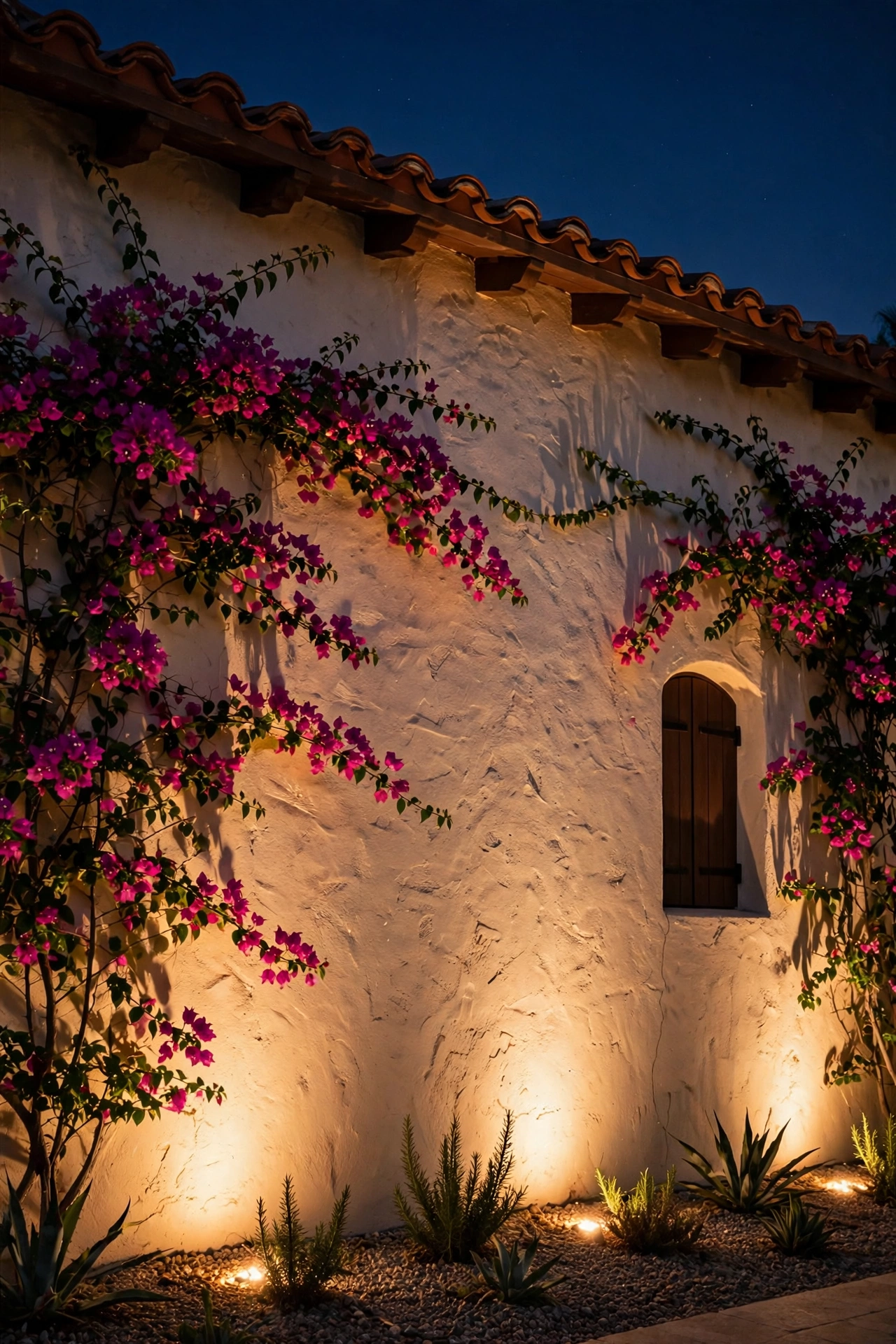
Every villa courtyard has that one quiet corner — beside a wall fountain, under a small tree, at the end of a path — that's begging to become a reading nook. Anchor it with a comfortable chair and side table, then light it in layers: a tall floor lantern or shepherd's-hook lantern beside the chair for reading light (warm 2700K, 400–600 lumens, shaded so it doesn't glare), plus two or three small lanterns with LED candles scattered on the surrounding wall cap or ground for ambiance.
Hang one lantern from a sturdy shepherd's hook driven 12 inches into the soil, positioned just behind and to the side of the chair so light falls over your shoulder onto the book — the same rule as indoor reading lamps. If the nook sits against the house, a single plug-in wall lantern on a timer is even simpler. Add a small outdoor-rated throw blanket to the chair and, honestly, you'll never read indoors again on a warm evening. Keep all fabrics and cushions at least 2 feet from any real-flame candle; LED candles remove the worry entirely. This little corner costs almost nothing but becomes the most-used three square feet of the whole garden.
Suggested budget range: $60 – $200.
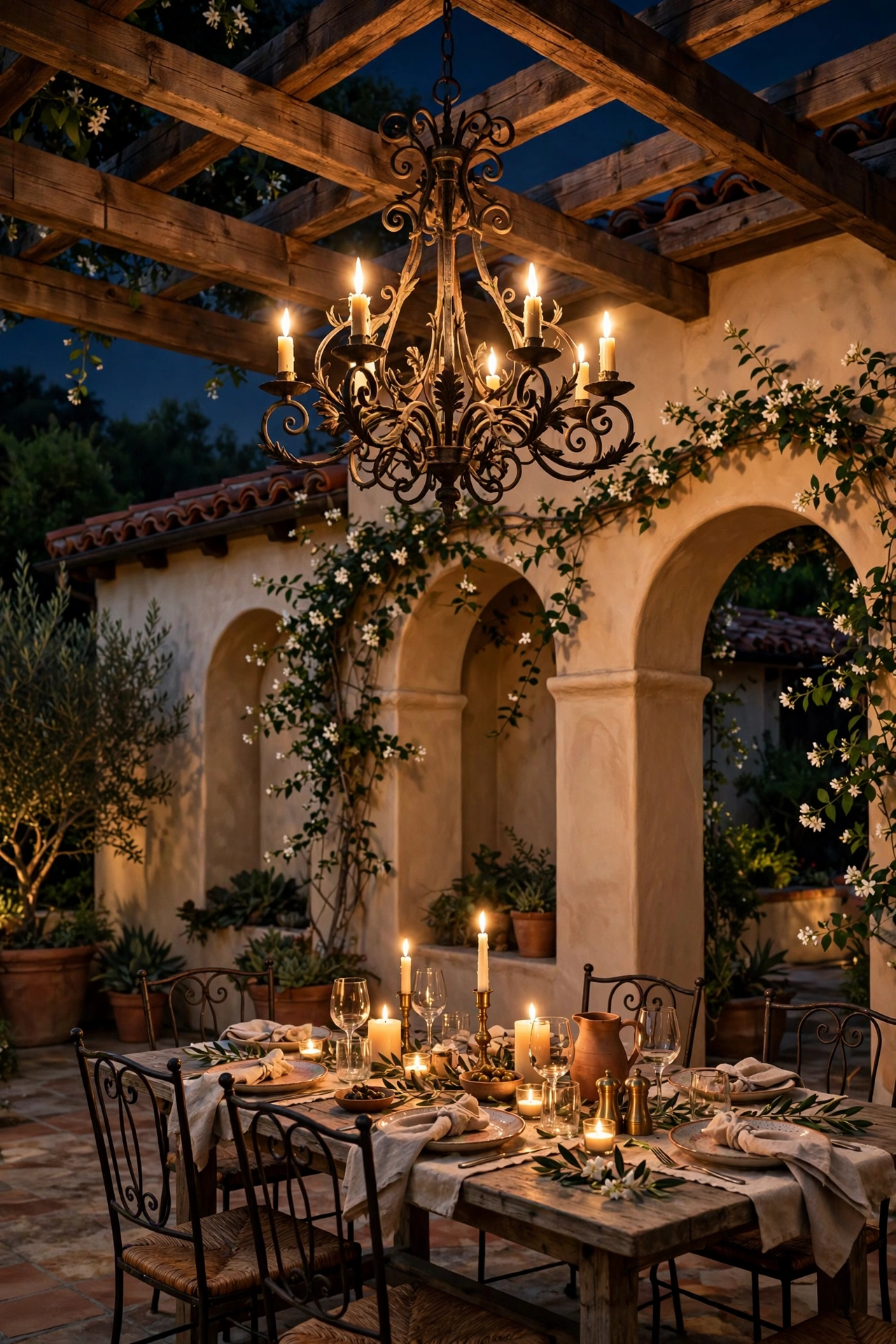
16. Hang a Wrought-Iron Chandelier Over the Dining Table
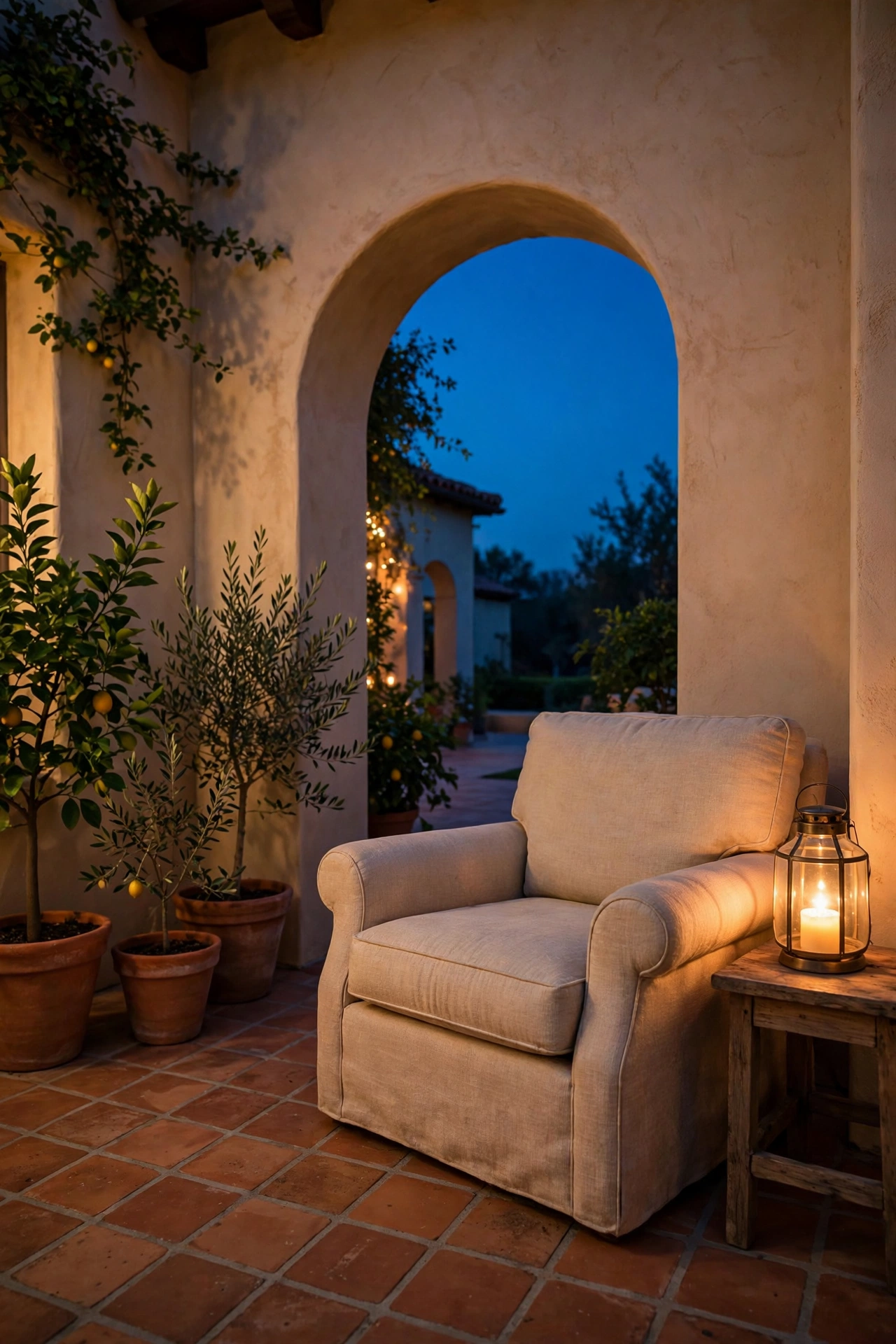
For the grand gesture, nothing beats a wrought-iron chandelier suspended over the courtyard dining table — it's the Mediterranean villa's signature move. Hang it from a pergola's center beam, a sturdy ceiling mount under a covered loggia, or a freestanding wrought-iron shepherd's arch if there's no overhead structure. The bottom of the chandelier should sit 30–36 inches above the tabletop, same as the pendants in idea #2, and the fixture diameter should be roughly half to two-thirds the table's width.
Choose an open-cage design with 4–8 candle-style arms so light radiates in every direction; LED candle bulbs at 2700K and 200–300 lumens per arm give you that historic glow without the dripping wax. Outdoor chandeliers must be wet- or damp-rated depending on exposure, and the mounting point needs to support 30–50 pounds — have an electrician verify the structure if you're unsure. A dimmer is non-negotiable here; chandeliers look best at about 60% brightness once dinner starts. If you love this look, our roundup of outdoor chandelier ideas has more styles and hanging-height guidance.
Suggested budget range: $200 – $600.
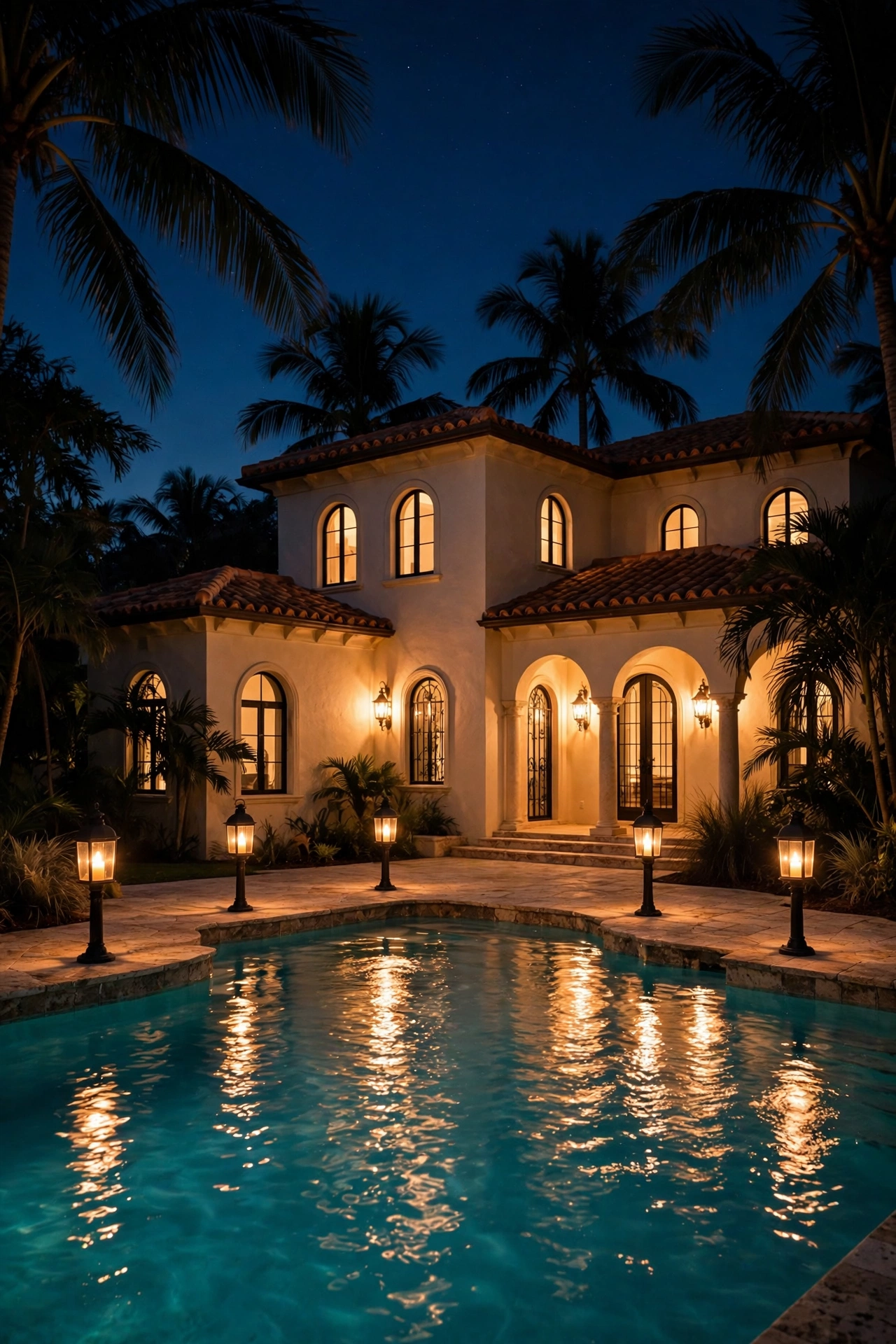
17. Flank the Pool with Lantern Posts
If your Mediterranean-revival home has a pool — and so many in California, Florida, and Texas do — lantern posts around the deck perimeter give you resort-level atmosphere with real safety benefits. Place 36–42 inch tall lantern posts every 10–12 feet around the pool deck, set back at least 4 feet from the water's edge, so the deck perimeter reads clearly after dark without glare on the water. Choose posts with a hooded or downward-directed head so light lands on the decking, not in swimmers' eyes.
Warm 2700K at 200–300 lumens per post is the sweet spot. All pool-area fixtures must be low-voltage (12V) or hardwired by a licensed electrician to meet pool electrical codes — never run standard extension-cord lighting near water. Keep one side of the pool slightly dimmer than the other; the contrast makes the water's reflections more dramatic and the space feels designed rather than uniformly lit. In my experience, lantern posts also do quiet security duty, eliminating the dark corners where pool equipment and gates sit. Tie them into the same dusk-to-dawn timer as the rest of the garden so the whole property wakes up together.
Suggested budget range: $250 – $700.
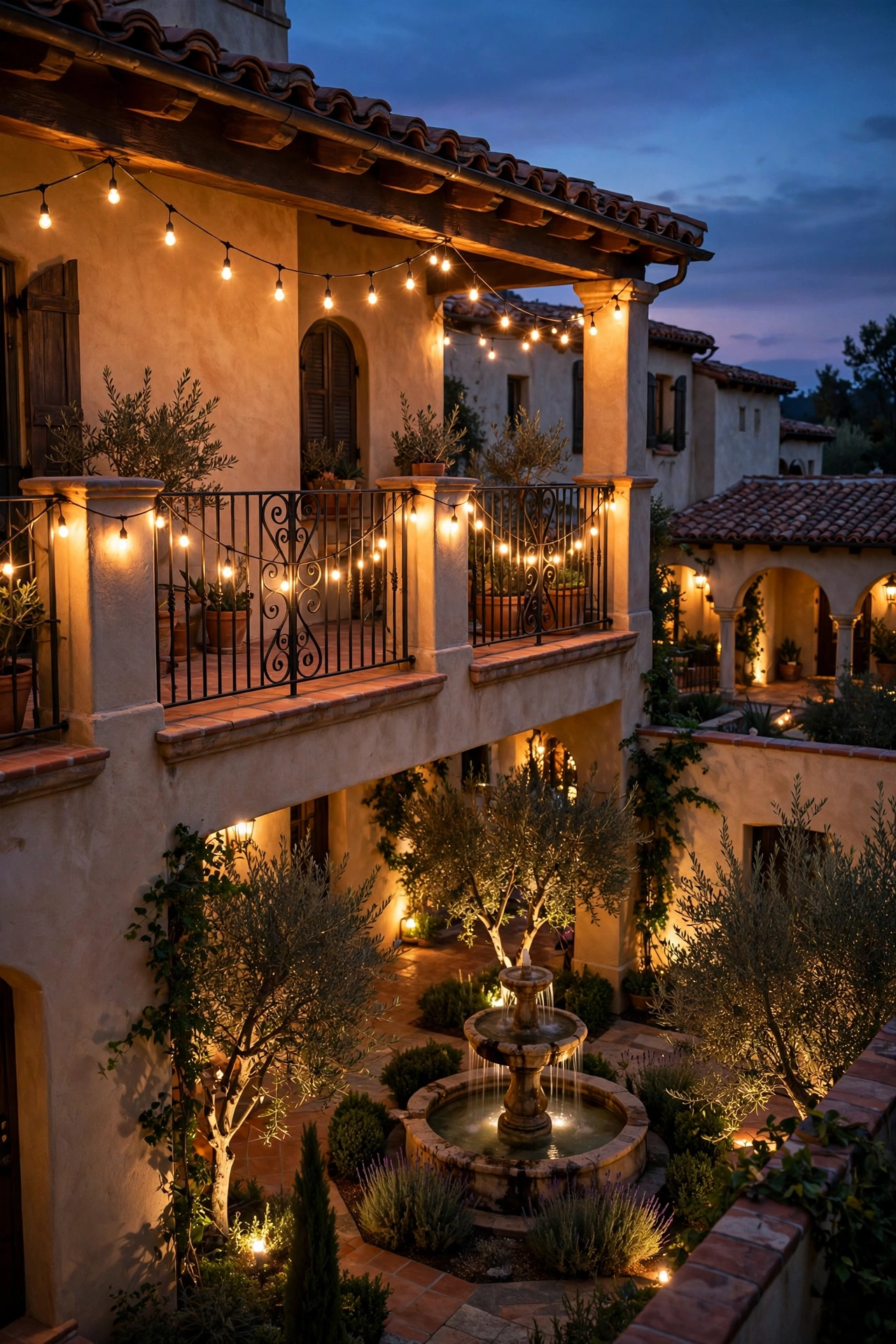
18. String Lights Along the Upper Terrace Railing
The upper terrace or balcony is the Mediterranean villa's crowning viewpoint — and string lights along its railing turn it into a glowing crown visible from the whole garden below. Swag the lights along the railing in gentle 12–18 inch dips between posts, attaching with small hooks or zip ties every 2–3 feet. For a standard 20-foot railing run, 40–50 feet of lights gives you full coverage with a little slack at the ends.
Use the same commercial-grade warm-white LED strings as your pergola (2200–2700K, shatterproof bulbs) so the color temperature matches across the property — mismatched whites are the fastest way to make a garden look accidental. Drape them on the garden-facing side of the railing so the glow spills outward over the courtyard, and keep the strand 6+ inches below the top rail so it doesn't interfere with anyone leaning on it. A smart plug on a sunset schedule means the terrace lights itself every evening. From the garden below, a lit terrace railing reads as pure romance; from the terrace itself, you get a softly glowing foreground for those long evening conversations.
Suggested budget range: $40 – $130.
19. Automate It All with Dusk-to-Dawn Zoning
Here's the idea that makes the other eighteen actually get used: put your mediterranean outdoor lighting on automated zones that switch on at dusk and off at dawn (or at a set bedtime). Divide the property into three or four zones — entry and paths, trees and architecture, dining and entertaining areas, pool — each on its own low-voltage transformer tap or smart switch. That way the entry glows for late arrivals while the dining zone can dim or switch off after the party ends.
A photocell timer on each transformer is the simplest setup: about $25 per transformer, completely automatic, adjusts with the seasons. Smart plugs and smart dimmers add phone control and sunset-synchronized schedules for string lights and plug-in lanterns. In my experience, the number one reason beautiful landscape lighting goes unused is the friction of walking around flipping switches — automation removes it entirely. Set entertaining zones to switch off around 11 p.m. or midnight to save energy and be kind to the night sky, while keeping entry and path zones on until dawn for safety. Honestly? Do this step first, even before you buy a single new fixture — you'll use what you already have twice as much.
Suggested budget range: $75 – $300 for timers, smart plugs, and zoning.
Frequently Asked Questions
What fixtures hold up best in Mediterranean-climate heat?
Powder-coated wrought iron, solid bronze, and marine-grade brass handle heat and sun far better than painted steel or plastic, which chalk and crack within a couple of summers. Look for fixtures with a UV-stable powder-coat finish and stainless-steel hardware. LED bulbs are essential in hot climates — they run far cooler than halogens, which can scorch nearby foliage and shorten fixture life. In my experience, spending a little more on solid metal fixtures pays for itself when you're not replacing sun-rotted ones every two years.
How do I mount lights on stucco without damaging it?
For lightweight sconces and lanterns, drill into the stucco with a masonry bit, insert a plastic or lead anchor, and seal around the mounting plate with exterior-grade silicone caulk to keep water out of the wall cavity. Always try to hit a stud or use toggle-style anchors for heavier fixtures like chandeliers — stucco alone won't hold real weight. If you're nervous about drilling, surface-mounted conduit and adhesive-backed cable clips handle low-voltage landscape wiring neatly without a single hole in the wall. For historic or delicate stucco, a licensed electrician with stucco experience is worth every penny.
How do I uplight olive and cypress trees without overdoing it?
One fixture per tree is the rule for both — two at most for a very large olive. Keep bulbs warm (2700K) and modest (200–400 lumens), aim the beam up through the canopy rather than at the trunk, and step back to the street or the far side of the garden to judge the effect; uplighting always looks brighter from across the yard than from two feet away. If you can clearly see the fixture's bright lens from your main viewing spot, add a small glare shield or reposition it behind a low shrub. The goal is a tree that glows, not a tree that looks like it's under interrogation.
How can I light a courtyard for privacy without making it feel exposed?
Bright, even lighting actually destroys privacy — it turns your courtyard into a stage visible from every neighboring window. Instead, keep light levels low and aimed downward: lanterns at table height, path lights, and step lights rather than bright floods. Uplighting trees and washing walls gives you beautiful ambient glow without a single harsh source that broadcasts activity. Position the brightest fixtures (entry lanterns, dining pendants) toward the center of the courtyard, away from boundary walls, so the perimeter stays softly dim. In my experience, a dimly lit courtyard feels more private than a dark one — you can see your own space beautifully while neighbors see only a warm, indistinct glow.
Conclusion
The real magic of mediterranean outdoor lighting is how little of it you actually need — a pair of lanterns at the arch, an olive tree glowing against the stucco, string lights swaying over the table, and suddenly your ordinary evening feels like a holiday on the Amalfi Coast. Start with one layer, live with it for a week, then add the next; the layering philosophy means every addition makes everything before it look better.
If this style has you dreaming in terracotta and wrought iron, browse our other outdoor lighting ideas — from statement wall lanterns to pendant lights made for the outdoors — and keep building your own warm-evening retreat, one glowing corner at a time.