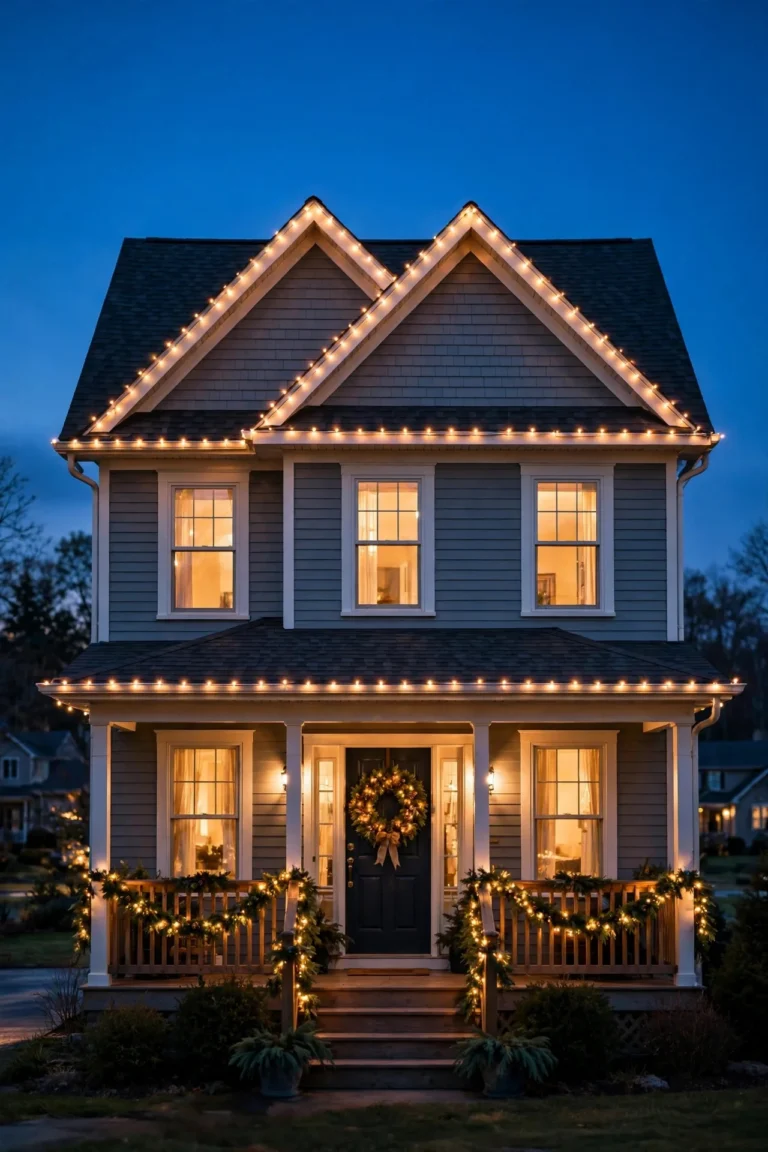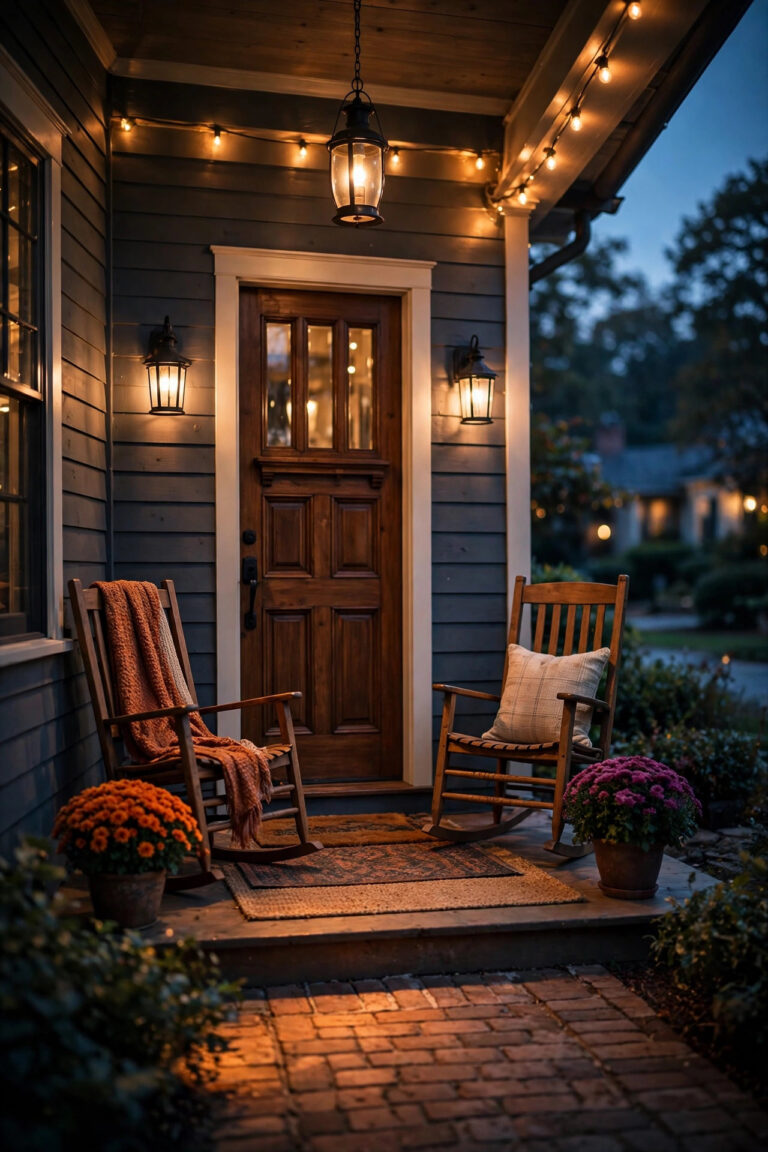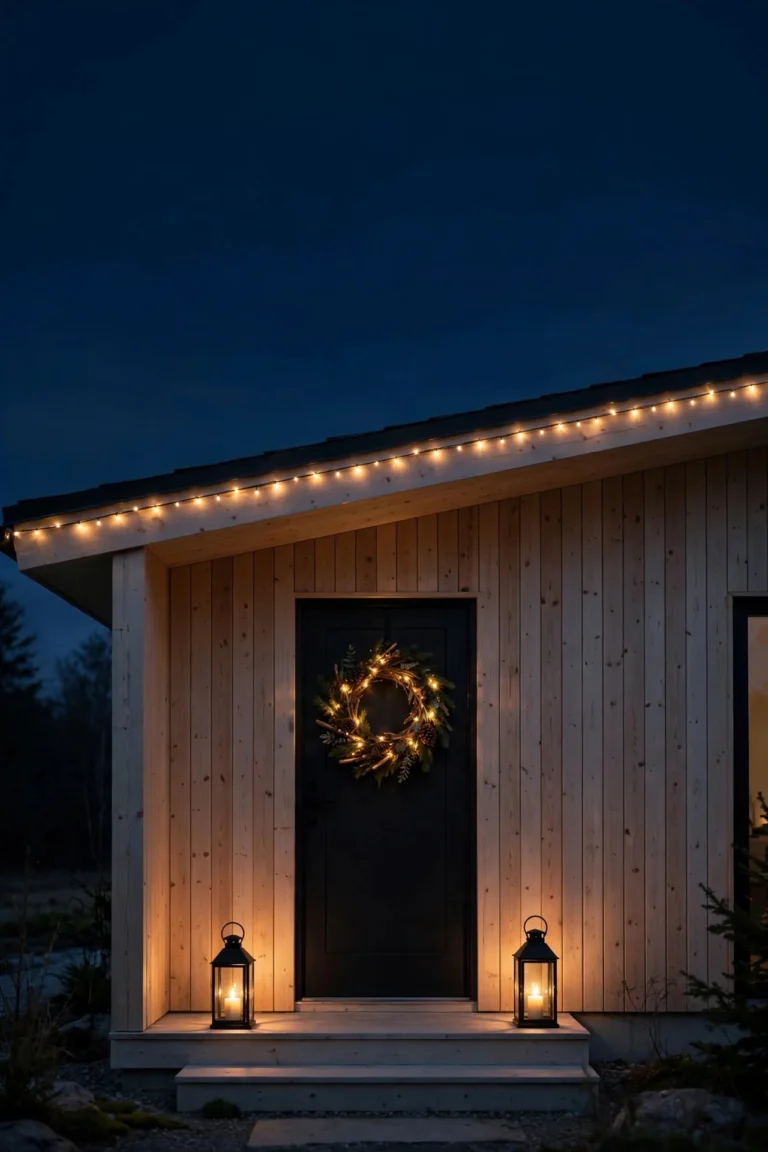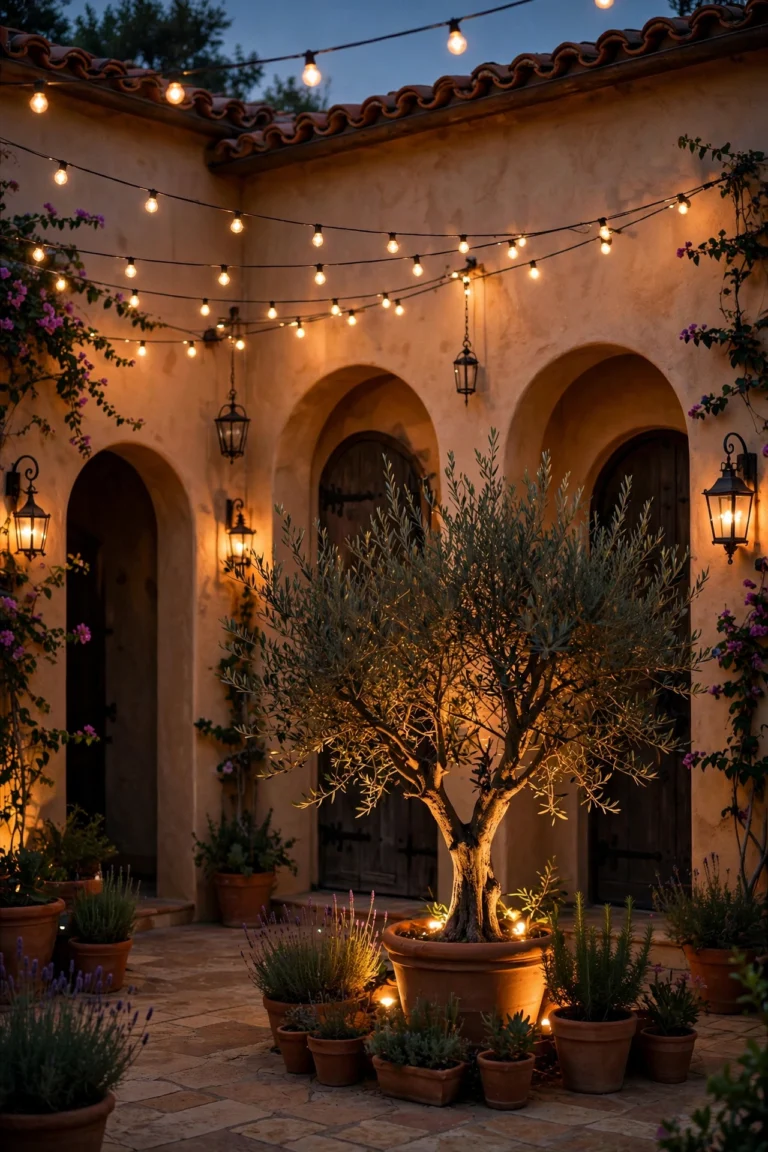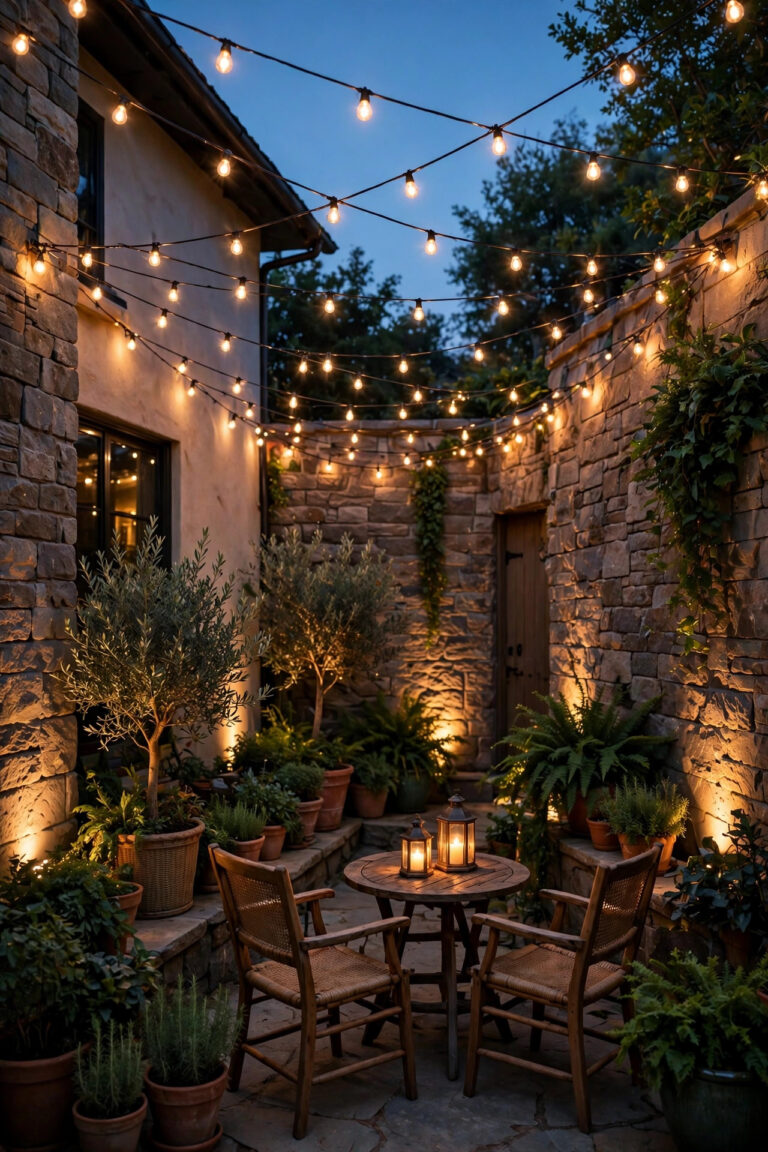
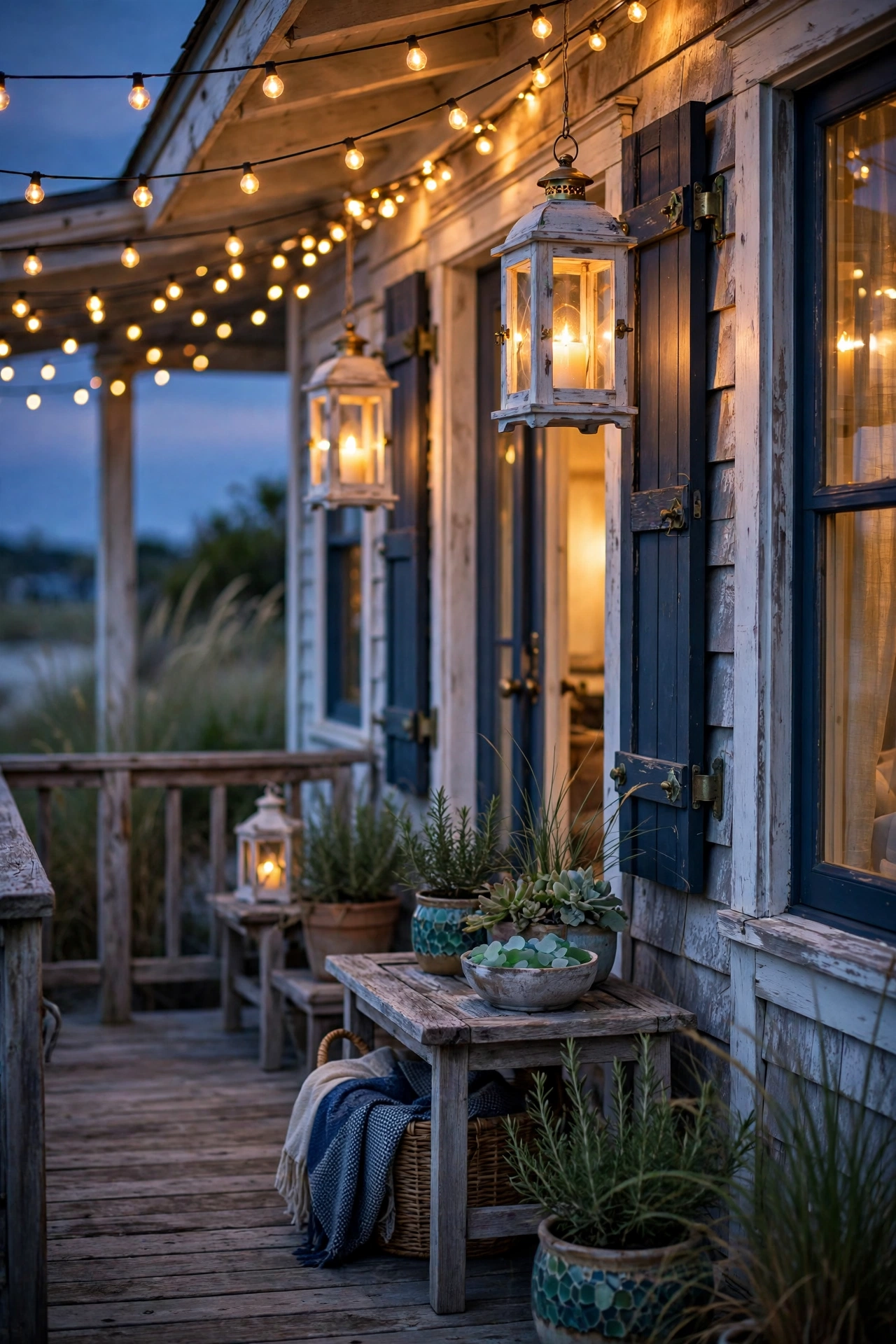
There's a special kind of magic in coastal outdoor lighting ideas that land right — that soft, breezy glow that makes a porch feel like a beach-house veranda even when the ocean is an hour away. I grew up summers on the Jersey Shore, and the houses I remember most weren't the fanciest ones. They were the ones with lanterns flickering warmly over a weathered deck, rope-wrapped pendants swinging gently in the salt breeze, string lights strung like constellations above a fire pit.
The secret to the look is layering, just like I always tell my readers: start with a foundation of practical downlighting (so you can actually see where you're walking), add a middle layer of decorative fixtures for style (that's where the lanterns and pendants come in), and finish with a sparkle layer — string lights, fairy lights, and candlelight-style accents that make everything feel effortless. Near the coast, you just do it all with salt-air-proof materials.
Here are 19 ideas to layer that breezy coastal glow across your whole exterior — from the front porch to the dock, if you're lucky enough to have one.
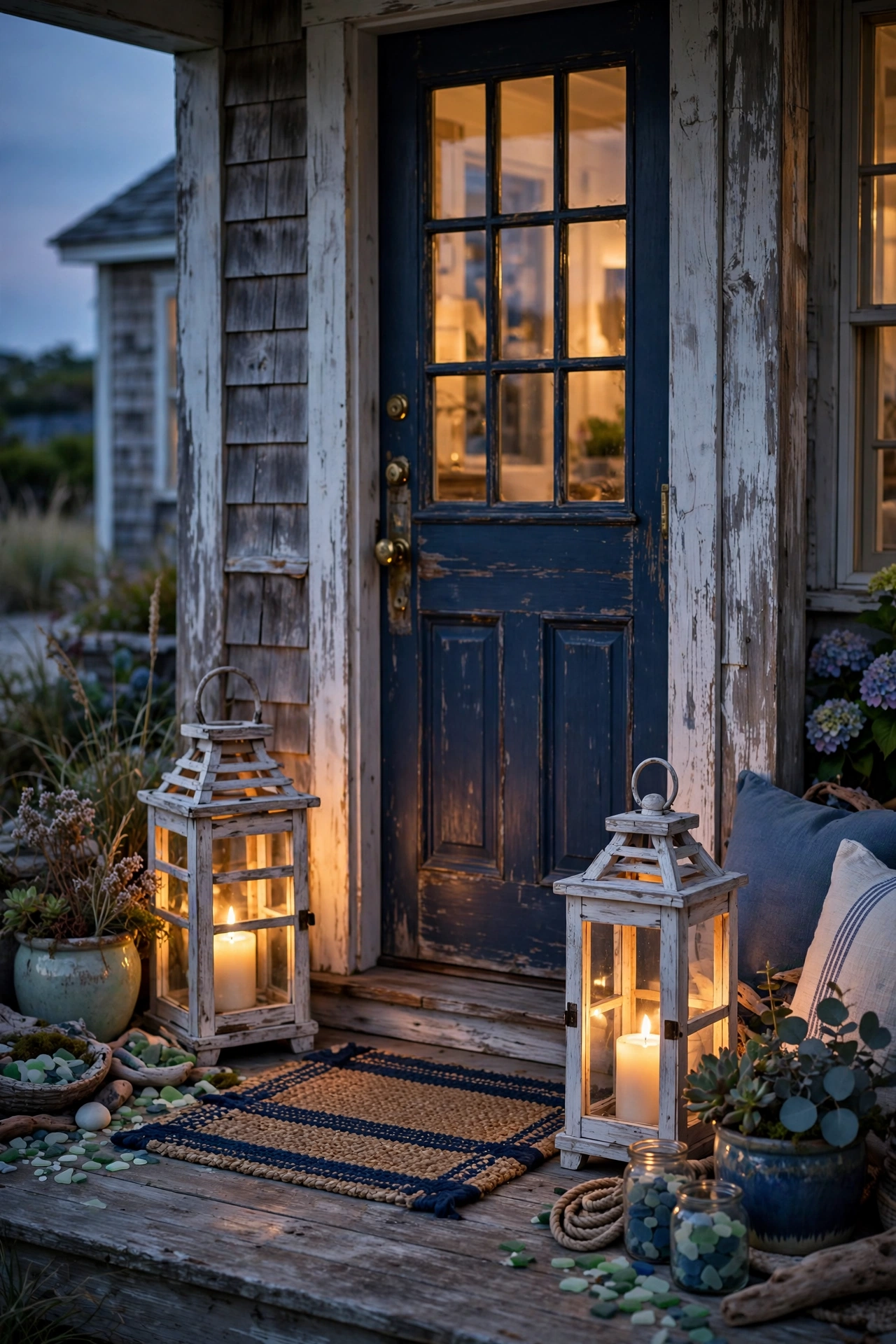
1. Whitewashed Wooden Lanterns on the Front Porch
Whitewashed lanterns are the poster child of coastal style for a reason: they catch the light beautifully at dusk and look like they washed up with the tide. Pick lanterns in a whitewashed or driftwood finish sized proportionally to your porch — about 14 to 18 inches tall for a standard 6-by-8-foot porch entry. Hang one from a chain on each side of the front door at roughly 66 inches from the floor to the center of the fixture, or cluster two large lanterns on the porch floor flanking a bench.
Inside, use LED pillar candles or a single warm-white (2700K) LED Edison-style bulb so the glow reads amber and inviting rather than harsh. Since these are often wood or wood-look, make sure the lantern is rated for damp locations at minimum if it's under a covered porch, and wet-rated if it's exposed. LED-only is a must here — real candles or incandescent bulbs too close to wood finishes are a fire risk. To protect a genuine whitewashed wood finish in salt air, spray the exterior once a season with a clear marine-grade sealant and bring the most delicate ones inside during winter storms.
Suggested budget range: $35 – $120.
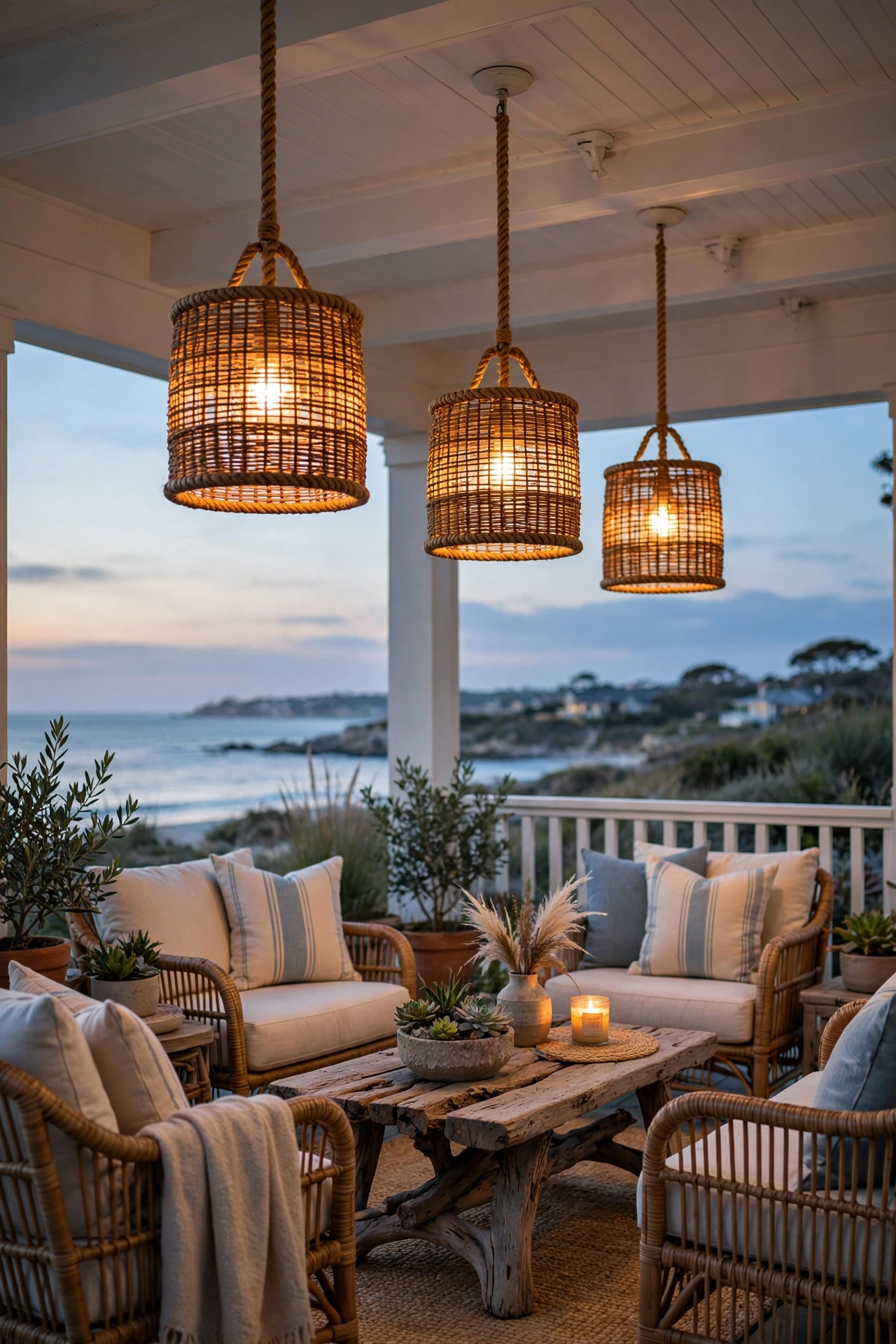
2. Rattan and Rope Pendant Lights Over the Porch Ceiling
Nothing says breezy coastal like a rattan or jute-rope pendant swinging softly from a beadboard porch ceiling. This is one of my all-time favorite coastal outdoor lighting ideas because it delivers so much texture for the money. For a standard 8-foot porch ceiling, hang the pendant so the bottom of the shade sits about 7 feet above the floor — low enough to feel intimate, high enough to clear heads. On a wide porch, hang three small pendants (12 to 14 inches in diameter) spaced 4 to 5 feet apart instead of one oversized one.
Use a damp-rated pendant with a porcelain socket and a warm-white 2700K LED bulb, around 800 lumens for real task light over a seating area. Natural rattan needs a little care near the ocean: choose synthetic-rattan or sealed natural rattan for exposed porches, and check that the mounting hardware is stainless steel so the salt air doesn't rust the canopy within a season. A timer or dusk-to-dawn sensor means the glow greets you every evening without a second thought. If you're still deciding on porch ceiling fixtures generally, my porch ceiling light ideas break down more options.
Suggested budget range: $60 – $220.
3. String Lights Draped Across the Deck
The single fastest way to get that breezy coastal evening glow is a canopy of string lights over the deck. Hang commercial-grade outdoor string lights (wet-rated, with shatterproof LED bulbs) in a zigzag or parallel pattern across the space, about 9 to 10 feet above the deck floor. Space your anchor points 10 to 12 feet apart, and always use a stainless-steel guide wire for runs over 30 feet — the cable alone will sag and the salt breeze will swing it without support.
For a true coastal feel, look for warm-white 2700K globe bulbs (G40 size is the classic) or slightly larger Edison-style filament bulbs; avoid cool blue-white tones, which read industrial rather than beachy. Let the bulbs hang just above the railing line so they catch the eye from inside the house too. Add a simple outdoor plug-in timer so they switch on at dusk, and check that the plug connection has an in-use weatherproof cover. For longer runs and styling tricks, my outdoor string lights guide goes deep.
Suggested budget range: $45 – $180.
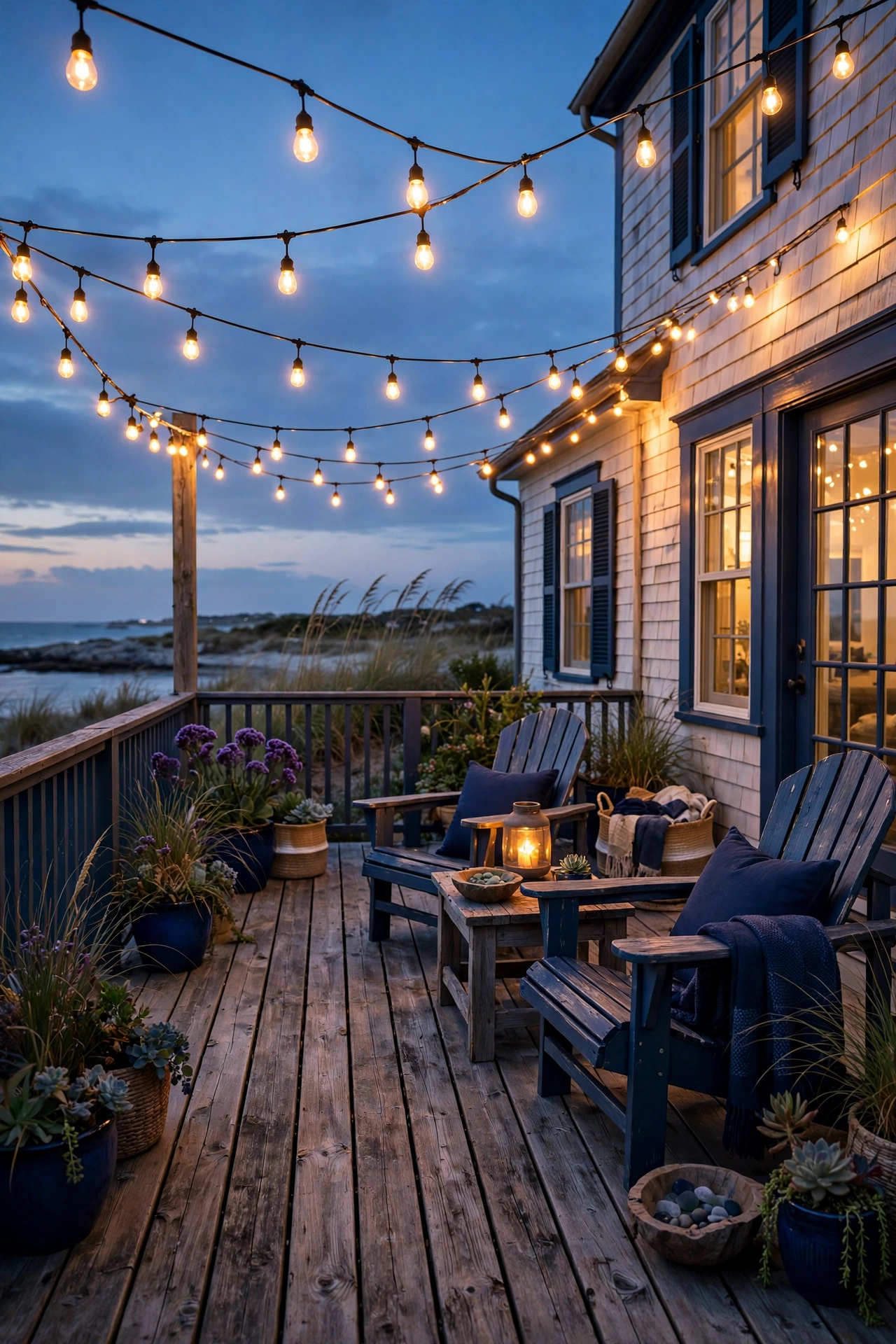
4. Navy and Brass Hurricane Lanterns on Stair Railings
Hurricane lanterns in navy blue glass with brass or copper-tone frames are pure coastal charm, and they look especially good lined along stair railings or a low garden wall. Place them every 3 to 4 feet so the glow overlaps slightly, and weight or anchor them so a gust doesn't send them tumbling — museum putty or a dab of clear silicone under the base works wonders.
Use LED flameless candles inside for zero fire worry on a wooden railing; the flicker-style ones mimic real candlelight so well your guests will do a double take. Honestly? Real glass hurricanes with real candles are gorgeous but nerve-wracking near a windy coast — LED is the practical choice and still reads perfectly at dusk. Wipe the glass down monthly in salt-air zones, since a fine film of salt builds up and dulls the glow. At about 10 to 14 inches tall, these are easy to store when a big storm is forecast.
Suggested budget range: $25 – $90.
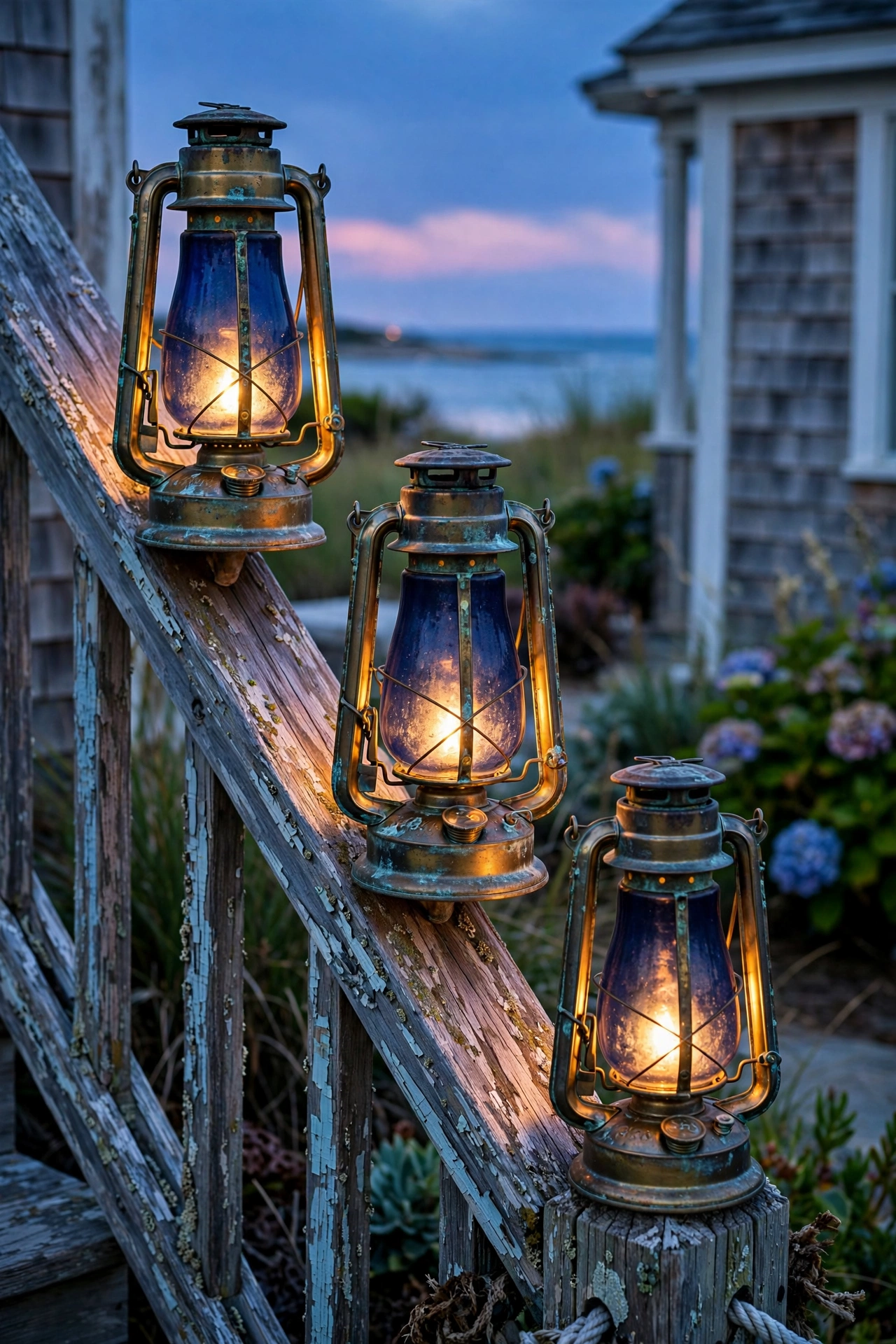
5. Dock and Pier Lights for a Waterfront Glow
If you have a dock or pier, lighting it well is equal parts safety and romance. Install low-profile dock lights — recessed puck lights set into the dock boards or low-profile bollard-style fixtures — every 8 to 10 feet along each side of the dock walkway. The key rule near water: everything must be wet-rated (IP65 or higher) and wired through a GFCI-protected circuit, with marine-grade, UV-resistant wiring run in conduit under the dock.
Warm-white 2700K–3000K LEDs cast that dreamy reflection across the water without attracting as many insects as brighter, cooler tones. Red or amber deck lights on the outermost pilings are a nice touch — they echo channel markers and keep night vision intact while you watch the water. Avoid down-facing spotlights pointed at the water from the house; they kill the mood and disturb wildlife. In my experience, a simple solar-charged post cap light on each piling, topped up by wired step lights on the dock stairs, is the sweet spot between effort and effect.
Suggested budget range: $120 – $450.
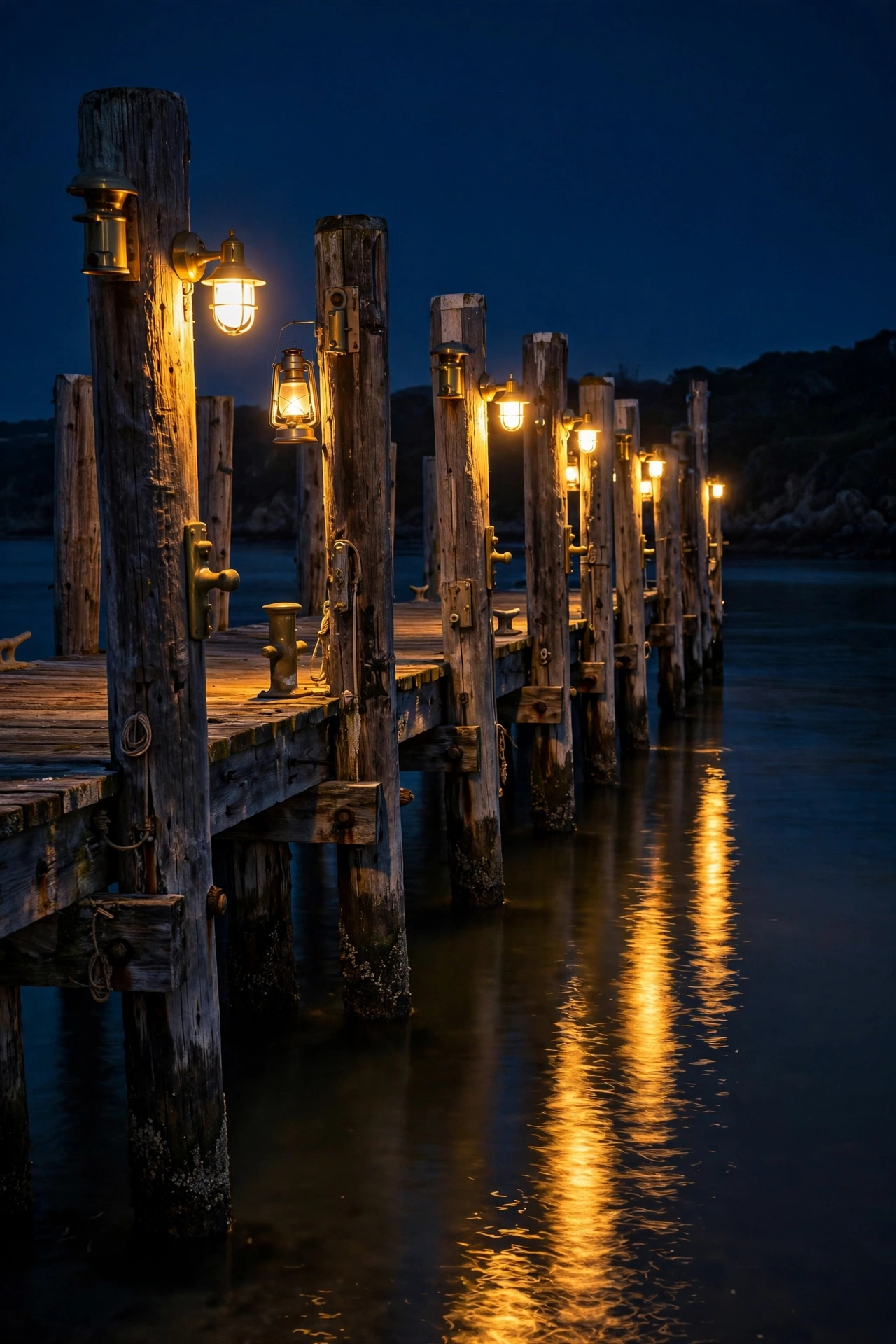
6. Sea-Glass Tone Path Lights Along the Walkway
Sea-glass green, aqua, and frosted-white glass path lights bring the shoreline right up your garden path. Space low-voltage path lights 6 to 8 feet apart along the walkway, staggering them left-right rather than in a rigid row so the light pools feel natural. Aim for fixtures 18 to 24 inches tall with a frosted or seeded-glass shade that diffuses the light softly — you want glowing pebbles, not runway markers.
Use warm-white 2700K LED bulbs or integrated LEDs around 100–200 lumens each. A 12-volt low-voltage system with a transformer and timer is the safest DIY-friendly route, and the cables tuck under mulch or along edging. In coastal soil, which can be sandy and corrosive, choose fixtures with aluminum or composite bodies and stainless-steel ground stakes; cheap painted steel stakes will rust out in a single salty season. Sea-glass colored glass also hides dust and salt film far better than clear glass, which is a small blessing.
Suggested budget range: $60 – $200.
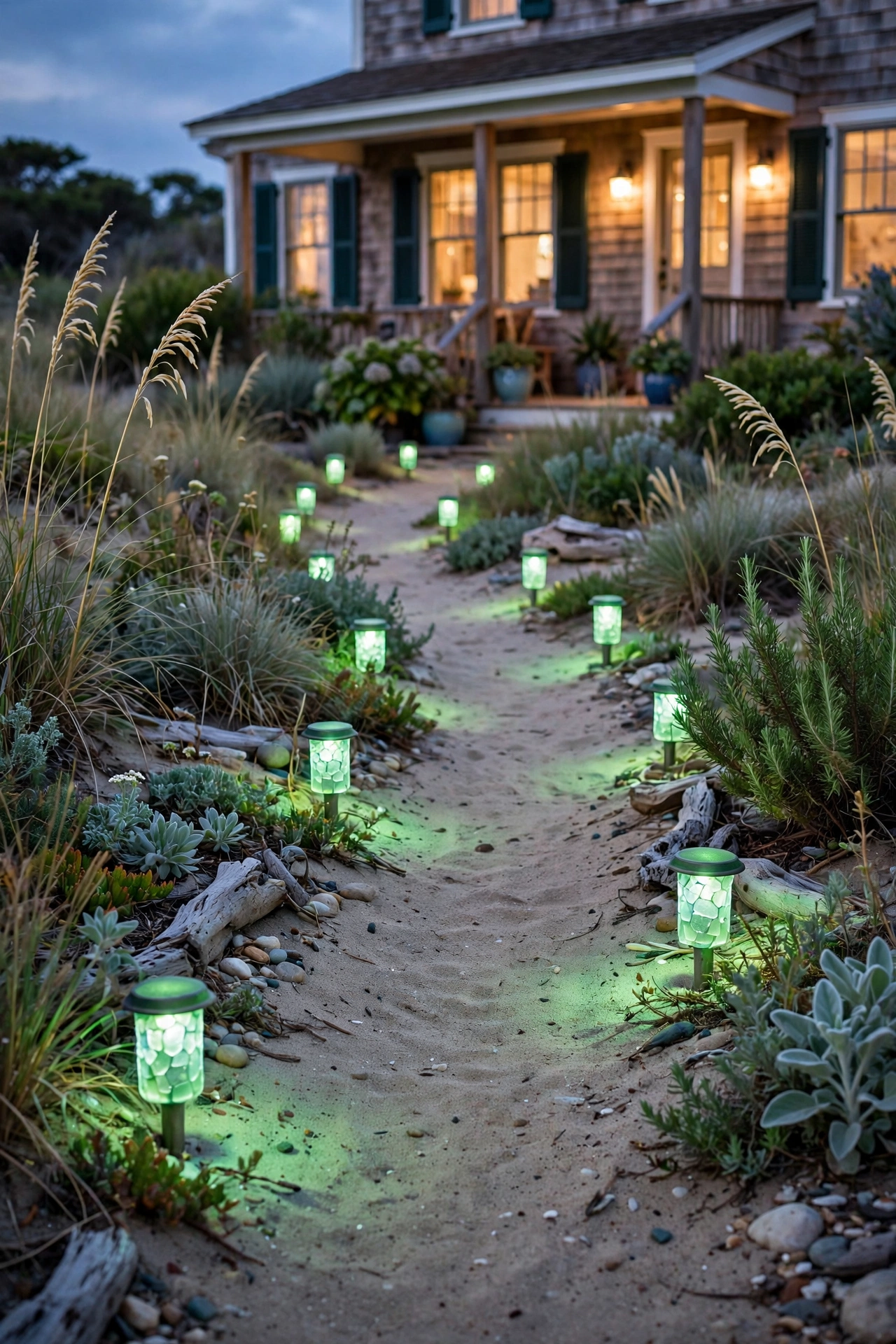
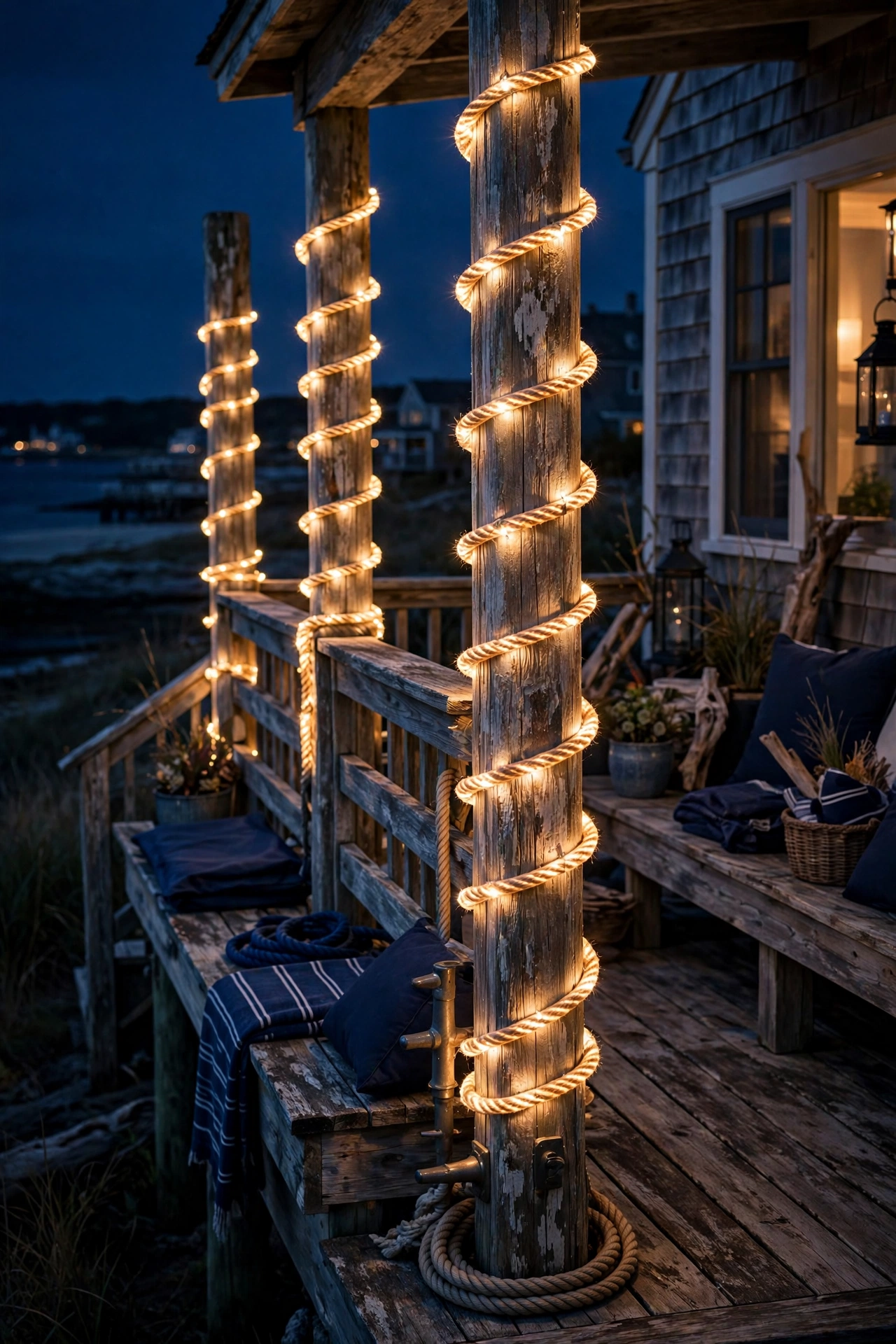
7. Rope-Wrapped Post Lights on Deck Columns
Wrapping deck posts or columns with natural rope instantly gives porch columns a ship's-mast feel, and adding lights takes it from cute to stunning. Use warm-white LED rope lights or micro fairy lights coiled in a spiral up each post, spacing the wraps about 6 inches apart for an even glow. Secure the rope light with small clear clips every foot — don't rely on adhesive backing alone in salty, humid air.
Choose LED rope lights rated for wet locations with a UV-resistant jacket, and keep all plug connections in weatherproof boxes tucked under the deck or behind a column. A smart plug or timer on the circuit lets you schedule them for sunset to 11 pm. Pair the wrapped posts with unlit rope wrapped on the railing for a cohesive nautical look, and keep the color temperature consistent (all 2700K) so everything melts together instead of clashing. This is a renter-friendly trick too if your posts are accessible — everything peels off without damage.
Suggested budget range: $30 – $110.
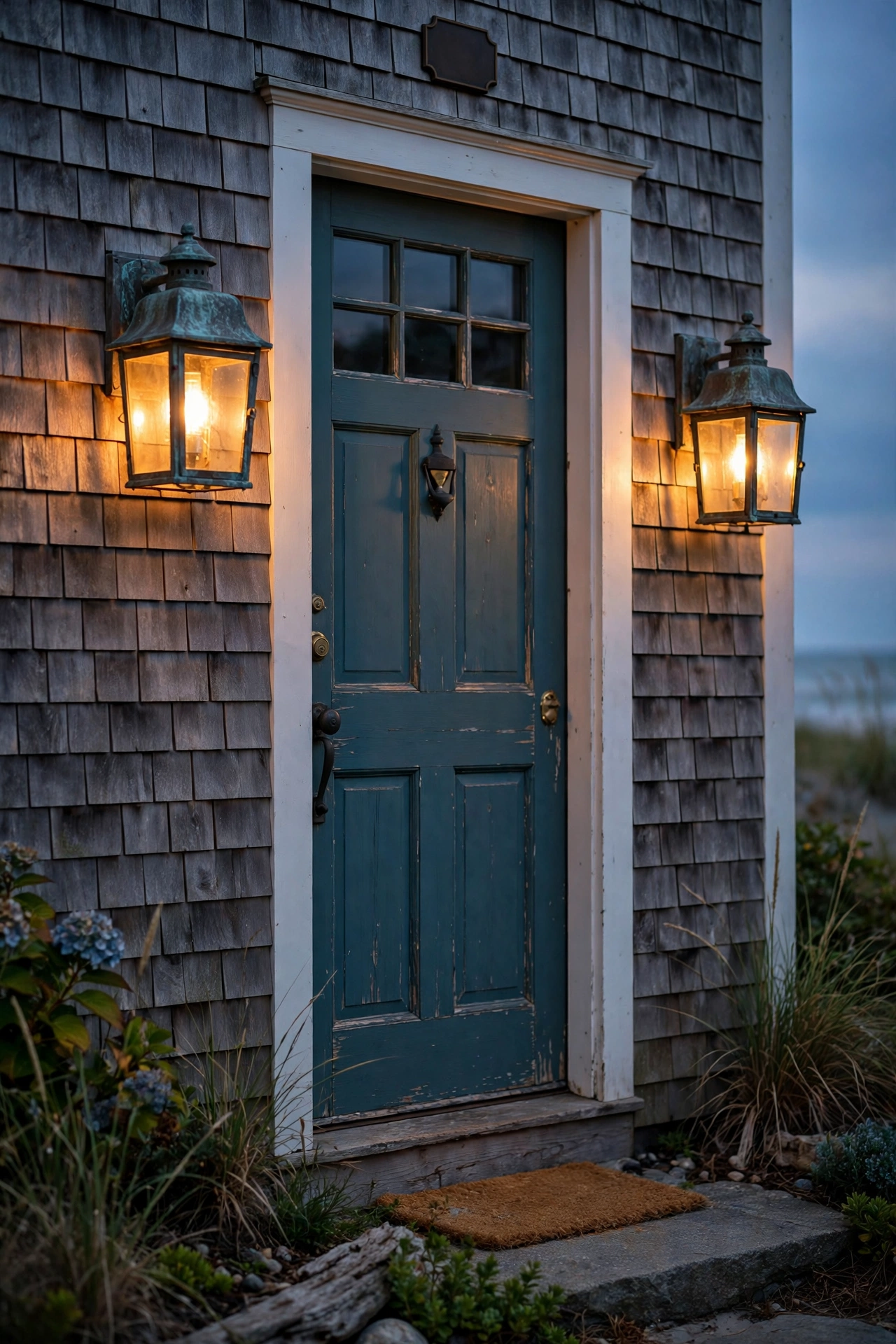
8. Outdoor Wall Lanterns in Weathered Copper or Bronze
A pair of lantern-style wall sconces flanking the garage or front door is the backbone of coastal curb appeal. Choose fixtures in a weathered copper, oil-rubbed bronze, or matte black finish — all of which hide salt-air patina gracefully, unlike polished chrome or nickel that pits and spots. Mount sconces 60 to 66 inches from the ground to the center of the fixture, about 6 to 10 inches from the door frame, and size them at roughly one-quarter the height of the door for proper proportion.
Look for wet-rated fixtures with sealed glass panels and silicone gaskets around the door — salt air will find any gap. A clear or seeded glass lets a warm 2700K LED filament bulb shine through; frosted glass diffuses better if the fixture sits at eye level. Put them on a dusk-to-dawn photocell so they switch on automatically — in my experience, that's the difference between a house that looks loved and one that looks dark. My outdoor wall lantern ideas has more pairings and placements.
Suggested budget range: $70 – $260.
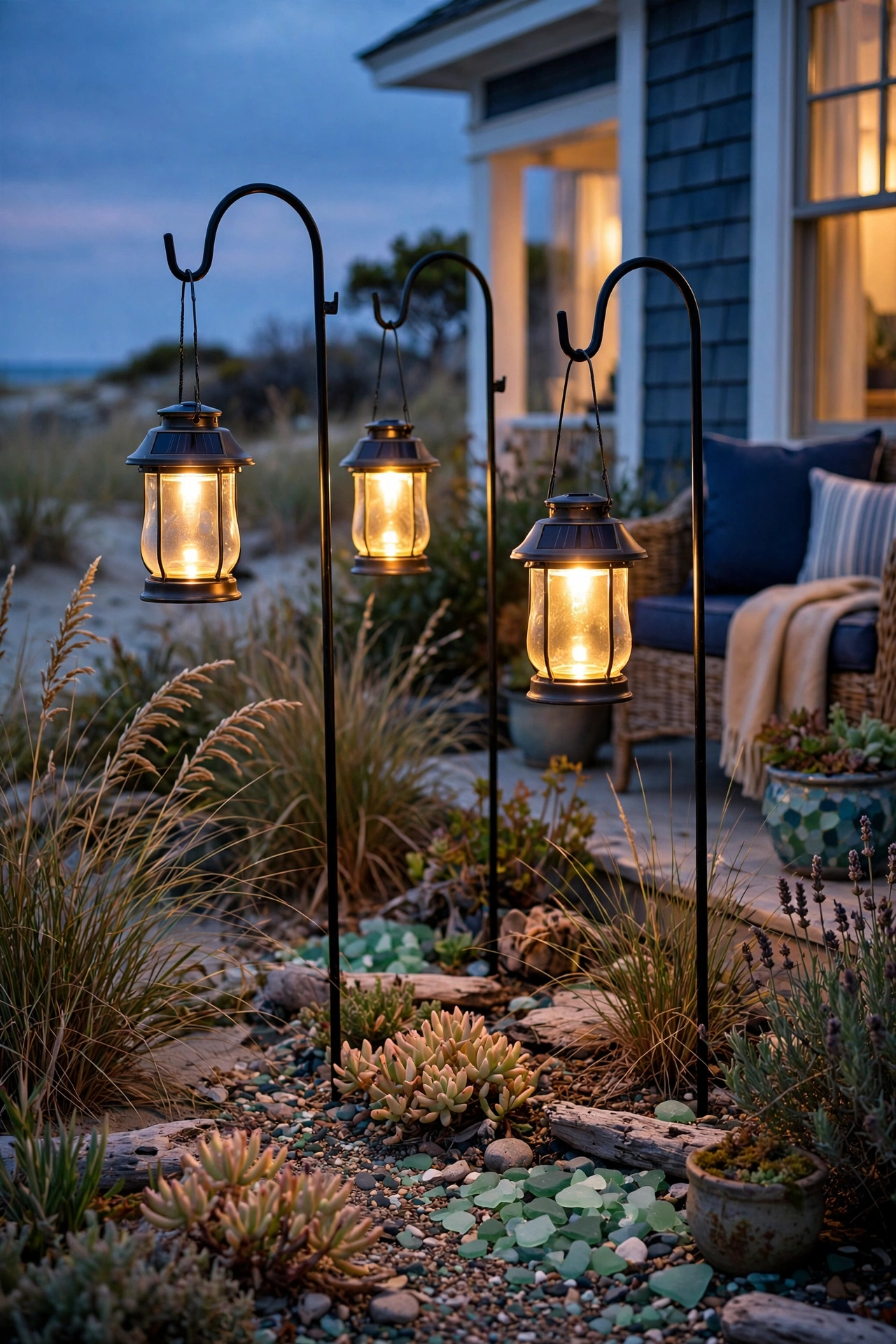
9. Solar Lanterns Hung from Shepherd's Hooks
Shepherd's hooks with hanging solar lanterns are the easiest coastal accent going — no wiring, no electrician, just stake and enjoy. Push 48- to 60-inch shepherd's hooks into garden beds or along a path, spacing them 8 to 10 feet apart, and hang solar lanterns with warm-white LEDs from each hook. In coastal areas, choose hooks and lanterns in powder-coated metal or resin wicker rather than thin painted steel, which rusts fast in salt spray.
Here's the honest caveat: solar lanterns near the coast need full sun to charge, and sea mist plus overcast days can dim them by evening. Set realistic expectations — they're accent glow, not security lighting — and wipe the small solar panels monthly so salt film doesn't block charging. Choose lanterns with a manual on/off switch and at least 6 hours of rated runtime so you're not disappointed by 9 pm. They look especially lovely mixed with beach grass and driftwood in a natural-style bed.
Suggested budget range: $20 – $75.
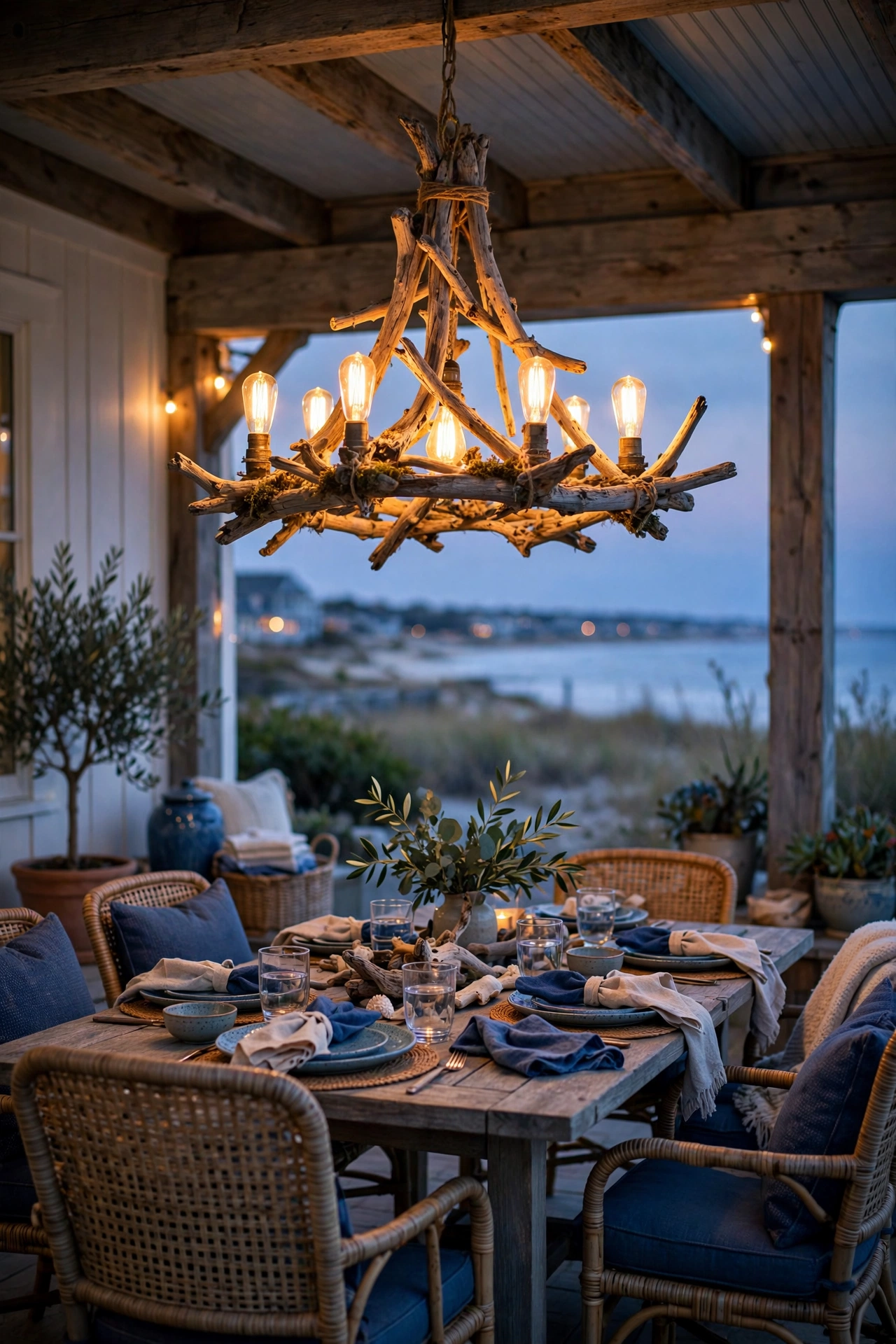
10. Outdoor Chandelier Over the Patio Dining Table
An outdoor chandelier over the patio dining table is the ultimate coastal entertaining statement — it says dinner party, not just dinner. Hang a damp-rated chandelier (driftwood, beaded wood, or whitewashed metal styles all fit the theme) so the bottom sits 30 to 36 inches above the tabletop for a standard 8-foot ceiling; raise it to 36 to 42 inches if your patio cover is higher. The chandelier should span about one-half to two-thirds the width of the table.
Use dimmable warm-white 2700K LED candelabra bulbs (40-watt equivalent each is plenty) on a dimmer switch so you can go from bright family dinner to low romantic glow. Make sure the fixture is damp-rated at minimum, wet-rated if the patio is uncovered, and that the mounting box is rated for the fixture's weight. In windy coastal spots, add a discreet stabilizer chain or wire so the chandelier doesn't swing into the table during gusts. It's a bigger install, but honestly, the wow factor per dollar is enormous.
Suggested budget range: $150 – $500.
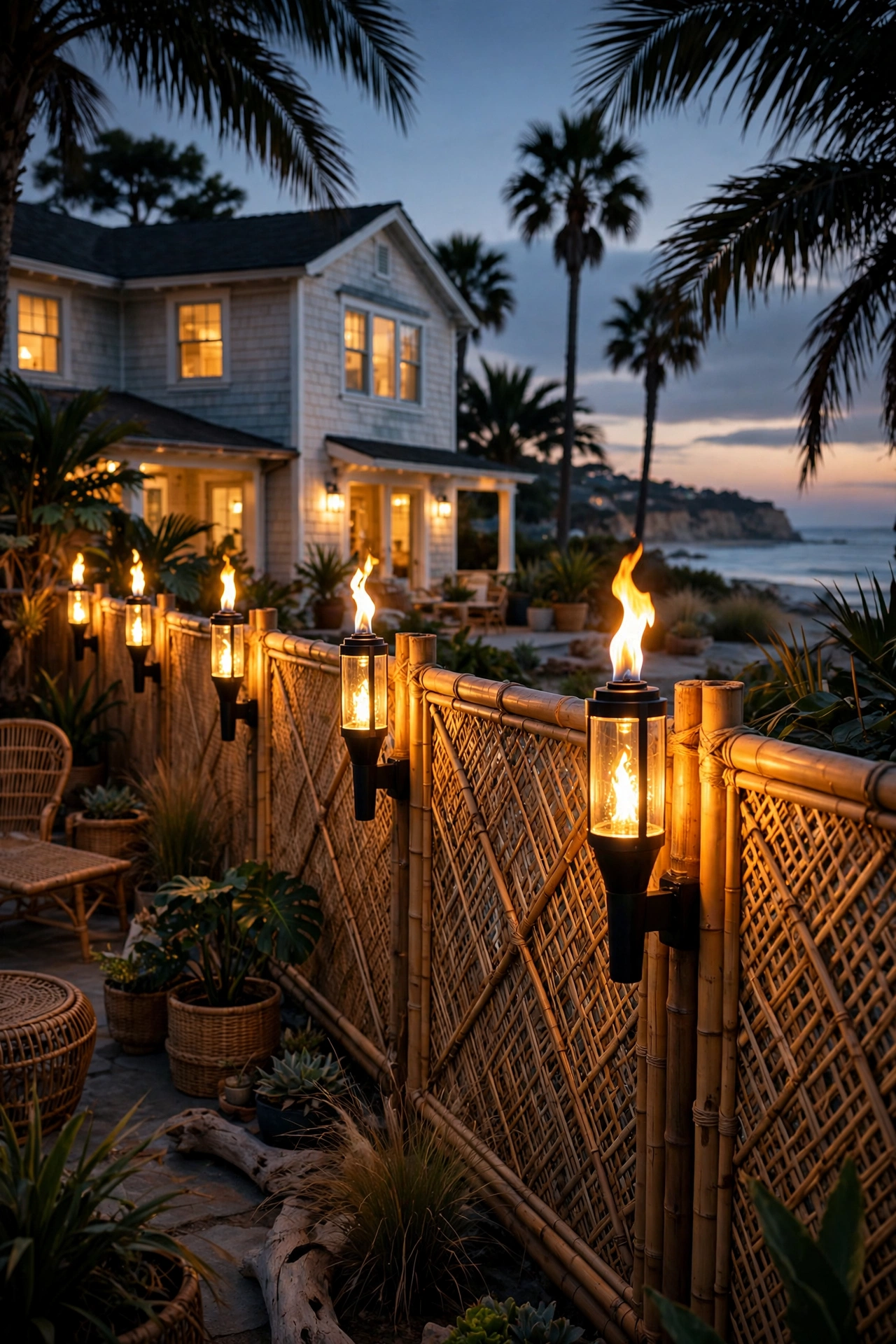
11. Tiki-Style Torches (LED) Along the Fence Line
Tiki-style torches instantly transport a backyard to the islands — but real flame torches and coastal wind are a risky combination. The smart play: LED flame-effect torches that mimic a real flame with zero fire risk. Stake them 6 to 8 feet apart along the fence line or the back edge of the patio, keeping the flame top at least 6 feet from any structure, overhang, or dry planting.
Most LED torches are solar-powered with a dusk sensor, and the flickering amber effect reads convincingly tropical at night. Choose resin or bamboo-look poles with a heavy-duty ground stake — lightweight torches become projectiles in a nor'easter. For permanent installations, wired low-voltage torches exist too, with warmer, steadier light and no charging worries. Group them in odd numbers (three or five) around seating areas rather than a rigid line everywhere; clusters feel like a resort, rows feel like an airport.
Suggested budget range: $30 – $130.
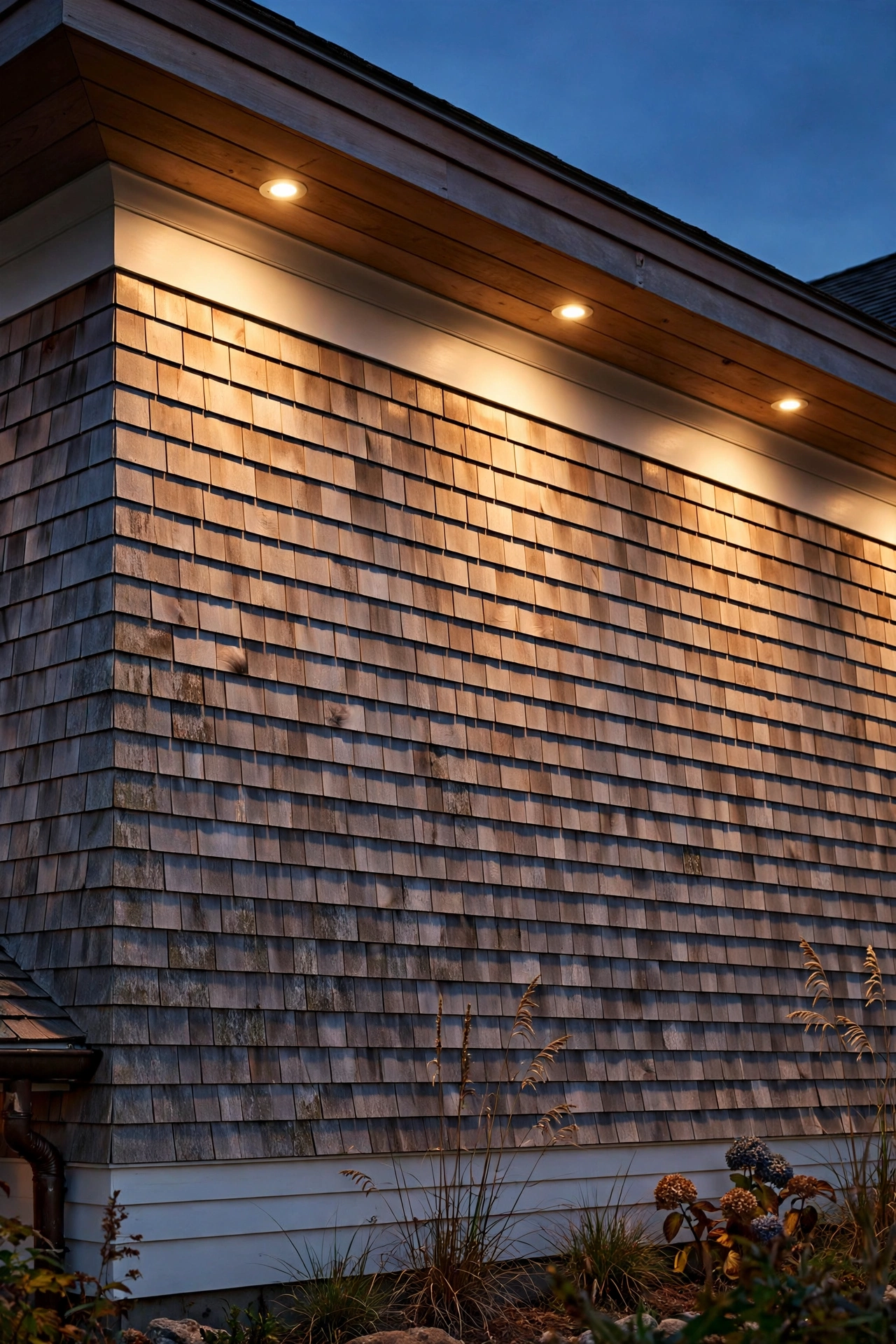
12. Under-Eave Recessed Lights in Warm White
For a clean, architectural coastal look, recessed lights tucked into the porch overhang or eaves wash the house in soft light without any visible fixtures. Space 4-inch recessed can lights 4 to 6 feet apart along the eave, set back 2 to 3 feet from the wall so the light grazes down the siding or shingles in a gentle scallop pattern. This is gorgeous on New England shingle-style homes and Florida stucco alike.
Use wet-rated recessed housings with warm-white 2700K–3000K LED retrofit trims; the sealed trim keeps salt air out of the electronics. Put them on a dimmer or a dusk-to-dawn timer so the wash comes on softly each evening. Because installation involves cutting into the soffit and running wiring, this is a job for an electrician in most cases — budget for labor. The payoff is a house that looks quietly expensive every single night, with zero fixtures to clean or style around.
Suggested budget range: $200 – $600.
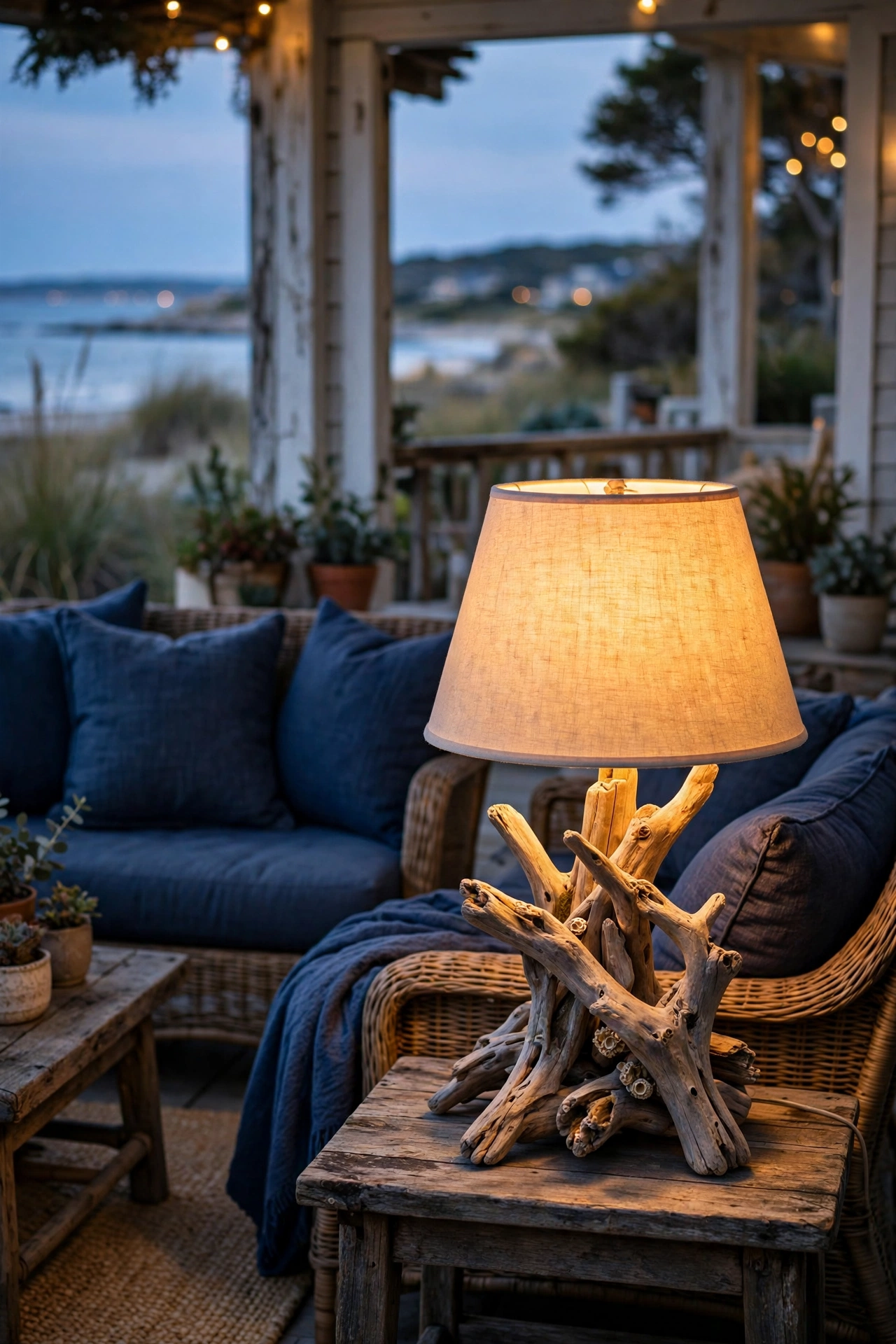
13. Driftwood and Shell Table Lamps on the Patio
A weatherproof table lamp on a side table or outdoor bar cart is the jewelry of coastal lighting — small, but it completes the whole outfit. Look for table lamps with driftwood-look bases, capiz-shell shades, or ceramic bodies in sea-glass tones, sized 16 to 22 inches tall so they don't overwhelm a side table. Place one on each end of an outdoor sofa or flanking a serving table.
The lamp must be rated for damp locations at minimum, with a weighted base so sea breezes don't topple it. Use a warm-white 2700K LED bulb around 400–600 lumens — bright enough to read by, soft enough to keep the mood. Run the cord through a weatherproof in-use outlet cover and keep the connection off the ground. Battery-operated LED table lamps are a fantastic cord-free alternative for spots far from outlets; just recharge them overnight. Honestly, this one small addition makes a patio feel like an outdoor living room.
Suggested budget range: $40 – $150.
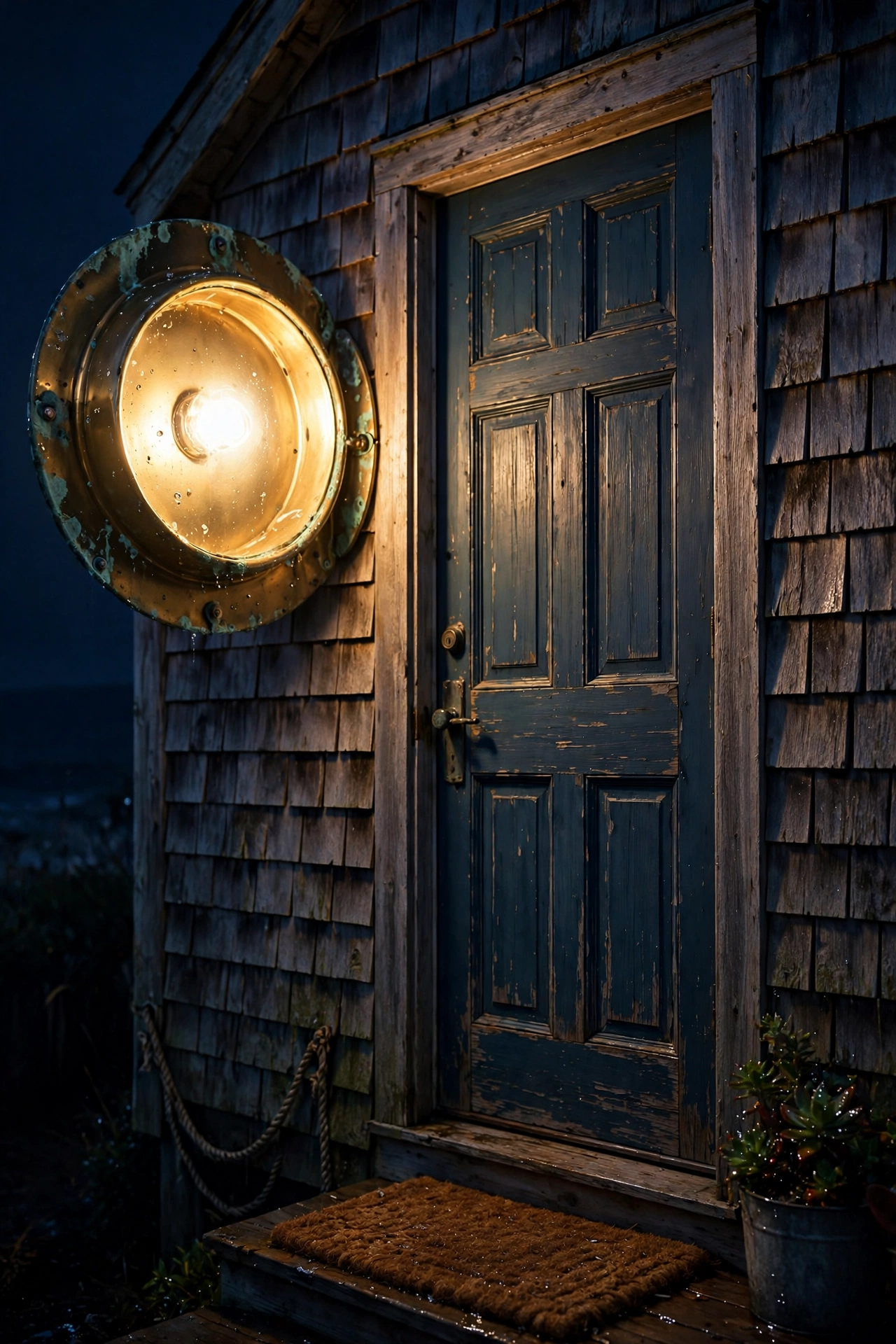
14. Nautical Bulkhead Lights by the Side Door
Nautical bulkhead lights — those round or oval caged fixtures you see on ships — are the most authentically coastal fixture you can buy. Mount one above a side door, on a shed, or beside the garage at 66 to 72 inches to center. Their heavy cage and thick glass were literally designed to survive sea conditions, so most are naturally wet-rated and corrosion-resistant.
Choose solid brass or marine-grade aluminum bulkheads; brass develops a beautiful patina in salt air instead of rusting. A warm-white 2700K LED bulb inside (around 400–600 lumens) gives that classic ship's-lantern glow. Because the cage diffuses and directs light outward, one bulkhead covers a surprisingly wide area — great for lighting a walkway intersection or a grill station. Pair with a matching wall-mounted version on the opposite side of the house for symmetry. They're nearly indestructible, which makes the higher price tag easier to swallow.
Suggested budget range: $55 – $180.
15. Fairy Lights Woven Through a Pergola
Weaving warm fairy lights through a pergola's beams turns an ordinary structure into a firefly-lit retreat. Drape copper-wire or micro LED fairy lights (warm white, 2700K) in loose swags between the pergola rafters, spacing strands about 12 to 18 inches apart so the light reads as a canopy rather than stripes. Start each strand at the outer beam and work inward, securing with tiny clear clips or thin wire ties — never staples, which can nick the wire and fail in salty humidity.
Use outdoor-rated, wet-location fairy light strands with a low-voltage plug-in transformer, and keep connections in a weatherproof box mounted to a post. A timer set for dusk to midnight gives you the magic without the electric bill worry — LED fairy strands sip power. In my experience, 200 to 300 tiny lights is the sweet spot for a standard 10-by-12-foot pergola; fewer looks sparse, more looks like a carnival. They pair beautifully with climbing jasmine or wisteria, whose leaves catch and scatter the glow.
Suggested budget range: $25 – $95.

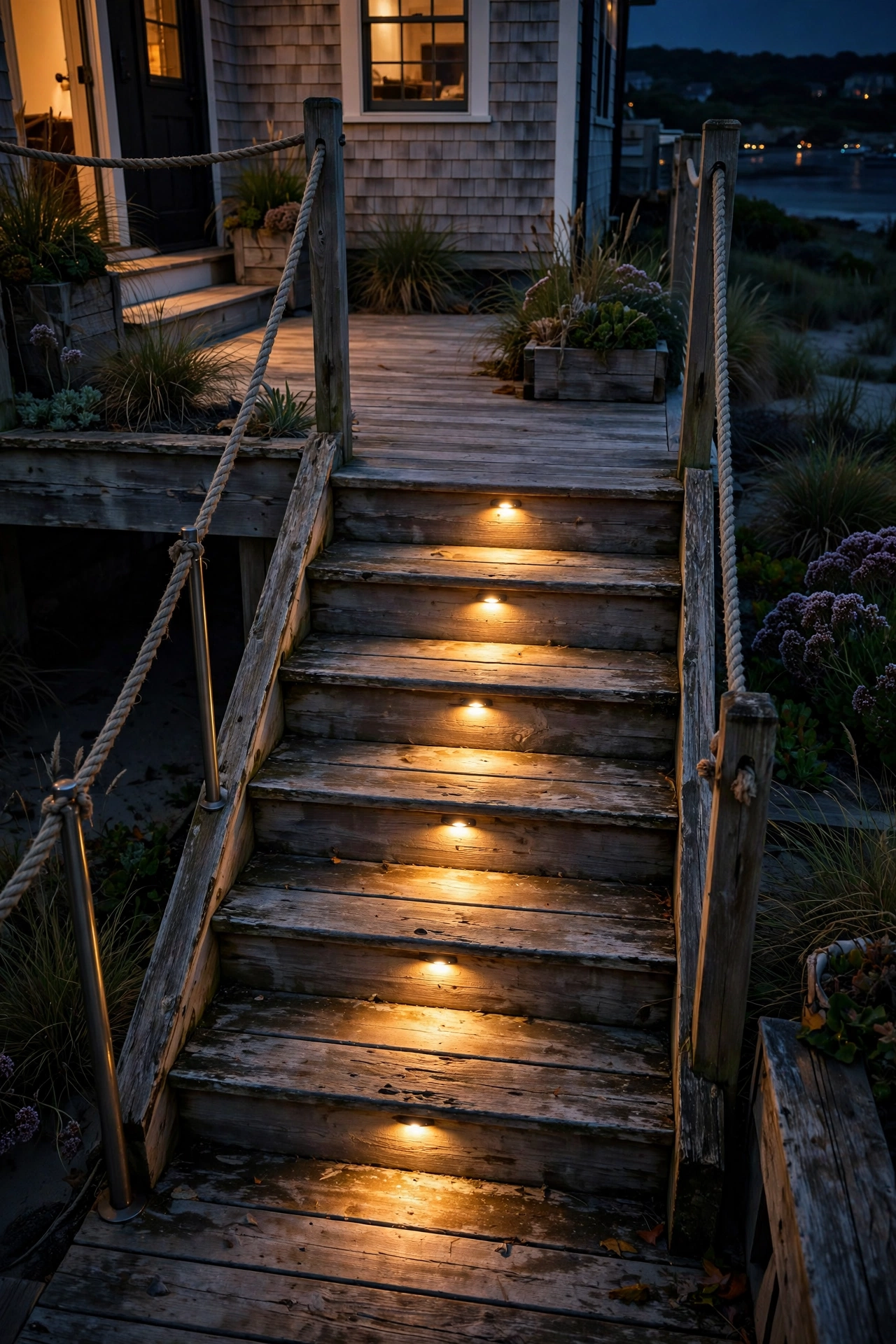
16. Step and Stair Lights on Deck Stairs
Deck stairs are where coastal style meets real safety — a missed step on a dark deck is no joke. Install recessed LED step lights into the stair risers (one per riser, centered) or mount small louvered fixtures on the side stringers every two to three steps. Recessed riser lights sit about 4 to 6 inches above the tread nosing and cast light down onto the step below without glare.
Choose wet-rated, low-voltage LED step lights in 2700K–3000K, around 50–100 lumens each — you need visibility, not a runway. Wire them to the same timer or transformer as your deck lighting so everything comes on together. In salt-air environments, stainless steel or solid brass step-light housings outlast painted aluminum by years. Keep the color temperature consistent with the rest of your deck lighting so the stairs blend into the overall glow rather than standing out as a separate system. My deck stair lighting ideas covers more configurations.
Suggested budget range: $80 – $300.
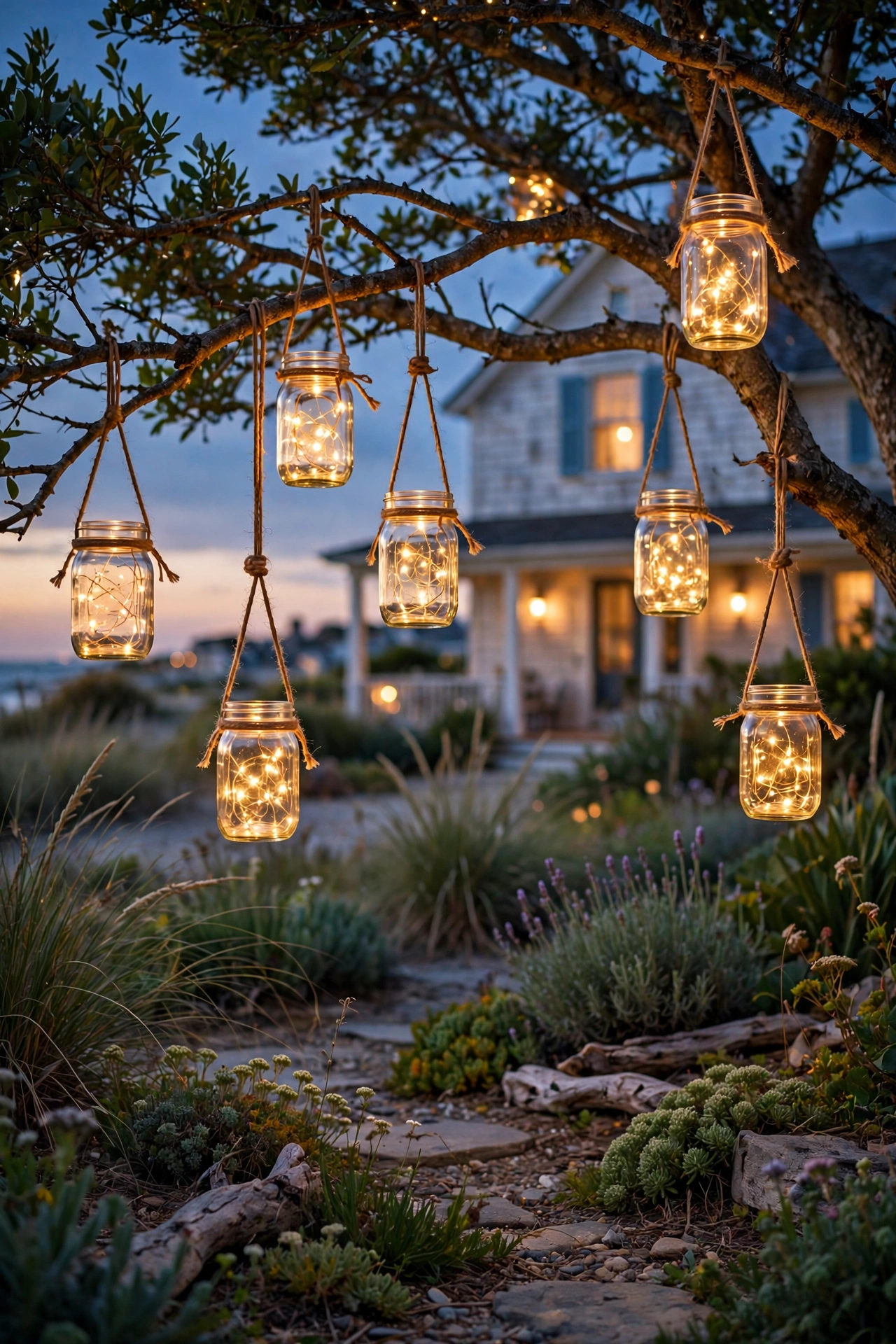
17. Hanging Mason Jar Lights from Tree Branches
Mason jar lights swinging from a sturdy tree branch are pure storybook coastal — think fireflies you can control. Hang 6 to 10 solar or battery-powered mason jar lights from shepherd's-hook-style hangers or strong branches at varying heights (6 to 8 feet off the ground), spacing them 3 to 4 feet apart so they read as a constellation rather than a cluster. Use LED fairy lights or a single warm-white LED tea light inside each jar.
Frosted or sea-glass-tinted jars diffuse the light beautifully; clear jars show off the fairy-light tangle inside. Since they're hanging in open air, battery or solar is far easier than wiring — just remember solar jars need daytime sun on their little panels. In windy coastal yards, hang them from branches at least 4 inches in diameter and use sturdy wire, not twine, which rots in salt air. Take them down before hurricane season if you're in a storm zone; five minutes of prevention beats replacing a shattered set.
Suggested budget range: $20 – $70.
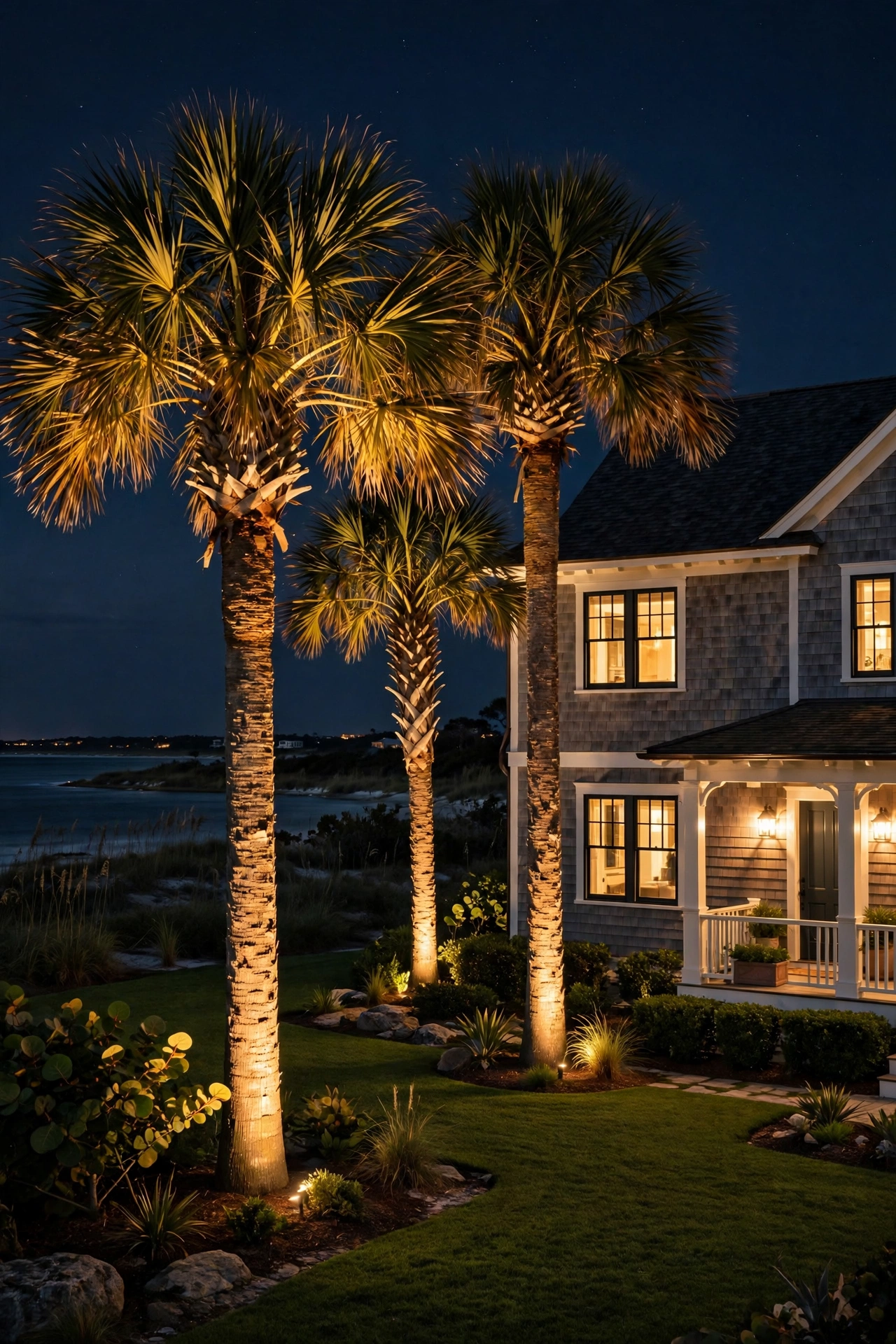
18. Uplighting for Palm Trees and Coastal Plantings
Uplighting transforms palms, sea grapes, and ornamental grasses into living sculptures after dark. Place low-voltage LED well lights or adjustable spotlights 12 to 18 inches from the base of each palm trunk, aimed up at a slight angle so the light washes the trunk and catches the underside of the fronds. For a medium palm, one 200-lumen spotlight works; for a large multi-trunk specimen, use two fixtures spaced on opposite sides.
Warm-white 2700K–3000K keeps the planting looking natural — cool white makes foliage look ghostly. Bury the low-voltage cable 6 inches deep and use a transformer with a photocell timer. Near the coast, choose composite or brass fixture housings with stainless-steel hardware; aluminum fixtures corrode where they meet sandy, salty soil. Honestly, uplighting just two or three key plants does more for nighttime curb appeal than a dozen scattered path lights — it's the difference between a lit yard and a designed one.
Suggested budget range: $90 – $350.
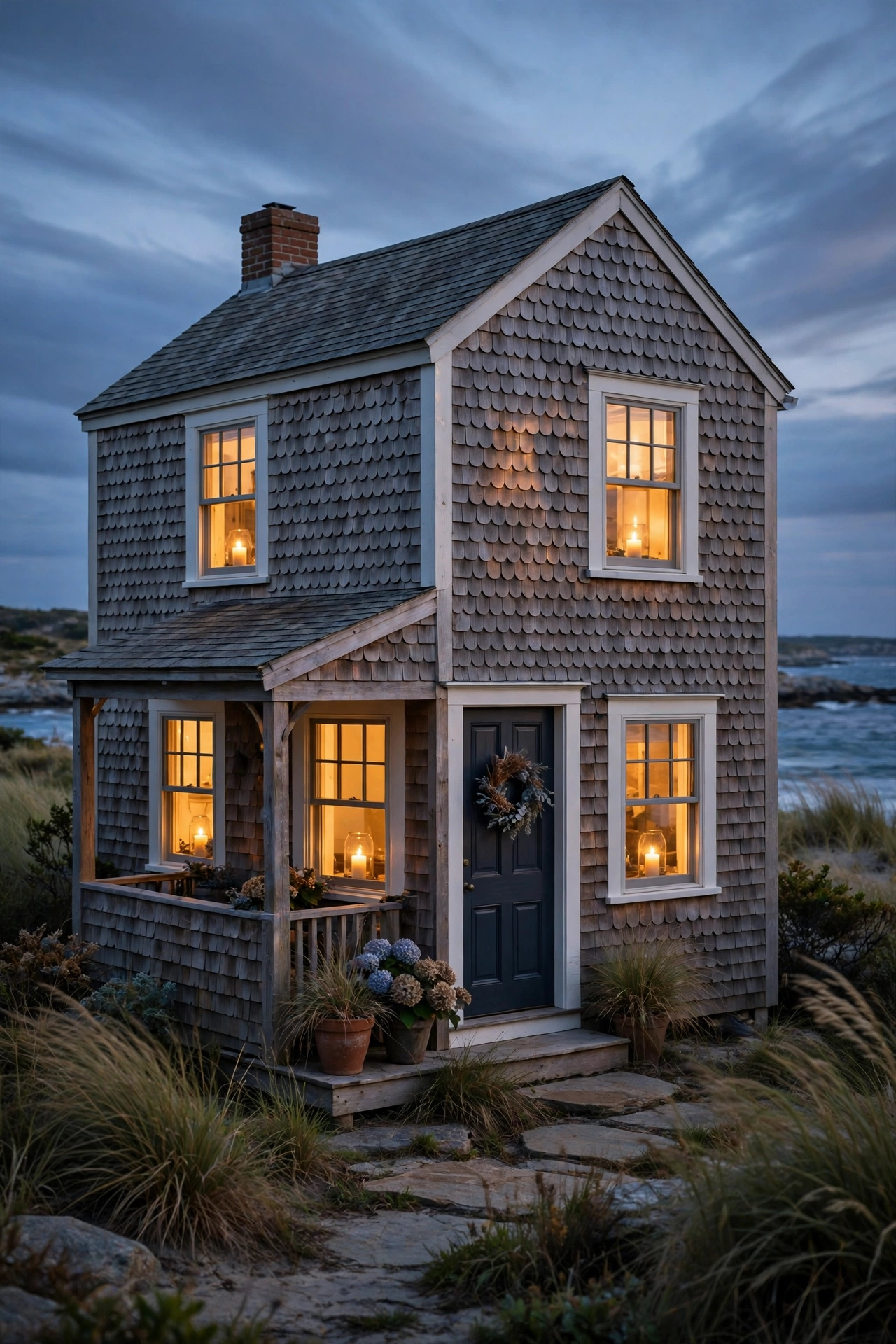
19. Candle-Style Window Lights for a Coastal Cottage Feel
Battery-operated candle-style lights in the windows give a coastal cottage that storybook, lived-in glow visible from the street. Place one LED window candle in each front-facing window, centered on the sill about 6 inches back from the glass, and set them all to the same timer schedule (dusk to 10 or 11 pm) so the whole facade glows in unison. This trick works beautifully on New England shingle cottages, Southern porches with tall windows, and Florida stucco homes alike.
Choose flameless candles with a realistic flicker in warm white — the slightly irregular glow reads as real candlelight from the curb. Look for candles with a built-in dusk sensor so you never have to touch them; quality ones run months on a set of batteries. For a coastal twist, set the candles inside simple glass hurricanes or pair them with sheer white curtains that diffuse the glow. It's the lowest-effort idea on this list and one of the highest-impact for curb appeal — a whole house that looks warm and welcoming every single night.
Suggested budget range: $15 – $60.
Frequently Asked Questions
What color temperature is best for coastal outdoor lighting?
Warm white — 2700K to 3000K — is the sweet spot for coastal outdoor lighting ideas. It flatters whitewashed wood, rattan, and natural textures, and it echoes candlelight and sunset tones that suit the breezy beach-house look. Cooler temperatures (4000K+) read stark and industrial against coastal materials and can make white siding look blue-gray at night. The one exception: keep it consistent — mixing 2700K and 4000K fixtures in the same view is the fastest way to make a lighting plan look accidental.
What fixture materials hold up best in salt air?
Brass, copper, and marine-grade (316) stainless steel are the champions near the ocean — they patina or resist corrosion instead of rusting. Powder-coated aluminum is a solid mid-range choice as long as the coating stays intact; touch up chips promptly. Avoid plain painted steel and chrome-plated fixtures within a mile or two of salt water, since the salt spray will pit and rust them within a season or two. Whatever you buy, look for wet-location ratings, silicone gaskets, and sealed glass — salt air exploits every gap.
Is solar or wired lighting better near the coast?
It depends on the job. Solar is perfect for low-stakes accents — path markers, hanging lanterns, mason jar lights — because there's no wiring to corrode. But solar panels lose efficiency behind salt film and on overcast coastal days, so wipe panels monthly and treat solar as accent light, not primary light. For anything structural — porch lights, deck stairs, dock lighting — go wired low-voltage or line-voltage with marine-grade components and GFCI protection. Wired is brighter, more reliable, and worth the electrician visit for safety-critical spots.
How do I prepare coastal outdoor lights for hurricanes and high winds?
Start by choosing fixtures rated for your wind zone and mounting everything to structural framing, not just siding. Before a storm, take down hanging lanterns, mason jar lights, and lightweight solar accents — anything that can become a projectile. Tighten fixture screws and check that pendant stabilizer chains are secure. After the storm, rinse salt spray off fixtures with fresh water, check gaskets and seals for damage, and test GFCI outlets before switching everything back on. A quick seasonal inspection like this easily doubles fixture lifespan in coastal climates.
Conclusion
Coastal outdoor lighting ideas work their magic when you layer them like the shoreline itself: practical downlighting as your sandy foundation, decorative lanterns and pendants as the rolling middle waves, and string lights, fairy lights, and candlelight as the foam on top. Keep everything warm (2700K–3000K), choose materials that laugh at salt air — brass, copper, sealed composites — and let the breeze move a pendant or two. That's the whole recipe for the breezy look.
Start with one layer this weekend — a pair of lanterns, a strand of string lights — and build from there. And if you're hungry for more, browse the rest of the lighting ideas on the site for porches, patios, and decks to keep the glow going all season.