Intro
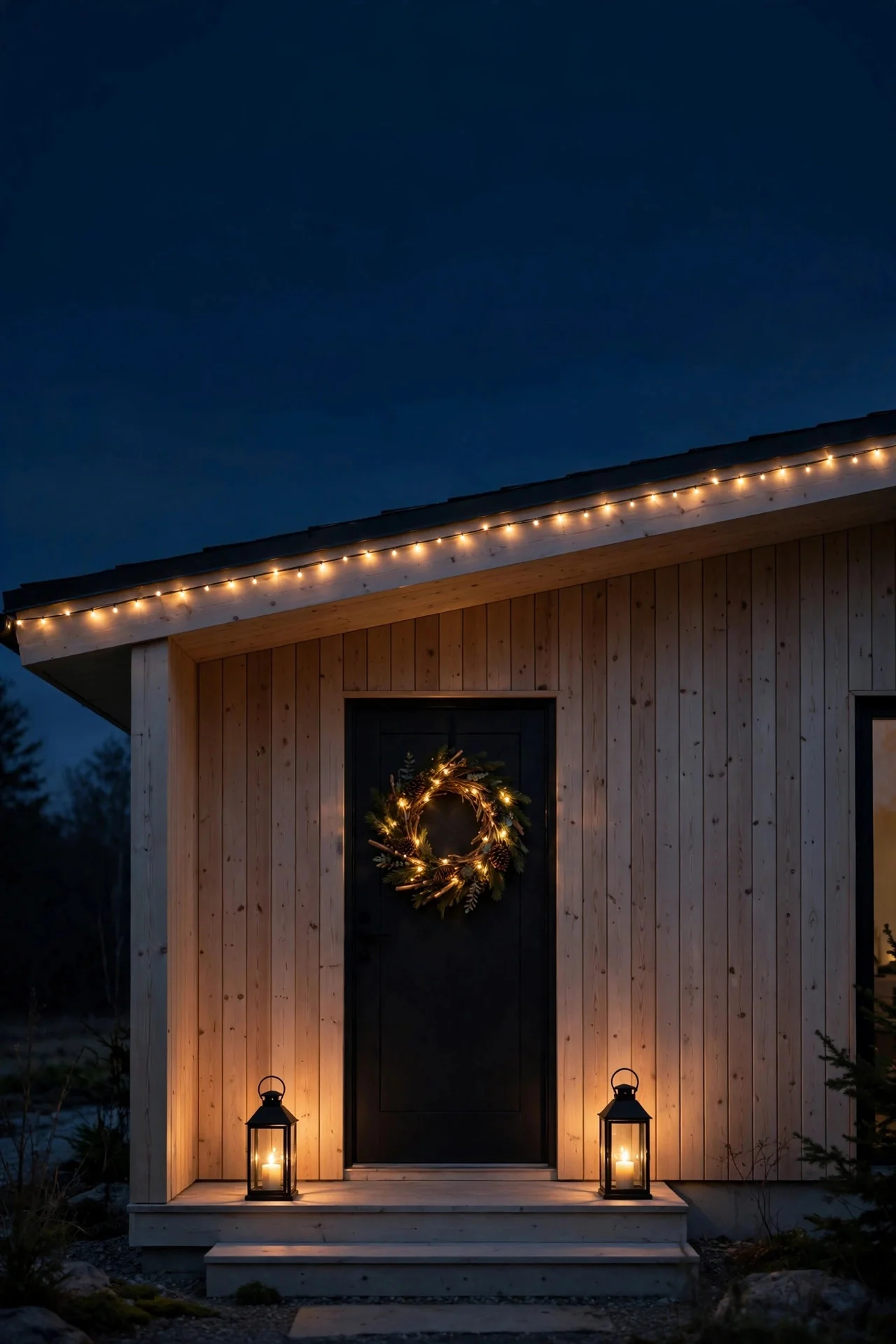
Every December, my street turns into a friendly contest of who can hang the most lights — and honestly? I retired from that race years ago. There's a quieter kind of magic in a home that glows with restraint: one warm line of light along the roof, a single wreath on the door, lanterns flickering on the steps. If minimalist outdoor christmas decor is calling your name this year, you're in exactly the right place.
In my experience, minimalism isn't about doing less — it's about choosing better. One strand of warm-white lights, hung perfectly straight, outshines three tangled colors every time. I always recommend the same layering rule I use in my [fall porch lighting ideas](https://exteriorhouselighting.com/fall-porch-lighting-ideas/) post: pick three focal points (high, middle, low), keep every bulb the same warm temperature, and let the darkness do the rest of the work. Negative space is a design choice, not an empty one.
Below are 21 of my favorite restrained ideas — each one simple to install, gentle on the electric bill, and calm enough to leave up straight through January. Put on something cozy and let's decorate with less.
1. A Single Strand of Warm-White Roofline Lights
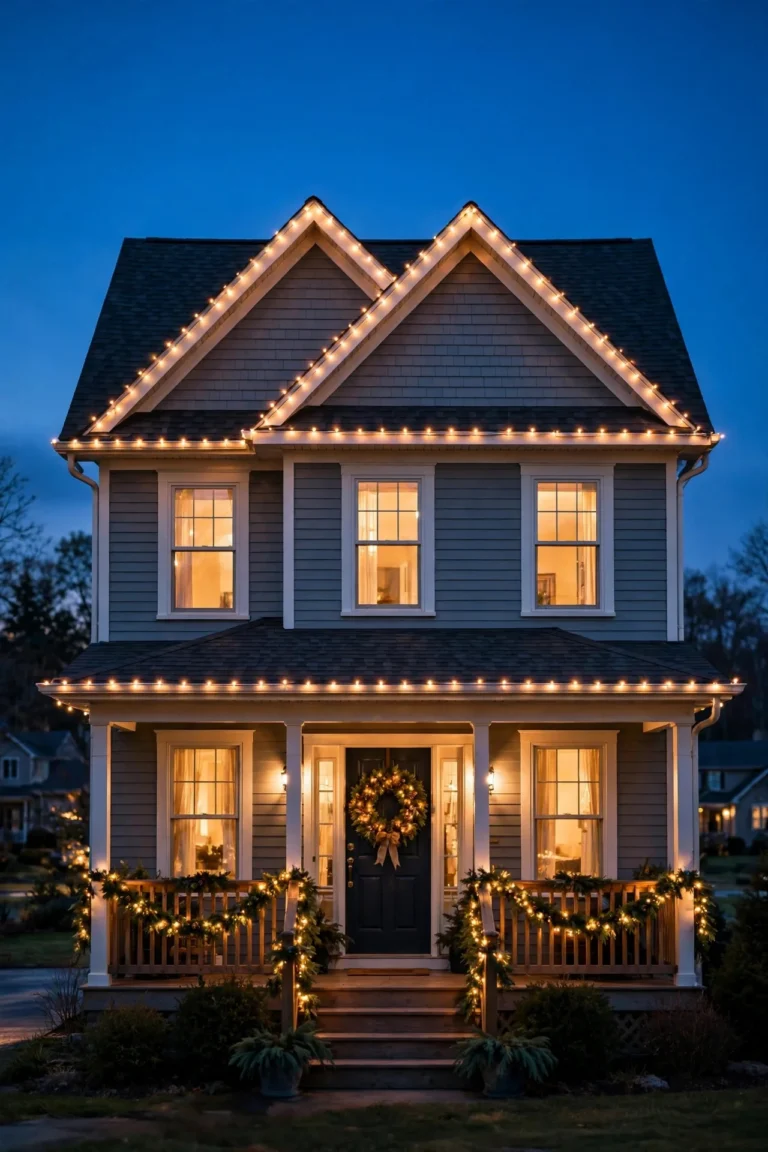
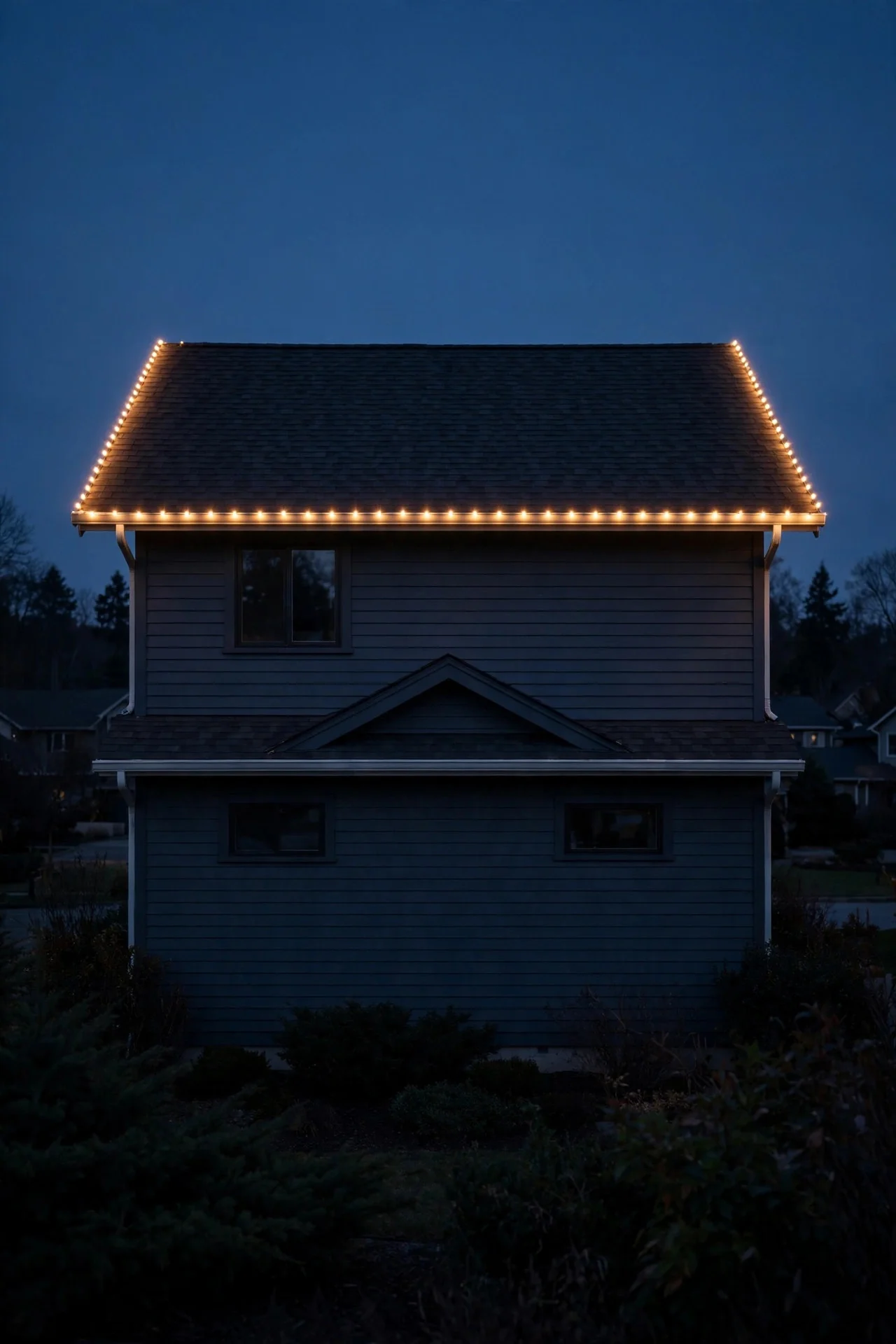
The cleanest look in all of holiday decorating is one straight line of warm-white lights along the front eave — nothing dripping, nothing blinking, just a crisp horizon of light that traces your home's silhouette. In my experience, this single move makes a house look finished and intentional in a way that a tangle of multicolor strands never will.
Here's the method: measure your front eave first (most ranch-style homes need 40 to 60 feet; a two-story gable can need 80 or more) and buy one continuous LED strand to match, so there are no mid-run plugs breaking the line. Choose 2700K warm-white C9-style bulbs or tight mini-LEDs — never cool white, which reads icy and cheap against a warm house. Hang them with all-weather gutter clips spaced about 12 inches apart, keeping the line perfectly level; a saggy strand ruins the whole effect. Plug into an outdoor-rated timer set for dusk to 11 p.m., and tuck the cord behind a downspout so it disappears.
Safety note: use only outdoor-rated strands with a UL or ETL listing, keep plugs off the ground in a weatherproof box, and never staple through the wire. One straight run, done well, is the whole statement.
Suggested budget range: $30 – $70.
2. The One-Wreath Rule: My Favorite Minimalist Outdoor Christmas Decor Move
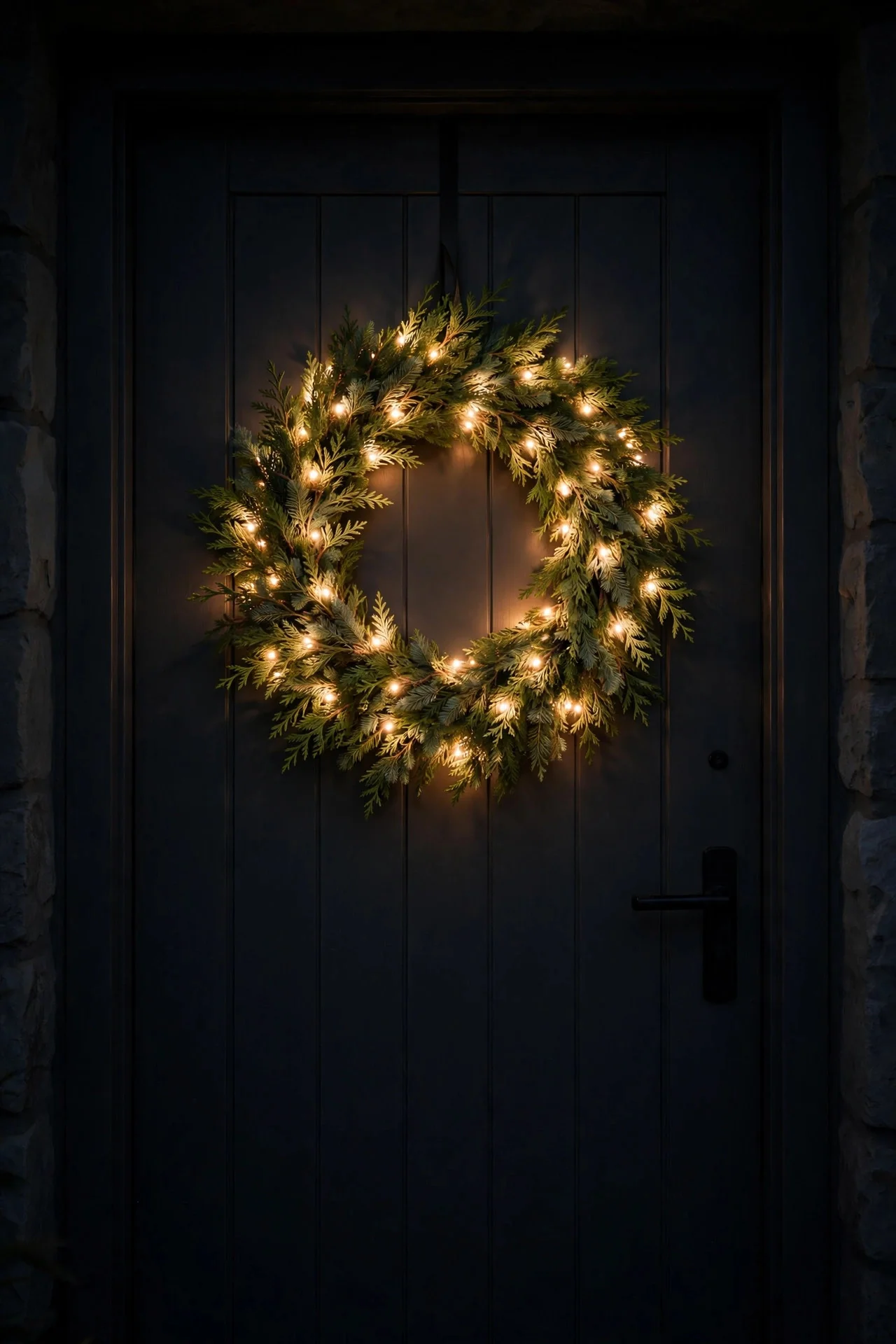
Your front door gets exactly one wreath — but make it a great one. I'm talking a full, generous 24- to 28-inch wreath with 50 or so warm-white LEDs woven through the greenery, hung dead-center at eye level. One perfect wreath says "we celebrate" louder than a door crowded with competing decorations.
For a truly minimalist look, choose a single-material wreath: all cedar, all eucalyptus, or all pinecones. Mixing five kinds of greenery plus berries plus a bow is where wreaths tip from elegant to busy. Hang it with an over-the-door wreath hanger rather than a nail — no holes in the door, and it positions the wreath at the perfect height. If you have a storm door, measure the clearance first; you need a slim-profile wreath under 6 inches deep or the lights get crushed every time the door swings.
In my experience, the magic detail is matching light temperature: if your porch sconce is warm white, your wreath LEDs should be 2700K too, or the mismatch will nag at you all season. Most pre-lit wreaths run on 3 AA batteries with a 6-hour timer — set it when you hang it and forget it until January.
Suggested budget range: $35 – $80.
3. A Sparse Eucalyptus Garland on the Porch Railing
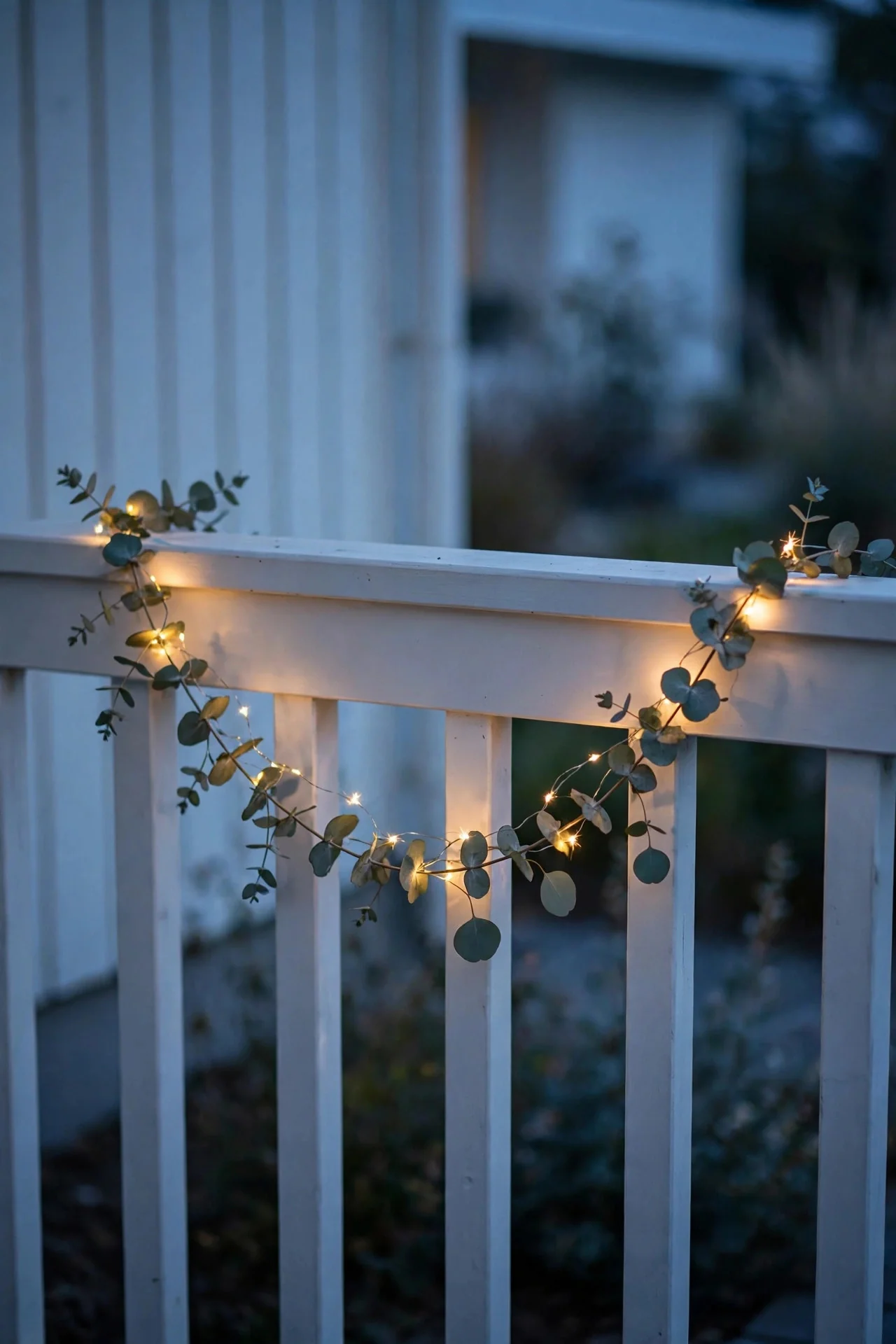
If a full evergreen garland feels like too much, try this Scandinavian-leaning alternative: one 6-foot strand of silver-dollar eucalyptus draped loosely along the top of your porch railing, nothing else. The soft blue-green leaves catch the light beautifully and smell faintly wonderful on mild December days, and the sparseness is the whole point.
Here's how I style it: lay the garland along the railing's top rail in one gentle, shallow swag — don't wrap it around the balusters, which reads busy. Let it drape naturally with a soft dip in the middle, and secure it with a few loops of jute twine at each end so it doesn't migrate in the wind. Then weave one 20-foot strand of warm-white copper-wire fairy lights through it, spaced loosely so the lights feel like dew rather than a light show. No bows, no ornaments, no pinecones — the restraint is what makes it stunning. I cover similar simple greenery ideas in my [seasonal outdoor decor](https://exteriorhouselighting.com/seasonal-outdoor-decor/) guide if you want more low-effort greenery tricks.
One practical note: real eucalyptus dries out faster in wind, so give it a good soak before hanging and expect it to fade to a pretty silvery tone by Christmas — which honestly looks even more minimalist.
Suggested budget range: $25 – $60.
4. A Pair of Candlelit Lanterns on the Steps
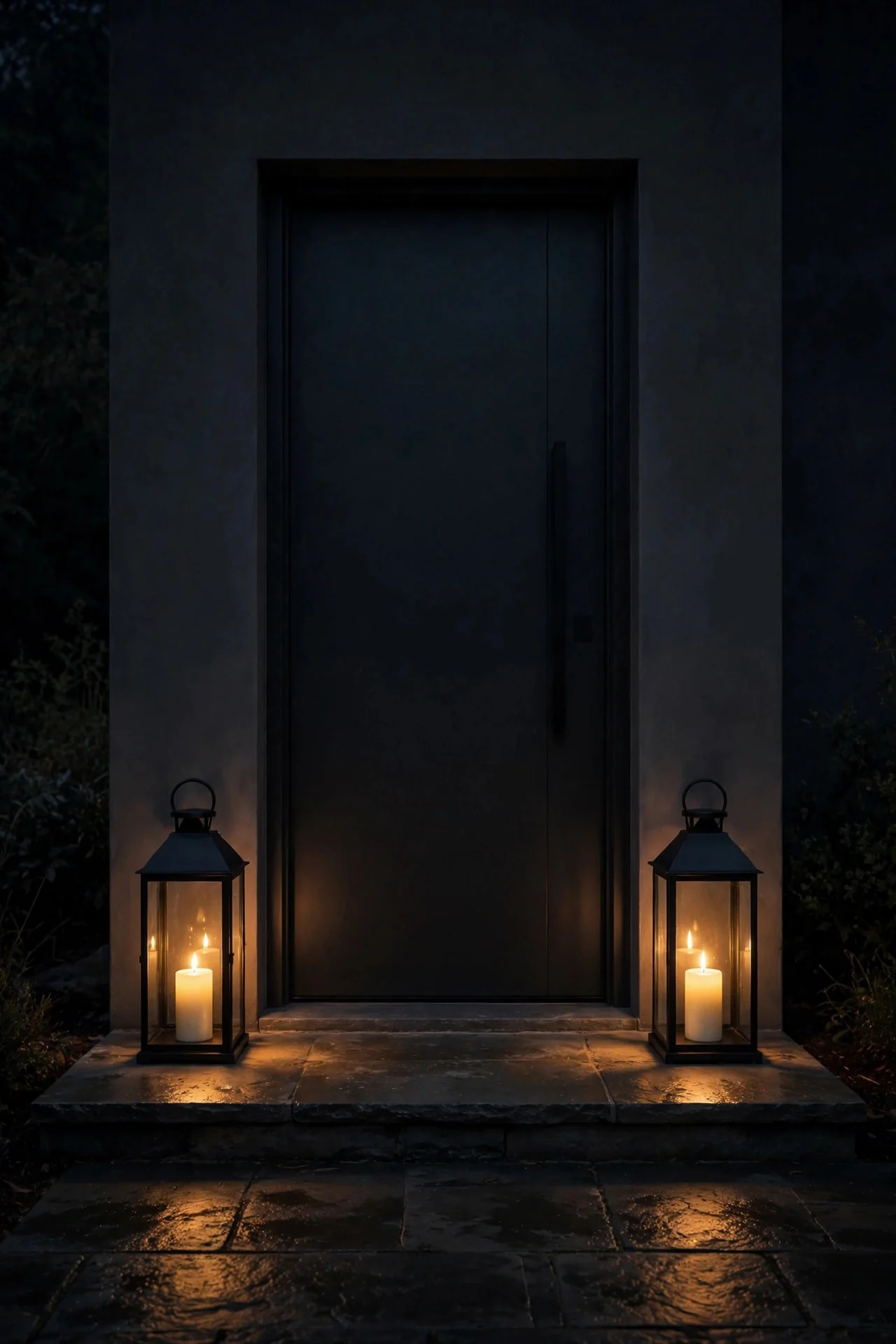
Two lanterns, one on each side of the front door or the bottom step, is the minimalist's version of a grand entrance. I always recommend matching lanterns — same size, same finish — because symmetry reads calm and deliberate, while mismatched pairs read like leftovers.
Go for black metal lanterns with clear glass panels; they show the glow instead of hiding it. Inside each, place a flameless LED pillar candle in the 3×6 size with a flickering-flame mode — the movement is what sells the candlelight illusion from the street. Skip real flames entirely here: glass lanterns trap heat, and a gust can send a real candle's flame licking the glass. LEDs stay cool, run 200-plus hours on a timer, and you can leave them out through January rain and sleet.
Styling tip from my own porch: set the lanterns slightly forward of the door, about 18 inches from the threshold, so their glow spills across the welcome mat and lights the path for guests. If your steps are narrow, place the pair on the ground flanking the bottom step instead — never in the walking path. Weigh them down or choose a latched design if your porch catches wind.
Suggested budget range: $30 – $70.
5. A Bare-Branch Tree Wrapped in Fairy Lights
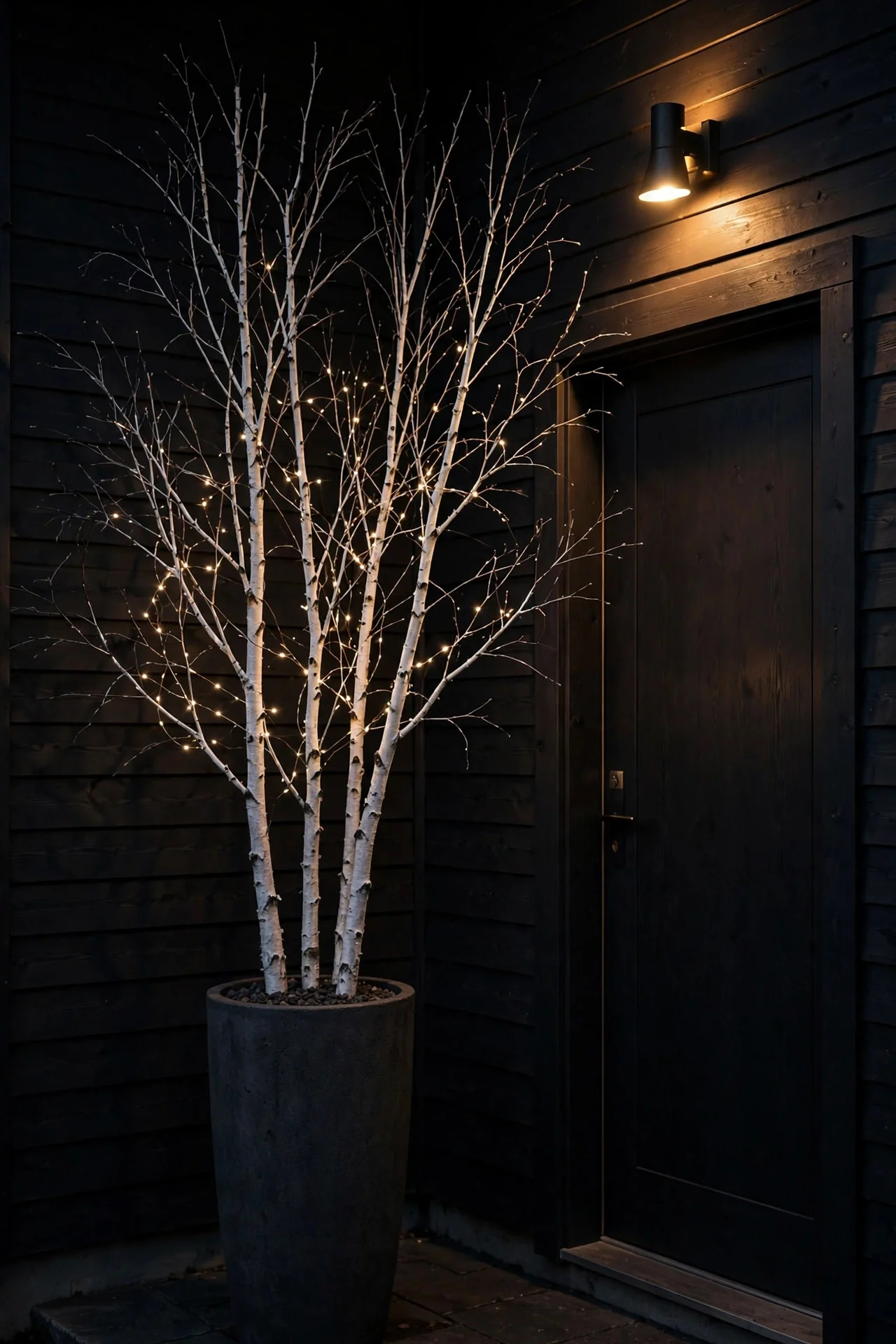
This one is pure Scandinavian poetry: take bare branches — white birch stems are my favorite, but any leafless branches from the yard work — stand them in a tall weighted planter, and wrap them sparsely with warm-white micro fairy lights. No ornaments, no tinsel, no star on top. The lit branches look like a charcoal sketch of a tree, glowing.
The build is simple and free if you forage: cut 5 to 7 straight branches between 4 and 6 feet tall, strip any leaves, and anchor them in a tall narrow planter filled with gravel or sand for stability (top-heavy branches tip in wind — weight matters). Wrap one 66-foot strand of copper-wire fairy lights with 200 LEDs loosely around the branches, leaving plenty of bare wood showing; the gaps are what make it elegant. Run the strand down into the planter and hide the battery pack under the gravel.
Place it where it silhouettes against something dark — beside the front door against dark siding, or on the porch corner against the night. In my experience, 200 LEDs is the sweet spot: fewer looks underdone, more looks like a regular Christmas tree, which defeats the purpose.
Suggested budget range: $20 – $50.
6. A Topiary Pair Lit With White Lights
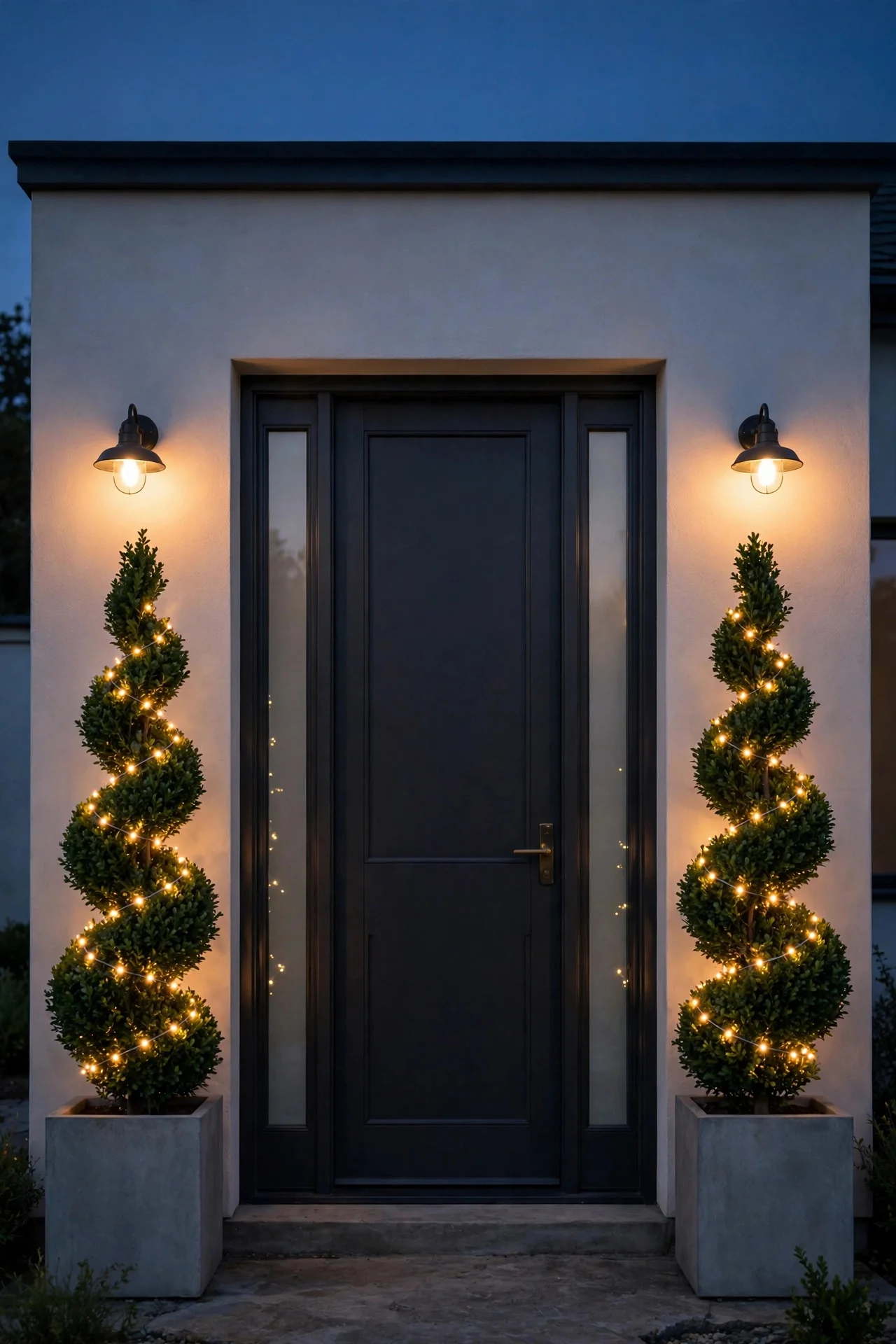
Two matching topiaries flanking the front door, each strung with a single strand of white mini lights, is the most classic minimalist move there is — and it works from December straight through March if you use plain boxwood. The symmetry does all the decorating for you; you don't need anything else near the door.
Buy the topiaries in matching planters (I love simple concrete or matte black pots for this) and make sure they're the same height — even a 6-inch difference breaks the illusion. For each one, take a single 50-light warm-white mini strand and spiral it loosely from the bottom of the cone or ball up to the top, keeping the spacing even. That's it: no ornaments, no ribbon, no second color. In my experience, 100 total lights across the pair is plenty; the goal is a soft glow, not a beacon.
If real topiary maintenance sounds like a chore, faux boxwood has gotten remarkably convincing, and it won't brown by New Year's. Either way, weigh the planters with a brick at the bottom if your porch is exposed — a toppled topiary with lights tangled around it is the opposite of minimalist. I lean on this same symmetrical simplicity in my [minimalist decor](https://exteriorhouselighting.com/minimalist-decor/) post for year-round styling.
Suggested budget range: $60 – $140.
7. A Single Lit Star in the Window
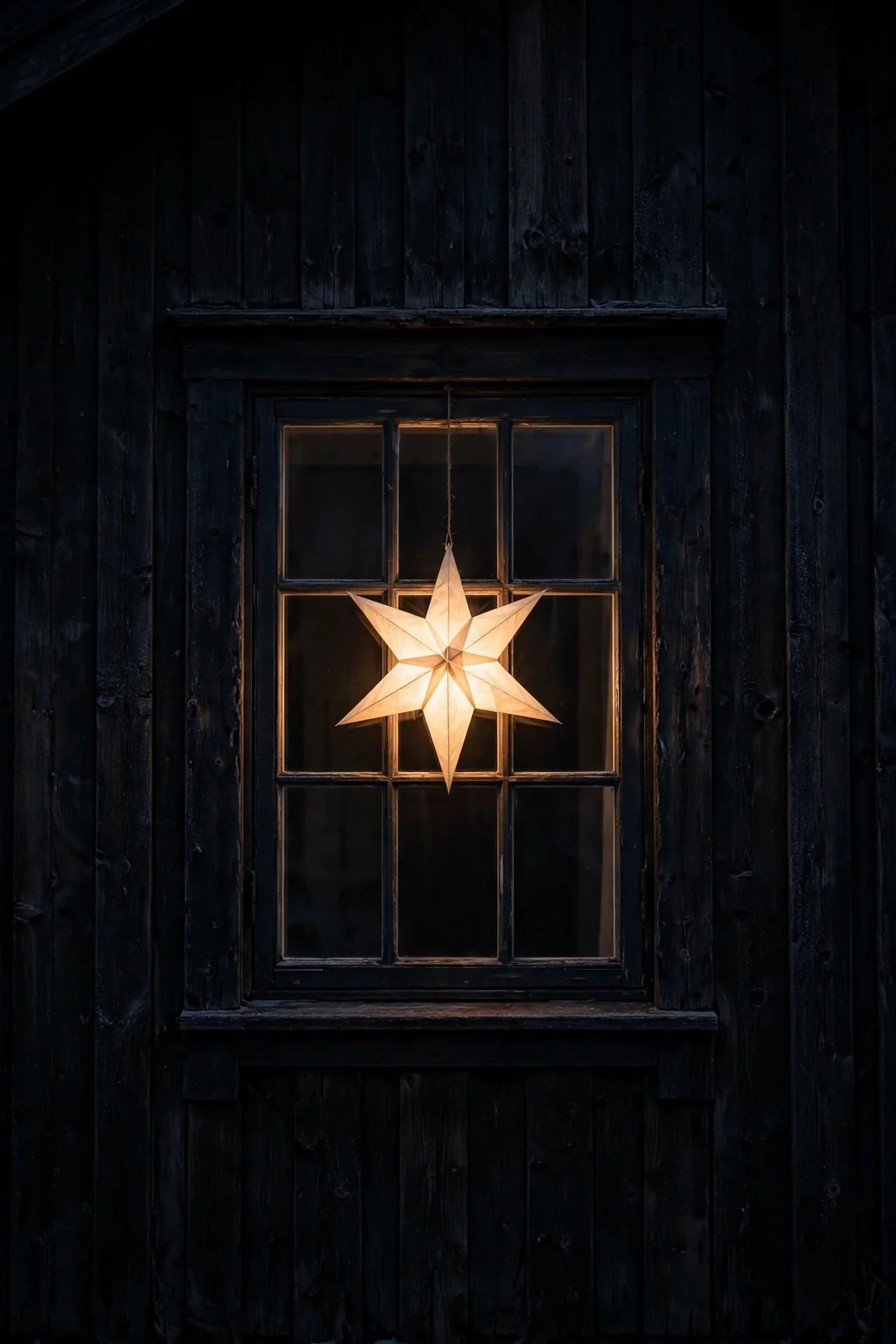
One glowing star, hung centered in your front window, is the most quietly powerful decoration on this list. It's a single point of warm light in a dark facade, and from the street it reads like a promise. Scandinavians have done this for generations — a paper or metal star in every window — and there's a reason the tradition stuck.
Hang it with a suction cup or a small adhesive hook at the top of the window frame, centered both ways; off-center is the most common mistake and it ruins the symmetry the whole idea depends on. Choose a star with a warm bulb or built-in warm-white LEDs — the classic 7-point paper star with a soft glow is my favorite, but a flat metal star with fairy lights works for modern homes. Keep the cord hidden: run it behind the curtain or along the window trim down to the outlet, and put it on the same timer as your other window lights so everything switches on together.
Size matters here: for a standard 3-foot-wide window, a 16- to 20-inch star fills the space without overwhelming it. And honestly? One star in one window beats a star in every window for the minimalist version — pick your most visible front window and let it be the jewel.
Suggested budget range: $15 – $35.
8. Paper-Bag Luminaries With LED Tea Lights
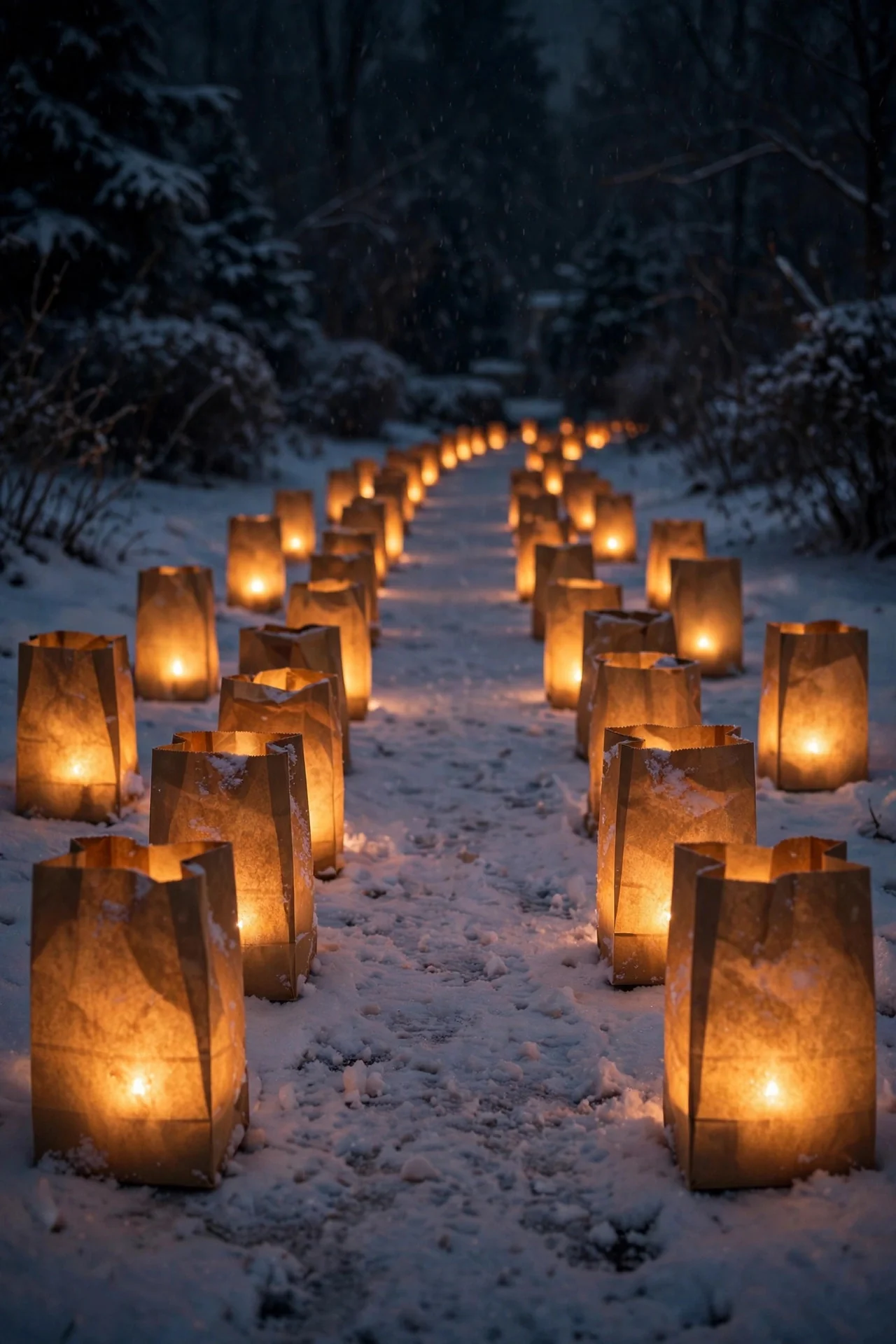
There's nothing more quietly magical — or more affordable — than a row of paper-bag luminaries lining your walkway on Christmas Eve. The bags glow like little lanterns, the walkway becomes a runway of warm light, and the whole thing costs less than a pizza. Kids love helping fold the cuffs; it's a genuine little ritual.
The method: take standard brown paper lunch bags, fold the top edge down about 2 inches for a finished cuff, and pour 2 inches of sand into each for weight and stability. Here's the critical safety rule — use flameless LED tea lights only, never real candles. Paper bags and open flame are a fire waiting to happen, and honestly the flickering LED kind looks just as warm from a few feet away. Space the bags 3 to 4 feet apart along both sides of the walkway, and set them out after any rain has passed since wet paper sags.
In my experience, 10 to 12 bags make a beautiful walkway; more than 16 starts to look like a runway instead of a welcome. Bring the bags inside if wind picks up past 15 mph — they're light even with the sand — and store the LED tea lights for next year. For one special night, this is the highest-impact, lowest-cost idea here.
Suggested budget range: $10 – $25.
9. Unlit Greenery Plus One Spotlight
Here's a secret most people miss: you don't need lights ON the greenery if you light the greenery itself. Fill two or three planters with plain fresh cedar or fir boughs — no lights, no ornaments, just honest evergreen — and aim a single low-voltage LED spotlight at them from the ground. The uplight turns simple branches into sculpture.
The setup: arrange the boughs loosely in your planters, varying the heights so they look gathered rather than arranged. Place one small outdoor LED spotlight (warm white, 2700K, about 200 lumens) on the ground 2 to 3 feet in front of the planter, angled up at roughly 45 degrees. The light raking up through the branches creates long shadows and deep texture that strings of lights can never match. Run the spotlight on the same dusk-to-11 timer as everything else, and use a low-voltage landscape kit if you have one — it's safer and easier than line voltage.
This is also the most durable idea on the list: fresh cedar holds up for weeks in cold weather with zero maintenance, and there's nothing to untangle in January. One fixture, three planters, done. In my experience, guests always ask about this one — it looks far more expensive than it is.
Suggested budget range: $40 – $90.

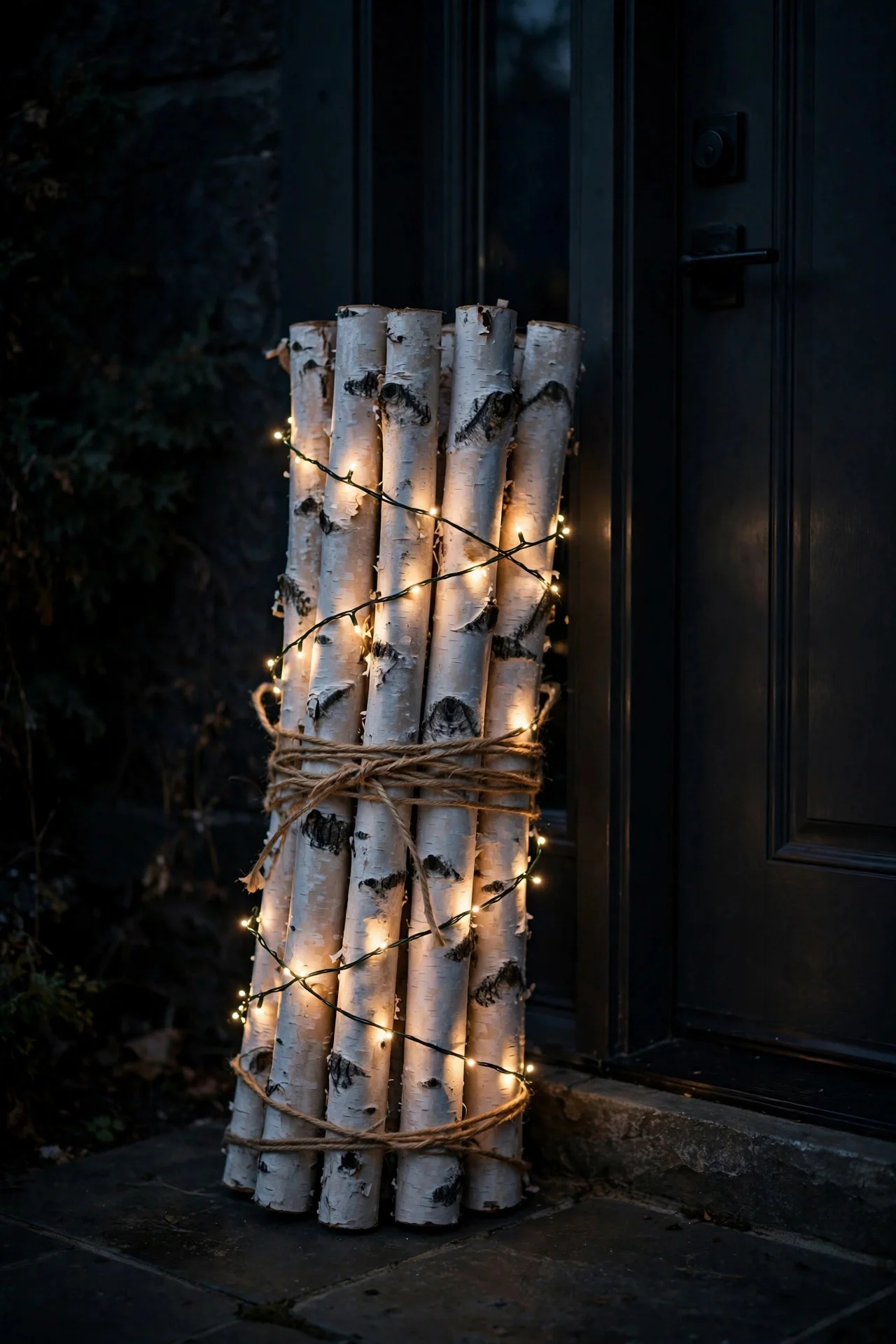
10. A Lit Bundle of White Birch Logs
A standing bundle of white birch logs, tied with jute and wrapped in a single strand of fairy lights, is rustic minimalism at its best. It looks like something you'd find outside a cabin in Vermont — natural, textural, and completely effortless. It takes ten minutes to build and guests will assume you bought it at a boutique.
Gather 5 to 7 white birch logs, each 18 to 24 inches long and 2 to 4 inches thick — craft stores sell them, or check firewood suppliers for birch specifically. Stand them upright in a tight bundle and lash them together with jute twine in two places, top and bottom, trimming the ends. Then wrap one 33-foot strand of warm-white copper-wire fairy lights loosely around the bundle, letting a few loops dip between the logs. Set the whole thing in a galvanized bucket or directly on the porch floor beside the door, and hide the battery pack inside the bundle's center.
Keep it simple: no bow, no greenery tucked in, no second strand. The white bark with its dark markings is the decoration; the lights just make it glow. Birch is naturally rot-resistant, so it'll last the whole season outdoors, and you can reuse it for years.
Suggested budget range: $20 – $50.
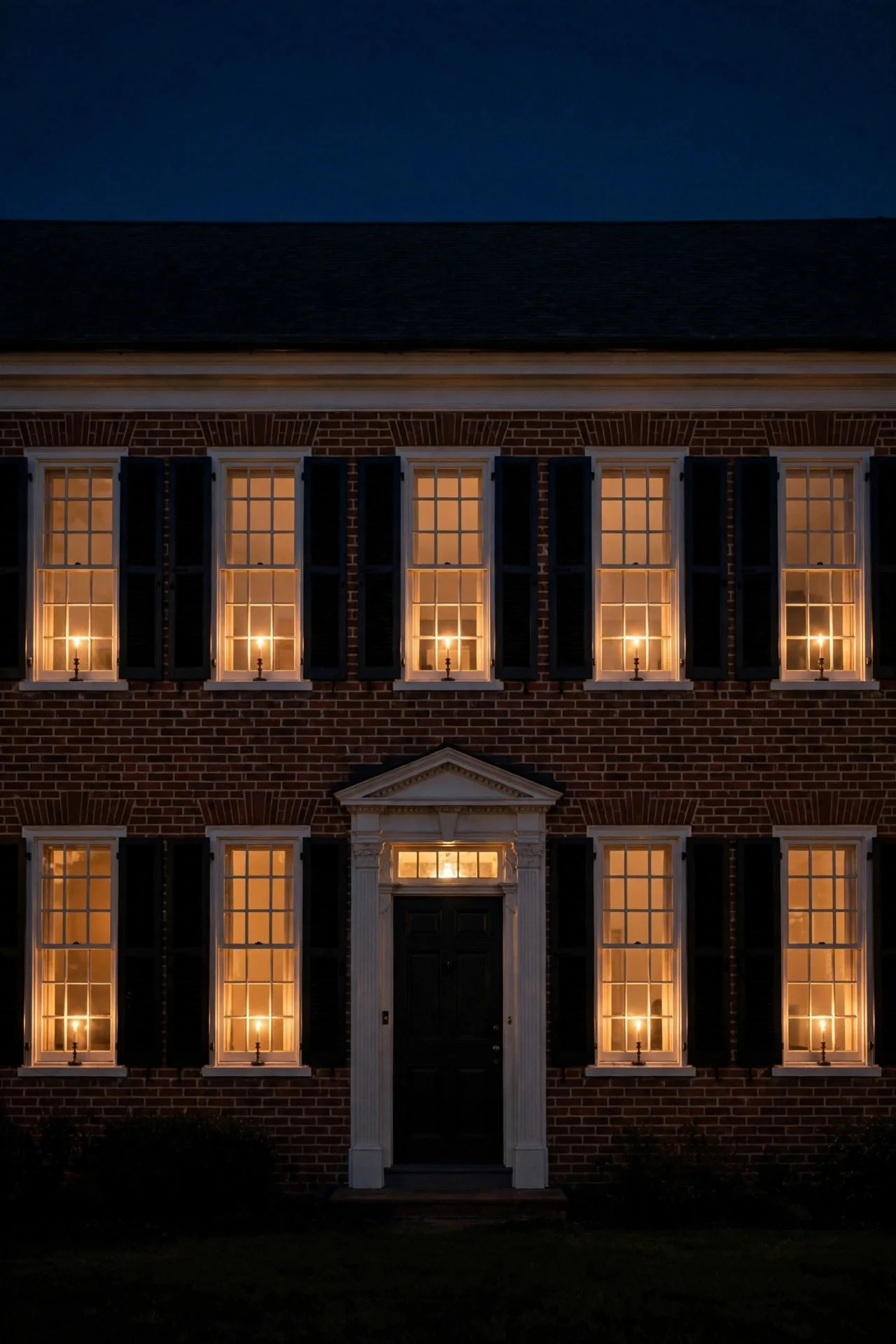
11. Window Candles in Every Front Window: A Minimalist Outdoor Christmas Decor Classic
If you only do one thing from this list, make it this: put a single electric candle in each front-facing window, all on timers, all the same warm white. From the street, the effect is extraordinary — a row of soft flames floating in the dark, symmetrical and serene. It's the colonial Williamsburg look, and it's timeless for a reason.
Buy plug-in or battery candles in matching heights (the classic 9-inch taper style), and choose the flicker-flame version in warm white — steady-glow candles look like nightlights, while flicker reads as real flame. Center each candle in its window using a small suction-cup holder or a windowsill stand, and keep every candle at the same height for that crisp, uniform rhythm. Set them all on dusk-to-dawn timers — battery candles with built-in timers are worth the small premium, since you set them once and they repeat daily.
One caution from experience: if you have deep window sills or heavy curtains, the candles can disappear from street view. Test the sightline from the sidewalk before you commit, and trim back any shrubs blocking the lower windows. Nine matching flames, glowing in unison, need no other decoration on the facade — let them carry the whole front of the house.
Suggested budget range: $30 – $75.
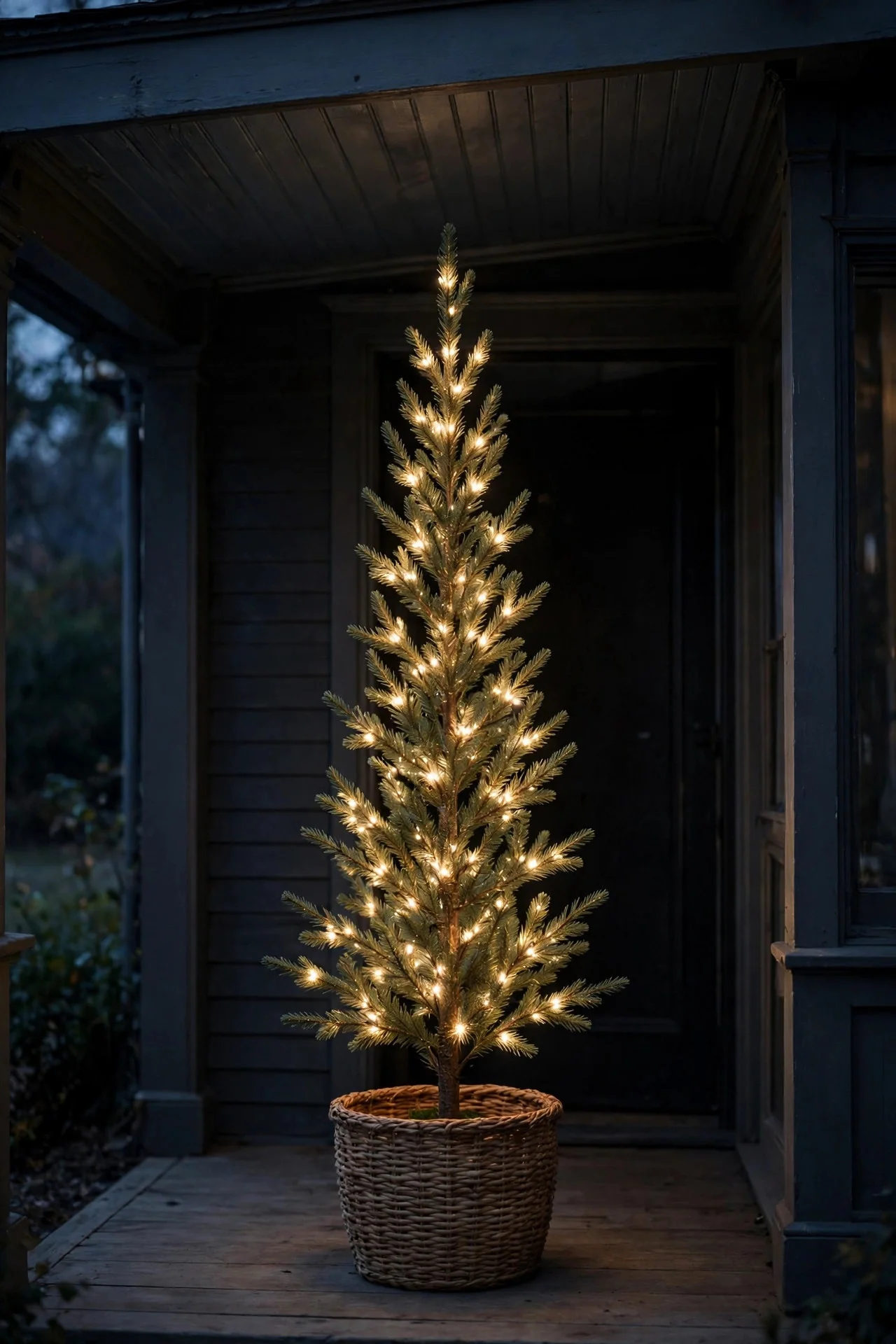
12. One Slim Pre-Lit Porch Tree
A single slim Christmas tree on the porch — pre-lit, undecorated or nearly so — gives you the full holiday feeling without a single ornament box to haul from the attic. The slim profile is key: a 4- to 5-foot pencil tree takes up barely 18 inches of floor space, so it fits even on a small porch or beside the door.
Choose a pre-lit tree with warm-white LEDs already strung (look for 150 to 200 lights on a 5-footer) so there's zero tangling and zero ladder work. Set it in a woven basket or a galvanized tub with the pot hidden, and then stop — resist the ornament urge. In my experience, a bare lit tree looks more elegant than a decorated one in this context; if you truly can't resist, add five to seven ornaments in a single material, like all matte gold balls, and nothing else. Run an outdoor extension cord along the wall to the tree and put it on a timer with your other lights.
Weather note: keep the tree under the porch roof or eave overhang so rain and snow don't sit on the branches, and stake the basket if your porch is windy — slim trees are top-heavy. When January comes, it collapses back into its box in five minutes. Minimal decorating, minimal teardown.
Suggested budget range: $50 – $120.
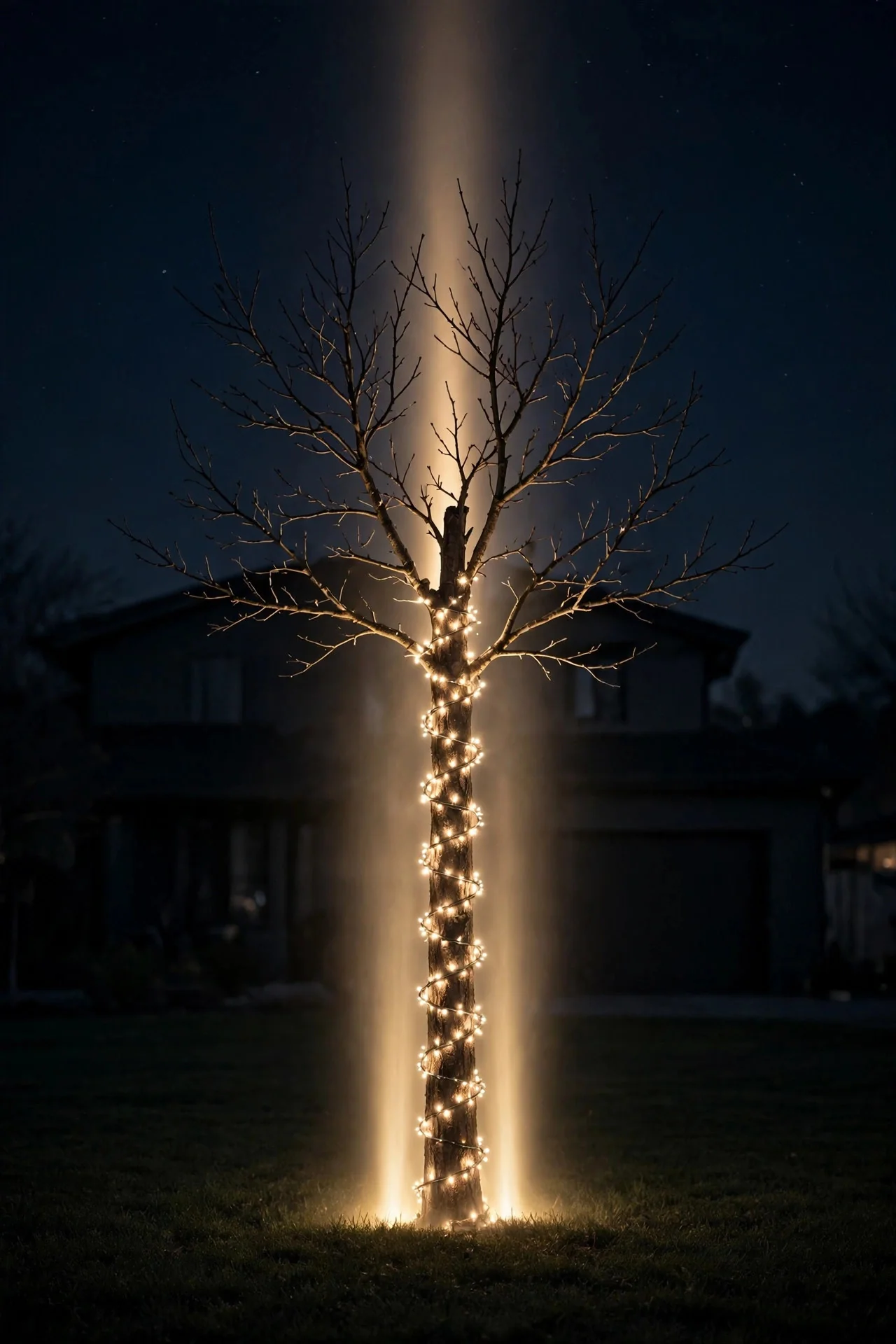
13. Trunk-Wrapped Yard Tree With Bare Branches
Instead of lighting a whole tree, light just the trunk: wrap the trunk of one front-yard tree in a spiral of warm-white mini lights and leave every branch bare. The effect is sculptural — a glowing column rising out of the dark lawn — and it uses a fraction of the lights a full tree wrap would need.
Start at the base and spiral upward with even 4- to 6-inch spacing between wraps, using a single 100-light strand for a trunk up to about 10 inches in diameter and 8 feet of clear trunk. Tuck the plug end at the back of the trunk near the ground and run an outdoor extension cord along the lawn edge to the house (bury it an inch under mulch so the mower never finds it). Choose green-wire strands for trees — the wire disappears against the bark during the day, which matters for the minimalist daytime look too.
Pick the tree closest to the street for maximum impact, and keep everything else in the yard dark. One glowing trunk against a dark lawn and a dark house is a genuinely striking composition — it's the landscape-lighting version of a single brushstroke. In my experience, neighbors always ask how you did it, and they're shocked it was one strand and twenty minutes.
Suggested budget range: $30 – $80.
14. A Scandinavian Candle Bridge in the Window
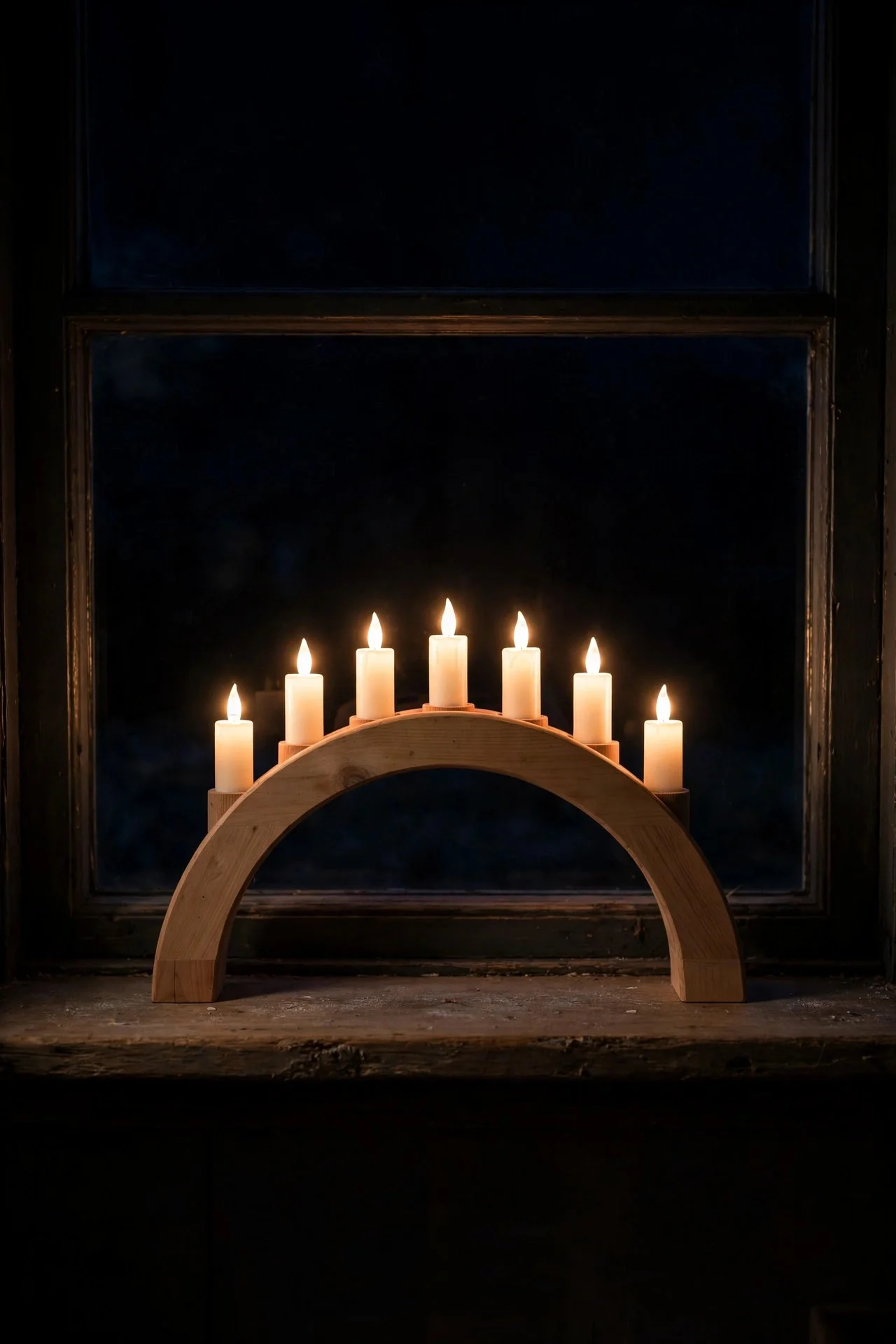
The Swedish ljusstake — a wooden candle bridge with seven glowing arms — is the definitive minimalist Christmas window decoration, and it costs almost nothing. One arched row of warm electric candles in the window reads as both festive and deeply calm, and it's been doing exactly that in Scandinavian homes for a century.
Center the bridge on the windowsill of your most visible front window, arch facing out. The classic design is natural wood with seven warm-white electric candles, and I recommend the traditional look over novelty shapes — the simplicity is the point. Plug it into a timer so it joins your other window lights at dusk, and run the cord behind the curtain to keep the sill clean. If the window is wide, one bridge centered is still better than two crowded together; negative space around it makes the glow feel intentional.
Styling tip: pair it with nothing else in that window — no garland, no star, no second candle. The bridge is a complete composition on its own. In my experience, this is the decoration guests photograph most, precisely because it looks so effortless. And at the end of the season, it folds flat into a drawer.
Suggested budget range: $20 – $45.
15. Glass Hurricanes With Pillar Candles on the Patio
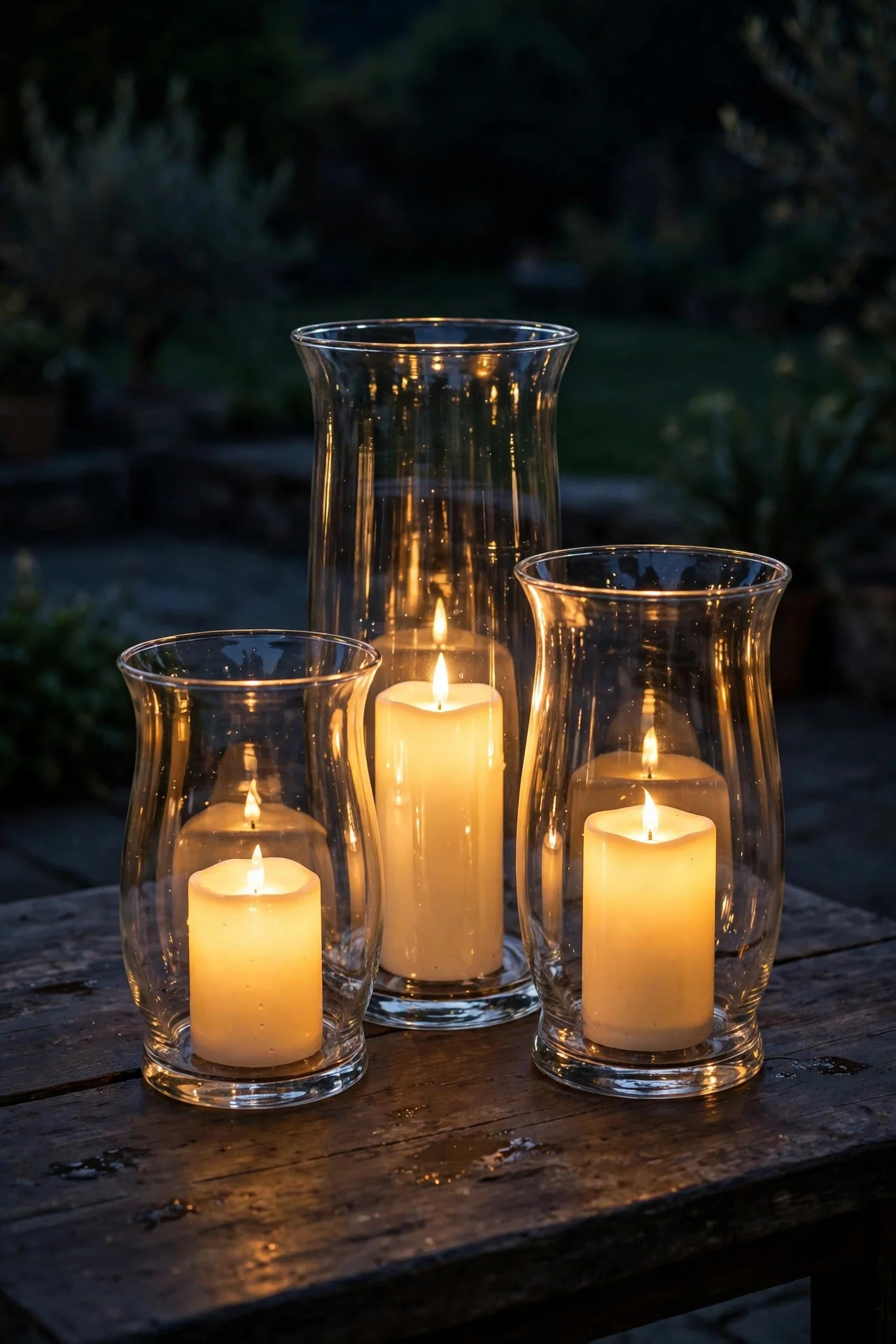
If your back patio or deck gets used through the holidays, three glass hurricanes with LED pillar candles on the outdoor table create an instant candlelit dining scene — no string lights required. It's the minimalist's answer to a fully dressed patio: one surface, one material, one warm glow.
Choose hurricanes in three heights (say 10, 14, and 18 inches) and cluster them in the center of the table, tallest in the middle. Inside each, place a flameless LED pillar candle — the 3×4 and 3×6 sizes look most realistic — in the flickering-flame style. The glass does two jobs: it protects the "flame" from wind and it doubles the glow with reflections. Use real glass, not plastic; plastic scratches and clouds within a season, while glass rinses clean for years.
Practical notes: bring the hurricanes inside during storms or high wind — they're top-heavy and expensive to replace. Set the LED candles on timer mode (most run 5 hours on, 19 off) so the table lights itself every evening. And keep the rest of the patio dark; the contrast between the glowing table and the dark yard is what makes it feel like a secret.
Suggested budget range: $35 – $80.
16. A Single Swag on the Mailbox Post
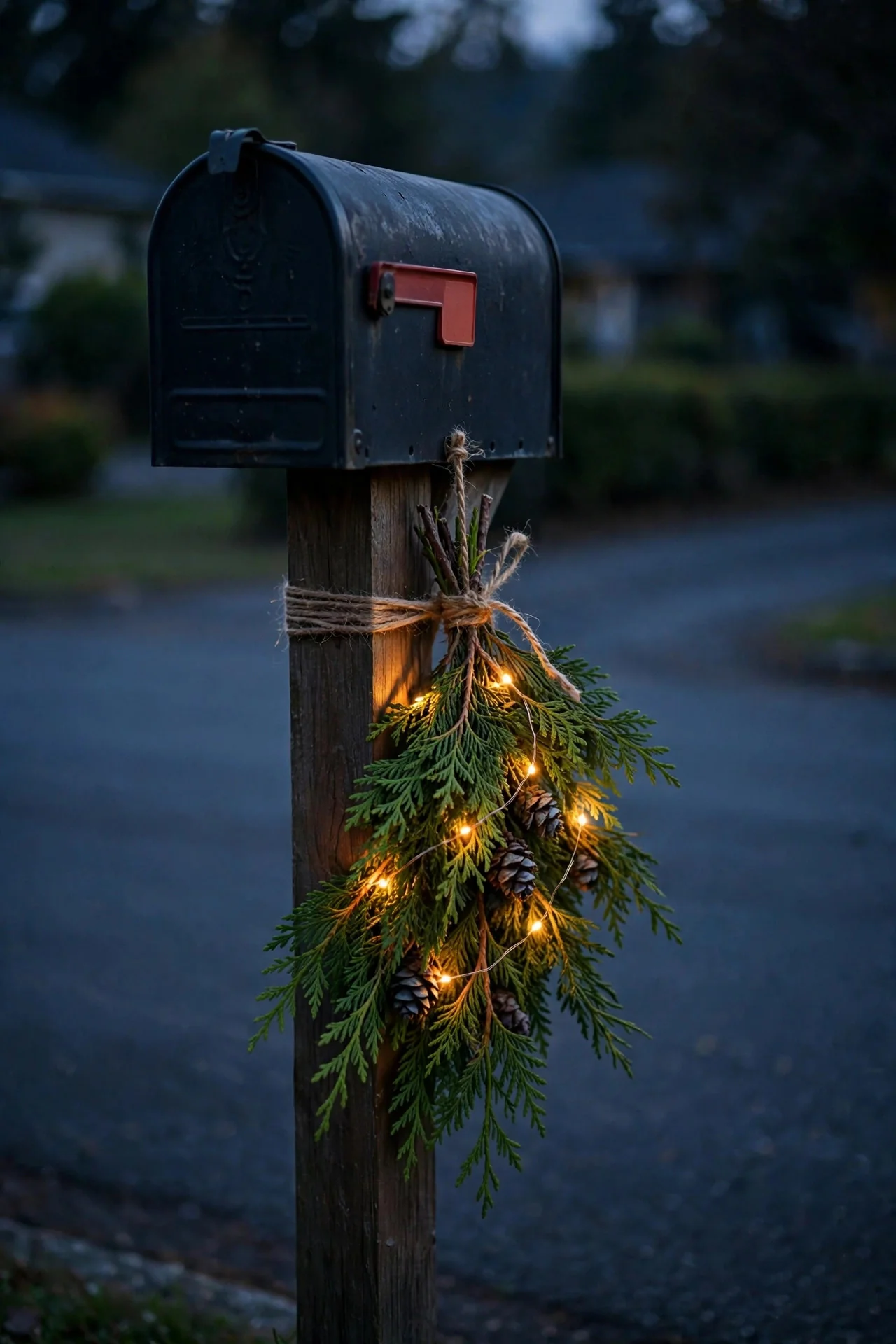
The mailbox is the first thing visitors see, so give it one small gesture: a single 2-foot greenery swag tied to the post with jute twine, wrapped with one short strand of fairy lights. It's the exclamation point at the end of your street's sentence — small, but it makes the whole frontage feel considered.
Build it from a small bunch of fresh cedar or fir, tied at the top with jute so the branches fan downward naturally. Attach it to the mailbox post just below the box with another loop of twine — no nails, no damage. Weave a single 10-foot copper-wire fairy light strand through it, battery pack tucked behind the post. That's the entire decoration: greenery, twine, light.
Keep the scale honest — a mailbox swag should be modest, roughly the width of the post and no longer than your forearm, or it overwhelms the little structure. In my experience, fresh greenery lasts 3 to 4 weeks in December cold; swap it once mid-season if it browns. And check your local rules: some HOAs restrict mailbox decorations, so a quick glance at the guidelines saves a headache.
Suggested budget range: $15 – $35.
17. An Oversized Pinecone Wreath on the Garden Gate
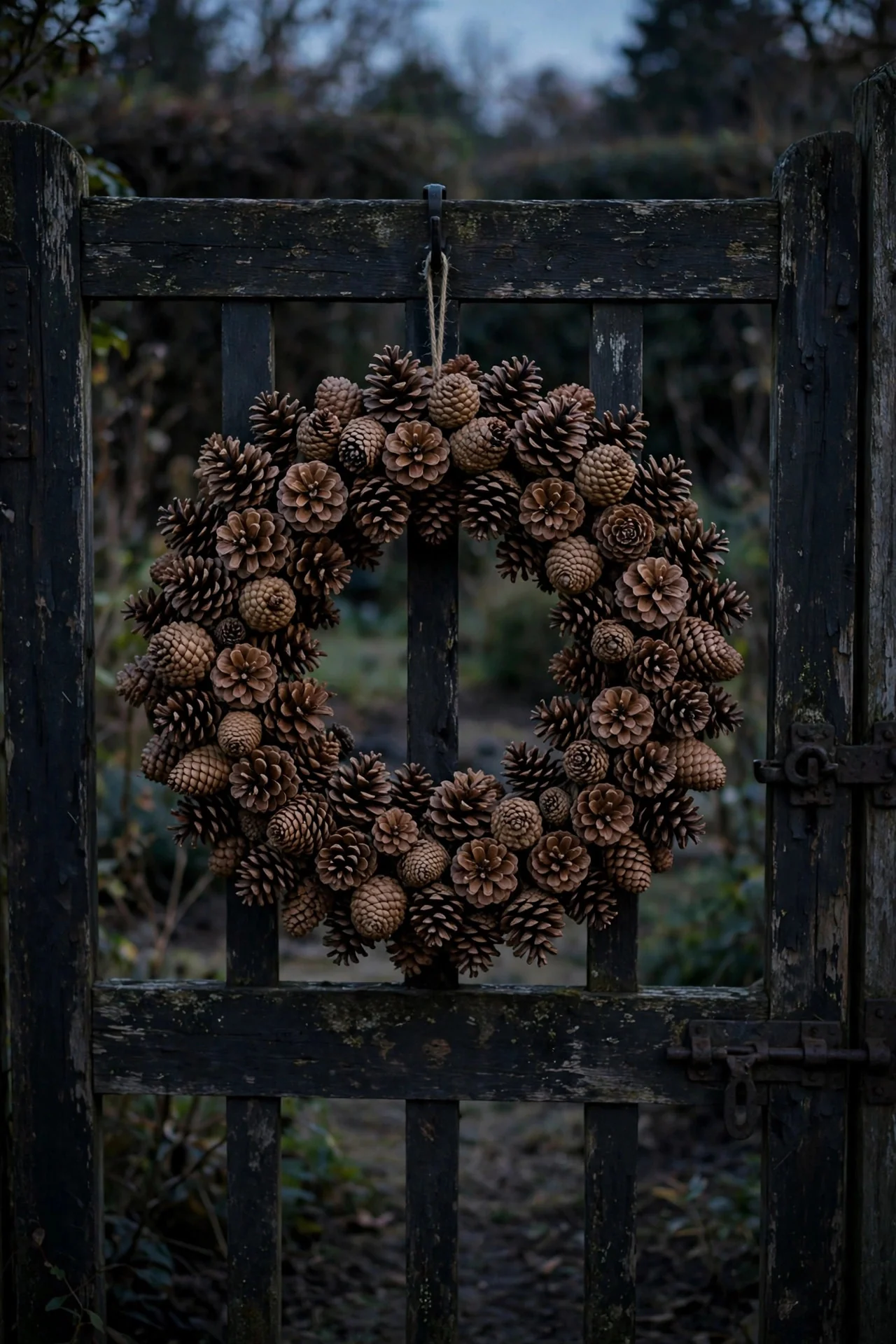
Move the wreath off the door and onto the garden gate, and make it all pinecones — no greenery, no bow, no lights on the wreath itself. An oversized pinecone wreath (24 inches or more) has incredible texture, and hung on a dark gate or fence it becomes a piece of natural art. Light it with a single existing landscape spotlight if you have one, or let the moon do the work.
Hang it centered on the gate with a simple loop of jute or wire — pinecone wreaths are heavy, so use a proper over-the-gate hanger or a sturdy hook, not a suction cup. The all-pinecone construction is naturally weatherproof: rain runs off, snow sits prettily in the scales, and it looks better slightly weathered than brand new. If you want a whisper of light, tuck one short battery fairy strand deep inside the wreath so the glow peeks through the scales — but honestly, unlit is the more confident choice here.
In my experience, this works best on a gate or fence that's visible from the street but separate from the house — it extends the holiday feeling to the property line without adding anything to the facade. One wreath, one gate, done.
Suggested budget range: $25 – $55.
18. A Branch-Tripod "Tree" With Sparse Fairy Lights
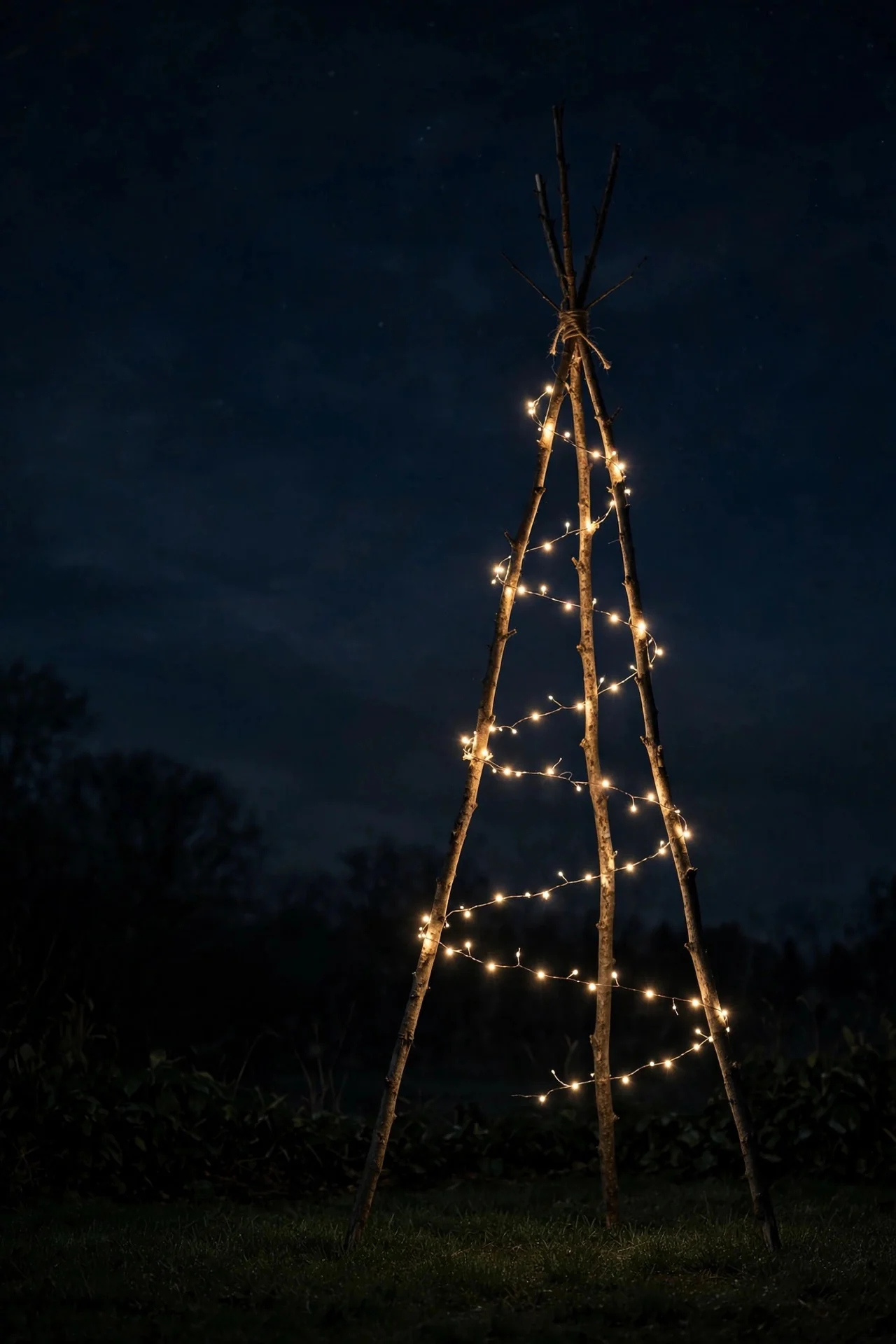
For the ultimate less-is-more statement, build a Christmas tree out of three bare branches: lash three tall, straight branches together at the top to form a tripod, stand it in the yard or on the porch, and wrap it sparsely with warm fairy lights. It's a tree reduced to its essence — line, light, and air — and it's genuinely beautiful.
Cut or buy three branches 6 to 8 feet long and as straight as you can find; birch or any smooth-barked wood looks best. Tie them together about 12 inches from the top with jute twine, then spread the legs to form a stable tripod — on soft ground, push the feet a few inches into the soil; on a porch, stand them in a wide, heavy planter with gravel. Wrap one 66-foot strand of warm-white fairy lights loosely around the tripod in a wide spiral, leaving big gaps of bare wood. No ornaments, no topper, no skirt.
Anchor it well: a tripod catches wind like a sail, so guy-line it with thin twine to ground stakes in the yard, or weight the planter heavily on a porch. In my experience, this looks best silhouetted against open sky at the edge of the lawn — it reads as modern art, not as a decoration, and that's exactly the point.
Suggested budget range: $15 – $40.
19. One Centered Swag Above the Doorway
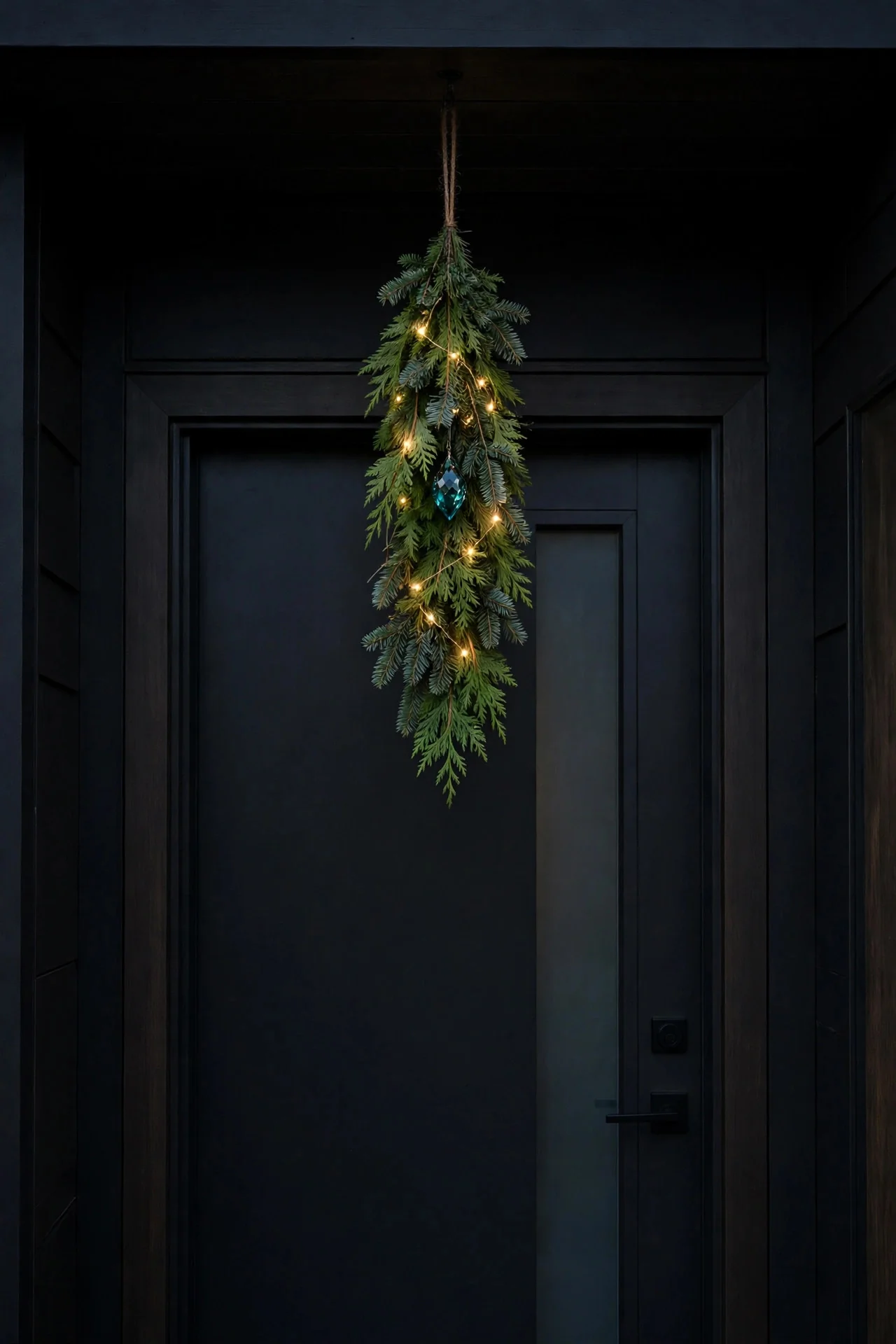
Instead of framing the door with garland on both sides — the classic maximalist move — hang a single 3-foot greenery swag centered above the door, like a pendant. The asymmetry of one centered piece against the full width of the doorway is what makes it feel modern and calm.
Build the swag from mixed evergreens (cedar and fir is my favorite pairing) tied at the top so the branches cascade down about 30 inches. Hang it from a single adhesive hook or a small nail centered on the trim above the door, and let it hang straight — no draping to the sides. Weave one short strand of warm-white fairy lights through it, or leave it unlit if your porch sconce already washes the doorway in light. The rule: the swag should be narrower than the door itself, roughly half the door's width, so it reads as a jewel rather than a frame.
In my experience, this is the trick that converts garland skeptics — people who find full door framing fussy love the restraint of a single centered piece. Fresh greenery lasts the whole month in cold weather; give it a shake after storms and replace the fairy-light batteries once.
Suggested budget range: $20 – $45.
20. A Single Spotlight Washing the Facade
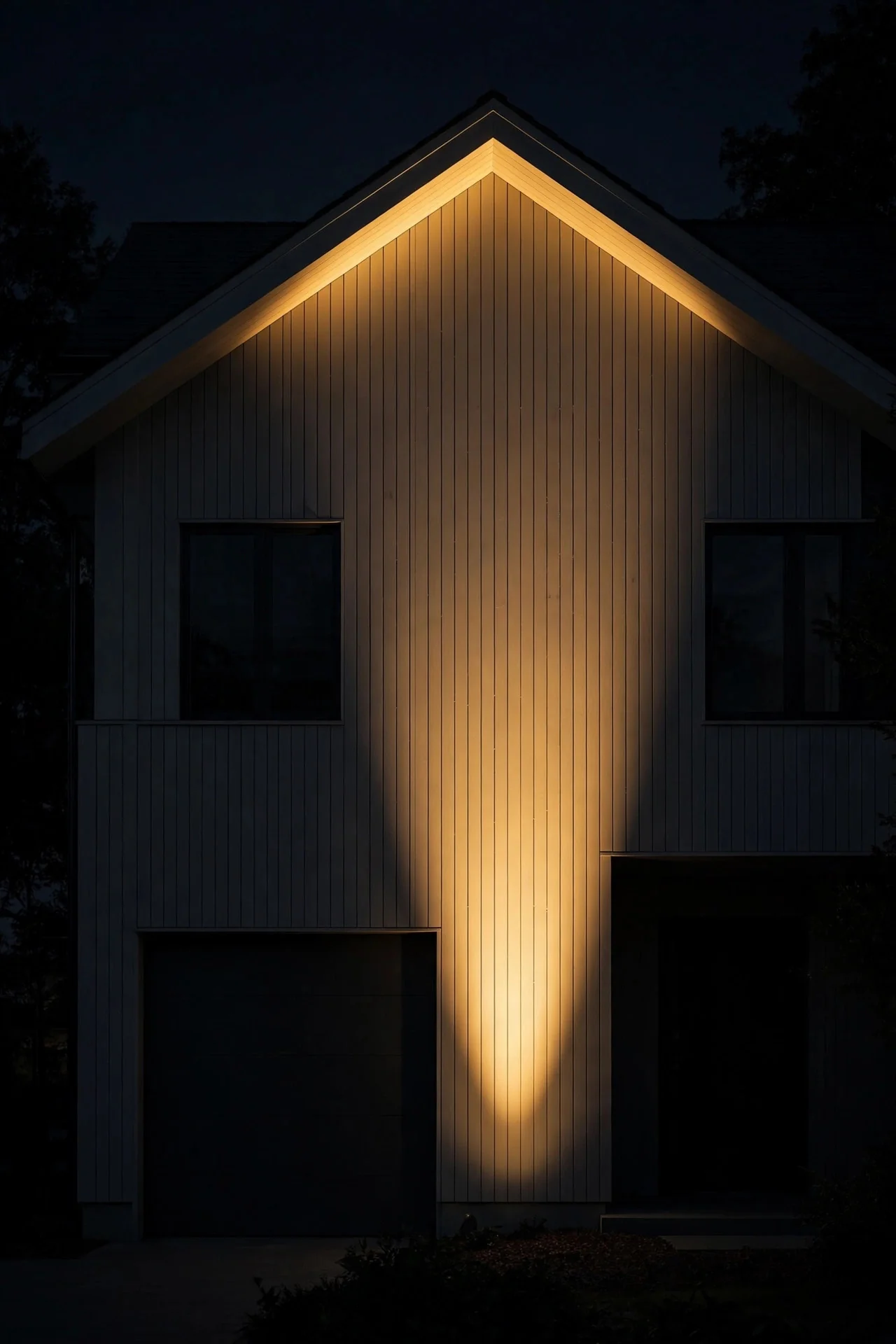
The boldest minimalist move of all: skip the decorations and light the architecture instead. One low-voltage LED spotlight aimed up at the front of your house — washing the siding, the stonework, or the gable in warm light — makes the whole home glow without a single ornament. It's landscape lighting doing holiday duty, and it looks expensive.
Place the spotlight on the ground 8 to 12 feet from the house, angled up at about 30 degrees so the light grazes the facade rather than blasting it. Warm white (2700K to 3000K) is essential; cool white on siding looks like a security light, not a celebration. Aim it at your home's best feature — a stone chimney, a gabled entry, a row of shutters — and let the rest fall into shadow. One fixture, one feature, done. If you already have landscape lighting, just re-aim an existing fixture for December and put it on a timer; zero new purchases.
Safety and courtesy matter here: keep the beam on your own house, not spilling into neighbors' windows, and use a shielded fixture so the bulb itself isn't visible from the street — you want the glow, not the glare. In my experience, this is the idea that makes people slow down as they drive by.
Suggested budget range: $40 – $100.
21. Embrace Negative Space: The Final Minimalist Outdoor Christmas Decor Lesson
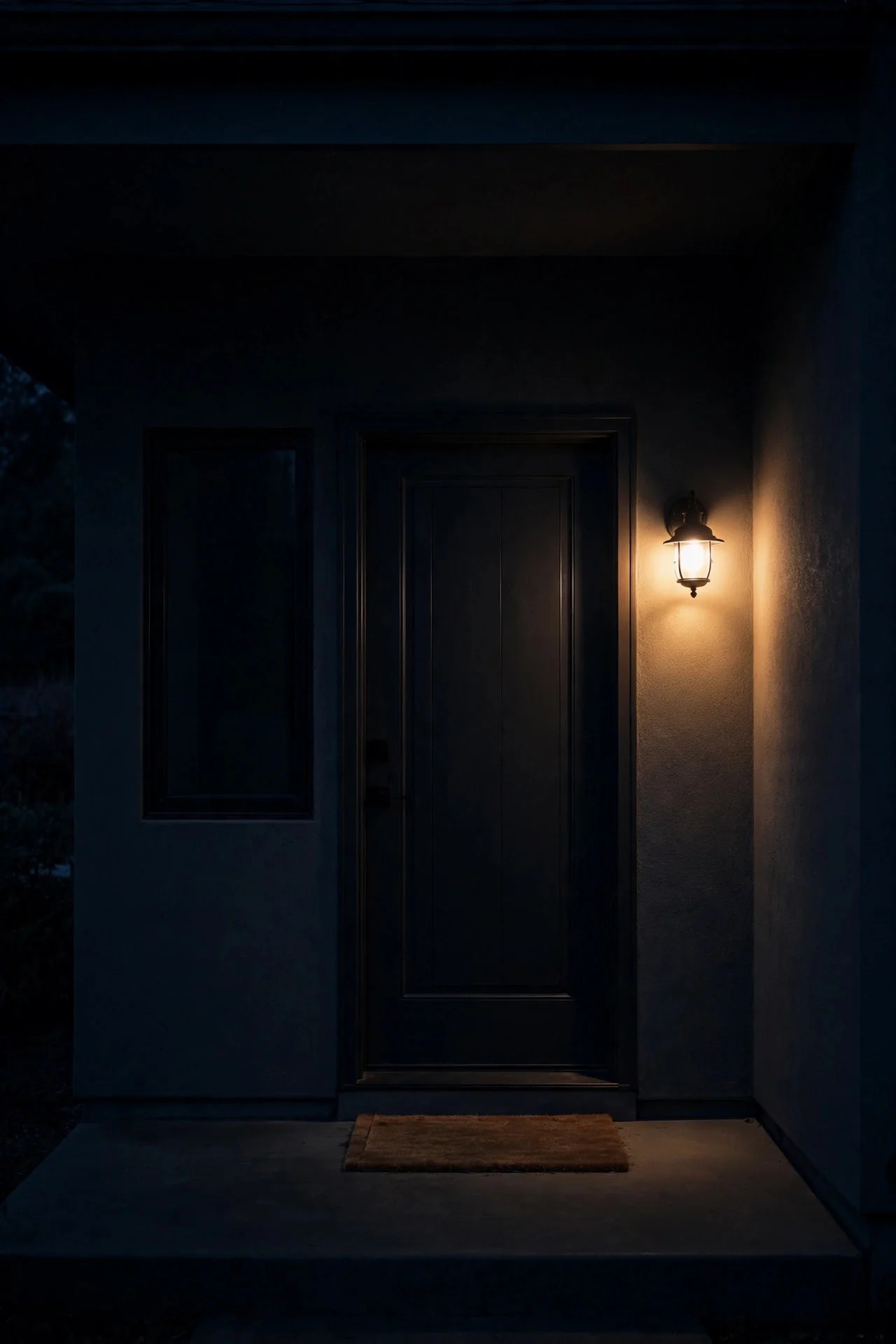
Here's my closing confession: some years, the most beautiful house on the block is the one with almost nothing — just the warm porch sconce that's been there all year, a plain evergreen doormat, and the quiet confidence to leave it at that. Negative space is a decoration. The dark windows, the unlit roofline, the empty lawn: they're the canvas that makes everyone else's lights meaningful, and they make your one warm sconce feel like a hearth.
If this speaks to you, do it deliberately rather than by default. Swap the porch bulb for a warm 2700K LED if it isn't already, and put it on a dusk-to-dawn sensor so the welcome is automatic. Add one natural texture — a plain cedar doormat, a basket of pinecones by the door — and stop. Clean the sconce glass so the light is clear, trim any shrubs blocking it, and let the single warm pool of light be the whole statement.
In my experience, this is the hardest idea on the list to actually commit to, because restraint feels like doing nothing — but it's not. It's editing. And a house that glows with one warm light in the December dark feels more like Christmas than a house shouting with ten thousand of them. Less really is more.
Suggested budget range: $0 – $20.
Frequently Asked Questions
What color temperature is best for minimalist outdoor Christmas decor?
Warm white, every single time — specifically 2700K, which matches traditional incandescent candlelight. The minimalist look depends on visual calm, and nothing shatters calm faster than mixing 2700K warm white with 5000K cool white or multicolor strands on the same facade. Check the Kelvin rating on every box before you buy, and make it a house rule: one temperature everywhere, inside the windows and out. If you're replacing old lights, replace them all at once so nothing clashes.
How many lights is "enough" for a minimalist look?
Fewer than you think. My rule: three focal points maximum per view — one high (roofline or window), one middle (wreath or door), one low (lanterns or walkway). In raw numbers, most of the ideas in this post use 50 to 200 LEDs total, and a whole minimalist house rarely needs more than 300 to 500. If you can count your light sources on one hand from the street, you're in the right territory. When in doubt, remove one thing — editing is the entire skill.
What does minimalist outdoor Christmas decorating typically cost?
Much less than the maximalist version. Most individual ideas in this post run $15 to $80, and a complete minimalist scheme — say a roofline strand, one wreath, and a lantern pair — typically lands between $100 and $200 total. The savings compound: fewer lights mean lower electric bills (a 200-LED strand costs pennies per evening to run), cheaper storage, and almost no replacement costs since you're buying fewer, better pieces. Minimalism is genuinely the budget-friendly way to decorate.
How do I store a minimal setup after the holidays?
This is where minimalism really pays off: the whole display should fit in one or two bins. Coil each light strand around a piece of cardboard or a cord reel — never stuff them loose in a bag — and label which strand goes where with a bit of masking tape. Store wreaths in breathable wreath bags (not airtight plastic, which traps moisture), keep LED candles with batteries removed, and put everything in a cool, dry spot. One labeled bin, opened next December, with everything working: that's the minimalist dream, and it's completely achievable.
Conclusion
The thread running through all 21 of these ideas is simple: minimalist outdoor christmas decor works because every light earns its place. One straight roofline, one perfect wreath, a pair of lanterns flickering on the steps — chosen carefully, hung well, and all glowing the same warm white. No tangles, no ladder marathons, no January dread when it's time to take it all down.
This December, I'd love for you to try the three-focal-point rule on your own home: pick one high, one middle, one low, and let the darkness handle the rest. I think you'll be surprised how complete it feels — and how many neighbors slow down to look.
If this calmer approach to the holidays speaks to you, browse more lighting ideas on the site — there's a whole collection of porch, patio, and landscape looks waiting, each one designed to make your home glow without the overwhelm. Here's to a quieter, warmer Christmas.