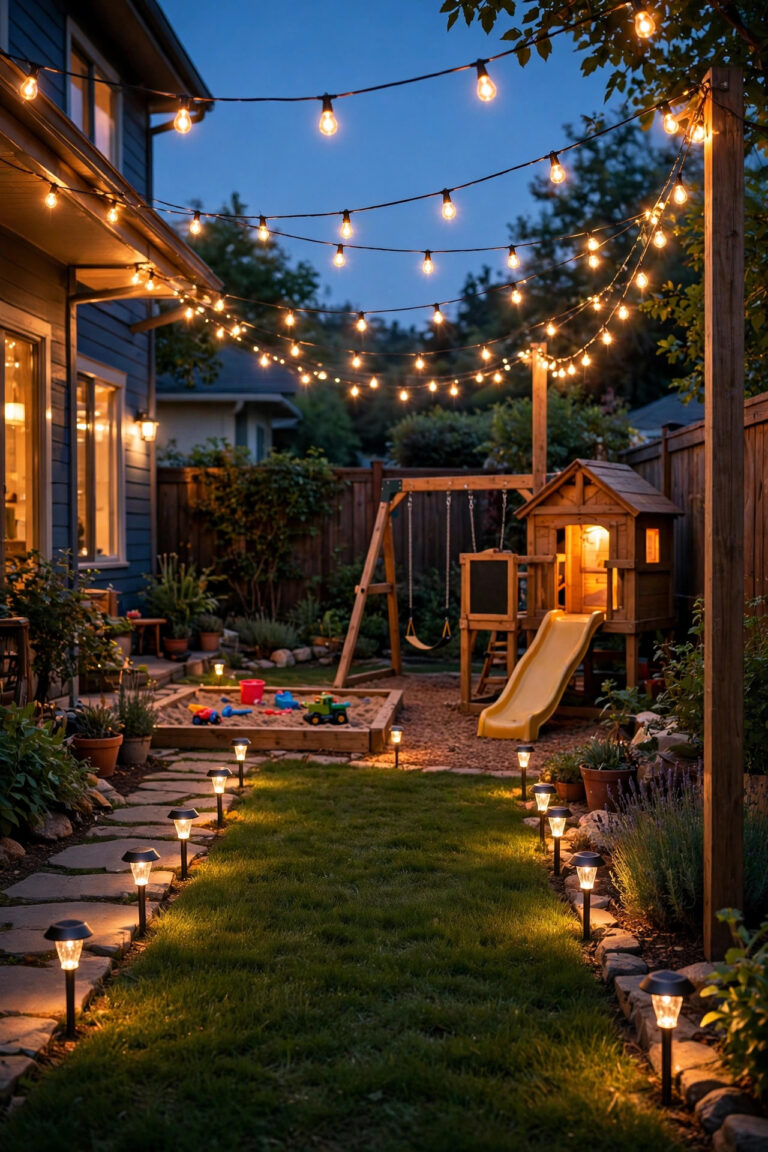
Your porch light has the hardest job of any fixture at your house. It is the welcome guests see first, the light your security camera leans on after dark, and the reason you can tell a package from a raccoon at midnight. So when the old one dies — or you move into a house with a bare bulb and big plans — the solar vs wired porch lights question lands fast, because the two could not work more differently. One drinks from your home wiring and burns as bright as you ask, all night, every night. The other makes its own power on a little rooftop panel and asks for nothing but sunshine and patience. I have run both at my own front door, and honestly, I have strong opinions about where each one belongs. In this guide I will compare them job by job: brightness and reliability, motion sensing, installation, style, controls, maintenance, and honest 2026 costs. By the end you will know exactly which type your entry needs — and which porches should never be asked to run on sunshine alone.

The Short Answer
If your entry already has wiring — and most do — choose wired. It is brighter, it burns all night in any weather, and it costs pennies a month to run. Choose solar when there is no wiring to use: a gate post, a detached garage, a rental you cannot drill into, or a side door that only needs a burst of light when someone approaches. The one setup where solar almost always disappoints is a covered or north-facing porch, where the panel never sees real sun. Everything below explains why, with the numbers to prove it.
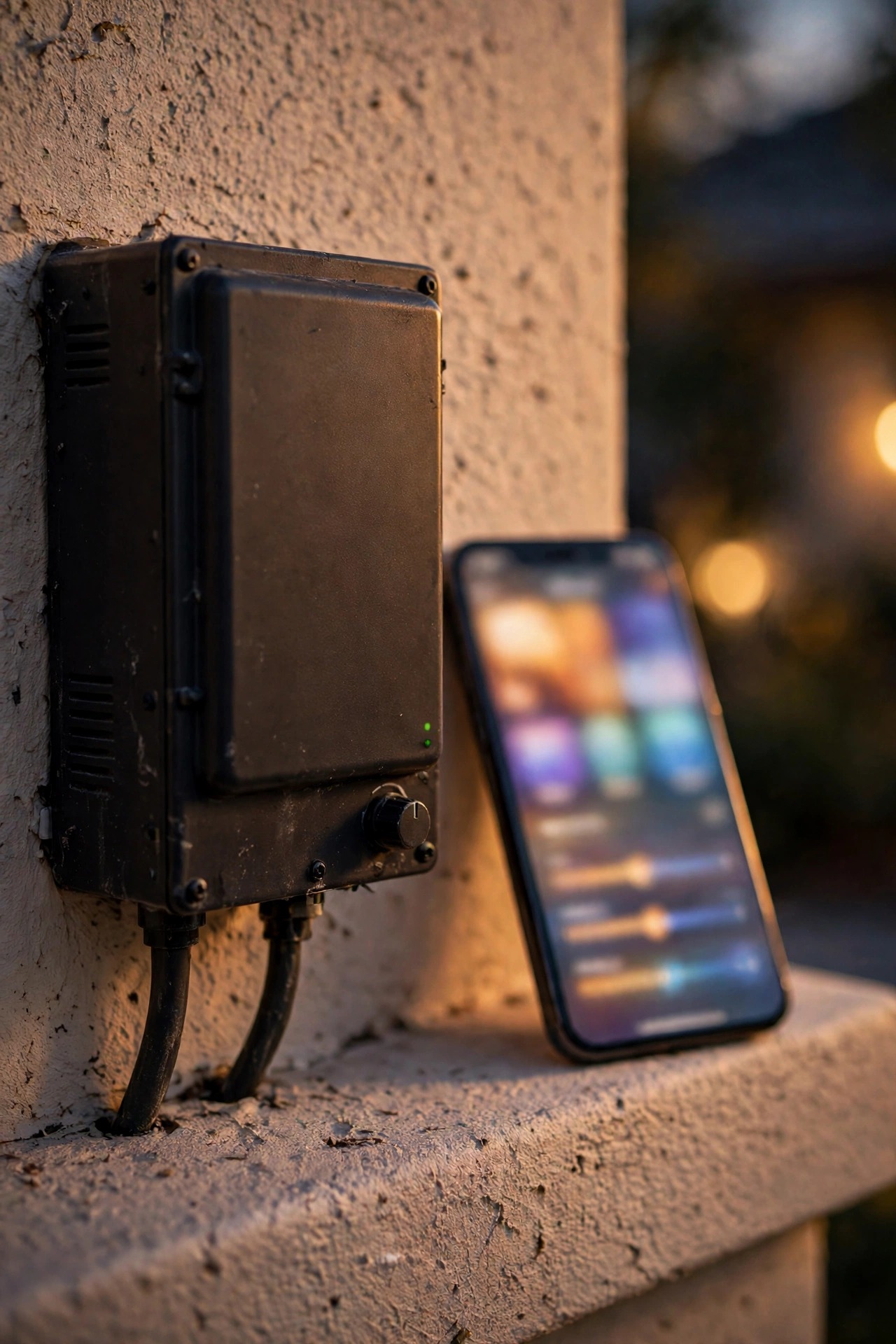
The Three Jobs Your Porch Light Does Every Night
Before we compare hardware, it helps to name what the light is actually for, because solar and wired fixtures are not equally good at every job.
Job one is welcome. A warm, steady glow at the entry tells guests they found the right house and tells you the home is lived in and cared for. This is the layering piece I talk about in every project: the porch light is the top layer that makes the path lights and landscape lighting below it make sense.
Job two is security. A lit entry discourages the casual prowler, and just as important, it lets your doorbell camera record faces instead of grainy silhouettes. Cameras need even, front-facing light far more than they need raw brightness — a face lit softly from the front reads clearly, while a harsh backlight turns everyone into a shadow.
Job three is pure utility: finding the keyhole with grocery bags in both arms, reading a house number from the street, spotting the package on the mat before the dog does, seeing ice on the steps in January.
Keep those three jobs in mind, because every section that follows grades both types against them. A light that is charming at job one can quietly fail job two, and the cheapest option often fails job three on the darkest night of the year. Grade every fixture you consider against all three jobs, and the choice between the two power sources gets much simpler.

Solar vs Wired Porch Lights on Brightness and All-Night Reliability
A wired porch light is as bright as the bulb you screw into it. A typical entry fixture with a standard LED bulb puts out 800 to 1,100 lumens — enough to light the whole porch, the steps, and a good slice of the walk. It delivers that brightness at 6 p.m. and the identical brightness at 5 a.m., in July and in the middle of a January cold snap, because the power behind it never runs out.
Solar porch lights play a different game. Most produce somewhere between 100 and 400 lumens on a full charge — a pleasant glow rather than real working light — and many step down to a dim idle level to stretch the battery, brightening only when motion trips them. What the battery holds depends entirely on what the panel collected that day. A short, gray December day might give the light four or five weak hours. A covered porch or a north-facing entry can starve a panel so thoroughly that the light fades before you are home from work.
None of this makes solar bad. It makes solar honest about physics: it is a battery with a light attached, refilled by weather. Wired is a faucet. For a main entry that must perform every single night — for the camera, for the keyhole, for the icy steps — that difference counts for more than any other in this guide.

Motion Sensing: Both Sides Do It, Differently
Motion activation is where solar quietly wins back some ground, so let me give both sides their due.
On the wired side, motion-sensor sconces and floods have been around for decades and they are excellent: adjustable sensitivity, adjustable on-time from a few seconds to several minutes, and on many models a dusk-to-dawn mode that holds a low glow all night and jumps to full brightness when someone approaches. Because power is unlimited, a wired motion light can be genuinely bright — bright enough to light a driveway apron or a whole side yard when it trips.
Solar motion lights work on the opposite principle, and it suits them. Instead of burning all night, they sit dark and sip almost nothing, then spend their stored energy in short, bright bursts when the sensor trips. A decent solar motion light over a gate or side door can keep doing that through weeks of cloudy weather, because it is not trying to be a porch light at all — it is a tripwire with a flashlight attached.
The catch is placement and patience. Sensors on both types read a cone roughly 30 feet deep; mount one too high or aim it at a busy street and you get false triggers from every passing car. And a solar motion light still cannot hold the steady glow that reads a house number. Match the tool to the job: steady light for the entry you use every night, motion bursts for the corners you only visit.

Installation Reality: The Junction Box Decides Most of This
Here is the fact that settles the debate for most houses: the wiring is probably already there. Nearly every home built in the last sixty years has a junction box beside or above the front door, which turns a wired porch light into a simple fixture swap. Kill the breaker, test that the wires are dead, match black to black, white to white, ground to the green screw, and hang the new fixture. Most swaps take under an hour, and my step-by-step walkthrough of how to install a porch light covers the whole job including the safety checks.
Solar skips all of that. Two screws, a charged battery, done — fifteen minutes with a drill you already own. That is a genuine superpower in the places wiring never reached: a gate post at the end of the drive, the man door on a detached garage, a shed, a fence corner. Running new wire to those spots means trenching, conduit, and an electrician, and the bill changes the math completely (details in the cost section below).
Two warnings before you fall in love with the easy option. First, a solar fixture still needs its panel in real sun, which sometimes means mounting the light where the panel works rather than where the light looks best — remote-panel models on a cord solve this and are worth the small premium. Second, renters: solar and battery fixtures are usually your only no-permission option, and they are a good one.
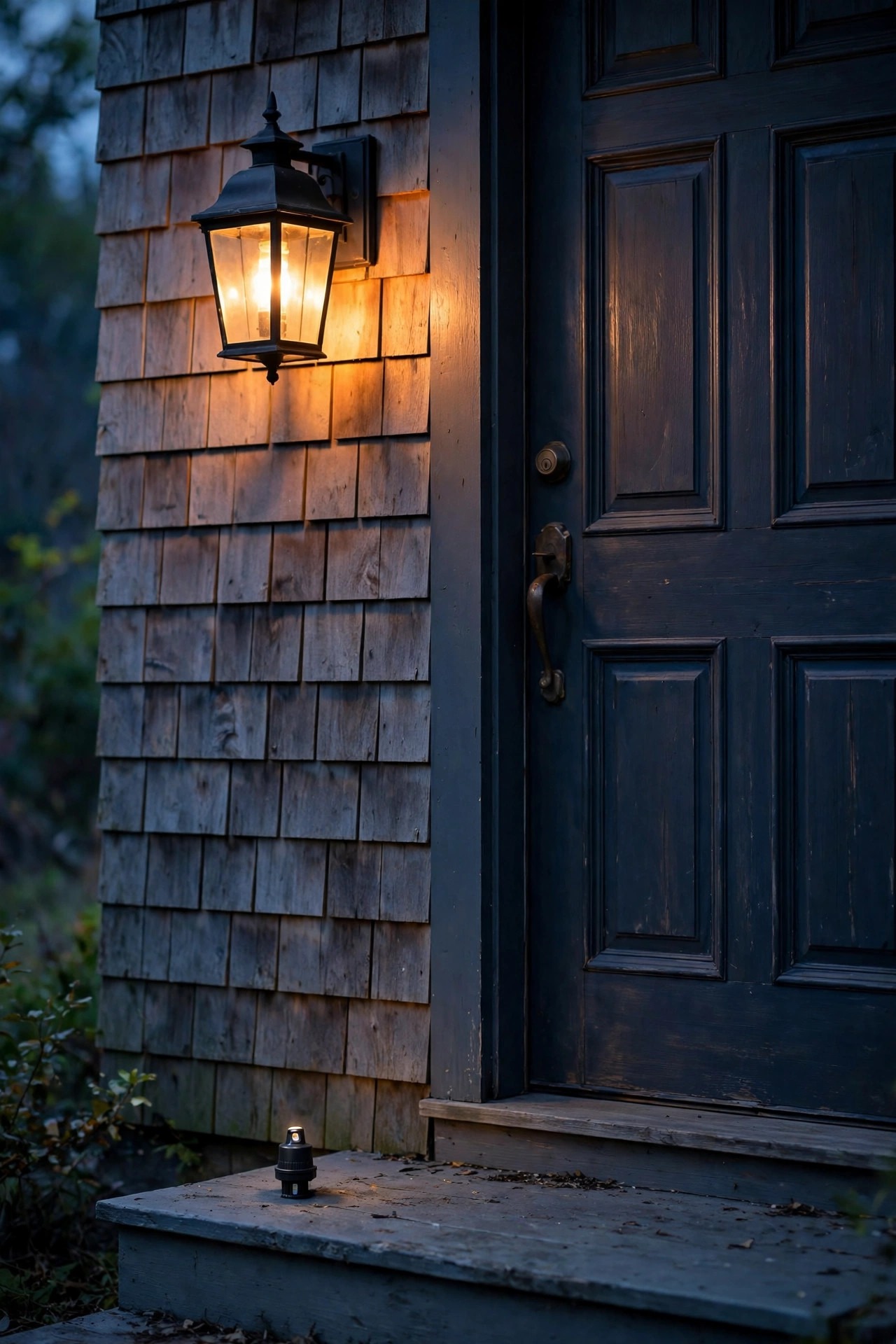
Style, Finishes and Sizing: Where Wired Runs Away With It
Walk into any lighting showroom and the wired porch fixtures fill aisles: coach lanterns, craftsman boxes with seeded glass, farmhouse barn lights, slim modern cylinders, carriage styles for colonial homes. Every finish exists — matte black, oil-rubbed bronze, brushed nickel, aged brass — and most designs come in sizes from a petite 6 inches to statement pieces over 20 inches tall. Sizing counts for more than people think: as a rule, a single fixture should run about a quarter to a third of your door height, so a standard 80-inch door wants a fixture roughly 20 to 27 inches tall for a grand single, or a pair of smaller ones flanking the door at eye level. Wired fixtures make hitting that proportion easy.
The solar catalog is catching up but still trails. You will find handsome modern sconces and lantern shapes, yet the selection skews smaller, darker, and more uniform, because every design has to hide a panel and a battery somewhere in its silhouette. That panel often reads as a flat black lid on top of the fixture — unobtrusive on a contemporary home, slightly out of place on a traditional one.
My honest take: if the front of your house is your style statement and the wiring exists, wired gives you the fixture you actually want. Save solar for the spots where nobody is judging the silhouette.
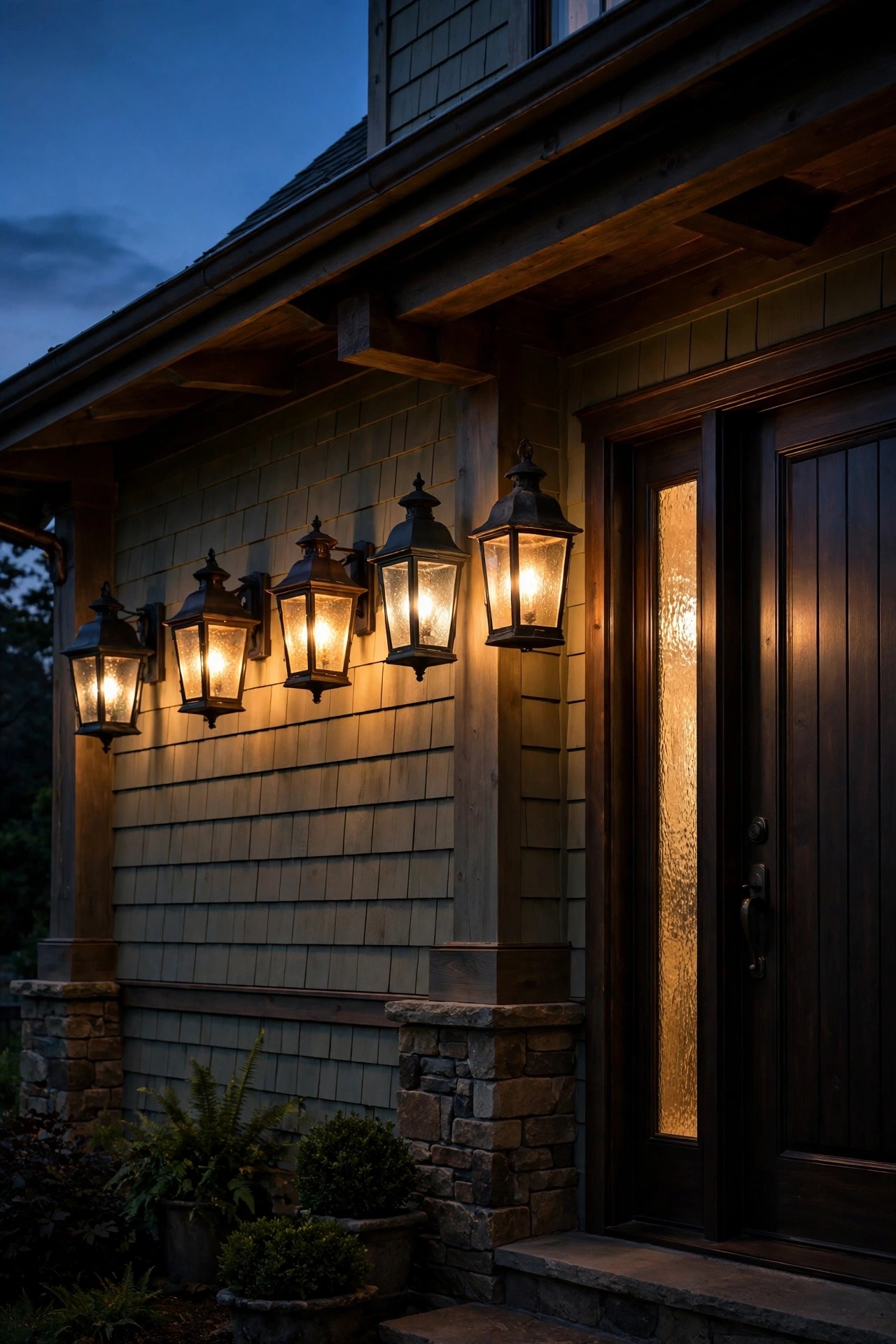
Controls: Photocells, Timers and Smart Options
A porch light you have to remember to flip on is a porch light that stays dark half the time, so controls count almost as much as the fixture itself.
Wired fixtures get the full menu. A photocell switches the light on at dusk and off at dawn automatically — built into many fixtures, or added with a photocell bulb in any fixture you already own. In-wall timer switches go further, and astronomical models follow sunset as it shifts through the year with no seasonal reprogramming. Smart bulbs and smart switches add phone control, dimming, schedules, and vacation routines that make an empty house look occupied. If your current fixture is fine but dumb, my guide to adding a photocell or timer to a porch light walks through the cheap upgrades.
Solar fixtures nearly all include a photocell by default — they have to, since the same sensor logic tells the panel when to charge and the light when to burn. That built-in dusk-to-dawn behavior is genuinely convenient. Beyond it, the options thin out: a few models offer remotes or app control and selectable brightness modes, but there is no solar equivalent of a whole-home schedule, and a solar light cannot join the rest of your lighting scenes.
Edge to wired, clearly — with one footnote. Solar automatic dusk-to-dawn costs you nothing and asks nothing, which is more than I can say for a switch somebody in your house keeps flipping off out of habit.
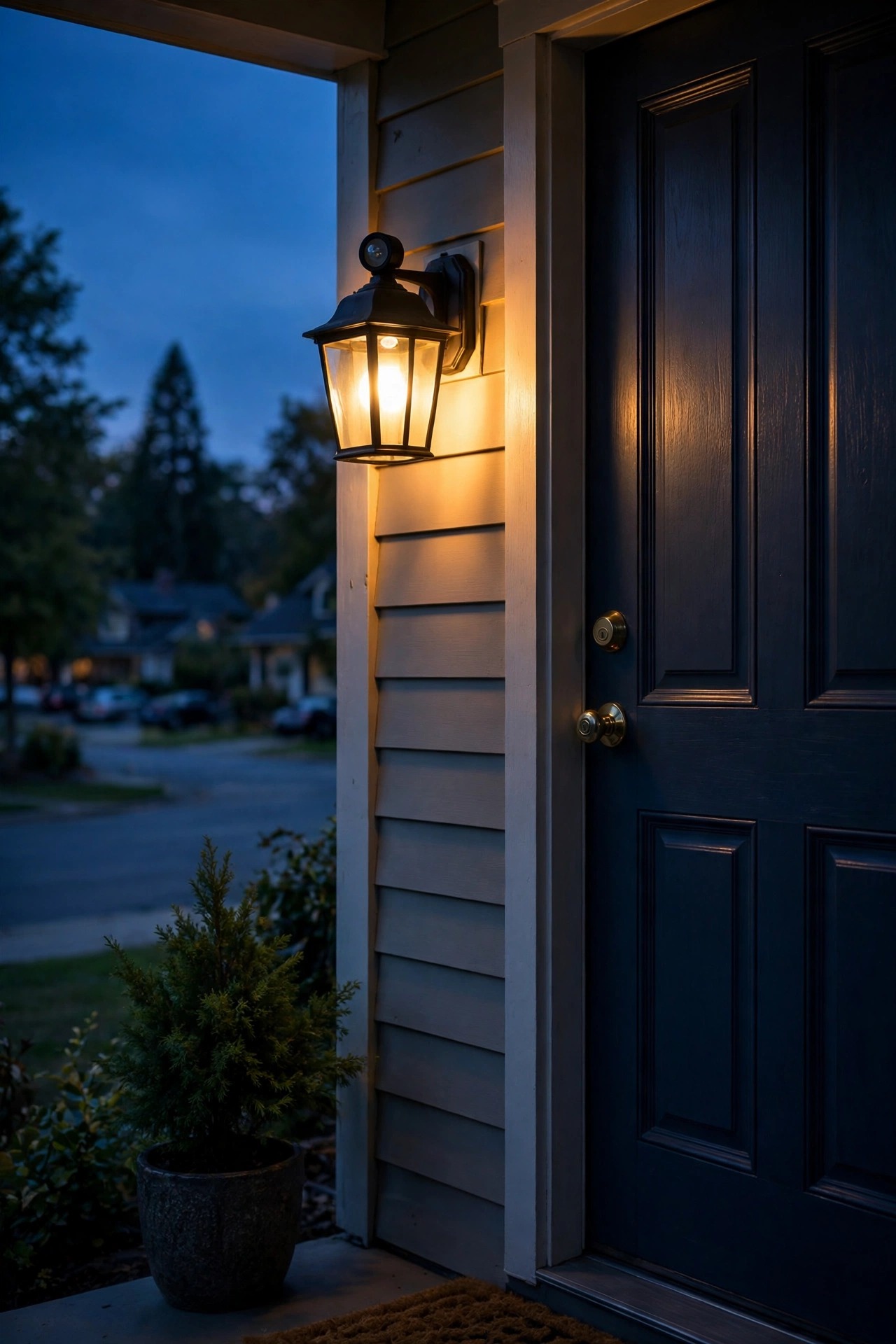
Maintenance: Panels and Batteries vs Bulbs and Glass
Neither type is truly set-and-forget, but they ask for different chores.
A solar porch light needs its panel wiped down every month or two — pollen film, dust, and bird contributions can quietly cut charging by a third, and in snowy climates you will be brushing the panel off after storms if you want light that night. The battery is the wear item: expect to replace it every one to three years, and check before you buy whether it can be replaced at all. A sealed solar fixture with a dead battery is not a light with a problem; it is e-waste with a lens. In my experience a budget solar fixture lasts three to five seasons before something — battery, panel haze, a corroded contact — ends it.
Wired maintenance is lighter and slower. An LED bulb in a sheltered porch fixture commonly runs a decade; integrated LED fixtures last longer still, though when one of those dies the whole fixture goes with it. Your real chores are washing the glass twice a year so the light you paid for actually escapes, and occasionally replacing a tired photocell, a ten-minute job with the breaker off.
Over five years, the wired fixture on your wall will mostly just work. The solar one will ask for a little attention every season — a fair trade only where wiring was never an option.

What It Costs in 2026
Fixtures first. A good wired porch fixture runs $40 to $250, with most attractive, well-built options landing between $75 and $150. Add an LED bulb at $8 to $15 unless the fixture has integrated LEDs. If the junction box already exists, DIY installation is free, and an electrician will typically swap a fixture for $100 to $200. Running brand-new wiring to an unlit entry is the expensive scenario: $250 to $600 or more depending on the wire run, and that is the number that makes solar look brilliant.
Solar porch lights run $25 to $120, with remote-panel and motion models at the top of the range, and installation is effectively free. The hidden costs arrive later: replacement batteries at $8 to $15 every one to three years, and a full fixture replacement every three to five years when something sealed gives up.
Running costs are where wired surprises people — by being nearly free. A 9-watt LED burning twelve hours a night uses about 39 kilowatt-hours a year, roughly $7 annually at average US electricity prices. A brighter 14-watt bulb still lands around $11 a year. Solar running cost is a true $0, but saving $7 a year takes a long while to pay back a fixture you replace twice as often.
Five-year math for a typical entry: wired comes to about $160 all-in with one bulb change. Solar lands around $90 to $150 across one fixture, one battery, and possibly one replacement. Close enough that cost alone should never decide this — sunlight and existing wiring should.

Solar vs Wired Porch Lights: The Verdict by Situation
Enough comparison — here is how I would call it at five real entries, including my own.
Your main front door, with wiring already in place: wired, and it is not close. You get full brightness for cameras and keyholes, any style you love, smart control if you want it, and a decade of near-zero attention.
A covered porch or a north-facing entry: wired again. I have watched homeowners cycle through three solar fixtures on a roofed porch, blaming the products, when the real problem was a panel living in permanent shade. The one exception is a remote-panel solar model with the panel mounted out where the yard gets sun — workable, but wired is still simpler.
No wiring anywhere near the spot — a gate, a detached garage door, a shed, the far end of a fence: solar, happily. That is what it was born for, and a motion model there will run for seasons. The same logic drives my advice on solar vs wired landscape lighting out in the yard.
A rental, or a home you may sell within a year or two: solar or a battery fixture. No changes to wiring you do not own, no electrician, and you take the light with you when you go.
A side or back door that gets occasional traffic: a solar motion light is the value pick of this entire guide. It asks for nothing, bursts bright when the dog needs out, and never once needs a switch flipped.
Match the light to the situation and both technologies look smart. Force one to do the other's job and both look broken.

6 Mistakes That Make a Porch Light Disappoint
Mistake one: buying an integrated-panel solar light for a shaded porch, then concluding that solar is junk. The fixture was fine; the site was impossible. Check where the sun actually falls at noon in December, not just in June.
Mistake two: judging by the lumens printed on a solar box. Those numbers describe the first bright minute on a full battery, not hour six of a winter night. Read owner reviews for how the light behaves at midnight instead.
Mistake three: mounting a motion light where it watches the street. Every passing car becomes a trigger, the battery drains on false alarms, and the neighbors get a strobe show. Aim sensors along the approach path, not across it.
Mistake four: choosing a bare-bulb wired fixture at face height. Plenty of lumens, all of them aimed into your eyes — guests squint and cameras record a white flare instead of a face. Shielded glass or a downward-facing design wins.
Mistake five: mismatching the pair. Two different color temperatures flanking a door — one warm, one daylight — makes a beautiful entry look like a repair in progress. Match 2700 to 3000K on both sides.
Mistake six: forgetting the steps. The porch glows, the stairs sit in shadow, and somebody misses the last tread in the dark. One small fixture or a lit zone aimed at the steps finishes the job the porch light started.
Frequently Asked Questions
Can a solar porch light really stay on all night?
On a full summer charge, a good one can hold a modest glow from dusk to dawn, especially models that idle at low brightness and save their strength. Winter is the honest test: shorter days, weaker sun, and long nights mean many solar porch lights fade somewhere in the small hours, and a shaded or covered porch makes it worse. Motion-activated models last longest of all because they spend most of the night dark. If guaranteed light until sunrise is non-negotiable, that is a wired job.
How bright should a porch light be?
For a single entry fixture, somewhere between 400 and 800 lumens lights a porch, steps, and faces comfortably without glare. A pair of sconces can run 300 to 500 lumens each and look richer than one bright light. More is not better at face height — a blazing bare bulb blinds guests and washes out cameras. Warm white, 2700 to 3000K, flatters faces and brick alike and matches the rest of your outdoor lighting.
Can I put a solar light on a covered porch?
Only the remote-panel kind. A standard solar fixture charges through a panel built into its top, and under a porch roof that panel might see a tenth of the light it needs, so the fixture glows weakly and dies early regardless of what the box promises. If your heart is set on solar for a covered porch, choose a model with the panel on a cord and mount that panel out on a sunny railing or post. Otherwise, the covered porch is wired territory.
Should I pay an electrician to add wiring for a porch light?
For the main entry you use every night, yes, I would. It permanently unlocks real brightness, every fixture style, and every control option, and it is a one-time job on the door that counts most for security and first impressions. For a side door, a gate, or any spot you visit a few times a week, a solar motion light delivers most of the benefit with none of the disruption. Spend the wiring money where the traffic is.
Conclusion
The solar vs wired porch lights debate has a boring secret: both technologies are good, and almost every unhappy porch light I see is simply the right product installed in the wrong situation. Wired owns the main entry — brighter, steadier, prettier, and nearly free to run once the box is in the wall. Solar owns everywhere the wire never went, asking only for honest sunshine and a battery change now and then. Look at your porch the way the light will experience it — the roof over it, the direction it faces, the wiring behind the wall — and the choice usually makes itself. Start with the entry you use every night, get that one right, and let the layering build from there. If you are planning the rest of the front-of-house glow, browse the porch and path lighting ideas here on the site and steal the combinations that fit your home.