Every spring, a neighbor asks me the same question at the mailbox: should the front walk get solar stakes or a real wired system? The honest answer is that the solar vs wired path lights debate has no single winner — it has a right answer per path, per yard, and per budget. I have installed both, lived with both, and ripped out both when they were wrong for the spot. Solar lights ask almost nothing of you on day one and then quietly depend on the weather forever after. Wired lights demand one sweaty weekend of trenching and then behave like porch lights: on at dusk, same brightness, no drama. This guide compares the two head to head on the three things that actually decide satisfaction — cost, brightness, and lifespan — plus the practicalities nobody mentions at the store: shade, winter, maintenance, and what each system feels like to live with in year three. By the end, you will know exactly which runs in your yard deserve cable and which ones a solar stake will handle beautifully.
The Short Answer
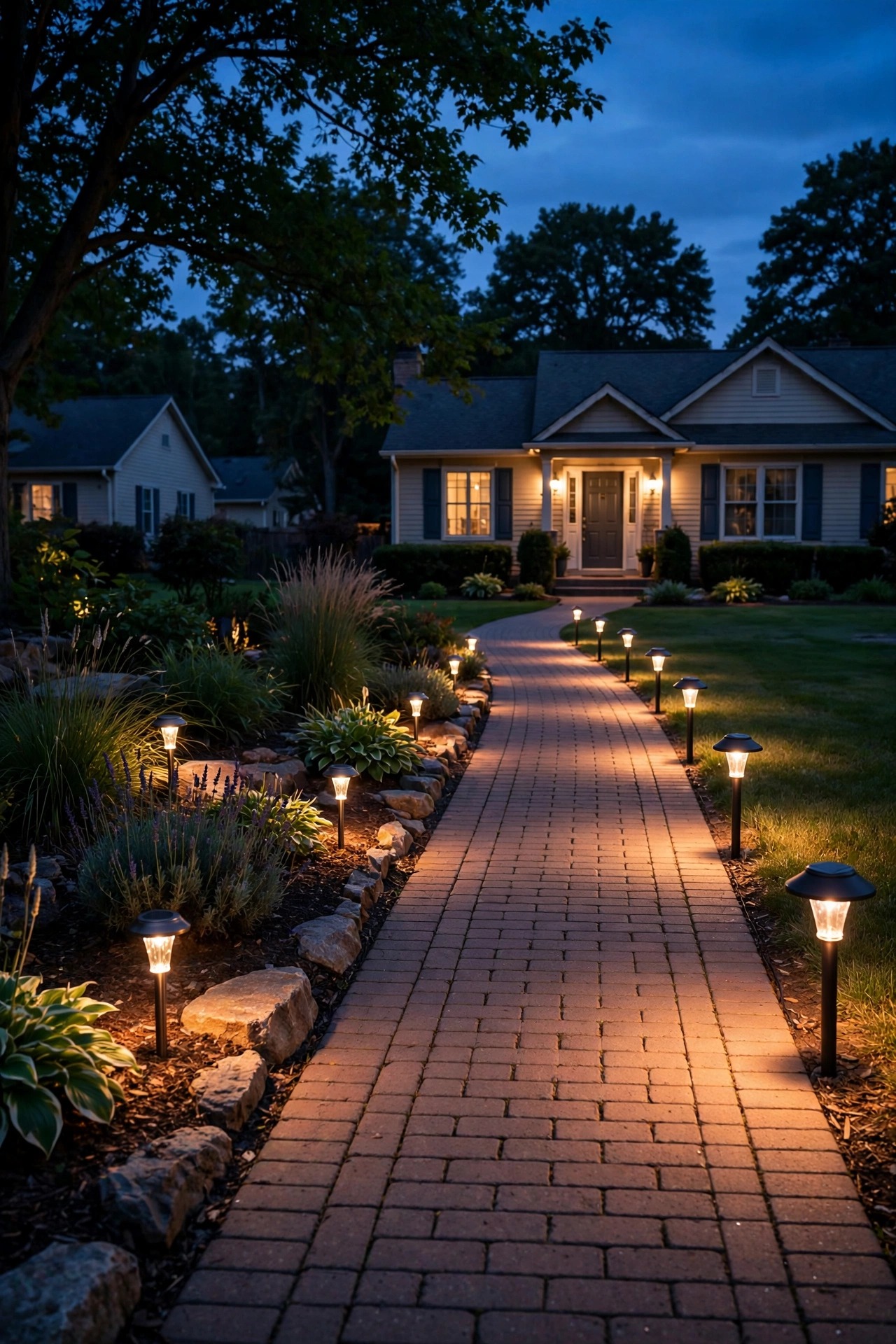
Short version: wired path lights win on brightness, consistency, and lifespan — they deliver the same warm pool of light every single night, in January as in June, and a good low-voltage system runs for a decade or more. Solar path lights win on installation and upfront cost: no cable, no transformer, no digging, and they are genuinely good along sunny garden edges. The catch is physics. Solar brightness rises and falls with the weather and the season, and batteries fade within a few years. Most yards land on a hybrid: wired for the main walk, solar for the accents.
How Each System Actually Works
A solar path light is a tiny self-contained power plant. A small panel on top collects sunlight all day, a rechargeable battery tucked inside stores it, a light sensor notices dusk, and the LED switches itself on. Every fixture is independent — no wiring, no central control, no communication between lights. That simplicity is the whole appeal, and also the ceiling: each light lives or dies by the sun that happened to fall on its own little panel. My guide to solar path lights walks through panel types and placement if you want the deep dive.
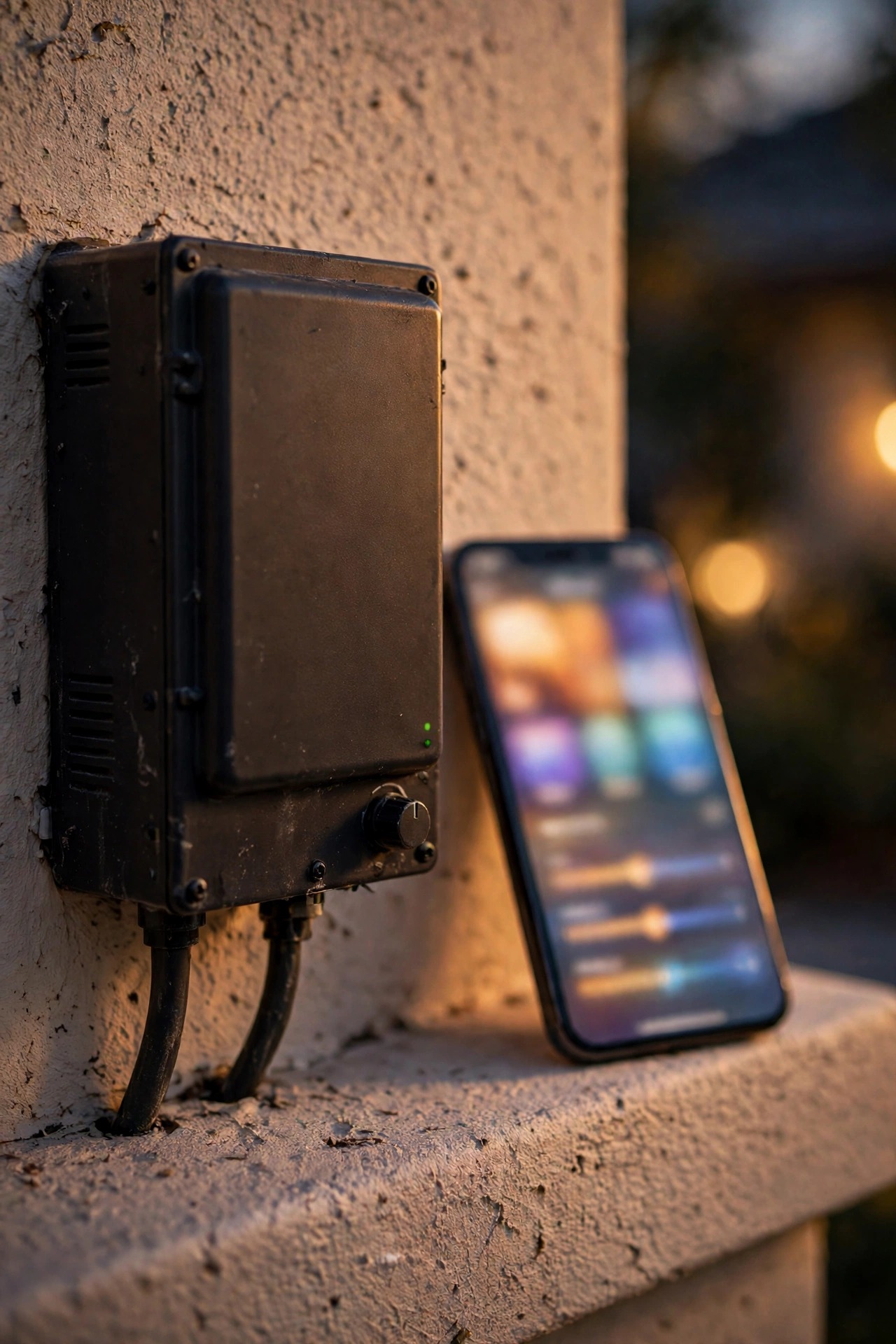
A wired system — almost always low-voltage for paths — works like a tiny utility. A transformer plugged into an outdoor outlet steps household current down to a safe 12 volts. A buried cable runs from the transformer along your path, and each fixture taps into that cable. One timer or photocell at the transformer runs the entire system together, so every light shares the same schedule and the same steady power. The fixtures themselves are simpler than solar ones because they carry no panel and no battery. Everything that can wear out is concentrated in a few serviceable parts instead of scattered across a dozen stakes.

Brightness and Consistency: Solar vs Wired Path Lights, Side by Side
This is the axis where the two systems are not really close. A typical solar stake produces a soft glow — enough to mark an edge, not enough to truly light the ground. Even good solar models are modest, and that output is a best case: it assumes a full sunny day of charging. After two cloudy days, the same light may glow weakly for an hour and quit by nine. Solar output also fades through the night as the battery drains, so the light at midnight is dimmer than the light at dusk.
Wired fixtures deliver several times that brightness, and they deliver it identically every night of the year. Because the power never runs out, you can space fixtures so their pools of light overlap slightly, which is what makes a walk feel evenly lit instead of dotted. Color is more consistent too: a wired run uses matching bulbs in one warm color temperature, while solar stakes bought in different batches often drift bluish or mismatched. For pure decoration, solar glow is honestly charming. For seeing the path, wired wins without a fight. Stand on your porch at ten on a December night after a gray day, and the difference stops being theoretical: one system is a rumor of light, the other is simply on.
Lifespan and Failure Modes: Batteries and Panels vs Transformers and Cable
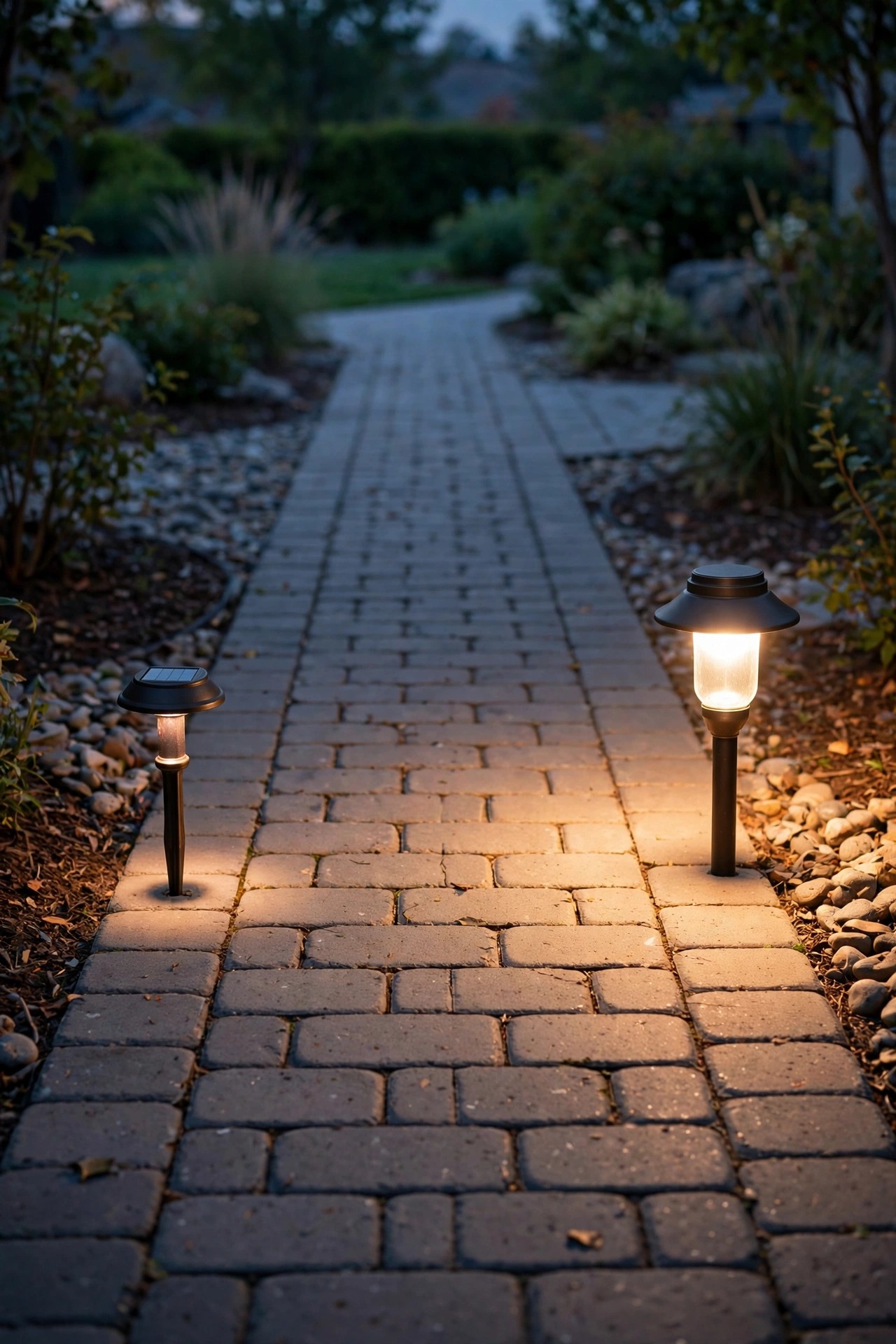
Solar lights fail slowly and individually. The battery is the first casualty — most hold a useful charge for one to three years before run time collapses. Better models let you swap the battery; sealed bargain units expect you to replace the whole light. Panels haze over in the sun, plastic housings go brittle, and water sneaks past tired seals. The LED itself could last a decade, but the parts around it rarely do. Expect a cheap solar set to look tired by year three and a quality one to need battery attention on the same schedule.
Wired systems fail rarely and usually all at once. The transformer is the heart, and a decent one runs ten to fifteen years. Buried cable lasts indefinitely unless a shovel finds it. Fixtures with replaceable bulbs ask for a new bulb every few years; integrated LED fixtures commonly run a decade. When a wired run goes dark, it is almost always one fixable thing — a tripped breaker, a failed timer, a cut cable — rather than twelve little funerals. Over a ten-year window, the wired system asks for far fewer replacements, which matters as much as the purchase price. Keep the receipt math in mind, too: replacing a whole set of lights twice in a decade quietly erases the savings that made solar look cheap on day one.

Installation Day: Stake-and-Go vs Trenching Cable
Solar installation barely deserves the word. You push the stake into the soil, pull the battery tab, and walk away. Ten lights take fifteen minutes, nothing is permanent, renters can take them when they leave, and rearranging the layout next season costs nothing but a whim. If the ground is hard clay you may need to pre-wet the spots or start the holes with a screwdriver, and that is genuinely the hardest part.
Wired installation is a real project, though a very doable one. You mount the transformer near an outdoor GFCI outlet, plan the cable run, and dig a narrow trench roughly six inches deep along the path — a flat spade makes a slit trench in most lawns, so you fold the cable in rather than excavating. Fixtures connect with weatherproof connectors, you power up at dusk to check spacing and aim, adjust voltage drop on long runs by looping the cable back or splitting it into two shorter runs, then backfill. Nothing about it needs a permit or an electrician in most places, since the run beyond the transformer is low voltage — just plug the transformer into a covered GFCI outlet and keep the connections off the soil surface. A ten-to-twelve-light system is an honest weekend. My notes on choosing low-voltage path lights cover fixture styles if you go this route.
Shade, Winter and Weather: Where Each System Struggles
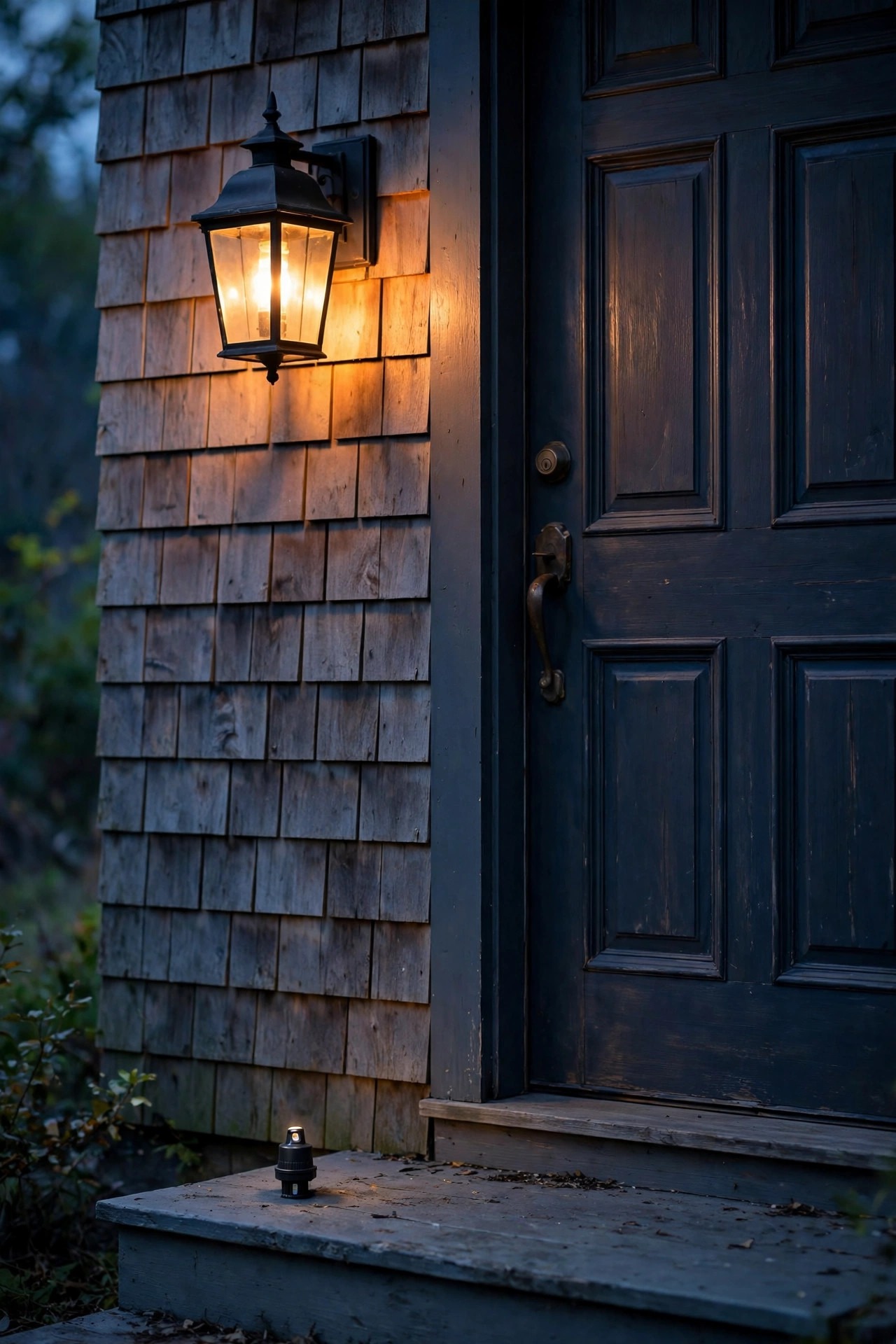
Solar lights run on a simple contract: roughly six to eight hours of direct sun buys a full night of light. Break the contract and the light breaks its promise. A path under mature trees, on the north side of the house, or shadowed by a fence may get two hours of sun — and two hours of dim, short-lived glow is what comes back at night. Winter compounds everything: shorter days, a lower sun that hides behind the house, snow sitting on panels, and cold batteries that hold less. Remote-panel models, where the panel sits on a cable in a sunny spot, are a genuine partial fix.
Wired lights do not care about any of this. A January blizzard changes nothing about their output; the transformer hums along under its cover and the schedule runs off a timer or an astronomical clock that tracks the season. The only weather caveats are installation ones — nobody trenches frozen ground happily — and basic common sense about keeping connections weatherproof. One honest exception: open yards with a low winter sun but no tree canopy can still feed solar panels decently at midday, which is why two houses on the same street can have opposite experiences with the identical light. But if your path lives in shade, this section alone settles the debate.

Safety Light vs Accent Light: How Much Brightness You Actually Need
Not every path does the same job, and matching the system to the job is where good outcomes come from. Some runs are pure accent: the edge of a flower bed, a gentle dotted line around a tree, a hint of glow along a fence. Nobody is judging their footing there, and a soft solar gleam is honestly all the moment asks for. If it runs short on a cloudy night, nothing bad happens.
Other runs are safety infrastructure wearing a pretty hat. The front walk your guests use after dinner, the steps down from the deck, the path to the driveway where the grade changes — these need real, reliable illumination every single night, including the overcast Tuesday in December when someone is carrying a casserole. That reliability is exactly what solar cannot promise and wired delivers by default. My rule after years of both: if a stumble there would hurt, wire it. If a dim night there would merely disappoint, solar is fine. Brightness numbers help frame it: an accent only needs to be seen, while a step needs to be read — edges, tread depth, and the dark line where one level ends and another begins. Shielded, downward-aimed fixtures matter for both systems, since glare blinds more than darkness does.

Maintenance: The Small Jobs That Keep Either System Alive
Solar maintenance is frequent but tiny. Panels need a wipe whenever they look dusty or pollen-filmed — a dirty panel can cut charging dramatically, and it happens faster than you would guess under trees. Batteries need replacing every year or two on models that allow it, stakes need straightening after frost heave and mower bumps, and lights need repositioning as shrubs grow and shade creeps. None of it is hard; all of it is recurring, forever, light by light.
Wired maintenance is rare but slightly more mechanical. Once or twice a year I walk the run: straighten tilted fixtures, clean lenses, confirm the timer still matches the season, and check any connection that sits where sprinklers soak it. A fixture occasionally fails and gets swapped at its connector in minutes. The system mostly disappears from your life between those walks, which is the quiet luxury you paid for on installation weekend. Whichever system you choose, the five-minute monthly glance while taking out the trash is what separates a yard that still glows in year three from a yard of sad plastic. Neither list is a reason to choose or reject a system on its own — but if you know you are a set-it-and-forget-it person, weight this section heavily, because maintenance debt is where solar setups quietly die.
What It Costs in 2026
Let me put honest 2026 numbers on all three title axes, starting with purchase price. Solar stakes run about $3 to $6 per light in bargain multipacks — a full set of eight is often $25 to $40 — while quality metal solar lights with replaceable batteries run $12 to $25 each. A ten-light front walk in solar lands between $60 and $200, all-in, forever, no other hardware.
A wired system costs more before it lights anything. Fixtures run $25 to $60 each, a decent transformer is $70 to $180, and 100 feet of low-voltage cable is roughly $50 to $90, plus small change for connectors. Ten lights done yourself: $400 to $900. Hiring it out typically lands between $1,800 and $3,500 for the same run.
Running costs are small but real. A wired run of ten LED fixtures draws perhaps 30 to 50 watts total; five hours a night works out near $10 to $15 a year in electricity. Solar electricity is $0. The five-year ledger is where it turns: cheap solar usually gets re-bought once — say another $60 to $200 — or nursed with $40 to $120 of replacement batteries, while the wired system spends its $50 to $75 on electricity and nothing else. Cheap solar is cheaper for about two years. Across a decade, wired usually wins the money argument too.

Solar vs Wired Path Lights, Zone by Zone
Here is the verdict I actually give friends, run by run. The front walk and main entry: wired, no hesitation — it is the most-used, most-seen, most-stumbled-on path you own. Steps and grade changes: wired, for the same safety reason. The driveway edge where cars and guests navigate: wired if the run is reasonable, quality solar only where the sun is truly full.
Garden beds, flower borders, and the edges of planting islands: solar, happily — soft accent glow, zero trenching through roots, easy to move when you divide the perennials. Around specimen trees and along fence lines far from the house: solar again, especially where a cable would have to cross a driveway or patio to reach. The mailbox at the curb and any spot where digging is impossible or forbidden: solar by default. Renters and anyone testing a layout before committing: solar as the rehearsal, wired as the performance. And the garage-side path you use every night with arms full of groceries? That one counts as a main walk in my book, however short it is — frequency of use, not length, decides. If you are planning the whole yard at once, my broader take on solar vs wired landscape lighting maps the same logic onto spotlights and floods.
The Hybrid Setup Most Yards End Up With
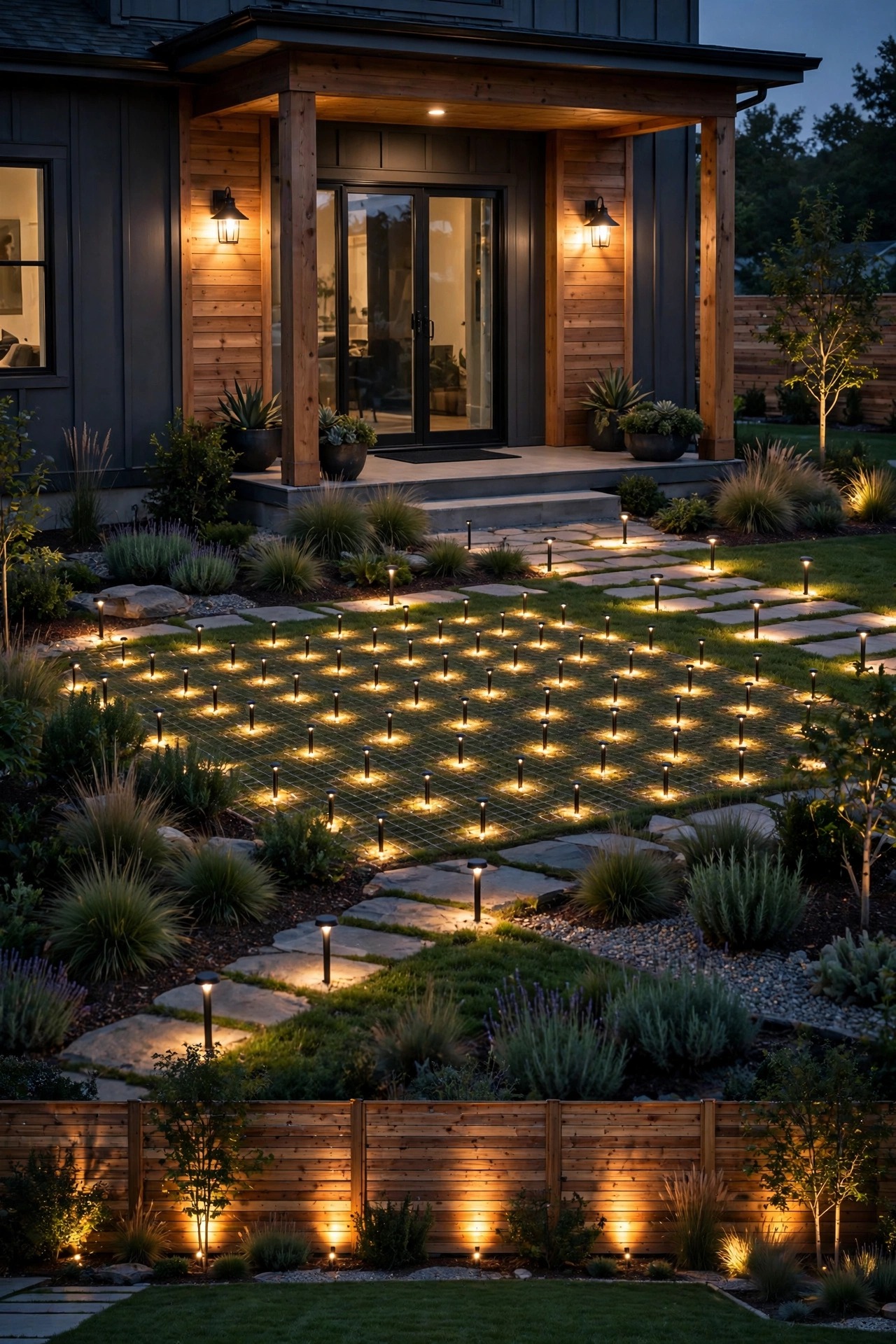
Notice what the zone-by-zone verdict produces: most real yards end up hybrid, and that is not a compromise — it is the correct answer. A wired backbone handles the three or four runs you depend on nightly: the front walk, the steps, the side path to the driveway. Solar handles everything decorative and distant, where its weaknesses do not matter and its freedom does.
Two tricks make a hybrid look designed rather than accidental. First, hold one color temperature across both systems — warm 2700 to 3000K everywhere, and buy solar lights specified warm white, because a blue-white solar stake next to a warm wired fixture instantly reads as a mistake. Second, keep fixture styles in one family: black metal finishes and similar silhouettes let the two systems blend after dark, when all anyone sees is the light itself. Slightly oversize the transformer and leave a little slack in the cable runs, and future-you can extend the wired backbone the year the solar experiment along the side fence finally annoys you enough. Start with the backbone even if the budget only stretches to the front walk this year; solar can hold the side yard for a season or three and retire gracefully to pure accent duty as you extend the cable.

Mistakes That Make Either System Disappoint
Most unhappy path lights I am asked to rescue trace back to one of these. First, buying solar for a shaded main walk — the single most common error. The lights were never defective; the address was. No panel chemistry rescues a path that gets two hours of sun, and the fix is wired fixtures or a remote panel, not a pricier stake.
Second, comparing box lumens. Solar packaging often quotes a peak or theoretical figure, while what you live with is sustained output on a February charge. Judge solar by battery capacity and panel size, not the lumen shout on the box. Third, burying wired cable too shallow — an inch under the mulch feels finished until the first time an edging tool or aerator finds it. Six inches down, or tucked cleanly under the edging, is the standard for a reason. Fourth, mixing color temperatures along one sightline, covered above and worth repeating because it ruins more pretty yards than any hardware failure. Finally, spacing solar stakes at wired-fixture distances: solar needs tighter spacing for a continuous effect, because each light throws a smaller pool. Every one of these mistakes is fixable after the fact, but each is cheaper to dodge on paper than to correct with a shovel or a second purchase.
Frequently Asked Questions
Can solar path lights really light a walkway safely?
On a sunny, open walk, quality solar lights can mark the route clearly enough for careful footing — but safely is a strong word. Their output depends on the day of weather behind them, and they are dimmest exactly when nights are longest. For a guest walk or any steps, I treat solar as decoration and let wired fixtures carry the safety job.
How long do wired path lights last compared to solar?
A low-voltage wired system is a decade-plus installation: transformers commonly run ten to fifteen years, cable lasts indefinitely, and quality fixtures go just as long with occasional bulb swaps. Solar lights typically give two to four good years before batteries fade and housings weather, though replaceable-battery models stretch that with fresh cells.
Can I mix solar and wired lights on the same path?
Yes, and it often looks great — that is the hybrid approach this guide recommends. The two rules are matching color temperature, warm on both sides, and keeping fixture styles in one finish family. Put the wired fixtures where the footing matters and let solar fill the decorative gaps.
Should I replace my old wired system with solar to save money?
Almost never. If the cable and transformer are sound, your wired system is the most reliable lighting you own, and its electricity use is a few dollars a year. Refresh the fixtures or bulbs and keep it. Solar saves money on installation, not on ownership — and you already paid the installation.
Conclusion
The solar vs wired path lights question resolves the moment you stop asking which system is better and start asking which path needs what. Wired wins brightness, consistency, and lifespan, and asks one weekend of trenching as its price. Solar wins installation and flexibility, and asks the weather for permission every night after. Give the walks you depend on a cable, give the beds and borders their solar sparkle, hold one warm color temperature across both, and your yard will glow the way you pictured it — in June, in January, and in year five. Browse the rest of the site for fixture ideas once you know which runs are which, and your future self, coming home on a dark wet night, will thank you.