There is a particular kind of evening I chase all summer: the sun drops behind the fence, the stone underfoot is still warm from the day, and nobody at the table is in any hurry to head inside. That unhurried feeling is exactly what the best mediterranean patio lighting ideas are built for. Around the Mediterranean, dinner is not an event with an end time, and the lighting follows the same philosophy — low, warm, and layered, so faces glow and the food looks just as good at nine as it did at seven. Honestly, the trick is never one big fixture. It is layers: a soft canopy overhead, lanterns at eye level, and small pools of light low to the ground that quietly mark the edges of the space. Get those three layers working together and a plain concrete or stone patio suddenly feels like a courtyard in Spain or a terrace above the Amalfi Coast. Below are the 17 setups I recommend most, from five-minute string light wins to the iron and stone fixtures that give this style its bones. Every single one works on a real American patio, with real budgets and real weekends in mind.
1. Start With Layers: The Mediterranean Patio Lighting Ideas Formula
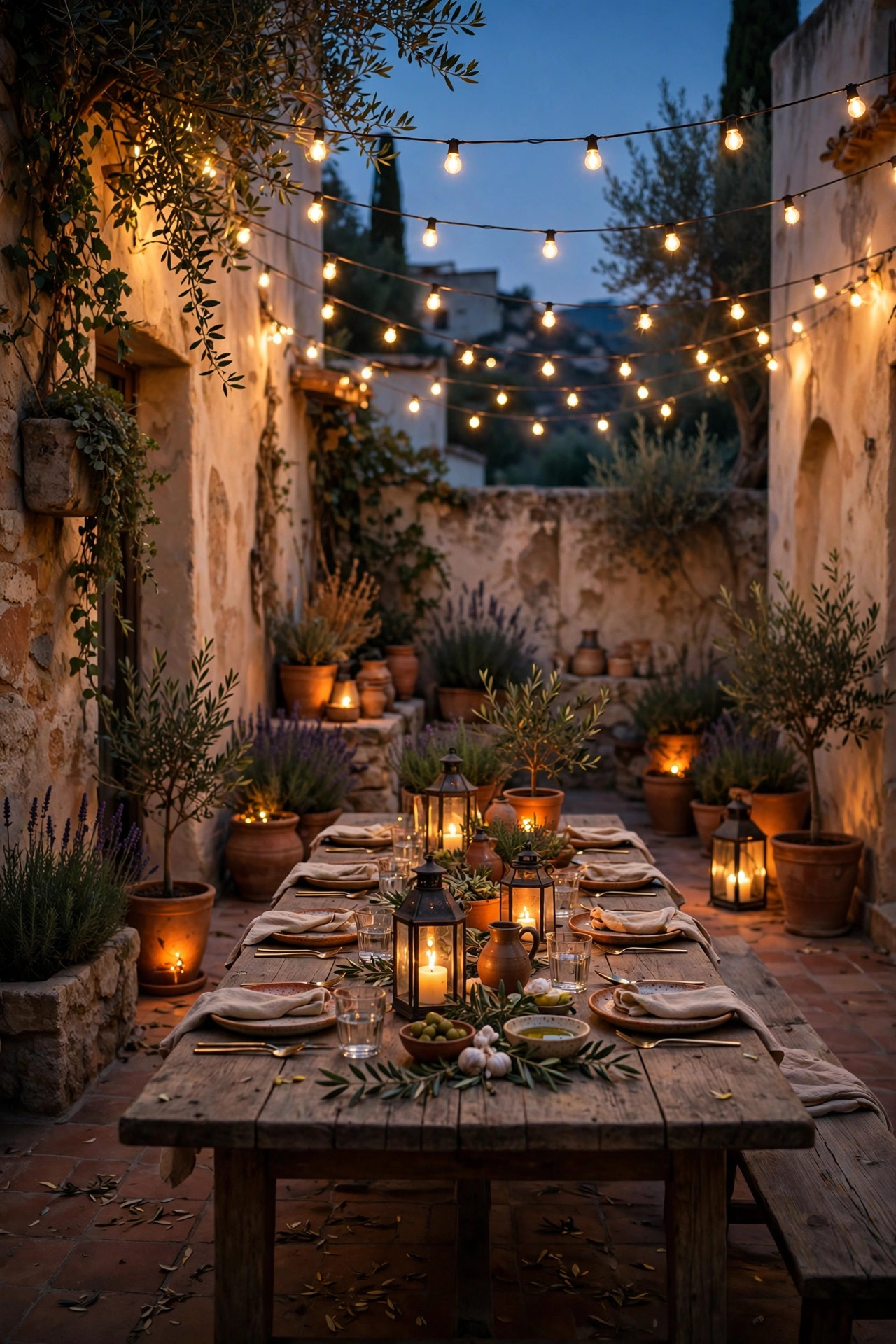
Every Mediterranean patio that feels magical after dark is running the same three-layer formula, and once you see it you cannot unsee it. Layer one is overhead: a soft canopy of string lights or a shaded pendant that gives the whole space a ceiling of warm glow. Layer two sits at eye level: wall lanterns, table lanterns, and candles that light faces, because flattering faces are the entire point of a long dinner. Layer three stays low: path stakes, step lights, and uplights that outline the patio edges and wash the plantings. In my experience, most patios fail because they only have one layer, usually a single harsh floodlight. Before you buy anything, walk your patio at dusk and assign every corner to a layer. Dining zone gets all three. Lounge corner gets eye-level and low. Steps and edges get low only. Keep every bulb at 2700K so the layers blend into one warm wash instead of fighting each other. Sketch it on paper, count your fixtures, and buy in that order: overhead first, faces second, edges third.
Suggested budget range: $150 – $450.

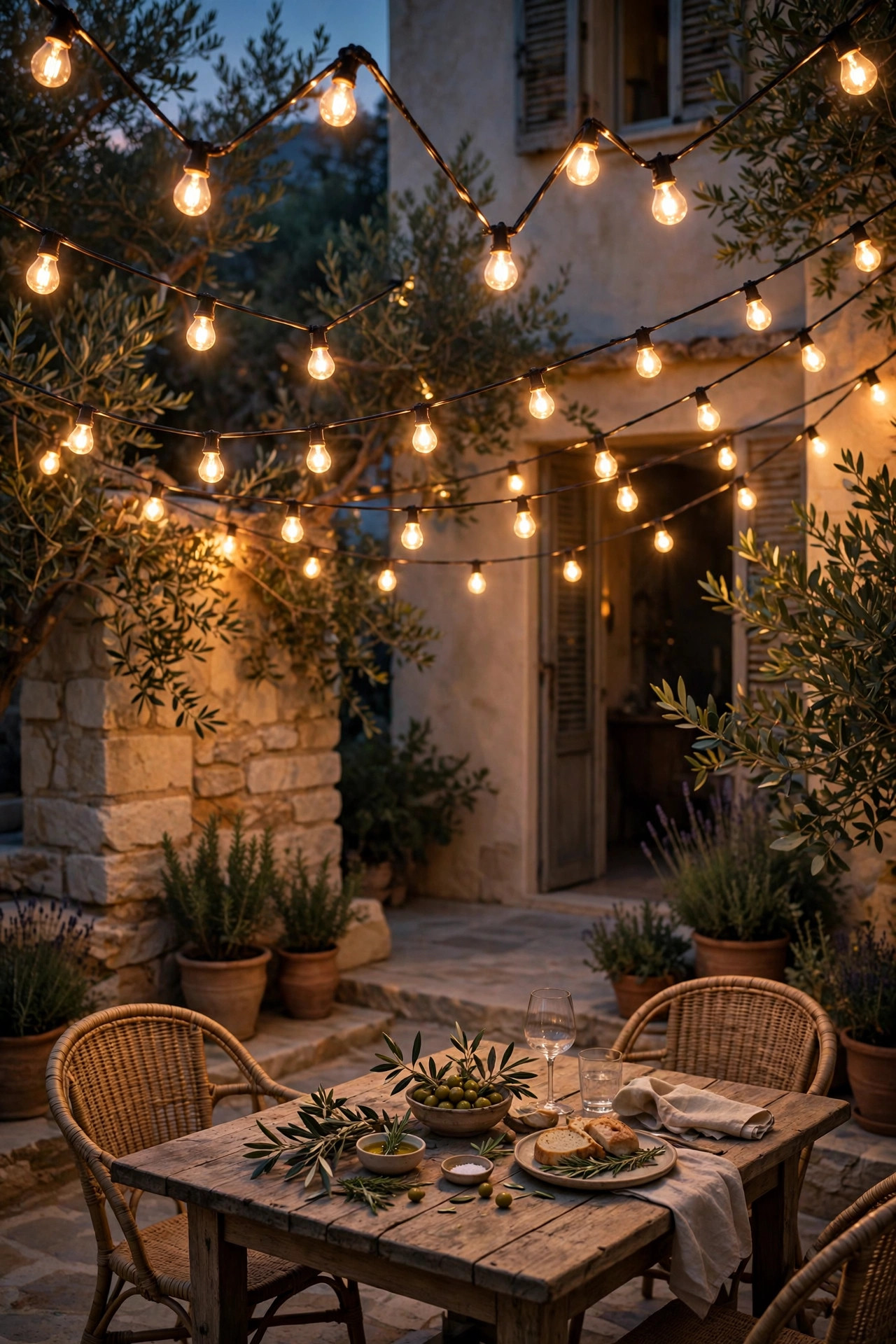
2. Zigzag a Canopy of Bistro String Lights Overhead
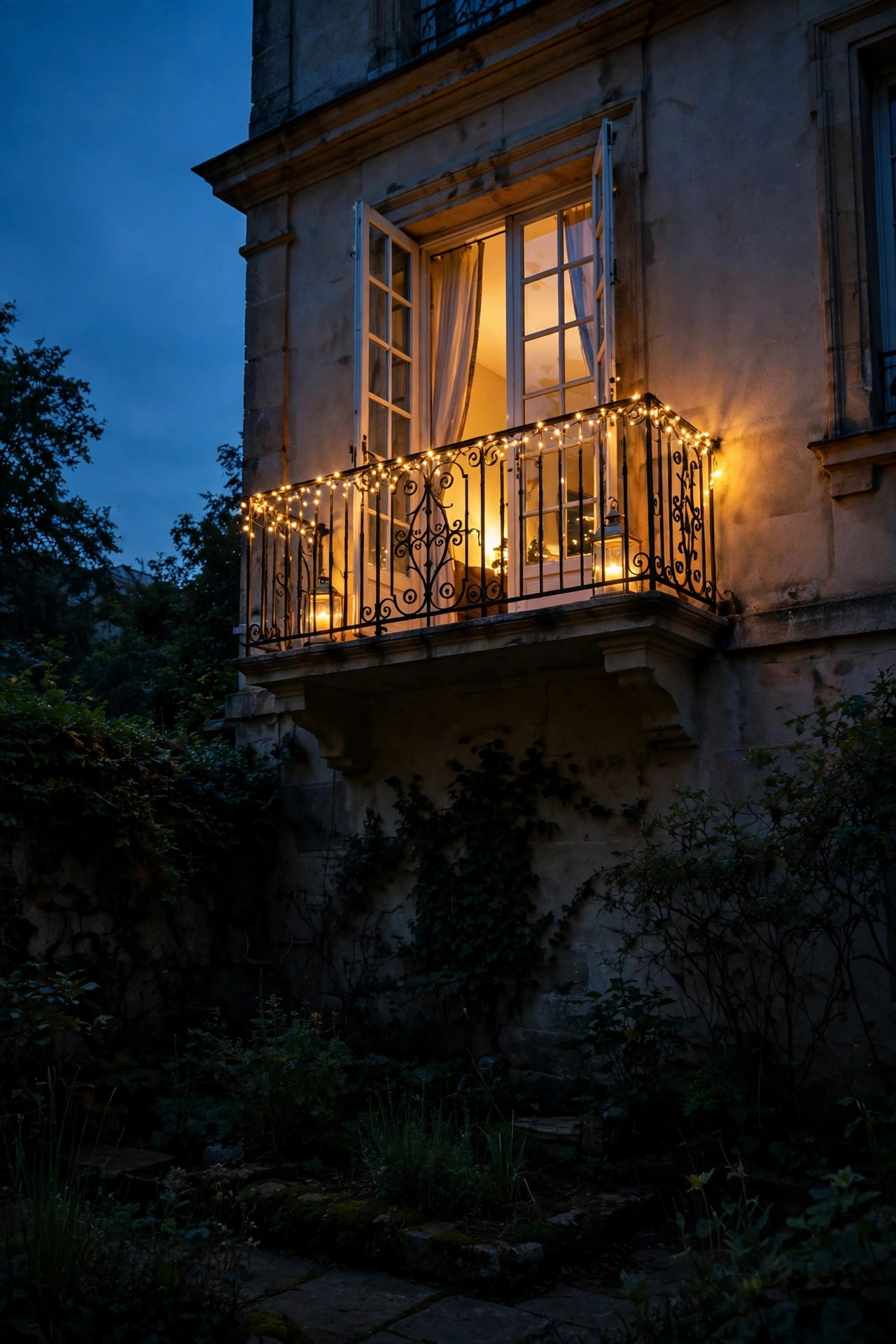
If I could only do one thing from this whole list, it would be this canopy. Commercial-grade LED string lights zigzagged over the dining area create that taverna ceiling that makes everyone linger. Run a stainless guide wire first on longer spans — the wire carries the weight so the sockets never sag — and keep each run to about 10 to 12 feet between anchor points. G40 globe bulbs or vintage-style filament LEDs at 2700K give the warmest pools of light; space the zigzags roughly 3 feet apart so the glow overlaps without hot spots. Anchor into house siding, a pergola beam, or sturdy poles, and always plug into a GFCI outlet with a drip loop so rain runs off the cord instead of into the socket. One strand is a nice touch; three or four crossing strands are a transformation. I have a full breakdown of strand styles and spacing in my guide to bistro string light ideas if you want to compare bulb shapes before you buy. On a dimmer, this canopy alone can carry the whole dinner.
Suggested budget range: $60 – $180.
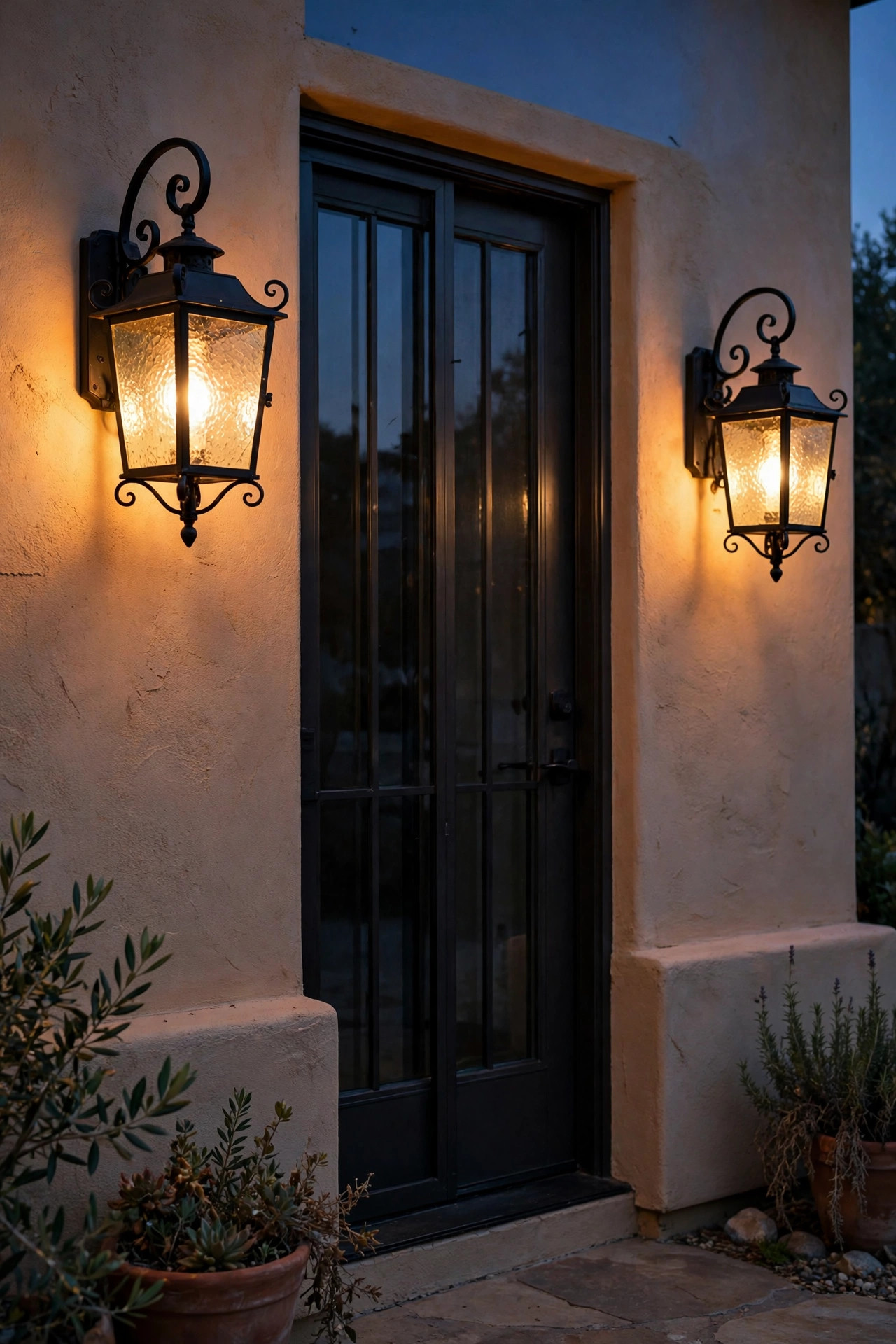
3. Flank the Door With Wrought Iron Wall Lanterns
Nothing says Mediterranean like black wrought iron against warm stucco or stone, and a pair of iron lanterns flanking the patio door is the fastest way to get that bones-of-the-house look. Choose lanterns with seeded or amber glass to soften the bulb, and size them generously — outdoor lanterns almost always look smaller once mounted, so go one size up from what feels right in the store. Mount the pair at about 66 inches from the patio floor to the center of the fixture, matched on both sides of the door for that symmetrical old-world welcome. Use LED filament bulbs at 2700K, and pick fixtures rated for wet locations since patio doors take wind-driven rain. If your door wall also holds the grill or an outdoor kitchen, add one matching lantern there so the set reads as a family. Dusk-to-dawn photocell bulbs are my favorite cheat here: the lanterns greet you every evening without a switch, and the pair frames every photo anyone takes on your patio all summer long.
Suggested budget range: $90 – $260.
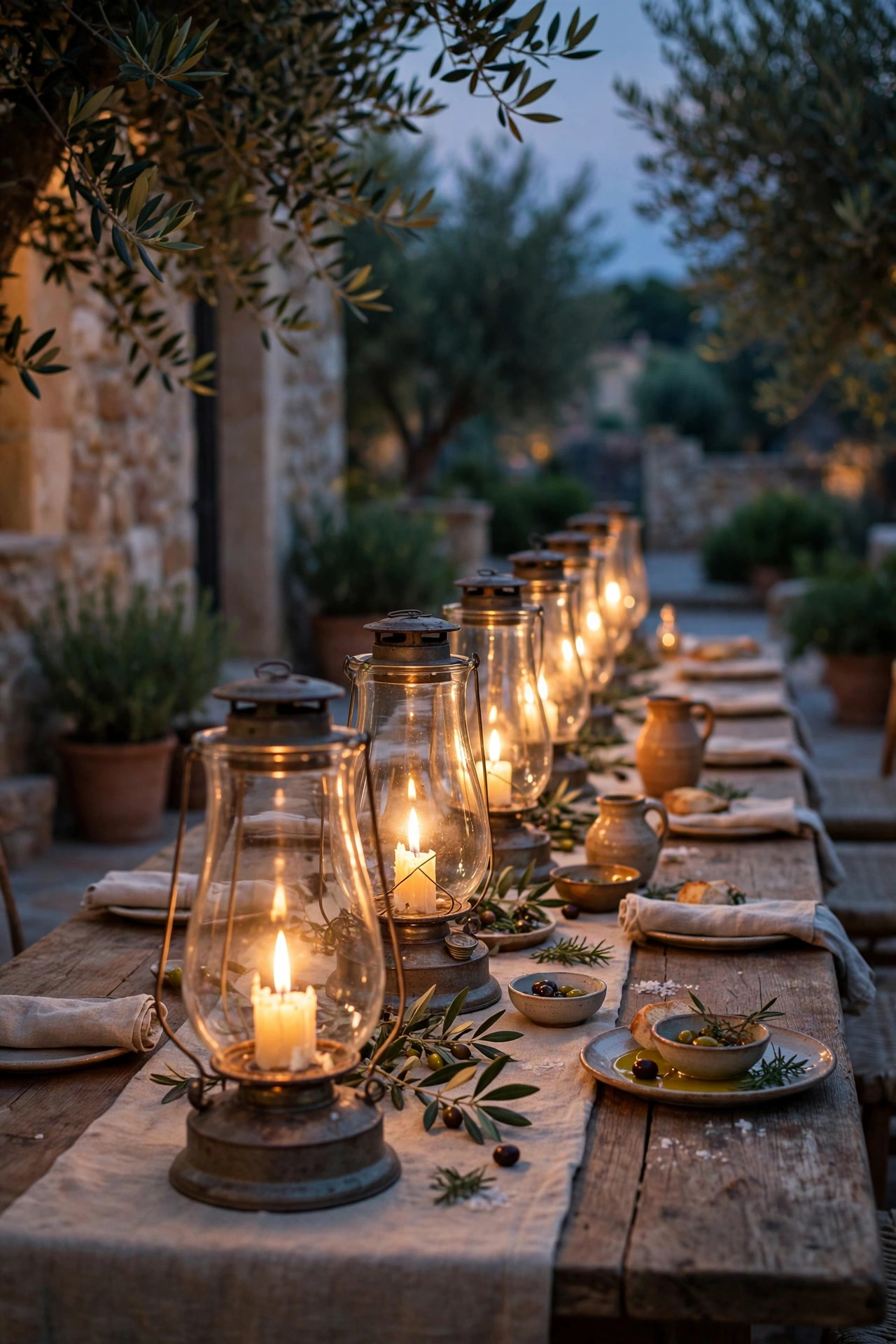
4. Run Hurricane Lanterns Down the Middle of the Table
A long dinner deserves a lit centerpiece, and a row of glass hurricane lanterns marching down the center of the table is the most Mediterranean move I know. The tall glass chimneys protect flames from patio breezes, so if you love real candles this is where they belong — always inside the glass, never loose near linens or dried centerpiece herbs. For a worry-free version, use flameless LED candles with a realistic flicker and put them on a timer so the table lights itself at sunset. Mix three heights for rhythm: tall hurricanes at the ends, shorter ones between, and tiny votives scattered where plates allow. Odd numbers photograph best, and grouping in threes keeps it from looking like a runway. Set them on a woven runner or a weathered wood board to protect the table and gather the arrangement into one long glowing ribbon. Keep flames and hot glass at least a foot from anything flammable, and let the lanterns stay out as decor during the day — the glass and metal earn their keep around the clock.
Suggested budget range: $35 – $120.
5. Uplight Terracotta Pots and Potted Citrus
Terracotta is the unofficial pottery of the Mediterranean patio, and a small uplight tucked at the base of each big pot turns plantings into sculpture after dark. Use a low-voltage well light or a warm solar spotlight aimed up into the canopy of a potted olive, lemon, or bay tree, positioned about 6 to 10 inches from the trunk so the beam grazes bark and leaves instead of blasting through them. The terracotta itself picks up a gorgeous rim of glow from the spill. Group pots in threes — one tall tree, one mid shrub, one trailing plant — and light the tall one; the others borrow the light and shadow. Solar versions have gotten genuinely good, but for the hero tree I recommend wired low-voltage on a timer so the effect never fades by dessert. Keep fixtures slightly buried or hidden behind the pot rim so guests see the glow, not the hardware. This is the cheapest layer-three trick on the list and the one visitors ask about most.
Suggested budget range: $40 – $150.

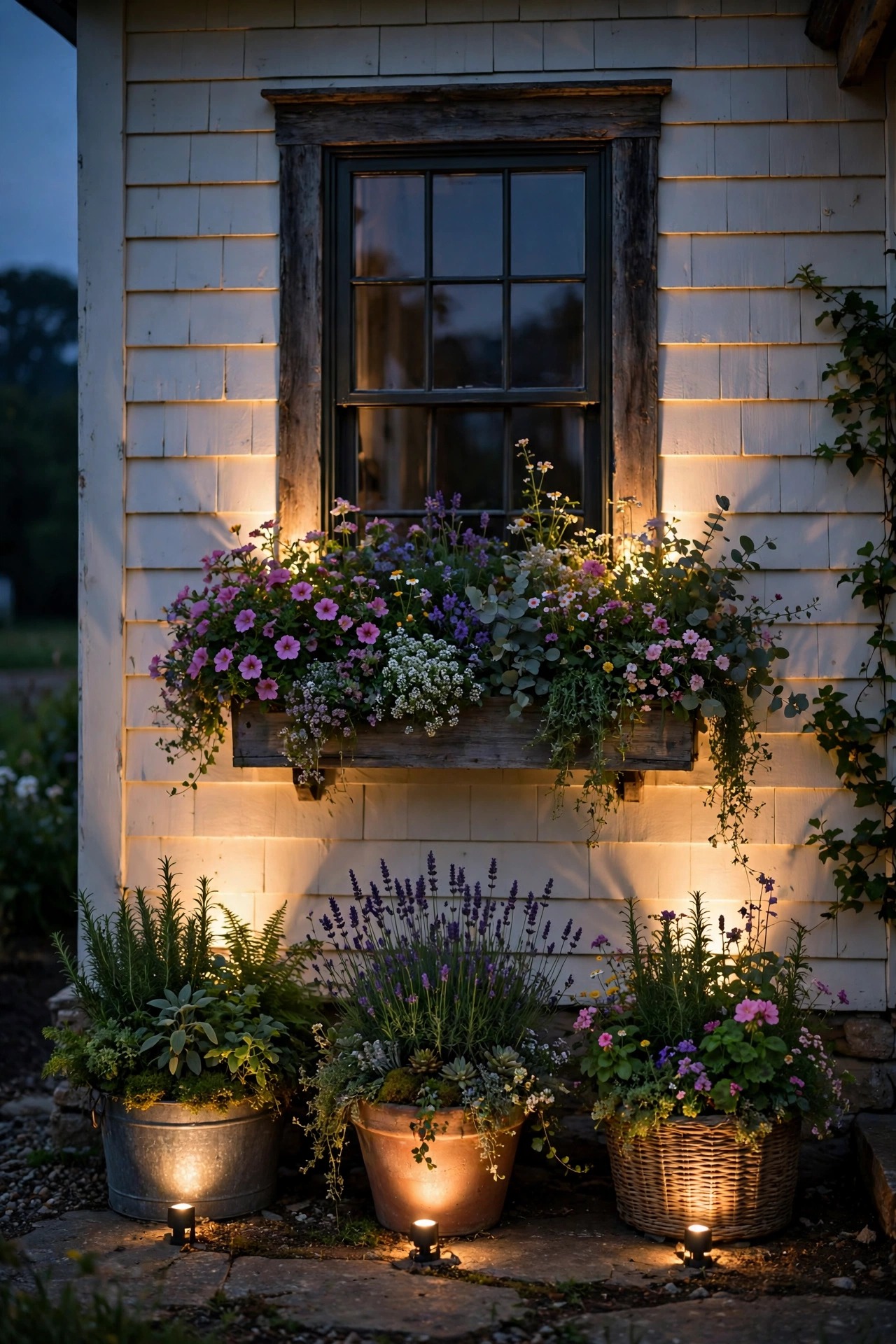
6. Add Downlights Under the Pergola
A pergola over the dining table is prime Mediterranean architecture, and it gives you something priceless: a ceiling to light from. Recessed puck lights or small downlights mounted to the beams wash the table in a soft pool of light that feels like a private dining room outdoors. Space them evenly over the table rather than the whole pergola — two to four fixtures usually covers an eight-foot table — and put them on a dimmer so the light can drop as the evening deepens. If hardwiring is not in the cards, battery puck lights with remotes or a plug-in pendant swagged from the center beam get you most of the effect in an afternoon. Vines woven through the beams throw beautiful moving shadows in a light breeze, which is half the charm. I collected more beam-by-beam layouts in my roundup of pergola dining lighting ideas if your pergola is already built and you are retrofitting. Warm 2700K, always, and aim straight down so nobody gets a bulb in the eye.
Suggested budget range: $120 – $400.

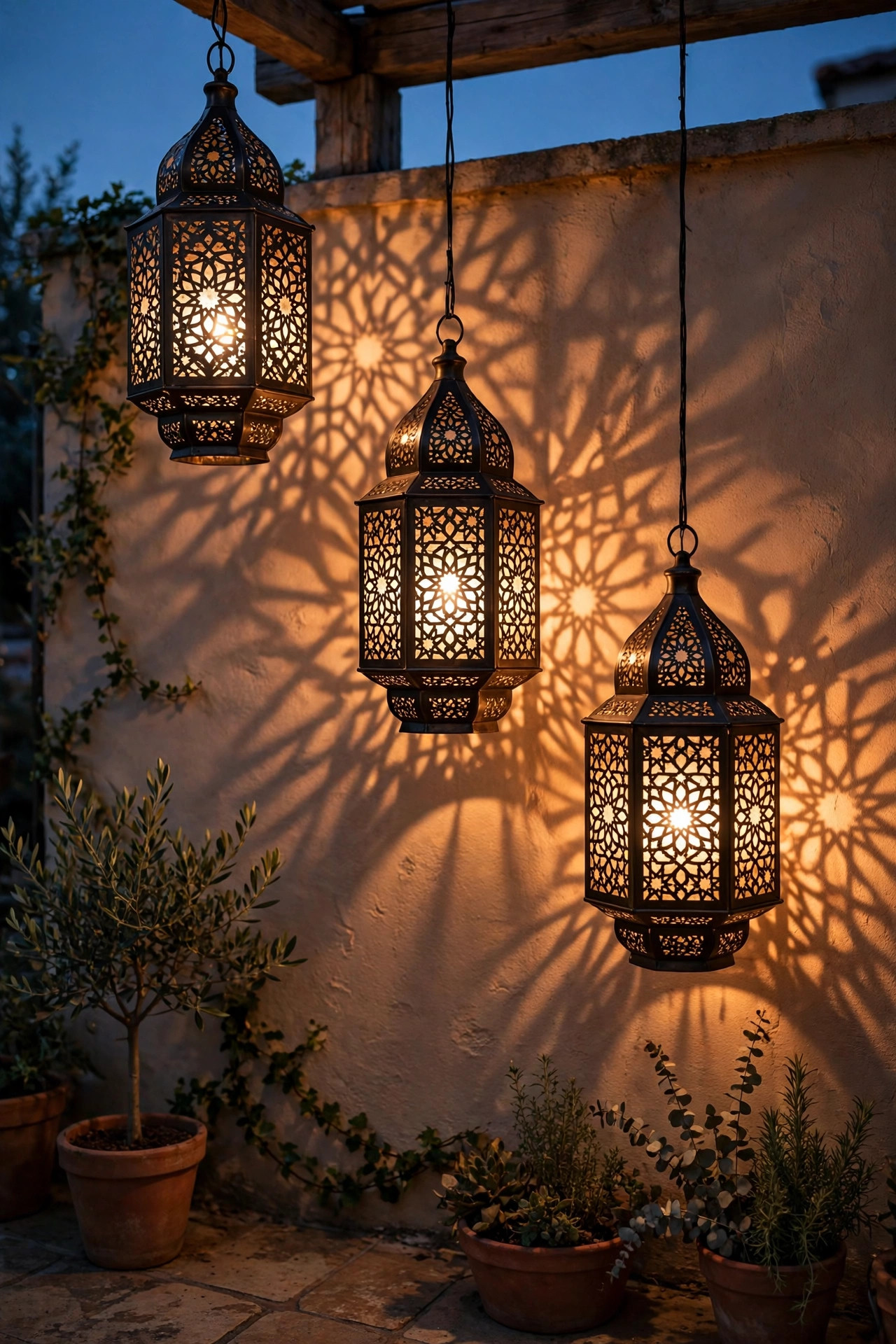
7. Hang Pierced Metal Lanterns for Patterned Light
Pierced metal lanterns — the filigree style you see in Moroccan courtyards and Andalusian patios — do something no other fixture does: they project the pattern. Hang two or three at staggered heights from a pergola corner, a shepherd hook, or a sturdy tree branch near the lounge chairs, and the cutwork throws lace-like shadows across the stone. Put flameless candles or warm LED fairy-light bundles inside rather than real flame; the piercings glow like embers and there is zero fire risk near cushions. Brass, aged copper, and matte black finishes all work; just keep the metal family consistent with your wall lanterns. During the day they read as sculpture, which I love — decor that earns its place twice. Hang them where the patterned light lands on a surface people actually see: a blank stucco wall, the patio floor beside the chairs, or the side of a big planter. One warning from experience: the tiniest piercings make the dimmest lanterns, so choose medium cutwork if you want real light and save the fine filigree for pure mood.
Suggested budget range: $45 – $160.
8. Line the Patio Edge With Warm Solar Stake Lights
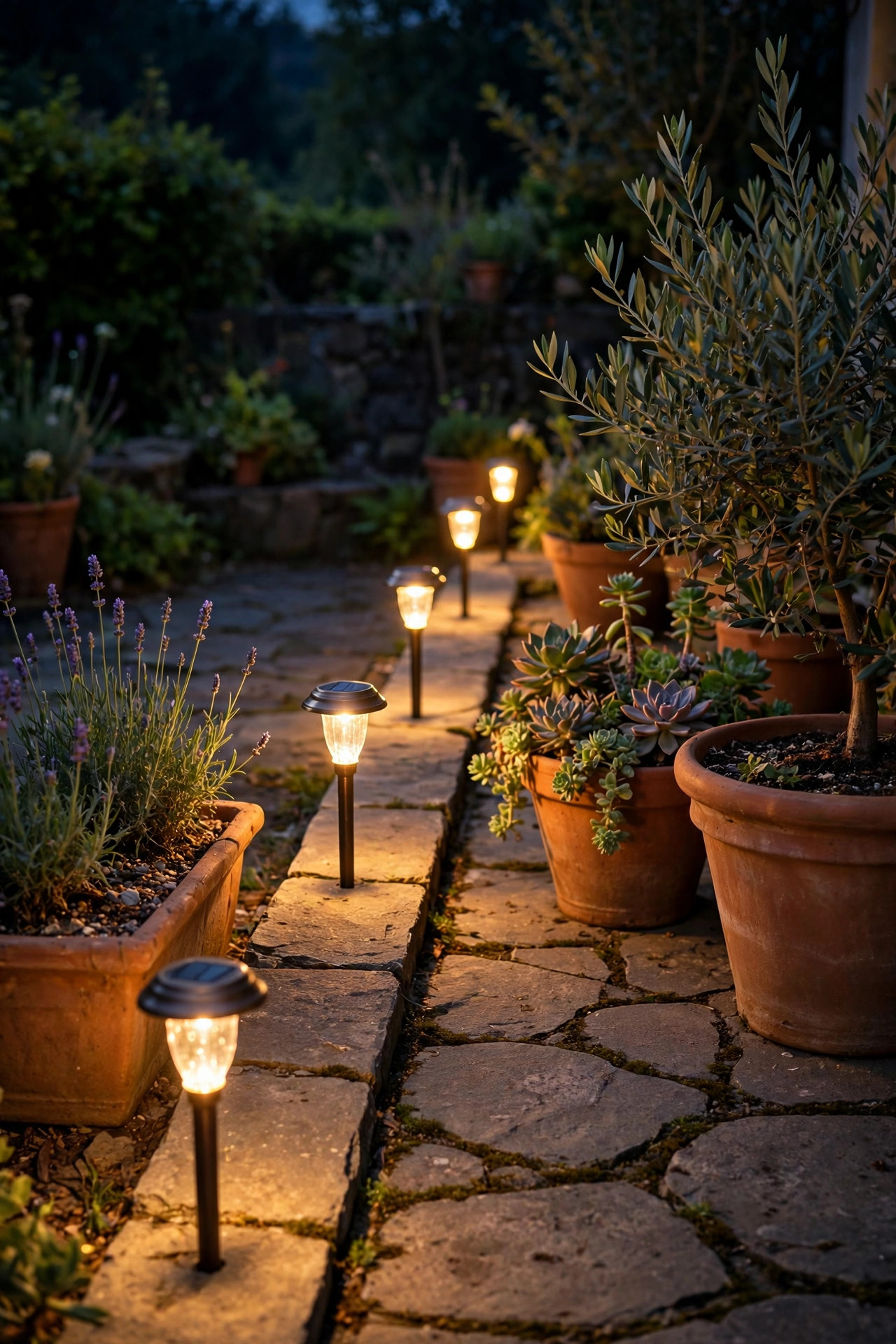
The edge of the patio is where Mediterranean yards blur into garden, and a gentle line of solar stakes makes that border glow without a single wire. Choose stakes with warm 2700K output — the bluish solar lights flooding the market will wreck the whole warm scheme in one purchase. Simple metal or terracotta-toned housings disappear by day. Space them 4 to 6 feet apart along the patio perimeter, closer where a step or grade change needs marking, wider along a straight run. Slightly irregular spacing actually looks more old-world than a perfect soldier row, so do not stress the tape measure. Push them into soil or gravel rather than between pavers, angle the panels toward the afternoon sun, and wipe the panels monthly — dusty panels are the number one reason solar stakes fade by midnight. For the two or three stakes guarding steps or the path to the gate, I splurge on brighter wired path lights and let solar handle the decorative border. The mix keeps the safety lighting dependable and the pretty lighting effortless.
Suggested budget range: $30 – $110.
9. Give a Fountain or Urn Its Own Glow
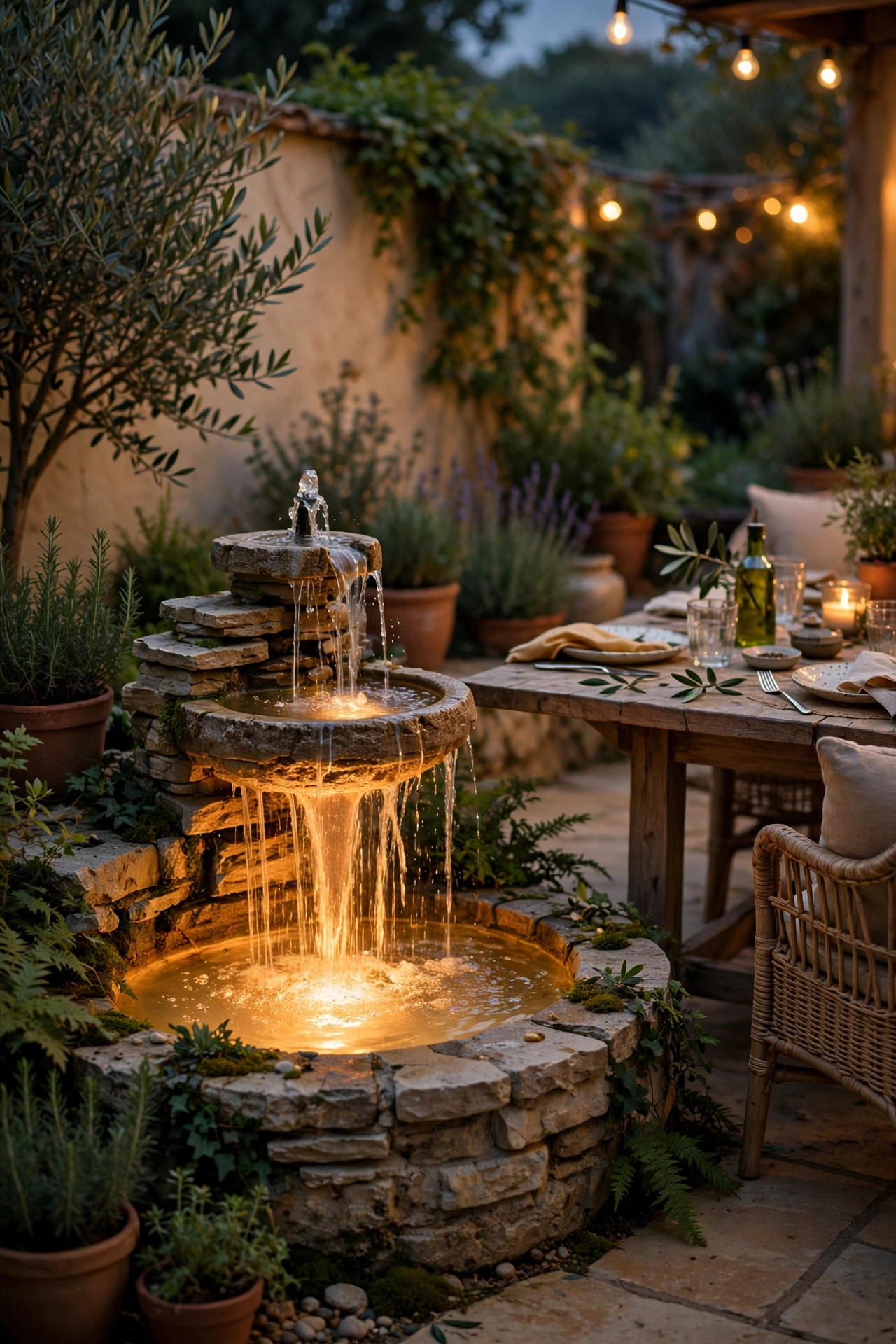
Water and warm light are the soul of a courtyard, and even a small patio fountain or a single bubbling urn becomes a focal point once it glows. A submersible LED puck in warm white, tucked under the waterline where the sheet of water falls, turns the whole feature into liquid amber. Keep the cord hidden along the back, plug into a GFCI outlet, and use only fixtures rated for full submersion — that rating is not optional around water. If a fountain is beyond the budget this year, a large glazed urn with a floating solar light gets you the shimmer for far less. Place the water feature where it catches sightlines from the table but off the main traffic path, and add one small uplight behind it to silhouette the spray. My broader notes on composing a courtyard around water live in my courtyard lighting ideas post, which covers fountains, entries, and strings together. Guests will drift toward the glowing water between courses; they always do.
Suggested budget range: $50 – $200.
10. Use String Light Poles Where There Is No Roof
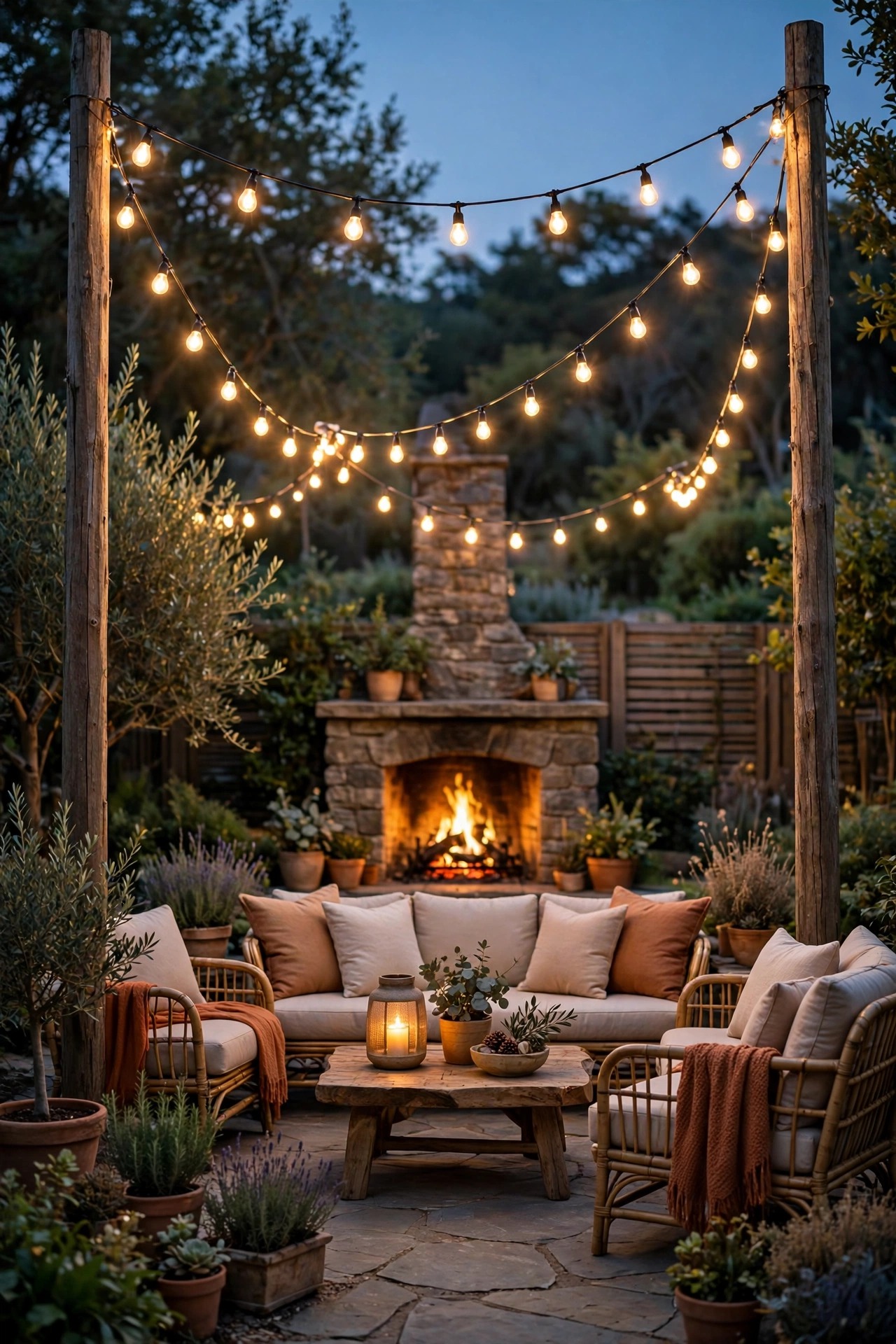
No pergola, no problem. Freestanding string light poles exist precisely for open patios, and they let you float the canopy from idea two anywhere you like. The budget route is a cedar or black metal pole set into a half-barrel or heavy planter filled with gravel and topped with soil and trailing plants — the planter hides the engineering and adds more terracotta-and-green to the scene. Commercial steel poles with ground sleeves are the sturdier splurge and worth it in windy spots. Either way, you want the top of the pole around 9 to 10 feet so swags dip to about 8 feet over the table — high enough for standing guests, low enough to feel like a ceiling. Two poles plus the house wall make a perfect three-point canopy; four poles freestand a whole dining court. Tension matters more than hardware: use the guide wire, keep swags shallow, and check planters after the first big storm. Once the poles are planted with jasmine or bougainvillea, they stop looking like equipment and start looking like architecture.
Suggested budget range: $70 – $220.
11. Recess Step Lights Into Stone Stairs
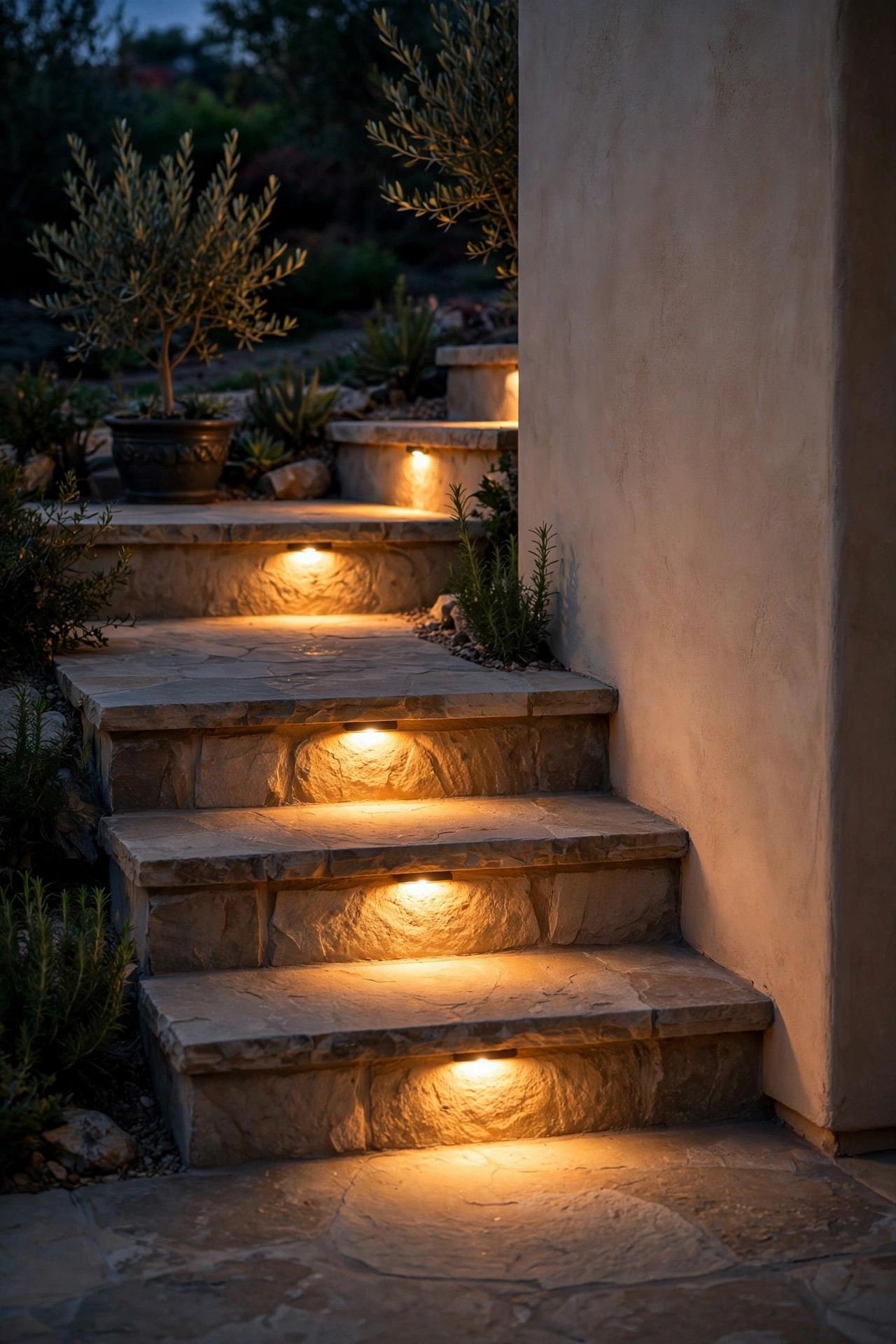
Mediterranean patios love a level change — a step up to the dining terrace, two down to the garden — and every one of those steps needs its own small light once the wine is poured. Recessed step lights tucked into the riser or a low fixture mounted on the side wall wash the tread below with a soft fan of light that says step here without shouting. Low-voltage versions wired into your landscape transformer are the reliable choice, and spacing one per step (or every other step on a wide staircase) keeps the rhythm even. Solar step lights work on sunny staircases but dim early on shaded ones, so match the power to the exposure honestly. Aim for visibility, not runway brightness: you want to read the edge of each tread from the table. Keep fixtures shielded so the beam hits stone, not eyes, and choose bronze or stone-toned housings that vanish into the masonry by day. This is the one idea on the list that is pure safety, and it still manages to look like a villa in Tuscany.
Suggested budget range: $80 – $300.
12. Anchor the Seating Area With a Fire Bowl
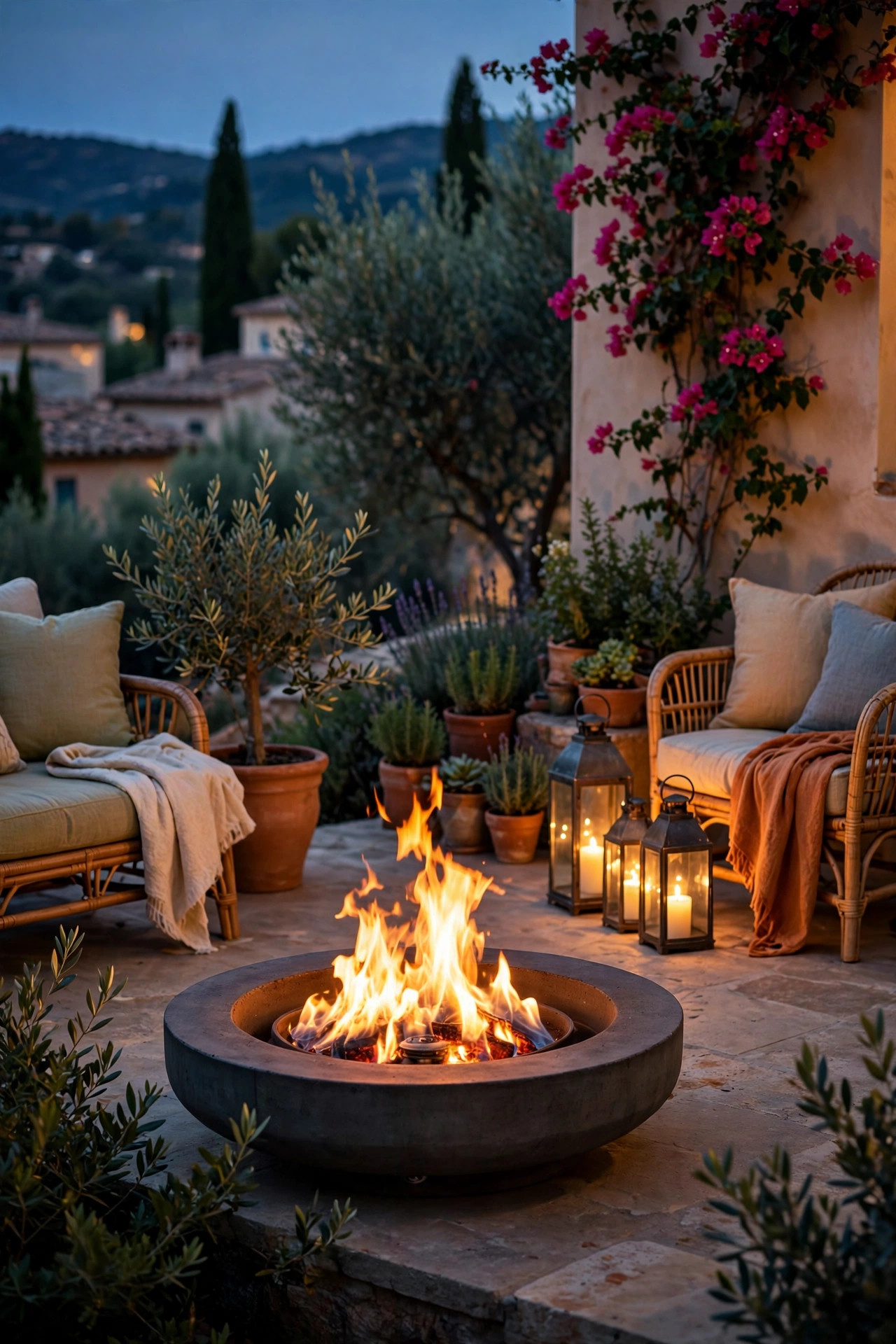
Every long dinner needs a gravity well, and a fire bowl at the edge of the seating area is the Mediterranean answer — think of the braziers that have anchored courtyards for centuries. A propane fire bowl or tabletop fire feature gives you instant flame with a knob instead of a woodpile, and the flicker does the same face-flattering work as candlelight at ten times the scale. Follow the manufacturer clearances religiously: keep the bowl well away from cushions, umbrellas, and dried plantings, set it on a noncombustible surface, and never leave it burning unattended. For small patios, a tabletop fire bowl in the center of a coffee table or at the end of the dining table delivers the glow without the footprint. Position it where people naturally gather after the plates are cleared, slightly downwind of the seats so smoke and heat drift away. On nights the fire bowl stays cold, ring it with flameless candles so the anchor still glows. Nothing on this list extends a dinner like real flame.
Suggested budget range: $100 – $450.
13. Hang One Statement Pendant Over the Dining Table
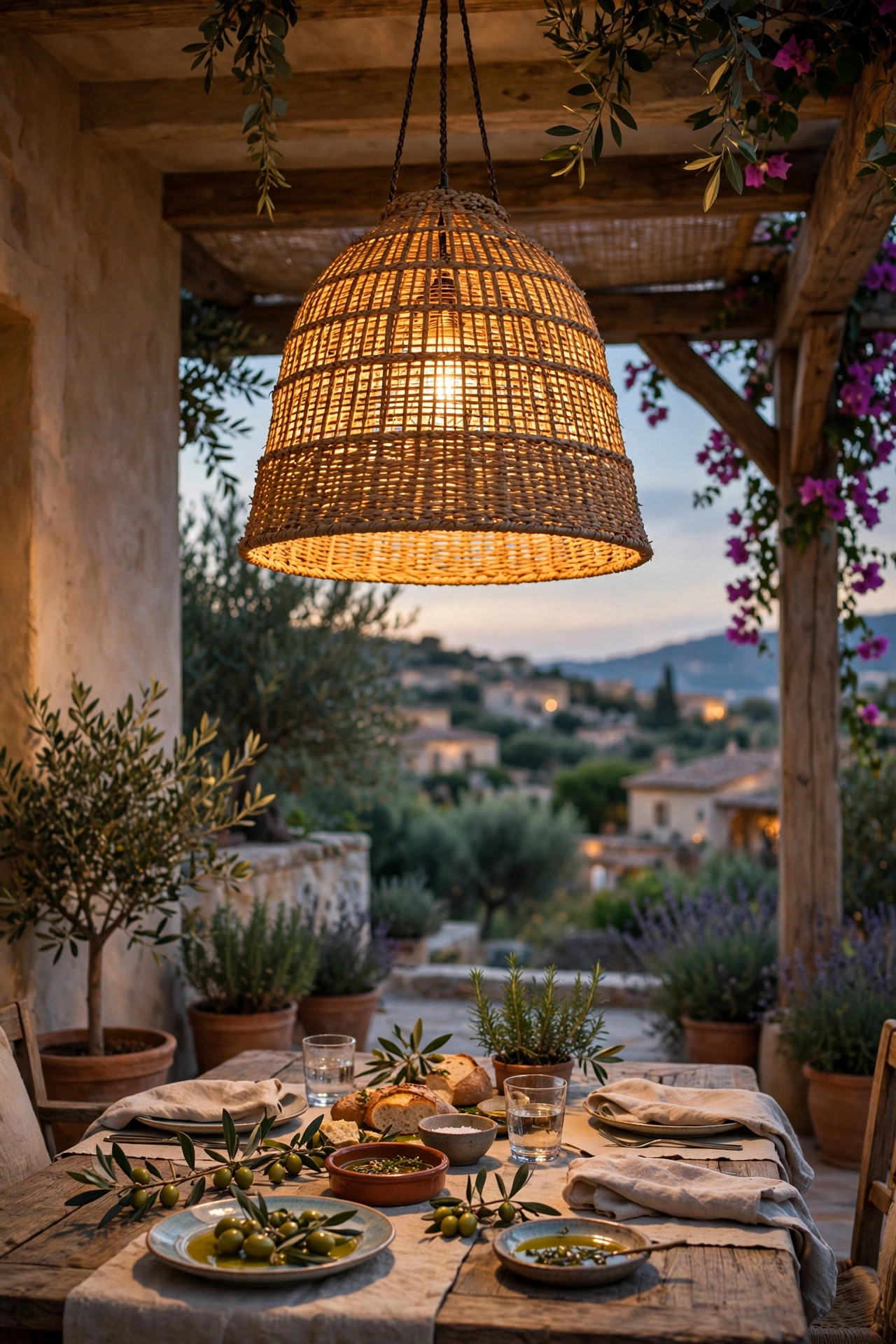
Under a covered patio or loggia, trade the string canopy for a single statement pendant and the whole space instantly feels like an outdoor dining room. Woven rattan, hammered metal, and aged iron cages all speak Mediterranean; pick the material that echoes something else on your patio so the pendant feels collected, not bought. Size it boldly — a pendant over an outdoor table should be at least 20 inches across — and hang the bottom about 30 inches above the tabletop so sightlines across the table stay open. Hardwired on a dimmer is the dream setup, but a plug-in pendant swagged from a hook with the cord wrapped in jute twine looks intentional and rents nothing from an electrician. Use a warm LED filament bulb and, if the fixture is open-weave, accept that the bulb is part of the decor and choose a pretty one. Wet-location rating matters anywhere rain can blow in; damp rating is fine deep under a roof. One great pendant plus dim wall lanterns has carried more of my summer dinners than any other combination here.
Suggested budget range: $85 – $280.
14. Cluster Fairy-Light Jars for Soft Fill Light
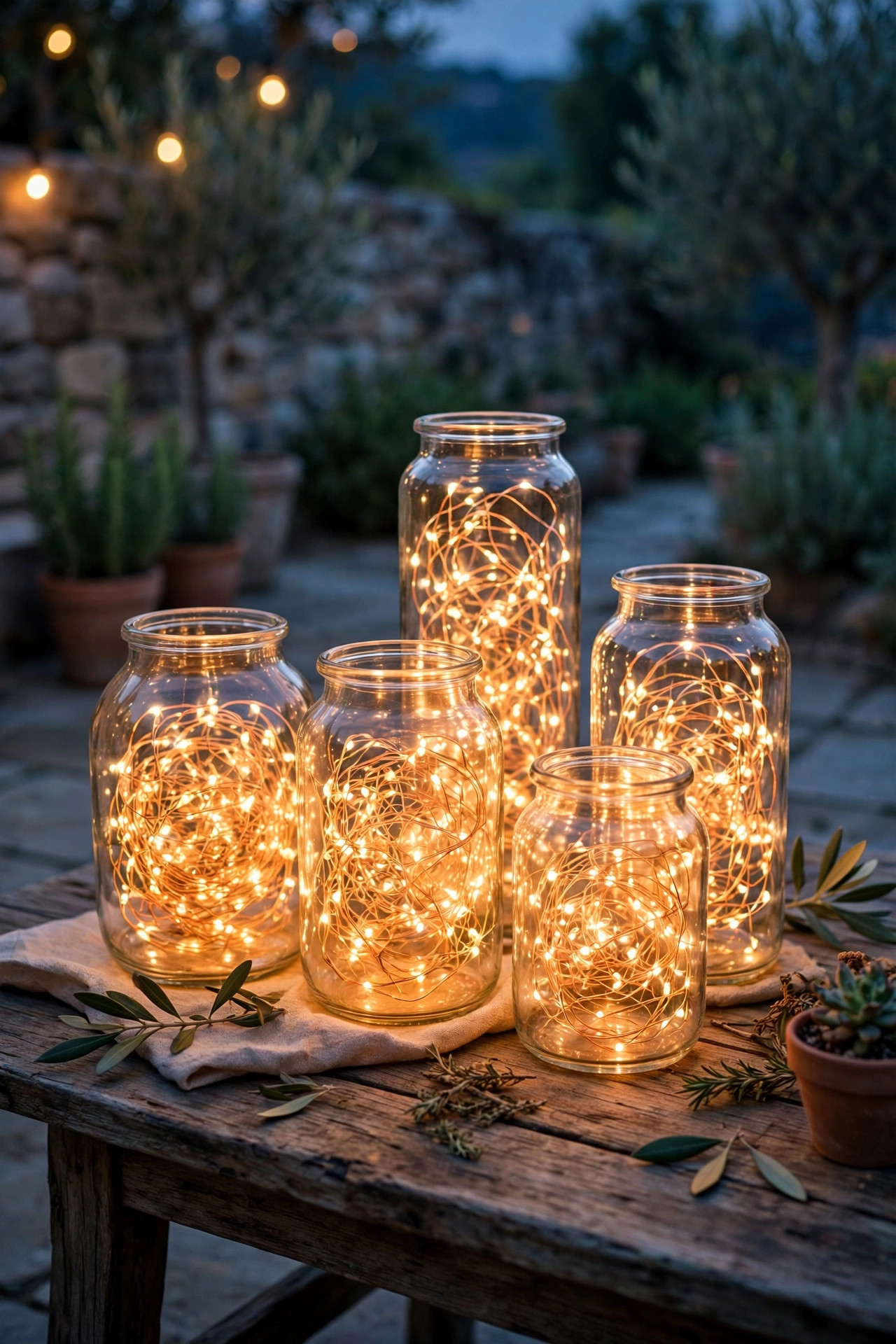
Between the big layers there are always dark pockets — the serving table, the step by the gate, the gap between planters — and copper-wire fairy lights coiled inside glass jars are my favorite way to fill them. The wire disappears, the jar catches and multiplies the points of light, and the whole thing reads as captured fireflies in the best way. Use warm white strands, battery packs with timers so they wake up at dusk on their own, and jars with real glass rather than plastic for that heavy, vintage sparkle. Wine bottles in green and amber glass make beautiful fill lights along a low wall; mason jars cluster well on the drinks station. Keep the fill genuinely soft — this layer is seasoning, not a fourth course — and replace batteries at the start of the season so brightness stays even. Because they are battery powered and cool to the touch, these jars are the one light I happily tuck near dried arrangements and wooden surfaces. Three jars minimum per cluster; single jars look lost.
Suggested budget range: $20 – $70.
15. Put Everything on Dimmers and Timers
The difference between a patio that glows and a patio that performs is control. Long dinners change mood by the hour — bright enough to serve and see the food early, low and golden by dessert — and dimmers let the light follow the evening instead of freezing it. Put the canopy and pendant on dimmers, the lanterns and landscape layers on a timer or dusk-to-dawn photocells, and the solar pieces will handle themselves. A simple routine that works: everything fires at sunset, pathway and step lights stay steady all night for safety, and the overhead layers dim by half around nine so the candles and fire bowl take over the mood. Smart plugs rated for outdoor use make this a phone-tap instead of a walk to the garage, and they remember the schedule when you forget. Whatever system you choose, test the full sequence on a quiet evening before guests arrive. Lighting that runs itself is the real luxury here — you should be refilling glasses at dusk, not hunting for switches with your hands full.
Suggested budget range: $25 – $120.
16. Spotlight the Planters Themselves
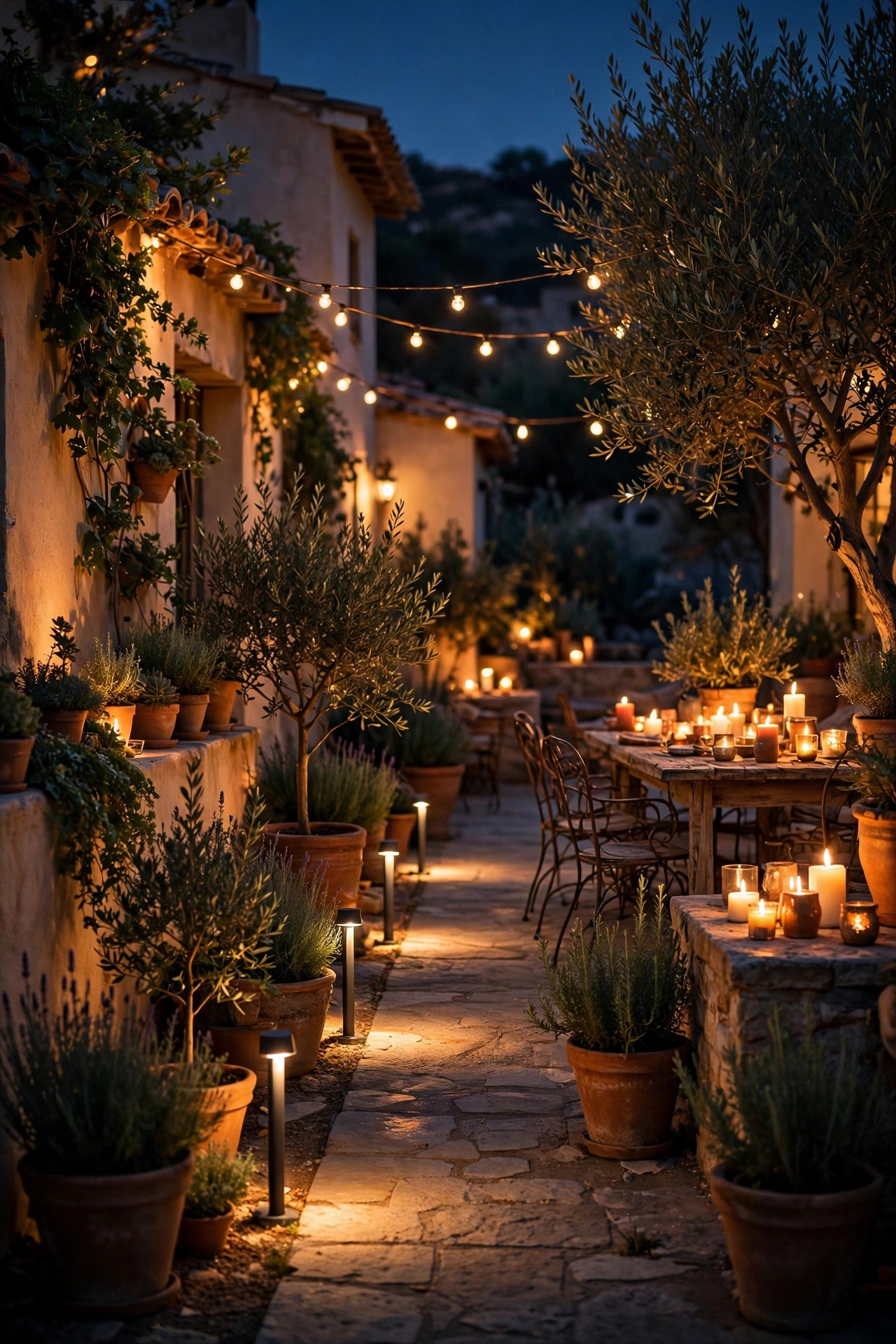
We lit the big potted trees in idea five; this is the same instinct aimed at the supporting cast — the rosemary standards by the door, the lavender in glazed blue pots, the little olive on the serving wall. A tiny spotlight or solar stake with an adjustable head, hidden at the back of each pot and aimed into the foliage, gives every planter its own pool of presence. Cool trick: lights placed behind a planter wash the wall behind it, so a row of pots along a stucco wall becomes a row of glowing silhouettes with bright halos. Match the finish of the fixture to the pot for invisibility, and keep the beams narrow — you are painting with light, not flooding a stage. Herbs near the kitchen door earn double duty: pretty at night, and lit well enough to snip from during dinner. This layer is deliberately subtle, and it is what separates a patio that was decorated from a patio that was composed. When guests cannot tell why the edges of your patio feel alive, this quiet spotlighting is usually why.
Suggested budget range: $35 – $130.
17. Finish With a Dusk Walk-Through of Your Mediterranean Patio Lighting Ideas
The last step costs almost nothing and saves every other idea on this list: once your mediterranean patio lighting ideas are installed, audit them at dusk like a guest. Sit in every chair at the table and check for a bulb glaring into your eyes — a shade, a dimmer notch, or a five-degree tilt fixes most offenders. Walk the path from gate to door and confirm every step and edge reads clearly. Stand at the street and look back: the patio should glow like a lit window display, warm and inviting, not like a stadium. Check that all the color temperatures truly match — one stray daylight bulb will announce itself the moment everything else is warm. Photograph the scene on your phone; the camera exposes hot spots and dead corners your eyes forgive. Adjust, swap, and dim until the photo makes you want to sit down. That ten-minute ritual, repeated each spring when the patio wakes up, keeps the whole layered scheme honest all season long.
Suggested budget range: $0 – $60.
Frequently Asked Questions
What color temperature gives the most Mediterranean feel?
Warm white at 2700K is the sweet spot, with 2200K to 2400K vintage filament bulbs as the extra-golden option for string lights and lanterns. That range mimics candlelight, firelight, and late sun on stone, which is the whole palette of a Mediterranean evening. Avoid anything labeled daylight or 4000K and up; one cool bulb in a sea of warm ones looks like a mistake, because it is. Match every layer to the same temperature so the patio reads as one scene.
Can I get this look with solar lights only?
Mostly, yes, with honest expectations. Modern warm-white solar string lights, stakes, and spotlights can carry the low and decorative layers beautifully, and they make the planter and border ideas almost free to run. Where solar still struggles is the hero layers: a long canopy over the table and bright step lighting on a shaded staircase. My usual compromise is solar for edges and accents, wired or plug-in power for the overhead canopy and the table itself. That hybrid keeps dinner reliably lit while the solar pieces handle the sparkle.
How do I keep string lights from sagging over a wide patio?
Sagging comes from weight hanging on the cord, so give the load to a guide wire instead. Run stainless steel cable between your anchor points, pull it snug, and clip the light strand to the wire every few bulbs. Keep spans near 10 to 12 feet, add a pole or anchor in the middle of longer runs, and choose commercial-grade strands with heavier cord. A gentle swag is charming and Mediterranean; a deep droop that dips into sightlines is just a wire asking for support.
How much does a Mediterranean patio lighting setup cost in total?
A convincing starter version — string light canopy, a pair of wall lanterns, table hurricanes, and a border of solar stakes — lands between about $275 and $750 in fixtures. The full layered scheme with pergola downlights, step lights, a fire bowl, and spotlighted planters typically runs $900 to $2,500 spread over a season or two. Running costs stay tiny: the whole patio in warm LEDs usually draws less power than one old porch bulb, and solar layers cost nothing at all to run.
Conclusion
If you remember one thing, make it the layers: something warm overhead, something kind at face level, and something low that traces the edges of the stone. That simple stack is what turns mediterranean patio lighting ideas from a shopping list into an atmosphere — the kind where dinner stretches past dessert because nobody wants to leave the glow. Start with the canopy and the table lanterns this weekend, then add one layer each month and watch the patio mature into the room you live in most. For more ways to build the scene, browse the rest of my outdoor lighting ideas here on the site and steal whatever fits your space.