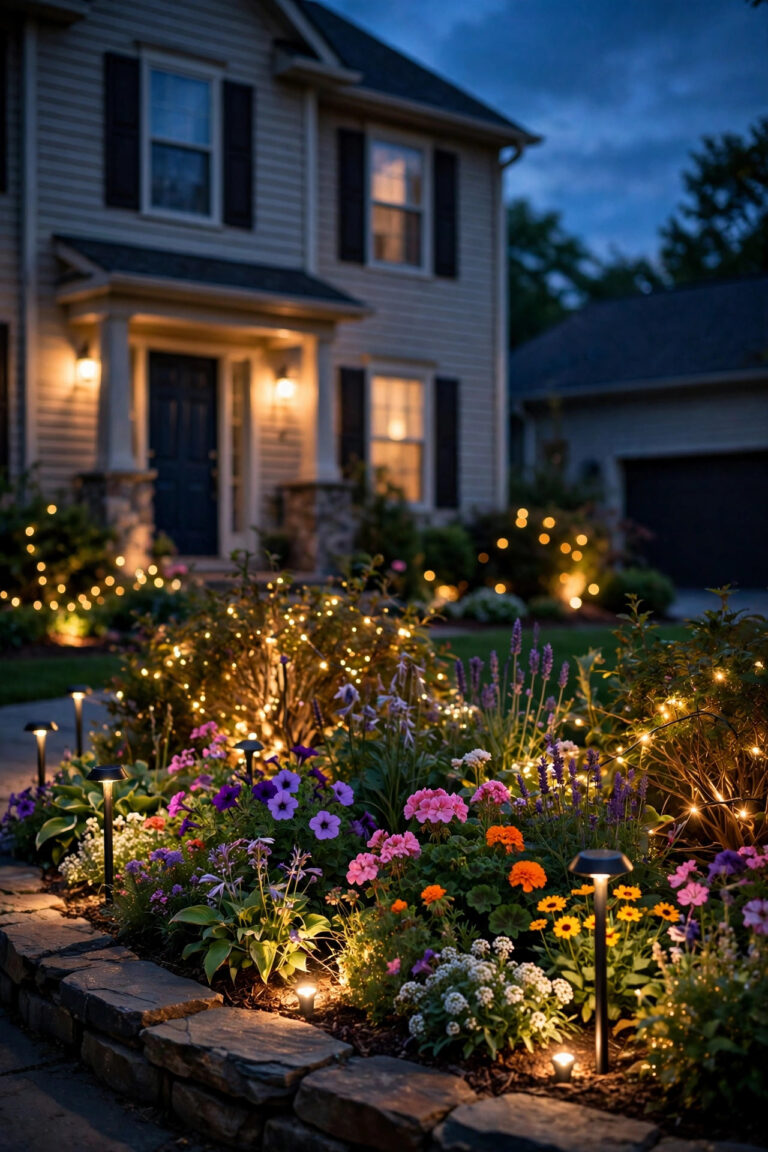
The first evening my cat discovered her new balcony catio, she refused to come inside until the stars were out — and honestly, I understood completely. A pet corner that goes pitch black at sunset wastes half its life, and that is exactly why I went hunting for catio lighting ideas that work for both of us: soft enough not to startle feline eyes, secure enough to survive a curious paw, and pretty enough that I get a lovely balcony glow out of the deal. Cats see beautifully in low light, so this is never about brightness; it is about layering. A gentle ambient wash for the whole space, a warm pool at perch height where your cat actually hangs out, and a practical ribbon of light along the floor for your own midnight water-bowl refills. Every idea below is cord-safe, flame-free, and cool to the touch, because in a pet corner the fixture is also a cat toy waiting to happen.
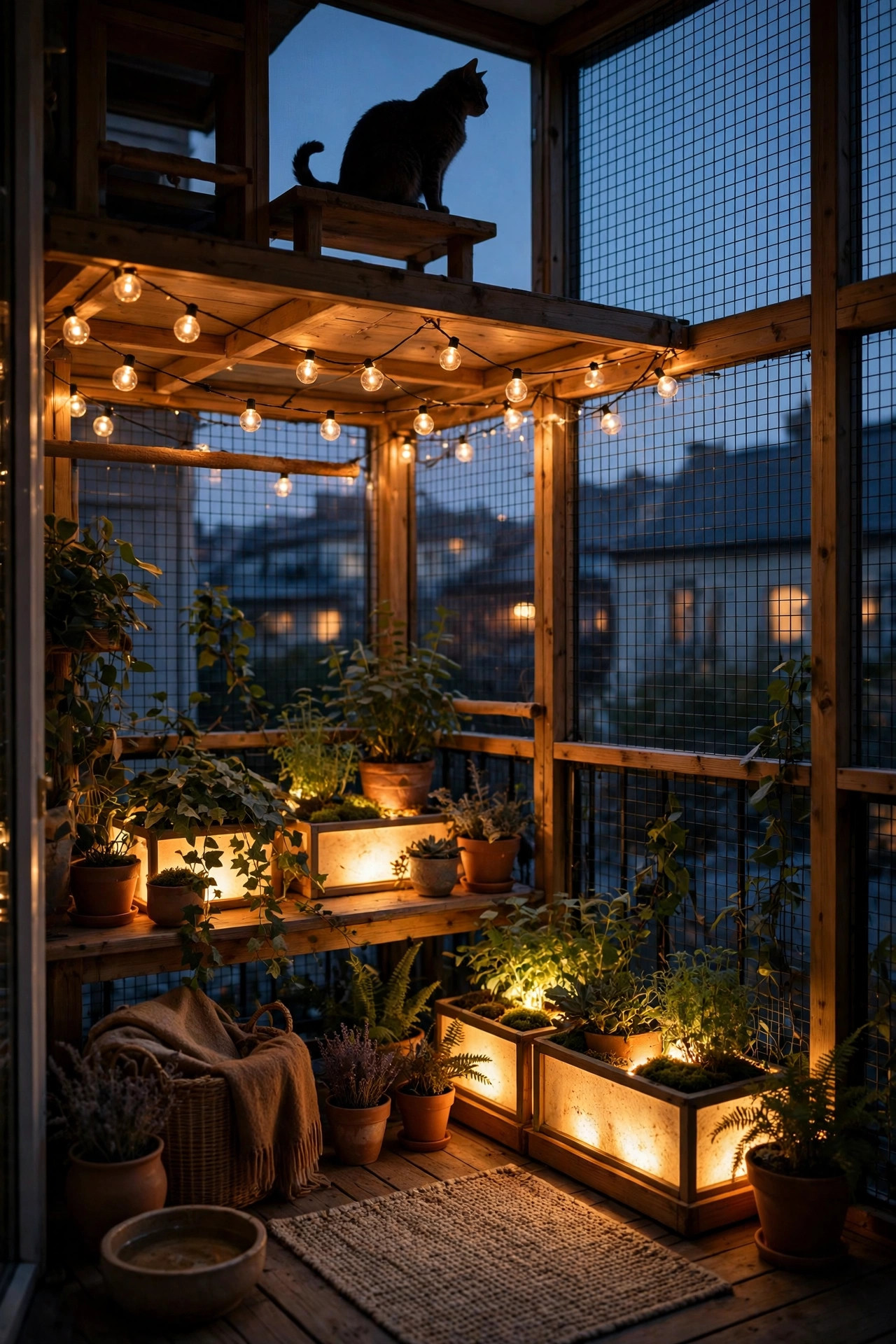
1. Start With a Layered Plan for Your Catio Lighting Ideas
Before I bought a single bulb, I sat in the catio at dusk with a notebook and watched where my cat actually goes. Cats live vertically, so my usual three-layer formula gets a feline remix: a soft ambient layer for the whole balcony, a warm mid layer at perch and shelf height where your cat spends the evening, and a low ground layer that lights your path to the door, the water bowl, and the litter corner. Sketch the perch route — cats follow the same climbing path every night — and put light beside it, never blasting straight into it. Mark every spot where a cord would hang within swatting distance, because those become battery or solar picks instead of plug-in ones. Also note the darkest corner; that is where a shy cat will hide if the rest feels too exposed, and it should stay dim on purpose. In my experience, ten minutes of watching your cat's evening routine tells you more than any product listing. Buy for the cat you have, layer the light low and warm, and the whole corner starts to feel like a little lantern-lit world built just for them.
Suggested budget range: $0 – $20.
2. Run Solar String Lights Along the Catio Roofline
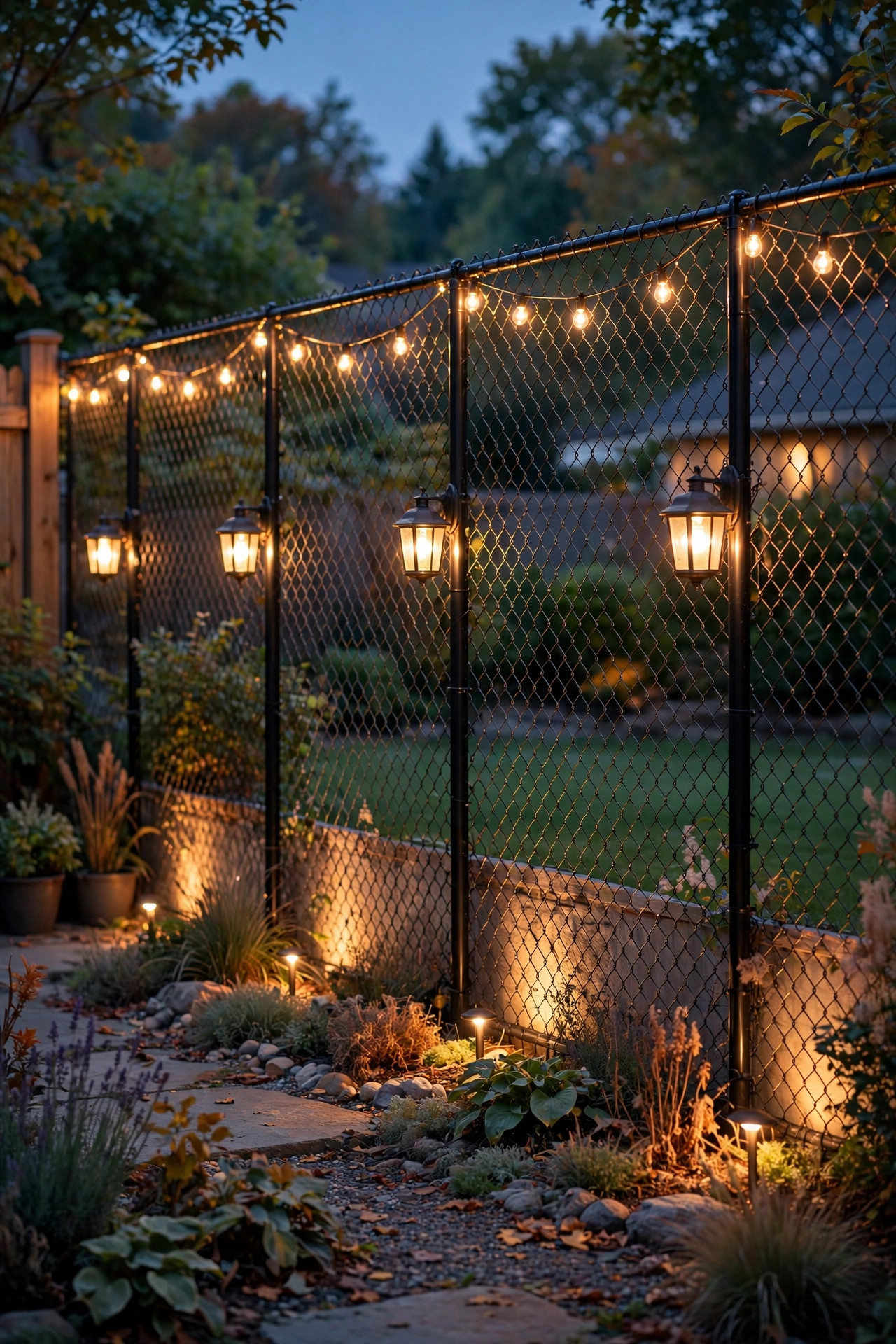
The roofline is my favorite place for light in a catio, because it is the one run of cable a cat almost never reaches. Solar string lights with shatterproof LED bulbs trace the top edge of the enclosure, washing the whole space in a gentle canopy glow while the little solar panel sits outside the mesh, soaking up sun all day. No outlet, no cord crossing the floor, nothing dangling at chew height. Secure the strand with a zip tie or clip every 12 inches so a determined cat cannot work a loop loose, and keep the panel angled toward the best sun your balcony gets. If your balcony faces north or sits in building shade, be honest about it: solar will run dim and short there, so choose a strand with a removable panel you can park in a sunny window. I pulled together my favorite solar string light ideas when I was comparing strand lengths for exactly this job. Warm white filament-style bulbs keep the mood cozy rather than carnival, and the whole run switches itself on at dusk like it is keeping a promise.
Suggested budget range: $20 – $45.

3. Choose Warm 2700K Light That Will Not Startle Your Cat
Here is the thing most people get backwards: your cat needs far less light than you do. Feline eyes gather roughly six times more light than ours, so a bulb that feels like a moody glow to you is a well-lit room to them — and a harsh daylight-white floodlight is genuinely unpleasant. I keep every catio bulb in the warm 2700K to 3000K range and deliberately dim, around 100 to 200 lumens per fixture. Warm light also flatters the space for the humans, so nobody loses. Skip anything with a fast strobe or rapid color-cycling mode; a slow fade is fine, but flashing light stresses many cats and turns your calm corner into a disco they did not ask for. If a fixture offers both white settings, tape over the switch once you have picked warm, because someone will eventually bump it. The same rule covers the pet corner indoors, by the way. When in doubt, dimmer and warmer wins: you can always add one more small fixture, but you cannot un-glare a cat who has decided the catio is too bright and moved back to your laundry basket.
Suggested budget range: $10 – $30.

4. Weave Fairy Lights Through the Climbing Shelves
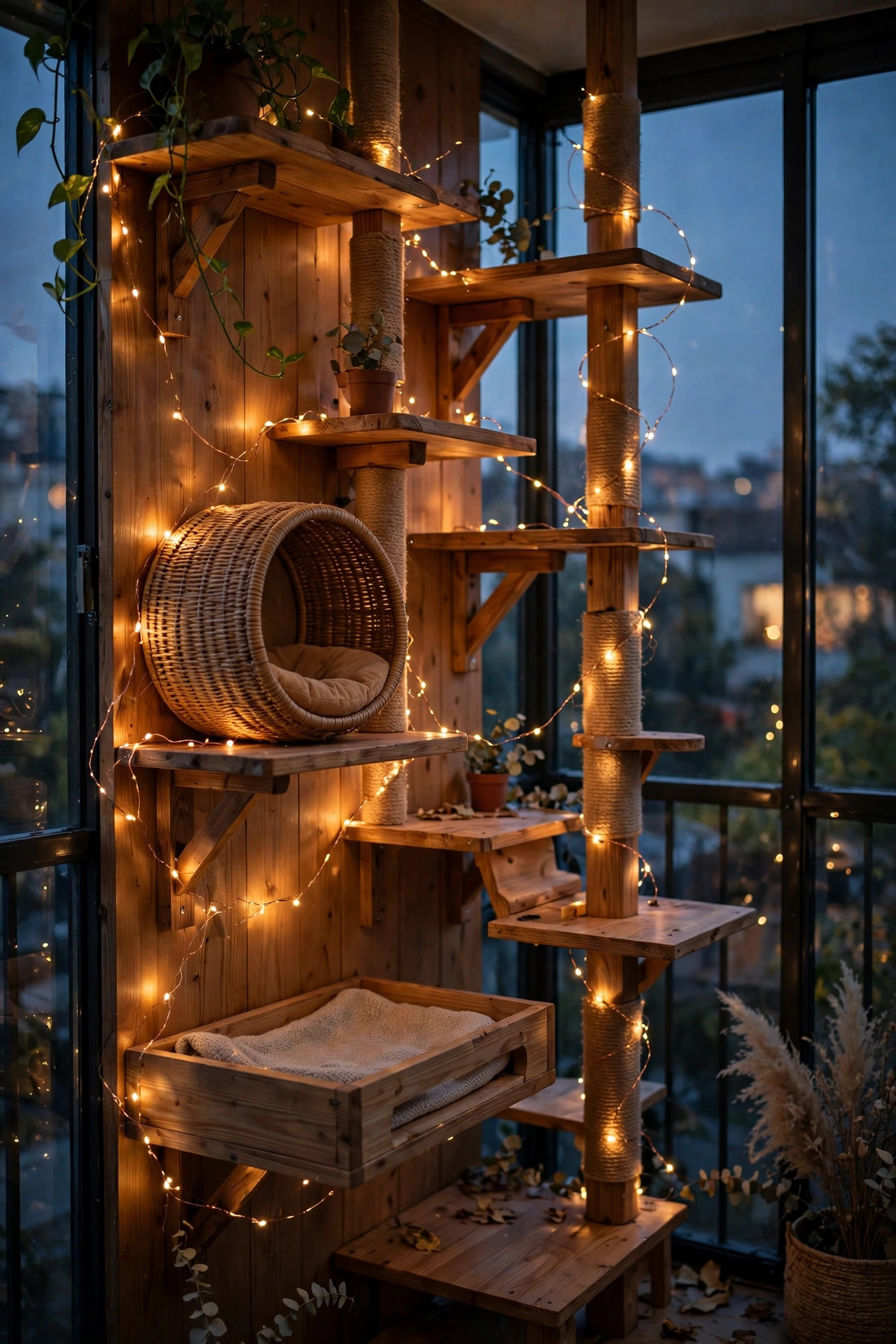
Copper-wire fairy lights are practically made for cat shelving. The wire bends around shelf brackets and hammock posts, disappears against the wood, and leaves a trail of tiny warm pinpoints that make the climbing route look like a little starlit staircase. Battery-powered strands are the right call here, because the whole strand can live inside the catio while the battery pack stays outside it. That last detail matters: mount the pack in a small lidded box on the exterior wall, well out of paw range, since button batteries and curious chewers are a dangerous mix. Keep the wire snug against the shelf edges with tiny clips every few inches — a loose loop is an invitation to bat, chew, and tangle. Copper wire is thin, so inspect it monthly for nicks where it passes a bracket. The LEDs themselves stay cool and sip power, so a set of batteries lasts weeks on a timer setting. Honestly, this is the layer visitors photograph and the one my cat ignores completely, which is the highest praise a catio fixture can earn.
Suggested budget range: $10 – $25.
5. Hide LED Strips Under Perches for an Indirect Glow
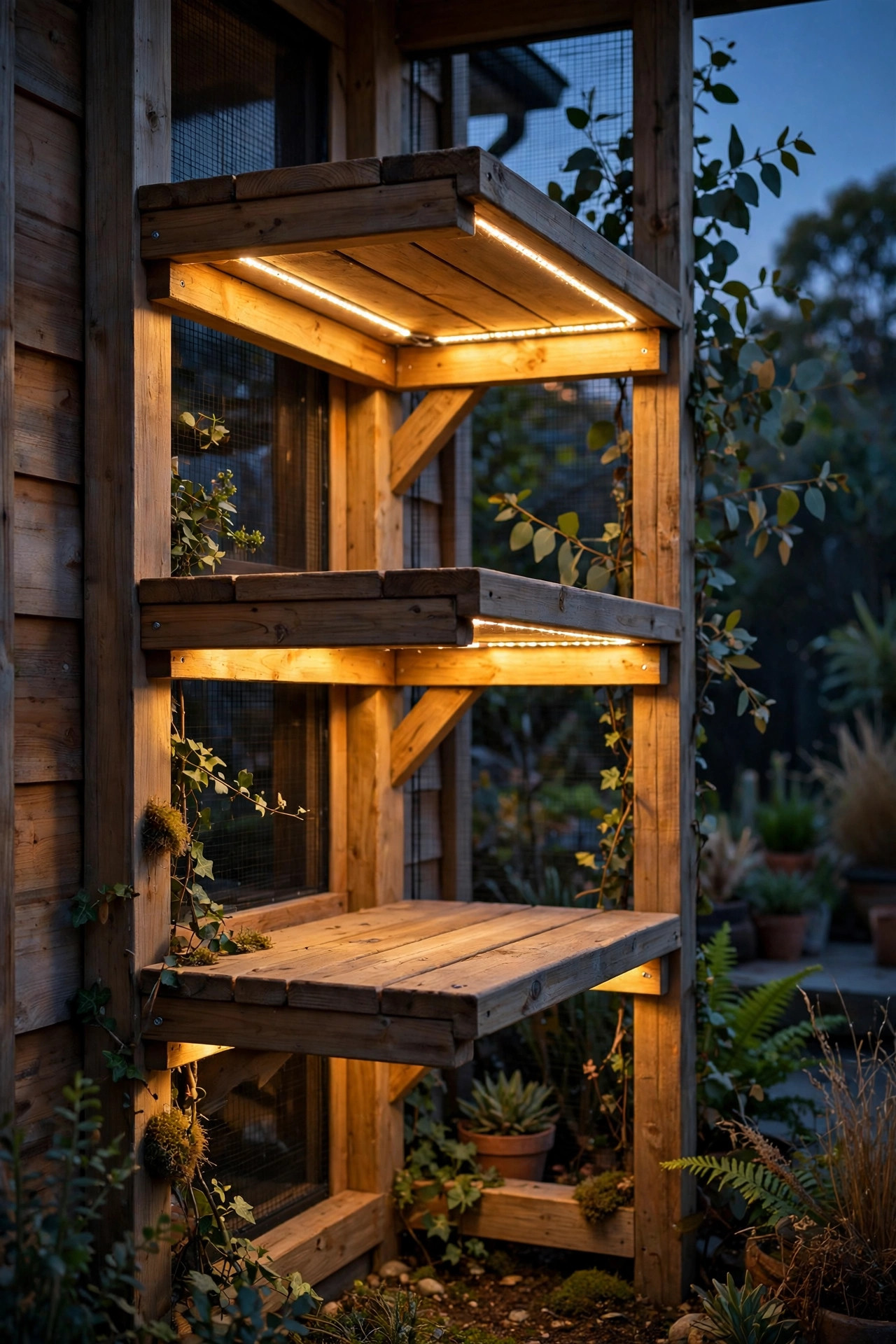
The most elegant light in our catio is one you never actually see. A warm LED strip tucked under the front edge of each perch throws light downward onto the level below and bounces a soft wash upward, so the cat is lit without ever facing a bulb. Indirect light is kind light — no glare, no hot spots, no shadows jumping. Choose an outdoor-rated strip with an adhesive back, then add the little mounting clips anyway, because balcony heat and humidity will eventually defeat glue alone, and a dangling strip is a ribbon toy in a cat's mind. Route the power lead down the outside of the enclosure or inside a split-loom cord cover; exposed low-voltage wire is still chewable wire. Connect the strips to one plug on a timer outside the catio so the whole mid layer turns on and off together. Cut strips only on the marked lines and cap the ends. The effect, honestly, is boutique-hotel-for-cats: floating shelves with a warm underglow, and a very smug resident surveying her kingdom from the top one.
Suggested budget range: $15 – $40.
6. Add a Gentle Motion-Sensor Light at the Door
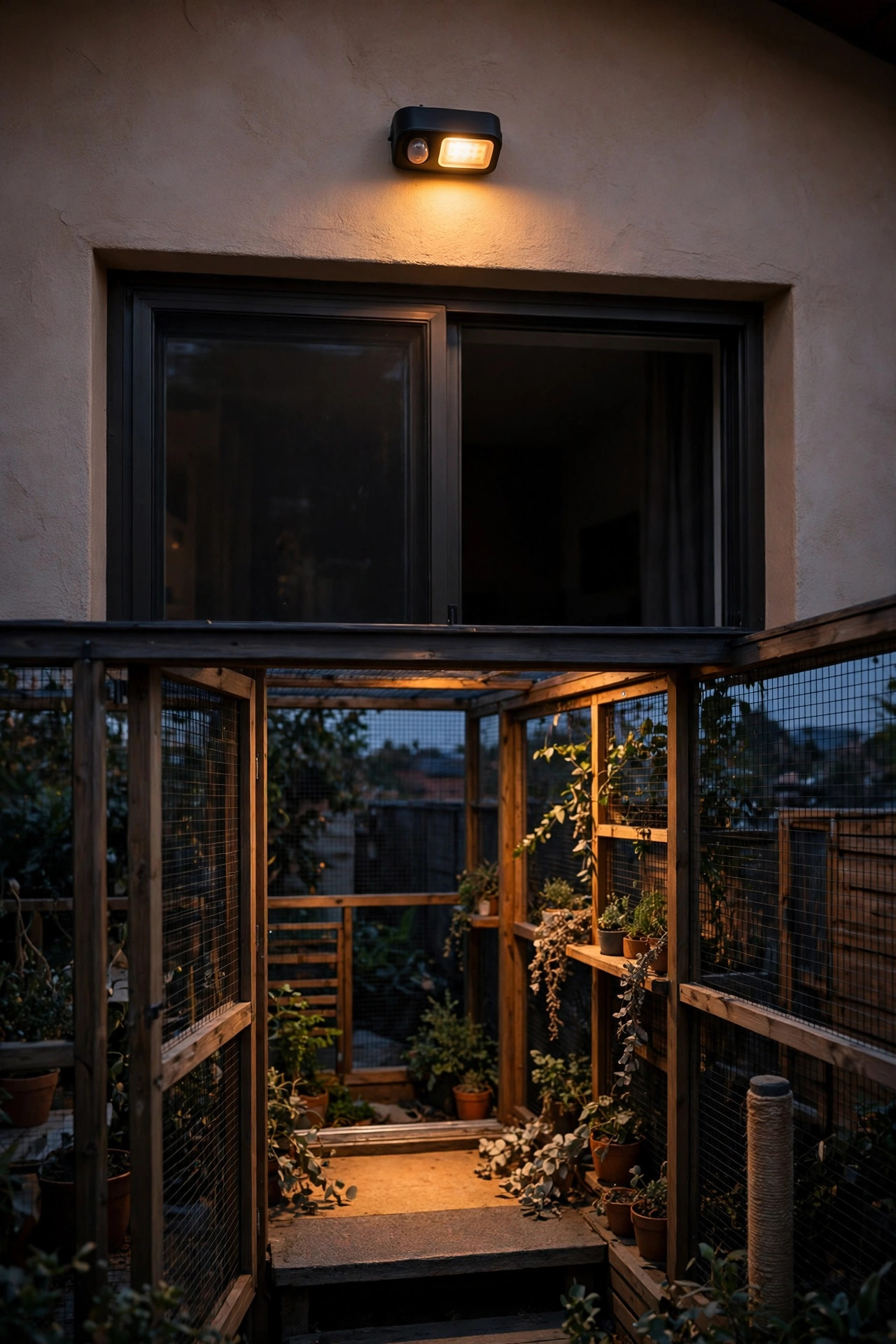
The catio door is where humans fumble — one hand on the latch, one holding a water bowl, in the dark, with a cat weaving figure-eights around your ankles. A small motion-sensor light mounted above the door, on the human side, solves it without lighting the whole balcony all night. Pick a warm, modest model around 150 to 250 lumens that stays on for 20 to 30 seconds, and aim the sensor along the doorway rather than into the catio, so passing cats do not trigger it every three minutes. Battery and solar versions both work well here, which keeps the wiring outside pet reach entirely. I angle ours slightly downward so the pool of light lands on the step and the latch, exactly where my eyes need to go. If your balcony door has a screen your cat likes to climb — mine does — mount the fixture a good foot to the side. It is a tiny, unglamorous light, and it has prevented more spilled water and stepped-on tails than every pretty fixture in this list combined.
Suggested budget range: $15 – $35.
7. Set Solar Stakes in the Planters Around the Pet Corner
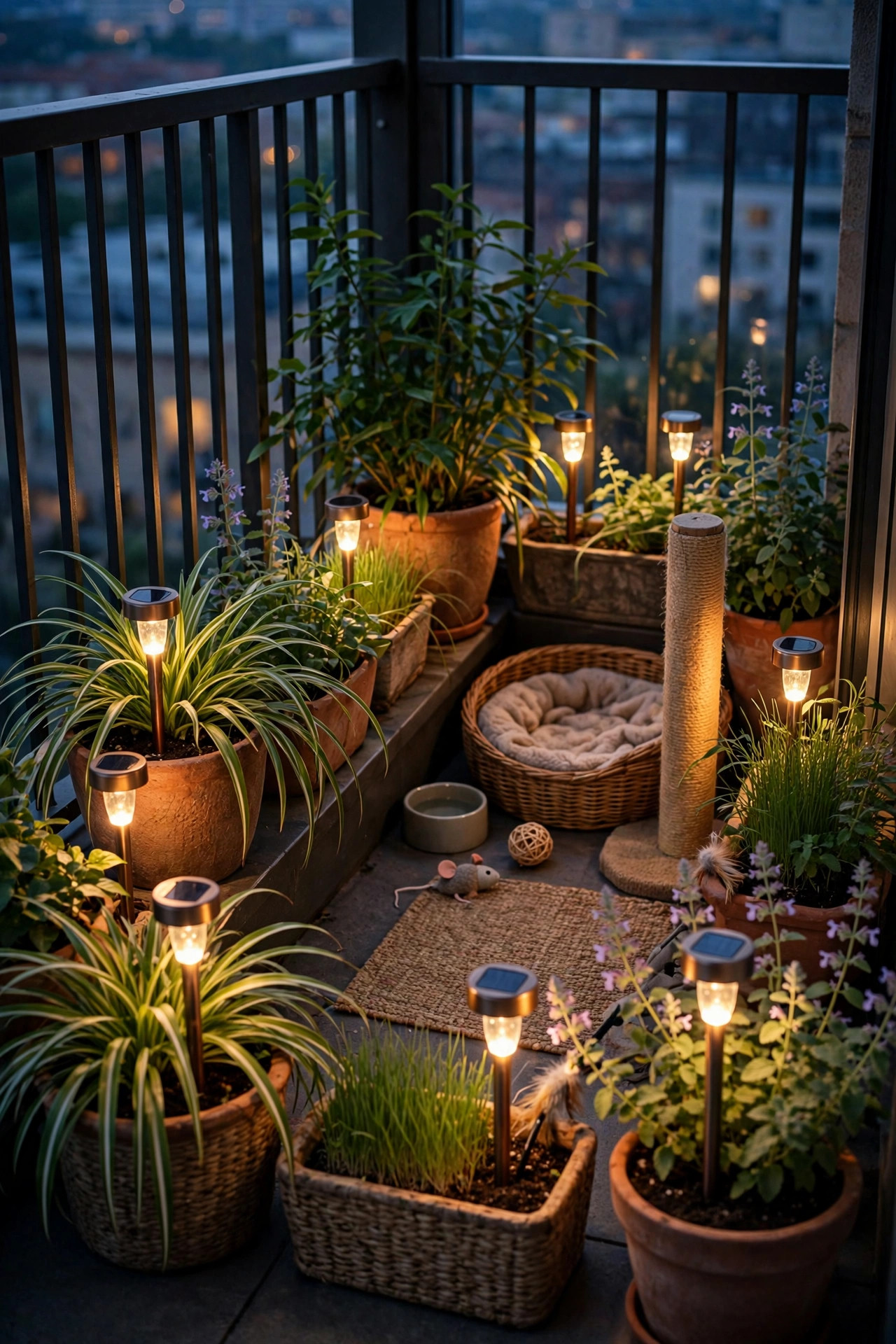
Big floor planters do double duty in a pet corner: they green up the balcony, and they are perfect hosts for low solar stake lights that mark the floor level. I push short stakes into the soil around the catio edges, where they read as a soft dotted border your feet can navigate by and your cat can completely ignore. Keep them low — 30 to 80 lumens is plenty — and choose sturdy resin or metal stakes that will not snap if a cat uses one as a scratching post audition. One real caution: pick your plants like a pet owner, not a stylist. Lilies are dangerously toxic to cats, and several common balcony favorites are not far behind, so build the planter around cat-safe choices like Boston ferns, parlor palms, and a dedicated pot of cat grass. Position stakes at least a few inches from the stems so the light grazes the leaves instead of spotlighting one sad fern. The layer is subtle, solar, and free to run, and on a dark balcony it quietly outlines the whole pet corner like a runway for one small, furry aircraft.
Suggested budget range: $15 – $40.
8. Give Your Cat a Glowing Hideaway
Every catio needs one spot where a cat can feel invisible while still being part of the evening, and a softly glowing hideaway is pure magic for shy cats. Mine is a simple wooden cube house on the lowest shelf, lit from outside by a small warm fixture aimed at its back wall, so the interior fills with bounced, gentle light instead of a bulb in anyone's face. A translucent-roof tunnel works the same way with fairy lights laid across the top. The rule that matters: no battery packs, no cords, and no loose bulbs inside the hideaway itself — anything a cat sleeps on will eventually be chewed, kneaded, or kicked, so the light source stays outside the box and only the glow gets in. Wash the cushion, check the fixture mount monthly, and keep the entrance facing away from the brightest layer so the inside stays a dim retreat. On warm nights my cat drags her favorite toy mouse in there and supervises the whole balcony from the shadows like a tiny, glowing-cave monarch.
Suggested budget range: $20 – $50.

9. Use Flameless Candles in Lanterns, Never Real Flame
I love candlelight on a balcony, and I will still never bring a real flame into a pet corner. It is not just the fire risk — though a tail through a candle flame is a vet visit nobody wants. Scented candles and essential-oil warmers are a genuine problem around cats, whose livers cannot process many of those compounds, and an open flame near a jumping animal is simply borrowed trouble. The good news: modern flameless candles are convincing. Rechargeable LED candles with a warm flicker, grouped inside metal-and-glass lanterns on the human side of the catio mesh, give me every bit of the mood with none of the worry. The lanterns stay outside the enclosure where paws cannot tip them, and the flicker reads through the mesh like fireflies with good manners. Choose candles with timers so they light themselves at dusk and click off at bedtime. Set a cluster of three at different heights near your chair, not the cat's shelves. Cozy for you, invisible to her, safe for everyone — honestly, I do not miss the real thing at all.
Suggested budget range: $15 – $40.

10. Bounce Light Off the Ceiling With Wall Sconces
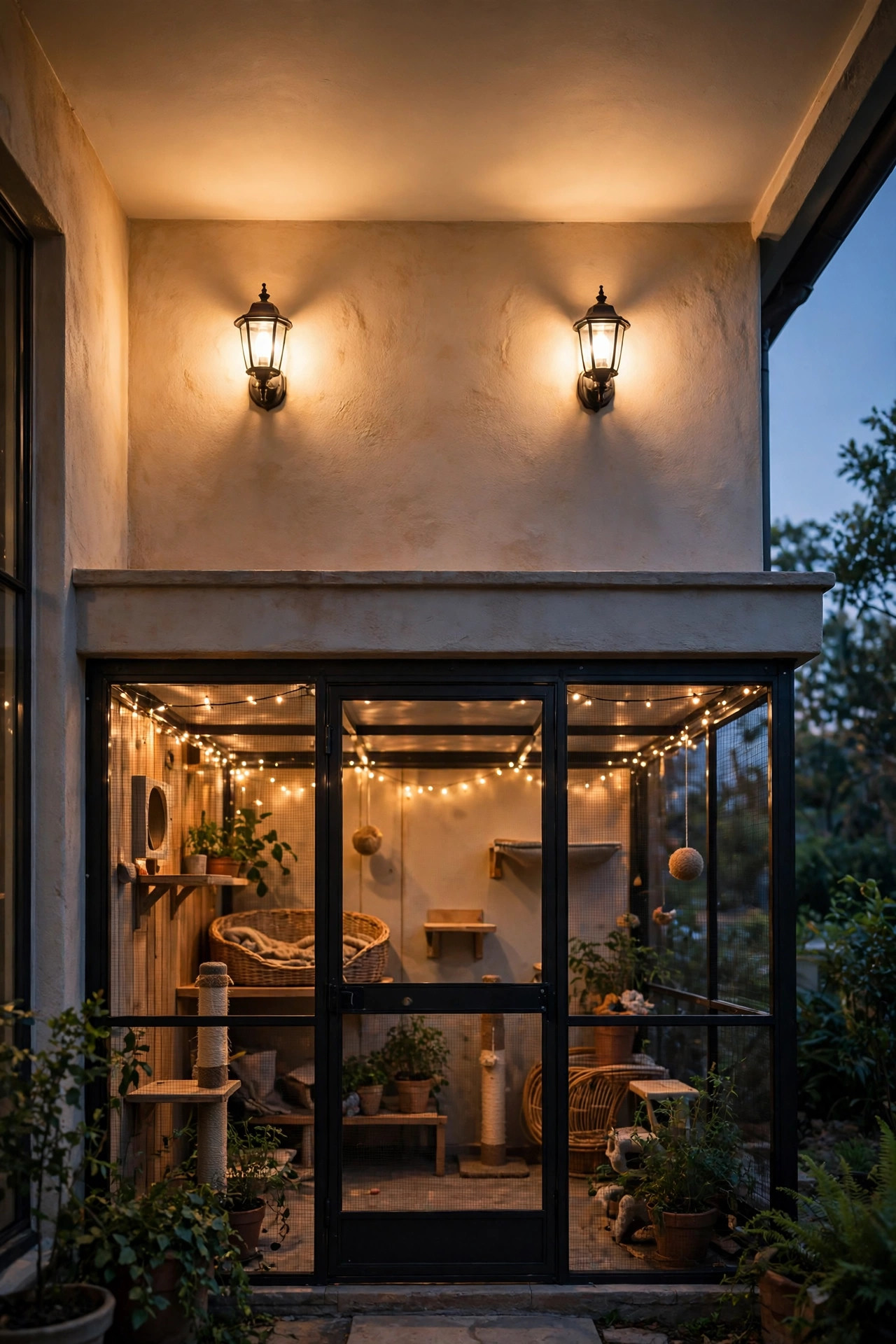
If I could keep only one catio trick, it would be this: aim the light at the ceiling and let the bounce do the work. Small uplight sconces mounted high on the wall — solar models mean no wiring near the cats at all — throw their light upward, and the ceiling reflects back a broad, shadowless wash that flatters the whole balcony. Nothing shines into feline eyes, nothing hangs at swatting height, and the fixtures themselves sit in the one zone even athletic cats rarely reach. Mount them above the door and over the human seating rather than over the top perch, since a cat sleeping directly under a fixture still gets the brightest of the bounce. Keep the pair matched in color temperature so the wash reads as one light. This is also my favorite layer for renters, because two screws or a heavy-duty outdoor adhesive mount beats running any new wiring; my roundup of general balcony lighting ideas covers more no-wire tricks in that spirit. Bounced light is how little spaces feel calm instead of cluttered.
Suggested budget range: $25 – $60.
11. Run a Rope Light Along the Railing Inside a Protective Channel
The railing is the natural picture frame of a balcony, and a rope light run along its inside face draws the prettiest border — with one non-negotiable condition in a pet space. The rope light lives inside a clear protective channel or split tubing, clipped tight every 8 to 10 inches, so what a cat can touch is smooth plastic, never the light itself. That channel solves chewing, clawing, and weather in one move, and the rope light inside is already sealed and outdoor-rated. Solar rope lights keep the whole run wire-free; plug-in versions belong on a GFCI outlet with the cord exiting straight down the wall, out of the enclosure entirely. I keep this layer dim and purely decorative — it outlines the balcony, silhouettes the planters, and throws a faint warm rim around the catio mesh that looks wonderful from inside the apartment. For more ways to treat a railing, the balcony railing lighting ideas I gathered for my own balcony make good browsing. Smooth, sealed, and softly glowing is the whole brief.
Suggested budget range: $15 – $35.

12. Put Everything on Timers So Your Cat Gets a Real Night
A lit catio at 2 a.m. is a catio working against its resident. Cats are crepuscular — most active at dawn and dusk — and like us, they sleep better with a genuinely dark stretch in between. So the whole system runs on timers: the ambient and perch layers come on at dusk, the fairy lights twinkle through the evening, and everything clicks off by about 11 p.m., leaving the motion-sensor door light as the only thing standing guard. Astronomical timers handle the shifting sunset for you, adjusting across the seasons without any fiddling. Solar fixtures mostly self-manage, running until their charge fades, which conveniently lands in the same late-evening window. There is a bird bonus, too: a balcony that goes dark overnight is kinder to the dawn chorus your cat loves to watch through the mesh. Honestly, the timers also save my electric bill and my forgetfulness — I have never once remembered to turn balcony lights off manually. Set the schedule once, match it to your cat's natural rhythm, and let the corner keep its own sensible bedtime.
Suggested budget range: $10 – $30.
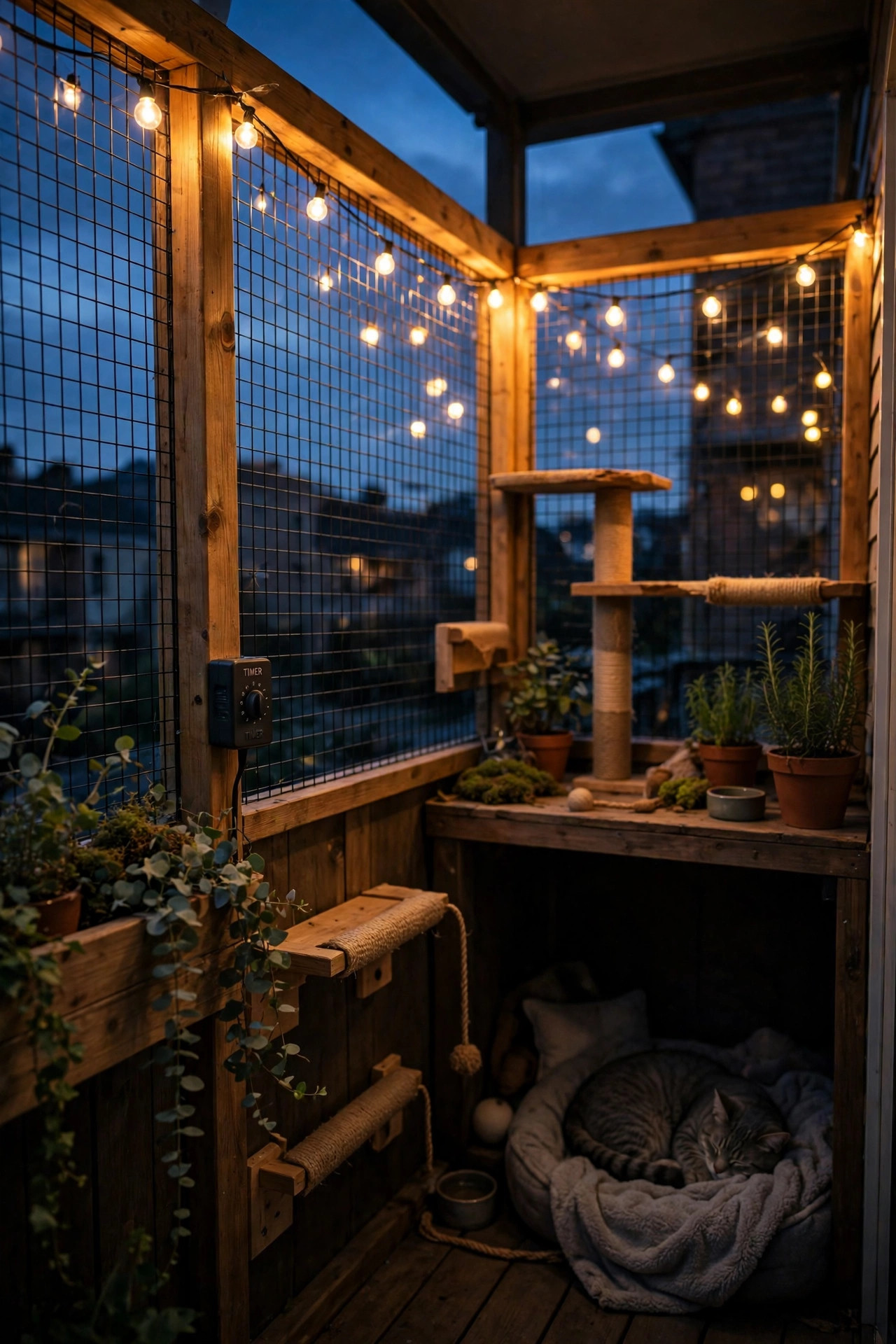
13. Uplight a Cat Grass Planter for Living Interest
Cats are visual hunters, and a pool of light with something moving in it is prime evening television. My version is a chunky planter of cat grass and a Boston fern, lit from below by one small, ground-level uplight on the human side of the mesh. The light rakes up through the grass blades, throws long dancing shadows whenever the breeze moves, and gives my cat a glowing little meadow to supervise. The fixture sits low and shielded, aimed at the plants and nothing else — never angle an uplight where it can catch eyes, feline or human. Keep the planter generous and the grass fresh; cat grass grows fast, goes leggy, and wants reseeding every few weeks, which is a small price for a living light feature. A solar spotlight handles the job on sunny balconies, while a low-voltage wired one is steadier in shade. This is the one idea on the list that is pure entertainment rather than utility, and it earns its place every single evening at moth o'clock.
Suggested budget range: $15 – $35.
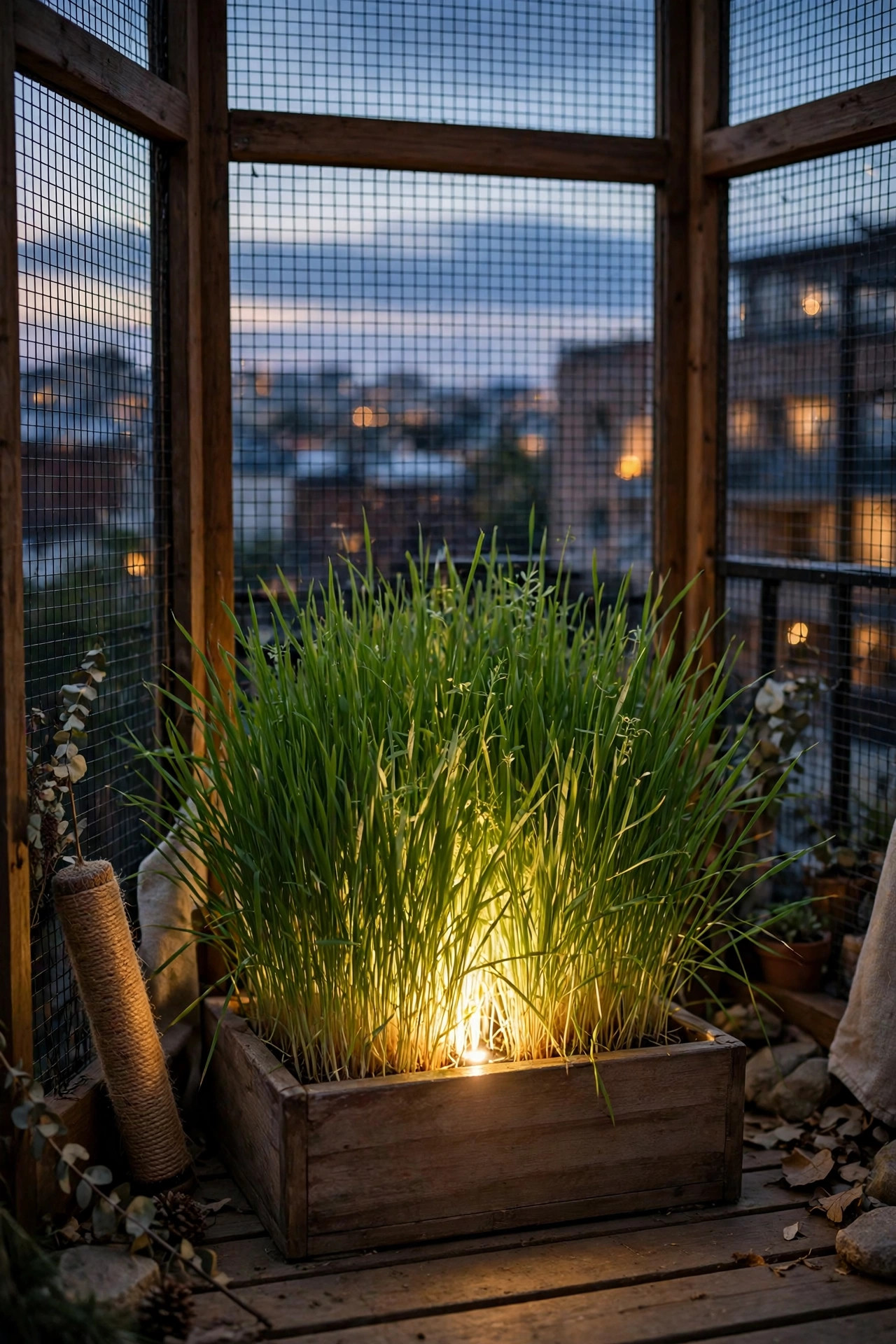
14. Light the Feeding and Litter Corner on Its Own Switch
Romance is lovely, but somebody still has to scoop the litter box and find the kibble at 10 p.m. I keep the practical corner — food, water, and litter, tucked at the far end of the balcony — on its own separate little light, so chores get a bright pool without flooding the whole catio and ruining the mood for everyone else. A battery puck light under the shelf above the feeding station, or a small clip light aimed at the floor, does the job; choose the brightest fixture in the whole setup here, around 300 lumens, because this one is for human eyes doing human jobs. Keep cords and batteries mounted above cat height, and the light angled down so it never glares across the enclosure. A waterfall-style water bowl near electricity makes me careful: everything here is battery-powered and the bowl sits a full two feet from any fixture. Unsexy? Completely. But a well-lit chore corner means the jobs actually get done nightly, and a clean, fresh catio is the foundation every prettier idea stands on.
Suggested budget range: $10 – $25.
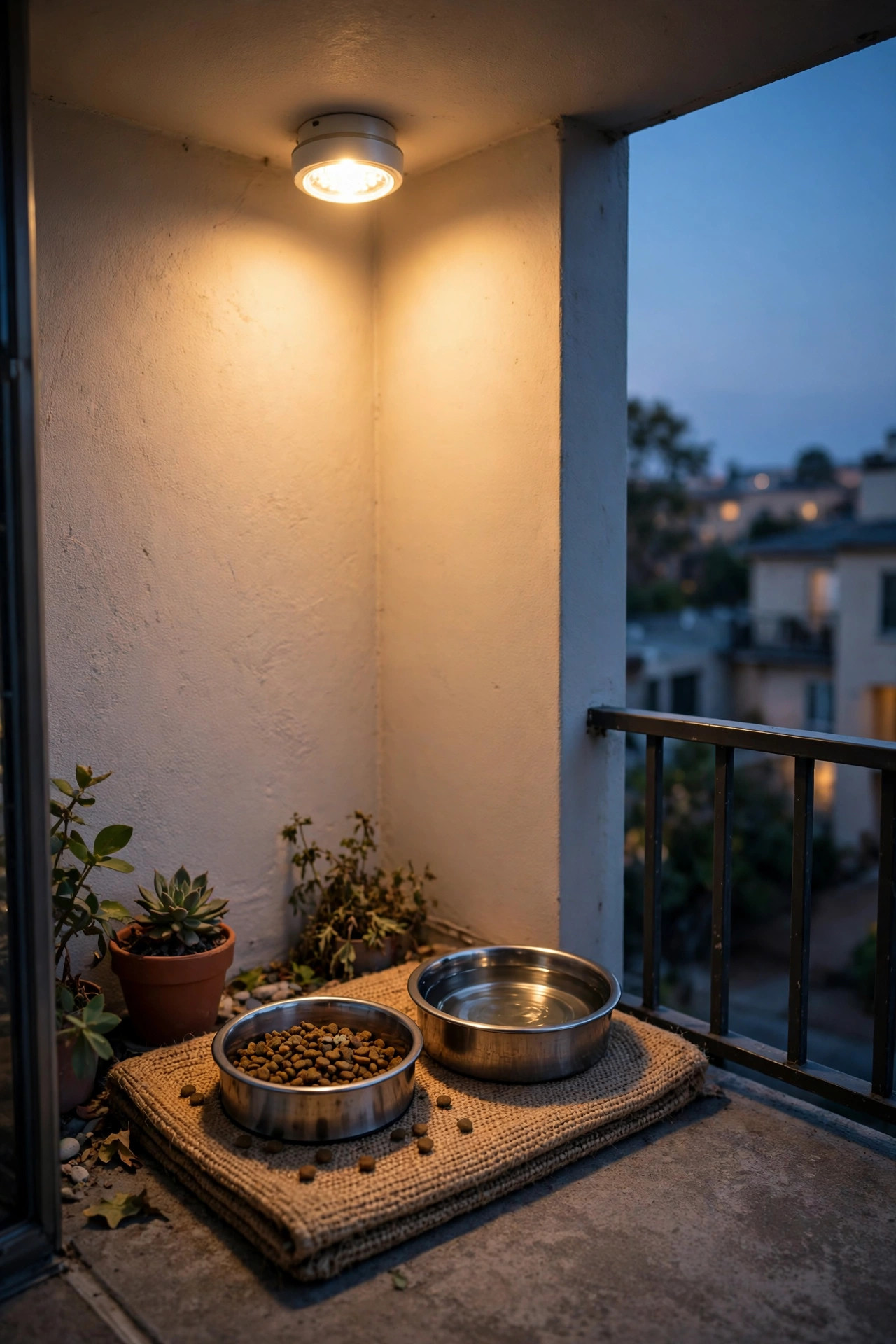
15. Finish With a Dusk Walk-Through of Your Catio Lighting Ideas
Once everything is up, do the inspection that actually counts — at dusk, at cat height, with your cat as the supervisor. Crouch down and travel her route: squint along the climbing shelves for any bulb aimed at face level, tug every strand and strip to check the clips, and run a thumb along each cord run feeling for nicks or a spot where the protective cover has slipped. Check that the hideaway stayed dim, the litter corner stayed bright, and the timers are set to hand the balcony back to the dark by late evening. Then sit in your chair with a drink and watch what your cat actually uses; the perch she picks under real light is data, and I have moved one fixture after every single walk-through I have ever done. Repeat the whole check monthly, and after any storm. Good catio lighting ideas are not really about the fixtures at all — they are about a small nightly world that stays safe, calm, and glowing in exactly the places two very different species need it to.
Suggested budget range: $0 – $15.
Frequently Asked Questions
What color light is best for cats at night?
Warm white, in the 2700K to 3000K range, is my recommendation for any pet space. Cats gather far more light than we do, so warm and dim reads as comfortably bright to them, while cool daylight-white bulbs look harsh and can make a cat avoid the area. Amber-toned light is another gentle option for overnight hours.
Are string lights safe around cats that chew cords?
They can be, with the right setup: choose shatterproof LED bulbs, clip the strand snugly so no loose loops hang at paw height, and keep cords outside the enclosure or inside a split-loom protective cover. Battery and solar strands remove most of the risk, and any damaged or nicked cord should be replaced, never taped and forgotten.
How bright should catio lighting be?
Much dimmer than you think. Most fixtures in a catio work best between about 30 and 200 lumens, layered in several places rather than blasting from one source. The exception is the feeding and litter corner, where a 300-lumen task light aimed at the floor helps the human on scoop duty.
Can I leave the catio lights on all night?
You can, but your cat would rather you did not. Cats rest best with a genuinely dark stretch overnight, and all-night light also draws insects to the mesh. Put the pretty layers on timers that switch off late in the evening and keep only a small motion-sensor light at the door for nighttime checks.
Conclusion
The best catio lighting ideas all come back to the same recipe: layer it warm, layer it low, and armor every cord like a cat is already planning something — because she is. Start with the roofline glow and the perch-level layer, add the practical corner light, set the timers, and do one honest dusk walk-through at cat height before you call it done. The result is a balcony that works beautifully for both species who live with it. If you are ready to keep going, browse the rest of the outdoor lighting ideas here on the site; your cat has already picked the next project, even if she has not told you yet.