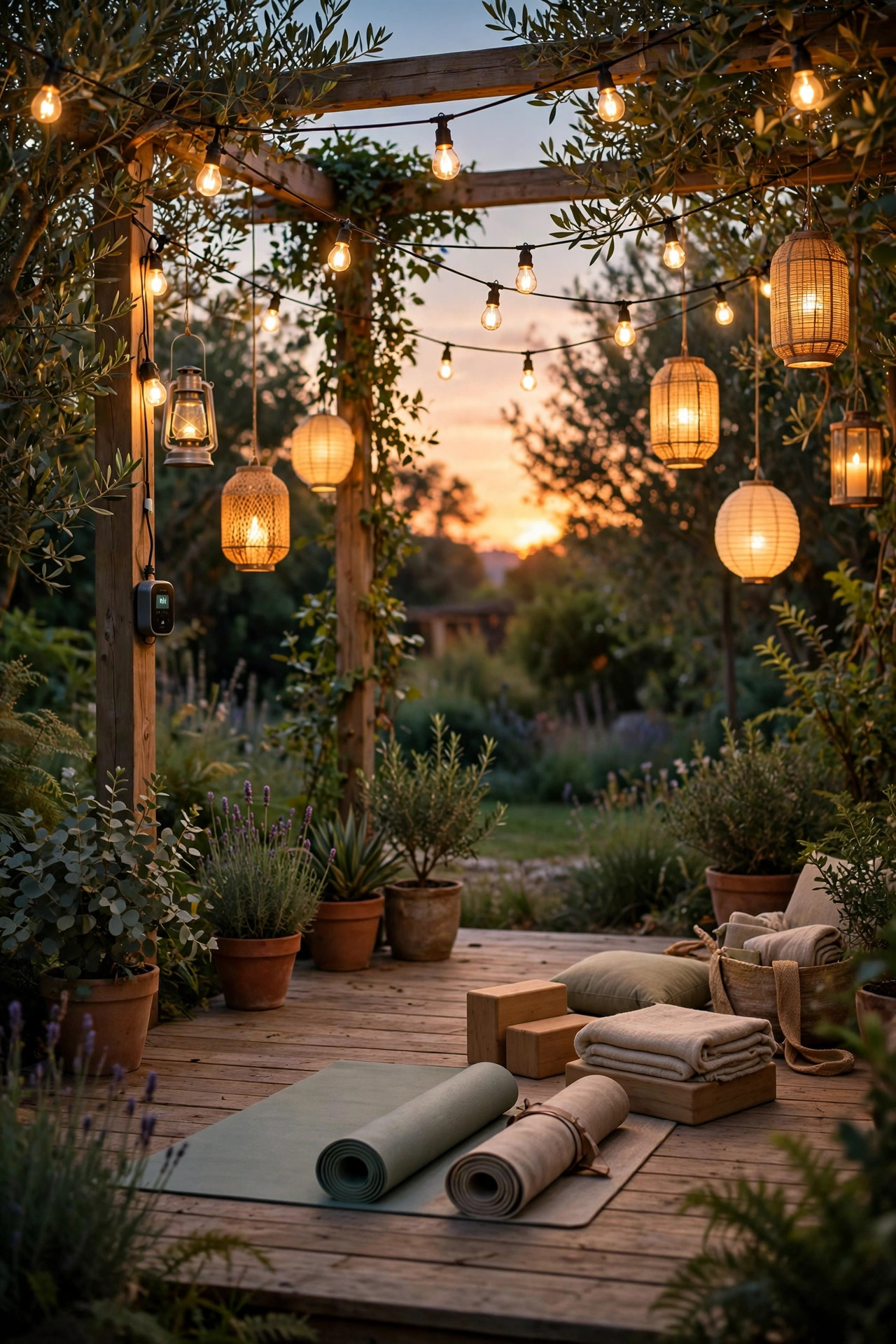
There is a particular kind of magic that happens when you unroll your mat outside just as the light starts to fade. The air cools, the birds quiet down, and if your outdoor yoga space lighting ideas are dialed in, the whole garden seems to exhale with you. I spent two summers getting my little practice corner right, and I learned that yoga lighting is the opposite of most outdoor lighting. You are not trying to see more. You are trying to see softer. Everything in this list follows the layering philosophy I use everywhere in my yard, just turned way down: a low glow at ground level so you can move safely, a warm pool of light at mat level for your focal point, and the faintest wash overhead so the space feels held instead of exposed. No glare in your eyes during savasana, no harsh blue-white bulbs, nothing that hums or flickers. Below are the 17 setups I rotate through my own practice space, from five-minute solar fixes to a full layered scene you can build in a single weekend.
1. Build Your Outdoor Yoga Space Lighting Ideas Around Three Soft Layers
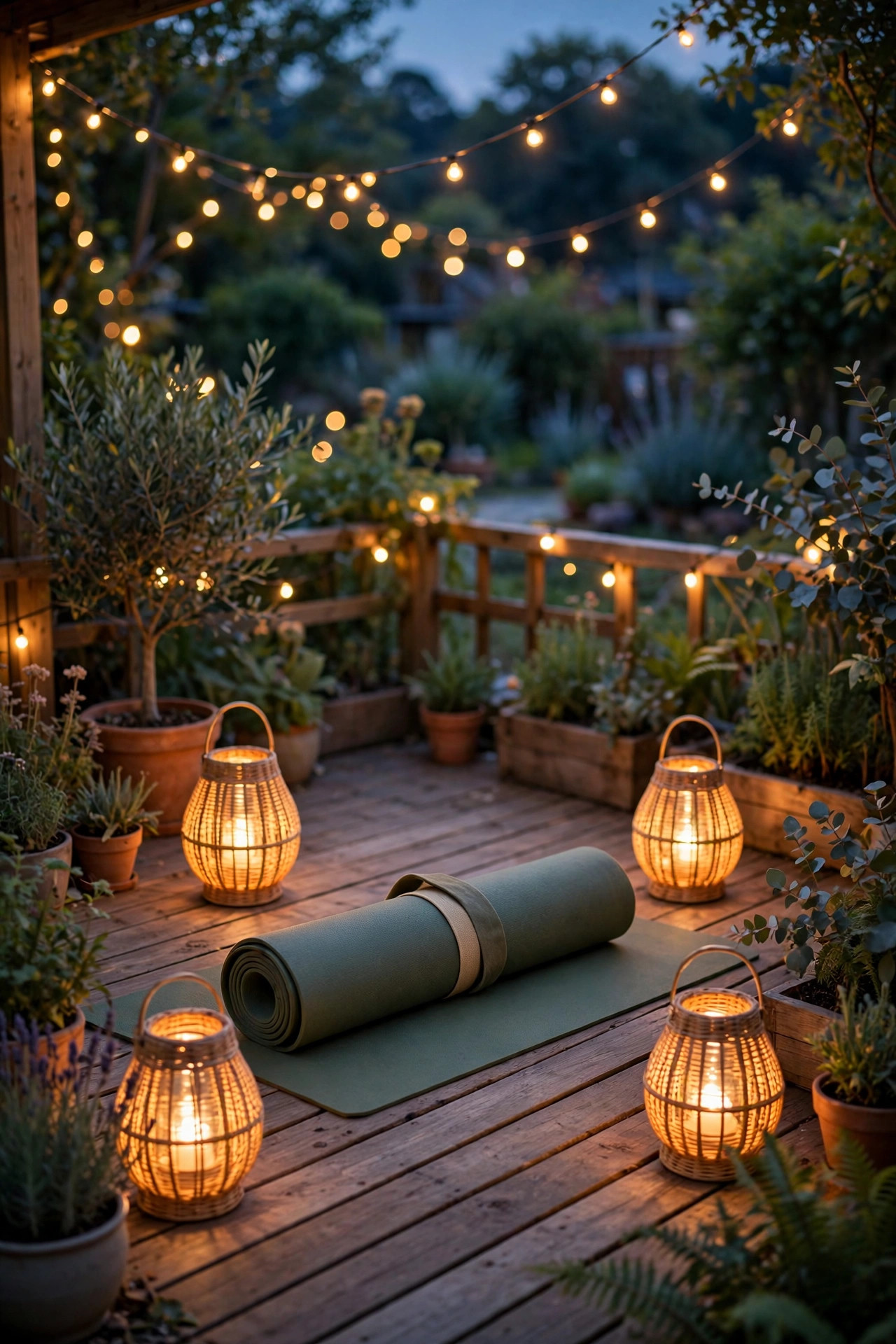
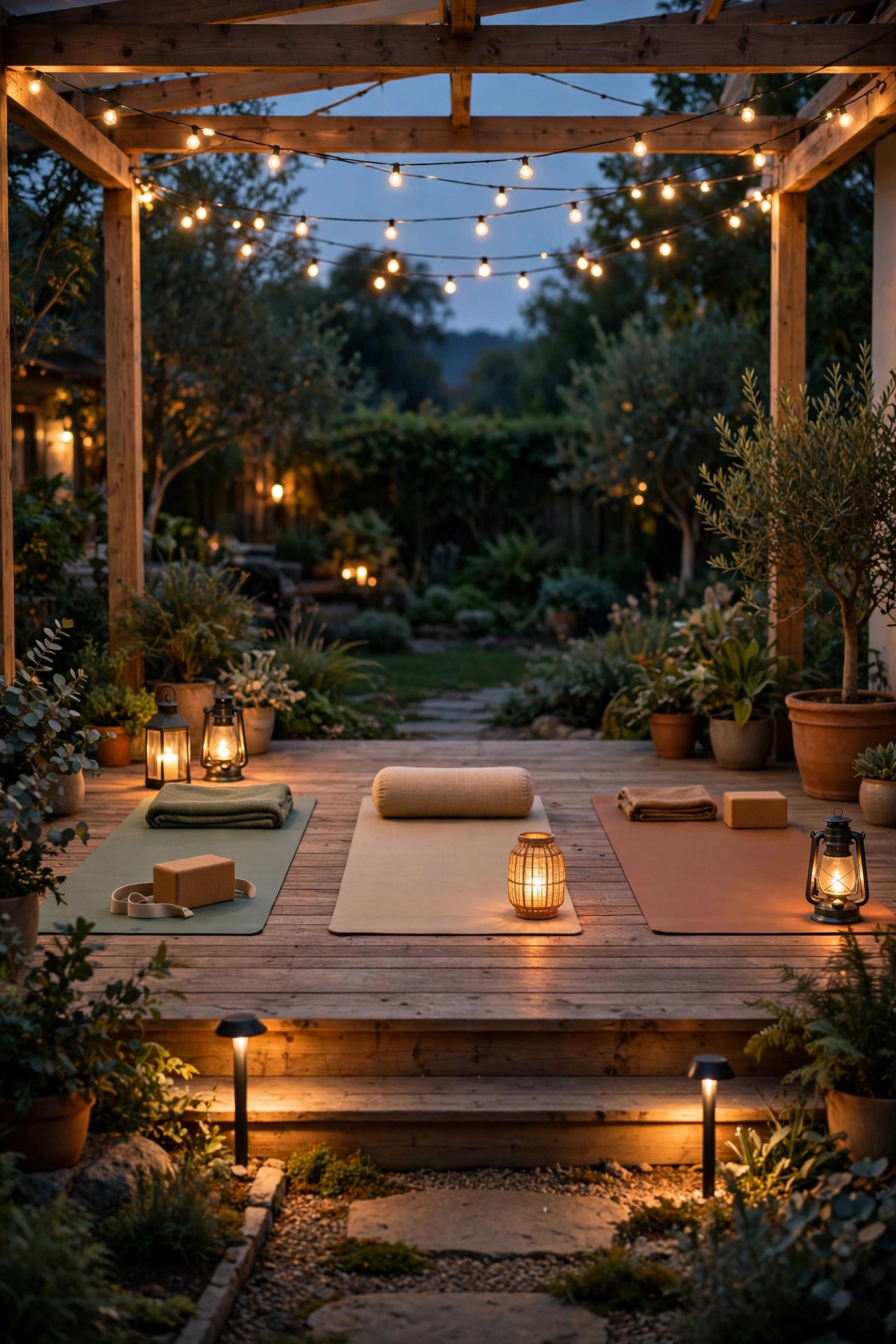
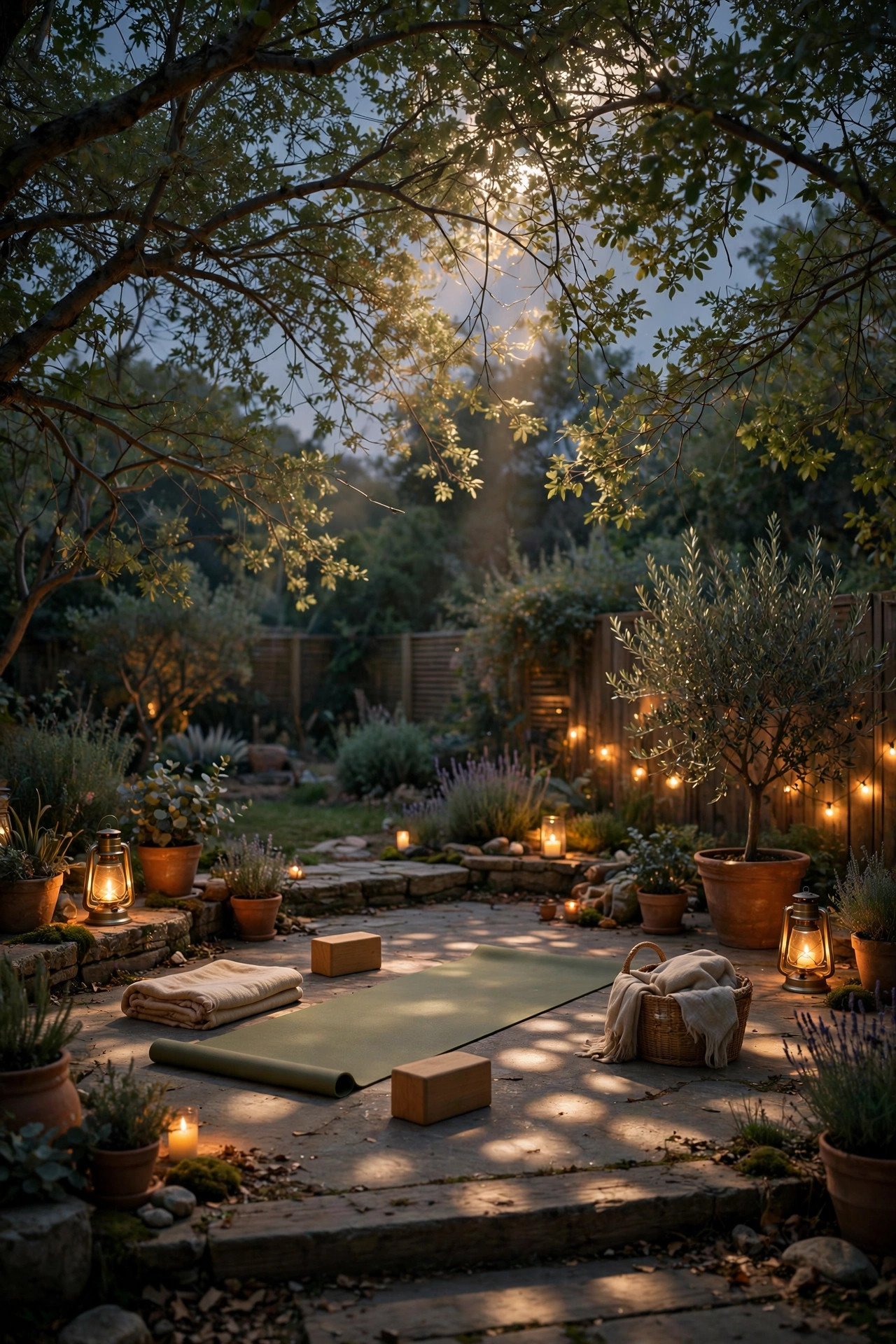
Every calm practice space I have ever set up starts with the same three layers, just kept much dimmer than a dining patio. Layer one is ground level: a few low lights that outline the deck edge or the path so you never trip carrying your mat and water bottle in the dark. Layer two is mat level, roughly knee to waist height, where lanterns and candles create the warm pool you actually practice inside. Layer three is a whisper of light overhead or behind you, something for your eyes to rest on during standing poses. The trick is restraint. Each layer should be just bright enough to register, and together they should total less light than one porch sconce. I always test my setup by lying flat on the mat and looking straight up. If any bulb is directly visible, that layer is too harsh and needs a shade, a diffuser, or a new angle. Start with this framework and every idea below simply becomes a choice about which fixture fills which layer.
Suggested budget range: $40 – $120.
2. Cluster Solar Lanterns at the Corners of Your Mat
Solar lanterns are the hardest-working pieces in my practice corner because they ask nothing of me. I keep six of them, one at each corner of my mat zone and two extra flanking the steps, and they charge themselves on the deck rail all day. Look for frosted or fabric-look shades rather than clear glass, because the diffused glow is what makes them feel like candlelight instead of hardware. Warm white, around 2700K, is non-negotiable for me. Placement matters more than quantity: set them slightly behind your mat line rather than in front, so the light washes across your space instead of shining into your face during forward folds. Most solar lanterns run 6 to 8 hours on a full charge, which easily covers an evening practice, but keep the little solar panels wiped clean or the runtime drops fast in dusty weeks. If you want more inspiration for styles that mix well together, my roundup of solar lantern ideas covers everything from hanging jars to stake styles.
Suggested budget range: $25 – $70.

3. Weave Copper-Wire Fairy Lights Through the Shrubs Behind You
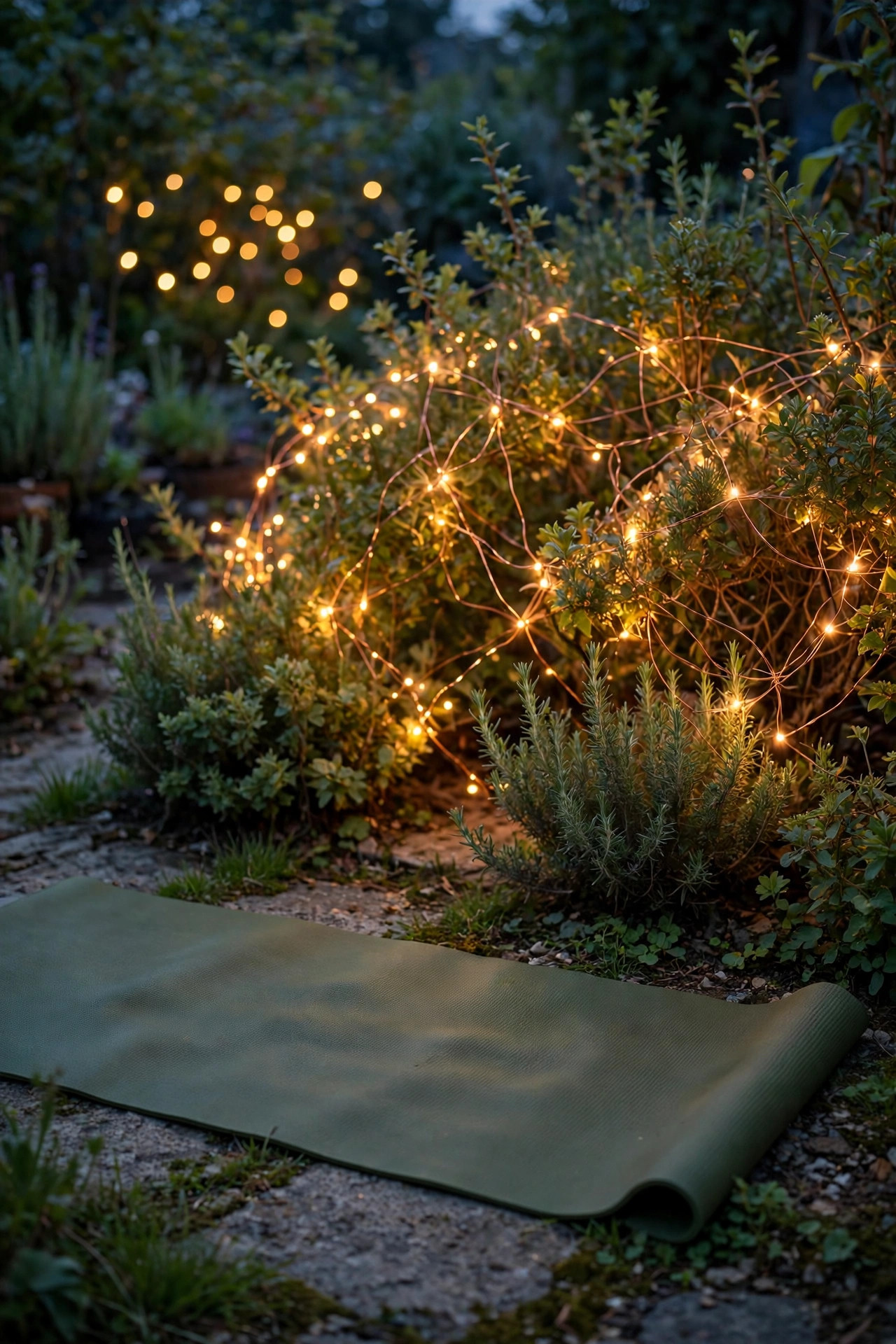
A backdrop changes everything. When the shrubs behind my mat are threaded with copper-wire fairy lights, the whole practice space gains depth, and my eyes have somewhere gentle to land during balance poses. The thin copper wire disappears into foliage, so all you see is a scatter of tiny warm points, like fireflies that agreed to stay put. One 33-foot strand usually covers two medium shrubs; I weave loosely rather than wrapping tight, because a random, organic pattern reads as natural while a perfect spiral reads as holiday decor. Battery-powered strands with a built-in timer are my pick here, set to come on at dusk and shut off after four hours, so there is no cord crossing the lawn to trip over. Keep the battery pack tucked in a small waterproof box at the base of the shrub. LED fairy lights stay cool to the touch, so they are safe against dry leaves, but I still keep them off any foliage that sits against the house siding. Browse my favorite outdoor fairy light ideas if you want more ways to use them around the yard.
Suggested budget range: $15 – $45.
4. Hang a Dimmable String Light Canopy, But Keep It Low and Loose
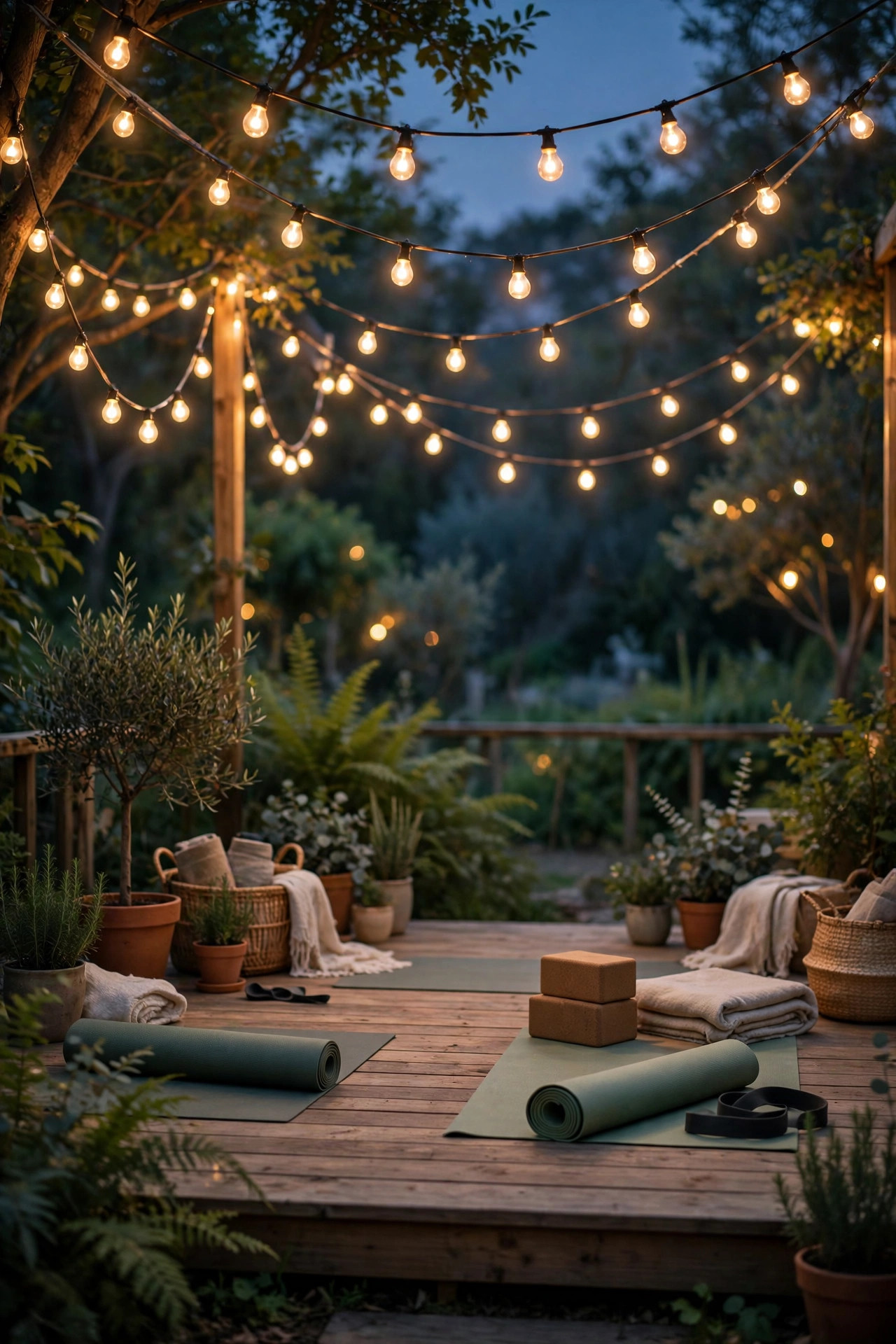
Overhead light is the layer most people get wrong for yoga, because a bright canopy aimed down at your face ruins every reclined pose. The fix is dimming and drape. I hang two strands of shatterproof LED string lights in loose swags about 8 feet up, never pulled tight, and run them through an outdoor-rated plug-in dimmer so they sit at maybe 30 percent brightness. At that level they read as a warm ceiling that defines the space without lighting it like a stage. Space the swags so no bulb hangs directly over the center of your mat; your gaze in savasana should meet soft bokeh at the edges, not a bare bulb. Use guide wire or sturdy hooks into the pergola or fence posts rather than the strand itself bearing the weight, and leave a little slack for wind. Everything outdoors needs a GFCI-protected outlet, full stop. If your string lights are not dimmable, swap in low-wattage vintage-style LED filament bulbs, which give that same amber softness straight out of the socket.
Suggested budget range: $45 – $110.
5. Ring Your Practice Space With Flameless Candle Lanterns
Real candles and yoga do not mix in my house. Between the breeze, the moving limbs, and the occasional curious dog, open flame near a mat is a stress I do not need during a practice meant to remove stress. Flameless candles solved it completely. I use the flickering LED kind with real wax bodies, set inside glass hurricane lanterns, and I ring the whole practice zone with seven or eight of them at floor level. The flicker is convincing enough that guests assume they are real, and the timer function means they light themselves five minutes before my usual practice time. Group them in odd numbers and vary the heights with small wood rounds or stacked stone coasters; a flat uniform ring looks like an airport runway. Keep them about a foot outside your mat footprint so a wide warrior stance never clips one. Because they are battery-powered and stay cool, they are also the safest option on a wooden deck or near the dry grass at the edge of my lawn.
Suggested budget range: $30 – $80.

6. Set a Salt Lamp on a Low Table for Meditation Corner Glow
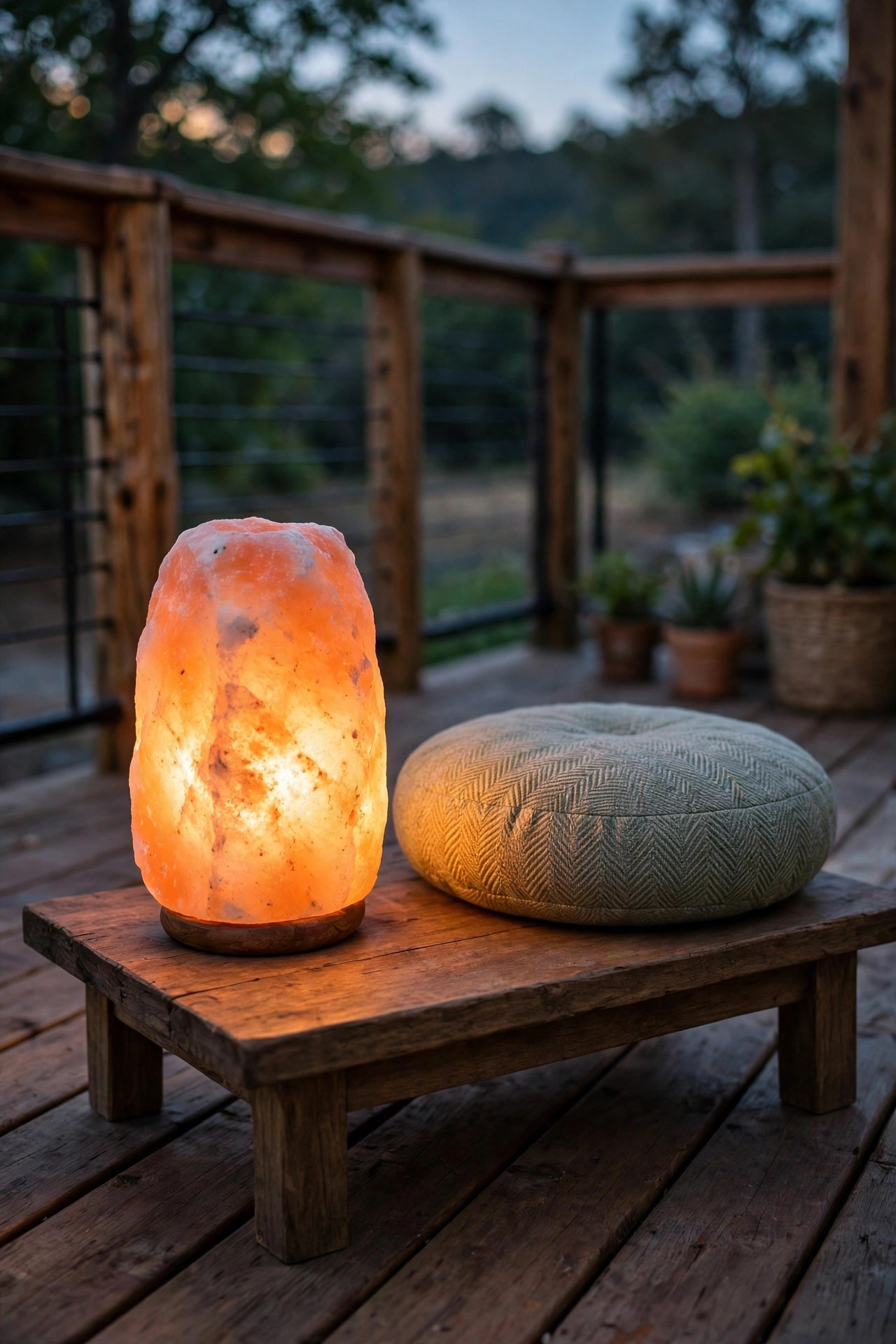
For seated meditation, I want one single source of light with a color so warm it almost reads orange, and that is exactly what a salt lamp gives you. I keep mine on a low side table at the corner of the deck, beside the cushion, and its uneven mineral glow is the most calming light I own. A small 6 to 9 pound lamp is plenty for a personal corner; anything bigger starts to feel like a nightclub accent. Two honest cautions from experience. First, salt lamps are indoor creatures at heart, so mine lives outside only on dry evenings and comes in when there is any hint of rain or heavy dew, since moisture makes them weep and crumble. Second, use the lowest-wattage bulb it accepts, because the lamp should glow, not illuminate. Pair it with everything else turned off except the fairy light backdrop and you get a meditation nook that feels carved out of the evening. It is the cheapest transformation on this whole list.
Suggested budget range: $20 – $50.
7. Add Moonlighting From a Tree Branch Above the Space
Moonlighting is my favorite trick for making a yard feel enchanted instead of lit, and it works beautifully over a yoga space. You mount one shielded downlight high in a tree, 15 to 20 feet up, and aim it through the branches so the light filters down in soft, broken patches, exactly like moonlight through leaves. Because the source is hidden and the light arrives dappled, there is no glare from any angle on the mat, even lying flat. This is a low-voltage job: a small bullet fixture, a tree-mount strap that will not girdle the trunk, and cable run down the back side of the tree to your transformer. Choose a cool-neutral bulb around 3000K here rather than warm amber, because real moonlight reads slightly silvery and the contrast with your warm lanterns is genuinely beautiful. If climbing and mounting is not your comfort zone, this is the one project on the list where I happily say hire it out. A single well-placed fixture can serve the yoga corner and the whole back garden at once.
Suggested budget range: $90 – $220.
8. Mark the Walk to Your Practice Spot With Low Solar Path Lights
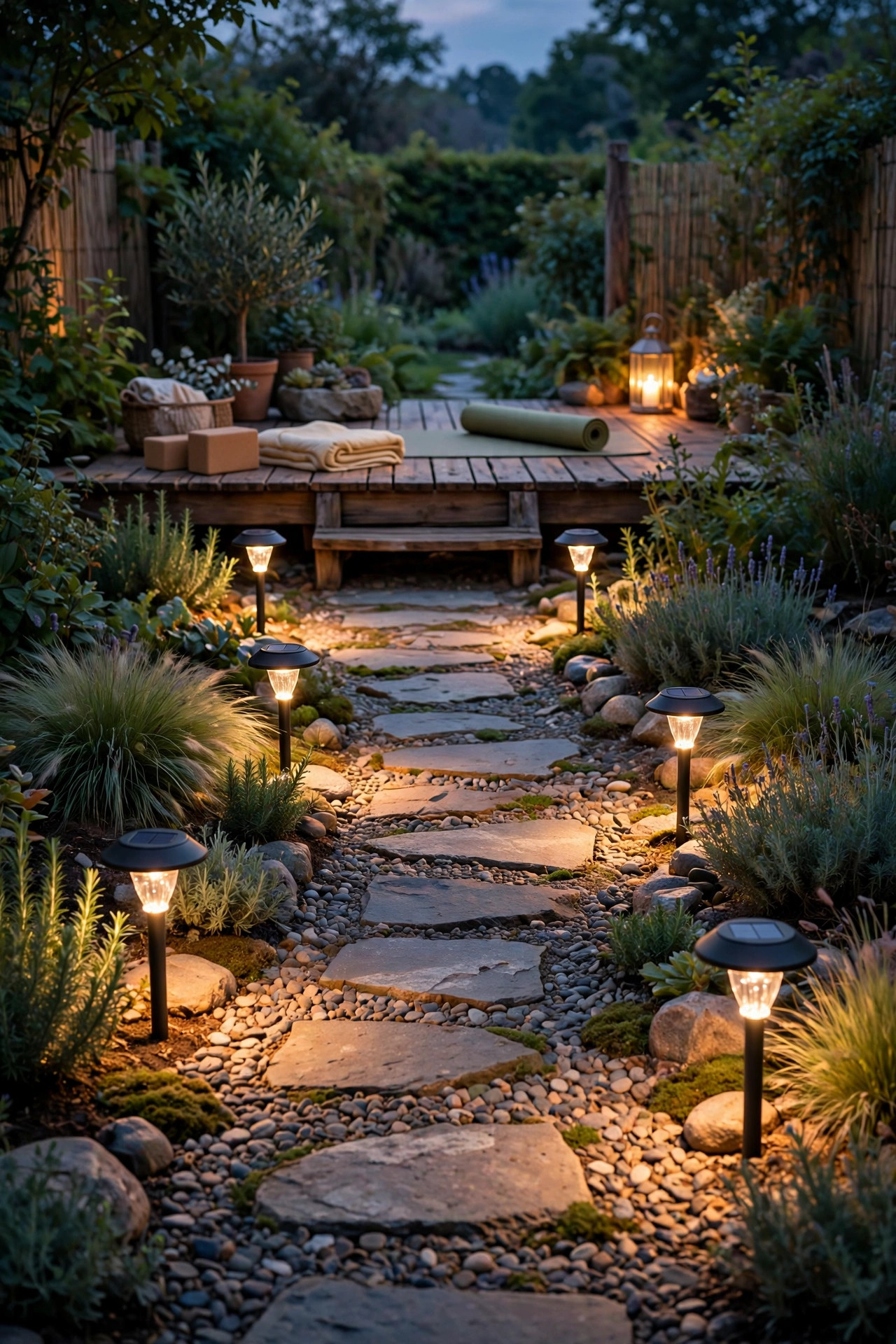
The most practical lights in my setup are also the least glamorous: a short row of low solar path lights between the back door and the deck where I practice. They are there so I can carry a mat, a bolster, and a mug of tea across a dark yard without a single anxious step. Keep them low, 12 to 15 inches tall, and hooded or frosted so the light pools on the ground instead of spraying outward. For a calm feel, spacing them 5 to 6 feet apart on alternating sides beats a tight runway line every time; you want gentle stepping stones of light, not landing-strip energy. Solar stakes with replaceable batteries are worth the small premium, because the sealed throwaway kind tend to fade after one season. In winter I pull mine into the garage once the days get very short and bring them back out in spring, which roughly doubles their useful life. Safe arrival and departure quietly bookend the whole practice.
Suggested budget range: $20 – $60.
9. Uplight One Focal Tree or Statue as Your Drishti Point
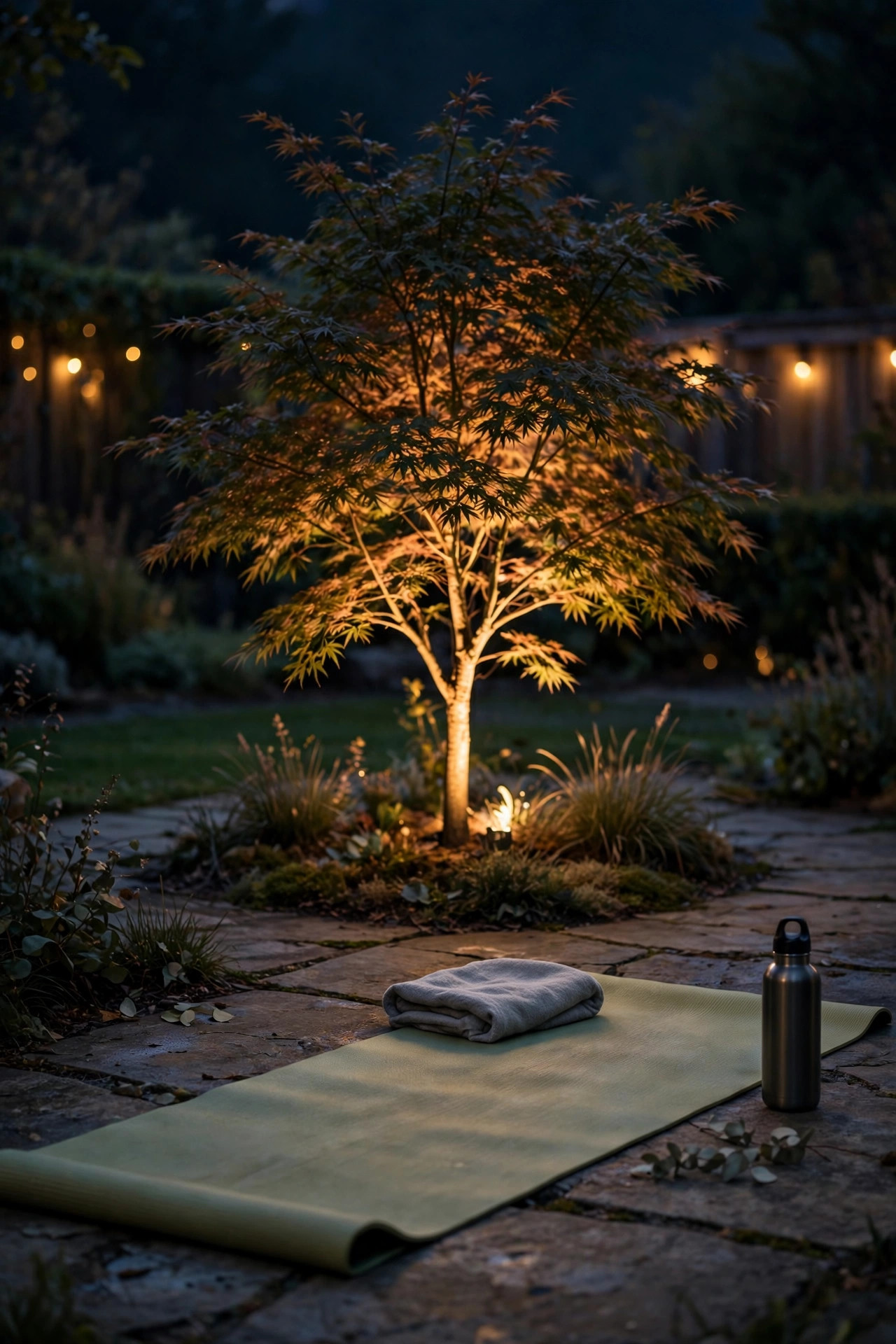
Every yoga teacher tells you to fix your gaze on one still point, your drishti, and I took that literally in my garden design. One small tree at the end of my practice deck gets a single soft uplight at its base, and that glowing trunk and canopy is where my eyes rest through every balance sequence. A narrow-beam spotlight, around 15 to 25 degrees, throws the light up the trunk without flooding the whole garden, and a honeycomb glare guard keeps the source invisible from the mat. Garden statues, a stone lantern, or a birdbath pedestal work exactly the same way if you do not have a suitable tree; the point is one illuminated object, gently lit, in an otherwise dim view. Keep the fixture on its own dimmer or its own smart plug if you can, so during meditation you can drop it to a ember-level glow. Of all 17 ideas, this is the one that most changed how the practice actually feels, because the space now has a quiet visual anchor instead of a dark void beyond the mat.
Suggested budget range: $35 – $90.
10. Drape a String Light Curtain Behind You for Privacy and Depth
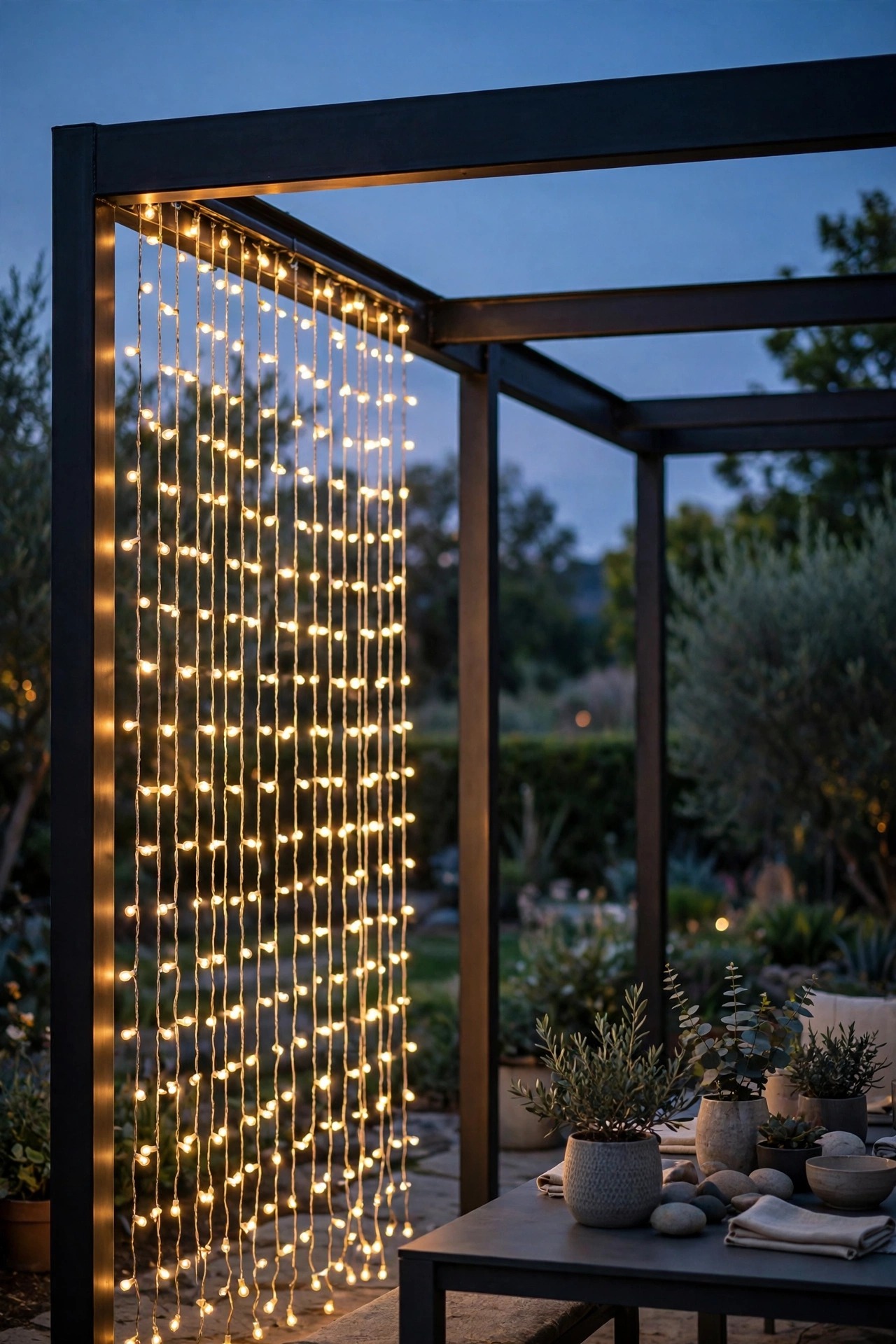
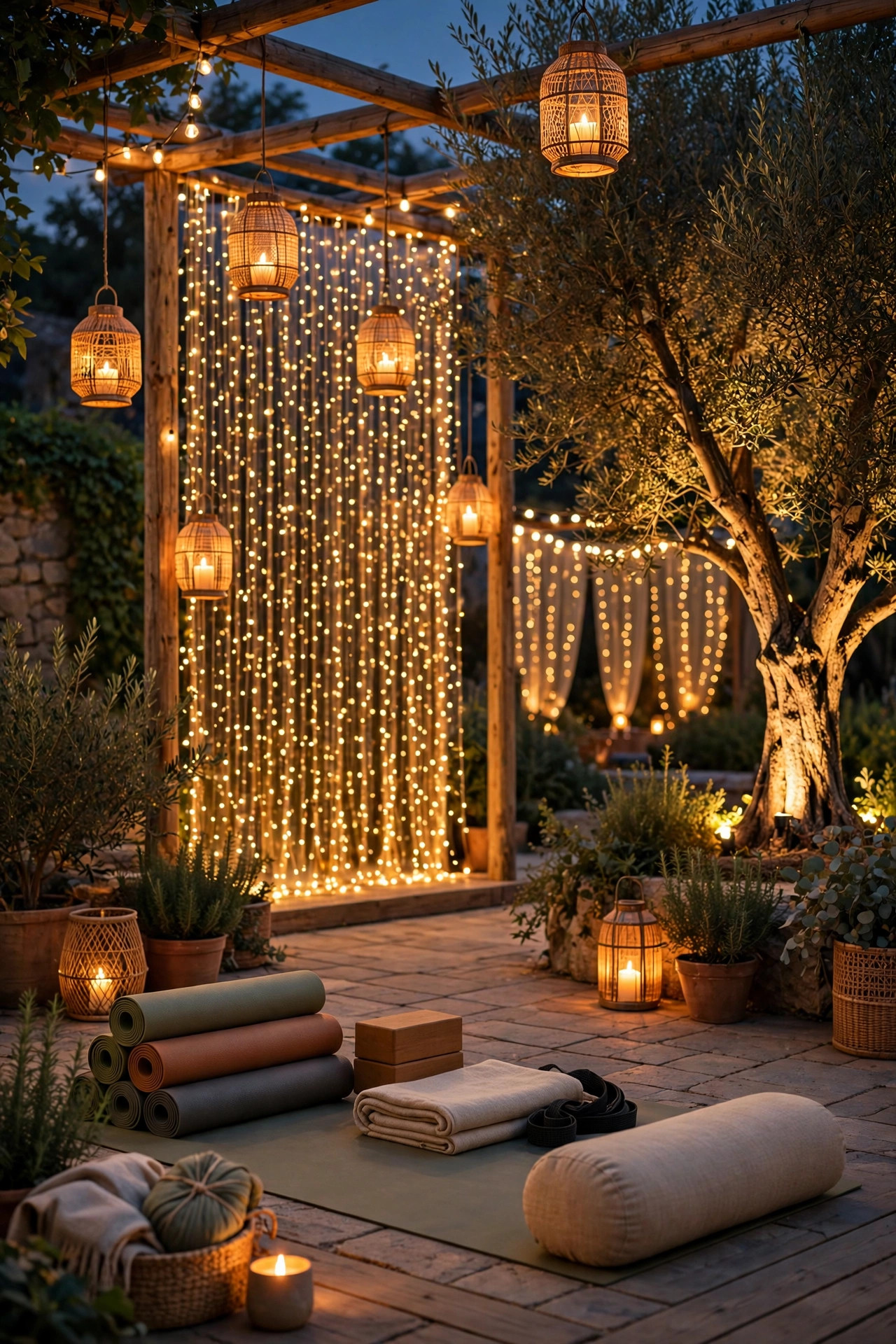
If your practice spot faces a fence or a neighbor's window, a curtain of light solves the privacy problem and the atmosphere problem in one move. I hang two curtain-light panels on the fence behind my deck, the kind with vertical drops of tiny LEDs on fine wire, and the effect is a soft wall of warm sparkle that screens the yard beyond without blocking the breeze. From the mat, it feels like practicing inside a lantern. The drops should hang clear of anything flammable and be rated for outdoor use, since the cheap indoor versions corrode at the connections within a season. I attach mine with removable hooks along the top rail so the whole curtain comes down in ten minutes for winter. Power it from a timer and it doubles as your session clock: when the curtain clicks off, practice is over. Pair the curtain with dark surroundings and it also photographs beautifully, which is not the point of yoga, but your sunrise salutation photos will quietly thank you.
Suggested budget range: $30 – $75.
11. Float Submersible Lights in a Nearby Fountain or Water Bowl
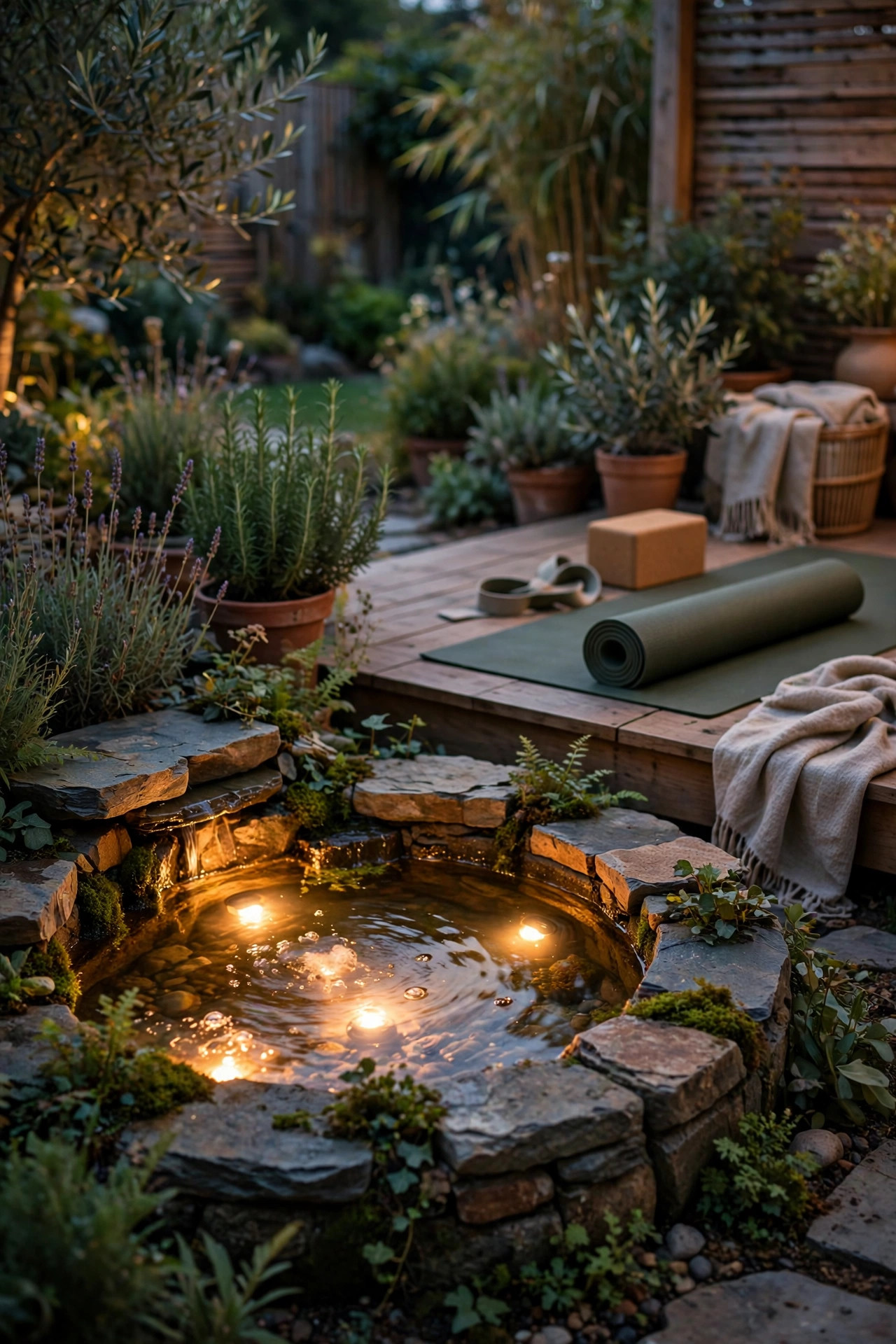
Water plus light is the fastest route to tranquility I know, and you do not need a pool to get it. My practice deck sits beside a small bubbling fountain, and two submersible LED tea lights dropped into the basin turn the whole water feature into a slow, rippling glow that moves even when the air is still. Look for lights rated IP68, which means fully submersible, and warm white only; the color-changing disco versions are fun for parties and terrible for meditation. If you have no fountain, a wide ceramic water bowl with a floating solar light gives a smaller version of the same effect on any patio corner. The sound matters as much as the sight here, so keep the pump gentle. One practical note: rechargeables beat the sealed disposable kind, since a season of nightly use eats through button batteries quickly. Set the bowl or fountain at the edge of your peripheral vision rather than dead ahead, and the moving reflections will soften your focus without stealing it.
Suggested budget range: $15 – $50.
12. Outline Your Mat Zone With Recessed Deck Lights
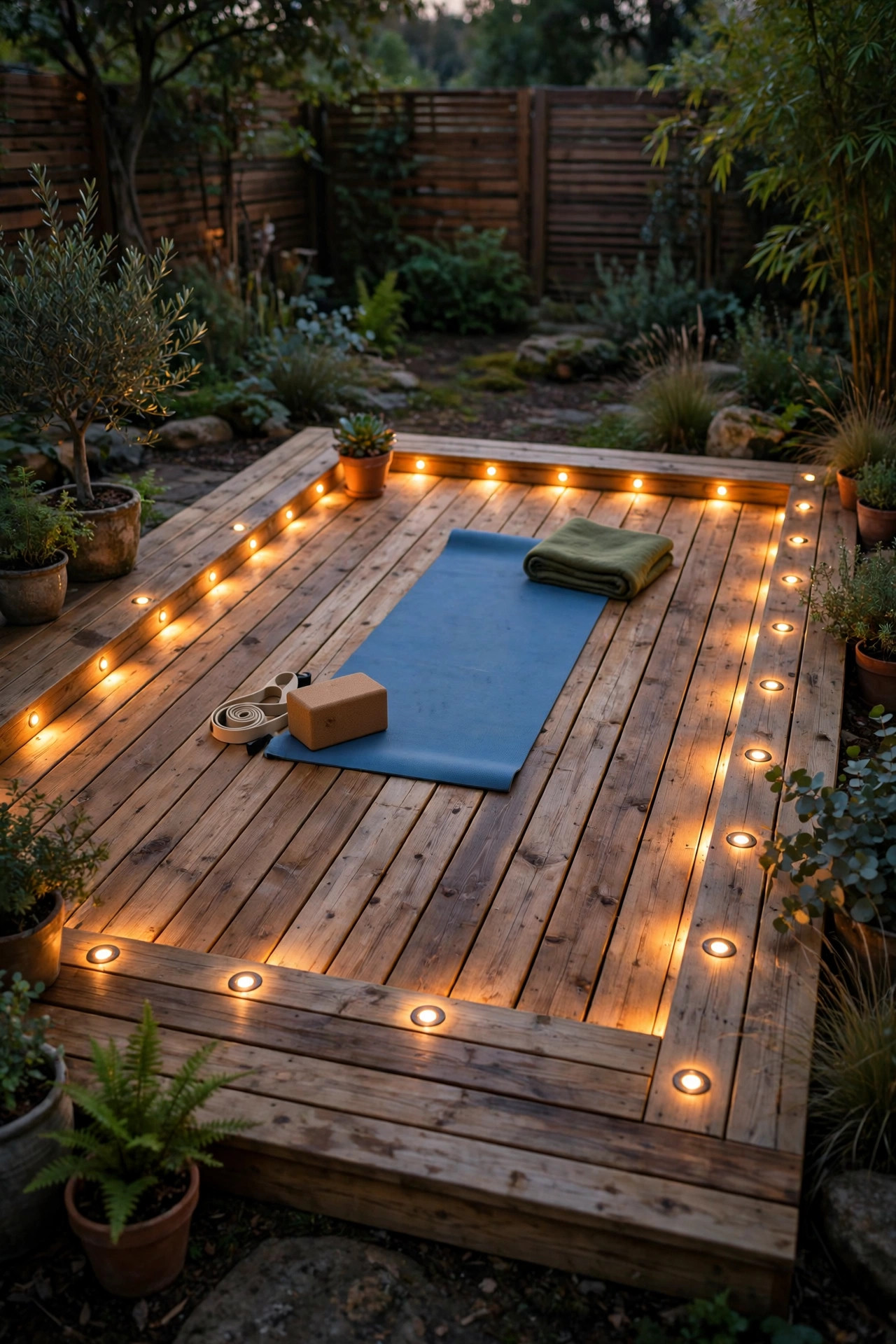
When I rebuilt my deck boards a few years ago, I added six small recessed lights around the practice area, and it is the most permanent, polished lighting on this list. These little puck-style fixtures sit flush with the deck surface and throw a soft ring of light upward, so at night the borders of my practice zone simply glow. Walk-over rated and low-voltage, they are safe bare-footed and add no trip hazard, which matters when you are moving through a flow with your eyes half closed. Spacing them about 4 feet apart along two sides of the mat zone is plenty; a full four-sided outline starts to feel like a helipad. Keep the color at 2700K and put them on a dimmer if your transformer allows it, because fixed full brightness is a touch strong this close to the ground. This is a saw-and-drill project, so plan it for a free Saturday, measure twice, and always confirm the hole size against the fixture template before the first cut.
Suggested budget range: $70 – $180.
13. Keep a Basket of Portable Battery Lanterns for No-Outlet Corners
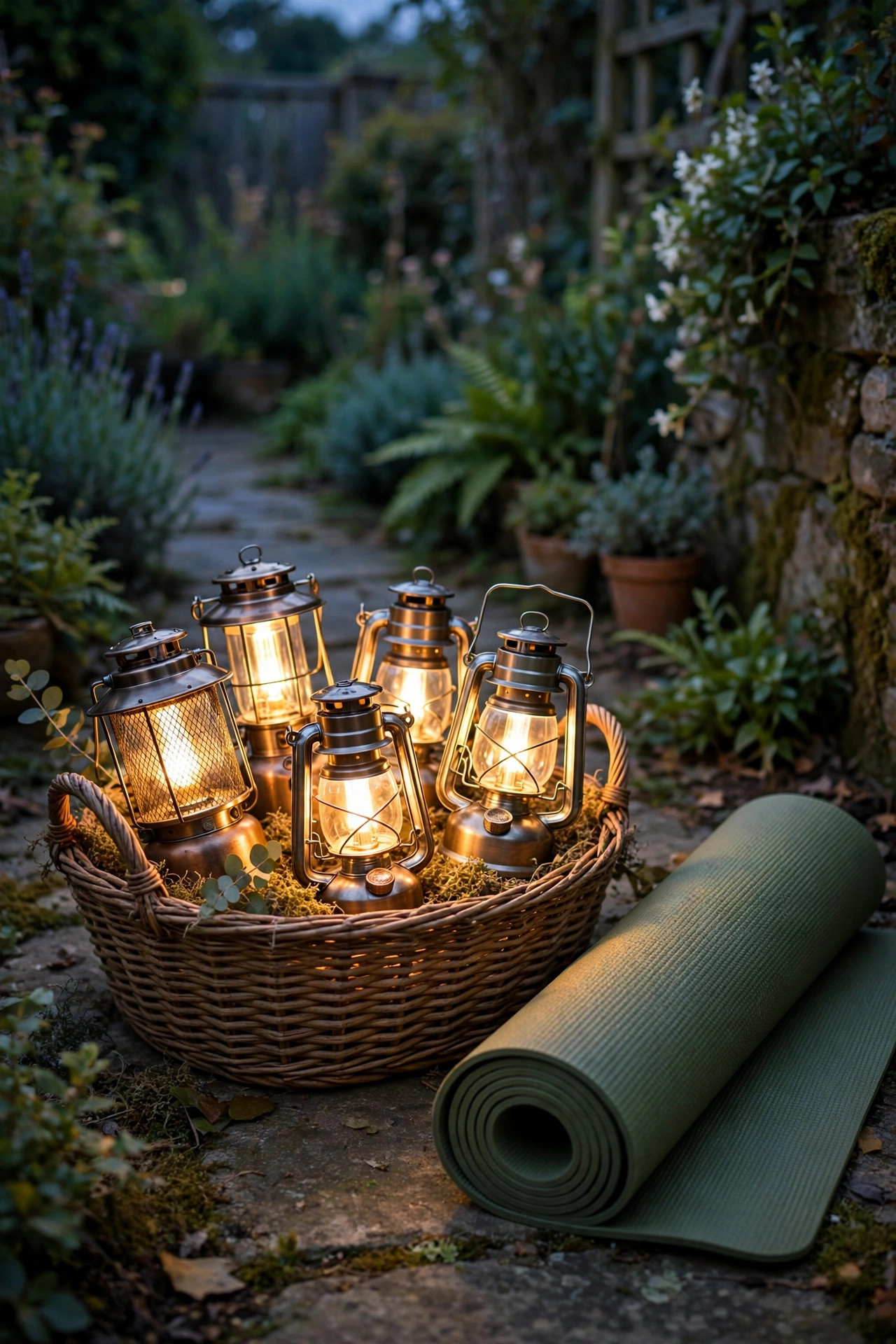
Not every perfect practice spot has power nearby, and honestly, the corner of the garden farthest from the house is often the most peaceful one. My solution is a woven basket of four portable battery lanterns that live by the back door, charged and ready, so any corner of the yard can become the studio in two minutes. Choose lanterns with a true dimmer dial rather than fixed brightness steps, and a warm setting at the low end, because portability is useless if the light is harsh. Rechargeable via USB is the way to go; I top mine up on the same Sunday routine as the watering cans. Weight matters more than you would think: a lantern you can hang from a shepherd's hook or a low branch gives you height options the tabletop ones cannot. Runtime on low is typically 30-plus hours, so a basket genuinely covers a week of evening practices. When guests come, the same basket becomes instant party lighting, which is my favorite kind of double duty.
Suggested budget range: $35 – $85.
14. Place Amber Bug-Smart Light Away From the Mat, Not Over It
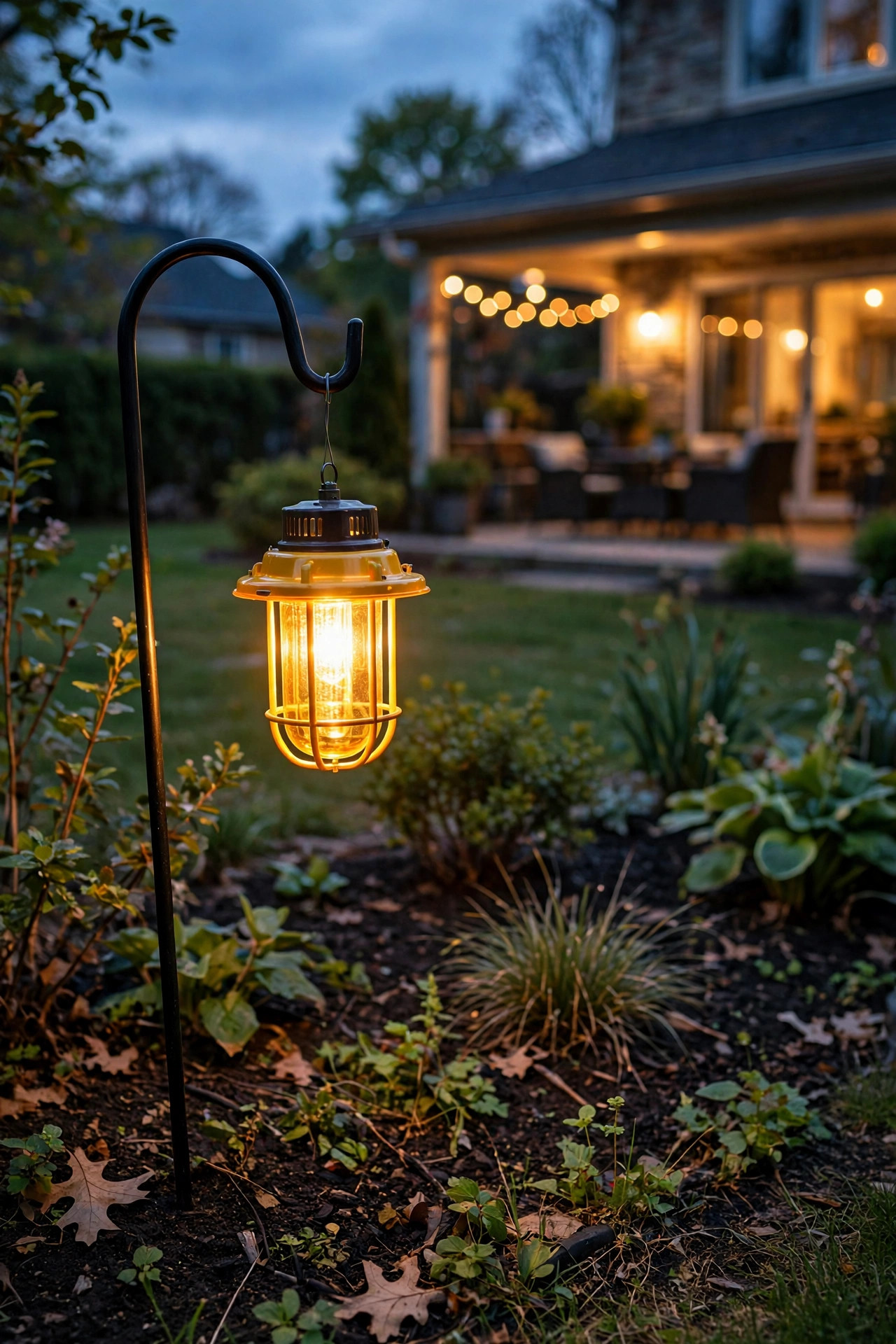
Nothing ends a meditation faster than a swarm of moths doing laps around your head, so let me share the placement trick that fixed my summer evenings. Insects navigate toward light, so instead of lighting the mat brightly, I put one amber-toned light about 15 feet away from the practice space, near the far fence, and let it act as a decoy. Amber and yellow-spectrum bulbs attract far fewer bugs than white light in the first place, and the ones that do gather, gather over there. Meanwhile the mat zone stays in the dim lantern glow that insects mostly ignore. Keep food and sweet drinks out of the practice area for the same reason, and a small fan on its lowest setting pointed across the mat discourages the few mosquitoes that wander over anyway. This is also why I never hang a bright porch light anywhere near the deck during practice. One decoy, placed deliberately, outperforms every citronella candle I ever burned, and it costs nothing extra once you know the trick.
Suggested budget range: $10 – $30.
15. Program Dimming Scenes and Timers So Practice Starts Itself
The most luxurious upgrade I have made costs the least attention: my practice lighting now turns itself on. A pair of outdoor smart plugs runs the string canopy and the focal tree light, scheduled to fade up at sunset and hold for ninety minutes, and a simple inline dimmer on the lanterns keeps those at their candle setting. The scene matters. Lights arriving gradually, rather than snapping on, signals your nervous system that the day is ending, and honestly that transition has become part of my practice. When you shop, look for plugs rated for outdoor use with a proper weather seal, and keep the connections tucked under an eave or in a waterproof box, because the plug is the weak point of any outdoor setup. If you are designing a space that stays gentle after dark, the principles in my guide to dark sky outdoor lighting will keep the whole yard neighbor-friendly too. Automation means the space is ready before your motivation wavers, and that, more than any fixture, is what keeps a practice consistent.
Suggested budget range: $30 – $75.
16. Set a Flame-Effect Torch Pair at a Safe Distance for a Fire Element
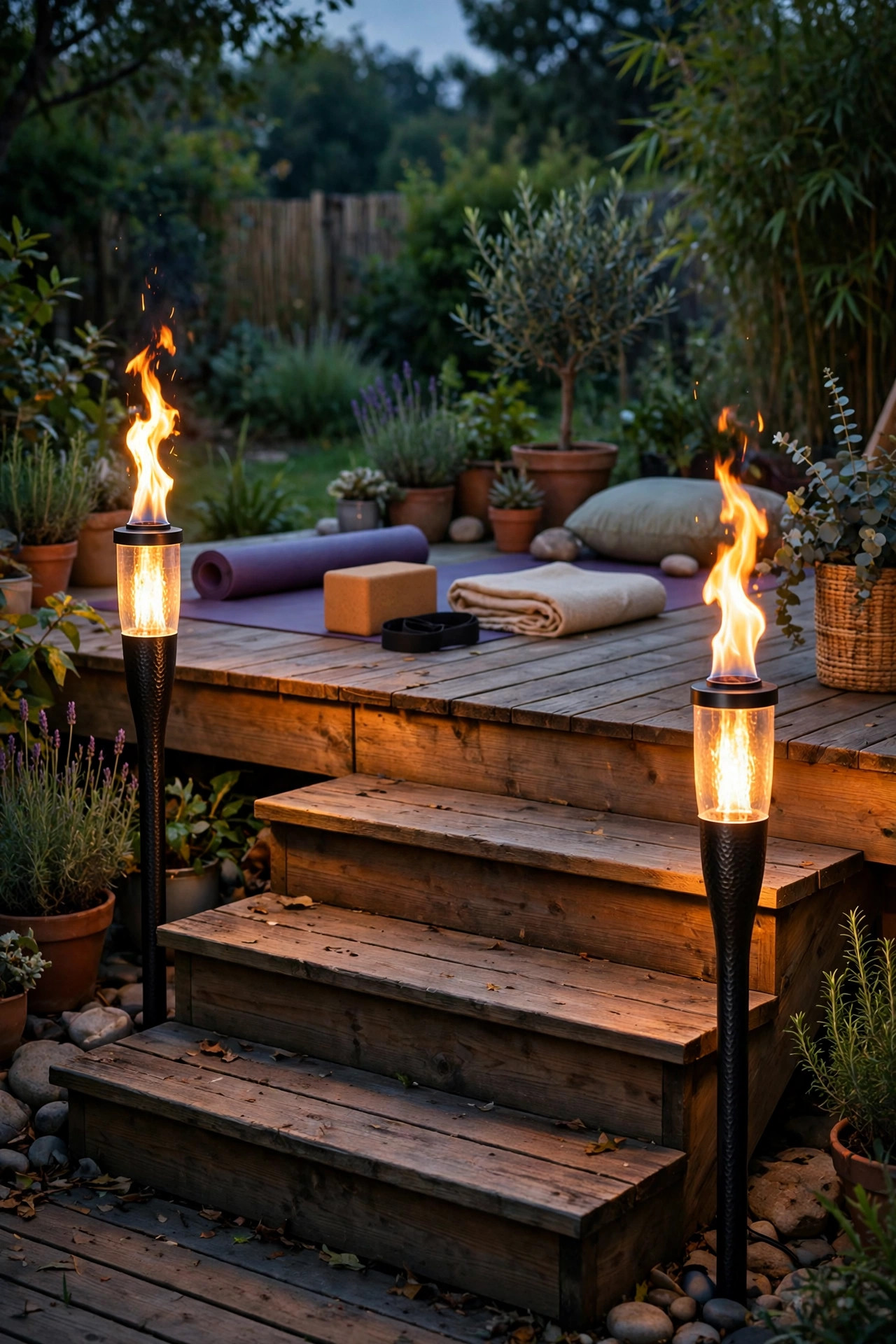
A little real fire energy, safely faked, adds something electric fixtures cannot. I flank the steps to my deck with two solar flame-effect torches, the kind with a cluster of LEDs that dance like a small torch flame, and the movement in my peripheral vision makes the whole space feel alive. Solar versions charge all day and need no wiring, but placement is everything: the panel needs real sun, so a torch buried under the maple tree will give you twenty sad minutes of flicker. Set them at least 6 feet from the mat and well clear of where a leg extends in a wide pose, because even a cool LED torch hurts when you kick it barefoot, which I say from personal experience. Stake them firmly and level, since a leaning torch reads as broken rather than rustic. If you prefer real flame in a fire bowl instead, keep it the same respectful distance, use a screen, and check your local burn rules before lighting anything.
Suggested budget range: $25 – $65.
17. Pull It All Together: My Full Outdoor Yoga Space Lighting Ideas Scene, Start to Finish
Here is the exact scene I run most nights, so you can copy it wholesale. The solar path lights handle the walk out. At the deck, six solar lanterns sit at the mat corners, down at their softest. The fairy lights in the shrubs and the string light curtain give me a glowing backdrop, the focal tree uplight is on at half brightness, and one salt lamp waits beside the meditation cushion for the final ten minutes. Total visible bulbs aimed at my eyes: zero. Total cost spread over two summers: under three hundred dollars, built a few pieces at a time. The order of operations is what makes it work. Ground layer first, so the space is safe. Focal point second, so the space has a heart. Backdrop third, so the space feels enclosed. Overhead light last and least, because it is the easiest to overdo. Build in that order, test from the mat at every step, and stop adding the moment the space feels complete rather than impressive. Calm is the whole point.
Suggested budget range: $150 – $350.
Frequently Asked Questions
What color temperature is best for outdoor yoga and meditation lighting?
Warm white, between 2200K and 2700K, is the sweet spot. It mimics candlelight and sunset, which helps your body wind down, while cooler 4000K-plus light feels clinical and can keep you alert when you are trying to do the opposite. Whatever you choose, keep every fixture in the space within the same warm family so the layers blend instead of fighting.
Can solar lights really power a whole evening practice?
Yes, for the soft lighting a yoga space needs. Modern solar lanterns and stakes run 6 to 8 hours on a full sunny charge, and because this style of lighting is deliberately dim, you are not asking much of them. The two conditions are honest sun on the panels during the day and clean panel surfaces. On a cloudy stretch, portable rechargeable lanterns are my backup.
How bright should the lighting be for outdoor yoga?
Far dimmer than feels right at first. Aim for gentle pools of light you can move in safely, roughly the level of a few candles, with no bare bulb in your line of sight when standing or lying on the mat. If you can read a book comfortably, it is probably too bright for meditation. Give your eyes five minutes to adjust before deciding a setup is too dark.
How do I keep bugs away from my practice space lights?
Use warm or amber bulbs, which attract far fewer insects than cool white, and place one brighter amber light 10 to 15 feet away as a decoy so bugs gather there instead. A small fan on low across the mat discourages mosquitoes, and skipping scented candles near the mat helps more than most people expect.
Conclusion
If I could leave you with one principle, it is this: your outdoor yoga space lighting ideas should disappear. The best setups on this list never announce themselves. They outline the path, warm the edges, give your gaze one calm point to rest on, and then get out of the way of the practice itself. Start with lanterns and a focal light, test everything from the mat, and add layers only when the space asks for them. When you are ready to extend the same gentle glow to the rest of your garden, browse more of my lighting ideas here on the site, and I will see you out there at dusk.