
A balcony garden works hard all day — the tomatoes climb, the basil perfumes the air, the vines soften the railing — and then the sun goes down and it all disappears into the dark. That used to frustrate me so much. The fix turned out to be beautifully simple: treat your plants as the lighting design. These balcony garden lighting ideas tuck solar stakes between the pots, weave fairy lights through the vines, and let your herb boxes glow like little lanterns, so the garden you grew all summer becomes the prettiest light fixture you own. My rule, same as everywhere in my home, is layering: something low in the planters, something at sitting height, and a soft sparkle up high. Almost everything here is solar, battery, or plug-in low voltage, which means no electrician, no drilling into the building, and nothing a landlord could object to. If you're starting from a bare railing, my broader balcony lighting ideas cover the basics — this list is all about lighting the green itself.
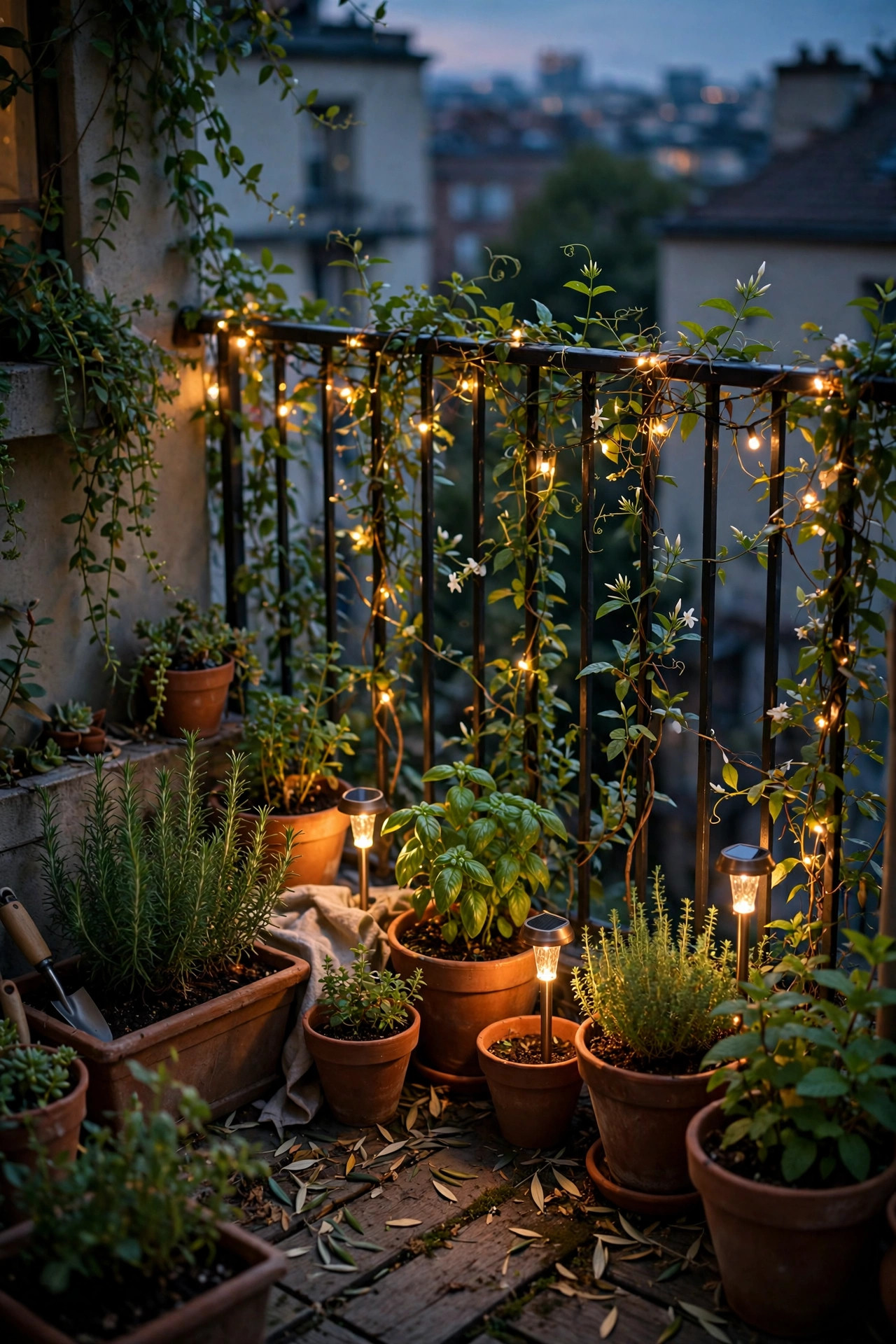
1. Solar Stakes Tucked Between the Pots
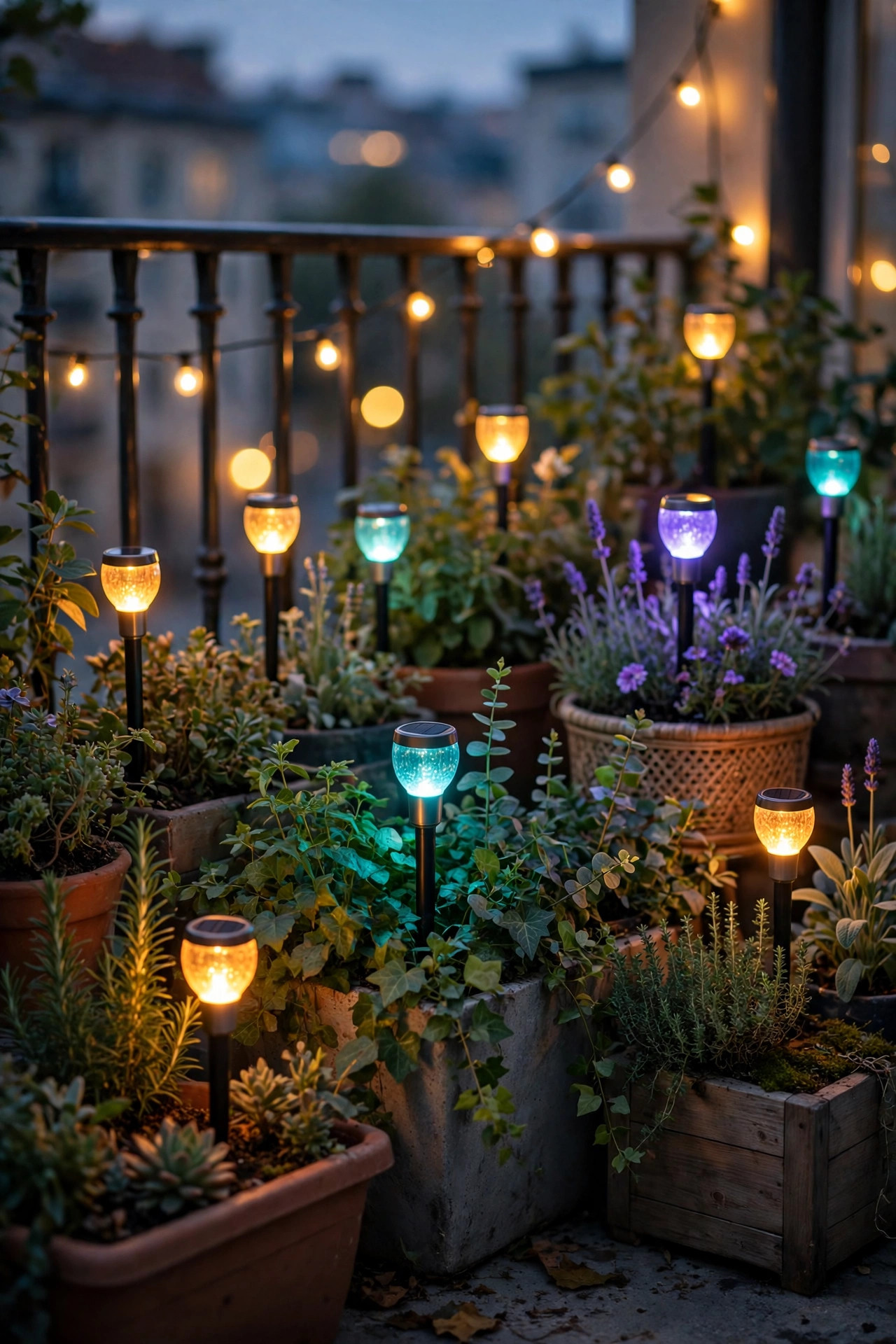
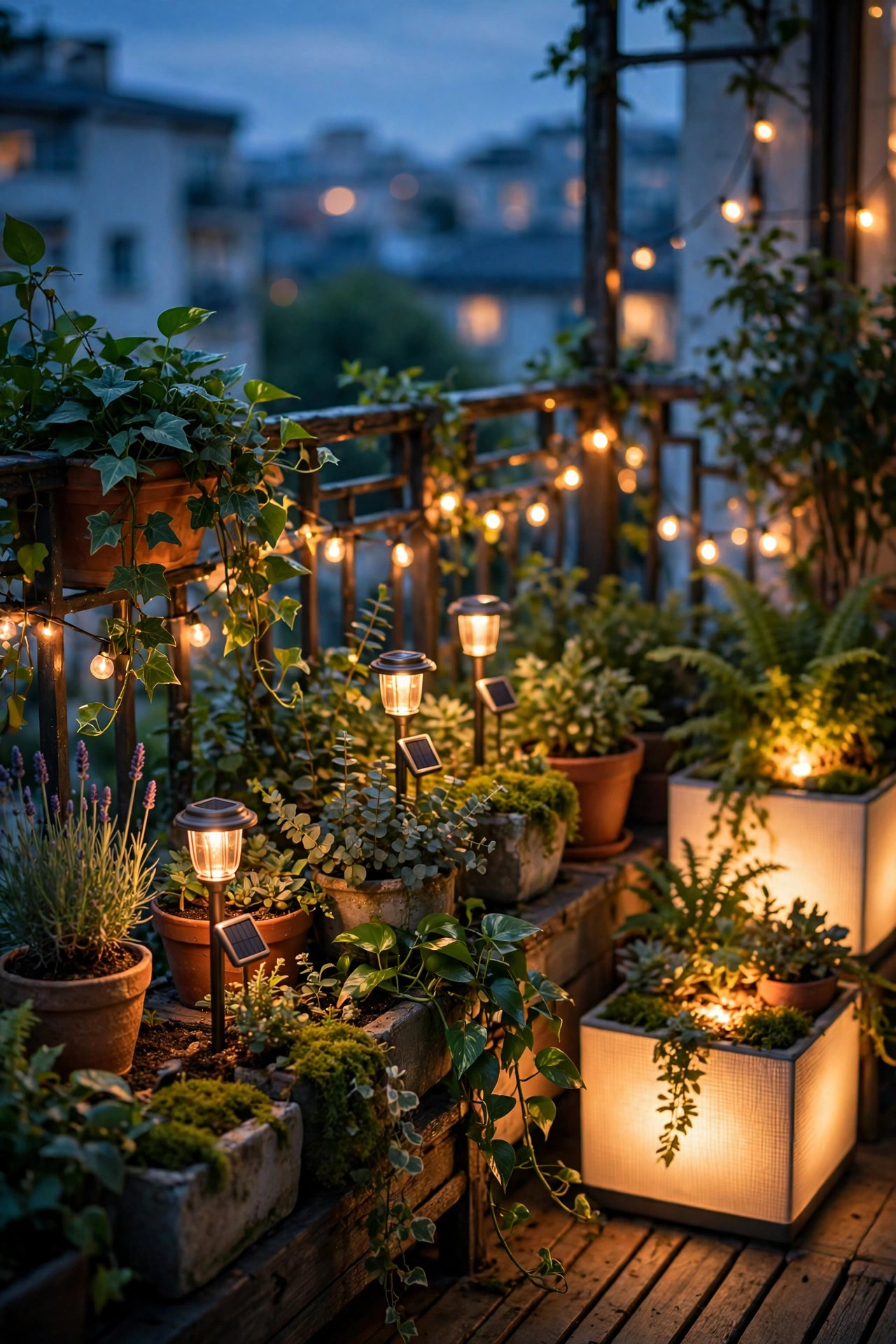
The fastest win on any balcony garden is a fistful of solar stake lights pushed straight into the soil. I cluster three stakes in my biggest pots — odd numbers just look better — pushed in at slightly different angles so the glow feels grown, not installed. During the day the little panels hide under the foliage; at dusk each pot gets its own warm pool of light, and the leaves above it catch the glow from underneath, which makes even a humble parsley plant look dramatic. Choose warm white (2700–3000K) stakes, never the blue-white ones, and look for an IP65 rating so daily watering doesn't kill them. Height matters: 12- to 16-inch stakes sit right at foliage level in most pots. Keep the panels wiped clean every few weeks — a dusty panel charges at half strength — and angle panels toward the sunniest stretch of your railing. In my experience, stakes in pots outshine stakes in the ground because the light source sits up inside the plant instead of under it. Start with four to six and add slowly; a balcony can tip from charming to landing strip surprisingly fast.
Suggested budget range: $12 – $30.
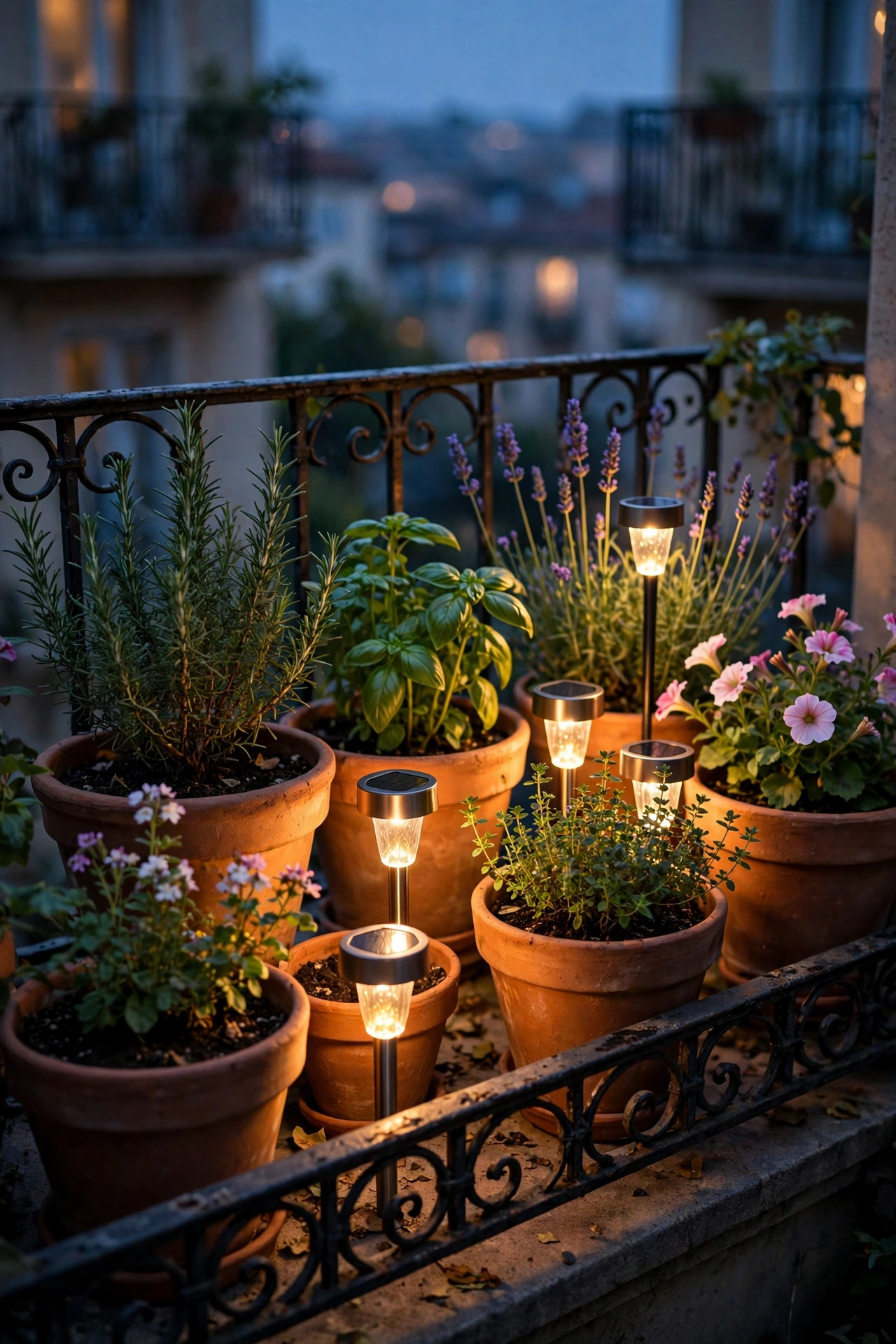
2. Balcony Garden Lighting Ideas: Fairy Lights Woven Through Climbing Vines
Of all my balcony garden lighting ideas, this is the one people photograph. Take a copper-wire fairy light string — the kind on a thin bendable wire — and weave it loosely along your climbing vines: jasmine, morning glory, sweet peas, even a determined tomato. The wire disappears against the stems, so at night the vine itself seems to sparkle, hundreds of tiny points floating in the leaves. Weave, don't wrap tightly; a loose spiral every 6 to 8 inches lets the plant keep growing without strangling a stem, and you can gently re-drape as the vine lengthens. Battery packs hide beautifully inside a pot, tucked under the mulch, and most have a 6-hour timer so the display runs itself. Waterproof the connection point with a zip bag if your balcony takes direct rain. One honest caution: check the string every few weeks during peak growth, because vigorous vines will happily swallow a strand whole — I've rescued more than one string from inside a passionflower. Solar versions work too if the panel can sit in full sun on the railing. The effect is genuinely magical for almost no money, and it comes down in two minutes at season's end.
Suggested budget range: $10 – $25.
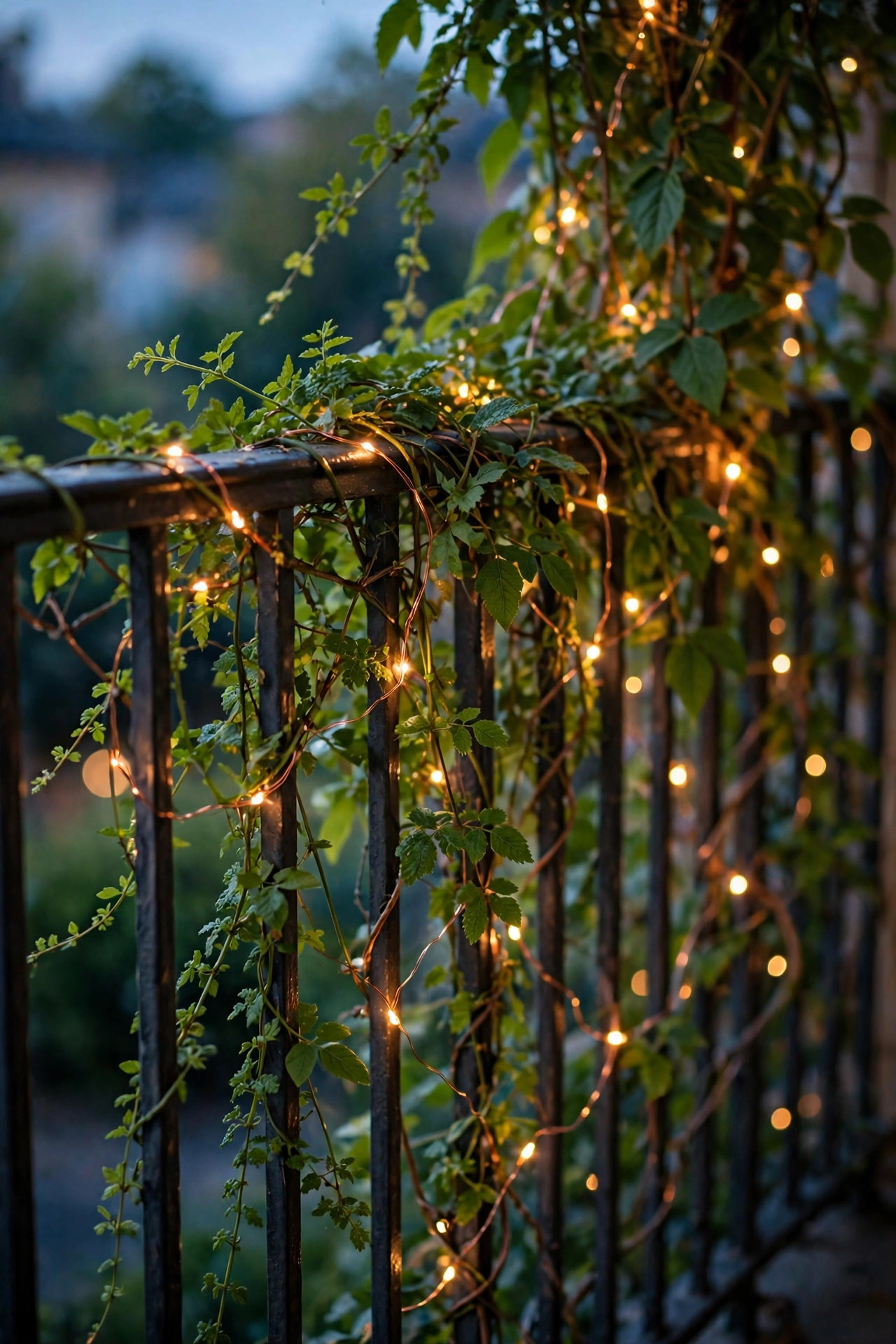
3. Solar String Lights Swagged Along the Railing
If your vines haven't covered the railing yet — or you prefer a cleaner look — a solar string light run swagged along the rail gives the garden structure after dark. I hang mine on the inside face of the railing, in gentle scallops about 18 inches deep, so the bulbs frame the planters below instead of competing with them. Clip the solar panel at the sunniest end of the rail, angled up; panel placement matters more than bulb count, honestly. Small-bulb strings (the little globe or Edison-style solar sets) read as garden jewelry rather than patio lighting, which suits a planted balcony. Secure every swag with two clips or zip ties — wind worries loose strings against the rail until the wire chafes. My deeper dive into solar string light ideas covers panel sizing and winter performance if you want the full picture. Keep the string above your tallest planter boxes so watering cans don't snag it, and let one swag dip near your favorite chair: that pool of light over the reading corner is where you'll end up every single evening.
Suggested budget range: $20 – $45.

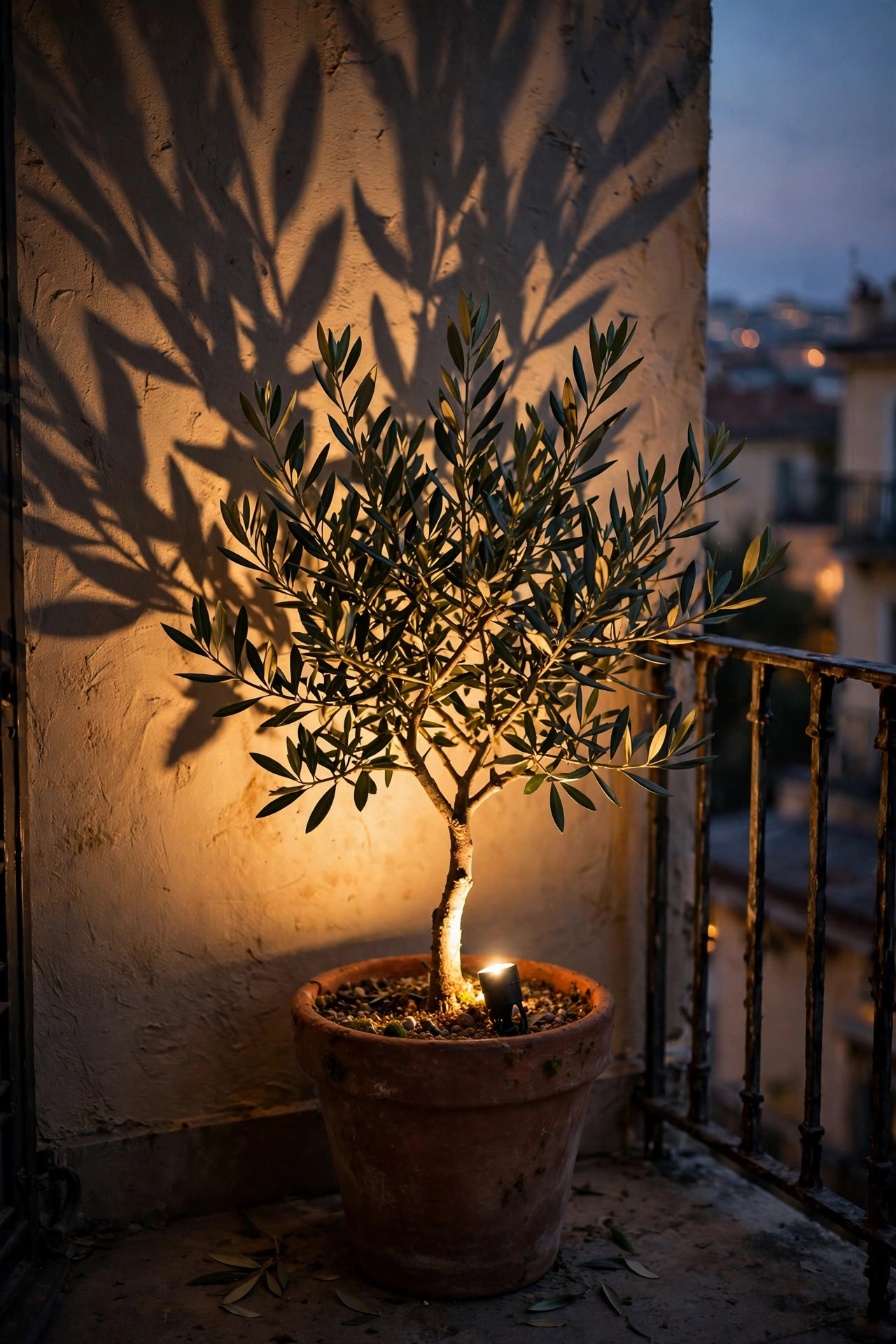
4. Mini Uplights for Statement Pots
Every balcony garden has one star — the olive tree, the dwarf citrus, the pot of ornamental grass you paid too much for. Give it the gallery treatment with a single small uplight. Solar or battery spot stakes push into the soil at the pot's edge and aim up through the foliage, so the plant throws leaf shadows across the ceiling and wall. That shadow play doubles the visual size of a tiny balcony, which is why designers use this trick in courtyards. A narrow beam (around 30 degrees) works best in a pot; wide beams just spill onto the floor. Position the light 4 to 6 inches from the trunk or main stems, angled up at roughly 45 degrees, and test after dark — five minutes of adjusting beats a season of almost-right. Keep the fixture itself low and dark-colored so it vanishes into the soil. One uplight per hero pot is plenty; two competing spotlights flatten the effect. In my experience this single light does more for a balcony garden's night look than any other purchase on this list, and it flatters everything planted around it too.
Suggested budget range: $15 – $35.
5. Copper-Wire Fairy Lights in the Herb Boxes
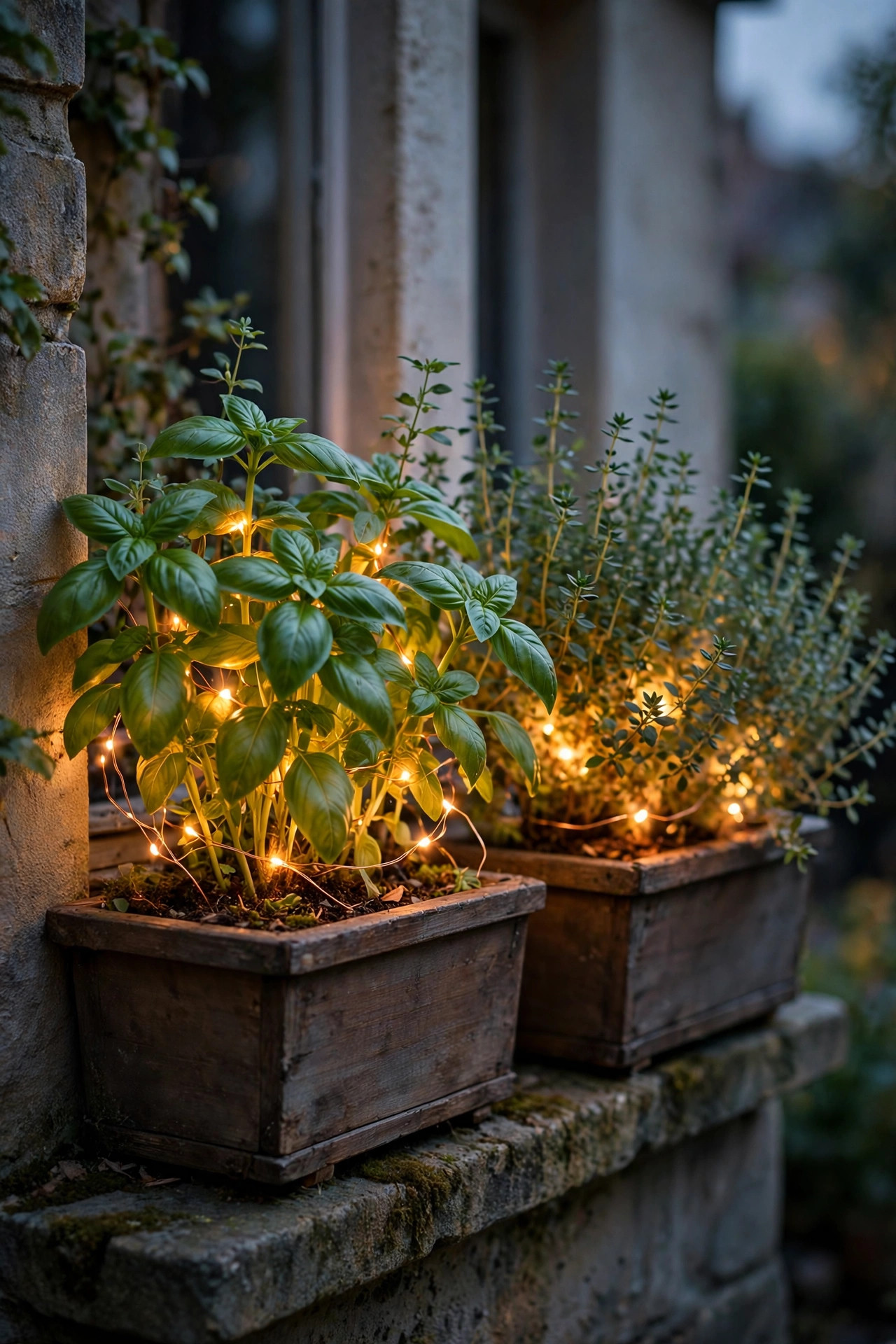
Herb boxes are the workhorses of a balcony garden, and they deserve their own glow. I run a short copper-wire fairy string through my window-box herbs — basil, thyme, oregano, a spill of trailing rosemary — threading it just under the leaf canopy so the light filters up through the foliage. The herbs look lit from within, and as a bonus you can actually find the basil at 9 p.m. when the pasta water is already boiling. Use the shortest string that fits (10 to 20 feet is plenty for a box) so you aren't stuffing excess wire into the soil. Battery packs with timers are ideal here because herb boxes get watered daily; tuck the pack in a zip bag at the end of the box where splashes miss it. Never push the wire or pack into constantly wet soil — rest it on top under the leaves instead. The warm light also seems to bother nighttime pests less than a bright white bulb would, though I'll admit that's gardener's intuition, not science. Total install time: about four minutes, most of it spent admiring your own work.
Suggested budget range: $8 – $18.
6. Solar Mason Jar Lanterns Between Pots
Mason jar lights were made for balcony gardens: solar lids with a tiny string of fairy lights coiled inside the jar, or simpler versions with a single warm LED under the solar cap. I nestle them between pots on the floor and on my plant stand, where they read as fireflies caught in glass. Group them in threes at different heights — one on the floor, one on an upturned pot, one on the shelf — and the whole corner starts to twinkle. The lids charge by day if the jar sits where sun reaches; in a shady corner, pop the lids off and lay them panel-up on the railing for a few hours. Frosted jars give a softer glow; clear jars show the coiled lights like a specimen. They are, honestly, the most forgiving light on this list: drop one and you've lost a jar, not a fixture. Keep a spare pair in the cupboard for the two evenings a month a friend comes over and the balcony needs to look like you planned it that way all along.
Suggested budget range: $15 – $30.

7. An LED Strip Under the Railing Planter Boxes
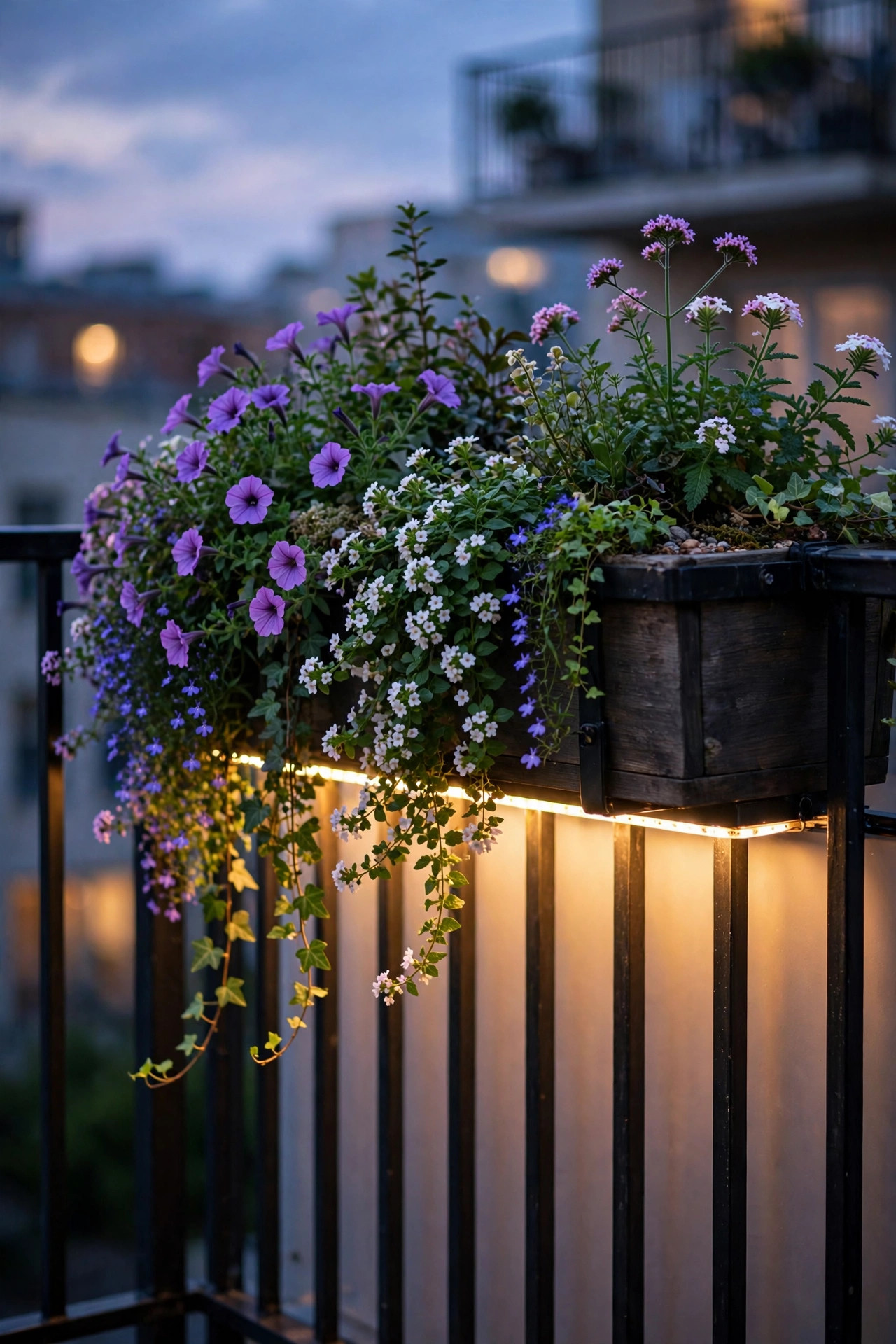
Railing planter boxes — those long troughs that hook over the rail — hide a perfect lighting channel underneath. Run a waterproof LED strip along the underside of the box and the light washes down the railing face and pools on the floor, making the whole planter appear to float above a halo. It's the most architectural look on this list, and it takes maybe twenty minutes. Choose an IP65 or better strip (the silicone-coated kind), warm white, and stick it with the adhesive backing plus a clip every 12 inches — balcony heat will defeat adhesive alone by August. Low-voltage plug-in strips with a simple inline dimmer are the most reliable; battery strips are fine for a single box. Route the cord down inside a railing post or behind a downspout so nothing dangles. The downlight also lights your step and watering can zone without shining in your eyes, which is more than I can say for most string lights. If you only add one "real" fixture to a balcony garden, make it this one — the floating planter effect fools everyone.
Suggested budget range: $18 – $40.
8. Trellis Lights for Vertical Gardens
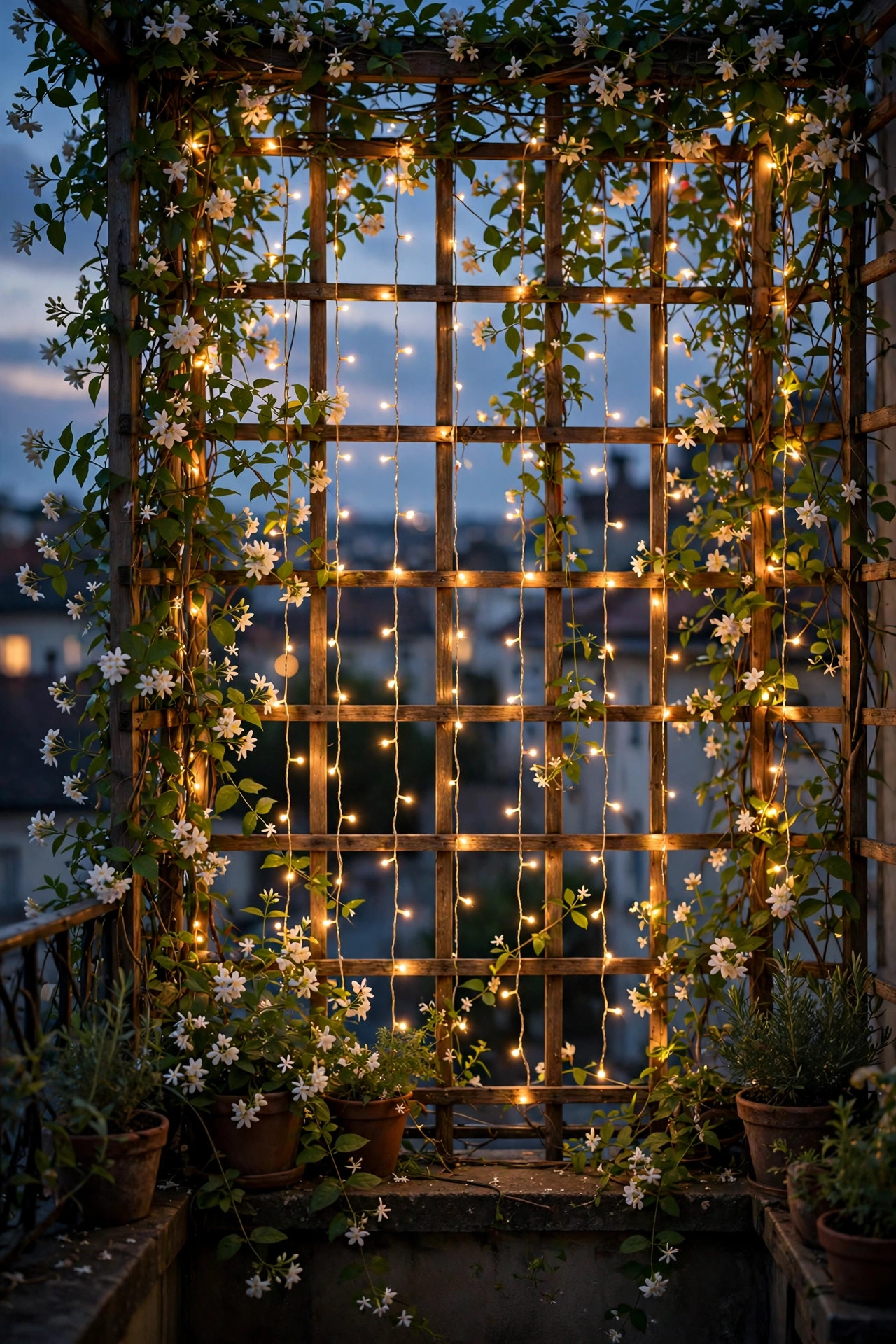
A trellis or obelisk turns one pot into a whole wall of green, and lighting it multiplies that effect after dark. My favorite method is a net-style or icicle fairy string draped over the trellis face, clipped at the top rail and left to fall in a soft curtain among the leaves — clematis and jasmine weave themselves through it in a season. Alternatively, run a single strand up the center cane and let the plant's own tendrils do the decorating around it. Keep lights on the front face of the trellis, not buried behind it, so the glow reaches you instead of the wall. Small solar spotlights aimed at the trellis from the pot below work beautifully too, especially once the vine is thick. Leave slack in every run: trellises flex in wind, and a taut wire fatigues fast. If your vine is a flowering one, warm white light keeps white and pink blooms looking true; colored lights turn blossom colors muddy, in my experience. This is also the safest way to get light up high on a balcony without attaching anything to the building — the pot carries the trellis, the trellis carries the light.
Suggested budget range: $12 – $28.
9. Solar Lantern Stakes in Oversized Pots
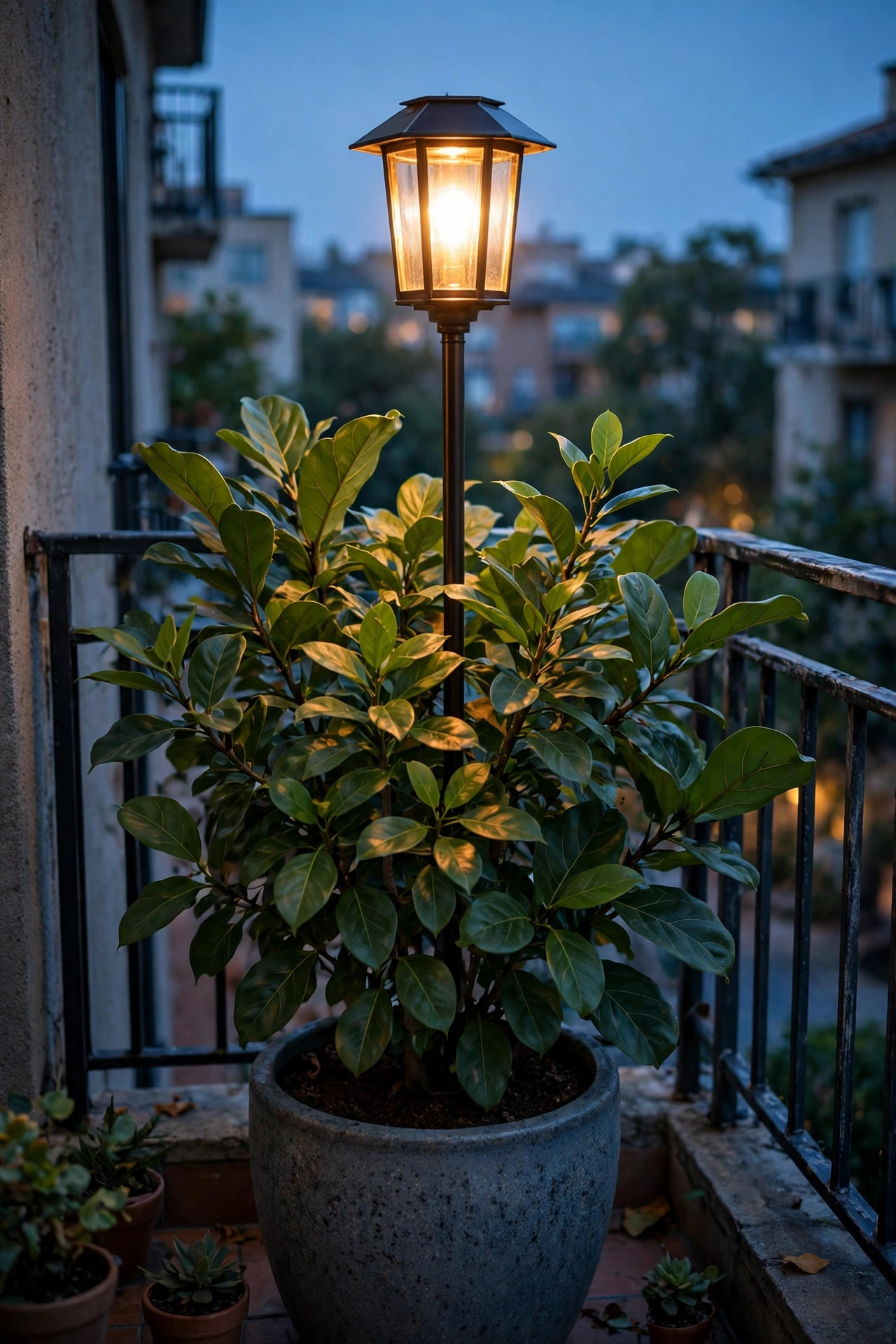
Big pots need bigger gestures. Solar lantern stakes — a shepherd's-crook stake with a hanging lantern, or a lantern head on a tall stem — stand 20 to 30 inches tall, which puts the light above the foliage of most container plants exactly where it can be seen from your chair. I use one in my largest pot as the "lamp" of the balcony, the light everything else supports. Look for metal lanterns with real glass and a warm LED candle or Edison-style bulb inside; the all-plastic ones fade to a sad gray by their second summer. Push the stake in near the pot's center-back so the lantern hangs over the plant, not in front of it. Because the panel is usually in the lantern cap, these need honest sun — a north-facing shady balcony will undercharge them, so test one before buying a set. A gentle sway in the evening breeze is part of the charm, but stake deeply (at least 6 inches of soil) so storm gusts don't lever it out of the pot.
Suggested budget range: $20 – $40.
10. An Overhead Canopy of Globe String Lights
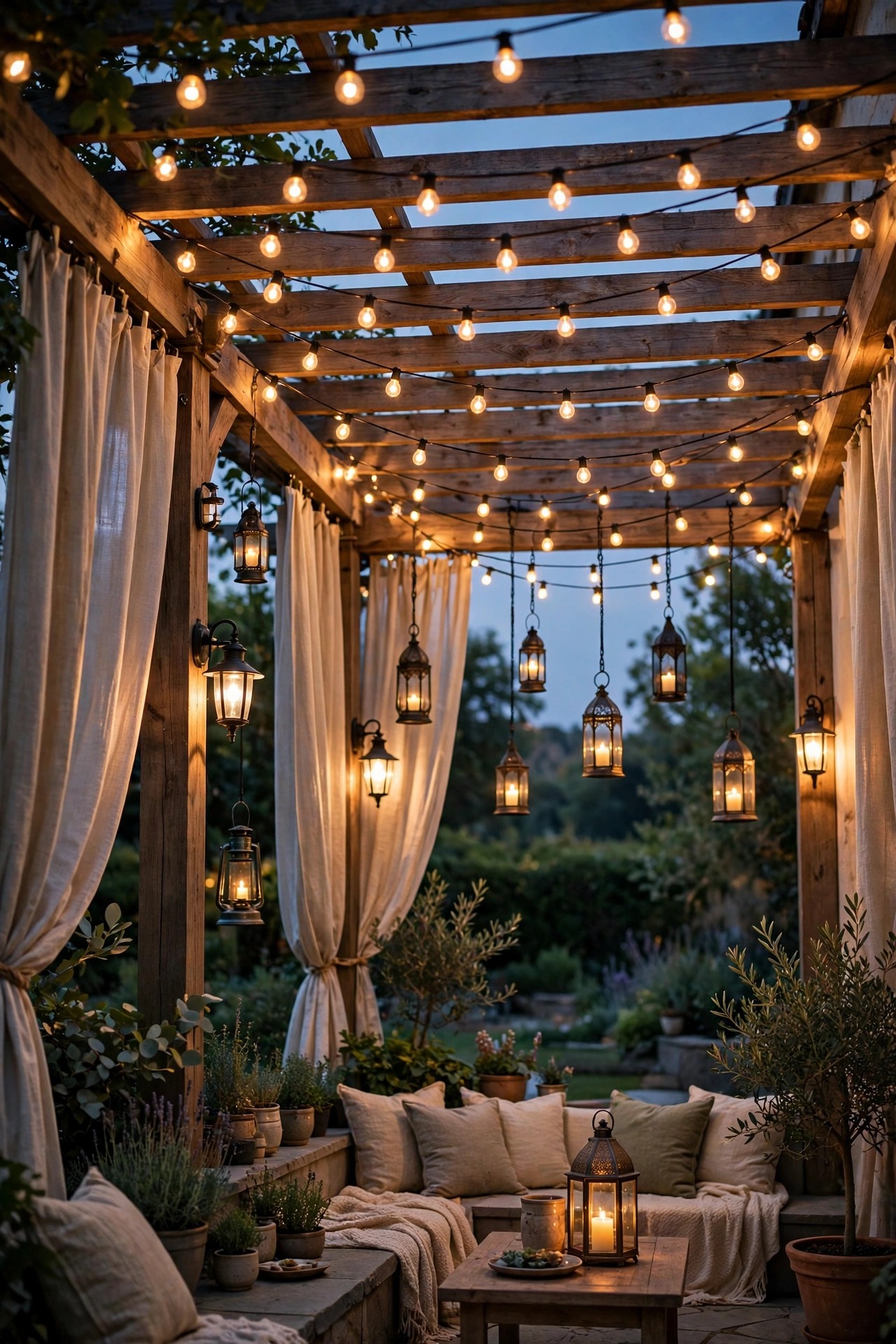
Every layer so far has been low or mid-height; a canopy of globe string lights is your ceiling, and it changes the whole geometry of a balcony garden. Run two strands in an X or a gentle zigzag from the top of the railing supports to wall hooks — or to a pair of tall planter poles if the building rules ban fixings. Small globes (1 to 2 inches) suit a garden better than big patio bulbs: they read as berries of light hovering over the plants. The magic is in the reflections — hundreds of tiny doubled glows on leaves, glass, and your wine glass. Keep strands at least 7 feet above the floor where they cross walking space, and never let a strand rest directly on foliage; even LED bulbs warm up enough over hours to scorch a tender leaf, so clip to supports, not stems. On a timer, the canopy clicking on at dusk is my favorite small daily ceremony. Combined with the lit planters below, you'll get the full layered effect the designers charge for: sparkle above, glow below, garden in between.
Suggested budget range: $25 – $50.
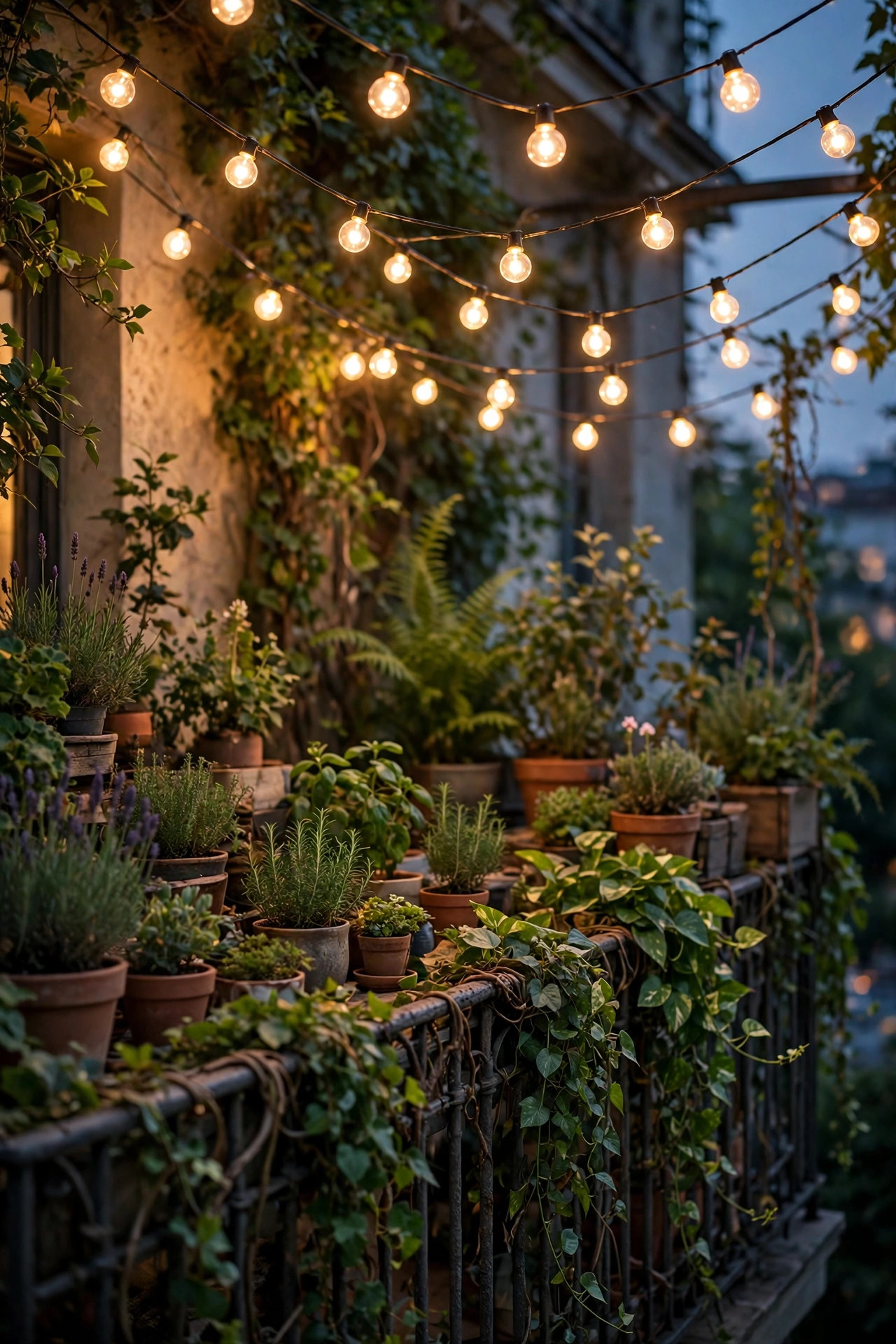
11. Glow Planters That Light Themselves
Some planters are the light: frosted resin or polyethylene pots with a solar or battery light inside, glowing softly through the walls like paper lanterns with plants growing out of them. Used sparingly — two, maybe three — they anchor a balcony garden's corners and steps with the calmest light on this list. I plant them with something upright and architectural (a grass, a small shrub) so the silhouette reads against the glow. Solar versions need the rim panel to see real sun; rechargeable ones with a USB port charge more reliably and let you top up before guests. My guide to patio lighting with planters covers sizes and runtimes in more depth if you fall for these. One warning from experience: glow planters are light-hungry plants' worst enemy if you forget the plant still needs drainage — check for proper drain holes before you buy, and never let a glowing pot sit in a saucer of standing water, which clouds the resin. In winter I bring mine in and use them as hallway lanterns; they earn their keep year-round.
Suggested budget range: $30 – $60.
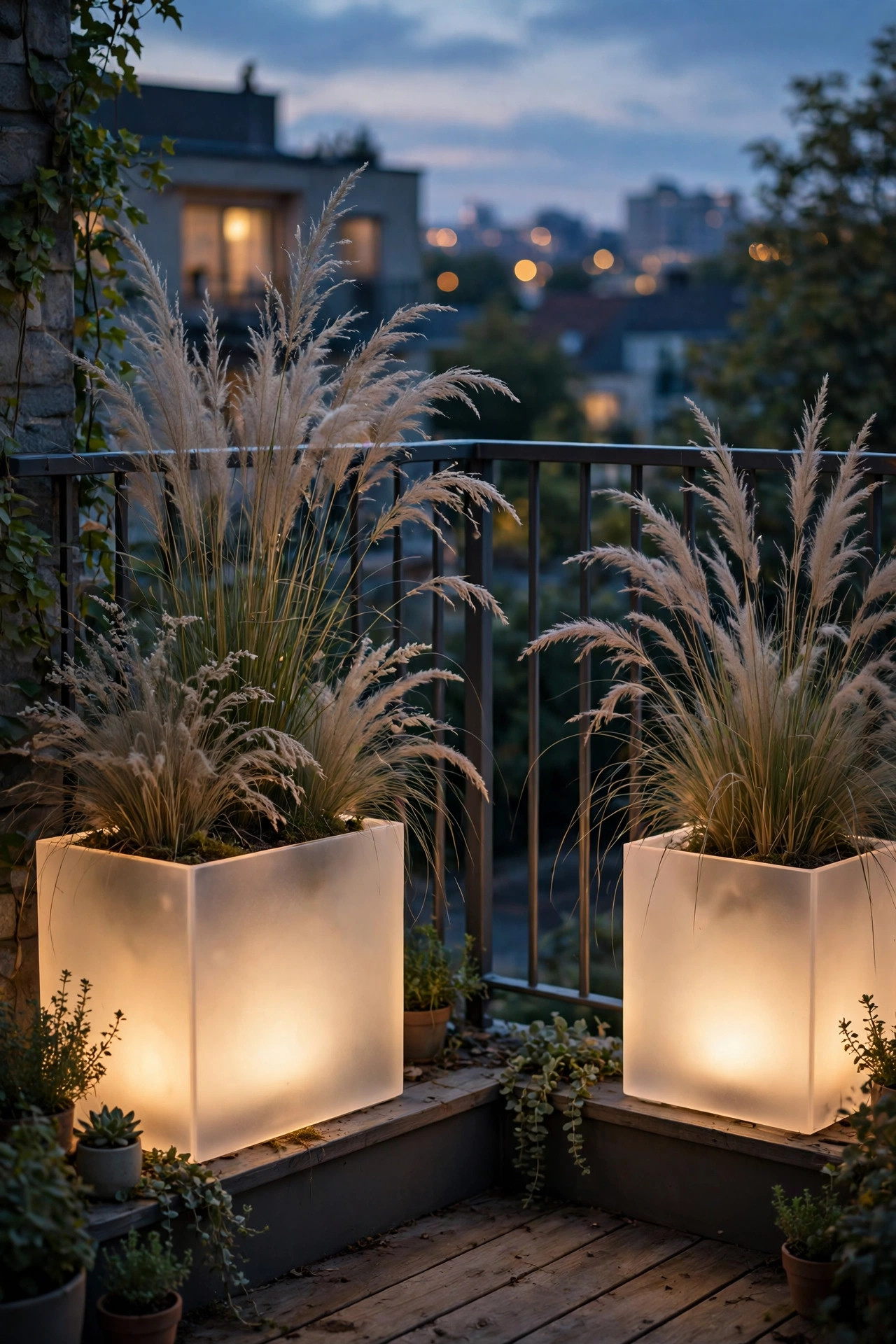
12. A Lit Potted Tree as Your Anchor
If your balcony fits one larger specimen — a potted fig, olive, bay, or dwarf maple — it deserves to be the anchor light of the whole garden. Two treatments work. The gentle one: a fairy string spiraled loosely up the trunk and out along two or three main branches, kept sparse so the tree still reads as a tree. The dramatic one: a single uplight in the pot (idea 4's trick, scaled up) throwing the canopy's shadow onto the ceiling. I've run both, some years on the same tree, and honestly the uplight wins for drama while the fairy spiral wins for charm. Whichever you choose, this becomes the brightest, tallest element on the balcony, so dim or skip other lights nearby and let it hold court. Keep brightness modest: a tree glowing like a storefront ruins the soft garden mood you're building. Battery fairy strings with a timer make the spiral effortless, and when the tree comes indoors for winter — the tender ones do — the lights travel with it and your living room inherits the magic.
Suggested budget range: $15 – $35.
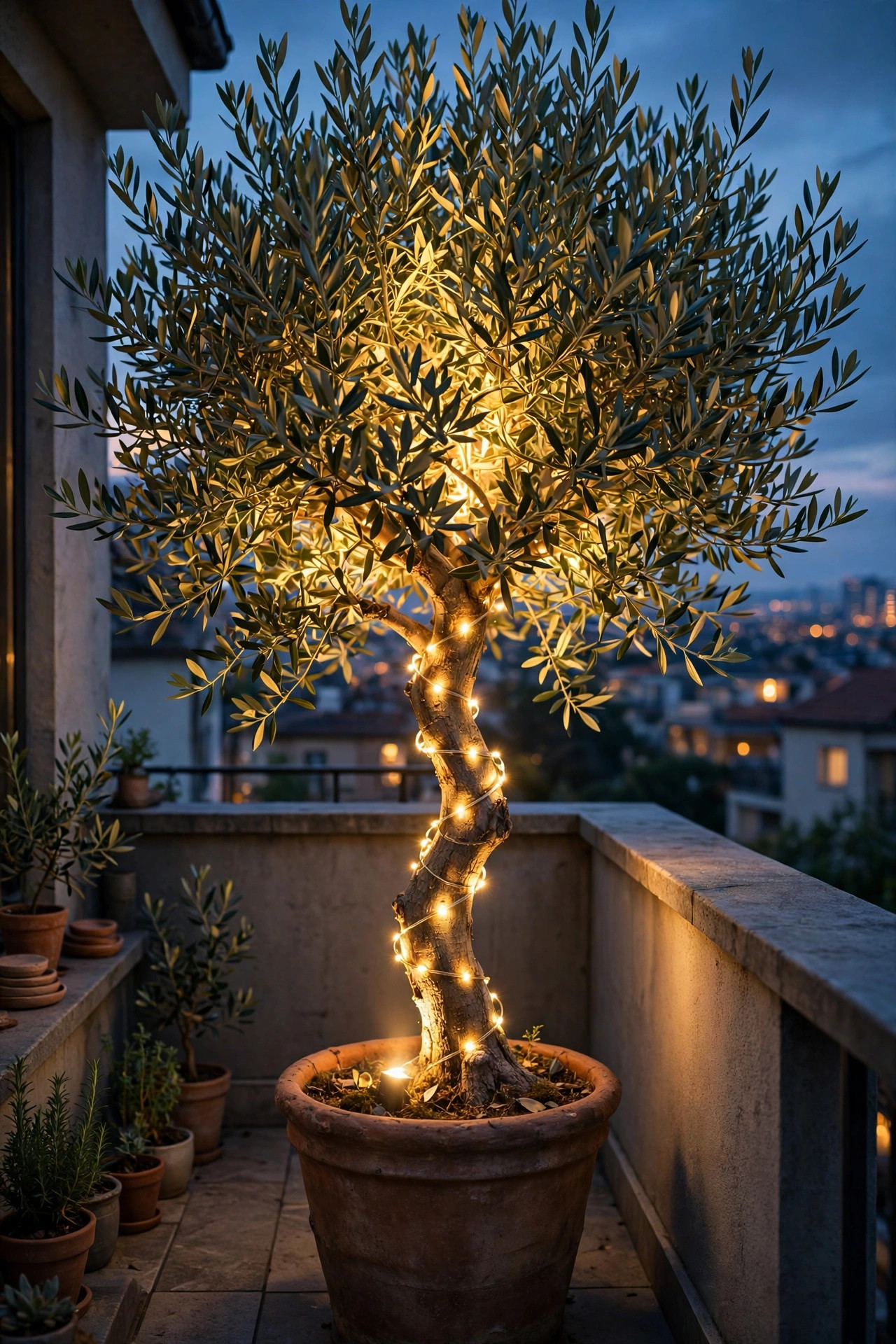
13. Puck Lights Under Pot Rims and Shelves
Sometimes the prettiest light is the one you never see the source of. Small waterproof puck lights — battery discs about the size of a hockey puck — stick under pot rims, under plant-stand shelves, and beneath the railing box, washing the surfaces below with a hidden glow. Under a plant stand, they light the pots on the shelf below without a wire in sight. Most come with a remote and a timer, and the better ones are IP65, which they need to be: this is the splash zone, where the watering can rules. Stick them with their adhesive pads first to test positions for a week; pads that survive watering earn a permanent screw. Three pucks under my two-tier stand transformed the darkest corner of the balcony into a little stage for the fern collection. Battery life is the honest trade-off — expect to swap or recharge monthly in summer — so buy the USB-rechargeable kind and batch-charge them while you deadhead. Keep one spare charged, always, because a puck will die the exact evening you have company. It is a law.
Suggested budget range: $12 – $25.
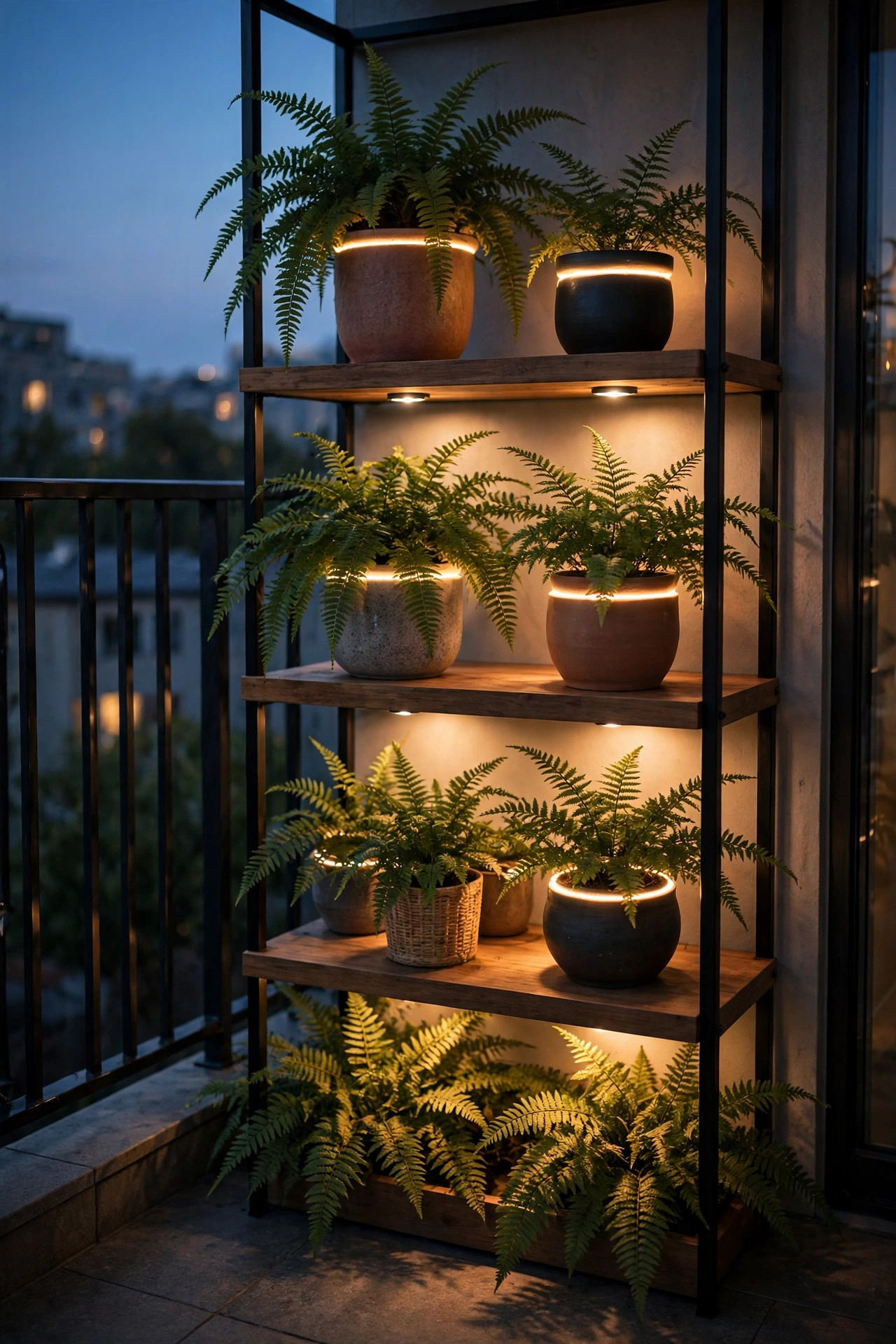
14. Net Lights Draped Over the Vine Wall
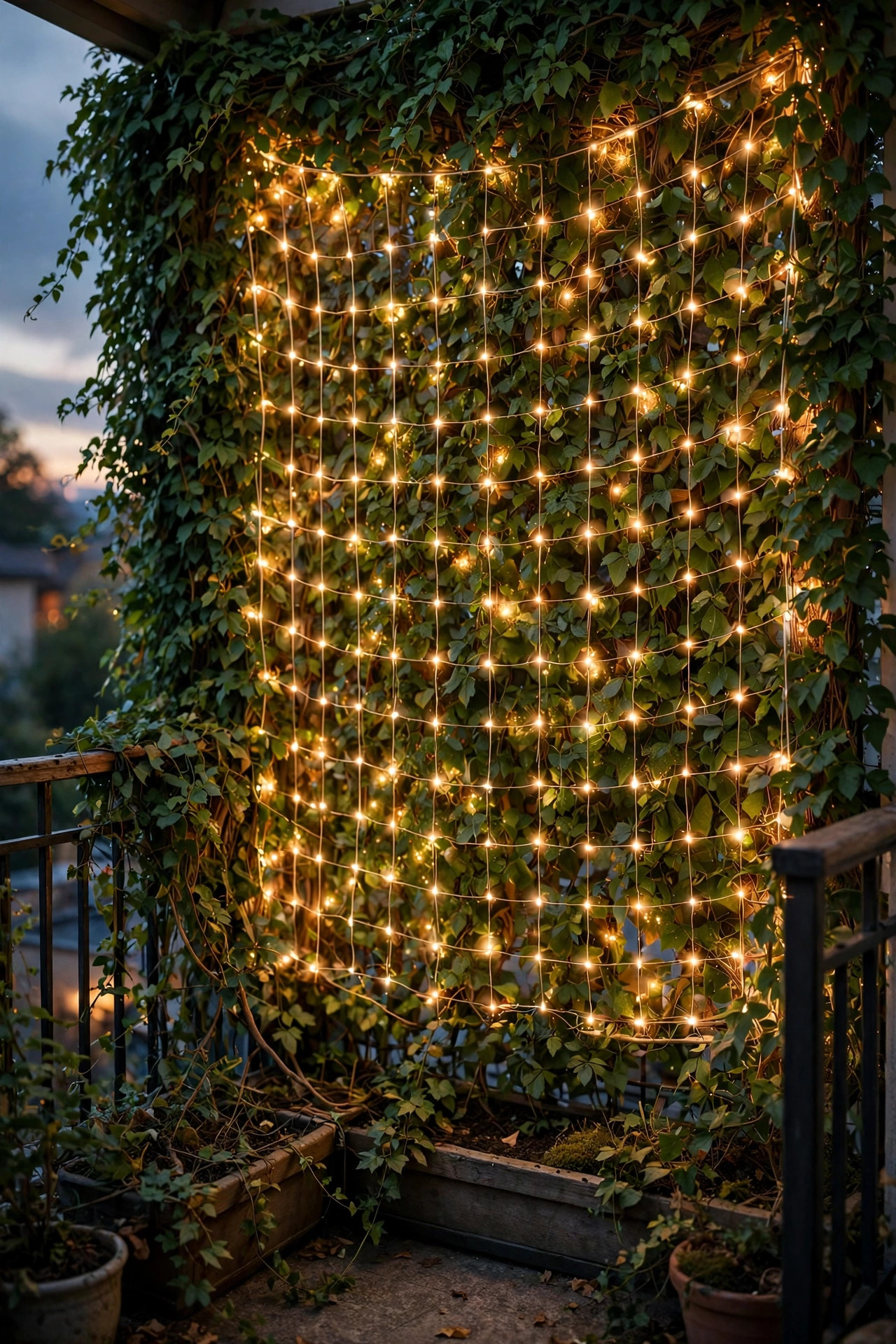
When your climbing plants graduate from trellis to a full green wall — a privacy screen of ivy, hops, or Virginia creeper — a net light is the tool made for it. The grid of tiny LEDs drapes over the whole face of the planting and distributes the sparkle evenly, no weaving required. Lay it over the front of the foliage, clipped loosely at the top and sides, and the wall glows like a hedge in a fairy tale. Nets come in solar and plug-in versions; on a balcony I'd pick solar with the panel clipped high on the screen's sunny end, or battery if your screen faces north. Don't pull the net tight — a soft drape with a few folds looks natural and leaves growth room. Mid-season, you'll need to lift and re-drape sections as the wall thickens; five minutes with a cup of coffee in hand, twice a summer. From the street, a glowing green wall is also the friendliest privacy screen imaginable — neighbors see a lit garden instead of your silhouette. It photographs absurdly well, too, which the group chat will confirm.
Suggested budget range: $18 – $35.
15. The Watering-Can Light Trick
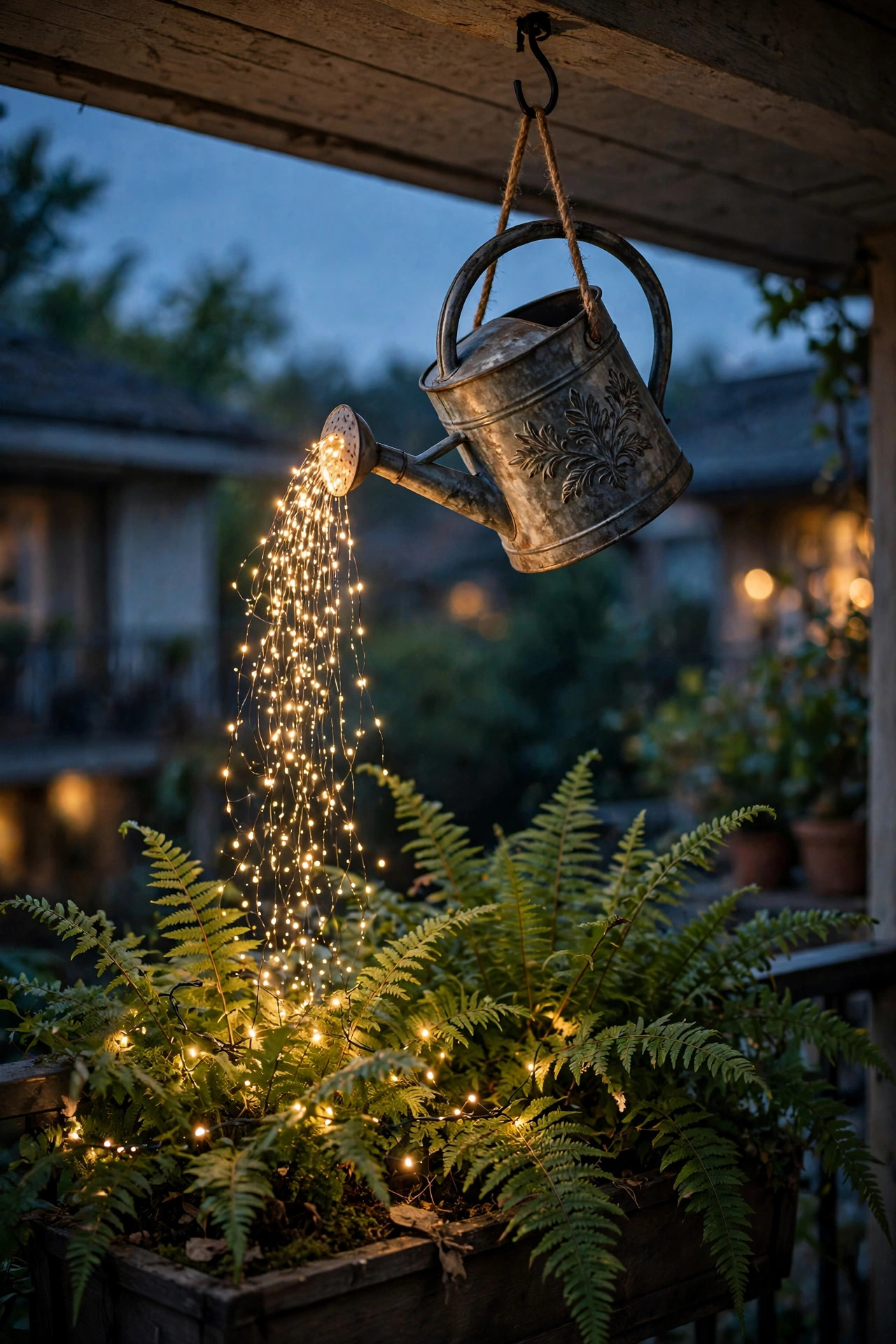
You have probably seen the photos: a vintage watering can appearing to pour a stream of light onto the plants below. It is a fairy string threaded through the can's spout, and on a balcony it is pure joy. Hang the can from a railing hook or a tall stake in your biggest pot, angled as if mid-pour, and let the string spill out of the spout in a loose cascade down into the foliage. The "water" lands in a pot of something soft and mounding — I use a fern — which hides where the lights end. Copper-wire strings work best because you can shape the fall; bunch the lights more densely near the spout and let them thin as they land. The battery pack hides inside the can itself, which also keeps it dry — genuinely clever. Use a lightweight can (a real gallon of vintage steel gets heavy on a hook) and secure it with wire so a gust doesn't send your sculpture over the rail. Everything secured, always, on a balcony: that rule outranks aesthetics every time. This one makes strangers stop on the sidewalk. I checked.
Suggested budget range: $15 – $30.
16. Flameless Candles Among the Herbs
Real candles and container gardens are a bad marriage — dry leaves, wind, and an open flame — but the look of candlelight among the herbs is too good to give up. Flameless LED candles solve it completely. I nestle two or three in weatherproof lanterns or hurricane glasses set directly into a wide herb planter and on the tray beneath my pots, and the flicker moves through the basil leaves like fireflies settling. Choose candles with a warm, slow flicker and a timer function; the cheap fast-blink kind reads as a roadwork warning. Outdoor-rated versions have sealed bases and survive rain left in the planter. Height variation matters: one tall pillar, one short, one in a lantern on the floor, and your eye reads it as a styled arrangement instead of a storage accident. Because they're flameless, this is also the one light I happily leave running on the 5-hour timer while I'm out for the evening, coming home to a balcony that looks tended and alive. Zero heat, zero wax on the mint, all of the romance.
Suggested budget range: $12 – $28.

17. Color-Changing Solar Bulbs for Party Nights
Ninety percent of the year I am a warm-white purist. But a balcony garden dressed for a birthday, a holiday, or just a Friday earns a little color, and solar stake bulbs with a color-changing mode are the easiest way to get it. Swap the caps on a few of your existing solar stakes — or keep a spare set of four color stakes in the cupboard — and the planters glow amber, teal, and violet while the rest of the balcony stays warm so the effect reads festive, not nightclub. The trick is restraint: color in the pots, warm white everywhere else. Keep the color set to the slow fade rather than the strobe; gardens should never strobe. Most of these stakes remember their last setting, so set them once before guests arrive and forget them. When the party's over, the warm-white stakes go back in and the garden returns to its calm self until the next excuse.
Suggested budget range: $15 – $30.
18. A Small Wall Light Over the Herb Station
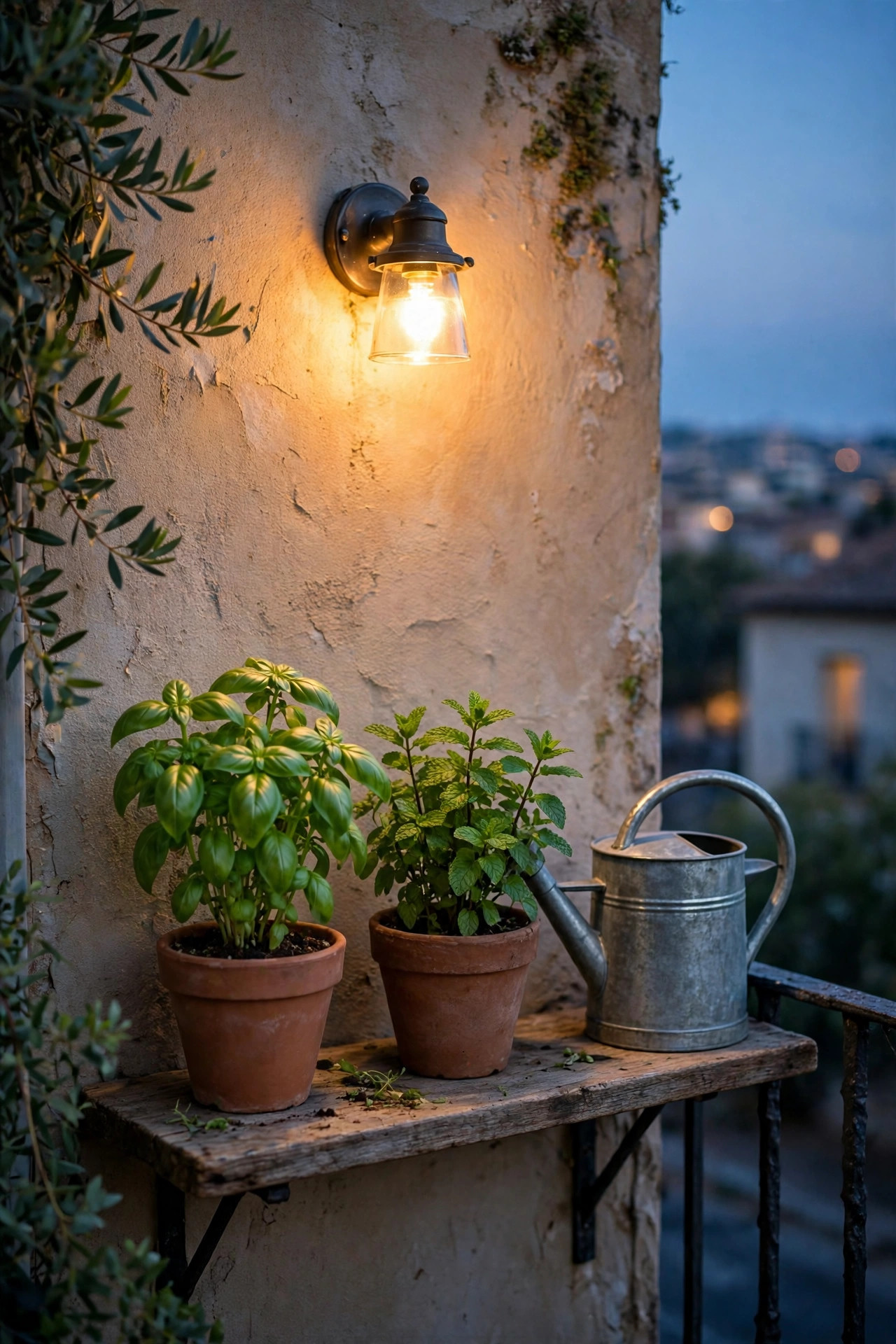
Every working garden needs one honest task light, and on a balcony it belongs over the herb station — the spot where you snip, rinse, and potter. A small battery or solar wall light mounted on the wall or clamped to a shelf above the herb boxes gives you a clean cone of usable light without flooding the whole balcony in brightness. Solar motion-sensor models are ideal: they idle at a dim glow and brighten when you step up with scissors, then settle back down. Aim it down at the plants, never out at face height, and choose a warmer color temperature than typical security lights so it blends with the garden's palette. This is also the light that saves your seedlings — late-evening checks for snails and thirsty pots stop being phone-flashlight expeditions. If your balcony has an outdoor outlet, a plug-in version with a dusk-to-dawn sensor is the set-and-forget option, but honestly the solar motion lights have gotten so good that I haven't bothered. Work light by need, candlelight by default: that's the balcony balance.
Suggested budget range: $15 – $35.
19. Fairy Lights Under Glass Cloches
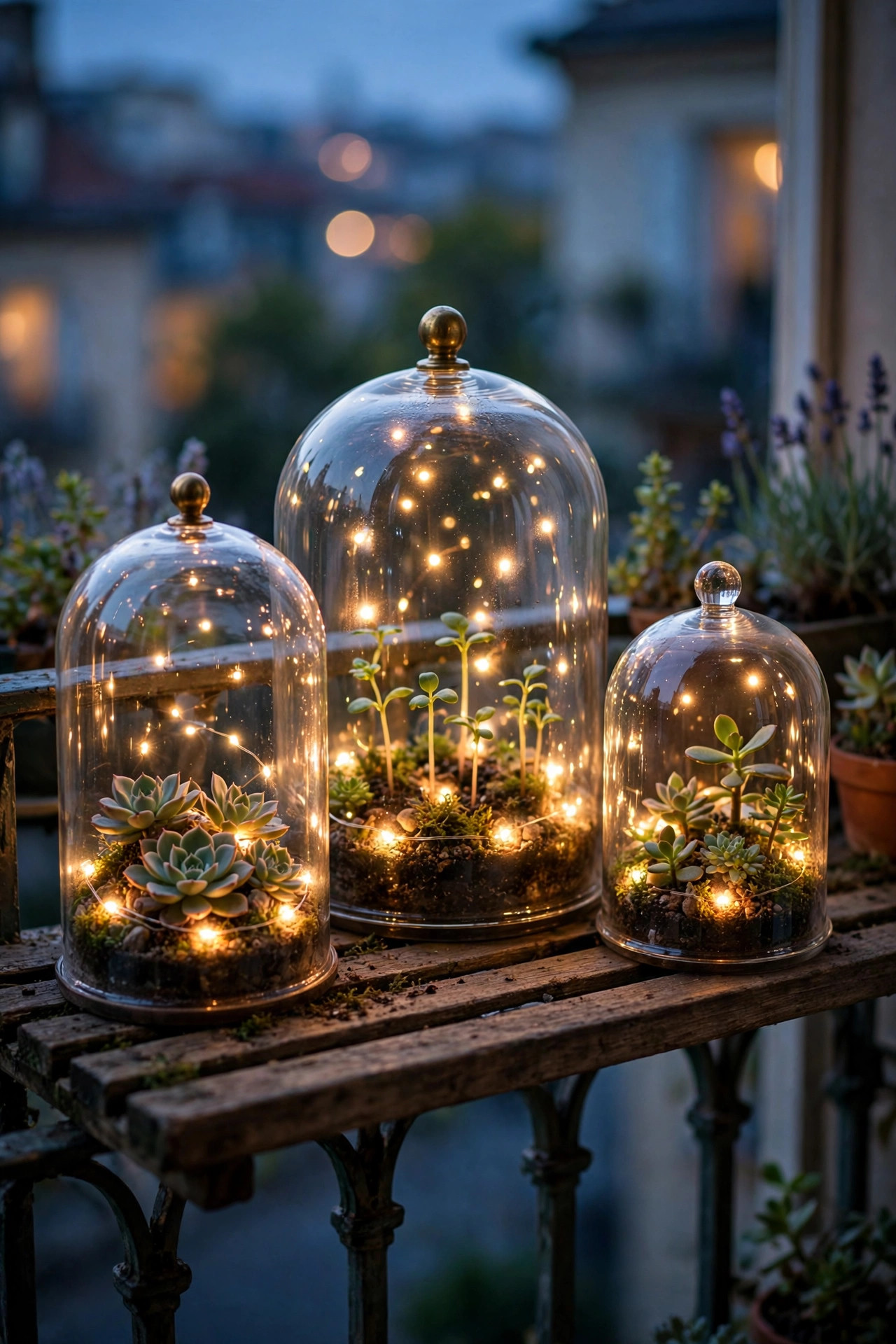
For the tender, precious corner of the garden — the seedling tray, the orchid, the tiny succulent collection — a glass cloche or bell jar with a pinch of fairy lights inside is the most jewel-like treatment I know. A 20-light micro string coiled gently inside the glass glows like captured fireflies, and the glass magnifies and softens it at once. Use battery strings with the thinnest wire, keep the pack outside the glass under the pot, and never seal a live plant in with the lights for days at a time — pop the cloche off in the morning for air, the way you would anyway. On a plant shelf, two cloches at different heights give you a display that looks curated from a magazine. Solar micro strings exist but the panels clutter the look; battery is cleaner here. This is also my winter rescue: when the balcony garden rests, the cloches come indoors with the succulents and the shelf keeps glowing. Small lights, small plants, outsized charm — that's the whole secret of container gardening after dark, really.
Suggested budget range: $10 – $22.
20. Timers and Smart Plugs So the Garden Lights Itself
The best balcony garden lighting is the kind you never remember to switch on. Almost every light on this list can run itself: battery fairy strings with 6-hours-on timers, solar stakes that wake at dusk, and for plug-in strings and strips, a simple outdoor smart plug or mechanical timer set to dusk-to-11 schedule. Layering your automation matters as much as layering the light. I stagger mine: the solar stakes and glow planters wake themselves at dusk, the canopy and railing strings click on with the timer at 7, and everything except the flameless candles rests by 11 so the garden — and the neighbors — get some true dark. In my experience, a consistent schedule also stretches battery life noticeably, because nothing gets forgotten on overnight. If you use smart plugs, put them on the indoor side of the outlet if you can, or in a weatherproof box; balcony outlets live hard lives. Set it in spring, tweak at the solstices, and your only remaining job is to be outside at dusk often enough to appreciate it. Which, let's be honest, was the point all along.
Suggested budget range: $10 – $25.
21. The Layered Finale: My Balcony Garden Lighting Ideas Recipe
When friends ask how my little balcony garden looks so finished at night, I give them the recipe rather than a product list, because any three lights from this page in the right layers will beat ten lights at one height. Here it is. Low layer, in the soil: solar stakes in the big pots, a puck under the plant stand, flameless candles among the herbs — light that lives inside the planting. Middle layer, at sitting height: fairy lights in the vines and herb boxes, jar lanterns on the stand, the herb station's little wall light — sparkle where your eyes rest. Top layer: the globe canopy overhead and your anchor tree, lit once, either spiraled or uplit. Keep everything 2700–3000K, keep the brightest single source dimmer than you think, and leave one corner deliberately unlit so the eye can rest — shadow is an ingredient, not a failure. Then, and only then, sit down out there with something cold and watch the garden do its evening shift change. These balcony garden lighting ideas took me three summers to assemble; you get the shortcut. Start with the low layer this weekend — the rest will follow, I promise.
Suggested budget range: $40 – $90.
Frequently Asked Questions
What color temperature is best for lighting balcony plants?
Warm white, 2700–3000K, every time. It flatters green foliage, keeps white and pink flowers looking true, and reads as candlelight rather than security lighting. Cool blue-white light (5000K and up) makes leaves look gray and sickly and turns a cozy balcony garden into a parking lot. If a product doesn't state its color temperature, assume it's cool and choose a different one.
Will lights in my pots bother the plants or attract more bugs?
Plants are fine — a few hours of gentle LED or solar light at night doesn't disturb their growth cycle at balcony scale, and the lights generate almost no heat in the soil. Warm light does attract fewer insects than bright white or UV-heavy bulbs, but some moths will visit any light. Keep the brightest sources away from your chair rather than the plants, and you'll both be comfortable.
How do I light a balcony garden with no outdoor outlet?
Easily — it's my default setup. Solar stakes, glow planters, and lantern stakes charge themselves; battery fairy strings and pucks run weeks on a timer setting. The only things that truly want an outlet are long LED strips and big string runs, and both now come in good solar and USB-rechargeable versions. Place solar panels where they get the day's strongest sun, even if that means a panel clipped high on the railing away from its light.
Can I leave solar and battery lights out all winter?
The lights, mostly yes — anything rated IP65 or better handles rain and frost, though battery life drops in deep cold and solar charging slows on short days. I bring battery packs and fairy strings indoors in the harshest months and let the hardy solar stakes overwinter in the pots. Cloches, candles, and glow planters all double as indoor decor in winter, which is half of why I buy them.
Conclusion
A balcony garden already has everything a great night space needs — texture, scent, height, life — it just needs light placed inside it rather than aimed at it. Stake the pots, weave the vines, let the planters glow, and layer it low to high until the whole railing hums softly at dusk. These balcony garden lighting ideas are renter-friendly, mostly solar or battery, and none of them ask more of you than an evening with a pair of scissors and a little patience. Start with three stakes and one string this weekend, then browse the rest of my lighting ideas here on the site and keep layering until your garden glows the way it grows — abundantly.


