If you have a raised deck, you probably have what I had for years: a shadowy cave underneath that collected bikes, flowerpots and spiderwebs. Then we added an under-deck drainage system to carry the rain away, and suddenly that wasted space became a dry, sheltered patio — the best seat in the yard on a drizzly evening. The only problem? It was pitch dark by seven. That's where good under deck lighting ideas come in, and honestly, this covered little room is now where we spend most of our summer nights. Because the space has a "ceiling" (the deck floor above), I light it the way I light any room: in layers. Something overhead for general glow, something at eye level for faces, something low to mark the steps and edges. Below are 15 ways to build those layers, from hardwired pucks to ten-minute battery fixes, each with an honest budget. And if you're still finishing the deck itself, my favorite deck lighting ideas pair beautifully with everything down here.
1. Recessed LED Puck Lights Between the Joists
If you only do one thing under your deck, make it this. Slim LED puck lights — the round, can-style fixtures about 3 to 4 inches across — screw right onto the underside of the joists or onto mounting plates between them, so the light source nearly disappears into the structure. I space mine roughly every 4 to 5 feet in staggered rows down the bays, which gives an even wash with no dark corners. Choose fixtures rated for damp or wet locations, because the underside of a deck collects condensation even when the patio below stays dry, and pick warm 2700K to 3000K color temperature so the space feels like a room, not a parking garage. Low-voltage pucks are the easiest DIY route: the cable staples neatly along the joists back to a small transformer plugged into a GFCI-protected outlet. Put them on a dimmer and you get bright task light for game night and a soft glow for quiet evenings from the same fixtures. In my experience this is the single change that makes an under-deck patio feel intentional instead of improvised.
Suggested budget range: $120 – $350.

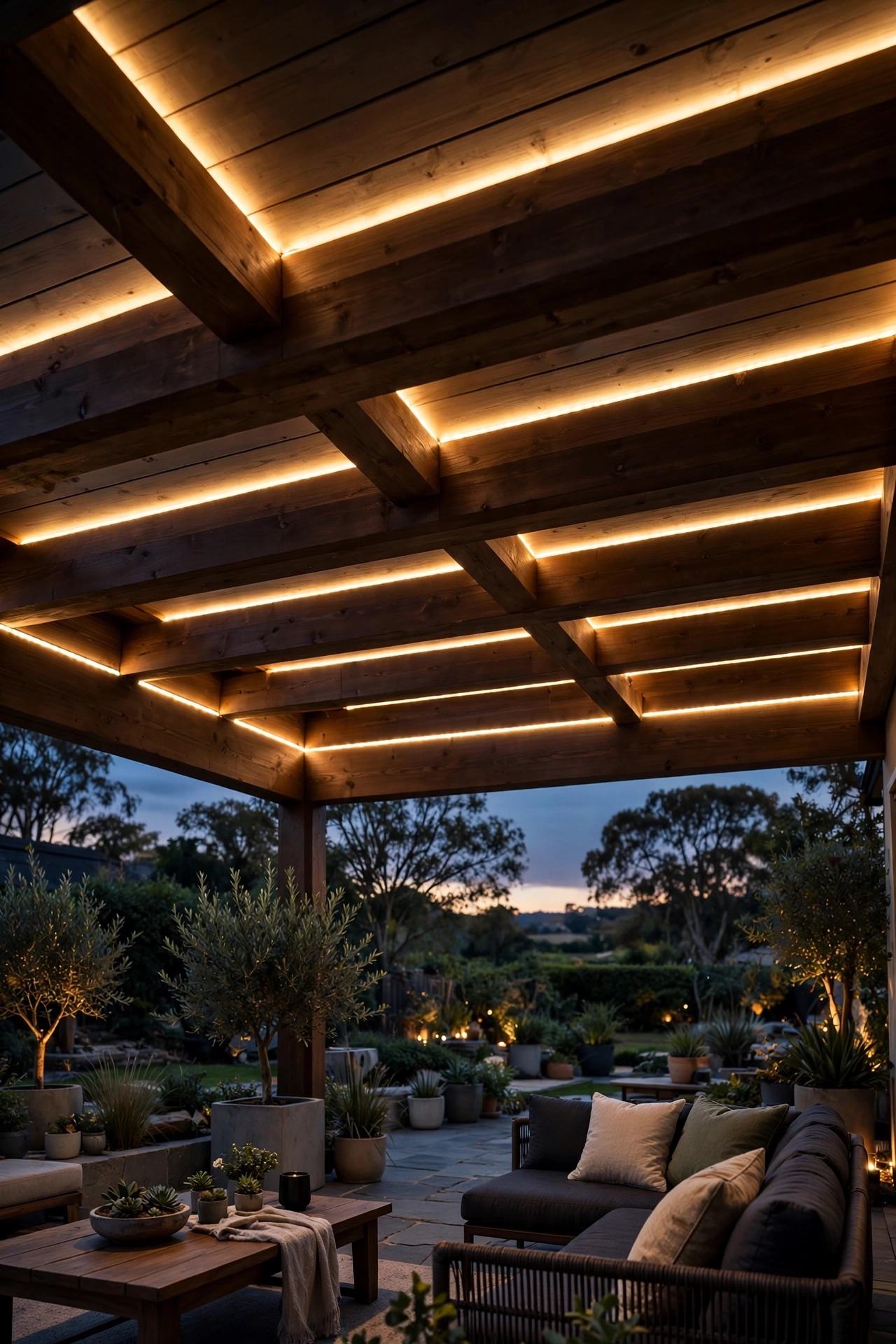
2. LED Strip Lights Tucked Along the Beams
For a soft, modern glow with no visible fixtures at all, run outdoor-rated LED strip lights along the inside faces of the beams. The trick is to mount the strip inside a slim aluminum channel with a frosted diffuser cover — it protects the tape, hides the individual diodes, and turns the light into one smooth ribbon instead of a row of dots. Because you never see the source, the light feels like it bounces down from the deck floor above, which is incredibly flattering for a low ceiling. Use IP65-rated tape at minimum, stick to 24-volt low-voltage runs for longer spans without dimming at the far end, and add a remote dimmer so you can take it from dinner-party bright to barely-there. I run one strip the full length of each main beam, about 16 to 24 feet on a typical deck, and cut the tape at its marked points to fit. It's the exact same approach I recommend for under-rail LED strip lighting on deck stairs, and down here it doubles as both ambient light and quiet architectural detail.
Suggested budget range: $60 – $160.
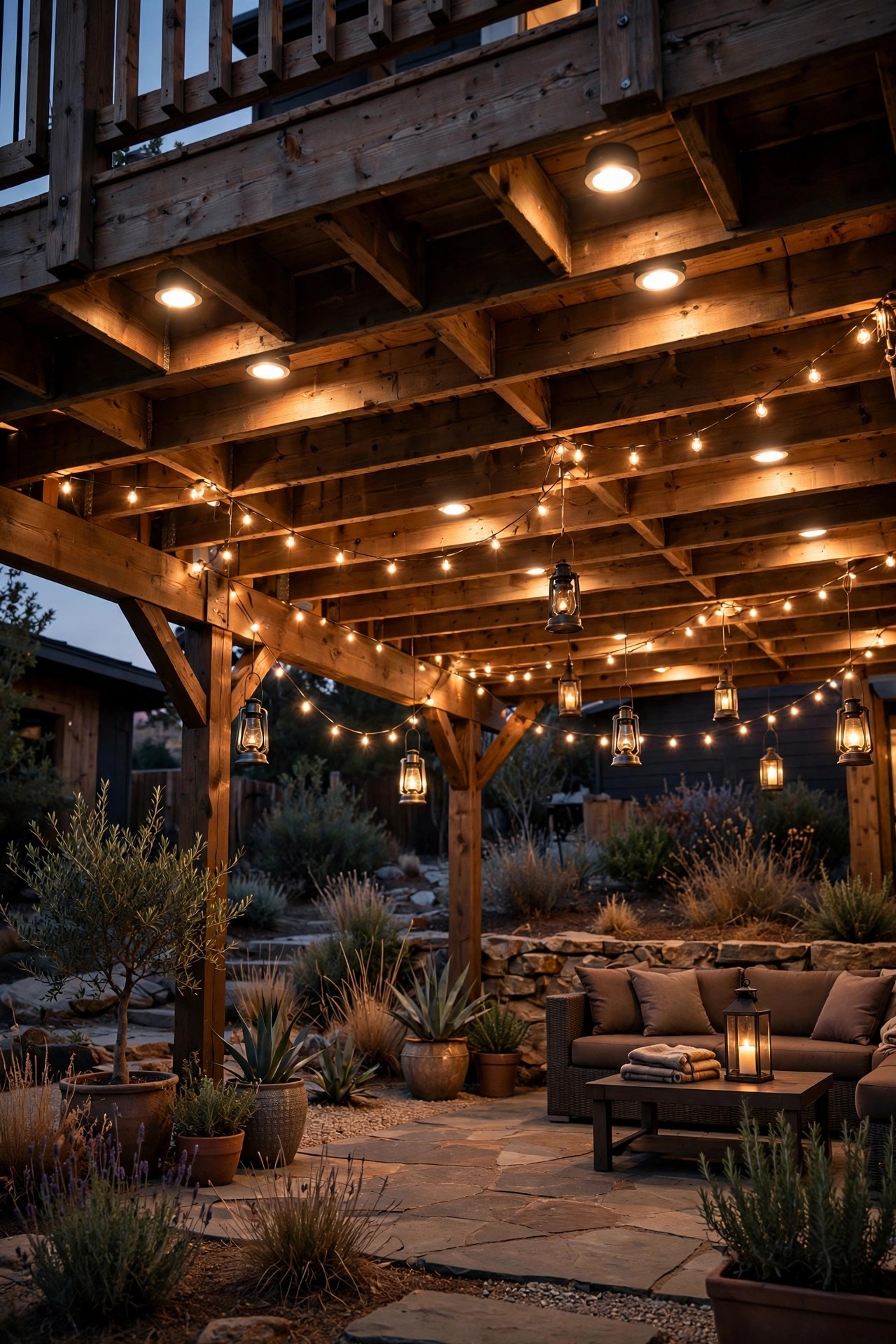
3. String Lights Swagged Between the Joists
Sometimes the fastest route to charming is the simplest one. Commercial-grade string lights swagged in gentle dips between the joists or support posts give an under-deck patio that bistro glow everybody loves, and the covered setting means they live a sheltered, easy life compared to strands out in the weather. Screw sturdy cup hooks or eye bolts directly into the joists — never just drape cord over a nail — and keep the lowest point of each swag at least 7 feet above the floor anywhere people walk. I use LED filament-style bulbs in warm white; they sip power, stay cool, and won't shatter like glass if a strand swings. A typical 12-by-16-foot patio needs two or three 48-foot strands run in parallel rows about 4 feet apart. Plug them into a GFCI outlet through an outdoor smart plug and they can fade on at dusk all by themselves. Honestly, half the under-deck patios I see need nothing more than this plus a couple of lanterns to feel finished.
Suggested budget range: $40 – $120.

4. Flush-Mount Fixtures on a Finished Under-Deck Ceiling
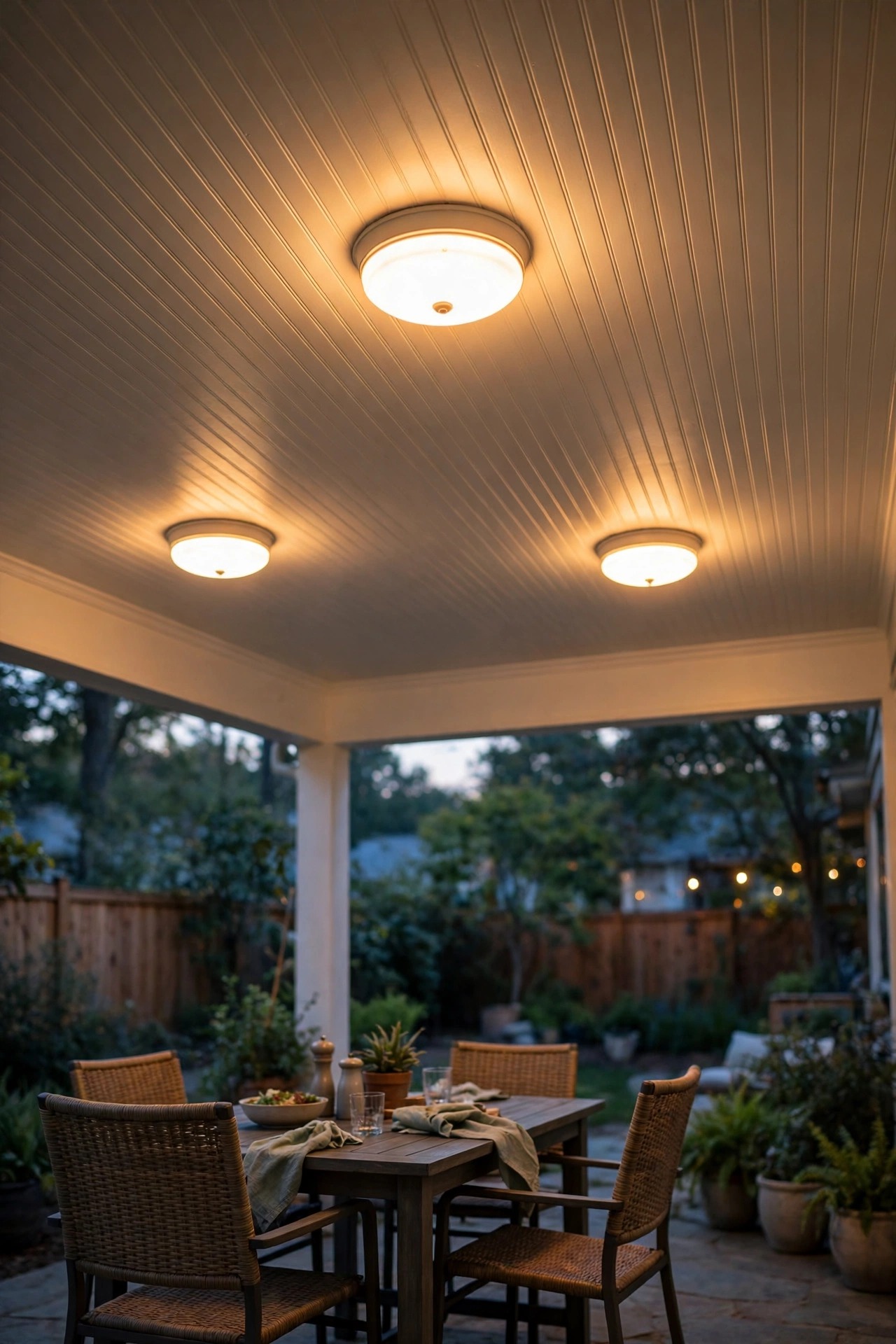
If your dry patio has a proper ceiling — the corrugated or beadboard-style panels that come with most under-deck drainage systems — treat it like a porch ceiling and install damp-rated flush-mount fixtures. This is the most "real room" option on the list: bright, even, permanent light that makes the space work for reading, grilling and homework at the patio table alike. The catch is planning. Junction boxes need to be mounted between the joists and wired before the ceiling panels go up, so this is a during-the-project decision, not an afterthought; retrofitting means pulling panels back down. I center one fixture over the seating zone and, on longer patios, a second over the dining area, each around 800 to 1,100 lumens. Choose sealed fixtures with frosted lenses so humid air and the occasional curious insect stay out of the housing. On a dimmer, two flush mounts plus one accent layer from this list is genuinely all the light most under-deck patios ever need.
Suggested budget range: $150 – $400.
5. Under Deck Lighting Ideas That Skip the Wiring: Battery Puck Lights
Renters, rejoice — and honestly, anyone who doesn't want to run cable. Battery-powered puck lights stick or screw to the underside of a joist in about a minute each, and modern versions come with remotes, dimming and built-in timers that shut them off after 30 or 60 minutes so you don't drain the batteries. The light from a single puck is modest, so think in clusters: I put three over the seating area and two over the grill station, angled straight down. At that spacing they read as a deliberate design rather than a compromise. LED battery pucks genuinely last months between battery swaps if you use the timer, and rechargeable versions with USB charging save the battery-buying treadmill entirely. Motion-sensor models are wonderful near the door or storage bins. Are they as bright as hardwired pucks? No. But for a first season under the deck, or a rental you can't modify, they deliver 80 percent of the effect for pocket change — and you can always upgrade later.
Suggested budget range: $25 – $60.

6. Sconces Mounted on the Support Posts
Every under-deck patio has chunky support posts, and they are perfect perches for sconce-style fixtures at eye level. That mid-height layer is what makes faces look good and keeps the space from feeling like it's lit by an interrogation lamp overhead — it's the layer most people skip and the one that changes everything. Mount fixtures about 5½ to 6 feet up the post, and choose shielded or frosted-glass designs that throw light up and down the post rather than straight into your eyes. Wiring runs neatly up the post inside a paintable cord cover or a shallow routed channel, then along a joist to your power source; low-voltage versions tap into the same transformer as landscape lights for the yard. Two posts lit is plenty for a small patio; light all four corners on a big one. I always match the finish to whatever the deck hardware uses — black posts fixtures disappear, bronze warms things up. Just keep fixtures clear of anything stored against the posts, and give them a quick wipe each spring when you open the patio up.
Suggested budget range: $70 – $200.

7. Pendant Lights Over the Table
If your under-deck patio has a dining table or a little bar-height counter, hang a pendant (or three) over it and watch the whole space organize itself around that pool of light. Outdoor pendants rated for damp locations hang from the joists on chain or cord; if there's no joist exactly where you want the light, swag the cord over to one with a ceiling hook — that slightly casual drape honestly suits the space. The classic rule works here: hang the bottom of the fixture about 30 inches above the tabletop so it lights the food and faces without blocking sightlines across the table. One larger pendant suits a round table; a row of two or three small ones looks better over a long farmhouse table. Use dimmable warm-white LED bulbs around 800 lumens each. Because pendants hang below the deck floor, measure your headroom first — you want at least 6½ feet of clearance anywhere the fixture isn't directly over furniture.
Suggested budget range: $90 – $260.

8. Rope Lights Hidden Behind a Beam Trim Strip
Rope light is the budget workhorse of indirect lighting, and under a deck it has a perfect hiding place: behind a slim trim strip nailed along the bottom edge of each beam, or tucked into the angle where the beam meets the joists. All you see is a warm line of glow washing down the posts and across the ceiling bays — no fixtures, no glare, no visual clutter. Buy IP65-rated LED rope light (it runs cool and sips power compared to old incandescent rope), and secure it with clips every 12 inches so it never sags into view. A single 50-foot spool handles the beams on most patios. Plug-in versions with an inline dimmer or a smart plug give you brightness control for almost no money. In my experience this is the cheapest way to make a plain under-deck space look deliberately designed, and it layers beautifully under brighter task lighting because it fills in the shadows those fixtures leave behind. Just avoid coiling excess rope while it's powered on — spread spare length along the beam instead.
Suggested budget range: $30 – $90.

9. Flameless Candle Lanterns on the Table and Shelves
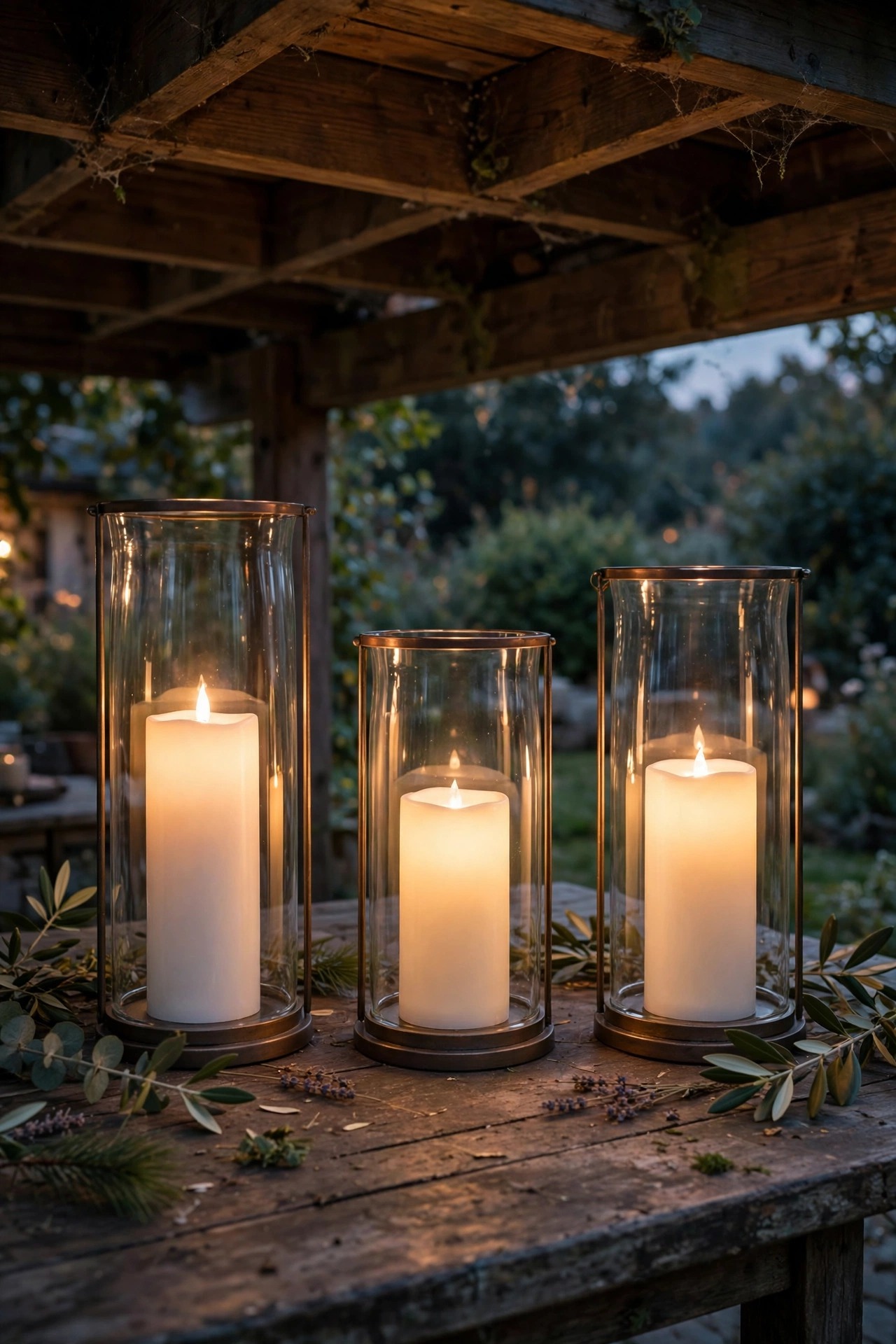
Not every layer of light has to be wired, bright or even permanent. A cluster of flameless LED candles inside hurricane lanterns gives an under-deck table that flickering, firefly warmth that makes people linger — with zero heat, zero wax drips and zero worry about real flames near cushions, kids or the dog. The details matter: choose candles with a realistic warm flicker and a built-in timer, so they click on for five hours at the same time every evening and you never think about them again. Group them in odd numbers — three lanterns of different heights on the table, a pair flanking the door — and mix in one or two on a low shelf or the storage bench. Real glass hurricanes look best and clean up with a quick rinse. Because they're portable, this is also the layer I move around: lanterns line the steps when we have guests, then drift back to the table. It's the smallest budget on this list and, per dollar, probably the biggest mood upgrade.
Suggested budget range: $25 – $80.
10. A Motion-Sensor Light for the Storage Corner
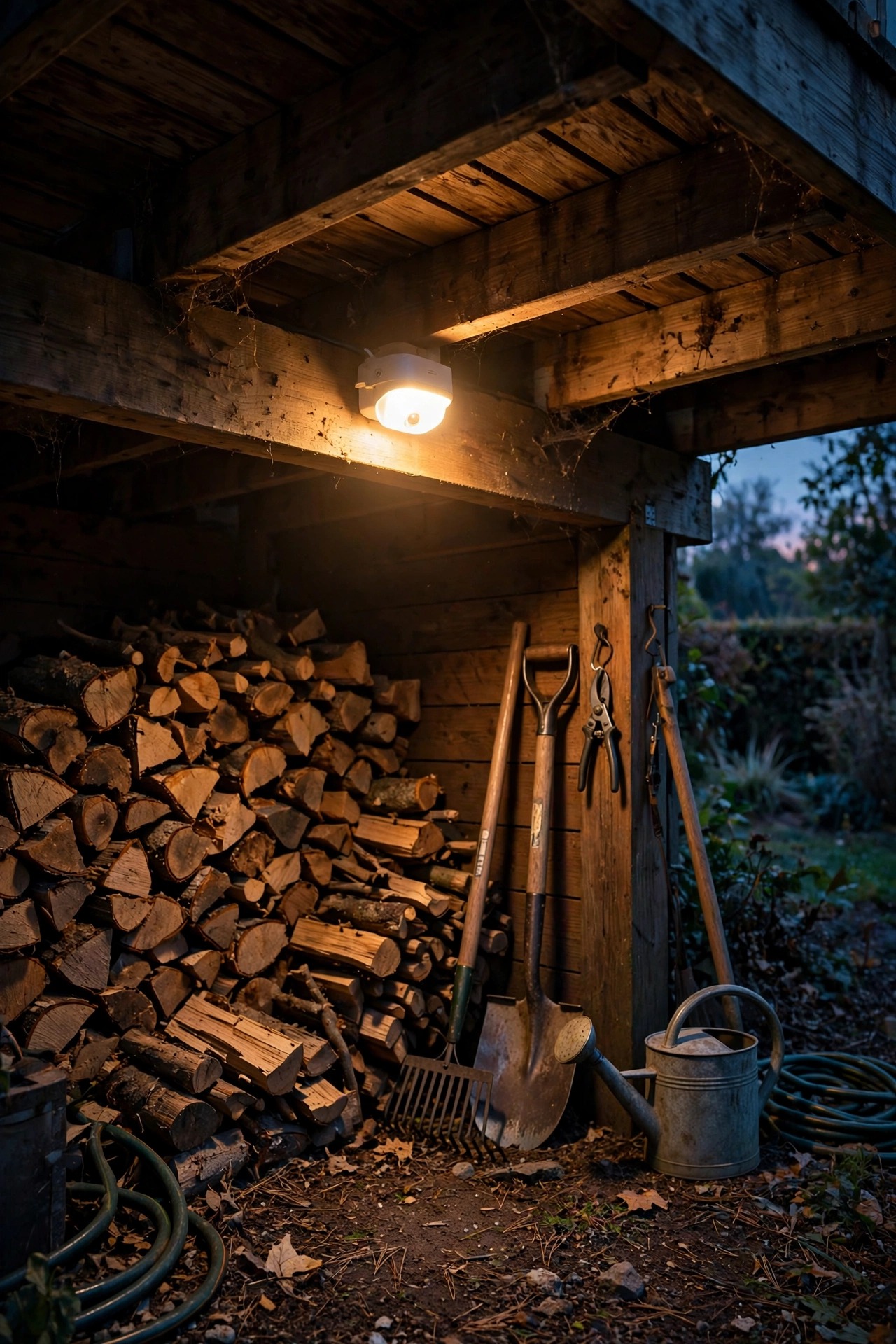
Let's be practical for one idea: most under-deck patios double as storage for the mower, the firewood and seventeen flowerpots. A dedicated motion-sensor light over that working corner is pure sanity. It stays dark while you're relaxing ten feet away — because nobody wants a security light blasting their dinner — then pops on the moment you walk over for another log or the watering can. Battery-powered models stick up in minutes and are my pick for most people; plug-in versions suit a corner near an outlet. Look for a sensor with about a 120-degree field of view, aim it along the storage wall rather than out into the yard, and set the timer to one or two minutes so it isn't cycling all night. Keep it on its own separate circuit of thought from your pretty lighting: this is a tool, not ambiance. Angle the head slightly downward to light the ground where you're stepping, and test the trigger zone after dark so passing raccoons don't host their own light show.
Suggested budget range: $20 – $60.
11. A Damp-Rated Ceiling Fan With a Light Kit
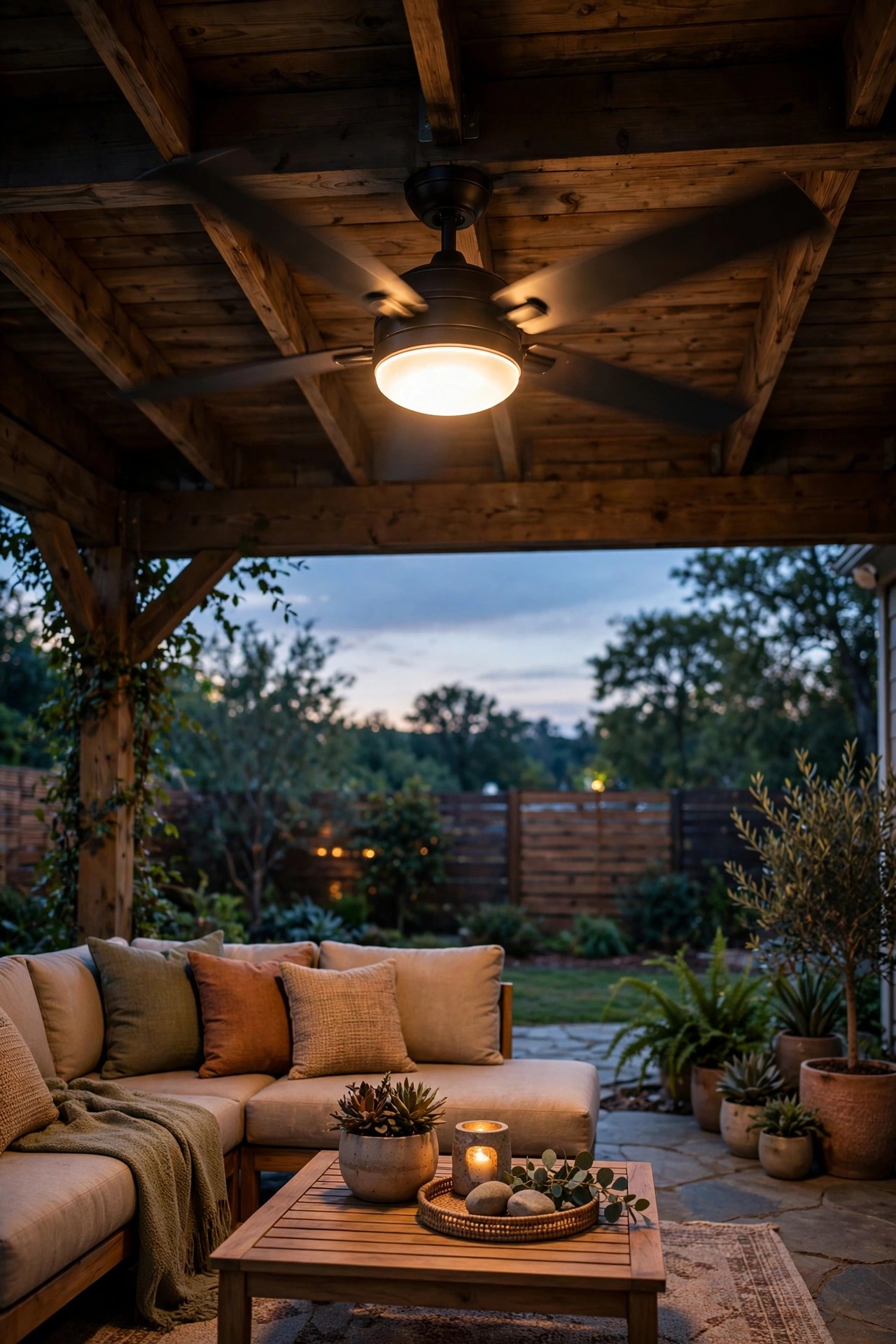
If your deck sits high enough, an outdoor ceiling fan with an integrated light is the hardest-working fixture you can hang under it. Moving air makes a still, humid evening feel five degrees cooler, discourages mosquitoes (they're weak fliers and hate a breeze), and the light kit gives you your general overhead layer in the same footprint. The non-negotiables: the fan must be rated for damp or wet locations — indoor fans corrode and wobble outdoors — and the blades need at least 7 feet of clearance above the patio floor, so measure before you fall in love with a model. Under a drainage ceiling, mount to a joist-mounted fan-rated box, never to the ceiling panels alone. Choose a light kit with dimmable warm-white LEDs and a remote, because nobody wants to stand on a chair hunting for a pull chain in the dark. Run the fan on low during dinners; it keeps the air pleasant without rattling the napkins. It's a bigger project than most ideas here, but it's the one guests always comment on.
Suggested budget range: $180 – $450.
12. Step Lights for the Stairs Coming Down
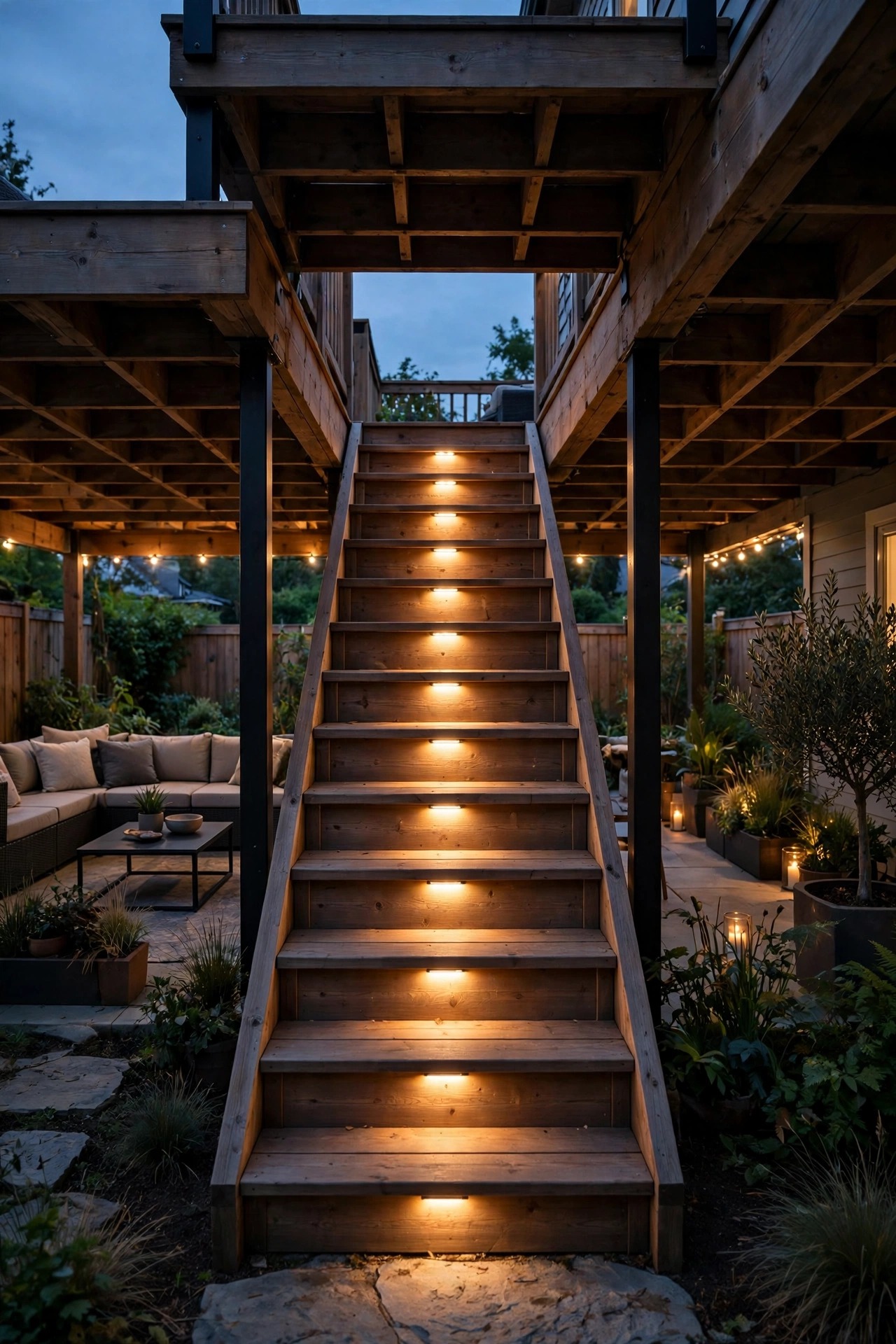
The prettiest under-deck patio in the world isn't worth a twisted ankle on the stairs that lead down to it. Small step lights — recessed into the stair stringer, surface-mounted on the risers, or tucked under each tread nosing — turn a dark staircase into a safe, glowing cascade. Low-voltage versions tie into a landscape transformer, and louvered or shielded designs push the light down onto the tread where your feet need it instead of into your eyes. I light every step on a long flight and every other step on a short one of four or five steps; consistency matters more than brightness, because one dark step in a lit run is exactly the one someone misses. Solar step lights won't help you here — the treads sit in shade all day — so plan on wired or battery models. This is also a lovely place to echo the lighting on the deck stairs above, so the whole structure reads as one design from the yard. Do this one first if anyone in the house makes the trip down after dark, which is everyone.
Suggested budget range: $60 – $180.
13. Low Path Lights and Uplights Around the Patio Edge
The edge of an under-deck patio — that line where the covered space meets the open yard — deserves its own layer. From inside, a completely black perimeter makes the patio feel like a cave mouth; a few low lights just outside the drip line make it feel like a room with a view. I set low-voltage path lights a foot or two beyond the posts, spaced about 6 feet apart, and add one or two spot uplights aimed at a nearby tree, the deck posts themselves or a big planter, so there's a lit focal point to look at. Because these fixtures sit outside the cover, solar versions finally work here — they get real sun — though wired ones are brighter and more reliable. Tie wired fixtures into your existing landscape lighting transformer if it has spare capacity, and aim everything downward or at surfaces, not out into the neighbors' windows. This edge layer also quietly marks where the patio ends for guests wandering out with a drink in hand.
Suggested budget range: $80 – $220.

14. Smart Under Deck Lighting Ideas: Plugs, Timers and Dimmers
Whatever fixtures you choose, how you control them decides whether you actually use them. My baseline setup: every plug-in layer — string lights, rope light, strips — runs through outdoor smart plugs on a dusk-to-dawn schedule, so the patio glows to life on its own each evening and shuts off at 11. Put the overhead layer on a dimmer, hardwired or plug-in, and keep the accent layers on separate plugs so you can run "candles and strings only" on quiet nights and "everything on" when you're hosting. Photocell timers work too, but under a deck a photocell can get confused by shade, so a smart plug with an astronomical clock (it calculates sunset from your location) is the more reliable brain. Group the plugs in an app scene and one tap sets the mood. Honestly, this invisible layer is the difference between a patio that gets lit twice a summer and one that's ready every single night. Label each plug with a small tag — future you, crouched behind the storage bins in October, says thanks.
Suggested budget range: $35 – $120.

15. The Layered Finale: Combine Three Heights for the Full Effect
Here's the recipe I'd hand a friend, because it's what my own patio ended up as after three summers of tweaking. Pick one overhead layer — recessed pucks, strips or swagged strings. Add one eye-level layer — post sconces or pendants over the table. Finish with one low layer — step lights plus a path light or two at the edge — and scatter flameless lanterns wherever you sit. Keep every bulb and fixture in the same warm family, 2700K to 3000K, because mixed color temperatures are the fastest way to make a space feel accidental. Put each layer on its own switch, dimmer or smart plug, and the patio gets settings: bright for projects, medium for dinner, low for stargazing with the strings barely glowing. You don't have to buy it all at once; I added a layer a season and the patio honestly improved every time. Start with whichever layer fixes your biggest complaint — darkness overhead, glare at eye level, or that spooky black edge — and build from there.
Suggested budget range: $250 – $700.

Frequently Asked Questions
Can I use regular indoor light fixtures under my deck?
I don't recommend it. Even a covered under-deck patio is a humid, outdoor environment, so anything hardwired or plugged in down there should carry at least a damp-location rating — and a wet-location rating if wind can drive rain in at the edges. Run circuits through GFCI protection, too. Indoor fixtures corrode, their sockets pit, and they become a safety problem long before they stop working.
How do I keep the space under my deck dry in the first place?
An under-deck drainage system is the real answer: membrane or panel systems installed between or below the joists catch the water that falls through the deck boards and channel it to a gutter at the low edge. Sloping the patio surface slightly away from the house helps with any splash, and keeping the perimeter clear so air can move will dry out the odd drip fast.
What color temperature looks best under a deck?
Warm white, every time — 2700K to 3000K. An enclosed-feeling space like this goes cave-like and chilly under cool, bluish light, while warm light reads as firelight and makes wood, skin tones and food all look better. Whatever you choose, keep every fixture in the space within the same range so the layers blend.
Won't all this light attract bugs to my patio?
Warm-white LEDs attract far fewer insects than old cool-white or incandescent bulbs, and a covered patio already shelters you from the worst of it. Two tricks help more: keep one brighter "decoy" light out in the yard, away from seating, to draw bugs off, and run a ceiling fan if you have one — moving air genuinely discourages mosquitoes.
Conclusion
A raised deck hides the easiest room addition you'll ever make — it just needs to stay dry and get a little light. The best under deck lighting ideas are really indoor layering tricks moved outside: something overhead, something at eye level, something low, all in the same warm glow. Pick the layer that fixes your biggest complaint, add the next one when you're ready, and that forgotten cave becomes the seat everyone fights over. If you're planning the surrounding spaces too, browse my patio lighting ideas for ways to make the whole backyard feel like one connected, glowing retreat.