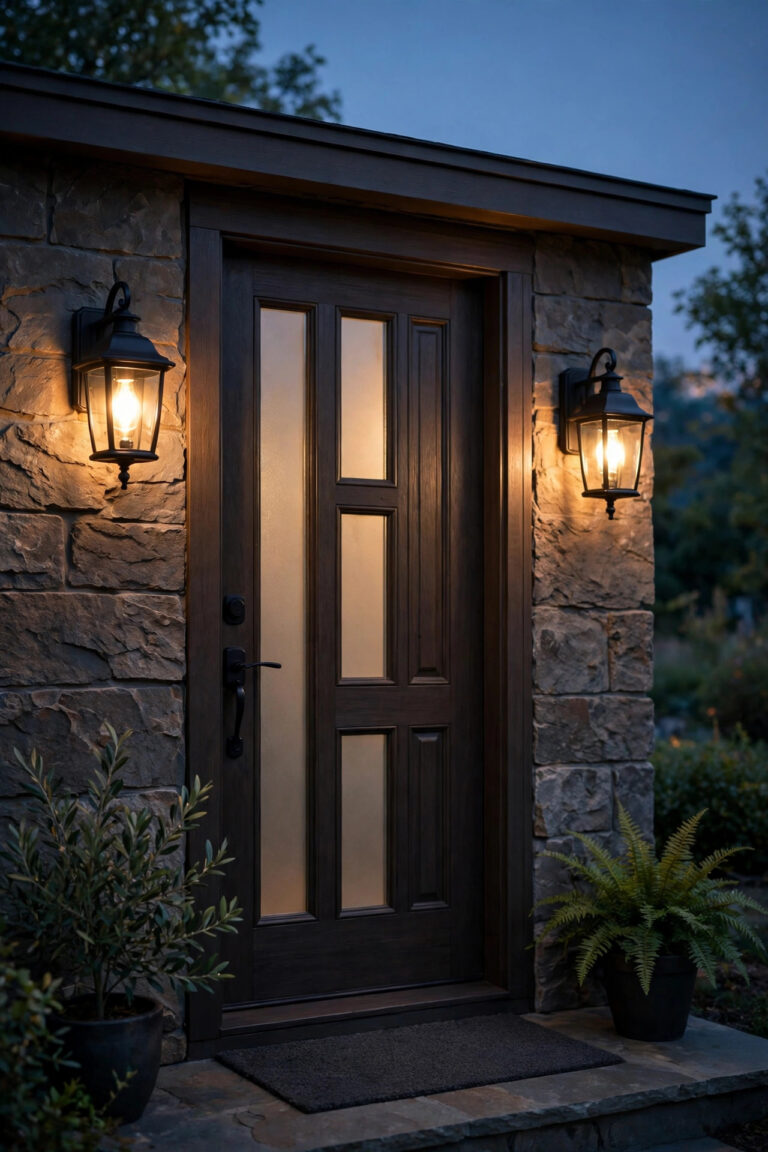
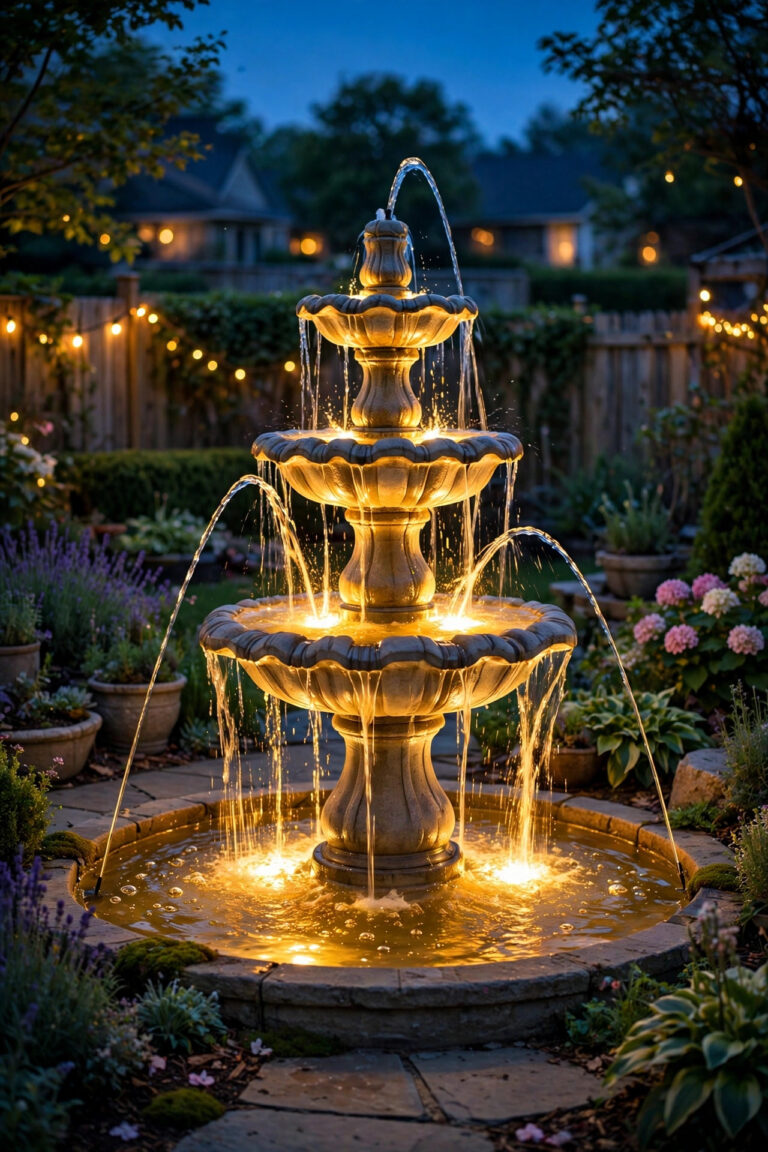
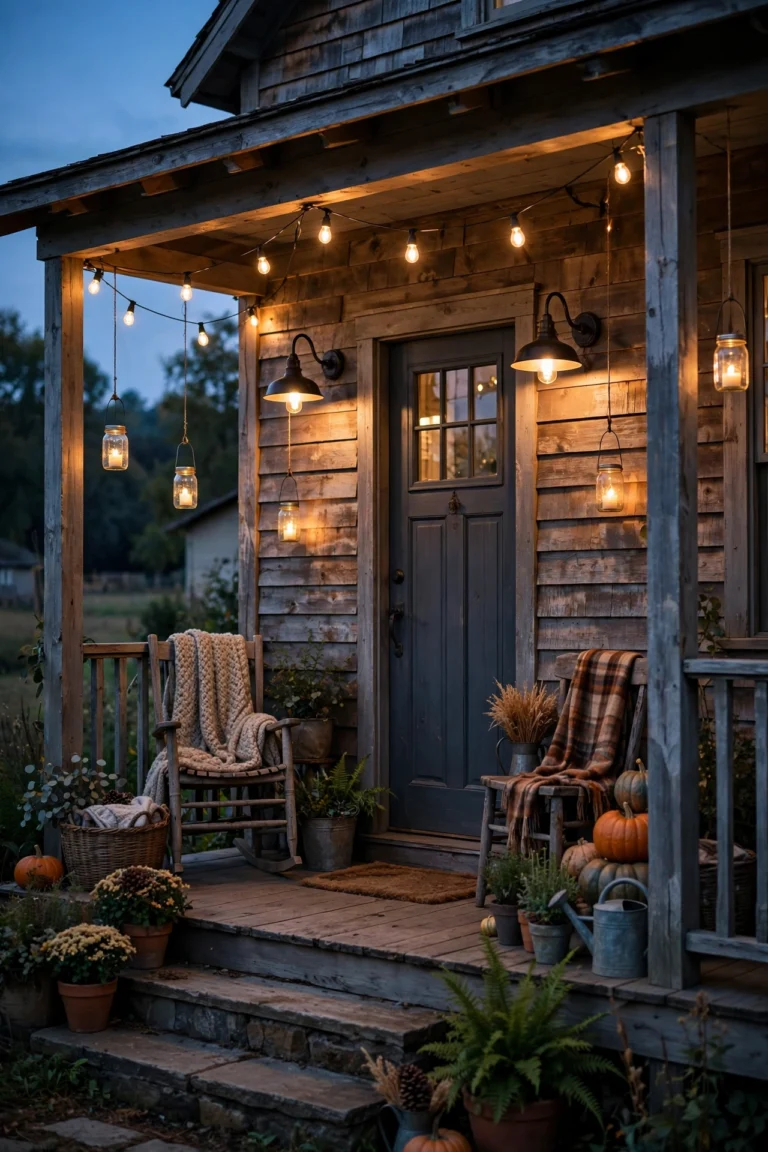
A screened pool is the best room in a Florida-style house, right up until the sun goes down and it turns into a dark glass box. In my experience, the fix is never one big fixture. The pool cage lighting ideas that actually work layer light the same way you would indoors: a soft ambient base, task light where people sit and read and snack, and a few accents that make the water and the frame itself glow. The cage gives you a gift most patios do not have — a built-in aluminum frame overhead and all around, which is basically a free mounting system for strips, strands, and clips. Below are the 19 layers I come back to again and again, from five-minute solar fixes to the wired upgrades that make a lanai feel like a resort at night. Mix two or three and the whole enclosure changes. It is honestly the easiest room makeover we have ever done.

1. LED Strips on the Frame: The Backbone of All Pool Cage Lighting Ideas
If I could only pick one layer, this would be it. A waterproof LED strip run along the inside of the top frame beams gives the whole enclosure an even, shadow-free wash that makes the space usable every single night. Choose an IP65 or IP67 rated strip in warm white, 2700K to 3000K, and mount it in an aluminum channel with a diffuser so you see glow instead of individual dots. Run the strip facing down or angled at 45 degrees toward the deck; facing it straight out creates glare at eye level. Most cage beams take adhesive-backed channel beautifully, but I always add the little mounting clips every 18 to 24 inches because pool humidity works on adhesive over time. Put the driver and controller in a weatherproof box near an outlet, and choose a dimmable strip so movie night can go low while a cleaning session goes full bright. One 50-foot run usually covers the top rails of an average cage.
Suggested budget range: $60 – $180.

2. Swag String Lights Across the Cage Ceiling
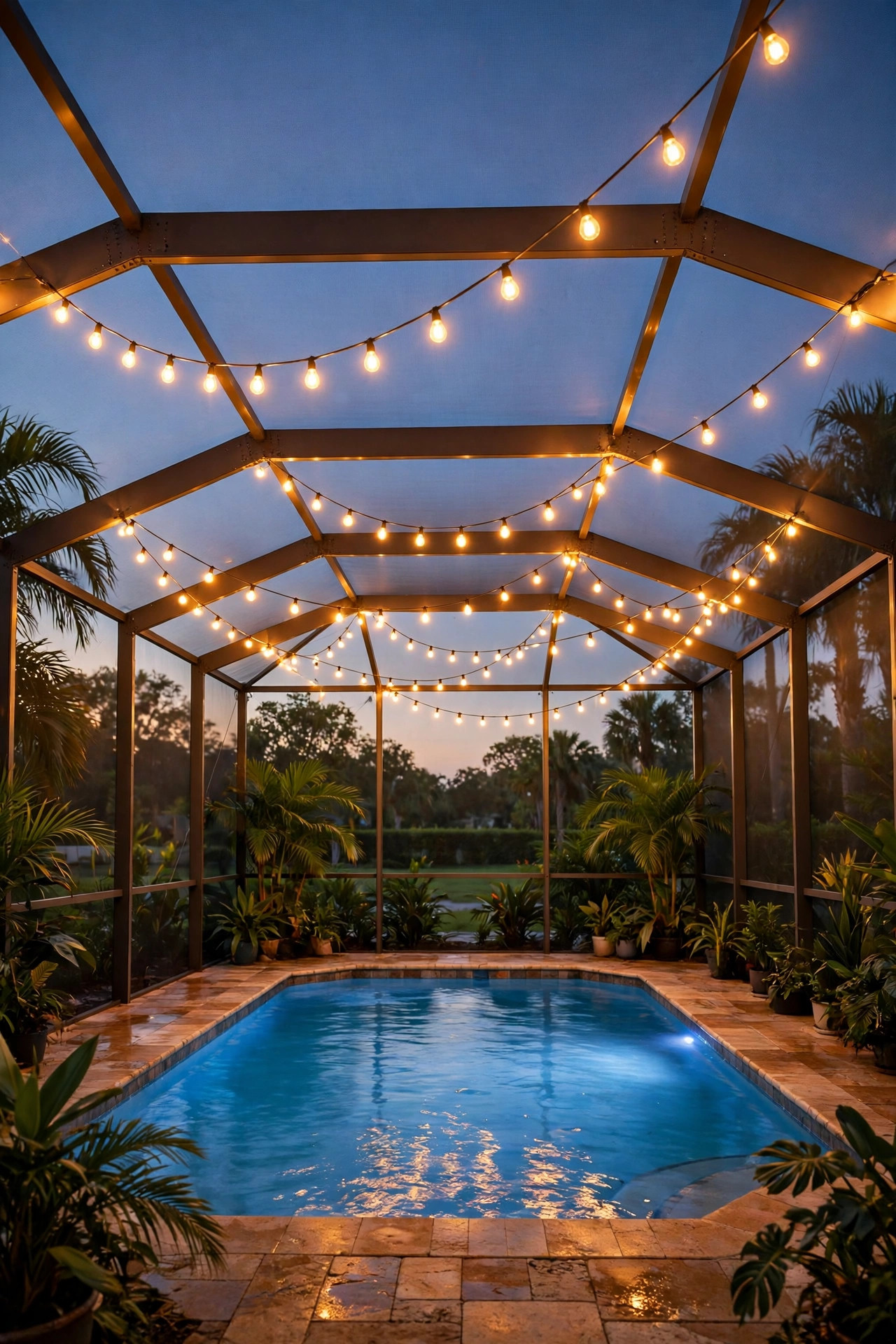
Nothing changes the mood inside a cage faster than a few gentle swags of string light overhead. The frame gives you anchor points every few feet, so run commercial-grade strands from beam to beam in soft catenary curves, letting each swag dip 12 to 18 inches at the center. Space swags about 4 to 6 feet apart so the ceiling reads as a canopy rather than a web. Shatterproof LED filament bulbs are the right call over water — no glass to fish out of the pool if a bulb ever fails. Keep strands at least a few inches off the screen roof so wind movement does not rub the mesh. My full method for strand spacing and bulb sizes lives in my guide to backyard string light ideas, and it translates to a cage beautifully. On a dimmer, these go from party-bright to barely-there sparkle, which is honestly how we run them most nights.
Suggested budget range: $45 – $140.
3. Make the Pool Light Itself the Centerpiece
Every layer in this post plays support to the real star: the water. A color-changing LED pool light turns the pool into a giant lantern that lights the whole cage from below, and on a soft aqua or warm white setting it flatters everything around it. If your pool still runs an old incandescent fixture, an LED retrofit bulb or full fixture swap is the single highest-impact upgrade on this list. Set it to a slow color fade for parties, but honestly? A steady warm white or gentle teal reads the most high-end for everyday evenings. I go deeper on bulb types, niche sizing, and safety in my roundup of pool underwater lighting ideas, including the GFCI rules that matter here. Keep the in-pool light on its own switch from the cage lighting so you can run one without the other — sometimes a glowing pool and a dark, quiet cage is the whole mood.
Suggested budget range: $120 – $450.

4. Hang Lantern Pendants Over the Lanai Seating
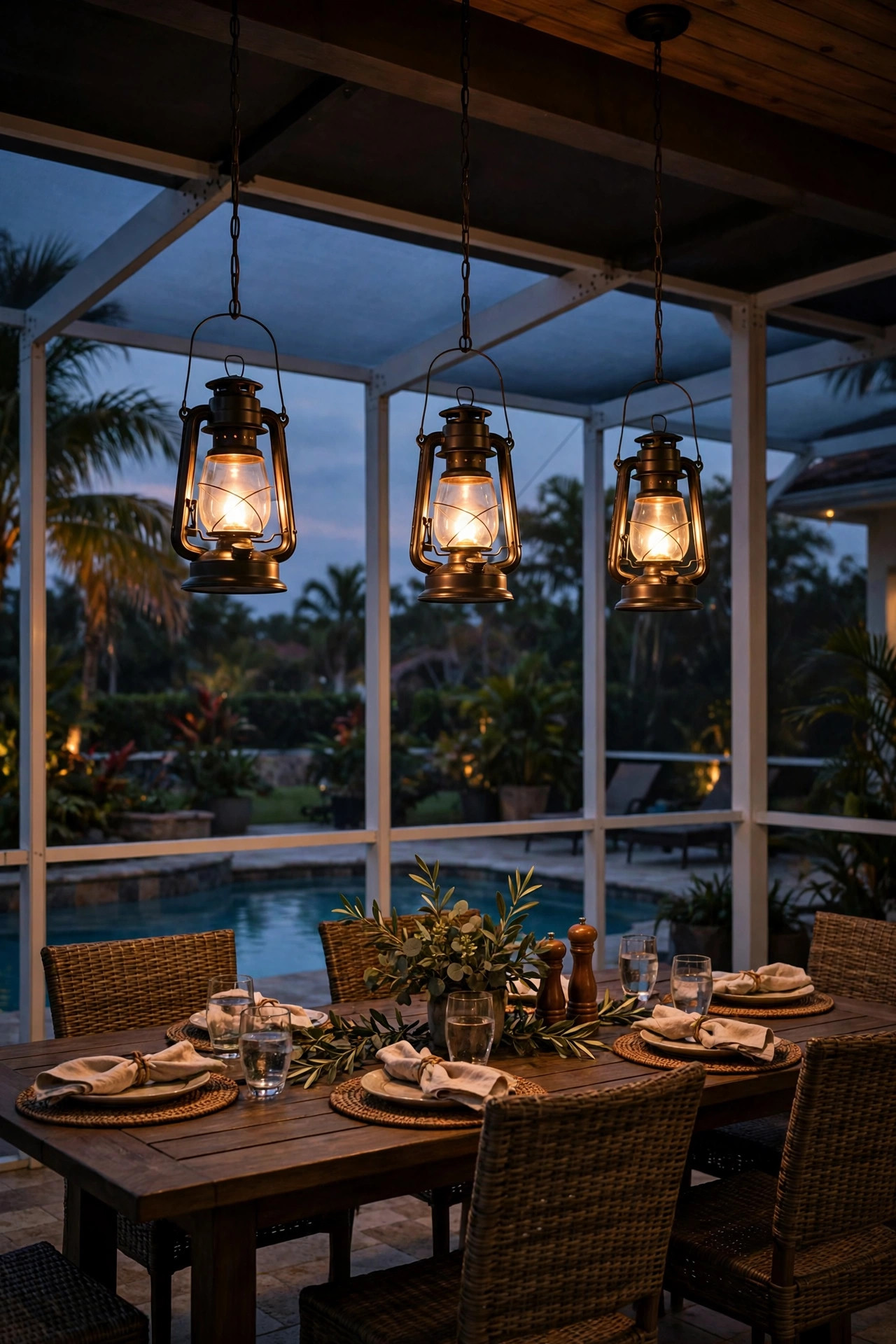
The covered lanai end of the enclosure is where everyone actually sits, so treat it like a dining room. Two or three lantern-style pendants hung over the seating or outdoor dining table give focused, flattering light exactly where faces and food are. Hang them so the bottom of the lantern sits about 30 to 36 inches above the table, and choose wet-rated fixtures with enclosed bulbs — the lanai roof leaks eventually, ask me how I know. If hardwiring is not in the cards, battery and solar lantern pendants with a warm 2700K glow have gotten genuinely good; just bring the removable battery packs inside during storm season. Match the lantern finish to your cage frame — bronze on bronze disappears elegantly, while matte black pops against a white frame. A dimmer or a three-way bulb lets the same fixture handle dinner prep and late-night winding down.
Suggested budget range: $70 – $260.
5. Mount Sconces on the House Wall Inside the Cage
The house wall is the one surface inside the cage that most people forget, and it is prime lighting real estate. A pair of up-down sconces flanking the sliding doors washes the wall with light, marks the entry clearly, and reflects a surprising amount of brightness back into the enclosure. Choose fixtures rated for wet locations even though they sit under cover, because wind-driven rain finds everything in Florida. Keep sconce brightness modest — 450 to 800 lumens each is plenty — since they sit right at eye level. This is also the easiest place to hardwire, because the wall already holds interior switches on the other side; an electrician can often tie in without tearing anything up. Put the sconces on their own switch or a smart bulb so the doorway glow can stay on as a night-light layer after the rest of the cage goes dark. It makes midnight trips to the hot tub feel civilized.
Suggested budget range: $80 – $300.

6. Install Flush-Mount Ceiling Lights Under the Lanai Roof
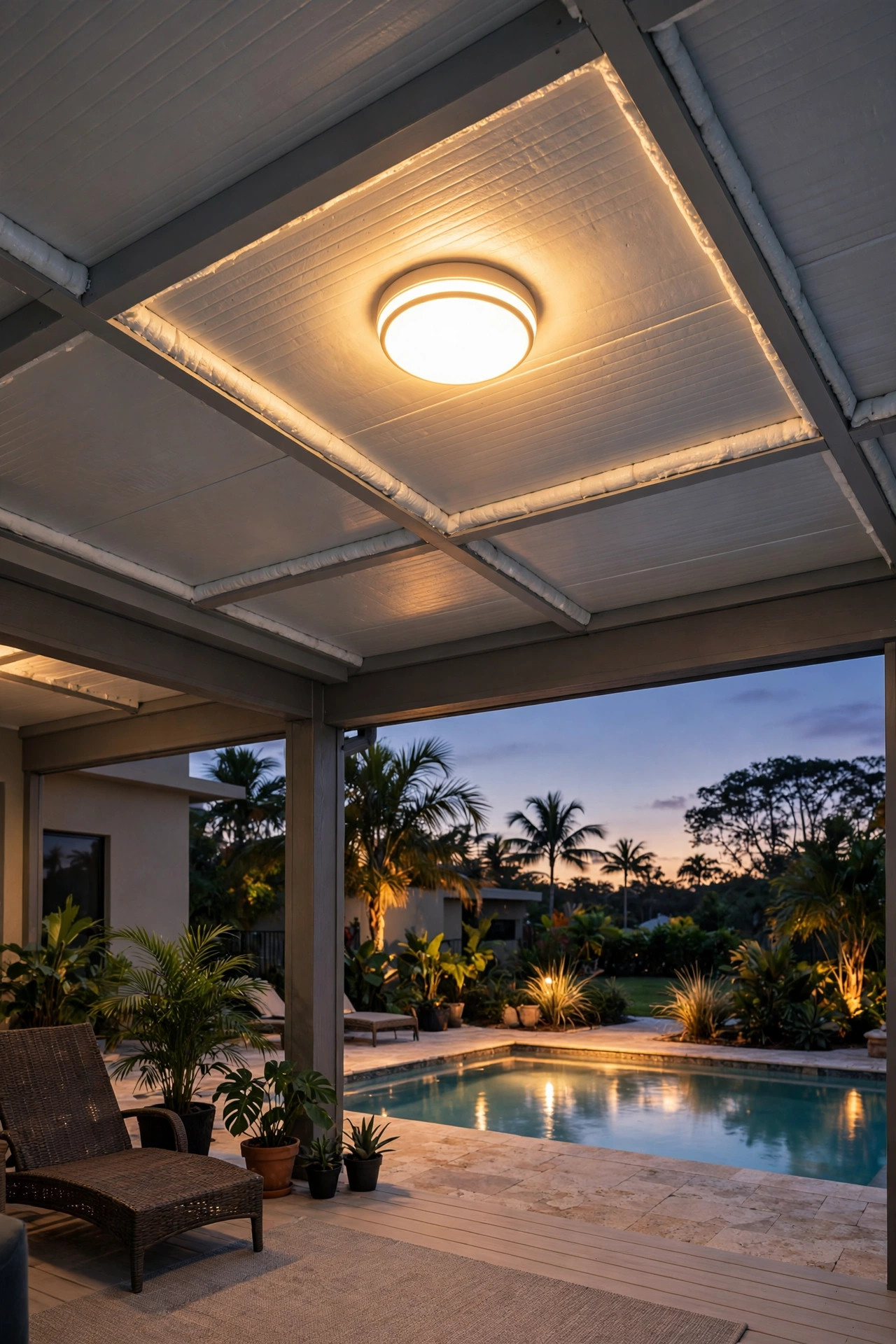
Every lanai needs one honest work light, and a flush-mount ceiling fixture is it. This is the light you flip on to find a dropped earring, check the skimmer, or hose down the deck — bright, even, and shadow-free. Look for a wet-rated LED flush mount in the 1,500 to 2,500 lumen range, and if your lanai roof has a fan beam, center the fixture where it will not fight the fan for visual attention. A frosted diffuser matters more than raw brightness; bare LED arrays under a low lanai ceiling are harsh. I like fixtures with a selectable color temperature switch so you can land on 3000K to match the rest of your layers. Honestly, this is the least glamorous idea on the list and the one you will use most. Put it on a dimmer if you can, and it doubles as perfectly decent ambient light for casual evenings when you do not want the full production.
Suggested budget range: $60 – $220.
7. Trace the Deck Edge With Rope Light
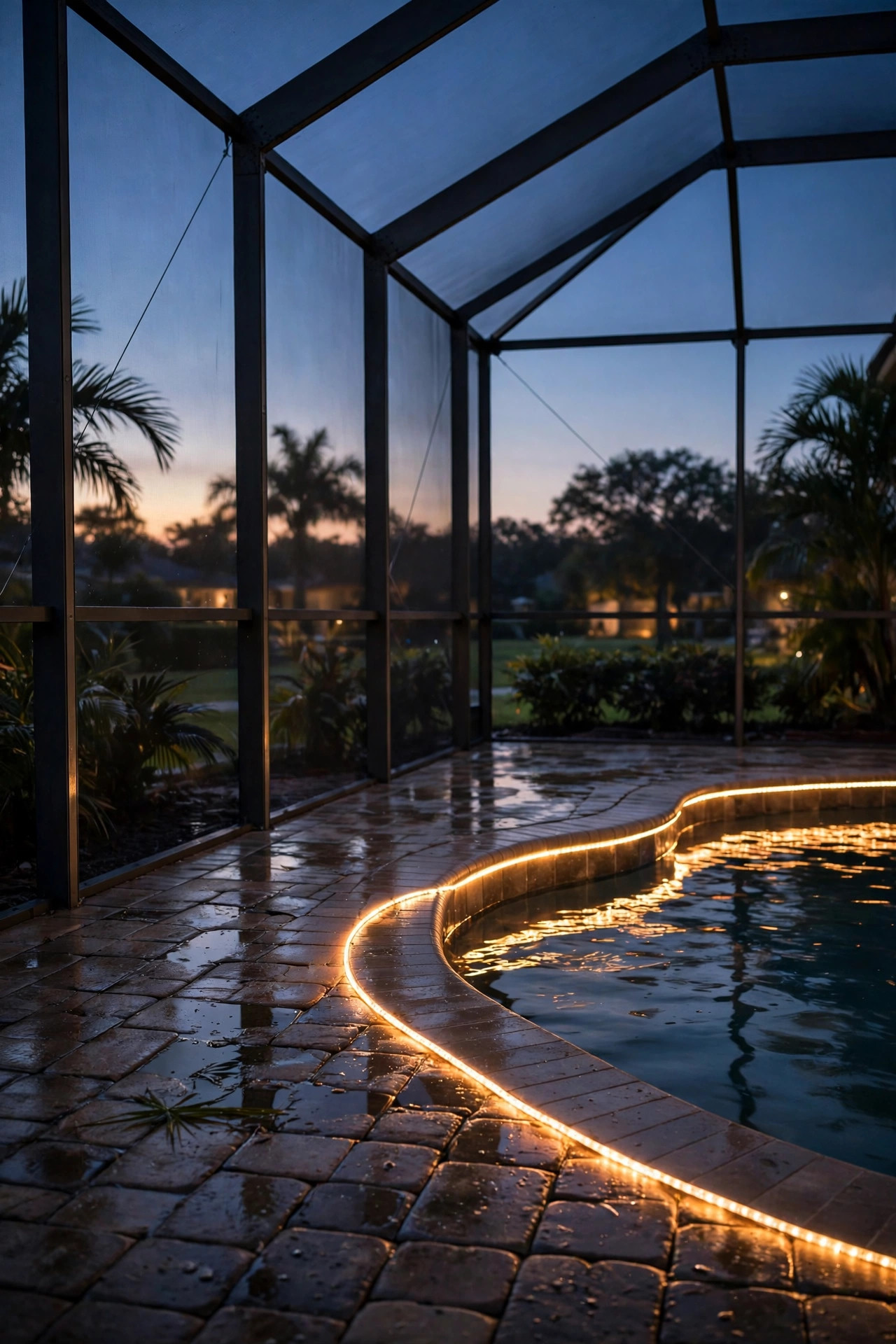
Wet feet, dark deck, pool edge — that combination deserves a guide light. A flexible LED rope light run along the base of the cage or tucked under the deck nosing draws a clean glowing line that shows everyone exactly where the walking surface ends and the water begins. Choose a fully sealed, submersible-rated rope or a neon-style LED flex, both of which handle splash and pressure washing without complaint. Mount it with clips every 12 inches rather than adhesive, and keep the run continuous around corners using the manufacturer connectors instead of sharp bends. Warm white at low brightness is the goal here; this is a wayfinding layer, not a feature light. It also looks quietly expensive — that thin line of light reflecting on wet pavers is a resort trick that costs almost nothing. On a timer, it can double as your overnight safety layer long after the party lights go off.
Suggested budget range: $35 – $110.
8. Line the Screen Perimeter With Solar Stakes Outside
Lighting the outside of the cage sounds backwards until you see it: a row of solar stake lights around the exterior perimeter keeps the view from going black at the screen line and makes the whole enclosure glow like a lantern from the yard. Space stakes 4 to 6 feet apart, just outside the screen, angled slightly toward the cage so the light rakes across the mesh. This trick also solves a real annoyance — a bright interior against a pitch-black exterior makes the screen itself visible and reflective, while a softly lit yard balances the view. Choose stakes with separate solar panels or high-efficiency cells if your perimeter sits under trees, and expect 6 to 8 hours of glow from a full day of sun. Warm white only, please; cool blue solar lights cheapen the whole effect. The installation is genuinely ten minutes with a mallet, and renters can pull them up without a trace.
Suggested budget range: $30 – $90.

9. Weave Fairy Lights Through Potted Palms
Every cage I have styled has at least two big potted palms or a fiddle-leaf in the corners, and they are begging for copper-wire fairy lights. A 33-foot strand woven up the trunk and out through the fronds turns a plant into a soft sculpture of light, and because the wire is nearly invisible, the effect reads as magic rather than decoration. Battery packs with built-in 6-hours-on timers are the practical choice — tuck the pack into the pot under a little mulch and forget about it for a month of evenings at a time. Keep the fairy lights to the plants and maybe a trellis panel; restraint is what keeps this classy instead of theme park. One caution: use LED fairy lights only, never anything that warms up, and keep the battery pack off the soil surface where irrigation reaches it. On their own these are barely accent light, but layered over the strip base they add the sparkle people remember.
Suggested budget range: $15 – $45.

10. Put a Ceiling Fan With a Light Kit at the Lanai End
In a screened enclosure, moving air is half the comfort equation, and a wet-rated ceiling fan with an integrated light kit earns its keep every single evening. The light kit gives you a central, dimmable ambient source over the seating zone, while the fan keeps bugs sluggish and conversations comfortable. Size the fan honestly: most lanai seating zones want a 52-inch fan, and the blades should clear the roof pitch by a comfortable margin on a downrod if your roof peaks. Choose a fixture where the light and fan run on separate controls — there are plenty of nights you want breeze without light, or light without breeze. Modern LED kits in the 1,200 to 1,800 lumen range with a frosted dome avoid the bare-bulb glare of older fans. If your lanai already has a fan, retrofit light kits exist for many models and cost a fraction of a replacement. This is an electrician-friendly afternoon job for most homeowners.
Suggested budget range: $180 – $480.

11. Add a Motion-Sensor Light at the Screen Door
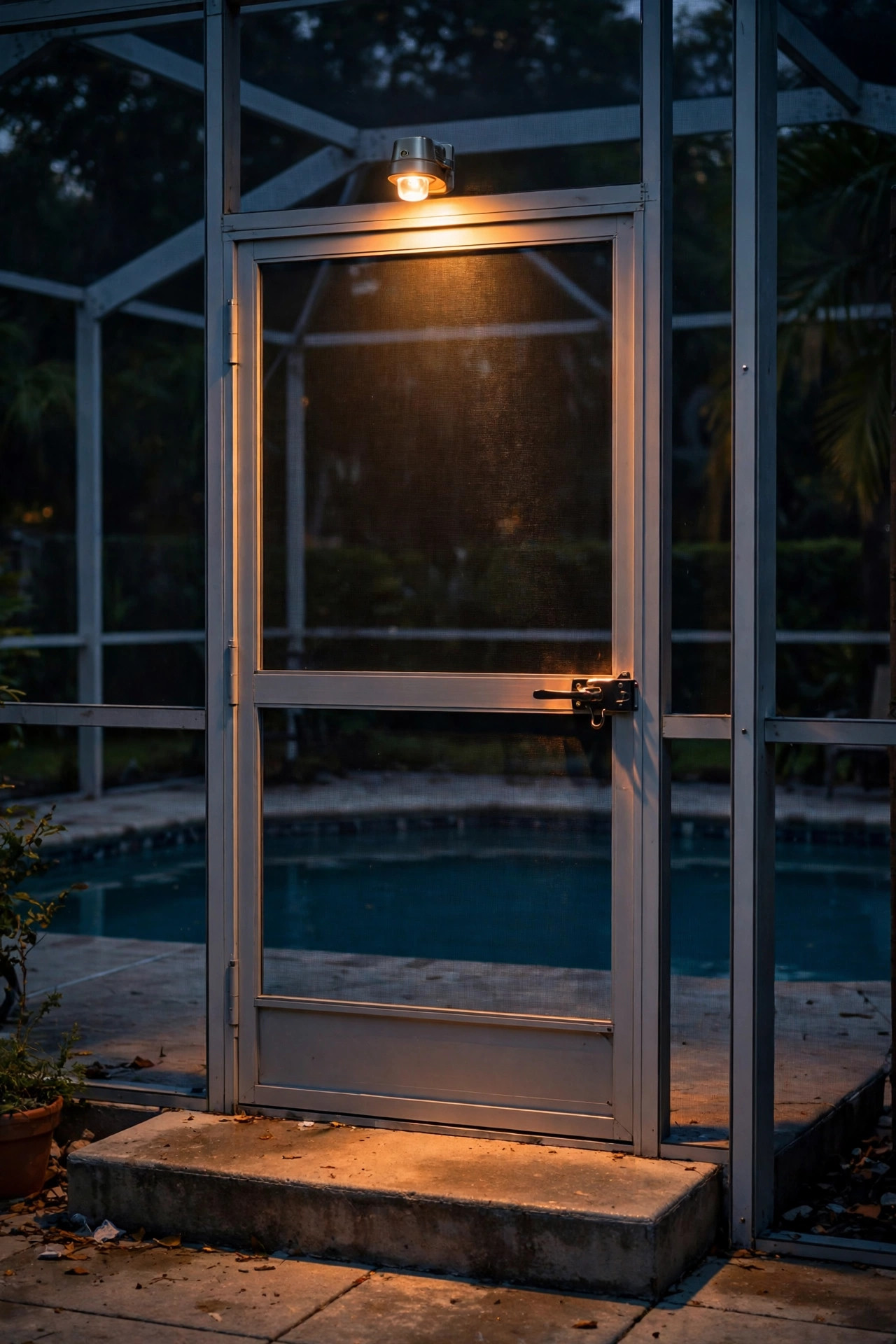
The trip from house to pool usually happens with full hands — towels, drinks, a plate of something — so the screen door deserves a light that thinks for you. A small motion-sensor fixture mounted above or beside the cage door clicks on as you approach, lights the latch and the step, and fades off a minute later. Battery and solar versions work fine here and skip the wiring entirely; just aim the sensor along the path of approach rather than straight at the pool, or every swimmer becomes a light show. Keep brightness modest, around 300 to 600 lumens, because this fixture fires at close range. Inside the cage, a second sensor light near the house door is genuinely useful for the same reason. This is the least decorative idea on the list and the one guests quietly appreciate most. It also earns its keep on security grounds, lighting the enclosure entry whenever anything moves out there at 3 a.m.
Suggested budget range: $20 – $75.
12. Cluster Flameless Lanterns on the Side Tables
Some nights call for candlelight, and inside a screen enclosure you can enjoy the look without a single real flame near pool towels and paper plates. A trio of flameless lanterns — mixed heights, same finish — grouped on a side table or the outdoor coffee table gives that low, flickering, flattering glow that overhead light never will. Choose lanterns with a realistic flicker mode and a timer function, and rechargeable versions beat battery-eaters over a long season. Because there is no flame, these are safe around kids, splashing, and the inevitable toppled drink. I move mine around constantly: beside the outdoor sofa, on the steps, even on the pool coping for a party (well back from the water edge, and never where a kick could send one in). Grouped in odd numbers and kept to one finish family, they look styled rather than scattered. Honestly, per dollar of evening atmosphere, nothing on this list competes.
Suggested budget range: $25 – $85.

13. Set Everything on Smart Plugs and Dusk Timers
The best lighting plan is the one that turns itself on. Putting your string lights, strips, and lanterns on smart plugs or simple dusk-to-dawn timers means the cage is already glowing when you walk out with dinner, and already off when you fall asleep. Program the pretty layers to come on at sunset and the safety layers — rope light, door sensor — to run until midnight. If you go the smart plug route, choose outdoor-rated plugs with a weatherproof housing, and keep them mounted off the deck where sprinklers cannot soak them. Group plugs by layer so one tap runs your evening scene: ambient only for a quiet swim, everything on for guests. Voice control from the lanai sofa sounds like a gimmick until the first night you dim the whole enclosure without getting up. Timers also solve the solar problem in reverse — on cloudy weeks, your wired layers still show up on schedule, so the space never feels forgotten.
Suggested budget range: $25 – $100.

14. Uplight the Cage Corners for Height
A cage is a tall box, and most lighting plans only address the bottom two-thirds of it. Small uplights tucked into the corner planters or aimed up the corner posts pull the eye to the peak of the roof and make the enclosure feel dramatically bigger. Use narrow-beam fixtures, 15 to 30 degrees, so the light climbs the post instead of spilling across the screen. Two corners is usually enough — all four can start to feel like a stadium. Solar uplights with a ground spike are the easy entry version, but wired low-voltage spots on your existing landscape transformer are steadier and brighter. Keep the fixtures low-profile and shielded so swimmers are not staring into a beam at water level. This is a pure drama layer: it contributes almost no usable task light, yet guests always ask what changed about the space. Height, it turns out, is what changed.
Suggested budget range: $40 – $130.

15. String Globe Lights Along the Top Rail
If fairy lights are sparkle, globe lights are punctuation. A run of G40-style globe strands clipped along the inside top rail gives the cage a clean, architectural line of warm orbs that reads beautifully from inside and out. The larger 2-inch globes suit the scale of a cage where tiny bulbs can disappear, and shatterproof plastic globes are non-negotiable over a pool deck. Space the strand so sockets sit 12 inches apart as manufactured — resist doubling up strands to add density, which overloads the clean line. I like globes as a perimeter treatment rather than a ceiling swag: the rail run defines the shape of the enclosure after dark. Put them on a dimmer, because at full brightness a full perimeter of globes is a lot of light at eye level; at 60 percent they are pure resort. Combined with the strip wash from idea one, you may find you rarely need anything else on a weeknight.
Suggested budget range: $50 – $150.

16. Light the Steps and Level Changes
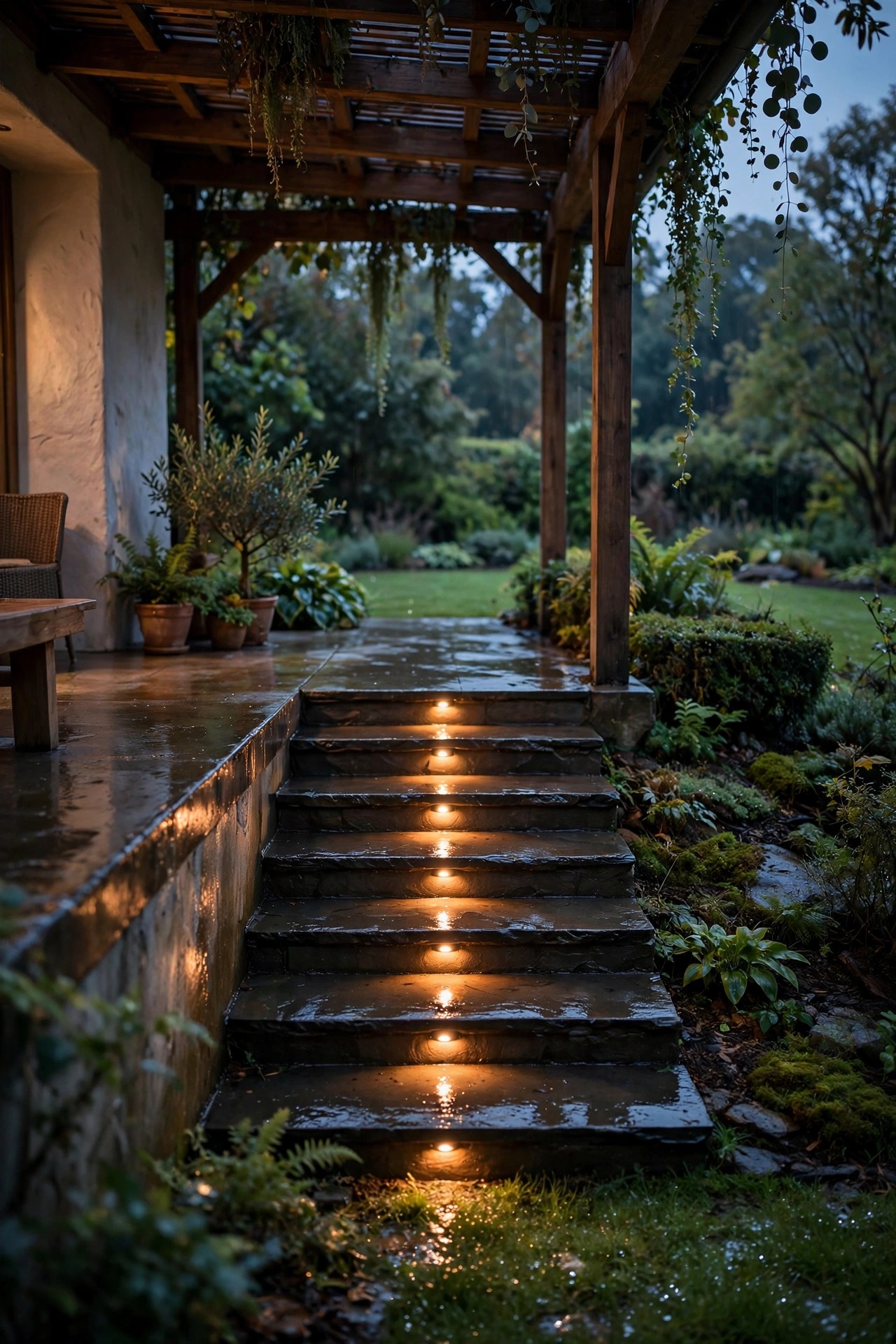
Plenty of pool decks hide a step down to the spa, a raised tanning shelf edge, or a single sneaky level change at the lanai — and at night, somebody will find it with a shin. Small recessed step lights or low-profile LED puck lights mounted on the riser face solve it permanently. Aim for a gentle marker rather than a flood: 50 to 150 lumens per step washes the tread without blinding swimmers at water level. Hardwired low-voltage versions tie neatly into a landscape transformer and disappear into the deck work; solar step lights with a decent panel work where the step catches afternoon sun. Keep fixtures flush so bare feet and pool floats never snag them. If your deck has a spa spillover or a raised beam, a light at each end of the hazard beats one in the middle. This is safety lighting that guests will never notice, which is precisely the point — the compliments go to the pretty layers while these quietly prevent the ER story.
Suggested budget range: $30 – $120.
17. Add Battery Puck Lights to the Bar Cart and Shelves
Every lanai has a dark little work zone — the bar cart, the towel shelf, the cabinet under the outdoor kitchen counter — where the pretty ambient layers never quite reach. A few battery puck lights stuck under a shelf lip or inside the cart fix it in minutes. Choose warm white pucks with a remote or tap control, and rechargeable models so you are not feeding batteries to a light you use for ninety seconds at a time. Under a shelf, the light pools down exactly where hands and glasses are; it feels oddly luxurious for something that costs less than lunch. These are damp-location survivors rather than true outdoor fixtures, so mount them under cover and pop them off their adhesive mounts to come inside during hurricane prep. I also keep two spare pucks loose in a drawer — clipped under an umbrella rib or set inside a lantern in a pinch, they are the duct tape of lanai lighting.
Suggested budget range: $15 – $50.

18. Wash the Screen With Soft Light From Outside
Here is a designer trick that surprises everyone: one or two soft floodlights in the garden beds, aimed gently at the outside of the cage, turn the whole screen wall into a glowing backdrop. The mesh diffuses the light the way a lampshade does, so the enclosure reads as a luminous room set into a dark garden. Use wide-beam fixtures, keep them low and shielded, and aim at the screen from 6 to 10 feet out so you get wash rather than hot spots. Warm white at modest output is plenty — you are lighting a shade, not a stage. This layer also flatters landscaping between the floods and the cage, throwing leaf shadows across the screen on breezy nights. It is the one idea on this list that does nothing for the people inside and everything for the view from the house and yard, which, if your kitchen window faces the pool, might make it your favorite.
Suggested budget range: $45 – $140.

19. Layer It All: My Full Pool Cage Lighting Ideas Recipe
When everything comes together, this is the recipe I install: the LED strip on the frame runs as the ambient base at about 70 percent, the pool light glows a steady warm teal, and the sconces mark the doorway. Globes on the top rail join for guests, fairy lights in the palms stay on their own timer, and the rope light at the deck edge runs all night as the safety layer. The secret is never running everything at full blast — three or four layers at moderate levels beat one layer at maximum every time, because contrast is what makes a space feel designed. Start with the strip and the pool light, live with it a week, then add the layer your evenings actually miss. Timers tie it together so the show runs itself. That is genuinely all there is to it: base, sparkle, safety, and one star — the water.
Suggested budget range: $200 – $600.
Frequently Asked Questions
What color temperature is best inside a pool cage?
Warm white, 2700K to 3000K, wins almost every time. It flatters skin, pairs beautifully with turquoise water, and does not fight the sunset. Cooler 4000K-plus light reads clinical against a pool and can make the whole enclosure feel like an aquarium supply store. Whatever you choose, match every layer to the same temperature so the space feels intentional.
Can I attach lights directly to the aluminum cage frame?
Yes, with the right hardware. Adhesive channels, clip-on mounts, and stainless screws into the frame uprights all work, but check your cage warranty and local wind codes before drilling — in hurricane country, some warranties and engineering specs care about penetrations. When in doubt, clips and channels do the job with zero holes, and they make storm prep removal simple.
Do lights inside a pool cage attract more bugs to the screen?
They attract bugs to the outside of the screen, which is exactly where you want them — the mesh still does its job. Warm white light draws noticeably fewer insects than cool blue-toned light, and keeping fixtures a few feet from the door reduces the crowd waiting to slip in with you. A fan running on the lanai helps more than any bulb choice.
How much does it cost to light a whole pool cage and lanai?
A solar-and-string-light refresh can land under $150 total. A layered setup with LED strips, sconces, globes, and timers typically runs $400 to $900 in materials. Fully hardwired plans with an electrician — sconces, fan, flush mounts, a new pool light — generally fall between $1,500 and $3,500 depending on how much wiring already exists.
Conclusion
A screened pool should not clock out at sunset. The pool cage lighting ideas above all follow the same simple formula: an even ambient base on the frame, the water itself as the star, a sparkle layer for mood, and quiet safety light at doors, steps, and edges. Pick the two layers your evenings miss most, put them on a timer, and the enclosure becomes the room everyone drifts to after dinner. For more ways to extend the glow beyond the screen, browse my favorite patio lighting ideas and adapt the same layering to the open deck.