If there is one lighting trick that instantly makes a backyard feel like your favorite little bistro, it is edison bulb string lights. Those warm amber filaments glowing against the dusk just do something to a space — dinner tastes better, conversations run longer, and nobody wants to go inside. In my experience, they are also the most forgiving lights you'll ever hang: no trenching, no electrician, and if a layout doesn't feel right, you just move a hook. The real secret is layering. One strand alone looks like an afterthought, but two or three thoughtful layers — overhead swags, a fence-line glow, a soft pool over the seating — make the whole yard feel designed. Below I'm sharing my 15 favorite ways to use them, from classic patio swags to a permanent ceiling grid, with the bulb shapes, spacing, and hardware that actually hold up outdoors. If you want the measuring and hardware basics first, my outdoor string lights guide walks through strand lengths and mounting step by step.
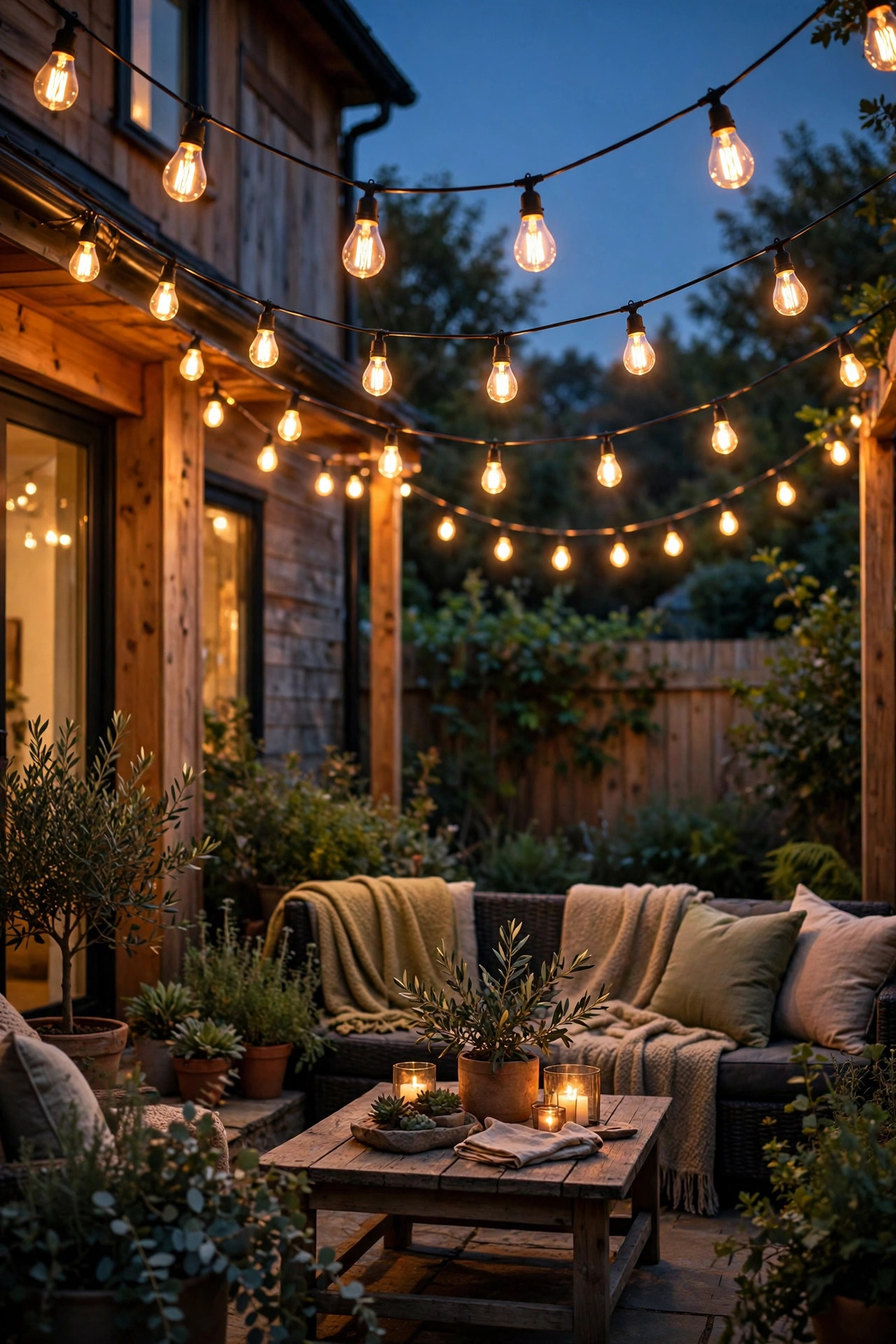
1. The Classic Single Swag Over the Patio
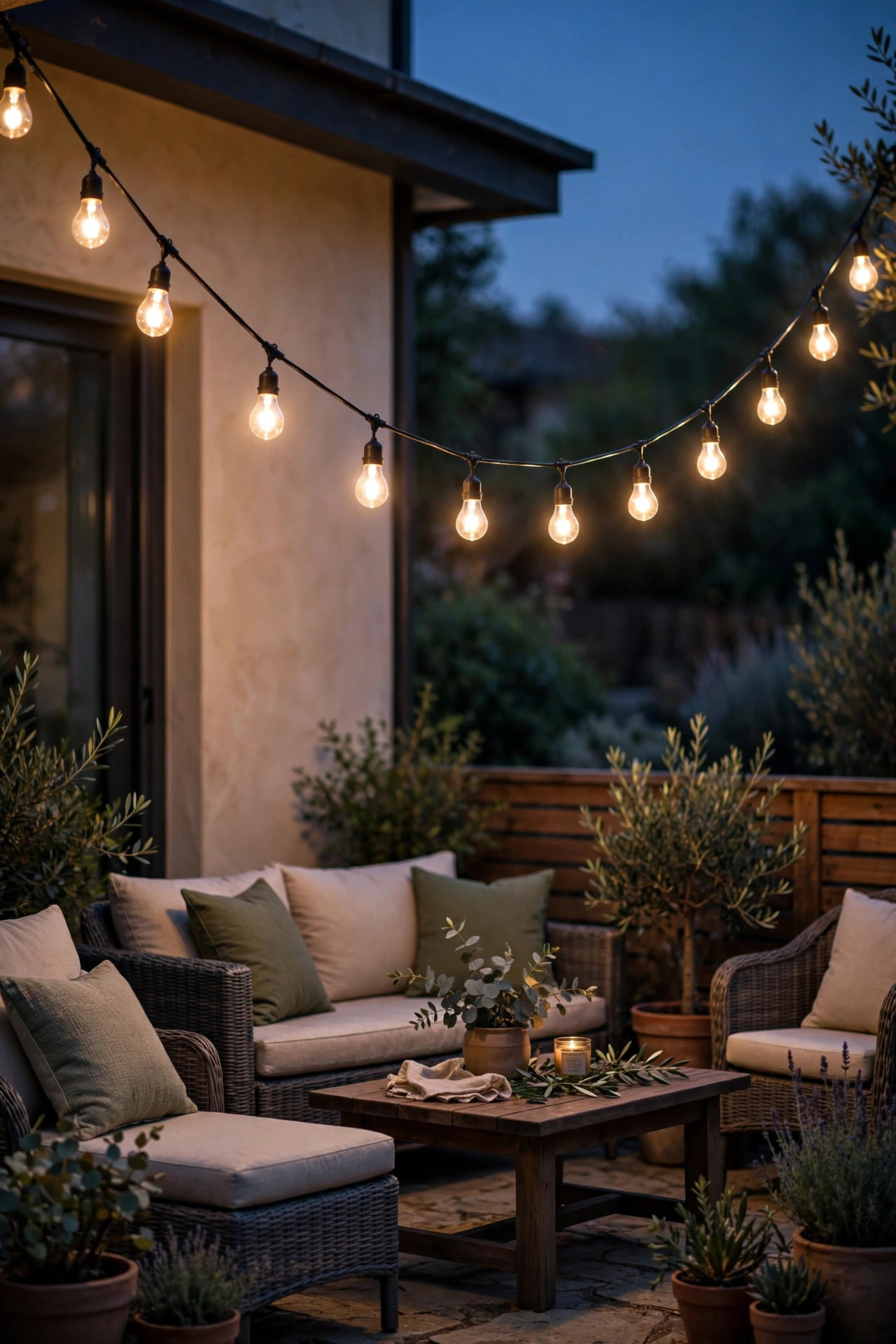
Start where almost everyone starts: one generous swag over the main patio. Attach the strand to the house fascia on one side and a sturdy post, pergola corner, or tree on the other, and let it dip about 12 to 18 inches in the middle — that gentle catenary curve is the whole vintage look. For a 12-by-14-foot patio, a single 25-foot commercial-grade strand usually does it, but honestly? Two parallel swags spaced 4 to 5 feet apart look twice as intentional. Use screw-in cup hooks or eye bolts rated for outdoor use, never staples, and always run the cord through a guide wire if your span is longer than about 15 feet so the sockets aren't carrying the weight. Keep bulbs at least 8 feet above the floor so taller guests aren't ducking. LED filament bulbs in 2200K give you that deep amber glow without the heat or fragility of true incandescent glass.
Suggested budget range: $40 – $120.
2. A Zigzag Canopy Over the Dining Table
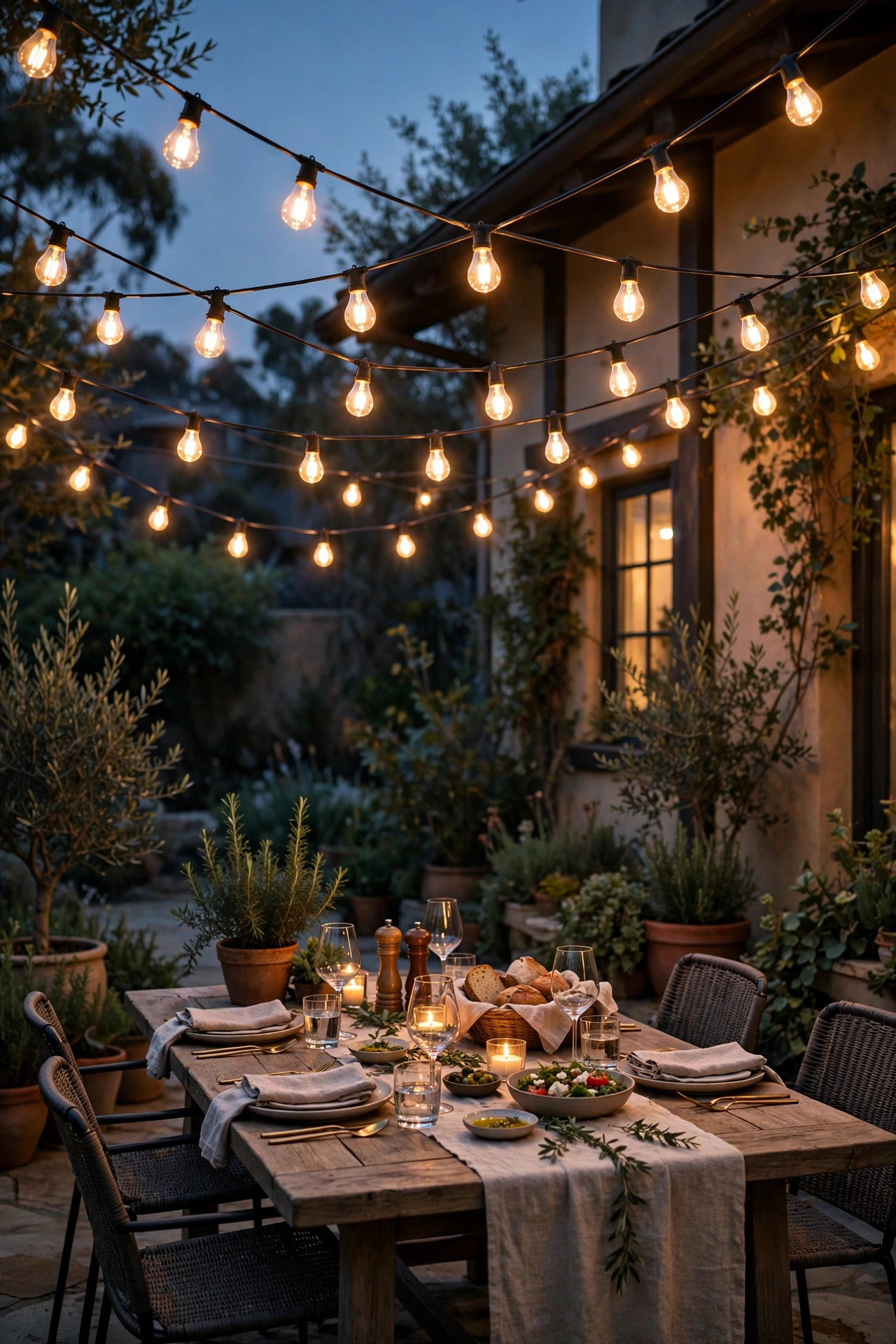
When we host dinners outside, this is the layout I reach for. Run three or four strands back and forth in a zigzag above your outdoor dining table, anchoring to the house, a fence, or two poles. The crossing lines create a "ceiling" of light that makes a plain table feel like a restaurant booth, and the bulbs reflect beautifully off glasses and plates. Keep the zigzag rows about 3 to 4 feet apart and the lowest dip at least 7½ feet above the ground so nobody brushes a bulb standing up. Because the light comes from several directions, faces look softer and there are fewer harsh shadows than with a single porch light. I like S14 or ST64 teardrop bulbs here — the elongated filament reads unmistakably vintage from below. Put the whole canopy on a plug-in dimmer and drop it to about 50 percent once dinner starts; the mood shift is instant.
Suggested budget range: $90 – $220.
3. Edison Bulb String Lights Wrapped Along Pergola Rafters
A pergola is practically begging for this treatment. Run edison bulb string lights along the top of each rafter or weave them in a gentle S-curve between the beams so the bulbs hang just below the wood line. The structure does all the supporting work, so there's no sagging mid-span to fight, and the light filters down through the rafters in soft stripes. Space your runs 18 to 24 inches apart for full coverage, or outline just the perimeter beams if you prefer a frame effect with a darker, cozier center. Secure the cord with UV-resistant cable clips every 2 feet — pergolas bake in the sun, and cheap plastic clips go brittle in a season or two. My pergola lighting ideas post covers pairing strands with climbing vines and shade sails if your structure has those too. Finish with a dusk-to-dawn timer so the pergola glows on its own every evening.
Suggested budget range: $70 – $180.

4. A Fence-Line Border That Defines the Whole Yard
Running a strand along the top of your fence is the easiest way to give a yard a finished edge. Screw small hooks into the fence posts every 6 to 8 feet and let the cord dip slightly between them — that scalloped rhythm looks charming from the house and gently says "this space is ours" to the whole backyard. It also solves a real problem: a dark fence line makes a yard feel smaller and a little eerie at night, while a lit one pushes the boundary outward. For a standard suburban lot you'll need two to three 48-foot strands connected end to end, so check the manufacturer's connectable limit — most commercial strands allow three to five. Keep the plug end near an outdoor GFCI outlet and run the first few feet of cord down the post so nothing dangles at neck height. Globe-shaped G40 bulbs read softer and more modern along a fence; teardrop ST64s lean harder into vintage.
Suggested budget range: $60 – $160.

5. A Welcoming Swag Across the Front Porch
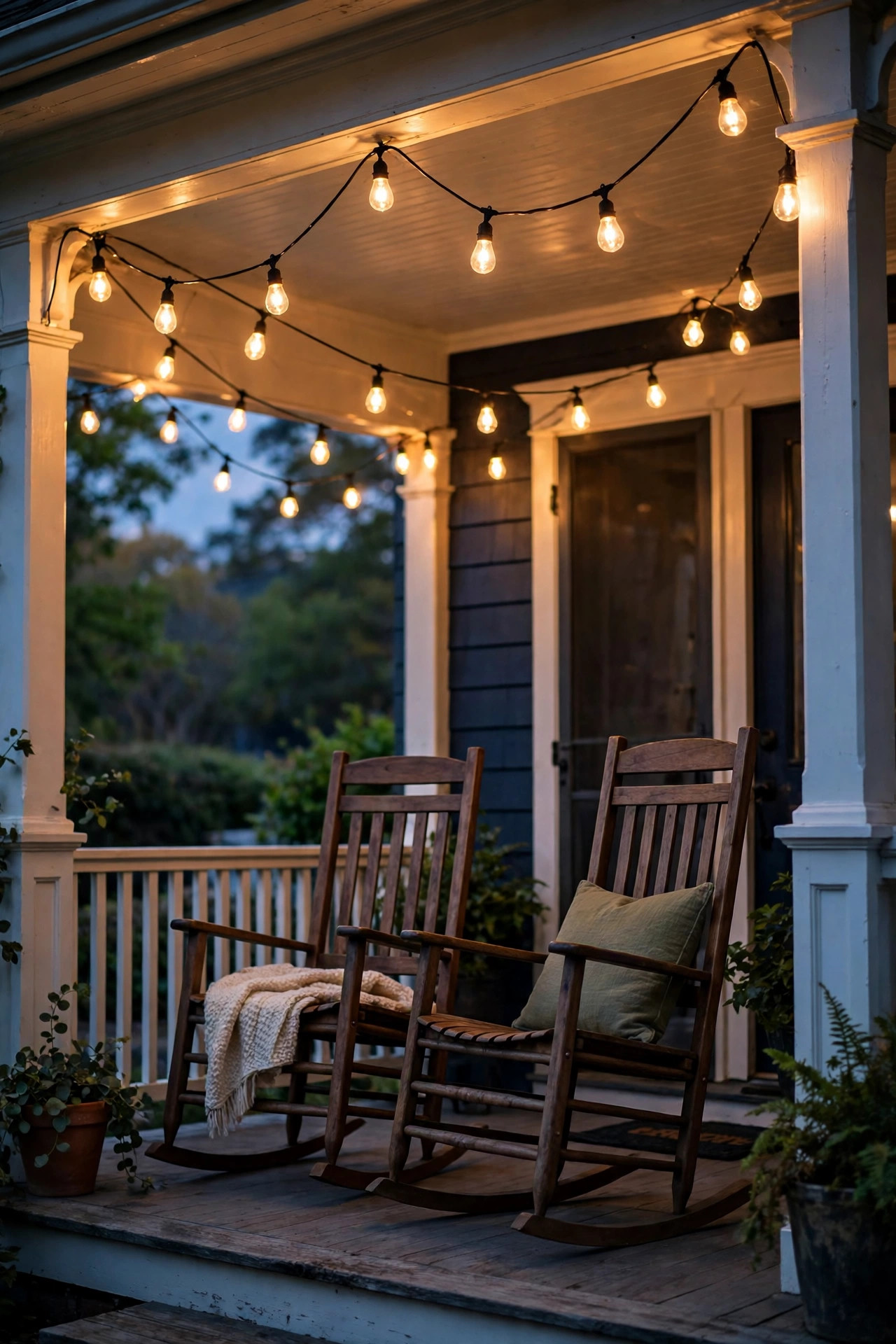
Don't save all the charm for the backyard. A single swag of edison bulbs across the front porch ceiling — corner to corner, or in a soft W between three hooks — makes your entry feel like a boutique hotel instead of a delivery drop-off. Porches are usually 6 to 8 feet deep, so a 15- or 25-foot strand with a shallow dip works perfectly, and the covered ceiling means the cord stays out of the worst weather, which stretches its life for years. Pair the swag with your existing porch light turned off; honestly, the string lights alone give plenty of light for rocking chairs and evening chats, and the layered look beats one glaring fixture every time. Add a plug-in timer set to switch off around 11 p.m. so you're not lighting the street all night. If your porch has columns, wrap the last foot of cord neatly down one column to a low outlet for a tidy finish.
Suggested budget range: $35 – $90.
6. Tree-to-Tree Spans for a Woodland Glow
If you're lucky enough to have two mature trees in the yard, a span between them is pure storybook. This is the one layout where a guide wire is non-negotiable: run a stainless steel cable tree to tree first, clipped with tree-friendly straps or through eye bolts placed high, then hang the strand from the cable with S-hooks or zip ties every couple of feet. Trees sway independently in wind, and that movement will fatigue a bare cord and its sockets within a season. Keep the span under about 30 feet, let the dip reach 10 to 12 feet at the lowest point so it clears raised arms and volleyball games, and use shatterproof LED filament bulbs — over a lawn, a falling glass bulb is a barefoot hazard waiting to happen. The effect at dusk, with light floating in the canopy gap, is the single most complimented setup in our yard.
Suggested budget range: $80 – $200.

7. A Low, Cozy Layer Over the Fire Pit Circle
Firelight plus filament light is my favorite combination in the whole yard. Hang two short swags in an X or a shallow V above your fire pit seating, keeping every bulb at least 10 feet above the pit itself and well off to the sides of the chimney of rising heat — LED filament bulbs only here, never real incandescent glass near open flame or embers. The strings aren't really for seeing by (the fire does that); they're for framing the circle and giving your eyes a soft ceiling so the space feels held. Adirondack chairs, a low strand glow, and firelight on faces — it's the coziest seat in the house from October through April. Use a strand with a built-in inline switch or a smart plug so you can kill the strings and let the fire be the only light when you want full campfire mode. Keep a spare bulb or two in the outdoor bin; fire pit areas see a lot of chair-dragging and setup bumps.
Suggested budget range: $50 – $130.

8. Deck Railing Swags With a Garland Twist
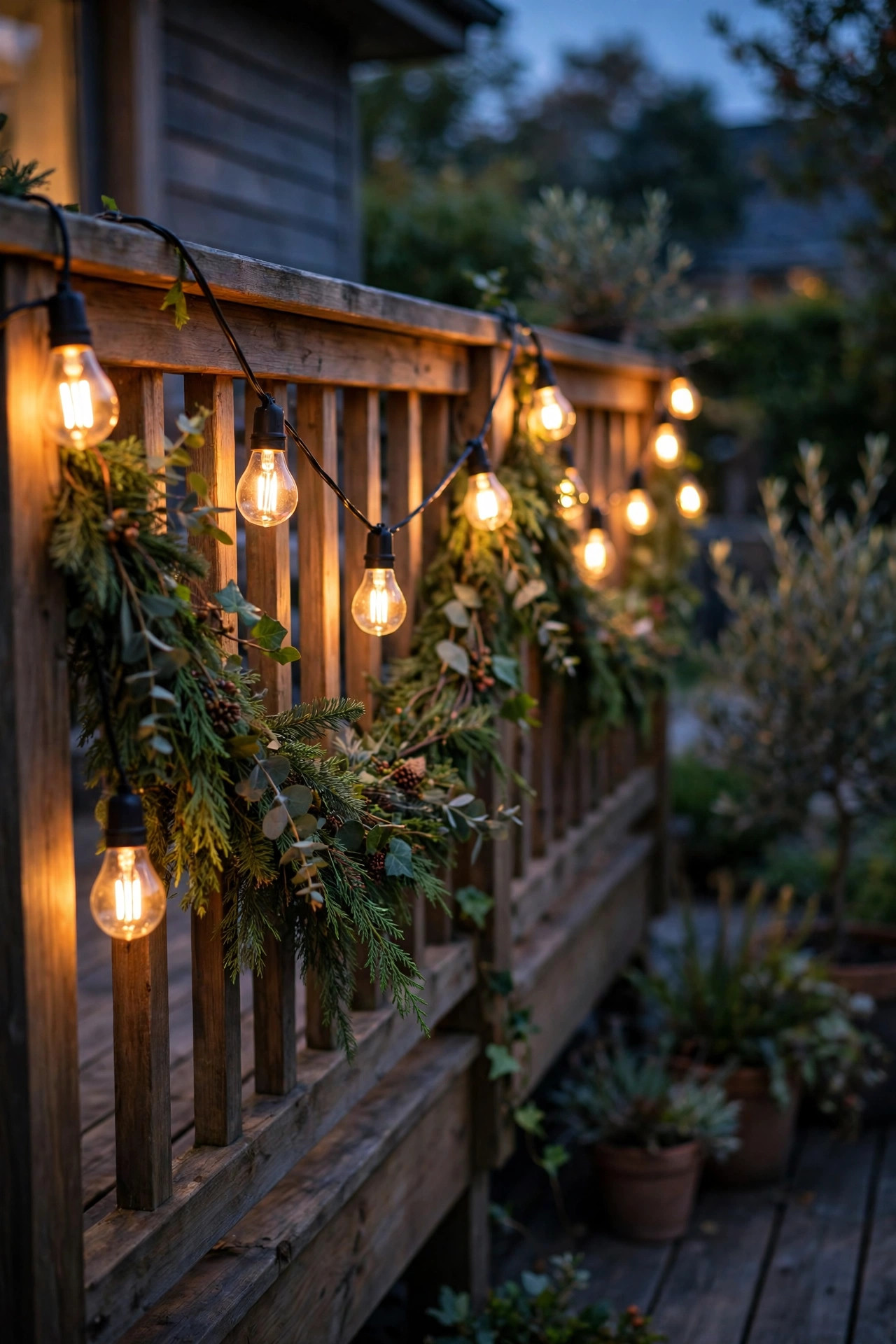
For decks, drape the strand along the top rail in shallow swags between the posts, then weave in a faux eucalyptus or ivy garland along the same line. The greenery hides the black cord completely during the day — my biggest pet peeve with string lights is a visible tangle at noon — and at night the leaves catch the light and throw lovely shadows. Attach with clear removable hooks or thin floral wire every 18 inches so the swags stay even; aim for a consistent 6- to 8-inch dip between posts. This is a renter-friendly trick too, since nothing screws into the railing. One caution: keep garland material at least a few inches from the bulbs themselves. LED filaments run cool, but dried faux greenery and any bulb shouldn't touch, full stop. In fall I swap the eucalyptus for a faux maple garland and the whole deck changes seasons for about twenty dollars.
Suggested budget range: $45 – $110.
9. A Crosshatch Grid for Parties and Weddings
When we're hosting a big gathering on the lawn, I go full crosshatch: parallel strands one direction, parallel strands across them, making a glowing grid ceiling over the whole party. It's the layout you see in every vineyard wedding photo, and it scales beautifully. You'll need four solid anchor points — house, trees, or freestanding poles set in weighted planters — and strands running every 5 to 6 feet in both directions. Because a grid multiplies your footage fast (a 20-by-20-foot area can eat 200+ feet of strand), buy commercial-grade connectable strands and map your outlet location before you hang anything; run the grid so all connections flow back to one GFCI outlet on a single heavy-duty timer. Keep the grid at 9 to 10 feet so it feels like a ceiling, not a net. Take it down after the event if your anchors are temporary — grids catch wind like a sail.
Suggested budget range: $200 – $450.

10. Mixed Bulb Shapes for an Eclectic Vintage Mix
Uniform strands look polished, but a deliberate mix looks collected — like you gathered real vintage fixtures over time. Alternate shapes along the same heavy-duty cord: teardrop ST64s, round G40 globes, and tubular T30s, all in the same 2200K LED filament family so the color stays consistent even though the silhouettes vary. This works best on a single feature run — over a porch, along a pergola beam, above a bar cart — where guests actually see the bulbs up close. Buy a socketed cord strand (the kind you screw bulbs into yourself) rather than a fixed strand, and order two spare bulbs of each shape, because finding a matching T30 in three years is nobody's idea of fun. Honestly, this is the idea that gets the most "where did you get those?" questions at our house. Keep the pattern simple — ABAB or AABBC — so it reads as intentional, not random leftovers.
Suggested budget range: $60 – $150.

11. Dimmable Edison Bulb String Lights for Mood Control
If you only upgrade one thing, make it a dimmer. Full-bright string lights are great for setting up and cleaning up, but at full power most strands are honestly too bright for the vintage mood you bought them for. An outdoor-rated plug-in dimmer drops them to a candlelight flicker for late evenings, and dimming also extends LED life and cuts the already-tiny energy bill. Two things to check: your bulbs must be labeled dimmable (most LED filament string strands are, but the cheapest ones buzz or strobe at low levels), and the dimmer itself needs a weatherproof housing or a covered outlet box. I set ours around 70 percent for dinner and 30 percent after dessert — that two-step ritual has become part of every evening outside. A smart plug paired with the dimmer gives you app and voice control plus schedules, so the lights can warm up the yard before you even step out.
Suggested budget range: $55 – $140.

12. A Renter-Friendly Balcony or Small-Patio Corner
Small spaces get the biggest payoff per bulb. On a balcony or tiny patio, run one 15-foot strand from the door frame corner out to a single string light pole or a clamp-on railing hook, then back — a simple triangle over a bistro set. No drilling: use heavy-duty adhesive hooks rated for outdoor use on smooth surfaces, or clamp hooks on the railing. A battery- or solar-powered strand with LED Edison-style bulbs removes the outlet problem entirely, though I'll be honest that plug-in strands are brighter and steadier if you have an outlet nearby. Ten to fifteen bulbs is plenty at this scale — you're lighting a conversation, not a courtyard. Choose warm 2200K and keep the strand above head height when seated, roughly 7 feet. Everything here comes down in ten minutes when you move.
Suggested budget range: $30 – $80.

13. Poolside Vintage Glow, Done Safely
String lights over a pool look like a resort photo, but this is the one layout where I'll get serious about rules. Electrical codes require overhead conductors to be well clear of the water — keep strands over the pool deck and lounge area only, never crossing the pool itself, and plug everything into a GFCI-protected outlet, no exceptions. Hung along the fence behind the loungers or swagged over the deck's seating end, edison bulbs give you that boutique-hotel shimmer with the reflections doubling the effect on the water from a safe distance. Choose fully sealed, wet-location-rated commercial strands; poolside humidity and splashes destroy bargain strands in a single season. Shatterproof bulbs matter here even more than over lawn — broken glass near bare wet feet is a nightmare scenario. Add a timer so the lights click off at a set hour; neighbors and sleeping kids will thank you, and so will your electricity bill.
Suggested budget range: $90 – $210.

14. A Permanent Porch-Ceiling Grid With a Timer
If you fall for the front porch swag in idea 5, the grown-up version is a permanent grid: three or four straight runs mounted to the porch ceiling joists with screw hooks, wired back to one outlet on an astronomical timer. Straight runs (no dips) read more architectural and tailored, and once they're up you never touch them again — the timer tracks sunset all year, so the porch simply glows every evening and switches off at your set hour. Use this on covered porches only, and staple nothing: run the cord through small screw-in hooks every 3 feet so the strand can be unclipped in minutes if a section ever fails. I always recommend leaving one accessible inline switch near the door for nights when you want darkness for stargazing or a projector. This is the highest-effort idea on the list, and also the one that makes the house look cared-for every single night with zero thought.
Suggested budget range: $120 – $280.

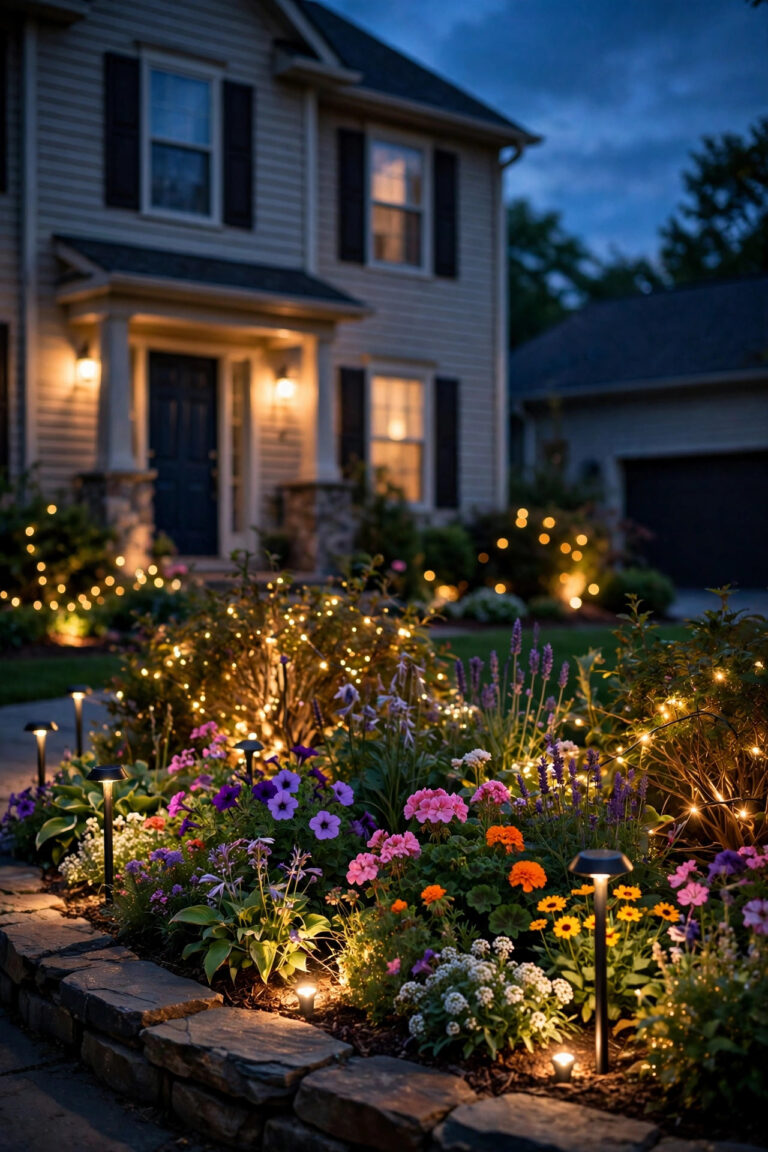
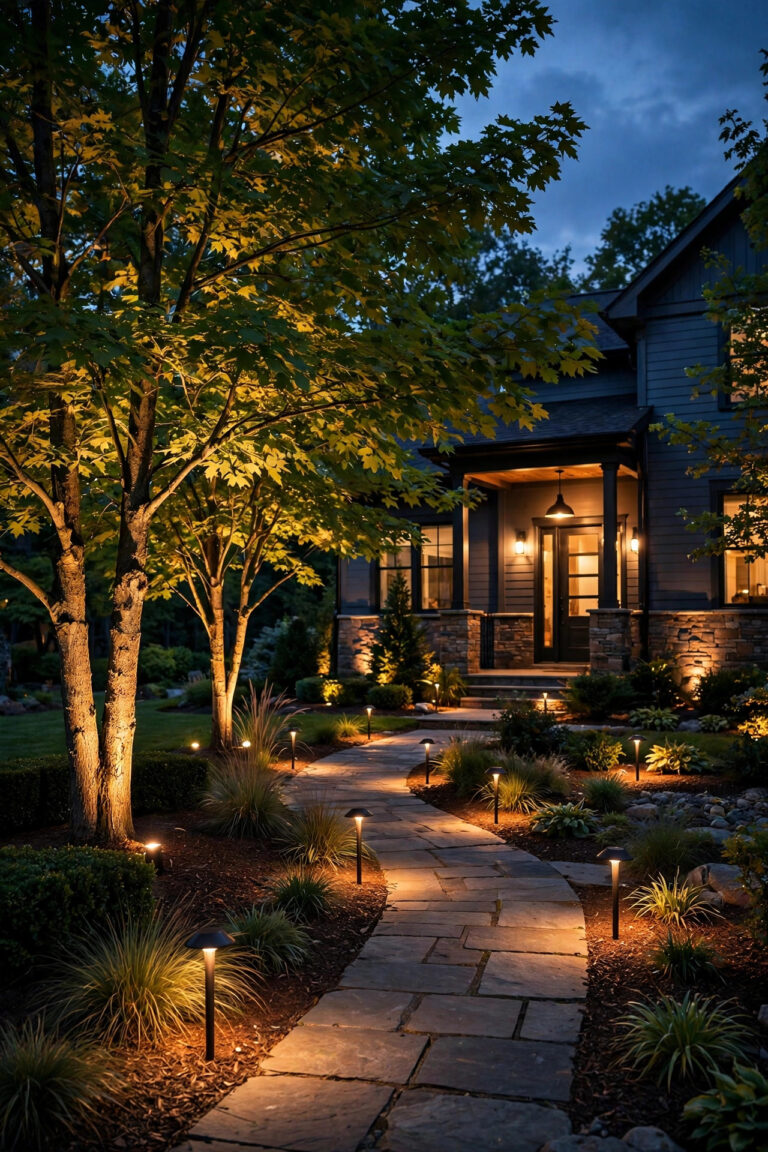
15. Layered With Lanterns and Path Lights for the Full Picture
My favorite yards never stop at one light type. Use edison strands as the overhead layer, then add a middle layer — lanterns on side tables, a candle lantern on the steps — and a ground layer of path lights or solar stakes leading in. The strands give you the vintage ceiling, the lanterns put warm light at face level where people actually sit, and the path lights keep guests from tripping on the garden edge. Match color temperature across all three layers (2200K to 2700K) or the yard looks like three different houses stitched together. Start with the strands, live with them a week, then add layers where you notice dark pockets — that's exactly how our yard evolved, one honest gap at a time. This layering approach is the whole philosophy behind my backyard lighting ideas for evening entertaining, if you want to plan the full scene at once.
Suggested budget range: $150 – $400.

Frequently Asked Questions
Are edison bulb string lights bright enough to eat dinner by?
Yes, if you plan for it. A strand with bulbs every 2 feet hung 8 to 9 feet over a table gives roughly the light of a dim dining room — perfect for eating and conversation. For task moments like grilling or reading labels, add a brighter layer nearby or choose strands with bulbs spaced 12 to 18 inches apart, and keep a dimmer in line so you can raise and lower the mood.
Can edison bulb string lights stay up all year?
Commercial-grade strands with sealed sockets and a wet-location (IP65 or better) rating can, and mine do. Bargain decorative strands usually can't — their sockets let in moisture and the cords crack in UV. Even with good strands, inspect the cord each spring, replace any cracked bulbs, and consider taking strands down ahead of ice storms or hurricanes in your area.
How long do LED edison bulbs last compared to real incandescent ones?
LED filament bulbs typically last 15,000 to 25,000 hours and use about 1 watt each, while true incandescent edison bulbs last around 1,000 to 2,000 hours, use 25 to 40 watts each, and get genuinely hot. On a 25-bulb strand run 5 hours a night, that's the difference between replacing bulbs in a decade versus replacing several every single season.
How do I keep string light strands from sagging too much?
Support is everything: use a stainless guide wire for any span over about 15 feet, hang the strand from the wire with clips or zip ties, and anchor into structure (fascia, posts, trees with straps), never into gutters or siding alone. A dip of roughly 1 inch per foot of span looks gracefully vintage; much more than that usually means your anchors or wire need attention.
Conclusion
Edison bulb string lights earn their vintage charm honestly — warm filaments, a soft dip in the line, and light that flatters everyone under it. Start with one swag over the space you use most, live under it for a few evenings, and then layer from there. Browse the rest of my outdoor lighting ideas here on the site for the path lights, lanterns, and porch fixtures that complete the picture.