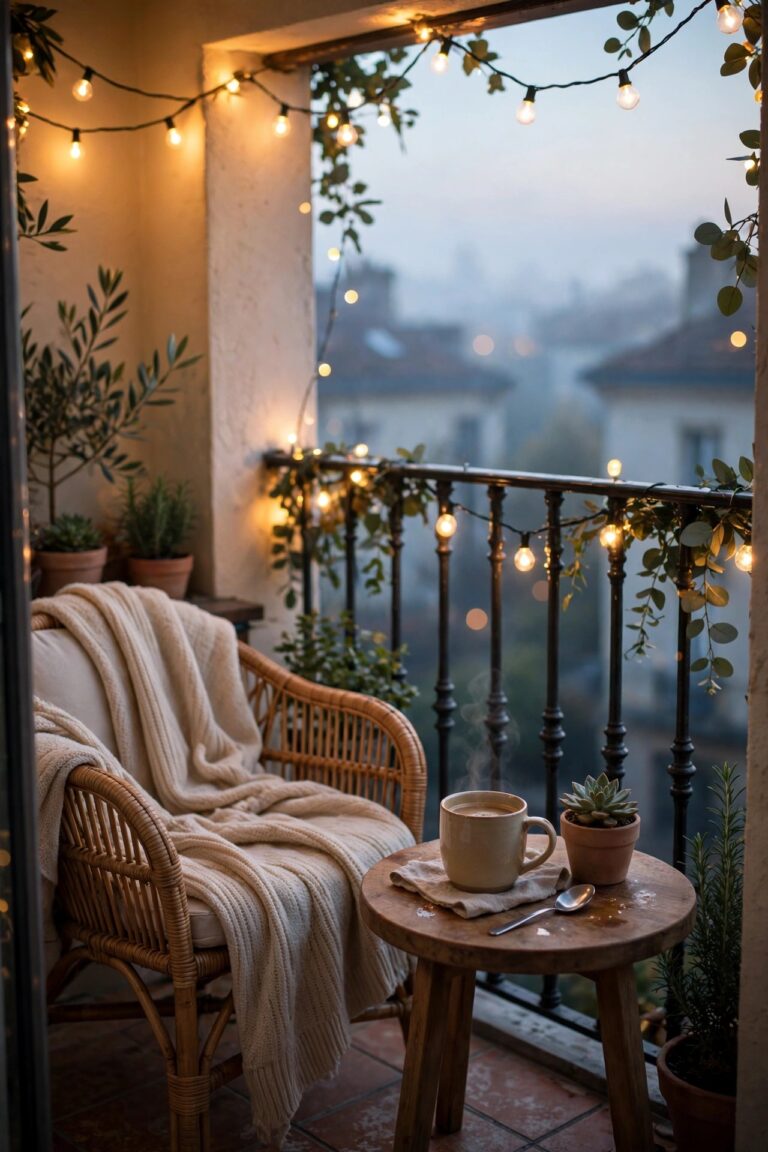
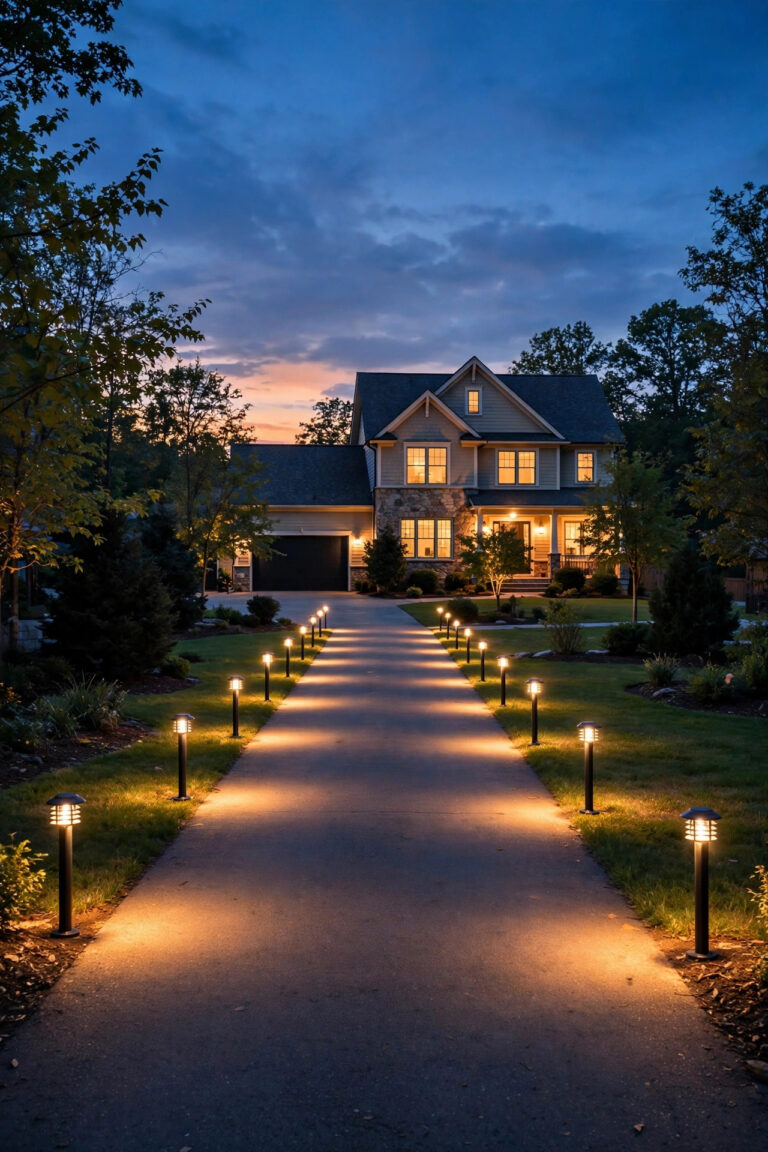
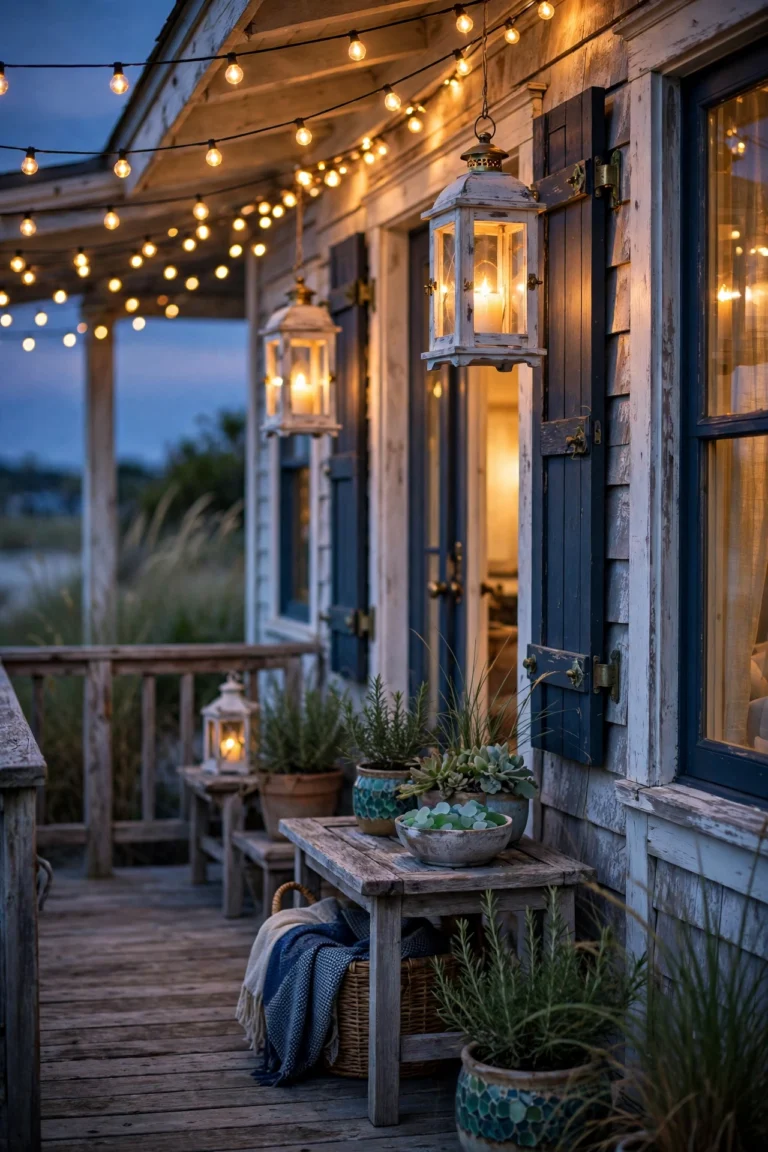
Every yard I have ever loved has the same problem spots: the side gate at the end of a long dark run of fence, the shed in the back corner, the big tree forty feet from the nearest wall. The electrician never ran wire to any of them, and honestly? Trenching cable across a finished garden costs more than the lights ever would. That is exactly why battery powered outdoor lighting ideas have become the backbone of my no-outlet map. Modern LED fixtures sip power, motion sensors stretch a set of batteries for months, and rechargeable cells have quietly erased the old buy-batteries-forever problem. My layering philosophy still applies out there: guidance light low along paths and steps, a welcoming glow at doors and seating, and a little accent sparkle up in the trees. Battery fixtures can now do all three layers without one inch of new wiring. Below are the 19 setups I actually use and recommend, with honest runtimes, the cold-weather truth, and the spots where each one earns its keep.
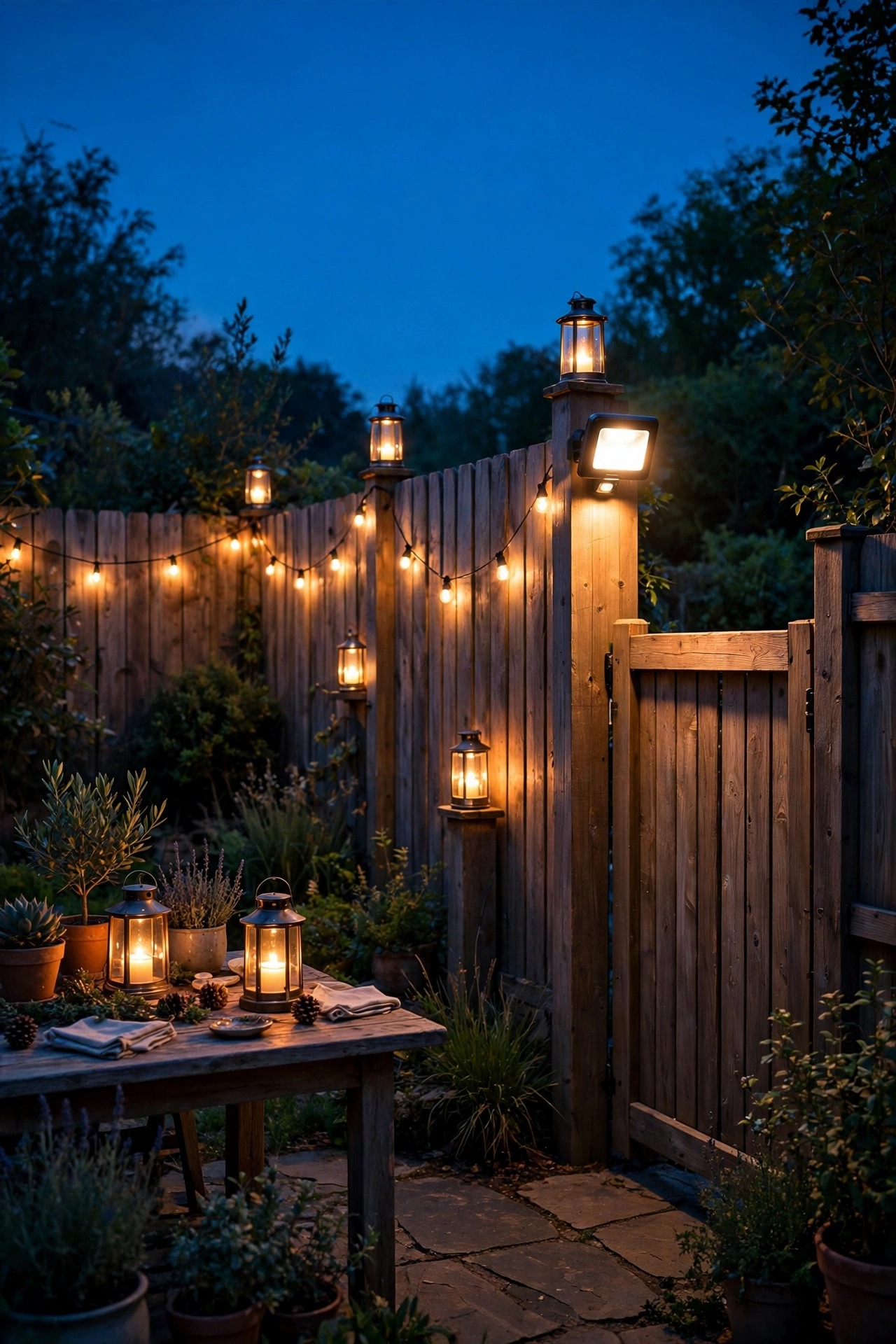
1. Battery Powered Outdoor Lighting Ideas Start With a Motion Floodlight at the Gate
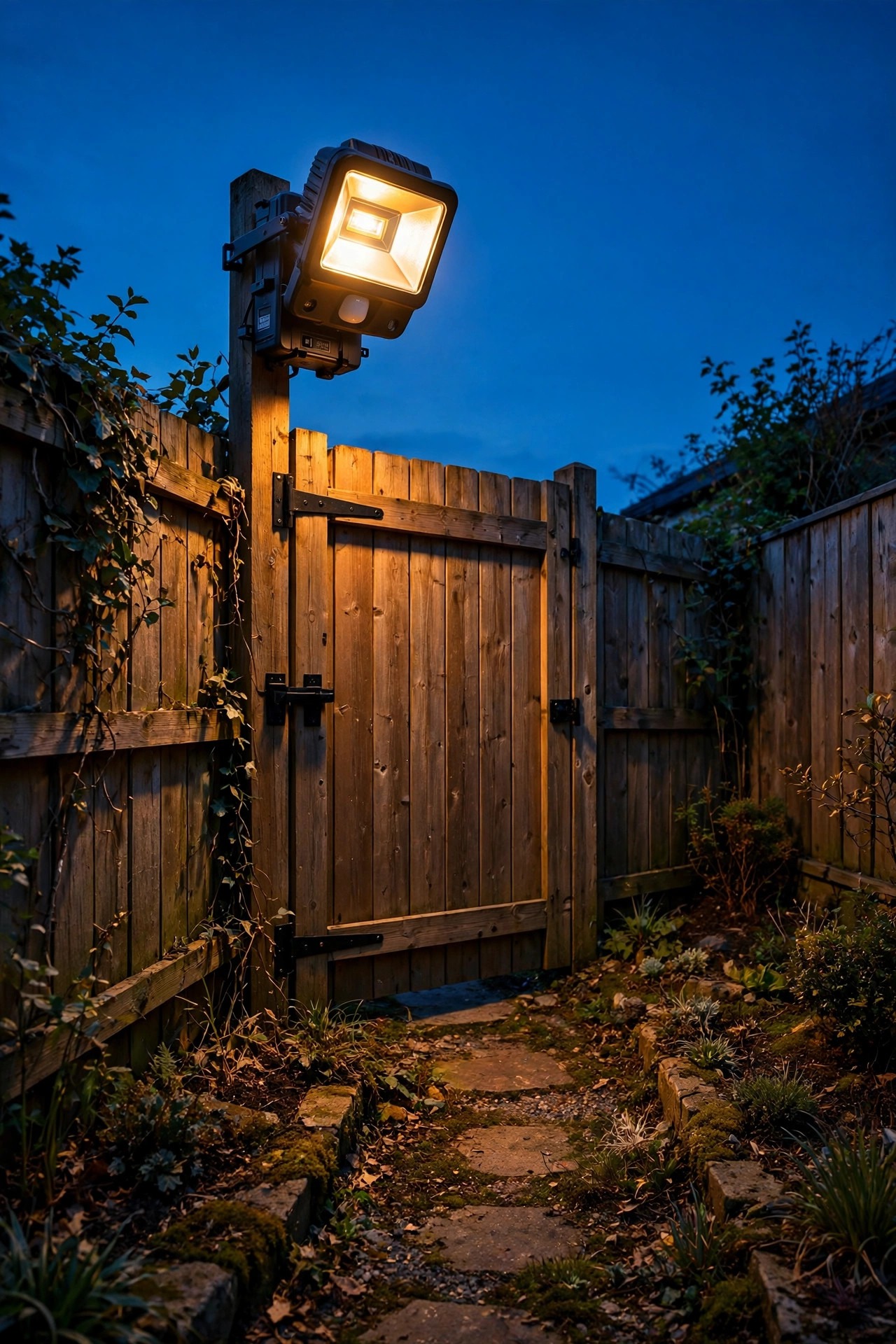
If you only buy one battery fixture, make it a motion-sensor floodlight for the darkest pinch point in your yard — for most of us that is the side gate or the garage side door. Mine lights the whole gate run, the trash bins, and the first ten feet of path, and it does it on a set of rechargeable cells that lasts four to six months. The math is why: a motion light that fires twenty times a night for thirty seconds each burns about ten minutes of light per day, while the same fixture left on dusk to dawn burns ten hours. Motion activation is the single biggest battery saver there is. Look for a wide detection angle, an adjustable head you can aim down the path instead of at the neighbors, and a weather rating of at least IP65. Mount it eight to ten feet up so the sensor sees a broad arc and the light pools where feet land. I keep a charged spare set in the kitchen drawer so a swap takes one minute on a step stool. For placement and tuning help, my motion sensor outdoor lights guide walks through range and sensitivity settings in detail.
Suggested budget range: $25 – $60.
2. A Battery Sconce Beside a Front Door With No Junction Box
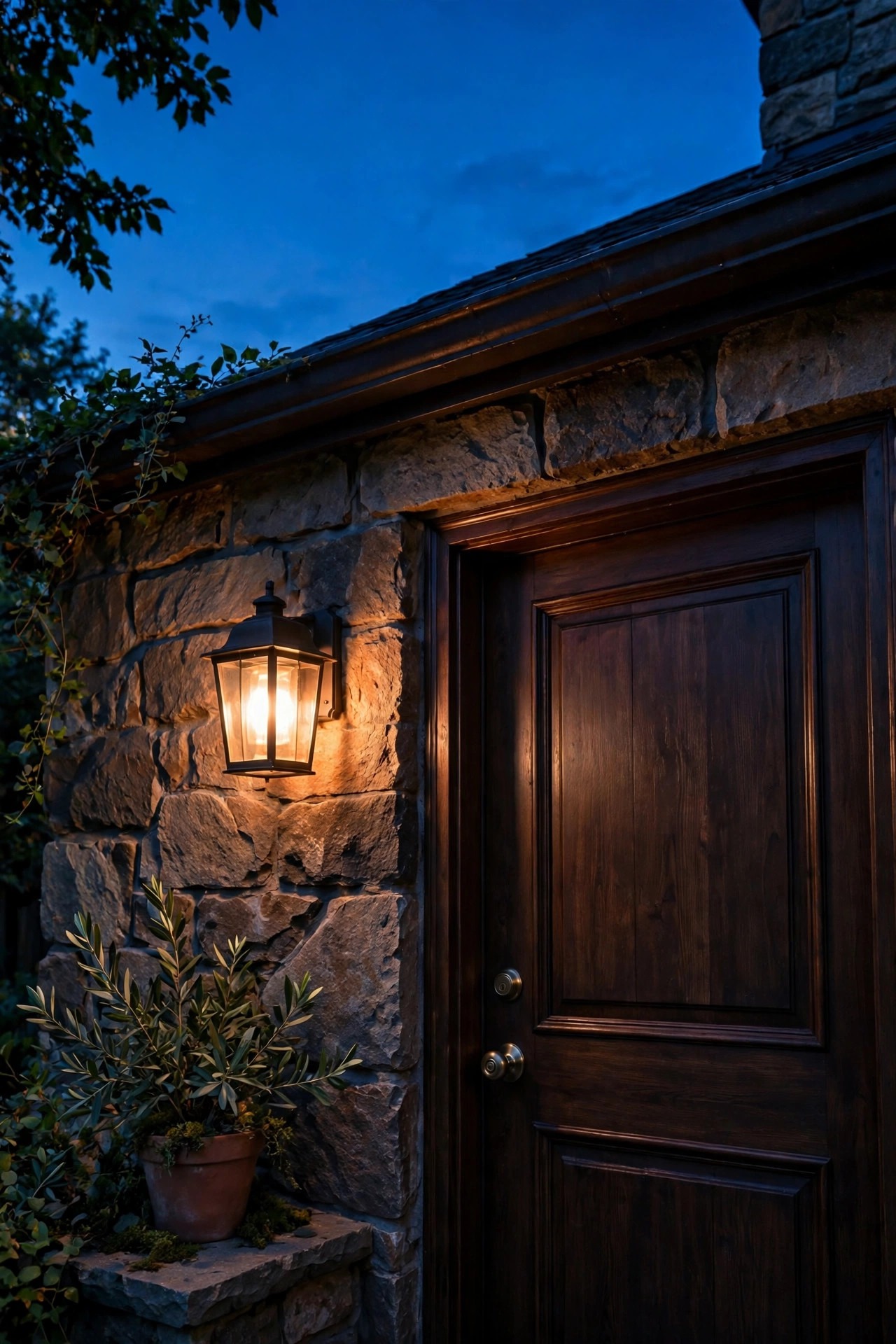
Plenty of older homes — and almost every rental — have a front door with no wired fixture beside it at all, just bare siding and a dark welcome. A battery-powered sconce fixes that in ten minutes with two screws, no junction box, no electrician, no landlord phone call. The good ones are full-size lantern shapes with a frosted panel and a warm LED behind it, so from the street they read exactly like a wired fixture. Most run on a dusk-to-dawn sensor or a simple remote, and a set of rechargeable batteries gives you roughly two to three months of evenings before a swap. My honest tip: choose one with a motion boost if your step is uneven, so it idles at a soft glow and brightens when someone actually arrives with groceries. Renters, this is the same trick I lean on in my renter friendly outdoor lighting roundup, because it leaves nothing behind but two small screw holes you can fill in a minute at move-out. Keep the finish matched to your door hardware and nobody will ever guess it runs on batteries.
Suggested budget range: $30 – $70.
3. Copper-Wire Fairy Lights for the Far Fence Line
The back fence is the classic dead zone: too far for an extension cord to look decent, too shaded for solar to charge honestly. A long strand of battery copper-wire fairy lights solves it with pure atmosphere. The wire is nearly invisible in daylight, the tiny warm LEDs read as fireflies after dark, and the battery pack tucks into a weatherproof box at the fence post. I weave mine through the top rail and let a few loose loops dip into the climbing roses. Runtime honesty matters here: a 33-foot strand on a timer setting — six hours on, eighteen off — runs about three to four weeks per set of batteries, and the timer is non-negotiable, because forgetting them on all night cuts that to days. Choose warm white, never the blue-white that makes a garden look like an aquarium. Because the strand is low voltage and feather-light, you can staple it gently along a trellis, wrap a small tree, or outline the roofline of a playhouse. When a section of my fence comes down for repair, the whole strand rolls up into a coffee can. Try that with wired lighting.
Suggested budget range: $10 – $25.

4. Remote-Control String Lights Under the Pergola Beam
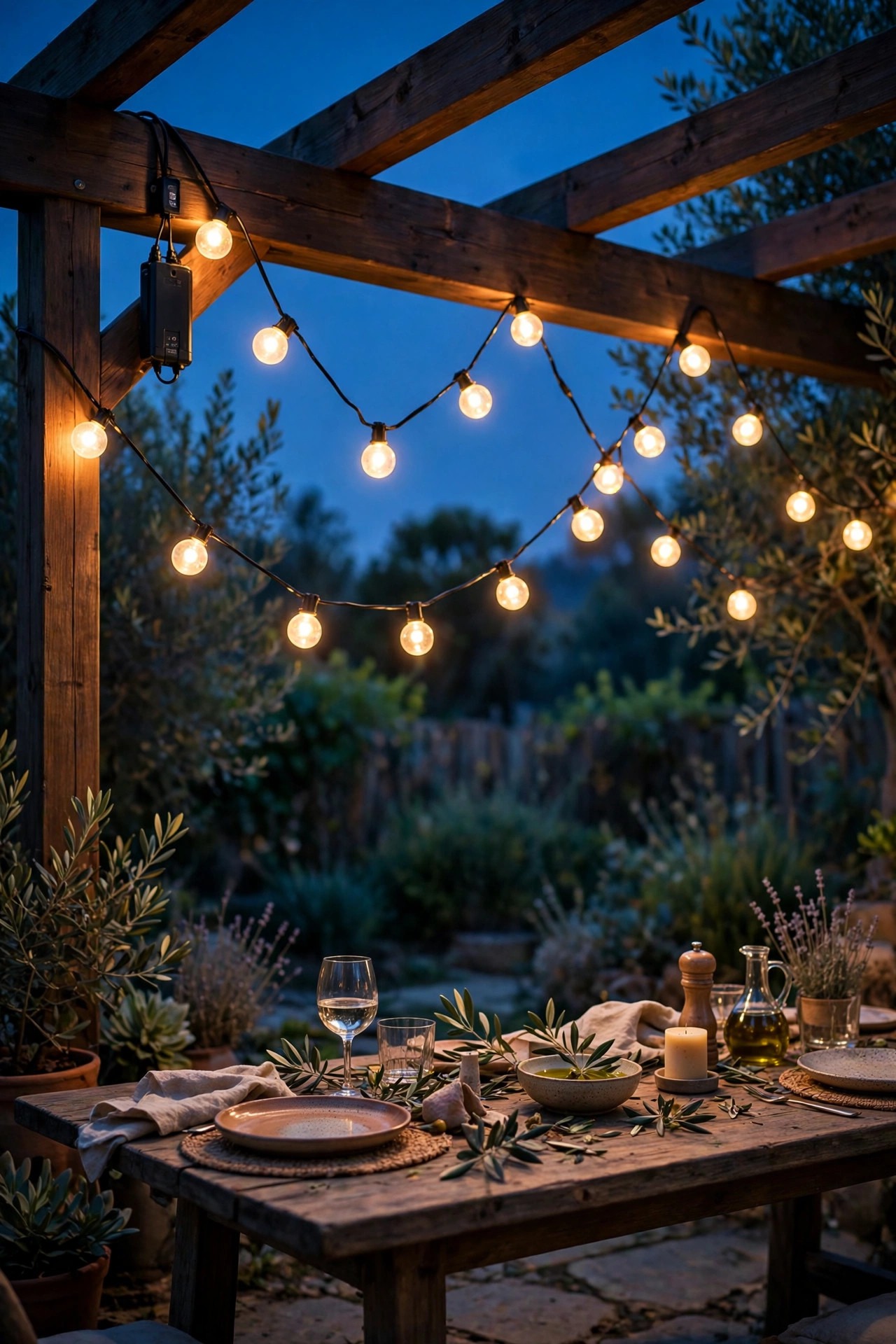
Overhead light is what turns a pergola or patio umbrella from furniture into a room, and the far corner of the deck is rarely where the outlet landed. Battery string lights with a remote have gotten genuinely good: shatterproof globe or Edison-style bulbs, a dimmer on the remote, and enough length to zigzag a 10-by-12 pergola in three passes. I screw small cup hooks into the beam every two feet so the swags hang even, and I keep the battery pack in a zippered weather pouch hung at the corner post where I can reach it without a ladder. Expect eight to twelve evenings of dinner-length use per charge on the rechargeable models — these are evening lights, not all-night lights, and that is fine, because nobody needs the pergola glowing at 3 a.m. The remote matters more than you think: dimming to half power roughly doubles your nights between charges and looks better in photos anyway. Store the strand wound on a piece of cardboard in winter if your pergola sits under snow load; the bulbs are tough, but ice creeping into the battery door is the one failure I have actually had.
Suggested budget range: $25 – $50.
5. Stick-On Puck Lights Under Rails, Treads and Eaves
Puck lights are the duct tape of the battery world — small, flat, adhesive-backed discs that stick under almost anything and throw a neat pool of light straight down. I have them under the porch handrail where it meets the steps, under the eave above the grill, and under the lip of the potting bench. Anywhere your hands work after dark or your feet change level, a puck earns its place. The motion-activated versions are the ones to buy for steps and paths: they wake as you approach and sleep twenty seconds later, which is how a three-battery puck survives a whole season. For the grill and potting bench, tap-on versions work fine since you are standing right there. Stick them to clean, dry surfaces and press for a full thirty seconds — the one time mine fell, I had rushed that step on a dusty rail. In cold snaps the adhesive stiffens, so I add a tiny stainless screw through the mounting tab on the two that live outdoors year-round. Swap in rechargeable cells and these cost almost nothing to run.
Suggested budget range: $12 – $30.
6. Peel-and-Stick Step Lights for Deck Stairs
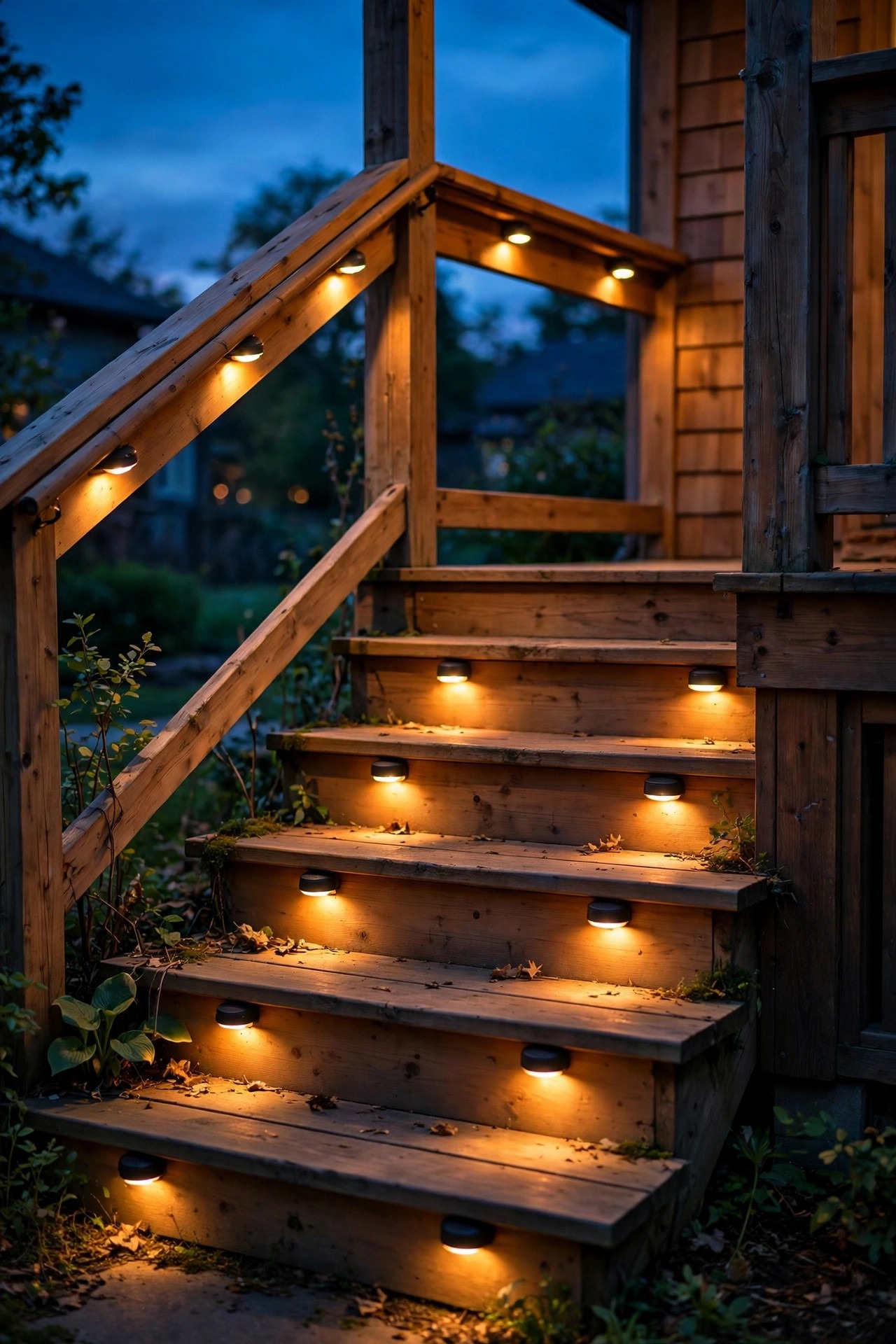
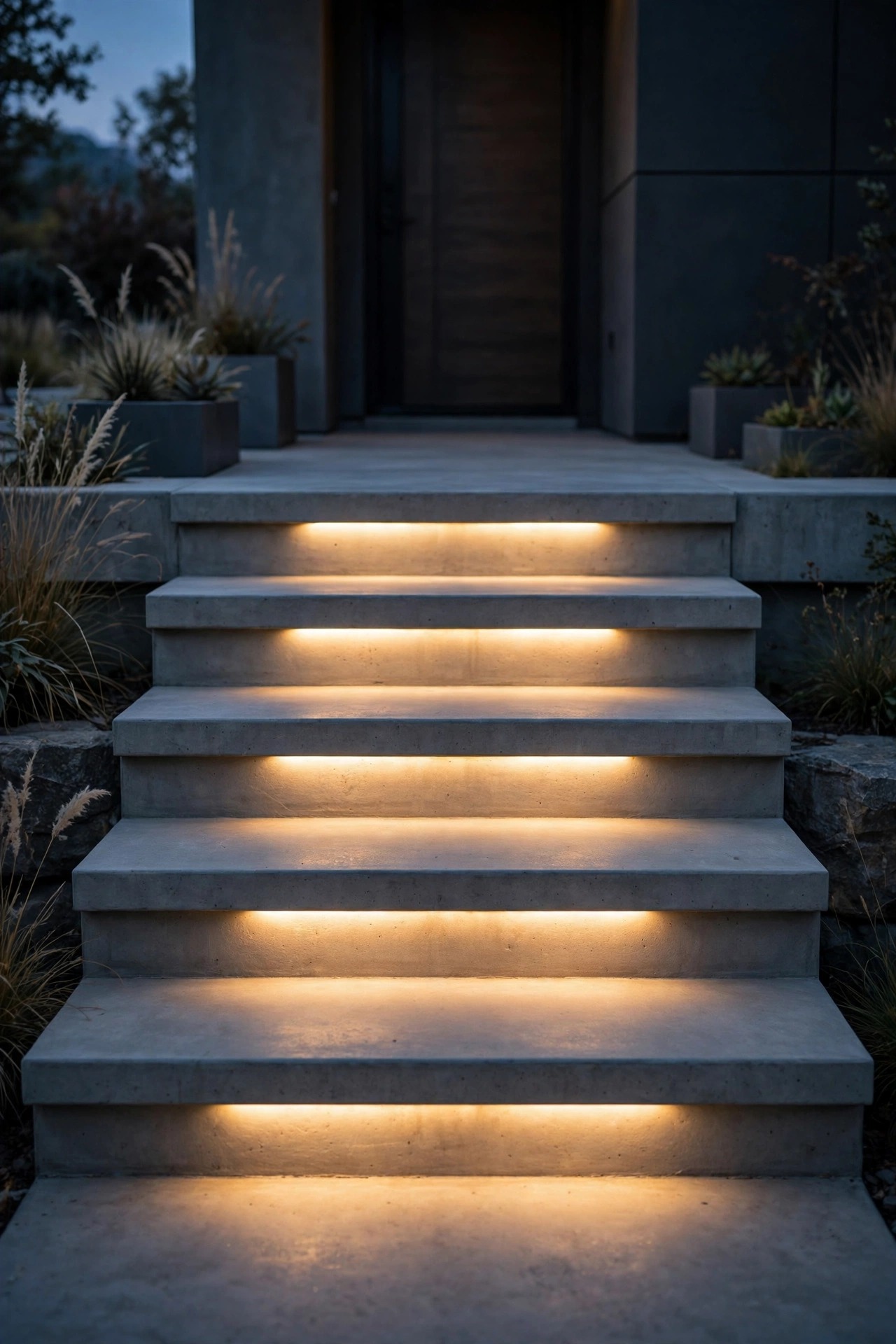
Deck stairs are where guests trip, and they are almost never where the wired step lights got installed. Low-profile battery step lights solve it with a peel-and-stick back or two small screws, one per tread or one per side of the stringer. I run mine down the outer edge of each tread so the light washes across the step surface and shows the edge line clearly — that contrast line is what your eye actually needs at night. Motion versions wake tread by tread as you climb, which looks quietly magical and sips power. Space them on every step for a main stair, every other step for a wide, gentle one. Two honest notes: first, clean the mounting spot with rubbing alcohol or the adhesive lets go by July; second, in freezing weather expect roughly two-thirds of the summer runtime, because cold batteries sag — a January swap schedule is normal, not a defect. Warm 2700K light keeps the deck feeling cozy instead of clinical, and because each light is independent, one failure never darkens the whole stair.
Suggested budget range: $15 – $40.
7. Stake Spotlights That Uplight Trees From the Ground
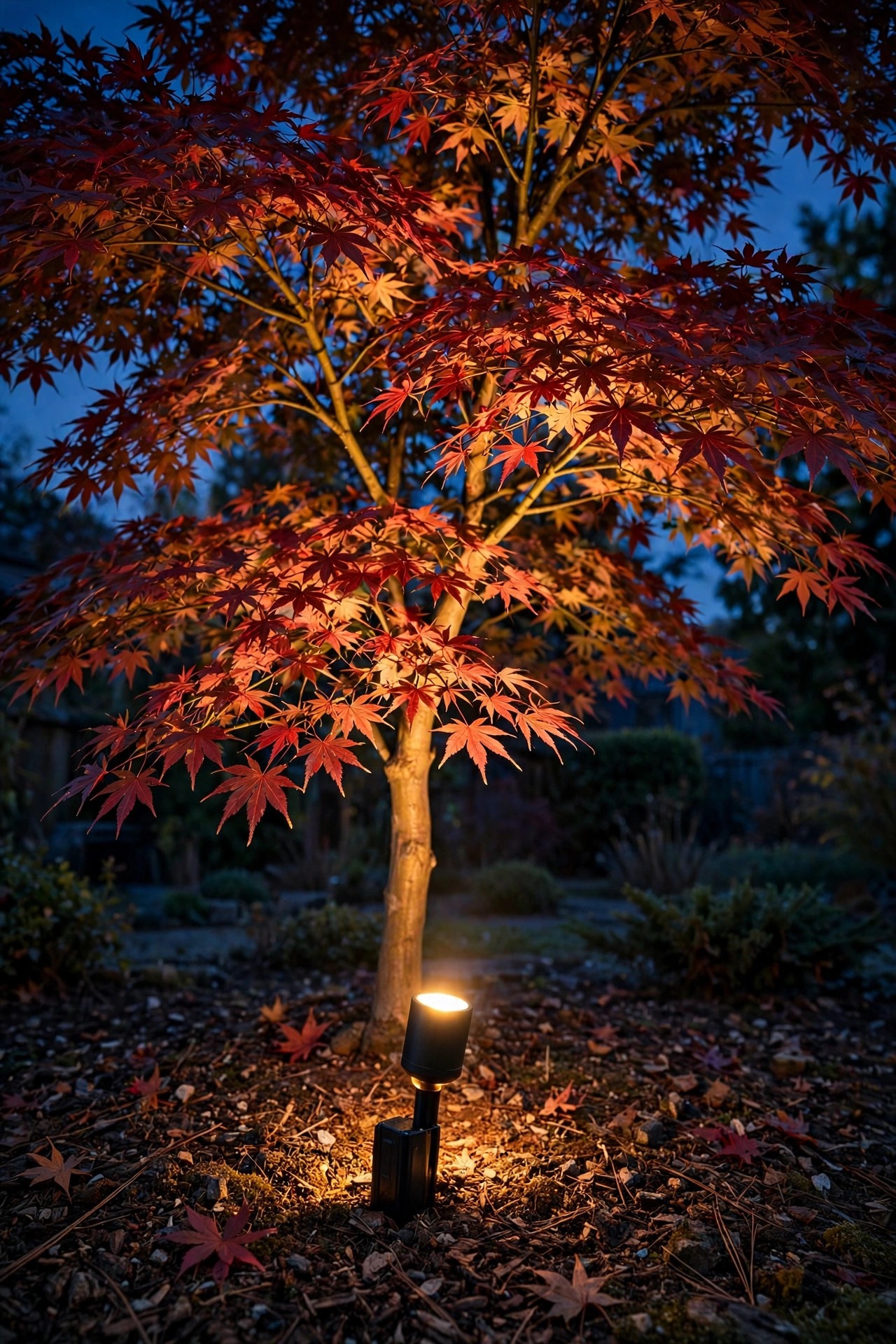
Every lighting designer will tell you the cheapest drama in a yard is one uplight under a good tree. The catch is usually the wire run across the lawn. A battery stake spotlight skips it: push the stake into the mulch bed, angle the head up into the canopy, done. Mine lights a Japanese maple from six feet out, angled slightly off center so the trunk shadow plays across the leaves. These are hungry fixtures by battery standards — a bright spot on all night will eat a charge in a week or two — so run them on the timer or remote for the evening hours only, or choose a motion-plus-dusk model for trees near the drive. Two lights crossed at 45 degrees give you the magazine look on a wide canopy; one is plenty for a small ornamental. Keep the lens wiped monthly, because mulch splash dims them fast, and pull the stakes before the first hard freeze if your winters are severe, since a frozen ground heave can crack the housing. The effect, honestly, fools everyone into thinking you hired a lighting crew.
Suggested budget range: $20 – $45.
8. Battery Path Stakes for the Shady Walkway Where Solar Starves
I love solar path lights, and I say this as someone with dozens of them: under a dense tree canopy or on the north side of the house, solar simply starves. The panels get an hour of dappled light, the lights glow bravely until 9 p.m., and the path goes dark exactly when you walk the dog. Battery path stakes are the honest fix for the shady walk — no panel, just a stake light with a real battery that does not care about your tree cover. Because they are not rationing a weak charge, they hold a steadier brightness all night. Space them six to eight feet apart on alternating sides so the pools of light overlap slightly and your eye reads a route instead of a dotted puzzle. Dusk-to-dawn photocell models are convenient here; on rechargeable cells expect a swap every six to ten weeks depending on night length. My full no wiring outdoor lighting ideas post compares these against solar and low-voltage for exactly this kind of problem path. In deep shade, batteries win, and it is not close.
Suggested budget range: $20 – $50.

9. Portable Lanterns — the Battery Powered Outdoor Lighting Ideas I Move Around Most
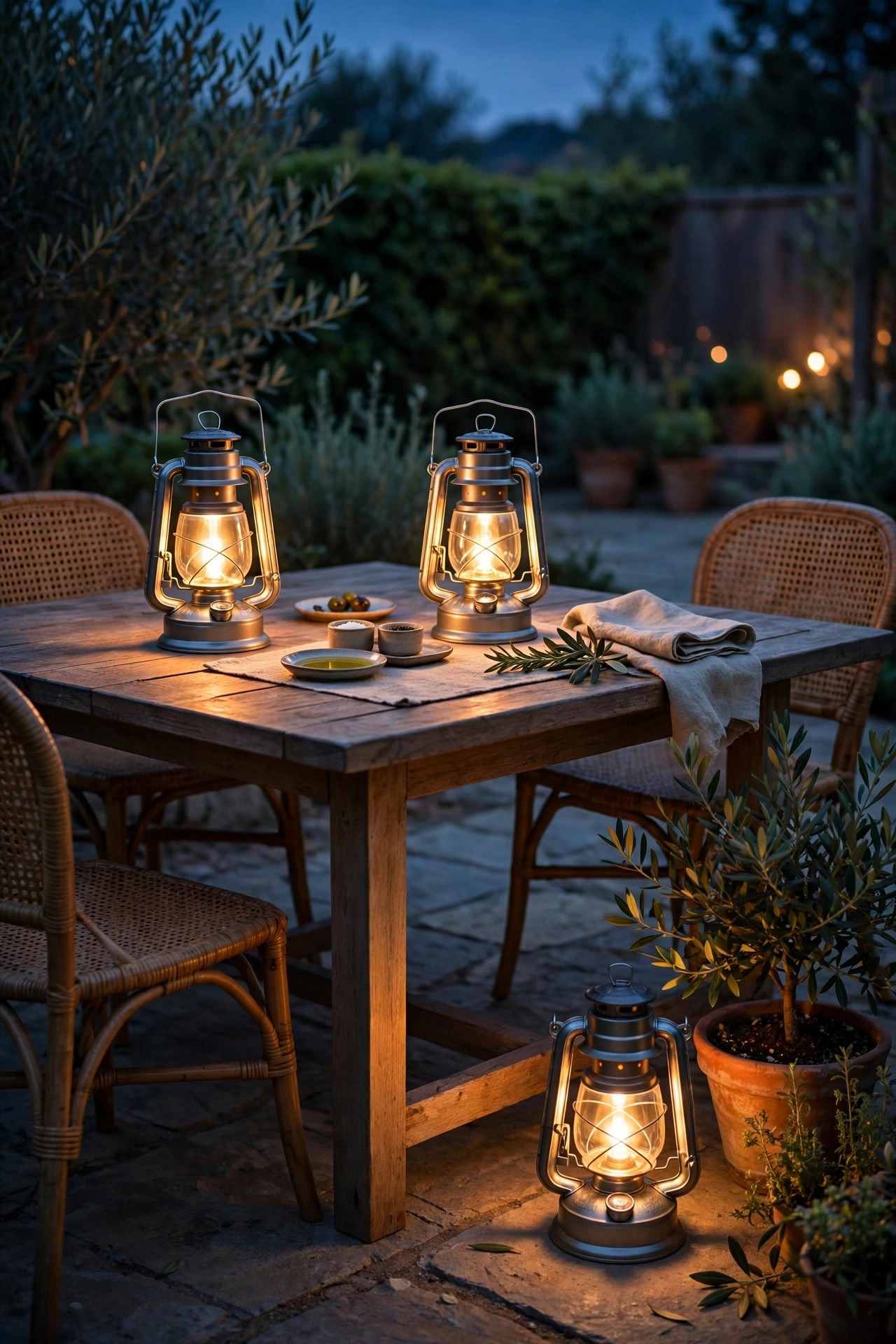
Ask me which battery lights get used every single week and it is not the fixtures — it is the three portable lanterns that live on my potting bench. Dinner on the patio? Two lanterns. Power flicker during a storm? Lantern by the door. A late game of cards on the screen porch, a walk down to the fire pit, a grandkid fort under the picnic table — the lanterns go where the evening goes. That mobility is something no wired or staked light can copy. Buy lanterns with a dimmer dial, a warm color setting, and a USB charging port so they top up from the same cable as your phone. A good one runs eight hours bright or forty dim, and dim is honestly the setting you will live on, since lantern light is about glow, not glare. Hang one from a shepherd hook at the seating area and set the others at ground level for a layered look. Metal and rattan styles both travel well; glass chimneys look prettiest but stay home on windy nights. Keep all three on one charging shelf and they are always ready.
Suggested budget range: $20 – $55.
10. Flameless Candles in Hurricane Lanterns on Shepherd Hooks
There is a special kind of pretty that only candlelight does, and a special kind of worry that real candles do near dry mulch, wooden decks, and curious grandkids. Battery flameless candles inside hurricane lanterns give you the flicker with none of the fire watch. I hang three along the garden path on shepherd hooks and drop two more into the big lanterns flanking the porch steps. The better candles have a real wax body, a moving flame tip, and a timer that turns them on at the same time every evening — set them once in June and they perform nightly until the batteries fade around September. That timer discipline is the trick; flickering candles on a five-hour timer outlast always-on ones by weeks. Cluster sizes for effect: a tall 6-inch candle in the big lantern, a short one in the small. On windy nights nothing blows out, on dry August nights nothing worries the fire marshal in me, and the amber flicker against dark green foliage is honestly the prettiest light in my whole yard.
Suggested budget range: $15 – $40.

11. A Light Bar Inside the Shed and Storage Bench
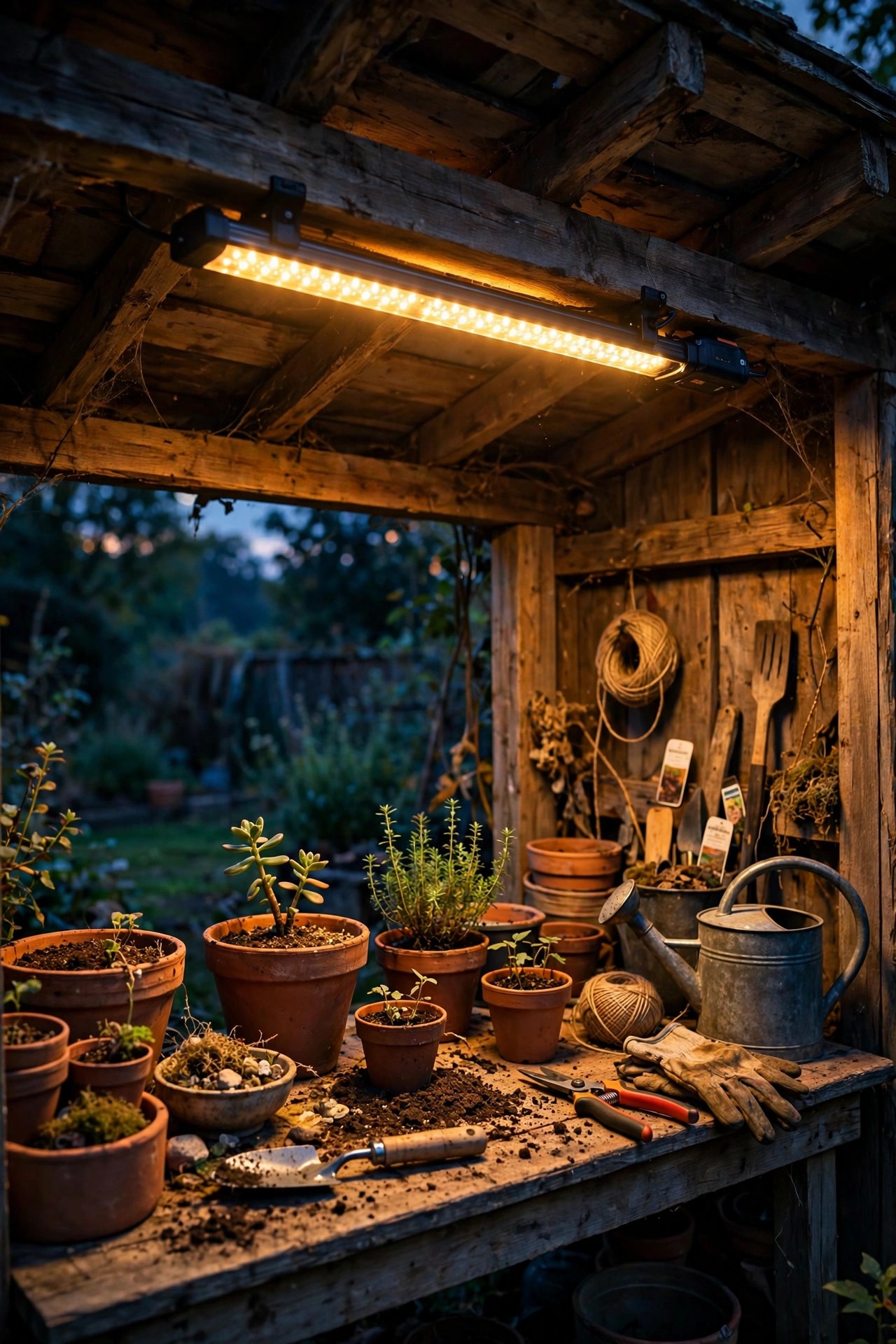
The inside of a garden shed at dusk is a spiderweb of rake handles waiting to find your forehead. A battery light bar screwed under the shed roof ridge — or under the lid of a deck storage bench — turns the grab-and-go rummage into a ten-second errand. These long, slim fixtures throw a wide, even wash that is perfect for finding the right pot, the trowel, or the dog towels in the bench. Motion versions are ideal here because shed visits are short and your hands are usually full; the light wakes when the door opens and sleeps after you leave. If your bar is the tap-on kind, mount it where your knuckles naturally land reaching in. Rechargeable bars with a magnetic mount are my favorites now: pop it off, charge it at the kitchen counter twice a summer, pop it back. While you are in there, stick a second small bar above the potting soil bins. Total project time is fifteen minutes, and it is the upgrade every single visitor to my shed comments on, usually while holding a rake they actually found.
Suggested budget range: $15 – $35.
12. Battery LED Strips Under the Deck Handrail
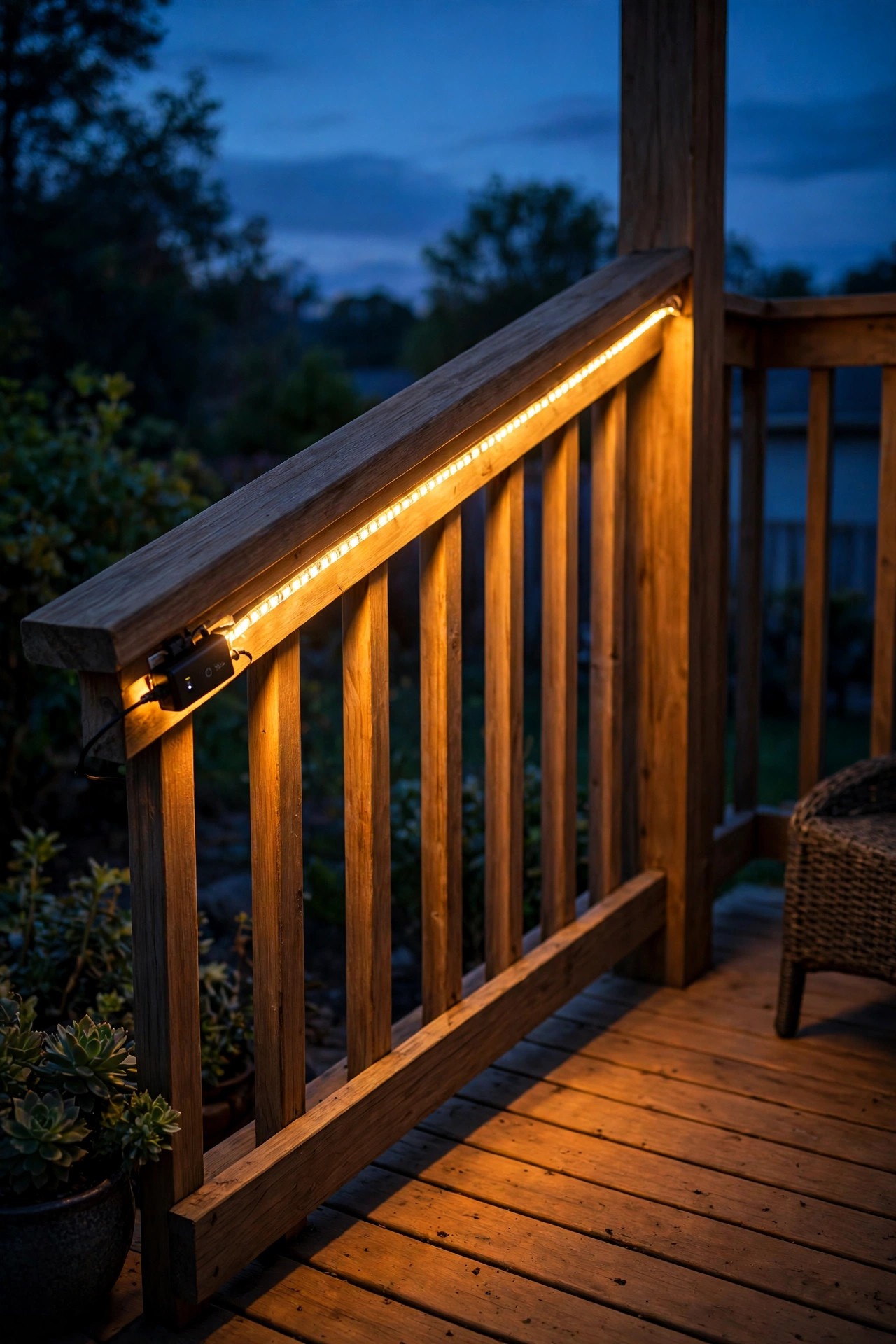
Under-rail lighting is the most expensive-looking trick in deck design, and the battery version costs less than a pizza night. A waterproof battery LED strip tucks into the underside channel of the handrail and throws a continuous ribbon of light down the balusters and across the deck boards — no hot spots, no visible fixtures, just glow. It reads as architecture, and it doubles as real safety light for the deck edge and the top step. Run the strip the full length of the rail and hide the battery pack inside a small weatherproof box mounted under the deck rim where you can reach it from the steps. On the remote, use the timer: three hours after dusk covers every dinner party I have ever hosted. Expect a charge or battery set to last about three to five weeks at that pace. In my experience the adhesive backing alone will not survive a humid summer, so add the little mounting clips every eighteen inches — ten extra minutes that save you the sagging-strip heartbreak in August. Warm white only, and keep it dim; the ribbon should whisper, not shout.
Suggested budget range: $18 – $40.
13. A Motion Light at the Mailbox and Driveway End
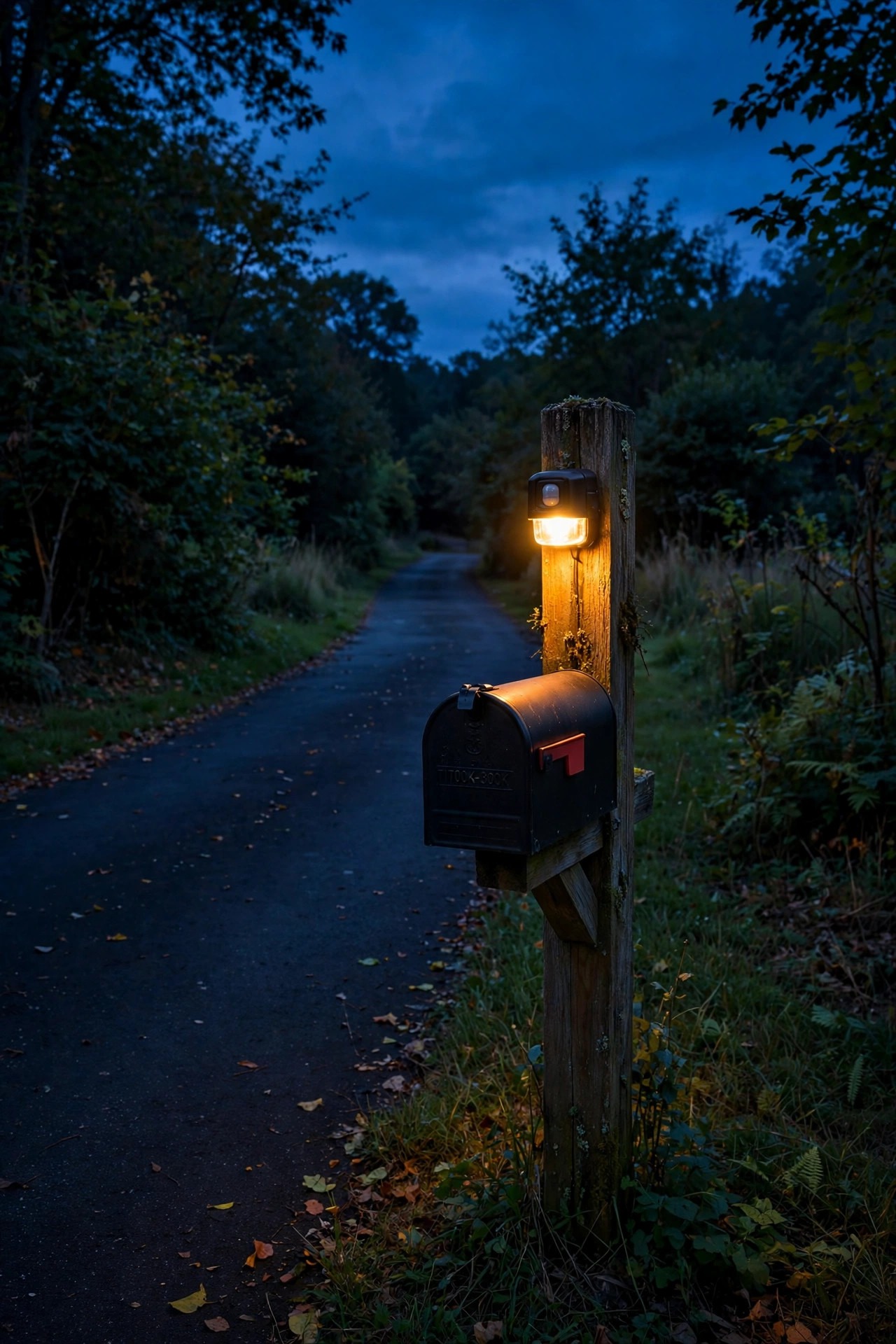
The end of the driveway is the far edge of the no-outlet map — the mailbox, the paper tube, the spot where you sort the mail by dome light in December. A small battery motion light mounted on the mailbox post or the fence post beside it changes that whole routine. It wakes as you pull in or walk up, gives you honest light to read envelopes and find the keyhole, and sleeps before the neighbors even notice. Because trips to the mailbox are short and predictable, a set of batteries here can last most of a year — this might be the lowest-maintenance light on the whole list. Aim it down at the box door and the gravel, never out at the street where it would flash drivers. If your mailbox sits on a shared post row, keep the sensor range dialed short so you light your box, not the whole row. Winter honesty: snow piling on the sensor lens blinds it, so give it a brush-off when you shovel. Small light, enormous quality-of-life upgrade on dark January evenings.
Suggested budget range: $15 – $35.
14. Post-Cap Lights for Shaded Deck and Fence Posts
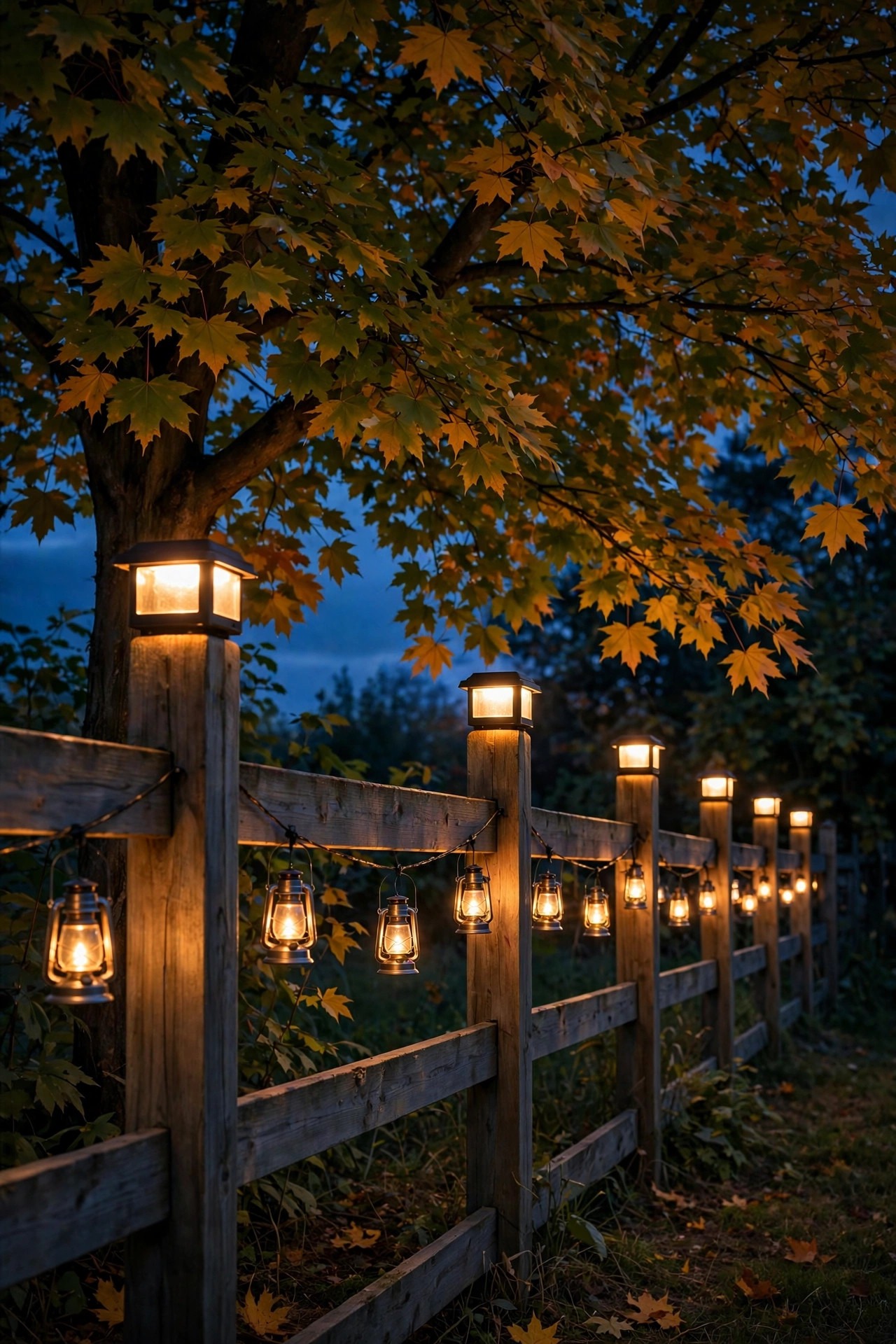
Solar post caps are everywhere, and on a sunny fence line they are lovely. But the posts under the maple, along the north fence, or beneath the deck pergola get the same starvation problem as shady path lights — a brave glow that dies by nine. Battery post-cap lights look identical from the street: a clean cap with a warm window on each face, sized for standard 4-by-4 and 6-by-6 posts. The difference is inside, where a real battery delivers the same brightness at midnight as at dusk. I run mine on the fence run behind the shade garden, and the effect is a dotted line of warm lanterns floating at rail height that ties the whole back boundary together. On dusk-to-dawn settings with rechargeable cells, plan a swap every month or so in summer, closer to three weeks in the long nights of December — cold plus long nights is the toughest combo batteries face. Buy caps with a replaceable battery door on top so the swap does not mean removing the whole cap in the dark with cold fingers.
Suggested budget range: $25 – $60.
15. A Rechargeable Floodlight for the Fire Pit Corner
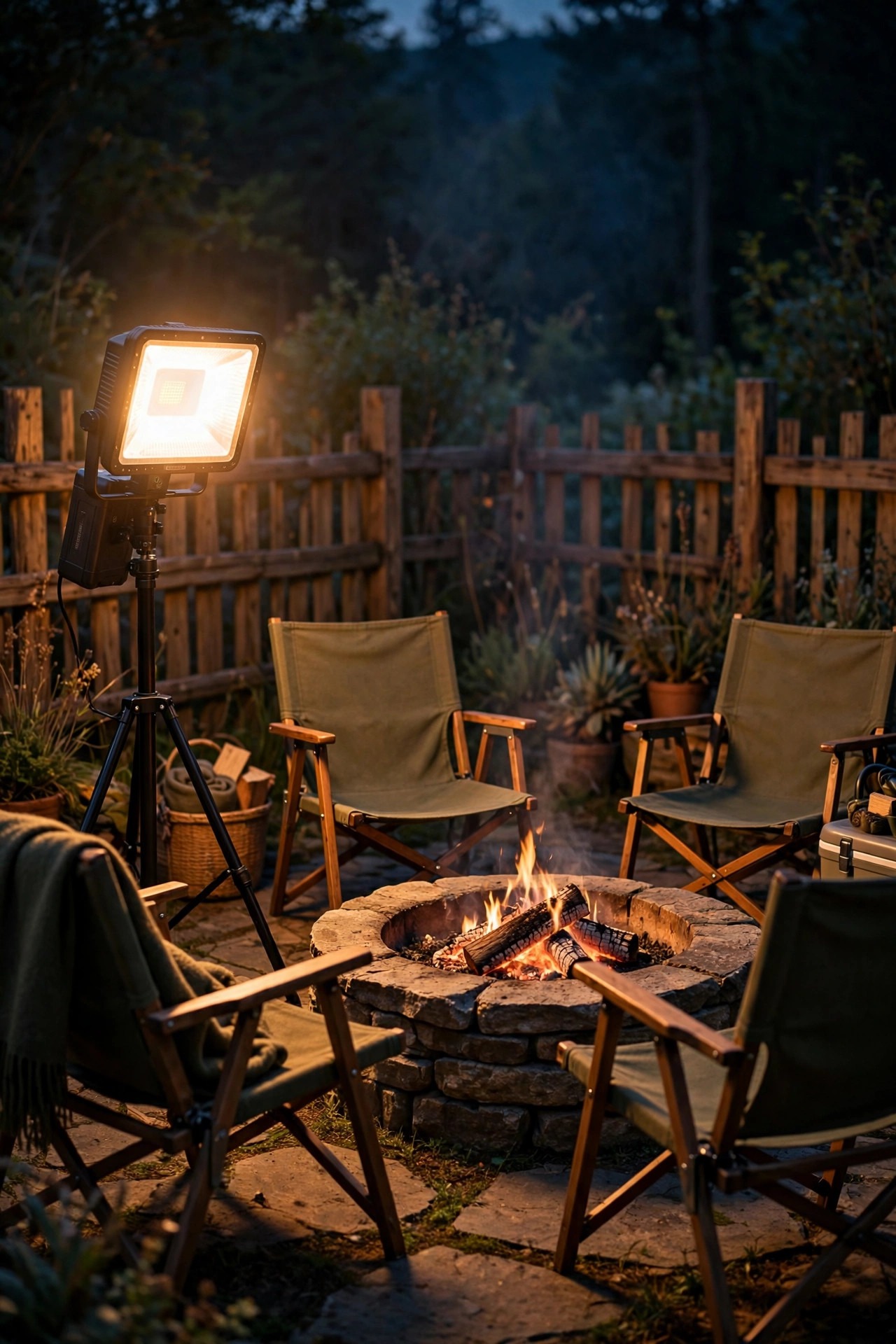
The far seating corner — fire pit, camp chairs, the stump side tables — is where my family actually lives on summer nights, and it is a full extension-cord-and-a-half from the house. A rechargeable floodlight on a small tripod or ground stake is the workhorse out there. It charges in the garage, carries out by its handle, and gives you a wide, dimmable wash for setting up chairs, finding the marshmallow sticks, and cleaning up after. Keep it aimed low and bounced off the fire pit surround or a pale fence panel rather than blasting faces — indirect light is the difference between cozy and interrogation. A mid-size unit runs a whole evening on medium with hours to spare, and medium is all you need once the fire itself is going. My rule after one sad midnight: the floodlight goes back on its charger the same night, every time, like returning a library book. It also moonlights as the storm light, the garage project light, and the pumpkin-carving light, which is why if I could only keep two battery lights, this one makes the cut.
Suggested budget range: $30 – $75.
16. A Remote-Control Ceiling Light for the Gazebo
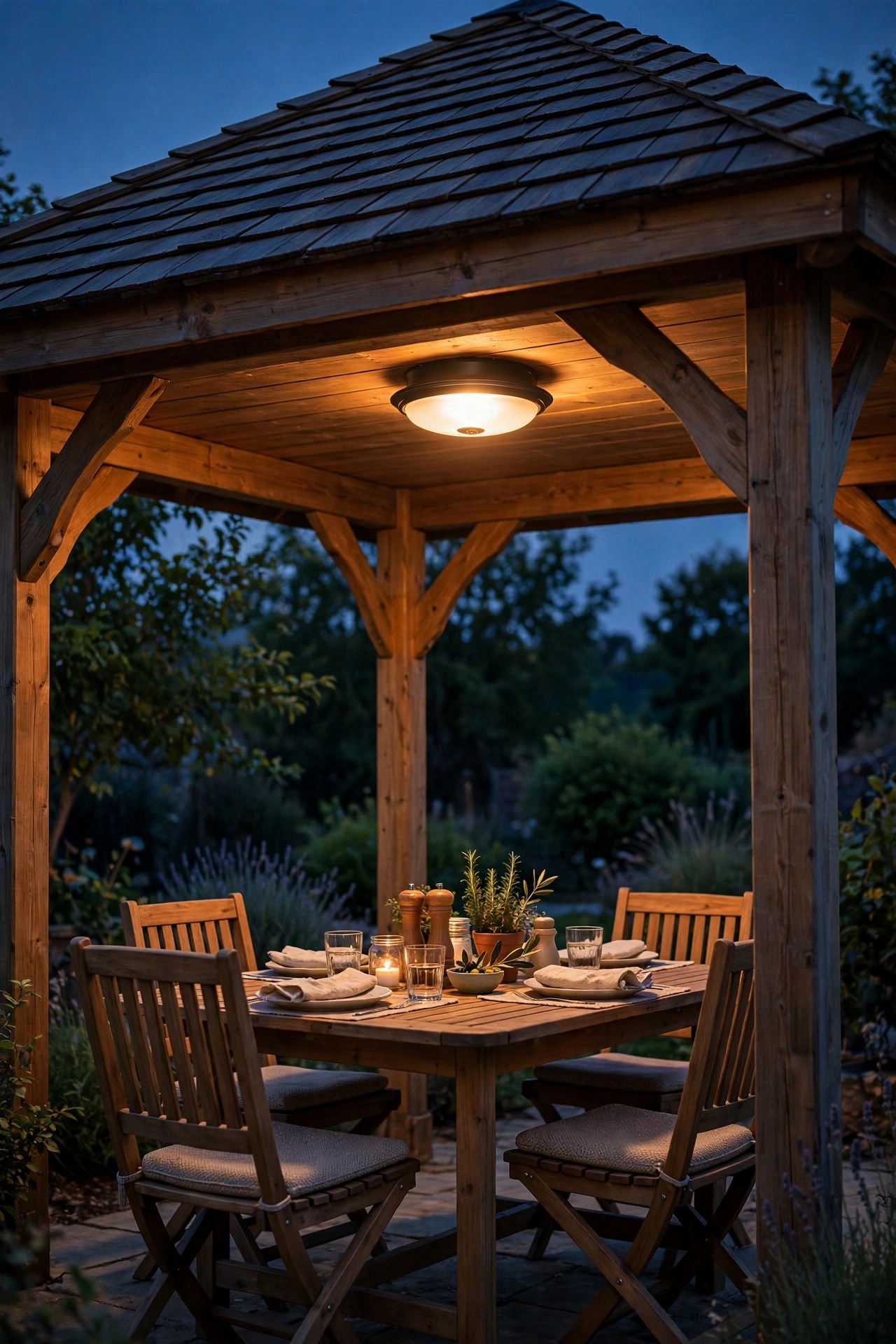
A gazebo without overhead light is a lovely silhouette you stop using at sunset. If yours was built without a ceiling junction box — most kit gazebos are — a battery ceiling light with a remote is the fifteen-minute fix. These mount flat to the center beam or hang from the existing hook, and the remote handles on, off, dim, and timer from your chair, which feels like pure luxury the first dozen times. I use the warm setting at about half brightness for dinners; full bright is genuinely reading-light strong for board games. Size your expectations honestly: this is the hardest-working position in the yard, so plan on charging or swapping every two to four weeks in heavy summer use. A model with a removable battery pack wins here, because climbing a step stool with a whole fixture in one hand is nobody idea of fun. Pair it with the portable lanterns from earlier at the gazebo steps and the whole structure glows like a little pavilion. Neighbors will ask who wired it. Nobody wired it.
Suggested budget range: $35 – $80.
17. Battery Rope Light Along Garden Edging and Raised Beds
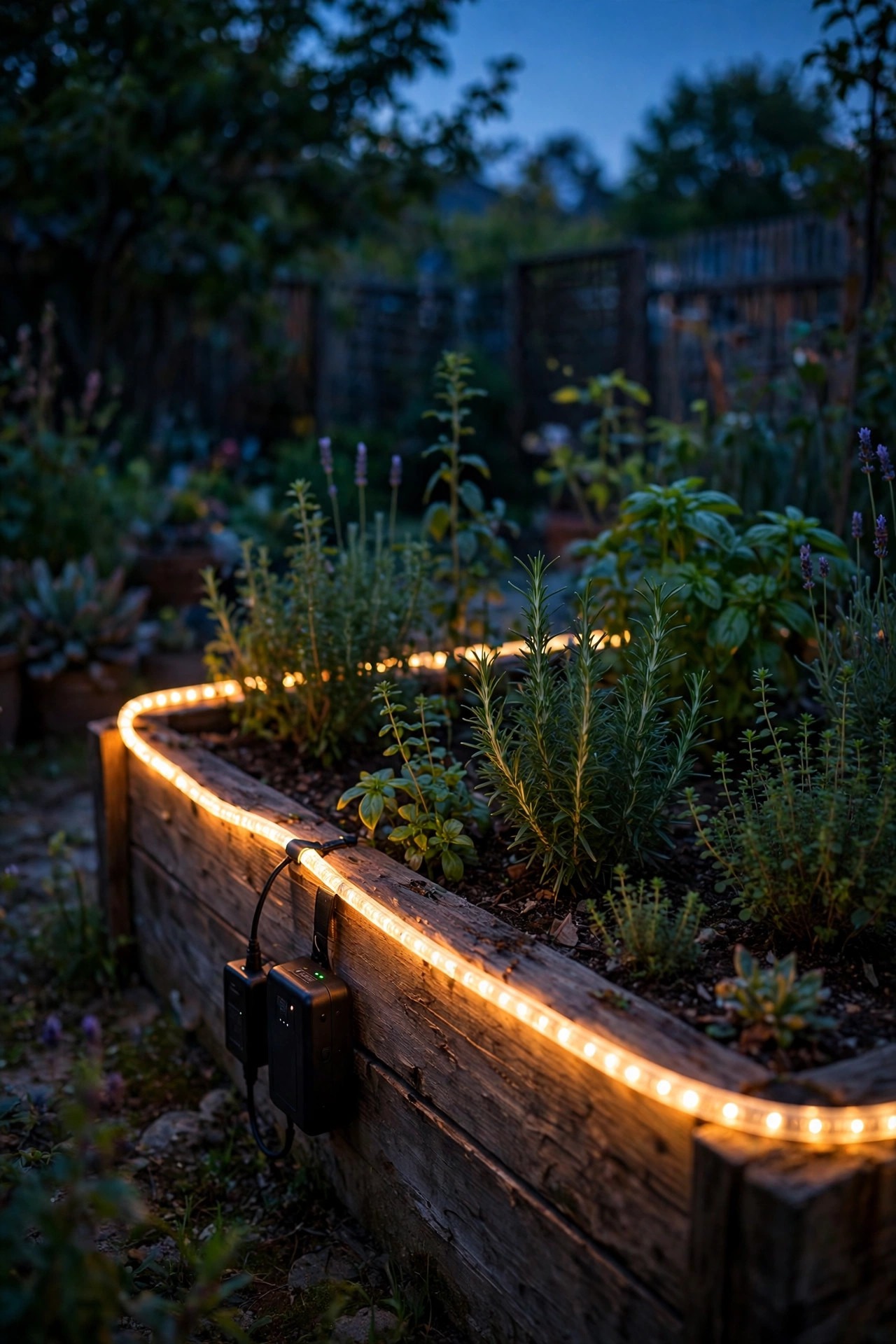
Some nights I do not want the garden lit; I want it outlined. A battery rope light tucked along the front edge of a raised bed or the inside lip of a garden border draws a soft, continuous line that shows the shape of the beds and keeps feet off the plantings. It is the quietest light on this list — more glow than illumination — and it makes the whole garden read as intentional after dark. Installation is pure handwork: push the little clips into the soil or screw them to the bed boards every foot or so, and coil the battery pack into its weatherproof pouch behind a shrub. Timer mode is your friend again, a four-hour evening window that stretches a set of batteries across most of a month. Green or black rope disappears in daylight; the warm white light temperature keeps it from looking like a holiday decoration in July. Around the vegetable beds it earns double duty, marking the path edge on the late-evening watering run. Just lift it out before the fall tilling, or you will till it exactly once and learn the same lesson I did.
Suggested budget range: $15 – $35.
18. A Stake Spotlight Aimed at the House Numbers
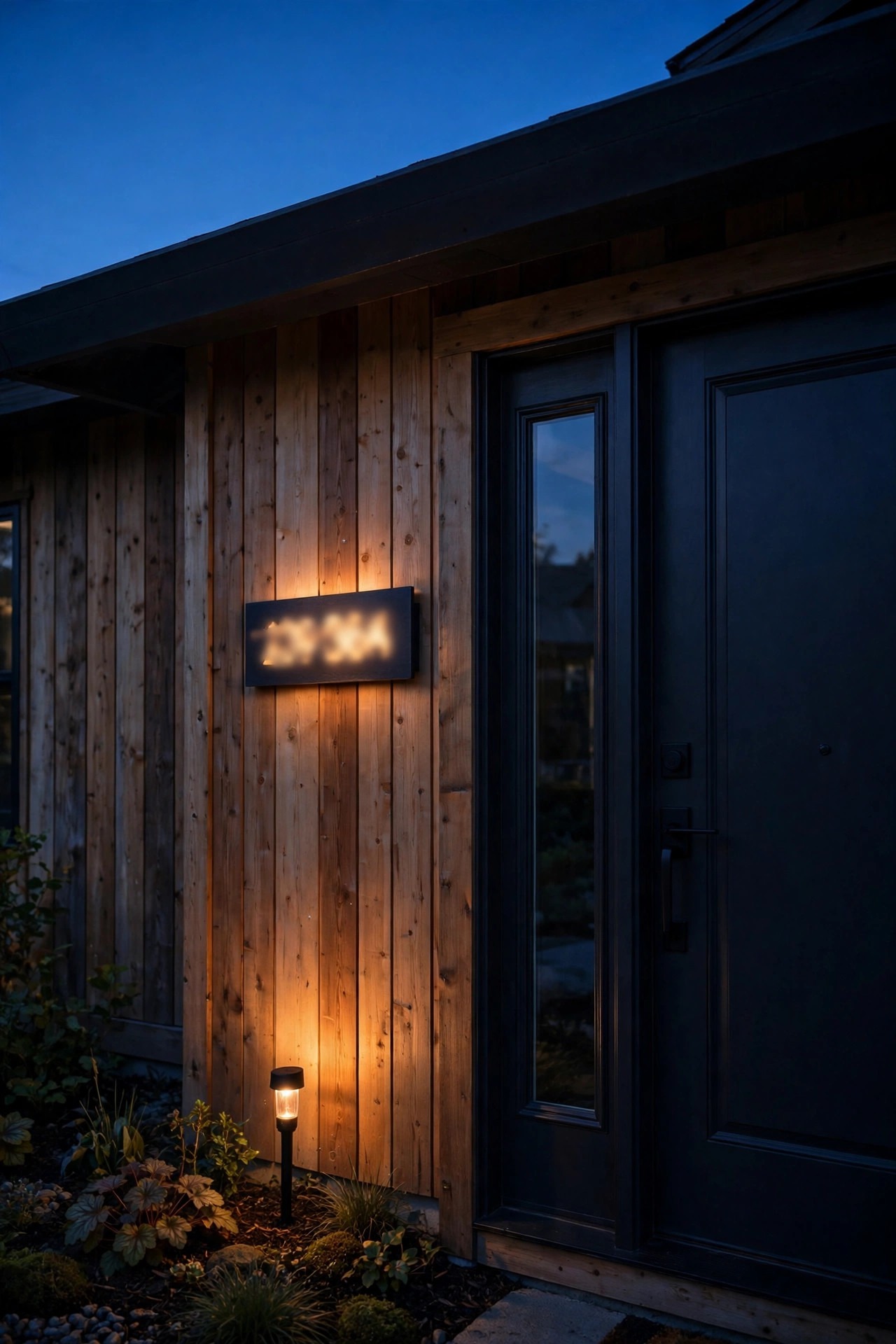
Guests circling a dark street looking for your address, delivery drivers doing the flashlight squint at every mailbox — the unlit house number is a small nightly failure with an easy battery fix. A small stake spotlight planted in the front bed and aimed up at the numbers gives you a soft, permanent-feeling wash that makes the address readable from a slow-moving car. It is the same fixture family as the tree uplights, just dialed to a closer, gentler job. Angle it from below and to the side so the numbers cast a tiny shadow and read in relief rather than washing flat, and keep the beam tight on the plaque so you are not spotlighting the whole front wall for the neighborhood. On a dusk-to-dawn sensor setting, rechargeable cells last about a month per swap. If your numbers live on the mailbox instead of the house, the same stake works from the planting at its base. It is a fifteen-dollar kindness to every driver, guest, and pizza professional who will ever look for your door after dark.
Suggested budget range: $15 – $40.
19. Run Battery Powered Outdoor Lighting Ideas Like a System: the Charging Station
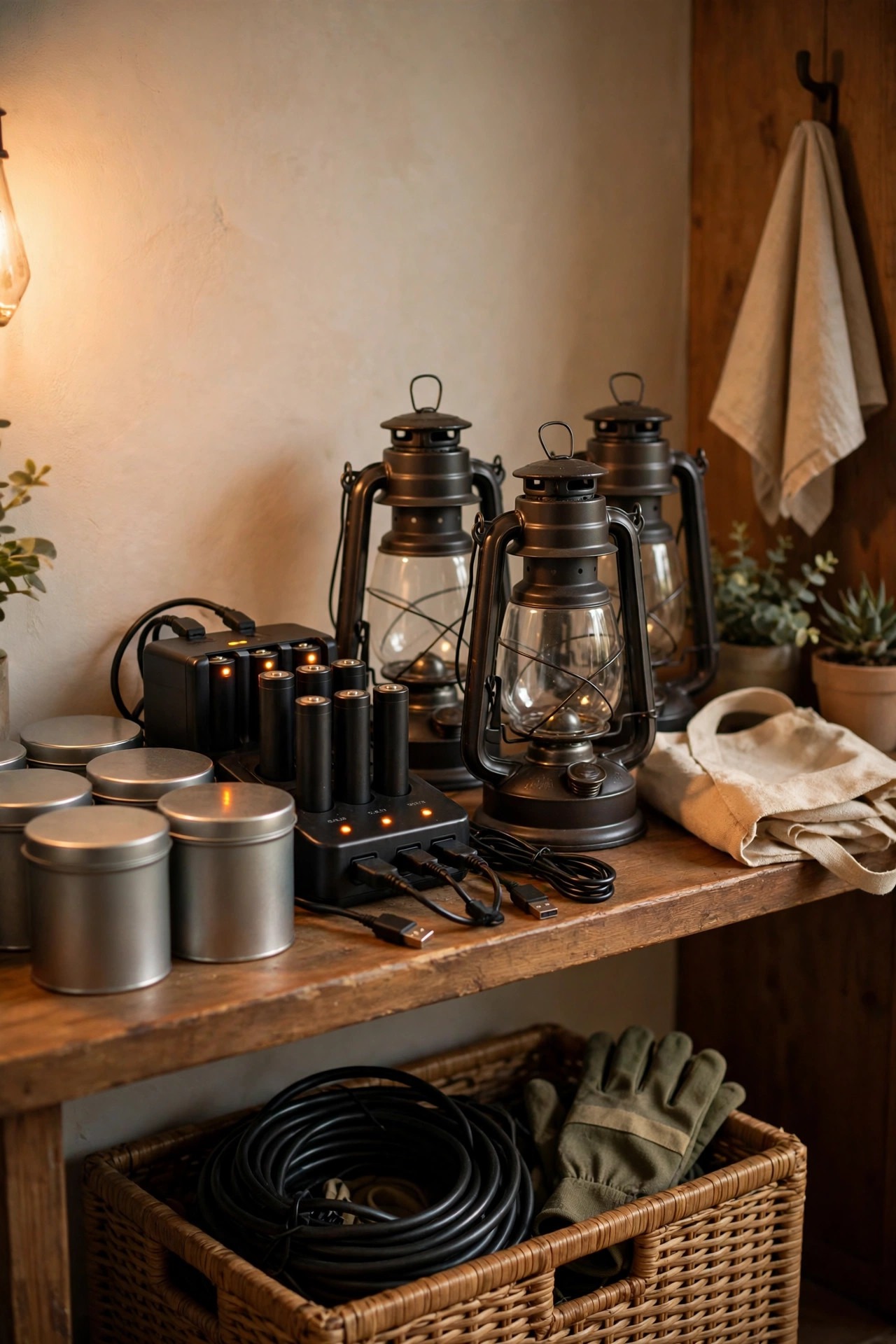
The difference between people who love battery lights and people who curse them in a dark yard is never the fixtures. It is the routine. My system fits on one kitchen shelf: a small multi-bay charger, two labeled sets of rechargeable cells for every fixture zone, and a standing Sunday-evening habit of swapping anything that looks dim. Zones matter — porch cells in one labeled tin, garden cells in another — so a swap takes five minutes and never turns into a drawer-digging expedition. Rechargeables beat disposables on cost within a single season and on waste immediately; a decent cell survives hundreds of cycles. Respect the physics and the system purrs: cold weather cuts runtime hard, so winter swaps come twice as often and spares stay warm indoors; motion fixtures outlast always-on ones by months, so convert any light you can to motion or timer duty. Twice a year, in April and October, I walk the yard at dusk with a notepad and re-aim, wipe lenses, and retire anything tired. That is the whole secret: treat battery powered outdoor lighting ideas as a system with a tiny weekly ritual, and the no-outlet map of your yard stays lit like it was wired by a pro.
Suggested budget range: $25 – $60.
Frequently Asked Questions
How long do batteries really last in outdoor lights?
It depends almost entirely on how the light is used. A motion-activated fixture that fires for a few minutes a night can run four to six months on one set of batteries. A dusk-to-dawn light might need a swap every four to eight weeks, and a decorative string or rope light left on all night can drain a set in one to two weeks. Timers and motion sensors are the whole game: the less time a light spends on, the longer everything lasts.
Do battery outdoor lights still work in cold winter weather?
They work, but expect shorter runtimes — standard alkaline and rechargeable cells can lose a noticeable share of their capacity in freezing temperatures, so a light that ran six weeks in July might run three or four in January. Swapping more often in winter is normal. Keeping spare cells warm indoors and choosing fixtures with easy battery doors makes the cold months painless.
Are battery lights bright enough to be useful, or just decorative?
Both kinds exist, and the honest answer is to match the fixture to the job. Battery motion floodlights and rechargeable floodlights are genuinely bright — plenty for gates, steps, driveways, and spotting a raccoon at the bins. The smaller decorative pieces, fairy strands and rope lights, are glow rather than work light. For steps, paths, and doors you need the task-rated fixtures; for atmosphere, the gentle ones are better anyway.
Rechargeable or disposable batteries: which is the smarter buy?
Rechargeable, and it is not close over a full season. One set of good rechargeable cells costs about as much as two or three sets of quality disposables, then keeps cycling for years. A simple charging station with labeled spare sets turns battery swaps into a five-minute routine instead of a recurring purchase. Disposables still make sense in one spot: rarely used emergency lights you want to forget about for a year.
Conclusion
The far fence, the gate, the shed, the shady walk — the best spots in your yard were never going to get wired, and they do not need to be. With the right fixtures in the right places and a small charging habit on the shelf, battery powered outdoor lighting ideas can carry the whole no-outlet map: guidance where feet land, welcome where people gather, and a little sparkle where the garden deserves it. Start with the motion floodlight at your darkest pinch point, add lanterns you can carry, and build out zone by zone. Then browse the rest of the lighting ideas here whenever you are ready to light the parts of the yard that do have power — the layers all play beautifully together.