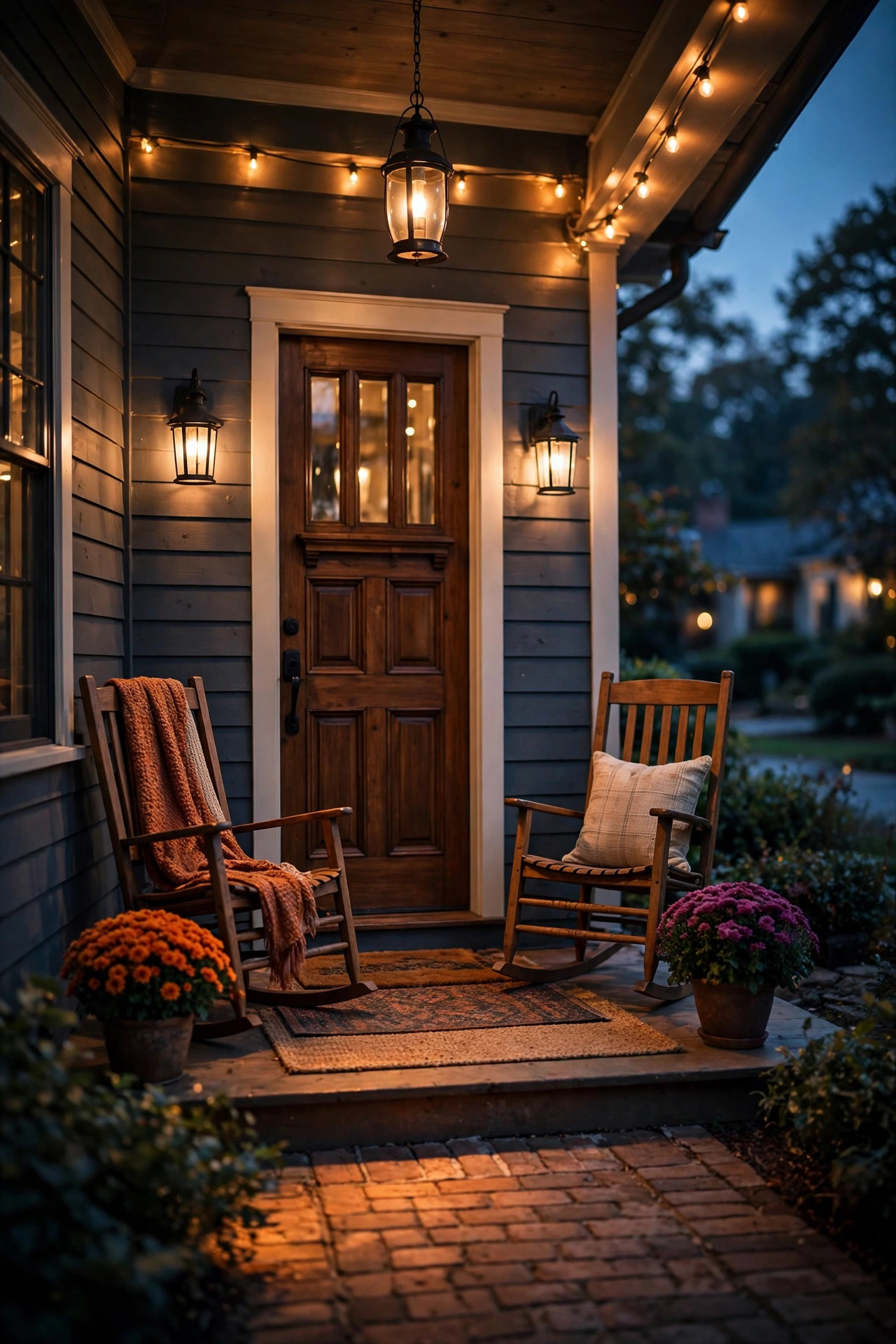
Your front porch is the first thing guests see and the last thing you pass every evening — and its lighting has to work just as hard in January as it does in July. These 25 front porch lighting ideas are built around one philosophy I swear by: layer your light. (If you're planning the whole entry from scratch, my guide to simple outdoor curb appeal pairs beautifully with this post — lighting is only half the equation.) Ambient light (the overall wash of glow), task light (bright, focused light where you need to see keys or steps), and accent light (the little twinkles that make a porch feel magical) work together so your entry never looks flat or, worse, dark and uninviting in any season. I'll walk you through sizing rules I've learned the hard way, smart placements that keep paths safe, seasonal swaps that take ten minutes, and the budget reality of each idea. By the end, you'll have a porch that photographs beautifully in December and July alike — and keeps your home safe, welcoming, and impossible to miss from the street.
1. Flanking Lantern Sconces Beside the Front Door
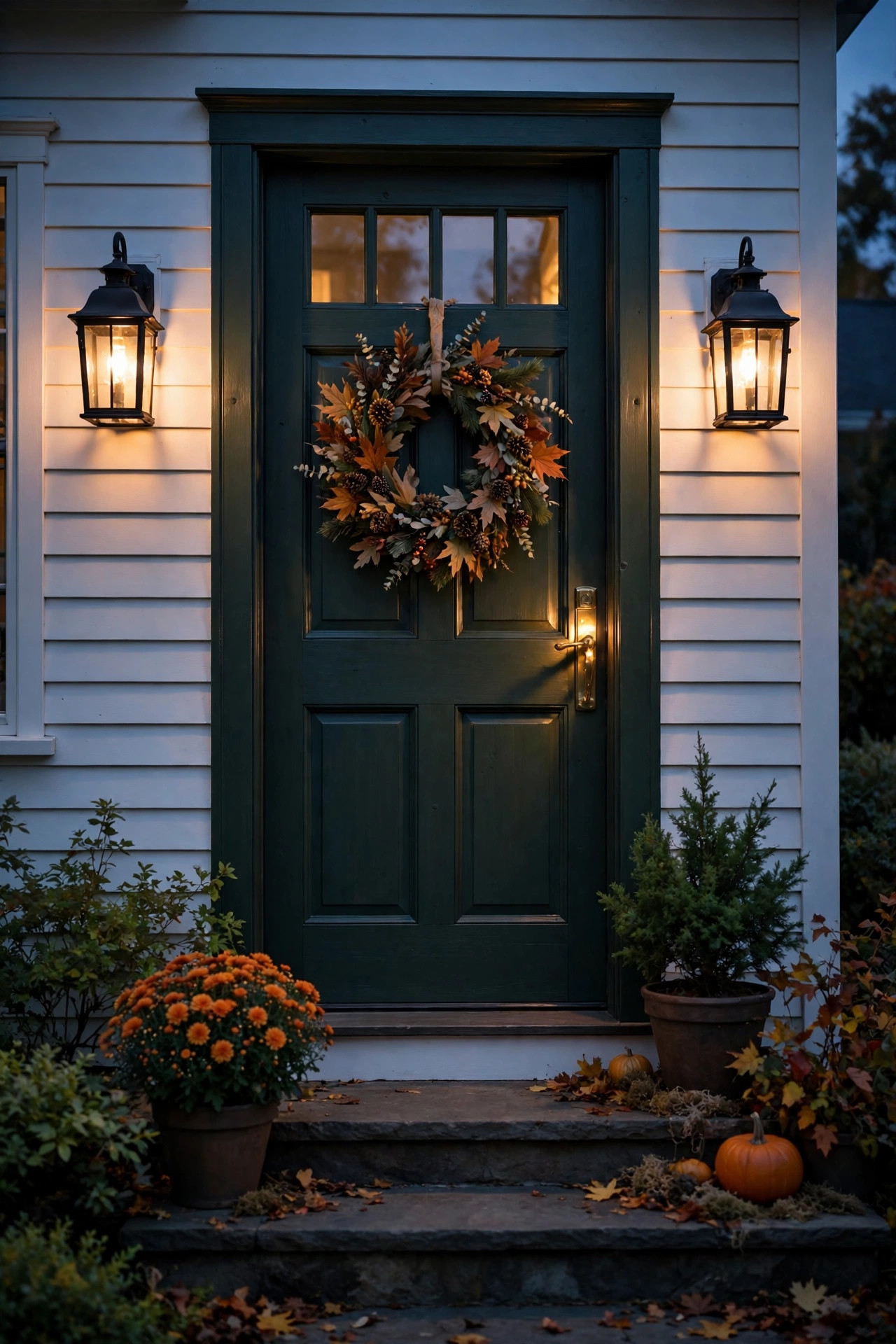
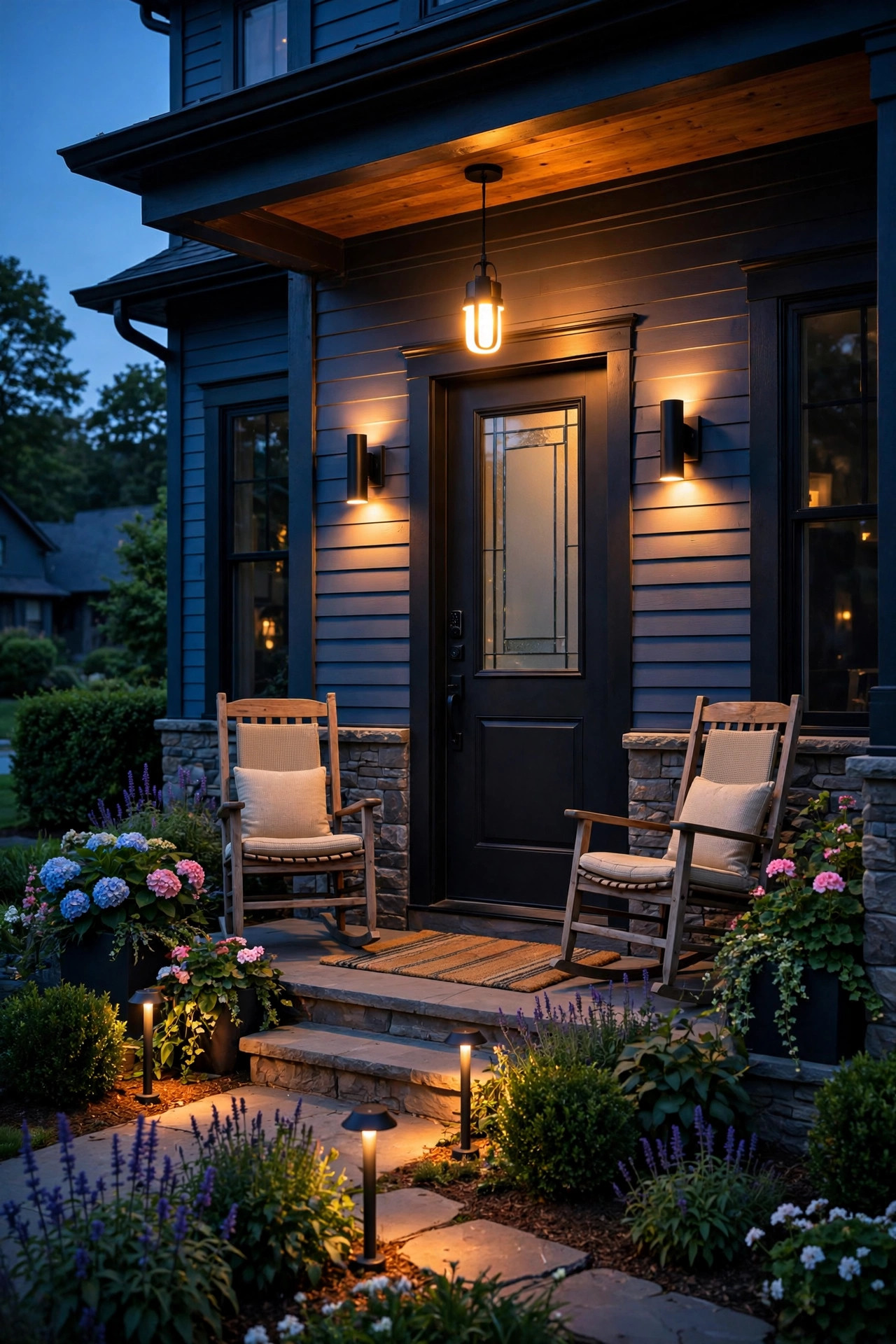
A matched pair of lantern-style sconces flanking your front door is the single most classic porch move, and honestly, it never goes out of style. (If you want to go deep on this exact look, my front door sconce pair guide covers every placement and wiring detail.) In my experience, the sizing rule that matters most is this: each fixture should measure about one-third the height of your door. On a standard 80-inch door, that means a fixture roughly 26–28 inches tall — most people buy ones that are way too small, and the entry ends up looking underdressed. Mount the center of each fixture 60–66 inches above the porch floor, about 6–8 inches from the door trim, and use warm white LED bulbs (2700K) so the glow feels welcoming rather than clinical. If your entry is wide, add a third fixture centered above the door for symmetry. Look for fixtures rated for damp or wet locations depending on how exposed your porch is — anything under a covered roof is typically fine with a damp rating, but fully exposed walls need wet-rated. Pair the sconces with a dimmer or smart bulbs so you can drop the brightness after midnight while keeping a soft glow for security.
Suggested budget range: $120 – $400.
2. A Statement Ceiling Pendant or Lantern
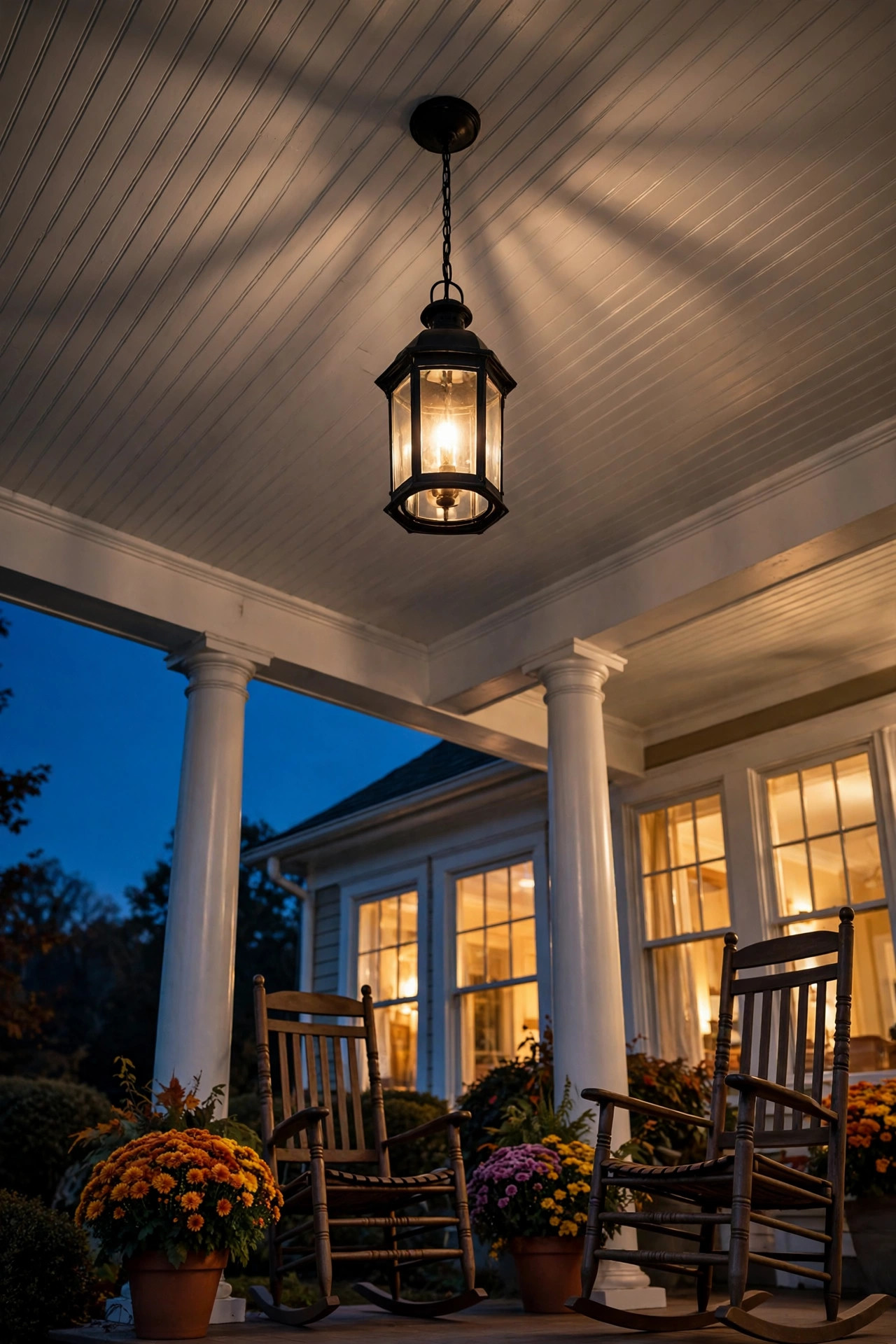
If your porch has a ceiling, hanging a pendant or lantern from it pulls the eye upward and makes the whole space feel designed rather than merely lit. The rule of thumb I always recommend: the bottom of the pendant should hang 7–8 feet above the porch floor, leaving plenty of clearance for tall guests. For a single pendant, size the fixture width to roughly one-half the width of your door — a 36-inch door takes an 18-inch-wide lantern. If your porch is wide (over 12 feet), hang two or three smaller pendants in a row, spaced evenly. A lantern with seeded or clear glass throws beautiful shadows and sparkle onto the ceiling, while an opaque shade gives a softer downward wash. Make sure any ceiling fixture is rated for damp locations since porch ceilings collect humidity, and wire it to the same switch as your sconces or a separate one so you can light the ceiling independently for movie-night mood.
Suggested budget range: $150 – $500.
3. Layered Wall Sconces With Downlighting
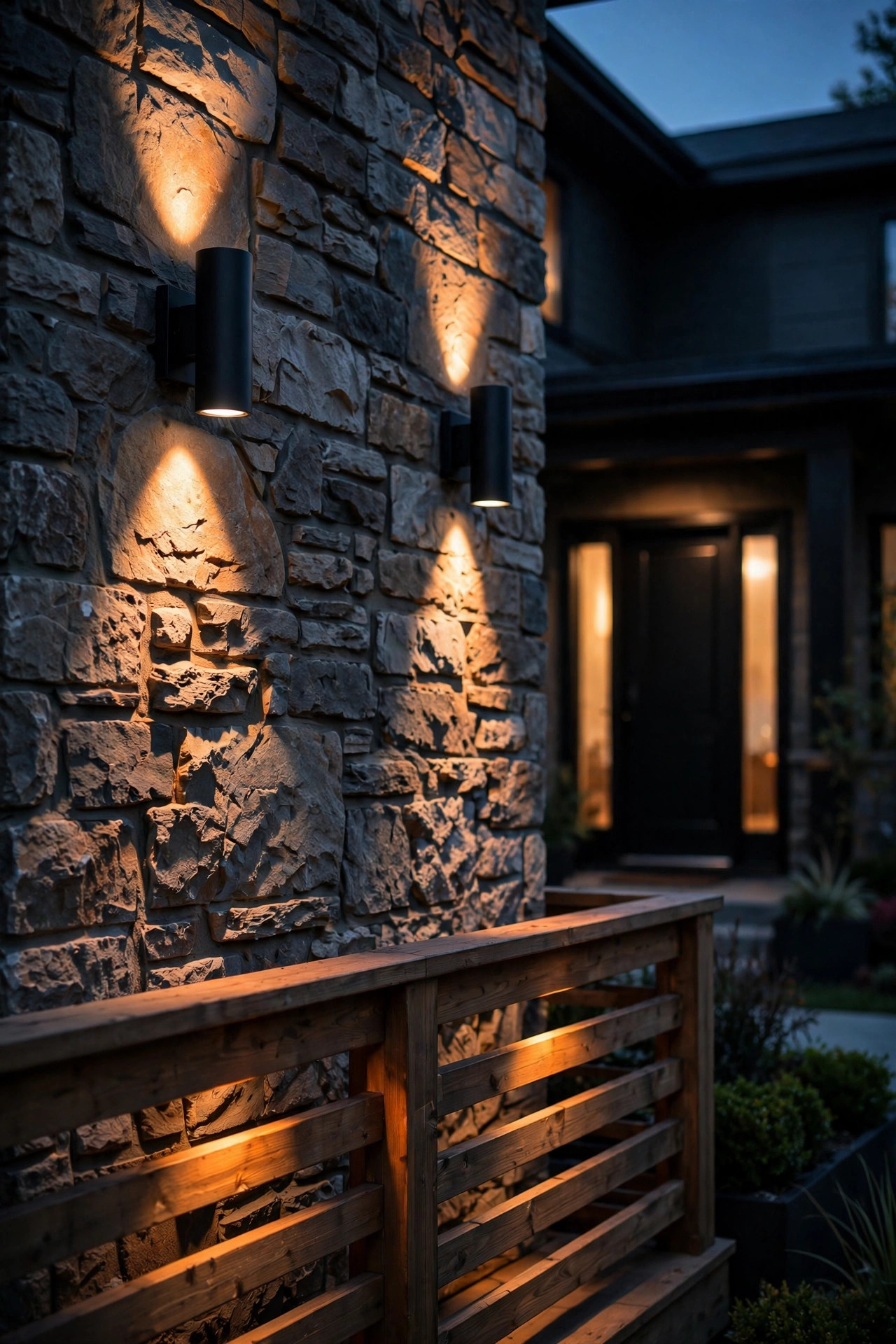
Downlighting sconces — the kind with a closed top and an open bottom that throw light downward — are the workhorses of porch lighting, and they're my personal favorite for layered looks. In my experience, a pair of downlights on the porch walls gives you task light where you need it (the welcome mat, the steps) while the soft spill across the siding counts as ambient glow. Space them 8–10 feet apart on long porch walls, mounted 5–6 feet off the floor. The magic happens when you pair them with a dimmer: full brightness for evening gatherings, dropped to 30 percent overnight as a security wash. Choose fixtures with shielded bulbs so you don't get that harsh glare hitting visitors' eyes as they walk up. Bronze, black, and matte nickel finishes all weather well in most US climates. If your porch ceiling is low, downlights on the wall give you the glow you want without anything dangling at forehead height.
Suggested budget range: $100 – $350.
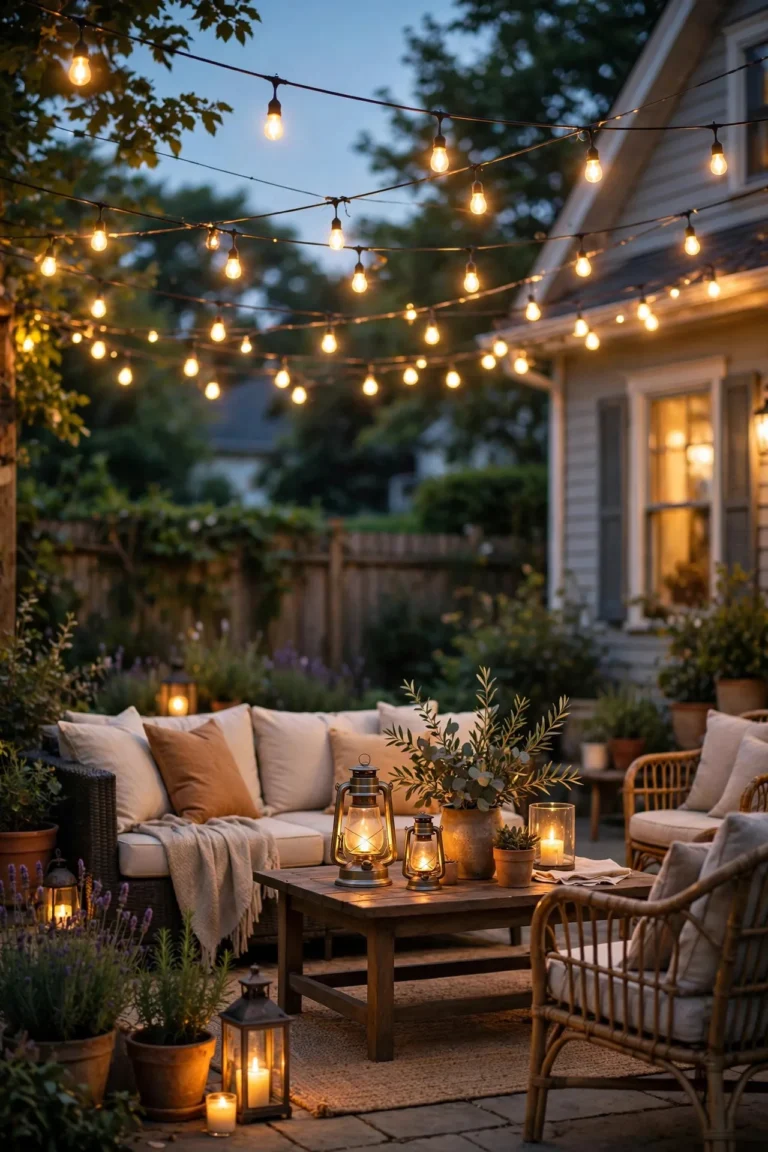
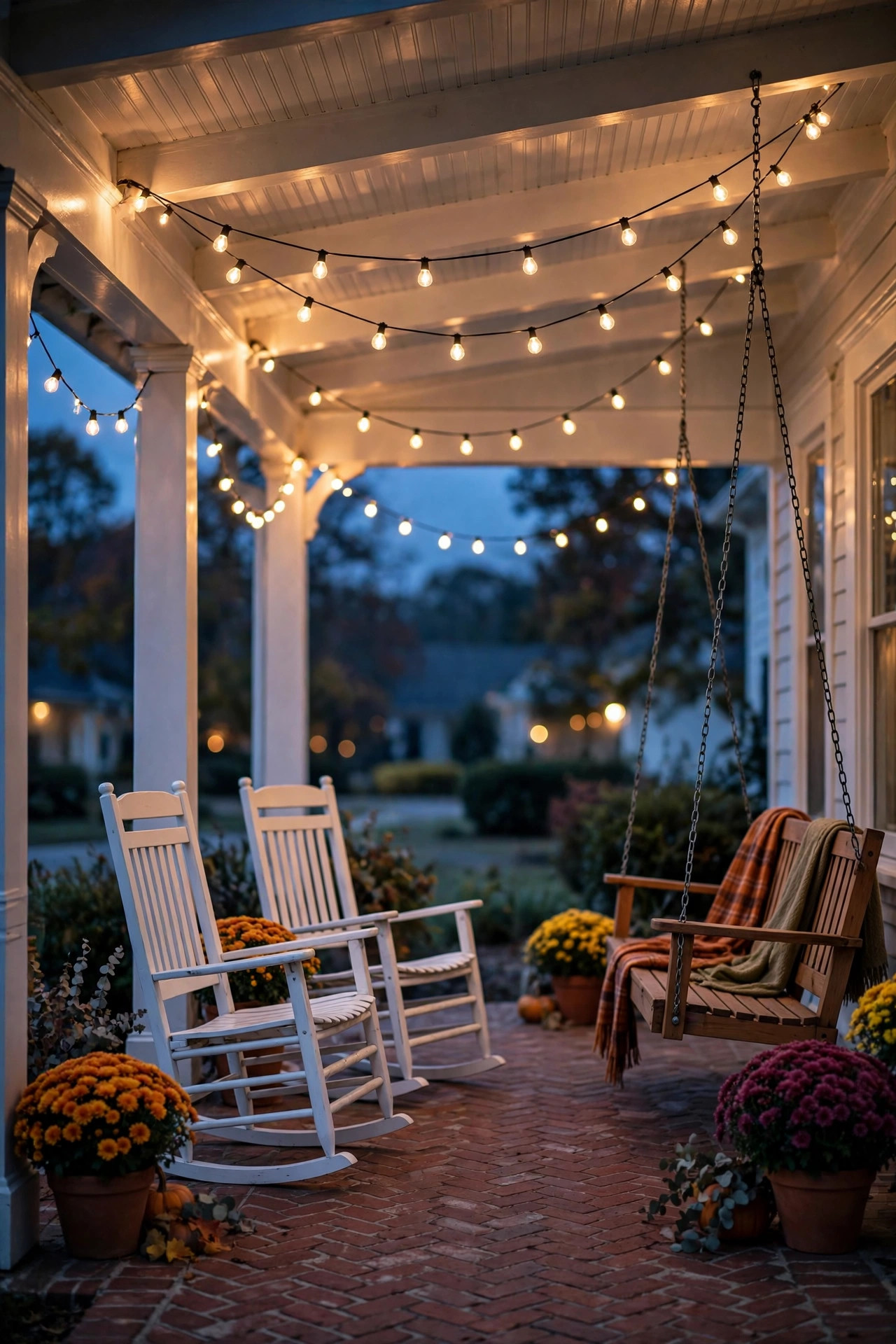
4. String Lights Draped Along the Porch Ceiling
Nothing says "come sit a while" like string lights strung across a porch ceiling — and this is one of the most forgiving projects in this whole list. Use outdoor-rated LED cafe strings with shatterproof bulbs (honestly, worth every penny after one hailstorm), draping them in loose swags from the ceiling or wrapping them along beams. For a standard 8-by-20-foot porch, two 50-foot strings are usually plenty. Keep the lowest swag at least 7 feet above the floor so tall guests don't walk into bulbs. Warm white 2700K bulbs keep it cozy; color-changing strings are a fun year-round trick — warm white most months, orange for fall, multicolor for December, and you never have to redecorate. Hang them with screw-in cup hooks rather than adhesive clips, which give up in summer heat. Plug the set into a smart plug on a sunset timer, and your porch lights itself every evening without a second thought.
Suggested budget range: $60 – $200.
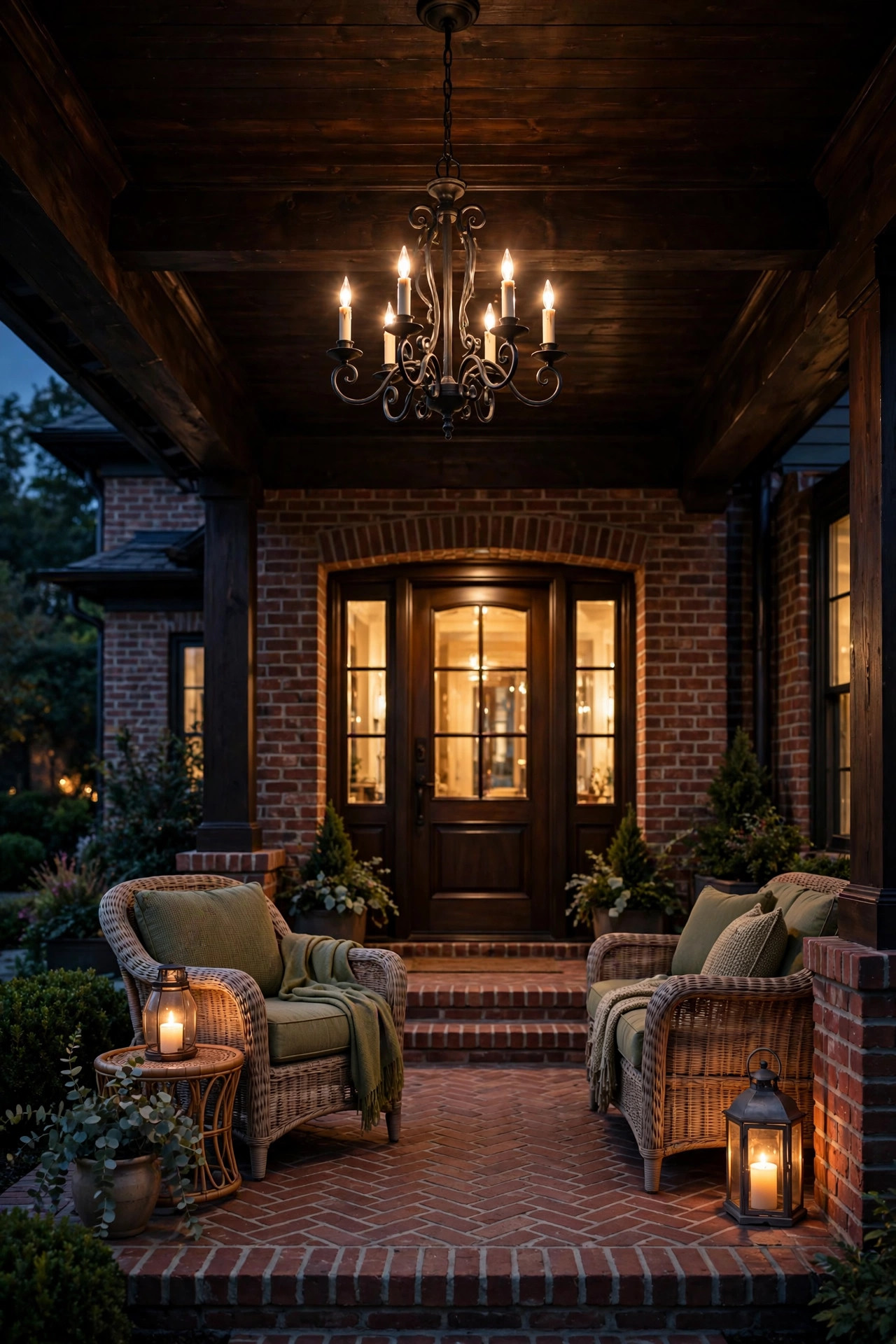
5. A Chandelier-Style Statement Fixture
For porches with ceilings 10 feet or higher, a chandelier-style outdoor fixture is pure drama — in the best way. In my experience, this is the idea that makes neighbors stop and stare, because nobody expects chandelier-level polish on a porch. Size it like a dining room chandelier: the fixture's diameter in inches should roughly match the porch width in feet (a 12-foot-wide porch takes a ~24-inch fixture), and hang it so the bottom sits 7–8 feet above the floor. Tiered or beaded designs scatter gorgeous light patterns across the ceiling. You must buy a fixture explicitly rated for outdoor damp locations — indoor chandeliers will corrode within a season or two in humid or coastal climates. Wire it to its own switch or a smart dimmer so you can run it full-bright for parties and low for quiet evenings. This is the splurge piece, but it can define your entire entry for a decade.
Suggested budget range: $250 – $800.
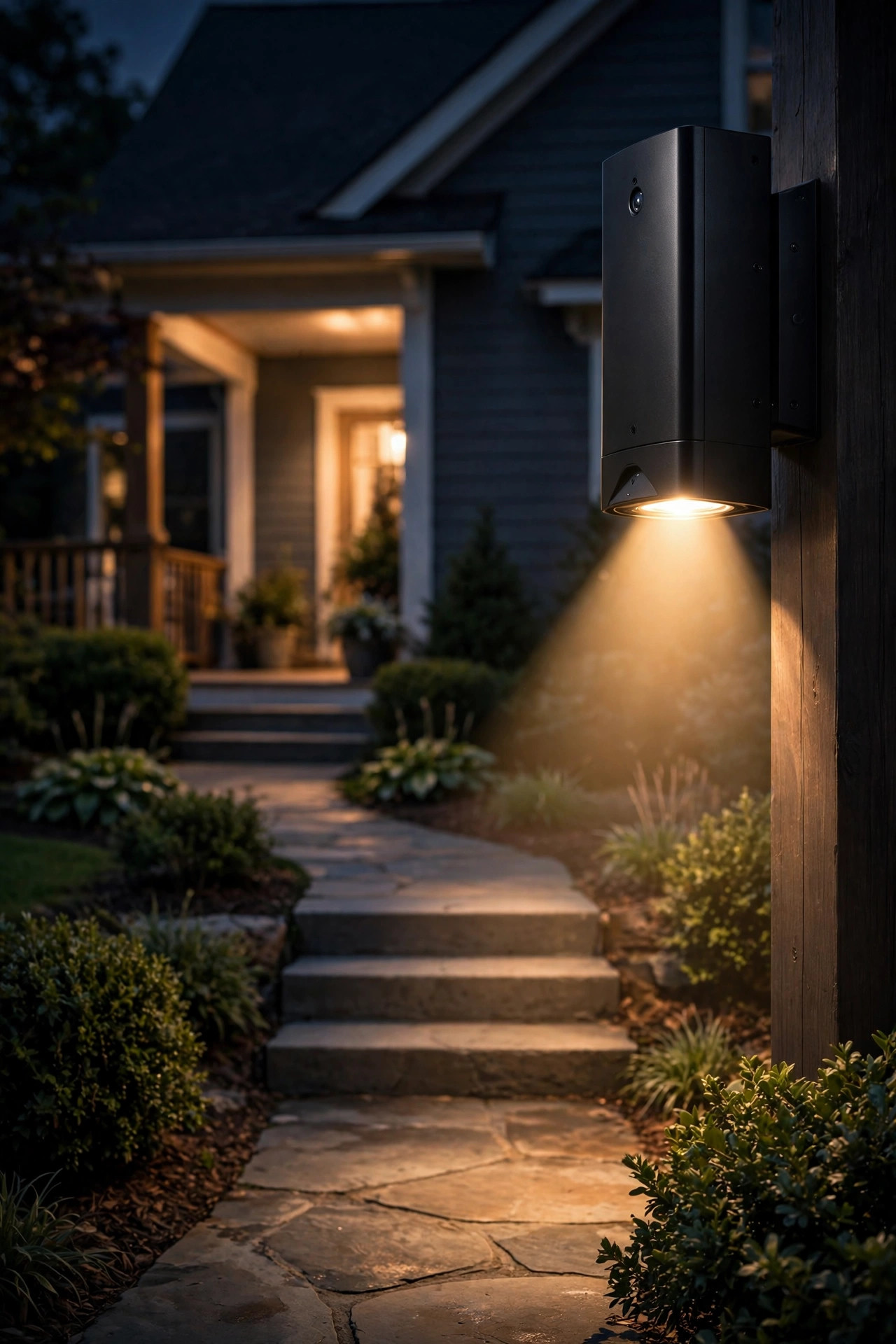
6. Motion-Sensor Security Lighting
Practical first: motion-sensor lighting keeps your porch safe without burning electricity all night. The trick is placement and sensitivity. Mount the sensor fixture 8–10 feet high, angled down toward the walkway and steps, and set the sensitivity so it triggers on people, not passing cars or raccoons — most sensors have a range dial, and dialing it to 15–20 feet usually nails it. A dual-brightness fixture is the upgrade I always recommend: it holds a low 20-percent glow all night (so the porch never goes pitch black) and jumps to full brightness when motion hits. Aim the sensor head away from street traffic and swaying plants, which cause false triggers and honestly get annoying fast. Pair the light with a solar or hardwired path light so the walkway is visible even before the sensor fires. It's the least glamorous idea on this list and one of the most useful.
Suggested budget range: $40 – $180.
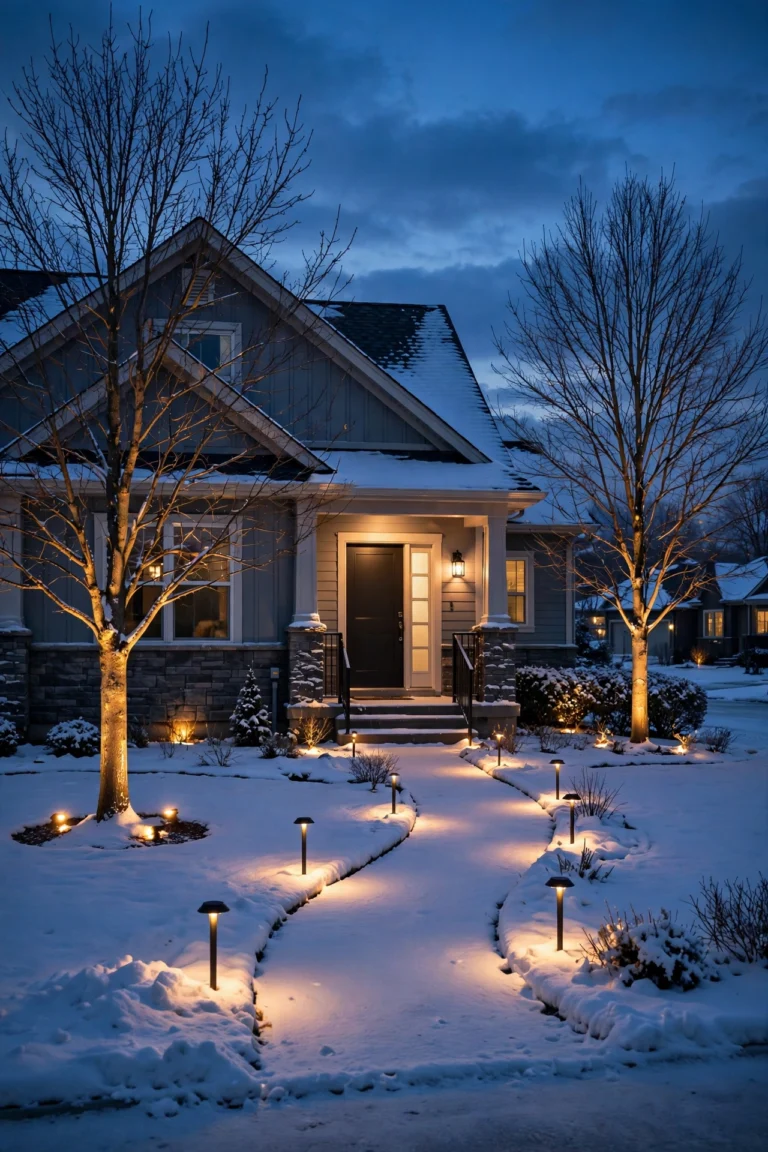
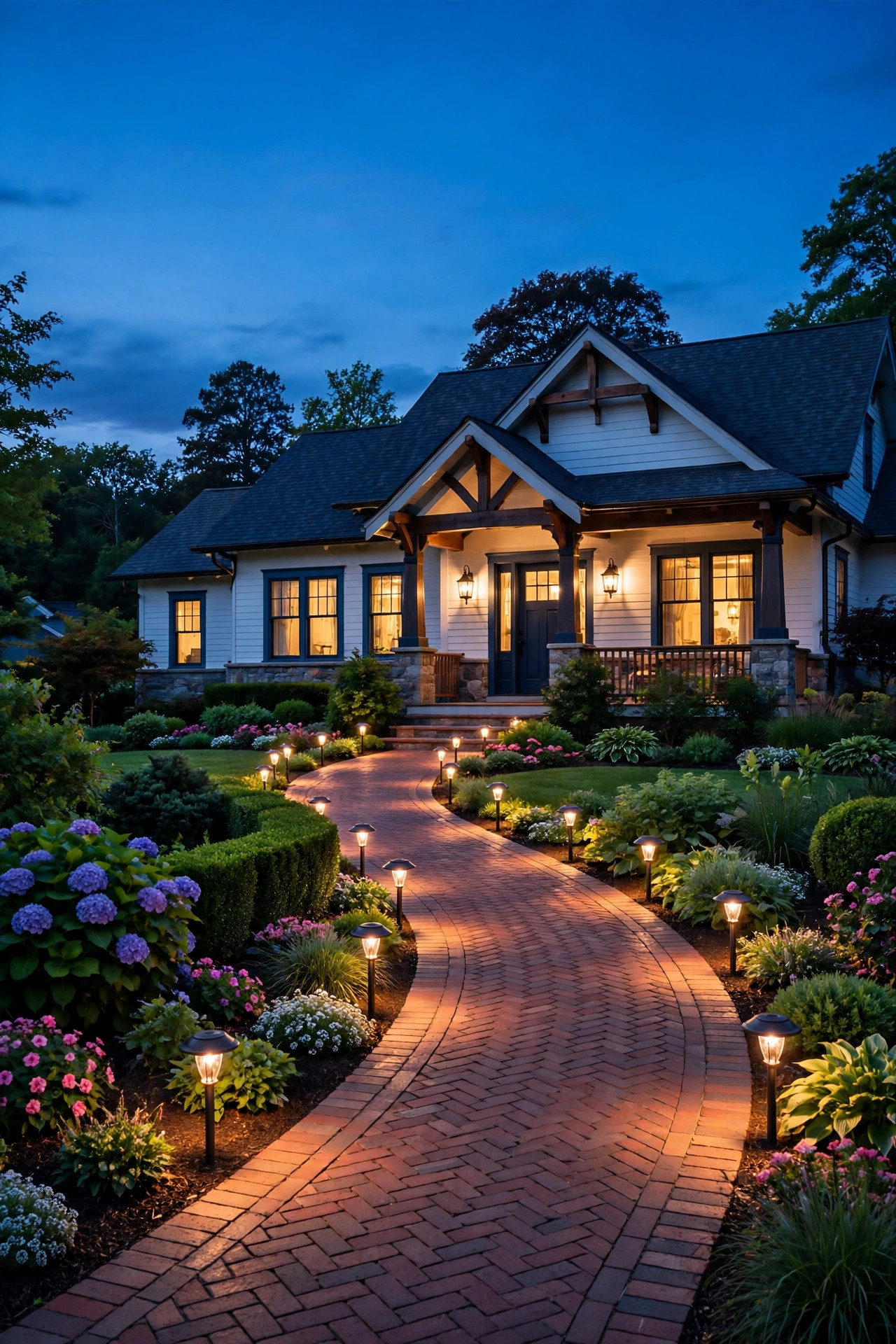
7. Solar Path Lights Leading to the Porch
Solar path lights are the easiest curb-appeal win in outdoor lighting — no wiring, no electrician, just stake and forget. Space them 6–8 feet apart on alternating sides of the walkway so the light zigzags naturally and guides the eye to the porch. In my experience, the biggest mistake people make is buying the cheapest set and wondering why they're dim by 9 p.m.; look for solar lights with at least 2000mAh batteries and high-efficiency panels, which hold charge through overcast days. Press the stake firmly into soil (not loose mulch), and make sure each panel gets at least 6 hours of direct sun — under a porch overhang they won't charge, so keep them out in the open yard. Warm white light (3000K or lower) keeps the look cohesive with the rest of your porch; avoid harsh blue-white solar lights, which clash with warm sconces. Wipe the panels twice a year and they'll run for years.
Suggested budget range: $50 – $150.
8. LED Step Lights for Safer Stairs
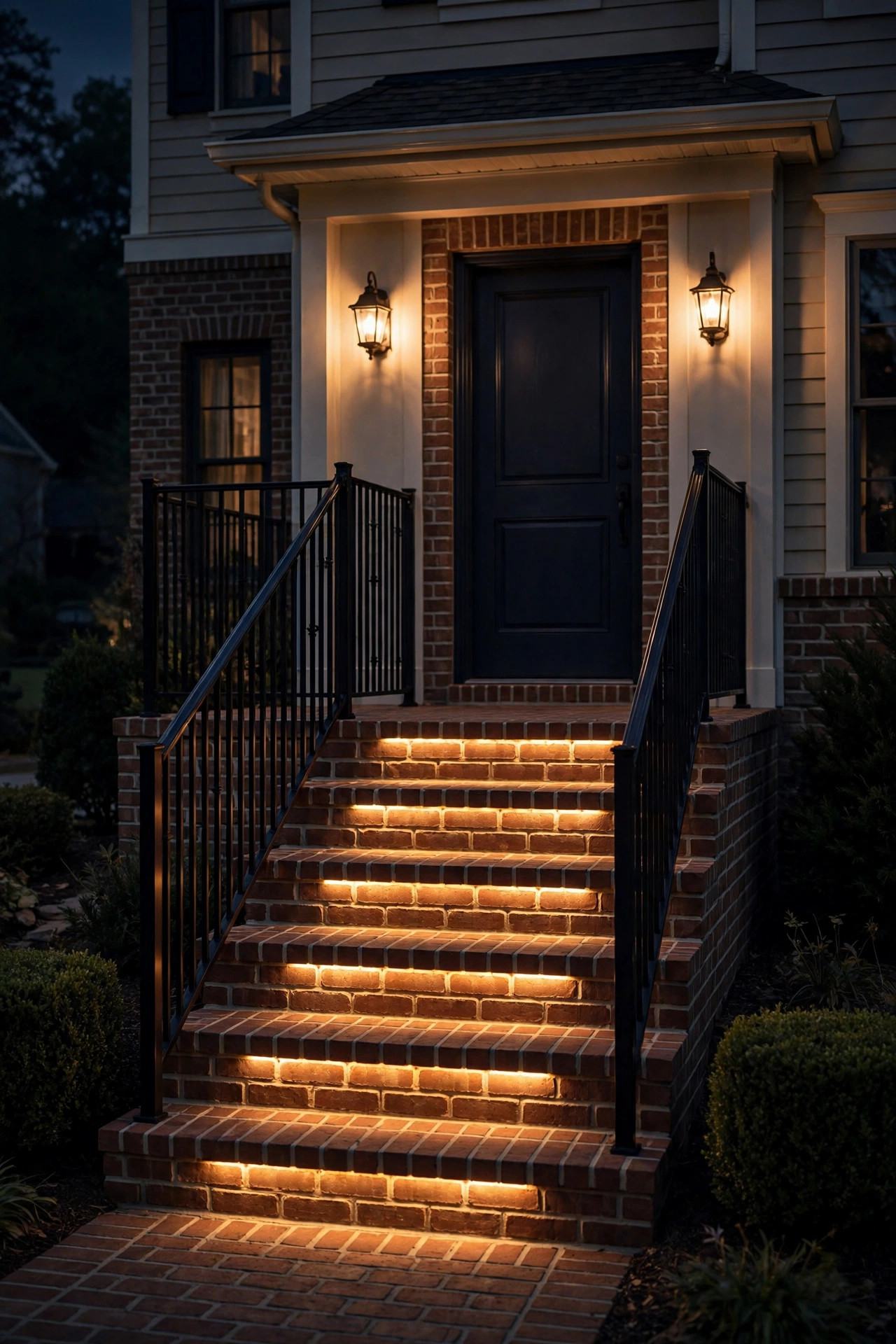
Porch steps are where accidents happen, and step lights solve the problem beautifully. Recessed LED step lights install directly into the riser or the side of each step, casting a soft wash across the tread without glare in anyone's eyes. For a standard 3–4 step porch entry, three lights (one per riser, or one every other step on wider stairs) give plenty of coverage. Low-voltage systems are the DIY-friendly route — a plug-in transformer in a nearby outlet, thin cable run along the stair edge, and the lights snap in. Choose warm white LEDs and look for fixtures rated for wet locations, since steps take direct rain. In my experience, step lights set to a dusk-to-dawn sensor are the sweet spot: they're on when it's dark and nobody has to remember anything. They double as accent lighting, outlining the porch's architecture in a way that photographs beautifully from the street.
Suggested budget range: $80 – $300.
9. Smart Bulbs With Sunset-to-Sunrise Schedules
If your porch lights are hardwired but dumb, smart bulbs are the fastest upgrade you can make — no electrician, no new wiring. Screw an outdoor-rated smart LED into each existing fixture, connect it to your Wi-Fi, and set a sunset-to-sunrise schedule so the porch lights itself every evening and shuts off at dawn. In my experience, this one change saves more energy than people expect, because nobody remembers to flip the switch off at bedtime. You also get dimming and color temperature control from your phone — warm white for cozy evenings, brighter cool white when you're expecting a late delivery or guests. Check that the bulb is rated for enclosed outdoor fixtures and your local temperature range (some smart bulbs misbehave below freezing). Group all porch bulbs into one "Porch" room in your app so one tap controls everything. Pair with a smart plug for any plug-in porch lighting, and the whole entry runs itself.
Suggested budget range: $60 – $200.
10. Fairy Lights Wrapped Around Porch Columns
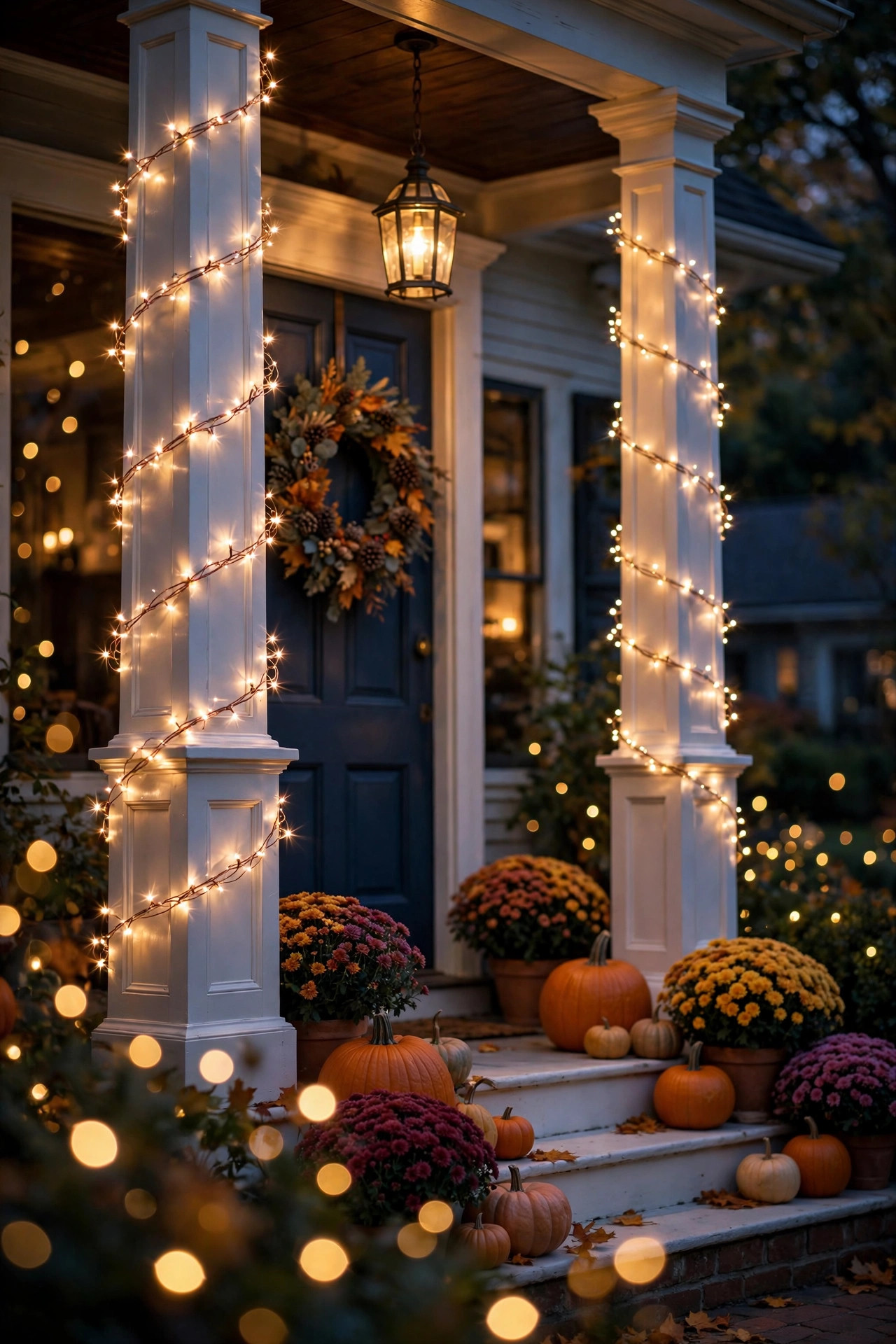
Porch columns are practically begging for fairy lights — and micro LED strings wrap around them in minutes with outsized payoff. Use copper-wire fairy light strings (battery or solar powered) and spiral them loosely around each column from base to top, spacing the wraps 3–4 inches apart. For a 10-foot column, a 33-foot string usually covers it with room to spare. The warm twinkle against the column's shadow lines is stunning from the street, and it reads as accent lighting rather than security lighting, so it layers beautifully with your main sconces. Battery packs tuck behind the column base; set them on a built-in timer (most have 6-hour timers now) so you don't burn through batteries. In my experience, this is the single fastest way to make a porch feel festive for any season — and because they run on batteries, there are no cords to trip over and no outlets to hunt for.
Suggested budget range: $25 – $80.
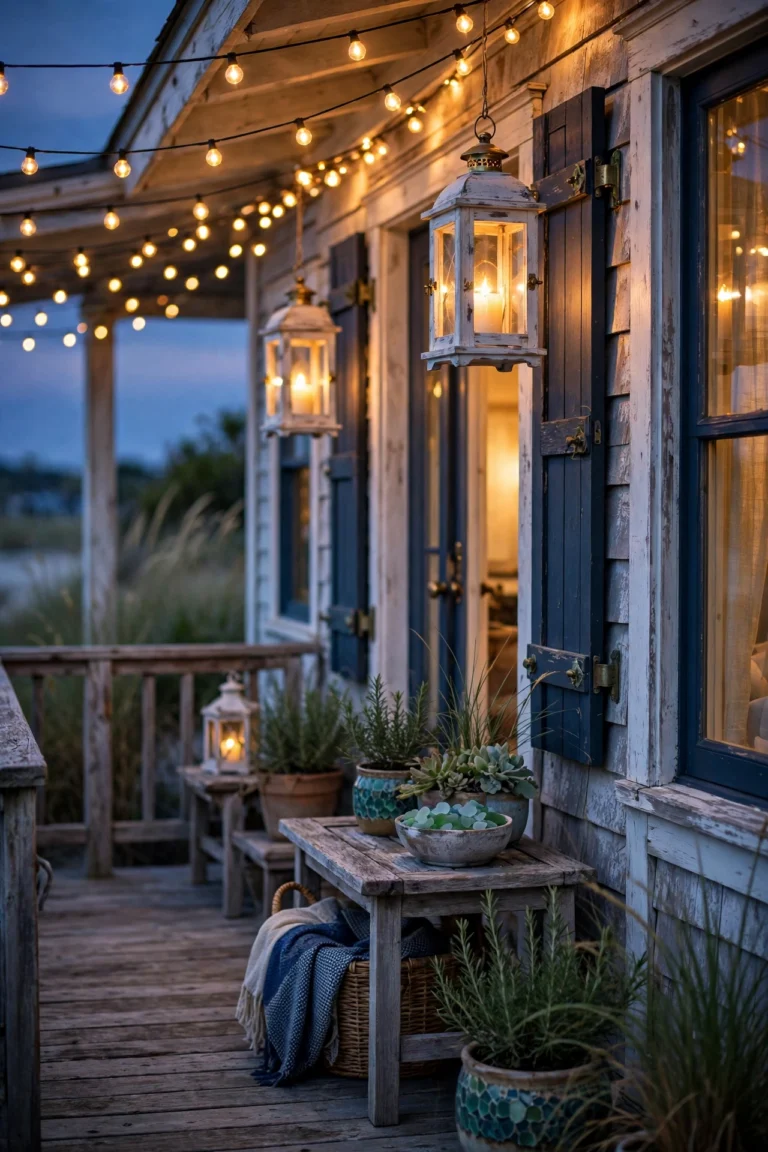
11. Lanterns With LED Candles on the Porch Floor
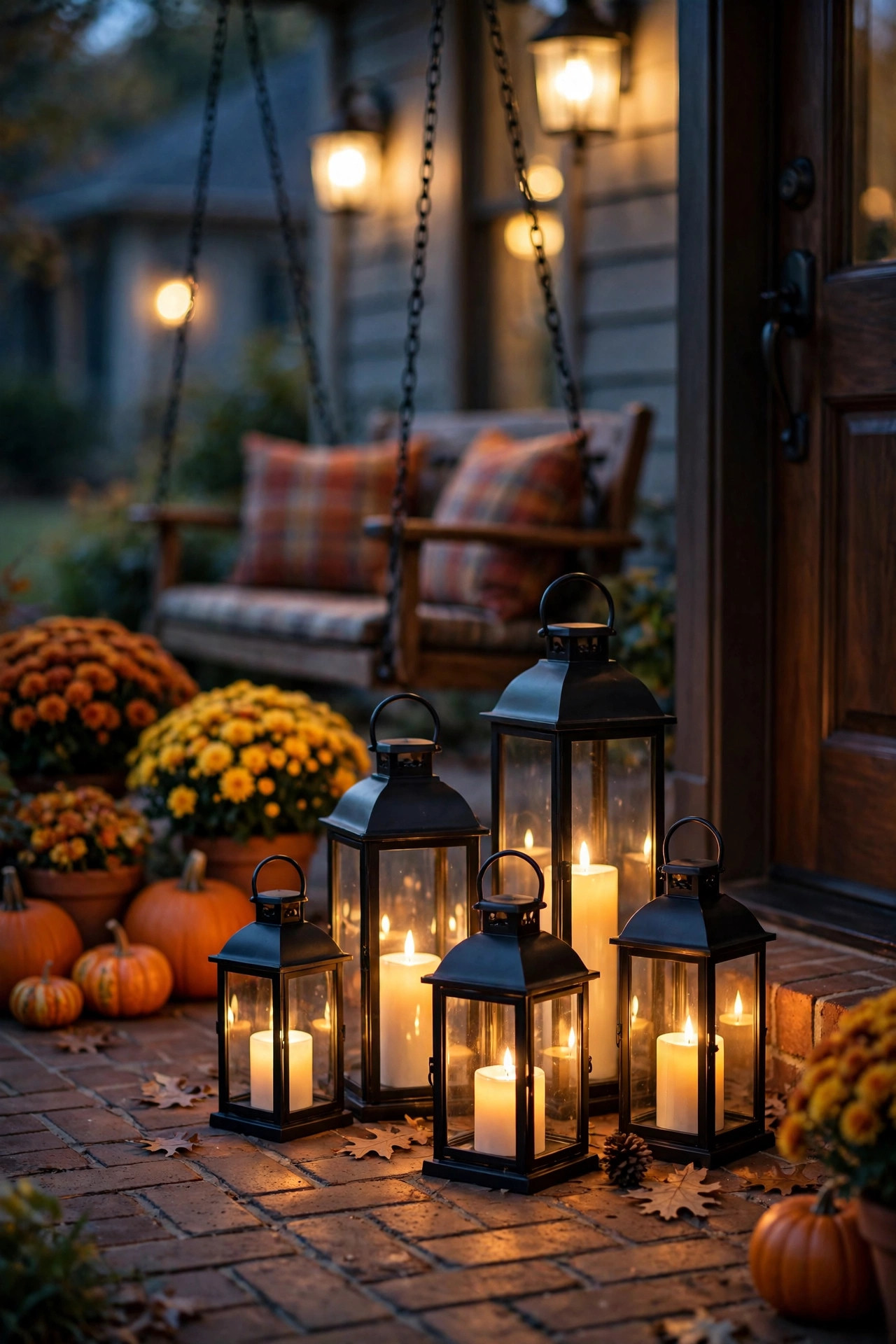
Real candles on a porch are a fire risk and a wind frustration — LED candles inside real lanterns give you the flicker without the worry. Cluster two or three lanterns of different heights (12, 16, and 20 inches is a lovely mix) beside the front door or on the porch steps, and let the flameless candles flicker from dusk onward. Choose lanterns with glass panels and metal frames rated for outdoor use; plastic frames fade and crack within a year or two in strong sun. Timer-equipped LED candles that run 5 hours and switch off automatically are the move — set and forget for weeks at a time on one set of batteries. This idea shines in every season: add a sprig of evergreen in winter, a small pumpkin beside them in fall, seashells in summer. In my experience, floor lanterns are what make a porch feel styled rather than just lit, and guests always ask where you got them.
Suggested budget range: $40 – $150.
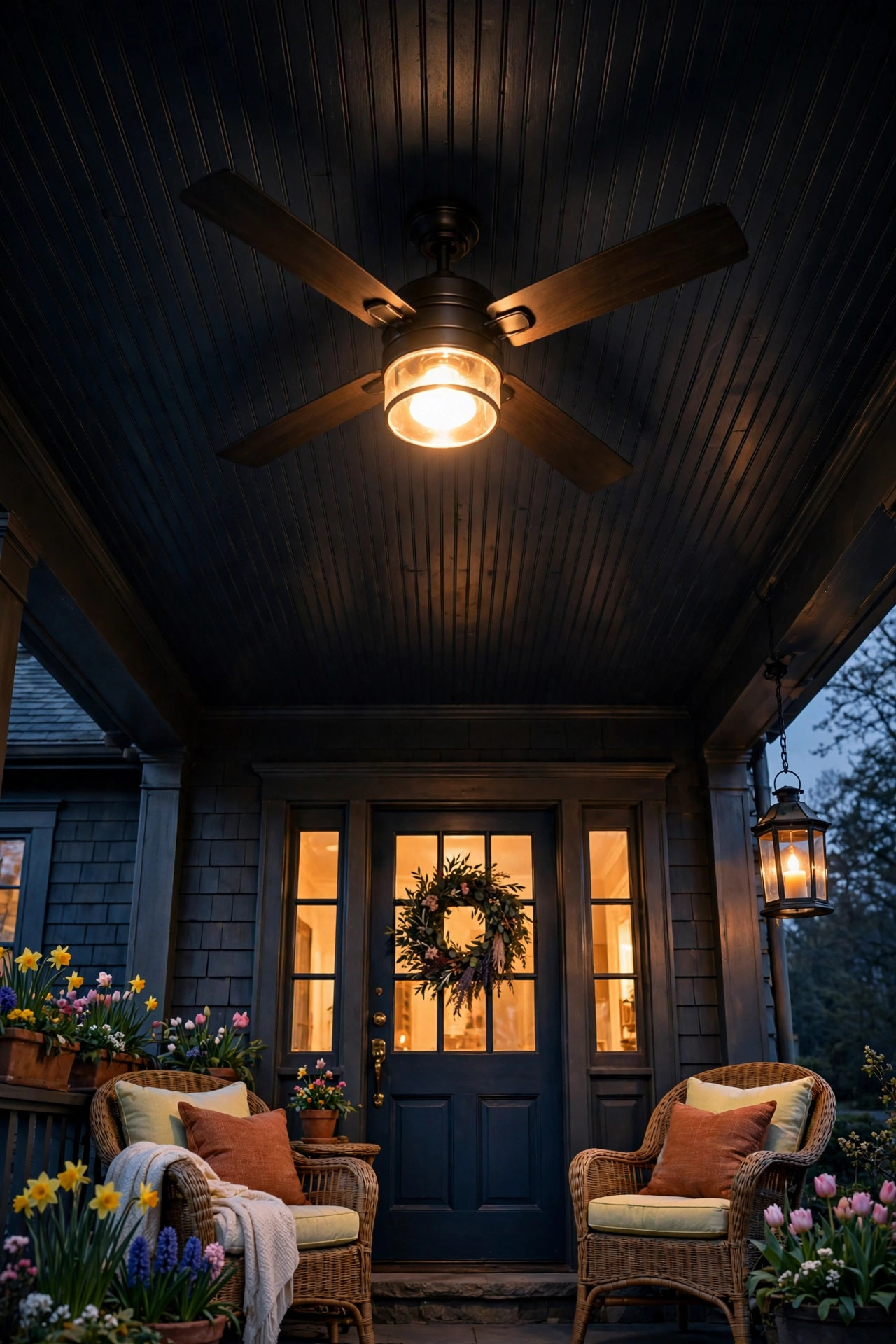
12. Overhead Fan With Integrated Light Kit
If you have a ceiling fan on the porch — and if you live in the South, you probably do — a fan with an integrated light kit does double duty all year. The light kit gives you ambient porch light while the fan keeps summer evenings bearable and actually improves the light's reach by stirring warm air in winter (run it on reverse in cold months). When choosing one, confirm it's rated for damp locations — outdoor fans have sealed motors and rust-resistant hardware that indoor fans lack. Look for a light kit with a dimmable LED module and a frosted diffuser so you don't get harsh glare when you're sitting right under it. In my experience, the fan-light combo lets you simplify everything else on the porch: with good overhead ambient light, your accent pieces (fairy lights, lanterns) can be purely decorative instead of carrying the lighting load.
Suggested budget range: $200 – $600.
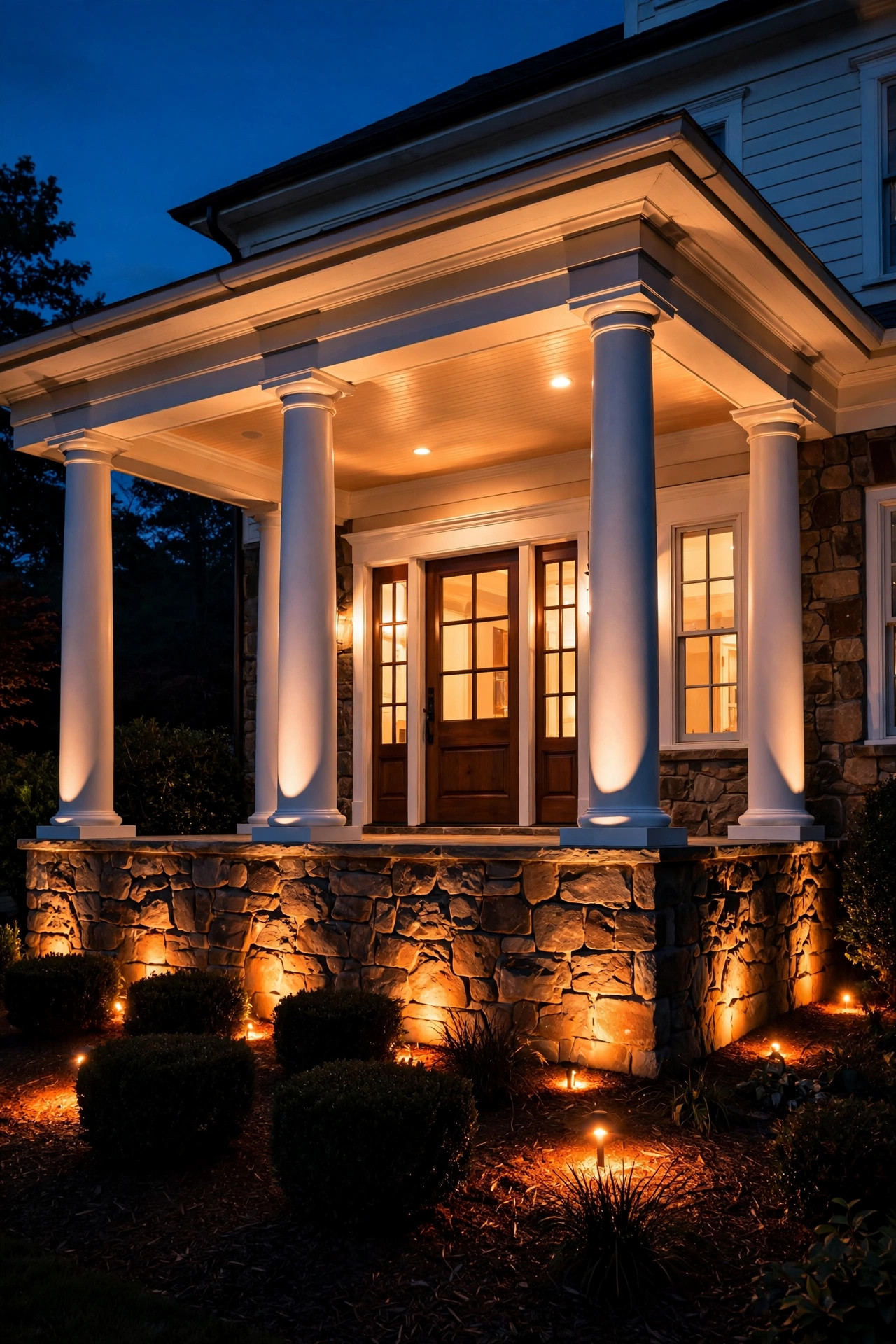
13. Uplights at the Porch Foundation
Uplighting the porch's foundation or the facade below it adds architecture-grade drama for surprisingly little money. Place small weatherproof uplights on the ground 1–2 feet out from the porch base, aimed up at the siding or stonework — the grazing light emphasizes texture and makes the whole entry look taller and more substantial from the street. Low-voltage LED uplights are the DIY path: a transformer on an outdoor outlet, cable tucked under mulch, and each light stakes or sits on the ground. Warm white 2700K keeps the effect elegant; cool white on brick or stone can look harsh. In my experience, three uplights across a standard porch facade is the sweet spot — more than that starts to look like a fast-food parking lot. Put them on the same timer as your path lights so the whole front elevation glows as one composition every evening.
Suggested budget range: $90 – $300.
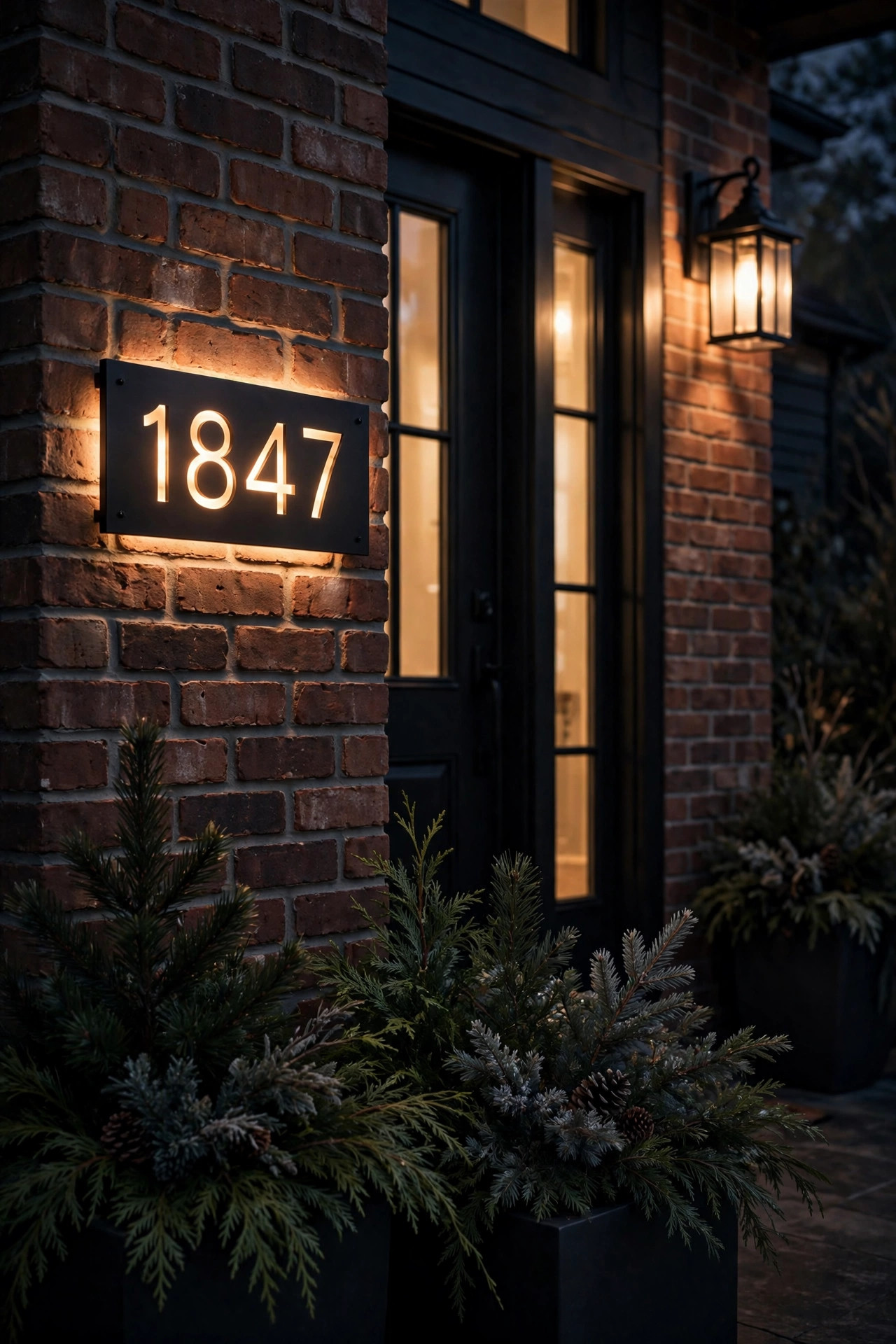
14. A Backlit House Number Sign
Your house number should be readable from the street at night — it's practical for guests, deliveries, and first responders, and a backlit sign makes it beautiful too. Mount an illuminated house number plaque beside the front door or on a porch column at eye level, wired into your porch lighting circuit or powered by a small solar panel. LED backlit numbers with warm white glow are the classic choice; modern floating-number styles look sharp on contemporary homes. Check local codes — some municipalities have visibility requirements for address numbers, which is a great excuse to do this right. In my experience, the sign reads best when the numbers contrast strongly with the plaque background (dark numbers on a light panel, or glowing white numbers on dark metal). It's a small detail that makes the whole porch feel considered, and it quietly boosts safety every single night.
Suggested budget range: $50 – $200.
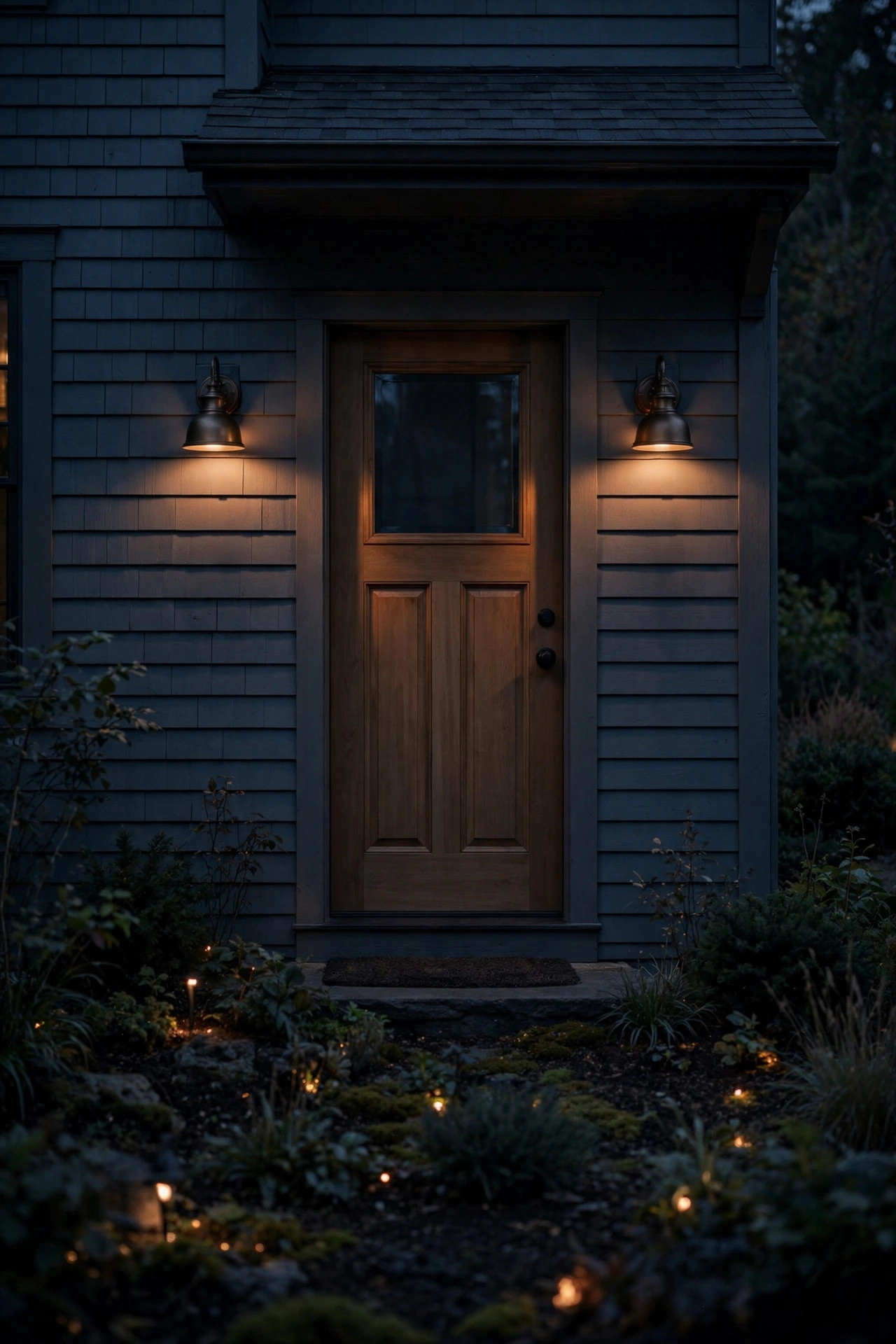
15. Dimmable Sconces for Mood Control
Static porch lighting is a missed opportunity — dimmable sconces let the same fixtures serve bright task light and soft evening mood. The key detail: your LED bulbs must be labeled dimmable, and your dimmer switch must be LED-compatible, or you'll get flickering and buzzing. A smart dimmer switch on the wall gives you phone and voice control plus scheduling, which honestly makes the porch feel like it runs itself. In my experience, the winning pattern is full brightness from dusk to about 10 p.m. (dinner, arrivals, the dog's last outing), then an automatic drop to 20–30 percent overnight as a gentle security glow. That dimmed overnight mode sips electricity — a 9-watt LED at 25 percent uses almost nothing — while keeping the porch from going dark. If your wiring is older, a plug-in lamp dimmer on string lights or lanterns achieves the same mood trick without touching the wall switch.
Suggested budget range: $80 – $250.
16. Seasonal Wreath With Built-In Lights
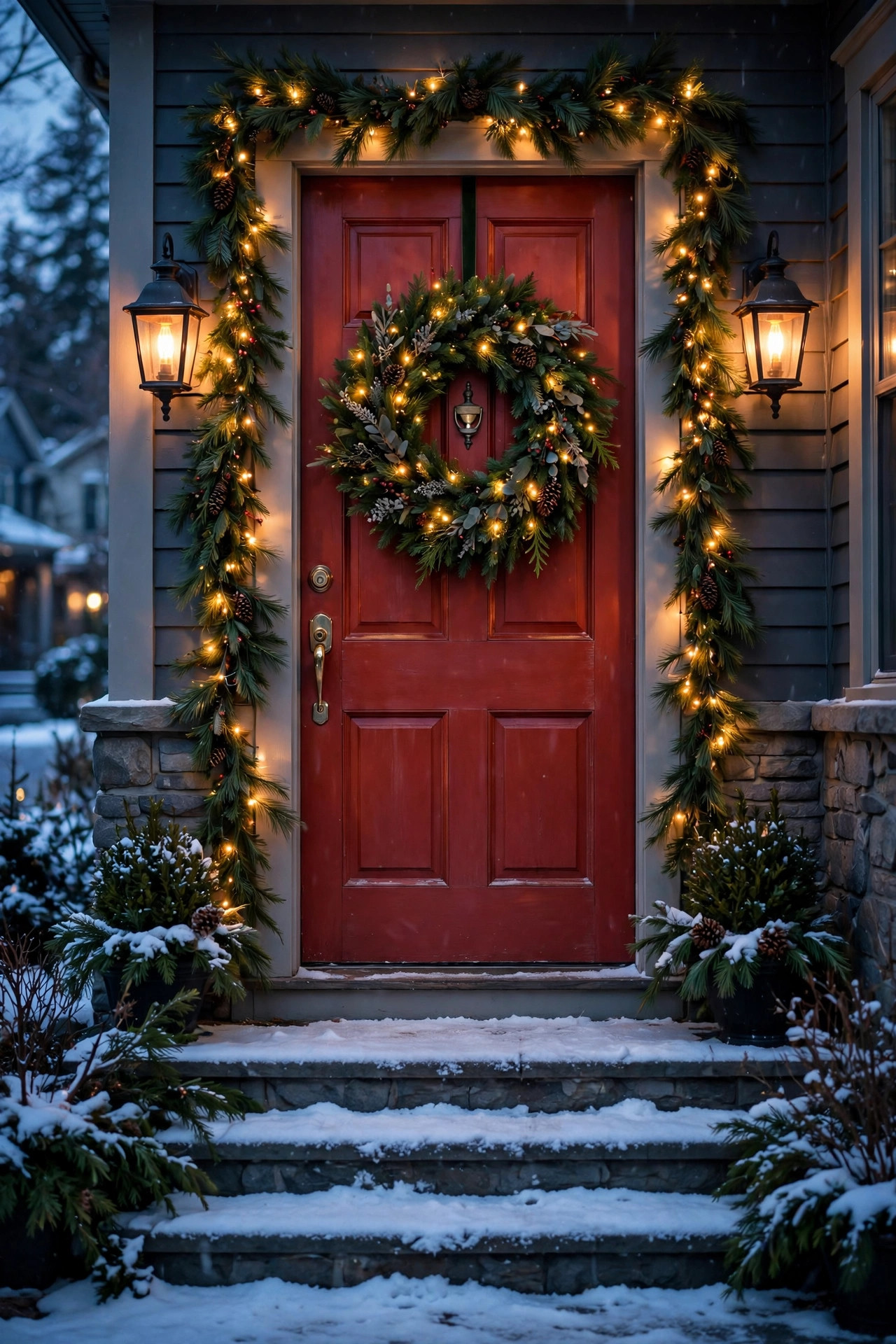
A lit wreath on the front door is the seasonal swap that never disappoints — and it works far beyond December. Start with a sturdy faux wreath in a neutral green, then weave in a battery-powered LED string (50–100 micro lights) and swap the accent decor by season: mini pumpkins for fall, pinecones and a plaid bow for winter, faux cherry blossoms for spring, seashells for summer. The lit wreath becomes a glowing focal point on the door itself, which most porches leave dark — and since it's at eye level, it has huge visual impact from the street. Use a wreath hanger over the door rather than nails, and tuck the battery pack behind the bow. In my experience, the 6-hour built-in timer on most battery strings is perfect: hang it once, and it lights itself every evening. One wreath, four seasons, endless compliments.
Suggested budget range: $35 – $120.
17. Solar Post Cap Lights on Porch Railings
If your porch has railing posts, solar cap lights turn every post into a glowing accent — no wiring required. Standard cap lights fit 4×4 or 6×6 posts and simply drop onto the post top, usually held by the cap's own lip or a couple of screws. Each one throws a soft pool of light onto the railing and porch floor below, which layers beautifully with overhead fixtures. In my experience, the warm white versions (2700–3000K) look a hundred times better than the bluish ones, so check the color temperature before you buy a whole set. Like all solar, they need direct daytime sun on the panel — if your porch is heavily shaded, pick a set with remote panels you can mount out in the yard. Space them on every post, or every other post on long railings for a more subtle rhythm. They're a small purchase that makes the railing read as finished architecture at night.
Suggested budget range: $60 – $180.

18. Rope Lighting Along the Porch Edge
Rope light is the quiet overachiever of porch lighting: it traces architectural lines with a continuous ribbon of glow that no other fixture can match. Run LED rope light along the underside of the porch roof edge, tucked just out of sight so you see the glow, not the source — that hidden-source trick is what makes it look professional. Use outdoor-rated LED rope in warm white, and secure it with mounting clips every 12–18 inches so it doesn't sag over time. In my experience, rope light along the eave line makes the whole porch read as one glowing composition from the street, and it works as your ambient layer so your sconces and accents can be dimmer. Plug it into a smart plug or dusk-to-dawn timer. One caution: cheap rope lights fade and yellow within a year — spend the extra for a quality silicone-jacketed LED rope and you'll get five-plus years out of it.
Suggested budget range: $50 – $160.

19. Statement Entry With Oversized Gooseneck Lights
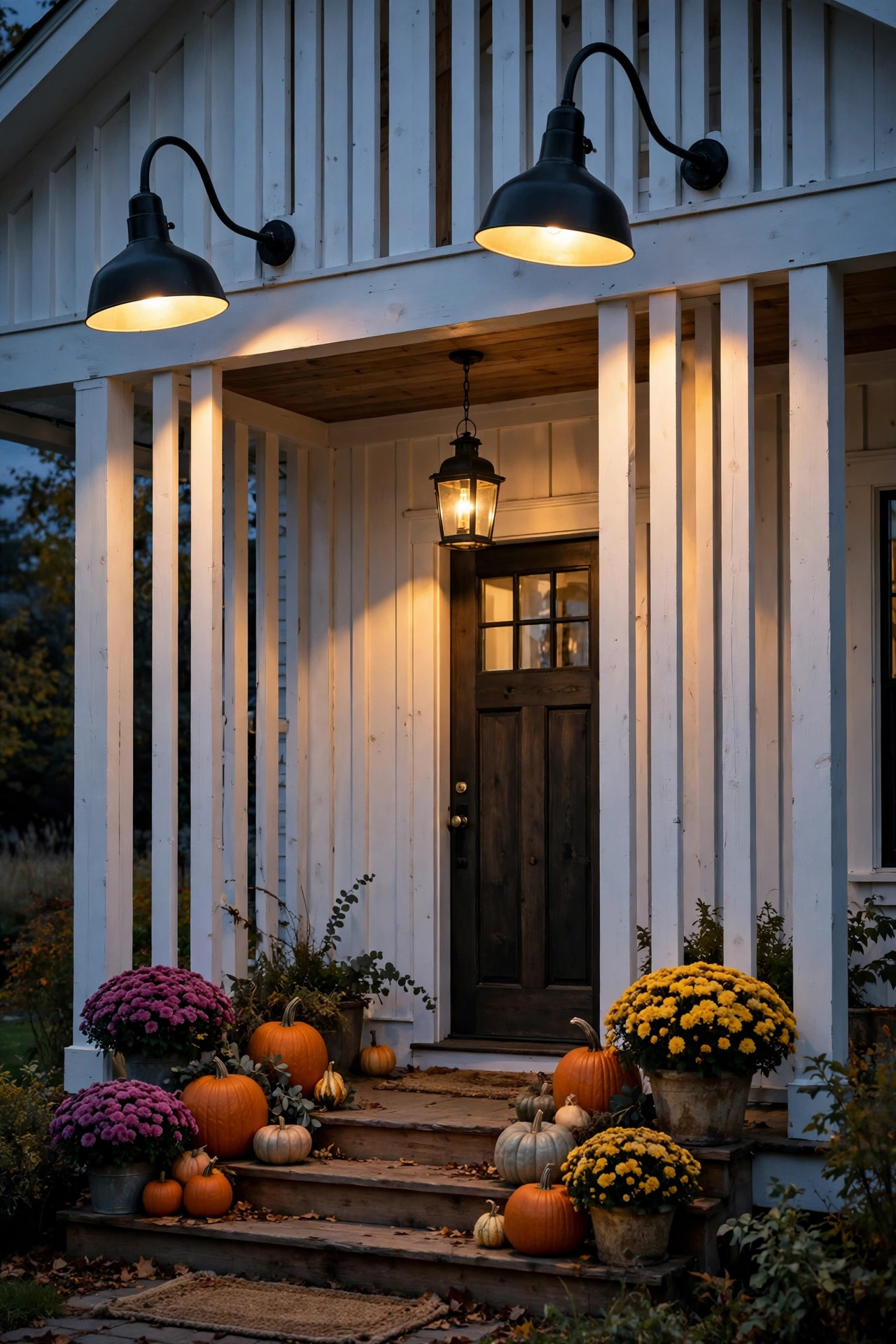
Gooseneck lights — those curved-arm barn-style fixtures — give a porch instant farmhouse or industrial character, and going oversized makes the statement. The rule here is the opposite of the delicate-sconce rule: the fixture's shade should be 14–18 inches in diameter for a standard door, mounted 8–12 inches above the door frame so the light washes down over the entry. In my experience, one centered gooseneck over the door plus a matching pair on the garage or porch side walls creates a cohesive look across the whole facade. Choose a matte black or aged-metal finish and a shade that directs light downward — that's the whole point of the gooseneck shape, a pool of task light right where you need it. Wet-rated fixtures are a must if the wall is exposed to rain. Pair with warm Edison-style LED filaments for that vintage glow, and you've got curb appeal that reads from a block away.
Suggested budget range: $150 – $450.
20. Timer-Controlled Outlet System for All Plug-Ins
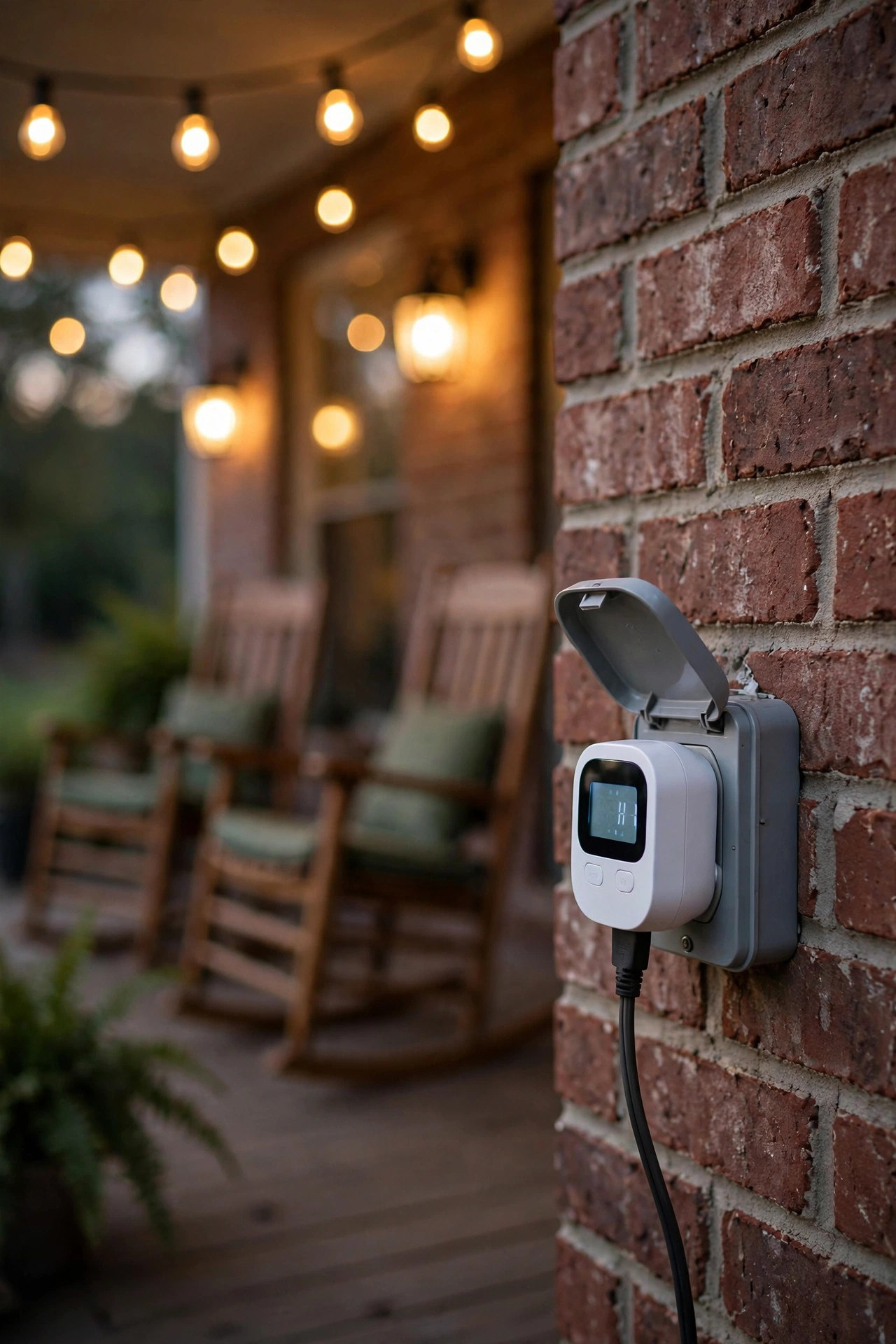
Here's the behind-the-scenes idea that makes everything else effortless: put every plug-in porch light on a timer system. A single outdoor-rated smart plug (or an old-school mechanical timer) on a power strip rated for outdoor use lets you schedule string lights, rope lights, lanterns, and seasonal decor to one dusk-to-dawn rhythm. In my experience, this is the difference between a porch that glows every evening and a porch that glows only when someone remembers. Outdoor smart plugs with two independently controlled outlets are the sweet spot — run your year-round string lights on one outlet schedule and your seasonal pieces on another. Make sure the plug is rated for outdoor use with a weatherproof cover, and keep connections off the ground where puddles form. If your Wi-Fi doesn't reach the porch reliably, a mechanical or astronomical timer (which adjusts for sunset times automatically) is the bulletproof low-tech alternative.
Suggested budget range: $30 – $100.
21. Spotlighting a Statement Tree or Shrub
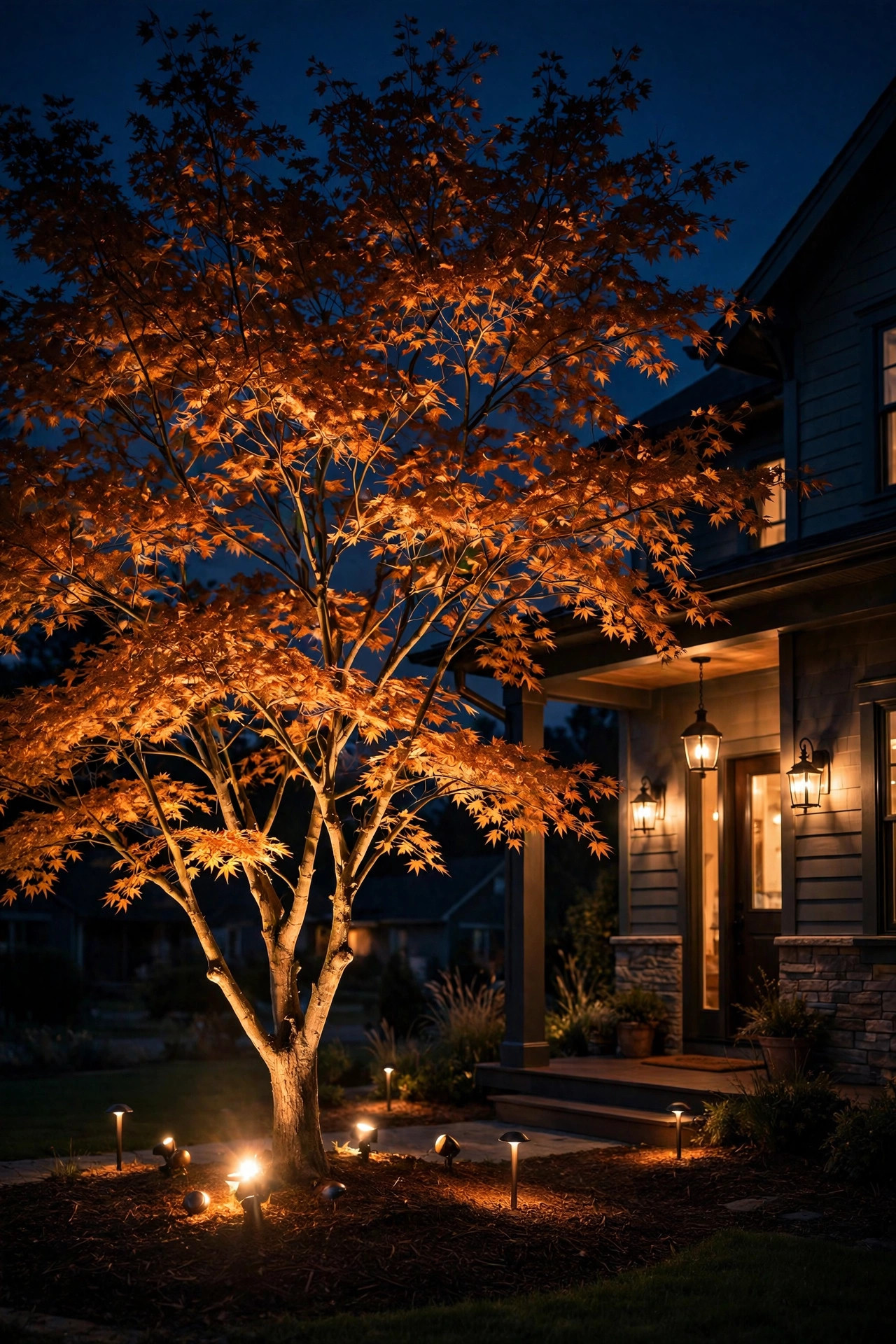
A well-placed spotlight on the landscape just beyond your porch pulls the whole front yard into the composition — and it costs far less than most people assume. Position a low-voltage LED spotlight at the base of a statement tree or large shrub near the porch, aimed up through the branches to create dramatic shadows on the facade behind. In my experience, one fixture per tree is plenty; two can cross-light a wide canopy for a more theatrical effect. Warm white (2700–3000K) keeps it natural — cool white on foliage looks artificial and harsh. Bury the cable 2–3 inches under mulch and run it back to the same transformer as your path lights, on the same timer. The spotlighted tree becomes the backdrop your porch lighting plays against, adding depth that makes a small porch feel grand. It's also the trick that makes winter-bare trees look intentional rather than sad.
Suggested budget range: $70 – $220.
22. Candle-Style Wall Sconces for Classic Charm
Candle-style sconces — slim fixtures with exposed flame-tip bulbs — bring an old-world elegance that pairs beautifully with traditional and colonial homes. Mount them in flanking pairs beside the door at 60–66 inches to center, same as any door sconce, but keep the fixtures slim (4–6 inches wide) so the candle silhouette reads clearly. LED flame-tip bulbs are the modern must: they give you the candle look at a fraction of the energy, and they're cool to the touch near door trim and wreaths. In my experience, a single clear-glass hurricane sleeve around each bulb cuts glare while keeping the flame visible — it's the detail that elevates the whole look. These fixtures run beautifully on the same dimmer as the rest of the porch, and honestly, they photograph like a dream in every season. Just confirm the fixture is damp-rated if it's under a covered porch, wet-rated if it's exposed.
Suggested budget range: $90 – $320.
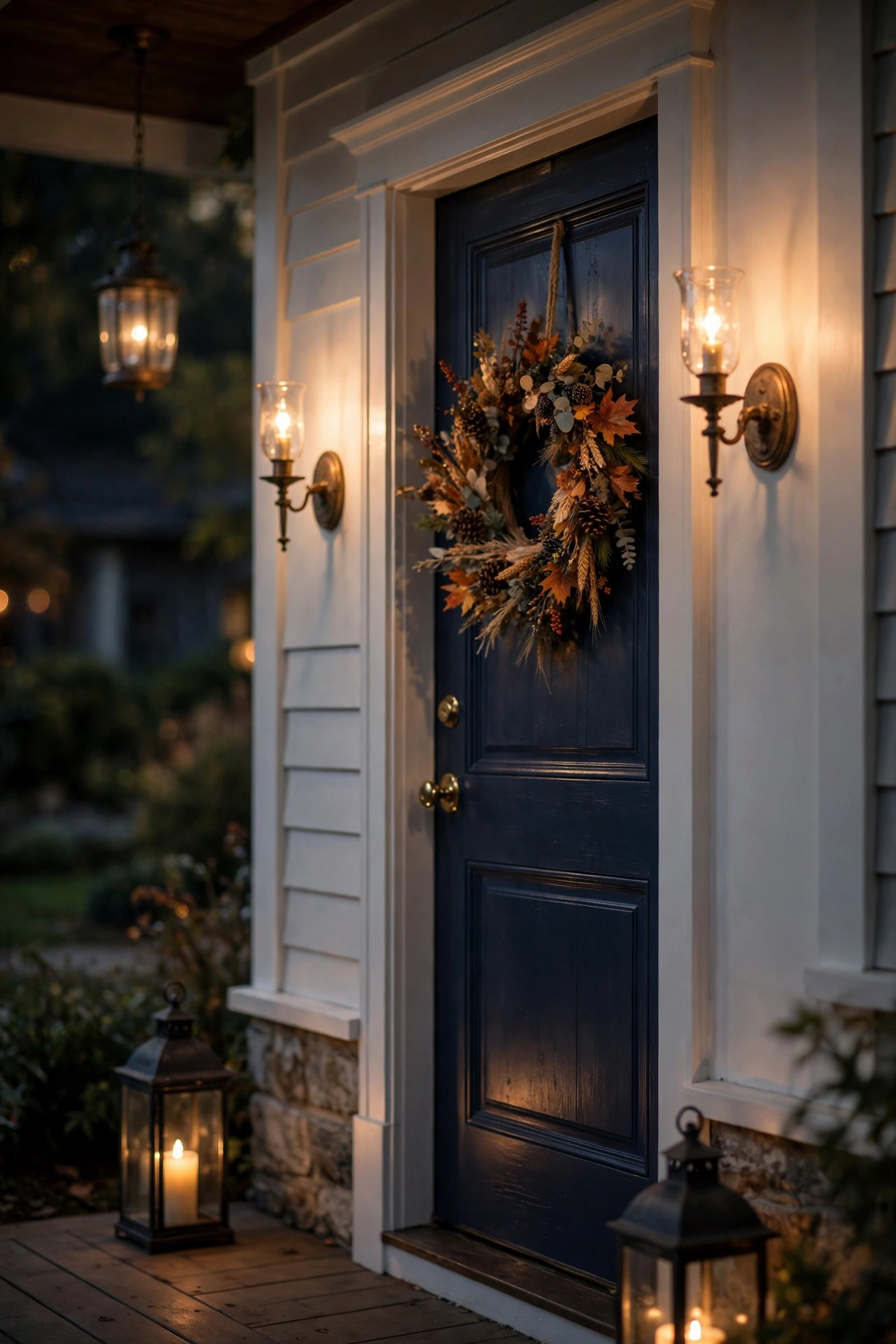
23. Layered Doormat Zone With Accent Lighting
The doormat zone — the three feet in front of your door — deserves its own little lighting moment. Layer a small accent light here: a low-profile LED spot aimed at the mat, a pair of mini lanterns flanking the doorway at floor level, or even a solar stake light tucked into the planter beside the door. The point is task light exactly where feet land and keys get fumbled, plus a visual anchor that draws the eye to the entry. In my experience, this is the detail that makes a porch feel safe and cared-for at night — visitors instinctively head toward the brightest spot, so make that spot your doorstep. Keep the light warm and low (2700K, and aimed down or shielded) so it doesn't glare into anyone's eyes. Pair it with a textured layered doormat look — a flat woven rug under a coir mat — and the entry reads as styled from the curb.
Suggested budget range: $40 – $140.
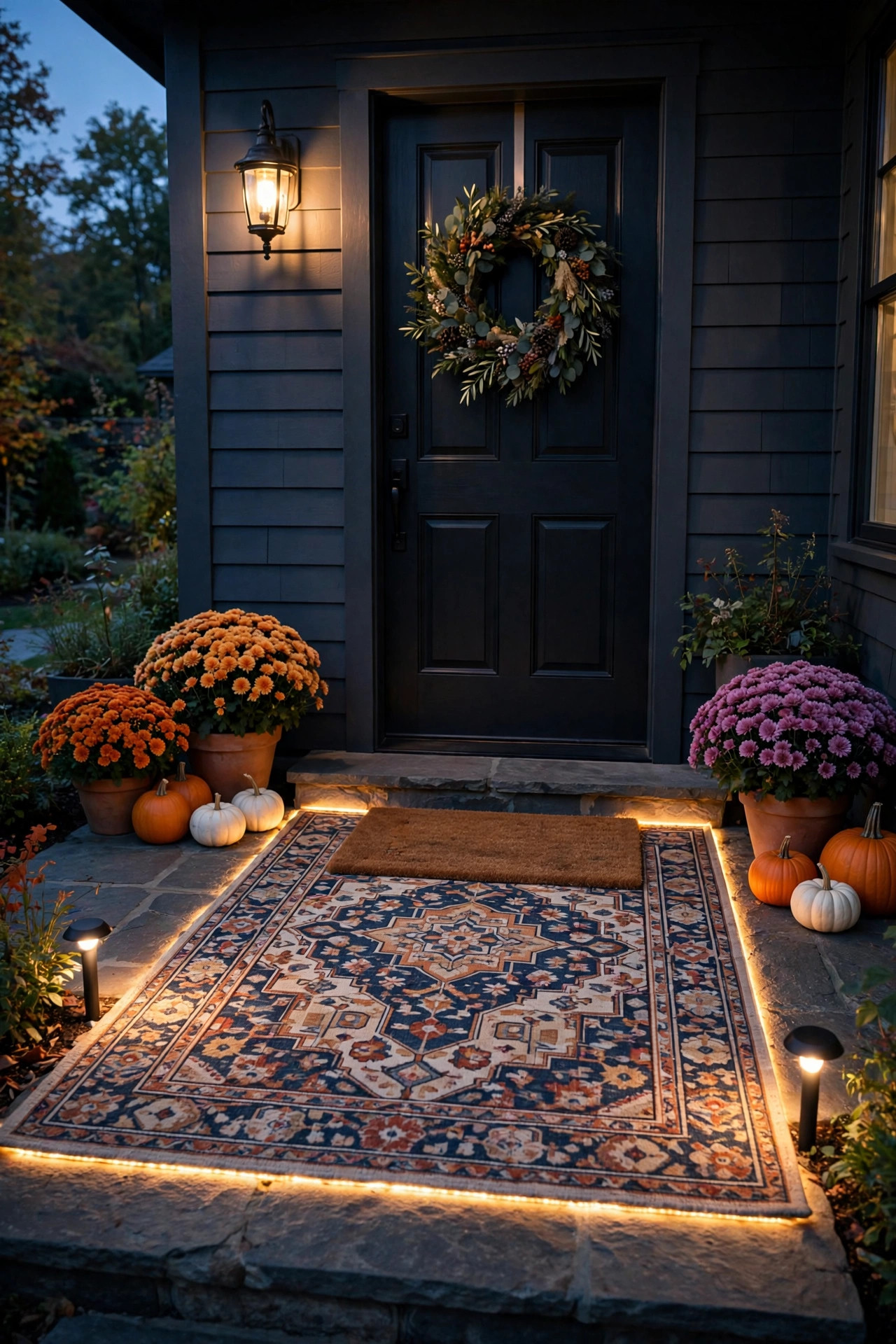
24. Seasonal Color-Changing Bulbs for Holidays
Year-round curb appeal gets easier when your fixtures can change color with the seasons. Swap your standard porch bulbs for outdoor-rated color-changing smart bulbs and suddenly your year-round sconces become your Halloween, Thanksgiving, and Christmas decor too: amber and purple for October, warm gold for Thanksgiving, red and green for December, soft pastels for spring. In my experience, this beats stringing seasonal lights every single time — no ladders, no tangled strands, no storage bins. Set the colors on a schedule (orange from the first week of October through Halloween, for instance) and the porch transforms itself. Keep one or two fixtures in warm white year-round as your anchor so the colored light reads as accent rather than chaos — a fully red porch is fun for a party but tiring every night. When the season passes, one tap in the app returns everything to classic warm white.
Suggested budget range: $50 – $180.
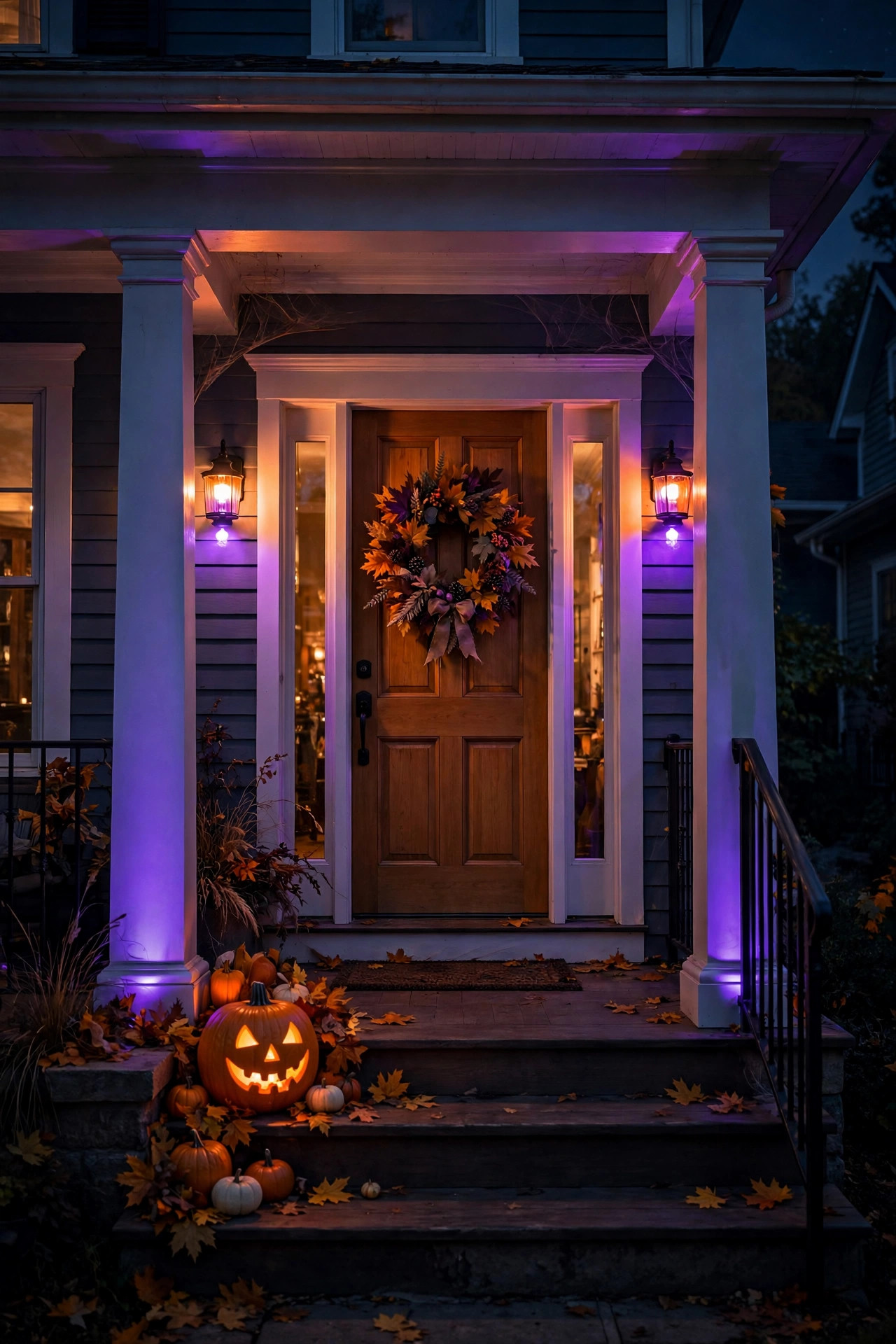
25. A Complete Layered Lighting Plan (Ambient + Task + Accent)
The final idea ties everything together: stop thinking in single fixtures and plan your porch in three layers. Ambient light is your foundation — the overall glow from a ceiling pendant, chandelier, or rope light that lets you see the whole space. Task light is the focused brightness where you need it — sconces by the door, step lights on the stairs, a gooseneck over the entry. Accent light is the jewelry — fairy lights on columns, lanterns on the floor, a lit wreath on the door. In my experience, porches with all three layers look intentional in every season, while porches with only one layer look flat no matter how expensive the fixtures. Sketch your porch on paper, assign each zone one job, and put each layer on its own timer or dimmer so you can run them independently. Honestly? This plan is the whole secret behind every porch you've ever admired from the street — and now it's yours to copy.
Suggested budget range: $300 – $1,200.
Frequently Asked Questions
How bright should porch lights be?
For a typical front porch, aim for 450–800 lumens per main fixture — that's roughly the output of a traditional 40–60 watt incandescent, now easily covered by a 6–9 watt LED. Bright enough to see faces, keys, and steps clearly, but not so bright it glares into the street or your neighbors' windows. Layer multiple softer sources rather than one blinding fixture; the combined effect feels brighter and looks far better. For security wash lighting, you can go up to 1,000–1,500 lumens on motion-sensor floods, since those only fire briefly.
At what height should porch sconces be mounted?
Mount the center of each wall sconce 60–66 inches above the porch floor — roughly eye level for most adults. Keep them 6–8 inches from the door trim on each side for a classic flanking look. For the fixture size itself, follow the one-third rule: each sconce should be about one-third the height of your door. On an 80-inch door, that's a 26–28 inch fixture. Pendants and chandeliers hang lower — the bottom of the fixture should clear 7 feet above the floor so tall guests don't duck.
What color temperature is best for front porch lighting?
Warm white, 2700K to 3000K, is the answer for nearly every porch. It flatters skin tones, makes wood and brick glow, and reads as welcoming from the street. Cooler temperatures (4000K+) look clinical and can wash out your home's exterior colors — save those for task-heavy areas like a workshop. If you want flexibility, tunable-white smart bulbs let you run warm white most evenings and shift brighter when you're expecting guests or a late delivery.
Should I leave my porch lights on all night or use a timer?
A timer (or smart schedule) beats all-night-on in almost every case. Running full brightness all night wastes electricity and can actually reduce security — a porch that never changes gives no signal that anyone's home or awake. The setup I recommend: full warm light from dusk until around 10 or 11 p.m., then drop to a dim 20–30 percent glow overnight, or switch to a dual-brightness motion sensor that holds low and jumps to full on movement. Dusk-to-dawn timers and smart plugs make this automatic, so you get the security benefit without the electric bill.
Conclusion
Great front porch lighting ideas share one secret: they layer ambient, task, and accent light so your entry glows beautifully in every season — not just during the holidays. Start with solid foundations (properly sized sconces or a pendant), add safety layers (step lights, path lights, motion sensors), then have fun with the accents (fairy lights, lit wreaths, seasonal color bulbs). Put it all on timers and smart schedules, and your porch will light itself beautifully while you barely lift a finger. If you're hungry for more inspiration, browse the site's collection of outdoor and seasonal lighting ideas — including expert lighting tips that go beyond the porch — because your entry is just the beginning of what great exterior lighting can do.