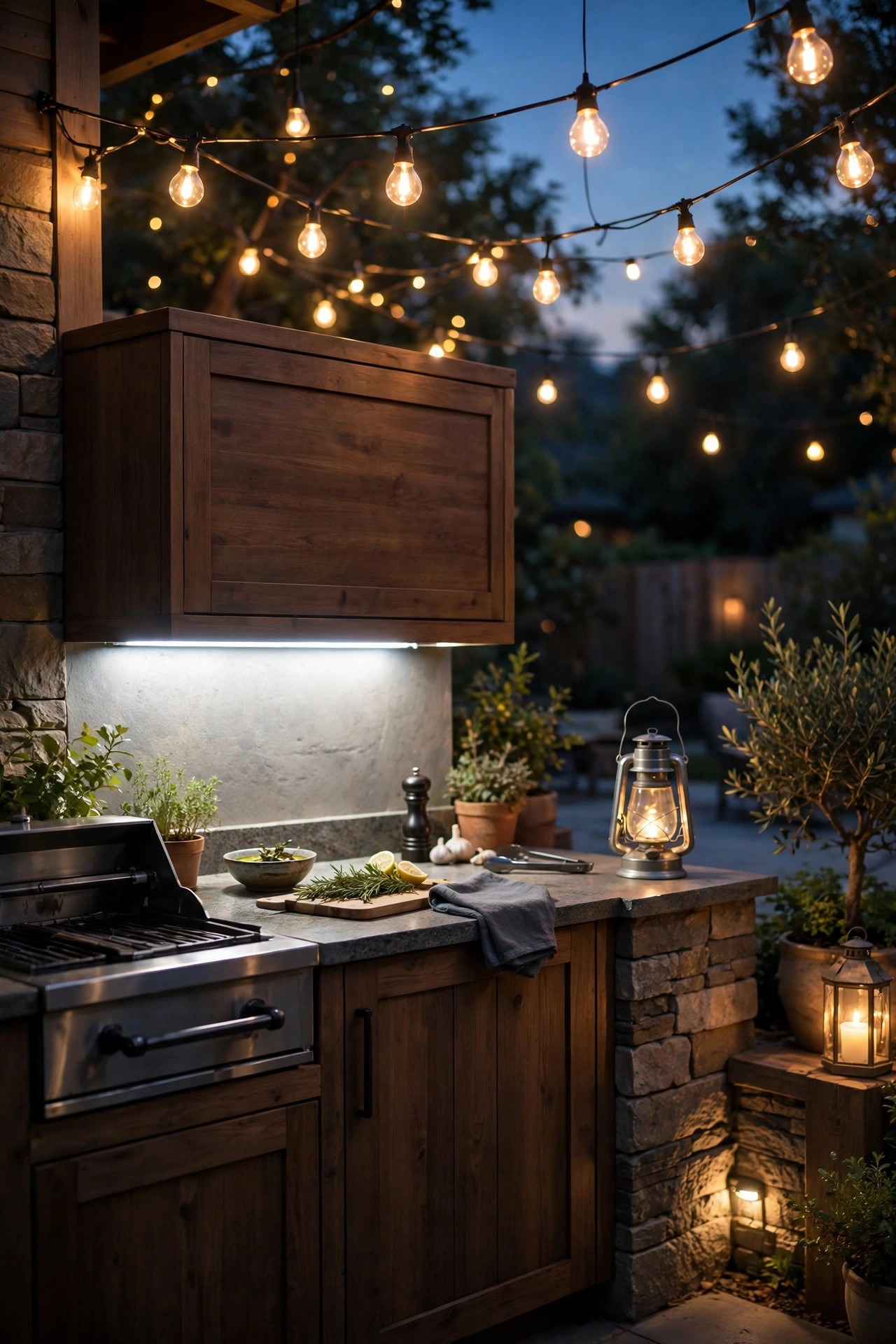
Our patio is not big. The whole outdoor kitchen is one short run of cabinets, a compact grill, and just enough counter space to start an argument — and honestly? It is my favorite room in the house once the sun goes down. The turning point was never a bigger grill or fancier stone. It was light. These small outdoor kitchen lighting ideas are the exact layers I pieced together over two summers of cooking in a space where every inch, and every single outlet, had to earn its keep. Here is the secret nobody tells you: a small kitchen is easier to light beautifully than a big one. A handful of well-placed fixtures can wrap the whole zone in warm, useful glow without glare, clutter, or a scary electrician bill. My rule is the same layering I use indoors — bright task light where the knives and tongs work, soft ambient light so faces look good across the counter, and a little accent sparkle just for mood. Below are 17 compact-friendly picks, each with realistic prices and the placement tricks that make a tiny cook space feel twice its size.
1. Under-Cabinet LED Strips, the Backbone of Small Outdoor Kitchen Lighting Ideas
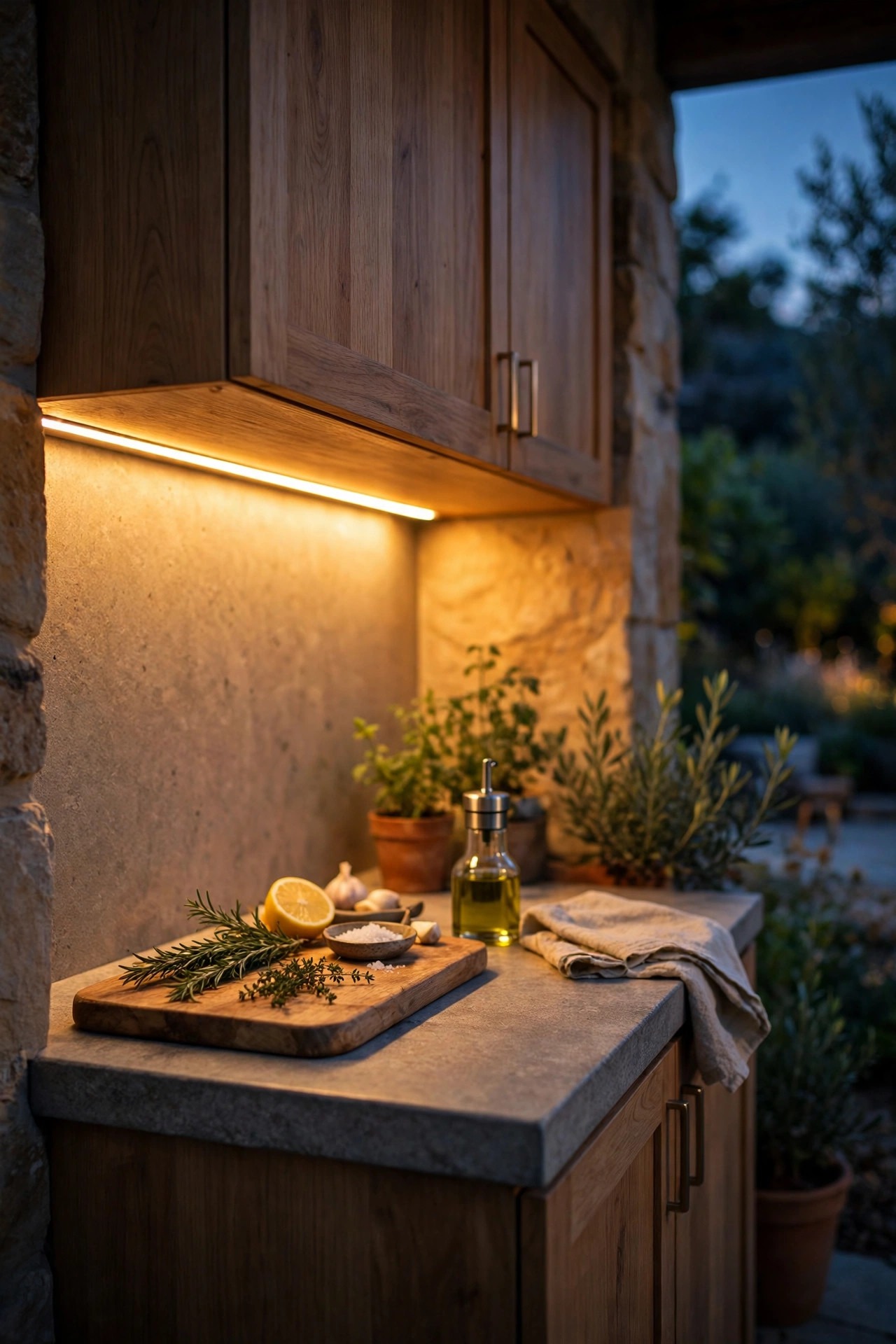
If you only buy one thing on this list, make it this. A slim LED strip tucked under a wall cabinet or floating shelf, right over your prep counter, puts bright, shadow-free light exactly where you are chopping, seasoning, and plating. In a small kitchen that one strip does the work of three fixtures. Look for a strip rated IP65 or better so steam, splashes, and surprise rain showers are non-issues, and choose warm white in the 2700–3000K range so food looks appetizing instead of clinical. No outlet nearby? Battery and USB-rechargeable strips with motion sensors are genuinely good now — mine charges about once a month in grilling season. Mount the strip toward the front edge of the cabinet, not the back wall, so the light falls on the counter and not into your eyes. An aluminum channel with a frosted cover diffuses the dots into one smooth wash and looks far more expensive than it is. Keep strips at least a few inches from direct grill heat, and let them run the full width of your prep zone — in a compact run that is usually just one 3 to 4 foot strip.
Suggested budget range: $20 – $55.
2. Hang One Statement Pendant Over the Counter
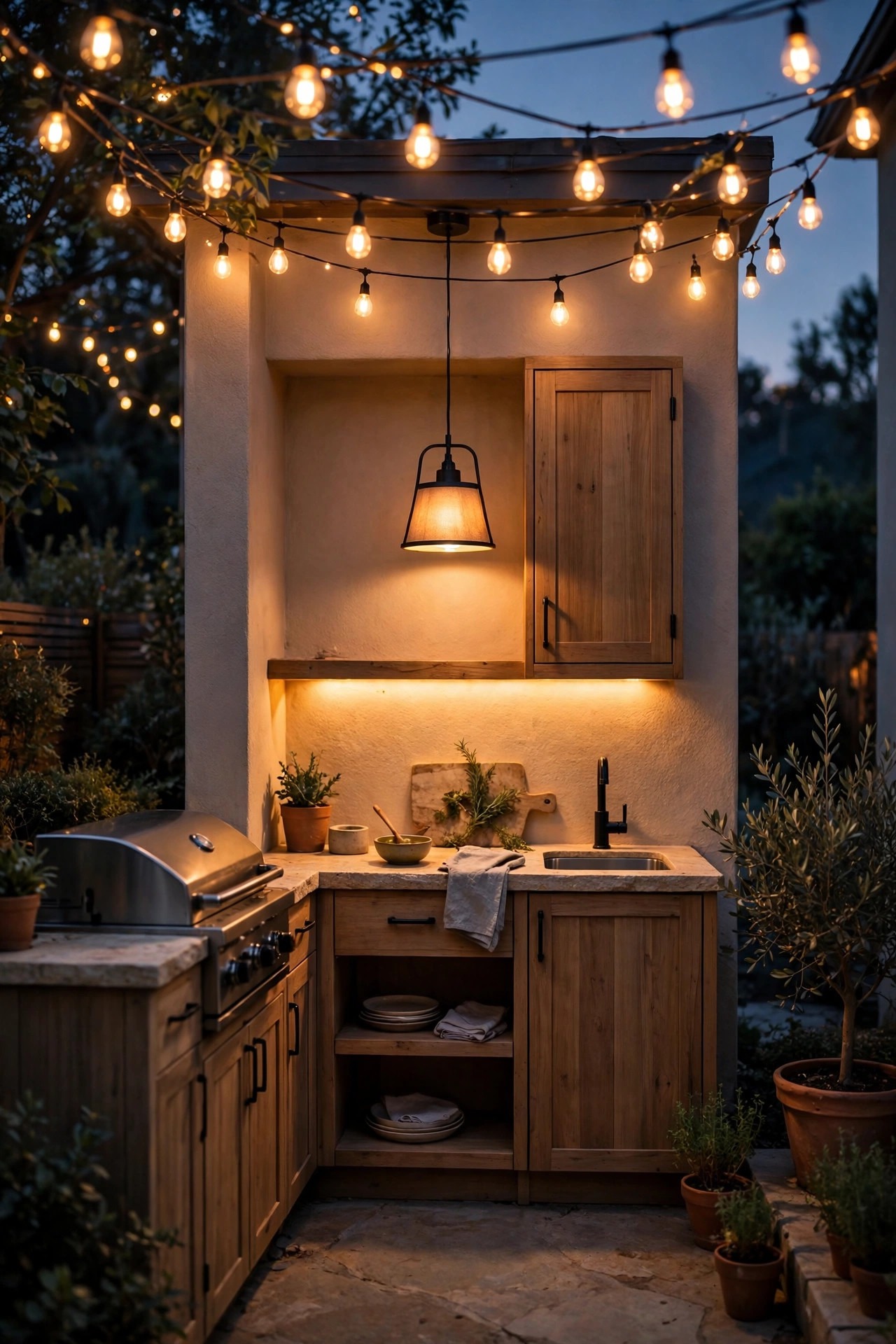
Big kitchens get a row of pendants. Yours gets one perfect pendant, and honestly, it looks more intentional. A single damp- or wet-rated pendant centered over your main counter or small island gives you focused task light and an instant focal point that makes the whole setup read as designed, not assembled. Hang it 30 to 36 inches above the counter surface — low enough to pool the light where you work, high enough that tall cooks and taller serving platters clear it easily. In a compact footprint, one medium pendant (10 to 14 inches across) beats two small ones, which just add visual clutter and dueling shadows. Choose an LED filament-style bulb for that warm restaurant glow, and put it on a dimmer if you can; full brightness for prep, half for lingering. If hardwiring is not in the cards, a plug-in pendant with an outdoor-rated cord swagged to a hook gets you 90 percent of the look in an afternoon. My full roundup of outdoor pendant light ideas covers the shapes and finishes that hold up best outside.
Suggested budget range: $45 – $120.

3. Stick-On Puck Lights for Shelves and Cabinet Interiors
Puck lights are the quiet overachievers of a small kitchen. Stick a few battery-powered pucks under open shelves, inside the grill cabinet, or beneath a raised serving ledge and suddenly every dark corner where the tongs hide is lit. Most are peel-and-stick or screw-mount, run on rechargeable batteries, and turn on with a tap or a little remote — no wiring, no electrician, no drama. I keep two inside the cabinet where the platters live, because fishing around in the dark with a tray of raw chicken is a hard no. Look for pucks with a warm color temperature to match the rest of your lighting; a blue-white puck in a sea of warm light looks like a tiny interrogation room. Motion-activated versions are wonderful inside cabinets since they switch off on their own. One caution: adhesive pads give up in serious summer heat, so use the screw mounts anywhere the puck hangs overhead. A six-pack covers most compact kitchens with spares left over for the cooler chest lid, which, yes, I have absolutely done.
Suggested budget range: $15 – $40.

4. Solar Lanterns That Live on the Counter
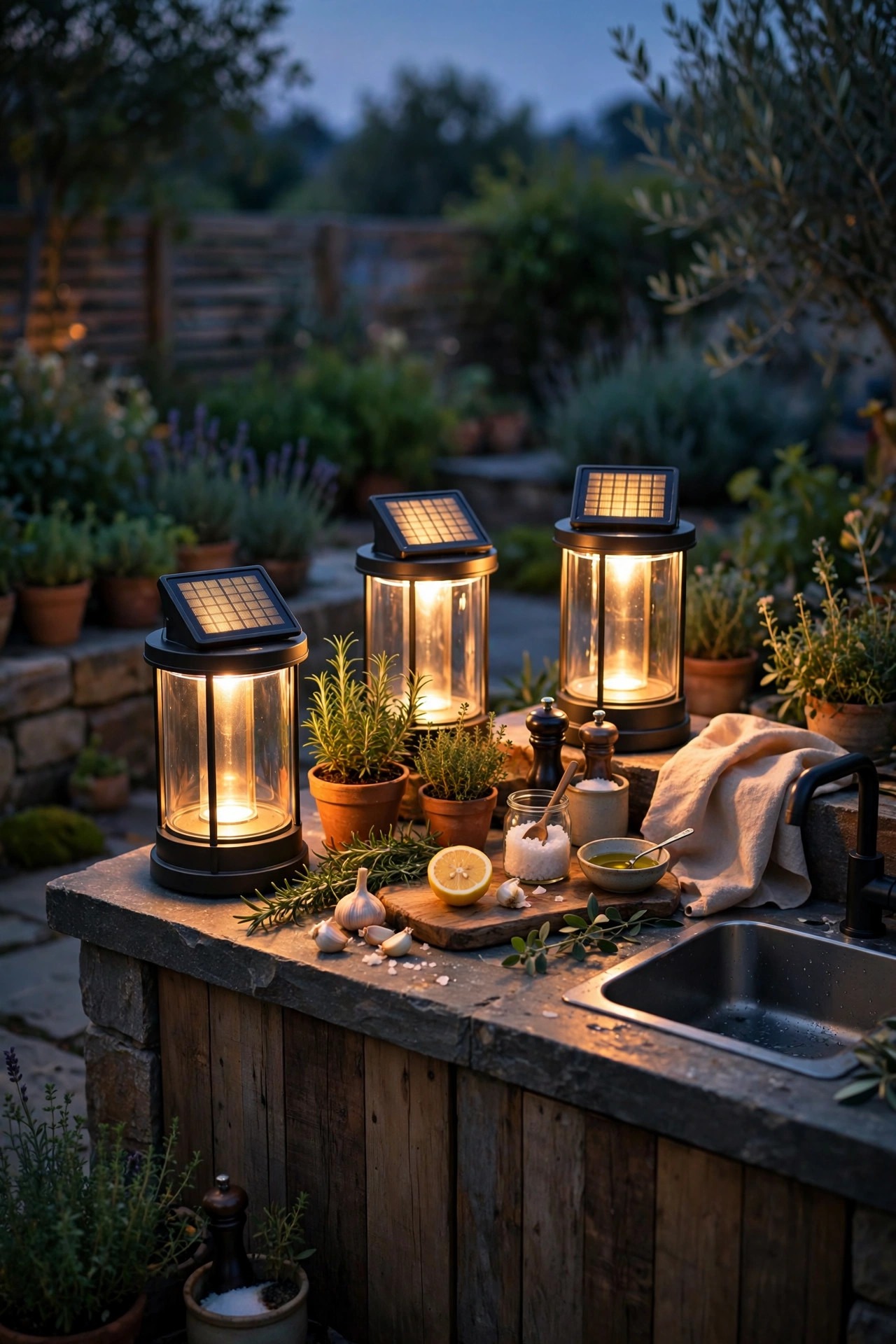
Counter space is precious in a compact kitchen, so anything earning a permanent spot has to multitask. Solar lanterns do: they charge quietly in the sun all day, then give you soft, movable ambient light all evening. I keep two on the serving end of the counter and carry them to the table when we sit down — try doing that with a hardwired fixture. Choose lanterns with a warm LED and a real solar panel sized for partial shade if your patio is covered; the tiny decorative ones fade by nine o'clock. A handle matters more than you think, and so does a weighted base, because a lightweight lantern on a breezy night becomes a projectile with ambiance. Flameless solar lanterns are also the safest accent near paper towels, wooden utensils, and recipe cards. Group two or three at different heights on a small tray and they read as a styled centerpiece instead of clutter. In winter I bring mine indoors — the batteries last noticeably longer when they are not freezing on the patio.
Suggested budget range: $20 – $50.
5. Swag One Strand of String Lights Over the Whole Zone
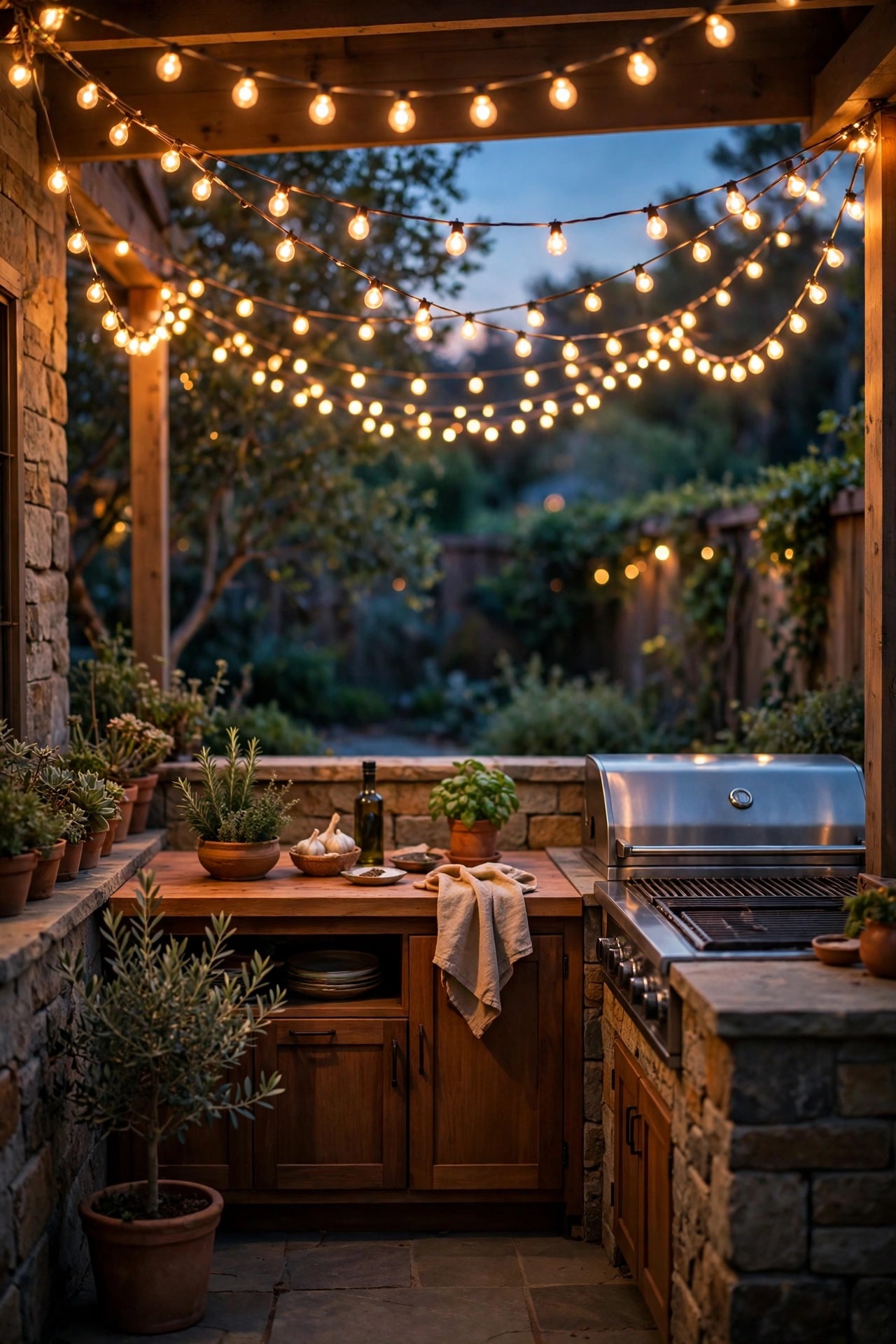
In a small outdoor kitchen, one strand of commercial-grade string lights can do the ambient work of half a dozen fixtures. Run a single 25 to 48 foot strand in a gentle swag from the house wall to a fence post or pergola corner, passing right over the cooking and serving zone, and the entire space sits under one warm canopy. Keep the lowest point of the swag at least 7 feet off the ground, and route it beside — never directly over — the grill, so heat and grease vapor do not coat the bulbs. Shatterproof LED bulbs in 2700K are the move outdoors; they sip power, survive drops, and will not shatter over food. Use screw-in hooks or a simple guide wire for spans over 15 feet so the strand does not sag onto anyone's head by August. One strand, one plug, one GFCI outlet: that is the whole install. The effect is disproportionate — guests always assume the lighting was the expensive part of our kitchen, and it was nearly the cheapest.
Suggested budget range: $30 – $75.
6. A Clip-On Task Light for the Grill
Grill lids are liars. That beautiful sear you think you see under the patio light is guesswork, and the clip-on grill light ends the guessing. These little lights clamp onto the grill handle or side shelf and aim a focused, heat-tolerant beam right at the grates, so you can actually judge color and doneness after dark. Look for an LED model with a flexible gooseneck, a clamp that opens wide enough for your handle, and a heat rating meant for grill duty — this is not the place for a random desk lamp. Battery power is fine and keeps cords away from hot surfaces entirely. Position the beam slightly from the side rather than straight down; angled light shows texture and char lines far better. One safety note I am firm about: the light itself is LED and cool-running, but keep the clamp and battery pack off the firebox and lid surfaces that get scorching hot. When dinner moves to the table, unclip it and use it to light the serving counter. Two jobs, one tiny light.
Suggested budget range: $15 – $35.

7. Toe-Kick Strips That Make Cabinets Float
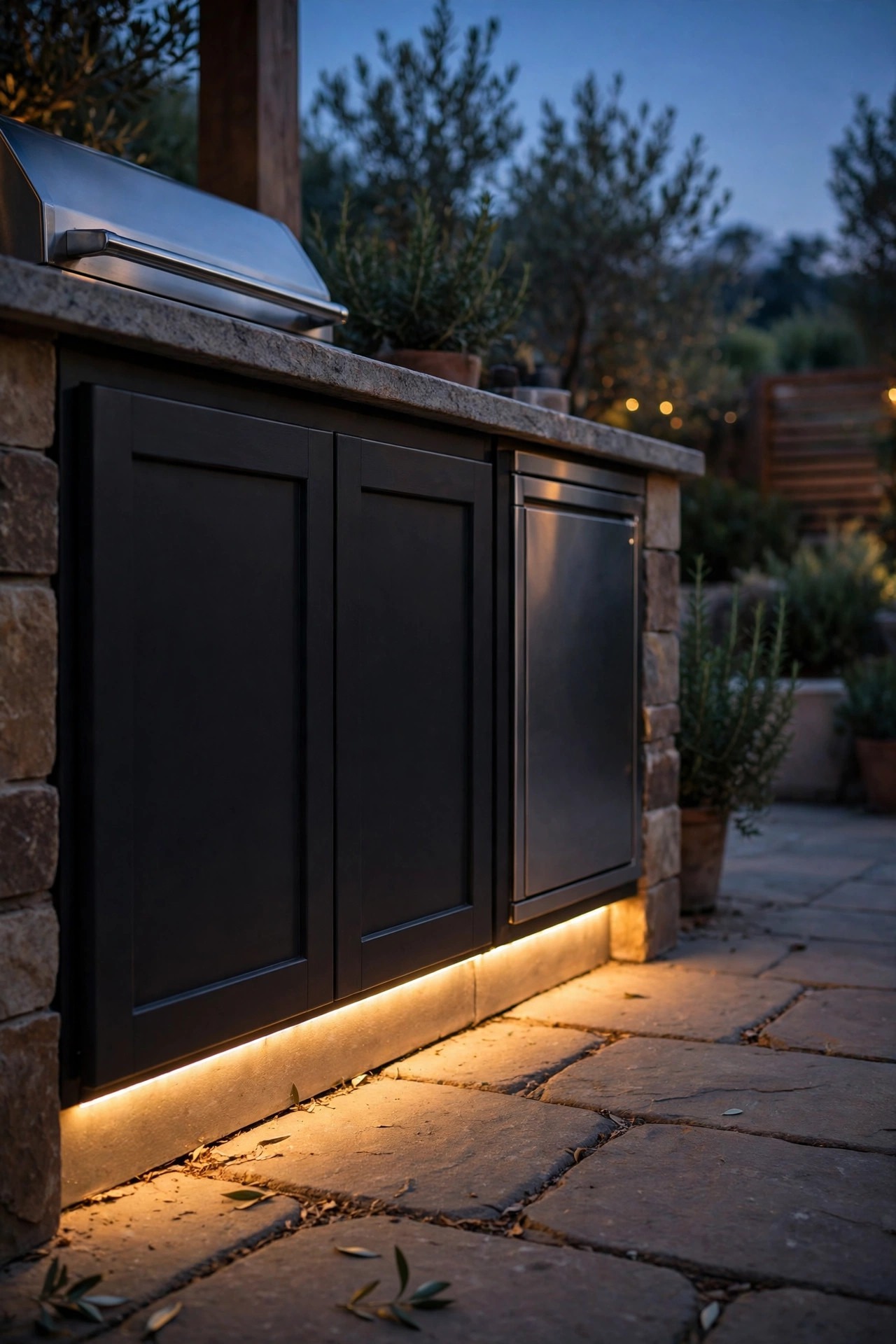
Toe-kick lighting is the trick I stole from indoor kitchen designers, and it might be my favorite small-space move. A low LED strip tucked along the recessed base of your cabinets washes the patio floor with a soft glow, makes the cabinetry look like it floats, and quietly lights the ground where dropped tongs, runaway cherry tomatoes, and the dog all end up. Because the light is low and indirect, it adds atmosphere without any glare at eye level, which matters when your whole kitchen is eight feet wide. Use a low-voltage strip rated for outdoor use, and run it on the same timer as your ambient lighting so the whole kitchen wakes up together at dusk. A warm 2700K strip reads as candlelight bouncing off the pavers; anything cooler starts to feel like a parking garage. This is also sneaky-good safety lighting for the step down off a raised patio. Keep the strip recessed so shoes and brooms do not catch it, and seal the ends against sprinkler spray. Small kitchen, floating cabinets, zero extra floor space used.
Suggested budget range: $25 – $60.
8. Flameless Candles at the Serving End
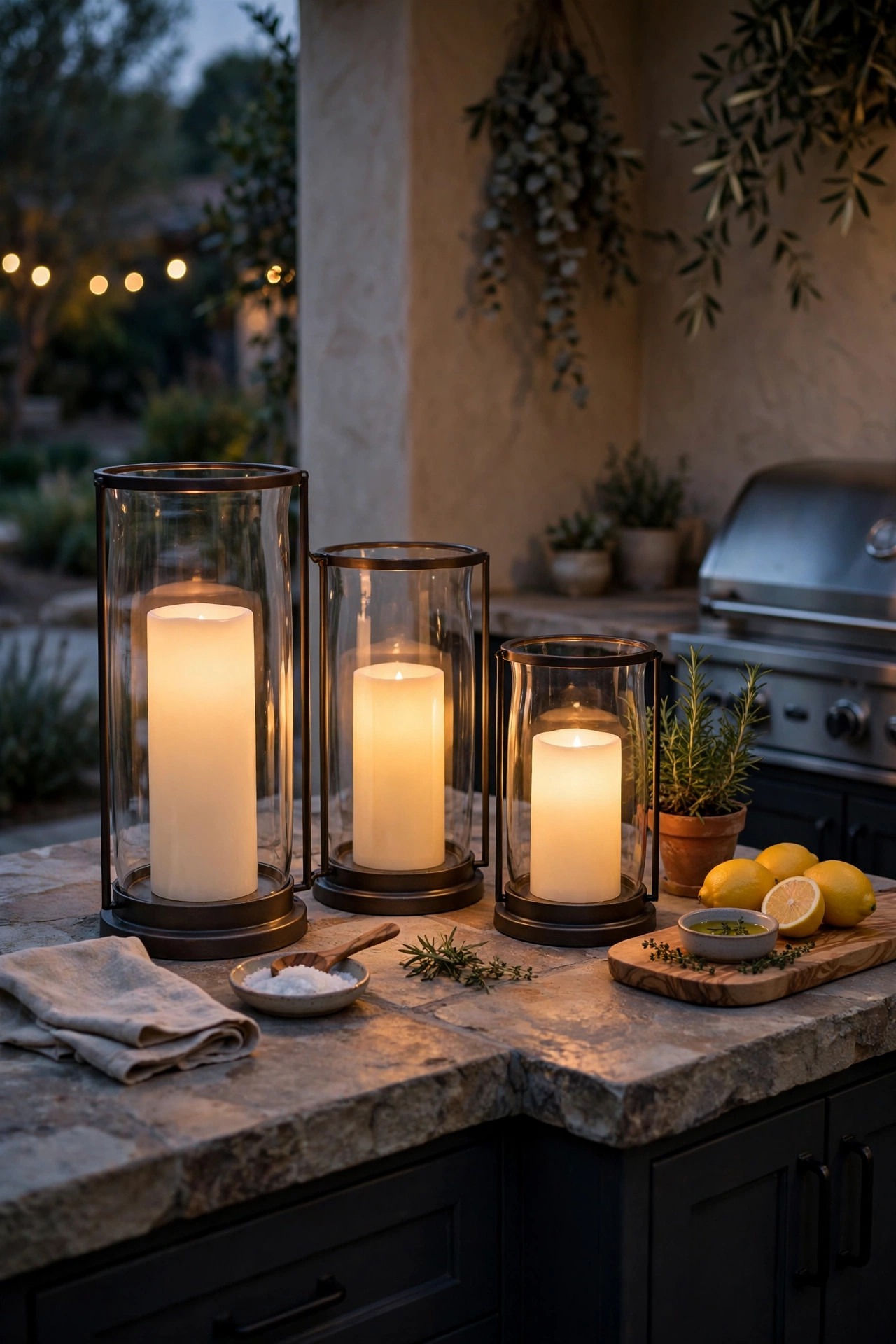
Every compact kitchen has a serving end — that one stretch of counter where finished food lands before it heads to the table. Give it flameless candles. A cluster of LED pillar candles in hurricane sleeves or a couple of flameless tea lights in small lanterns marks the pass beautifully and keeps the food zone looking warm and intentional in photos and in person. The non-negotiables: flameless only, always, anywhere near a working kitchen. Paper towels, wooden spoons, apron strings, and aerosol cooking spray all live near this counter, and real flame has no business in that crowd. Timers are the feature to pay for — set them to glow from 6 to 10 p.m. and they just handle themselves every single night. Vary the heights (a 4, 6, and 8 inch trio is classic) and keep them toward the back of the counter so platters still have room to land. Melted-look wax pillars read the most realistic outdoors, and the better ones even flicker convincingly in a breeze they do not feel.
Suggested budget range: $18 – $45.
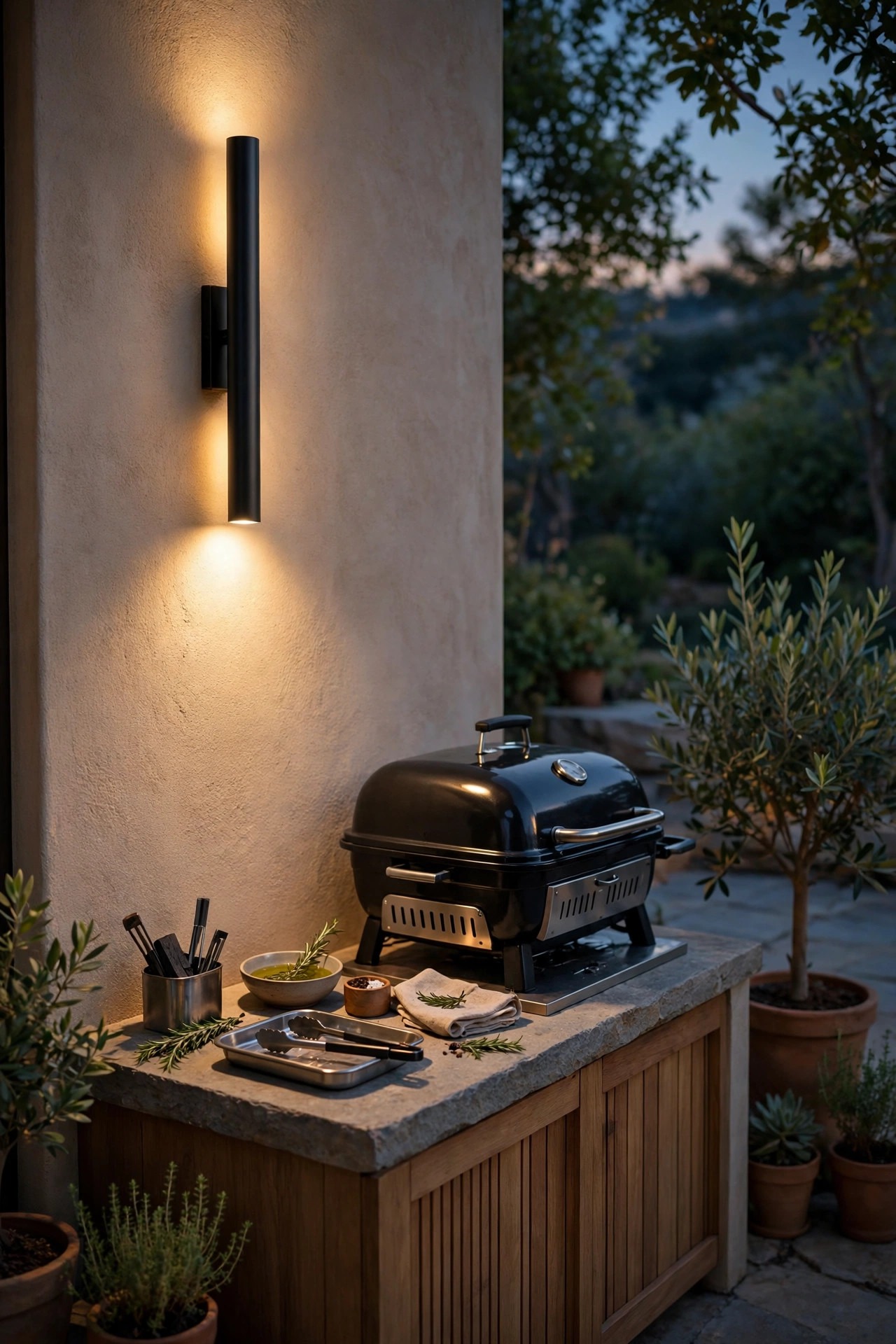
9. A Slim Wall Sconce on the Fence or House Wall
When counter space runs out, go vertical. A single slim sconce mounted on the house wall or fence panel behind your kitchen adds a layer of light that takes up exactly zero square inches of your compact footprint. Mount it 5 to 6 feet up, beside the grill rather than directly over it, and choose a downward-aimed or shielded fixture so the light pools on the work surface instead of blasting everyone in the eyes. Hardwired is lovely if you already have a junction box nearby, but solar sconces have gotten genuinely good — pick one with a replaceable battery and a panel that can catch a few hours of sun. Wet-rated construction is mandatory back here; this fixture will take direct rain and grill steam for years. Style-wise, a simple black or oil-rubbed lantern silhouette disappears into almost any patio scheme and matches the string lights overhead. I think of the sconce as the kitchen's porch light: it is the fixture I switch on for a quick weeknight grill session when the full layered show is not necessary.
Suggested budget range: $35 – $90.
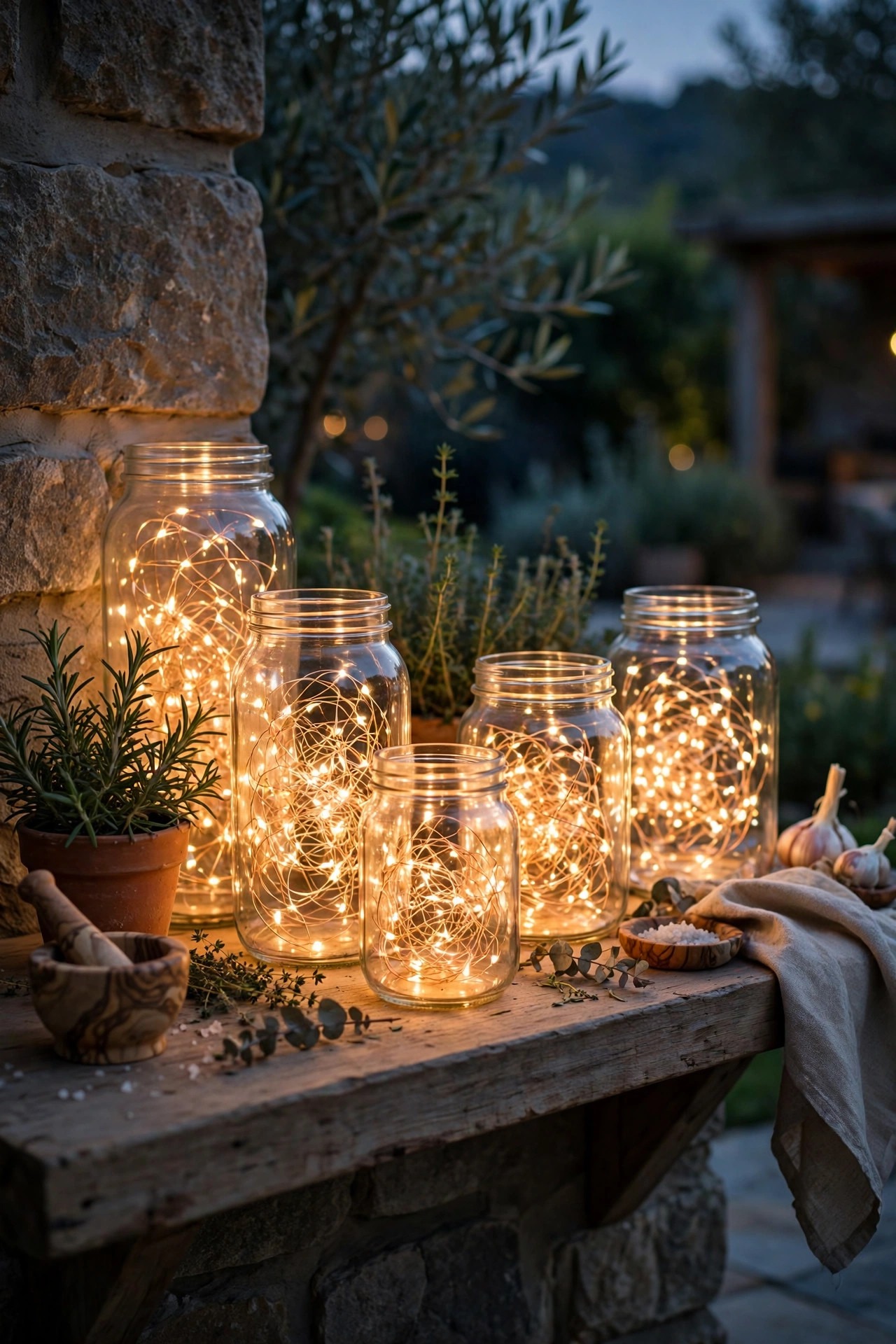
10. Fairy Lights in Jars Along the Backsplash Shelf
Not every layer has to be practical — some of it is just joy. Copper-wire fairy lights tucked into glass jars or a vintage-style bottle along your backsplash shelf give a small kitchen that twinkling, bistro-kitchen magic for less than a pizza. The battery packs hide behind the jars, the wire is nearly invisible, and the whole display takes up a shallow strip of shelf you were not using anyway. Because they are LED and barely warm to the touch, fairy lights are one of the few accents I am comfortable near cookbooks and wooden utensils — though I still keep them a sensible distance from the grill itself. Two or three jars at staggered heights beat a long uniform line; small spaces love a little rhythm. Solar-powered strands exist too, with the panel stashed in a sunny corner. This is also my fastest seasonal swap: amber jars for fall, a red-berry sprig tucked alongside in December, plain and sparkly all summer. In a compact kitchen where every object has to justify itself, these earn their shelf by making people smile.
Suggested budget range: $10 – $25.
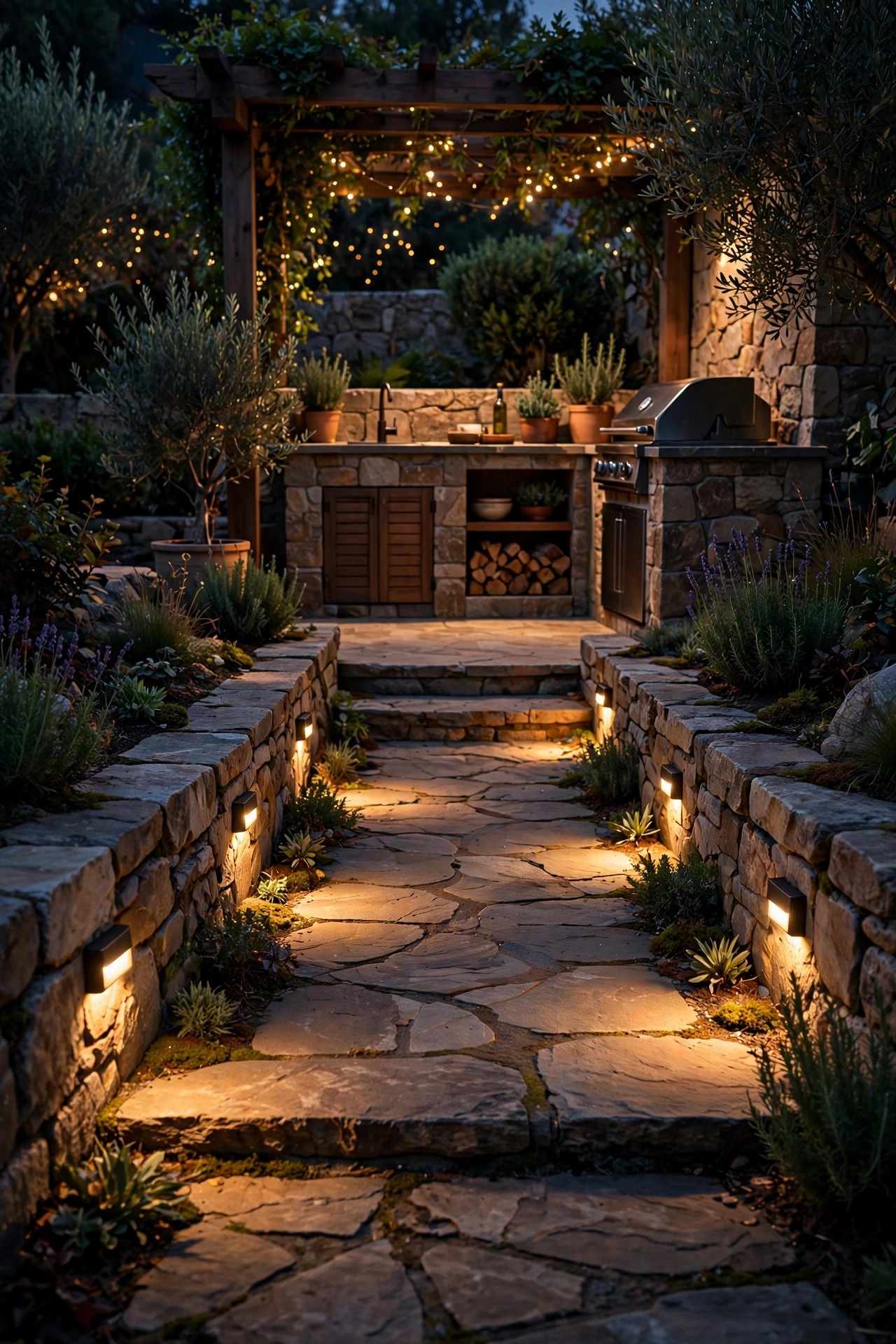
11. Motion-Sensor Lights for the Trip From the Kitchen Door
Here is the unglamorous lighting that prevents actual injuries: the path between your back door and the outdoor kitchen. You will walk it carrying trays, raw meat, and full glasses, in the dark, dozens of times a summer. Solar step lights on a raised patio edge, or a couple of motion-sensor stake lights along the short path, mean you never do that walk blind. Motion activation is perfect here because your hands are always full — the lights wake as you approach and fade after you pass. Keep the color temperature matched to your warm kitchen lighting so the path feels like part of the same space, and aim fixtures down at treads and edges rather than out at eye level. If your kitchen sits on a deck, small recessed step lights on the stair risers look built-in and cost very little to run on a low-voltage line. This is the least decorative idea on the list and the one my husband thanks me for most, usually while carrying a full platter with both hands.
Suggested budget range: $20 – $50.
12. A Petite Solar Chandelier Over the Bistro Table
Most compact kitchens come with a compact dining spot — a two-person bistro table tucked right beside the cooking zone. Hang a small solar chandelier over it and that little table becomes a destination. Outdoor solar chandeliers hang from a pergola beam, a shepherd's hook, or a sturdy umbrella arm, gather sun all day, and drop a pool of warm, flattering light exactly where the plates land. Scale is everything: 12 to 18 inches across is plenty, and anything grander will bully a small patio. Center it over the table, not the walkway, at about 30 inches above the tabletop. Because it is solar and cordless, you can take it down in thirty seconds for storm season. Look for warm-white LEDs and a metal frame with a real weatherproof finish — the painted plastic ones chalk and fade by July. Paired with the string lights over the kitchen, the chandelier separates dining from cooking with nothing but light, which is the oldest small-space trick there is: zones, not walls.
Suggested budget range: $40 – $110.

13. Rope Light Tucked Under the Counter Lip
If your small kitchen has a counter overhang — and most compact islands and bar ledges do — the underside of that lip is free real estate for light. A warm-white LED rope light clipped or channel-mounted under the overhang washes the cabinet faces and the floor below with a soft line of glow, defines the edge of the counter so guests stop bumping into it, and makes the whole run look custom-built. Rope and modern flat LED tape both work; tape gives a cleaner line, rope is more forgiving of uneven surfaces. Plug it into a GFCI-protected outlet (non-negotiable outdoors), keep connections off the ground and out of drip lines, and run the cord where nobody's feet go. Choose 2700K and a dimmable driver if you can — at full brightness this is cheerful task-adjacent light, dimmed down it is pure mood. Because the source hides under the lip, all anyone sees is the glow, which is exactly why it reads as expensive. In a small kitchen, one continuous run is usually 6 to 10 feet. That is the entire project, start to finish, in under an hour.
Suggested budget range: $15 – $40.

14. One Smart Plug and Timer to Run the Whole Show
The best small-kitchen lighting is the kind you never think about. Put your string lights, rope light, and any plug-in accents on one outdoor-rated smart plug with a timer, set it to switch on at dusk and off at bedtime, and your kitchen lights itself every evening like it has a staff. This matters more in a compact space than a big one: instead of hunting three switches and two remotes scattered around a tiny counter, there is one schedule and one override button in an app or on the plug itself. Look for a plug rated for outdoor use with a weather-resistant housing, and keep it mounted off the ground under the counter or inside a covered outlet box. Voice control through a smart speaker is a genuine kitchen luxury when your hands are covered in marinade — "lights on" beats wiping your hands to find a switch. Dimmers on the plug circuit let the same fixtures shift from prep brightness to dinner glow. It is the cheapest idea on this list per unit of daily happiness, and it makes every other layer work harder.
Suggested budget range: $15 – $35.

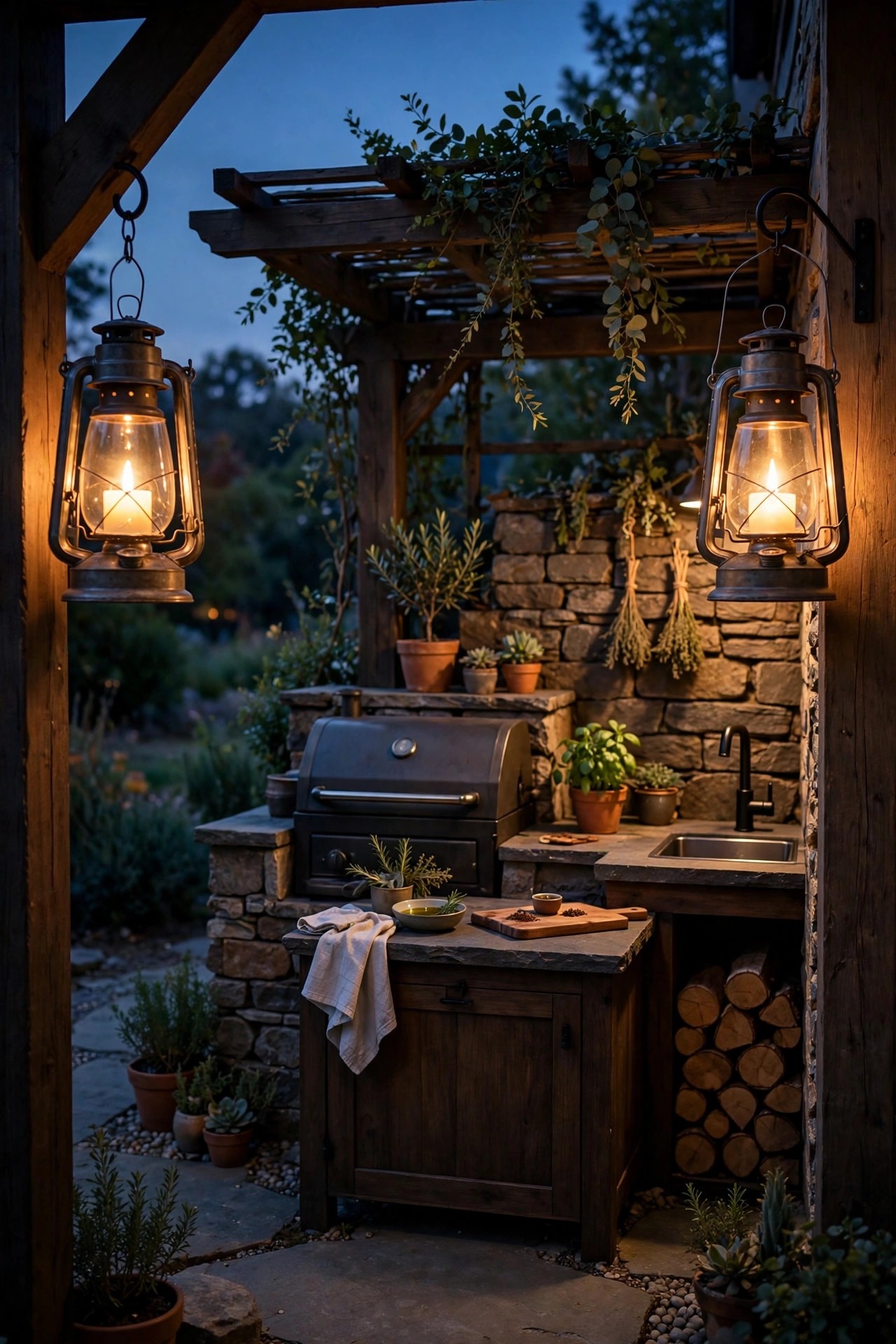
15. A Lantern Pair Framing the Kitchen Entry
Small spaces feel designed when they have a beginning, and a matching pair of lanterns gives your outdoor kitchen an entrance even if the whole thing is ten feet from the back door. Flank the opening to your cook zone — two wall lanterns on the posts, fence, or house wall that frame the space, or two larger lantern fixtures on either side of the serving counter — and the eye instantly reads "kitchen" instead of "grill in a corner." Symmetry is doing the heavy lifting here; it is the oldest trick for making a small footprint feel intentional and calm. Warm bulbs at 2700K, matched in brightness so one side does not outshout the other, and fixtures sized to the space: 8 to 12 inches tall reads right on most compact setups. Hardwired, solar, and flameless-candle versions all work, so this idea bends to whatever power your patio actually has. If you are gathering the full-size inspiration too, my guide to outdoor kitchen lighting shows the same framing trick at larger scales.
Suggested budget range: $50 – $130.
16. Match Every Bulb to One Color Temperature
This is less a fixture and more the rule that makes all the others look good: pick one color temperature family and hold the line. In a small kitchen, mismatched bulbs are glaring — a cool blue-white task strip beside warm amber string lights makes the whole space feel like a food truck parked inside a candlelit bistro. My formula is 3000K for the task layer (under-cabinet strips, grill light) where you want clean, accurate color on food, and 2700K for ambient and accent layers (strings, lanterns, candles) where warmth flatters faces and stone and wood. The two are close enough to blend and different enough to layer. When you buy any new fixture, check the Kelvin number on the box, not just the words "warm white," which manufacturers use loosely. Swap the one legacy bulb that has been glowing blue since 2019; in a compact kitchen there are so few bulbs that consistency is cheap. Photographers call this white balance. I call it the ten-dollar upgrade that makes everything else look intentional.
Suggested budget range: $10 – $30.

17. The Three-Layer Recipe That Makes Small Outdoor Kitchen Lighting Ideas Work
Here is the whole philosophy in one section, the recipe I would hand a friend starting from zero. Layer one, task: under-cabinet strips over the prep counter plus the clip-on grill light, so cooking is genuinely easy after dark. Layer two, ambient: one swag of string lights overhead and the sconce, so the space glows as a whole and nobody's face is in shadow. Layer three, accent: solar lanterns, flameless candles, or the fairy-light jars, purely for sparkle. In a compact kitchen you need exactly one or two fixtures per layer — six to eight total — and the starter version of that recipe lands under $150 if you lean on solar and battery pieces. Put the plug-in layers on the timer, keep everything in the 2700–3000K family, and dim what you can. That is it. Of all the small outdoor kitchen lighting ideas I have tested in our little patio kitchen, none transformed the space like simply committing to the layers in order instead of buying whatever looked cute at the store. Start with task, add glow, finish with sparkle.
Suggested budget range: $120 – $250.
Frequently Asked Questions
How bright should a small outdoor kitchen be?
Think in zones rather than one big number. Your prep counter wants roughly 300 to 500 lumens of focused task light — a good LED strip delivers that easily — while the ambient layer can stay much softer, around 100 to 200 lumens per fixture. If the whole space feels evenly bright, it will feel flat; contrast between a bright work zone and a gentle surrounding glow is what reads as atmosphere.
What color temperature is best for outdoor kitchen lighting?
Warm white wins outdoors. Use 3000K over the grill and prep surfaces for accurate color when judging doneness, and 2700K for string lights, lanterns, and accents where you want faces and food to look golden. Avoid anything above 4000K outside; it reads blue and institutional, and it makes a small space feel harsher, not bigger.
Can I light a compact outdoor kitchen with no hardwiring at all?
Absolutely, and small kitchens are the easiest case. Solar lanterns, a solar sconce, battery puck lights, rechargeable strips, and a plug-in string light on a smart plug can cover all three layers with zero electrician visits. The only non-negotiable: anything plugged in goes into a GFCI-protected outlet, and cords stay off the ground and away from the grill.
Are LED strip lights safe near grill heat?
Yes, with sensible placement. LED strips run cool compared to old bulbs, but the strip and its power supply should never touch the firebox, lid, or any surface you cannot rest your hand on. Mount task strips under cabinets over the prep zone rather than over the grill itself, choose strips rated for outdoor use, and keep a few inches of clearance from direct heat sources.
Conclusion
A compact patio kitchen does not need more light — it needs the right light, in layers, at the right scale. One honest task light over the prep counter, one warm ambient layer, and a little sparkle will outperform a single blazing fixture every single evening. Start with the layer you are missing, keep your color temperatures in the family, and put the whole show on a timer so it just happens. If these small outdoor kitchen lighting ideas have you rethinking the rest of the patio after dark, browse my favorite patio lighting ideas next — the same layering rules apply out there, just with a little more elbow room. Happy cooking, friends.