A sunroom is a trickster of a space. At noon it is the brightest room in the house, and by seven in the evening it can feel like a beautiful glass box that forgot how to glow. I learned this the first fall we used ours — the days got shorter, the single ceiling fixture glared like an interrogation lamp, and we drifted back to the living room. The fix was not more light. It was better light — the layered sunroom lighting ideas I now swear by: something overhead, something at eye level, and something low and twinkly. The fifteen ideas below are the exact mix that turned our three-season room into the spot where we eat breakfast, read through October, and watch the first snow fall without freezing. Most are renter-friendly, all are dimmer-friendly, and every one respects the fact that a sunroom lives half indoors and half out.
1. Anchor the Room With a Dimmer-Friendly Ceiling Fixture
Every sunroom needs one honest overhead light, and in my experience it should be on a dimmer from day one. Choose a semi-flush mount or a ceiling fan with an integrated light kit, fitted with dimmable LED bulbs in the 2700K range so the light reads warm instead of clinical. On bright mornings you will barely use it, but on a gray November afternoon it becomes the room's backbone. The dimmer is the whole trick: full brightness for puzzles and paperwork, thirty percent for dinner, ten percent when you just want the windows to do the talking. If your ceiling is low, stay with a flush mount under 7 inches deep so tall guests keep their dignity. Match the finish to your window frames — matte black and oil-rubbed bronze both disappear beautifully against white trim. A quick safety note: three-season rooms are damp locations in most building codes, so pick a fixture rated for damp use even though it feels indoors.
Suggested budget range: $60 – $180.

2. Frame the Windows With Copper-Wire Fairy Lights
This is the idea I steal compliments for most often. Run a strand of copper-wire fairy lights along the inside top edge of your window frames, using tiny clear adhesive clips every 12 to 18 inches. The wire nearly vanishes against the trim, and at dusk the whole wall of glass gets a delicate outline of stars. Because the LEDs sit right against the glass, you also get a gentle reflection that doubles the sparkle without doubling the strand. I use warm white, never the bluish cool white — in a glass room, cool light reads like a hospital corridor. Battery packs tuck behind the curtain rod; USB strands can hide along the sill and plug into the same outlet as your lamp. Order one size longer than you measured, because the corners always eat more wire than you expect. Honestly, of all my sunroom lighting tricks, this is the one that makes guests ask for a link.
Suggested budget range: $10 – $30.

3. Zigzag Bistro String Lights Across the Ceiling
If your sunroom ceiling has beams, you have a gift — use them. I zigzag two strands of shatterproof bistro string lights from beam to beam, letting each span sag about 6 inches for that café feel. Globe bulbs in a G40 size give the prettiest pools of light, and LED versions stay cool enough that nothing near fabric or dried wreaths is a worry. Keep the spacing even by measuring once and marking hook positions with painter's tape before you drill anything. One honest warning: glass-roof sunrooms can hit 110°F in summer sun, so choose commercial-grade outdoor-rated strands that shrug off heat and humidity. Plug both strands into one smart plug and the whole ceiling lands on a single schedule. If your beams run the other direction, a simple perimeter loop above the windows gives nearly the same glow with half the ladder time. This layered glow is close kin to my favorite outdoor fairy light ideas, just brought under a roof.
Suggested budget range: $35 – $90.

4. Hang a Woven Pendant Over the Reading Chair
Every sunroom has a best chair — the one angled toward the garden. Give it its own pendant. A woven rattan or seagrass shade, about 16 to 20 inches across, hung so the bottom sits roughly 5 feet off the floor, creates a pool of light that says "this corner is for novels." Swag the cord along the ceiling to the nearest beam if the junction box is not where you want it; cord covers in white make it look intentional. Inside, use a single 800-lumen LED filament bulb — the visible filament through the weave is half the charm. The woven shade throws patterned shadows at night that honestly look like you hired a designer. Just keep real candles and anything flammable out from under it, and dust the weave monthly with a vacuum brush, because sunrooms collect pollen like it is their job.
Suggested budget range: $45 – $120.

5. Sunroom Lighting Ideas Love Layered Table Lamps
Overhead light alone flattens a room; table lamps at eye level are what make it feel furnished after dark. I keep a pair of short ceramic lamps — 18 to 22 inches tall — on the side tables flanking our daybed, each with a 2700K LED bulb and a linen shade that diffuses rather than beams. Two lamps beat one because symmetry calms a glass room's echoey geometry. If outlets are scarce (and in three-season rooms they always are), rechargeable cordless lamps have gotten genuinely good: twelve hours per charge, three warmth settings, no cord to trip over on the way to the coffee. Place lamps so their light overlaps the seating, not the walkway. And a small styling note I swear by: lampshades in natural textures — linen, burlap, woven paper — echo the garden outside the glass far better than glossy white ever will.
Suggested budget range: $30 – $110.

6. Hide LED Strips Along the Ceiling Beams
For a soft ceiling glow with zero visible fixtures, tuck LED strip lights into the top channel of your beams or along the crown where wall meets roof. The trick is hiding the strip itself so you only see the wash of light it throws upward — direct view of the diodes looks cheap and spots like a runway. Choose 2700K strips with a high color-rendering index (90 CRI or better) so skin tones and plant greens stay true, and mount them in an aluminum channel with a frosted diffuser if your beams are flat. A plug-in dimmer remote costs little and saves you from app fatigue. This is also the layer I leave on when we watch storms roll in: bright enough to find your mug, dim enough to keep the lightning the main event. It pairs beautifully with the ceiling approach in my guide to porch ceiling light ideas if your roofline continues onto a porch.
Suggested budget range: $25 – $70.

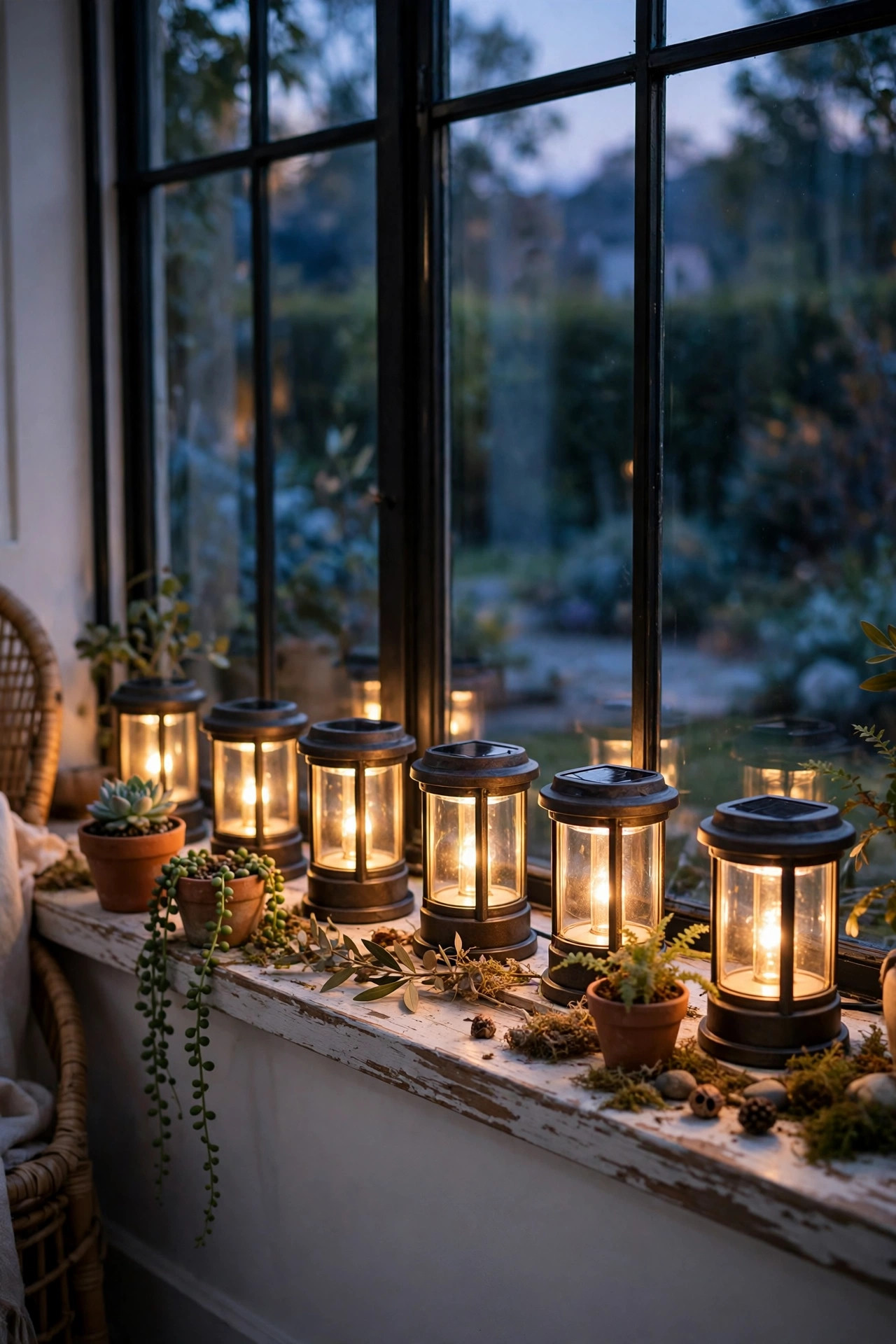
7. Line the Windowsill With Solar Lanterns
Here is the laziest idea on this list, and I mean that as praise. Set three to five small solar lanterns along your sunroom windowsill. All day they sit in the best charging spot in the entire house; at dusk they flick on one by one and pool little circles of amber light along the glass. Because they recharge where they live, there is no cord, no battery run, no timer to set. Choose lanterns with a flicker mode if you like a candle effect, and keep the solar panels wiped clean — a dusty panel in December cuts your glow time nearly in half. In deep winter, expect four to six hours instead of eight; that is still the whole evening. Group them in odd numbers and vary the heights slightly with a plant stand or a stack of garden books, and the sill looks styled instead of stocked.
Suggested budget range: $20 – $55.
8. Arc a Floor Lamp Over the Daybed
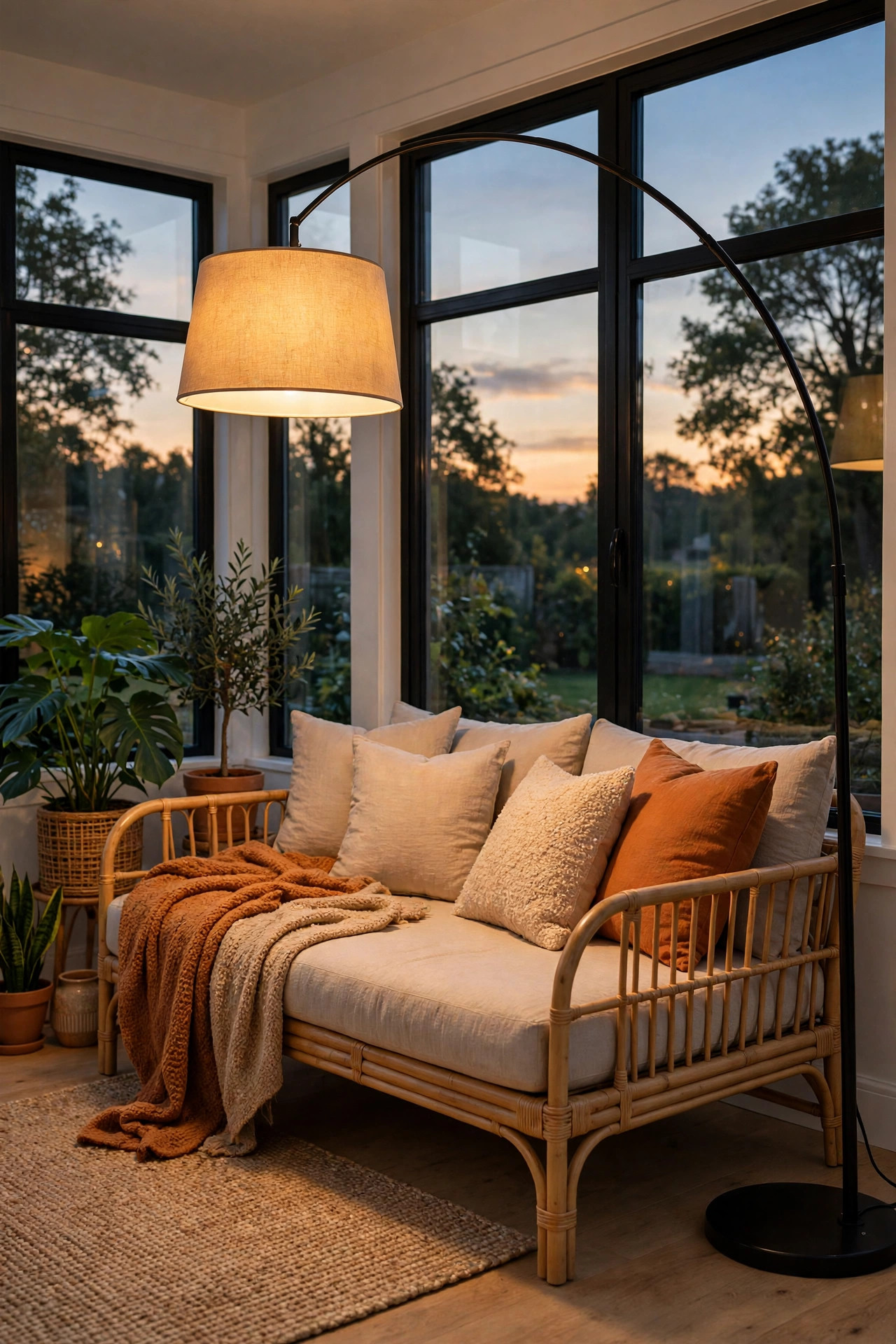
A daybed or chaise deserves the reading light treatment, and an arc floor lamp delivers it without a ceiling box or a side table. Look for an arc that reaches 5 to 6 feet out from its base and stands about 7 feet tall, so the shade hovers right over your book instead of your knees. Weight matters here — sunroom floors are often tile or decking that a featherweight base will skate across, so choose a marble or weighted steel base of at least 25 pounds. A linen drum shade softens the bulb, and a foot-switch on the cord means you never have to unfold yourself from a blanket to turn it off. I angle ours so the light also grazes the plant shelf behind the daybed, and the double duty makes the whole wall feel layered. Keep the arc path clear of the ceiling fan's swing if you have one.
Suggested budget range: $70 – $200.
9. Cluster Flameless Candles for Tabletop Glow
When I want the room at its coziest — soup night, card games, the first truly cold evening — I skip electricity almost entirely and cluster flameless candles down the middle of the table. Real wax shells with LED flames give you the flicker without the fire risk, which matters in a room full of wicker, cushions, and dried arrangements. Mix three heights, roughly 4, 6, and 8 inches, and nestle them into a tray with pinecones or river stones so the grouping reads as one centerpiece. The remote with a four-hour timer is non-negotiable for me; set it once and the candles "light themselves" every evening at dusk. Choose ivory rather than bright white wax, which can look plasticky, and keep one spare set of batteries in the drawer — these little lights dim so gradually you will not notice until they are ghosts.
Suggested budget range: $18 – $45.

10. Soften Everything With Paper Lantern Pendants
Paper lanterns are the budget decorator's secret weapon in a glass room, because daylight already does the heavy lifting and these just need to glow. Hang three lanterns — 12, 16, and 20 inches — at staggered heights over a seating area, each on its own cord kit with a warm LED bulb inside. The paper diffuses light so evenly that there are no harsh shadows on faces, which makes this my go-to setup over a game or dining table. Safety first and always: LED bulbs only, never incandescent or halogen, and keep at least 6 inches between bulb and paper. Lanterns fade after a year or two of strong sun, so buy a spare set while your color is in stock and treat replacements as a seasonal refresh, like swapping throw pillows. Cream and natural white lanterns keep the room calm; save saturated colors for parties.
Suggested budget range: $25 – $60.

11. Add Recessed Lights for a Low or Flat Ceiling
Not every sunroom has charming beams — some have a flat, low ceiling where hanging fixtures feel like obstacles. Slim LED recessed lights solve it. Modern wafer-style cans are under an inch thick, install straight into drywall or paneling with spring clips, and many let you select the color temperature at the switch box, so set them to 2700K and forget it. Space them about 4 feet apart in a grid, but offset the grid so a light is not directly over the television or the glass-top table — reflections will blind you at dinner. Put the whole set on a dimmer; recessed LEDs at full blast in a small glass room feel like a dentist's office. This is the one idea on the list where I recommend hiring an electrician if your room lacks existing ceiling wiring, because three-season rooms sometimes hide surprises above the panels.
Suggested budget range: $90 – $250.

12. Flank the Door With a Pair of Sconces
The wall between the sunroom and the house is usually the only solid wall you have, so make it work. A pair of sconces flanking the door at about 66 inches from the floor gives you symmetrical, glare-free light that feels architectural — like the room was designed, not decorated into submission. Up-down sconces wash both the wall and ceiling and stretch a low room taller; shaded sconces push light out at face level, which is kinder for conversation. Hardwired is cleanest, but battery sconces with remote pucks have improved enough that I used them all last winter with zero regrets. Keep the pair on the same switch or remote so they always match in brightness. If your door wall gets afternoon sun, choose metal over painted finishes — UV through glass fades paint faster indoors than most people expect. A dimmer on the pair turns them into gentle night-lights for late trips to the kitchen.
Suggested budget range: $40 – $130.

13. Drape a Twinkle Curtain on One Glass Wall
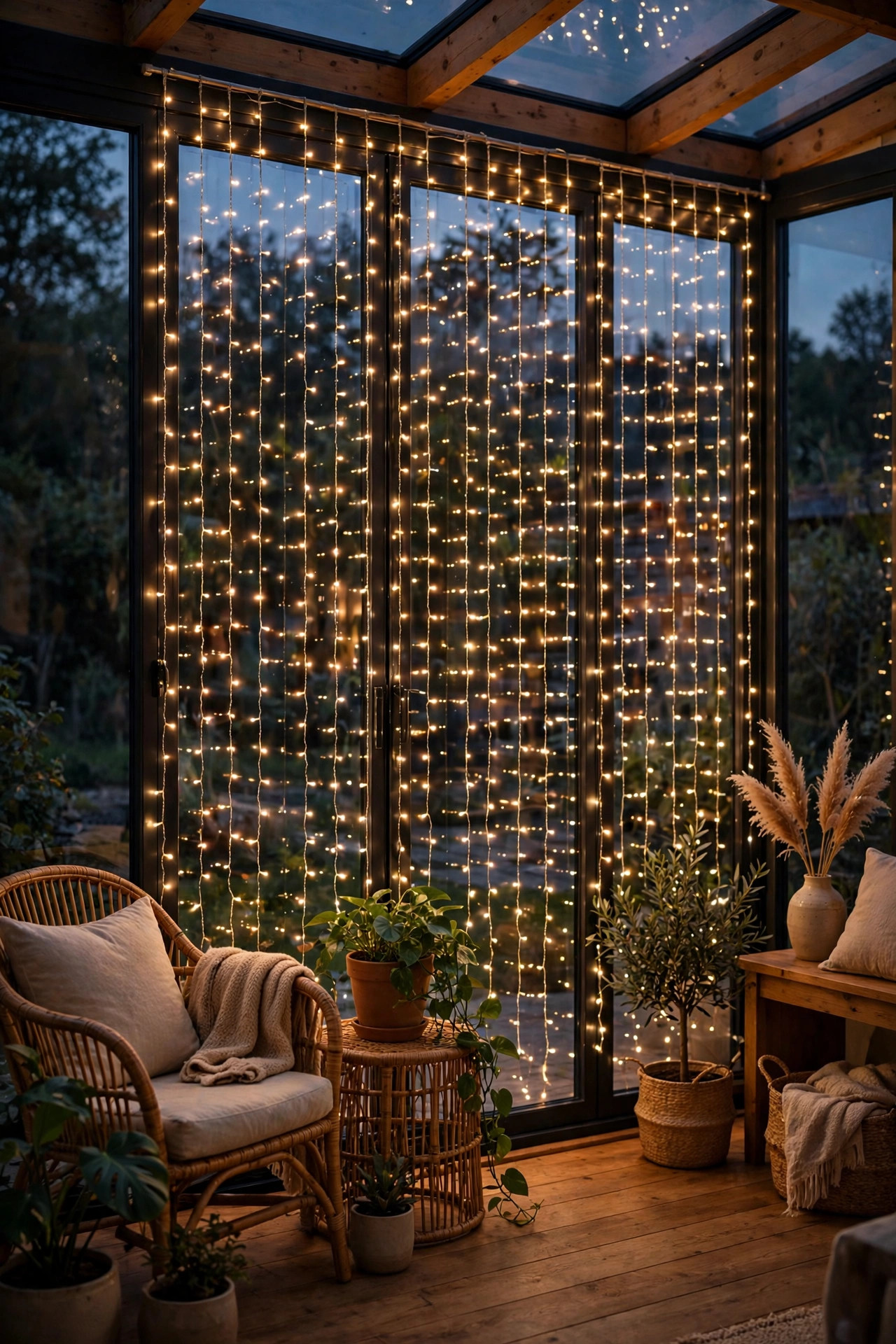
Reserve this for one wall only — the one facing the garden — and it becomes a backdrop instead of a distraction. A twinkle curtain of warm white LED strands, hung from a slim rod mounted just inside the top of the glass, gives you a shimmering veil between the room and the night. Set it to the slowest twinkle or a steady glow; fast flashing in a small room goes from festive to frantic in about ten minutes. Because the strands hang vertically, measure your glass height carefully and let the ends pool slightly on the sill rather than dangling mid-air. On movie nights this is the layer I dim to its lowest setting behind the screen wall. If your sunroom doubles as a screened porch in summer, the same trick translates — I borrowed it from my own notes on screened porch lighting ideas and it works just as well behind glass.
Suggested budget range: $22 – $50.
14. Sunroom Lighting Ideas for Short Days: Timers and Smart Bulbs
By December, sunset lands before dinner, and walking into a dark glass room to fumble for switches kills the whole mood. Put your main layers on timers or smart bulbs and let the room light itself. I run the fairy strands and sconces on a smart plug set to turn on twenty minutes before sunset — astronomical timers adjust automatically as the days shrink, which still feels like magic in January. Smart bulbs in the table lamps let me warm the tone even further at night, down toward a candle-like 2200K. Keep one layer, the ceiling fixture, on a plain manual switch for cleaning days and bulb hunts. The whole setup costs less than one nice dinner out, and it is honestly the upgrade visitors notice most: the room is simply always ready when you are. Start with the layer you use every single day, then add the sparkle.
Suggested budget range: $28 – $75.

15. Finish With a Plant Shelf Glow-Up
Your plants are already the sunroom's daytime stars, so let them close the show at night. Tuck a short waterproof LED strip or two battery puck lights under the top shelf of your plant stand, aimed down through the leaves. The light filters through the foliage and throws soft botanical shadows across the floor and wall — the single most atmospheric effect in this whole list, and it costs almost nothing. Keep the light warm and dim; you want moonlight-through-leaves, not a grow light, so skip anything marketed for plant growth and choose decorative strips at 2700K. Water carefully around any puck lights, or choose sealed waterproof strips if your watering can is as enthusiastic as mine. I rotate which shelf gets the glow each season, and somehow the plants under the light always become the room's focal point by winter. Ferns and trailing pothos catch this light especially beautifully.
Suggested budget range: $12 – $35.

Frequently Asked Questions
What color temperature is best for a sunroom?
Warm white, between 2700K and 3000K, is the sweet spot for nearly every layer. It keeps a glass room feeling like part of the home instead of a greenhouse, and it flatters skin, wood, and plant greens alike. If you love a candlelight feel in winter, a few 2200K bulbs in lamps or smart bulbs you can tune warmer at night are a lovely extra — just avoid mixing cool daylight bulbs into the same view, because the clash reads as a mistake rather than a choice.
Do sunroom lights need to be damp-rated?
Standard three-season rooms count as damp locations, so fixtures rated for damp use are the safe pick for anything hardwired or left up year-round. Battery and plug-in decorative lights are fine as long as they stay dry and off any surface that collects condensation. Check your windows on a cold morning — if they fog and drip, treat the sill zone as wet and keep anything electric a few inches back from the glass.
How many lights does a sunroom actually need?
Aim for three layers rather than a fixture count: one overhead source, one or two eye-level lamps or sconces, and one decorative layer like fairy strands or candles. In a typical 12-by-14-foot sunroom that means roughly five to seven light sources total. If the room still feels dim, add brightness to the eye-level layer first — that is where your eyes judge the room from — instead of cranking the ceiling light.
Can I use outdoor string lights inside a sunroom?
Yes, and I often prefer it. Outdoor-rated strands handle the heat, cold swings, and humidity of a three-season room better than most indoor sets, and shatterproof bulbs are a relief around tile floors and grandkids. Just confirm the strand is LED so it stays cool near curtains and paper shades, and route the plug to an indoor outlet rather than snaking an extension cord through a window gap.
Conclusion
A sunroom earns its keep in the hours after sunset, and the right light is what lets it. Layer something overhead, something at eye level, and something that simply sparkles, keep every bulb warm, and put the whole show on a timer before the short days arrive. Start with whichever of these sunroom lighting ideas fits the corner you love most, then browse the rest of the site for porch and patio inspiration — your glass room is only the beginning of the glow.