There is a moment on summer nights when a backyard pool goes from inviting to slightly nerve-racking: the sun drops, the water turns dark, and suddenly nobody can see the steps, the deck edge, or the toddler cannonball trajectory. That is why I am picky about pool deck lighting ideas. Around water, lighting is not just decor, it is how swimmers find the stairs, how you spot a kid at the far end, and how wet feet avoid a stubbed toe or worse. Get it right and the yard feels like a boutique hotel after dark.
My approach is the layering I use everywhere outdoors, with a safety-first twist. Start with a clear, glare-free perimeter so the deck edge reads instantly. Add task light at steps, gates, and the path from the house. Then finish with the pretty ambient layer that makes people linger. Below are 21 ways to build all three layers, mostly low-voltage or solar, all chosen to keep night swimming relaxed instead of stressful.

1. Recessed In-Ground Deck Lights Set Into the Pavers
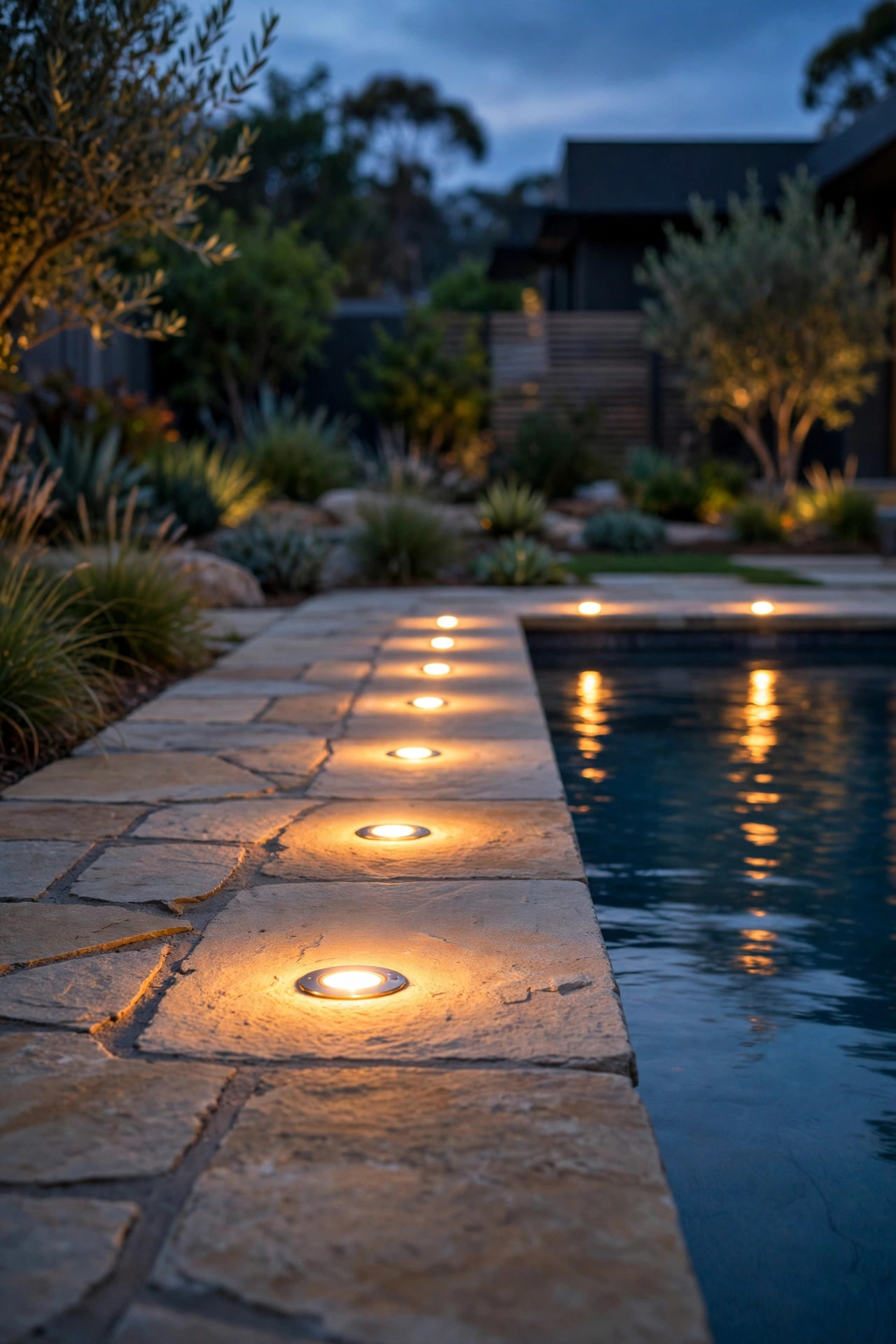
If I were starting from scratch, this is where my money would go first. Recessed in-ground lights sit flush with your pavers, concrete, or composite decking, so there is nothing to trip over, kick, or knock into the water. Each fixture is roughly the size of a hockey puck, and you space them 4 to 6 feet apart along the deck perimeter so their soft pools of light overlap and draw a clear glowing outline around the pool. That outline matters: at night, swimmers and barefoot guests read the edge of the deck instantly, which is the whole game for safety. Choose fixtures rated IP67 or IP68, because these live at splash level and get hosed down regularly. Most run on a 12-volt low-voltage system, which is the setup I always recommend anywhere near water. On pavers, installation is easiest during a deck build or re-sand, since each light needs a small hole cored or a paver cut. On an existing deck, a patient weekend with a hole saw gets it done. Aim the look warm, around 2700K, so the stone glows instead of looking like an airport runway.
Suggested budget range: $90 – $260.
2. Low-Voltage Pool Deck Lighting Ideas for the Perimeter Path
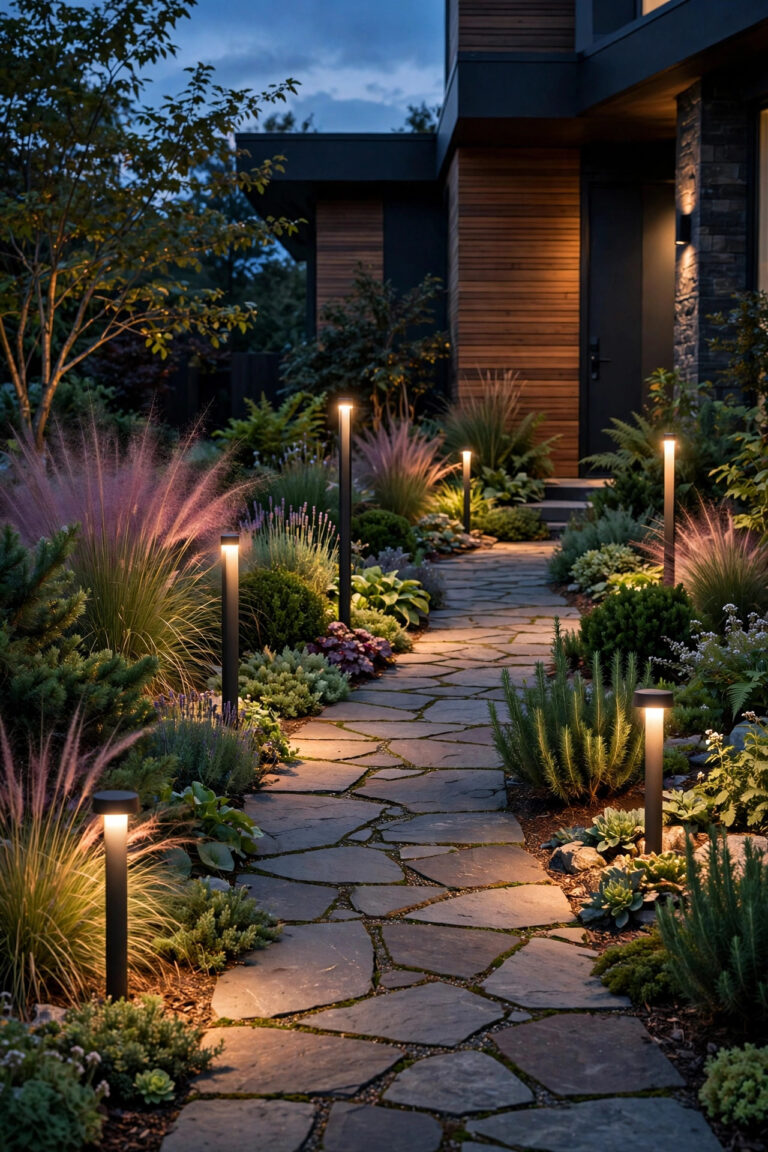
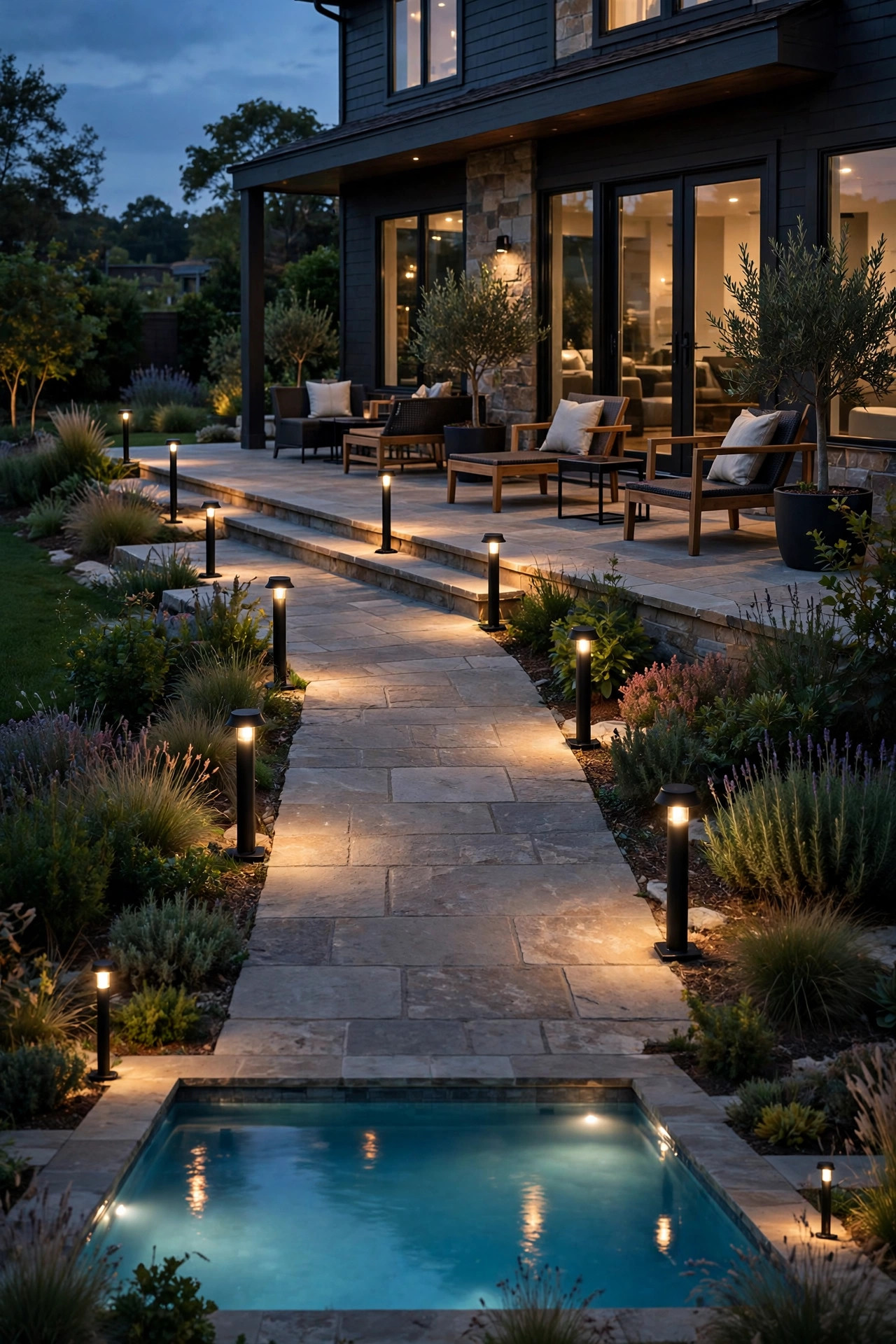
Not everyone can core holes in a finished deck, and honestly, classic path lights do the perimeter job beautifully for a fraction of the effort. These are the short fixtures on 6 to 12 inch stakes that you press into the planting beds or gravel border running alongside the deck. I angle this whole category as the workhorse layer: place them every 6 to 8 feet, staggered slightly rather than in a soldier-straight line, and choose hooded or louvered heads that throw light down and out instead of up into swimmers' eyes. Glare on wet skin and wet concrete is more than annoying; it genuinely hides the deck edge, so downward light is a safety feature, not a style preference. A 12-volt transformer system is my pick here over solar when the path is your main route, because the brightness stays consistent from dusk to midnight. Run the cable in the mulch bed, never across the walking surface. Look for solid metal housings in a dark bronze or black finish; the cheap plastic versions fade and crack within two summers in full sun. Expect about 100 to 200 lumens per fixture, plenty for a walking path.
Suggested budget range: $70 – $220.

3. Solar Stake Lights When You Have No Spare Outlet
Plenty of older pool decks have exactly one outdoor outlet and it is already spoken for by the pump equipment. That is where solar stake lights earn their keep. Modern versions with a real solar panel the size of a coaster (not a thumbnail) charge respectably and give you 6 to 8 hours of light after a sunny day. I use them to fill gaps: the far corner of the deck, the stretch behind the diving board, the garden side where running cable would mean trenching under concrete. Press them into soil or gravel borders, spacing them 4 to 6 feet apart, and keep the panels out from under shrubs so they actually see the sky. Two honest caveats from my own yard. First, solar lights dim noticeably after midnight and in December; they are a supporting layer, not your only safety light. Second, buy two or three spares, because individual units fail and a gap in the line looks worse than no line at all. Warm white only, please; the icy blue-white solar lights make pool water look like a hospital aquarium.
Suggested budget range: $25 – $80.

4. LED Strip Light Tucked Under the Coping Edge
This is the idea that makes guests ask what resort they are staying at. A waterproof LED strip hides in the shadow line just under the pool coping or under the lip of a raised bond beam, washing a continuous ribbon of light down the pool wall and across the first few feet of water. The effect is a floating, glowing edge that defines the perimeter better than almost anything else on this list, and because the light source itself is hidden, there is zero glare in swimmers' eyes. Use only strips rated IP68 and sold specifically for pool-adjacent use, run them on 12 or 24 volt low voltage, and keep the driver and all connections well away from the water in a dry, ventilated spot. An electrician should handle anything that ties into pool equipment, full stop. Warm 2700K to 3000K strips look elegant; save the color-changing versions for a dedicated party zone so the safety outline stays calm and readable. On a raised spa spillover or a tanning ledge edge, this same trick looks absolutely stunning. It is not the cheapest idea here, but per compliment received, it wins.
Suggested budget range: $120 – $380.

5. Step Lights for Deck Stairs, Benches, and Raised Tiers
More pool-deck tumbles happen on the two steps up to a raised spa or sun deck than anywhere else in the yard, usually with wet feet and arms full of towels. Small step lights fix this permanently. They mount into the vertical face of each riser, or into the side wall beside the steps, and wash a fan of light across the tread below. Put one on every step, or every other step on a wide staircase, positioned about 3 to 4 inches above the tread surface. Louvered faces keep the beam low and out of eyes. The same fixtures work beautifully along the front face of a built-in bench or a raised tanning ledge, anywhere a level change hides in shadow. Hardwired low-voltage versions are the most reliable, though solar step lights have improved enough for a secondary staircase. If your deck connects to the house patio, borrow the placement rhythm from these deck stair light ideas so the whole yard reads as one system. This is unglamorous lighting, and it is the kind that quietly prevents the ER visit.
Suggested budget range: $45 – $160.

6. Short Bollard Lights Along the Walk From the House
Every pool night starts with the same journey: out the back door, across the patio, down to the water, usually carrying drinks, towels, and a speaker. Lighting that route properly is half the safety battle. Short bollards, typically 12 to 24 inches tall, are my favorite tool for it because they stand up to foot traffic, lawn chairs, and the occasional pool noodle joust better than little stake lights. Space them 6 to 10 feet apart along one side of the walk only; lighting both sides creates a runway feel and doubles your cost for nothing. Choose bollards with shielded tops so the light lands in a clean circle on the ground and none of it fires sideways into the pool area, where you want calmer light. Powder-coated aluminum in black or bronze disappears into the landscaping by day. On a wide resort-style deck, a pair of taller bollards flanking the pool gate makes a handsome, obvious entry point that guests find without asking. Keep brightness modest, around 150 to 300 lumens each; this is guidance light, not stadium light.
Suggested budget range: $80 – $300.
7. Commercial-Grade String Lights Over the Lounge Zone Only
String lights absolutely belong at the pool, but placement is everything, and here is my firm rule: hang them over the lounge and dining zone, never directly over the water. A strand sagging above the pool is a hazard story I do not want, and dripping swimmers should not be reaching for towels under a line of bulbs. Over the seating area, though, they are pure magic. Use commercial-grade strands with heavy rubber sockets and shatterproof LED bulbs, strung between the house, a pergola, or sturdy poles set in concrete-filled planters. Keep the lowest swag at least 7 feet above the deck so nobody's raised pool noodle or volleyball serve connects with it, and plug the run into a GFCI-protected outlet, always. The warm cafe-style glow flatters everyone, makes the seating zone feel like a separate outdoor room, and reflects just enough in the water to look intentional. One 48-foot strand usually covers a lounge corner; two crossed strands make a canopy. On a timer, they click on at dusk and the whole evening routine runs itself.
Suggested budget range: $40 – $140.

8. A Pergola or Shade Sail With Warm Downlights
If your pool deck has a pergola, shade sail, or even a big cantilever umbrella, you are sitting on the best task-lighting structure in the yard. Mounting small downlights to the pergola beams gives you proper, shadow-free light over the outdoor kitchen counter, the bar cart, or the card table, exactly where people prep food and mix drinks with wet hands. I like slim puck lights or a short run of strip light screwed to the underside of each beam, wired to a dimmer so the zone goes from bright prep light to soft dinner glow. Keep fixtures rated for damp or wet locations, since pool humidity and splashes reach everything eventually. Under a shade sail, battery-powered puck lights with remotes are the renter-friendly version of the same idea. What I avoid is a single blazing fixture in the center; several small sources always look and feel better. This is also the perfect spot for a ceiling fan with a light kit if your pergola has a solid roof, because moving air plus soft light keeps the deck comfortable long after the swimmers dry off.
Suggested budget range: $85 – $320.

9. Battery Lanterns on Side Tables, No Cords Anywhere
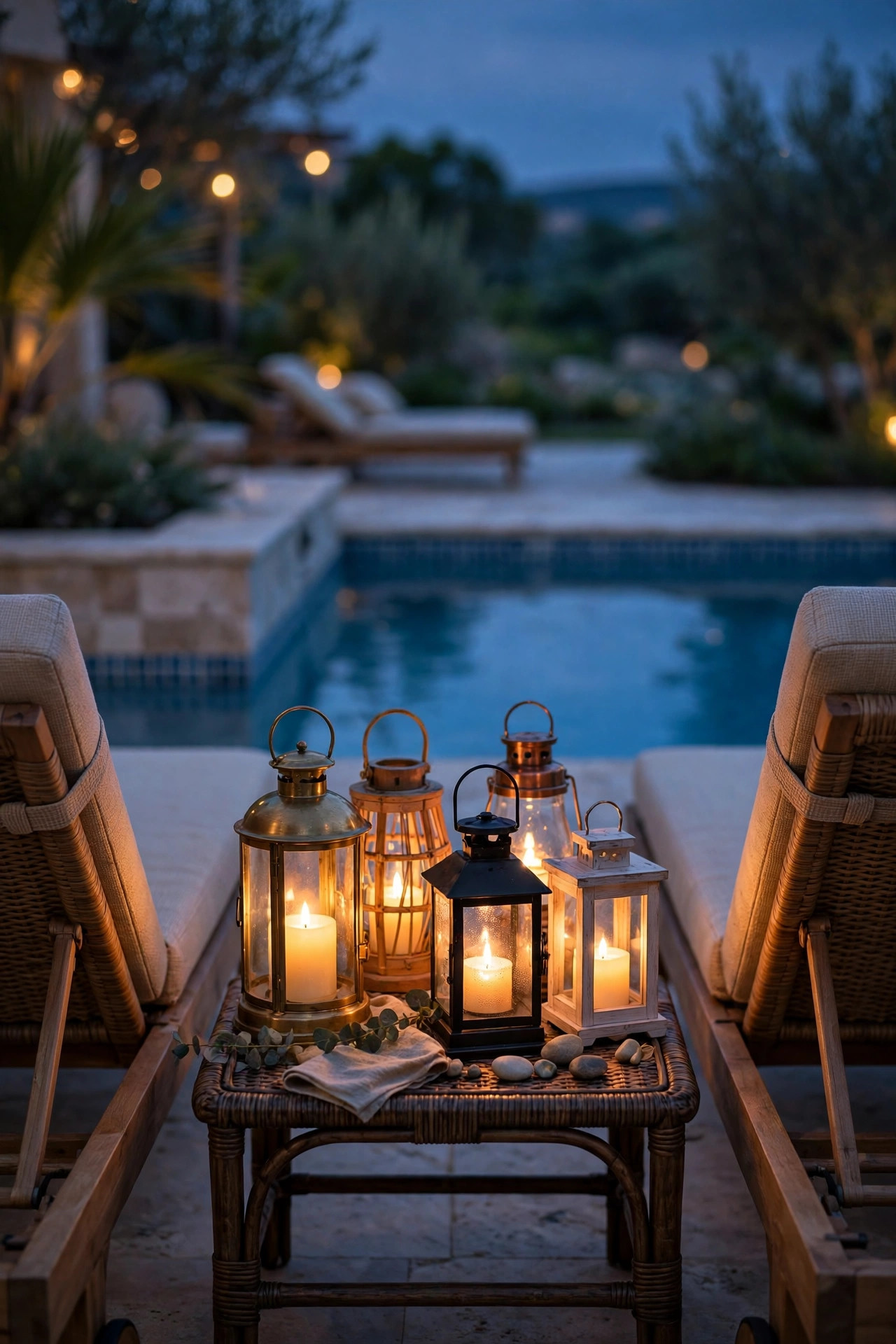
Some of my favorite pool nights have been lit by nothing fancier than a few good lanterns. Battery-powered lanterns with flameless LED candles or soft-glow bulbs are the safest accent light near water: no cords to trip over, no real flame for a breeze to push toward a towel, and nothing bad happens if one gets knocked off the table into a puddle. I cluster them in odd numbers, threes usually, on side tables between loungers and on the wide coping corner where people set their drinks. Vary the heights, 8 to 14 inches, for that collected look. Metal lanterns with a matte black or woven rattan finish suit most pool decks, and the light through the cutouts throws gorgeous patterns on the deck boards. Look for versions with a built-in timer, because the 5-hours-on, 19-hours-off setting means they greet you at dusk without a single thought. In my experience, brightness around 30 to 60 lumens per lantern is the sweet spot: visible glow, zero glare. Store them under cover in winter and the batteries will thank you.
Suggested budget range: $30 – $110.
10. Rope Light Tucked Into Deck Expansion Joints and Edges
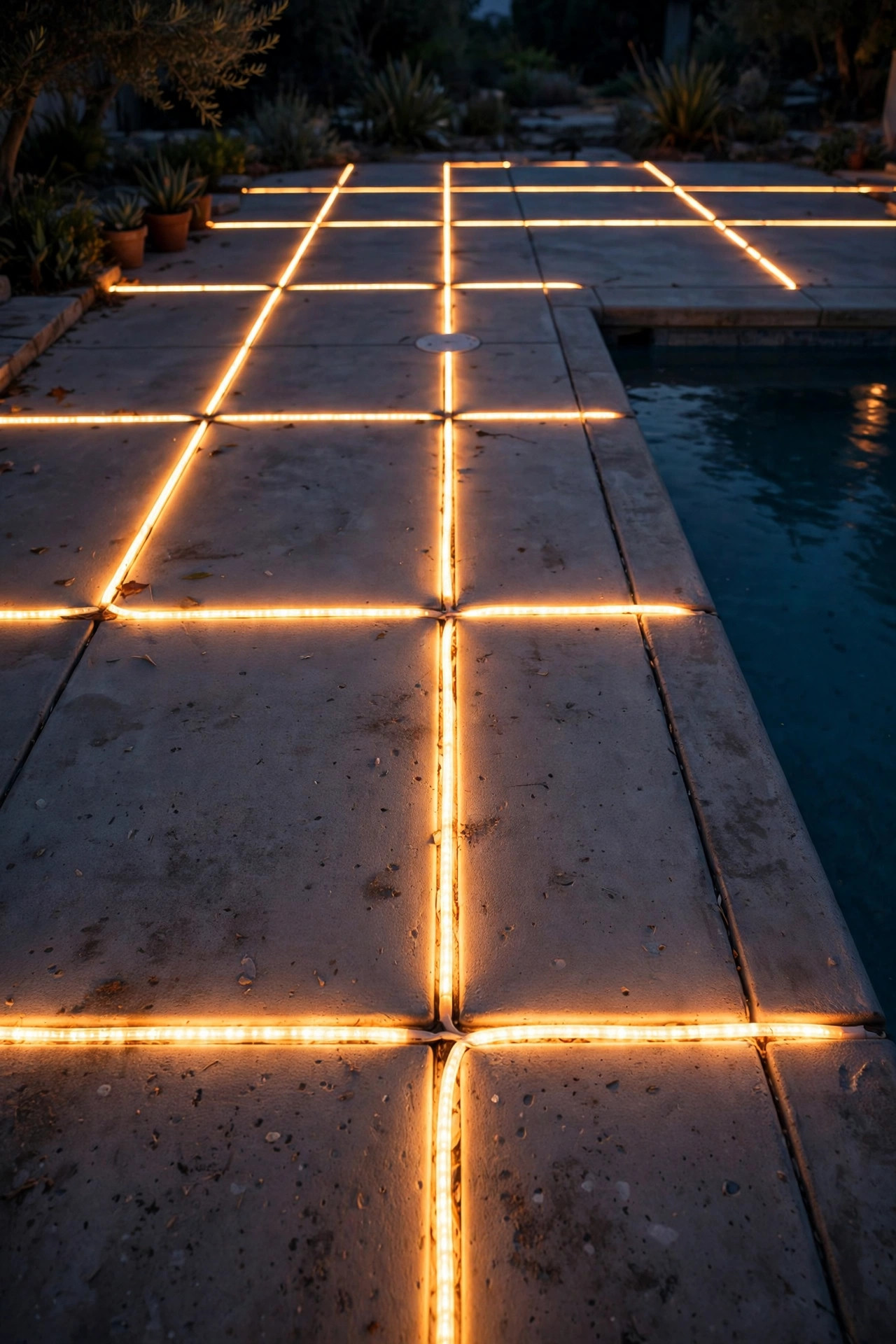
Here is a trick I borrowed from boat docks and now use everywhere: flexible rope light pressed into the expansion joints of a concrete deck, or run along the underside edge of a wood deck, draws a clean glowing line that maps the whole space. On concrete, the joints are already there every 8 to 10 feet, and a rope light seated just below the surface sits protected from foot traffic while outlining each slab. On wood or composite decks, mounting clips under the edge boards hide the rope completely, so all you see is a soft line of light floating along the perimeter. This is definition lighting, the layer that tells your eyes exactly where the deck ends and the planting or the water begins. Choose the encapsulated, outdoor-rated rope sold for wet locations, keep every connection and the plug end high, dry, and on a GFCI circuit, and never let a connection point sit in standing water. Warm white reads elegant; the blue rope light some people choose for a pool vibe honestly looks like a gas station. Slow, steady, and subtle wins here.
Suggested budget range: $35 – $120.
11. A Motion-Sensor Floodlight at the Gate and Entry
Pool safety codes in most towns require a self-closing, self-latching gate for a reason, and that gate deserves its own light. A motion-sensor floodlight mounted above the gate or the fence entry does two jobs: it lights the latch so fumbling with keys and codes ends, and it announces anyone entering the pool area after dark, which is exactly the alert a parent wants at 11 p.m. Aim the fixture down at the gate zone, not across the whole yard, and set the sensitivity so a wandering cat does not trigger it but a person always does. I prefer a warm-to-neutral 3000K LED here rather than the harsh daylight bulbs most floodlights ship with, so the blast of light does not wreck everyone's night vision for the next ten minutes. Keep the on-time short, 1 to 3 minutes. If your fence line is long, a second sensor light at the equipment pad is genuinely useful for whoever has to check the pump at night. Just promise me you will not mount one where it shines into the water; a floodlight reflection on the surface blinds you to what is under it.
Suggested budget range: $30 – $95.

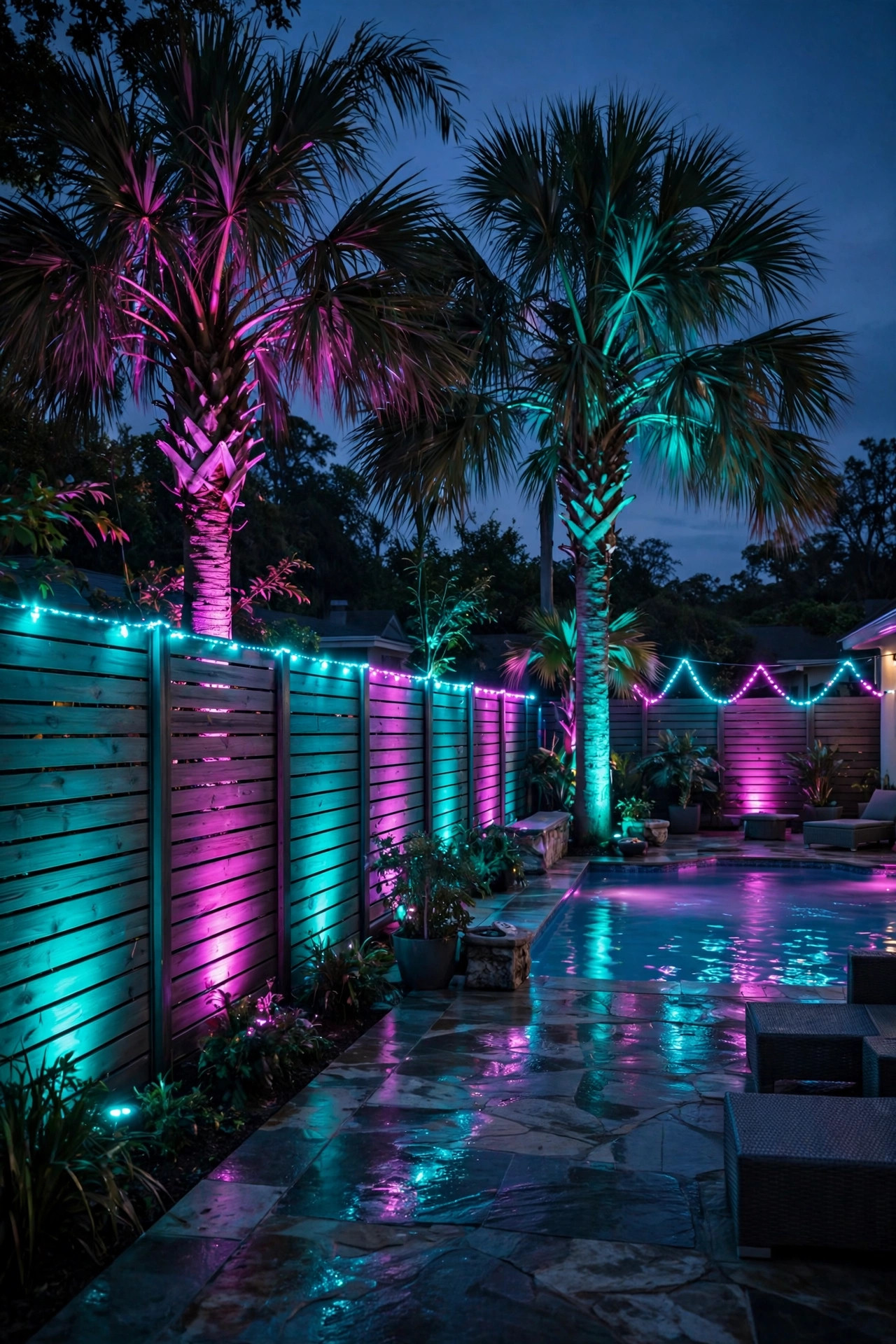
12. Color-Changing Lights for Party Nights, White Light for Swim Nights
Color-changing bulbs and light bars are enormous fun around a pool, and I own several, so this is not a lecture. It is a boundary. For birthday parties and movie nights, washing the fence and palms in teal or magenta turns the yard into an event. But when people are actually swimming, I switch everything back to warm white, and here is why: colored light distorts the water. Under blue or red light, it is genuinely harder to judge depth and to spot a swimmer in trouble, and lifeguards will tell you clear, bright, white light over water is non-negotiable. So build the system with scenes. One tap for Swim Night, all fixtures at warm white, perimeter at full brightness. One tap for Party, colors on the accent layer only. Smart bulbs in your pergola fixtures, lanterns, and a color-capable strip on the fence make this easy, and most apps let you schedule the return to white automatically. Fun layer on top, safety layer never off. That is the order of operations in my yard, every time.
Suggested budget range: $50 – $200.
13. Flame-Effect Solar Torches Without a Single Real Flame
Real tiki torches around a pool deck make me nervous: open flame, lamp oil, wet surfaces, and kids in motion are a combination I happily skip. Flame-effect solar torches give you 90 percent of the look with none of the liability. Inside each torch head, a cluster of LEDs flickers in a pattern that, from six feet away, honestly reads as fire. I stake them in the planting beds behind the lounge chairs and along the back fence line, where the flicker plays against foliage and makes the whole yard feel tropical. Space them 5 to 7 feet apart and keep them out of the walking path itself, flicker is ambient light, not guidance light, and the eye should not have to navigate by it. Because they are solar with the panel built into the top, they need a genuinely sunny spot; under the pergola they will sulk and die by 9 p.m. Most run 6 to 10 hours on a full charge in summer. Buy torches with replaceable batteries and you will get several seasons out of them instead of one.
Suggested budget range: $35 – $100.

14. Wall-Wash Lights on the Fence or House Wall
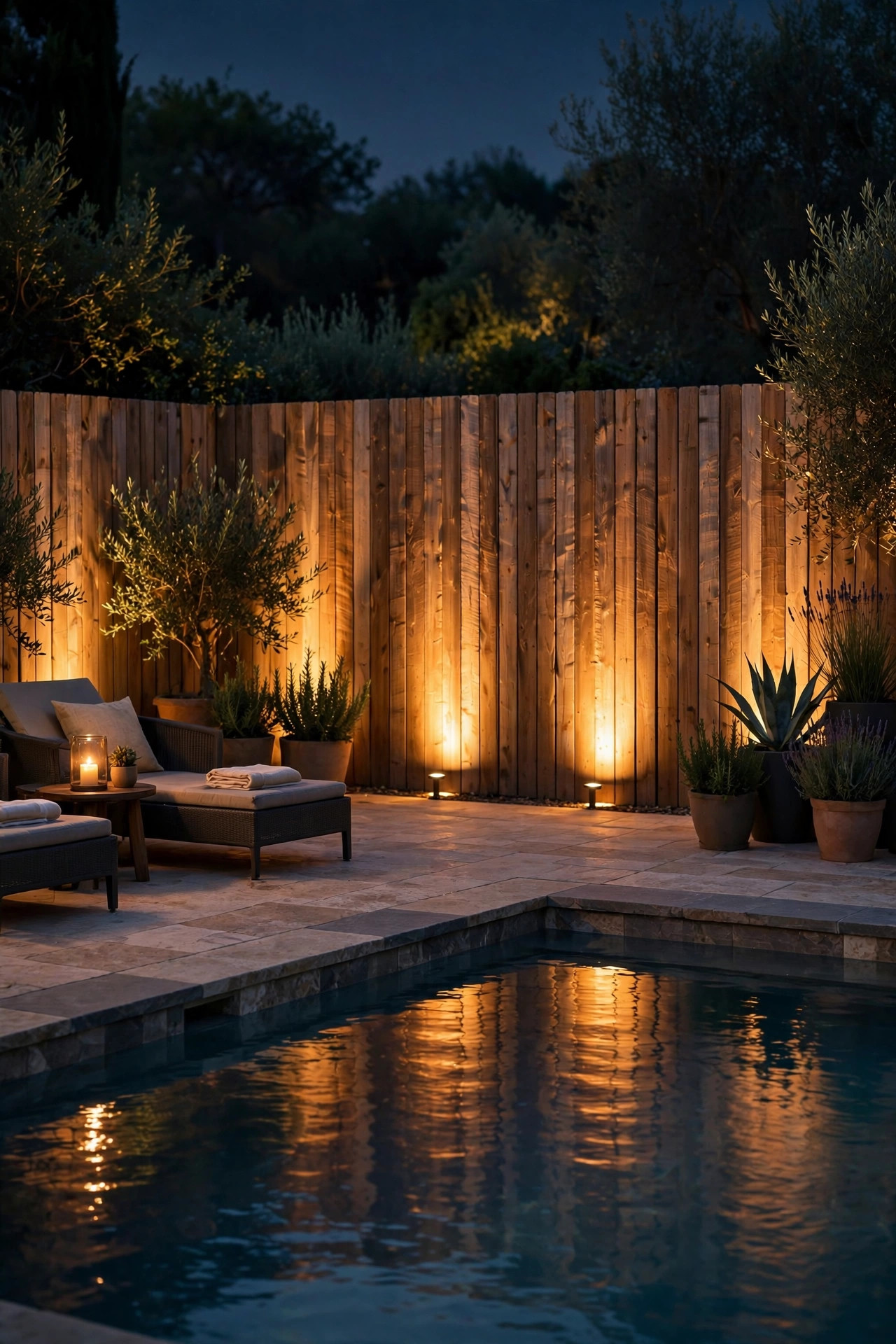
Every pool looks better with a backdrop, and light on the boundary fence or the house wall is what creates it. A row of small uplights or wall-wash fixtures aimed at the fence throws a soft vertical glow that closes in the space, kills the black-void feeling beyond the deck, and bounces a surprising amount of useful ambient light back toward the water. This reflected light is the secret to a deck that feels bright without any single bright fixture. Space washers 6 to 8 feet apart along the fence, set a foot or so out from the boards, and tilt them so the beam rakes up the texture of wood or stucco. If your fence is a plain flat wall, the raking light still adds depth through shadows from plantings. Keep this layer dim compared to the perimeter; it is atmosphere, and if it outshines the deck edge you have inverted the safety hierarchy. I run mine on the same transformer zone as the path lights with a separate dimmer, so on swim nights the backdrop drops low and the edge stays king.
Suggested budget range: $75 – $240.
15. Floating Lights for a Soft In-Water Glow
Floating lights are the jewelry of this list: zero safety function, all charm, and I adore them anyway. Solar floating orbs and lily-pad style lights drift on the surface, charging by day and glowing by night, and their reflections double the effect for free. A cluster of three to five in mixed sizes, say 6, 8, and 11 inch orbs, looks far better than a dozen scattered singles. Most are fully sealed and waterproof, with color options you can lock to warm white to match your deck lighting. Two practical notes from experience. First, take them out before a big swim session; batting a glowing orb is fun for about four minutes, then it is just in the way. Second, they pair beautifully with proper in-water lighting, so if you are planning a bigger upgrade, browse these pool underwater lighting ideas alongside this list. On a still night with the deck lights low, floating orbs on black water might be the prettiest sight in the whole backyard, and they cost less than dinner out.
Suggested budget range: $25 – $90.

16. Post Cap Lights on the Pool Fence and Deck Posts
If your pool is fenced with posts, or your deck has a railing, post cap lights are the easiest perimeter upgrade that exists. They sit right on top of each post, solar panel up, and cast a small halo of light down all four sides. On a fence line, a lit cap every post, or every other post on long runs, quietly marks the boundary of the pool area, which helps guests find the gate and helps you confirm at a glance that the enclosure is intact. On deck railings they do the same job at hand height, and the light they throw across the top rail is genuinely useful when people are carrying drinks up steps. Solar caps need sun, so they shine on south and west fence lines and disappoint in deep shade; for shaded runs, low-voltage wired caps are worth the extra effort. Sizes are standardized around common post dimensions, but measure your actual post before ordering, because nominal lumber sizes lie shamelessly. Expect a soft 20 to 50 lumens per cap. This is marker light, and as a finishing layer over a solid perimeter, it is perfect.
Suggested budget range: $40 – $150.

17. Uplights for Palms, Trees, and Planters Behind the Deck
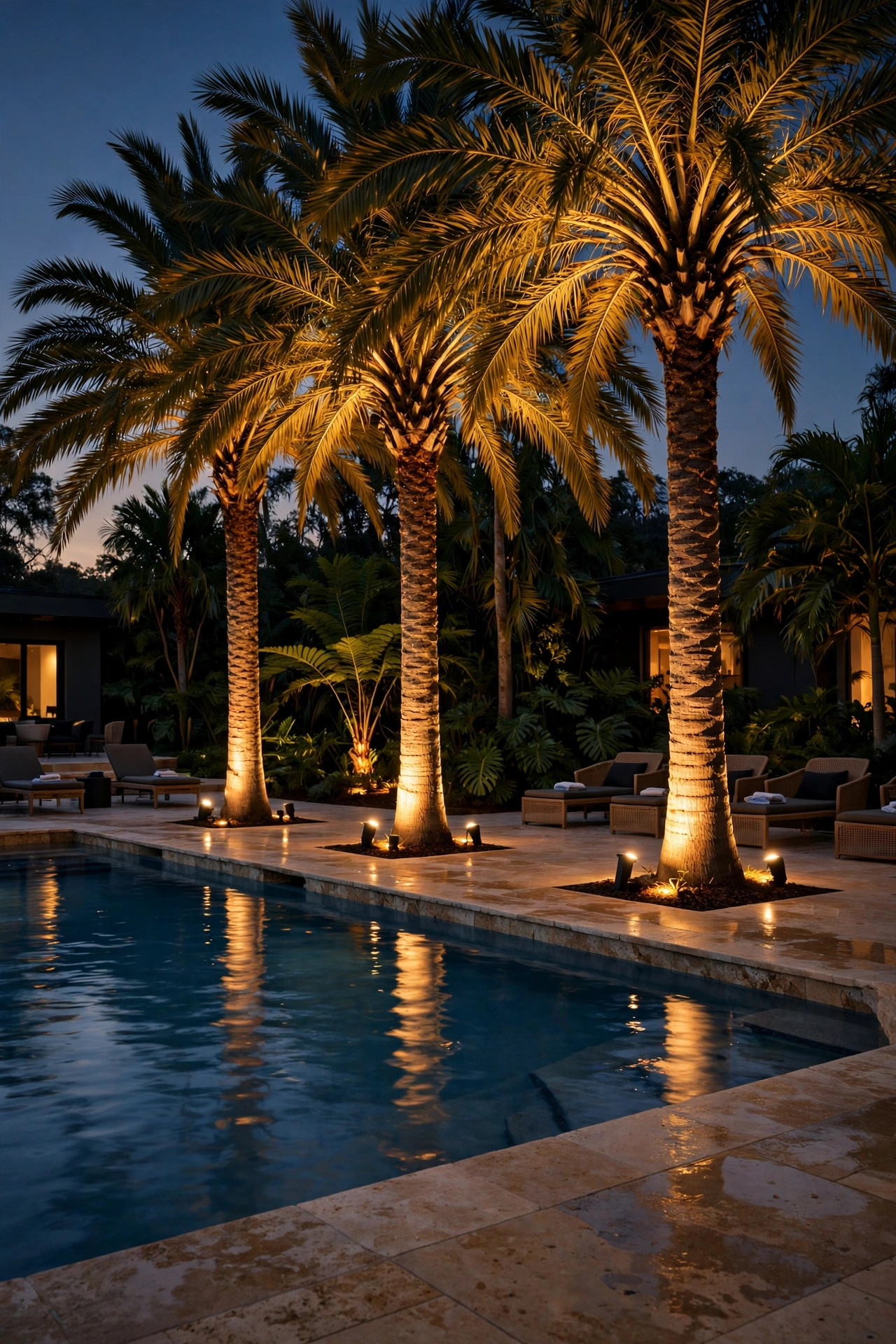
The prettiest pool decks I know all share one move: the plants behind the deck are lit, so the water sits in front of a glowing green backdrop instead of a black hole. One uplight per palm or ornamental tree, placed a foot from the trunk and aimed up into the canopy, is usually enough. Fronds and branches catch the light and throw it back as dappled ambience you could never buy in a fixture. For big planters flanking the steps or the gate, a small spike spotlight aimed into the foliage marks the obstacle and the beauty in one gesture, because an unlit planter at shin height is a trip hazard wearing a disguise. Keep this layer warm, 2700K, and modest; you are painting a backdrop, not interrogating a shrub. Watch for glare angles from the water: stand in the pool at swimmer height and check that no uplight fires directly across the surface into your eyes. Adjust the tilt down a few degrees and the problem vanishes. Low-voltage fixtures with adjustable heads make the fine-tuning painless.
Suggested budget range: $60 – $210.
18. Dusk-to-Dawn Photocells and Timers That Run It All
The best pool lighting system is the one nobody has to remember to switch on, because the nights it gets forgotten are the nights someone walks the deck in the dark. A photocell on your low-voltage transformer turns the whole system on at dusk and off at a set hour, and I think it should be standard equipment. My own setup runs the perimeter and path zones until midnight, then drops to just the gate light and step lights until dawn, bright enough for safety, dim enough to sleep next to. Smart plugs do the same job for string lights and lanterns, and a smart transformer adds per-zone schedules if your layers are wired separately. Set it once in May and forget it until the clocks change. One caution with cheap mechanical timers: they drift and they die in outdoor boxes, so spend a little more on an astronomical timer that tracks sunset for your zip code all year. For the electrical side of any pool-area setup, this GFCI outdoor lighting guide is the read I send friends before they touch a single wire.
Suggested budget range: $20 – $130.
19. Glow Markers for Steps, Edges, and the Shallow End Shelf
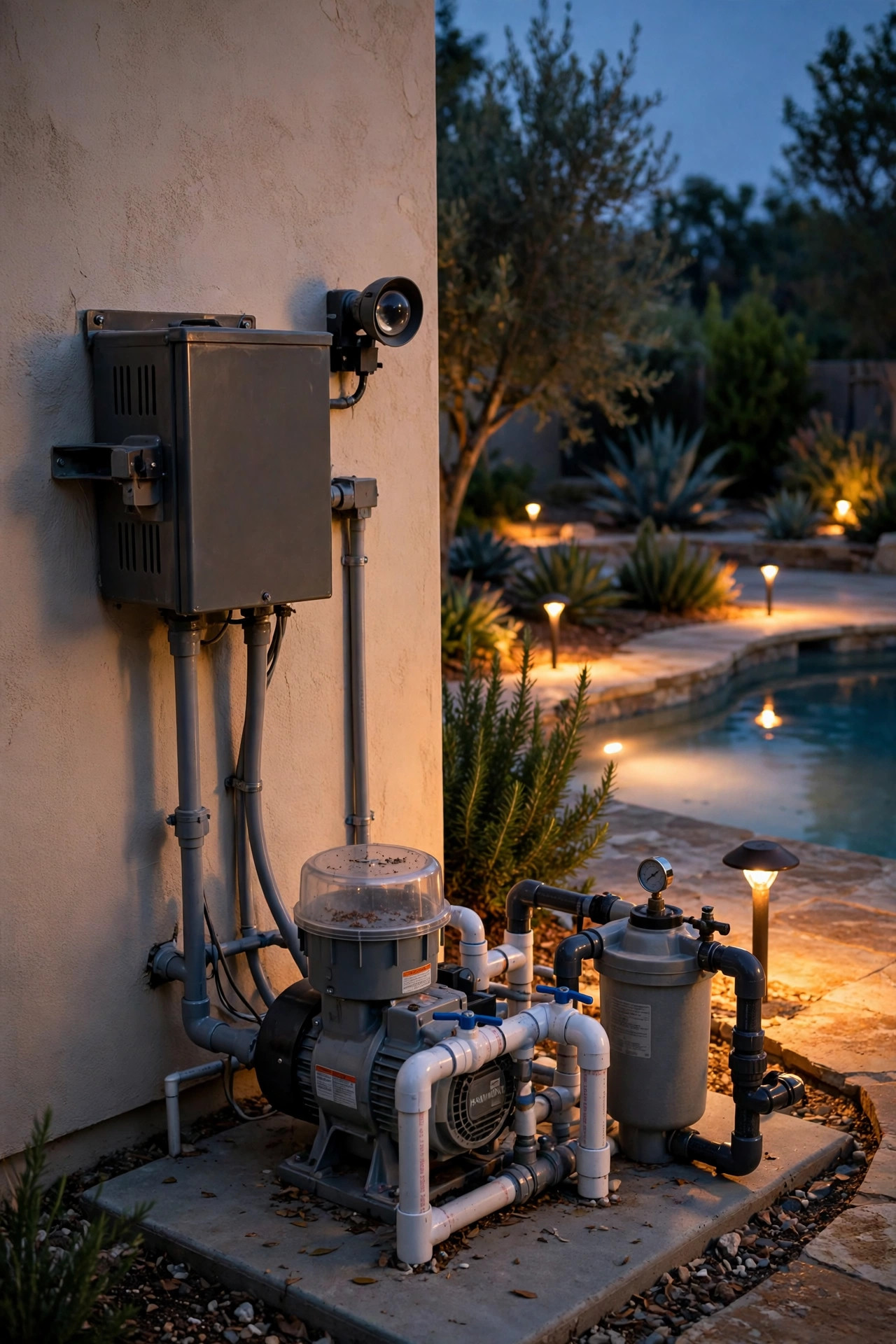
Sometimes the smartest light is barely a light at all. Photoluminescent and low-glow LED markers charge up or sip power and simply outline the things people bump into: the nose of each deck step, the corner of the raised spa, the edge of the tanning shelf where the depth changes. Peel-and-stick glow strips rated for outdoor use handle the step noses, and small solar marker pucks press into the lawn or gravel right where the deck ends. I also run a short line of markers along the path from the pool gate to the back door, the route every dripping kid takes to the bathroom. Because they glow rather than shine, they never create glare on the water and never need the eye to adjust. Replace adhesive strips each season; sun and chlorine splash are hard on them, and they are cheap. In my experience this is the layer guests never notice consciously and always benefit from, especially anyone whose night vision is not what it was. Safety lighting does not have to look like safety lighting.
Suggested budget range: $15 – $60.

20. Zones and Dimmers, So Bright Light Lives Only Where It Belongs
Here is the upgrade that ties a good system together: put your layers on separate zones with dimmers. Zone one, the perimeter and steps, stays at full brightness on every swim night, no negotiation. Zone two, the lounge string lights and lanterns, dims to candlelight levels once people settle in. Zone three, the backdrop uplights and wall wash, floats somewhere in between. A multi-zone low-voltage transformer or a few smart dimmers outdoors-rated for the load makes this simple, and the difference in feel is enormous. Bright light everywhere is just flat and glaring; bright light at the edges and steps with soft light at the seats is the boutique-hotel trick in one sentence. Zoning is also practical: when the kids are night swimming you raise everything, and when it is two adults with a glass of wine, the deck drops to a soft glow without touching a single fixture. If you are planning your system from zero, wire for zones from the start. Retrofitting them later means re-running cable, and nobody enjoys trenching twice.
Suggested budget range: $60 – $250.

21. The Full Layered Look: My Favorite Pool Deck Lighting Ideas in One Plan
If I were lighting a brand-new pool deck tomorrow, here is the exact recipe I would follow, in the order I would install it. First, the safety skeleton: recessed or path lights drawing the full perimeter, step lights on every level change, and a motion light at the gate, all low-voltage, all on a photocell timer. Second, the guidance layer: bollards down the walk from the house and glow markers on the step noses, so every route in the yard is readable at a glance. Third, the living layer: string lights over the lounge, lanterns on the tables, and a dimmer so the seating zone glows instead of glows-up. Fourth, the backdrop: uplights in the palms and a wash on the fence, which make the water look twice as expensive as it was. None of these layers has to happen in one weekend or one budget. Start with the perimeter this season, add the lounge layer next, and let the backdrop arrive when it arrives. Every layer you add makes the ones before it look better, which is the quiet magic of doing this in the right order.
Suggested budget range: $300 – $900.

Frequently Asked Questions
How many lumens do I need for pool deck lighting?
For most residential decks, aim for gentle but readable light rather than raw brightness. Path and perimeter fixtures at 100 to 300 lumens each, spaced 6 to 8 feet apart, give you clear footing without glare. The water itself does a lot of work for you: even modest deck lighting reflects off the surface and reads brighter than the same setup on a lawn. What matters more than lumens is placement and shielding. Downward-facing, glare-free fixtures at moderate brightness will always outperform a few very bright exposed bulbs, which create harsh contrast and dark blind spots between them. If swimmers are squinting, you have a glare problem, not a brightness problem.
What is the best color temperature for lighting around a pool?
Warm white, 2700K to 3000K, is my recommendation for nearly every fixture on the deck. It flatters skin, makes stone and wood glow, and keeps the water looking inviting rather than clinical. Cooler temperatures, 4000K and above, can make the pool look strikingly blue-green and some people love that resort contrast for the in-water lights specifically. Just avoid mixing temperatures randomly around the deck; a warm path light beside a blue-white floodlight looks like a mistake even when it was not. Pick one temperature for the deck layer, keep it consistent, and let any deliberate contrast live in the water lights alone.
Are solar lights safe and reliable enough around a pool?
Solar lights are electrically the safest option near water because there is no wiring and no mains power at the fixture at all. As a purely decorative or marker layer, they are wonderful. The honest limitation is performance: they dim after several hours, fade faster in winter and under shade, and vary a lot from unit to unit. For the layers that protect people, the perimeter path, the steps, and the gate, I recommend wired low-voltage lights on a timer so brightness is guaranteed all night. Use solar freely for accents, floating lights, post caps, and fill-in spots, and think of it as the supporting cast rather than the lead.
How far should deck lights and outlets be from the pool water?
Keep it simple and conservative: plug-in fixtures and cords should stay well back from the water, and anything that plugs in outdoors belongs on a GFCI-protected outlet, no exceptions. Low-voltage 12-volt systems are the standard choice near pools precisely because they are far more forgiving around splashes. Recessed and strip fixtures sold for pool decks carry IP67 or IP68 ratings for a reason, so check the rating instead of assuming outdoor means waterproof. Anything involving the pool equipment circuit, bonding, or new wiring should go to a licensed electrician who knows your local pool code. It is the one part of this hobby where DIY confidence should stop at the low-voltage transformer.
Conclusion
Great pool deck lighting ideas all serve the same two masters: nobody gets hurt, and nobody wants to go inside. Build the safety layer first with a clear perimeter, lit steps, and a watched gate. Then earn the compliments with string lights, lanterns, and a glowing backdrop. Start with one layer this weekend, swim a few nights under it, and add the next when you are ready. And when your own deck is glowing, come browse the rest of the site for the porch, patio, and garden layers that complete the picture.