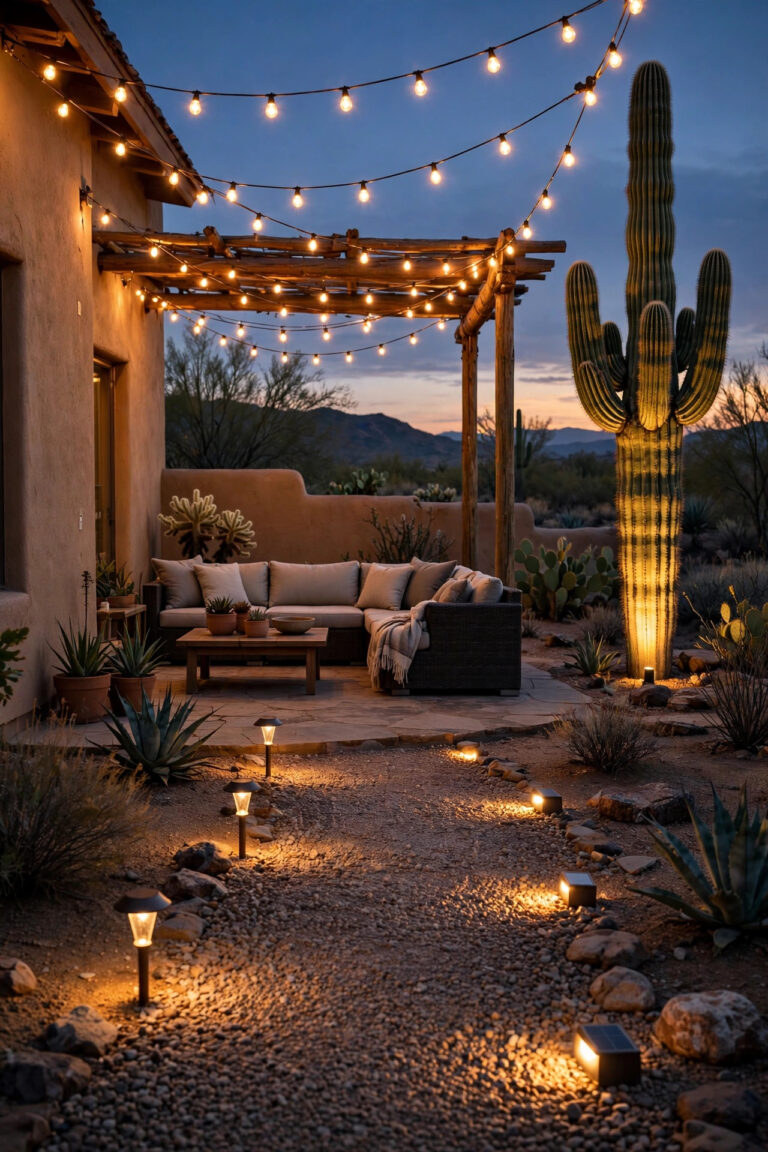
Stand at the curb in front of almost any house at dusk and you can spot the problem in seconds: a dozen mismatched fixtures all shouting at once. The good news? Your front yard does not need more light, it needs less, placed better. That is exactly why I keep coming back to minimalist front yard lighting ideas whenever a neighbor asks how to fix a busy-looking entry. The approach is simple: a few fixtures, each with one clear job, all sharing the same finish and the same warm glow, layered quietly so the house looks calm and intentional from the street. In this post I am sharing the 15 moves I use on my own front yard, from low bollards on the walk to a single uplit tree, with spacing numbers, bulb temperatures, and honest budget ranges for every idea. If your yard currently glows like a runway, or you are starting from a blank slate, these minimalist front yard lighting ideas will help you edit down to the essentials and end up with curb appeal that feels effortless, because it nearly is.
1. Start With a Three-Layer Plan, the Base of All Minimalist Front Yard Lighting Ideas
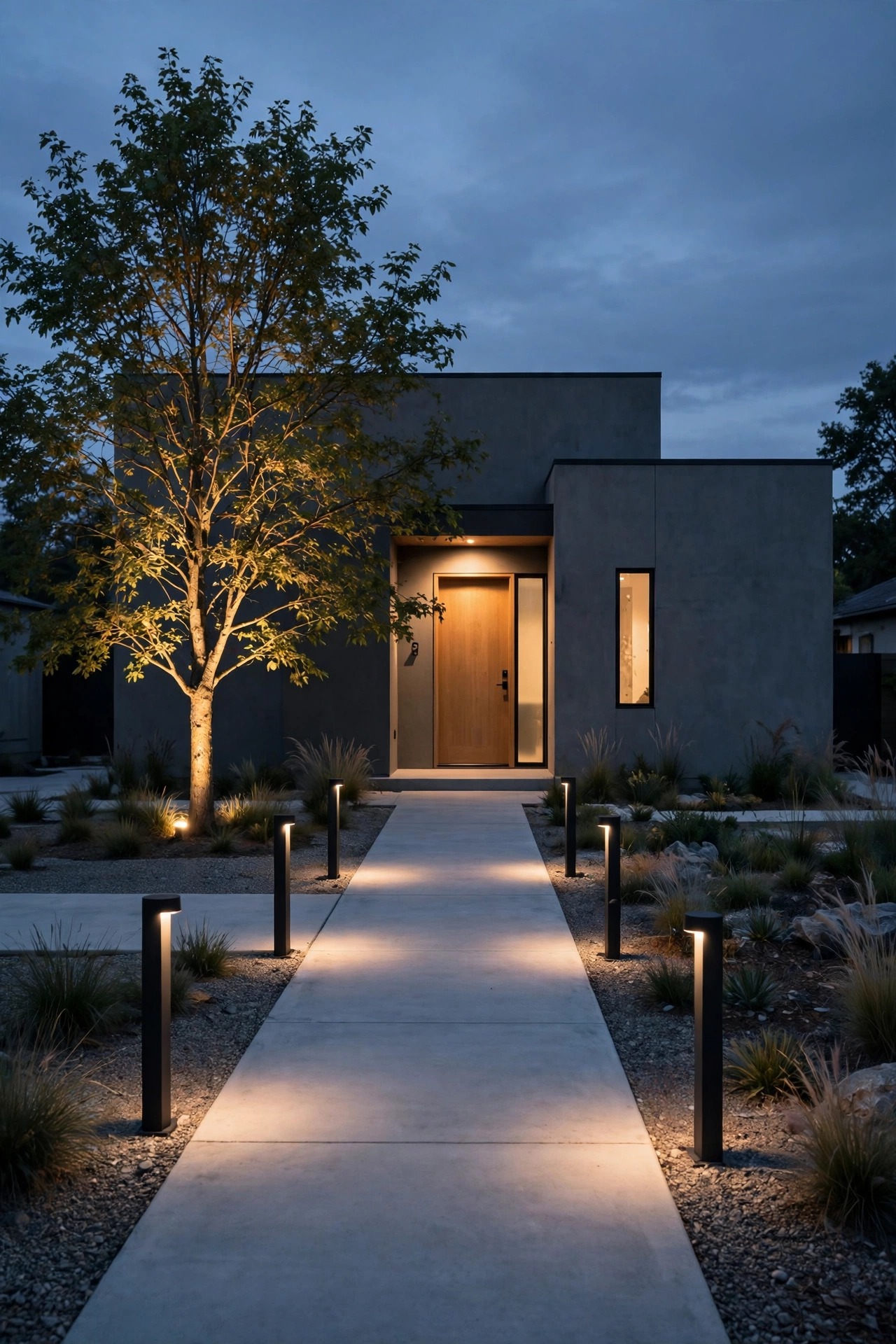
Every calm front yard I admire is built on the same quiet structure: three layers of light, each doing one job. The first layer is guidance — low lights that trace the walk and driveway so guests always know where to step. The second is welcome — a soft glow at the front door and porch that says someone is home. The third is accent — one or two gentle highlights, usually a tree or a stretch of beautiful siding, that give the yard its depth. When I plan a yard, I sketch those three layers on paper before I buy anything, and I cap the fixture count hard: most front yards need just 10 to 16 fixtures total. Anything that does not serve a layer gets cut, no matter how pretty the catalog photo looks. This is the same layered approach I lean on in my front yard landscape lighting projects, only edited down further. Start with the plan, and every idea that follows gets easier, because you are filling named jobs instead of collecting lights.
Suggested budget range: $150 – $450.
2. Line the Front Walk With Low Bollards in One Style Only
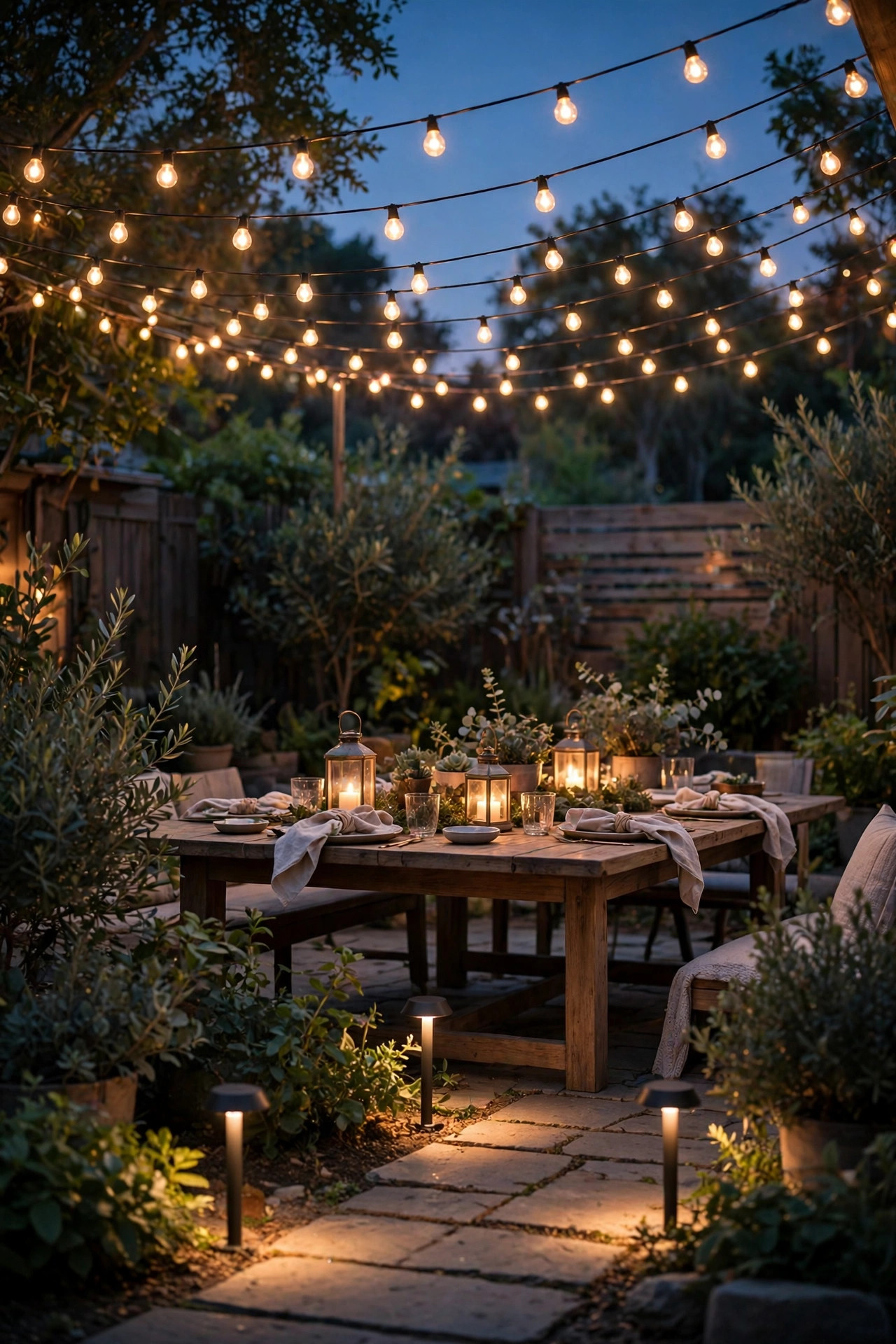
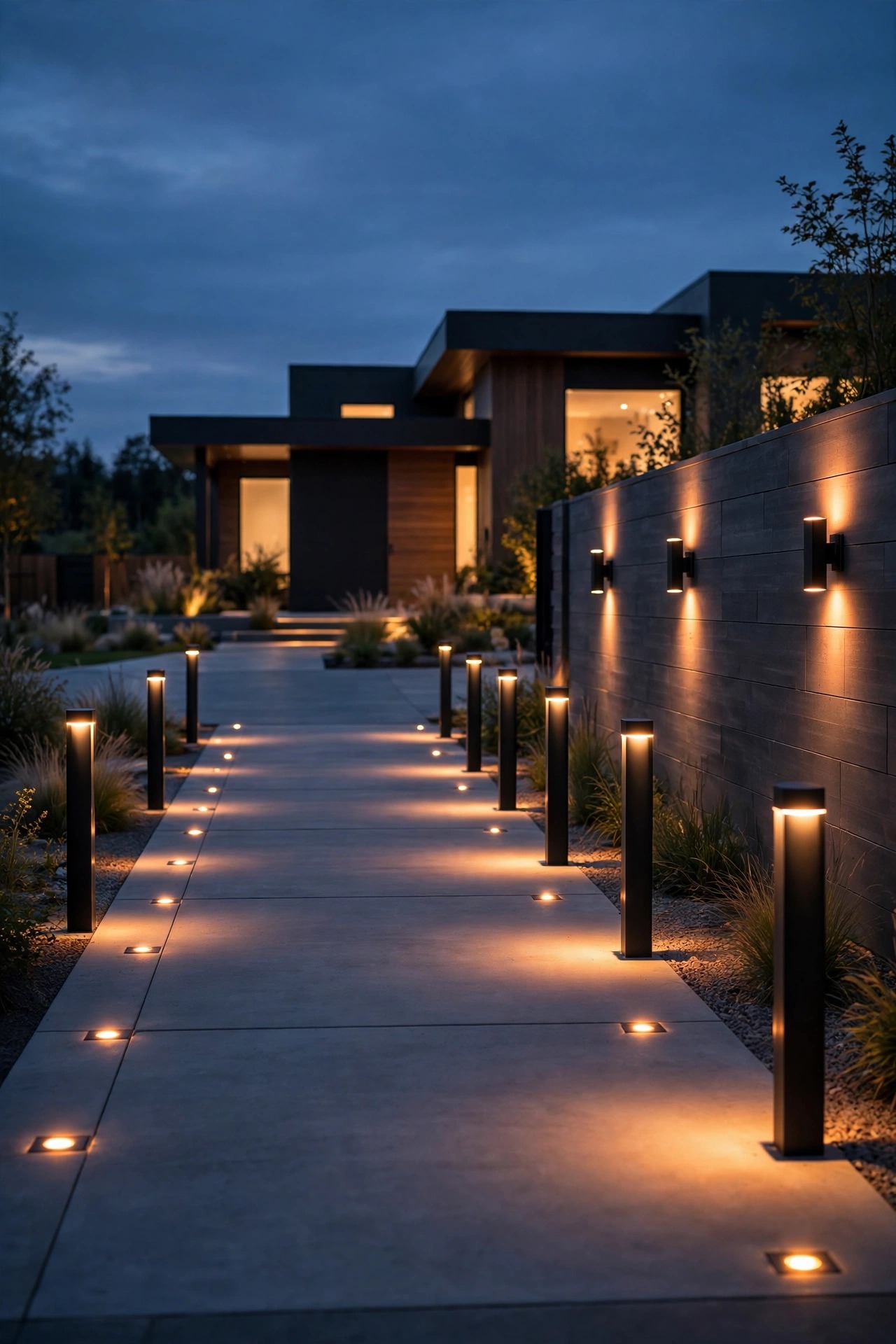
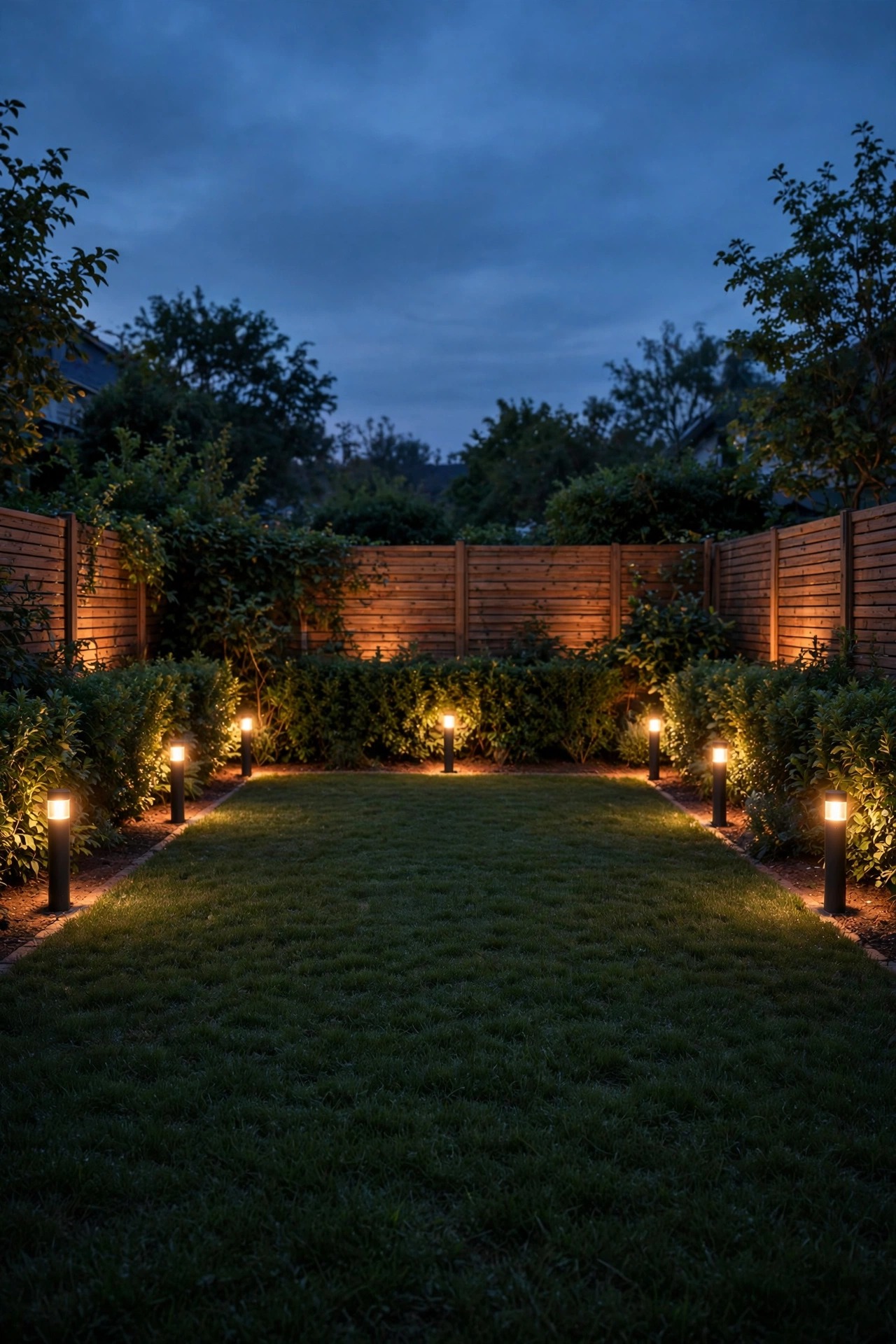
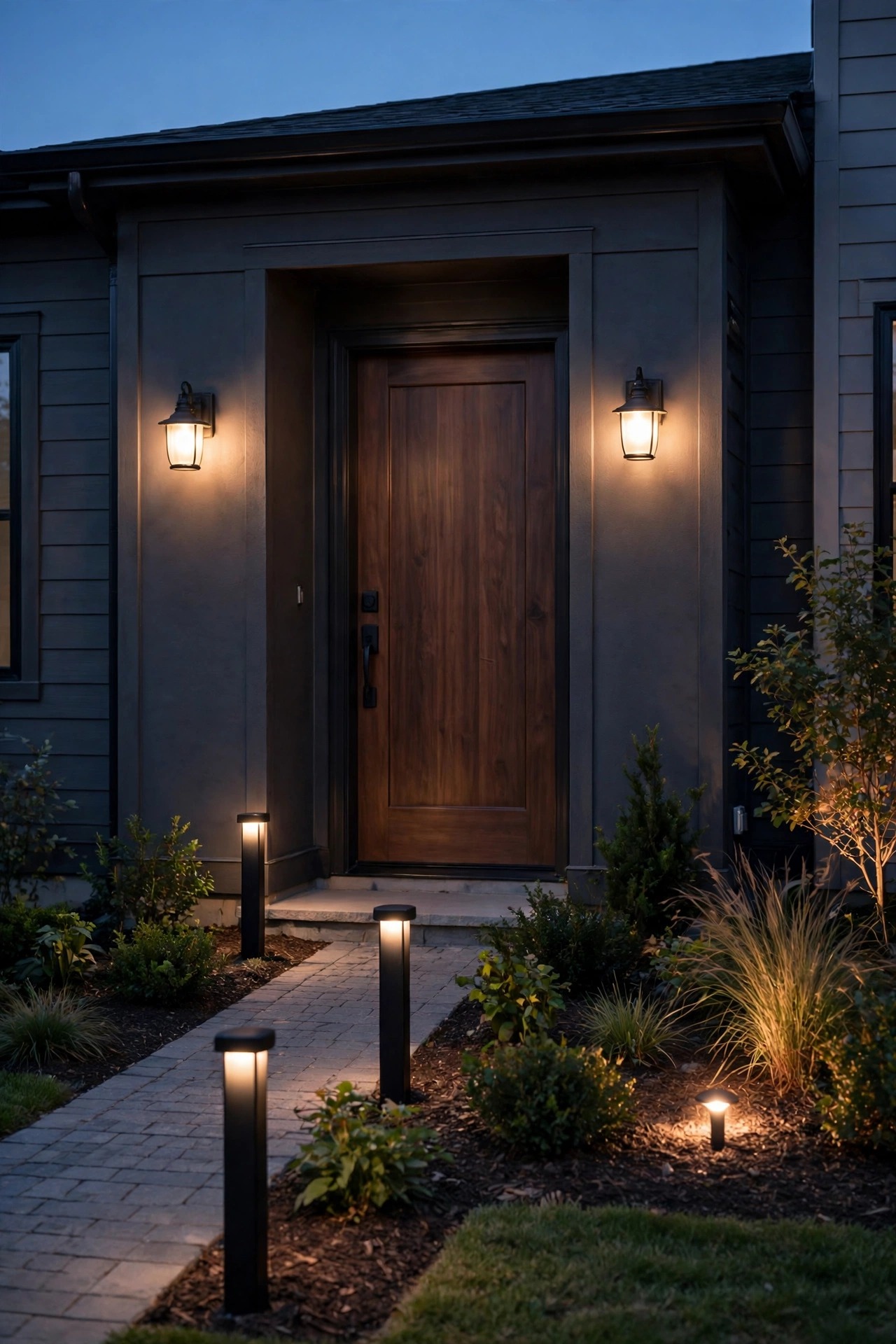
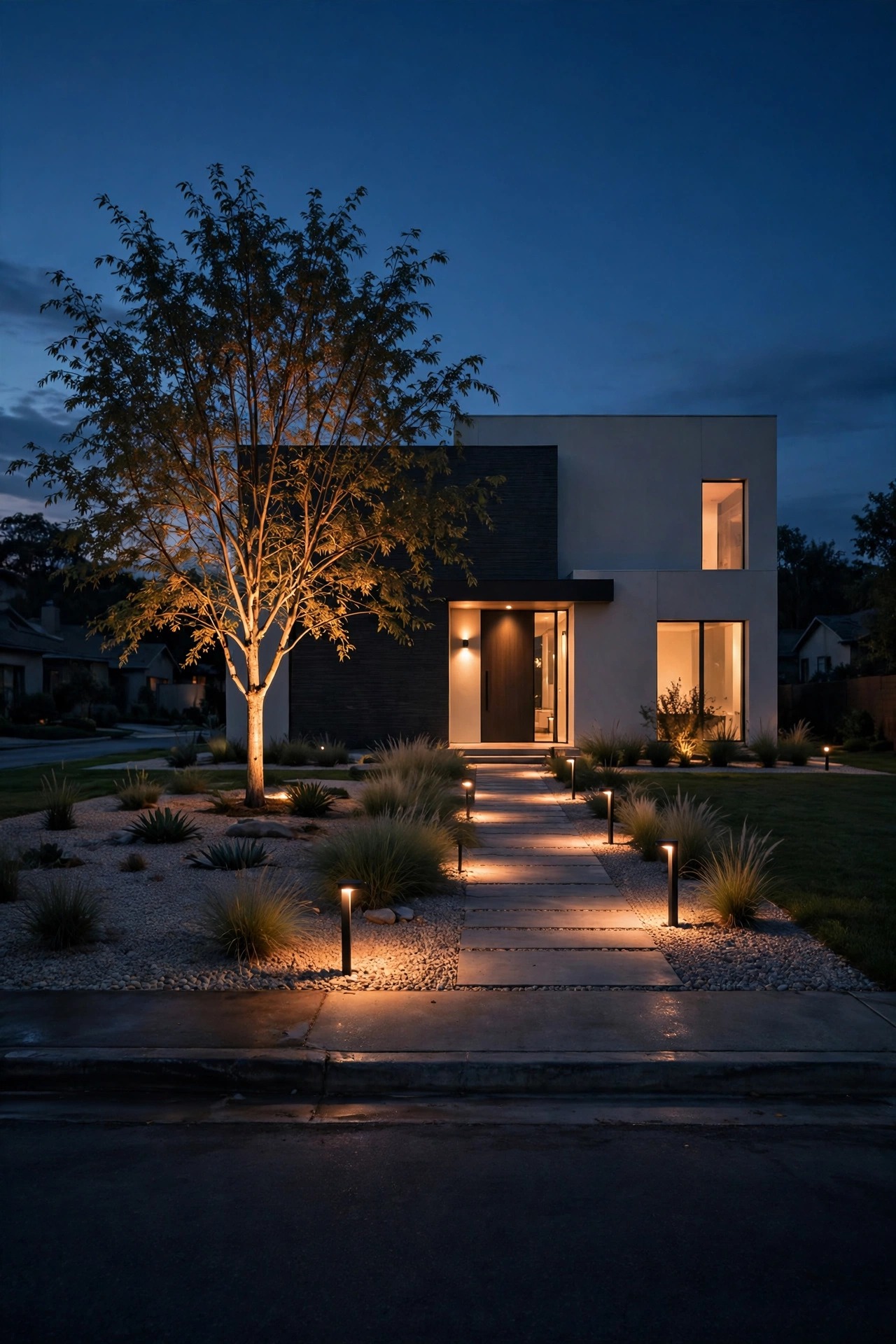
If I could keep only one fixture type in the front yard, it would be the low bollard. A simple matte cylinder, 12 to 18 inches tall, throws a soft pool of light downward onto the walk without glaring into anyone's eyes or lighting up the whole street. Space them 6 to 8 feet apart along one side of the path — one side only, because a double row instantly reads as a runway. Stagger them slightly if your walk curves. I always choose low-voltage wired bollards over solar for the main walk: the light is steadier, the color stays consistent, and one transformer runs the whole line for pennies a night. Look for fixtures with a shielded or louvered top so the LED itself is never visible from the street; all guests should see is the lit path, not the hardware. Pick one style and repeat it without exception. The repetition is what makes the yard feel designed rather than accumulated, and at dusk the row of quiet pools of light does more for curb appeal than twice as many mixed fixtures ever will.
Suggested budget range: $120 – $300.

3. Edge the Driveway With Flush In-Ground Markers
Driveways are where front yards collect clutter — chunky stakes, tilted solar spikes, fixtures guests back over. The minimalist fix is to take the light down to the pavement itself. Flush in-ground markers sit level with the driveway surface, so by day there is nothing to see and nothing to hit with a tire or a snow shovel. At night they switch on as a calm dotted line that tells drivers exactly where the edges are. Space them 8 to 10 feet apart down both sides of a straight drive, or along the outer edge only on a curved one. Choose fixtures rated for drive-over loads — look for a rating of at least 2 tons — with tempered glass lenses and sealed, IP67-rated housings that shrug off rain, sprinklers, and road salt. Low-voltage wired versions tie into the same transformer as your path lights, so the whole front yard runs on one system. Keep the beam tight and downward; the goal is a readable edge, not a lit runway. It is the cleanest driveway lighting I know, and the one that gets the most compliments from neighbors.
Suggested budget range: $90 – $260.

4. Give One Statement Tree a Single Uplight and Stop There
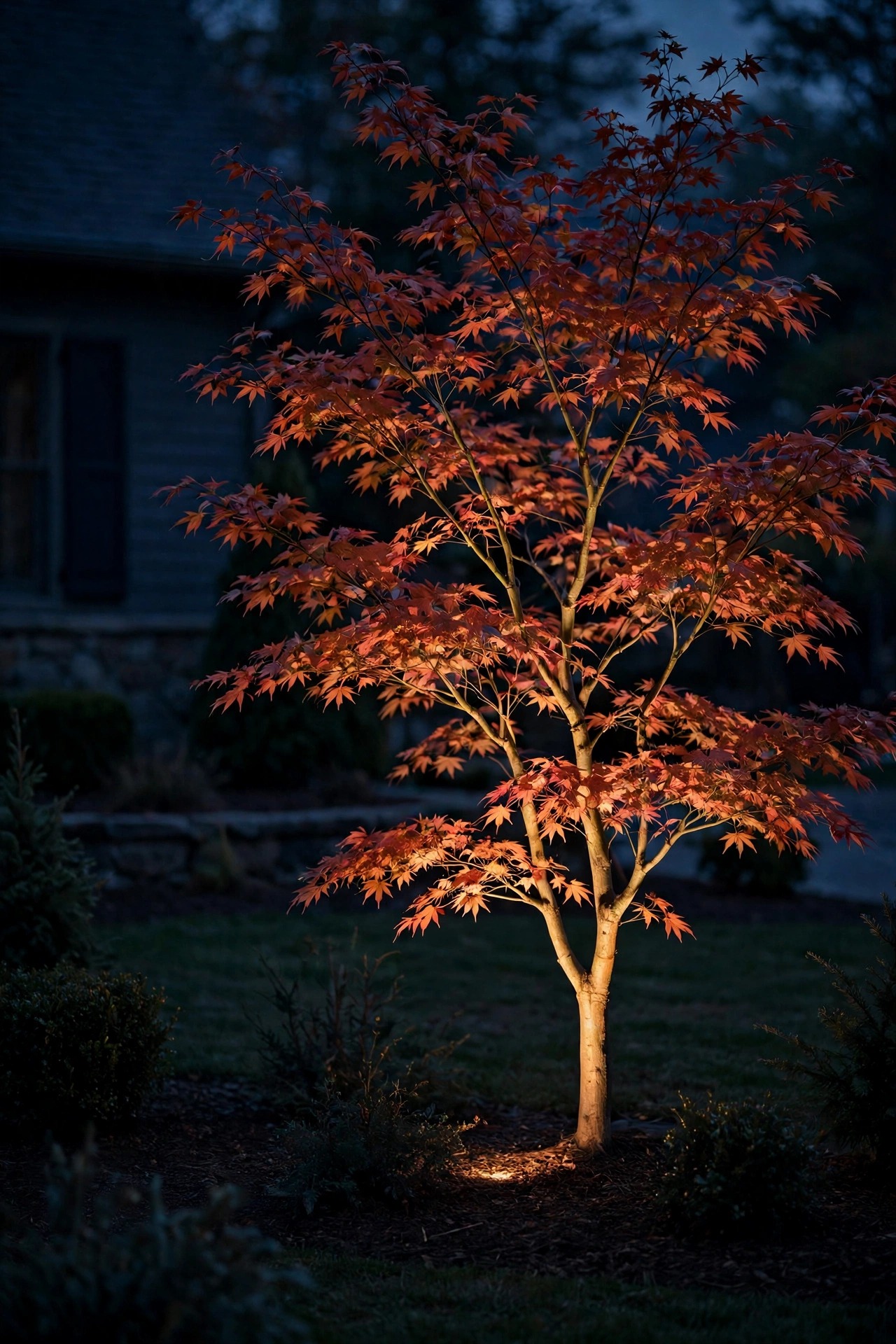
Every front yard has one tree doing the heavy lifting — the oak by the corner, the Japanese maple near the porch. Give that tree one well-placed uplight and let it be the yard's single piece of drama. One fixture, not three: a single narrow-beam spotlight (30 to 40 degrees) set 12 to 18 inches from the trunk, aimed up into the canopy, creates those beautiful shadowed branches without turning the tree into a stadium exhibit. I use a warm 2700K LED in a matte black or bronze well light that disappears into the mulch by day. Resist the urge to uplight every tree and shrub in sight. When everything is highlighted, nothing is, and the yard flattens into noise. One lit tree against a mostly dark yard reads as intentional and a little luxurious, like a gallery with a single painting. If you have two matching trees flanking the house, a matched pair is the one exception I allow. Otherwise, one tree, one light, and darkness doing the rest of the design work for free.
Suggested budget range: $40 – $120.
5. Frame the Front Door With One Slim Sconce Pair
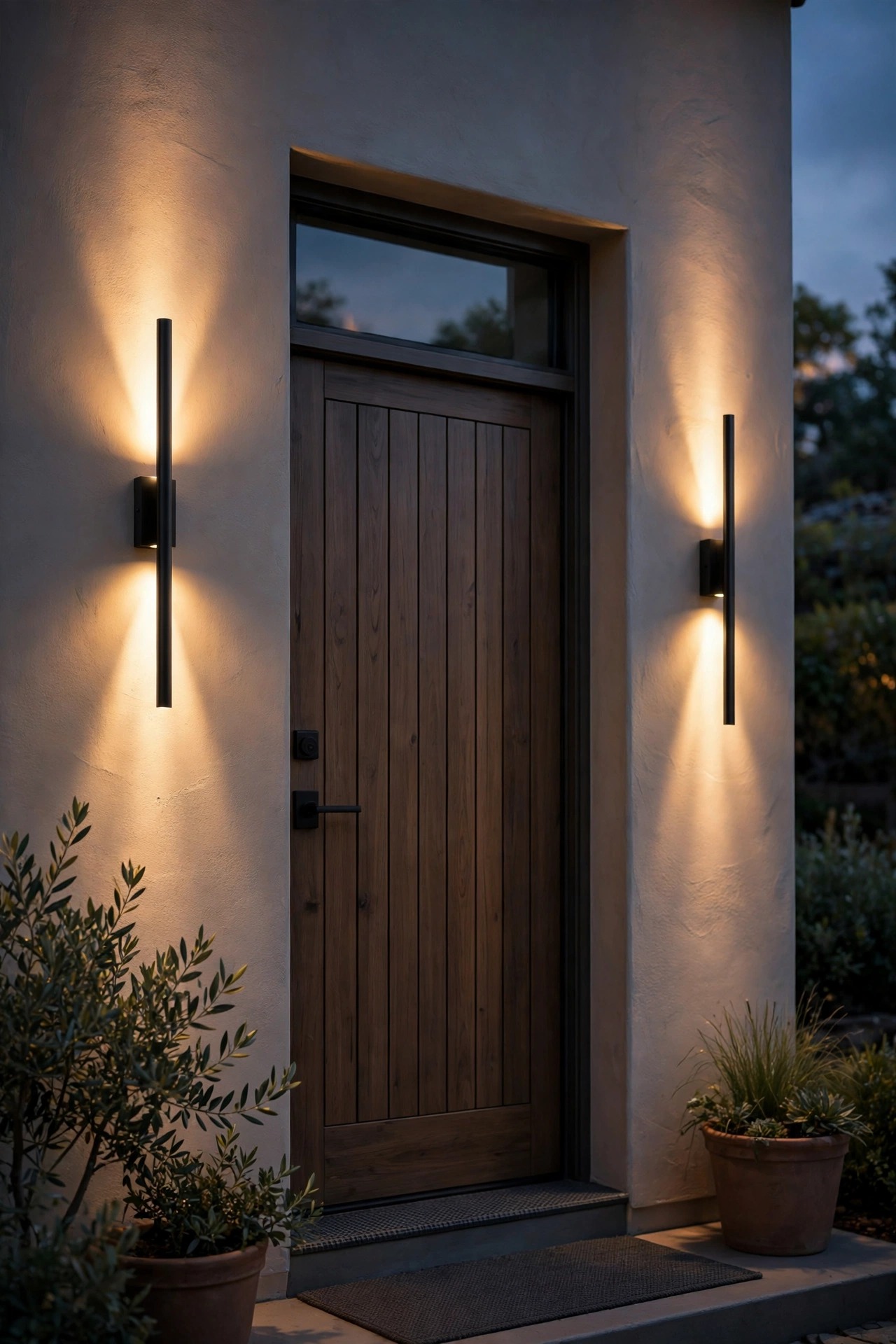
The front door is the welcome layer, and it needs exactly two fixtures: one slim sconce on each side of the door, mounted at eye level, about 66 inches above the threshold. That is it — no lantern trio, no oversized carriage lights competing with the walkway. I look for narrow, architectural sconces with frosted or opal glass that hides the bulb, because a visible filament turns the entry harsh and busy. Up-down sconces are my favorite for a minimalist entry: they wash slim ribbons of light above and below the fixture, so the door glows without a bright spot in your guests' eyes. Size matters more than ornament here — each sconce should be roughly one-third the height of the door, and mounted so the pair feels like punctuation, not decoration. Put them on the same timer as the path lights so the whole welcome scene arrives together at dusk. In my experience, a clean sconce pair plus a lit walk is all the entry lighting most homes ever need, and it photographs beautifully for anyone selling a house.
Suggested budget range: $80 – $220.
6. Tuck Fixtures Into the Planting Beds, Never on the Open Lawn
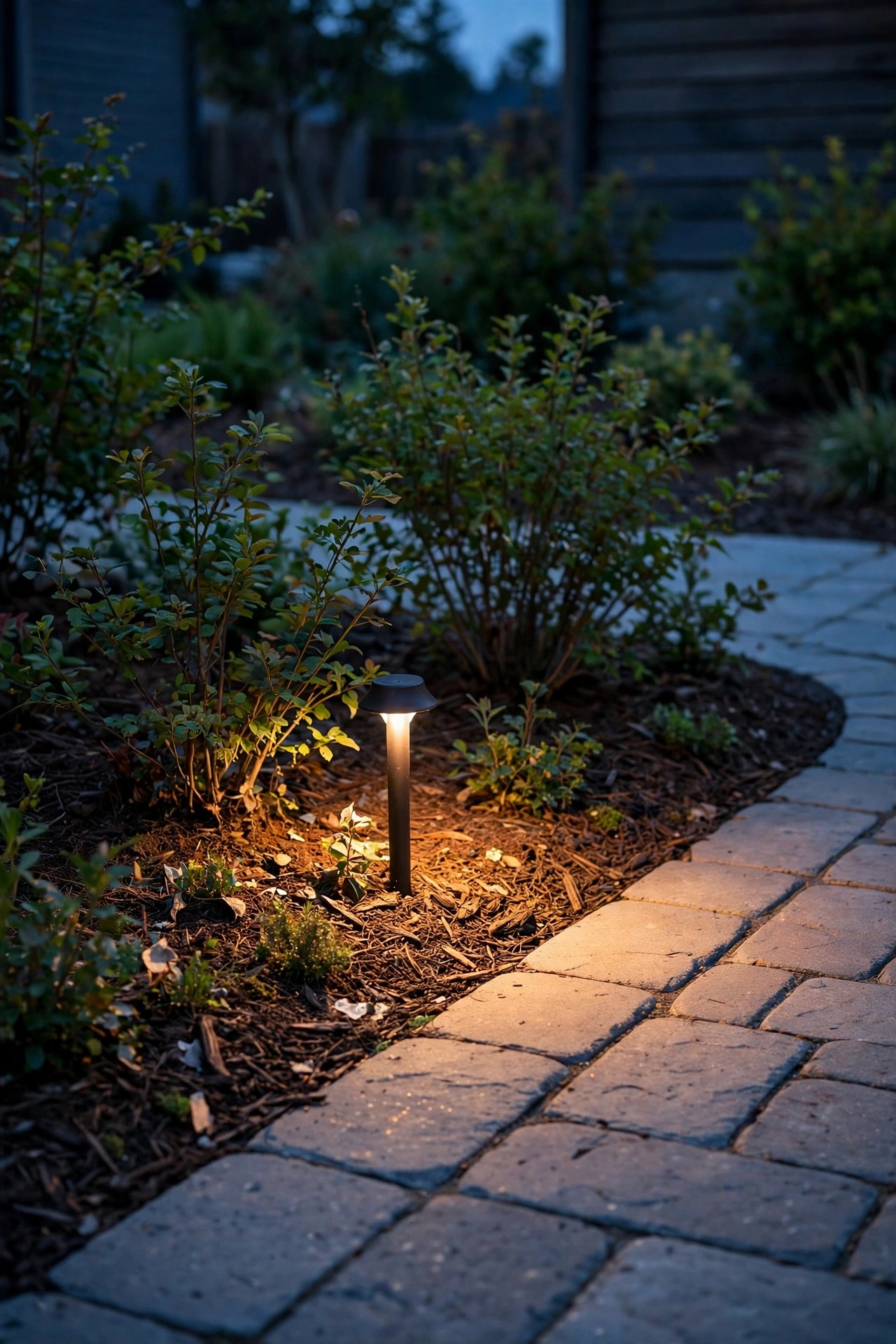
Nothing breaks a minimalist front yard faster than fixtures standing in the middle of the grass like little soldiers. Mowing around them is a chore, they lean within a season, and by day they are pure visual clutter. My rule: every ground fixture lives inside a planting bed, tucked at the base of a shrub or behind an ornamental grass, where the housing disappears into mulch and shadow. From the street you see light washing a hydrangea or pooling at the walk's edge — never the fixture itself. This also protects your investment: bed fixtures are safe from mower decks, string trimmers, and soccer balls. When I retrofit a yard, simply moving existing path lights from the lawn edge into the beds behind them softens the whole scene, because the light source hides and only the glow remains. Keep beds mulched 2 to 3 inches deep so low fixtures stay nestled but their lenses stay clear, and check each spring that growing plants have not swallowed a lens. Hidden hardware, visible light — that is the whole trick.
Suggested budget range: $100 – $280.
7. Light the House Numbers and Mailbox With One Soft Glow
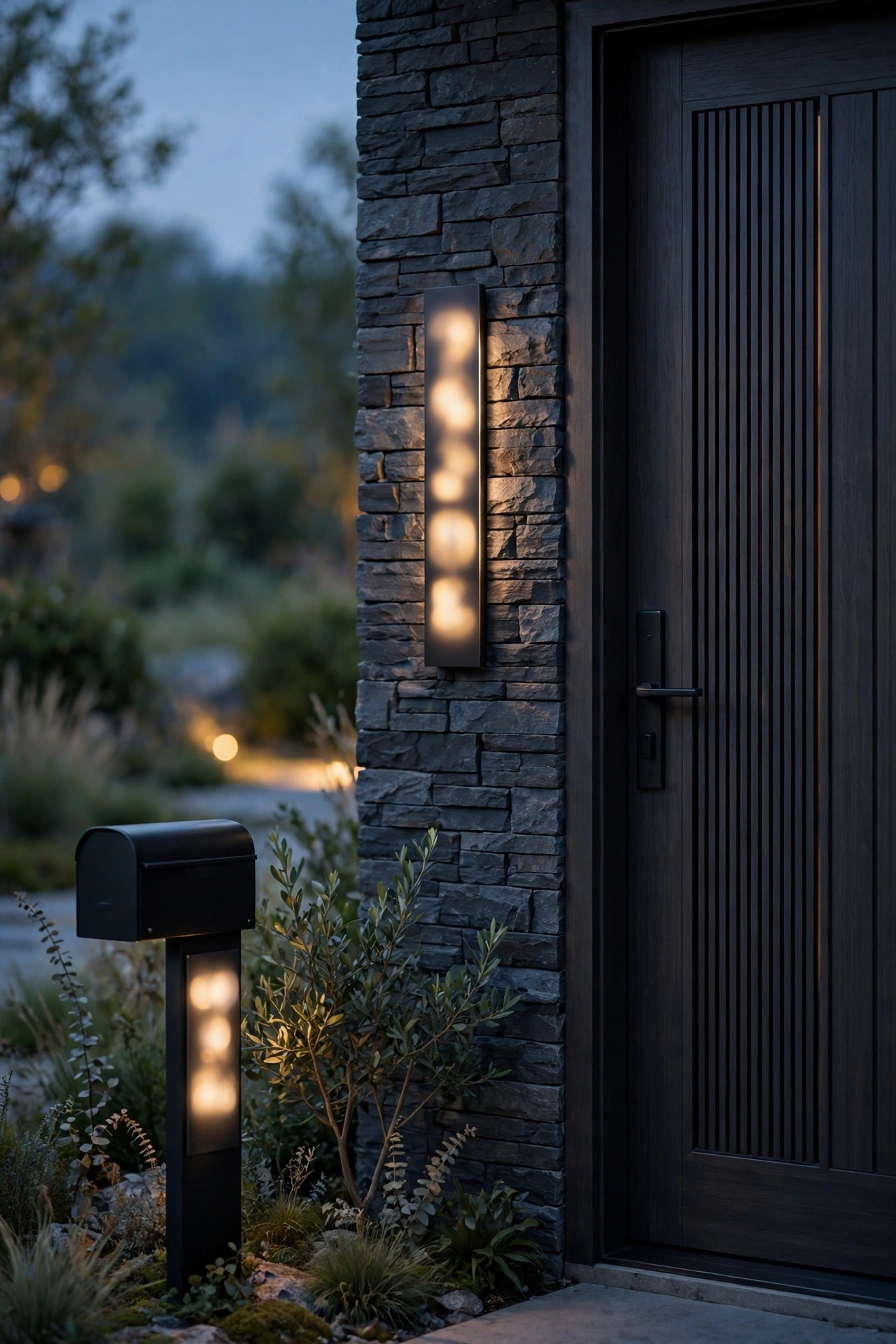
Delivery drivers and first-time guests judge your front yard by one practical test: can they find the house number after dark? A minimalist yard answers yes with restraint. Backlit or edge-lit house numbers in a simple modern font give off a soft halo that is readable from the street without a spotlight blasting the siding. If backlit numbers are not in the budget, aim one small, shielded downlight from the porch ceiling or a nearby sconce so the numbers fall inside its beam. At the curb, skip the solar mailbox stake with the plastic flag motif; instead, mount a slim number plaque on the mailbox post and let one low bollard from the walk do double duty nearby. The key is restraint: numbers need about the brightness of a night-light, not a billboard. Choose numbers at least 4 inches tall — many local codes require it for emergency services — in a finish that matches your other fixtures. It is a small detail, but a calmly lit address makes the whole entry feel considered, and your pizza arrives faster. Honestly? Worth it for that alone.
Suggested budget range: $35 – $110.
8. Graze One Stretch of Facade and Leave the Rest Dark
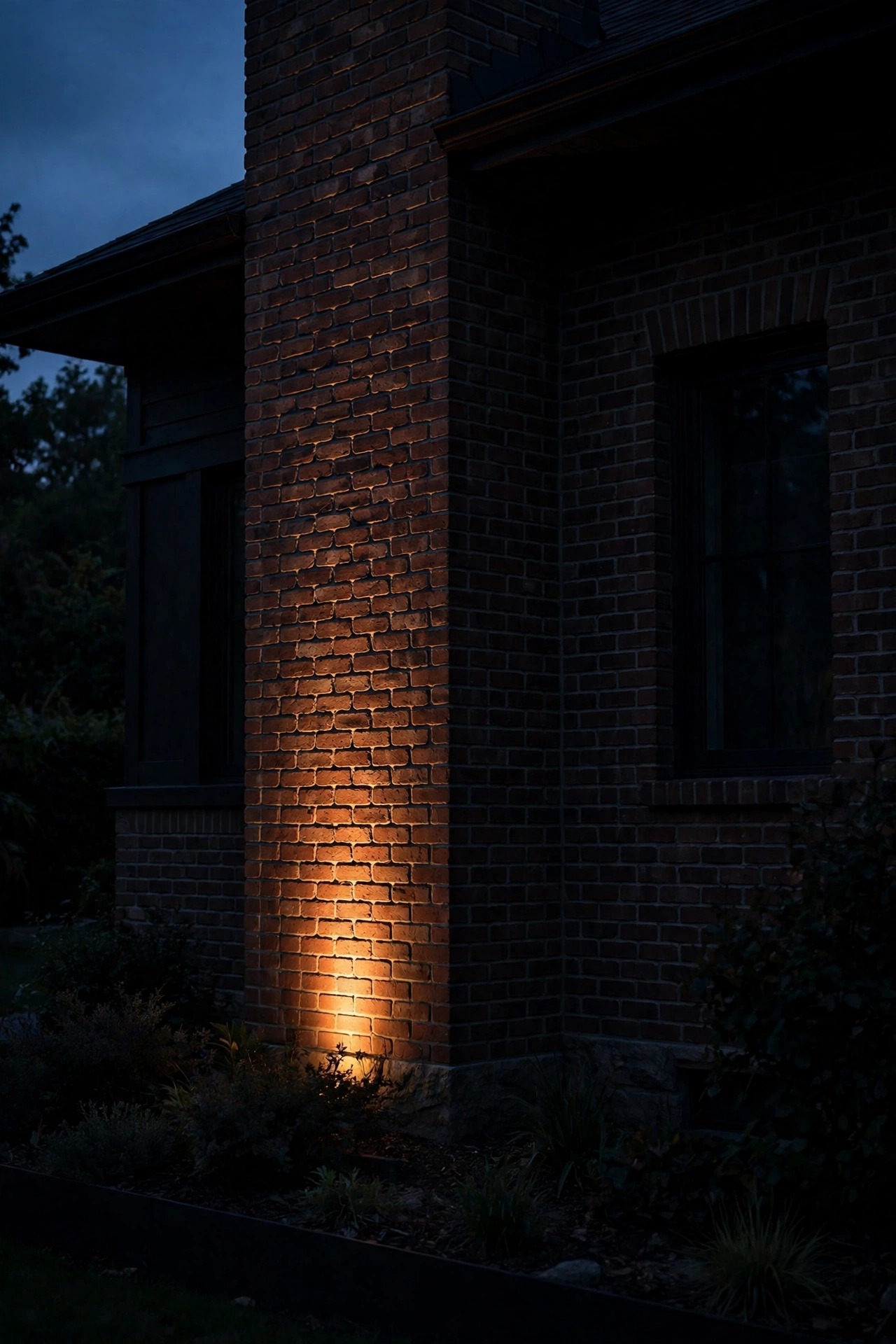
Brick, stone, and board-and-batten siding have texture that begs for a grazing light — a fixture placed close to the wall, aimed almost straight up, so the light rakes across the surface and every shadow line shows. The minimalist discipline is choosing one stretch of facade to graze: the chimney breast, the gable above the garage, or the wall beside the front door. Just one. Fixtures sit 6 to 12 inches out from the wall in the bed below, with a narrow beam that climbs without spilling into windows. I avoid washing the entire front of the house; a full floodlight flattens architecture, annoys neighbors, and reads as a security light at a warehouse. One grazed section, though, gives the yard depth and makes the house look quietly expensive. Keep windows out of the beam path, and if your siding is smooth vinyl or stucco, grazing has little texture to reveal — in that case skip this idea entirely and let the tree and door carry the accent layer. Knowing what to leave dark is half the design.
Suggested budget range: $60 – $180.
9. Recess Step Lights Into the Porch Steps Themselves
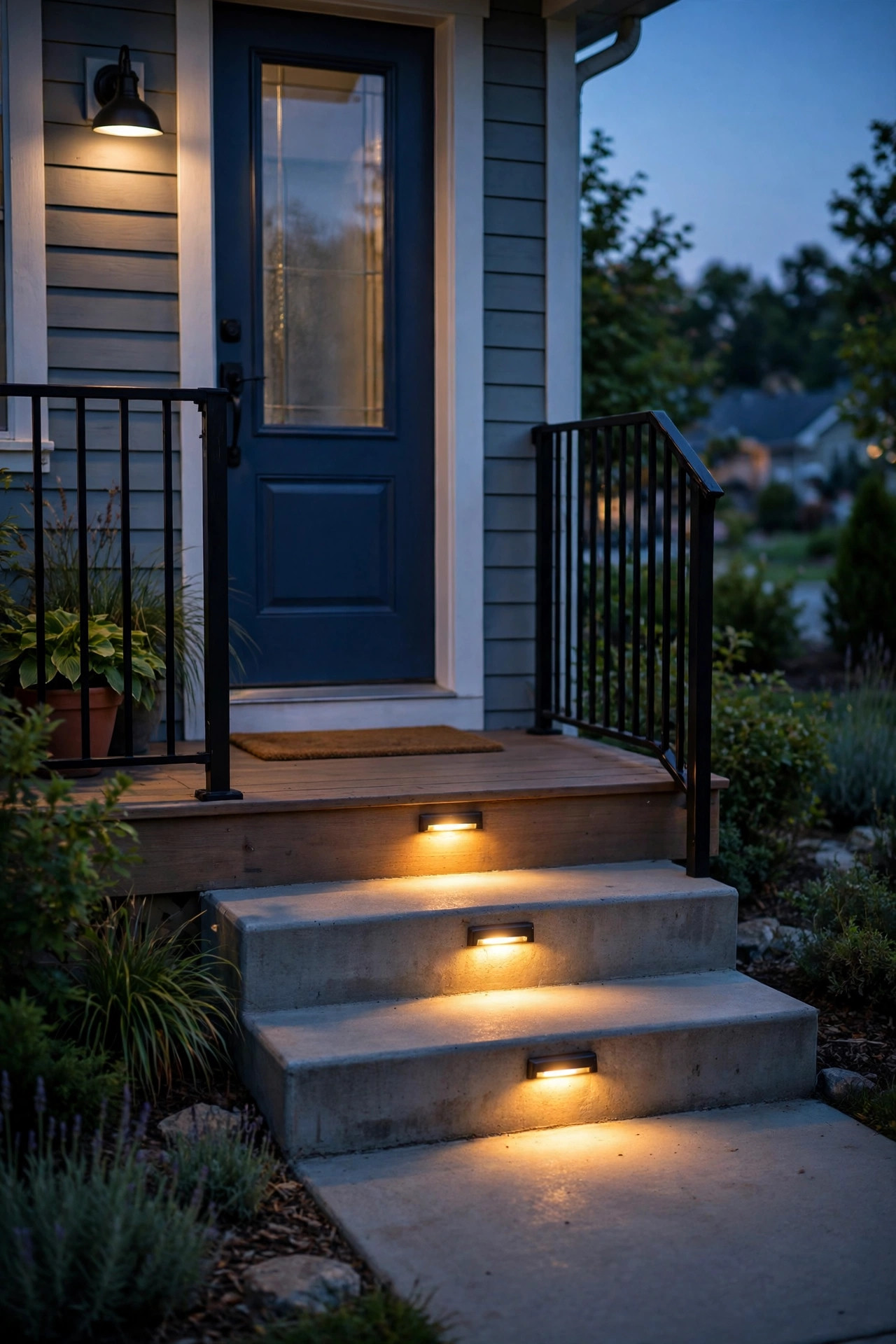
Porch steps are the one place guests actually trip, so they deserve light — but not a lantern on a post beside them. Recessed step lights mount flush into the riser or the side wall of the steps, washing each tread with a low, even glow while the fixture itself nearly vanishes. One light per step is plenty for steps up to 4 feet wide; wider entries take two, placed symmetrically. Aim for light you can see the effect of, not the source: louvered or hooded trims push the beam down onto the tread and keep glare out of eyes. Hardwired low-voltage versions are my pick for reliability, wired into the same transformer run as the walk lights so everything switches together. If your steps are solid concrete and cutting is not an option, slim surface-mount strips under each tread nosing give nearly the same invisible effect. Either way, keep the color temperature matched to the rest of the yard — mismatched step lights are a tiny detail that somehow makes the whole entry look off. Safe, subtle, and done.
Suggested budget range: $70 – $200.
10. Commit to One Finish Everywhere, Matte Black Above All
Walk any yard that feels cluttered and you will usually find four finishes fighting: oiled bronze sconces, silver solar stakes, a copper lantern someone loved, and white fixtures from the builder. The fastest minimalist edit costs nothing but resolve: pick one finish and let it rule the whole front yard. I default to matte black because it disappears against soil, mulch, and shadow, and because nearly every fixture style comes in it. Bronze is my second choice for brick or traditional homes. The rule has no exceptions for sentiment — the odd lantern moves to the backyard, where mixing bothers nobody. When every fixture shares a finish, the eye stops cataloguing hardware and starts seeing the lit scene instead, which is precisely the calm we are after. Replacing a handful of mismatched stakes with one matching set usually costs less than people expect, especially in low-voltage lines sold as kits. And by day, a single-finish yard looks tidy and intentional even with the lights off, which is more than half of curb appeal.
Suggested budget range: $150 – $400.

11. Hold Every Bulb to One Warm Temperature, 2700K
If finishes are the yard's wardrobe, color temperature is its accent color — and mixing temperatures is the quickest way to make a careful plan look accidental. A 2700K path light beside a 4000K porch bulb reads as a mistake, even when each fixture is lovely alone. So I standardize the whole front yard on 2700K, the warm amber-white of a classic bulb, and I never let another temperature cross the property line. When buying LEDs, check the box for both the Kelvin rating and a CRI of 90 or above, which keeps brick reds and foliage greens looking true instead of washed out. Integrated LED fixtures make this easy because the temperature is fixed at the factory; for socketed sconces, buy spare bulbs from the same pack so replacements match perfectly. If some areas feel too dim, add brightness with lumens, never by jumping to a cooler temperature. One temperature everywhere is invisible when done right — nobody notices it, which is the point — but it is the invisible discipline underneath every serene front yard photo you have ever saved.
Suggested budget range: $25 – $90.
12. Run the Whole Yard on One Timer and One Photocell
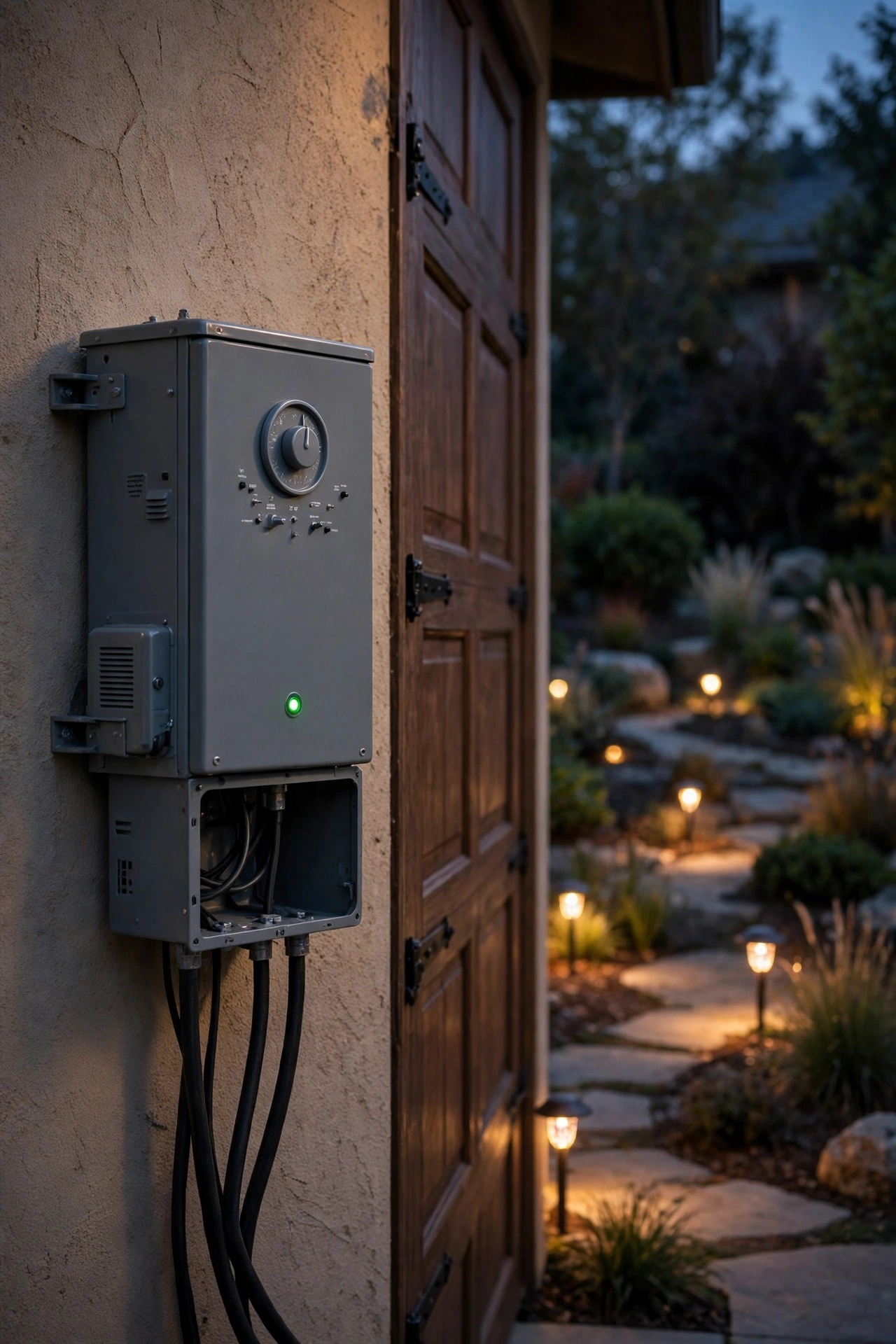
A minimalist yard should switch itself on like it was never a decision. I put every low-voltage run on a single transformer with a built-in photocell and timer: lights fade on at dusk, run at full warmth through the evening, and switch off at a set hour — mine go dark at 11 p.m., which trims the electric bill and keeps the street calmer for neighbors. One control point also means one temperature, one schedule, one scene; no orphan fixtures burning at 3 a.m. because someone forgot a switch. This single-system thinking is the backbone of my minimalist lighting approach: fewer controls, fewer choices, less to maintain. If your transformer lacks a photocell, a plug-in astronomical timer that tracks sunset for your zip code costs very little and never needs seasonal adjusting. Solar fixtures are the exception that proves the rule — each has its own sensor and its own opinion about dusk, which is why I keep them off the main stage. One yard, one switch, one calm scene every single night.
Suggested budget range: $30 – $120.
13. Light Only the Perimeter, a Signature Move in Minimalist Front Yard Lighting Ideas
Here is the idea that surprises people most: leave the middle of the lawn completely dark. Instead of sprinkling fixtures across the grass, place light only at the yard's edges — the walk, the driveway border, the beds against the house, the fence line at the sidewalk. The dark center is not empty; it is negative space that makes every lit edge look deliberate and lets the house sit in a calm pool of shadow. It also halves your fixture count, your cable run, and your maintenance, since everything sits within reach of a bed or border. From the street, a perimeter-lit yard reads as a framed picture: bright thresholds, glowing edges, and a quiet middle that gives the eye a rest. Wildlife appreciates it too — fewer lights crossing open lawn means fewer disrupted birds and pollinators. When I redo a yard, this is often the single change that turns a busy lighting collection into a composition. Try it for one week before adding anything back. In my experience, almost nobody misses the middle lights, and the electric bill sends a small thank-you.
Suggested budget range: $130 – $350.
14. Shrink the Fixture Count Even Further in a Small Front Yard
Small front yards are where minimalism stops being a style and becomes simple math: a 20-foot yard with 20 fixtures is a lighting store, not a home. For compact entries and townhome fronts, I cut the plan to three elements — a sconce pair at the door, three or four bollards on the walk, and one accent, either the tree or the facade graze, never both. That is six to eight fixtures total, and it looks generous. Scale fixture size down too: a 12-inch bollard instead of an 18-inch one keeps proportions honest. If you want more small-space layouts, my small front yard lighting ideas walk through several, but the principle never changes: in a small yard every fixture is visible from everywhere, so each one must earn its place twice. Skip the mailbox light, skip the bed spots, and let one beautiful material — a stone walk, a cedar door — do the decorative work. Restraint reads as confidence, and small yards done this way routinely outshine bigger, busier ones on the same street.
Suggested budget range: $80 – $240.
15. Finish With a Street-View Check of Your Minimalist Front Yard Lighting Ideas
The last step happens at the curb, not in the yard. Once everything is installed, wait for full dark, walk to the street, and look at your house the way every guest, buyer, and delivery driver sees it. This is the honest view: you will spot the one bollard aimed a degree too high, the sconce glaring through the sidelight, the tree light that is brighter than the door. Adjust ruthlessly — drop a dimmer setting, swap one bulb down in lumens, pull one fixture entirely if the scene feels crowded. Then take a photo; phones flatten brightness honestly and reveal hotspots your eyes forgive. I repeat this street check every season, notebook in hand, and nearly every time I remove or soften something rather than add. That reflex is the whole philosophy behind these minimalist front yard lighting ideas: the yard is finished not when there is nothing left to add, but when there is nothing left you would take away. Keep the scene quiet, warm, and a little understated, and your front yard will be the one the neighborhood slows down to admire.
Suggested budget range: $0 – $40.
Frequently Asked Questions
What color temperature works best for a minimalist front yard?
I use 2700K everywhere, no exceptions. It is the warm amber-white that flatters brick, stone, wood doors, and skin tones, and it matches the glow of the classic bulb guests expect at a home. Cooler 4000K light can look sharp on modern architecture in photos, but in a real front yard it reads cold and commercial, and mixing it with warm path lights makes a careful plan look accidental. Buy bulbs and fixtures rated 2700K with a CRI of 90 or higher, keep spares from the same pack for socketed fixtures, and if a spot feels too dim, raise the lumens — never the temperature.
How many lights does a minimalist front yard actually need?
For most homes, 10 to 16 fixtures cover it: four to six path or bollard lights, a few driveway markers if the drive is long, a sconce pair at the door, two or three bed or step lights, and one accent for a tree or facade. Small yards often need just six to eight. The honest test is function — every fixture should guide a step, welcome a guest, or highlight one feature. If a light does none of those jobs, it is decoration the yard is paying for nightly, and it can probably go.
Are solar lights bright enough for a minimalist front yard?
For accents, yes; for the main walk, I still prefer low-voltage wired lights. Good solar stakes now give a pleasant glow for garden edges, but their brightness fades on cloudy stretches, each fixture switches on its own schedule, and color temperature varies between brands — three things that fight the one-scene calm minimalism depends on. A single low-voltage transformer runs the whole yard consistently for a few dollars of electricity a year. If wiring is impossible, choose solar fixtures from one line, in one finish, all rated 2700K, and accept a gentler glow.
How much does minimalist front yard lighting cost to run?
Less than almost any other style, because there is less of it. A typical 12-fixture low-voltage LED yard draws about 60 to 90 watts total; run five hours a night, that is roughly 10 to 16 kilowatt-hours a month, or around $2 to $3 at average US rates. The fixtures themselves are the real cost — budget $80 to $450 per idea in this list depending on scope — but fewer, better fixtures usually beat a cart full of cheap stakes that need replacing every second season. A timer that shuts the yard down late at night trims running costs further.
Conclusion
A calm front yard is not about owning fewer things for the sake of it; it is about every light having a job and nothing shouting. Start with the three-layer plan, repeat one fixture and one finish, hold the whole yard to a single warm temperature, and let the dark spaces breathe. These minimalist front yard lighting ideas prove that restraint is not a compromise — it is the design. Pick three ideas from this list, live with them for a week, and edit before you add. And if you are planning the backyard next, browse the rest of the lighting ideas here on the site; the same quiet rules work beautifully out back, too.