A pergola out in the middle of the yard is my favorite kind of garden room — no walls, no roof overhead but the sky, just four posts and a promise. But here's the honest problem nobody mentions at the garden center: it's a long way from the house, which means a long way from the nearest outlet. That's exactly why I put together these freestanding pergola lighting ideas — every single one works without running power across the lawn, or shows you how to get power there safely when you truly need it.
The secret is the same layering I use everywhere: a gentle glow overhead, something warm at table height, and a soft line of light that leads you out there in the first place. A mid-yard retreat should feel discovered, not floodlit. Below you'll find 15 ways to build that feeling, from ten-dollar solar stakes to a full low-voltage setup. If your pergola is attached to the house instead, my roundup of pergola lighting ideas covers that layout — this list is for those of us whose pergola lives out in the grass, earning its glow the solar way.
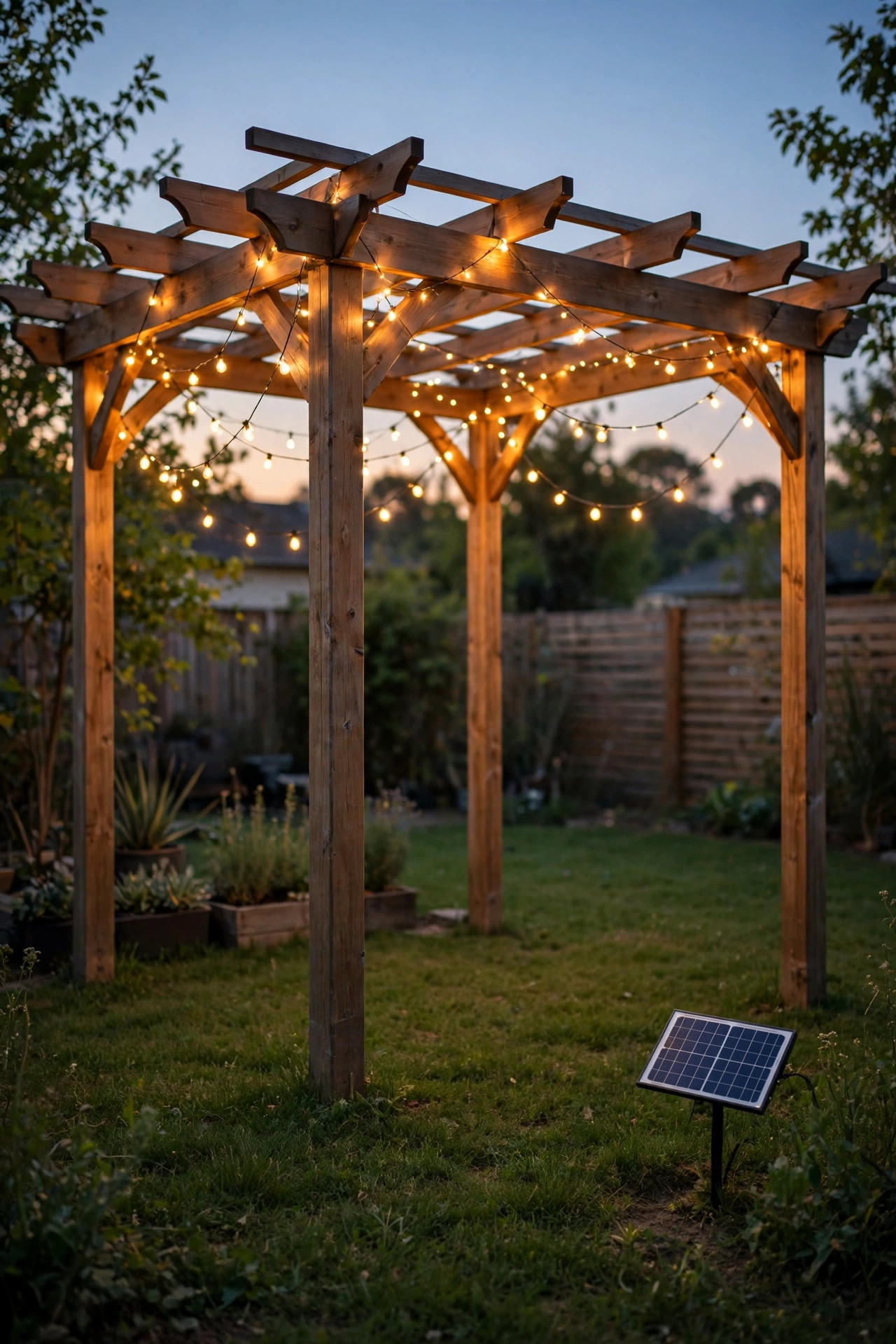
1. Bistro String Lights Zigzagged Across the Rafters
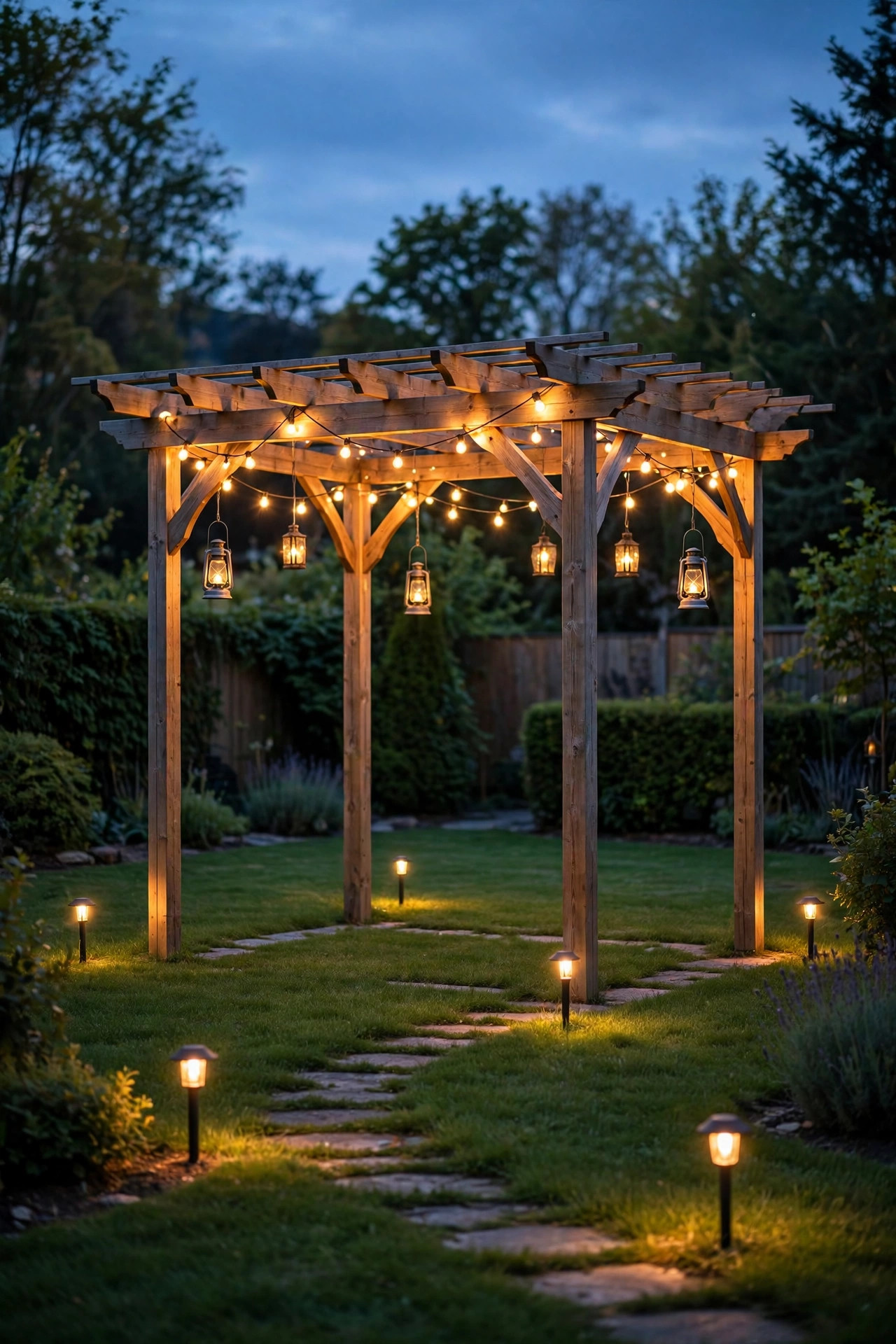
This is the backbone of almost every pergola I light, and it works just as well mid-yard as it does on a patio. Run two or three strands of outdoor string lights in a zigzag between the rafters, letting each span sag about 6 to 8 inches in the middle — that gentle drape is what makes it look like a café instead of a clothesline. For a 10-by-12-foot pergola, plan on roughly 100 feet of strand total. Use guide wire or screw-in cup hooks at each anchor point so the weight never hangs on the cord itself. Out mid-yard, I reach for solar-powered strands or a single heavy-duty outdoor extension run from a GFCI outlet — never daisy-chain indoor cords across wet grass. Shatterproof LED filament bulbs are worth the small premium; the glass look is there, but a dropped bulb bounces instead of shattering. I cover the strand styles in more depth in my guide to bistro string light ideas, including how the bulb spacing changes the mood.
Suggested budget range: $35 – $90.
2. Solar String Lights — Freestanding Pergola Lighting Ideas With Zero Wiring
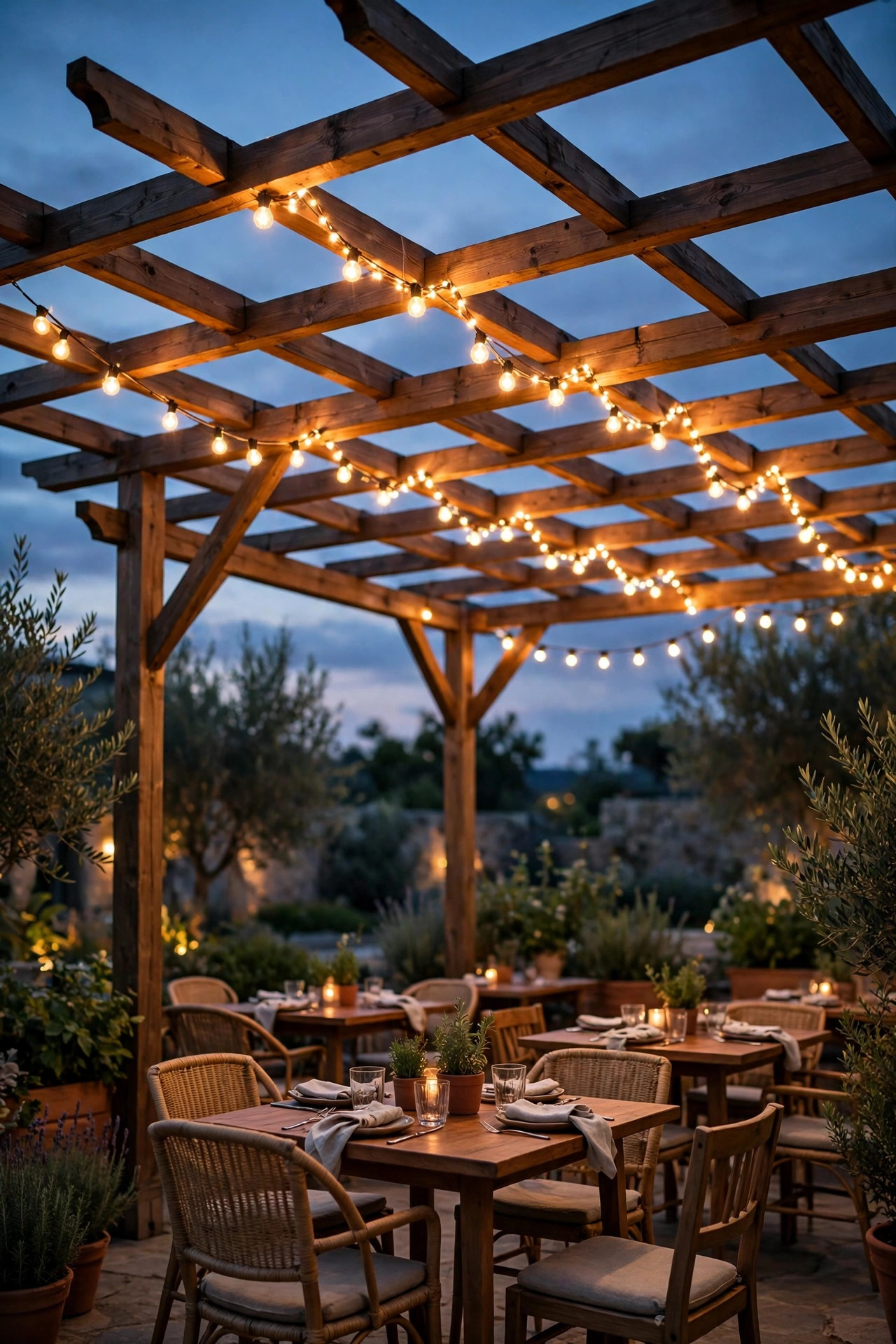
When there's no outlet within reach, solar string lights are the honest hero of the mid-yard pergola. The setup is simple: the strand hangs exactly like a wired one, but the small solar panel stakes into the ground a few feet away where it catches full sun, ideally facing south and tilted slightly up. In my experience the panel placement matters more than the brand on the box — a panel shaded by the pergola's own shadow after 2 p.m. will give you dim lights by 9. Look for strands with a separate, cabled panel (not a panel glued to the strand) so you can chase the sun independently. Expect 6 to 8 hours of glow after a clear day, less in December. Warm white at 2700K keeps the light golden rather than blue. My favorite trick: run two shorter strands from opposite corners instead of one long one, so if a strand fades early, half the pergola still glows. Keep the receipt — solar strands are the one category where I always buy from somewhere with an easy return window.
Suggested budget range: $25 – $60.
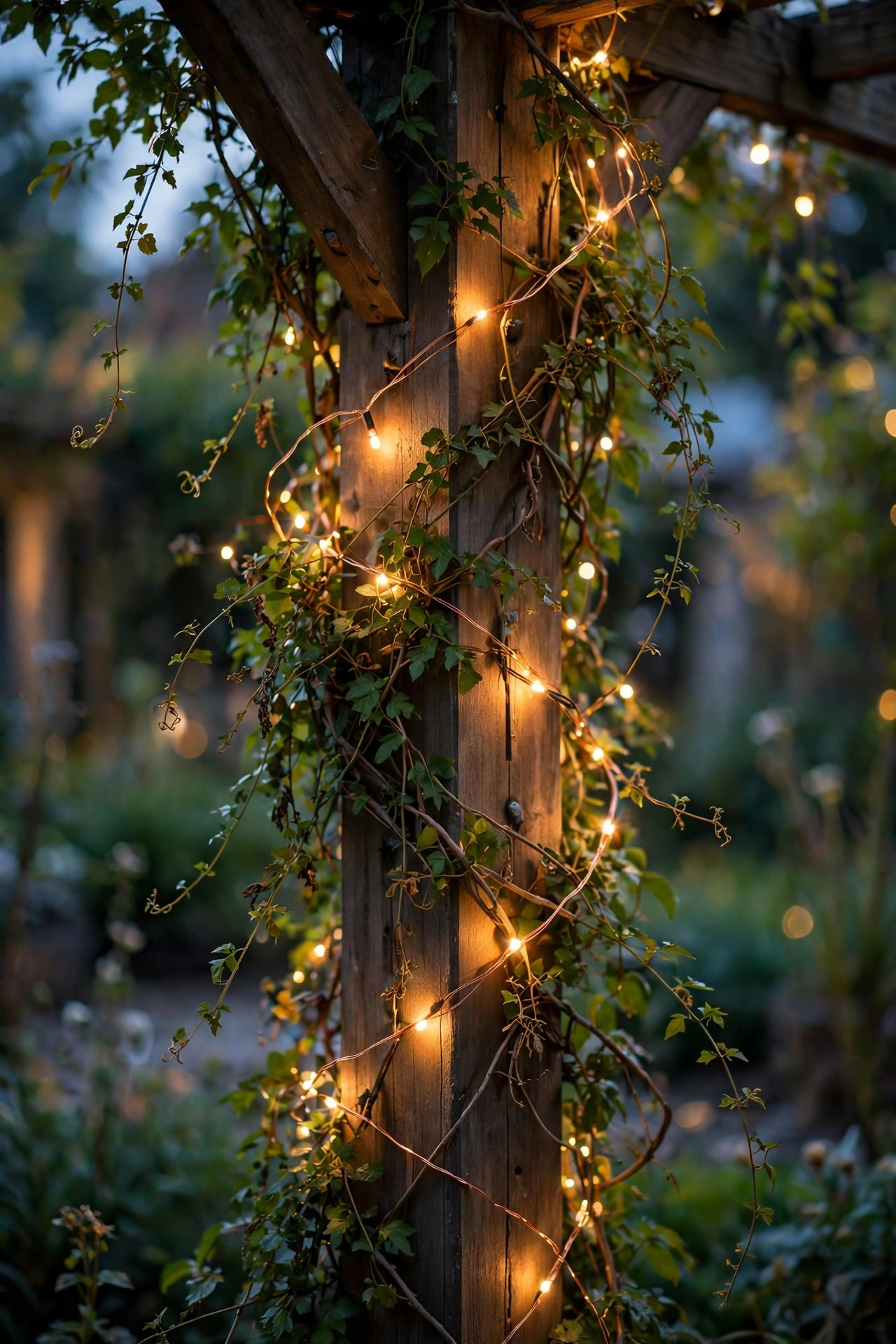
3. Copper-Wire Fairy Lights Woven Through Climbing Vines
If your pergola posts carry climbing roses, jasmine, or even a young wisteria, fairy lights were made for exactly this. The copper wire is hair-fine and disappears into the stems, so the vine itself seems to sparkle. Weave a 33-foot strand loosely up one post and along the beam the vine follows, securing nothing tightly — the plant needs room to grow, and you need slack to lift the strand out at pruning time. Battery-powered strands with a timer function are my pick here; hide the battery pack in a small weatherproof box at the base of the post. Six hours on, eighteen off, and you'll forget it's even there until it twinkles on at dusk. One caution from experience: keep the wire out of the direct path of your pruning shears by running it along the back side of the main stems. The effect is pure magic in June when the jasmine blooms, but honestly it carries a bare winter vine beautifully too, tracing the structure in tiny points of light.
Suggested budget range: $10 – $25.
4. Hanging Solar Lanterns From the Beams
Lanterns give a pergola something string lights can't: pools of light at sitting height, right where faces and drinks actually are. I hang solar lanterns from the beams at staggered heights — one at about 6 feet over the coffee table, a couple at 7 feet near the corners — using simple S-hooks so they come down in seconds for storms. Most solar lanterns charge through their own top panel, which means they need a few hours of daylight reaching the beam; on a pergola with a slatted top that's rarely a problem, but under a solid shade sail you'll want to hang them at the open edges. The flickering-flame style reads beautifully from the house, though at the table itself I prefer a steady warm glow — easier on the eyes over a long dinner. Mix sizes, not styles: three lanterns in the same finish, in small, medium, and large, looks intentional. All one size looks like a store display. Hang them before you judge brightness; lantern light is about atmosphere, not task lighting.
Suggested budget range: $30 – $75.

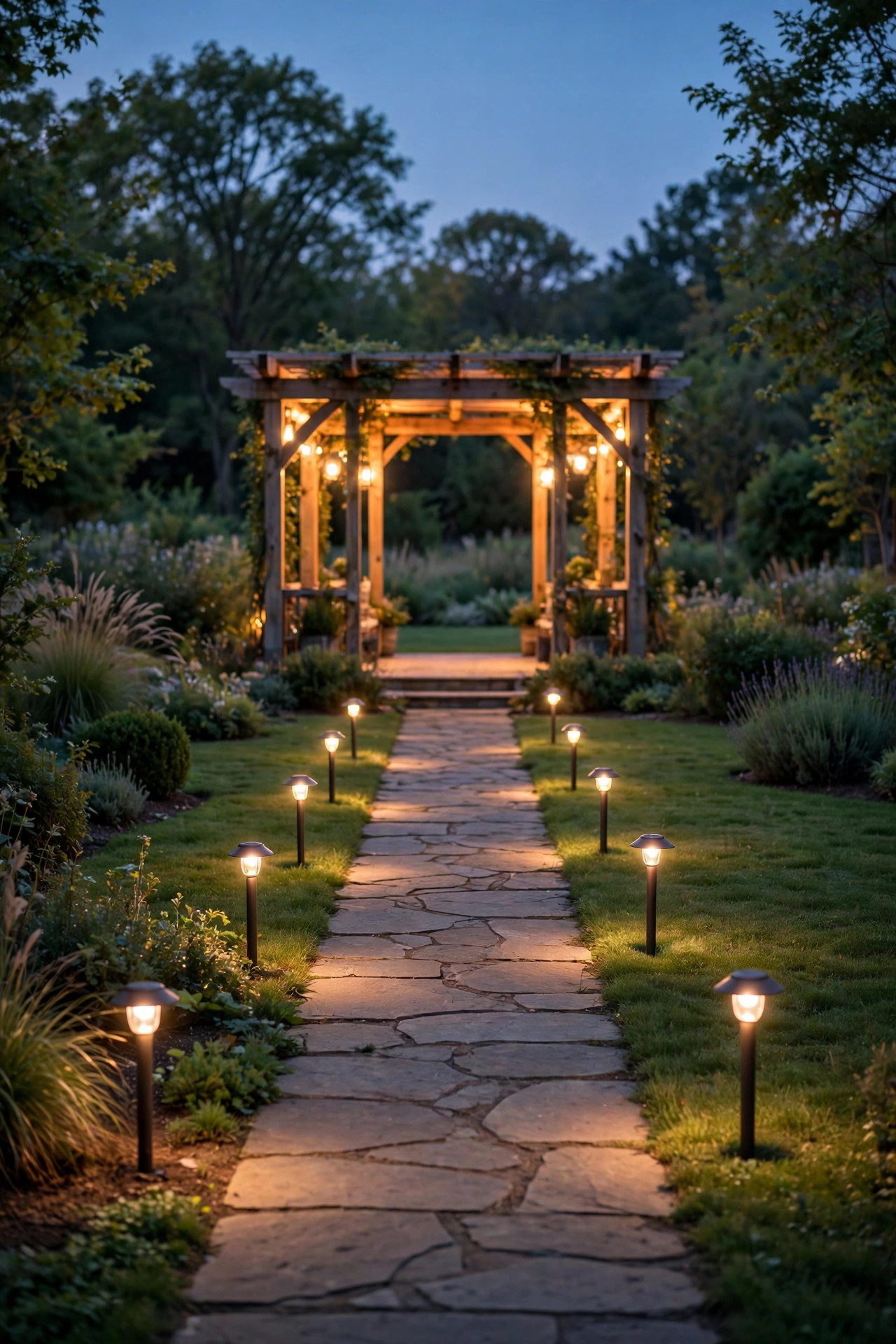
5. Low-Voltage Path Lights Lining the Walkway In
A retreat you have to stumble toward in the dark isn't much of a retreat. A short run of path lights from the patio or back door to the pergola turns the walk itself into part of the evening. For a permanent mid-yard setup, low-voltage lighting is the grown-up answer: a small transformer plugs into a GFCI outlet at the house, and a single 12-volt cable buries just 6 inches under the lawn or mulch edge out to the pergola, with fixtures staked every 6 to 8 feet along the way. It's safe to DIY because 12 volts can't hurt you, and the cable is forgiving. My full walkthrough on how to install landscape path lights covers transformer sizing and the voltage-drop math so the last light isn't dimmer than the first. Angle the fixtures to wash the path surface rather than blasting sideways, and keep them just bright enough to read the ground — this is a runway, not a runway at an airport.
Suggested budget range: $120 – $300.
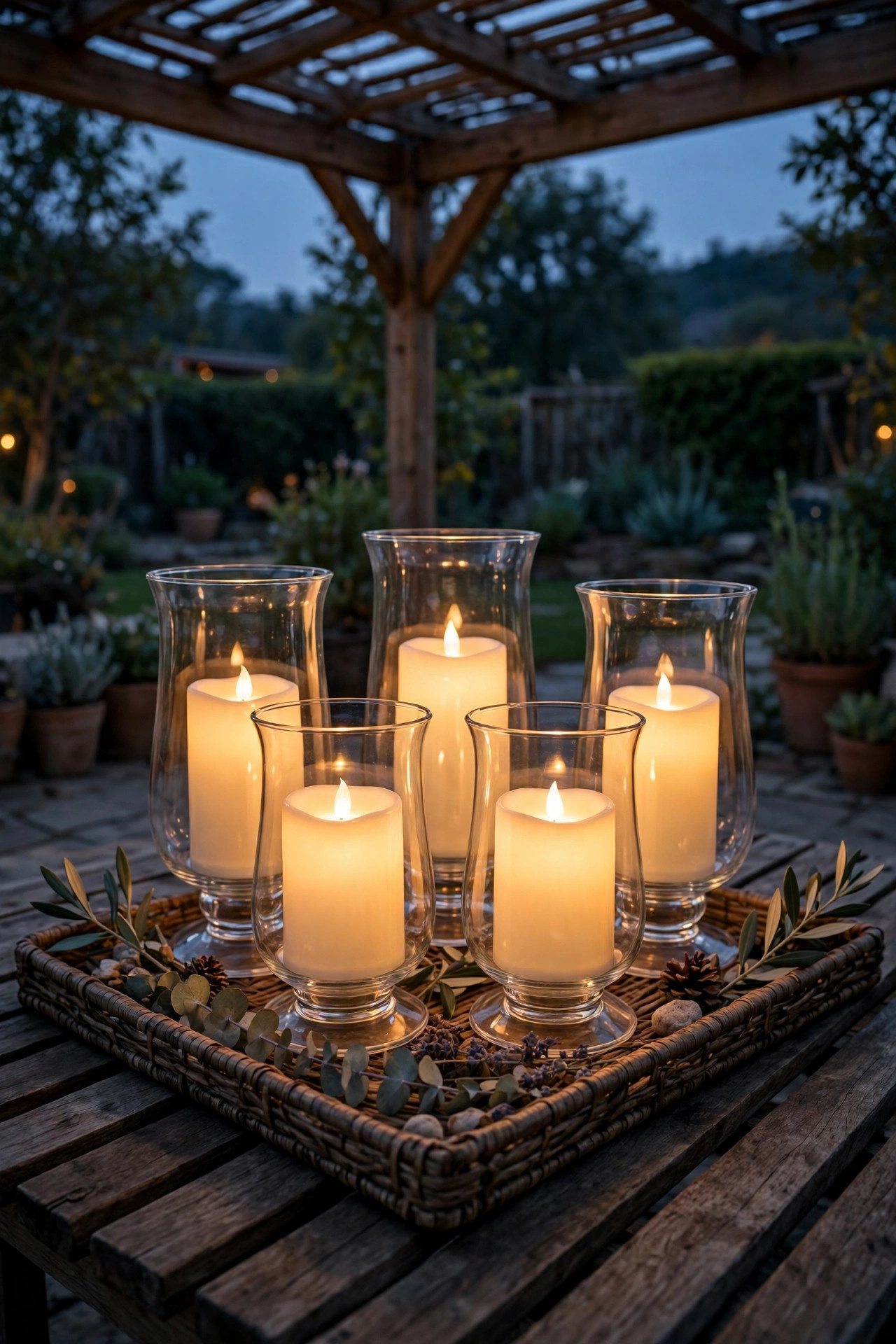
6. Flameless LED Candles in Hurricane Holders on the Table
Never underestimate table light. Real candles blow out the moment a breeze crosses an open yard — and a freestanding pergola catches every breeze there is — so I use flameless LED candles as my table layer, grouped inside glass hurricane holders that give them weight and presence. The better ones have a realistic flicker, a waxy finish, and a timer that turns them on at the same time every evening. Cluster three hurricanes of different heights on a tray with a few smooth stones or a sprig of greenery and you have a centerpiece that survives wind, curious kids, and my own habit of forgetting things outside overnight. Safety note, because it matters: LED candles are the only flame-look option I allow anywhere near pergola curtains, cushions, or dry grass clippings. Real flame in a mid-yard structure, surrounded by lawn furniture and summer-dry planting beds, is a risk I simply won't take — and with today's flicker technology, honestly, nobody can tell the difference from six feet away.
Suggested budget range: $20 – $50.
7. Solar Post Cap Lights on the Four Corner Posts
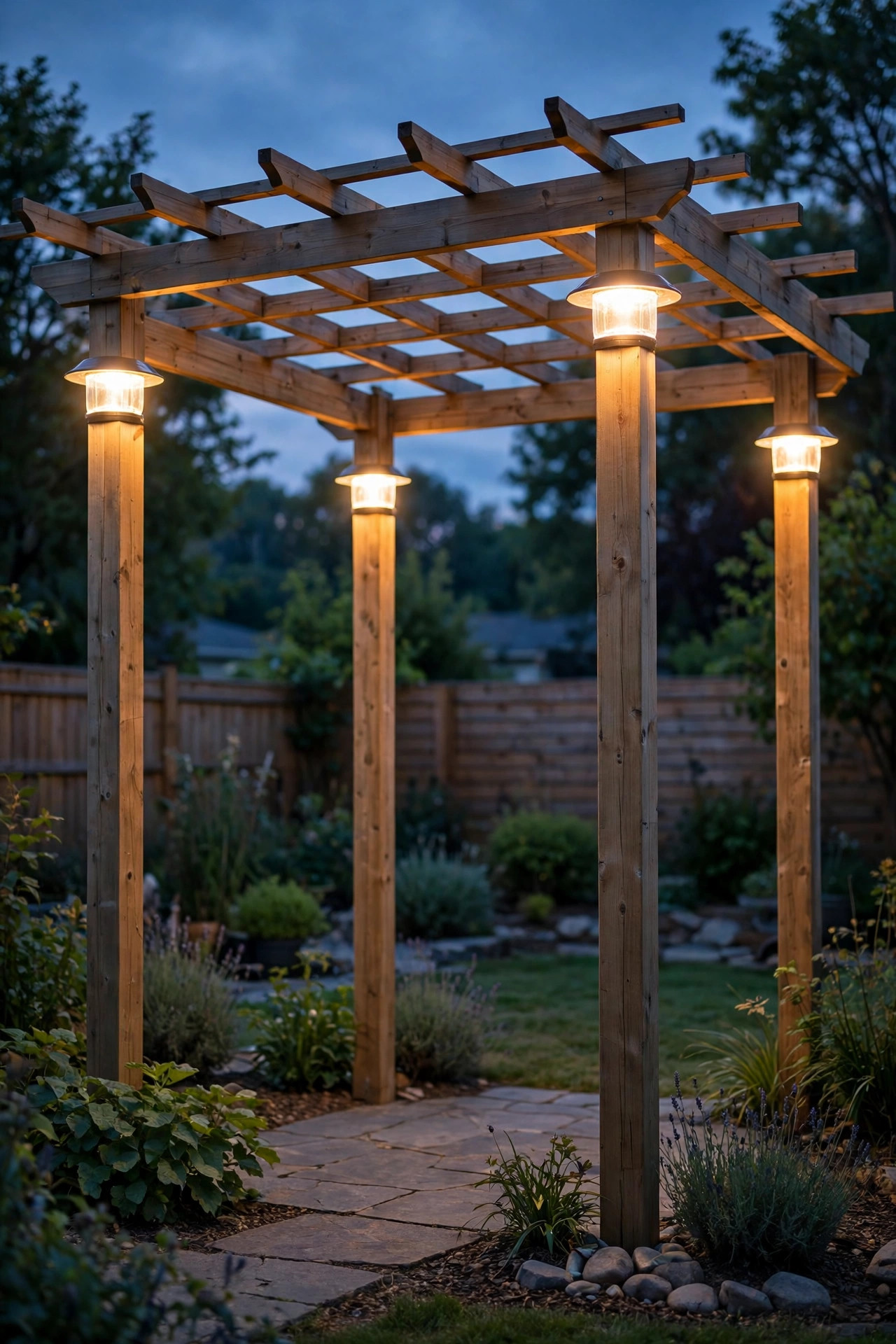
A freestanding pergola announces itself by its four posts, so cap each one with light. Solar post cap lights slip or screw onto the top of standard 4×4 or 6×6 posts and charge all day in the one spot on the whole structure guaranteed full sun. The light itself is modest — a soft halo rather than a beam — but four of them working together outline the pergola's footprint from clear across the yard, which makes the retreat feel like a destination. Measure your posts before ordering; nominal lumber lies, and a cap that's a quarter-inch small will rattle in the wind until it drives you inside. I like a cap with a replaceable battery, because the fixture will outlive its first battery by years, and a dusk-to-dawn sensor so there's no switch to remember. From the house, this is the layer that reads as architecture. From inside the pergola, you barely notice it — which is exactly the point of good perimeter light.
Suggested budget range: $40 – $100.
8. A Battery Pendant Hanging Over the Seating Area
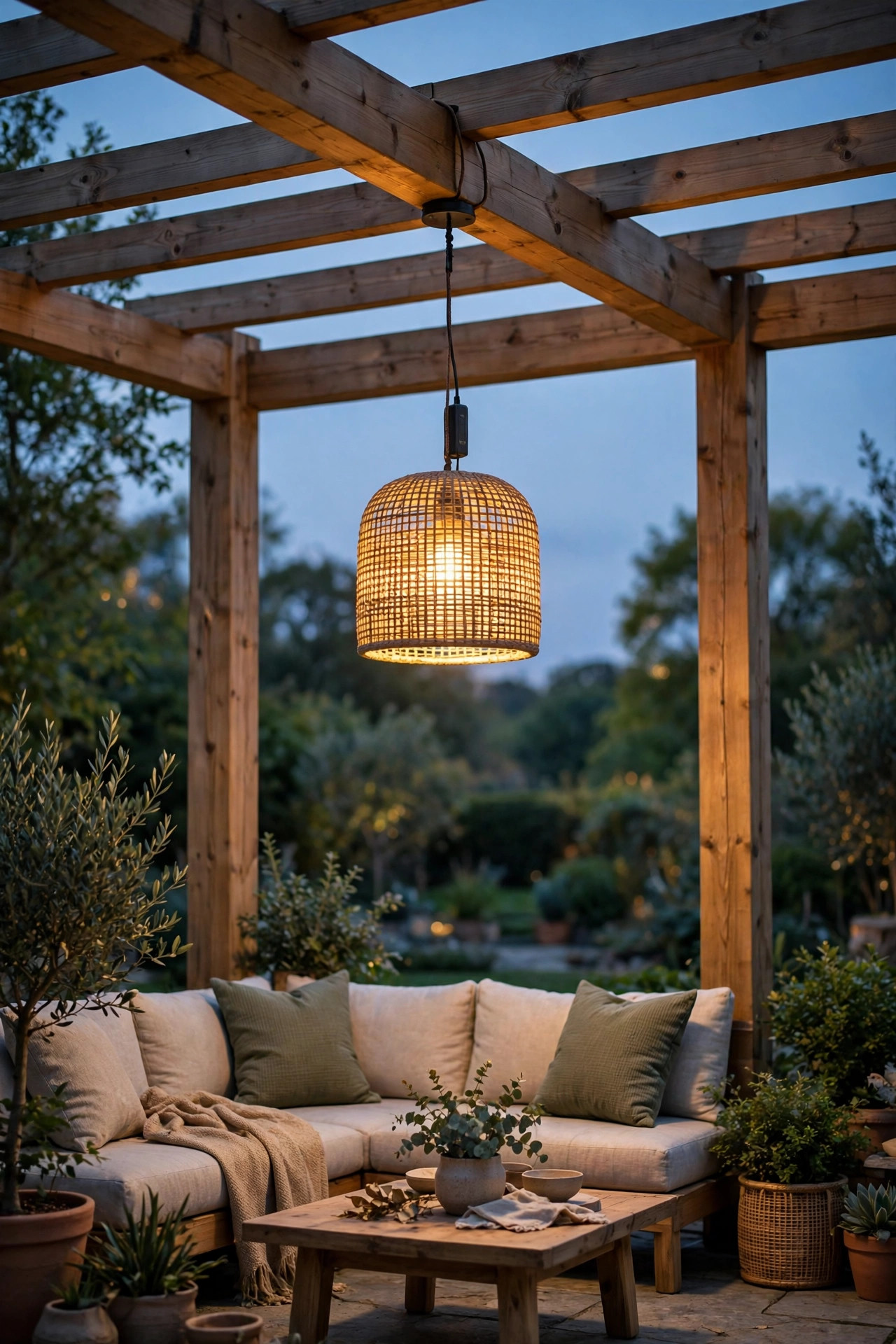
Every seating area wants one true focal light, and under a pergola that's a pendant centered over the coffee table or dining table. Mid-yard, the practical version is a battery-operated or solar pendant — they hang from a hook on the center beam, come with a remote, and the good ones run 20-plus hours per charge. Hang it so the bottom of the shade sits about 30 inches above the table surface: low enough to feel intimate, high enough that nobody's sight line across the table is blocked. A woven or rattan-style shade scatters the light into patterns across the beams that I never get tired of. Bring it inside for the winter if your climate freezes hard — lithium batteries and January are not friends. And a small habit that saves frustration: recharge it the same day you mow the lawn. It becomes part of the route, and the pendant is never dead on the one Friday night you actually have guests coming.
Suggested budget range: $35 – $85.
9. Ground Uplights Washing Up Each Post
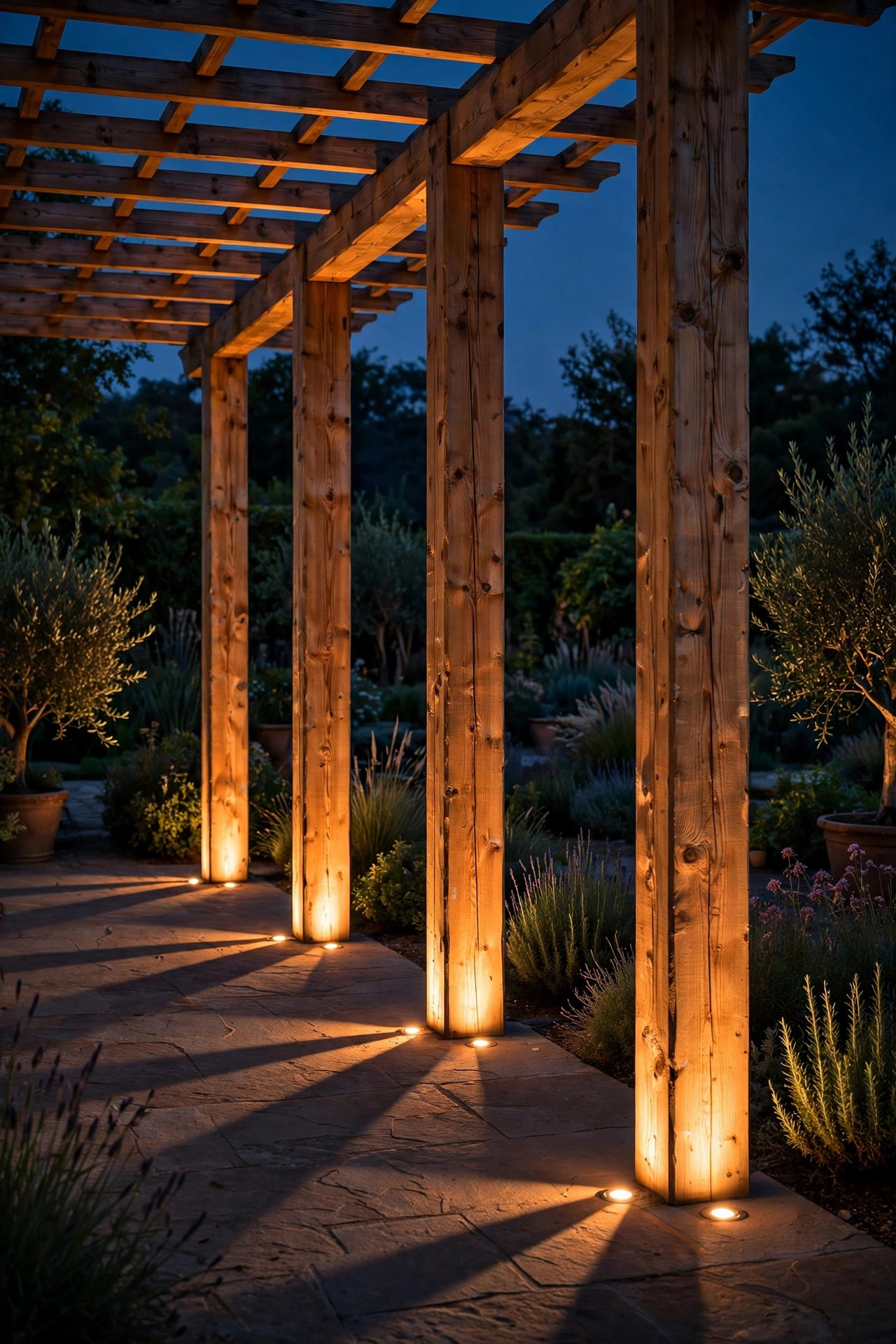
Uplighting is the cheapest drama in landscape lighting. Place one small spotlight at the base of each post, aimed straight up the grain of the wood, and the whole structure gains height and shadow-play after dark. Solar spotlights work fine for this if the surrounding lawn is open to the sky; for a shadier yard, tap them into the same low-voltage run as your path lights so everything switches on together. Angle each fixture a few inches out from the post base and tilt it slightly — a beam that grazes the post throws long, interesting shadows, while a beam pointed dead-center just makes a bright stripe. This is also the layer that makes the pergola visible from the street-facing windows, and I won't pretend I don't enjoy that. Keep the fixtures' lenses wiped down every few weeks; a summer of mower spray and dew leaves them hazy, and a hazy lens quietly steals half your light.
Suggested budget range: $45 – $110.
10. LED Strip Lights Hidden Along the Inner Beam
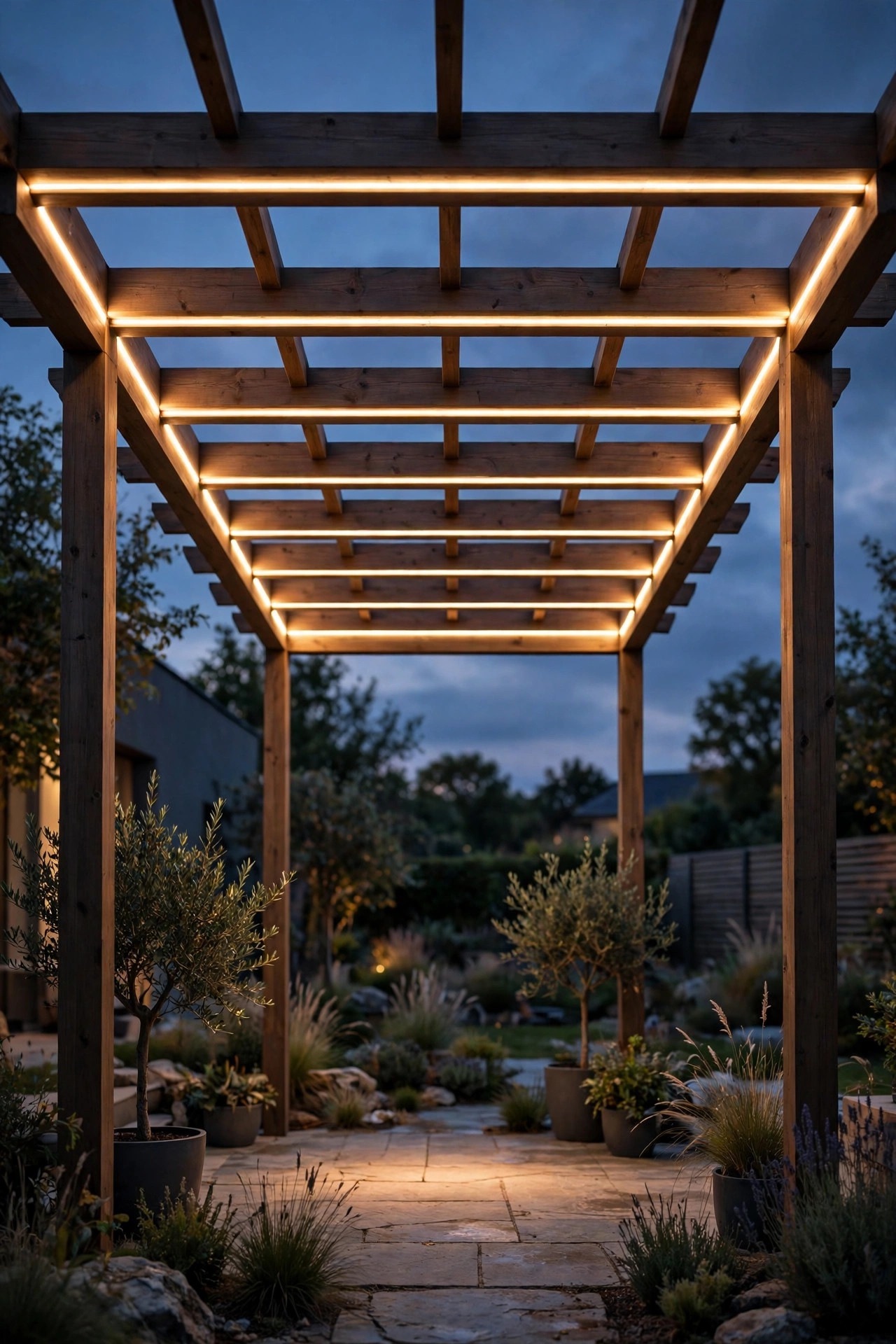
For a clean, modern glow with no visible bulbs at all, run an outdoor-rated LED strip along the inside face of the pergola's top beams, tucked into an aluminum channel with a frosted cover. The channel matters: it diffuses the individual diodes into one smooth ribbon of light and protects the strip from weather and the occasional volleyball. Point the strip downward for a ceiling-wash effect over the seating, or up toward a shade sail or slatted roof to bounce soft indirect light back down — the upward bounce is gentler and, honestly, the one I choose for dinners. Battery packs handle a single evening, but for a permanent install this is where a low-voltage run earns its keep, since strips draw steady power for hours. Dimming is non-negotiable in my book; full-bright strip light belongs in a workshop, but at 40 percent it's candlelight with better posture. Cut strips only on the marked lines and seal every cut end with the silicone caps from the kit.
Suggested budget range: $50 – $130.
11. Flame-Effect Solar Torches Around the Perimeter
Tiki torches look wonderful for exactly one evening and then become a smoky, oily chore — and an open flame mid-yard, surrounded by dry summer grass, is a hard no from me. Flame-effect solar torches give you the same dancing orange flicker with a solar panel doing all the work. Stake four to six of them a few feet out from the pergola's corners, staggered rather than in a soldier-straight line, and they read as a glowing boundary for the retreat: inside this circle is our room. The stakes push into lawn or mulch in seconds, and most have a ground stake plus a clamp option if you'd rather mount one to a post. The flicker rate matters more than brightness — a slow, uneven flicker reads as fire from the house, while a fast strobe reads as a malfunction. Bring them in before the first hard freeze if you want the batteries to see a second season.
Suggested budget range: $30 – $70.

12. Globe String Lights for a Softer, Rounder Glow
If bistro bulbs are café energy, globe string lights are garden-party calm. The frosted, milky globes diffuse the light so there are no harsh pinpoint bulbs — just soft orbs floating over the seating, which flatters faces and photographs beautifully. I run them in two parallel lines along the long beams rather than a zigzag; the orderly rows suit the softer mood. Solar versions exist and are the natural fit out in the yard, though I'll admit the wired ones run a touch brighter and steadier — if you've already buried a low-voltage line for path lights, a strand on a smart plug is painless. Space globes about 12 inches apart for an even wash. One styling note from a mistake I made once: keep globes at least a hand's width from any fabric shade sail, even LED ones. The bulbs themselves stay cool, but trays and clips can rub a sail threadbare over a windy season. Soft glow, zero fuss — this is the strand I recommend for anyone who finds Edison filaments a little too industrial.
Suggested budget range: $30 – $80.
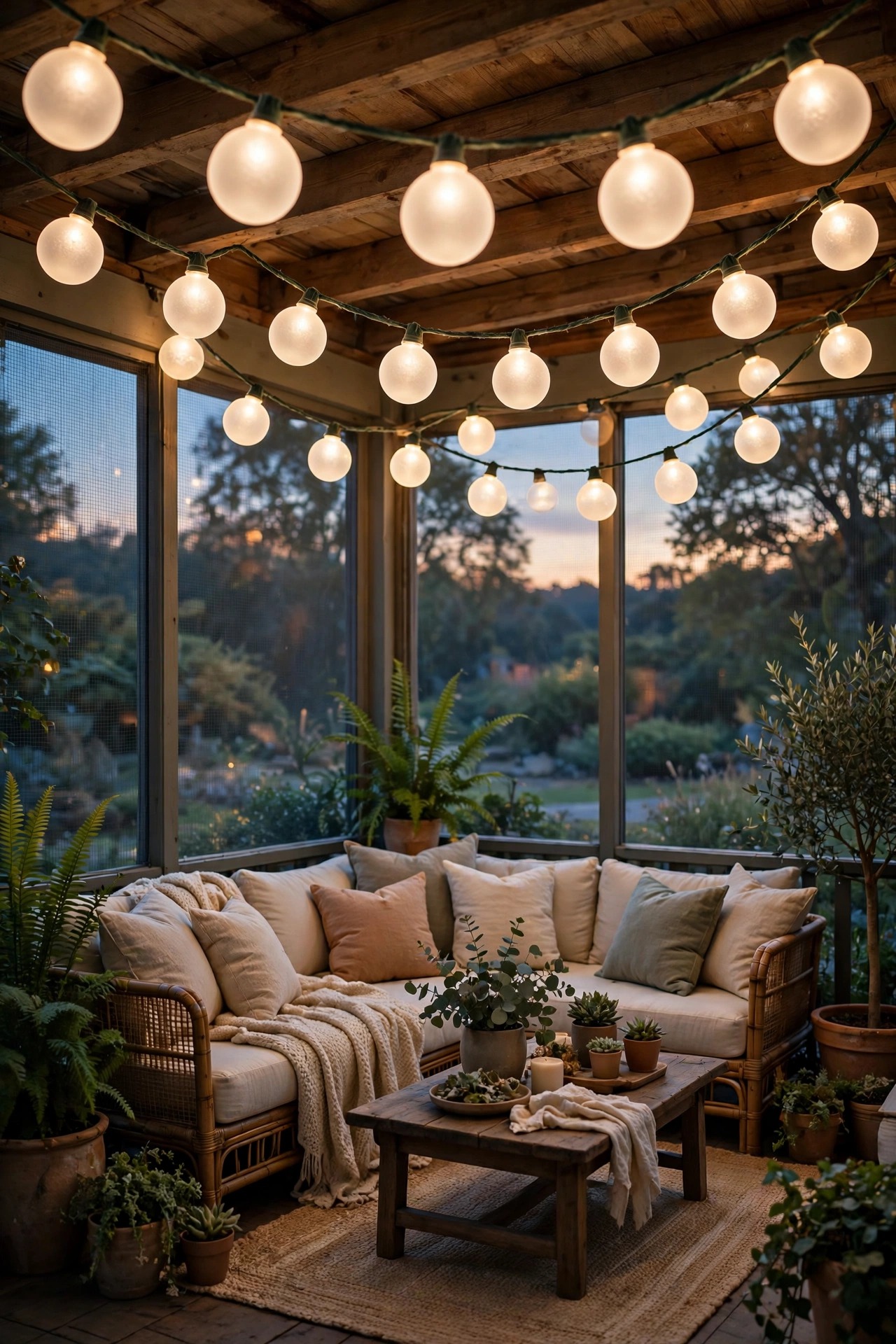
13. A Hanging Solar Chandelier as the Centerpiece
For the pergola that's really an outdoor dining room, a chandelier makes the room official. Solar chandeliers hang from the center beam on a hook or short chain — the panel sits on top of the fixture where the pergola's open slats let the sun in, and by evening you get a circle or cluster of warm bulbs over the table. Check the weight before you fall in love; most pergola beams handle 10 to 15 pounds easily, but a big multi-tier fixture plus a windy night deserves a through-bolted hook, not a screw hook meant for a fern. Height rules mirror indoor dining: bottom of the fixture roughly 30 to 36 inches above the tabletop. In my experience the chandelier is the piece guests ask about, and it's the piece that makes a mid-yard structure feel anchored and intentional rather than temporary. Take it down for winter storage if you're in snow country — ice loading on a hanging fixture is real, and so is the spring repair bill.
Suggested budget range: $60 – $180.

14. Dusk-to-Dawn Sensor Lanterns at the Entry Side
Every pergola has an entry side — the two posts you naturally walk between. Flank them with a pair of lanterns fitted with dusk-to-dawn sensor bulbs or solar lanterns with light sensors, and the retreat turns itself on before you even think about it. This is the layer my household relies on most: no switches, no apps, no walking out to a dark pergola to set the mood. Solar lanterns on shepherd's hooks pushed into the planting beds at the pergola's feet are the zero-install version, and they double as markers for the path's end. If you've run low-voltage power, small lantern fixtures mounted at about 5 feet on the entry posts wash the steps and the first chairs in light right where a guest carrying two drinks needs it. Match the lantern finish to your post caps and the whole structure reads as one designed set. Set-and-forget lighting is unglamorous, but it's the reason our pergola gets used on ordinary Tuesdays.
Suggested budget range: $35 – $95.
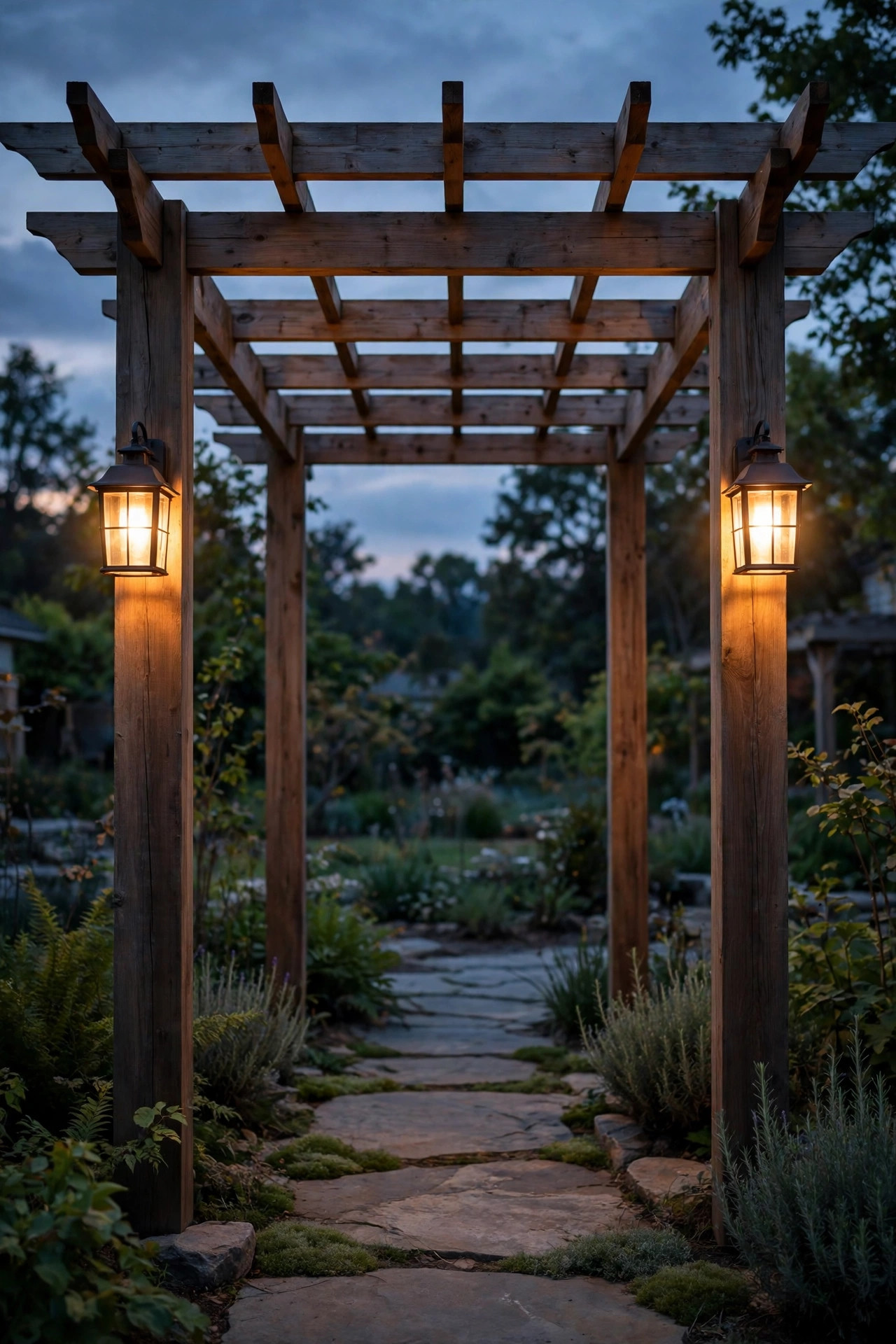
15. Layer It All: My Go-To Freestanding Pergola Lighting Ideas, Combined
Here's how the whole list comes together in my own yard — and if you take one section seriously, make it this one. Overhead, solar bistro strands zigzag the rafters for the main glow. At the edges, post caps outline the footprint and uplights wash the posts so the structure has bones. At table height, a battery pendant and flameless hurricanes do the close-up work where people actually sit. And the path lights lead the way out, because a retreat that glows but can't be reached is just yard art. Notice what's missing: nothing competes. Each layer does one job at one height, and the total effect is far richer than any single bright fixture could give you. Start with two layers — overhead and table — and add one more each season as budget allows. That slow build is honestly how every good lighting scheme I've ever made came together. The pergola glows, the lawn stays dark and restful around it, and the brightest thing in the yard is exactly where you want to be sitting.
Suggested budget range: $150 – $400.

Frequently Asked Questions
How do you power lights on a pergola in the middle of the yard with no outlet?
You have three good options. Solar fixtures need no power at all and handle most decorative lighting. Battery-operated pieces like pendants and flameless candles cover table-level light. For anything brighter or more permanent, a 12-volt low-voltage system is the sweet spot: the transformer plugs into a GFCI outlet at the house, and the cable buries about 6 inches deep across the lawn. It's safe to install yourself because 12 volts can't shock you, and one run can feed path lights, uplights, and strips together.
Are solar lights bright enough for a pergola retreat?
For atmosphere, absolutely — a quality solar string strand or lantern gives plenty of warm glow for conversation, drinks, and finding your chair. Where solar falls short is true task light: reading a book or grilling at the pergola. If you need that, add one stronger piece — a rechargeable pendant over the table usually solves it — rather than expecting the whole scheme to run brighter. Also remember solar output follows the day's weather; after two cloudy days, expect a shorter, dimmer evening.
What color temperature is best for pergola lighting?
Warm white, 2700K to 3000K, every time. It matches candlelight and firelight, flatters skin, and makes wood and greenery look rich. Cool white (4000K and up) reads as security lighting and will make your retreat feel like a parking lot. The one trick that matters most: keep every layer in the same temperature family. Mixing a 2700K string light with a 5000K solar stake looks like a mistake even if each light is lovely on its own.
How do I stop string lights from sagging too much across a freestanding pergola?
A little sag — 6 to 8 inches over a 10-foot span — is the look you want. Beyond that, the strand is carrying too much weight on its own cord. Run a thin stainless guide wire between your anchor points, tension it snug, and clip the strand to the wire every few feet so the wire bears the load. Also anchor into the beams or posts with screw hooks, never just looped cord around wood — wind works loops loose, and mid-span drops follow.
Conclusion
A pergola standing out in the grass asks a little more of its lighting — no house wall to borrow power from, no patio slab to bounce light off — but that's exactly what makes it special when you get it right. Choose your layers, lean on solar where the sun is generous, run low-voltage where you want permanence, and these freestanding pergola lighting ideas will turn four posts in the lawn into the room everyone drifts toward after dinner. Start with the overhead glow this weekend, add the path lights next month, and let the retreat grow one layer at a time. When you're ready for the next project, browse more of my outdoor lighting ideas here on the site — the garden deserves the same treatment.