If you have ever bought solar flood lights by the number on the box, you already know the disappointment: one light promising five-figure lumens glows like a candle, while a modest unit two aisles over lights up the whole driveway. Honestly? The box numbers are close to fiction, and raw brightness is only half the story anyway. Think of a solar flood as a tiny power plant working on a daily budget — the panel earns energy all day, the battery stores it, and the LEDs spend it all night. Get any one of those three wrong and even a genuinely bright light fades by ten o'clock. In this guide I will translate brightness into plain English: how many lumens you actually need for a driveway, a backyard, a flag, or real security, how panel and battery size decide whether you get that brightness for twenty minutes or all evening, and the mounting tricks that make modest lights perform like much bigger ones. By the end you will know exactly which specs matter, which ones to ignore, and when solar is honestly the wrong tool for the job.

The Short Answer
For most homes, aim for 700 to 1,500 true lumens per flood head — enough for a driveway, a patio edge, or a motion-triggered security burst over the garage. Smaller jobs like a flag, a sign, or a garden feature need only 300 to 700. Just as important as the LED rating is the support system behind it: a panel of at least 5 watts, a battery you can replace when it tires, and a motion or dim-until-motion mode instead of full blast all night. If a listing promises stadium brightness from a panel the size of a coaster, smile and keep scrolling.
What Lumens Actually Mean for Solar Flood Lights
A lumen is simply a unit of total light output — how much light a fixture produces in all directions. Forget watts for a moment: watts measure electricity consumed, not light delivered. For reference, an old 100-watt halogen flood threw about 1,500 lumens, a standard 60-watt porch bulb about 800, and one car headlight roughly 1,200. Most honest solar floods produce somewhere between 500 and 3,000 real lumens, and the good ones say so plainly.
Here is the part the listings hope you skip: claimed lumens are routinely inflated two to four times over reality. A light advertised at some enormous figure but powered by a tiny two-watt panel is a physical impossibility — the panel cannot harvest enough energy in a day to feed LEDs that bright for more than a few minutes. Treat headline lumens as marketing and shop by panel watts and battery capacity instead, because those two numbers cannot lie as easily.
Beam angle matters as much as raw output. A wide 120-degree flood spreads its lumens thin across a big area, while a narrower 60-degree beam concentrates the same lumens into a smaller, brighter pool. Brightness at ground level also falls fast with distance: double the mounting height and the light landing on the driveway drops to roughly a quarter, a rule of thumb called the inverse square law. Finally, check color temperature. Most solar floods shine a harsh 6,000K daylight white — fine for security, less lovely over a patio. A few models offer 3,000K warm white, which I always recommend anywhere people actually sit and linger.

How Bright Is Bright Enough? Lumens by Use Case
After years of swapping lights around my own yard, here is the cheat sheet I wish came in the box. All figures are true lumens per light head, not the inflated numbers on the packaging.
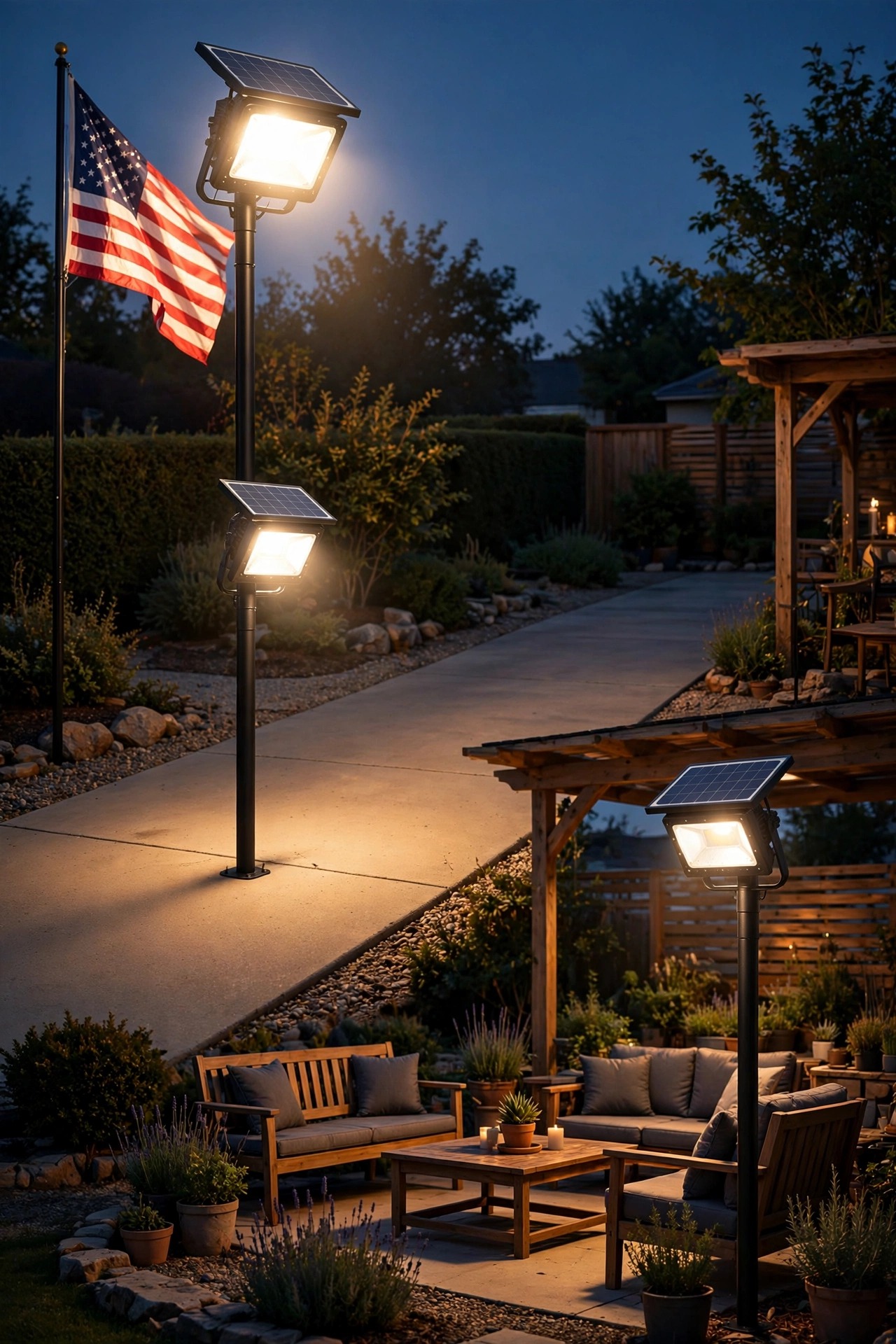
– Flag, sign, or address numbers: 300–700 lumens. A small subject lit from 10 to 15 feet away needs a gentle wash, not a blast, or the fabric glows white and the detail disappears.
– Porch steps and small patios: 300–800 lumens. Enough to read a step edge and a door handle comfortably, especially on a dim or motion setting.
– Single-car driveway: 700–1,200 lumens per head. A wide two-car drive does better with two heads totaling 1,500–3,000, cross-lit so no corner hides in shadow.
– Backyard hangout zone: 800–1,500 lumens with a dimmer or low mode. You want faces and food visible, not an interrogation scene, so brightness you can turn down beats maximum output.
– Security over garage doors and entries: 1,000–2,000 lumens in motion bursts. The sudden jump from dark to bright is what startles, and bursts are exactly what solar batteries handle best.
– Big yards, barns, docks, and parking corners: 2,000–5,000 lumens. This is the honest ceiling of solar, and only large separate-panel systems get there reliably.
Two patterns are worth remembering. First, when you are torn between two sizes, buy the brighter light with a dim mode rather than the dimmer light stuck at full power — you can always spend less of the budget, but you cannot spend what was never harvested. Second, these figures assume mounting 8 to 12 feet up; go higher and you need more lumens for the same pool of light below.
The Solar Panel Decides Your Brightness Budget
Every solar flood lives or dies by its panel, so let us do the math nobody prints on the box. A decent 5-watt panel soaking up five hours of strong sun harvests roughly 25 watt-hours of energy on a good day. A 1,000-lumen LED head draws about 8 to 10 watts, which means that harvest buys you around three hours at full brightness — or a whole night at a 25 percent dim setting with motion bursts on top. That single calculation explains nearly every disappointed review ever written.
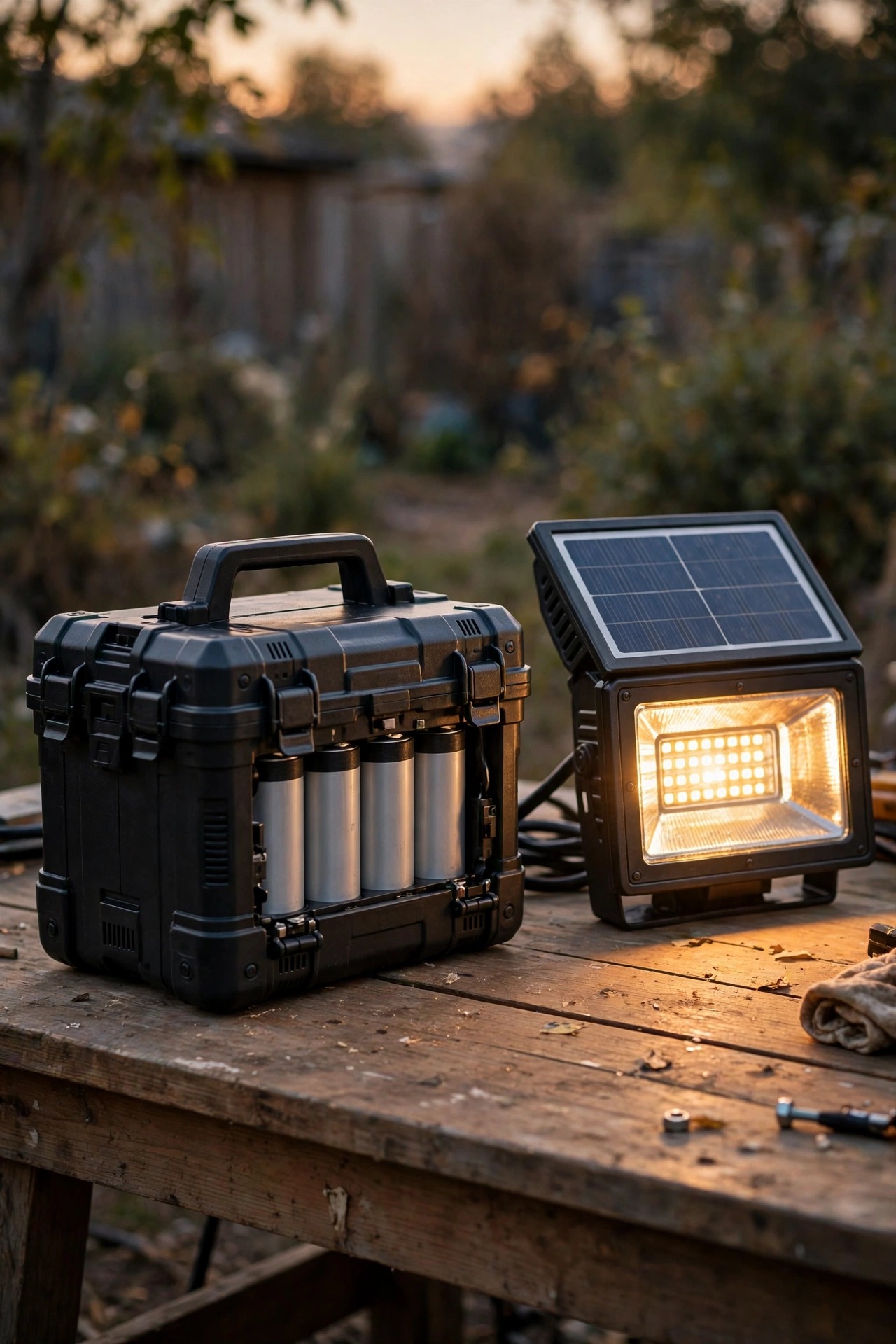
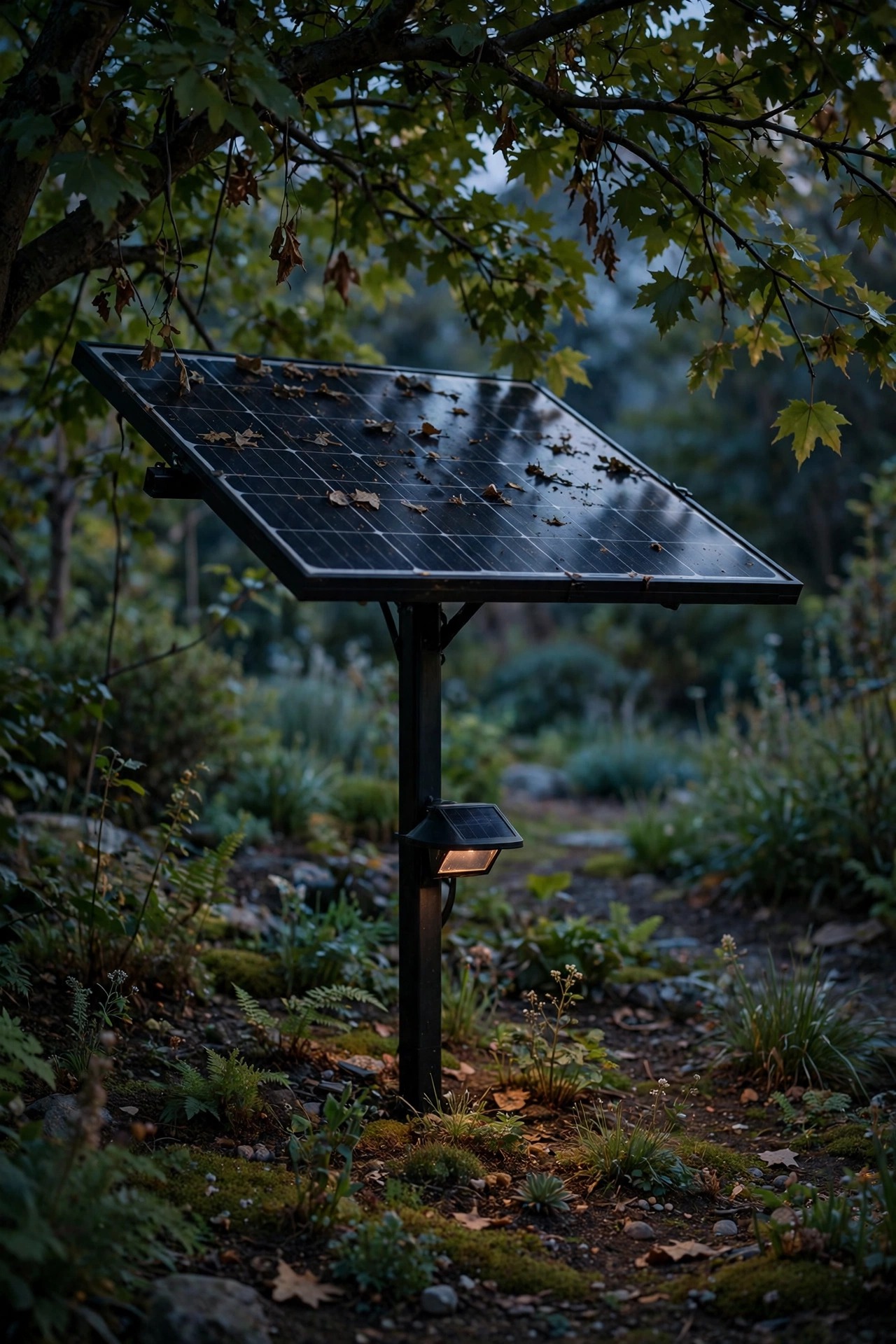
Panels come in two flavors. Integrated panels sit on top of the light itself, typically 2 to 6 watts, and force a compromise: the light must live where the sun is, not where you need the glow. Separate panels on a cable, usually 5 to 15 watts, break that compromise — the panel bakes on the sunny roof edge while the light works from the shady side of the garage. In my experience, a separate panel is the single best upgrade a solar flood can have.
Placement rules are simple. Face the panel south if you are in the United States, tilt it roughly to match your latitude, and keep it out of tree and roofline shade, because partial shade can cut harvest by half or more. Wipe the panel monthly; a film of pollen and dust quietly steals output all summer. And if your lot is heavily wooded with no sunny perch anywhere, take that as an honest signal — that corner of the yard is a wired-light job, and no panel will change it.

Battery Size: The Spec That Decides Your Runtime
If the panel is the paycheck, the battery is the savings account, and makers play games with its size. Many listings quote milliamp-hours per cell rather than for the whole pack, which makes a two-cell light sound twice as capable as it is. Convert everything to watt-hours — volts multiplied by amp-hours — and the fog clears. A typical mid-size pack of two lithium cells holds about 15 to 20 watt-hours; larger driveway-class units carry 30 to 45. Compare that with the panel math above and you can predict runtime within half an hour, no guessing.
Winter is the honest test. Short days mean a smaller harvest, and cold lithium delivers noticeably less of its rated capacity on freezing nights, so a light that coasted until dawn in July may quit at 2 a.m. in January. That is normal physics, not a defect, and it is why I steer northern readers toward motion and hybrid modes for the dark months.
The feature that matters most over the years is replaceability. Batteries are wear items that tire after two to five seasons, while the LED and housing can last a decade. A light with a standard, swappable battery pack can be refreshed in ten minutes and kept in service; a sealed unit becomes e-waste the day its battery fades. When two lights look identical on the shelf, the one with the replaceable battery is the real bargain, every single time.
Motion-Activated or Dusk-to-Dawn? Pick the Right Mode
How a light spends its stored energy matters as much as how much it stores, and the two classic modes behave very differently. Motion-activated lights idle dark or nearly dark, then fire to full brightness for 15 to 60 seconds when the sensor sees movement. A typical sensor watches 16 to 26 feet out across a 120- to 180-degree field. Because the light is only truly working for minutes per night, even a modest battery lasts until dawn — which is why motion mode is the right answer for security and driveways.
Dusk-to-dawn lights promise a steady glow all night, and here honesty matters: most solar floods simply fade somewhere between midnight and 3 a.m., especially in winter, because a small panel never banked enough to run full brightness for ten hours. The ones that genuinely make it do so at a low setting, which is perfect for marking a path or washing a flag — just do not expect driveway-level output at 4 a.m.
My favorite setup is the hybrid mode many mid-range lights now offer: a soft 10 to 20 percent standby glow that marks the space, jumping to full brightness when motion trips it. The standby keeps the yard from feeling abandoned, the burst does the real work, and the battery sees an easy night. If a light you love lacks a hybrid mode, choose motion for anything security-flavored and dusk-to-dawn low mode for anything decorative, and you will rarely be disappointed.

Mounting Height and Aim: Put the Light Where It Earns Its Keep
The sweet spot for a solar flood is 8 to 12 feet up — high enough to spread a generous pool of light, low enough that the pool stays bright. Remember the inverse square rule: mount at 16 feet instead of 8 and the ground below gets about a quarter of the brightness from the same light. This is why so many gable-mounted floods disappoint; the light is fine, the geometry is not.
Aim the head down at roughly 30 to 45 degrees rather than straight out. A level-aimed flood throws half its light over the fence into the sky and the street, glaring into drivers' eyes while the driveway stays dim. Tilt it down and the same lumens suddenly work twice as hard. If the sunny spot and the lighting spot disagree, use the panel cable: mount the head under the eave where the light is needed and let the panel sit several feet away in the sun.
Two more habits separate satisfying installs from frustrating ones. Cross-light wide areas with two smaller heads from opposite corners instead of one powerful head — shadows soften, blind spots vanish, and faces stop looking like Halloween masks. And always do a ladder test at night before the final screws: hold the light in place, walk the route a guest or a driver would take, and check for glare and dark gaps. Ten minutes of testing saves a season of squinting. I cover placement patterns in more depth in my guide to outdoor flood light placement.

IP Ratings and Weatherproofing That Survives Real Weather
That two-digit IP code on the box is worth decoding before you buy. The first digit rates dust protection, the second rates water, and for a flood light the second number does the heavy lifting. IP44 means splash-resistant only — acceptable under a deep porch roof, a slow death sentence on an exposed gable. IP65 shrugs off rain jets from any direction and is my minimum for a wall out in the weather. IP66 handles heavier storm rain, and IP67 survives brief immersion, which matters for lights mounted low near sprinklers or snow melt.
In my experience, though, weather kills solar floods in sneakier ways than raw rain. Condensation fogs the inside of the lens after a season of hot days and cold nights. Rubber gaskets harden and crack after two summers of ultraviolet, and then one September storm finds the seam. Water also wicks down the panel cable into the housing if the cable enters from above with no drip loop — a simple downward bend in the cable before it reaches the light prevents most of it.
Housing material helps too. Powder-coated metal bodies outlast thin plastic ones that go chalky and brittle, and a metal back plate sheds summer heat that ages batteries. Winter asks one extra chore: brush snow off the panel after storms, because a buried panel harvests nothing no matter how bright the LEDs are. Buy IP65 or better, mount with a drip loop, and your light will outlive the cheap ones on the street by years.

Honest Limits: Solar Flood Lights vs Wired Floods
Let us be straight about where each technology wins. A wired flood on a real circuit can pour out 5,000-plus true lumens from dusk to dawn, in the shade, in December, without a thought. If you need stadium-level light all night on a north wall that never sees the sun, wired wins and it is not close. Wired fixtures also shrug off weeks of storms that would starve a panel.
Solar wins everywhere the wire cannot easily go. No trenching across the lawn, no electrician, no permit questions, and the light can move when the garden changes. A solar flood at the back gate, the shed, the far fence corner, or the top of a long driveway costs an afternoon instead of a project. Solar also keeps working during power outages — the one night your neighbors' security lights are dark, yours still fires when someone crosses the yard, which is a genuinely underrated safety perk.
So here is my decision rule. If the spot gets six or more hours of direct sun and the job is motion bursts or a few evening hours of light, solar is the smart buy and you will be happy. If you need guaranteed all-night brightness in a shaded spot, run the wire once and be done. My own yard runs both without apology: wired over the garage where a junction box already existed, solar everywhere the trench would have been miserable. Each technology doing what it is actually good at is not a compromise — it is just good design.
Mistakes That Make Solar Flood Lights Look Dim
Most "dim solar light" complaints trace back to a handful of fixable mistakes, and I have personally made at least four of them.
1. The panel sits in shade. Even dappled afternoon shade can halve the harvest. The light gets blamed; the shadow did it.
2. Buying by claimed lumens. Shop by panel watts and battery watt-hours instead, and the "dim" surprises mostly disappear.
3. The shipping film is still on the panel. That clear protective sheet is meant to come off; left on, it clouds within months and quietly chokes charging.
4. Mounting too high for the output. A modest light at 18 feet is a rumor of light at ground level. Drop it to 10 feet and it transforms.
5. Full-brightness dusk-to-dawn on a small battery. The mode promises ten hours the battery never had. Switch to hybrid or motion and the same light feels twice as strong.
6. Never cleaning the panel. Pollen, dust, and one bird's opinion can cost a third of your harvest by midsummer.
7. An IP44 light on an exposed wall. One storm season of driven rain and the electronics corrode from the inside.
The encouraging part is that nearly all of these are afternoon fixes, not replacement purchases. My checklist of ways to make solar lights brighter walks through the recovery steps in order, and most readers get their "dead" lights performing again the same weekend.
What It Costs in 2026
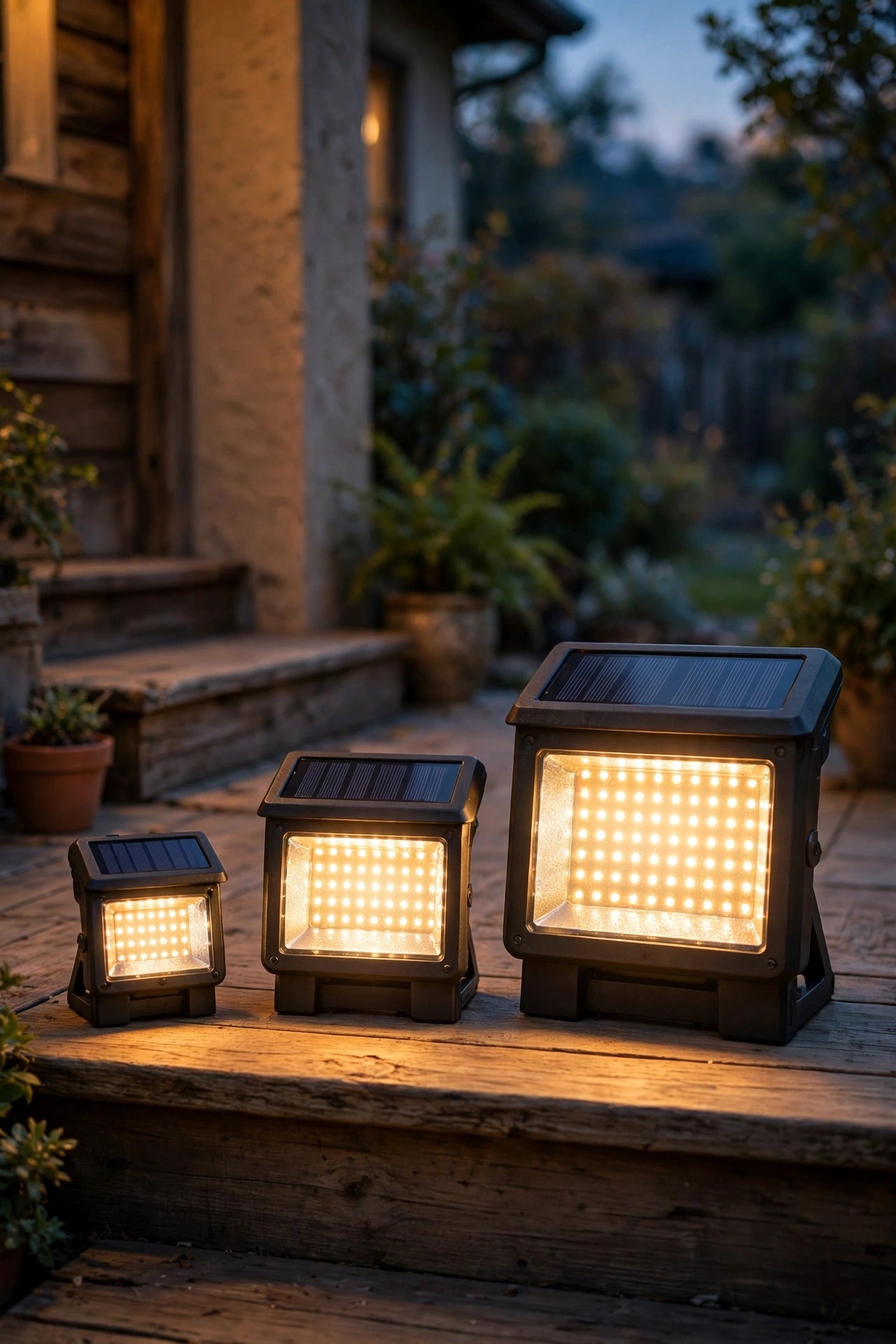
Prices for solar floods sort neatly by how much panel and battery they carry, so shop the tiers rather than the lumen claims. Small single-head lights for steps, signs, and accent duty — honestly 300 to 800 true lumens — run $20 to $45. The crowded middle tier, dual-head lights with separate cabled panels in the 800 to 2,000 true-lumen class, costs $45 to $90 and is where I send most readers; this is the value sweet spot for driveways and garage security. High-output multi-head kits with big panels, honestly 2,000 to 3,500 true lumens whatever the box claims, run $90 to $200. Premium large-panel systems with replaceable batteries and metal housings top out around $200 to $350.
Running costs are where solar quietly wins. The electricity bill is $0 forever, and a hardworking solar flood that replaces a wired light left on all night saves its owner real money every month. The one recurring expense is the battery: where the pack is replaceable, expect $8 to $20 every two to four years, which is trivial next to the light's lifespan.
Set that against the wired alternative for a fair picture. A wired flood fixture itself costs $30 to $120, but putting it somewhere new — no existing junction box — typically means $150 to $400 of electrician time, and more if a trench is involved. One avoided electrician visit pays for a premium solar kit outright, which is why solar makes the most financial sense exactly where the wiring would be hardest. My honest advice: skip the cheapest tier entirely, spend in the $45 to $90 band for everyday jobs, and reserve the premium tier for big yards where you would otherwise be paying for trenching.
Frequently Asked Questions
How many lumens do I need for a two-car driveway?
Plan on 1,500 to 3,000 true lumens in total, split across two heads mounted 9 to 12 feet up at opposite corners. Cross-lighting from two sides kills the dark wedge in the middle that a single center light always leaves. Choose motion or hybrid mode so the battery only spends at full power when a car or a person actually arrives.
Do solar flood lights work in winter and through cloudy weeks?
Yes, with honest expectations. A good panel still harvests on bright overcast days, just less — often a third to half of a clear-day haul — and cold batteries deliver less of their charge. The fixes are simple: angle the panel steeply so snow slides off, keep it brushed clean, and lean on motion mode through December and January so the smaller harvest only gets spent when something actually moves.
How long do solar flood lights last before they wear out?
The LEDs themselves are rated for 30,000 to 50,000 hours, which is decades of evenings. The battery is the real wear item at two to five years depending on heat and how deeply it cycles each night, and the panel slowly loses a little output per decade. Lights with replaceable batteries routinely serve eight to ten years; sealed units usually end when their first battery tires.
Can a solar flood light stay on all night long?
Only the right kind. Large-panel systems running a low or medium setting can genuinely glow from dusk to dawn, and hybrid lights fake it beautifully with a dim standby plus bright motion bursts. A compact light promising full brightness all night is promising math its panel cannot do — expect it to fade in the small hours, especially in winter, and choose your mode accordingly.
Conclusion
Brightness, in the end, is a budget: the panel earns it, the battery stores it, and the mode you choose spends it. That is the whole secret behind solar flood lights that actually satisfy — match true lumens to the job, roughly 1,000 per head for driveways and security bursts and a few hundred for flags and features, then give the light a sunny panel and a sensible mode and it will feel generous every night. If you are still browsing shapes and styles before you buy, my roundup of solar flood light ideas shows the main types glowing in real yards. Choose the panel first and the lumens second, and your nights get brighter from day one.