If you have ADHD, you already know that bedrooms don’t stay organized by accident. Traditional organizing advice doesn’t stick because it assumes you’ll maintain a system through willpower alone — and that’s just not how ADHD brains work. You need strategies that work with your brain, not against it, and systems that are so simple you’ll actually keep using them.
The biggest mistake people make when organizing ADHD bedrooms is creating systems that require too many decisions or too much maintenance. A perfectly labeled filing system that takes three minutes to put something away? That’s never going to work. You need your bedroom to be a space where calm is possible, where things have homes that make sense to you, and where you can toss stuff down without creating chaos.
Here’s the good news: small, specific changes to your bedroom organization can transform the space from a source of stress into somewhere that actually helps you function. These aren’t about achieving perfection or getting magazine-worthy aesthetics. They’re about creating a bedroom that supports you — one that makes it easier to wind down, easier to find things, and easier to keep functioning when your executive function is running low.
In this post, I’m sharing 12 ADHD bedroom organization hacks that actually work because they’re based on how ADHD brains operate. Each one is achievable, affordable, and designed to reduce friction in your daily routine. Pick the ones that resonate with you and start with just one or two. That’s the real secret to sustainable organization.
1. The “Doom Box” Strategy — A Judgment-Free Landing Pad
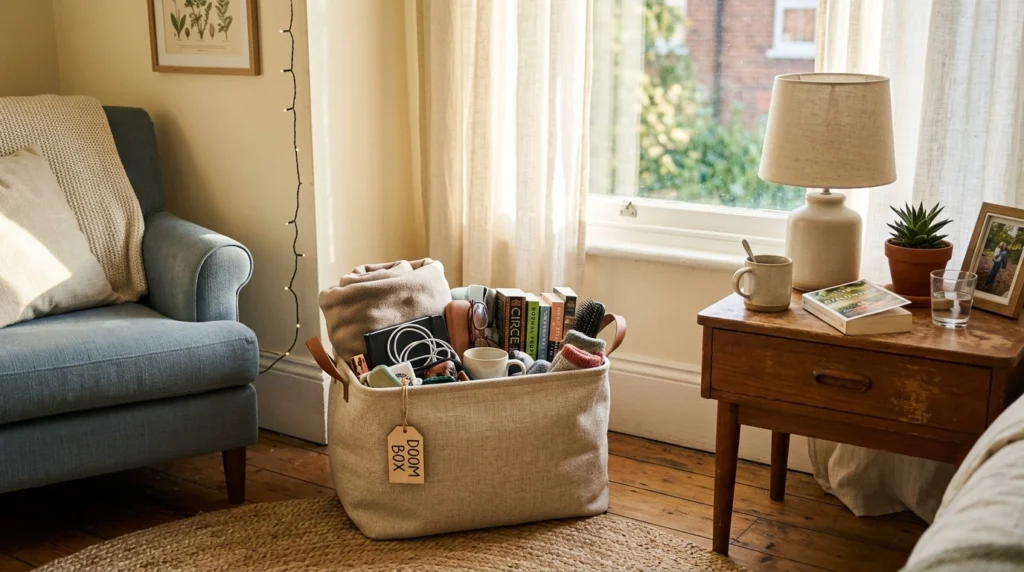
Here’s what I’ve learned from working with ADHD clients: your bedroom will accumulate things. Clothes, books, random objects from other rooms, stuff you meant to deal with yesterday. Fighting that reality is exhausting. Instead, create a designated “doom box” or basket — a specific place where anything that doesn’t belong can live temporarily without making you feel guilty.
The doom box isn’t for hiding mess; it’s a legitimate part of your system. When you don’t have the energy to put something away properly, it goes in the doom box. No judgment. No guilt. Once a week (or whenever you feel like it), you sort through and deal with it. This prevents that overwhelming moment where your entire floor becomes a mountain of clothes and you freeze.
I recommend using a large fabric storage basket or even a clear plastic bin so you can see what’s inside. Place it in a corner of your room, somewhere visible but not in your main sightline. The key is making it easy to access — if it’s hard to reach, you’ll just leave stuff on your bed instead. Budget-wise, a decent storage basket runs $20–$40 depending on size.
Tip: Resist the urge to buy a beautiful basket that matches your décor before you’ve tried the system. Use whatever container you have first. Once you know the doom box actually works for you, then invest in something nicer.
2. Clear Drawer Dividers — See Everything, Eliminate Decision Fatigue
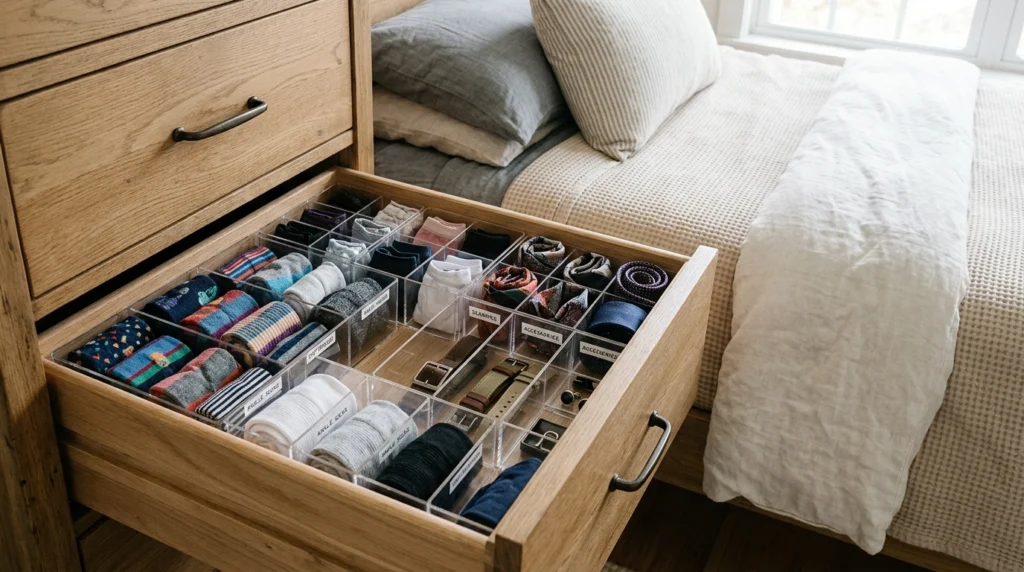
ADHD brains work better with visibility. When your socks, underwear, and accessories are hidden in a dark drawer, you forget they exist. Then you end up wearing the same three items on repeat while the rest sit unworn. Clear drawer dividers solve this because everything is visible at a glance, and you actually know what you have.
Transparent acrylic or plastic dividers let you categorize without losing visibility. Keep like items together — socks in one section, underwear in another, accessories in a third. The magic is that you don’t have to dig or search, and you’re less likely to just grab the first thing you see. When ADHD brains have visual clarity, decision fatigue drops dramatically.
You can find clear drawer dividers at Target, IKEA, or Amazon for $10–$25 depending on the set. Measure your drawers first so you know what size you need. Pro move: take a photo of your organized drawer on your phone. When the drawer inevitably gets messy, you have a visual reference for how to reset it without overthinking.
Tip: Don’t aim for perfect sorting at first. Start with one drawer and let it evolve. If your system isn’t working after a week, change it. Flexibility is more important than “correct” organization for ADHD brains.
3. The “Launch Pad” — Everything You Need Tomorrow, In One Place
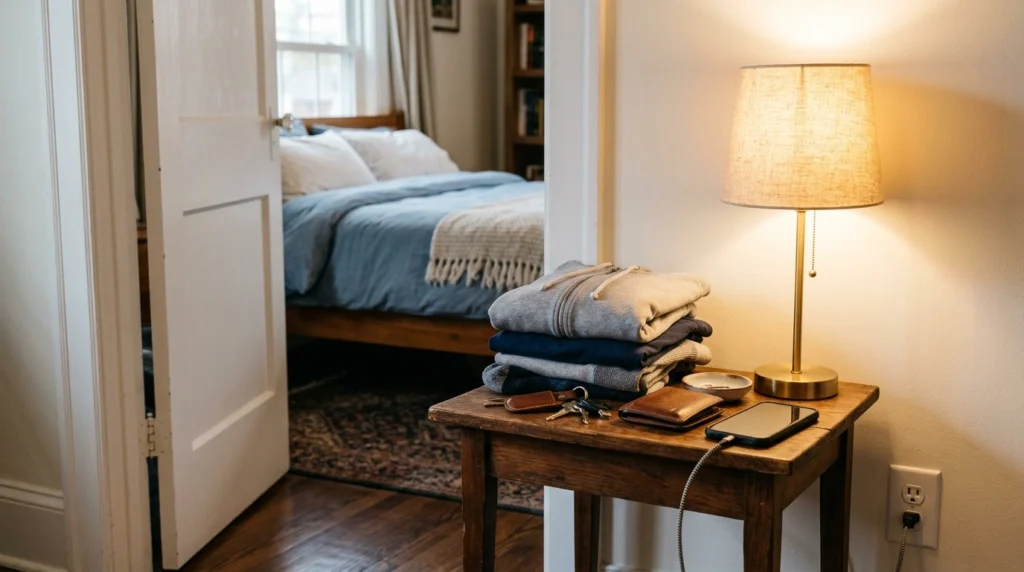
ADHD brains don’t naturally plan ahead. You don’t wake up thinking, “Let me gather everything I need for tomorrow in an organized fashion.” What actually happens is 20 minutes before you need to leave, you’re panicking because you can’t find your keys, your wallet, or the shirt you wanted to wear.
A launch pad is a small, dedicated table, shelf, or even a chair in your bedroom where you put tomorrow’s essentials the night before. Your phone charger, keys, wallet, the outfit you’re wearing, your bag. Everything in one spot. This works because it reduces morning friction and decision-making, and it keeps you from tearing apart your room looking for things.
Set up your launch pad somewhere between your bed and your bedroom door — in the path of your exit. Make it a small ritual: before bed, gather what you need tomorrow and place it there. It takes two minutes and eliminates an entire category of morning stress.
You don’t need to buy anything special. A small desk, a chair, or even a sturdy shelf will work. If you don’t have extra furniture, use a designated corner of your dresser or a small table. Cost: $0 if you use what you have; $30–$60 if you want to add a small shelf or accent table.
Tip: If you share a room, make sure your launch pad is in a spot that won’t be disturbed by your roommate. If you have a pet or a kid who might touch your stuff, place it on a higher shelf.
4. Vertical Storage — Use Your Walls, Save Your Floor

ADHD bedrooms often struggle with floor space becoming a dumping ground because there’s nowhere else to put things. Vertical storage — shelves, pegboards, wall-mounted organizers — solves this by moving items off the ground and onto walls where they’re visible and accessible.
Wall-mounted shelves work especially well because they’re visible, they don’t take up floor space, and you can arrange them however makes sense. String lights above a shelf, a few books, a plant, a framed photo — it becomes part of your room’s aesthetic while also being functional. Pegboards are fantastic for ADHD brains because you can customize them exactly how you want, and they feel more flexible than traditional furniture.
Install shelves at eye level or slightly above so you actually see what’s on them. Items at floor level get ignored and forgotten. For a basic shelf unit, expect to spend $30–$80 for installation-ready options, or $15–$40 for simple floating shelves if you do the installation yourself.
Tip: Don’t fill your shelves just because they exist. Leave breathing room. Overcrowded shelves become visual chaos, and ADHD brains are overstimulated by too much visual information.
5. Clothing Rotation — Keep Only What You Actually Wear
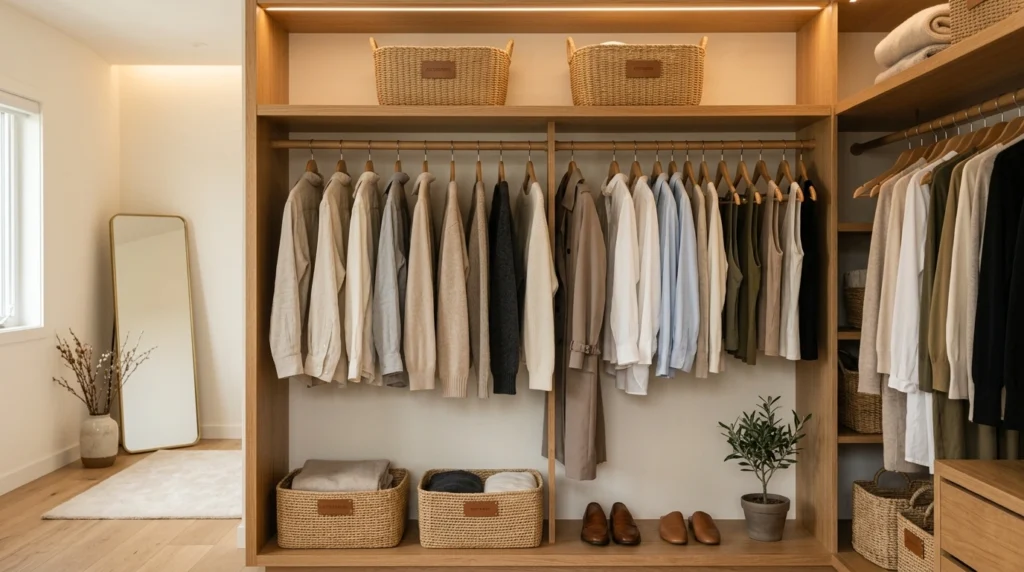
ADHD brains often hold onto clothes you don’t wear because there’s a vague guilt attached — maybe you’ll fit into it, maybe you’ll like wearing it someday, maybe you spent money on it so you “should” wear it. Meanwhile, your actual rotation of clothes you love is buried under everything else.
Here’s the reset: pull out everything you’ve worn in the past three months. Those are your clothes. Everything else can go — donate, sell, or store in a bin in a closet. This isn’t about minimalism; it’s about clarity. When you can see and access only the clothes you actually wear, getting dressed is faster and requires fewer decisions.
Keep your seasonal clothes in vacuum-sealed bins under the bed or in a closet, clearly labeled with what’s inside. When the season changes, swap them out. This reduces your active wardrobe and makes your drawers and closet less overwhelming.
The upfront work takes an afternoon. After that, maintaining is simple: when you buy new clothes, something old goes. Cost for vacuum-seal bags and bins: $20–$40.
Tip: If you have items that are special or expensive but you don’t wear them, be honest: you’re not going to wear them. Donate them to someone who will appreciate them.
6. The “Flat Folding” Method — Clothes Stay Put, You Can See Everything
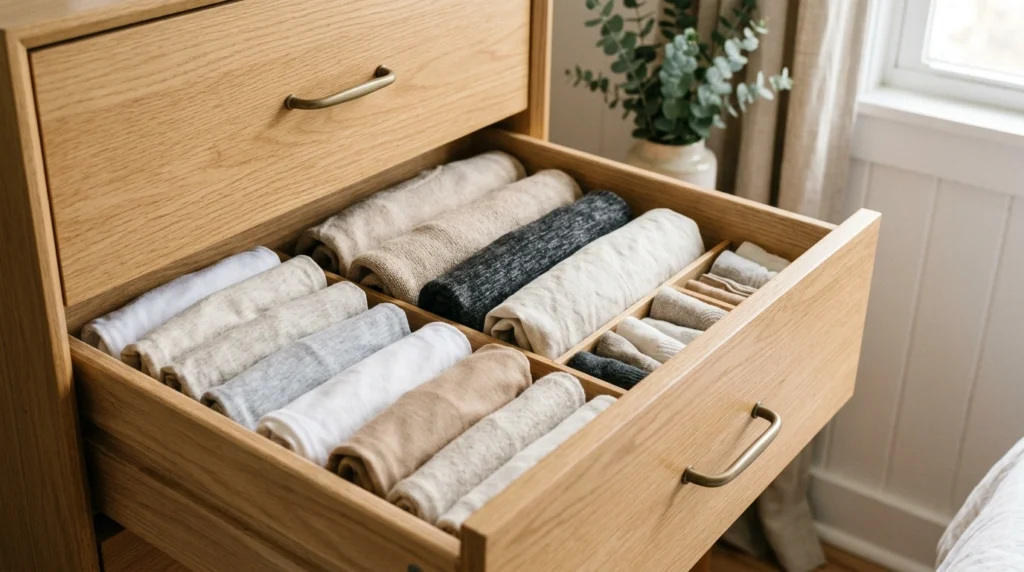
Traditional vertical folding means stacks of clothes where only the top item is visible. You reach for it, the whole stack shifts, and suddenly everything is falling apart. Flat folding (the KonMari method or similar) means folding clothes so they stand up in your drawer. You see every single item without moving anything.
This is ADHD gold because visibility + no moving = no frustration. You open a drawer and can see all your options at once. You grab what you want without disturbing everything else. It takes a bit of practice to learn the fold, but once you get it, it’s game-changing.
Spend 20 minutes watching a video on flat folding. Then fold all your clothes that way. No new products needed. The only time investment is the initial setup, and it pays for itself in mental energy saved every single morning.
Tip: You don’t have to fold everything flat. Start with pants, shirts, and sweaters. Underwear and socks can stay however works for you.
7. Cord Management — Tame the Charger Chaos
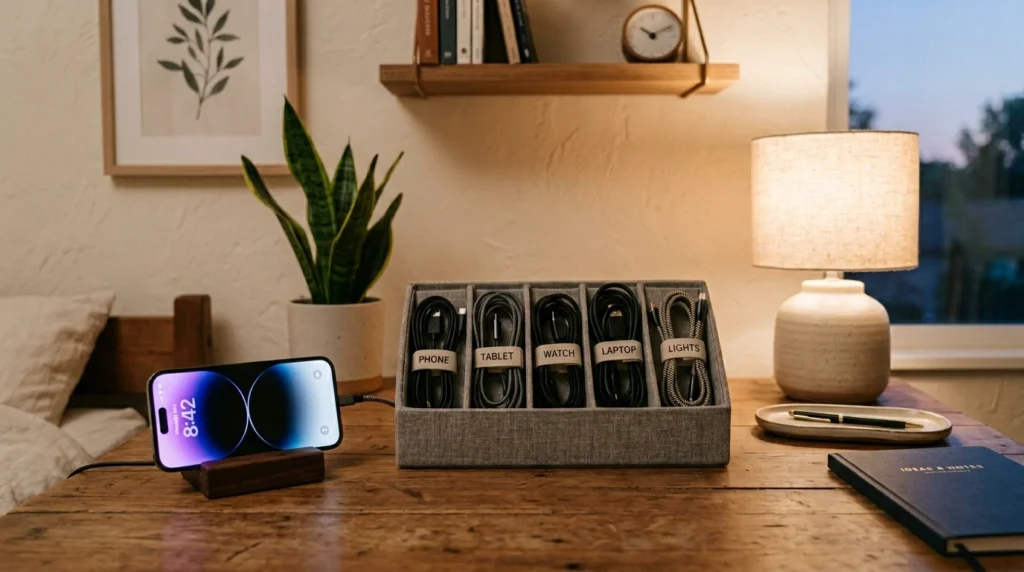
If you have ADHD, your bedroom probably has a tangle of phone chargers, laptop cables, headphone cords, and mystery wires. You can’t find the right charger when you need it, so you have multiple chargers doing the same job. Cords become fire hazards, they look messy, and they add to visual clutter.
A simple cord organizer — even a fabric pouch or a divided drawer divider — keeps cords bundled and labeled. Label one side of a velcro strap with what the charger is for (Phone, Laptop, Nintendo Switch, etc.). Bundle the cord and tie it with the labeled strap.
Alternatively, use a small fabric pouch or ziplock bags in a drawer. Put each charger in its own bag and label it. When you need a charger, you know exactly where to look.
Cost: $5–$15 for cord organizers or velcro straps. You might already have what you need.
Tip: Take a photo of your organized cord collection and add it to your phone. When you need to replace a charger, you know exactly what you’re looking for.
8. Scent as a Trigger — Create a Calm Sensory Experience
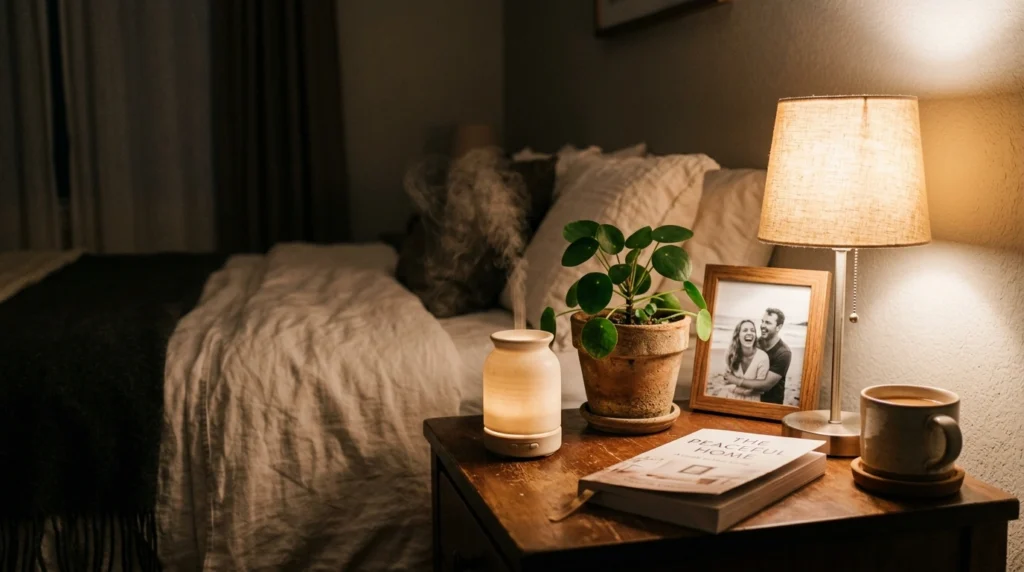
ADHD brains are sensitive to sensory input, and smell is powerful. If your bedroom smells stale or musty, it doesn’t feel like a calm retreat. A simple scent can shift your entire mood when you walk into the room.
Use a diffuser, a scent sachet, or a simple bowl of baking soda with a few drops of essential oil. Keep it minimal and choose a scent that genuinely relaxes you. Lavender works for some people, but maybe it’s eucalyptus or vanilla or something totally different. The point is creating a sensory trigger that says “this is a calm space.”
Replace or refresh your scent every month or so. A quality diffuser runs $15–$40, or you can use sachets for $5–$10. Essential oils are usually $5–$15 per bottle.
Tip: If you have sensory sensitivities, skip this entirely. Not every hack works for every brain.
9. Weighted Blanket + Comfortable Bedding — Sleep Is Organization Too
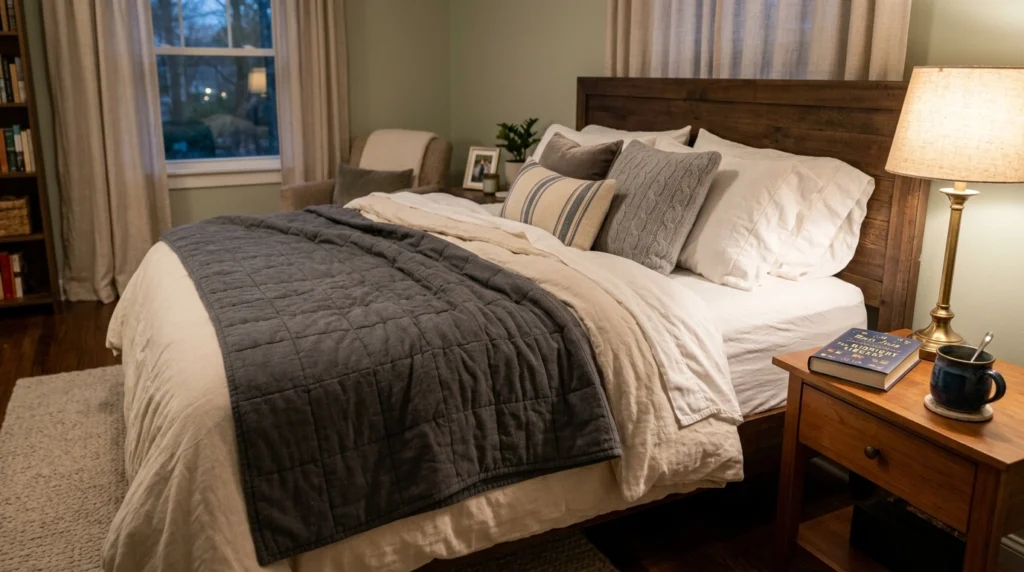
This might sound obvious, but if you’re using scratchy sheets or a blanket that doesn’t feel good, you’re not going to want to get into bed. You’ll avoid your bedroom. Then suddenly your bedroom becomes a dumping ground because you’re not actually spending restful time there.
A weighted blanket and truly comfortable bedding — sheets that feel good on your skin, a blanket you actually want to curl up in — signal to your ADHD brain that sleep is possible. It’s worth the investment.
Weighted blankets run $60–$150 depending on quality. High-quality sheets (bamboo, high-thread-count cotton, linen) are $40–$80. A good throw blanket is $20–$50. This is your bed, where you spend about 8 hours a day. It’s worth prioritizing comfort.
Tip: Test blankets and sheets before buying if you can. Different textures work for different people, and ADHD brains often have strong texture preferences.
10. Lighting Control — Bright Lights Make You Tense; Warm Lights Help You Wind Down

Harsh, bright overhead lights tell your brain to stay awake and alert. If your bedroom is lit by a single overhead fixture, you’re working against your own biology when trying to wind down.
Create layered lighting: a warm bedside lamp, a small desk lamp if you work in your room, and maybe string lights or a diffused light source. Skip the overhead light whenever possible. When you do use overhead lighting, use warm-toned bulbs (2700K color temperature).
The entire setup can be $30–$60 if you’re buying new lamps, or free if you work with what you have. Warm-toned LED bulbs are usually $5–$15 each.
Tip: Get on a lamp schedule. Same time every night, dim the lights and switch to your warm bedside lamp. This trains your brain that darkness = sleep time.
11. The “Morning Basket” — Everything You Need to Exist, In One Place

Similar to the launch pad but reversed: your morning basket contains all the small things you use first thing when you wake up. Your medications (if applicable), a water bottle, a journal or notepad, maybe a phone charger. Everything you need to function in those first 30 minutes.
Keep this basket on your nightstand or on a small table next to your bed. When you wake up, everything you need is right there. You don’t have to wander around your room looking for things. You don’t have to decide what to do first. The basket decides for you.
Use any small basket or container you have. Cost: $0–$20 depending on whether you already have something.
Tip: Keep your morning basket simple. 5-8 items max. If it becomes a catch-all for random stuff, it loses its purpose.
12. A Mirror and Laundry Basket In Your Room — No More “Clean Clothes Mountain”
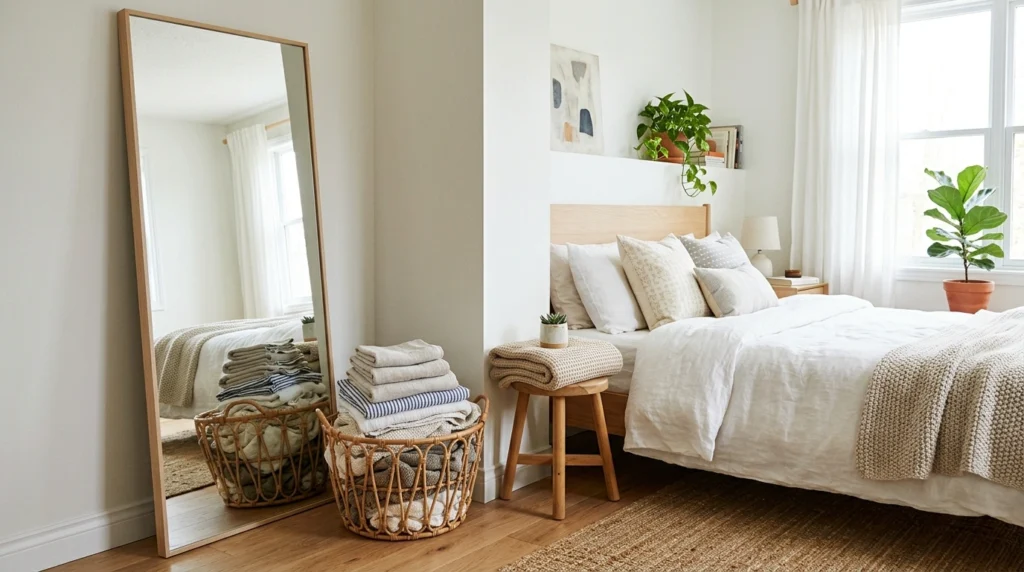
Here’s the brutal truth: if your clean laundry basket is in a different room, you won’t take clothes there to fold. It’s just too much friction. Your clean laundry ends up sitting in the basket in the laundry room, getting wrinkled, and you end up just pulling out clothes and rewashing them.
Move your clean laundry basket to your bedroom. Fold clothes while sitting on your bed, watching TV, or listening to music. It becomes a low-stress activity instead of a chore you avoid.
Keep a full-length mirror in your bedroom too. Getting dressed becomes faster because you can immediately see if something works or if you need to change. You also catch things like stains or tears before you leave the house.
Cost: A laundry basket is $15–$30. A mirror is $20–$60 depending on style. Both are worth having in your bedroom anyway.
Tip: Fold clothes immediately after washing. Don’t let them sit. The longer they sit, the more you resent the task.
Conclusion
ADHD bedroom organization isn’t about creating a magazine-worthy aesthetic. It’s about designing a space where you can function, rest, and feel calm. Every hack in this post comes from understanding how ADHD brains actually work: we need visibility, we need reduced friction, we need systems that don’t require constant willpower to maintain.
The biggest realization I had when organizing my own ADHD bedroom was this: I didn’t fail at organization because I’m lazy or messy. I failed because traditional systems didn’t account for how my brain actually works. Once I stopped fighting my brain and instead built systems around it, organization became sustainable.
Start with just one or two of these hacks. Maybe the doom box and the launch pad. Maybe the clear drawer dividers and the flat folding. Once those feel natural, add another. Don’t try to overhaul your entire bedroom in one day. That’s overwhelming, it doesn’t stick, and you’ll just quit.
Your bedroom should be a calm, clutter-free room that supports your peace of mind. You deserve to walk in and feel like your space is working for you, not against you. These ADHD bedroom organization hacks make that possible without requiring you to rewire yourself or maintain systems that don’t make sense for how your brain operates.
Which of these ideas are you trying first? Drop it in the comments — I’d love to hear what works for you.
FAQ
How do I maintain these systems if my ADHD makes motivation hard?
You maintain them by making them so easy that maintenance requires almost no willpower. A doom box that takes two seconds to use will get used. A system that requires five decisions and 10 minutes? That one won’t. Start with the simplest hacks and skip anything that feels complicated. A system you actually use is infinitely better than a perfect system you abandon.
What if I share a bedroom with someone else?
Shared spaces require compromise. Use your half of the room strategically. Keep your doom box, launch pad, and morning basket in your specific area. Use vertical storage to keep things in your zone. Clear drawer dividers still work even if your roommate doesn’t use them. Focus on what you can control without requiring your roommate to change their habits.
Can I use bins and closed storage instead of visible storage?
You can, but visibility is the secret weapon for ADHD brains. When things are hidden, we forget they exist and don’t use them. If you have sensory preferences for fewer visible items, use clear bins so you can still see what’s inside. Or start with visible storage and switch to closed storage if it feels overwhelming after a week.
How do I stop my organized system from getting messy again?
It will get messy again. That’s normal, not a failure. ADHD brains don’t maintain systems perfectly. Instead of aiming for perfection, aim for a “reset routine” — maybe 15 minutes on Sunday evening to put things back where they belong. You’re not maintaining perfect organization; you’re doing a weekly reset. That’s sustainable.
What if I try a system and it doesn’t work?
Change it immediately. Organization advice isn’t one-size-fits-all, especially for ADHD. If a hack doesn’t click, it’s not a personal failure — it just means that particular system doesn’t match how your brain works. Try something different. Flexibility is your friend.